
Dog life guide
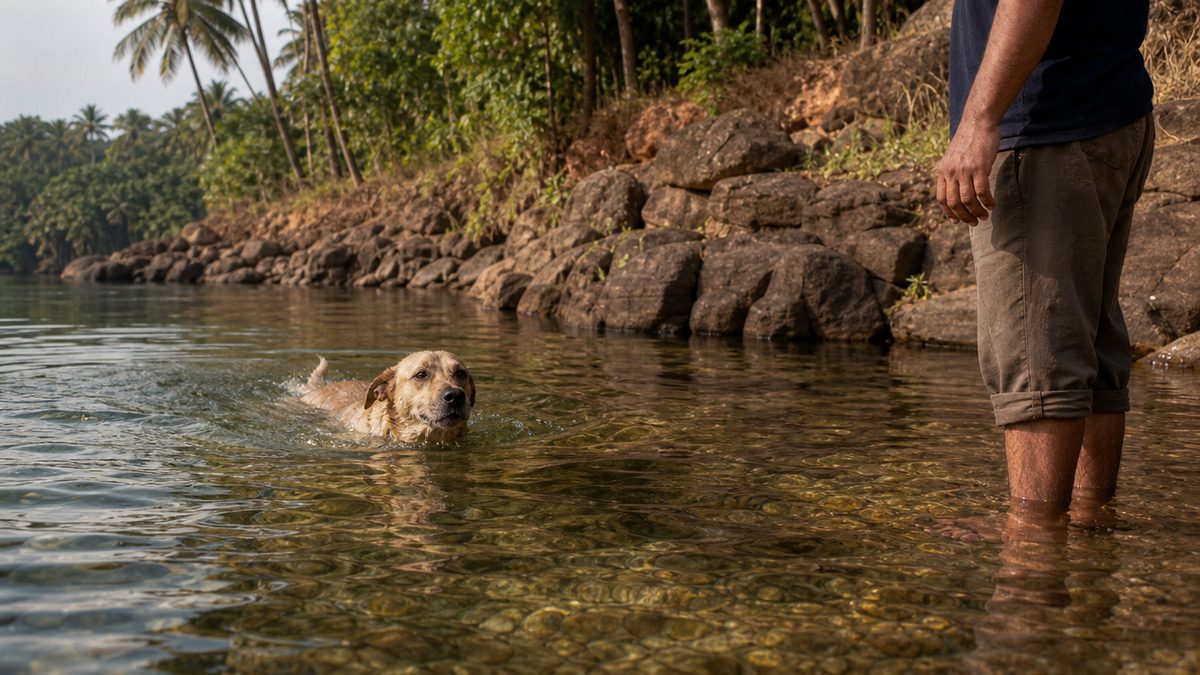
Swimming with dogs India: which dogs can swim, which water is fit, and what the water does to them
India publishes a bathing-water standard and measures rivers against it. In 2022 and 2023, 804 of 2,116 river monitoring locations failed it. That is the number the swimming advice is missing.
Quick answer
Swimming with dogs India-wide turns on two questions: can this dog swim, and is this water fit to swim in. Not every dog floats. CPCB measures Indian rivers against a bathing standard of BOD under 3 mg/L, and 804 of 2,116 river locations failed it across 2022 and 2023. Check the water first, fit a life jacket on a deep-chested or flat-faced dog, teach the pool exit before the first swim, and dry the ears afterwards.
This guide is general information for Indian pet owners and is not a diagnosis. Always consult a registered veterinarian near you before acting on anything you read here, and treat any sudden change in your pet's condition as urgent.
Can all dogs swim? No, and that belief is the most dangerous idea in this subject
No, not all dogs can swim, and a veterinary hospital that treats near-drownings says so in those words. The Animal Medical Center published its advice after its intensive care unit treated a dog that nearly drowned in its family's swimming pool, and called the idea that every dog swims a common misconception.
The belief matters because of what owners do with it. A person who assumes the dog will paddle puts it in water without a test, without a plan for getting it out, and often without watching. The hospital's review of submersion incidents in pets found that falling into a swimming pool was the most common body of water dogs fell into, and that most dog drownings happen in the summer months.
Three things about a dog's build decide whether it floats, and none of them is breed reputation.
- Weight distribution. A dog carrying a heavy chest and head on short limbs sits nose-down in the water. It can paddle and still be unable to keep its muzzle clear, which is the difference between swimming and tiring while drowning slowly.
- Airway. A flat-faced dog works harder for every breath on dry land. Asked to breathe through a short, obstructed airway at water level, in a sprint-paced activity, it has no reserve. The AVMA states plainly that overweight pets and short-nosed dog breeds have higher risk of problems with warm-weather exercise, and swimming in an Indian April is warm-weather exercise.
- Coat and condition. A heavy double coat waterlogs. An unfit, elderly or arthritic dog fatigues in minutes rather than in the half hour its owner has planned for.
Read those against your own dog rather than against a list. A brachycephalic dog, meaning one bred for a shortened muzzle, is the clearest case, and our page on BOAS in dogs covers what that airway is actually doing. A deep-chested dog is the second. Neither is a ban on water. Both are a reason to fit a life jacket before the first swim rather than after the first fright.
What we could not find, and are not going to invent
There is no published study counting which breeds sink. Every page asserting that bulldogs cannot swim, including several that rank for the question in India, traces back to other pages asserting the same thing. We looked for a denominator and there is not one. What is published is the airway physiology, the warm-weather exercise risk, and a veterinary hospital's clinical observation that pools are where dogs drown. That is enough to act on and it is less than the confident lists claim to know.
So test, do not assume. Get into the shallow end with the dog, with a second person present, and watch the waterline at its nose. A dog that swims with its muzzle low, that thrashes with its forelegs clear of the surface, or that tires inside two minutes has told you its answer.
PDSA's instruction is one line and has no exceptions: never leave your dog unsupervised when in water. A dog that can swim can still cramp, panic, be caught by a current, or fail to find the way out. Supervise every swim, including the short ones, including in a shallow tank.
How do I know if a lake is safe for my dog? India publishes a standard and measures against it
To know whether a lake is safe for your dog, compare it against India's own bathing-water standard, which exists, is public, and is the same test the government applies to rivers. The Central Pollution Control Board sets Class B water, designated for organised outdoor bathing, at total coliforms of 500 MPN per 100 ml or less, pH between 6.5 and 8.5, dissolved oxygen of 5 mg/l or more, and biochemical oxygen demand over five days at 20C of 3 mg/l or less.
That last figure is the one that does the work. CPCB identifies a polluted river location as a monitoring point that is non-compliant with the BOD limit in the Primary Water Quality Criteria for Bathing Water, meaning BOD above 3.0 mg/L. So India already answers, for hundreds of specific places, the question every swimming page asks you to answer by looking at the water and guessing.
The answer is not comforting and it is not uniformly bad. Reviewing data from 2,116 river locations monitored during 2022 and 2023, CPCB found 1,312 of them, 62 percent, complying with the BOD criterion of less than 3.0 mg/L. The other 804 locations exceeded it. Roughly two in five monitored river points in India fail the standard set for people to bathe in.
The national monitoring network is larger than rivers alone. It runs to 4,736 locations across 28 states and 7 union territories, of which 2,155 are on rivers, 909 on stagnant water bodies including lakes, ponds and tanks, 227 on creeks, marine and coastal water, 1,233 on wells and 212 on drains, canals and treatment plants. The 909 stagnant-water locations matter here, because a tank or a lake is where most Indian dogs actually get wet.
| Priority class | Maximum BOD observed | Against the bathing standard of 3.0 mg/L |
|---|---|---|
| Class I | above 30.1 mg/L | More than ten times over |
| Class II | 20.1 to 30.0 mg/L | Seven to ten times over |
| Class III | 10.1 to 20.0 mg/L | Three to seven times over |
| Class IV | 6.1 to 10.0 mg/L | Two to three times over |
| Class V | 3.1 to 6.0 mg/L | Just over, the largest group |
Where you live changes the odds a great deal. The 2025 assessment identified 296 polluted river stretches on 271 rivers across 32 states and union territories, and the distribution is lopsided. Maharashtra carries 54, the most of any state, followed by Kerala with 32, Madhya Pradesh and Manipur with 18 each, Karnataka with 14 and Bihar with 12. Delhi has one, and it sits in Priority Class I.
Named stretches are more useful than state totals when you are deciding about a particular afternoon, and CPCB publishes those too, with a BOD figure attached to each monitoring point. Under the heading for stretches above 30 mg/l, the Mithi river through Mumbai is recorded at 50 mg/l, and the Musi downstream of Hyderabad at 34 mg/l at Nagole in Rangareddy and 23 mg/l at the Hyderabad downstream point. In the 10 to 20 mg/l band, the Khari at Lali village near Ahmedabad is recorded at 19 mg/l against municipal and industrial waste from the city, and the Godavari at the Nashik downstream point at 18 mg/l.
Hold the Mithi's 50 mg/l against the bathing standard of 3 mg/l and the ratio is close to seventeen to one. That is the gap between what a city river carries and what the country's own rules say water should carry before a person, or a dog, gets into it. If your weekend water is downstream of a city, assume it is carrying that city's sewage until the monitoring data says otherwise.
Where CPCB's own 2025 report disagrees with itself
The October 2025 report prints two different totals for the same thing, and we are publishing both rather than picking one. Its preface states that the number of polluted river stretches has decreased from 351 in the 2018 assessment to 279 in the 2025 assessment. Its executive summary, four pages later, states that the total number of polluted river stretches has decreased from 351 in 2018 to 296 in 2025, and Chapter 2 and Table 1 both use 296.
The 296 figure is the one the rest of the document is built on, and the 279 appears to be a number borrowed from the previous round: the same report records that in 2022, 311 polluted river stretches were identified on 279 rivers. So 279 is a count of rivers from an earlier assessment that has landed in the preface as a count of stretches in this one. We have not seen that noted anywhere else, and a reader quoting the preface would be quoting an error.
You are not going to run a BOD test before a swim. Use the standard as a way of asking the right question instead of the wrong one. The right question is what is upstream, not whether the water looks clean. Sewage-loaded water is often clear. Ask whether the stretch is downstream of a town, a drain outfall or an industrial estate, and treat a yes as a no.
Two field observations do real work when there is no data. Murky water you cannot see the bottom of hides both the contamination and the hazards, and India's own pool standard uses visibility as a formal test of fitness, requiring a 150 mm black disc on the pool floor to stay clearly visible from the side walks at distances up to 9 metres. Water with an obvious smell, a surface film or a drain running into it fails on sight. Neither test is sensitive. Both are better than nothing.
What is actually living in it: leptospirosis, and whether Indian water blooms
The organisms that matter in Indian recreational water are leptospires above all, with cyanobacteria a documented but mostly coastal and estuarine problem. The two need very different responses from an owner, and only one of them is well characterised here.
Leptospirosis is the reason a swim in stagnant fresh water is a medical decision rather than a recreational one. The bacteria survive in surface water, a dog is infected through contact rather than only by drinking, and the disease is one a household can catch from its own dog. We are not going to re-derive it here, because our page on leptospirosis in dogs in India carries the Indian serogroup data, the vaccine coverage question and the clinical course in full, and our monsoon care guide for dogs carries the seasonal pattern.
Two findings on that page bear directly on a decision to let a dog swim, and both come from Indian work rather than imported advice. A risk-factor study of dogs in and around Chennai found a history of contact with wet soil or stagnant water among the predictors of acute disease that survived multivariate analysis, alongside a history of rodent exposure and the north-east monsoon season, the October to December rains that soak Tamil Nadu and coastal Andhra Pradesh. The exposure is therefore not hypothetical and not seasonal in the way a reader in Mumbai or Delhi might assume, because the south-west and north-east monsoons put the risk in different months in different states.
The one line to carry into a swimming decision is that stagnant, warm, rat-frequented fresh water is the classic exposure, and that a temple tank or an urban lake in a humid Indian month supplies all three conditions at once. Talk to your own veterinary surgeon about the lepto vaccine before a season of swimming, not after a swim.
That vaccine conversation is set out on the condition page, and it is a genuine decision with a genuine caveat rather than a formality, because what the vials sold here cover is not a settled question.
Are cyanobacteria blooms documented in Indian water?
Yes, cyanobacterial blooms are documented in Indian water, though the published record is dominated by coastal and estuarine events rather than by the inland lakes most dogs swim in. A 2025 review in iScience by Nayak, Kolluru, Kumar and Bhadury, written from Florida Atlantic University, the University of Georgia, the Indian Institute of Science in Bengaluru and the Indian Institute of Science Education and Research in Kolkata, records that as of October 2022 a total of 218 harmful algal bloom events have been documented in Indian waters, and that about 65 percent of them, 141 events, were observed in a little over two decades since 2000.
Two findings in that paper matter to a dog owner specifically. A dominant portion, about 88 percent, of those blooms was caused by dinoflagellates or cyanobacterial species. And the seasonality is the opposite of what you would guess: pre-monsoon blooms are typically cyanobacteria-dominated, while post-monsoon and winter blooms are primarily dinoflagellates. Pre-monsoon is March to May, the hottest months, which is exactly when an Indian owner is most tempted to let a dog cool off in open water.
The review also records that while Indian marine cyanobacterial blooms are mostly Trichodesmium erythraeum, a few reports in estuarine environments or backwaters include Microcystis aeruginosa, a freshwater species. Microcystis is the genus behind the dog deaths reported from blue-green algae abroad. Finding it named in Indian backwaters is the closest thing to a direct warning the Indian literature currently offers.
Blue-green algae, which is cyanobacteria rather than true algae, can appear as a paint-like film, a green or blue-green scum, or a pea-soup discolouration, often banked against the downwind edge. Toxic and non-toxic blooms look identical, there is no field test, and a dog does not need to swim to be poisoned, because grooming a contaminated coat is enough. If the water has scum on it, the dog does not go in and does not drink. If a dog has already been in such water, rinse it thoroughly before it grooms itself and call a veterinary surgeon rather than waiting for signs.
Be honest about the limits of what is known here. The 218 events are an all-India count across marine, coastal and estuarine waters compiled to 2022, not a register of inland lakes, and the review's own argument is that India lacks integrated observation networks and coordinated monitoring. Nobody can tell you whether the tank near your house bloomed last April. Treat visible scum as the decision point, because it is the only one available.
Idol-immersion water, in one paragraph
Keep a dog out of a water body for a sustained period after an immersion, and treat the shoreline as part of the problem rather than the safe part.
This question belongs to another page and we are not going to restate it. What goes into immersion water, what India's own monitoring says about it, the artificial-pond alternative that has moved the problem into local parks, and what to do if your dog has already been in it are all covered on our guide to Ganesh Chaturthi and your pet, which carries the CPCB immersion guidelines and the post-immersion timing.
The swimming-specific point is narrow and worth stating once. An immersion site is a planned, dated, locally known contamination event in a water body a dog may otherwise swim in all year. That makes it the one case where you can actually schedule around the pollution instead of guessing at it. Note the dates, and keep the dog out.
Is saltwater ok for dogs to swim in? Yes to swim in, no to drink
Saltwater is fine for a dog to swim in and dangerous for a dog to drink, and the second risk has a published dose. Merck's veterinary manual records that dogs have developed hypernatraemia after swimming or playing in the ocean without having access to fresh water.
The numbers are unusually clear for this subject. The acute oral lethal dose of salt in dogs is about 4 g/kg, and clinical signs of toxicosis can appear after ingestion of 2 to 3 g/kg. Seawater averages about 35 parts per thousand salinity, which NOAA states another way as about 3.5 percent of the weight of seawater coming from dissolved salts, with chloride and sodium together making up around 85 percent of all dissolved ions.
Put those two together and you get something no swimming page gives an owner: an approximate volume.
| Dog bodyweight | Salt at the 2 g/kg signs threshold | Roughly that much seawater |
|---|---|---|
| 5 kg | 10 g | about 330 ml |
| 10 kg | 20 g | about 670 ml |
| 20 kg | 40 g | about 1.3 litres |
| 30 kg | 60 g | about 2.0 litres |
| 40 kg | 80 g | about 2.7 litres |
A third of a litre is not much for a small dog chasing a ball through surf for an hour. That is the practical finding: the risk is not one dramatic gulp, it is steady incidental ingestion by a dog that is having a wonderful time and is never offered anything else to drink.
Where two good sources do not quite agree
Merck describes the ocean as containing about 3.5 percent sodium. NOAA's 3.5 percent is the share of seawater weight made up of all dissolved salts, not of sodium alone, with sodium and chloride together about 85 percent of dissolved ions. The two figures are measuring different quantities and Merck's phrasing overstates the sodium fraction. We have used the lower, NOAA-derived sodium chloride figure in the table, which makes the volumes above more conservative rather than less, and we have flagged the discrepancy rather than averaging it away.
Prevention is simple and almost nobody does it. Carry fresh water to the beach and offer it every fifteen minutes, before the dog is thirsty. Merck's own management line for an acute ingestion in a small animal, before signs appear, is to allow the animal access to water and observe it closely for several hours. Access to fresh water is the intervention.
Excess salt intake in dogs results in vomiting within several hours after ingestion, and signs can progress to weakness, diarrhoea, muscle tremors and seizures. A dog that vomits after a long session in the sea needs a veterinary surgeon the same day, not a wait-and-see evening. Do not try to correct this at home: Merck is explicit that treatment must return the animal to normal water and electrolyte balance slowly over two to three days, because lowering serum sodium quickly drives water into the brain and increases the likelihood of severe cerebral oedema. Rapid rehydration by a well-meaning owner is itself a hazard.
The sea itself, and Goa's own rules
Currents matter more than water quality on an Indian beach, and the state with the most beach tourism publishes the framework. Goa's tourism department instructs visitors to swim only in the swim zones marked by dual red and yellow flags, not to enter water marked by red flags, and not to enter areas or water which have rip currents, warning that a rip current pulls you back into the sea and can cost you your life.
Three things follow for a dog. The flag system marks water judged safe for a supervised adult human, which is a reasonable lower bound for a dog and not a guarantee. The lifesaver on duty is watching swimmers, not your dog, so the supervision the flags imply does not extend to it. And a rip pulls a strong dog out as easily as a person, with the added problem that a dog will keep swimming directly for shore against the current until it is exhausted.
The closure hours are the detail that catches people out. Goa's instructions state that all beaches are closed from sunset to 7 am the next morning. The standard advice everywhere, including on our own heat safety guide for dogs, is to keep a dog out of the midday sun and use the cool hours. On a Goa beach those two rules collide, and the window that satisfies both is narrow: after 7 am and before the sand and sun get serious.
How long should I let my dog swim for? Short sessions with breaks, because fresh water has its own risk
Let a dog swim in short sessions with regular breaks rather than for a fixed number of minutes, because swallowing too much fresh water causes water intoxication and no one can tell you the volume that does it.
Water intoxication is the mirror image of salt toxicosis. Swallowing excess water dilutes a dog's sodium, causing hyponatraemia, and cells across the body absorb water and swell in response. The kidneys can usually sort the balance out over time, but if brain cells swell it can quickly lead to irreversible brain damage first.
It is rare, and PDSA says so rather than frightening people. What makes it worth a section is how ordinary the behaviour that causes it is. Throwing a ball or a toy into a river for a dog to retrieve, or playing with water from a garden hose, is enough to make a dog swallow too much and fall ill. The dog that is best at fetch is the dog at risk.
The signs to watch for after any session in water are listed below.
- Staggering or loss of coordination, and tiredness or weakness beyond the usual post-swim flop.
- Bloating, vomiting, or passing large amounts of clear urine.
- Dilated pupils or glazed eyes, and excessive drooling.
- In severe cases, difficulty breathing, collapse, a seizure or coma, all of which are an emergency.
One hazard has a dose and the other does not
This asymmetry is worth stating because it changes how you manage each. Salt toxicosis has published numbers: 2 to 3 g/kg for signs, about 4 g/kg as the acute lethal dose. Water intoxication has none. PDSA states directly that how much water is too much is difficult to define, as it depends on many factors, and that the dog's size and the volume swallowed determine it.
So the sea is managed by offering an alternative, and fresh water is managed by limiting time and changing the toy. PDSA's prevention list is specific about the second part: use floating toys to stop the dog diving under, and avoid tennis balls and other rounded toys in favour of flat ones, which let a dog close its mouth more tightly around the toy and swallow less. A flat frisbee-style float instead of a ball is a genuinely evidence-led swap, and it costs nothing.
One more line from the same source, because owners over-correct in the wrong direction. Your dog is unlikely to voluntarily drink enough water from its bowl to cause water intoxication, so do not restrict its water. The risk is swallowing while swimming and retrieving, not normal drinking, and a dog coming out of a hot afternoon in a humid Indian city needs its bowl.
Is it safe for a dog to swim in a chlorinated pool? Usually yes, and an Indian pool is less chlorinated than you think
A chlorinated pool is usually safe for a dog to swim in, and a pool run to the Indian standard carries markedly less chlorine than the figures in foreign advice. IS 3328, the Bureau of Indian Standards specification for swimming pool water, caps total residual chlorine at 0.5 mg/l at the inlet with a minimum of 0.2 mg/l at the outlet.
Set that against the international figure. WHO's guidelines for safe recreational water recommend that acceptable free chlorine levels be set locally, but that in public and semi-public pools these should not exceed 3 mg/l. The two are not the same measurement, because total residual chlorine includes both free and combined chlorine while WHO's ceiling is on free chlorine alone. That comparison still runs one way: since total residual chlorine is never less than free chlorine, a pool complying with IS 3328 cannot be carrying free chlorine above 0.5 mg/l, which is a sixth of WHO's ceiling for a public pool.
The practical reading is that most of the chlorine anxiety imported from American pet blogs does not transfer to an Indian pool run to its own national standard. The caveat is the same one that applies to every standard in this guide: compliance is not automatic, and nobody is publishing your society pool's test results.
What chlorine actually does to a dog's eyes, according to India's own standard
The irritation most owners blame on chlorine is usually caused by pH, and IS 3328 says so in a note attached to its own table. Too low an alkalinity and low pH are the most common causes of complaints of taste, odour and eye irritation, and at pH lower than 7.5 there is an increased tendency for formation of dichloramine and nitrogen chlorides or similar compounds which cause eye irritation. The standard sets pool pH at 7.5 to 8.5 for that reason.
So a pool that stings a dog's eyes is more likely to be badly balanced than heavily dosed, and the strong swimming-pool smell people read as too much chlorine is in fact the chloramines that form when there is not enough free chlorine for the load. A dog with red, weeping eyes after a pool session is telling you about the pool's chemistry, not about chlorine as such. Rinse the face with clean fresh water and do not use the pool again until it has been balanced.
| Requirement | The standard | Why a dog owner cares |
|---|---|---|
| Total residual chlorine | 0.5 mg/l max at inlet, 0.2 mg/l min at outlet | Far below the WHO free-chlorine ceiling for public pools, so chlorine burn is an unlikely explanation for a sore dog |
| pH | 7.5 to 8.5 | Below 7.5 the standard's own note predicts eye irritation from chloramine formation |
| Clearness | A 150 mm black disc on the floor at the deepest point must stay clearly visible from the side walks up to 9 metres | A pool you cannot see the bottom of fails its own standard, and you cannot see a dog in trouble either |
| Standard plate count | Not more than 100 per millilitre | The bacteriological bar a shared pool is supposed to meet |
| Coliform organisms | No more than 10 percent of 10 ml portions over a month may show any coliform | Faecal contamination control, which is the part a dog in the pool also affects |
| Turbidity | 10 NTU maximum | The measured version of the visibility test |
One honest limit on all of this. IS 3328 applies to swimming pools of the continuous circulation type, and the standard's foreword states that for natural swimming pools it is not possible to lay down uniform standards because of the considerable variability in the quality of such waters. India's pool standard deliberately declines to cover the lake. That gap is why the CPCB bathing criteria earlier in this guide are the right instrument for open water and this one is not.
Can my dog use the society pool at all?
Usually not, and that is a bye-law question rather than a health question. A shared pool in an Indian apartment complex is a common amenity governed by the society's own rules, and whether a dog may use it is decided by the document that governs your society rather than by any national rule about animals. The ground rules, including which document binds you, what a resident welfare association can and cannot restrict, and how a dispute actually proceeds, are set out on our guide to society rules for pets in India. Settle it with the committee before you put a dog in the water, not after a complaint.
Purpose-built dog pools are the alternative, and several Indian cities have them. Costs, booking rules and what the venues require of you are on our guide to things to do with your dog in India, which prices them from the venues' own pages. This page is about the water rather than the venue, so one thing only: the better operators ask for vaccination proof and turn away dogs with ticks, cuts or skin infection, and that screening is working in your dog's favour as much as the next dog's.
A few mouthfuls of a correctly balanced pool is not an emergency, because a pool complying with IS 3328 carries very little residual chlorine. Sustained drinking is a different matter and is worth stopping, both because of the chemistry and because a dog filling itself with any water while swimming is the water-intoxication route. Put a bowl of fresh water at the poolside and offer it on every break. A dog that drinks pool water is usually a dog with nothing better on offer.
Drowning, life jackets and getting a dog out of trouble
Prevent drowning by teaching the exit before the first real swim, because the commonest fatal scenario is a dog that can paddle and cannot find the way out.
The Animal Medical Center's instruction is specific and it is the single highest-value thing on this page. Once a dog paddles happily around the pool, teach it where the stairs are located so it can get out when it gets tired or if it falls in. Stand on the stairs and use treats to encourage it to come toward you and walk up the stairs. Do this a few times and give a refresher course every now and then.
That is the whole intervention. A dog in difficulty swims to the nearest wall, not to the exit, and keeps trying at the wall until it is exhausted. A dog that has been taught the steps turns and uses them. The training takes a few sessions and it is what separates a fright from a drowning.
Barriers do the rest of the work. Most pools are fenced, and a dog that cannot swim needs that fence to be dog-proof. In an Indian context the equivalents are a latched gate on the pool enclosure, a secured terrace tank, and a covered sump or overhead tank access, because a dog falls into a sump the same way it falls into a pool and nobody is watching.
When a life jacket is genuinely needed
A life jacket is not a default accessory and it is not a substitute for supervision. Fit one in the five situations listed below, each of which describes a dog that will tire or sink before it can be reached.
- Any brachycephalic dog, every time. The airway has no reserve and the build sits low in the water.
- Any deep-chested or heavy-boned dog on its first swims, until you have actually watched it float unaided and recover.
- Any senior, arthritic, convalescent or overweight dog, which fatigues on a timescale its owner has not planned for.
- Any dog on a boat, a backwater houseboat or open water, where entry is unplanned and the distance to shore is not a dog's distance.
- Any dog that swims where a current exists, including a river in spate and a beach with rips.
PDSA treats a flotation vest as something to train a dog to wear rather than something to strap on at the water's edge, and that is the right framing. A first-time jacket on an already anxious dog at an unfamiliar lake adds a novel restraint to a frightening situation.
A panicking dog of any size will climb a swimmer, and drowned rescuers are a well-documented pattern in human water safety. Call the dog toward the exit you taught it. Use a long lead, a pole, a branch or a float to reach it, and get it to a point it can stand. On a beach, raise the lifesaver on duty rather than entering the water yourself. A dog that has been pulled from the water and seems fine still needs a veterinary surgeon the same day, because inhaled water causes problems that develop over the hours after the event rather than at the time.
After every swim: ears, rinse, dry, and what to watch for
After every swim, rinse the coat with clean fresh water, dry the ear flap and the visible part of each canal, and dry the dog properly rather than leaving it to air-dry in humid weather.
An ear infection after swimming is the complication owners ask about most, and the detail belongs to the condition page rather than to this one. Our page on ear infections in dogs in India carries the Indian case series, the breed and ear-shape evidence, the monsoon pattern and the question of what you can and cannot do at home. The swim-specific conclusion from it is short: dry the ear flap and the visible canal after every bath, swim and wet walk, keep the canals dry and ventilated afterwards, use a drying agent only if your own veterinary surgeon has recommended one for a dog that swims often, and book an appointment on the first head shaking rather than waiting to see whether it settles.
Note the lag, which is the part that defeats people. Indian case data on the condition page puts the onset of signs well after the water, not on the evening of the swim, so a dog that is fine at bedtime tells you nothing. Write the swim date down.
Coat care and drying technique are covered on our guide to grooming a dog at home in India, including how long a double coat actually takes to dry and the humidity problem behind hot spots. The rinse itself is worth doing properly for three separate reasons.
- Salt. Dried seawater leaves salt in the coat, the dog grooms it off, and that adds to the sodium load the sea has already given it.
- Whatever was in the water. A coat that carried a contaminated lake home becomes an oral exposure the moment the dog starts licking, which is the specific mechanism behind cyanobacteria poisoning in dogs.
- Chlorine and chloramines. A rinse removes the residue that keeps working on skin and eyes after the dog is out.
- Sand and grit. Rinse between the toes and the pads, where grit stays and rubs.
Dry the dog, do not let it drip. In a humid coastal climate a thick coat left wet stays wet for hours and that is where skin trouble starts. Towel first, then let it finish somewhere ventilated rather than in a closed, air-conditioned room where it will be cold and still damp.
Watch for vomiting, diarrhoea, unusual tiredness, staggering, pale or yellow gums, reluctance to eat, or a fever, and call a veterinary surgeon if any of them appear. Tell the clinic where the dog swam, when, and whether the water was stagnant or had any surface scum. That history changes what the vet looks for and it is the single most useful thing you can bring to the appointment.
Is there anywhere you can swim with your dog? Yes, ranked by how much you can actually know about the water
Yes, there are places to swim with your dog in India, and the sensible way to rank them is by how much is knowable about the water rather than by how pleasant they look. The order below runs from best characterised to least.
A purpose-built dog pool is the only option where the water is dosed, filtered, tested against a published standard and emptied of other hazards. It is also the only one where somebody is accountable if it is wrong. For a dog that has never swum, for a flat-faced or deep-chested dog, and for a first attempt at anything, this is where to start.
A clean hill stream above a town comes next, and the qualifier is doing the work. Upstream of habitation, with moving water, a visible bottom and no drain outfall, a Western Ghats or Himalayan foothill stream on a weekend out of Pune, Bengaluru or Dehradun is about as good as open water gets here. Downstream of the same town it is a different river. CPCB's assessment found 149 stretches previously listed as polluted now complying with the BOD criterion, with Assam contributing 41 of them, Odisha 14, Madhya Pradesh 11, and Goa, Gujarat and Kerala ten, ten and nine respectively, so improvement is real and it is local.
The sea is third. Water quality is less of a worry than in a stagnant tank and the currents are more of one, so the decision is about the flags and the rips rather than about the bacteriology. Carry fresh water, keep sessions short, and rinse afterwards.
Backwaters and lagoons are fourth and they are genuinely ambiguous. The Kerala backwaters are warm, calm, shallow and inviting, and they are also the estuarine environment in which Indian reports of Microcystis aeruginosa have been recorded. Calm, warm, nutrient-rich, slow-moving water is the condition cyanobacteria like. Look hard at the surface before the dog goes in.
Urban lakes and temple tanks come last, and in most cities they are a no. They are stagnant, they are frequently receiving drains, they are rat habitat, and they are the exposure the Indian leptospirosis risk-factor work describes. The one in your neighbourhood may be fine. You have no way of knowing, and 909 of India's monitoring locations sit on stagnant water bodies precisely because they are worth monitoring.
What nobody has published about this, and what we would want
Three gaps are worth naming, because a reader deserves to know where the evidence stops. Nobody publishes an Indian count of dog drownings, so the scale of the problem here is unknown and every figure in circulation is foreign. Nobody tests Indian recreational water for cyanotoxins on a routine basis, which the iScience review identifies as a coordination failure rather than a scientific one. And no Indian state publishes a rule on whether pet dogs may enter the sea at a public beach: Goa's tourism department sets out the flag system, the rip-current warning and the sunset-to-7-am closure for its beaches and says nothing at all about dogs.
That silence is not permission and it is not a prohibition. It means the decision is yours, made on the water in front of you, with the standards in this guide as the nearest thing to a yardstick India currently offers.
What Google India asks about swimming with dogs
What breeds of dogs can't swim?
No breed list is reliable, because build decides this rather than breed name. Flat-faced dogs struggle most, since a shortened airway leaves no breathing reserve during hard exercise, and the AVMA records higher warm-weather exercise risk for short-nosed breeds. Deep-chested, heavy-boned and heavily coated dogs sit low or waterlog. Test your own dog in a shallow end with help present rather than trusting a list, and fit a life jacket if it swims nose-low or tires inside two minutes.
How do I know if a lake is safe for my dog?
To know whether a lake is safe, ask what is upstream rather than whether the water looks clean, because sewage-loaded water is often clear. India's bathing-water standard is total coliforms of 500 MPN per 100 ml or less and BOD of 3 mg/l or less, and CPCB found 804 of 2,116 monitored river locations exceeding the BOD criterion across 2022 and 2023. Treat water downstream of a town, a drain or an industrial estate as unfit, and never enter water with surface scum.
Is saltwater ok for dogs to swim in?
Saltwater is fine to swim in and not fine to drink. Dogs have developed hypernatraemia after swimming or playing in the ocean without access to fresh water. Signs of salt toxicosis can appear after ingesting 2 to 3 g/kg of salt, which for a 10 kg dog is roughly 670 ml of seawater. Carry fresh water to the beach and offer it every fifteen minutes. A dog that vomits after a long session in the sea needs a veterinary surgeon the same day.
What if my dog drinks pool water?
A few mouthfuls of a correctly balanced pool is not an emergency, because the Indian standard caps total residual chlorine at 0.5 mg/l at the inlet, well below the WHO ceiling for public pools. Sustained drinking is worth stopping, both for the chemistry and because a dog filling itself with any water while swimming risks water intoxication. Keep a bowl of fresh water at the poolside and offer it on every break, since a dog drinking pool water usually has nothing else available.
Is it safe for a dog to swim in a chlorinated pool?
A chlorinated pool is usually safe, and an Indian pool run to its own standard carries less chlorine than foreign advice assumes. IS 3328 caps total residual chlorine at 0.5 mg/l at the inlet against a WHO free-chlorine ceiling of 3 mg/l for public pools. Eye irritation is more often a pH problem than a chlorine one: the Indian standard's own note attributes it to low pH and chloramine formation below pH 7.5. Rinse the dog afterwards and dry the ears.
How long should I let my dog swim for?
Swim in short sessions with regular breaks rather than for a set number of minutes, because no published volume defines how much swallowed water is too much. PDSA states that the amount depends on the dog's size and many other factors. Limit time in the water, rest between sessions so the body can rebalance fluid, and use flat floating toys instead of tennis balls, which let a dog close its mouth more tightly and swallow less while retrieving.
Should I rinse my dog after swimming in the ocean?
Yes, rinse with clean fresh water after every sea swim. Dried seawater leaves salt in the coat that the dog then grooms off and swallows, adding to a sodium load the sea has already supplied. Rinse the coat, the face and between the toes and pads where grit lodges, then dry the ear flap and the visible canal. In humid coastal weather, towel the dog and let it finish drying somewhere ventilated rather than leaving a thick coat wet for hours.
Is there anywhere you can swim with your dog?
Yes, ranked by how much you can know about the water. A purpose-built dog pool is dosed, filtered and tested against a published standard. A hill stream upstream of any town is next. The sea is third, where currents matter more than bacteria. Backwaters are ambiguous, being the estuarine setting where Indian reports of Microcystis have been recorded. Urban lakes and temple tanks come last, because they are stagnant, drain-fed and rat habitat.