
Dog care guide
Grooming a dog at home in India: bathing frequency, brushing by coat, nails, ears and the monsoon
One fixed order, brush to teeth, with the bath interval for each coat, the nail schedule, the ear rule for the rains, the evidence on shaving a double coat, and a four-item kit priced from an Indian seller.
Quick answer
Dog grooming at home in India runs in one fixed order: tick check, brush to the skin, warm-water bath with a dog shampoo, rinse, dry with the ears first, nails, eyes and ears, teeth. Bathe a smooth coat when dirty, a non-shedding coat every six to eight weeks, a double coat at its two annual sheds; brush long, curly and silky coats daily. Trim nails every three to four weeks. In the monsoon, dry ears and paws after every walk: 48 of 81 otitis cases in a Palampur series fell in the rains. A four-item kit costs Rs 1,385. Your nearby vet decides for your dog.
This guide is general information for Indian pet owners and is not a diagnosis. Always consult a registered veterinarian near you before acting on anything you read here, and treat any sudden change in your pet's condition as urgent.
What you can do at home, and the order to do it in
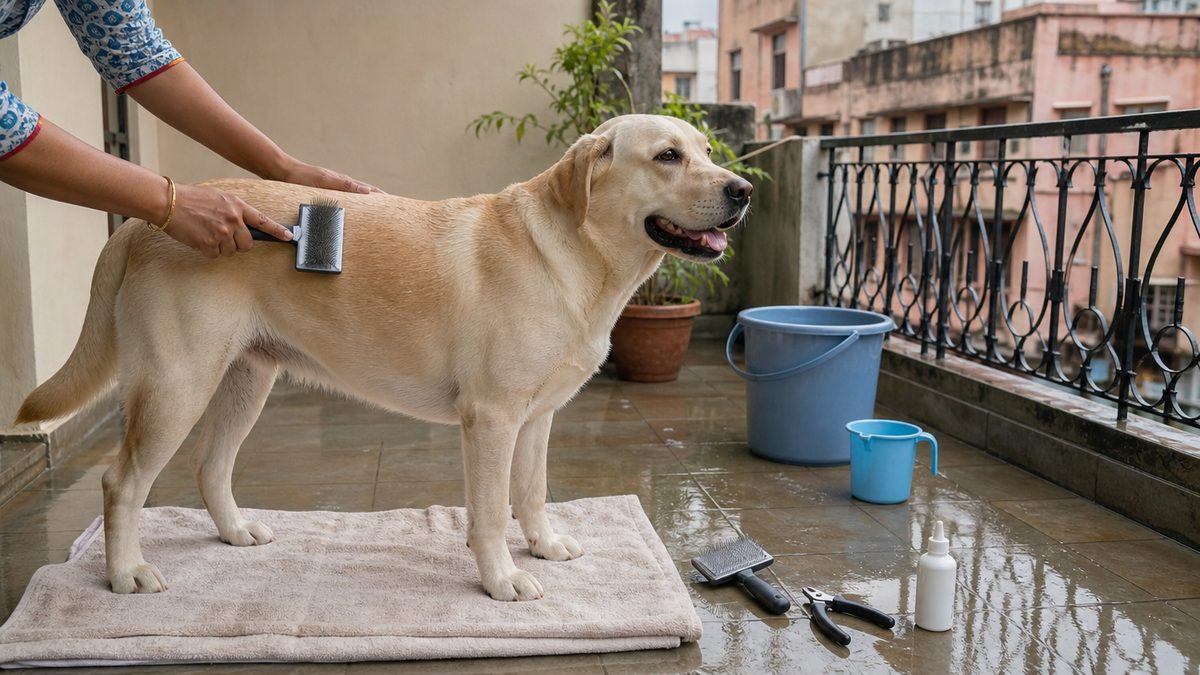
You can groom your dog yourself at home for everything except a breed haircut, a hand-strip, a medical clip and anal-gland expression, and the order matters: brush before water, dry before nails, teeth last.
Dog grooming at home is a sequence because each step protects the next: tangles that go into water come out as mats that only clippers remove, so brush them out before the bath, and a wet ear is an ear at risk, so ears are dried after the bath and cleaned only when they need it. The eight steps are this page's own order; no veterinary body publishes one.
- Check the whole dog by hand. Ears, armpits, groin, around the eyes and between the toes are the brown dog tick's attachment sites, so the tick check opens every session.
- Brush to the skin, clearing every tangle before the dog sees water.
- Bathe in warm water with a dog shampoo, lathering three to five minutes if the shampoo is medicated, never leaving the dog standing in lather.
- Rinse until the water runs clear, then condition a long or thick coat and rinse again.
- Dry to the skin, patting rather than rubbing, ears first.
- Trim the nails, the tip that turns down only, every three to four weeks.
- Wipe the eyes and check the ears, cleaning an ear only when you see wax, debris or smell.
- Brush the teeth, at least three times a week, with a dog toothpaste.
Four jobs stay with a professional groomer or vet. Hand-stripping a wire coat is a premium service that an untrained hand makes painful; most pet dogs get a 'pet strip', a clipper trim with the dead undercoat carded out. A severely matted coat is clipped by a groomer or vet, sometimes under sedation, with clippers and never scissors. Anal sacs are expressed to treat a problem, not as routine care. A breed haircut on a Poodle or Shih Tzu is professional work; the brushing between haircuts is yours.
Start the handling early. The 2019 AAHA life-stage guidelines have vets address desensitisation and grooming needs in puppyhood, and the cost of skipping that is measured: in a 2026 survey of 242 veterinary team members, dogs showed fear, anxiety or stress at nail clipping in 72.4 percent of responses (165 of 228). Handle a puppy's paws, ears and mouth daily from the week it arrives; the first-year calendar puts that beside the vaccine dates.
Bathing: how often by coat type, water temperature and the shampoo question
Bathe a non-shedding coat every six to eight weeks with its haircut, a double coat at its two seasonal sheds and when dirty, and a smooth coat when it is dirty or smells, in warm water with a dog shampoo, rinsed until the water runs clear.
How often to bathe a dog depends on the coat, and the published intervals disagree by a factor of three: VCA's four-vet page says every six to eight weeks for non-shedding breeds and 'on an occasional basis' for most dogs, Humane World says monthly for short coats, Merck Animal Health says at least once every three months, and the only source saying three times a week is the Merck Veterinary Manual describing a vet-prescribed medicated protocol. None cites a trial.
| Coat type | Breeds on this site | Interval | Who says so |
|---|---|---|---|
| Non-shedding, hair grows continuously | Shih Tzu, Lhasa Apso, Poodle, Yorkshire Terrier | Every 6 to 8 weeks, with the haircut | VCA |
| Double coat with undercoat | Golden Retriever, German Shepherd, Siberian Husky, Pomeranian | At the spring and autumn shed, otherwise when dirty | VCA |
| Short, smooth | Labrador Retriever, Pug, Beagle, Indian Pariah Dog | When dirty or smelly; 'monthly' (Humane World) | VCA, Humane World |
| Any coat, healthy skin | All | At least once every three months | Merck Animal Health |
| Any coat, under a medicated protocol | As prescribed | Three times a week, three to five minutes' contact | Merck Veterinary Manual |
Water temperature is the one point every source agrees on: VCA says warm, because shampoo cleans better warm and cold hose water is why many dogs hate baths, Merck Animal Health says lukewarm, and Vetic's Delhi clinics use only warm water. Mix the shampoo with water for this wash if the coat is thick, which is VCA's own suggestion, and throw what is left away rather than keeping a diluted bottle. The distinction is the one thing on this subject anyone has measured. In 117 bottles of non-medicated dog grooming product sampled in Israel, 97 in use in grooming salons and 20 in homes, Pseudomonas aeruginosa was isolated from 14, and dilution was the only recorded risk factor that reached significance: 7 of 18 diluted bottles were contaminated against 7 of 99 undiluted, an odds ratio of 15.5 with a 95 percent confidence interval of 2.05 to 117.23, P below 0.01. Every diluted bottle in that study had been diluted with tap water to the manufacturer's own instruction, so this is not a finding about over-thinning, and the authors name the tap water itself as a possible source. P. aeruginosa is the bacterium most commonly isolated from the lesions of dogs with post-grooming furunculosis, and our guide to dog grooming cost in India turns this into a question to ask a salon. A medicated product needs three to five minutes of contact, and the dog is never left standing in lather, shivering.
Shampoo and skin pH, with the measurements
Use a dog shampoo, and know why. VCA's reason is that dog skin 'has a different thickness and pH (acidity) than human skin' and that human shampoo is too harsh. The measurements are messier: in 77 client-owned dogs, intact skin pH ran from 4.40 to 8.18 in dogs over 12 weeks and 3.97 to 5.70 in younger puppies, and in 149 healthy dogs the median was 6.58 at one to six years, varied by breed, and was described as more alkaline than human skin. So no single 'dog pH' exists for a bottle to match, and the Merck Veterinary Manual's dermatology chapter, reviewed May 2025, lists 'many mild human products' among cleansing shampoos, a direct disagreement with VCA. Our reading: an unperfumed dog shampoo is the right buy, and the documented harm is over-bathing and lather left on, not one emergency wash with a mild human product.
Drying is part of the bath: squeeze, then pat, because rubbing knots a long or curly coat, and dry the ears, because trapped moisture contributes to ear problems. Vetic says professional blow-drying separates a dense undercoat; a hair dryer on cool at arm's length does the same at home.
Brushing by coat type: smooth, double, wire, curly and long
Brush a long, silky or curly coat daily, a double coat two or three times a week with an undercoat rake added during the shed, and a smooth coat once or twice a week with a rubber glove, and inspect every coat daily behind the ears, in the armpits and in the groin, where matting starts.
The brush is chosen by the coat, not the breed. VCA pairs them: slicker brushes for curly, non-shedding coats; combs or stiff bristle brushes for medium-length shedding coats such as retrievers; rubber grooming gloves for smooth coats; long-toothed combs with offset tines for long coats and for clearing loose undercoat in the shed. Humane World adds an undercoat rake once a week on a double coat. Daily brushing keeps a long, silky or curly coat from tangling behind the ears, in the armpits and down the backs of the legs; comb the feathering behind the ears first, because a comb finds the tangle a brush glides over.
| Coat | Breeds on this site | Tool | How often | Source |
|---|---|---|---|---|
| Smooth | Labrador Retriever, Pug, Indian Pariah Dog, Beagle | Rubber grooming glove or short-bristle brush | Once or twice a week; sheds at a low level all year | VCA |
| Double | Golden Retriever, German Shepherd, Siberian Husky, Pomeranian, Indian Spitz | Comb or stiff bristle brush; undercoat rake weekly during the two heavy sheds | Two or three times a week; daily during the shed | VCA, Humane World |
| Wire | Wire Fox Terrier, Miniature Schnauzer, Airedale Terrier | Slicker and comb; hand-strip or 'pet strip' by a groomer | Two or three times a week; strip or clip as the groomer advises | AKC |
| Curly | Poodle, Bichon Frise | Slicker brush | Daily; haircut every 6 to 8 weeks | VCA |
| Long or silky | Shih Tzu, Lhasa Apso, Maltese, Yorkshire Terrier | Long-toothed comb, then slicker | Daily, ears, armpits and backs of legs first | VCA |
A wiry coat is the one case where the cheap option damages the coat. Clipping softens a wire coat over time, changes its colour and texture and, by the AKC's account, affects temperature regulation and skin health; hand-stripping pulls the dead outer hairs in the direction of growth so a new harsh coat grows in. Ask which of the two the groomer sells before the Wire Fox Terrier goes on the table.
A double-coated dog sheds its undercoat in two heavy cycles a year, late spring and late autumn; Vetic calls this 'blowing the coat' and notes that the Indian Spitz carries a thick double coat that sheds heavily in the warm months. The rake and comb do in ten minutes what a shave does badly. Whatever the coat, a mat comes out with clippers, never scissors, and an extensive or skin-irritating mat goes to a groomer or the vet.
Nails: the quick, clipper against grinder, and how often
Trim the nails every three to four weeks, taking only the tip that curves down, and stop at the chalky white ring with a darker centre that appears on the cut face just before the quick.
The quick is the living core of the nail, with its blood vessels and nerves; cutting it hurts and bleeds, and it shows pink on a pale nail and not at all on a dark one. Nails need trimming when they click on the floor or touch the ground as the dog stands Merck Animal Health USA. Vetic's veterinary page sets every three to four weeks, every two to three for low-activity or senior dogs, and notes that consistent trimming keeps the quick shorter over time, so overgrown nails are a spiral: the longer the nail, the longer the quick, the less you can take. The dewclaws touch no pavement, so check them every time.
Clipper or grinder
Two clipper styles exist, scissor-type and guillotine, and both work; Vetic suggests scissor-style for thick nails and guillotine for small dogs Merck Animal Health USA. A grinder files the nail gradually, gives more control on dark nails and suits a nervous dog; a clipper listed at Rs 527 and a grinder at Rs 2,150 on one Indian seller's pages on 18 September 2026 Supertails, Wahl Nail Clipper for Dogs… Supertails, Trixie Nail Grinder for Dogs…. Cutting the quick is managed, not feared: press styptic powder or plain cornflour onto the nail, hold steady pressure for 30 to 60 seconds, and stop for the day.
The technique is the same on every veterinary page: hold the paw firmly but gently, cut top to bottom at a slight angle, take small slices, look at the cut face after each Merck Animal Health USA. What decides between a two-minute job and a wrestling match is the weeks before the first cut: touch the feet daily, squeeze the closed clipper beside a nail without cutting, treat, and trim one nail a day if that is all the dog allows; in the 2026 survey, gentle handling and counter-conditioning reduced the dog's fear. A dog that panics at the clipper goes to the vet or groomer for its nails, and nobody has failed.
One claim that travels with this advice does not survive testing. In the only controlled test, seven clinically healthy dogs with long claws were measured on a pressure-sensing instrumented treadmill over 137 locomotion trials, 68 before a trim and 69 after, at speeds of 2.9 to 10.1 km/h, and stride duration, stance duration, swing duration, stride length, peak vertical force, paw contact area, paw width and centre-of-pressure path length were all unchanged, as were vertical impulse in fore and hind limbs and fore-hind weight distribution. The authors conclude that in clinically sound dogs longer claws do not impair overall locomotor function, and go further, suggesting claw length might be a consequence rather than a cause of altered locomotion patterns. Two small things did change, a forepaw about 2.2 mm longer before trimming and a slightly shorter medio-lateral centre-of-pressure excursion, and neither is an orthopaedic finding. Seven dogs is a small sample, every one of them was sound, and the authors record that claw length was never objectively quantified, so this is not a licence to leave a nail growing into a pad; our guide to dog paw care in India carries the full measurement.
Ears: how to clean, when not to, and the monsoon otitis problem
Clean an ear only when you see wax, debris or smell, with a dog ear cleaner and cotton, never a cotton bud, and call the vet instead when an ear is red, painful or smelly, the commonest thing an Indian grooming session finds in the rains.
Not every dog needs its ears cleaned; over-cleaning irritates the canal and can itself lead to infection, some healthy ears never need it, and the VetCompass otitis paper warns against 'overzealous ear-cleaning';. When an ear does need it, the method is VCA's, and a 100 ml chlorhexidine ear cleanser from an Indian veterinary maker listed at Rs 226 on 18 September 2026.
- Pull the ear flap straight up to straighten the canal.
- Fill the canal with cleaner without touching the bottle tip to the ear; peroxide and alcohol cleaners sting an inflamed canal.
- Massage the base of the ear for about 30 seconds until it squelches.
- Let the dog shake, then wipe the flap and the opening with cotton or gauze.
- Go no deeper than a finger reaches, and never with a cotton bud, which can rupture the eardrum or push debris in.
- Stop and call the vet if the dog shows pain at any step.
A red, swollen, painful or foul-smelling ear, or a dog shaking its head and scratching at one side, is not a cleaning job: cleaning can push debris deeper and, if the eardrum has ruptured, put cleaner into the middle ear. Those were the presenting signs in the Palampur series. Your nearby vet looks in that ear first; this page cannot.
The monsoon, with denominators
Otitis externa is common in any climate and more common in a wet one. In a random sample of 22,333 UK dogs in 2016, 7.30 percent were diagnosed with it in one year; pendulous ears carried 1.76 times the odds of erect ears, the Basset Hound 5.87 times a crossbred, the Golden Retriever 2.23 and the Labrador Retriever 1.64, with moisture, swimming, humidity and frequent bathing named as predisposing factors. The oldest weather study, 8,975 dogs at 15 North American teaching hospitals, found that monthly temperature, rainfall and humidity explained much of the monthly variation in cases. Three Indian series carry season data, and they disagree, so all three are in the table.
| Series | Dogs screened | Otitis cases | Season finding |
|---|---|---|---|
| Palampur, Himachal Pradesh, June 2022 to July 2023 (Nainika and Sharma 2025) | 2,476 | 81 (3.27 percent); Labradors 23.45 percent of cases | 59.25 percent of cases (48 of 81) in the rainy season |
| Veterinary College, Hebbal, Bengaluru (Chaudhary and Mirakhur 2023) | Not stated in the abstract | 1.33 percent of all dogs presented; non-descript dogs and Labradors most affected | Rainy season highest, then winter, then summer; drop ears more affected than prick ears |
| Durg, Chhattisgarh (Roy et al. 2018) | 281 | 51 (18.14 percent); German Shepherds 31.37 percent of cases | Summer (March to June) 21 cases, 41.18 percent; rains (July to October) 17, 33.33 percent; winter 13, 25.49 percent |
| UK primary care, 2016 (O'Neill et al. 2021, VetCompass) | 22,333 sampled of 905,554 | 7.30 percent in one year | No season analysis; pendulous ears 1.76 times the odds of erect |
Two of the three Indian series put the peak in the rains and one in the summer; the honest reading is that heat and moisture both raise the count and none of the three is 'the Indian figure', and all three are hospital or clinic prevalence, not population rates Chaudhary M, Mirakhur KK. Non-descript… Roy M, Kashyap R. The full Indian literature belongs on the otitis externa page; for a grooming session the rule is simpler. In the monsoon, wipe the flap and opening dry after every wet walk and every bath, look and smell once a day, and treat a drop-eared dog, a Cocker Spaniel, Labrador, Golden, Basset or Beagle, as a dog whose ears are checked before its coat.
Eyes, teeth and anal glands: the short version
Wipe the corners of the eyes with a damp cloth, brush the teeth at least three times a week with a dog toothpaste, and leave the anal glands alone unless the vet has shown you why and how.
Eye care at home is a wipe, not a wash: a soft cloth dampened with warm water clears the corners of the eyes, never rubbed across the eye, with only dog products. Persistent discharge, redness or squinting is a vet visit.
Dental care is the grooming job with the biggest documented pay-off. VCA's dental page, written with two board-certified veterinary dentists, estimates that over 80 percent of dogs over three have periodontal disease, notes that plaque hardens into tartar within a day, and sets twice-daily brushing as the target and three times a week as the minimum, about 30 seconds a side on the outer faces of the cheek teeth and canines. Human toothpaste is out: it is not made to be swallowed and some brands contain xylitol, toxic to dogs. AAHA has vets start home oral hygiene once the permanent teeth are in and check 'daily dental hygiene' at every adult visit; the breed pages carry the breed-level periodontal figures, and the Shih Tzu page is one to read before you skip a week.
Anal glands: when not to
Anal sacs sit beside the anus and, in a healthy dog, empty by themselves with each bowel movement; expressing them is a treatment for impaction or infection, done by a vet, the signs are scooting, licking at the tail base or a swelling beside the anus, and recurring cases are emptied 'on a routine basis by veterinary professionals';. The AKC says not to attempt it unless a vet has trained you, and Humane World answers 'should I expel my dog's anal glands?' with 'No';. That sits awkwardly against Indian packages: Patmypets' Bengaluru page lists 'cleaning of the pet gland' as a standard step in its at-home groom. A dog with no anal-sac history does not need that step, and you can ask the groomer to skip it.
Should you shave a double coat for the Indian heat? What the evidence says
Do not shave a double-coated dog to the skin for the heat: the veterinary advice is to leave at least 2.5 cm of coat, post-clipping alopecia is a documented risk in plush-coated breeds, and the heat-illness data show that a thick coat raises risk without any trial showing that shaving lowers it.
The veterinary advice is consistent. VCA allows a long coat to be cut short for summer but leaves at least one inch, 2.5 cm, against sunburn, reserves a full shave-down for dogs that will not tolerate brushing, done at the vet and typically under sedation, and warns that post-clipping alopecia, delayed regrowth for up to two years, occurs 'especially in plush-coated breeds like huskies and pomeranians';. Vetic's Indian page says most double-coated dogs do not need shaving 'even in hot climates', that shaving is for medical reasons such as tight mats, and that undercoat removal is what helps. The is it ok to shave your dog page will collect these sources.
What the heat-illness data say about the coat
The largest study of heat-related illness in dogs, 905,543 UK dogs in 2016 with 395 confirmed events, gives each breed's odds against the Labrador Retriever in its Table 2, and the coat is the authors' own explanation for two results: the Golden Retriever 'does, however, have a thicker coat' than the Labrador, and the Chow Chow, 'another breed with a very thick coat', had the highest odds of any breed. The Siberian Husky row is the one every Indian Husky owner should read: its odds did not differ significantly from the Labrador's, and the authors say other double-coated breeds may carry extra risk but the study was under-powered to show it.
| Breed | Odds ratio (95 percent CI) | Coat | Reading |
|---|---|---|---|
| Chow Chow | 16.61 (6.21 to 44.44) | Very thick double coat | Highest in the study; wide interval, small sample |
| Pug | 3.24 (1.67 to 6.29) | Smooth | Brachycephalic skull, not coat |
| Golden Retriever | 2.65 (1.40 to 5.01) | Thick double coat | The authors' coat comparison with the Labrador |
| Pomeranian | 2.12 (0.48 to 9.30) | Plush double coat | Not significant, p 0.319 |
| Siberian Husky | 1.18 (0.28 to 5.06) | Dense double coat | Not significant, p 0.822; too few in the sample |
| Shih Tzu | 0.47 (0.18 to 1.24) | Long single coat | Not significant; lowest odds despite the flat face |
| Lhasa Apso | 0.24 (0.03 to 1.76) | Long single coat | Not significant |
Three cautions sit next to that table. Coat type could not be retrieved for individual dogs because clinics do not record it, so the coat is inferred from breed, not measured. The paper disagrees with itself: the discussion prints the Golden Retriever at 2.67 and the Chow Chow at 16.17 while Table 2, the model output, prints 2.65 and 16.61, and the table governs. And a PubMed search on 18 September 2026 for clipping or shaving, coat, dog and heat or thermoregulation returned three records, none measuring body temperature in clipped dogs, against a control query returning 47. 'Shaving keeps a dog cooler' is untested, so is its opposite, and the documented costs, sunburn and post-clipping alopecia, tip the decision.
Rake the dead undercoat out weekly through the shed, keep any trim at 2.5 cm or longer, dry a wet double coat to the skin, and manage the heat with the walk window rather than the clippers: 40 percent of the UK events, 158 of 395, fell in a single heatwave month, and the heat-safety guide gives the pre-dawn hour for nine Indian cities Hall EJ, Carter AJ.
Monsoon grooming: humidity, wet coats, hot spots, yeast and paws
In the monsoon, dry the dog to the skin after every wet walk, ears and paws first, because heat and humidity are the two conditions a veterinary dermatologist names for Malassezia yeast overgrowth, and a damp, matted coat is where a hot spot starts.
The yeast is already on the dog. Malassezia pachydermatis is the normal commensal of canine skin, and it overgrows into dermatitis when 'favorable environmental conditions (heat, humidity)' or a change in the host tip the balance; it lives on the lips, interdigital skin, perianal skin and ear canals, and the breeds at raised risk include the Shih Tzu, Basset Hound, Cocker Spaniel and Poodle, plus any dog with skin folds. The signs are face rubbing, paw licking, a greasy coat, paw staining and a rancid smell; the diagnosis is a slide under the vet's microscope, because bacteria and allergies produce the same signs, and the treatment with the strongest evidence, a 2 percent miconazole and 2 percent chlorhexidine shampoo twice a week, is a medicated protocol the vet prescribes and times.
A hot spot, pyotraumatic dermatitis, is the wet, raw patch that spreads in a day. In a prospective series of 44 cases, lesions sat on the cheek, neck and thigh, males and dogs under four were over-represented, Rottweilers, German Shepherds and Golden Retrievers were the commonest breeds, and 25 of 27 cultures grew Staphylococcus intermedius; that series found no seasonal pattern, and no Indian hot-spot series was found for this page, so the monsoon link rests on the mechanism, moisture held against skin under a dense or matted coat, not on a count. The ear data are the count: two of three Indian otitis series peak in the rains Hayes HM, Pickle LW. A Mumbai, Kolkata or Chennai monsoon is humid, and a coat stays damp for hours, which is the whole problem.
- Towel and dry after every wet walk, to the skin on a double coat, with a hair dryer on cool at arm's length.
- Wipe the ear flap and opening dry and smell each ear once a day.
- Wash and dry between the toes, because interdigital skin is a Malassezia site and a tick site, and trim the hair between the pads so it dries Humane World for Animals.
- Brush a long or double coat daily through the rains, so no mat holds water against the skin.
- Bathe less, not more, and never leave a coat half-dry; a monsoon bath is finished by the dryer or not started.
- Take a spreading wet patch, a rancid smell or a scratching, head-shaking dog to the vet the same day, because a hot spot grows by the hour and a yeast diagnosis needs a slide.
Paws take the worst of a wet Indian street: between the toes is where Malassezia pododermatitis shows as licking, staining and hair loss, and where a tick attaches unseen TroCCAP, Guidelines for the control…. Rinse the feet after a waterlogged walk, dry between every toe, and check the pads for cuts; the summer problem, hot pavement, is covered by the heat-safety guide.
The tick check that belongs in every grooming session
Run your fingers over the ears, armpits, groin, around the eyes and between the toes at the start of every session, because those are the brown dog tick's attachment sites and, by the tropical guideline's own words, the grooming visit is itself an exposure.
The tick on an Indian dog is almost always Rhipicephalus sanguineus, the brown dog tick, the most common tick on dogs in the tropics by the TroCCAP guidelines, which put diagnosis at 'visual inspection of preferred attachment sites (e.g. ears, armpits, inguinal region, periocular, and interdigital areas)' and prompt removal with tweezers or a tick tool. That is a two-minute hand check against the lie of the coat, done first so a tick is off before the brush drags across it.
The guideline's prevention paragraph carries the sentence no grooming page quotes: even dogs living mostly indoors 'may be frequently exposed to ticks, for instance, when visiting parks or pet stores for grooming, bathing, hair cutting or nail trimming', and dogs with outdoor access are protected 'throughout the year' with products on their label schedule. A professional groom is therefore a reason to check the dog when it comes home. The Bengaluru services sell an 'Anti-Tick Bath' at Rs 1,200 and a 'Tick and Flea treatment' add-on at Rs 499 PawSpace, Pet Grooming at Home…; the Merck dermatology chapter's verdict on flea and tick shampoos is that their insecticide 'is not adequate to kill all fleas in a severe infestation' and that they are 'excellent routine cleansing products';. A bath washes; a licensed acaricide on its label interval protects, and the tick prevention guide covers the product classes and the removal technique.
Tools and costs: a priced Indian starter kit and what a professional groom costs
A four-item starter kit, a slicker brush, a nail clipper, an ear cleaner and a dog shampoo, cost Rs 1,385 on one Indian seller's pages on 18 September 2026, against Rs 934 to Rs 1,999 for one professional bath or full groom in Delhi and Bengaluru.
The kit is priced from the seller's own product pages, each opened on 18 September 2026, and every figure passed the exchange-rate test this site runs on Indian prices (Rs 339 is USD 4.02 at 84.38 and 4.58 at 74, and the other three divide as untidily), so none is a converted dollar list Supertails, Intas Ambiflush Ear Cleanser… Supertails, Virbac Episoothe Oatmeal…. Prices move; the printed MRP moves less.
| Item | Product on the page | Selling price | MRP | Used for |
|---|---|---|---|---|
| Slicker brush | Wahl Slicker Brush, 15 cm | Rs 339 | Rs 399 | Curly, long and double coats; the one brush every kit needs |
| Nail clipper | Wahl Nail Clipper, 8 cm | Rs 527 | Rs 599 | Every three to four weeks |
| Ear cleaner | Intas Ambiflush Ear Cleanser, 100 ml | Rs 226 | Rs 230 | Only when wax, debris or smell is present |
| Dog shampoo | Virbac Episoothe Oatmeal Shampoo, 200 ml | Rs 293 | Rs 298 | Unperfumed oatmeal shampoo, the type VCA recommends for routine baths |
| Total | Rs 1,385 | Rs 1,526 | Roughly one professional bath and a half | |
| Optional: nail grinder | Trixie Nail Grinder | Rs 2,150 | Rs 2,150 | Dark nails and nervous dogs |
| Optional: undercoat rake | Andis Flexible Rake, 18 cm | Rs 1,148 | Rs 1,350 | Double coats during the shed |
The grinder and rake are listed separately because only some coats need them Supertails, Andis Flexible Rake for Dogs; a rubber glove, a long-toothed comb, cornflour for a cut quick and a towel complete the list, and cotton buds do not belong in an ear.
What a professional groom costs, from the services' own pages
Dog grooming at home in Bengaluru has a going rate the home-service operators publish themselves, reported here as their own claims. Sploot prices a Regular Bath at Rs 999, an Anti-Tick Bath at Rs 1,200, a Full Body Trim at Rs 1,200 and a Complete Grooming Package at Rs 1,999. PawSpace starts at Rs 999, prices a full body haircut with ear cleaning and nail clipping at Rs 1,599 including GST, and adds Rs 499 above 45 kg. Patmypets states Rs 950 to Rs 1,850, and publishes separate pages for Pune, Hyderabad and Delhi. In Delhi, Vetic's clinic page starts Pet Bathing at Rs 934, a Haircut at Rs 1,359 and Complete Bath and Hair Styling at Rs 1,869. Every figure fails the 84.38 and 74 divisions (Rs 999 is USD 11.84 and 13.50), so these are rupee-native prices.
The kit costs less than two professional baths, and a dog bathed every six weeks at Rs 999 spends about Rs 8,700 a year on baths alone. What the kit does not buy is a breed haircut, a hand-strip, a medical clip or the groomer's eye for a lump you have not noticed, so the sensible pattern for a Poodle or Shih Tzu in an Indian city is a professional cut every six to eight weeks and everything else at home.
Common questions
How can I groom my dog at home?
Groom in a fixed order: hand-check for ticks at the ears, armpits, groin and toes, brush every tangle out, bathe in warm water with a dog shampoo, rinse until clear, dry to the skin with the ears first, trim the nail tips, wipe the eyes, clean an ear only if it needs it, and brush the teeth. Brushing before water is the step that prevents mats.
Can you groom your dog yourself at home?
Yes, for brushing, bathing, drying, nails, eyes, ears and teeth. Four jobs stay with a professional: a breed haircut, hand-stripping a wire coat, clipping a severely matted coat (sometimes under sedation), and expressing anal sacs, which is a treatment for a dog with a problem rather than routine care. A dog that panics at clippers goes to the vet for its nails.
What are the 7 steps of grooming a dog?
No veterinary body defines seven steps; the seven-step lists that rank are individual salons' own, and they differ. An Indiana salon lists de-matting, pre-bath trim, brushing, bath, drying, eyes and ears, nails; an Abu Dhabi salon lists brushing, trimming, nails, skin check, making it enjoyable, ears, and bathing only when needed. This page's order runs brush, tick check, bath, rinse, dry, nails, eyes and ears, teeth.
What is the best way to groom your dog at home?
Brush first, because tangles set into mats once wet; bathe in warm, never cold, water, mixing the shampoo with water for this wash if the coat is thick rather than keeping a diluted bottle; rinse fully; pat dry rather than rub; then do nails, eyes, ears and teeth on a calm dog. Cut mats out only with clippers, never scissors, and take a large mat to a groomer or vet. Start handling the paws and ears in puppyhood.
Why do groomers spray dogs with vinegar?
As an acidifying rinse, on the belief that a lower skin pH discourages yeast and bacteria. The measured effect is small: a single application of vinegar held canine skin pH below 6 for a mean of 12 hours, against 50 to 65 hours for commercial acidifying sprays, and acetic acid and boric acid wipes showed no laboratory activity against the common skin staphylococci or E. coli, with only a small zone against Malassezia where chlorhexidine cleared one four times as wide. It is not a treatment for an infected ear or skin.
How much does it cost to groom a dog in Bangalore?
On the home-grooming services' own Bengaluru pages, read on 18 September 2026, Sploot lists a Regular Bath at Rs 999, an Anti-Tick Bath at Rs 1,200 and a Complete Grooming Package at Rs 1,999; PawSpace starts at Rs 999, with a full body haircut, ear cleaning and nail clipping at Rs 1,599 including GST and Rs 499 extra above 45 kg. Those are the operators' claims, not a ranking.
Is it necessary to cut your dog's nails?
Yes, when they click on the floor or touch the ground as the dog stands, on comfort and injury grounds: a nail left long enough grows into the pad, and the quick grows out with the nail, so a neglected nail becomes harder to shorten later. The gait claim that usually accompanies that advice has one controlled test behind it and failed it. Seven clinically healthy dogs, each with at least one long claw touching the ground when standing, were measured on a pressure-sensing instrumented treadmill over 137 trials immediately before and after a trim, and stride duration, stance duration, swing duration, stride length, peak vertical force, paw contact area, paw width and centre-of-pressure path length were all unchanged; the authors suggest claw length might be a consequence rather than a cause of altered locomotion patterns. Most dogs need a trim every three to four weeks, depending on activity and the surfaces they walk on; the dewclaws touch no surface, so they need checking every time.
What not to do when giving a dog a bath?
Do not bathe a coat with tangles in it, use cold garden-hose water, leave the dog standing in lather, skip the rinse, put a cotton bud into the ear, or rub a long coat dry in circles. Do not bathe more than the coat needs; healthy dogs are bathed occasionally, and three-times-a-week bathing is a vet-prescribed medicated protocol, not grooming.
Can we cut dog hair?
Yes, with round-tipped scissors or clippers with guide combs for hair over the eyes, around the genitals and between the paw pads, and with clippers only, never scissors, for a mat. Keep any summer trim at 2.5 cm or longer to prevent sunburn, do not shave a double-coated dog to the skin, and leave wire coats to a groomer who strips or cards them.