
Cat health guide
Why does my cat bite me? Six reasons, the warning signs, and what to do
Almost half of cats bite a person at some point, and most of those bites happen during petting or play. The bite is a sentence, not a betrayal. Learn to read which of six things it means and you can usually stop it.
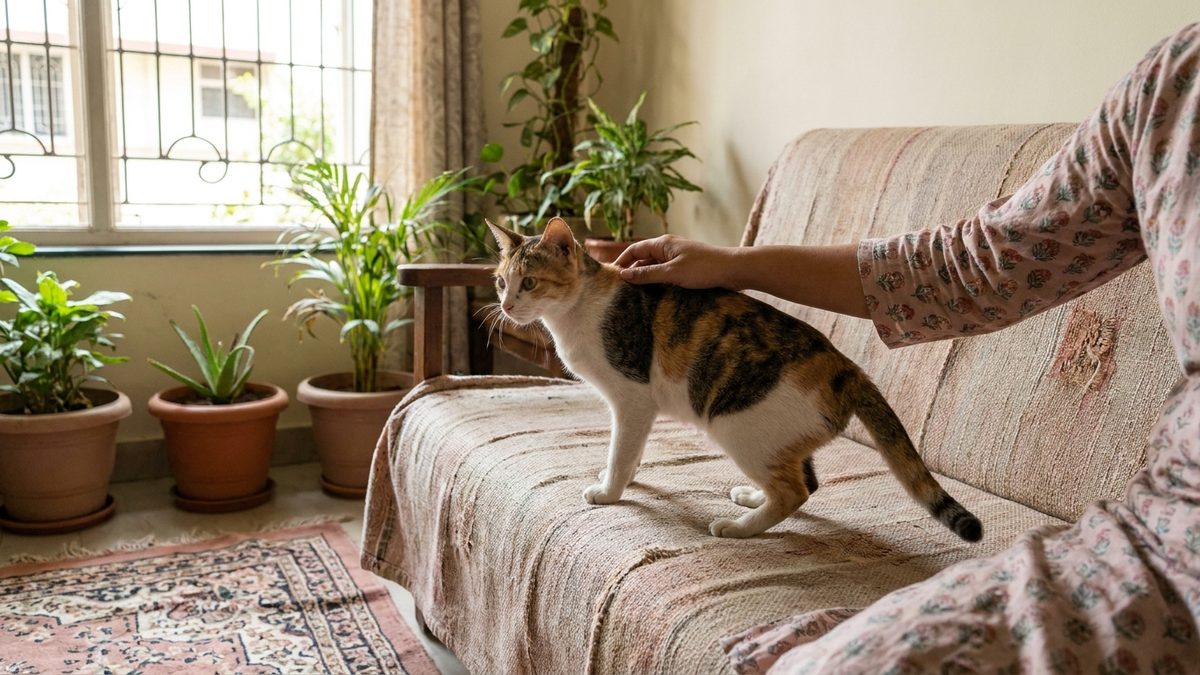
Quick answer
Why does my cat bite me usually has six answers, from overstimulation while being petted to play and predatory biting, redirected aggression after your cat spots a street cat, pain, fear, or a gentle love bite that means enough. Learn your cat's warning signs, stop stroking at the first tail flick, redirect play onto a toy, never punish the bite, and see a vet when the biting is sudden or new.
This guide is general information for Indian pet owners and is not a diagnosis. Always consult a registered veterinarian near you before acting on anything you read here, and treat any sudden change in your pet's condition as urgent.
Why does my cat bite me? Start with the six reasons
Why your cat bites you is almost always one of six things: overstimulation while being petted, play and predatory biting, redirected aggression, pain, fear, or a gentle love bite that asks you to stop. The bite is communication, not spite, and each of the six has its own trigger, its own warning signs and its own fix.
Biting is common, and the research says so with numbers. In a survey of 107 cat owners in Sao Paulo run by the University of Sao Paulo and published in the Journal of Feline Medicine and Surgery, human-directed aggression occurred in 49.5 percent of cats, and it was most commonly linked to petting and play. The ASPCA ranks aggression as the second most common feline behaviour problem its behaviourists see, and names play aggression as the most common type that cats direct at their owners. A cat that bites you is behaving like roughly half of all cats, not like a broken one.
The stakes are real enough that biting costs cats their homes. Cornell Feline Health Center reports that in one study, 27 percent of cats surrendered to shelters for behavioural reasons were given up for aggression. Working out which of the six kinds of bite you are dealing with is the whole game, because the response that fixes one makes another worse.
The six reasons at a glance
Read the table before the detail. Each row gives the trigger, the warning sign that comes just before the teeth, and the one thing to do, and every row is expanded in its own section below.
| Reason | What sets it off | The warning sign | What to do |
|---|---|---|---|
| Overstimulation (petting-induced aggression) | Too much stroking, or stroking the wrong place | Tail flick, skin ripple, ears rotate back, head turns to your hand | Stop stroking at the first sign and keep sessions short |
| Play and predatory biting | A moving hand, foot or ankle reads as prey | Crouch, wiggle, stare, pinned ears, then a pounce | Redirect to a toy, never let hands be the toy |
| Redirected aggression | A trigger it cannot reach, often a street cat at the window | Sudden arousal, a tense odd state, a lashing tail | Leave the cat alone for hours and remove the trigger |
| Pain-induced aggression | Being touched where it hurts, usually a new behaviour | A cat that never bit now bites when handled | See a vet before a behaviourist |
| Fear or defensive aggression | A threat it cannot escape: a stranger, a noise, a corner | Crouch, flattened ears, dilated pupils, a hiss | Give space, do not corner or console |
| Love bite | Contentment, grooming, or a quiet request to stop | A soft nibble during calm petting or after a lick | Read the rest of the body and redirect if it stings |
Overstimulation: why your cat bites you while you pet it
A cat bites you while you are petting it because the stroking has crossed from pleasant to too much, a pattern vets call petting-induced aggression or overstimulation. The cat enjoyed the first few strokes, reached its limit, and used its teeth, or a swat of the paw, to end the session.
This is the commonest everyday version of the problem, and it has a measured basis. In the Sao Paulo survey, sensitivity to being stroked was one of the two most pervasive risk factors for a cat that bites people, alongside the general level of background stress in the home. A 2019 review in the Journal of Feline Medicine and Surgery from the Autonomous University of Barcelona put petting-related aggression at up to 40 percent of the owner-directed aggression cases seen by referral behaviour services. The ASPCA notes it is more common in male cats than female ones.
Why a nice thing turns sharp is not fully understood. The Barcelona review offers two candidates: a motivational conflict in the cat, or simply a very low tolerance threshold for contact. The ASPCA's version is physical, that repeated stroking over one spot can tip from pleasant into irritating, the way a back rub fixed in one place would for you. Either way, an overstimulated cat is not turning on you; it has reached a limit you did not see.
The warning signs owners miss
The bite is described as sudden, but the body almost always announces it first. Watch for these warning signs, which the ASPCA and the Barcelona review both list.
- The tail starts to flick, twitch or lash at the tip Amat M, Manteca X.
- The ears rotate, flatten or flick back and forth.
- A ripple or twitch runs along the skin of the back.
- The pupils dilate and the cat goes still or tense.
- The head turns sharply towards your hand.
The fix is to stop before the limit, not at it. When your cat signals that it has had enough, the ASPCA's advice is the whole of it, which is simply to stop. The Barcelona review goes further for a cat that bites often, and its method is worth copying. Wait until the cat asks for attention rather than reaching for it, give a single stroke, avoid the belly and the legs, and build the duration up slowly, and pairing the stroking with a piece of food the cat loves helps turn contact back into a good thing. Keep the sessions short and end them while the cat is still enjoying them.
A cat that bites at stroke twenty is telling you its limit is around fifteen. Pet to well inside that, stop, and let the cat come back for more. You lose nothing by stopping early, and you teach the cat that your hand is a thing it can trust.
Play and predatory biting: when your hand became the toy
A cat bites your hands, ankles and feet in play because a moving limb triggers the same predatory sequence it would use on a mouse, which runs stalk, chase, pounce, grab and bite. Play aggression is normal feline behaviour, and the ASPCA calls it the most common kind of aggression that cats aim at their owners.
The Barcelona review files this under misdirected predatory behaviour and notes it is one of the most frequent aggression problems that affect human family members. The attack is usually silent and is set off by movement, whether a foot under a blanket, a hand trailing off the sofa or an ankle on the stairs. The cat stalks, pounces, grabs and bites, running the predatory sequence on the nearest moving thing.
Certain cats do this more. The review lists the pattern: young cats, kittens weaned or separated from littermates too early, cats that do not get enough stimulation, single indoor cats, and cats whose owners have played with them using bare hands and feet. The ASPCA adds the mechanism behind the early-weaning point, which is that kittens learn to sheathe their claws and soften their bite by playing with littermates who stop the game when a bite lands too hard, so a kitten raised alone may never have learned it. A kitten weaned too young and brought home early is covered on our bringing a kitten home page.
Redirect the hunt, and never make your hand the prey
The fix is to move the target off your body and onto a toy, not to suppress the drive. The single rule underneath it is that you never play with a cat using your bare hands or feet PetMD, Cat Love Bites. A hand that wrestles a kitten today is a hand that gets ambushed by a four-kilo adult next year.
- Give the hunting drive a daily outlet with a wand or rod toy, so the cat can stalk, chase and catch something that is not you. Our guide to things to do with your cat carries the prey sequence and the session length.
- Keep the toy on a long rod, never a short one, so your hand stays out of range of the bite Cornell Feline Health Center.
- Anticipate the ambush. Cats hunt most at dawn and dusk, so a play session in the evening drains the drive before it finds your ankles.
- Feed the mind too. Food puzzles and hidden food turn the hunt into foraging, and our guide to indoor cat boredom and enrichment owns that, because a bored indoor cat is the one most likely to hunt your feet.
- Freeze mid-ambush. If the cat has already locked on, stop moving, because it is your movement that drives the attack, and throwing a toy at that exact moment can read as you joining the game and reward it.
The most common way a play-biting habit is built is a person wrestling a cute kitten with bare fingers. The kitten learns that hands are for hunting, and it does not forget when it grows up and the bite breaks skin. Redirect to a toy every time, and tell children and visitors the same rule PetMD, Cat Love Bites.
Redirected aggression: the bite that seems to come from nowhere
A cat bites you out of nowhere, hard, when something has wound it up that it cannot reach, most often another cat seen through a window, and it turns on whoever is closest. This is redirected aggression, and the ASPCA calls it probably the most dangerous kind because the bites are uninhibited.
It is common and it is misread. The Barcelona review reports that according to some authors redirected aggression accounts for up to 50 percent of all owner-directed aggression cases seen in referral practice. Owners describe it as unprovoked or out of the blue because they never saw the first trigger, which the ASPCA says can be a cat that walked past the window half an hour earlier.
The arousal lasts, and that is the dangerous part. The review found that while some cats calm down in about 30 minutes, others stay aroused for hours and even days, and the risk of another attack stays high the whole time. One study it cites found the cats were in a defensive posture in 80 percent of redirected cases, which means fear is as much a part of it as frustration.
The common triggers are a cat or other animal seen or smelled but not reached, loud noises, and unfamiliar people. In an Indian flat the classic one is a community cat on the landing or the compound wall, in full view through a grille or a balcony mesh and completely out of reach.
What to do, and what not to do
Do not approach, console or pick up an aroused cat, because you become the target it could not otherwise reach. Give the fearful, aroused cat a dark, quiet room and leave it alone for hours until it is fully back to normal, then let it come to you. To stop it recurring, block the view by pulling a curtain, frosting the lower glass, or keeping street cats away from the window Cornell Feline Health Center. When the trigger is another cat inside your own home rather than outside it, that is a different problem, and our guide to introducing a second cat covers cat-to-cat tension and how to break up a fight without being bitten. The window-trigger layout is on our cat friendly home setup page.
Pain and the sudden change: a new biter is a vet visit first
A cat that never used to bite and suddenly does is a medical question before it is a behavioural one. Pain-induced aggression makes a cat bite or scratch to stop you touching a part that hurts, and a sudden change in temperament is one of the clearest signs that something physical is wrong.
Rule out the body first. Cornell is explicit that the first step with any aggressive cat is to make sure there is no medical reason, and it names hyperthyroidism, osteoarthritis, dental disease and central nervous system problems as conditions that can cause aggression. The ASPCA's list is longer and adds dental pain, abscesses from fighting, and sensory or cognitive decline in older cats.
The tell is the change, not the growl. A cat in pain may resent having a sore joint touched or a bad mouth handled, and may hiss, bite or scratch to avoid it. If your gentle cat has become a biter over weeks, or flinches and bites when you touch one area, that is a reason to see a vet, not a behaviour to correct. In an older cat the usual hidden cause is arthritis, which rarely shows as a limp, and our guides to senior cat care, arthritis and hyperthyroidism in cats cover what to look for.
Any clear change in how much your cat bites, especially in a cat over six or seven, is a veterinary question first. Pain, thyroid disease and dental disease all show up as a shorter temper, and no amount of behaviour training fixes a sore tooth. This page publishes under a medical disclaimer for that reason.
Love bites and gentle nibbles: affection, or a polite stop
A gentle bite that does not break the skin, often during calm petting or after a few licks, is what owners call a love bite, and it can mean affection, overstimulation or a quiet request to change what you are doing. The body language around it tells you which.
A board-certified veterinary behaviourist writing for PetMD describes love bites as a cat gently placing its mouth on a person, usually without breaking the skin, and sometimes following a lick or a bit of grooming. The honest answer to why cats do it is that there is no single answer, because it can be bonding and affection, but an overstimulated cat can equally nip from irritation, frustration, attention-seeking or play.
The useful distinction is between a love bite and a real bite. A love bite is soft and comes with relaxed body language, often purring or slow blinking. A real bite is harder and comes wrapped in the fear and warning signals, which are dilated pupils, flattened ears, a twitching tail, raised fur, hissing or growling. The clean way to read it, from the same source, is that cats bite when they want an interaction to stop because of fear, anxiety or pain. A gentle nibble in a content moment is usually a request; a hard bite with warning signs is a refusal.
If the love bites are soft and you do not mind them, you do not have to do anything. If they sting, or you would rather they stopped, treat them like overstimulation, which means you watch the body language, keep petting short, and redirect to a toy before the mouth comes out.
What to do the moment a cat bites you
The moment a cat has your hand in its teeth, freeze and let it disengage, then move away calmly, because pulling your hand back fast is the one move that turns a warning into a deep wound. How you respond to a bite decides whether it gets better or worse.
Five steps cover the moment itself, and the order matters.
- Freeze. Do not jerk your hand back, because a sudden pull can trigger the cat's hunting instinct and a deeper bite.
- Let the cat let go on its own, then move away calmly. Staying still takes the force out of a play attack, because it is your movement that drives it Amat M, Manteca X.
- Redirect, do not punish. Offer a toy or toss a treat rather than scolding the cat.
- End the attention and walk away, which teaches the cat that biting stops the fun, not that your hand is prey.
- Wash any broken skin with soap and running water and watch it, and see a doctor for a hand puncture.
Why punishment and discipline backfire
Punishing a cat for biting makes biting more likely, not less. Cornell states plainly that any type of physical punishment can increase a cat's fear or anxiety and worsen aggression. The ASPCA agrees that painful punishment is not only ineffective, it can trigger pain-induced aggression and worsen fear and territorial aggression. PetMD lists scolding, grabbing, squirting with water and hitting as the responses that make a cat escalate. So the honest answer to how to discipline a cat for biting is that you do not discipline it; you read the warning signs earlier, remove the trigger, and give the behaviour somewhere else to go.
One thing more you never do is grab or hold a biting cat by the scruff. If your cat bites specifically when you lift it, that is a handling problem with its own answer, and our how to hold a cat page owns the supported lift, the scruff question and the signs that mean stop.
Learn your own cat's warning signs and stop the interaction at the first one, every time. A cat that trusts you to stop when its tail twitches has no reason to escalate to teeth. Most bites are not a failure of discipline; they are a warning that was read too late.
The India layer: the bite, the wound and the folk-remedy trap
In India three things change the cat-bite question: many owners are first-generation and read cats like dogs, the window trigger is usually a community cat, and the wound itself runs into a folk-remedy habit a cat owner needs to know is dangerous. The behaviour is the same the world over; the aftermath is not.
First, cats are not small dogs, and most new Indian cat owners learned animal handling on dogs that tolerate being hauled about. A cat keeps a shorter ledger, which is why the overstimulation and handling rules on this page matter more, not less, in a first-cat household. Our how to hold a cat page covers the handling half of that.
Second, the wound is a medical event. Cat bites are not common beside dog bites, but they are not trivial. A WHO-sponsored national survey by the Association for Prevention and Control of Rabies in India found cats were the biting animal in 4.7 percent of animal-bite cases across 18 states. A Spanish study of 936 feline-aggression incidents found cat bites were mostly single punctures, mostly on the hands, and mostly a defensive response by the cat. A puncture on the hand is the dangerous kind, because it seals over and drives oral bacteria deep, which is why the ASPCA warns that cat bites easily become infected.
What to do with a cat bite, and what never to put on it
Wash it and get it seen. If a cat bite breaks the skin, wash the wound immediately with soap and running water and seek medical attention promptly, because the puncture carries a real infection risk. A cat bite or scratch that breaks the skin is also a rabies-exposure question in India, and the decision about vaccination is a doctor's, so our how to hold a cat page carries India's exposure categories for a cat, and rabies in dogs covers the disease itself.
What you must not do is reach for the kitchen. The folk remedies are common and they are harmful. The APCRI survey found 45.3 percent of bite victims used some indigenous treatment and 36.8 percent applied a substance directly to the wound. A 2023 survey of 928 people in Haryana and Punjab by the Lala Lajpat Rai University of Veterinary and Animal Sciences found 40.62 percent believed red chilli powder kills the rabies virus, and 63.67 percent believed no post-bite vaccination was needed. Both beliefs are wrong and both are dangerous. Red chilli, turmeric, oil, lime and salt do nothing useful to a bite wound and delay the care that works.
Do not wait to see whether a hand puncture settles. Cat-bite punctures on the hand are the ones that abscess, and the Spanish data put most cat bites exactly there. Wash with soap and water, skip the chilli and turmeric, and see a doctor the same day, and the more so for a child, who is more likely to be bitten on the face and neck.
Third, the window trigger is a feature of Indian flats. A community cat on the landing, the compound wall or the opposite balcony is the commonest redirected-aggression trigger here, visible through a grille and out of your cat's reach. The fix is to block the sightline. From the humid coastal flats of Maharashtra and Tamil Nadu, in Mumbai, Pune, Chennai and Kolkata, to the drier heat of Delhi, Hyderabad and Karnataka's Bengaluru, an indoor cat with a window onto other cats needs either a managed view or a blocked one. The cost of getting the aftermath wrong is not small either, since the APCRI survey put the direct cost of treating a single animal bite at about 252 rupees, a figure now worth a few hundred more, before the lost days and the infection risk.
What this page can prove, and what it cannot
This page can prove that biting is common, that most of it happens around petting and play, and that punishment makes it worse. It cannot prove why your individual cat bites you on a given evening, and no study can.
Four things here are well supported. About half of cats show aggression towards a person at some point, measured at 49.5 percent in the Sao Paulo survey, and petting and play are the two commonest settings. Petting-related and redirected aggression are each a large share of the serious cases that reach a behaviourist. Physical punishment increases fear and worsens aggression, which two independent bodies state directly American Society for the Prevention…. And a cat's body shows warning signs before it bites, the same short list across every source Amat M, Manteca X.
Three things are not settled, and a page that pretends otherwise is selling you something. The mechanism of overstimulation is still unknown, and the Barcelona review offers candidates rather than a cause. The term love bite is popular usage, not a scientific category, and the same soft nibble can mean affection or a request to stop. And none of the behavioural figures here come from India, because the prevalence work is Brazilian and the referral data Spanish, while the Indian numbers on this page are about bite wounds and folk remedies rather than cat behaviour Palacio J, Leon-Artozqui M Sudarshan MK, Mahendra BJ. Where your own cat is concerned, the strongest evidence you have is the warning sign it gave you last time, and the fact that it stopped when you did.
Common questions
Why does my cat randomly bite me?
Rarely is it random. A cat that bites seemingly out of nowhere is usually overstimulated by petting, redirecting frustration from something it saw and could not reach, in pain, or treating your moving hand as prey. Watch for the tail flick, the ear twitch and the skin ripple that come first, stop the interaction at the first sign, and see a vet if the biting is new.
Why does my cat grab me and gently bite me?
A cat that grabs your hand and gently bites is usually in play, running the predatory sequence on the nearest moving thing, or giving an affectionate love bite in a calm moment. Keep your bare hands out of play, redirect the grab onto a wand toy, and read the rest of the body, because relaxed and purring is a love bite while tense with a lashing tail is a warning.
What does it mean if a cat bites you gently?
A gentle bite that does not break the skin is usually a love bite or a polite request to stop. It can signal affection or grooming, or it can mean the petting has gone on too long. Read the body language around it, because a soft nibble with purring and slow blinking is contentment, while a nibble with a twitching tail and flattened ears means stop now.
Do cats show affection by biting?
Sometimes, but not always. A soft love bite during cuddling can be a sign of bonding, much as cats groom each other, but the same gentle nibble can equally mean overstimulation, frustration or a bid for attention. Affectionate bites come with relaxed body language and purring, and if the bite is hard or comes with a lashing tail and flattened ears, it is a warning rather than affection.
How to discipline a cat for biting?
You do not discipline a cat for biting, because punishment makes it worse. Cornell and the ASPCA both state that physical punishment increases a cat's fear and worsens aggression, and that scolding, hitting or squirting water can push a cat to escalate. Instead, learn the warning signs, stop the interaction before the bite, remove the trigger, and redirect the behaviour onto a toy.
How to tell if a cat is about to bite you?
A cat about to bite almost always warns you first. The common signals are a tail that flicks, twitches or lashes, ears that rotate or flatten back, dilated pupils, a ripple along the skin of the back, and a head that turns sharply towards your hand. When you see them during petting or play, stop and give the cat space, because the bite is the next step.