
Cat life guide
How to hold a cat in India: the lift, the scruff question, and the signs that say stop
Three named bodies now advise against scruffing, and the study they all cite is more cautious than any of them. Here is the lift that works, the research behind it, and the one signal almost every owner reads backwards.
Quick answer
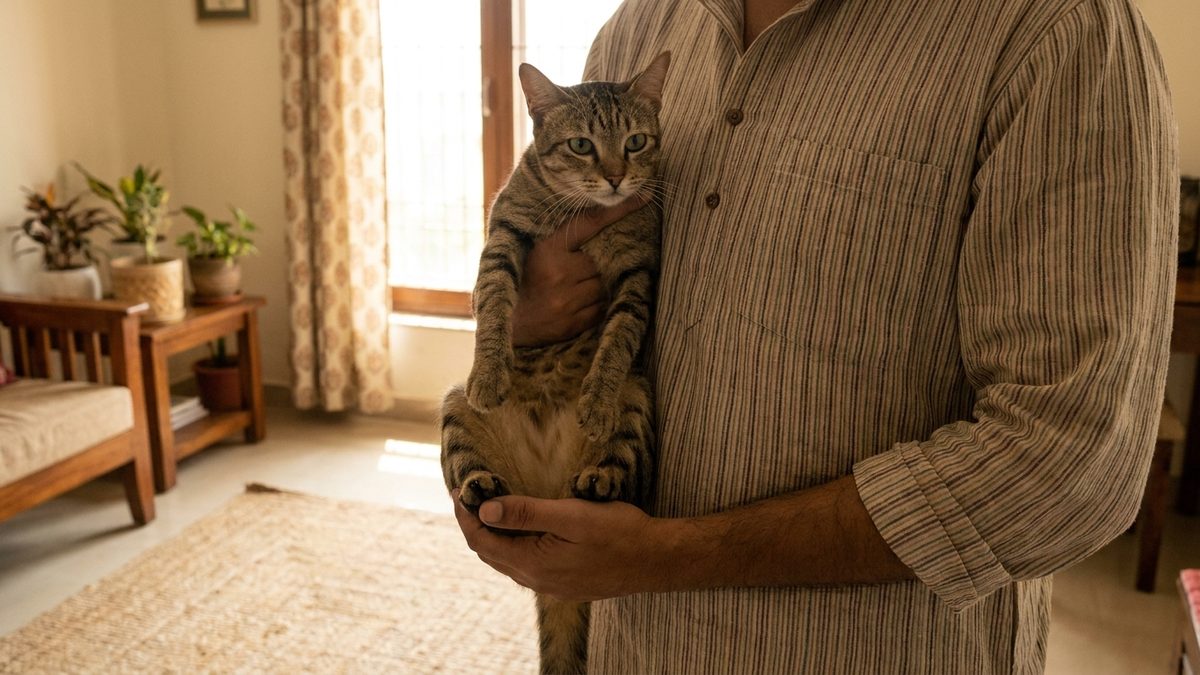
How to hold a cat starts before you touch it. Crouch to its level, hold out a hand, and let the cat come. Stroke the cheeks for a few seconds and pause. If it stays put and stays loose, slide one hand under the chest behind the front legs, the other under the back legs, and scoop so the hindquarters sit in your elbow. Hold it against your chest. Most cats want down inside two minutes. Never lift a cat by the scruff.
This guide is general information for Indian pet owners and is not a diagnosis. Always consult a registered veterinarian near you before acting on anything you read here, and treat any sudden change in your pet's condition as urgent.
How to hold a cat, in eight steps
To hold a cat, work through eight steps in order and treat the first four as permission rather than preparation. The lift itself is two hands and three seconds. Everything that decides whether it goes well happens before them.
Cats Protection publishes the sequence below, and the single most useful thing in it is that half the steps happen before you touch the animal. The reason is physical rather than sentimental. Cats are most comfortable with all four paws on the ground, because from there they can leave, and lifting removes that option. The 2022 AAFP and ISFM Cat Friendly Veterinary Interaction Guidelines put the same point in one line for clinical staff: cats feel more secure with all four feet in contact with a solid surface.
- Approach slowly and on their level. Do not loom, do not come from behind, and do not lift a sleeping cat. Leave it a way past you, so it is not cornered.
- Hold out a hand and keep it still. If the cat wants contact it comes and sniffs. If it has not approached within a minute or two, it does not want to be touched, and that is the answer.
- Stroke the cheeks or chin. These are the preferred areas of touch, and you move with the fur, never against it.
- Stroke for a few seconds, then stop and look. The guidelines tell clinical staff to massage the facial glands for a few seconds, pause, and continue only if the cat welcomes it, which it shows by rubbing its face on your hand or moving closer. Do the same at home.
- Scoop with two hands. Crouching beside the cat, run a hand down its back, then under the chest behind the front legs. Put the other hand behind the back legs and lift, so the rear end settles into the crook of your elbow.
- Support the hindquarters and bring the cat in. As you stand, hold it against your chest with one arm under the rear and the other around the chest supporting the front legs. Back legs never dangle.
- Stand still, or move slowly. A cat held by someone who is also walking, turning and talking has nothing stable to brace against.
- Put it down before it asks twice. Most cats stay comfortable for one to two minutes. Wriggling, a stiffening body, a hiss or a growl all mean the same thing.
Putting a cat down, which is where the scratch usually happens
Lower the cat all the way to the floor and let it put all four paws down before you let go, rather than opening your arms at waist height. A cat that has to jump pushes off your forearm with its back claws, and most of the scratches owners describe as unprovoked are collected in that half second. This is also the step that children skip, because a child's arms tire first and the instinct is to open them.
Picking up a kitten, and the one difference
Picking up a kitten uses the same two-handed method on a smaller scale, with the rear end supported by a hand rather than the elbow. Size is not a licence to use one hand. The clinical guidelines describe a gentle paediatric cradle hold for neonates, one hand over the back with thumb and forefinger at the base of the jaws and the other hand carrying the lower half, and they are explicit that this replaces scruffing rather than softening it. Our kitten care guide and bringing a kitten home cover the first weeks around it.
Lifting a cat under the front legs with the back half hanging puts the animal's whole weight on its shoulders and chest and gives it nothing to brace on. Cats Protection's rule is that the cat must be fully supported at all times and the back legs must not be left dangling in the air. If you are already holding a cat that way, slide your free hand under its rear rather than putting it down fast.
Scruffing a cat: what the welfare bodies say now
Welfare and veterinary bodies now advise against scruffing, and the strongest statement comes from the 2022 AAFP and ISFM guidelines, which say scruffing is no longer recommended for cats at any life stage and that it is a mistaken premise that scruffing makes patients easier to work with.
Scruffing means gripping the loose skin at the back of the neck to restrain a cat, sometimes with the cat lifted off the ground. It is still taught in Indian households as the way to move a cat that does not want moving, and it is usually defended with one sentence about the mother cat. That sentence deserves a proper answer rather than a flat denial, and it gets one below.
International Cat Care's position statement sets out the mechanism. A cat's coping strategy under stress is to avoid or retreat, and it copes much better when it believes retreat is available and that it has some control. Scruffing removes both at once. The statement goes further and points out the self-defeating part: people scruff because they are afraid of being bitten, and scruffing often provokes or escalates exactly the self-protective reaction they were trying to prevent.
The guidelines add the part owners never see, because it happens later. Heavy restraint does not only hurt the moment it is used. Its effects are likely cumulative across repeated use, increasing handling aversion over time and making repelling behaviour such as growling, swiping, scratching or biting more likely in the longer term. A cat that now bites when picked up was often taught to, over years, by people who were each being quick about it.
What the mother cat is actually doing, and why it does not transfer
The mother-cat comparison is not a myth, and pretending it is costs you the argument. There is a real reflex. Researchers at The Ohio State University gave it the name pinch-induced behavioural inhibition, because that describes the method and the response without implying hypnosis, and they recorded the classic picture: the back ventroflexes, the tail curls under the body and the animal goes passive. Their conclusion was that the response is not a fear or pain response and that it may have evolved to let a queen carry her kitten.
Three things in that same paper are what make the comparison fail in your hands.
- It is a juvenile mechanism. The authors observed that young cats and kittens are more responsive than adults, and described the adult response as possibly the residue of a conserved juvenile mechanism. The reflex you are counting on is strongest in the animal you are least likely to be lifting.
- A queen is not lifting four kilograms. She carries a kitten of a few hundred grams a short distance, with the kitten's spine curled and its weight close to her jaws. A human hand gripping a pinch of skin and taking the full hanging weight of an adult cat is a different load through a different structure.
- The paper tested clips, not a hand. The response was induced with binder clips at 140 to 160 mmHg, the range of systolic blood pressure, placed along the dorsal midline. That is a measured, controlled pressure. It is not a grip taken in a hurry by someone who is already annoyed.
Cats Protection says the same thing in a single sentence for owners, and it is the clearest version anywhere: although mother cats sometimes pick up their kittens this way, it is not appropriate for humans to do so.
Four named bodies, and they do not all draw the line in the same place
Where sources disagree we publish the disagreement rather than the tidiest version. On scruffing, the four positions below are not identical, and the difference matters if you are trying to work out whether your vet or groomer is doing something wrong.
| Source | Its position, in its own terms | How absolute it is |
|---|---|---|
| AAFP and ISFM Cat Friendly Veterinary Interaction Guidelines, 2022 | Scruffing is no longer recommended for cats at any life stage, including neonates and paediatric patients | Absolute, and explicitly extended to kittens |
| International Cat Care position statement | Scruffing should never be used routinely in cat care, based on current evidence of clear negative impacts on welfare | Near absolute, with the word routinely left in |
| Moody and colleagues, Veterinary Record 2020, the study the other two cite | Recommends against full-body and clip restraint, and suggests scruff restraint should be avoided when possible | The most cautious of the four, and the only one reporting the data |
| ASPCApro humane cat holds | Offers the snake hold as an alternative to scruffing calm cats, notes scruffing can make some cats defensive and may not be necessary for all cats, and keeps it as a fallback if absolutely necessary | A professional fallback, not a ban |
Read that table honestly and the disagreement is narrower than it looks. It is about how far a trained professional may go with a cat that is already in crisis on a consulting table. Not one of the four endorses scruffing as a way for an owner to pick a pet cat up at home, which is the practice this page exists to replace.
Do not lift, carry, pin or hold a cat still by the scruff, and do not let anyone else do it in your home, including a groomer, a relative or a helper. If a cat has escalated to striking or biting, the clinical answer is sedation prescribed by a veterinary surgeon or another day, never a firmer grip.
What the handling research measured, and what it missed
The handling research measured struggling, ear position, vocalisation, lip licking, pupil dilation and respiratory rate under different holds, and it reversed itself between 2008 and 2020. Both halves of that reversal are worth knowing, because the older half is where most of the folklore still in circulation came from.
The first study to validate what a bad hold does was published in 2018. Working with 51 healthy shelter cats, a University of Guelph team compared full-body restraint, defined as the cat held on its side against the handler with front and back legs grasped and a forearm across the neck, against passive restraint, defined as the cat held lightly with the least restraint possible in a position of its own choosing and free to move its head, body and limbs.
The results were not close. Cats were 8.2 times more likely to struggle under full-body restraint. The examination took more than double the time to complete. Lip licking rose, stress-associated ear positions rose, respiratory rate rose, pupil dilation rose, and the cat was more likely to escape afterwards. The practical reading for an owner is that the firm grip is not the fast route. It is the slow one.
The 2020 trial that put scruffing in the middle, not at the bottom
The same group then tested scruffing directly. Seventeen cats were scruffed, sixteen had clips applied to the dorsal neck skin and nineteen got full-body restraint, with each cat also handled with passive restraint as its own control. The ranking that came out of it is more interesting than the headline usually allows. Full-body restraint and clip restraint produced the greatest number of negative responses, scruffing produced fewer, and passive restraint produced the fewest of all.
So scruffing is not the single worst thing in the literature. It is worse than leaving the cat alone and better than pinning it. The authors' own recommendation reflects that: they recommend against full-body and clip restraint outright, and suggest scruff restraint should be avoided when possible. The 2022 guidelines summarise the same finding accurately, saying responses were greatest for full body and clip restraint followed by scruff restraint, and then go further than the study did by removing scruffing at every life stage. We think the guideline is right to, given the cumulative-harm argument it makes, but a reader deserves to know that the gap exists.
Where the 2008 and 2020 findings actually collide
The clipnosis paper of 2008 concluded that clips were a safe, convenient, benign method of restraint for routine procedures, and that the cats appeared calmer, with most purring and kneading while the clips were on. The 2020 trial found no detectable difference between clip restraint and full-body restraint, the known aversive control. Those are flatly opposed conclusions about the same intervention, twelve years apart, and the explanation is in what each team looked for.
| Pozza and colleagues, 2008 | Moody and colleagues, 2020 | |
|---|---|---|
| Cats | 13 healthy and 18 with idiopathic cystitis, all laboratory housed | 17 scruff, 16 clip, 19 full body, each its own control |
| What was measured | A minus three to plus three observer rating, a neurological examination, and telemetry for heart rate, blood pressure and temperature | Ear position, vocalisation, lip licking, pupil dilation ratio and respiratory rate |
| What it found | 92 percent of healthy cats scored positive on first exposure, no sign of pain, miosis rather than pupil dilation | Clip restraint no better than full-body restraint on the negative-response count |
| Conclusion drawn | Safe, convenient and benign for routine procedures | Recommend against clip restraint |
The 2008 team concluded there was no pain because the signs they looked for were absent, including the pupil dilation they expected and did not get. The 2020 team used a wider set of behavioural indicators and found the cats were responding after all. Neither team was careless. The lesson is the one that matters for every handling claim on the internet: an animal that stops moving has not necessarily stopped minding, and the measures you choose decide the answer you get.
All three are small. Fifty-one cats in one, fifty-two across three arms in the next, thirty-one in the oldest. All used shelter or laboratory cats handled by strangers in an unfamiliar room, not pet cats handled at home by the person who feeds them. They establish that restraint produces measurable fear responses. They do not establish how your own cat will respond to you, and nobody has run that study.
Reading a cat before you touch it
Read a cat before you touch it by looking for four responses rather than two. Most owners can spot a cat that runs and a cat that swipes. The two in between are the ones that get missed, and one of them looks exactly like a cat that is happy to be held.
The 2022 guidelines use a behavioural model with four responses to protective emotions, named inhibition, appeasement, avoidance and repulsion. Avoidance is the cat leaving. Repelling behaviour is growling, hissing, striking or biting, and the guidelines deliberately avoid calling it aggression, because the aim of the behaviour is to increase distance from something the cat perceives as a threat.
The quiet cat is the one you will misread
Inhibition is the response that costs cats the most, and the guidelines are blunt about why. It is a passive response and is often not recognised by people interacting with the cat. Then comes the sentence that should change how you hold your own cat: inhibition can certainly make cats easy to handle and work with, but those showing this response are indicating that they feel the need to protect themselves.
Read that against what you believe about your own cat. A cat that goes still and limp in your arms, does not struggle, and lets you carry it from room to room is widely taken as a cat that enjoys being carried. It may be. It may also be an inhibited cat that has learned struggling does not work. Cats Protection draws the same distinction from the other end: a cat that does not move away but shows anxious or tense body language is only tolerating the interaction and is not enjoying it, and the instruction is to stop and not pick it up.
The signals below are the ones the sources name, separated from the ones that get repeated without evidence.
- Whiskers. Splayed whiskers are named in the guidelines as a sign a cat may display when experiencing protective emotions. Whisker position is a real signal, not folklore.
- Ears. Side and back ear positions were among the objective measures used to score negative responses in the restraint trial, which makes ear position one of the few signals with a measurement behind it.
- Lip licking. A swallow or a lip lick when nothing has been eaten is on the same measured list and rose under full-body restraint.
- Going very still. Inhibition, and the single most misread signal in the set.
- A face rub against your hand, or the cat moving closer. The guidelines treat this as the cat welcoming contact, which makes it the closest thing to a yes a cat gives.
- The tail. The guidelines describe tail up as part of a relaxed, positive posture on approach. Beyond that, be careful: tail position is read far more confidently than the evidence supports, and a tail is one signal on an animal, not a verdict.
The slow blink has its own evidence and its own home on this site. Our things to do with your cat page sets out what the study found and how to do it, so we are not repeating it here. It is a greeting, not a permission slip, and a cat that slow-blinks at you across a room has not agreed to be carried.
The grooming-session stop signals, the ones that tell you to end a brushing session, are a different and longer list, and our cat grooming at home page carries them with the towel technique that goes with them.
Where a cat wants to be touched, measured
A cat wants to be touched on the head and neck, particularly over the facial glands, and the finding is not a preference anyone guessed. Those are the same regions socially bonded cats groom on each other to strengthen the bond.
The facial glands sit around the cheeks, the chin, the base of the ears and the corners of the mouth, and they produce the pheromones a cat deposits when it rubs its face on a doorframe or on you. Massage or stroke over them in the direction of the fur, from the side rather than face on, at the cat's own level. Most cats dislike touch over the caudal region, the abdomen and the feet, and the guidelines tell clinical staff to leave those until last if they have to be touched at all.
The caudal region means the back end, just in front of the base of the tail. That is the patch many owners scratch hardest, because some cats raise the rear and appear to ask for it, and it is the one region with a published negative result against it.
The study, and the result nobody expects
A University of Lincoln team ran two experiments on how cats respond to being stroked on different body regions by a familiar and an unfamiliar person. The caudal region produced the highest negative behavioural scores in both experiments, scoring 2.0 against 0.0 to 1.0 for every other region with an unfamiliar handler, and 2.0 against 1.0 with the familiar one. The order in which regions were touched made no significant difference. The authors' recommendation is plain: handling of cats should avoid the caudal region.
The second finding is the one worth sitting with. Familiar handling produced significantly higher negative behavioural scores than unfamiliar handling, 8.5 against 5.0, at p equals 0.001. Cats objected more to being stroked by the person they live with than by a stranger.
Resist the obvious reading. The authors do not claim cats dislike their owners, and they close by saying the result highlights the need for further investigation into the owner and cat relationship. A plausible explanation, and it is only that, is the inhibition problem from the previous section: a cat may express less in front of a stranger because it is guarded, and more in front of a familiar person because it is not. If that is right, the honest conclusion is uncomfortable and useful. Your cat tells you more than it tells anyone else, and you are the person most likely to be ignoring it.
Touch the cheeks, the chin and the base of the ears. Leave the belly, the feet and the patch in front of the tail. Stroke for a few seconds, pause, and let the cat ask for more by moving into your hand. If it does not ask, you have your answer and you have not spent anything to get it.
Cats that dislike being held, and what to do instead
Cats that dislike being held are normal, and no amount of persistence fixes it, because there is nothing broken. Many cats do not enjoy being restrained in that way, and the sensible response is to find a different way to be close to the animal.
Whether a cat tolerates being lifted mostly traces back to a window in early kittenhood that shut before you met it. The 2022 guidelines put the critical period at 2 to 9 weeks and say that a kitten handled positively and frequently in that period, by a range of people including children, is more likely to grow into a cat that is amenable to handling and less fearful of people, including unfamiliar ones. Cats Protection gives the window as 2 to 7 weeks. We have published both rather than averaging them, because the practical point survives the disagreement: the weeks that decided this were over before the cat was rehomed.
The guidelines add the asymmetry that makes recovery hard. In a cat not well socialised to humans as a kitten, it may take only a single negative experience to make it wary, against many positive ones to make it friendly. That is the arithmetic working against anyone who decides to persist.
Training a cat to be held, and when it is not worth doing
Cats Protection draws a line here that almost nothing else on the subject draws, and it is worth quoting its shape. Training a cat to accept handling is reasonable when the handling has a purpose the cat benefits from, such as grooming or medication. Training a cat to be picked up because you would enjoy cuddling it is not recommended, because it only works in specific situations and the cat is still unlikely to enjoy being lifted whenever you feel like it.
What replaces it is not consolation. It is the better relationship.
- Sit on the floor and wait. A cat that will not be lifted will often climb onto a lap, which is the same contact arranged in the cat's favour.
- Stroke the head and chin where the cat already is. No lift, no transport, no decision to reverse.
- Play instead. Our things to do with your cat page carries the prey sequence and the session length, and a wand toy buys more goodwill than an hour of being carried.
- Train the carrier, not the lift. Cats Protection's own advice for a nervous cat is to train it to walk into the carrier rather than to be picked up and posted into one. Our cat in a car page has the method.
- Give it somewhere to be near you without being touched. A shelf or a chair arm within reach is contact on the cat's terms. The cat friendly home setup page covers the layout.
When not to pick up a cat at all
There are four moments when the answer is no regardless of how the cat usually responds, and Cats Protection names all of them. Do not lift a sleeping cat, because you startle it awake. Do not lift a frightened or stressed cat, which usually wants to hide and will mind more, not less, for being cuddled. Do not lift a cat in pain, and remember cats conceal pain, so you may not know until you touch it. Do not lift a cat mid-play or mid-hunt, when your hand reads as prey.
Add a fifth. A cat that has recently started objecting to being picked up when it never did before is a cat to take to a vet, not a cat to work on. Pain is a documented driver of protective behaviour, which is why the guidelines treat pain assessment as essential in a cat that has become difficult to handle. In an older cat the usual cause is joint disease, and our senior cat care page covers how to see arthritis in a cat that never limps.
Children and cats: the cat version of the problem
Children and cats need a different rule set from children and dogs, because the failure mode is different. A dog is usually approached head on and hugged. A cat is usually picked up, carried badly and then dropped, and the injury that follows is a scratch rather than a bite.
Our teaching children how to meet a dog page owns the greeting mechanics, the five steps and the Indian bite data, and nothing here replaces it. The cat version changes three things.
- The rule is not how to approach, it is who lifts. Set the household rule that children do not pick the cat up, full stop, until an adult has watched them do it three times and is satisfied the back end is supported the whole way down.
- Teach the put-down first. Children lift adequately and release badly, because their arms tire and they open them. Practise lowering to the floor with a soft toy of the right weight before the cat is involved.
- Teach the one-minute clock. Most cats stay comfortable for one to two minutes. Give a child a countable limit rather than a judgement call, because a judgement call is the thing a seven-year-old has not got yet.
- Give the cat a route out of the room. A child cannot chase what has already gone up a shelf. The hiding places and vertical routes on our cat friendly home setup page do more for child safety than any rule you can enforce by voice.
There is a reason to get this right beyond the scratch itself. The guidelines note that handling by a diverse range of humans including children during the 2 to 9 week window makes a kitten more amenable to handling later. A child who learns the supported lift at six is part of why that cat is easy for a vet to examine at ten. A child who learns the armpit lift is part of the opposite.
The person most likely to pick up your cat badly is a visitor who has decided it is friendly. Say the sentence before it happens, not after: please do not pick her up, she comes to you if she wants to. It is easier to say early than to retrieve a scratched guest and a cat that has now learned the drawing room is unsafe. If the household has frequent visitors, the routine side of that is covered on our cat friendly home setup page.
Several people, one cat: joint households, staff and the handover
In a household where several people handle one cat, agree the method once and apply it as a rule, because the cat does not generalise from one person to the next. The 2022 guidelines put it in four words for clinical teams, and it transfers exactly: trust is not transferable.
That line is written about a veterinary team, where each member has to build rapport with the cat before handling it. In a joint family of six in Pune or Kolkata, with grandparents, two working adults, a teenager and a helper, the cat is running six separate relationships and scoring each one. The person who scruffs it once is not spending their own credit. They are spending the household's, because the cat becomes warier of hands in general.
Three practical rules follow.
- One method, said out loud, to everyone. Two hands, support the hindquarters, down within two minutes, nobody uses the scruff. A rule that lives in one person's head is not a rule.
- The person the cat likes least should lift it least. There is no fairness principle that applies here. If the cat accepts one adult and tolerates the rest, that adult does the vet run.
- Domestic staff get told, not assumed. A helper who has been scruffing cats for thirty years is not being careless, she is using the method she was taught, and nobody has told her otherwise. Say what you want done and why in one sentence, and say it to the person rather than leaving a note.
The wider question of how household staff and your pet get on, including the bite and injury side, sits on our house help, drivers and your pet page, which is worth reading before this conversation rather than after it.
An Indian veterinary chain's list of common new cat owner mistakes puts a related failure near the top of the behaviour section: treating cats as small dogs, and expecting them to give up chasing, climbing and scratching. Most first-generation Indian cat owners learned animal handling on dogs, and a dog mostly tolerates being hauled about by whoever is nearest. A cat keeps a ledger.
Handling for a purpose: the carrier, the vet, medication and nails
Handling for a purpose goes better when you remove the lift from the job entirely, which is possible more often than owners think. Each of the four jobs below has its own page on this site, so this is the short version and the route.
- The cat carrier. Train the cat to walk in rather than lifting it in. This is the single highest-return handling change available, and the method, the carrier type and the two welfare bodies that disagree about size are on our travelling with a cat in a car page.
- The vet visit. Ask whether the examination can happen in the bottom half of the carrier, because that is what the guidelines themselves recommend where the cat prefers it. A clinic that refuses to try is telling you something. Our choosing a vet in India page covers what else to ask.
- The nail check. Nail trimming, including the technique and the two things not to do, lives on our cat grooming at home page. Do it on a cat already on your lap, one nail at a time, not on a cat you have carried to the bathroom.
- Medication. Never a lift-and-pin job. Dose and drug are a veterinary decision, and a hands-off approach to medicating reduces anxiety and improves how well the medication works. Ask your vet to show you once, in the room.
- An emergency move. When the cat has to be moved now and will not cooperate, the method is a towel, not a scruff. Cats Protection describes approaching from behind, placing the towel over the whole body and head in one movement, scooping with the towel folded underneath, and putting cat and towel straight into the carrier.
One thing worth saying plainly about the clinic. If you watch a member of staff scruff your cat, you are watching a technique that the profession's own 2022 guidelines describe as no longer recommended at any life stage, and that a survey of Canadian and American veterinary teams found is still in routine use, with many respondents reporting heavy restraint including scruffing with calm as well as fearful cats. It is common. It is not current practice. You are allowed to ask for a towel instead.
The India layer: the part-outdoor cat, the heat and the scratch
In India three things change the handling question, and none of them appears on the pages that currently rank. Most Indian pet cats have an outdoor route, most of the year is too warm for a cat to want body contact, and a cat scratch is classified as a rabies exposure under India's own national guidelines.
The cat with a route out
A cat that comes and goes through a window grille, a kitchen ventilator or a gap in a balcony mesh has an escape route, uses it, and knows it is there. That changes the lift in a specific way. The worst moment to pick up a part-outdoor cat is the moment it has decided to go out, because you are not interrupting a rest, you are blocking an intention, and frustration is one of the protective emotions the guidelines name. An Indian veterinary chain publishes a whole guide to the indoor-outdoor cat for exactly this reason, since the fully sealed indoor cat is a minority arrangement in Indian flats. The hazards of the route itself, from the balcony to the grille, are on our indoor cat safety page.
Heat, humidity and the floor the cat has chosen
A cat lying on bare tile in May has chosen the coolest surface available, and lifting it off that surface and pressing it against a human chest is a heat decision as much as a handling one. In humid coastal cities such as Mumbai, Chennai and Kolkata the cat cannot shed heat by evaporation easily, and in dry inland heat in Delhi, Ahmedabad and Hyderabad the tile is the only cool thing in the room. Expect more refusals from March to June than in January, and do not read a seasonal refusal as a change in the relationship. Our heat safety for cats page covers the rest.
The wet months are a separate problem and they are not the same months everywhere. Our monsoon care for cats page measured this across eleven cities and found Chennai's wettest month is November while the west coast peaks in July, so a cat in Tamil Nadu is on a different calendar from a cat in Maharashtra or Karnataka. A damp cat is harder to hold securely and less willing to be held, and the grip that works on a dry coat slips on a wet one, which is how people end up tightening instead of putting the animal down.
Community cats: the rule is do not handle
Do not pick up a street cat. The 2022 guidelines give the rule for feral and street or community cats in one line, written for veterinary professionals, and it is the strictest instruction in the document: do not physically handle these cats when they are not sedated or anaesthetised. A fed cat is not a handled cat, and many colony cats will eat from your hand for years and still bite if lifted. Our street cats in India page covers what that relationship can and cannot be, and how to get a colony sterilised without handling anyone yourself.
The scratch, and what India's national guidelines say about it
India's National Guidelines on Rabies Prophylaxis, published by the National Centre for Disease Control in Delhi, record that dogs are responsible for about 97 percent of human rabies in India, followed by cats at 2 percent and jackals, mongoose and others at 1 percent. Two percent of an Indian rabies burden is not a small number, and bad handling is how most cat scratches happen.
| Category | Type of contact | Recommended post-exposure prophylaxis |
|---|---|---|
| I | Touching or feeding the animal, licks on intact skin | None, if a reliable case history is available |
| II | Nibbling of uncovered skin, minor scratches or abrasions without bleeding | Wound management and anti-rabies vaccine |
| III | Single or multiple transdermal bites or scratches, licks on broken skin, contamination of mucous membrane with saliva | Wound management, rabies immunoglobulin and anti-rabies vaccine |
Read row two carefully, because it is the one Indian cat owners get wrong. A minor scratch that does not bleed is a Category II exposure and the guidelines recommend the vaccine for it. The decision is a doctor's and not ours, and this page does not tell you which schedule applies to you. What it tells you is to go, rather than to decide at home that it was only a scratch.
Wash the wound immediately with plenty of soap and running water, and go to a doctor or an anti-rabies clinic. The national guidelines state plainly that applying irritants such as chillies, oil, turmeric, lime or salt is unnecessary and damaging, and that the wound should not be dressed or stitched before assessment. Keep your own cat's rabies vaccination current, which our cat vaccination schedule page sets out, and tell the doctor the cat's vaccination status when you go.
What this page can prove, and what it cannot
This page can prove that restraint produces measurable fear responses in cats and that the bodies setting standards have moved against scruffing. It cannot prove what your own cat feels, and nothing published does.
Four things here are well established. Full-body restraint makes a cat 8.2 times more likely to struggle than passive restraint and doubles how long the examination takes. Scruff restraint, clip restraint and full-body restraint all produce more negative responses than passive restraint. The caudal region is the worst place to stroke a cat, measured twice. A cat that goes still may be inhibited rather than content.
Four things are not established, and a page that pretends otherwise is lying to you.
- How your individual cat responds to you. Every study here used shelter or laboratory cats handled by strangers. The closest thing to a home finding is the Lincoln result that cats scored worse with a familiar handler, and its own authors call for further investigation rather than drawing a conclusion.
- Whether scruffing is harmful or merely aversive. The 2020 trial measured fear indicators, not injury, and placed scruffing below full-body and clip restraint on its own scale. Claims that scruffing bruises or damages an adult cat's neck are widely repeated and we have not found them in a primary source.
- Whether the Indian household pattern changes any of this. No study of cat handling has been run in India that we could find. The India section above is the national rabies guidance applied to a handling page, plus climate and housing context, not Indian handling research.
- What a cat that tolerates handling is feeling. Tolerance is measurable. Enjoyment is not, and the honest position is that a cat choosing to stay is the strongest evidence available.
If your cat has changed, see a vet before you see a behaviourist. A cat that used to accept being lifted and now objects is a pain question first, and that is a veterinary decision rather than a handling one. This page publishes under our medical disclaimer for that reason.
Common questions
What is the correct way to hold a cat?
The correct way to hold a cat is with two hands and the whole body supported. Crouch beside the cat, slide one hand under the chest behind the front legs and the other behind the back legs, and scoop so the rear settles into the crook of your elbow. Bring the cat against your chest with one arm under the rear and the other around the chest. The back legs never dangle, and you lower all four paws to the floor before letting go.
How do cats prefer to be held?
Cats prefer to be held briefly, securely and on their own terms, and many prefer not to be held at all. Cats are most comfortable with all four paws on the ground, because from there they can leave if they choose, so being lifted removes the option. Most cats stay comfortable for only one to two minutes. The cats that accept it longest are usually the ones handled gently and frequently as young kittens.
Can I hold my cat by the armpits?
No. Holding a cat under the front legs with the back half hanging puts the animal's entire weight through its shoulders and chest and leaves it nothing to brace against. Cats Protection's rule is that a cat must be fully supported at all times and the back legs must not be left dangling in the air. If you are already holding a cat that way, slide your free hand under its hindquarters rather than dropping it to correct the grip.
What are improper ways to hold a cat?
Five ways are improper. Lifting by the scruff, which welfare bodies no longer recommend at any age. Lifting by the armpits with the rear unsupported. Lifting a sleeping, frightened, painful or playing cat. Holding on while the cat wriggles, hisses or growls. And opening your arms at waist height so the cat has to jump, which is where most scratches are collected.
Is it okay to lift a cat by its neck?
No. The 2022 AAFP and ISFM Cat Friendly Veterinary Interaction Guidelines state that scruffing is no longer recommended for cats at any life stage, and call it a mistaken premise that scruffing makes a cat easier to work with. International Cat Care says scruffing removes both of a cat's coping options at once, the ability to retreat and the sense of control, and often provokes the self-protective reaction the handler was trying to avoid.
Can you hurt a cat by scruffing it?
Scruffing measurably increases fear responses, and the honest answer on physical injury is that we could not find it demonstrated in a primary source. The 2020 trial that tested scruffing directly measured ear position, vocalisation, lip licking, pupil dilation and respiratory rate, and found scruffing worse than passive restraint but less bad than full-body or clip restraint. Its authors recommend avoiding scruff restraint when possible rather than describing it as injurious.
Do cats like it when you scruff them?
No. A scruffed cat often goes passive, which looks like acceptance and is not. The 2020 restraint trial found scruffing produced more negative responses than passive restraint on objective behavioural and physiological measures. The guidelines separately warn that a cat which goes still may be showing inhibition, a protective response that makes cats easy to handle while signalling that they feel the need to protect themselves.
At what age should you stop scruffing a cat?
There is no age at which it starts. The 2022 AAFP and ISFM guidelines say that while it was traditionally considered normal practice to scruff paediatric and neonatal patients because of their size, scruffing is no longer recommended for cats at any life stage. For a kitten they describe a loose wrap in a tea towel or a paediatric cradle hold instead, with one hand over the back and the other carrying the lower half.
Is it normal for cats to not like being held?
Yes, it is normal and common. Many cats do not enjoy being restrained in that way, and whether an individual accepts it depends largely on how it was handled during a window in early kittenhood, given as 2 to 9 weeks by the 2022 guidelines and 2 to 7 weeks by Cats Protection. Training a cat to be picked up purely so you can cuddle it is specifically not recommended, because it rarely generalises and the cat still does not enjoy it.
How do I stop my cat from biting me when I pick him up?
Stop by changing when and how you lift rather than by correcting the bite. A bite when you pick a cat up means it did not want to be picked up and could not leave. Check first for pain, because a cat that has recently started objecting is a veterinary question. Then run the four permission steps before every lift: approach low, offer a hand, stroke the cheeks for a few seconds, pause and read the answer. Put the cat down the moment it wriggles.