
Cat care guide
Grooming a cat at home in India: brushing by coat, mats, nails and the heat
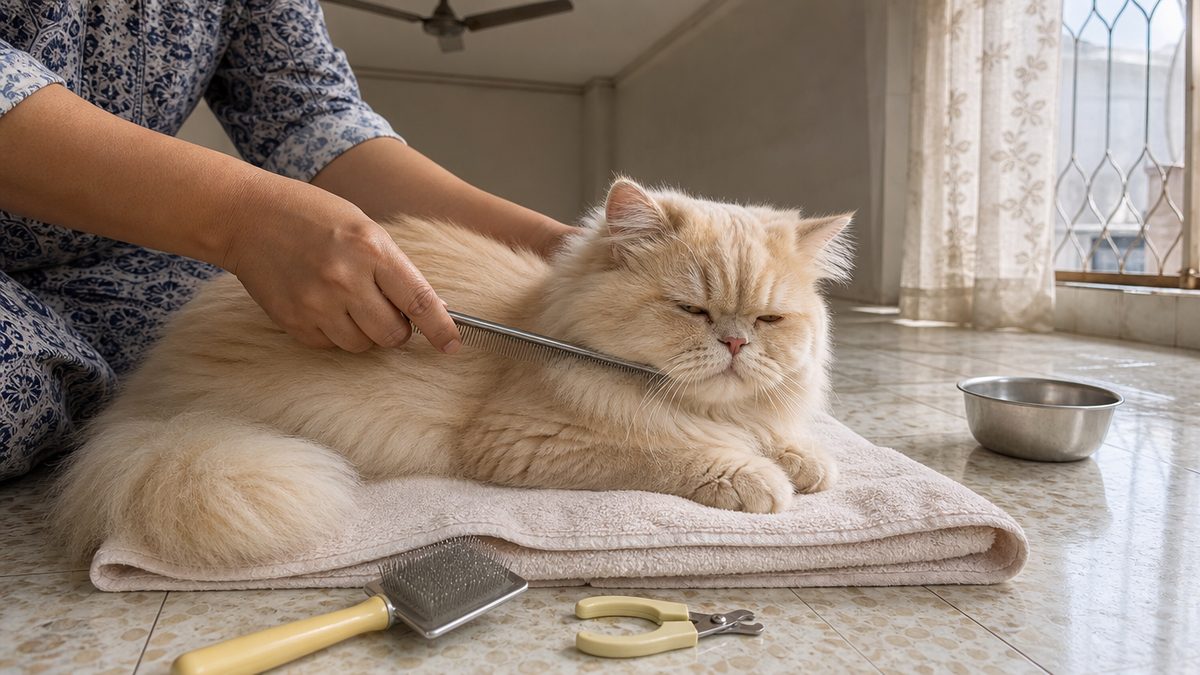
Brushing by coat with the Persian's daily comb, the mat that must not meet scissors, the bath most cats never need, nails and the declawing rules, ears cleaned only when needed, the one grooming job with a prevalence figure, the summer-shave question answered, and a four-item kit priced from an Indian seller on the day of writing.
Quick answer
Cat grooming at home in India comes down to a comb on the cat's terms: brush a short-haired cat weekly and a long-haired cat daily, tease small knots apart with fingers and never scissors, skip the bath unless something is on the fur, trim only the white claw tips, clean ears only when needed, brush the teeth, check for ticks and fleas every session, and do not shave for the heat. A four-item kit costs Rs 1,126 in India. Your nearby vet decides for your cat.
This guide is general information for Indian pet owners and is not a diagnosis. Always consult a registered veterinarian near you before acting on anything you read here, and treat any sudden change in your pet's condition as urgent.
Brushing by coat: short-haired weekly, long-haired daily, the Persian every day without exception
Brush a short-haired cat at least once a week and a long-haired cat at least once a day, the interval International Cat Care and Vets4Pets both give, and comb a Persian every day, because the breed body that wrote its standard calls a steel comb essential and ICatCare says many Persians cannot keep their own coat mat-free Vets4Pets (UK), Grooming Cats The Cat Fanciers' Association International Cat Care. The cat does most of the work itself: oral grooming took 4 percent of the 24-hour budget of 11 videotaped cats, and a healthy cat's grooming bout lasts a mean of 4.8 minutes Guillon M, Naudin L, Cochet-Faivre N. Cat grooming at home covers what the tongue cannot reach, and the coat sets the size of that gap.
The coat decides the interval, not the calendar. A cat's fur has three hair types, down, awn and guard, and cats moult all year, so the shedding hair is either swallowed or brushed out. The ranking pages disagree on how often without saying so: ICatCare and Vets4Pets say weekly for a short coat and daily for a long one, the ASPCA says one or two brushings a week, and Purina says every one to two weeks for most short-haired cats Vets4Pets (UK), Grooming Cats ASPCA, Cat Grooming Tips Purina US Pet Expert Team. The table prints the spread; this page follows ICatCare.
| Coat | Interval | Tools named by the source | Source |
|---|---|---|---|
| Short-haired (an Indian domestic cat, a British Shorthair, a Siamese, a Bengal) | At least once a week; twice a week in a moult | Fine-toothed flea comb first, bristle brush, rubber grooming pad or mitten | International Cat Care, Cats Protection Cats Protection, Grooming your cat |
| Semi-long (a Maine Coon, a Ragdoll) | Two or three times a week, five to ten minutes a session | Comb | The Cat Fanciers' Association's Maine Coon profile |
| Long-haired (a Persian, a Himalayan) | At least once a day | Wide-toothed comb, rubber pad; for the Persian a steel comb with long coarse and fine teeth | International Cat Care, CFA Persian profile The Cat Fanciers' Association |
| Hairless (a Sphynx) | No brushing; skin wiped and bathed instead | Damp cloth, cat shampoo on the vet's advice | CFA Sphynx profile, Purina Purina US Pet Expert Team |
The short-haired routine, in the order ICatCare gives it
To brush a short-haired cat, start with the flea comb, because it is a diagnostic tool before it is a grooming tool, and end before the cat objects. The five steps are listed below.
- Run the fine-toothed flea comb through the coat first and look for flea dirt, the tiny black comma-shaped specks that run red when a drop of water touches them; if you find any, the flea problem is bigger than the brush and the cat ticks and fleas guide covers the products that are safe for a cat.
- Loosen the dead hair with your fingers, massaging against the growth from tail to head.
- Brush or comb from head to tail, in the direction the hair grows.
- Sweep the coat up towards the head with the bristle brush and smooth it down again, if the cat tolerates it; ICatCare notes that many cats do not like this step, so skip it rather than push.
- Finish with the rubber pad or mitten from head to tail, then a damp cotton or rubber glove to lift the last loose hairs and leave the gloss.
Vets4Pets adds that a cat grabbing the brush at the belly is saying it has had enough, and that each cat should have its own kit, because a brush that smells of another cat can be refused.
The long-haired routine and the two places mats start
To groom a long-haired cat, massage the skin against the growth, then comb with the wide-toothed comb from head to tail, taking care under the armpits and between the hind legs, where the skin is thin and friction makes knots common; the other place is between the toes and pads, checked every session. A Persian's clock is faster: ICatCare says many cannot keep their coat mat-free, the eye corners and the side of the nose need regular cleaning, and the underside of the tail stains with faeces that clump if left. The CFA's Persian profile calls a steel comb with long coarse and fine teeth 'essential' and puts any bath after a thorough combing and nail clipping. The Persian breed page turns that into a daily schedule for an Indian flat.
Grooming is also when you look. The 2021 AAHA/AAFP guideline treats a change in grooming as a clinical sign: more grooming can mean a skin condition, an allergy, a parasite or an endocrine disease, and less can mean illness, bladder pain, joint pain or reduced mobility. A cat that stops keeping itself clean, or chews bald patches, needs a vet, not a better brush.
Mats: why scissors are dangerous, when to stop brushing, and why a lion cut is a vet's job
Never cut a mat out with scissors, because when a coat is matted it is extremely difficult to see where the skin ends and the hair starts, and you can cut the cat; that is International Cat Care's sentence, and Vets4Pets gives the mechanism, that the skin forms a little tent under a knot Vets4Pets (UK), Grooming Cats. Tease a small knot apart with your fingers from the root, and hand a large one to a vet, because the 2022 AAFP/ISFM handling guidelines say anything more than a hygiene clip or a single mat removal is best done under chemical restraint or general anaesthesia.
A mat is a pain problem before it is a coat problem. Mats form when shed hairs weave the living coat together; they pull the skin, restrict movement and collect dirt, and once started they build fast. The 2022 guidelines also say not to brush a matted coat, since the brush pulls the skin and causes pain. Brushing through matted fur is the mistake that teaches a cat to hate the brush.
Do not put scissors near a mat, and do not put a brush through one either. ICatCare, Vets4Pets and Just Cats Clinic all say never scissors, because the skin tents into the knot and is cut with it Vets4Pets (UK), Grooming Cats Just Cats Clinic (Reston, Virginia). A small knot is teased apart with fingers from the root; a large one, or a coat gone solid on the belly and behind the legs, goes to the vet for a clip, which ICatCare says often needs sedation or a general anaesthetic and leaves fur only on the tail, head and lower legs until it grows back. A cat's skin is thin, and a clipper burn on a struggling cat is a wound that then needs treating. Your nearby vet decides whether the clip needs sedation.
The ranking pages disagree, so both sides are printed. On the same Google India page, the ASPCA says to snip faeces from the fur 'with scissors' and trim toe hair with rounded scissors, while ICatCare, Vets4Pets and Just Cats say scissors never touch a knot Vets4Pets (UK), Grooming Cats Just Cats Clinic (Reston, Virginia). Happy Cats Haven, a longhair rescue, recommends thinning shears and a guide-comb scissors, while warning that electric clippers are 'hard to keep from cutting into the skin';. This page follows ICatCare, because the reader is usually holding a cat that is already unhappy, and a guide comb only protects skin that holds still.
Why long coats mat faster in India. A cat that lies on a cool tiled floor through a 40-degree afternoon, as ICatCare says hot cats do, presses the belly coat flat for hours, and the belly and armpits are where ICatCare says knots form; in the monsoon the same coat stays damp longer International Cat Care. Neither Bengaluru home-grooming page that ranks says this.
The lion cut, and who should do it
A lion cut is a full-body clip that leaves the head, lower legs and tail tip, and for a Persian that has gone solid it is a veterinary decision, not a style. ICatCare says a professional cat groomer may manage to comb mats out by hand, but severe mats 'will need to be shaved off by your veterinary team', often under sedation or a general anaesthetic. What no service page that sells a haircut prints is that a matted cat that fights the clippers is a sedation case, and a professional groomer on a bathroom floor cannot sedate anything. Ask who clips, what happens when the cat struggles, and whether a vet is in the room.
Bathing: a healthy cat does not need one, and how to do it on the day it does
A healthy cat does not need a bath, in International Cat Care's words ('if your cat is healthy there is no reason to bath your cat, most don't tolerate it well'), and Cats Protection and Vets4Pets agree that a bath is for a cat with something toxic or unpleasant on its fur Cats Protection, Grooming your cat Vets4Pets (UK), Grooming Cats. The pages that give a bathing interval are retailers and service companies, and the interval is theirs, not a veterinary body's.
Who says bathe, and how often. Petco says some cats 'may benefit from' a bath every 8 to 12 weeks while its own vet Q and A says most never need one, and Vetic's Indie cat guide says once every few months, with a warning that over-bathing strips the skin's oils. The three service pages on the same results page, PawSpace, Patmypets and Vetic Mumbai, all put the bath at the centre of the package, and none gives a reason a healthy cat needs one Patmypets, Pet Grooming at Home… Vetic Pet Clinic. Cats Protection's line is the useful one: a cloth soaked in warm water removes most dirt, and a cat with something toxic on it needs the vet first, because it will lick the fur before you find the shampoo.
When a bath is right. Engine oil, paint, something sticky, or a dog antiparasitic on the coat: the last is an emergency, because TroCCAP's tropical guideline says highly concentrated synthetic pyrethroids and amidines are toxic for cats, and the cat ticks and fleas guide has the product list. An elderly or arthritic cat that has stopped cleaning its rear, a cat in a cone after surgery, and a hairless cat are the other three, and the senior cat care guide covers the first Cats Protection, Grooming your cat.
The method, from the two clinic pages that agree with each other
To bathe a cat with the least stress, set everything up before the cat enters the bathroom and finish in minutes. The ASPCA and Just Cats Clinic steps are nearly identical and are listed below Just Cats Clinic (Reston, Virginia).
- Trim the claws and brush the coat first, because a mat that gets wet tightens, and a wet cat with sharp claws hurts you.
- Put cotton in the ears, a rubber mat in the sink or a plastic tub, and three to four inches of lukewarm water, never hot; a bucket and mug do the job in an Indian bathroom.
- Wet the cat with a jug, avoiding the ears, eyes and nose, and use a cat shampoo, because a cat's skin has a different thickness and pH from ours and Just Cats says even baby shampoo is too harsh; the ASPCA dilutes one part shampoo in five parts water.
- Rinse until the water runs clear, because residue irritates the skin and attracts dirt; wipe the face with a damp cloth and plain water.
- Towel dry in a warm room away from a fan or draught, comb a long coat while it is damp, and reward the cat; Petco adds one rule the others skip, never use a hair dryer on a cat.
The hairless exception. A Sphynx has no coat to take up the skin's oil, and the CFA's breed profile says the breed has 'very oily skin that requires regular bathing'; Purina puts hairless cats at weekly baths, and the Sphynx page on this site records that registries disagree and that over-bathing makes the skin greasier Purina US Pet Expert Team. A 2021 review of hair and glabrous skin explains why: the Sphynx's follicles are stuck in continuous growth, producing dysplastic hairs that cannot form a coat, so its bare skin loses more water and relies on blood-flow changes to shed heat. For that breed the wipe and the bath replace the brush, on the vet's interval.
Nails: how to trim, how often, what not to do, and where declawing stands
Trim only the white tip of the claw with a cat nail clipper, never the pink quick that carries the nerve and blood supply, and do two claws a session until the cat is used to it; that is the shared method of the ASPCA, Just Cats Clinic and Purina, with styptic powder within reach Just Cats Clinic (Reston, Virginia) Purina US Pet Expert Team. How often is where the pages split, from every 10 to 14 days to only when needed, and the split is printed rather than averaged.
A healthy cat with a scratching post may need no trim at all. Vets4Pets says healthy cats keep their own claws at length by scratching, outdoor cats need them sharp, and an indoor cat whose claws click on the floor or catch in fabric may benefit from the tips being trimmed. Cats Protection adds that older cats scratch less, so claws overgrow and can curl into the pad. The 2022 AAFP/ISFM guidelines tell the vet to consider dental or joint pain when a cat stops maintaining its claws, and to teach indoor-cat owners to trim.
| Source | Interval stated | What it says about the cat |
|---|---|---|
| ASPCA | Every ten days to two weeks | Do not trim more than two claws a sitting until the cat is comfortable |
| Just Cats Clinic | Every 10 to 14 days | To stop claws growing into the pads |
| Petco | Every 2 to 3 weeks in its table, 'monthly trims' in its text | Two intervals on one page |
| Vetic, India | Every three to four weeks for an indoor cat | A clicking sound on the floor means they are too long |
| Vets4Pets, Cats Protection | Not routinely; tips only if they click or catch, more as the cat ages | Scratching posts do the job for a healthy cat Cats Protection, Grooming your cat |
This page follows the last row for a healthy adult with a post, and Vetic's interval for an indoor cat on smooth tiles that never wears a claw down; check at every session and trim only the overgrown ones. The adult cat care guide puts that check in the annual routine.
The technique, and the two things not to do
To trim a claw, sit the drowsy cat on your lap facing away, press the toe pad so the claw extends, cut from the side rather than crushing the nail, and snip the sharp tip only; look at the claw head-on, where the pink quick shows through, cut about halfway between tip and quick, and remember the dewclaw on each front leg Purina US Pet Expert Team. If you cut the quick, press, apply styptic powder or cornstarch, and end with praise, because the next session depends on how this one ended. The two things not to do are to use a clipper made for a dog, when Cats Protection says to use clippers made for a cat's claws and to ask the vet nurse if unsure, and to trim all ten claws in one sitting on a cat new to it ASPCA, Cat Grooming Tips.
Start in kittenhood. The 2021 AAHA/AAFP guideline lists nail trims among the procedures a kitten should be gently and positively acclimated to, paired with food, and says cats can be taught to voluntarily accept grooming, nail trimming and ear treatments. The ASPCA's version is three seconds of paw massage a day, one toe at a time, and snipping uncooked spaghetti beside the cat for the clipper sound, the same approximation the 2022 guidelines give as an example of cooperative care Rodan I, Dowgray N, Carney HC, Carozza E. The kitten care guide puts paw handling in the first week home.
Declawing: what the veterinary body says, and where it is illegal
Declawing is an amputation, not a nail trim. The Feline Veterinary Medical Association, which as the AAFP wrote the guidelines cited on this page, 'strongly opposes' it as an elective procedure: its position statement says declawing removes the third phalanx, is not medically necessary in most instances, and carries risks that rise with age, from acute pain and infection to lameness, behavioural problems and chronic neuropathic pain, and it lists the alternatives on this page, scratching posts, regular trimming, temporary nail caps and enrichment.
It is banned by statute in a growing list of places. New York's Agriculture and Markets Law, section 381, prohibits any onychectomy, phalangectomy or tendonectomy on a cat except for a therapeutic purpose, excludes 'cosmetic or aesthetic reasons or reasons of convenience', and sets a civil penalty of up to 1,000 dollars. In England and Wales, section 5 of the Animal Welfare Act 2006 makes it an offence to carry out or permit a procedure that interferes with an animal's sensitive tissue or bone structure other than for medical treatment. This page found no Indian instrument that names declawing; an Indian owner has the professional position of the feline body whose guidelines Indian vets follow, and a vet who declines is applying it.
Ears and eyes: clean only when there is something to clean, and the Persian's tear stains
Healthy feline ears do not require cleaning, in the words of the 2022 AAFP/ISFM guidelines ('in the absence of aural discomfort or disease, feline ears do not require cleaning'), so the weekly ear cleaning that the ASPCA, Petco and Chewy prescribe is a weekly look, not a weekly wipe ASPCA, Cat Grooming Tips Petco Animal Care. Eyes get a damp cotton pad when there is discharge, one pad per eye, and a Persian gets that daily because its tear ducts are deformed International Cat Care.
What a healthy ear looks like, and the signs that end the home routine. The flap is pale pink, clean, without odour and with minimal wax. Coffee-ground debris, a foul smell, redness, head shaking and ears held flat are the signs of ear mites or infection, and Vetic, the ASPCA and Cornell all send those to the vet rather than to repeated home cleaning; Cornell adds that treatment starts with the vet clearing the wax that shields the mites ASPCA, Cat Grooming Tips Cornell University College of Veterinary…. The guidelines add that some ear cleaners irritate the canal and the nasopharynx, and that large volumes poured in carry the same risk, which is why a vet cleans after an otoscope look, not before.
- Look weekly, at the flap and the opening, in daylight.
- Wipe only the part you can see, with a vet-recommended ear cleaner on a cotton ball, lifting the debris off rather than rubbing it in; never push a cotton bud into the canal, which Vetic and the ASPCA both say can injure the ear or pack debris deeper.
- Stop and book the vet at coffee-ground debris, smell, redness or head shaking, because those are diagnoses, not dirt.
Ear mites: how common, with a denominator
Ear mites are common enough in owned cats for a routine check to earn its place, and the two studies that counted them put the figure between 6 and 25 percent. In Egypt, a hot-climate country closer to Indian conditions than any European survey, Otodectes cynotis was found in 174 of 683 owned cats (25.47 percent), with age, season and breed all affecting the rate. In northern Italy, mites were found in 12 of 204 owned cats (6 percent), and half of those 12 were indoor-only and 5 had no symptoms, which is the detail that matters for a flat in Pune. Among 187 stray cats in the same region, 55.1 percent had cytological otitis externa and Otodectes was the primary cause in 53.3 percent, the background a street-rescued Indian cat arrives with. TroCCAP calls ear mites 'a classical kennel or cattery disease', says every contact animal must be treated, and lists selamectin repeated at day 30; an Indian prevalence figure this page could not find in a study it could open.
Eyes, and why a Persian's face is a daily job
Wipe a cat's eyes only when there is crust or discharge, with a damp cotton ball, away from the corner, a fresh ball per eye, and no drops a vet has not prescribed. A Persian or Himalayan is different because the problem is structural: ICatCare says the short tear ducts of a brachycephalic skull cannot drain tears into the nose, so the eyes run constantly, the fur stains and the wet skin under it can develop sores. The CFA profile says the eyes 'may stain and require cleaning with a soft, damp cloth';. Yellow, green or one-sided discharge, squinting, a visible third eyelid or a cloudy cornea are vet visits, not eye care, and the ASPCA lists all of them.
Teeth and hairballs: the one grooming job with a prevalence figure, and the one with almost no evidence
Brush the teeth, because periodontal disease was the most common specific diagnosis in cats in the largest primary-care study published, recorded in 2,780 of a random sample of 18,249 UK cats in one year (15.2 percent), with a median age of 9.47 years in affected cats against 4.94 in the rest. Hairballs are the opposite case: the 2013 review in the same journal found no published data on how common they are in pet cats and no objective information in the public domain on whether hairball diets work.
Teeth
What the number means for the cat on your lap. Dental disease of any kind ran at 21.2 percent in the same year, periodontal disease at 15.2 percent, and the odds rose with age, adult body weight and neutering; a cat with periodontal disease carried a median of three other diagnoses against one, and had 1.79 times the odds of at least one comorbid disorder. The breed table is printed because the ranking pages say only that 'most cats have some degree of dental disease by three', with no figure and no source Vetic Editorial, Grooming Your Cat.
| Breed | Cats in sample | With periodontal disease | Percent |
|---|---|---|---|
| Siamese | 123 | 23 | 18.7 |
| Maine Coon | 168 | 28 | 16.7 |
| British Shorthair | 542 | 84 | 15.5 |
| Crossbred | 15,841 | 2,442 | 15.4 |
| Persian | 131 | 19 | 14.5 |
| Bengal | 219 | 21 | 9.6 |
| Ragdoll | 328 | 31 | 9.4 |
| All cats | 18,249 | 2,780 | 15.2 |
What to do, from the guideline. The 2021 AAHA/AAFP guideline calls for 'lifelong proactive dental care' from the first kitten visit, tells the practice team to show owners how to examine the mouth and brush the teeth, points to Veterinary Oral Health Council products, and says a dental diet may help an adult that refuses brushing. The technique is the same on every clinic page: cat toothpaste on a finger for a few sessions, then the finger on the gums, then a finger brush on the outer surfaces, never human toothpaste, which carries fluoride and xylitol Vetic Editorial, Grooming Your Cat. Petco says daily and Vetic two to three times a week; the guideline gives no number, so this page says as often as the cat allows, with a look inside the mouth at every session for a red gum line, tartar, a loose tooth or a smell ASPCA, Cat Grooming Tips. The adult cat care guide carries the same study and the annual dental check.
Hairballs
Brushing has a mechanism, diet has two small trials. A cat swallows much of the hair it grooms out, and ICatCare says daily grooming, particularly in a moult, removes most of that hair and prevents hairballs. That is a mechanism rather than a trial, and it is still the best-supported measure, because the diet alternative has been tested with conflicting results. In a 2014 trial of 32 cats on four diets for 42 days, added sugarcane fibre cut the number and mass of faecal hairballs and abolished the large ones seen on the control diet, while added cellulose did nothing. In a 2020 trial of 12 cats, three fibre sources produced no effect except a lower hair weight per gram of faeces on Miscanthus grass. Two trials, 44 cats, one fibre that worked: that is what 'hairball control' on a food label rests on.
Frequent hairballs are a symptom. The 2013 review's point is that in most short-haired cats frequent hairballs signal a chronic disease that increases fur ingestion or slows the gut, with itchy skin, fleas and dietary intolerance the common contributors. The 2021 guideline tells the vet to ask specifically about vomiting hairballs and how often, because owners treat it as normal. A Persian that brings one up every few weeks in a moult needs the comb more; a short-haired cat that brings one up weekly needs the vet, and possibly the flea check first. Your nearby vet decides which cat you have.
Heat: should you shave a cat for an Indian summer? Mostly no, and here is why
Do not shave a healthy cat for the heat, because the coat keeps the sun off the skin and holds a layer of cooler air against it, and because a cat cools itself by spreading saliva on that coat and letting it evaporate; that is the position of a PetMD veterinarian, of the PDSA, which calls fur 'a great sun barrier', and of International Cat Care, which counts temperature regulation among the jobs a cat's own grooming does PDSA (People's Dispensary for Sick… International Cat Care. The exception is a coat that has already matted, and that clip is the veterinary decision described in the mats section.
What the coat does in heat. ICatCare lists the jobs a cat's coat and grooming do: the smoothed coat insulates the body, saliva spread on it evaporates and cools the cat, the coat stays waterproof, and sebum makes vitamin D in sunlight. A 2021 review of hair and hairless skin in domestic animals makes the general point that hair 'influences heat loss or heat retention' in hot and cold conditions, and uses the Sphynx as the case where a missing coat leaves the skin losing more water and relying on blood-flow changes to shed heat. The PetMD veterinarian's summary is that shaving removes the surface the saliva evaporates from, stresses the cat, turns a sunny window into sunburn, and does less for air at the skin than regular brushing.
A brushed coat is the cool coat. The PDSA's summer advice is a daily brush to remove the thick undercoat and loose fur, and it names long-haired and flat-faced breeds as the cats at high risk in heat, which in an Indian flat means the Persian twice over. Cats Protection and ICatCare give the rest: shade indoors and out, several water bowls refreshed through the day, a supervised fan, open windows, and cool tiles or a cool mat, which cats usually find themselves International Cat Care. The heat safety guide for cats puts city temperatures against those measures.
| Question | Answer | Source |
|---|---|---|
| Shave a healthy cat for summer? | No; the coat insulates against heat and sun, and brushing beats clipping for air at the skin | PetMD veterinarian, PDSA, ICatCare PDSA (People's Dispensary for Sick… International Cat Care |
| Trim a long coat? | A light trim to reduce excess fluff and mats is the one concession the veterinary source makes | PetMD veterinarian |
| Clip a matted coat? | Yes, by the veterinary team, often under sedation or anaesthesia; anything beyond a single mat is not a home job | ICatCare, 2022 AAFP/ISFM guidelines Rodan I, Dowgray N, Carney HC, Carozza E |
| Sunscreen on the shaved or thin-furred cat? | Pet-safe, SPF 30 or higher, on the nose, ear tips, belly and groin; never zinc oxide or salicylates, which are toxic to cats | Cats Protection |
| Which cats are at highest risk? | Long-haired and flat-faced breeds in heat; white, pale and hairless cats for sunburn | PDSA, Cats Protection Cats Protection, Cats and warm weather |
The signs the routine has failed. Excessive panting, lethargy, drooling, a high temperature, vomiting and collapse are ICatCare's heatstroke list, and the PDSA adds diarrhoea, mouth breathing and unsteadiness; both say contact the vet immediately, and both name the trap, a cat shut into a hot room, shed, car or store cupboard while looking for shade. Check before you close anything.
The disagreement, for the record. PawSpace, Patmypets and Vetic Mumbai all sell a cat haircut as a package line, priced in the tools section as each company's own claim, and none of the three pages says why a healthy cat would need one Vetic Pet Clinic. A trim bought for the heat is money spent on making a cat hotter.
The tick and flea check that belongs in every grooming session
Check the ears, armpits, groin, around the eyes and between the toes for ticks every time you groom, because those are the attachment sites TroCCAP's tropical guideline names for dogs and cats, and it recommends 'regular visual inspection and prompt removal of ticks' to cut the risk of disease transmission. The tick check takes a minute with your fingertips, the flea check is the comb pass that opens the brushing routine, and the cat ticks and fleas guide carries the products, the doses and the dog products that poison cats.
Where to look. Adult fleas and flea dirt sit most often on the neck, the lower back near the tail and the abdomen, and the dirt is comma-shaped and reddish because it is digested blood; ICatCare's test is a drop of water, which turns flea dirt red. TroCCAP notes that cats tolerate flea bites better than dogs, so a cat can carry fleas a dog would have made obvious, and that fleas carry Bartonella, Rickettsia felis and the tapeworm Dipylidium caninum, with heavy infestations causing anaemia in kittens. In a humid monsoon week the flea cycle in the flat runs faster, and the check is the same.
Removing a tick from a cat
To remove a tick, wear gloves, grip it with fine-tipped tweezers parallel to the skin and as close to it as possible, pull upward with steady even pressure, and never twist with tweezers or squeeze the body, which can push the tick's fluids into the cat. A slit-and-rotate tick hook is the tool ICatCare prefers, and its handling advice is that a helper holds the cat gently around the shoulders with their own body as a backstop, all four paws on the surface, and that a cat which becomes distressed or tries to bite goes to the vet rather than being held harder. Clean the bite with salt water, crush the tick in tissue, and watch the site for redness. In a heavy infestation TroCCAP says manual removal is not feasible and a fast-acting systemic acaricide licensed for cats is the treatment.
TroCCAP's guideline says that highly concentrated synthetic pyrethroids, with the exception of flumethrin, and amidines 'are toxic for cats', and that only acaricides licensed for dogs and cats should be used. A permethrin spot-on bought for the household dog, or a dog 'anti-tick bath' shampoo, is the way a grooming session ends in an emergency. The cat-safe classes and the Indian products are on the ticks and fleas page, and the choice for your cat is your nearby vet's.
The grooming venue is itself an exposure. TroCCAP notes that even indoor animals meet ticks when visiting parks or pet stores for grooming, bathing, hair cutting or nail trimming, which is an argument for grooming at home and against the 'tick and flea treatment' sold as a Rs 499 add-on on PawSpace's Bengaluru page, because a bath is not a licensed acaricide on a label interval PawSpace, Cat Grooming Services….
Stress and restraint: the cat friendly handling rules, the towel, and when to stop
Do not restrain a cat to groom it, because the 2022 AAFP/ISFM Cat Friendly Veterinary Interaction Guidelines cite a study in which every restraint method, full-body, scruff and clip, raised objective indicators of fear and aversion against minimal handling, worst for full-body and clip restraint, and say the effect of repeated restraint is likely cumulative. The guidelines replaced the older phrase 'minimal restraint' with cooperative care, giving the cat a sense of control, and their tools are the ones a home groomer has: a loose towel, a chosen location, short segments and breaks.
Loose towel, never a tight one. The guidelines say to use blankets or towels 'to cover or gently wrap, but not to tightly restrain, the cat', and a towel roll draped over the neck gives a cat the sensation of being hidden, which is how a cat copes with a novel situation. The wrap is a hide, not a straitjacket. Cats Protection says grooming should be carried out 'with as little restraint as possible', and Vetic's Indian guide says a cat not used to handling will resist and may scratch or bite, a reason to build the habit slowly, not to hold harder Vetic Editorial, Grooming Your Cat.
Sessions of minutes, in the cat's place. The guidelines say to proceed 'in short manageable segments', take breaks, let the cat choose its position, and use food as a distraction; ICatCare says sessions run 'as short or long as your cat is comfortable with' and end before discomfort, on a treat. Vets4Pets' phrase is 'little and often';. In practice a stress-free session is two minutes of comb on the back of a cat already on your lap, a treat, and stop, repeated daily, rather than a stressful Sunday hour on a cat carried to the bathroom.
The signs to stop at, from ICatCare
Stop the session when the cat shows any of the signs below and try again another day, which is ICatCare's rule; Vets4Pets adds that a growl means the earlier signals were missed and a scratch or bite is next Vets4Pets (UK), Grooming Cats.
- Skin rippling or twitching along the back.
- Tail swishing, thumping or twitching at the tip.
- A sharp turn of the head towards your hand or the brush.
- Freezing or going tense, or ears flicking and rotating backwards.
- Swallowing or lip licking, head shaking, or a short rapid burst of self-grooming.
- Growling or hissing, at which point the session is already over.
What a groomer should and should not do to keep a cat still. The honest answer to 'how do groomers keep cats still' is that the good ones mostly do not, and the guidelines say the ones who scruff or pin are the ones a cat learns to fear; PawSpace's article claims 'gentle handling', 'minimal restraint' and a 45 to 90 minute session, far longer than any veterinary source on this page allows for a cat's tolerance. A cat that has escalated to striking or biting needs a vet's chemical restraint or another day, not a firmer grip. Ask a home groomer what they do when the cat says no.
Start early, and give a new cat time. The 2021 AAHA/AAFP guideline says kittens should be gently and gradually acclimated to nail trims and grooming, paired with food, avoiding unpleasant first encounters. For an adopted adult, the 3-3-3 handout that shelters print gives three days to decompress, three weeks to learn the routine and three months to feel at home, which puts the first comb after the first week, not on the first evening. The adopting a cat guide and the kitten care guide carry those first weeks.
Tools and costs: a Rs 1,126 home kit from an Indian seller, and what a Bengaluru home groomer charges
A four-item cat grooming kit costs Rs 1,126 from one Indian seller on 18 September 2026, a Wahl slicker brush at Rs 339, a Trixie double-sided steel comb at Rs 352, an M Pets cat nail clipper at Rs 301 and a 50 ml Virbac Epiotic ear cleaner at Rs 134, each read from Supertails' own product page against its printed MRP on that day Supertails, Trixie Double Sided Comb… Supertails, M Pets Cat Nail Clipper Supertails, Virbac Epiotic Ear Cleanser. A fine-toothed flea comb, the tool ICatCare puts first, adds Rs 330 for a five-item kit at Rs 1,456 International Cat Care.
The prices are rupee-native. Each figure was divided by 84.38 and by 74, the two rates that have turned converted dollar lists into fake Indian prices elsewhere: Rs 339 gives 4.02 and 4.58, Rs 352 gives 4.17 and 4.76, Rs 301 gives 3.57 and 4.07, Rs 134 gives 1.59 and 1.81, Rs 330 gives 3.91 and 4.46 Supertails, Trixie Double Sided Comb… Supertails, M Pets Cat Nail Clipper Supertails, Virbac Epiotic Ear Cleanser Supertails, Basil One Sided Flea Comb…. None lands on a dollar price a shop would print, and each sits under a printed MRP, so these are Indian shelf prices with a discount. They are one seller's prices on one day; the MRPs move less.
| Tool | Product and price on the day | Printed MRP | What it is for |
|---|---|---|---|
| Slicker brush | Wahl Slicker Brush for Dogs and Cats, 15 cm, Rs 339 | Rs 399 | Loose hair and the undercoat of a semi-long or long coat; too sharp for daily use on a short-haired cat, where a rubber pad does the job |
| Steel comb | Trixie Double Sided Comb for Dogs and Cats, Rs 352 | Rs 400 | The Persian's essential tool; coarse side first, then fine, to the skin |
| Nail clipper | M Pets Cat Nail Clipper, 5.5 cm, Rs 301 | Rs 350 | A cat-sized clipper that cuts from the side; the white tip only |
| Ear cleaner | Virbac Epiotic Ear Cleanser, 50 ml, Rs 134 | Rs 136 | A veterinary-brand cleaner labelled for cats, on a cotton ball, only when there is something to wipe and only after the vet has looked |
| Flea comb (optional fifth) | Basil One Sided Flea Comb, Rs 330 | Rs 375 | The first pass of every session, checking for flea dirt |
The Andis steel comb on the same site is Rs 729 against an MRP of Rs 985, and a Skatrs cat nail clipper is Rs 129 against Rs 299, so the four-item kit runs from Rs 954 to Rs 1,503 depending on the comb and clipper; the table prints one mid-priced version of each Supertails, Skatrs Nail Clipper for Cats…. Cats Protection's point stands over all of these grooming tools, 'usually at most you'll only need to brush them', and many short-haired cats prefer a grooming mitt because it feels like stroking. Not on the list: scissors, a hair dryer, a dog shampoo, a cotton bud or a tick-and-flea bath, for the reasons in the sections above.
What a home grooming visit costs in Bengaluru, as each company states it
PawSpace's Bengaluru page lists 'routine grooming' at Rs 899, 'just trim' at Rs 1,299, 'bath and basic grooming' at Rs 1,499 and a 'complete makeover' at Rs 1,999, with tick and flea treatment at Rs 499 and knot removal 'chargeable depends on the condition'; its article gives Rs 699 to Rs 999 basic and Rs 1,299 to Rs 1,999 full as its Bengaluru averages. Patmypets lists a 'Fresh Meow Pack' at Rs 850, a 'Pampered Meow Pack' with a haircut and an 'anti tick bath' at Rs 1,500 and a 'cat hair cut only' at Rs 1,100, and its FAQ gives Rs 1,100 to 1,900 for cats. Vetic's Mumbai clinic page starts a spa bath at Rs 977, a haircut at Rs 1,359 and a full package at Rs 1,869. Each is that company's claim on the day it was read, none is a recommendation, and the exchange-rate test finds nothing: Rs 899 divides to 10.65 and 12.15.
The interval the service pages sell is not the interval the coat needs. PawSpace's article says short-haired cats every 6 to 8 weeks and long-haired every 4 to 6, and Vetic Mumbai says 'most cats should be groomed every 4 to 6 weeks'; ICatCare says a weekly comb for a short coat and a daily one for a long coat Vetic Pet Clinic International Cat Care. Both can be true only if the visit is the deep clean and the daily comb is yours. A Persian groomed every six weeks by a visiting groomer is matted for five of them. The kit above costs less than one 'complete makeover' and, used five minutes a day, is what makes the makeover unnecessary.
Common questions
Can I groom my cat at home?
Yes, and for most cats home grooming is all the grooming they need: a weekly comb for a short coat, a daily comb for a long one, a claw check, a look in the ears and mouth, and a tick and flea pass. International Cat Care's routine is written for owners, and a healthy cat needs no bath and no clip.
How do you groom a cat for beginners?
Start with a relaxed cat on your lap, let it sniff the comb, run a flea comb through the coat, then comb head to tail in the direction of growth for a minute or two, stop before the cat objects and give a treat. Build up over days, and leave the belly, scissors and the bath alone until the cat accepts the comb.
What are common cat grooming mistakes?
The five that do harm: cutting a mat out with scissors, because the skin tents into the knot; brushing through a matted coat, which pulls the skin; shaving a healthy cat for the heat; pushing a cotton bud or a full pour of cleaner into a healthy ear; and holding a cat down to finish, which teaches it to fear the next session.
Can I shave my cat myself at home?
No. A healthy cat should not be shaved for heat, because the coat shields the skin from sun and holds a layer of cooler air, and a cat cools itself by evaporating saliva off that coat. A coat that has matted solid does need clipping, and that is the veterinary team's job, often under sedation, never a home clipper on a struggling cat.
How do I immobilize my cat for grooming?
You should not. The 2022 AAFP/ISFM guidelines cite a study in which full-body, scruff and clip restraint all raised fear indicators against minimal handling. Use a loose towel as a hide rather than a wrap, work in short segments with breaks, let the cat choose where it sits, and stop at the first stress sign.
How do groomers keep cats still?
The good ones mostly do not; they work in a quiet room, in short segments, with the cat partly covered by a loose towel, and stop when the cat says stop. The guidelines say scruffing and pinning are what cats learn to fear, and that a cat which strikes or bites needs a vet's sedation or another day, not a firmer grip.
How do you groom an unwilling cat?
In pieces the cat can tolerate: one or two strokes of the comb on the back while it is already settled, a treat, and stop, repeated daily and lengthened only as the cat allows. Watch for the stop signs, skin rippling, tail twitching, ears back, lip licking, and end before them. A cat with bad grooming memories may need a behaviourist's plan.
How to wash a cat without it freaking out?
First ask whether it needs washing at all; a healthy cat does not, and a damp cloth removes most dirt. If something is on the fur, trim the claws and comb first, prepare a tub with three to four inches of lukewarm water and cotton in the ears, lather with a diluted cat shampoo in minutes, rinse until clear, towel dry in a warm room and reward.
How much does it cost to groom a cat in Bangalore?
PawSpace's own Bengaluru page lists routine home grooming at Rs 899, a trim at Rs 1,299, bath and basic grooming at Rs 1,499 and a full makeover at Rs 1,999, with tick and flea treatment a Rs 499 add-on; Patmypets lists Rs 850 to Rs 1,500 for its cat packs. Each is the company's own price on 18 September 2026, not a recommendation.
How much is normal grooming for a cat?
Normal grooming is a weekly comb for a short coat and a daily comb for a long one, done by you for a few minutes at a time, with claws, ears, eyes and teeth checked in the same session. The four tools that covers cost Rs 1,126 from an Indian seller on the day of writing, less than a single home-visit package in Bengaluru.
How long does it take a cat to groom itself?
About 4 percent of a cat's day goes on oral grooming, or 8 percent of the time it is not asleep or resting, in the study that videotaped 11 cats over 24 hours; a 2026 study of 29 healthy cats found a mean grooming bout of 4.8 minutes. That is roughly an hour a day in short bursts, most often after sleep.
What happens if I don't groom my cat?
A short-haired healthy cat mostly copes, swallowing the loose hair and bringing some of it up as hairballs. A long-haired cat mats, first under the armpits and between the hind legs, then across the belly; mats pull the skin, and a coat gone solid has to be shaved off by the veterinary team, often under sedation.
What is the 3-3-3 rule for cats?
It is a shelter handout for a newly adopted cat: three days to decompress, when it may hide and refuse food; three weeks to learn the routine; three months to start to feel at home. For grooming it means the comb waits until the cat is coming out and eating, roughly the end of the first week, and the first session is one stroke and a treat.