
Cat care guide
Adult cat care in India: the annual routine
The hub for the adult years, 1 to 10, in an Indian flat: what the 2021 AAHA/AAFP guideline puts in the annual visit and its diagnostics table, the WSAVA 2024 booster interval beside the Indian Nobivac label and a Vetic booking, International Cat Care's every-1-to-3-months worming logic against a clinic's 6-monthly schedule, a seasonal calendar from summer heat to the Supreme Court's 8 pm to 10 pm Diwali window, the five environmental pillars in a two-bedroom flat, the 1,125-fall Berlin series with a dated Indian net price, the WSAVA body condition chart with the 1.3-million-cat prevalence behind it, VetCompass dental prevalence by age, and a year's cost in rupees read on 18 September 2026.
Quick answer
Cat care tips for an adult cat in India are an annual calendar and a seasonal one: a yearly examination with weight and body condition recorded, the core booster every 3 years for a low-risk cat under WSAVA 2024 and yearly under the Indian label, worming every 1 to 3 months, flea control all year, a netted balcony, the five environmental pillars, and a measured ration, because 47.2 percent of surveyed adult cats were overweight. A sourced year costs about Rs 27,500 to Rs 30,700.
This guide is general information for Indian pet owners and is not a diagnosis. Always consult a registered veterinarian near you before acting on anything you read here, and treat any sudden change in your pet's condition as urgent.
Adult cat care in India: the years from 1 to 10 and what changes in them
Adult cat care in India runs from the first birthday to the senior threshold, which the 2021 AAHA/AAFP feline life stage guideline sets at over 10 years, with a turn at 7: young adult from 1 through 6 years, mature adult from 7 to 10. The guideline names the job of each half in one sentence, obesity prevention in the young adult cat, and increased vigilance for early detection of renal disease in the mature adult and senior cat.
International Cat Care counts 7 life stages rather than 4, kitten to 4 months, mature kitten to 12 months, junior at 1 to 2 years, adult over 2, mature at 7 and over, then senior and super senior, and it says the same thing about the turn: from 7 the risk of certain diseases rises, the diet may need to change and the cat needs health checks 'more frequently';. The two bodies disagree only on labels. Both put the change at 7, and neither puts it at 9, which is where one ranking clinic blog puts it. The adult years are most of a cat's life: the UK life table built on 7,936 deaths in 2019 gives a life expectancy at birth of 11.74 years, 12.51 for females and 11.18 for males, and the probability of dying in any one year stays under 5 percent until year 9. That is a UK figure; no Indian life table for pet cats was found on this attempt.
| Age | AAHA/AAFP 2021 | International Cat Care | What the guideline flags |
|---|---|---|---|
| Under 1 year | Kitten | Kitten, then mature kitten from 4 months | Congenital defects, the kitten series, socialisation |
| 1 to 2 years | Young adult | Junior | Weight gain after neutering, the first adult booster, litter tray size |
| 2 to 6 years | Young adult | Adult | Obesity prevention, dental disease and tooth resorption at the oral exam, resource count in a multi-cat home |
| 7 to 10 years | Mature adult | Mature | Kidney disease, thyroid (T4 test strongly considered), blood pressure, appetite and thirst changes, masses |
| Over 10 years | Senior | Senior, then super senior | Visits at least every 6 months, arthritis, cognitive decline, litter tray access |
This page is the hub for the adult years, so it carries two calendars and the numbers behind each. The annual calendar is the vet visit and what goes into it, the booster interval, and the worming and flea schedule. The seasonal one is summer heat, monsoon damp, the short winter and Diwali. The six things an adult cat in an Indian flat needs every year are listed below, and each has its own section on this page or its own guide.
- Book one full physical examination a year, with weight, body condition score and muscle condition score written down, and two a year from age 10
- Give the core booster at the interval the vet sets for the cat's risk, every 3 years for a low-risk cat under WSAVA 2024 and yearly under the Indian label and clinic booking
- Deworm every 1 to 3 months by lifestyle, and keep flea control running all year because the tropics have no flea season
- Weigh the cat monthly and score its body condition against the WSAVA 9-point chart, because 47.2 percent of adult cats in the largest survey were overweight
- Brush the teeth or at least look in the mouth, because periodontal disease climbs from 3.6 percent under 3 to 19.9 percent at 6 to 9
- Net the balcony and mesh the windows, because 59.4 percent of the 1,085 aged cats in the Berlin fall series were adults of 1 to 8
What changes at 7 is the screening, not the routine. The AAHA/AAFP task force 'recommends that veterinarians strongly consider T4 testing in the apparently healthy mature adult cat', and its diagnostics table moves every blood and urine test from 'consider' at 1 to 6 to 'recommended' at 7 to 10. International Cat Care adds regular blood pressure checks from 7, because hypertension in cats is usually secondary to chronic kidney disease or hyperthyroidism and its first visible sign can be sudden blindness. The years after 10 are the senior cat care guide's job, and the year before this page begins is the kitten care guide's.
The annual vet visit: what the 2021 AAHA/AAFP guideline says it includes
The annual vet visit for an adult cat is the floor the 2021 AAHA/AAFP guideline sets, 'a minimum of annual examinations for all cats, with increasing frequency as appropriate for their individual needs', and at least every 6 months once the cat is senior. The guideline also lists what the visit contains, and an Indian chain's own pages give what each part costs.
The room work is the same at every adult visit. The vet takes a history that starts with an open question, asks specifically whether there has been 'any urination or defecation outside the litter box', assesses the diet by amount, frequency and the way the cat is fed, and makes a nutritional recommendation to continue or change it. Body weight, body condition score and muscle condition score are recorded at every visit, with dorsal and lateral photographs recommended so a slow change is visible a year later, and the invasive parts, the dental examination, the temperature, the nail trim and the blood draw, are kept until the end so the cat leaves on a calmer note. The guideline also puts pet insurance and 'anticipated costs of care' on the discussion list at every stage, which is why the pet insurance guide sits beside this page.
The diagnostics table, by life stage
| Test | Young adult, 1 to 6 | Mature adult, 7 to 10 | Senior, over 10 |
|---|---|---|---|
| Complete blood count | Consider | Recommended | Strongly recommended |
| Serum biochemistry (protein, liver enzymes, glucose, urea, creatinine, electrolytes) | Consider | Recommended | Strongly recommended |
| Urinalysis (specific gravity, sediment, glucose, protein) | Consider | Recommended | Strongly recommended |
| T4 (thyroid) | Consider | Recommended | Strongly recommended |
| SDMA and other renal indices | Consider | Recommended | Strongly recommended |
| Blood pressure | Consider | Recommended | Strongly recommended |
| Retroviral testing (FeLV, FIV) | Consider | Consider | Consider |
| Faecal examination | Consider | Consider | Consider |
| Testing frequency | Single baseline, then as needed | Every 1 to 2 years | At least yearly, every 6 months recommended |
The table's footnote matters as much as its rows: the tests are 'for apparently healthy cats', are 'intended to establish baseline data and to detect unapparent clinical disease', and a single baseline at 1 to 6 is what turns a creatinine or T4 reading at 8 into a trend rather than a guess. Retroviral testing is a lifestyle call, and the cat vaccination schedule guide records that a PubMed search for feline leukaemia virus in India returned no records on 18 September 2026, so an indoor-only cat's vet may reasonably skip it.
What the visit costs in India is one chain's list price on one day, not a national rate. Vetic's Koramangala, Bengaluru clinic page prints a consultation 'starts at Rs. 799', blood tests 'start at Rs. 200' and vaccination 'starts at Rs. 750', and the chain's home-visit page offers a vet at the door for Rs 299 against a list price of Rs 799 Vetic Pet Clinic. None of those divides to a whole number of dollars at 84.38 or at 74 (Rs 799 is 9.47 and 10.80; Rs 200 is 2.37 and 2.70), so they are rupee-native prices rather than a converted list. A government veterinary hospital or a college clinic charges a fraction of these; the cat sterilisation guide lists the Chandigarh Animal Husbandry rate card as one example of that tier.
The questions to bring, by age
The guideline's Table 2 tells the vet what to ask at each stage, because the common health issues of the adult years, weight gain, dental disease, lower urinary tract disease, then kidney and thyroid disease from 7, announce themselves in small changes at home first, and an owner who brings the answers gets more from the 15 minutes. The items for the two adult stages are listed below.
- Young adult, 1 to 6: any vomiting, hairballs or diarrhoea, any change in grooming habits, any change in behaviour, and whether the cat's tolerance of other cats or of handling has dropped as it matured
- Young adult, 1 to 6: whether the litter tray still fits the grown cat in length and height, and whether the number and spread of trays, bowls and beds still matches the number of cats
- Mature adult, 7 to 10: any change in appetite or drinking, any increase in urination, any vomiting or diarrhoea, any new night-time activity or vocalisation
- Mature adult, 7 to 10: any change in mobility, vision or grooming, any lump, and whether the cat still gets onto the bed or the window sill it used to reach
- Both stages: what the cat eats, how much, how often and how it is fed, with the pack or the recipe in hand, because the diet assessment is part of every consultation
Two things in that list do not wait for the annual visit. A cat that strains in the tray and passes nothing, a cat that goes suddenly blind, and a cat that stops eating for two days each need a vet the same day; the reader's nearby vet decides for their animal, and this page is a calendar, not a diagnosis.
Adult boosters and parasite doses: WSAVA 2024, the Indian label and the clinic booking
An adult cat's core booster interval under WSAVA 2024 is every 3 years for a low-risk cat and every year for a high-risk one, and in India the trivalent vaccine's own label, the rabies label's endemic-area footnote and the clinic booking all land on once a year, so the reader's vet decides which risk the cat carries MSD Animal Health India Vetic Pet Clinic, Cat vaccination near me.
WSAVA's feline table puts it in one cell. After the kitten series and the dose at about 6 months, 'revaccinate low risk cats at 3 years of age and then every 3 years', while 'annual revaccination is advised for cats at higher risk'. For a high-risk cat the split is by component, panleukopenia no more often than every 3 years and herpesvirus and calicivirus annually, but 'in some countries, bivalent vaccines containing only FHV and FCV are unavailable', and there 'cats that have high-risk lifestyles would need to receive trivalent (FPV, FCV, FHV) vaccine annually';. India is one of those countries: the three cat vaccines the cat vaccination schedule guide found on sale, Nobivac Tricat Trio, Felocell 3 and Feligen, are all trivalent. FeLV is for cats under 1 year, cats with outdoor access or cats living indoors with a cat that goes out, two initial doses and then a booster every 2 to 3 years.
The Indian label is stricter than the guideline on two of three components. MSD Animal Health India's Nobivac Tricat Trio page states 'the duration of immunity is 1 year for the FCV and FVR components; 3 years for the FPLV component';. Its Nobivac Rabies page gives dog and cat revaccination at 3 years and then adds the footnote that decides the matter here, 'annual revaccination is recommended in endemic areas';; India is endemic, and WSAVA says rabies intervals follow 'local regulations and, in the absence of these, datasheet DOI claims';. Vetic's national cat page books exactly that, 'your cat should be vaccinated with CRP (Tricat/Feligen) and anti-rabies each year', at a package that 'starts at Rs 1,899' against a list of Rs 1,908. Rs 1,899 divides to 22.5 at 84.38 and 25.7 at 74, so it is a rupee price, not a converted one.
| Component | WSAVA 2024, low-risk cat | WSAVA 2024, high-risk cat | MSD India label | Vetic booking |
|---|---|---|---|---|
| Panleukopenia (FPV) | At 3 years, then every 3 years | No more often than every 3 years | 3 years duration of immunity | Every year, in the trivalent |
| Herpesvirus and calicivirus (FHV, FCV) | Every 3 years with the trivalent | Annually; trivalent annually where no bivalent exists, as in India | 1 year duration of immunity | Every year, in the trivalent |
| Rabies | Per local regulation or datasheet | Per local regulation or datasheet | 3 years, annual in endemic areas | Every year, from Rs 1,899 with the CRP |
| FeLV | Not needed for an indoor-only cat with no outdoor housemates | Two doses, then every 2 to 3 years | Not on the two MSD pages opened | Not on the booking page |
Which governs today is a risk judgement the vet makes with the owner. A single sterilised cat in a netted flat, with no boarding and no cat that comes and goes, is WSAVA's low-risk cat, and its owner can ask for the 3-year trivalent interval with a yearly rabies dose and a yearly examination regardless. A cat with a shared stairwell, an open balcony, a cattery stay or a housemate that goes out is the high-risk cat, and for that cat the label, the guideline and the booking agree on once a year. Where a vet follows the guideline rather than the leaflet, WSAVA asks for documented informed consent for that off-label interval. Publish both, and let the animal's own vet choose.
Worming every 1 to 3 months, or every 6, by lifestyle
International Cat Care's rule for an adult cat is 'every 1 to 3 months depending on risk (influenced by hunting behaviour and outdoor access)', with a product that covers both roundworms and tapeworms, and its reason for the tapeworm cover is a chain: 'if your cat has fleas, assume they're also infected with Dipylidium caninum (and vice versa)';. Vetic's deworming page books a longer interval for the indoor cat, 'indoor adult cats, every 6 months', with every 3 months for outdoor cats, multi-pet households and cats under a year. The two disagree by a factor of two for the cat this page is written for, and the AAHA/AAFP guideline sides with the shorter interval in spirit: 'regular use of broad-spectrum products is likely to be beneficial for the majority of pet cats, regardless of lifestyle', and 'even indoor-only cats have a real risk for parasitic infections';. The dose is cheap either way: Savavet's Kiwof for cats is one tablet per 4 kg of body weight, and a strip of 10 sells at Rs 437 on Supertails, so a 4 kg cat dosed four times a year spends Rs 175 and dosed monthly spends Rs 524. The actives, the milligrams per kilo and the other Indian packs are in the cat deworming schedule guide.
Fleas all year, and the one product rule
Flea control for a cat in India runs all year, because TroCCAP's guideline for the tropics says 'the prevention of flea infestations must be done throughout the year', and 'dogs and cats living in the tropics should be protected from ectoparasite infestations throughout the year';. Cats tolerate flea bites better than dogs do, which is exactly why an indoor cat's fleas go unnoticed until the tapeworm segments appear. Zoetis India's Revolution is a once-a-month spot-on for cats that covers fleas, ear mites, roundworm and hookworm, applied to the skin in front of the shoulder blades; three cat pipettes sell at Rs 2,472 on Supertails, which is Rs 824 a month and Rs 9,888 a year, and Rs 2,472 divides to 29.3 and 33.4, so it is not a converted price. Cheaper actives and the tick question are in the cat ticks and fleas guide.
TroCCAP's guideline for the tropics states that 'highly concentrated synthetic pyrethroids (with the exception of flumethrin) or amidines are toxic for cats';. The permethrin spot-ons sold for dogs in India are that class of product. Buy a product whose pack says cat, dose it by the cat's weight, and keep a treated dog away from the cat until the spot has dried; the cat's own vet chooses the active.
The seasonal calendar: summer heat, monsoon damp, winter and Diwali
The seasonal calendar for an adult cat in an Indian flat has four entries, summer heat, monsoon damp, the short winter and Diwali noise, and the sources behind each are International Cat Care's hazardous weather article, the Berlin fall series, TroCCAP, Virbac India's monsoon page and the Supreme Court's 2018 firework order Candela Andrade M, Slunsky P, Nerlich Supreme Court of India.
Summer: water in several places, one cool room, and the windows
Summer care for a cat starts with water, because International Cat Care's first rule for a heatwave is to 'ensure your cat has plenty of fresh water', replacing it 'several times throughout the day', with fountains and 'multiple bowls around the house' so water is within reach of wherever the cat rests. A cat 'evolved from desert animals' finds the cool tiles and the bathroom floor on its own; the owner's job is the room the cat cannot leave, because a cat 'confined to a room or conservatory which gets very hot' is the one at risk of heatstroke, and a closed west-facing flat with the AC off at 3 pm in May is that room. A fan may run 'when supervised', a cool mat or a towel-wrapped frozen bottle goes in the favourite spot, and white-eared cats can burn, so the article names pet-safe sunscreen. Feeding wet food raises water intake, which the AAHA/AAFP guideline notes for cats that drink little, so hydration in summer is a feeding question as much as a fresh water question. The signs of heatstroke that end the wait are listed below, and any of them means the vet now.
- Excessive panting, which in a cat is a warning rather than a way of cooling
- Lethargy or tiredness beyond the usual afternoon sleep
- Drooling
- Fever or a high temperature
- Vomiting
- Collapse or unconsciousness
Summer is also fall season wherever windows open for the breeze. In the Berlin series 867 of 1,125 falls (77 percent) happened in the warm months and 62.1 percent of those with a recorded time happened in the evening or at night, and the authors note that in warm climates falls dip only where air conditioning keeps windows shut, while in tropical climates no seasonal dip has been observed at all. A fixed mesh on every window that opens is the summer rule that costs least.
Monsoon: fleas, damp litter and the bedding
Monsoon care for a cat is a hygiene job. Virbac India's monsoon page tells owners to 'keep litter boxes impeccably clean, as increased humidity can promote bacterial growth', to ventilate against 'dampness and mold', to wash bedding and to air it out on any dry sunny day, to towel a cat dry after it has been out, and to brush daily and check for fleas and ticks while doing it, which is the routine the cat grooming at home guide sets out. It is a manufacturer's page, so its food advice is its own product; its hygiene advice matches the guideline material. TroCCAP's year-round flea rule is the one that bites hardest in these humid months, and the monthly spot-on does not pause for the rains. Thunder is the other monsoon stress: the same Virbac page asks for 'ample hiding places that are easily accessible', which is the first of the five pillars in the next section Ellis SLH, Rodan I, Carney HC, Heath S.
Winter, briefly
Winter care for a cat in India is a weight watch, with one qualification the measurement adds. International Cat Care's cold-weather section says a cat 'may eat more and exercise less' when it stays in, so the owner should provide enrichment and monitor the weight, keep water fresh, and give an older or unwell cat 'lots of warm, draft-free places to sleep';. The eating-more half is measured and the getting-fatter half is not: daily intake in 38 colony cats over four years varied by month at p below 0.001, was greatest October to February, and was about 15 percent lower in summer than in winter, yet 'a seasonal effect on bodyweight was not recorded'. Those cats met real cold, and accelerometers on 28 pet cats found that only the ones with outdoor access were less active in winter while indoor-only cats showed no seasonal change at all, so a cat that never leaves an Indian flat has less reason than the headline suggests to eat more in January. Watch the weight because weight gain in a neutered indoor cat is the real risk, not because winter causes it. In a Delhi, Chandigarh or Lucknow January that means a covered bed off the marble floor and the ration held at the maker's chart rather than raised because the cat asks, and our winter care for cats in India guide sets the feeding side out in full.
Diwali: the two-hour window, and the room
Diwali care for a cat has a legal clock. The Supreme Court's order of 23 October 2018 in Arjun Gopal v Union of India directs that on Diwali and similar festivals fireworks 'would strictly be from 8:00 p.m. till 10:00 p.m. only', with 11:55 pm to 12:30 am for Christmas Eve and New Year's Eve. Enforcement varies by city and street, so treat 8 to 10 pm as the floor of the noise and not its ceiling, and set the cat up before dusk. The VCA behaviour page gives the method: a sanctuary room the cat already likes, windows and doors shut, a fan or music to mask the bangs, a puzzle toy for distraction, calm handling rather than fuss, and, for a cat that is severely distressed, a vet visit well before the festival so any medication starts early on the day. The ISFM pillar for a safe place is the same instruction in guideline form: a private, enclosed, preferably raised spot the cat can retreat to when it cannot see the threat.
| Season | Main risk | What to do | Source |
|---|---|---|---|
| March to June | Heatstroke in a closed hot room; falls from windows opened at night | Water in several places, one cool room the cat can reach, fan when supervised, mesh on every opening window | International Cat Care, Berlin fall series |
| June to September | Fleas and tapeworm, damp litter, mouldy bedding, thunder stress | Monthly flea spot-on, scoop daily, wash and sun the bedding, a covered hiding place | TroCCAP, Virbac India, ISFM |
| October and November | Firework noise, 8 pm to 10 pm by court order and longer in practice | Sanctuary room shut by dusk, masking sound, medication started early for a severely distressed cat | Supreme Court 2018, VCA |
| December to February | Weight gain from eating more and moving less | Ration by the chart, monthly weigh-in, warm draft-free bed for an older cat | International Cat Care |
The five pillars of a healthy feline environment, applied to an Indian flat
The five pillars of a healthy feline environment are a safe place, multiple and separated key resources, opportunity for play and predatory behaviour, positive and predictable human contact, and an environment that respects the cat's sense of smell, as the 2013 AAFP and ISFM Feline Environmental Needs Guidelines set them out, and each one has a two-bedroom-flat translation.
The pillars exist because an indoor life has a cost the guideline bodies name plainly. International Cat Care calls the indoor cat's biggest issue 'the potential negative impact on their mental wellbeing', from a life that is 'predictable and monotonous', and adds that 'indoor-only cats are more likely to develop obesity due to a more sedentary lifestyle'; its fix is vertical space, 'shelves and cat climbing trees', which also lets cats in a multi-cat flat 'spend time off the ground and away from each other';. The AAHA/AAFP guideline says the ideal feline home 'requires plentiful and thoughtfully distributed resources including resting areas, feeding stations, water sources, scratching posts, and litter boxes', and that some cats go high while others retreat low, so both kinds of refuge belong in the flat. The five pillars are the guideline's word for play and enrichment, and each, with the flat version, is listed below.
- Provide a safe place: 'a private and secure area, often in a raised location', such as a cardboard box on its side on a shelf, the top of the wardrobe reached by a chair, or a covered bed, at least one per cat and out of the path of the household
- Provide multiple, separated key resources: 'a minimum of two resting areas, two feeding areas and two toileting areas', each in its own place, with food and water apart, so the second litter tray goes in the spare bedroom corner rather than beside the first in the bathroom
- Provide opportunity for play and predatory behaviour: 'hide food in multiple locations', scatter or toss kibble, use puzzle feeders, and put 'all toys with string or other parts that can potentially be ingested' away after play, which in an Indian home includes rakhi thread and kite manjha
- Provide positive, consistent and predictable human contact: most cats want 'a high frequency, low intensity level of social contact' that they 'initiate, moderate and end', so short sessions the cat starts beat one long cuddle it did not ask for
- Provide an environment that respects the sense of smell: 'avoid using products or substances (cleaners, detergents, scented litter or other cat paraphernalia) that may disrupt the cat's sensory perception', keep shoes and shopping bags at the door, and leave the facially marked corners of the sofa unwashed
Litter trays, scratching posts and the resource count
The litter tray count is one per cat plus one, or one per social group plus one where the groups are known, placed in more than one quiet location with an escape route, and the substrate most adult cats prefer is clumping and unscented; some cats find scented litter 'significantly aversive', and about 10 percent of sterilised cats still spray, so a tray that is avoided is a problem to diagnose rather than a habit to punish. Unscented bentonite clumping litter sold at Rs 264 for 5 kg (BearHugs) and Rs 319 for 5 kg (Petcrux) on Supertails on 18 September 2026, both rupee-native prices (Rs 264 divides to 3.13 and 3.57; Rs 319 to 3.78 and 4.31) Supertails, Petcrux Eco Clump Bentonite…. The types, the tofu and silica alternatives and the training sequence are in the cat litter training guide.
A scratching area is a key resource in its own right, because scratching leaves scent from the pad glands as well as sharpening claws, and the guideline shows both a sisal post and a flat scratching pad as valid forms. A 16-inch jute-post activity tree listed at Rs 1,033 on Supertails is the cheapest vertical scratching resource read on this attempt; Rs 1,033 divides to 12.2 and 14.0, and the second quotient is close enough to a round dollar figure that the price should be treated as one data point rather than a market rate. A taller post the cat can stretch full length on, fixed so it does not wobble, is worth more than a plush condo; the games that use it are in the things to do with your cat guide.
Indoors or outdoors in an Indian city, and the balcony net with its numbers
Indoors with a netted balcony is the choice for an adult cat in an Indian flat, because International Cat Care's own weighing of the two lifestyles puts fewer physical risks and a possibly longer life on the indoor side, and the largest study of cats falling from buildings, 1,125 falls treated at one Berlin university clinic between 2004 and 2013, found that 645 of the 1,085 fallers with a recorded age (59.4 percent) were adults of 1 to 8 years Candela Andrade M, Slunsky P, Nerlich.
International Cat Care says 'there's no right or wrong answer' and then lists the sides. Indoors, the cat is 'exposed to fewer physical risks, so may live a longer life', is safe from territorial fights, from dog attacks, from cars and from infectious disease caught from other cats; the cost is boredom, obesity, and stress from cats it can see through the glass but cannot see off. Outdoors gives 'increased sensory experiences and greater control over the environment', and the road risk rises on rural roads, on long straight stretches and for cats that hunt at the roadside. An Indian street adds free-ranging dogs and endemic rabies to that list, which the free-ranging dogs guide and the cat vaccination schedule guide cover, and a rehomed adult should in any case stay in for two to three weeks before any outdoor access.
The balcony is the indoor cat's outdoor risk, and the Berlin series gives it numbers. The 1,125 falls were all from at least 4 metres, 82 percent of the cats were European Shorthairs, the mean age was 2.3 years, 77 percent of falls happened in the warm months, 62.1 percent of those with a recorded time at night, and 74.2 percent of the cats landed on a hard surface. Of the 1,122 with a recorded breed, 33 were British Shorthairs, 33 Maine Coons, 28 Persians, 21 Siamese and 2 Bengals, so the pedigree cats on the Persian, British Shorthair, Maine Coon, Siamese and Bengal pages fall too. Part 2 gives the outcome: 975 of 1,125 (87 percent) survived, 150 (13.3 percent) died or were euthanased, only 3.7 percent were uninjured, thoracic trauma was found in 58.3 percent, orofacial injuries in 51.1 percent and limb fractures in 47.2 percent, and survival stayed above 80 percent for falls up to 21 metres before dropping to about 60 percent beyond it. A seventh-floor balcony in Mumbai or Gurugram is inside that 21 metres and outside any comfort.
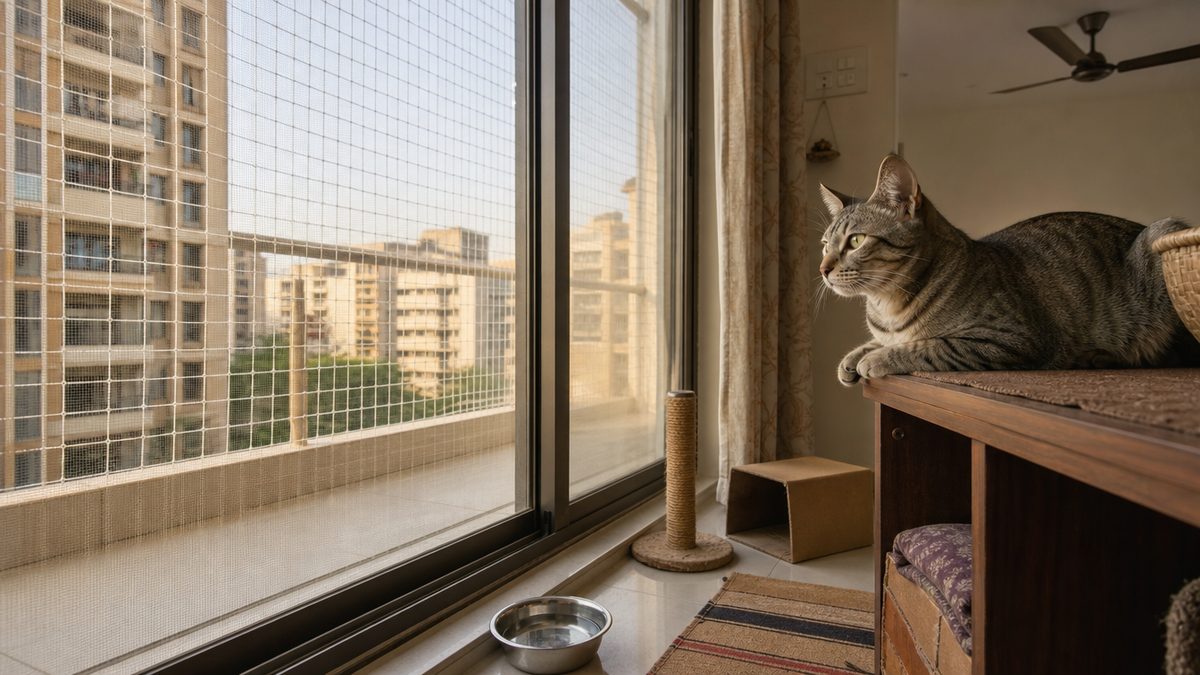
MK Bird Net Services, with service centres in Mumbai, Pune, Bangalore, Ahmedabad, Jaipur, Delhi, Chennai, Kochi and Kolkata, lists a nylon cat-proofing net with a 5 mm mesh at 'approx. Rs 30 / sq ft' and a minimum order of 100 sq ft, so a 10 by 10 foot balcony opening is about Rs 3,000 before the visit charge. Rs 30 divides to 0.36 and 0.41 and Rs 3,000 to 35.6 and 40.5, so it is a rupee price; it is also one installer's list price on one day, so get two quotes. Fit fine mesh to every window that opens, check the AC sleeve and the drying-rack pulley gap, and do it before day one, because the fallers were mostly adults, mostly at night, mostly in the warm months.
The choice is not only safety. The same fall series notes that in Berlin, where flats have no air conditioning, ventilation in summer 'relies on open windows and balcony doors', and that is a Chennai or Kolkata flat in April as much as a German one in July. A netted balcony gives the cat the sun, the birds and the breeze that International Cat Care lists on the outdoor side of the ledger, at a fall risk of nil, and the three Indian insurers that write cat policies, listed in the pet insurance guide, cover a fall as an accident only if the policy was bought before it.
Weight: the WSAVA body condition score and how many adult cats are heavy
Weight is the number the adult years turn on, because the 2021 AAHA/AAFP guideline names obesity prevention as the young adult cat's main job, scores 6 or 7 on the 9-point chart as overweight and 8 or 9 as obese, and the largest prevalence study, 1,341,118 cats seen at one US chain between 2020 and 2023, found 47.2 percent of adult cats overweight and another 13.9 percent obese Montoya M, Peron F, Hookey T, Morrison J.
The prevalence climbs through the adult years and peaks at the mature stage. In the 1.3-million-cat study, 36.2 percent of young adults were overweight and 3.6 percent obese; at the adult stage the figures were 47.2 and 13.9; at the mature stage 44.8 and 21.7; at senior 32.0 and 12.6; and a cat recorded as overweight while still growing had 1.52 times the odds of being overweight as an adult. A Swedish study found the second half of the problem, the owner's eye: trained staff scored 45 percent of 1,072 cats as overweight, while owners judging their own cats scored 22 percent of 1,665, and eating mostly dry food, being 'a greedy eater' and inactivity carried the risk, with male cats more often heavy and Persians less often. The AAHA/AAFP guideline puts the published range at 1.8 to 40 percent, names neutering as a risk factor 'especially [in] males', and lists what excess weight predisposes to: diabetes mellitus, lameness, skin disease and urethral obstruction. The UK life table adds the last line: non-ideal body weight was 'significantly linked to a decreased lifespan';. No Indian prevalence study exists to cite; a PubMed search for obesity, cats and India returned 0 records on 18 September 2026 with a passing control, so the figures above are foreign and the chart below is the tool.
| Score | What you feel and see | Verdict |
|---|---|---|
| 1 to 2 | Ribs very easily seen on a short-haired cat, lumbar vertebrae and pelvic bones easily seen and felt, severe or pronounced abdominal tuck, no fat pads | Under ideal, see the vet |
| 3 | Ribs easily felt with minimal fat covering, lumbar vertebrae obvious, obvious waist behind the ribs, minimal abdominal fat pad | Under ideal, lean |
| 4 | Ribs felt with minimal fat covering, noticeable waist behind the ribs, slight abdominal tuck, minimal abdominal fat pad | Ideal |
| 5 | Well proportioned, ribs felt with slight fat covering, waist seen behind the ribs but not pronounced, abdominal fat pad minimal | Ideal |
| 6 | Ribs felt with slight excess fat covering, waist and abdominal fat pad present but not obvious, abdominal tuck absent (the chart notes 6 may be acceptable in some older cats) | Over ideal, overweight |
| 7 | Ribs not easily felt through moderate fat covering, waist not easily seen, slight rounding of the abdomen, moderate abdominal fat pad | Over ideal, overweight |
| 8 | Ribs not felt under excess fat, waist absent, obvious rounding of the abdomen with a prominent fat pad, fat over the lower back | Obese |
| 9 | Ribs not felt under heavy fat cover, heavy fat deposits over the lumbar area, face and limbs, distended abdomen with no waist | Obese |
How to check at home in two minutes a month
To check a cat's body condition at home, use the same three touches the chart is built on and write the result down. The steps are listed below Quimby J, Gowland S, Carney HC, DePorter T.
- Run flat fingers over the ribs behind the shoulder; at 4 or 5 the ribs are felt under a slight covering, at 7 they are hard to find, at 8 they are not felt
- Look down at the cat from above; a waist behind the ribs is 5, no waist and a rounded abdomen is 8
- Look from the side; a slight tuck of the belly is 4 or 5, a swinging abdominal fat pad is 7 or more
- Weigh the cat on the bathroom scale by weighing yourself holding it and subtracting, on the same day each month, and keep the number with the date
- Photograph the cat from above and from the side once a quarter, the two views the guideline asks the vet to keep, so a slow gain is visible to you first
- Take the score and the weight to the annual visit and ask the vet to score the cat too; a score of 6 or 7 is overweight and 8 or more obese by the guideline's own cut-offs
Feeding by the maker's chart is the lever. Royal Canin India's Fit 32 page prints a daily ration by body weight, 44 g for a 3 kg cat, 54 g for 4 kg, 63 g for 5 kg and 72 g for 6 kg at ideal weight, and 35, 43, 51 and 58 g for the same cats if they are overweight, at a metabolisable energy of 3,839 kcal per kg. That is a measured cup, not a filled bowl. The Kolkata newspaper page that ranks for 'cat care india' quotes a Feline Club of India speaker advising owners to 'keep kibbles available in a bowl throughout the day' because 'cats don't overeat';; the 1.3-million-cat figure above is the answer to that, and the AAHA/AAFP guideline's answer is the food puzzle and the hidden portion rather than the open bowl Montoya M, Peron F, Hookey T, Morrison J. What a neutered cat's ration drops to, and how to cost a home-cooked diet, are in the cat diet chart guide and the homemade cat food guide.
Teeth: how common dental disease is in the adult years, with the denominators
Dental disease in adult cats rises from 3.6 percent under 3 years to 13.1 percent at 3 to 6 and 19.9 percent at 6 to 9 in the largest primary-care study, 18,249 UK cats in the VetCompass programme in 2019, where periodontal disease was 'the most common specific diagnosis in cats' at 15.2 percent overall.
The age gradient is the finding. Of 5,555 cats under 3, 202 (3.6 percent) had periodontal disease recorded; of 3,772 aged 3 to 6, 494 (13.1 percent); of 3,046 aged 6 to 9, 605 (19.9 percent); of 2,394 aged 9 to 12, 601 (25.1 percent); the median age of a cat with the disease was 9.47 years against 4.94 without, and a cat over 9 had more than six times the odds of a cat under 3. Neutered males had higher odds than entire females, cats of 4 to 7 kg had higher odds than cats under 3 kg, and a cat with periodontal disease carried a median of 3 other diagnoses against 1 for a cat without, with 1.79 times the odds of at least one comorbid disorder. The ranking clinic blog's 'majority of cats over 3' has no denominator; the measured figure at 3 to 6 is 13.1 percent, which argues for starting the brushing at 1 rather than waiting for a majority.
| Breed | Cats in the sample | With periodontal disease | Percent |
|---|---|---|---|
| Siamese | 123 | 23 | 18.7 |
| Maine Coon | 168 | 28 | 16.7 |
| British Shorthair | 542 | 84 | 15.5 |
| Crossbred | 15,841 | 2,442 | 15.4 |
| Persian | 131 | 19 | 14.5 |
| Bengal | 219 | 21 | 9.6 |
| All cats | 18,249 | 2,780 | 15.2 |
The breed rows carry small numerators, and the paper's own confidence interval for the Siamese runs from 12.2 to 26.7 percent, so read the Siamese and Maine Coon figures as 'higher than average' rather than as ranks; the Bengal and the Ragdoll were the only breeds with significantly lower odds than the crossbred cat. The Persian sits at the average here, but its flat face adds a separate problem the same research group has measured, malocclusion, which is on the breed page.
What to do is in the AAHA/AAFP guideline, which calls for 'lifelong proactive dental care', asks the practice team to 'instruct owners on how to examine the cat's mouth and how to brush the teeth', points owners to products with Veterinary Oral Health Council approval, and makes the young adult oral examination a specific check for periodontal disease and tooth resorption. The home version is a soft brush or finger brush with a cat toothpaste, daily if the cat allows and several times a week if not, plus a look at the gum line for the red rim and a sniff for the breath that changed; a cat that drools, chews on one side or paws at its mouth needs the vet, not a diet change. No Indian clinic page opened on this attempt prints a dental scaling price for a cat, so that line of the cost table is blank rather than guessed.
What a year of adult cat care costs in India, in rupees
A year of adult cat care in India costs about Rs 31,000 to Rs 36,200 on the lines this page could source, dry food, the annual booster, one consultation, worming, monthly flea control and litter, before insurance, grooming and any illness, and every figure in the table was read on 18 September 2026 from the seller's or clinic's own page and divided by 84.38 and by 74 to check it is not a converted dollar list.
| Line | Source and unit price | A year for a 4 kg cat | Divided by 84.38 and by 74 |
|---|---|---|---|
| Dry food, Royal Canin Fit 32, 4 kg pack | Supertails, Rs 3,573 (Rs 893 per kg); maker's chart 54 g a day | 19.7 kg, about Rs 17,600 | 42.3 and 48.3, not a conversion |
| Dry food, Royal Canin Fit 32, 10 kg pack | Supertails, Rs 7,498 (Rs 750 per kg); same 54 g a day | About Rs 14,780 | 88.9 and 101.3, not a conversion |
| Dry food, Whiskas Ocean Fish adult, 3 kg pack | Supertails, Rs 1,086 (Rs 362 per kg); the maker's page prints no gram table in its text | About Rs 7,140 at the same 54 g, otherwise from the pack | 12.9 and 14.7, not a conversion |
| Annual booster, trivalent plus rabies | Vetic national page, package from Rs 1,899 (list Rs 1,908) | Rs 1,899 | 22.5 and 25.7, not a conversion |
| Consultation at the annual visit | Vetic Koramangala, from Rs 799; home visit Rs 299 on offer (list Rs 799) | Rs 299 to Rs 799 | 9.5 and 10.8, not a conversion |
| Baseline blood tests | Vetic Koramangala, from Rs 200 | From Rs 200, panel price on the day | 2.4 and 2.7, not a conversion |
| Worming, Kiwof for cats, one tablet per 4 kg | Supertails, Rs 437 for 10 | 4 to 12 doses, Rs 175 to Rs 524; 2 doses on Vetic's indoor schedule, Rs 87 | 5.2 and 5.9, not a conversion |
| Flea control, Revolution cat spot-on, monthly | Supertails, Rs 2,472 for 3 pipettes (Rs 824 a month) | Rs 9,888 | 29.3 and 33.4, not a conversion |
| Litter, unscented bentonite, 5 kg | Supertails, Rs 264 (BearHugs) to Rs 319 (Petcrux); a 5 kg pack lasts 3 to 4 weeks for one adult cat | 13 to 17 packs, about Rs 3,430 to Rs 5,530 | 3.1 and 3.6; 3.8 and 4.3 |
| Balcony net, one-off | MK Bird Net Services, Rs 30 per sq ft, 100 sq ft minimum | About Rs 3,000 once | 0.36 and 0.41, not a conversion |
| Scratching tree, one-off | Supertails, Rs 1,033 | Rs 1,033 once | 12.2 and 14.0, one data point |
The sum is arithmetic, not a market survey. Food at Rs 14,780 to Rs 17,600, the booster at Rs 1,899, one consultation at Rs 799, worming at Rs 175 to Rs 524, flea control at Rs 9,888 and litter at Rs 3,430 to Rs 5,530 add to about Rs 31,000 to Rs 36,200, and the flea line is still the largest single share of it, which is where a vet's choice of a cheaper active changes the year most Vetic Pet Clinic, Koramangala Supertails, Savavet Kiwof Cat Deworming… Supertails, Zoetis Revolution Cat Spot… Supertails, BearHugs Unscented Bentonite… Supertails, Petcrux Eco Clump Bentonite… Supertails, Scoopy Cat Litter. A supermarket food at Rs 362 a kilo, the Whiskas adult pack, would cut the food line to about Rs 7,140 at the same grams, but its maker's page prints no gram table, so that row is a comparison of price per kilo and not of a year. Every food figure rests on Royal Canin's own gram chart, so a cat fed by the bowl rather than the chart eats more and costs more, and a cat scored 6 or 7 on the chart above eats the overweight column, 43 g rather than 54, and costs a fifth less. The prices are one retailer's and one chain's on one day; a wholesale bag from the neighbourhood shop, a college clinic or a government veterinary hospital moves each line down, and an illness moves the year up by more than the whole table.
Two lines are missing on purpose. Dental scaling has no Indian cat price on any page opened. Insurance is a choice rather than a cost, and the pet insurance guide names the three insurers that write a cat policy, with the entry ages, waiting periods and exclusions from the policy wordings. Sterilisation, spaying for a female and neutering for a male, is a one-off that belongs before the adult years, and its clinic and NGO prices are in the cat sterilisation guide. The exchange-rate test in the last column is the site's standing check: a rupee figure that divides to a whole number of dollars at 84.38 or at 74 was probably converted from a foreign list, and none of these did.
Common questions about caring for an adult cat in India
How do I care for an adult cat?
To care for an adult cat, book one full examination a year with weight and body condition score recorded, give the core booster at the interval the vet sets for its risk, deworm every 1 to 3 months by lifestyle, keep flea control running all year, weigh the cat monthly, brush its teeth, and keep it indoors behind a netted balcony with the five environmental pillars in place.
What is the 3-3-3 rule for cats?
The 3-3-3 rule is a shelter handout for a newly adopted cat, not a guideline. Pasadena Humane gives 3 days to decompress, when the cat may hide, refuse food or miss the tray, 3 weeks to learn the routine, and 3 months to start to feel at home, by which time house soiling in an adult should have resolved; it is a settling-in frame rather than a health rule.
At what age is a cat fully adult?
A cat is fully adult at 1 year by the 2021 AAHA/AAFP guideline, which runs the young adult stage from 1 through 6 years and the mature adult stage from 7 to 10, with senior beginning after 10. International Cat Care calls 1 to 2 years 'junior' and says a cat enters its prime after 2, once growth and development have finished; a neutered cat reaches that point heavier unless its ration drops International Cat Care.
Do and don'ts with cats?
The cat care do's and don'ts for a flat are short. Do feed by the maker's gram chart, scoop the tray daily, give one tray per cat plus one with unscented clumping litter, provide a raised hiding place and a scratching post, and weigh the cat monthly. Don't leave string toys out after play, don't let a dog flea product near the cat, don't open a window without mesh, and don't leave an open bowl of kibble down all day Quimby J, Gowland S, Carney HC, DePorter T Tropical Council for Companion Animal….
How to take care of a cat for beginners?
To take care of a cat as a beginner, fix three things before the cat arrives, mesh on every window that opens and a net on the balcony, two litter trays with unscented clumping litter placed apart, and a measured ration from the food pack's own chart, then book the first vet visit within the week, when the vet sets the booster, worming and flea schedule and records the baseline weight the next ten years are measured against Candela Andrade M, Slunsky P, Nerlich.
How much does it cost to care for a cat in India?
A year of adult cat care in India adds to about Rs 31,000 to Rs 36,200 on the lines this page could source: dry food at Rs 14,780 to Rs 17,600 by Royal Canin's own gram chart for a 4 kg cat, the annual booster at Rs 1,899 at Vetic, a consultation at Rs 799, worming at Rs 175 to Rs 524, monthly flea control at Rs 9,888, and litter at Rs 3,430 to Rs 5,530 for the 13 to 17 packs a cat gets through at one 5 kg pack every 3 to 4 weeks, before insurance, grooming and any illness Supertails, Zoetis Revolution Cat Spot… Supertails, Scoopy Cat Litter.
What is a silent killer for cats?
Vets apply 'silent killer' to systemic hypertension, high blood pressure, because, as a Vet Times clinical article puts it, 'clinical signs of this condition are not always readily visible' until a cat goes suddenly blind. It is usually secondary to chronic kidney disease, which the VetCompass study of 353,448 cats calls the most frequent cause of death in cats over five, and International Cat Care asks for blood pressure checks from age 7 Conroy M, Brodbelt DC, O'Neill D International Cat Care.
Can a cat live 40 years?
No cat has lived 40 years on any verified record. Guinness World Records lists the oldest cat ever as Creme Puff of Austin, Texas, born 3 August 1967, who lived 38 years and 3 days to 6 August 2005. The UK life table built on 7,936 deaths in 2019 puts a pet cat's life expectancy at birth at 11.74 years, so 20 is exceptional and anything past 30 is a record claim Teng KT, Brodbelt DC, Church DB.
How do I say "I love you" in cat?
Slow-blink at the cat. The University of Sussex study in Scientific Reports found that cats half-blinked and narrowed their eyes more often when their owners slow-blinked at them than when the owner sat with a neutral face, and that cats were more likely to approach an experimenter who had slow-blinked; the authors describe the slow blink sequence as a form of positive emotional communication between cats and humans.