
Cat care guide
Heat safety for cats in India: signs of heat stress and how to keep an indoor cat cool
Cats overheat in a hot place, not on a walk: every feline case with a known trigger in the only surveillance series was environmental, and one in four cats was 15 or older. This guide gives the signs, the 40 C line, the first aid, summer heat figures for nine cities, the closed-flat routine and the AWBI advisory of 4 May 2026.
Quick answer
How to keep cat cool in summer in India comes down to the room, the water and the signs: leave the coolest tiled room and the bathroom open with a fan running, draw the curtains by 10 am and open the windows at night, feed wet food with water in three spots, and treat an IMD orange or red day as a no-balcony, no-terrace, no-car day. A cat above 40 C body temperature is in heatstroke: cool it with water and moving air first, then go to your nearby vet, who decides for your cat. Cats were 16 of 174 recorded heat-illness cases, all from a hot place.
This guide is general information for Indian pet owners and is not a diagnosis. Always consult a registered veterinarian near you before acting on anything you read here, and treat any sudden change in your pet's condition as urgent.
How often cats get heat illness, and what the 16 recorded cats tell us
Cats were 16 of the 174 heat-related illness cases recorded across UK veterinary practices in the SAVSNET surveillance study of 2013 to 2018, 9.2 percent of the total against 146 dogs, and every feline case with a recorded trigger was environmental, a hot place rather than exertion.
Hall, Radford and Carter read the electronic consultation records of volunteer practices across the UK and confirmed 16 cats: 11 females and 5 males, 10 domestic short-hairs, 3 domestic long-hairs, 1 Bengal and 1 crossbreed, aged 0.4 to 19 years with a median of 10.4. The trigger was not written down for 10 of the 16 (62.5 percent); the 6 with a trigger were all environmental, none exertional and none vehicular, where 73.5 percent of triggered dog events followed exercise. Cats presented from May to September, 12 of 16 (75.0 percent) in June and July, the two hottest British months, so in India the same curve sits over April, May and June.
Age is the finding that matters most for an Indian flat. Four of the 16 cats (25.0 percent) were 15 or older, against 7.82 percent of the 285,547 cats in the VetCompass comparison population, a significant over-representation; the authors point to age-related changes in thermoregulation and to the heart, airway and kidney disease that old cats carry. The senior cat care guide covers those diseases; this page covers the room.
The signs the vets recorded were quieter than a dog's: of the 14 cats with a sign in the notes, 10 were lethargic, 6 had abnormal breathing and 3 vomited; no cat was recorded as collapsed or obtunded, and no feline record reported death, though the authors warn that a cat which overheats away from home and cannot get back is never counted.
| Measure | Cats | Dogs, for comparison |
|---|---|---|
| Cases | 16 of 174 (9.2 percent) | 146 of 174 |
| Trigger recorded | 6 of 16; all 6 environmental | 104 of 146; 73.5 percent exercise, 6.9 percent hot vehicle, 19.6 percent environmental |
| Peak months | June and July, 12 of 16 | July, 62 of 146 |
| Age | Median 10.4 years; 4 of 16 aged 15 or more (25 percent, against 7.82 percent of cats generally) | 4 to under 6 years over-represented |
| Breed or coat | 10 domestic short-hair, 3 domestic long-hair, 1 Bengal, 1 crossbreed, 1 unrecorded | Springer Spaniel, Cavalier, French Bulldog, Bulldog over-represented |
| Commonest recorded signs | Lethargy 10 of 14, abnormal breathing 6 of 14, vomiting 3 of 14; no collapse recorded | Abnormal breathing 72, lethargy 55, collapse 46 of 134 |
| Deaths recorded at the consultation | None | 5 |
A PubMed search on 18 September 2026 for heat stroke, heatstroke or heat-related illness in cats returned 9 records, of which 2 report feline cases: the SAVSNET series above and a 2021 series of 3 cats treated after being shut in a running clothes dryer; the same search restricted to India returned 0, while the dog equivalent returned 83 Cudney SE, Wayne. The 9.2 percent is British. What transfers is the shape of the risk: a hot enclosed place, an old cat, the two hottest months, and a set of signs quiet enough to miss until the case is fatal.
Signs of heat stress in a cat, the 40 C line, and cool-first first aid
A cat's normal body temperature is 38.1 to 39.2 C, and above 40 C (104 F) the cat is at risk of heatstroke, with severe dehydration, seizures, blood clotting problems, organ damage, coma and death on the PDSA's list of what can follow.
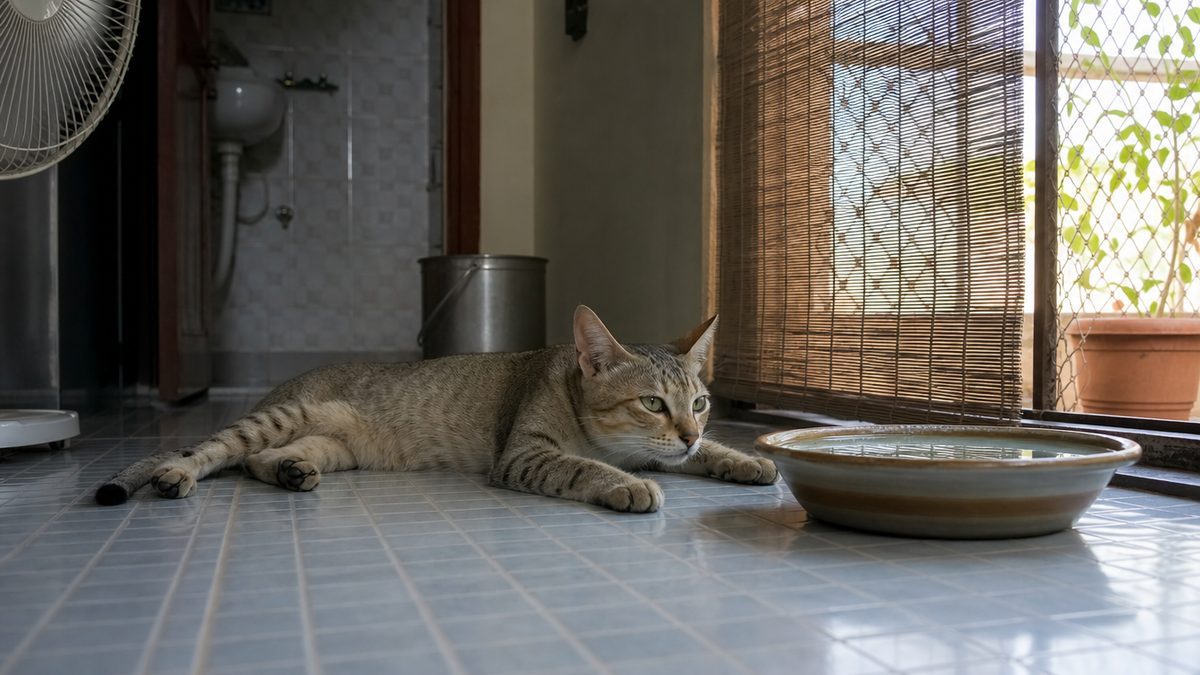
The early stage is heat exhaustion, roughly 39.4 to 40 C (103 to 104 F) on PetMD's veterinarian-written page, and its signs are behaviour, not collapse: the cat seeks a tile floor or a shady spot, pants, starts to drool, develops sweaty paws, drinks more and grooms itself to cool off. The Royal Veterinary College says the signs are similar in dogs and cats 'although in cats the signs are often more subtle', and Vets Now puts the one that matters in a sentence: rapid breathing at rest 'is not normal in cats the way it is in dogs'; Vets Now (UK emergency veterinary chain). A cat pants late, so a cat that pants is already in trouble.
| Stage | What you see | Source |
|---|---|---|
| Too hot, still coping | Lying flat on tiles, in the bath or the basin; grooming more; drinking more; inactive through the afternoon | International Cat Care, PetMD |
| Heat exhaustion, about 39.4 to 40 C | Panting or open-mouth breathing at rest, drooling, sweaty paws, restlessness, odd cool hiding places | PetMD, Vets Now |
| Heatstroke, above 40 C | Panting and fast breathing; bright red, dark red or very pale gums; vomiting; diarrhoea, sometimes with blood; weakness; confusion; wobbliness and collapse; seizures; blindness; unconsciousness | PDSA |
| What the AWBI asks a citizen to watch for | Excessive panting, lethargy, drooling, rapid heartbeat, collapse | AWBI advisory, 4 May 2026 |
First aid: cool first, then the vet, and never a wet towel over the cat
To cool a cat with heatstroke, follow the PDSA's three steps, which match the Royal Veterinary College's 'cool first, transport second' rule Royal Veterinary College. The five actions below are theirs.
- Move the cat to a cool room or into the shade at once.
- Pour cold tap water slowly over the whole body, gently, keeping it away from the nose and mouth; make a breeze with a fan or open doors and windows; lay the cat on top of a cold, soaking wet towel; offer cold water to drink but never force it; wrap an ice pack or a bag of frozen peas in a tea towel and put it between the legs.
- Do not cuddle the cat or cover it with a wet towel, which makes it hotter; Vets Now says the same, a damp cloth over the cat traps warm air under it.
- Call your nearby vet and go, in a car with the air conditioning on or the windows open, with a second person cooling the cat on the way.
- Have the cat examined even if it looks recovered; the serious signs may not be immediately apparent, and a cat that has had heatstroke is more prone to a recurrence.
The sources disagree on how cold the water should be, and both are printed here. The PDSA (September 2023) says cold tap water over the whole body and an ice pack between the legs; the RVC says not ice-cold water, which narrows the skin's blood vessels and can start shivering, and recommends water 'of any temperature that is cooler' than the animal with moving air; PetMD says a slightly cool damp towel on the back and water on the paw pads and ears Royal Veterinary College PetMD, Heatstroke in Cats: Signs. Tap water in an Indian May is nowhere near ice-cold, so the instruction is the same in all three: water cooler than the cat, poured not wrapped, with a fan, then the vet. The 2026 RECOVER first aid guidelines for dogs and cats include heat stroke among 38 recommendations and grade 15 of them as resting on low or very low quality evidence and 18 on expert opinion, so no first-aid page, this one included, is quoting a trial. The veterinarian who sees your cat decides what it needs; the PDSA's treatment list is cooling, a fluid drip, blood and urine tests and possibly days in hospital.
The IMD heat wave alert, read for a cat that never leaves the flat
An IMD heat wave is declared when a plains station reaches at least 40 C (30 C in the hills) and runs 4.5 to 6.4 C above its normal maximum, or reaches 45 C outright, at two stations in a sub-division on two consecutive days; severe means more than 6.4 C above normal or 47 C actual, and a coastal station qualifies at 37 C with a 4.5 C departure.
The season is March to June with May the peak, and WHO India counts five to six heat wave events a year over the northern states India Meteorological Department. Two government pages print different departure figures: the NDMA page, last updated 13 December 2025, still gives 5 to 6 C (severe 7 C or more) where the normal maximum is 40 C or below and 4 to 5 C (severe 6 C or more) above it. IMD declares the wave, so its 4.5 to 6.4 C governs today; both agree on the 40 C floor and the 45 C trigger National Disaster Management Authority. Two more IMD definitions matter to a cat more than to a dog. A 'warm night' is declared only when the maximum stays at 40 C or more and the minimum runs 4.5 to 6.4 C above normal, and 'hot and humid weather' is a maximum 3 C above normal with above-normal humidity; the first means the flat does not cool overnight, the second means evaporation, the only cooling a cat has beyond its paw pads and its tongue, slows down, because high humidity 'leads to slower evaporation rate';.
| Colour | IMD definition | The cat |
|---|---|---|
| Green | Maximum near normal | Normal routine; water in several places |
| Yellow | Heat wave at isolated pockets for 2 days | Coolest room open to the cat, fan or air conditioning through the afternoon; Persians, long-haired, senior and overweight cats checked every hour |
| Orange | Severe heat wave for 2 days, or heat wave for 4 days or more | No balcony, no terrace, no car; curtains drawn by 10 am, wet floor and fan or AC from 11 am; wet food; a neighbour with a key if you work |
| Red | Severe heat wave beyond 2 days, or 6 or more heat wave days | As orange, plus a plan for the power cut: the cooler flat or clinic you can carry the cat to |
The IMD's own do's and don'ts already cover the cat: 'keep animals in shade and give them plenty of water to drink', 'do not leave children or pets in parked vehicles', and for the home, 'use curtains, shutters or sunshade and open windows at night' and 'use fans';. The human line is the feline one: the NDMA defines heat stroke in a person as a body temperature of 40 C or more, and the PDSA's cat threshold is the same 40 C PDSA, Heatstroke in cats (Pet Health Hub. IMD refreshes its five-day warning four times a day, with a morning bulletin at 0800 IST and the five-day warning at 1600.
How to read a forecast for a cat
To read a forecast for a cat, take the district colour and the forecast maximum from mausam.imd.gov.in, treat a maximum of 40 C or more as an orange day whatever the colour says, and treat a forecast minimum of 30 C or more as a night the flat will not cool on its own. The dog twin, heat safety for dogs in India, translates the same alert into walk windows; a cat has no walk to cancel, so for a cat the alert is about the room.
Nine cities: how hot the flat gets, how many days pass 40 C, and where the fan stops working
The hottest month's mean daily maximum runs from 35.8 C in Bengaluru to 42.7 C in Ahmedabad, Delhi passes 40 C on about 60 days a year and Ahmedabad on 67, and the humid coast peaks at a wet-bulb temperature of 25.8 to 27.2 C, where the evaporation a cat cools by slows to a crawl.
The method is the breed pages' own, run again for this page on 18 September 2026: NASA POWER's daily API, queried for each city-centre point for T2M, T2M_MAX, T2M_MIN and RH2M for every day of 2019 to 2023, averaged by month, with the wet-bulb temperature computed by Stull's formula from the monthly mean temperature and humidity, never from a period maximum. POWER returns a grid cell; all nine cells sit within 100 m of their city's real elevation (Delhi 206 m against 216, Mumbai 97 against 14, Bengaluru 842 against 920), so the plains figures are the cities, while hill stations fail that check and a reader in Ooty, Shimla or Manali should use the local IMD forecast alone. The dog guide's hourly pull gives the same mean daily maxima and wet-bulb peaks 0.1 to 0.4 C lower, because it averaged hours rather than days. Hyderabad's April and May tie at 39.2 C, May a hundredth warmer.
| City | Hottest month, mean daily max | Mean daily min, same month | Days a year at 40 C or more | Peak wet-bulb (Stull) | Months with mean daily max 35 C or more |
|---|---|---|---|---|---|
| Delhi | Jun, 41.3 C | 28.9 C | 60 | Jul, 26.8 C | Apr-May-Jun-Jul |
| Jaipur | May, 40.3 C | 26.1 C | 50 | Jul, 26.0 C | Apr-May-Jun-Jul |
| Ahmedabad | May, 42.7 C | 26.9 C | 67 | Jul, 26.4 C | Mar-Apr-May-Jun |
| Hyderabad | May, 39.2 C | 26.3 C | 32 | Jun, 23.6 C | Mar-Apr-May |
| Kolkata | Apr, 39.1 C | 24.9 C | 17 | Jun, 27.2 C | Apr-May |
| Mumbai | Apr, 39.7 C | 24.6 C | 23 | Jun, 25.8 C | Mar-Apr-May |
| Chennai | Apr, 36.2 C | 26.4 C | 2 | May, 26.3 C | Apr-May-Jun |
| Pune | Apr, 38.2 C | 21.3 C | 10 | Jun, 23.0 C | Mar-Apr-May |
| Bengaluru | Apr, 35.8 C | 21.1 C | 0 | May, 22.1 C | Mar-Apr |
What the table says about your flat
Delhi, Jaipur and Ahmedabad are the dry-heat cities: a 40 to 43 C mean afternoon in the hottest month, 50 to 67 days a year at or past the IMD's 40 C floor, and a June night of 26 to 29 C at its coolest; Delhi's minimum stayed at 30 C or above on about 15 nights a year, 11 of them in June, the 'warm night' IMD defines and the night a west-facing flat never sheds its heat India Meteorological Department. A closed room in one of these cities is the greenhouse of the British cases. Kolkata, Mumbai and Chennai are the wet-bulb cities: cooler afternoons, 2 to 23 days past 40 C, but a peak wet-bulb of 25.8 to 27.2 C in May or June, so a cat cooling by evaporation off a licked coat and four paw pads gets less from every lick, a fan moving humid air is a comfort rather than a cooling system, and the AC or a wet tile floor does the work. Bengaluru and Pune are the exceptions, with a 21 C night in the hottest month and, in Bengaluru, no day at 40 C in five years; every city's afternoon still reaches the point where the PDSA's commonest cause, a hot poorly ventilated room, applies PDSA, Heatstroke in cats (Pet Health Hub.
The closed room, the glass balcony, the terrace and the car: where cats overheat
The most common cause of heatstroke in cats is being accidentally trapped in a hot, poorly ventilated space such as a shed, greenhouse, conservatory or garage, per the PDSA, and International Cat Care makes the same point about a cat 'confined to a room or conservatory which gets very hot'; International Cat Care.
In an Indian city the conservatory is the glass-fronted balcony, the shed is the store room or the parked car, and the greenhouse is the west-facing bedroom with the door shut and the AC off at 3 pm; a closed room is the case, not the exception. The 2021 series of three cats treated for heat stroke after being shut in a running clothes dryer, all meeting canine heat-stroke criteria, with clotting, liver, kidney and heart injury in the cats exposed longest, is the extreme version of the same mechanism: a cat curls up somewhere warm and cannot get out. The RSPCA's figure for the enclosed space is that a car, conservatory or outbuilding 'can quickly rise to 47 C (117 F), which can be fatal'.
The hot car, measured
A closed car heats by an average of 3.2 F (1.8 C) every five minutes whatever the outside temperature, with 80 percent of the rise in the first 30 minutes and about 40 F (22 C) in an hour, in the Stanford study of 16 clear days at 22 to 36 C outside; even on the coolest day the interior reached 117 F (47 C), and windows opened 1.5 inches made no significant difference to the rate or the final temperature. The IMD's don'ts say 'do not leave children or pets in parked vehicles'; the PDSA says never in a car on a warm day, 'not even for a few minutes or with the windows open'; and ICC adds the trap in reverse, a cat that slips into a car left open to cool and is locked in for the night PDSA, Heatstroke in cats (Pet Health Hub International Cat Care. A vet visit in May goes by air-conditioned car or by autorickshaw with a shaded, ventilated carrier out of the sun.
The terrace and the balcony floor
Asphalt in direct sun reaches 52 C (125 F) when the air is 25 C (77 F) and 57 C at 30 C, per the Washington State University College of Veterinary Medicine quoting Berens's 1970 study of thermal contact burns, and skin is destroyed in 60 seconds at 52 C; the college's test is to press the back of your hand to the surface and count to seven. The AWBI's 2026 advisory names 'burns from hot surfaces' among the injuries an owner has a duty to prevent. A terrace, a sunlit balcony tile or a metal grille fails the seven-second test from mid-morning to dusk in every city in the table, so a balcony cat gets its balcony before 9 am and after sunset, netted, with a shaded water bowl. The falls that come with a window opened for the night breeze are on the adult cat care guide, and the whole flat, room by room, is on the indoor cat safety guide.
The one-room flat without air conditioning
To keep a one-room flat liveable for a cat without air conditioning, use the IMD's household list and ICC's cat-specific one together; the seven steps below are theirs, with fans and wet tiles doing the work the AC would International Cat Care.
- Curtains, shutters or a sunshade on the sun-facing window by 10 am, and the windows opened at night, IMD's own rule for keeping a home cool.
- Fans running, supervised, and the kitchen or bathroom tiles left open to the cat, because 'tiles and materials such as porcelain keep cool' and cats find them on their own.
- A cool mat or a frozen water bottle wrapped in a towel in the cat's usual resting spot.
- Water in several places, replaced several times a day, with a fountain for the cat that likes one.
- The bathroom door open and the floor wet, since a cat that lies in the bath or on wet tiles is cooling itself the only way it can.
- A plan for the power cut. PetMD lists 'indoor cats when there is no power or air conditioning in the home' among the commonest settings for feline heatstroke, so know which neighbour, relative or clinic has a cooler room you can carry the cat to.
- Sunscreen for a white-eared cat that sits in the window, pet-specific only, on the ear tips and nose, because ICC says cats with white, thin or no hair get sunburn and repeated sunburn can become squamous cell carcinoma.
Water: how much a cat actually drinks, and why wet food is the summer lever
A cat on a 73 percent moisture diet took in 144.7 ml of water a day, about 30 ml per kg of bodyweight, against 103.4 ml on the same food fed dry at 6 percent moisture, in a controlled cross-over trial of six cats, and it drank less from the bowl while taking in 40 percent more in total.
That is the mechanism behind every 'feed wet food in summer' tip: a cat does not make up the gap at the bowl. A 2026 scoping review of 32 papers from 1975 to 2025 found healthy cats consuming 23 to 51 ml of total water per kg of bodyweight a day, and the 42 to 51 ml/kg that produced a dilute urine (specific gravity below 1.035) was reached only on a wet diet or a dry diet with nutrient-enriched water; diet format, protein, salt and osmolytes changed intake, and fat content and water source type, 'static or flowing', did not. So the wet food is the evidence-backed lever, the fountain is a preference some cats have, and the Indian page that calls a fountain 'one of the highest-impact single purchases' is asserting what the review did not find. For a 4 kg cat the review's band is roughly 90 to 200 ml a day, which is a pouch or two of wet food plus what the cat drinks; the cat diet chart sets the amounts, and this page sets the season. Hydration is the AWBI's word for the same duty, 'key to combating heat stress', and a cat kept hydrated through May is a cat that reaches June.
How to offer the water, per International Cat Care
To get a cat to drink more, International Cat Care's drinking guide and its heatwave page give six rules, listed below International Cat Care.
- One water bowl per cat plus one, on every level of the home, with outdoor bowls near the door.
- Wide, shallow, glass or ceramic, filled to the brim, so the whiskers do not touch the sides and the cat's head stays out of the bowl.
- Away from the food and the litter tray, in a quiet spot the cat can approach from any side, and never a double bowl.
- Replaced several times a day in a heatwave, with a fountain, a dripping tap or a shower tray holding a little water for the cats that prefer movement.
- Poached chicken or fish water, tuna spring water, or a spoon of water stirred into the wet food, and never milk, brine, stock or anything with onion.
- Wet food picked up after the meal, because in hot weather food left out becomes 'a breeding ground for bugs and bacteria'.
Two sources disagree on ice, and both are printed here. ICC says to offer water and other liquids at room temperature where possible because 'flavour is reduced in cold liquids'; Blue Cross and the RVC suggest ice cubes in the bowl Blue Cross (UK), Top tips for keeping your… Royal Veterinary College. Offer both bowls and let the cat choose. The AWBI's answer for the balcony or the street is a large earthen pot with a wide opening, in the shade, which stays cool by evaporation through the clay and is too heavy to tip.
Persians, long coats, kittens, seniors and the overweight cat
Cats with long coats, obese cats, brachycephalic cats such as Persians, very old cats and very young kittens, and cats with heart and lung disease are the PDSA's five higher-risk groups, and the Royal Veterinary College lists Persian cats beside Pugs and French Bulldogs among the flat-faced animals most susceptible to heatstroke Royal Veterinary College.
The Persian's nose
A cat sheds a large share of its body heat through its nose as it breathes out, and a flat-faced cat has 'much less space inside their nose', which the PDSA says puts a Persian at much higher risk 'even on seemingly cool days';. International Cat Care's Persian page gives the anatomy: small nostrils (stenotic nares), narrow nasal passages and an overlong soft palate, severe in some cats. No study has measured heat illness odds in brachycephalic cats the way the 2020 VetCompass study did in dogs: a PubMed search on 18 September 2026 for brachycephalic, brachycephaly or Persian with cat or feline and heat stroke, heat stress or thermoregulation returned 2 records, neither reporting feline cases by skull shape, while the dog search returned 17. So this page gives the Persian, the Himalayan and the Exotic Shorthair no odds ratio, and the rule instead: the coolest room in the flat is theirs, the air conditioning runs through an orange or red day, and open-mouth breathing at rest is the vet, now.
Coats, ages and weight
Of the 16 SAVSNET cats, 3 were domestic long-hairs and 1 was a Bengal; the series is too small to rank coats, and the four cats aged 15 or more are the only group it found over-represented. A long-haired Maine Coon, Ragdoll or British Shorthair carries a coat built for a northern winter, and the agreed step is to brush it daily to remove the dead undercoat, which the RSPCA, Vets Now and Blue Cross all give, because 'matted hair traps heat'; Vets Now (UK emergency veterinary chain) Blue Cross (UK), Top tips for keeping your…. A clip is a vet's call, and the sources split: Purina Australia says to talk to the vet first, a US veterinarian quoted by Daily Paws recommends a lion cut for long-haired cats, and ICC's weather page says nothing about clipping Daily Paws, Cats Can Overheat Too International Cat Care. The cat grooming at home guide has the brush and the grooming routine. Kittens of 4 months or younger and senior cats are on PetMD's list, as are cats with kidney disease, diabetes or mobility problems that keep them from the water bowl; the kitten care guide and the senior cat care guide carry the rest. The PDSA's line on weight is plain, 'overweight cats find it much more difficult to stay cool on warm days', and a short-coated Siamese or Bengal is not exempt, since the one Bengal in the series was a short-haired cat in a hot place Hall EJ, Radford AD. Monitor the four groups on every yellow day, not only on orange ones.
Community cats: the AWBI advisory of 4 May 2026, and what to put out
The Animal Welfare Board of India's advisory of 4 May 2026 is addressed to 'all the compassionate citizens, animal owners and care takers' as well as to every Chief Secretary, says animals 'including but not limited to dogs' are vulnerable to dehydration, heatstroke and burns from hot surfaces, and asks for shade through the day and water bowls kept full.
The legal frame is Section 3 of the Prevention of Cruelty to Animals Act, 1960, the duty of every person having charge of an animal to take all reasonable measures for its well-being, with failure an offence under Section 11(1); the advisory, file AC-02003/1/2026-AWBI, was digitally signed by the Board's Secretary on 4 May 2026 and renews the letter of 18 April 2024. Its four steps are shelter, water, monitoring and awareness, and the water instruction is specific: bowls 'in shaded areas, near wells or handpumps', in 'large earthen pots with wide opening or stable containers that cannot be easily overturned by animals';. The signs it asks a citizen to watch for, 'excessive panting, lethargy, drooling, rapid heartbeat, and collapse', are the dog's list; for a community cat the first sign is the one the SAVSNET vets recorded most, a cat that stays flat in the shade at 4 pm and does not come for food Hall EJ, Radford AD.
The only temperature lines in Indian animal law are in the same document, and neither is written for a cat: Rule 6(3) of the Prevention of Cruelty to Draught and Pack Animals Rules 1965 bars working an animal above 37 C between 12 noon and 3 pm, and Rule 12 of the Transport of Animals on Foot Rules 2001 bars moving animals on foot above 30 C or outside sunrise to sunset. They are the closest thing to a statutory 'too hot', and 30 C is roughly the mean daily minimum of a Delhi June night.
What to put out, and where
To help the cats on the stairwell, the parking floor or the lane, put out the five things below, and put them where a cat will use them.
- A wide earthen pot in permanent shade, refilled morning and evening, on the ground floor and away from the dogs' bowl, since ICC's rule is that a cat drinks where it feels safe from all sides.
- A shaded box open on two sides in a parking area or stairwell, because the shelter director quoted by Daily Paws says the best summer cat shelters are 'open on the sides to allow for airflow'.
- A look under the bonnet and in the wheel arches before starting a car, ICC's rule for cats that hide in engine bays, and a look inside a car or store room before locking it.
- Wet food in the shade at dusk, picked up after, not left to spoil through a 40 C afternoon.
- A vet's number saved, because the AWBI asks for 'immediate veterinary attention' at any sign of distress, and the adopting a cat in India guide lists the shelters that take in a community cat.
No page ranking for 'cats in summer india' on 18 September 2026 cites the AWBI advisory, the 1960 Act or the IMD criteria; the Indian pages say the summer is harsh and list products. The advisory is two pages in English, it is addressed to you as a citizen and care taker, and it says the water bowl and the shade are a duty under Section 3.
Seven mistakes that put cats in the clinic
The seven mistakes below each match a recorded trigger or a wrong first-aid step, and the first is the one the 16-cat series points to: a hot place the cat cannot leave.
- Shutting the cat in the hottest room. Every feline case with a known trigger was environmental; check the store room, the car and the balcony before you lock up.
- Reading panting as cooling. Rapid breathing at rest is a warning in a cat, not a way of cooling.
- A wet towel over the cat. It traps heat; the towel goes under the cat, soaking wet.
- Ice water and ice on the skin. The RVC's warning is narrowed skin vessels and shivering.
- Dry food only through May. The wet-diet cat took in 40 percent more water in the cross-over trial.
- Five minutes in the parked car. 1.8 C every five minutes, and the cracked window does nothing.
- Trusting a short coat or a young cat. One of the 16 was a Bengal, and the flat-faced Persian is at risk 'even on seemingly cool days'; PDSA, Heatstroke in cats (Pet Health Hub.
Every mistake has a cheap fix: the door left open, the water in three places, the wet food, the fans and the wet floor, the IMD colour, and cool first, then the vet. A cat that vomits, collapses or pants at rest on a hot afternoon has passed the point where the fix is cheap, and the vet near you decides what it needs.
Common questions
What temperature is too hot for a cat?
A body temperature above 40 C (104 F) is the line at which a cat is at risk of heatstroke; normal is 38.1 to 39.2 C. No veterinary body publishes an air temperature for cats, so use the IMD's plains heat wave floor, 40 C, as the household alarm, and the cat's own behaviour, flat on the tiles and panting, as the earlier one.
How hot is too hot for cats in the UK?
No UK charity page opened for this guide prints an air temperature for cats; the PDSA gives the body-temperature line, above 40 C, and the RSPCA warns that a car, conservatory or outbuilding can rise to 47 C. The British cases were presented from May to September, 12 of 16 in June and July, so a British June is a cat's danger month and an Indian April is hotter.
Do cooling mats really work for cats?
International Cat Care lists pet-specific cool mats and a towel-wrapped frozen bottle among the things that help a hot cat, but no trial has measured a cooling mat in cats. In nine working dogs, a 4 C mat brought core temperature down to 39 C in 36 minutes, against 48 for a fan alone and 16 for water immersion, so a mat helps a warm cat and is not first aid for a hot one.
Can a cat recover from heat stroke?
Yes, if it is cooled quickly and seen by a vet: the PDSA says a mild case treated fast is likely to make a full recovery, while a cat left hot for long is likely to develop organ damage and can die. None of the 16 cats in the SAVSNET series had death recorded at the consultation. A cat that has had heatstroke is more prone to a recurrence, so the next summer is planned, not hoped for.
How to know if a cat has heat stroke?
A rectal temperature above 40 C (104 F) confirms it. Without a thermometer, the PDSA's signs are panting and fast breathing, bright red, dark red or very pale gums, vomiting, diarrhoea that may contain blood, weakness, confusion, wobbliness, collapse, seizures, blindness or unconsciousness, in a cat that has been in a hot place. Start cooling, then call your nearby vet.
How can I treat heat stroke in my cat at home?
Cool first, then go: move the cat to a cool room or shade, pour water cooler than the cat slowly over its whole body away from the nose and mouth, put a fan on, lay the cat on a soaking wet towel, offer but never force a drink, and never cover it with a wet towel or use ice-cold water. Home cooling is the first ten minutes, not the treatment; the vet checks for kidney and clotting damage.
How can I tell if my cat is overheating?
A cat that is overheating seeks a tile floor or a shady spot, pants, starts to drool, develops sweaty paws, drinks more and grooms itself to cool off, which PetMD lists as the signs of heat exhaustion at roughly 39.4 to 40 C. Rapid breathing at rest is the one sign that is never normal in a cat; if you see it, move the cat somewhere cool and call your vet.
Do cats get too hot in the summer?
Yes. Cats were 16 of the 174 heat-related illness cases recorded across UK veterinary practices from 2013 to 2018, every one with a known trigger caused by a hot environment rather than exercise, 12 of 16 in June and July, and one in four aged 15 or more. An Indian April to June is hotter than a British July, and the closed flat is the hot environment.