
Dog life guide
How should a child approach a dog: the five steps, the stop and check, and what the Indian data change
Every page tells a child to ask permission. Almost none teaches the second half of the greeting, which is stopping after a few seconds to find out whether the dog wants more. That pause is the whole skill.
Quick answer
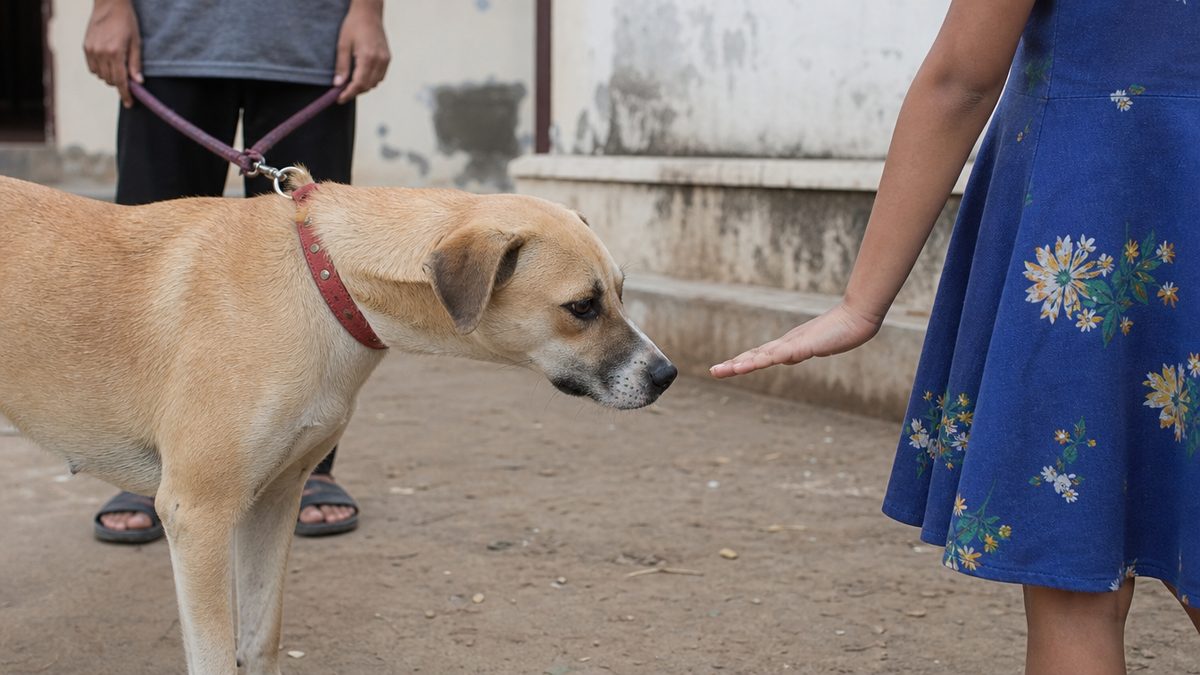
How should a child approach a dog? Ask the owner, then stand still and let the dog come. Offer a low, still hand instead of reaching over the head. Stroke the shoulder, chest or side of the neck for about three seconds, then stop and watch. If the dog leans back in, carry on. If it moves away or turns its head, stop. Children under five cannot do this reliably, so an adult supervises instead.
This guide is general information for Indian pet owners and is not a diagnosis. Always consult a registered veterinarian near you before acting on anything you read here, and treat any sudden change in your pet's condition as urgent.
How a child should approach a dog, in five steps
To approach a dog, a child works through five steps in a fixed order, and the fifth is the one almost every page leaves out. Ask permission, stand still and let the dog come to you, offer a low still hand, stroke the shoulder or chest for about three seconds, then stop and find out whether the dog wants more.
- Ask permission, out loud, and wait for the answer. The guide the Animal Welfare Board of India hosts for teachers puts it first, in the dog's own voice: always ask the owner's permission before you stroke a dog. The American Veterinary Medical Association gives the same instruction twice, once to the child and once to the parent.
- Stop two steps short and let the dog come to you. Approach slowly and calmly, do not loom over the dog, and do not walk straight at it, because a head-on approach and direct eye contact both read as threatening.
- Offer a low, still hand and let the dog close the last gap itself. If a dog approaches to sniff you, stay still, and in most cases it moves off once it has decided you are not a threat.
- Stroke the shoulder, the chest or the side of the neck, never the top of the head. Three or four slow strokes is the whole of it, and the child's face stays well away from the dog's face.
- Stop and check. Take the hand away, sit back and watch for three seconds. A dog that leans in again, nudges the hand or turns its body towards the child is asking for more. A dog that steps away, turns its head aside or goes still has answered no, and the greeting is over.
Steps one to four are on every page that ranks for this question. Step five is on almost none of them, and it is the one that turns a set of rules into a conversation the dog takes part in. We call it the consent test, and the rest of this page is about why it matters and what to do when the situation is not a leashed pet in a park.
Where this page disagrees with the guide the Indian government hosts
The Animal Welfare Board of India hosts a teachers' guide produced with World Animal Protection and the Global Alliance for Rabies Control, and on two details it says something different from the AVMA. It tells the child to let the dog sniff your hand before you touch me, with the hand held in a fist shape, and to stroke the dog along his back or his side. The AVMA never tells anyone to put a hand out at all. Its instruction is passive: stay still, and if the dog chooses to come and sniff, let it.
Both positions are defensible and we have not averaged them. An offered fist is a smaller, slower target than an open palm and gives a nervous dog something to investigate. A hand that is never offered gives the dog one less thing to decide about. For a young child the passive version is easier to get right, because an offered hand drifts upward and forward within a second or two, which is exactly how a greeting becomes a reach over the head.
Ask, wait, low hand, shoulder, stop. Five words in order. A child who can say the list can usually run it, and an adult standing beside them can prompt the missing step with one word instead of a lecture.
Speed is the sixth rule and it applies throughout. The same guide asks people not to make sudden movements or noises close to dogs, because these may also frighten them. Done slowly the five steps are predictable, and a predictable human is an easy human for a dog to read. Done at a run they are not a greeting at all.
One line in the same guide is worth more than the five steps put together, because it covers the case the steps do not. If the dog draws back, you should not try to stop him. A retreat is a decision, and following a retreating dog is how a greeting becomes a bite.
The stop and check, and why leaving it out changes everything
The stop and check works because it turns one question into a repeated one. Asking the owner answers whether the child may touch the dog. Only the dog can answer whether it still wants to be touched thirty seconds later, and the pause is the only way to collect that answer.
Two studies from the same German group measured what dogs actually do while people handle them. In the first, 24 privately owned dogs were put through nine different interactions, each lasting 30 seconds with a minute between them, by either a familiar or an unfamiliar person. Familiarity significantly changed how often and how long the dogs produced appeasement gestures, and how often they redirected their behaviour. In other words, the same touch from a stranger is not the same event as that touch from the person the dog lives with, which is the whole reason a visiting child needs a different procedure from the child who owns the dog.
The second study put heart rate monitors on 28 dogs through nine physical interactions. Being stroked on the chest produced increased vagal tone, the cardiac signature of a settled animal. Petting and holding the dog around the head produced an increased standard deviation of normal-to-normal intervals instead. The authors' own summary is blunt: some common physical human-dog interactions are perceived as unpleasant by dogs.
Three seconds, not thirty
Keep each round of contact short, because the dog's answer changes with time rather than staying fixed at the moment permission was granted. A dog that enjoyed the first four strokes may have had enough by the twelfth, and a child who is being told the dog loves it has no way of noticing. Stroking in three second rounds with a pause between them gives the dog a chance to leave at four separate moments instead of one.
Where to stroke a dog is settled enough to teach as a rule. Shoulder, chest and the side of the neck are reachable without the child's hand passing over the dog's eyes, and the chest is the one region with a measured calming response behind it. The top of the head, the ears, the tail and the paws all come later or not at all.
- Yes, carry on: the dog steps back in, pushes its head or shoulder under the hand, or swings its body side-on and leans.
- No, stop: the dog steps away, turns its head aside, goes stiff and still, or finds something very interesting on the floor.
- Stop anyway: the dog is eating, asleep, ill, tied up, behind a gate, inside a car, or with puppies. The Animal Welfare Board of India's first tip covers exactly this list.
- Stop and get an adult: the dog growls. A growl is information, and a child should be praised for reporting it rather than told off for annoying the dog.
Lip licking, a turned-away head and a hard stare are the three signals worth naming to a child, and our guide to reading your dog's body language covers the full vocabulary and the research on how badly adults read it. This page is the procedure; that one is the dictionary. The procedure is designed so that a child who cannot yet read dog body language is still safe, because the pause does the reading for them.
Why the head and the hug are the two classic mistakes
The head and the hug are the two classic mistakes because each one puts a child's face close to a dog's face while taking away the dog's route out. A hand over the skull arrives from above and blocks the dog's view of it. A hug does the same thing and pins the dog in place as well.
A child reaching for a dog's head is not being clumsy. They are doing what they have watched adults do, from a height where their own face ends up level with the dog's. The reach itself is the problem. It travels over the eyes, it arrives faster than a dog can read, and the thing behind it is a face.
Whether a child should crouch is the one piece of this where the usual advice goes the wrong way. Adults are often told to get low so they stop looming over a small dog, and that is sound for an adult. A child who crouches gains nothing, because they were never tall enough to loom, and loses a lot, because a crouching child's face lands at the dog's head height with nothing in between. We tell children to stay upright, bend from the waist if they need to reach, and keep the face out of it.
Evidence for the rule comes from three directions, and they are not equally strong. We have set them out separately rather than pooling them, because one of the three does not support the simple version of the claim.
| Source | What it measured | What it found | What it does not show |
|---|---|---|---|
| Kuhne and colleagues, 28 dogs, cardiac and behavioural | Nine standard physical interactions with heart rate variability recorded | Chest stroking produced increased vagal tone; petting and holding around the head produced increased SDNN; some common interactions are perceived as unpleasant | It did not test children, and SDNN on its own is not a distress score |
| Owczarczak-Garstecka and colleagues, 143 videos of 362 bites | Human and dog behaviour in the 60 seconds before a bite, coded from 56 videos showing the full interaction | Tactile contact rose about 21 seconds before a bite, and standing or leaning over the dog rose about 20 to 30 seconds before | Hugging followed no clear pattern, and there was no clear rise in contact with the head and neck before a bite |
| Indian hospital and community bite series | Where bites land on children, by anatomical site | Cheek, lips, ear and nose dominate the Delhi facial series, which is 37.1 percent children aged 0 to 10 | A hospital series counts the bites bad enough to reach a hospital, not the bites that happen |
The one study that watched the moment itself did not find a hug effect
Owczarczak-Garstecka and colleagues coded 143 online videos containing 362 bites, and analysed the lead-up in the 56 that showed the whole interaction. What rose before a bite was tactile contact generally, at about 21 seconds, and standing or leaning over the dog, at about 20 to 30 seconds. Hugging did not follow any clear pattern, kissing was rare or absent, and the authors saw no clear increase in contact with the head and neck.
That is a real result and we are publishing it rather than quietly dropping it. It cuts against the version of the advice that says hugging causes bites. What it supports is the broader shape of the rule: the thing that climbed before a bite was a person putting their body over a dog, which is what both the head reach and the hug do.
A hug is the one greeting a dog cannot answer. Every other step in the five has an exit, and the stop and check exists so the dog can take it. A child's arms around a dog's neck remove that exit at the moment the child's face is closest to the dog's teeth. The case for the rule is the geometry, not a measured hug effect, and we are saying so plainly.
The same reasoning rules out two other things children do: lying on a dog, and putting a face down to a dog's face for a photograph. Both are a hug without the arms.
Where children actually get bitten in India, and why two studies disagree
Where a child gets bitten depends on which Indian study you read, and the two best ones point in opposite directions because one counted hospital patients and the other knocked on doors. Both numbers are correct. They are answering different questions, and most pages quote only the first.
At Dr. RML Hospital in New Delhi, a review of 105 facial dog bite patients treated between January 2021 and January 2022 found that children aged 0 to 10 were the largest group at 37.1 percent. The cheek was hit in 32.4 percent of cases, the lips in 29.5 percent, the ear in 19.0 percent and the nose in 13.3 percent. That is the picture most dog bite pages describe, and it is where the advice about faces comes from.
A community survey in rural Tamil Nadu looked at the same question from the other end. Trained interns and social workers visited 4,150 households across 34 villages and asked about all 5,841 children in them. They found a period prevalence of 17.9 dog bite episodes per 1,000 children a year, with 56 percent of bites in children under 10. The site distribution was nothing like the hospital picture: lower limb 53.3 percent, upper limb 27.6 percent, trunk 8.6 percent, and head and neck just 4.7 percent, which is 5 episodes out of 105.
| Sreeramaraju and colleagues, New Delhi | Venkatesan and colleagues, rural Tamil Nadu | |
|---|---|---|
| What was counted | 105 patients who reached a tertiary hospital with a facial dog bite | 105 bite episodes found by visiting 4,150 households and asking about 5,841 children |
| Period | January 2021 to January 2022 | One year of recall, published 2017 |
| Share who were children | 37.1 percent aged 0 to 10, the largest single band | 56 percent of bites in children under 10 |
| Where the bite landed | Cheek 32.4, lips 29.5, ear 19.0, nose 13.3 percent (facial cases only, by design) | Lower limb 53.3, upper limb 27.6, trunk 8.6, head and neck 4.7 percent |
| Which dog | Pet dogs 61 percent, stray dogs 39 percent | 70.4 percent of bites happened in or around the home |
| What it is good for | Understanding how bad a child's facial bite is and how it is repaired | Understanding how often children are bitten and by what, including bites nobody took to a hospital |
The Tamil Nadu authors explain the gap themselves. Hospital based studies indicate most of the bites are common in face, head, neck, and upper limb contrary to this study, and they suggest the difference is that most of the minor bites were treated in the community itself. A hospital series is filtered by severity. A facial bite in a small child gets taken to a hospital; a nip on the shin gets washed at home, or not washed at all.
For a parent this resolves into one practical sentence. Facial bites are the ones that disfigure, so the rules about faces and heads stay exactly as they are, and most of the bites a child will actually experience will be on a leg, at home, from a dog the family knows.
When, as well as where: a Mumbai year
A study of 3,350 dog bite cases presenting at a tertiary hospital in Mumbai, Maharashtra across 2022 tracked them month by month against the weather. Cases started climbing in February and peaked in March, then stayed low through the monsoon and the winter, with the lowest count in August. Bites correlated positively with maximum temperature and negatively with humidity, at rho = -0.730 with P = 0.007, and negatively with rainfall and with the number of rainy days.
The honest reading is that the weather is not acting on the dogs so much as on everybody's timetable. Hot dry months put more children outdoors for more hours, and the monsoon takes them back inside. If you are going to teach this procedure once a year, February is a better month for it than August.
The Tamil Nadu survey is the only one of these that has a denominator for children specifically: 105 bite episodes among 5,841 children in a year, which is 17.9 per 1,000. Hospital counts have no denominator at all, so they can tell you what a bad bite looks like and never how likely one is.
Teaching by age: what a three year old can do and what an eight year old can do
A three year old cannot be taught dog safety reliably, an eight year old can, and the research that separates them is about reading rather than remembering. Age appropriate rules therefore mean one thing for the preschool child, which is supervision, and something quite different from about six onwards, which is a procedure the child runs themselves.
A longitudinal study followed children aged 3, 4 and 5 and their parents through four sessions of rating video clips of dogs showing distress signals, with 124 children at baseline and 88 completing all four rounds, alongside 40 parents. Least recognition of different distress signaling is found in 3-year-old children, the authors report, and all participants, including adults, find the more subtle signals of dogs' distress hardest to judge. They also flag the direction of the errors, noting the high proportion of errors classed as happy by the participants.
A second study tested 265 children aged 4 to 12 on recordings of dogs in three situations. Children aged 6 to 12 recognised the dogs' states more than 80 percent of the time. The 4 to 5 year olds fared almost 60 percent worse than them on the audio recordings, and about 45 percent worse on the audio-visual ones. Age significantly affected recognition for the audio task, at p below 0.001. Dog ownership had no significant effect at all.
Take that last finding seriously. Living with a dog does not teach a child to read one, so the family that has always had dogs is not exempt from teaching the procedure.
| Age | What the child can reliably do | What the adult does |
|---|---|---|
| Under 3 | Nothing. A toddler cannot be taught dog safety and cannot hold a rule under excitement | Physical separation and line-of-sight supervision. No unsupervised contact at any time |
| 3 to 5 | Learn and repeat safe choices, with the weakest signal recognition of any age tested | Stay within arm's reach, run the five steps aloud with the child, and veto on their behalf |
| 6 to 8 | Recognise most dog signals and run the five steps with prompting | Stay in the room, prompt the missing step, and keep the lead in an adult hand outdoors |
| 9 and up | Run the greeting unprompted, including the stop and check, and explain it to a younger sibling | Spot check, and keep the rules on unfamiliar and free-ranging dogs absolute |
Practising with a parent beats practising alone, under six
A randomised study gave 96 children aged 3, 4, 5 and 6 an interactive dog safety program, with half receiving verbal feedback and half doing extra practice with a parent. Safe choices rose significantly at every age, older children did better than younger ones, and the gain was still there two weeks later. The detail that matters for a parent is this: children practising with parents performed better than others when under 6 years, while the verbal feedback made no difference.
So the under-six version of this page is not a lesson. It is the parent and the child doing the five steps together, on a calm familiar dog, several times, with the parent naming each step out loud.
Never leave a baby or small child alone with a dog, and the AVMA adds a second line most people have not heard: consider waiting until your children are older than 4 years before adopting a new dog. A resident dog meeting a new infant is a different problem again, and our guide to introducing your dog to a new baby covers it.
The street dog, which is India's own case
A free-ranging dog on an Indian street is a different situation from a leashed pet, and the most useful difference is that nobody is there to give permission, so the answer is always no. The five steps do not apply, because step one cannot be completed and step three closes a distance the dog has chosen to keep.
Indian free-ranging dogs have been studied on exactly this question. Researchers at Kolkata tested 103 adult free-ranging dogs by offering food either from an experimenter's hand or from the ground. The dogs avoided making physical contact with the unfamiliar human. An immediate social reward did not change that, but over repeated meetings social contact did, and the authors conclude that these dogs tend to build trust based on affection, not food.
Read that from the dog's side. A street dog's default with a stranger is distance, and it gives that distance up slowly, over days, to someone it has met before. A child who walks up and reaches has taken the decision away from an animal whose whole strategy is to make that decision itself.
A loose dog is the ordinary case on an Indian street rather than the exception, which is why this has to be taught as a standing rule and not as something a child works out each time. There is no lead to check and nobody to ask, so the answer is decided before the child leaves the house.
Five rules, in the order a child will need them
- Do not run. Dogs chase things that move, and the guide the Animal Welfare Board of India hosts says plainly that if you run away or shout, it is much more likely the dog will bite.
- Do not scream. The same sentence covers noise, and a scream from a child is the single most reliable way to turn a curious dog into a chasing one.
- Do not stare. Avoid direct eye contact with unfamiliar dogs, and do not walk straight at one, because both read as a challenge.
- Stand still, arms by the sides, and look at the ground. Stay still until the dog leaves.
- Back away slowly, sideways, once the dog has lost interest. Do not turn and run, at any point.
Teach it without the scare story. Street dogs in India are not a different species and most of them are not aggressive; the Kolkata work found them cautious and slow to trust rather than hostile, and the Delhi facial series found that 61 percent of its facial bites came from pet dogs rather than strays. A child who is taught to be frightened of every street dog will run, which is the one behaviour this section exists to prevent. Our guide to free-ranging dogs in India sets out the law, the counts and the civic position.
Mumbai's civic rules put feeding spots away from children's play areas, garden entry and exit points and staircases, in locations least frequented by children and senior citizens, with timings agreed with the residents' association according to the movement of children. That is a planning rule, not a safety lecture, and it works because it separates the two groups in space and time rather than relying on either to behave. Our guide to feeding community dogs in India covers the practice itself.
Two situations deserve a flat no rather than a procedure. A dog with puppies, and a pack of three or more. Neither is a case where standing still has a good record, and neither is something a child should be left to handle. After dark the calculation changes again, and our guide to night walks and street safety in India covers routes and visibility.
If a dog runs at a child, jumps up or knocks them over
To handle a dog that runs at a child, jumps up or knocks them over, teach two postures and nothing else. Stand still like a tree while upright, and curl up like a rock on the ground. Both work for the same reason, which is that a still, quiet object stops being interesting.
The tree position is described precisely in the guide the Animal Welfare Board of India hosts. Children who are standing should stay very still with their arms by their side like the trunk of a tree, with their heads down and their eyes closed, without making a sound. The rock is for a child who has fallen or been knocked down: protect the face and stomach, remain still and heavy like a rock, essentially in the foetal position, and when the dog has lost interest, move away slowly and silently.
The AVMA's version of the rock differs in one detail worth knowing. It says to curl into a ball with your hands over your head and neck, and protect your face. Hands over the head and neck is the better instruction, because the back of the neck is the part a standing dog can reach. Eyes closed and hands over the head are not in conflict, and a child can do both.
- Practise the tree in the living room, not in front of a dog. Thirty seconds, twice a week, until it is automatic.
- Practise the rock on a bed or a mat, with an adult counting out loud to ten.
- Practise after a surprise, because the posture has to survive a fright. Clap once, then say tree.
- Do not practise with the family dog joining in, which teaches the child that the posture is a game.
Is there evidence behind be a tree, or is it folklore?
There is good evidence that teaching changes what a child does, weaker evidence that it changes how badly they get hurt, and no evidence at all that it changes how often they are bitten. All three statements come from the same small literature and all three belong on the page.
The strongest single trial randomised eight primary schools in Sydney. A total of 346 children aged 7 and 8 received either a 30 minute lesson from an accredited dog handler, covering how to recognise a friendly, angry or frightened dog and how to approach and pat one safely, or nothing. Seven to ten days later the children were filmed for 10 minutes while a docile tethered Labrador stood unsupervised nearby. In the control schools 118 of 149 children, 79 percent, patted the dog. In the intervention schools 18 of 197, 9 percent, did. Chi-square was 212.30 with P below 0.0001, and the control children who patted did so without hesitation and tried to excite it.
The Cochrane review that assessed this literature found only two randomised trials fit to include, Chapman's 346 children and a Melbourne study of 192 children aged 4 to 6, and neither measured dog bite rates. Its conclusion is the one to carry: there is no direct evidence that educational programmes can reduce dog bite rates in children and adolescents, and the evidence does not suggest that educating children and adolescents is effective as a unique public health strategy.
One later study gets closer to the outcome that matters. A paediatric trauma centre in Graz compared 212 child bite cases from 2014 to 2018, after a city-wide school safety programme reaching roughly 1,800 to 2,000 children a year, with 341 cases from 1994 to 2003 before it. Severe injuries fell from 26 percent, 89 of 341, to 8 percent, 17 of 212, with p = 0.033, and inpatient treatment fell from 27.5 percent to 9.0 percent. The number of bites per year did not fall at all, going from 37.8 to 42.4, p = 0.267. The authors are careful to note that they do not know whether the bitten children had taken part in the programme.
Teach the procedure, and do not treat it as protection. Bite prevention that rests on a child remembering a rule under fright has never been shown to reduce bites. Adult supervision, a leash in an adult hand and a closed gate have no such gap in the evidence, and they are what stands between the child and the dog while the teaching does its slower work.
After a bite or a scratch, the first fifteen minutes
After a bite or a scratch, wash the wound with soap and running water for 15 minutes before doing anything else, then see a doctor the same day. Nothing else a family does in the first hour comes close to this in value, and in India it is routinely skipped.
- Wash the wound immediately, for 15 minutes, with plenty of soap and water. The teachers' guide the Animal Welfare Board of India hosts gives the instruction in those words and in the child's own voice, so a child can carry it out alone if no adult is there.
- Tell an adult what happened and where, at once. The guide asks the child to say which dog it was and where they were when it bit them.
- Go to the nearest clinic or hospital the same day, not the next morning.
- Write down what the dog looked like: colour, size, where it was, whether it is usually there, whether it has an owner, whether it is vaccinated. Health authorities need to find and observe it.
The Tamil Nadu survey measured how often this actually happens. Of 105 bitten children, 63.8 percent washed the wound at all and only 36.1 percent used soap and water. Another 20.9 percent had an irritant applied instead, such as turmeric paste, chilli powder or ink. Rabies immunoglobulin reached 3.8 percent of victims, which the authors attribute to it not being stocked at the primary health centre and to its cost, without giving a rupee figure.
One child in five in that survey had an irritant put on the wound. It does not disinfect anything, it makes the wound harder for a doctor to assess, and the fifteen minutes spent applying it are the fifteen minutes that should have gone on soap and water.
Wound washing is where this page stops. What counts as an exposure, the vaccination schedule and the post-exposure categories all live on our guide to stopping puppy biting, which carries the national guidance, and on our condition page on rabies in dogs in India. The World Health Organization makes the link explicit: preventing bites reduces both the injuries and the risk of contracting rabies.
Five things the adult has to do, which the child cannot
To keep a child safe around dogs an adult does five things the child cannot do for themselves, and teaching the five steps is only the last of them. The other four are all about who is standing where, and none of them depends on a child remembering anything.
- Supervise with hands free and eyes up. Never leave a baby or small child alone with a dog, and be alert for situations that are escalating rather than waiting for them to escalate. Adult supervision means being able to reach the dog, not being in the same house.
- Ask on the child's behalf, and refuse on the child's behalf. A child who has been told to ask permission will ask, and will believe the answer. An adult is better placed to notice that the owner saying yes is already shortening the lead.
- Keep the lead in an adult hand in public. Mumbai's civic guidelines, signed by the Municipal Commissioner on 20 March 2025, state that children below 18 years of age must not be allowed to walk or handle pets in public spaces without adult supervision, and advise leashing when a pet is out or is around children.
- Register and vaccinate the dog, because the paperwork is what makes a bite manageable. The rules are municipal rather than national: a Greater Chennai Corporation pet licence costs ₹50 and the corporation issued 9,115 of them in 2024, with free anti-rabies vaccination at its veterinary clinics. Our guide to the Chennai pet licence covers that process.
- Teach the procedure in a calm week, not at the gate. The Sydney trial's whole intervention was a single 30 minute lesson followed by practice, and a lesson delivered while a strange dog is three metres away is not a lesson.
What this page can show, and what it cannot
Four claims here are measurements with denominators attached. The five step greeting is not one of them. It is an assembly of veterinary and welfare guidance plus what the petting studies measured, and no trial has tested the five steps as a package against anything else.
- Measured: children aged 6 to 12 recognise dog signals above 80 percent of the time and 4 to 5 year olds do far worse; one 30 minute lesson cut patting an unsupervised dog from 79 to 9 percent; chest contact produces a settling cardiac response while head handling does not; 4.7 percent of child bites in a Tamil Nadu community survey landed on the head or neck.
- Not established: that any of this reduces how often children are bitten; that hugging specifically precedes bites; that an offered fist is safer than an unoffered hand; that three seconds is the right pause rather than two or five.
- Not covered here: a resident dog's behaviour towards a child it lives with, puppy mouthing, and the post-bite medical pathway. Each has its own page, and each is linked above.
- Out of scope entirely: whether a particular breed is safe with children. The AVMA's position is that it is not a dog's breed that influences whether the animal will bite, but rather the dog's individual history and behavior.
The last thing an adult can do costs nothing. Praise the child for stopping. A child who walks away from a dog that turned its head has done the hard half of this correctly, and the only way that behaviour survives into the next encounter is if somebody notices it out loud. Our guide to puppy training basics in India covers the same principle from the dog's side.
Common questions
How to approach an unknown dog?
To approach an unknown dog, ask the person holding it first, and if nobody is holding it, do not approach at all. Walk up slowly at an angle rather than head on, do not lean over the dog, avoid direct eye contact, and stop a step short so the dog closes the gap itself. If it comes to sniff, stay still and let it finish before touching anything.
How does a dog like to be petted?
A dog likes to be petted on the chest, the shoulder and the side of the neck, in short rounds with pauses. In a study of 28 dogs wearing heart monitors through nine standard interactions, being stroked on the chest produced increased vagal tone, the cardiac signature of a settled animal, while petting and holding the dog around the head did not. The authors concluded that some common physical interactions are perceived as unpleasant by dogs.
How can kids prevent dog bites?
Kids prevent dog bites by changing what they do rather than by judging the dog. Ask first, stand still, keep hands low, stroke the shoulder rather than the head, and stop every few seconds to see whether the dog wants more. One 30 minute lesson cut the share of 7 and 8 year olds who patted an unsupervised tethered dog from 79 percent to 9 percent a week later, so the teaching does work on behaviour.
How to introduce kids to a dog?
Introduce kids to a dog in a calm room with the dog free to leave, and run the greeting as five named steps. Ask permission, stand still and let the dog come, offer a low hand, stroke the shoulder for three seconds, then stop and watch. Never introduce a child to a dog that is eating, asleep, unwell, tied up, behind a fence, inside a car or with puppies, which is the first of the five tips the Animal Welfare Board of India hosts.
How can I teach my toddler to be gentle with pets?
You cannot teach a toddler dog safety, so supervise instead and build the habit alongside them. In a longitudinal study of children aged 3 to 5, the three year olds showed the least recognition of a dog's distress signals of any group, and errors across all ages tended to be classed as the dog being happy. Stay within arm's reach, do the stroking together with your hand over theirs, and name each step out loud.
What are some signs that a dog is uncomfortable with a child?
Three signs are worth teaching a child to spot: a quick lick of the lips when no food is around, the head turning away from the child, and the whole body going stiff and still. Any one of them means stop and step back. Children aged 4 and 5 read these badly, scoring almost 60 percent worse than 6 to 12 year olds on the same task, so an adult watches too. Our dog body language guide covers the full set.
Are children in India bitten more often by pet dogs or by street dogs?
It depends which bites you count, and the two best Indian datasets disagree. In a New Delhi hospital series of 105 facial dog bites, 61 percent came from pet dogs and 39 percent from strays, with children aged 0 to 10 the largest group at 37.1 percent. In a rural Tamil Nadu household survey, 70.4 percent of child bites happened in or around the home. Teach the street dog rules, and do not assume the family dog is the safe one.