
Dog life guide
Introducing a dog to a new baby: a dated plan, the bite evidence, and what an Indian household changes
Every page on this query is a list of tips. This one is a calendar, the four surveys that measured what actually changes for the dog, the bite epidemiology that says who gets hurt and where, and the Indian parts nobody writes down: six scheduled health-worker visits, a joint household, and the rehoming conversation some readers are really here for.
Quick answer
Introducing dog to new baby works best as a dated plan that starts four months out, not on the day. Move the nursery boundary, the sleeping place, the walk time and the attention now, while nothing stressful is attached to them. Book a veterinary examination. Keep the first meeting on a loose lead with a second adult. Supervise with a gate, because where it has been counted, most bites to young children come from a familiar dog indoors.
This guide is general information for Indian pet owners and is not a diagnosis. Always consult a registered veterinarian near you before acting on anything you read here, and treat any sudden change in your pet's condition as urgent.
What actually changes for the dog, and how much of it has been measured
A dog's behaviour changes when a baby arrives, and four studies now put numbers on which behaviours and how often. Most dogs cope, a sizeable minority get worse at something specific, and the dog that was in the house first does least well on the measures that matter.
Start with the largest recent sample of the exact household this page is written for. Two hundred and forty-two parents in the United States, each with a child under three and a dog they already owned before that child was born, were asked which of twelve behaviours had started or become more bothersome since the birth. Barking and whining led at 33.9 percent, that is 82 of 242, followed by begging at 24.0 percent, anxiety or fear at 17.8 percent and house soiling at 17.4 percent.
Those behaviours did not land only on the dog. Dog behaviour scores correlated with the parents' own anxiety at 0.410 and depression at 0.309, both p below 0.001, and in the regression the behaviours that had worsened predicted both. Nearly half the sample, 114 of 242 or 47.1 percent, scored above the cut-off on a child-dog conflict scale adapted from the work-family conflict literature, meaning they were struggling to meet both sets of demands at once. A page that treats the barking as the dog's problem has missed half of what the data say.
The change often begins before the birth. A survey of 130 people who owned a dog while they were pregnant found that 64.5 percent reported their dog's behaviour changed during the pregnancy, and 26.9 percent believed it changed before they themselves knew they were pregnant. Attention seeking rose most, reported by 67.1 percent, and guarding around both familiar and unfamiliar people rose as well.
| Study | Sample | Headline finding | The limit the authors state |
|---|---|---|---|
| Kogan and colleagues, United States, 2024 | 242 parents of a child under 3 who owned the dog before the birth | Barking or whining worse in 33.9 percent, begging 24.0, anxiety or fear 17.8, house soiling 17.4; 47.1 percent above the child-dog conflict cut-off | Owner-reported, recruited through a paid online panel, and a survey framed around guilt may have primed the answers |
| Wilson, Milne, Jacques and Reeve, 2025 | 130 people who owned a dog while pregnant | 64.5 percent said behaviour changed during pregnancy, 26.9 percent before they knew; attention seeking up in 67.1 percent | Perception rather than observation, which the authors say plainly |
| Arhant, Beetz and Troxler, mostly Austria and Germany, 2017 | 402 caregivers of a child up to 6 living with a family dog | Dogs present before the child showed less affiliative and more fear-related behaviour towards that child; no difference in aggression | Self-selected sample, 82.4 percent mothers, 55.6 percent rural |
| Reisner, Shofer and Nance, United States, 2007 | 111 children bitten by 103 dogs referred to a veterinary behaviour service | Children under 6 bitten in connection with resource guarding in 44 percent of cases against 18 percent of older children | A highly selected referral population, so the proportions do not describe all dogs |
The finding that applies to almost every reader of this page
In those 402 households, 70.4 percent of the dogs had lived there before the child was born, which is the situation you are in. Those dogs behaved measurably differently from dogs that had grown up with children already in the house. They showed less calm affiliative behaviour towards the child, with U equal to -5.238 and p below 0.001, less energetic affiliative behaviour, with U equal to -7.171, and more fear-related behaviour, with U equal to -3.581. Aggression did not differ between the two groups, and neither did resource-related behaviour.
Read that as the argument for starting months early rather than as a warning. The gap is in warmth and comfort, not in danger, and the one variable you still control is how much of the upheaval the dog meets at once.
When clinicians take a history after a bite they are told to record descriptions of what the dog and the child did, and to avoid labels based on presumed motivations such as jealousy or territoriality. That is not pedantry. A dog called jealous gets told off. A dog described as pushing between a person and the pram gets managed.
The dated plan, from four months out to the first six weeks
To prepare a dog for a new baby, make every change the dog will face before the baby arrives, so that none of them is paired with the baby. The ASPCA dates the first block to four months before the birth and the routine changes to one or two months before.
The principle underneath the calendar matters more than the dates. A dog that loses the bedroom, the early walk and half its attention in the same week that a loud new animal arrives has been handed a reason to connect the two. The same losses spread across three months are just the house changing, and nothing in particular caused them. A gradual handover is not a kinder version of the same intervention, it is a different one, because what the dog learns depends entirely on what each change is paired with.
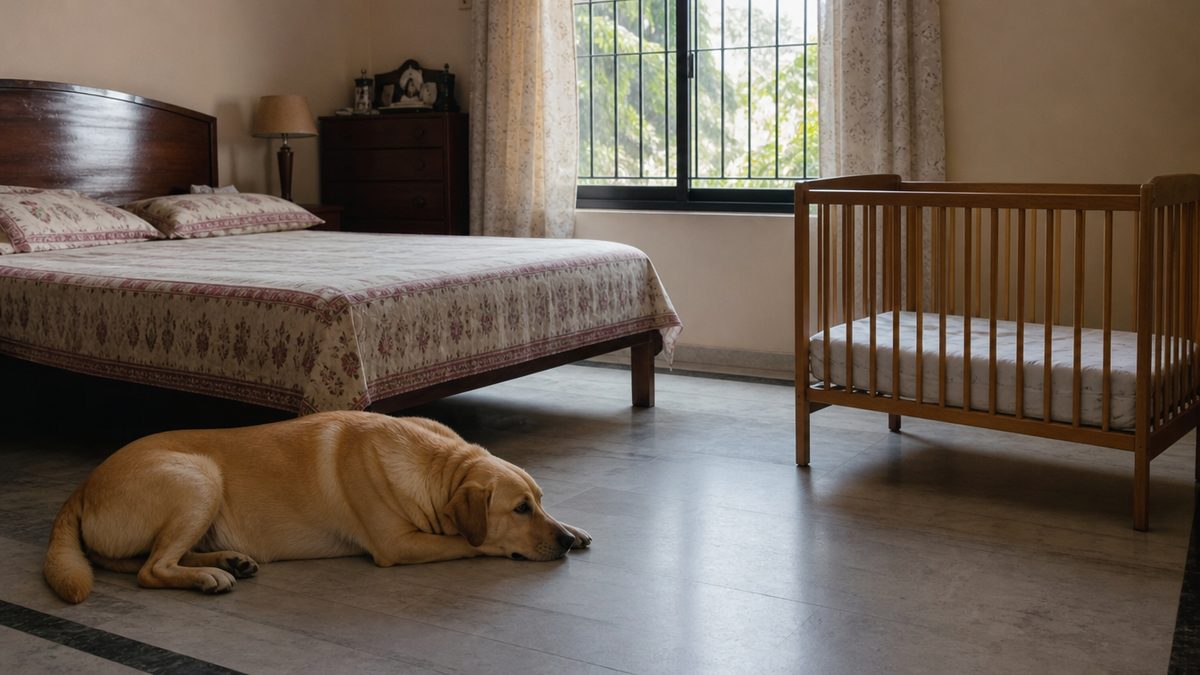
Start with the room, because it is the change that is easiest to leave until the nursery is finished and the one the behaviour clinics put first. The Ohio State Indoor Pet Initiative, whose page is adapted from the behaviour clinic at the University of Pennsylvania's veterinary hospital, says to accustom the dog to gates or a closed door to the baby's room now, especially if this is a room the dog used to be allowed to enter, and to put the gates up even if the room is not finished. A baby gate installed in February is a piece of furniture. The same gate installed the day the baby comes home is a wall that appeared with the baby.
- Fit the baby gate and start closing the nursery while there is nothing in it worth guarding, and feed the dog near the closed door so the boundary predicts something good.
- Move the dog's sleeping place now, if it is going to move. A bed in the corridor in month five is a change. A bed in the corridor in week one is an eviction.
- Shift the walk to the time it will actually happen, which in a house with a newborn usually means earlier, and hand it to the person who will be doing it.
- Reduce attention deliberately, at random times of day. The ASPCA warns specifically against lavishing extra attention in the final weeks, because it sets the dog up for a bigger drop.
- Book the veterinary examination. Half of the dogs in the first case series to assess child-directed biting from a veterinary behaviour standpoint had a medical problem identified or suspected, so this is a bite-prevention step rather than a formality.
- Start the handling work. Poke the dog gently, then treat; tug an ear, then treat; four to eight short sessions a day, building intensity only when the dog looks up for the treat.
- Play recorded baby noise at a volume low enough to produce no reaction, feed the dog while it plays, and raise the volume only when the dog is relaxed at the current one.
- Unwrap the pram, the cot, the swing and the carrier one or two at a time and let the dog investigate each with you there.
What changes one to two months out
The second block is routine changes rather than training. Vary the dog's feeding time within a window instead of keeping it to the minute, so that a household which has stopped being predictable is not itself the stressor. Line up a dog walker now and have them take the dog out occasionally before they are needed, which is the ASPCA's own instruction and the thing most households arrange a fortnight too late. Teach the dog to settle on a mat in the room where you will be feeding the baby, and pay it for settling there while you sit in the chair. Begin the resource guarding prevention described further down this page. And pick a point in the day when more than one adult is usually home, then spend 15 to 30 minutes with the dog at that time every day, which is the Penn-derived advice for building a slot the dog can still count on afterwards.
| When | What changes | Why this date |
|---|---|---|
| Four months before | Nursery boundary and baby gate, sleeping place, baby equipment, recorded baby sounds, handling exercises, veterinary examination | These take the longest and must not coincide with the birth |
| One to two months before | Walk time, attention pattern, feeding window, the dog walker, the settle cue, resource guarding prevention | The window the ASPCA dates the routine changes to |
| The last two weeks | Nothing new. Rehearse what is already in place and pack the dog's things where a helper can find them | A change made now will be remembered by the dog as the baby's arrival |
| Homecoming day | One adult greets the dog first, a second carries the baby, the lead goes on before the door opens | The protocol both welfare sources describe |
| Days 1 to 42 | Supervision behind a physical barrier, a written visitor rule, the dog's own routine held unchanged | The scheduled health-worker visits and the stream of relatives both land inside this window |
| From the baby's sixth month | Resources moved up, floor space divided, the crawling baby managed | Fear-related dog behaviour towards the child peaks between 6 months and 3 years of the child's age |
A change made in the fortnight before the due date arrives alongside the baby, and the dog has no way to tell the two apart, which is the opposite of what the whole plan is for. If you have left the gate, the bed move or the walk change until now, do them anyway, but expect the dog to connect them to the baby and plan more supervision rather than less.
The first meeting, and the scent cloth nobody has actually tested
To run the first meeting, let the dog greet you without the baby, then sit down in a quiet room with a second adult holding a loose lead, and let the dog sniff the baby's feet for a couple of seconds before you end the moment on a reward. That sequence is what the two best-sourced pages in this field describe, and it is not the part most owners remember.
The ASPCA's version is specific. Send everyone else into the house first so the dog can express its usual excitement at seeing people, let it burn a minute or two of that, then have a helper put the lead on with treats already prepared by the door. Speak in a soft, cheerful voice. Choose a quiet room, sit down with the baby in your arms, and have the helper walk the dog towards you with the lead short but loose. Let it sniff the baby's feet for a couple of seconds, interrupt gently by asking for a sit, reward that, and then have the helper take the dog away with a new chew or a food puzzle.
The Penn-derived page adds the staffing. At least one other adult should be there, the best arrangement is for the parent to come in and greet the dog while somebody else carries the baby, and some parents send the dog to a familiar relative for the first day or two simply to get the baby settled without a second set of responsibilities. In a joint household that second adult is usually available, which is one of the few parts of this that is easier in India than elsewhere.
What the scent cloth is, and what it is not
Almost every page on this query tells you to send a blanket home from the hospital. The instruction is real and it comes from serious sources. The Penn-derived page says that if possible, while you are still at the hospital, try to send home an item of the baby's clothes for the dog to smell, to help accustom it to the baby's scent. The ASPCA puts it earlier and slightly differently, suggesting you borrow clothes and blankets that smell like a baby before the birth, and that you start using the baby's lotions, shampoos and powders on yourself so the dog associates those smells with a familiar person.
We could find no published trial of scent cloth introduction, in any species pairing, as of 21 October 2026. The practice is close to universal and entirely unevaluated, and we can see no mechanism by which it would do harm. What is established is narrower and more interesting. Dogs register the household's changes long before the birth, and 26.9 percent of pregnant owners in the one survey that asked believed their dog's behaviour changed before they themselves knew they were pregnant. The baby's scent is not going to arrive in a sealed envelope on day one.
The honest reading is that the scent cloth costs nothing, we found no welfare body warning against it, and nobody has shown that it changes anything. The parts of the first meeting that carry the safety are the second adult, the loose lead and your ability to end the session. Note also that the ASPCA's version of the scent idea is the better-reasoned one, because rubbing the baby's lotion on your own hands pairs the new smell with a person the dog already trusts, rather than presenting it as an object with no context.
- Walk the dog before you leave for the hospital collection, or have somebody else do it, so the dog is tired rather than wound up.
- Send the other adults in first and let the dog finish its greeting before the baby comes through the door.
- Put the lead on, held by a second adult, with treats already in that person's pocket.
- Greet the dog yourself, without the baby, while somebody else carries the baby past.
- Sit down in a quiet room with the baby in your arms and invite the dog over on a loose lead.
- Let the dog sniff the baby's feet for two seconds, then ask for a sit and pay it well.
- End it there and give the dog a chew in its own place. Three good two-second meetings beat one long one.
The ASPCA's instruction runs to one line. Never force your dog to interact with your baby, let it approach on its own, and when it seems nervous speak softly and praise it for investigating. A dog that chooses not to come over has told you something useful. A dog that has been carried over has told you nothing at all.
Supervision, and the failure the bite data keeps finding
Supervision fails most often with an adult in the room. The clearest statement of it comes from the first case series to assess bites to children from a veterinary behaviour standpoint, and it is worth quoting: the mere presence of a parent, who may underestimate the risk of bites to young children, may not be sufficient to prevent bites.
That case series examined 111 children bitten by 103 dogs referred for aggression. Thirty-four of the children were under six. In that group, 44 percent of bites were connected to resource guarding, against 18 percent in the six to seventeen group, a difference of 26 percentage points with a 95 percent confidence interval of 4 to 45 and p equal to 0.009. Eighteen percent of bites to the under-sixes followed an aversive, potentially pain-causing interaction such as stepping on the dog or falling onto it, against zero percent in the older group, p equal to 0.0006. A further 15 percent followed what the authors class as benign interactions, meaning petting, hugging, kissing, bending over or speaking to the dog.
The hospital data agree and add the injury pattern. Of 203 children presenting to a Philadelphia trauma centre with dog bites, 51 percent were under seven and 72 percent knew the biting dog. Most bites to the younger children happened during positive interactions, initiated by the child, with stationary, familiar dogs, indoors. Face bites made up 70 percent of injuries in the under-sevens, while 72 percent of injuries in the older group were to the extremities.
A review in BMJ Paediatrics Open pulls the pattern together. In roughly 70 percent of paediatric dog-bite cases the dog belongs to a family member, children are most commonly bitten at home, children under five are most likely to present with head and neck injuries because of their height and their habit of playing on the floor, and children under two tend to put their faces close to new or moving objects. Children under two and children aged nine to twelve are the two peak ages.
The specific thing adults get wrong
Three findings describe the failure precisely, and none of them is about negligence. Compared with dog behaviour experts, dog-owning caregivers without expert knowledge permit more high-risk interactions between children and both familiar and unfamiliar dogs, and rate those interactions as lower risk; over 50 percent of caregivers leave children unattended around family dogs at least for a short period. In more than half of observed cases, parents do not intervene in a potentially risky interaction with the family dog although they would intervene with an unfamiliar one. And caregivers' attentiveness during supervision falls as the child gets older, with a correlation of -0.38 against child age.
Worse for the obvious fix, an educational intervention aimed at preventing bites to children had no effect at all on caregivers' supervision behaviour, and education schemes raise knowledge in the short term without changing what children or parents do in the presence of a real dog. The review's conclusion is the practical one: environmental controls such as gates are less subject to human error and are badly underused, while caregivers rely on fewer prevention methods than experts and rarely use them.
- Supervised means an adult whose eyes are on the dog and the baby, not an adult in the room with a phone.
- Supervised means within arm's reach of one of them, because two seconds is the whole event.
- Supervised ends when you leave the room, and the Penn-derived rule is that the baby goes with you or the dog goes to its safe room, even for the oven or the doorbell.
- Supervised is not a substitute for the gate. Use both, and treat the gate as the thing that holds when attention does not.
- Supervised means nobody is eating. Children of any age should not be near the dog when food, including human food, is present.
- Supervised means one adult per animal and per child where the dog has ever shown aggression to a person, and otherwise the dog is behind its door.
Warning signs matter and three of them end a session with no discussion: a lip lick when nobody is eating, a hard stare that does not break when the dog's name is called, and a dog that goes completely still. What each signal means and the research behind the vocabulary is in our guide to dog body language, and this page does not repeat it.
Caregivers rely on supervision and rarely use environmental controls, and environmental controls are the ones that do not fail when someone is tired. If you buy one thing on this page, buy the gate. If you can only do one thing on the day the dog seems unsettled, close a door.
The Indian household: a joint family, six weeks of visitors and a room the dog has lost
An Indian household changes five things about this plan, and the first is the sheer number of people who will come through the door in the first six weeks.
Some of those visitors are scheduled. Under the Ministry of Health and Family Welfare's Home Based Newborn Care operational guidelines, an ASHA visits the home six times after an institutional delivery, on days 3, 7, 14, 21, 28 and 42, and seven times after a home delivery, adding day 1. She is paid Rs 250 for the set of visits. That is a health worker your dog does not know, arriving on a published schedule, going straight to the baby, in precisely the weeks when the dog's own routine has already been rearranged.
The unscheduled visitors are heavier. The Penn-derived guidance is blunt about them: if visitors are already a problem for your dog, the arrival of a baby brings new challenges, and when adults or other children visit, the dog should be in its safe room. For a six-week run of congratulatory visits that is not a one-off instruction, it is a daily arrangement, and it has to be decided before the first doorbell rather than during it.
The maid, the ASHA and the aunt who arrives at nine
Household help is the Indian variable with no equivalent in the foreign pages. A person the dog half knows is now handling the baby, the nappies and the room the dog has been shut out of, often at a new hour. Two rules cover it. The helper gets the dog's treat jar and gives the dog something good on arrival for the first fortnight, so the new pattern predicts a reward. And the helper never opens the dog's door during a feed or a sleep, which is the single instruction most often broken by whoever is nearest the handle. What a household helper does and does not mean for a dog left alone is covered in our guide to leaving a dog alone all day in India.
When the mother goes to her parents' house
The practice of a new mother spending the late pregnancy and the early months at her natal home is common enough across India to reshape this entire plan, and it is almost unstudied. In a qualitative study of 36 women who had recently given birth in urban south India, one woman was cared for at her own parents' home from mid-pregnancy through to almost nine months after the birth, and the authors record that inter-generational family pressures remain considerable. That study was conducted in Bangalore, now Bengaluru, in Karnataka, and its authors say explicitly that it cannot be generalised beyond the urban South Indian population. No national figure exists for how many Indian mothers do this or for how long.
For the dog the consequence is the part nobody writes down. Either its primary person disappears for months, or the dog moves house with her, or the baby arrives as a four-month-old stranger in a home that has already finished adjusting. The first of those is a textbook trigger for separation-related problems, and the dog shut out of a room is not the same thing at all, which our guide to dog separation anxiety sets out with the four forms the research now separates. Decide in advance which of the three arrangements you are running, and if the dog stays behind, rehearse the new handler for weeks rather than days.
Grandparents, the balcony and the law
A grandparent who believes a dog should not be near an infant is not going to be argued out of it by a study, and the attempt usually ends with somebody quietly letting the dog in or quietly shutting it out. Give them a job instead. The morning walk, the feeding, the gate rule on visitor days: a person with a defined role in the plan tends to follow the plan.
What should not happen is the improvisation a cramped flat invites, which is to tie the dog on the balcony or shorten its chain. Section 3 of the Prevention of Cruelty to Animals Act 1960 makes it the duty of every person having the care or charge of any animal to take all reasonable measures to ensure the well-being of such animal and to prevent the infliction of unnecessary pain or suffering. Section 11(1) then makes it an offence to keep or confine any animal in a cage or other receptacle which does not measure sufficiently in height, length and breadth to permit the animal a reasonable opportunity for movement, and to keep for an unreasonable time any animal chained or tethered upon an unreasonably short or unreasonably heavy chain or cord. Those two clauses describe the balcony and the short chain precisely, and they were drafted long before anybody thought of them as a nursery solution.
| Person | The one rule they hold | What they get instead |
|---|---|---|
| The grandparent who wants the dog outside | The dog is never tied up or shut on a balcony as a solution | The morning walk and the feeding, which are real jobs and keep the dog's routine intact |
| Household help | Never opens the dog's door during a feed or a sleep; washes hands before handling the baby | The treat jar, and the dog greeting them instead of being moved out of their way |
| Visiting relatives | The dog is behind its gate before the doorbell, not after | Five minutes with the dog afterwards, on the dog's terms, which is better for everyone |
| The ASHA or any home health visitor | The dog is in another room for the whole visit, every visit | Nothing. This one is non-negotiable and it recurs six or seven times |
| Older children in the house | They call an adult if the dog goes stiff, and they never take anything out of the dog's mouth | A defined job, usually filling the water bowl, which gives them a reason to be careful |
Two physical details decide whether any of this holds. Work out now which room the dog will be in and whether it is bearable with the door shut, because in a humid Chennai or Mumbai August the baby's room has the air conditioner and the dog's room does not, and a dog scratching at a hot door is not reacting to the baby. Second, the monsoon shortens the walk at exactly the point in the year when you need it to hold; a flat in Mumbai or Pune with no alternative exercise route needs an indoor plan rather than an apology. The temperature side of that is in our guide to how to keep dog cool in summer in India, and the structural side in keeping a dog in a flat in India.
Hygiene and allergy: both halves of the evidence, pointing opposite ways
The infection risk from a household dog to an infant is real and modest, and the same early exposure is associated with less asthma and less allergy at school age. Both halves carry denominators, and almost no Indian page on this query carries the second one.
Take the risk half first. Children under five are more likely to get sick from germs animals can carry, because they touch surfaces that may be contaminated with animal faeces and are more likely to put their hands in their mouths, and because their immune systems are still developing. Worth noticing, though, is which animals the United States public health agency actually names. Its list of animals children under five should avoid is reptiles, amphibians, poultry including chicks and ducklings, and rodents. Dogs are not on it.
The quantified version of the risk comes from the Swedish national registers. A cohort of every child born in Sweden between 2001 and 2010, 1,011,051 children in total, found that preschool children exposed to a dog in their first year had a raised risk of pneumonia, with a hazard ratio of 1.13 and a 95 percent confidence interval of 1.06 to 1.20, and of other lower respiratory tract disease, hazard ratio 1.06, confidence interval 1.00 to 1.13. That is a real increase and a small one.
The same paper carries the other half, which is why it is the best single source on this question. In the school-age cohort of 276,298 children, of whom 11,585 had an asthma event in their seventh year and 22,629 had been exposed to a dog in their first year, dog exposure during the first year of life was associated with a reduced risk of asthma at age six, with an adjusted odds ratio of 0.87 and a confidence interval of 0.81 to 0.93. Exposure to farm animals cut it further, hazard ratio 0.69. The authors' own explanation is that dog exposure may increase an infant's overall exposure to microorganisms and allergens, some of which raise the risk of respiratory infection while others modulate the immune system in a way that lowers the risk of allergy-related asthma later.
The allergy half has its own page and this one does not rebuild it. In short, a second Swedish study found the effect follows a dose, with allergy ever falling from 49 percent among children who had no pets in their first year to zero among those who had five or more, p for trend 0.038. The wider literature, the hypoallergenic breed claim, what allergy testing costs in India and what to do if the allergy turns out to be real are all set out in our guide to pet allergy in children in India.
Read all of that carefully rather than triumphantly. These are associations in Swedish populations, the dose study reports a p value for trend rather than an effect size at the top of its range, and no Indian study has tested any of it. They are not a reason to acquire a dog and they are not a reason to keep one you cannot manage. What they do rule out is the idea, which arrives in a lot of Indian households at exactly this moment, that a dog in the house is straightforwardly bad for an infant's health.
The hygiene that is worth doing
- Handwashing is the whole intervention, and the one instruction most people miss is to wash your hands before breastfeeding or preparing formula, not only after touching the dog.
- No licking of the baby's face, mouth or hands. The agency's phrasing is to never allow children to kiss animals or to put their hands in their mouths after handling them.
- Keep the dog out of the room during a nappy change, which is the single highest-contamination moment of the day in a small flat.
- Keep the dog away from everyone while anybody is eating, which the same guidance frames as a bite-prevention rule as much as a hygiene one.
- Hold the deworming and vaccination schedules without slipping, which is the part that genuinely changes the risk. The intervals are in our guides to the dog deworming schedule India and the dog vaccination schedule India.
- Wipe paws at the door through the monsoon, when a street-walked dog brings in more than it does in March.
A paediatrician who asks you to tighten hygiene is giving sound advice. A relative who cites germs to argue that the dog must go is making a claim the evidence does not support, and the registry data run the other way at age six. If an allergy or asthma question is already live in your family, that is a conversation for your child's doctor with the actual figures in front of you, not a decision to take in week two, and the figures are in pet allergy in children in India.
Rehoming, without judgement
Rehoming is the question a large share of readers came here for, and the honest answer has three parts. It happens less often than the pressure suggests, Indian law reaches abandonment rather than rehoming, and there is a responsible version of it that is not the same act as leaving a dog on a road.
Start with how often it is even considered. Of 325 caregivers living with a child under six and a family dog who answered the question, 87 percent had never considered finding a new home for the dog. Nine percent had considered it rarely, 3 percent sometimes, and one respondent said she often thought about it because living with child and dog was very difficult. That is a self-selected European sample weighted towards committed owners, and no Indian equivalent exists as far as we can find on 21 October 2026.
One large dataset measured the health version of this decision sideways. Among Swedish children who developed asthma before the age of one, the proportion of dogs that had been moved to a different setting was larger than among children who had not, p equal to 0.004. Families do give dogs away over a health fear. The same cohort found the asthma association running the other way by age six.
Indian law does not forbid rehoming and does reach abandonment. Section 11(1)(i) of the Prevention of Cruelty to Animals Act 1960 makes it an offence to, without reasonable cause, abandon any animal in circumstances which render it likely that it will suffer pain by reason of starvation or thirst, and the punishment for a first offence is a fine which may extend to fifty rupees. A maximum of ₹50, unrevised since 1960, is not a deterrent and nobody should pretend otherwise. The reason not to put a dog out is the outcome, not the fine. A pet dog abandoned on an Indian street joins the free-ranging population, and in the hospital series set out below, the small children who were bitten were overwhelmingly bitten by free-ranging dogs.
The responsible version is named in the clinical literature rather than hidden from it. Where a dog's welfare is compromised and behaviour modification alongside risk management is not possible, rehoming either temporarily, to allow the owner time to reflect and consider the options, or permanently, to a household able to manage the dog's behaviour, may be considered; and where aggression is focused on children, rehoming to an adult-only household may be feasible. That is a planned transfer with the history disclosed. It is not a gate left open.
Five things to do before the conversation about rehoming
- Get the full veterinary examination first. A medical problem was identified or suspected in 51 of 103 dogs referred after biting a child, most often orthopaedic or dermatological, and pain changes tolerance before it changes anything a family would call lameness.
- Install the environmental controls you have not installed. Caregivers rarely use them at all, and the gate is the specific control the review literature calls underused.
- Arrange a temporary stay with somebody the dog already knows. Sending the dog to a familiar relative for the first days is standard advice rather than a failure, and it buys the household a fortnight to decide with a clear head.
- Get a behaviour assessment through your own veterinarian before anybody decides anything, and bring written notes on what the dog actually did rather than what somebody thought it meant.
- If you still rehome, do it through a recognised shelter or a known household with the full history disclosed in writing. Our guide to how to adopt a dog in India sets out how Indian shelters screen, which is also how to judge the home you are handing the dog to.
Leaving a dog outside a colony gate, driving it to another locality, or handing it to a stranger who answered a message is abandonment in substance whatever it is called at the time, and section 11(1)(i) reaches it. A planned, documented transfer to a household that knows the dog's history is a different thing and nobody should be shamed for it. If the pressure in your house is coming from relatives rather than from the dog's behaviour, that is worth naming out loud before any decision is made.
The risk peaks later than you expect, when the baby starts moving
The dangerous window opens when the baby becomes mobile rather than when it comes home. The Penn-derived guidance says it plainly: many pets first become anxious about babies when they become mobile, so be very observant when the baby first scoots and crawls.
The Austrian survey tracked exactly this. Fear-related behaviour by the dog towards the child peaked when the child was between six months and three years old. Children began interfering with the dog's resources from the second half of their first year, with the frequency climbing through the second year. Painful interactions, meaning sitting on the dog, pulling its tail or stepping on it, rose in frequency until the child was about one and a half to two and declined afterwards.
The injury numbers in that sample are a useful corrective in both directions. Of 326 dogs, 53, that is 16 percent, had already injured the focus child, and all of those injuries were minor and needed no medical attention, mostly scratches from paws or bumps from the dog knocking the child over. Eleven incidents, 3 percent, were bites. Four of those followed the child disturbing the resting dog, three a resource-related interaction, two a painful interaction and two play with the dog as a puppy. None of the resource-related injuries was caused by aggression; they were fingers caught while feeding treats or playing fetch.
So the crawling baby's three problems are resources, resting places and reach. All three have fixes, and the one with a published protocol is resource guarding.
- While the dog eats, walk up and drop something better than its dinner into the bowl, every meal for a week or two.
- The following week, reach in and place the treat on top of the food instead of dropping it from above.
- The week after, hand-feed the treat next to the bowl, then approach, pat the dog's back and then feed it.
- Next, touch the edge of the bowl with an empty hand, withdraw, then reach back in with the treat.
- Finally, lift the bowl away, add something good and give it straight back, then have every adult in the house practise the same sequence.
Alongside the bowl work, teach a go-away cue so the dog knows that leaving is an option. The ASPCA's reasoning is the part worth repeating: many dogs do not realise they can simply walk away from a baby, and a dog that feels trapped expresses its discomfort by growling or snapping instead. Say the cue, point, and pay the dog for moving a few feet, building up over sessions until it will leave the room on the word.
The rest is geography. The dog needs a resting place off the floor or behind a door that the crawling baby cannot reach, its food and water out of the crawl zone, and a chew it can take somewhere private. Where the lost attention goes is the subject of our guide to dog boredom busters, which carries what the evidence actually supports, and the flat-specific version of dividing a small space is in keeping a dog in a flat in India. Barking at the new noise, if that is what you get, is a separate problem with six separate causes, covered in can neighbours complain about dog barking in India.
When to get professional help, and what that means in India
Book the veterinary examination before the baby arrives, because half of the dogs that bite children turn out to have something physically wrong with them.
In that case series of 103 dogs referred after biting a child, a medical problem was identified or suspected in 51 of them, 50 percent, most commonly orthopaedic at 20 percent and dermatological at 20 percent. The anxiety screen was abnormal in 77 percent of the dogs, and fear-related aggression was the commonest primary diagnosis, at 87 percent. The authors' instruction follows directly: because disease and pain can increase irritability in dogs, their presence should be an indication to separate the dog from young children until the disease has been treated or the pain reduced.
The same study takes away the two reassurances that get offered most often. Ninety-three percent of those dogs were neutered and 66 percent had been through formal obedience classes, so neither is protective. Sixty-six percent of them had never previously bitten a child and 19 percent had never bitten any human. He has never done it before is not a safety statement, it is a description of 66 percent of the biting dogs.
- The dog is avoiding the baby, showing fear of it or showing aggression towards it, in which case separate them completely and contact your veterinarian immediately.
- The dog has growled, snapped or shown teeth near the baby even once, which is information rather than disobedience.
- The dog has a history of aggression to any person, which is a known risk factor for future bites and needs a veterinary surgeon with behaviour experience rather than a trainer.
- The dog has become irritable, restless or less tolerant since the pregnancy, which is a pain question before it is a behaviour question.
- You are managing the household by shutting the dog away for most of the day, which is not a plan and will not hold for a year.
Whatever you do, never punish the warning. The ASPCA is explicit that you should avoid punishing a dog for growling, snapping or showing teeth, because if you inhibit the warning system it may disappear and the dog may then bite with no notice at all; as long as the dog growls, you still have the chance to remove the dog or the child. Where the dog is already aggressive towards the baby, the instruction is to keep them apart at all times and to hire somebody with extensive experience of treating aggression specifically.
In India that last instruction is harder than it reads. There is no Indian board certification in veterinary behaviour, which our guide to dog separation anxiety documents from the Veterinary Council of India's own draft postgraduate regulations, and there is no licensing regime for trainers either. The practical route is to start with the veterinarian who already knows your dog, ask them by name who they have referred a case like this to and what happened to it, and check what any behaviour practitioner has actually trained in before you pay. Our guide to dog separation anxiety sets out the Indian qualification picture in full, and puppy training in India covers how to vet a trainer in a market where nobody else will.
One thing not to assume. A dog that has been shut out of a room and complains about it does not automatically have separation anxiety, which is a clinical condition with its own differentials and which the research now splits into four distinct forms. Film one absence before you label anything.
What this page can show, and what it cannot
Six claims here are measurements with denominators attached and five common beliefs are not established, so the line between them is drawn here rather than left to the reader.
- Dogs that lived in the family before the child showed less affiliative and more fear-related behaviour towards that child than dogs raised with children, across 402 households.
- Children under six are bitten in connection with resource guarding far more often than older children, 44 percent against 18 percent, and in pain-causing interactions 18 percent against zero.
- Seventy percent of bites to children under seven presenting to one trauma centre were to the face, and 72 percent of the 203 children knew the dog.
- Half the dogs referred after biting a child had a medical problem identified or suspected, and 93 percent of them were neutered.
- Dog exposure in the first year of life was associated with less asthma at six, adjusted odds ratio 0.87, and with more pneumonia in the preschool years, hazard ratio 1.13, in the same million-child cohort.
- Over half of caregivers leave children unattended with the family dog at least briefly, and an educational intervention did not change supervision behaviour.
Where the Indian data and the Western data disagree
The two Indian datasets on this page point in opposite directions, and the reason is the denominator rather than the dogs. In a prospective series of 308 children admitted over one year to a tertiary hospital serving six districts of North Bengal, and reported by a team led from Kolkata, 96 children were under five. Of those, 90, that is 93.75 percent, were bitten by a stray animal and only 2 by a pet. In a cross-sectional survey of 100 pet-dog-owning families in a high-end housing society in the National Capital Region of Delhi, 44 of 355 family members had been bitten in the previous year, and 31 of those 44 bites, 70.5 percent, were by a pet dog.
Both are true and they measure different populations. The hospital series counts the bites that reach a rabies clinic in a largely rural district, where free-ranging dogs dominate. The society survey counts what happens inside houses that keep dogs. If you keep a dog and you are reading this, the second is your denominator, and it matches the 70 percent family-dog figure from the review literature.
What both literatures agree on is the injury pattern, and the Indian figure is the sharper one. In that hospital series, 32 of the 96 children under five had a facial bite, against 8 of 142 children aged five to nine and none at all aged ten to twelve, p below 0.001, and the under-fives also had the highest proportion of Class III exposures. The review literature attributes the pattern to the child's height and their habit of crawling or playing on the floor, and notes that children under two put their faces close to new or moving objects. That mechanism is why the gate matters more than the instinct that your dog would never.
- No study of preparing a dog for a new baby has been run in India. Every behavioural figure on this page comes from the United States, Austria, Germany, Canada or Sweden.
- The three behaviour surveys here are owner reports rather than observation, with self-selected or panel-recruited samples, and all three say so themselves. The two bite series are hospital and referral populations, which are not the general dog population either.
- The scent cloth is unevaluated. No trial has tested whether sending a baby's clothing home from the hospital changes anything.
- The zero allergy prevalence at five or more pets is reported as a p value for trend rather than an effect size, and we did not read the per-cell counts behind the five-pet group.
- Nobody has measured how long a dog takes to settle with a new baby. Any page giving you a confident number of weeks is guessing.
One last boundary. This page is about prevention and it does not cover what to do after a bite. If a dog's teeth break a child's skin in India, that is a rabies question before it is a training question, whatever the dog's vaccination certificate says; the exposure categories and the wound protocol are set out in our guide to how to stop puppy biting and the disease itself in rabies in dogs. Wash first, then go to a doctor, then deal with the dog.
Common questions
How long will it take my dog to get used to a new baby?
Nobody has measured it, and any page quoting you a number of weeks is guessing. What has been measured is the opposite shape: fear-related behaviour by dogs towards the child in their household peaked when the child was between six months and three years old, which means settling is not a milestone you pass in week six. Plan for the first year, not the first month, and judge progress on whether the dog chooses to be in the room.
How soon can I introduce my dog to my newborn?
On the day you come home, if the meeting is staged properly. Send the other adults in first, let the dog finish greeting people, then put it on a loose lead held by a second adult, sit down with the baby, and allow a two-second sniff of the baby's feet before ending on a reward. Some families deliberately send the dog to a familiar relative for the first day or two instead, which is standard advice rather than a failure.
Is it safe for newborn babies to be around dogs?
Supervised and behind a barrier when unsupervised, yes, and the evidence runs both ways rather than one. Children under five are more vulnerable to germs animals carry, but the United States public health list of animals under-fives should avoid names reptiles, poultry and rodents and does not include dogs. The bite risk is real and concentrated in the face, which is why physical separation when no adult is watching matters more than any other single step.
Is it okay if my dog licks my newborn?
Not the face, the mouth or the hands. Public health guidance is to never allow children to kiss animals or to put their hands in their mouths after handling them, and to wash hands before breastfeeding or preparing formula rather than only afterwards. A lick on a covered foot is not an emergency and does not need panic. Open skin, the mouth and the eyes are where the line sits, and handwashing is the whole intervention.
Are dog germs harmful to newborns?
Measurably, slightly, and not in only one direction. In a cohort of every child born in Sweden across ten years, preschool children exposed to a dog in their first year had a hazard ratio of 1.13 for pneumonia and 1.06 for other lower respiratory disease. The same children had an adjusted odds ratio of 0.87 for asthma at age six. More infections early, less allergic asthma later, from the same exposure in the same study.
Should dogs be allowed near newborn babies?
Yes, under supervision that means an adult watching rather than an adult present, and behind a gate the rest of the time. The failure the data keeps finding is the supervised bite: over half of caregivers leave children unattended with the family dog at least briefly, caregivers permit more high-risk interactions than experts do, and an education programme aimed at fixing this changed knowledge without changing behaviour. Environmental controls do not get tired.
Will my dog be jealous of my new baby?
Jealousy is a label clinicians are told to avoid, because it describes a motive nobody observed. What is measured is more useful. In 242 households with a dog and a child under three, barking or whining had started or worsened in 33.9 percent, begging in 24.0 percent and anxiety or fear in 17.8 percent. Those are behaviours with fixes. Jealousy is a word that gets a dog told off.
How to prepare a dog for the first baby?
To prepare a dog for a first baby, start four months out and change everything the dog will lose while the baby is not yet there to be blamed for it. Fit the baby gate, move the sleeping place, shift the walk, reduce attention at random times, and book a veterinary examination. One to two months out, change the routine itself and line up a dog walker. In the last fortnight, change nothing and rehearse.