
Dog training guide
Dog body language: what the research demonstrates, what it only asserts, and what an Indian street changes
Owning a dog does not make you good at reading one. In the study that tested it, the people who had never owned a dog read the dogs more accurately than the owners did.
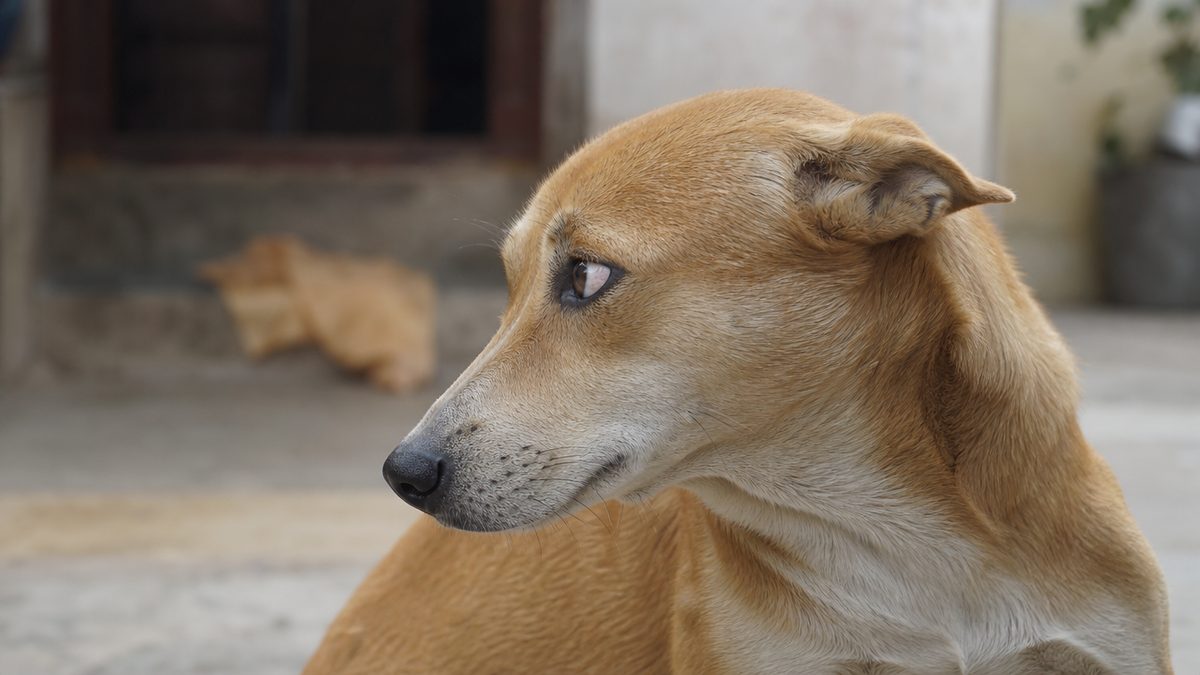
Quick answer
Dog body language is read badly by most people, including owners. In one study of 71 adults watching dogs that an expert panel had classed as fearful, 68.4 percent called them relaxed. Read the whole animal: tail carriage and speed, ear position, whale eye, lip licking, freezing and weight shift. A wag measures arousal, not happiness, and a growl is information worth keeping.
This guide is general information for Indian pet owners and is not a diagnosis. Always consult a registered veterinarian near you before acting on anything you read here, and treat any sudden change in your pet's condition as urgent.
How badly people read dogs, measured
People read dogs badly, and the measurement is uncomfortable. In a 2016 study, 71 adults watched video of small children interacting with dogs that an expert panel had already classed as fearful, anxious and lacking confidence, and most of the viewers called the dogs relaxed.
The numbers are worth stating exactly, because almost nothing else on this subject carries a denominator. Across the three video clips, participants classified the dogs as relaxed 68.4 percent of the time and as confident 65.1 percent of the time. Asked what the dogs were actually doing, they named play in 23.0 percent of answers and friendly behaviour in 19.2 percent. The expert panel had scored all three dogs the other way.
One result in that study should change how you read the rest of this page. Participants who did not own a dog classified the dogs' emotional states more successfully than the dog owners did. The authors put it plainly: having experience with a dog without any theoretical knowledge of dog behaviour may be a detriment to interpreting canine language.
Years with your own dog teach you your own dog. They can also teach you to generalise from one animal to every animal, which is the error the non-owners in this study were not making. Treat familiarity as a starting point, not a qualification.
Why the subtle signals are the ones that go missing
Owners miss the quiet signals because they are watching for the loud ones. Reviewing earlier work on how owners perceive stress in their own dogs, the Pisa group that ran the main calming-signal study notes that owners tend to focus their attention on vocalisations and gross body movements, while the more subtle signals displayed in the earlier stages of arousal often go unnoticed and can be misinterpreted, and may be disguised by a dog's own morphology.
That is the whole problem in one sentence. A bark registers. A half-second head turn, a tongue flick over the nose or a two-second freeze does not, and those arrive first. Everything below is organised around reading the early ones.
This page covers the vocabulary. It does not cover noise fear, which has its own evidence and its own page at firecracker fear in dogs, or distress at being left alone, which is covered at dog separation anxiety.
The tail: speed and height, not happiness
Read the tail as a measure of arousal and attention rather than of happiness, because the association between tail wagging and a happy dog is a human assumption that the research does not support cleanly.
A 2024 opinion piece in Biology Letters, published as such and reviewing the whole literature, set out to summarise what is known about why dogs wag. Very little is settled. The authors write that despite the ubiquity of dogs in our lives and all the meaning we ascribe to tail wagging, quantitative studies to date have led to patchy results and a structured theoretical framework is missing. They add that little is known about how tail movements are neurophysiologically controlled, and that to their knowledge no study has tracked the development of tail wagging in the same individual dog across its life.
Two findings in that review cut directly against the popular reading. Dogs wag at things that are not social at all, including food, electric fans and plastic bags. And one study found that aggressive dogs wagged their tails more, and had lower serotonin, than non-aggressive dogs, which the reviewers describe as counterintuitive to the widely held human belief linking tail wagging to positive valence.
What the tail does carry reliably is height and motion. Across canids, wagging with low carriage is often used as a visual sign of appeasement, submission or non-aggressive intent, and the combination of wagging and tail carriage looks like a reliable indicator of formal submission in dog to dog interactions. The American Kennel Club's guidance adds the obvious caution that neutral tail carriage is breed-specific, with some breeds carrying the tail high over the back by default and others much lower.
| What you see | What it indicates | What it does not mean |
|---|---|---|
| Fast, small, high wag with a stiff body | High arousal and attention on something | Not an invitation. Arousal is not friendliness |
| Broad, loose, whole-body wag at mid height | High arousal with loose posture, the pattern people read as greeting | Not a guarantee. Read the face and the weight shift as well |
| Low wag, tail below the hocks | Appeasement or non-aggressive intent across canids | Not contentment. A dog can wag low and still be very worried |
| Tail tucked, no motion | Fear, listed as an obvious sign of stress by welfare bodies | Not sulking, and not something to correct |
| No wag at all, body still | Freezing, which observers find harder to read than any wag | Not calm. In a controlled test, a still dog read as more stressful than a right-biased wag |
Left wag, right wag, and the fact that dogs notice
Dogs wag asymmetrically, and other dogs read the asymmetry. A right-side bias corresponds to left-hemisphere activation and appears with stimuli of positive valence, such as the dog's owner, while a left-side bias corresponds to right-hemisphere activation and appears with stimuli that elicit withdrawal, such as an unfamiliar, dominant dog.
The question of whether dogs themselves detect this was tested directly. Dogs watching video of another dog wagging with a left bias showed higher cardiac activity for longer, and higher scores of anxious behaviour, than when the same stimulus wagged with a right bias. They scored as more relaxed watching the right-biased wag, and approached the screen during that condition.
Be careful what you do with that. The bias is a statistical tendency measured frame by frame from video, not something you can judge standing at a gate in Pune while a dog comes at you down a lane. The useful takeaway is not that you should try to see left and right. It is that a wag is a channel carrying several different messages, which is exactly why a wag on its own tells you almost nothing.
Calming signals: what one study demonstrated, and what is only asserted
Calming signals are demonstrated to be communicative, and demonstrated to de-escalate aggression once it has started. They are not demonstrated to prevent aggression, which is the claim the popular framework is best known for.
The framework comes from the Norwegian trainer Turid Rugaas. Her own page states that dogs have about 30 calming signals, perhaps even more, and describes them as a language which is there to make sure that dogs have a way to avoid and solve conflicts and live together in a peaceful manner, adding that dogs are experts at it. The page names yawning, licking, head turning, the play bow, sniffing the ground, sitting, smacking the lips, lying down and tail wagging among them, and cites no research anywhere on it.
A group at the University of Pisa put the idea to the test. They took 18 behaviours from Rugaas's list, paired 24 dogs as senders with recipients of matched size, and filmed 96 off-leash meetings of five minutes each, 48 between familiar dogs and 48 between unfamiliar ones. One observer, blinded to whether the dogs knew each other, coded every video frame by frame, with inter-observer reliability of 91.2 percent on a 10 percent sample.
They recorded 2,130 signals across 1,445 behavioural sequences. The dogs spent 42.0 percent of their time in close interaction, but 65.9 percent of the signals happened there, which is strong evidence that these behaviours are directed at the other dog rather than produced at random. More signals appeared between unfamiliar dogs than between familiar ones. The four commonest by a distance were head turning, nose licking, freezing and turning away.
Then the part that matters. The recipient dogs produced 109 aggressive episodes. In 67.0 percent of those, 73 cases, the other dog produced at least one signal afterwards. Of those 73, the aggression dropped a rung in 79.4 percent (58 cases), stayed level in 15.1 percent (11) and escalated in 5.5 percent (4).
The gap between the claim and the finding
Three gaps are worth naming, and no page currently ranking for this topic names any of them.
- About 30 signals are claimed; 18 were tested. The study worked from Rugaas's own list and excluded only one item, splitting up, because only two dogs were present at a time. The remaining count in the popular framework has never been enumerated against data.
- Prevention was not shown, and the authors say so. No aggressive episode in the study was preceded by a calming signal, which means the design could neither demonstrate nor rule out a preventive role. De-escalation after the event is what was measured.
- This is one pilot study of 24 dogs. The authors call it a pilot in the abstract, describe the findings as a starting point, and state that further research is needed before the meaning and impact of each signal is understood.
There is a fourth point, and it is the practical one. Most of the behaviours Rugaas labelled calming signals are documented elsewhere in the literature as indicators of stress, yawning, looking away, head turning, nose licking and paw lifting among them. The Pisa authors note this is not a contradiction, because a stressed dog communicating its state is exactly what would cause a receiver to back off.
When your dog turns its head away, licks its nose or freezes during an interaction, the reliable reading is that your dog is uncomfortable right now. Whether it is also trying to calm anyone is a separate question the evidence has not settled. Act on the first reading and you will rarely be wrong.
The face: ear position, whale eye, lip licking and yawning
Read the face first for the quiet signals, because they arrive before anything a person would describe as a reaction.
Dogs Trust groups the signs into tiers, and the first tier is almost entirely facial. The subtle signs it lists are below.
- Turning the head or body away.
- Lip licking that has nothing to do with food.
- Yawning that has nothing to do with tiredness.
- Pupils dilating.
- Ears pulled back.
- Eyes narrowing, or the whites of the eyes showing.
- Sudden stillness or freezing.
- Looking to you for reassurance.
- Tension visible in the body and face.
- Going unusually quiet.
Whale eye is the one most people have seen and never named. The whites of the eyes become visible because the dog is holding its head still while swivelling its gaze, usually towards whatever is bothering it. Dogs frequently show whale eye when they feel anxious, worried or pressured. A dog doing this while a child leans over it is not tolerating the child. It is running out of options.
Ear position has to be read against the dog's own neutral, which is why a fixed rule fails. Ears pulled back is a documented subtle stress sign, but an Indie with large erect ears, a Labrador with drop ears and a Pug with small folded ears start from three different neutral positions and have three different visible ranges. Learn where your own dog's ears sit when it is asleep and relaxed, and read movement away from that.
Lip licking and yawning both deserve a correction. In the Pisa data, nose licking was the second commonest signal recorded, while yawning was among the rarest, and yawning was one of only two behaviours shown more often when the dogs were interacting at a distance than when they were close. The popular infographics show a yawn as the headline stress signal. The one study that counted them found it uncommon.
Context is what makes a yawn readable. Rugaas's own description lists the moments: when someone bends over the dog, when you sound angry, when there is shouting in the house, at the vet, when someone walks directly at the dog, and when you have just told it off. A yawn at nine at night on a dog's bed is a yawn. A yawn while a stranger reaches for its collar is not.
Panting appears on every stress-signal list written for temperate countries. In Chennai, Mumbai, Kolkata or Ahmedabad in a humid month, a panting dog is thermoregulating, and treating that as anxiety will have you reading fear into an ordinary afternoon. Panting counts as a signal only when the dog is cool, rested and panting anyway, and when something else on the list is happening at the same time.
The guilty look is a reply to you, not an admission
The guilty look is a response to the owner's behaviour, and the best test of it found no relationship at all between the look and whether the dog had actually done anything.
Alexandra Horowitz filmed 14 dogs across a series of trials in their owners' living rooms. Each owner told the dog not to eat a treat and left the room. The experimenter then either gave the dog the treat or removed it, so obedience was controlled rather than observed. Separately, owners were told on their return either that the dog had eaten the treat, in which case they scolded it, or that it had behaved, in which case they greeted it warmly. What the owner was told often did not match what had happened.
The result was clean. There was no difference in guilty-look behaviours according to whether the dog had actually disobeyed. More of those behaviours appeared in trials where owners scolded. And the effect of scolding was more pronounced when the dogs had been obedient, not when they had disobeyed.
Read that last line twice. The dogs that looked guiltiest were the innocent ones being told off for something they had not done. The conclusion in the paper is that the guilty look is a response to owner cues rather than an appreciation of a misdeed.
The practical consequence is about what your dog learns from you. If you come home, find the chewed slipper and scold, you have not taught the dog anything about the slipper, which it chewed hours ago. You have taught it that your arrival sometimes predicts trouble, which makes your homecoming a thing to be anxious about. Where chewing happens only in your absence, that is a different problem with its own page at dog separation anxiety.
Horowitz's own introduction records how widespread the belief is, citing a survey of 307 dog owners in which three quarters said their dog experiences guilt. We read that figure inside her paper rather than in the original survey, and record it that way.
The whole body: weight shift, freezing, raised hackles and the play bow
Read the whole body, because every signal above is ambiguous on its own and several of them appear in both a delighted dog and a frightened one.
Freezing is the most under-read signal there is, and two separate studies say so from different directions. In the Pisa meetings, freezing was one of the four commonest signals and rose sharply with unfamiliarity, appearing 152 times between unfamiliar dogs against 38 times between familiar ones. In the asymmetry experiment, dogs watching a still, non-wagging dog scored as more stressed and showed more targeting behaviour than when watching a right-biased wag, which the authors attribute to freezing being associated with fear.
So a dog that has gone quiet and stopped moving is not settling down. It is the moment to stop whatever is happening, which in an Indian living room is usually a guest's child draped over a dog that has not moved for ten seconds.
Raised hackles get misread in the opposite direction. Piloerection can run across the shoulders, along the back or all the way to the tail, and it simply indicates arousal: the dog may be stressed, nervous, excited, surprised or intensely focused on something. Like goosebumps in people, it is often an involuntary reaction. Hackles up is not a declaration of intent and it is not a reason to pull your dog away mid-greeting, which is itself a good way to turn a neutral meeting into a bad one.
Weight shift is the cheapest thing to learn and the fastest to read at distance. A dog leaning its weight forward over the front feet is committing to something. A dog leaning back over its hind feet, or with a crouching, lowered body, is trying to buy distance. You can read that from across a road, which is more than you can say for a lip lick.
Is it play or is it a fight?
To tell play from a fight, watch for pauses, role reversals and loose, bouncy movement, and treat continuous, stiff, silent intensity as the thing to interrupt. The play bow is the signal everyone looks for, and it is less informative than it is usually described.
Two studies of the play bow disagree, and neither has been overturned. Bekoff's classic 1995 work found that play bows function as behavioural modifiers that clarify playful intent before or after easily misinterpretable actions such as bite-shakes. A 2016 study of adult pet dogs in dyadic play found instead that bows most often occurred after a brief pause, and that what followed was synchronous behaviour, or escape behaviour by the bower with chasing by the partner. Its conclusion is that in adult dogs the play bow reinitiates play after a pause rather than mediating offensive or ambiguous actions.
The practical reading is that a play bow tells you play is restarting, not that everything that follows is play. The more useful test is the one below, which is a trainer's heuristic rather than a research finding, and we flag it as such.
- Count the pauses. Healthy play breaks itself up. Play that has run for two minutes with no break has stopped being play.
- Check the roles. Over a few minutes each dog should take turns chasing and being chased, being on top and being underneath. One-directional pressure is not play.
- Separate them briefly and let go. If the dog that was underneath comes straight back for more, it was playing. If it moves away, stays behind you, or shakes off and does not return, it was not.
- Read the bodies, not the noise. Play growling with a loose, curving, wiggly body is normal. Silence with a stiff body and a hard stare is the one to interrupt.
If the dog in question is a puppy with its teeth on a person rather than another dog, that is mouthing and it has its own page at how to stop puppy biting. Where the other animal is a cat, read introducing a cat to a dog for the specific signals that matter there.
The ladder: why growling is the most useful thing a dog says
Growling is the most useful thing a dog says, because it sits one rung below the behaviours that leave a mark, and because punishing it removes the warning without touching the feeling that produced it.
Welfare bodies describe the sequence in tiers rather than as a list, and the tiers are what make the vocabulary usable. Dogs Trust sets out subtle signs, more obvious signs, and the behaviours a dog reaches when nothing earlier worked.
| Tier | What it looks like | What it means for you |
|---|---|---|
| Subtle | Head or body turned away, lip licking, yawning, dilated pupils, ears back, whites of the eyes showing, sudden stillness, visible tension | Change something now. This costs nothing and nobody gets hurt |
| More obvious | Tail lowered or tucked, cowering, hiding, avoiding touch, trembling, whining or growling, drooling or panting, pacing, rolling onto the back | The earlier signals were missed. Stop the interaction, do not correct the dog |
| Last resort | Trying to run away or escape, lunging, snapping and biting, involuntary soiling | Nothing below worked. This is where bites, complaints and rehoming decisions come from |
This escalation model is not only a teaching poster. The Pisa study used the ladder of aggression set out by the veterinary behaviourist Kendal Shepherd as its measurement instrument, scoring each aggressive exchange for whether the recipient moved up or down it. We read the ladder there, in its research use, rather than in Shepherd's own chapter.
The buried finding in that study is the strongest argument there is for leaving a dog's warnings intact. Of the 36 aggressive episodes that were not followed by any signal from the other dog, 24 involved one individual dog who, in the authors' description, seemed to provoke other dogs and to fail to signal. Two thirds of the silent episodes came from a single animal that did not use the vocabulary. A dog that does not signal gets into more trouble, not less.
A growl is a dog telling you it is at the end of what it can tolerate. Punish it and the feeling does not change; only the warning disappears, and the next version of that moment has no warning in it. Thank the growl, end the situation, and work out what produced it. The evidence on why aversive handling is the wrong tool at all is set out in full in our guide to puppy training without punishment, and we do not repeat it here.
One caution that belongs with the ladder. A dog that begins growling at handling it used to accept, or that starts guarding a spot it never guarded, may be in pain. Behaviour that changes rather than behaviour that has always been there is a veterinary question first and a training question second. Bonbeno does not diagnose; take a changed dog to a vet before you take it to a trainer. Where the issue is noise rather than handling, start at firecracker fear in dogs; where it is barking at neighbours, start at dog barking and your neighbours.
Breed and face shape change which signals exist
Breed and face shape decide which signals a dog can physically produce, so a city roster of Pugs, Spitz, Labradors and Indies is not one vocabulary but several of different sizes.
The foundational study is nearly thirty years old and still the clearest. A team at Southampton observed ten single-breed groups for at least three hours each and recorded 15 agonistic behaviour patterns drawn from the signals wolves use during escalating displays of dominance and submission. The number any one breed produced ranged from two, in Cavalier King Charles spaniels, to 15, in Siberian huskies, and that count correlated with how closely the breed physically resembles a wolf as rated by a panel of 14 behaviour counsellors (Spearman rS = 0.839, N = 10, P < 0.005).
| Breeds | Signals observed | What it means for a reader |
|---|---|---|
| Cavalier King Charles spaniel, Norfolk terrier, Shetland sheepdog, French bulldog | 2 to 4 | Almost nothing to read. Most of what is left appears in a wolf before 20 days old |
| Cocker spaniel, large munsterlander, Labrador retriever | 6 to 9 | A partial vocabulary. India's commonest pedigree city dog sits in this band |
| German shepherd, golden retriever, Siberian husky | 11 to 15 | Close to the full set. Erect ears and a mobile tail do most of the work |
The authors are candid about what follows: the consequences for the dogs of losing so many apparently important visual signals can only be guessed at. No Indian breed was in that study. The Indian pariah dog and the Indian Spitz have never been tested this way, so where a desi dog sits on that scale is unknown. Its erect ears, mobile sickle tail and long muzzle suggest the upper band, and we flag that as an inference and not a finding.
The flat-faced end has now been measured directly. A 2025 study tracked 46 facial landmarks, derived from the Dog Facial Action Coding System, across 230 videos of 14 dogs, seven brachycephalic Boston Terriers and seven normocephalic Jack Russell Terriers, in four contexts: called by name, play, separation and a threatening stranger. Overall facial movement scored 3.55 for the Jack Russells against 1.79 for the Bostons (p = 0.002), and the gap held across every facial region, eyes, ears and muzzle. In the play condition it was 4.24 against 1.94.
Less movement is only half the problem. In the companion human study, 350 participants watched silent clips of the same two breeds and tried to name the context. Positive contexts were read more accurately in the Bostons, while the negative contexts, separation and the threatening stranger, were more likely to be recognised in the Jack Russells. Participants used the face and tail to judge the Jack Russells, but fell back on the torso for the Bostons. The authors' conclusion is that human observers tend to assign a positive, happy message to brachycephalic dogs.
Pugs, Shih Tzus, French Bulldogs and Boxers are common in Indian cities. Such a dog produces about half the measured facial movement of a long-nosed dog, and the movement it does produce is read by people as cheerful whatever is happening. The distressed flat-faced dog therefore gets read as the happy one. Read the body, not the face: posture, weight shift, tail and whether it is trying to leave. The separate and serious airway problem these breeds carry is covered at brachycephalic obstructive airway syndrome, and a dog struggling to breathe is a medical emergency, not a communication one.
Tail shape runs the same way. Curled tails arrived with domestication alongside floppy ears, and a tail carried tight over the back, as in a Spitz or a Pug, has a smaller visible range than one that hangs. That makes tail carriage a weaker channel on those dogs. No study has quantified this, so treat it as a reasonable expectation rather than a measured effect, and compensate by watching the shoulders and the feet.
Reading a street dog you have never met
Read an unfamiliar street dog by distance and orientation before anything else, because reading a dog you do not know is a different skill from reading your own, and the signals you can resolve at ten metres are the only ones you will get.
There is Indian field data on this, and it is better than anything the ranking pages carry. A group at IISER Kolkata tested free-ranging dogs at Mohanpur and Kalyani in West Bengal, in residential areas, markets, railway stations and roadsides, using a stranger offering food with a pointing gesture. They tested 83 adults, 58 juveniles and 68 pups individually.
The age pattern is the finding. 89 percent of pups approached the bowls, against 43 percent of juveniles and 69 percent of adults. Of the dogs that did approach, 78 percent of pups followed the pointing cue, against 54 percent of juveniles and 52 percent of adults. Mean time to approach ran from 3.12 seconds in pups to 3.92 in juveniles and 5.78 in adults, though that particular gradient did not reach statistical significance and we report it as a trend rather than a finding. Prolonged gaze alternation, the back and forth looking between the person and the food, was shortest in pups.
The authors attribute the hesitation plainly: the dogs' dilemma about approaching can be attributed to fear of the experimenter, which is high in juveniles and adults and conspicuously missing in the pups. They note that in the streets, people beckon, feed and scare away dogs using their hands, and that humans are responsible for a large proportion of free-ranging dog mortality during the juvenile phase.
That gives you a reading rule that is specific to India and sourced. An adult street dog that stops, hesitates and looks between you and your hand is doing arithmetic on you, and it has a history that makes the sum worth doing. Give it the five or six seconds the data says it needs. A puppy that trots straight up has not learned the sum yet, which is a reason to be careful on its behalf, not a reason to relax.
- Read the orientation. A dog facing you square on with its weight forward is a different proposition from one standing side on, and the side-on dog is the common one.
- Read the distance it keeps. A dog that holds a gap and will not close it has given you its answer. Do not close the gap for it.
- Read the group. One dog on a lane and five dogs around a bin are different situations, and resident groups behave differently near a den or a litter.
- Read what is behind you. The same dog reacts differently to a person on foot, a person with a dog, and a two-wheeler, and most street encounters are decided by what you are doing, not by the dog.
- Do not read a shake-off during the monsoon. A wet dog shakes water off. The same shake is also a stress signal, and in Mumbai or Kolkata in August you cannot tell the two apart.
Why unprovoked in a clinic record does not mean no warning
A bite recorded as unprovoked means nobody present reported a provocation, which is a different thing from the dog giving no warning. At one anti-rabies clinic in Kashmir, 170 dog bite cases were profiled over a single study period. 80.6 percent (137 cases) were recorded as unprovoked against 19.4 percent (33) provoked. 45.3 percent of the victims were school-age children between 5 and 19, 85.3 percent of the bites landed below the waist, 97.1 percent happened on the street rather than in a home, and only 1.8 percent involved a pet dog.
Hold that against the reading research. Adults watching video called fearful dogs relaxed 68.4 percent of the time, and the clinic classification comes from the account of a person who has just been bitten, often a child, recorded while the wound is being washed. India's own rabies training module for medical officers concedes the difficulty directly, noting that there are various factors in understanding the reason for an animal being provoked and that it would therefore be difficult to ascertain the reasons behind the provoking.
Two things must be said together here, and most writing on this manages only one. Dogs do bite with no warning a person could have seen, particularly dogs whose warnings have been punished away, and a nine-year-old on a lane cannot be expected to read a dog at all. The unprovoked figure is not a verdict on the victim. It is a measure of what was noticed, by people the research says are poor at noticing, and it should not be read as evidence that most Indian dog bites arrive out of nowhere.
Wash the wound with soap and running water and get to a doctor the same day. India's rabies guidance for medical officers is explicit that a bite by a provoked animal does not mean the animal is not rabid, and that a provoked bite should also be managed as an exposure with post-exposure prophylaxis started immediately. Nothing on this page is a reason to wait and assess. See rabies in dogs.
One honest limit on all of this. The only published field data on how Indian free-ranging dogs respond to an unfamiliar person's gesture comes from one laboratory in West Bengal. Nothing equivalent has been published from Maharashtra, Karnataka or Tamil Nadu, and nothing at all from the dense inner areas of Delhi, Hyderabad or Bengaluru, so treat the Kolkata figures as the best available rather than as a national picture. For the law, the civic position and what to do about a dog on your street, see stray dogs in India; for encounters after dark specifically, see walking a dog at night in India.
What the evidence cannot tell you
The evidence cannot tell you what your individual dog means by one signal, and the honest reason is the size of the studies behind every claim above.
Set the sample sizes out and the picture is clear. The calming-signal test ran on 24 dogs. The guilty-look study ran on 14. The facial-movement comparison ran on 14 dogs of two breeds, and its authors list that as a limitation themselves. The signal-repertoire study covered ten breeds. The study of how adults read dogs had 71 participants. These are real findings with real statistics, and they are also a thin foundation for a subject this confidently written about.
Three gaps matter more than the rest.
- No study has followed tail wagging in the same dog across its life, so nothing is known about how an individual's signalling changes with age.
- No body-language research has been published on Indian dogs as subjects. Every behaviour figure on this page comes from Europe, Turkey, Israel or the United States. The Indian work that exists is on free-ranging dogs responding to people, which is a different question.
- Nobody has measured how accurately Indian owners read their own dogs. The 68.4 percent figure is from a Turkish-led online survey, not from Pune or Chennai, and whether it holds here is unknown.
Which leaves you building your own baseline, which is free and takes a fortnight.
- Film your dog, thirty seconds at a time, in four ordinary situations: asleep, eating, greeting you, and meeting someone new. Phone video is enough.
- Watch each clip once with the sound off. Sound is what pulls attention to barks and away from the face, which is the error the research documents.
- Write down the neutral. Where do the ears sit, how much white shows at the eye, where is the tail, where is the weight. That is your reference, and it is specific to your dog and nobody else's.
- Repeat it in a situation your dog finds mildly difficult, such as the lift, a visitor at the door, or the vet's waiting room, and compare it against the neutral clips.
- Rebuild the baseline once a year, and again after any illness or injury, because age and pain both change the picture.
Do that and you will be reading your dog against itself rather than against an infographic drawn from a breed it does not resemble. That is the whole method, and it is more than any of the pages currently ranking for this query will give you. If what you find is a dog that is bored rather than worried, dog boredom busters is the better next page.
Finally, the medical line. Any change in how a dog signals, particularly new growling, new guarding, new avoidance of handling or a dog that suddenly tolerates less than it used to, is a reason to see a veterinary surgeon before you change anything about its training. Pain is a frequent hidden cause of a dog that has stopped being easy. Across six referral behaviour caseloads the proportion of cases with a suspected painful condition ran from 23 to 82 percent, and no amount of reading body language substitutes for an examination.
Common questions
What does it mean if a dog is wagging its tail?
A wagging tail means the dog is aroused and attending to something, not that it is happy. Tail wagging appears with food, with fans and with plastic bags, and one study found aggressive dogs wagged more than non-aggressive ones. Read the height and the body: a low wag signals appeasement across canids, while a fast high wag on a stiff body is arousal you should not approach.
How to tell if a dog is being playful or aggressive?
Watch for pauses, role reversals and loose bouncy movement, and treat continuous stiff silent intensity as the thing to interrupt. Separate the dogs briefly and let go: if the one that was underneath comes straight back, it was playing. A play bow is weaker evidence than people assume, because research on adult dogs found it mainly restarts play after a pause rather than labelling everything that follows as play.
How do you respond when your dog growls?
Stop whatever is happening, give the dog space, and never punish the growl. A growl sits one rung below snapping and biting on the escalation that welfare bodies describe, so punishing it removes the warning without changing the feeling behind it. Then work out what produced it. If the growling is new, or attached to handling the dog used to accept, see a veterinary surgeon first, because pain is a common cause.
What are some calming signals for dogs?
The behaviours most often counted are head turning, nose licking, freezing and turning away, which were the four commonest in the only published test of the framework. Others include yawning, the play bow, sniffing the ground, paw lifting, blinking and making the body smaller. Treat all of them as evidence your dog is uncomfortable right now, because the same behaviours are documented elsewhere as stress indicators.
What does it mean if a dog yawns?
A yawn out of context usually means the dog is under mild pressure rather than tired. It appears when someone bends over the dog, when voices are raised, at the vet, when a person walks straight at it, or just after it has been told off. Judge it by the situation, not the yawn: a yawn on a dog bed at night is tiredness, and a yawn while a stranger reaches for the collar is not.
Should I stop petting my dog if he yawns?
Yes, pause and give the dog the choice. A yawn while you are handling a dog belongs to the subtle tier of stress signs, alongside lip licking, turning the head away and the whites of the eyes showing. Stop, take your hands off and see whether the dog re-engages. If it moves back in for more, carry on. If it moves away, settles elsewhere or shakes off, it had already asked you to stop.
Can dog growling be friendly?
Play growling is normal, and the body tells you which kind you are hearing. A loose, curving, bouncy dog that keeps breaking off and restarting is playing. A stiff dog that has gone still and silent, or one growling while holding a hard stare, is not. Growling also appears in the obvious tier of stress signs, so if the body is tense rather than loose, treat it as a warning.
Why is my Pug harder to read than other dogs?
A flat-faced dog physically produces less facial movement. Measured across 230 videos, brachycephalic Boston Terriers scored 1.79 against 3.55 for long-nosed Jack Russell Terriers on the same facial dynamics scale, and the gap held for eyes, ears and muzzle. Worse, people watching such dogs tend to read a positive, happy message whatever the situation. With a Pug or a Shih Tzu, read the posture, the weight shift and whether the dog is trying to leave.