
Dog life guide
Walking a dog at night in India: what a driver sees, when street dogs are busiest, and the heat after sunset
India's 18:00 to 21:00 block carries 20.8 percent of all road accidents, the largest of the eight. That is the block almost every Indian dog walk sits in, and nobody has written seriously about what it means.
Quick answer
Walking dog at night safety in India rests on four measured facts. India's 18:00 to 21:00 block carries 20.8 percent of all road accidents, the largest of eight. Drivers recognise 5 percent of pedestrians in dark clothing, 100 percent in retroreflective limb markings. Free-ranging dogs are busiest near 8 pm. Ahmedabad still averages 34.5 degrees at 20:30 in May. So light the dog, mark its legs, and hold a short fixed lead.
This guide is general information for Indian pet owners and is not a diagnosis. Always consult a registered veterinarian near you before acting on anything you read here, and treat any sudden change in your pet's condition as urgent.
Why most Indian dog walks happen in the dark
Most Indian dog walks happen in the dark because the daylight hours are too hot to walk in for a large part of the year, so the walk slides past sunset by default rather than by choice. The hour it slides to differs by more than an hour across the country, because India runs one clock across about 29 degrees of longitude.
Start with when it actually goes dark where you live, because the answer is not the same in Kolkata and Ahmedabad even though the clock is. Queried for this page on 21 October 2026, NASA's POWER archive of hourly downward shortwave radiation for 2019 to 2023 puts the last hour of meaningful daylight in May at 18:30 IST in Delhi, Mumbai, Ahmedabad and Pune, and at 17:30 IST in Chennai, Kolkata, Bengaluru and Hyderabad. In December the spread widens: Kolkata's last lit hour is 15:30 IST and Pune's, Mumbai's, Bengaluru's and Ahmedabad's is 17:30.
Read that December row again. A Kolkata owner who walks the dog after work in winter is walking in full darkness from about four in the afternoon, while a Pune owner at the same clock time still has daylight. The same advice cannot be written for both, and no page written for the Indian market separates them.
| City | Last lit hour, May (IST) | Last lit hour, December (IST) | Mean air temp at 20:30 IST in May | Mean wet-bulb at 20:30 IST in May |
|---|---|---|---|---|
| Delhi | 18:30 | 16:30 | 31.7 C | 20.4 C |
| Ahmedabad | 18:30 | 17:30 | 34.5 C | 21.4 C |
| Mumbai | 18:30 | 17:30 | 29.3 C | 24.4 C |
| Pune | 18:30 | 17:30 | 26.7 C | 21.4 C |
| Hyderabad | 17:30 | 16:30 | 31.7 C | 22.6 C |
| Chennai | 17:30 | 16:30 | 29.7 C | 26.4 C |
| Bengaluru | 17:30 | 17:30 | 26.1 C | 21.9 C |
| Kolkata | 17:30 | 15:30 | 28.7 C | 25.9 C |
Two caveats belong with that table rather than under it. POWER returns a reanalysis grid cell, not a reading from your street, and its hourly resolution means the last lit hour is accurate to about an hour rather than to a sunset minute. Use it to compare cities, which is what it is good for, and use your own window for the rest.
India runs one clock across 29 degrees of longitude
Indian Standard Time is a single zone from Gujarat to the north-east, so the sun sets by the clock progressively later as you move west. Kolkata sits at 88.4 degrees east and Ahmedabad at 72.6, and the measured gap in the last lit hour between them reaches two hours in December. If you have moved cities and your dog's evening walk suddenly feels different, that is why.
Two companion guides own the temperature question. Heat safety for dogs in India carries the nine-city walk windows, the IMD alert colours and the pavement hand test; winter care for dogs in India carries the cold, the fog and the hypothermia signs. This page takes the one variable neither of them is about, which is the absence of light, and follows it through traffic, street dogs, snakes and equipment.
The heat after sunset, measured
Heat after sunset does not fall as fast as the sky goes dark, so an 8 pm walk in May is a dark walk rather than a cool one in most Indian cities. In Ahmedabad the mean daily maximum in May is 42.7 C, and the mean at 20:30 IST is still 34.5 C.
The numbers below are the five-year hourly means for May at each city-centre point, pulled for this page. Ahmedabad does not drop under 30 C at any hour of a May evening: 37.5 C at 18:30, 34.5 C at 20:30, 32.5 C at 22:30 and 31.4 C at 23:30. Delhi reads 34.1 C at 18:30 and is still at 30.1 C at 22:30. Hyderabad matches Delhi almost hour for hour. Only Pune and Bengaluru behave the way the advice assumes, falling from about 29.8 C and 27.6 C at 18:30 to 25.7 C and 25.4 C by 21:30.
Those two are not the exception because their owners are luckier. They are high. The POWER grid cells return an elevation of 842 m for Bengaluru in Karnataka and 636 m for Pune in Maharashtra, against 206 m for Delhi, 97 m for Mumbai and 47 m for Ahmedabad. Air on an upland plateau sheds heat to a clear night sky far faster than air trapped in a coastal or riverine city at sea level, which is why a Bengaluru evening genuinely cools and a Chennai one does not. If you have moved from one kind of city to the other, the walk routine has to move with you.
The mechanism is not mysterious and it is not the tarmac burning your dog's paws at eleven at night. The United States Environmental Protection Agency states it plainly: heat islands often build through the day and become more pronounced after sunset because of the slow release of heat from urban materials, and in heavily developed areas surfaces and structures obstructed by neighbouring buildings become large thermal masses that cannot release their heat readily. A street of close-set buildings is an urban canyon, and it holds the day's heat in the air you and the dog are walking through.
The same EPA page says that surface temperatures vary more than air temperatures during the day but are generally similar at night. So the honest version of the thermal-lag point is about the air, not the ground. The pavement burn risk belongs to the middle of the day, and heat safety for dogs in India carries the seven-second hand test and the measured surface figures behind it. What has not left at 9 pm is the heat in the air.
The satellite record agrees and gives Indian numbers for it. A 23-year analysis of MODIS land surface temperature over major South Asian cities found the highest average night-time surface temperature during April, May and June in Ahmedabad at 27.82 C and the lowest in Bengaluru at 22.56 C, and found Jaipur's night-time surface urban heat island intensity at 2.17 C in those months and 2.63 C in winter. The same study records the fastest warming over the 23 years in Ahmedabad and Delhi, a total change of 3.70 C and 3.01 C in night-time surface temperature during May, June and July. The evening walk is getting hotter, not cooler, in the two cities where it is already worst.
The coastal cities get no benefit from waiting
A dog sheds heat by panting, which is evaporation, and evaporation is governed by the wet-bulb temperature rather than by the thermometer. In the humid coastal cities the dry-bulb falls through the evening and the humidity climbs, so the wet-bulb does not move. Chennai, on the Tamil Nadu coast, has a May wet-bulb of 26.2 C at 18:30 and 26.4 C at 20:30, 21:30 and 22:30. Mumbai's goes from 24.1 C at 18:30 to 24.6 C at 23:30, which is slightly worse, not better.
So the practical reading splits by climate. In Delhi, Ahmedabad, Jaipur and Hyderabad, waiting an extra hour buys a real reduction in dry heat, and a 22:30 walk is measurably easier on the dog than a 19:30 one. In Mumbai, Chennai and Kolkata, waiting buys you darkness and nothing else, so you may as well walk at the lighter end of the evening and shorten the route instead.
None of this changes on a day the dog is already struggling. A flat-faced, overweight, senior or heavily coated dog has the same ceiling after dark that it has at noon, and the signs and first aid sit on the heat safety guide. Your nearby vet decides the ceiling for your dog.
What a driver sees, and at what distance
A driver sees far less of you and your dog than you assume, and the single biggest change you can make is where the reflective material sits rather than how much of it there is. In a closed-road trial, drivers recognised 5 percent of pedestrians in black clothing on low beam with glare, and 100 percent of pedestrians wearing retroreflective strips arranged to depict biological motion with no glare.
Joanne Wood, Richard Tyrrell and Trent Carberry drove ten younger and ten older participants around a closed road circuit at night and recorded the distance at which each first recognised a pedestrian, across four clothing configurations and two headlamp beams. Driver age, clothing configuration, beam and glare all significantly affected performance. In the absence of glare, mean recognition distances ran from 0.0 m, meaning older drivers on low beam never recognised the pedestrian in black at all, to 220 m for younger drivers on high beam with retroreflective biomotion markings.
Zero metres is not a figure of speech in that sentence. It is the measured mean for one condition, and the condition is an ordinary adult in ordinary dark clothes on a road lit by dipped headlights. Your dog, which is smaller, lower and often darker, is in a worse position than the pedestrian in that trial, and so is a child.
Where the retroreflective material goes matters more than how much there is
Biological motion is the finding that does not appear on a single Indian page about night walks. Human vision picks out a moving person from the pattern made by their joints, so retroreflective strips placed at the ankles, knees, wrists, elbows, shoulders and waist read to an approaching driver as a walking human, while the same area of material on a vest across the torso reads as an unidentifiable bright patch. The Cochrane review of visibility aids records the same, that retroreflective materials arranged in a biomotion configuration enhance recognition.
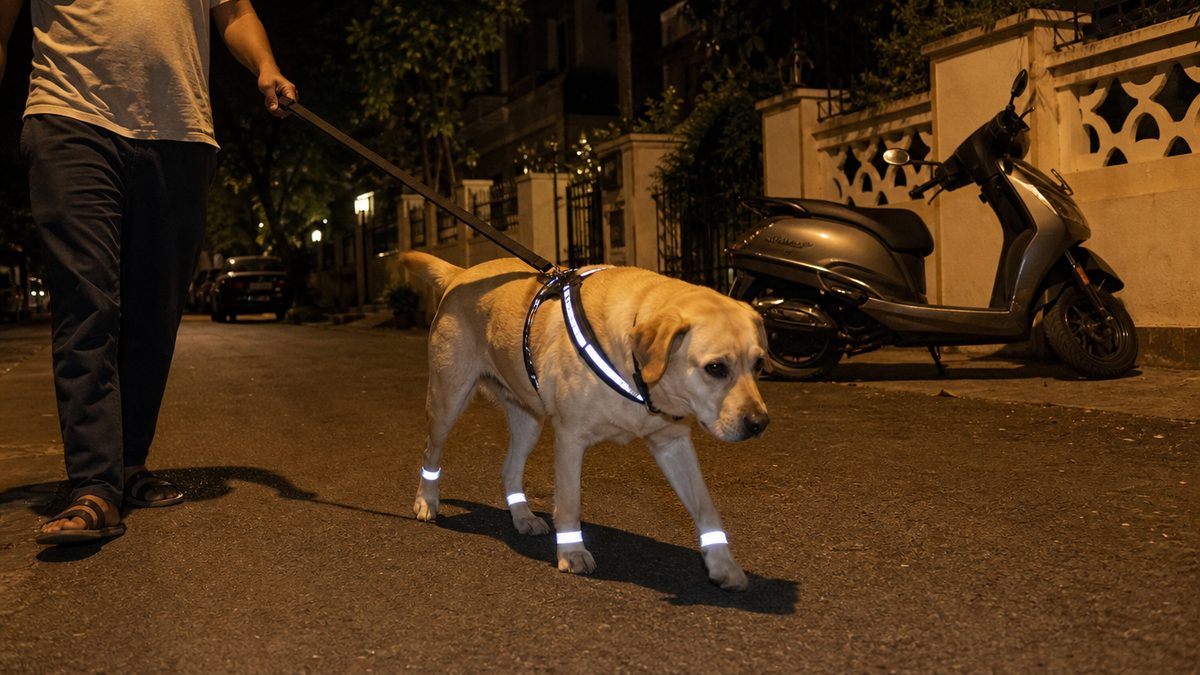
The dog version follows directly. A reflective collar is a single point of light at the dog's neck. Reflective material on the harness strap behind each front leg and around each lower leg moves with the gait, and that movement is what the driver's visual system is built to identify. Nobody has run Wood's trial on dogs, so this is the human finding applied to the same problem rather than a measured canine result, and we are labelling it as such.
The Cochrane review found no trials assessing the effect of visibility aids on the occurrence of pedestrian and cyclist motor vehicle collisions and injuries, and concluded that visibility aids have the potential to increase visibility and enable drivers to detect pedestrians and cyclists earlier, but that the effect on safety remains unknown. So the measured claim is about recognition distance, which is large and reproducible. The claim that reflective gear will prevent a crash has never been tested. Buy it anyway, because 220 m against 0 m is the whole of a driver's stopping distance, and know what has and has not been shown.
Now the Indian denominator, which is where the evening walk stops being an abstraction. The Ministry of Road Transport and Highways records 4,80,583 road accidents in 2023, distributed across eight three-hour blocks. The 18:00 to 21:00 block carried 99,945 of them, 20.8 percent, the largest single block, and the Ministry notes this is in line with the pattern seen over the past five years.
| Time block | Accidents, 2023 | Share | The walk reading |
|---|---|---|---|
| 18:00 to 21:00 | 99,945 | 20.8 percent | The commonest Indian dog-walk hour is the commonest crash hour |
| 15:00 to 18:00 | 84,479 | 17.6 percent | Second worst; the last of the daylight walk |
| 12:00 to 15:00 | 71,697 | 14.9 percent | Too hot to walk most of the year anyway |
| 09:00 to 12:00 | 67,580 | 14.1 percent | Too hot from March to June |
| 21:00 to 24:00 | 55,157 | 11.5 percent | Half the risk of three hours earlier, and darker |
| 06:00 to 09:00 | 48,872 | 10.2 percent | The morning walk, as the traffic builds |
| 00:00 to 03:00 | 24,298 | 5.1 percent | Few people, few vehicles |
| 03:00 to 06:00 | 22,794 | 4.7 percent | The safest block on the road, and the coolest hour of the day |
The 03:00 to 06:00 row deserves a second look, because it is the hour the heat evidence already points at. The quietest three hours on India's roads are also the coolest three hours of an Indian summer day, which means the pre-dawn walk solves the traffic problem and the heat problem at once. It creates a different problem, which is that it is completely dark and very empty, and the rest of this page is about managing that.
The official pedestrian share is disputed, and both figures belong on the page
MoRTH records 35,221 pedestrians killed in 2023, 20.4 percent of the 1,72,890 people who died on Indian roads, up 7.30 percent on 2022. The Transportation Research and Injury Prevention Centre at IIT Delhi disputes that share directly in its Road Safety in India status report, writing that the official estimates of the share of pedestrians among all road deaths are extremely low compared to independent researchers' estimates, about 19 percent against about 35 percent, and that the official estimates for all other modes will therefore also be wrong.
We are publishing both rather than averaging them. The honest statement is that pedestrians are somewhere between a fifth and a third of everyone killed on an Indian road, that the two sources disagree about which, and that nobody disputes the direction. Whichever figure is right, a person walking a dog at night is in the most exposed road-user category there is during the worst three hours of the day.
Two-wheeler riders accounted for 77,539 deaths in 2023, 44.8 percent of the total, the largest road-user category by a wide margin. Wood's trial used a car's headlights. A two-wheeler puts out a single beam that swings with the handlebars, and its rider is unprotected and has less time to react than a driver in a cabin. Plan your visibility at night for the scooter coming up the inside, not for the car.
Free-ranging dogs after dark
Free-ranging dogs are not nocturnal, and the evening walk still runs into them more than any other walk does, because their busiest hours and your convenient hours are the same hours. In the only 24-hour study of the question, dogs were recorded active in 79 percent of sightings in the 20:00 to 20:59 block, the highest of all 24 hourly blocks.
Arunita Banerjee and Anindita Bhadra of IISER Kolkata sampled free-ranging dogs at eleven locations in West Bengal across a full year, covering all 24 hours of the day, and recorded 5,669 sightings. More than 50 percent activity appeared only in the window from 09:00 to 22:30 hours. Hour by hour, activity ran 31 to 35 percent through the small hours, rose to 57 percent by 09:00, held around 50 percent through the afternoon, and peaked in the evening: 72 percent at 16:00, 73 percent at 19:00, 79 percent at 20:00 and 76 percent at 21:00.
Their headline conclusion is the one that corrects the common belief. Contrary to expectation from their evolutionary history, free-ranging dogs are not nocturnal; 75 percent of recorded activity fell in the diurnal hours against 25 percent at night, and the authors describe them as generalists that remain active when humans are active. So the reason the evening walk meets more street dogs is not that darkness makes them come out. It is that 8 pm is the hour when the largest number of them and the largest number of us are on the same road.
One thing does change at night in their data. Broken into three-hour blocks, vocalisations were the highest share of activity in the 21:00 to 23:59 block, at 8.5 percent, against 3.1 to 6.5 percent in every other block. The late-evening barking chorus that every Indian street knows is real and it is measurable, and a dog that barks back into it is a separate problem covered on dog barking and your neighbours in India.
Your own dog is the variable you control
Most encounters are shaped by what your dog does, and the lead is the strongest lever there is. Carri Westgarth and colleagues observed 286 walks in public walking areas and modelled what made a dog-dog interaction happen. If the subject dog was on the lead an interaction was half as likely as if it was off the lead, and an interaction was almost four times more likely to happen with an off-lead dog than with one on the lead. The measured interaction rate was 0.6 a minute off the lead and 0.1 a minute on it.
Read that against an Indian street, where the other dog is a resident and will never be on a lead. You control exactly one of the two variables, and controlling it still halves the odds. Nothing else available to you comes close.
What to do if a group starts towards you is set out below, drawn from FOUR PAWS' own guidance for people in countries with large street dog populations.
- Stop, or slow to a walk. Never run away from a dog, because running can trigger chase behaviour; if a dog starts to chase you while jogging or cycling, stop and wait for it to move away, or continue moving very slowly.
- Shorten the lead by taking it up in your hand rather than by reeling. A shortened grip keeps your dog beside your leg without jerking its neck.
- Turn your body sideways and look away. Staring, yelling, waving your arms, leaning forward and walking directly towards a dog are all read as threats; standing sideways and avoiding eye contact are calming signals.
- Keep walking past at a steady pace, on the far side of the road if there is one. If a dog barks at you from a distance it is a warning to stay away from its territory, and staying calm, keeping a safe distance and walking past slowly usually ends it.
- Do not walk into the middle of a group. Dogs stay in groups to protect each other and are territorial; be especially careful at night, because in the dark you may not be able to see all the dogs around you.
- Ask a local for help if you are stuck. Many of the dogs are regulars in the area and are likely to respond better to someone they know.
A retractable lead gives a dog several metres of line in the dark, where you cannot see what it is walking into, and it lets the dog build speed before the line goes tight. It also puts a thin cord across a street at shin height to an oncoming scooter. Use a short fixed lead after dark. The measured case against the retractable lead, and the collar against harness question, are both settled on collar or harness for dogs in India; this page does not re-argue them.
The law, the Animal Birth Control Rules, the sterilisation route and what to do about an aggressive or injured community dog all sit on free-ranging dogs in India. Two lines from it are worth carrying here: a sterilised dog is released at the place it was caught, so the dogs on your route are legally resident and are not going anywhere, and a bite is a same-day hospital visit whatever the dog looks like.
If your dog does slip the lead in the dark, the first hour decides most of it, and how to find a lost pet in India sets out the search, including the finding that walking the area at night with a torch outperforms driving around it. A current tag with a working phone number and a microchip are what make that search short, and pet microchipping in India covers the backup.
Snakes on the night route, briefly
Snakes are a genuine and seasonal night-walk hazard in India, and this page covers only the route decision, because snake bite in dogs in India already carries the signs, the first hour, the antivenom and the cost. The denominator is the part worth adding here.
India's snakebite burden is larger than the official reporting shows. Analysing 2,833 snakebite deaths from 611,483 verbal autopsies in the nationally representative Million Death Study, Suraweera and colleagues estimated that India had 1.2 million snakebite deaths from 2000 to 2019, an average of 58,000 a year, with half of all deaths falling in the southwest monsoon from June to September. Their systematic review of 87,590 Indian snakebite cases found 64 percent occurred outdoors and 48 percent between June and September.
The burden is not spread evenly, and where it sits is worth knowing before you decide how much of this applies to you. Just under 70 percent of the snakebite deaths from 2001 to 2014 occurred in eight states holding about 55 percent of the population: Bihar, Jharkhand, Madhya Pradesh, Odisha, Uttar Pradesh, Andhra Pradesh including Telangana, Rajasthan and Gujarat. Tamil Nadu, Karnataka and Maharashtra are not on that list. A reader in central Bihar and a reader in central Bengaluru are not facing the same risk on the same walk, and no page that treats snakes as a generic Indian hazard tells them so.
Our own snake bite health page quotes the figure India's national action plan takes from Central Bureau of Health Intelligence reporting, about 3 lakh snakebite cases and about 2,000 deaths a year. The Million Death Study estimate is 58,000 deaths a year. They are not the same instrument. One counts what reaches a hospital and gets recorded; the other estimates deaths across the whole population, including everyone who never reached one. The WHO's summary of the same study notes the government's declaration of 15,500 snakebite deaths in public hospitals for 2003 to 2015 against 154,000 detected for the same period. Plan the walk around the larger number.
For a night walk the useful part is where you put your feet, and three kinds of ground carry most of the risk.
- Grass verges and unmown strips beside a road, where the ground is not visible and the dog's nose arrives before your torch does.
- Construction sites, rubble heaps and stacked building material, which hold rodents and therefore hold what hunts rodents.
- Unlit lanes through the monsoon and the weeks after it, when flooded burrows push snakes onto roads and other drier ground.
The instruction follows from that and takes nothing from the health page beyond a link. Carry a torch and point it at the ground ahead of the dog rather than straight out, keep the dog on hard surface where you can, and do not let it nose into verges or rubble after dark during the monsoon months. If a bite happens, go now and do nothing to the wound; everything else is on the snake bite page, and the rest of the wet-season routine is on monsoon care for dogs in India.
The gear that earns its place, and what it costs
Four items earn their place on a night walk in India: a light on the dog, retroreflective material on its limbs, a short fixed lead and a torch for you. Each does a different job, and two of them are routinely confused with each other.
A lamp and a reflector do two different jobs
A lamp emits light, so it is seen by anyone looking in its direction whether or not they are shining anything at you. A retroreflector returns light to its source, so it is seen only by someone whose own headlight is pointed at it, and it is invisible to a pedestrian, to a cyclist without a lamp, and to a driver until their beam reaches you. The Cochrane review treats them as separate interventions for exactly this reason, listing lamps, flashing lights and retroreflective materials as three distinct things that increase night-time detection.
So the answer is both, not either. A clip-on collar light makes your dog a visible object on an unlit lane. Retroreflective material on its legs is what turns it from an object into a recognisable moving animal once a vehicle's beam arrives, which is the biological motion effect.
| Item | What it does | Price as printed | The catch |
|---|---|---|---|
| Clip-on LED collar light | Emits light, so the dog is seen without any beam on it | ₹249, down from an MRP of ₹299 on one Indian seller's page | Runs on a charge; a flat light is no light, so charge it with your phone |
| Reflective collar | Returns a driver's headlight from one point at the neck | ₹200 to ₹600 across the range on one Indian seller's category page | One point of light; it does not produce the biomotion pattern |
| Retroreflective tape or strips on the harness and legs | Returns a driver's headlight from the moving joints | No price confirmed; the Indian industrial-tape page opened for this returned no rendered price on this attempt | Check it does not sit where a strap chafes; see the fit rules on the harness guide |
| Short fixed lead | Keeps the dog beside your leg where you can see it | Covered on the equipment guide | A retractable lead undoes every other row in this table |
| A torch or head torch for you | Lights the ground ahead of the dog and makes you a lamp | Not priced here | Point it down, not out; a beam in a street dog's eyes is a threat signal |
Bonbeno names no product as a recommendation and ranks none. The prices above are a guide to what each category costs in India, read on the sellers' own pages on the date given, and a verdict on any named product would need first-hand testing we have not done.
Spend it on the light rather than on a reflective collar. A lamp works on an unlit lane with no vehicles on it, which is where most of an Indian night walk happens, and it works regardless of whether anyone's headlight is pointed at you. Then add reflective material for the cost of a roll of tape, and put it on the legs and the harness straps rather than on the collar, because that is the placement the evidence is about.
One item not on the list is a deterrent spray, which is the product the search results push at anyone asking how to protect a dog from street dogs while walking. It solves a problem you should be avoiding by route choice, it is a poor thing to be fumbling for one-handed in the dark, and spraying a resident community dog on your own street makes every future walk worse.
Your own safety, honestly
Your own safety on a night walk comes down to being visible to traffic, keeping your attention free, and telling someone where you went, and this page does not tell anyone which streets they may walk on.
Start with the part that is measured, because it is the part most people skip. Everything in Wood's trial was about a human pedestrian, not a dog. If you have put a light on your dog and nothing on yourself, you are the unlit object in the pair, and you are taller and heavier than the dog. Reflective material on your own ankles and wrists costs nothing extra and does the same job.
Staying alert is the part no piece of equipment replaces, and on an Indian street at night it mostly means keeping your hearing and your hands free. The five habits below cost nothing.
- Carry a torch and keep it pointed at the ground three to five metres ahead. It shows you the verge, the open drain and the sleeping dog, and it makes you a light source.
- Keep one ear free. If you listen to anything, use one earphone, because a scooter coming up behind you on an Indian street is a sound before it is a sight.
- Hold the lead in the hand away from the road, so the dog is never between you and moving traffic.
- Tell someone the route and roughly when you will be back, and take a charged phone. A dog that bolts turns a twenty-minute walk into a two-hour search.
- Walk the route once in daylight before you walk it at night. You are looking for open manholes, missing footpath slabs, parked vehicles that force you into the carriageway, and where the resident dogs sit.
The Animal Welfare Board of India's own guidance puts the lead at the centre of both halves of this. Leashing of pets in public places is advisable, it says, because it assures passers-by that they are safe and makes them more comfortable, and leashing also ensures the safety of the pet from being run over by vehicles on streets, or worse still, being the cause of accidents. The same document asks owners to make every effort to keep their dogs quiet, particularly during night hours.
Two honest notes about the dog's role. A dog is a reason to be outside late and some deterrent to being approached, and it is not a security system; a frightened dog pulls towards home and gives you less control, not more. And a dog on a short lead beside you is far easier to protect than a dog on six metres of line in the dark.
Where a bye-law sets a lead length or a muzzle requirement, that is a separate subject and things to do with your dog in India sets out which Indian municipal instruments actually state one. This page is about what works, not about what is enforceable.
The two-minute routine before you open the gate
To get out of the door safely at night, run the same five checks every time, in the same order, because a routine survives a tired evening and a decision does not.
- Clip the light on and switch it on indoors, where you can see that it works. A collar light that died yesterday looks identical to one that is charged.
- Check the tag with your fingers, not your eyes. A tag that has worked loose comes off on a lead jerk, and in the dark you will not notice it fall.
- Clip the lead to the harness and give it one firm pull to test the buckle and the stitching. Do the escape test in the lift lobby, not on the road.
- Pick up the torch and your phone, and take a bag. Every one of these is useless left on the shoe rack.
- Decide the route before you step out, and say it out loud to whoever is home. Choose well-lit routes you already know over a shortcut you have not walked in daylight.
Two additions by season. Through the monsoon and the weeks after it, add the rule about keeping off verges and rubble. Through festival weeks, assume firecrackers and assume your dog will try to bolt from one, and how to calm dogs during firecrackers in India covers the preparation that makes those evenings survivable.
Keep your vet's night number and the nearest 24-hour veterinary hospital's number saved before you need either. A night walk is the walk on which you are least likely to be able to look one up calmly.
The dogs that need the night walk changed, not shortened
Four kinds of dog need a different night walk rather than the same walk made shorter, because the thing that makes the dark hard is specific to each of them.
A senior dog is the clearest case. Failing sight and hearing both bite hardest in low light, and a dog that does not hear a scooter cannot move out of its way. Walk a senior earlier in the evening while there is still some light, keep the route identical night after night so the dog is navigating memory rather than vision, and put the light where you can see it from behind. The wider picture is on senior dog care in India.
A reactive dog gets worse in the dark, and for a reason worth understanding. Dogs read each other's body language at distance, and darkness removes the distance at which that reading happens, so the first information a reactive dog gets about another dog is that it is already close. Walk later, when there is less to meet, pick wide roads over narrow lanes, and work on the behaviour in daylight where you can see what you are rewarding.
A small dog is harder for a driver to resolve at any distance and sits below the beam of a dipped headlight on an uneven road. The light goes on the harness at the dog's highest point rather than low on the collar, and the dog stays on the inside.
A dark-coated dog is the one owners most consistently underestimate. A black Labrador or an Indian pariah dog with a dark coat returns almost nothing to a headlight, and the whole of the 0 m figure in Wood's trial was a human in black clothing. Reflective material is not optional for these dogs, it is the only thing making them exist to a driver.
A dog without a complete vaccination course should not be meeting the free-ranging population at its busiest hour, and 20:00 to 21:00 is that hour. Carry a young puppy through the stretch of the street where the resident dogs sit, keep it off shared ground, and leave the night walk until the course is finished. Your nearby vet decides the date.
Three things everyone says that the data does not support
Three claims repeat across the pages that rank for this question in India, and the measurements contradict all three.
"Street dogs are more aggressive at night because they are nocturnal"
They are not nocturnal. In the only study to sample Indian free-ranging dogs across all 24 hours, 75 percent of recorded activity fell in daylight hours and the authors concluded explicitly that the dogs are not nocturnal but generalists that are active when humans are active. The reason the evening walk meets more dogs is overlap, not nocturnality. That matters practically, because it means the fix is timing and route choice rather than avoiding darkness, and a 05:00 walk meets dogs at 31 percent activity while a 20:00 walk meets them at 79 percent.
"A reflective collar makes your dog visible"
It makes a point at your dog's neck visible to a driver whose headlight is already pointed at it. It does nothing for a pedestrian, nothing for an unlit cyclist, and nothing at all until a beam arrives. The configuration that produced 100 percent recognition in the one trial that measured it was retroreflective material placed to depict biological motion, at the joints of the limbs, not a single band. A collar is a starting point and it is the weakest version of the right idea.
"The evening is the cool walk"
Measured, it is not, in six of the eight cities above. Ahmedabad is at 34.5 C at 20:30 in May and Delhi and Hyderabad at 31.7 C, against a pre-dawn mean of 25.9 C to 27.4 C. In the humid cities the dry-bulb does fall and the wet-bulb does not, so the heat a panting dog actually experiences is flat or slightly worse across the evening. Only Pune and Bengaluru deliver the cool evening the advice assumes. An evening walk in an Indian May is a dark walk taken in heat, and it should be planned as both.
That reflective gear prevents crashes, which no trial has shown. That pavement burns dog paws at 10 pm, which the surface temperature evidence does not support. That street dogs are dangerous, which the law, the ecology and the civic position on free-ranging dogs in India address properly. And that there is a canine version of the biological motion trial, because there is not. Each of those is a place where the honest answer is narrower than the one that would sell the advice.
Common questions
Is it better to walk a dog at night or in the morning?
Morning, on the road-safety evidence. India's 03:00 to 06:00 block carried 22,794 accidents in 2023, 4.7 percent of the national total and the smallest of the eight three-hour blocks, while the 18:00 to 21:00 block carried 99,945, which is 20.8 percent and the largest. The pre-dawn hours are also the coolest. The evening's advantages are daylight at the edges, company on the street and a schedule that fits work.
Is 9pm too late to walk my dog?
No, and in much of India it is better than 7 pm. Measured over 2019 to 2023, Delhi's mean May air temperature falls from 34.1 C at 18:30 IST to 30.9 C at 21:30, and Ahmedabad's from 37.5 C to 33.5 C. The 21:00 to 24:00 road-accident block also carries about half the share of the 18:00 to 21:00 one. In Mumbai, Chennai and Kolkata the wet-bulb does not improve, so waiting buys darkness rather than comfort.
Are reflective collars good for dogs?
They help and they are the weakest version of the right idea. A collar puts one point of retroreflection at the neck, and it only works once a vehicle's headlight is pointed at it. In the trial that measured this, drivers recognised 100 percent of pedestrians wearing retroreflective material arranged at the joints to depict biological motion, against 5 percent of pedestrians in plain dark clothing. Put material on the limbs and the harness straps, and add a light that emits rather than reflects.
What is the best defense against dogs while walking?
Route choice, a short lead and not running. FOUR PAWS advises never running away, because running can trigger chase behaviour, and recommends stopping or moving very slowly instead, standing sideways, avoiding eye contact and not staring, shouting or waving your arms. Keep your own dog on a short fixed lead beside your leg, walk past a group rather than through it, and ask a local for help if you are stuck, because the dogs usually know them.
How to defend yourself against a stray dog?
Stay still or move away slowly, keep your arms close to your body and avoid direct eye contact, and do not shout or make sudden movements. FOUR PAWS gives crouching as if to pick up a stone as a last resort, while being clear that you should not actually throw anything. If you are knocked down, protect your head and vital organs and stay still until the dogs lose interest. Any bite that breaks the skin is a same-day hospital visit.
Is it okay to walk a dog at night?
Yes, and for most Indian owners for most of the year it is the only practical option. Treat it as a different walk rather than the same walk in the dark: a light on the dog, retroreflective material on its limbs, a short fixed lead, a torch pointed at the ground, and a route you have already walked in daylight. Free-ranging dogs are at their most active around 8 pm, so expect to meet them and plan the route accordingly.
Do dogs like going on walks at night?
No study has measured whether pet dogs prefer night walks, and this page will not invent one. What has been measured is that free-ranging dogs in India are active across both day and night, with 75 percent of recorded activity in daylight hours and a peak of 79 percent active around 8 pm. For an owned dog in an Indian city the walk time is set by the heat and by your working day rather than by the dog's preference.
Is there a dog collar that lights up at night?
Yes, two separate categories exist and they are often confused. An LED collar or clip-on collar light emits its own light and is visible without any beam on it, selling in India from about ₹249 on one seller's page. A reflective collar returns a driver's headlight and does nothing until that beam arrives. Bonbeno ranks no product, because a verdict needs first-hand testing. If you buy one thing, buy the one that emits.