
Cat life guide
How to make my house cat friendly: the physical setup for an Indian flat
Almost every cat-friendly-home page is a shopping list. This one is a map of the space you already have: the 2.75 metres of height above an Indian flat's 46 square metres of floor, where each resource goes once you accept there is only one level, and what the measured evidence says about shelves, hiding boxes, domestic staff and a second cat.
Quick answer
How to make my house cat friendly? Add height first, then spread the resources out. An Indian urban home averages 46.1 sq m of floor and 2.75 m of clear height, so the unspent space is vertical. Give one safe place and one litter tray per cat plus one, separated rather than clustered, at least one hiding place per cat, and a scratching post where the cat sleeps or enters. Environmental stress in cats is a medical problem, not a mood.
This guide is general information for Indian pet owners and is not a diagnosis. Always consult a registered veterinarian near you before acting on anything you read here, and treat any sudden change in your pet's condition as urgent.
How to make my house cat friendly, starting with the space you already have
To make your house cat friendly, add vertical space first and separate the cat's resources second, because the floor area of an Indian home is effectively fixed and the height above it is almost entirely unused.
The two numbers that frame this are both official. The National Sample Survey's 76th round, run from July to December 2018, measured the average floor area of a dwelling unit at about 46.1 square metres in urban India and about 46.6 square metres in rural areas. The National Building Code of India 2016 requires, in general, a minimum clear height of 2.75 metres between floors, measured from the top surface of the floor to the lowest point of the ceiling. A cat in a typical Indian flat therefore lives inside about 46 square metres of floor and 2.75 metres of height, and nearly all of that second number is empty air.
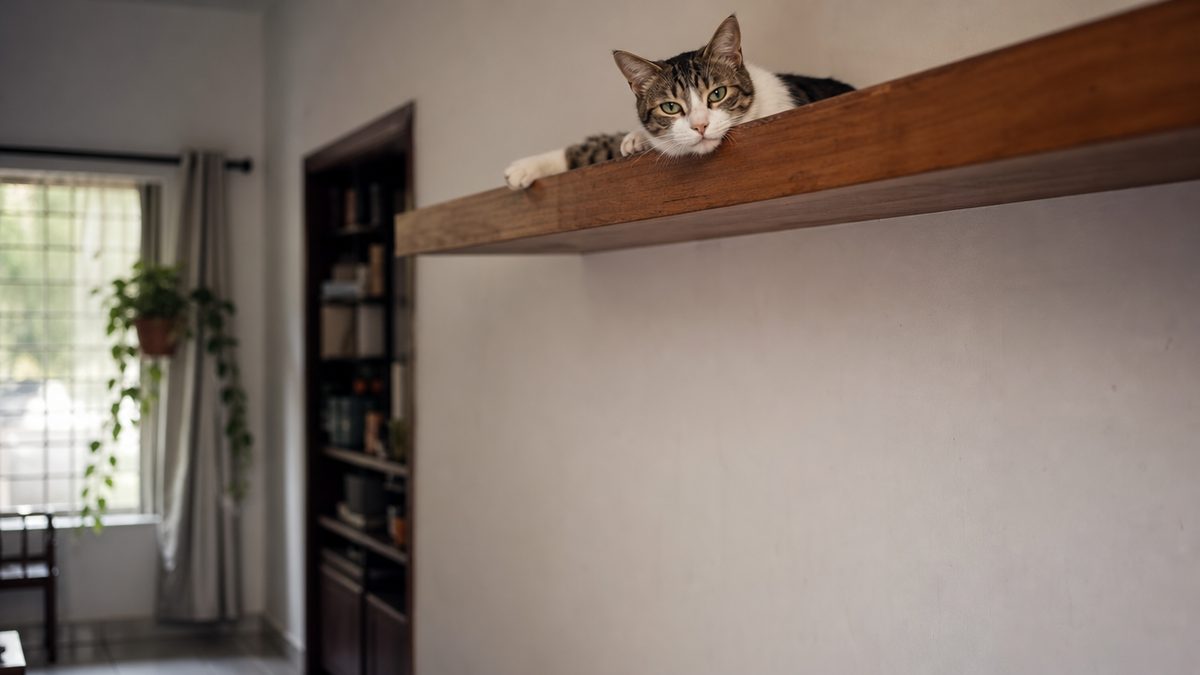
That gap is the opportunity. You cannot add floor area without moving house. You can add usable surface at roughly 1.1 metres, 1.7 metres and 2.3 metres without giving up a single square metre of the floor, and a cat treats those surfaces as territory rather than as furniture.
| Dimension | Typical Indian figure | Who measured it | How much of it the cat currently gets |
|---|---|---|---|
| Floor area of the dwelling | about 46.1 sq m urban, 46.6 sq m rural | NSS 76th round, July to December 2018 | Most of it, minus furniture, and it cannot be increased |
| Clear height between floors | minimum 2.75 m | National Building Code of India 2016 | Usually the bottom 1 m, because nothing above that is reachable |
| Usable surface one shelf screen added in a cat room | 2.25 sq m, about 0.32 sq m per cat with 7 cats | Desforges et al, 29 cats in 4 rooms, 2016 | Zero until you build it, and used immediately once you do |
| Safe places needed | one per cat plus one additional place | 2024 AAFP intercat tension guidelines | In most flats, one, which is the cat's own bed |
Why the clean, empty flat is the hard version
International Cat Care puts the problem in a sentence. Open-plan living spaces with clean lines and a lack of clutter 'may be the basis of the modern style, but this couldn't be further removed from your cat's natural habitat', because a cat still needs a degree of camouflage to move through a space inconspicuously, and 'it's very hard to disguise a cat in an empty room'. A slightly more cluttered home is 'a haven of possibilities', offering high places to sit and plenty of places to disappear from view, and pulling furniture away from walls creates hiding places on its own.
That is the opposite of what an interiors page will tell you. The new-build 2BHK in Bengaluru or Gurugram, with everything built in, no gap behind any unit and a single open living-and-dining space, is a harder flat for a cat than an older one with a standalone almirah, a loft, a sofa pushed off the wall and suitcases stacked on a cupboard. If you are choosing between tidy and cat friendly, the cat wants the version you would apologise for.
One thing comes before all of this. If the flat has an unnetted balcony or an openable window with no mesh, that is the first fix and it is a safety question rather than a comfort question. Our guide to indoor cat safety in India covers nets, mesh sizes and the fall data in full, and nothing on this page replaces it.
Stand in each room and write down three heights: the top of the almirah, the top of the fridge or the kitchen counter, and the sill of the window the cat watches. Those three are the perches you already own. Everything you add after that is a route between them, not a new destination.
Why vertical space is not decoration
Vertical space is not decoration because a cat uses height to watch a room and to keep out of another cat's way, and the one controlled test of adding it to a cat room measured both the use and the drop in conflict.
Twenty-nine cats housed in four social rooms were filmed for two days before a free-standing shelf screen was introduced, four days while it was in place and two days after it was taken away. Given the ratio of the new screen to the existing shelving, 0.58 to 0.42, a statistically significant proportion of cats were found on the screen during the test phase, at P less than 0.0001.
The conflict result is the one that matters in a flat with two cats. Agonistic events occurred significantly less often in the test phase after the morning feed than in either the baseline or the removal phase, and in the afternoon they rose again before feeding once the screen had gone. The screen added 2.25 square metres of usable space, which the authors put at 0.32 square metres per cat in a room holding seven, with no change to the size of the room.
Hold that figure against an Indian flat. A 46 square metre home that gains 2.25 square metres of shelf has added about five percent to its usable area while giving up none of its floor, and the cats in that study moved onto the new surface straight away.
The 2024 AAFP intercat tension guidelines describe the same mechanism from the clinic side. One of their case figures records tension in a multi-cat household that 'occurred because of competition for vertical space', resolved after a behaviour consultation by placing perches along the walls of both levels of the home including above the stairs, 'leading to toleration between the cats'. The guidelines also tell clinicians to advise caregivers to stop one cat staring at another 'by using a solid piece of furniture as a visual barrier between cats and/or by using vertical space';.
The route up matters more than the top
International Cat Care's list of high resting places carries three warnings that most Indian setups ignore. A freestanding cupboard or wardrobe makes a good high place but usually needs another piece of furniture placed nearby as a halfway platform. A shelf needs a non-slip surface, because many wooden shelves are extremely slippery. And the cat has to be able to get down easily, which matters most for older cats with limited mobility.
The halfway platform is the part Indian homes miss. An almirah top with nothing between it and the floor is a one-way perch: the cat climbs by launching off a bed or a chair that may not always be in that spot, and comes down in a drop it will stop taking at twelve years old. A stool, a trunk or a single wall shelf at about waist height converts an unreachable high place into a used one. The changes an old cat needs are in senior cat care in India.
What goes on the perch matters less than people think, and the one thing to get right is that the cat can rest flat. Beds on cat trees have to be large enough for the cat to lie in comfortably, or they are not used. A bare 30 by 40 centimetre shelf with a folded towel on it beats a plush cup the cat has to curl into.
An Indian ceiling fan hangs into a room whose clear height is a minimum 2.75 metres, which puts the blade close to the top of a tall almirah or a loft shelf. Measure the blade height, keep every perch outside the swept circle, and switch the fan off before the cat goes up. No published series of cat injuries from a ceiling fan exists, so this is a geometry rule rather than a measured risk, and we say so rather than dressing it up. The rest of the household hazard list is in indoor cat safety in India.
Resource distribution: one per cat plus one, and spread apart
Resource distribution means one of each key resource per cat plus at least one extra, placed apart from each other rather than in a row, and the second half of that rule is the half most homes get wrong.
International Cat Care states it in three parts. A cat's resources, meaning food and water bowls, scratching facilities and litter trays, should be 'available in sufficient numbers ie, a minimum of one per cat, plus at least one extra', should be 'spaced out around the home away from each other', and should be 'suited to an individual cats' needs', such as a tray with lower sides for a kitten or an elderly cat. The 2024 AAFP intercat tension guidelines apply the same arithmetic to safe places, asking for 'one safe place per cat plus one additional place' in order 'to allow choice and prevent competition';.
Where those resources go is the part a count never conveys. The AAFP guidelines ask that all key resources, meaning safe places, food, water, litter boxes and scratching surfaces, be distributed through three components of each cat's physical environment: the home range, the territory and the core territory. Safe places, food, water and play belong inside each cat's core territory, with food and water separated and with 'multiple visually separated feeding and water stations'. Litter boxes and scratching surfaces go 'in different locations toward the periphery of the territory on each level of the home'. Where a household holds more than one social group of cats, each group gets its own core territory.
What separated means when the home has only one level
That guidance assumes a house with levels and a periphery. An Indian flat averaging 46.1 square metres usually has one level, three or four rooms and a single corridor, so 'on each level of the home' does not translate and 'toward the periphery' has to be read as distance and sightline instead.
The working translation is short. Two resources are separated when a cat using one cannot be seen from the other, and when reaching one does not require walking past the other. A food bowl in the kitchen and a litter tray in the bathroom are separated. Two litter trays side by side in the same bathroom are not two trays at all, and International Cat Care says why: trays placed alongside each other are often read by a cat as a single tray and go unused once one of them is soiled.
| Resource | One cat | Two cats | Where it goes in a three-room flat |
|---|---|---|---|
| Safe place, raised and private | 2 | 3 | Almirah top in the bedroom, a shelf in the living room, a covered bed in the third room |
| Hiding place at floor level | 2 | 3 | Under the bed, behind the sofa pulled off the wall, a carton on its side |
| Litter tray | 2 | 3 | Bathroom, utility balcony, spare room corner, never two side by side |
| Food station | 1 to 2 | 2 to 3 | Kitchen floor and one other room, out of sight of each other for two cats |
| Water station | 2 | 3 | Away from the food and away from the tray, including one near where the cat sleeps |
| Scratching post or pad | 2 | 3 | Beside the sofa nearest the front door, beside the bed, one horizontal pad |
Litter tray placement is a resource question rather than a training question, and this page stops at where the tray goes. The tray count and size, the eight litter types sold in India with prices, the cleaning schedule and what to do when a cat stops using the tray are all in litter training a cat or kitten in India. Water bowls, bowl material, bowl placement and how to raise a cat's actual water intake are in can cats drink milk, including why the water fountain evidence is thinner than the advice suggests.
No published trial has compared n resources against n plus one in cats and measured the outcome. The count comes from feline-medicine consensus guidance, and it is sensible, because a spare removes the cost of one resource being occupied or soiled International Cat Care. Treat the plus one as prudent rather than proven. Treat spread apart as the half with a measured mechanism behind it.
Hiding places, and why taking them away backfires
Taking a cat's hiding places away makes it more vigilant rather than more sociable, and two Dutch shelter studies measured how much difference a single box makes.
Nineteen newly arrived cats at a Dutch animal shelter were randomly split into a group of ten that received a hiding box and a group of nine that did not, then scored over fourteen days on the Kessler and Turner Cat-Stress-Score. The box group had a significantly lower mean score on observation days 3 and 4, at P less than 0.01, and the variance within the box group was minimal, meaning the box worked on most of the cats rather than on a few. Both groups reached the same mean score by day 14, but the box group had already reached that level by about day 3.
A later randomised controlled trial from the same shelter medicine programme extended the result. Cats with a hiding box showed a significantly faster fall in the Cat-Stress-Score and reached a lower steady state seven days earlier than the control group. The same trial found that nearly all cats in both groups lost significant body weight in the first two weeks and that the box did not prevent it, which is the authors' own caution against treating a hiding box as a complete answer to a stressful environment.
What a cat does when it has nowhere to hide is the reason this matters at home. Stressed cats in environments without hiding opportunities rest alert behind the litter box, which is concealment of a sort and rest of no sort at all. A cat under your bed is not rejecting you. A cat with nowhere to go under is not accepting you either; it is on watch, and the watching costs it something you will not see.
International Cat Care's private places are the ordinary ones: space under a bed, the inside of a cupboard or wardrobe, the gap behind a sofa pulled off the wall. Its single rule about them is the one Indian households break most often, because a cat 'should never be disturbed while using a private area' unless you have reason to think it is unwell.
Hauling a hiding cat out to meet a guest, to be photographed or to prove it is friendly removes the one resource it is using to cope. The 2024 AAFP guidelines list hiding among the subtle signs of social tension, so a cat that has started hiding more is reporting something about its environment rather than something about its personality. Investigate the environment. Do not extract the cat.
An Indian flat is built with hiding places and then usually seals them. The space under a divan bed is a storage box. The gap behind an almirah flush to the wall does not exist. The loft is full. Open one of the three, leave the carrier out with the door off so it becomes a den rather than a vet signal, and count a cardboard carton on its side as a legitimate resource rather than as clutter to be thrown out on Sunday.
Two further points follow from the shelter data. A cat in a new home is in the same position as a cat in a new shelter, so the hiding place goes in before the cat arrives, which is what bringing a kitten home in India and how to adopt a cat in India set out step by step. And a settling period measured in days to a fortnight is what the stress scores actually show, which is worth remembering the next time someone quotes you a rule of thumb about three days, three weeks and three months.
Scratching posts, placement, and what declawing is
Scratching posts get used when they stand where the cat already scratches, because scratching is normal territorial behaviour rather than a habit to be broken.
The American Veterinary Medical Association's policy states the function plainly. Scratching 'is a normal behavior of cats that conditions the claws, serves as a visual and scent territorial marker, allows for self defense, and provides healthy muscle engagement through stretching';. A cat shredding the sofa arm is marking, and the mark is visual as well as chemical, which is why the spot it picks is almost always beside a doorway or beside where it sleeps.
Placement follows from that function. The AAFP guidelines group scratching surfaces with litter boxes as resources that belong 'in different locations toward the periphery of the territory on each level of the home';. International Cat Care adds that a post should be as tall as possible so the cat can scratch vertically at full stretch, that panels fixed to a wall at the right height work where there is no floor space to spare, and that some cats prefer horizontal surfaces such as mats or corrugated cardboard, so offering a variety is how you find out which this cat wants.
This is why a post in the corridor gets ignored. A corridor in a 46 square metre flat is transit space with no resting place and no entry point in it, so nothing about it invites a territorial mark. The sofa arm nearest the main door does invite one. So does the floor beside the bed the cat wakes on. Put the post in the place you were trying to protect, and the behaviour moves onto it; put it where it looks tidy, and it does not. Substrates, heights, cat trees and what each type costs in rupees are in things to do with your cat in India.
Declawing, plainly
Declawing, or onychectomy, is the surgical amputation of all or part of the third toe bone of each digit together with the claw. The AVMA 'strongly discourages veterinarians from performing onychectomy, tenectomy, or any other surgical procedure intended to prevent the normal use of the animal's claws that is not medically necessary', states that amputation or other surgical alteration of the distal digits 'is an acutely painful procedure and may result in chronic pain, maladaptive behavior, disability, and significant mutilation', and holds that where the surgery is performed, multi-modal perioperative pain management must be used.
India has no statute that names declawing, so the position here is professional rather than legal, and we could find no Indian regulator or veterinary council document on it. The practical point is that the procedure removes a normal behaviour that a correctly placed post redirects without amputation, and the AVMA itself puts the duty on the veterinarian to counsel owners about natural scratching behaviour and about effective alternatives to surgery before anything else. If a clinic offers it, that counselling is what to ask for.
The Indian flat: grilles, ceiling fans, open kitchens and the monsoon
The Indian flat changes six things about a cat friendly home, and the first is that a window grille is ventilation rather than containment.
International Cat Care's advice on fresh air arrives with the Indian caveat already attached. Open windows are worth having for the smells they carry, 'just make sure you cover open windows with grills if you don't want your cat to go outdoors';. An Indian safety grille is engineered to stop a person, and the gap between its bars passes a cat without the cat breaking stride. The grille is the frame you fix mesh to. It is not the mesh.
The six changes an Indian flat makes to the standard advice are set out below, with the page that carries each one in full.
- Grille windows let a cat through. Mesh or net the opening and treat the grille as a mounting frame, because the cat-sized gap is the default rather than the exception. Mesh sizes, net prices and the fall data are in indoor cat safety in India.
- The ceiling fan sweeps the plane your best perch sits in. A clear height of 2.75 metres leaves the blade close to the top of a tall almirah, so measure it and put the shelf on a wall the fan does not reach.
- The open kitchen hands the cat its highest clear surface. In an open-plan flat the counter is often the tallest uncluttered surface in the room, which is exactly why the cat chooses it, and a gas burner makes it the wrong choice. Give the cat a taller perch in the adjoining room instead of competing for the slab.
- The washing machine drum, the geyser bucket and the overhead tank hatch are warm or wet enclosures a cat will climb into. Check the drum before every load and keep the bucket covered; the hazard list is in indoor cat safety in India.
- Marble and tile floors are a resource in summer and a problem in winter. A bed belongs in a raised position near warmth or sunlight in a cool climate, and 'in a very warm climate, your cat may appreciate a cooler location';, which is why a cat in a Chennai or Ahmedabad May abandons its bed for the bathroom floor and why the same cat wants a raised bed in a patch of sun through a Delhi or Pune January. Provide both and let the cat choose; heat itself is covered in keeping a cat cool in summer in India.
- Monsoon humidity moves the sleeping site upward. A floor-level bed in a humid Mumbai or Kolkata August stays damp, so the cat settles higher, and a raised bed on a shelf gets used in exactly the weeks the floor bed does not.
Two more belong on that list and have pages of their own rather than a line here. The balcony is the single most dangerous surface in an Indian flat and is covered in indoor cat safety in India. Festival noise, Diwali above all, is covered in Diwali with your pet in India. What this page adds to the festival question is that the hiding place and the high perch you build in October are the two things the cat actually uses on the night, so the setup is the preparation.
One honest limit on this whole section. No published study has measured any of these six in cats, in India or anywhere else. Each is the general feline principle applied to a specific Indian fixture, and we are telling you which part is evidence and which part is reasoning rather than letting the two blur.
Domestic staff, visitors and the routine your cat is tracking
Domestic staff and visitors are a routine stressor that imported cat guides never consider, and the longest study of unusual events in cats put a relative risk on each consequence.
Twelve healthy cats and twenty cats with feline interstitial cystitis were observed by a single observer for 77 weeks. Unusual external events, defined by the study to include changes in caretakers, changes in the daily routine and a lack of interaction with the investigator, were identified in 11 of those weeks; the remaining 66 were control weeks.
The results are the reason this section exists. Exposure to an unusual event significantly raised the relative risk of a decrease in food intake to 9.3, of no elimination at all within 24 hours to 6.4, of defecation outside the litter box to 9.8 and of urination outside it to 1.6. Disease status predicted none of it, because the healthy cats and the cats with cystitis were comparably affected.
Now read that against an ordinary Indian household. A cook at nine. A cleaner at eleven whose shift changes when her child is ill. An istri-wala at the door. A plumber for the society's water line. Relatives for a week in December, and the family itself away over Diwali. Each of those is a change in caretaker or a change in routine in precisely the sense the study measured, and in most urban Indian homes several of them happen every single week.
The size of that workforce has never even been counted. India launched its first ever All India Survey on Domestic Workers in November 2021, and the government's stated reason was that 'there is a dearth of data on the magnitude and prevailing employment conditions' of domestic workers, with 1,50,000 households to be covered to produce a first national estimate. So the practice is close to universal in urban middle-class homes and the arithmetic behind it is not published, which is as precise as this page can honestly be.
What to change is small, specific and free. The AAFP guidelines' fourth pillar asks for positive, consistent and predictable human interaction, which is a scheduling instruction as much as a behavioural one.
- Give the room the help works in both a hiding place and a high perch, so the cat can leave the floor without having to leave the room.
- Keep the same person on the same days wherever you can, because the measured stressor was the change of caretaker rather than the presence of one.
- Ask the person not to feed the cat, not to pick it up, and not to open the main door while the cat is loose in the hall.
- Feed the cat before the help arrives rather than after, so a meal is not competing with a vacuum cleaner.
- Watch the tray on days with visitors, because defecation outside the box carried the highest relative risk of any sign measured, at 9.8.
- Set up the hiding place and the perch a week before a house fills with guests, never on the morning they arrive.
One thing not to do is force the introduction. A cat that watches the cleaner from the top of the almirah for six months and never comes down has solved the problem, and a cat carried over to be petted has had its solution taken away.
Two cats: tolerating is not the same as getting along
Two cats that tolerate each other are not two cats that get along, and the test is whether they nose-touch, sleep touching, groom each other and head-bunt.
The 2024 AAFP intercat tension guidelines open with the scale of it. Surveys globally indicate that intercat tension affects between 62.2 and 87.7 percent of households with two or more cats, and 25 to 31 percent of feline behaviour cases in a behaviour practice are due to intercat tension or conflict. In one large survey of feline relationships, 87.7 percent of 2,492 multi-cat households reported signs of tension; of those, 73.3 percent said the signs began with the introduction of a new cat, 23.6 percent described a gradual change in a previously positive relationship and 3.1 percent an abrupt change.
The guidelines are direct about why owners miss it. 'Often, caregivers will describe their cats as being good friends, but deeper investigation will reveal the cats do not nose-touch, sleep-touch, groom each other or bunt, suggesting that caregivers have misjudged the cats' relationship.' Where that absence is consistent, 'the cats do not share a social bond but merely tolerate one another';.
Tension itself is mostly silent. The guidelines note that cats most commonly show inhibition of normal behaviours, such as inappetence, inactivity, disturbed sleep and lack of elimination, or avoidance such as hiding, rather than hissing and swatting, and that the subtle signs that equally need recognising include staring, walking away, hiding and blocking, with staring the most frequently displayed in a US survey-based study. Displacement behaviours such as overgrooming, and marking such as furniture scratching or urine marking, may be manifestations of the same thing.
| What you see | Category | What it indicates |
|---|---|---|
| Nose-touching on meeting | Affiliative | A social bond, not merely co-existence |
| Sleeping in contact, allogrooming, head-bunting | Affiliative | The strongest available evidence that the cats are a single social group |
| Neither affiliative nor agonistic behaviour at all | Toleration | An acceptable outcome, and the realistic target in a small flat |
| One cat staring at the other across a room | Subtle tension | The most frequently displayed sign in a US survey-based study |
| Blocking a doorway, a corridor or the tray | Subtle tension | Resource control, and the reason resources are separated |
| Eating less, sleeping badly, not eliminating, hiding more | Inhibition or avoidance | The commonest presentation, and the one most often read as personality |
| Overgrooming a patch, scratching furniture, urine marking | Displacement or marking | May be a manifestation of social tension rather than a training failure |
| Hissing, growling, swatting, chasing, physical fights | Overt conflict | Unmistakable, and by this stage the harder version to resolve |
Toleration is a legitimate result, and the guidelines say so: cats that show neither affiliative nor agonistic behaviour toward each other are an acceptable outcome. The goal in a 46 square metre flat is not friendship. It is enough separated space that neither cat has to negotiate for anything it needs.
Is a second cat worse? The evidence does not say so
A systematic critical review searched Scopus, Web of Science and Google Scholar, returned 1,334 unique papers and retained 15 that compared single-cat with multi-cat housing, or different multi-cat group sizes, against behavioural or physiological measures of wellbeing. Only four of those 15 had that comparison as their primary aim. The reviewers concluded that the papers 'did not indicate consistent directions of effects regarding cat group size and outcome measures relevant to wellbeing', that the inconsistency is likely due to substantial methodological variation, and that social and environmental factors 'may be as, if not more, important than absolute numbers of cats residing within a household';.
So the two commonest claims about multi-cat homes point in opposite directions, and both are on this page because both are sourced. Tension is extremely common wherever more than one cat lives, and the number of cats by itself does not reliably predict welfare. The reconciliation the review itself offers is that the environment carries more of the weight than the count, which is the argument for spending on shelves, hiding places and separation rather than on arguing about whether one cat is better than two.
Environmental stress is a medical problem in cats
Environmental stress is a medical problem in cats because changing the environment measurably changes the course of a urinary disease, which is a stronger claim than saying stress is bad for cats and it has a published study behind it.
Forty-six client-owned, indoor-housed cats with idiopathic cystitis, diagnosed on a history of recurrent lower urinary tract signs with bladder stones and bacterial infection ruled out, were offered recommendations for multimodal environmental modification based on a detailed environmental history, in addition to their usual care. They were followed for ten months by client contact. The study found significant reductions, at P less than 0.05, in lower urinary tract signs, fearfulness, nervousness and signs referable to the respiratory tract, with a trend at P less than 0.1 toward reduced aggressive behaviour and lower intestinal signs.
Read the design before the result. This was a prospective observational study with no control group, and its own authors said as much, concluding that the approach 'is a promising adjunctive therapy for indoor-housed cats with LUTS, and should be followed up with prospective controlled clinical trials';. That controlled trial has not been published since. The honest statement is therefore that environmental modification is the best-supported non-drug approach to this disease and that its evidence base is uncontrolled, which is a different sentence from the one most pages write.
International Cat Care makes the same link from the other end, naming obesity and feline idiopathic cystitis as the physical problems that follow when a cat with nothing to do fills its day with sleeping and eating.
We do not explain the disease here, because it has its own page. Feline lower urinary tract disease covers the signs, the emergency, the diagnosis and the treatment. The one line worth repeating in any context is that a male cat straining in the tray and producing nothing is an emergency to be seen the same evening, not a furniture problem.
A cat that stops using the tray, stops eating, grooms a patch bare or starts hiding has a medical differential before it has an environmental one. The 2024 AAFP guidelines put feline physical health first on their own list of what to address, with any illness or pain managed appropriately before the environment is redesigned. Set the house up for the cat you have, and take the change you noticed to a veterinarian.
Can I leave a cat alone for 4 days?
No. Four days is longer than any published study of cats left alone has tested, the longest experiment on record ran four hours, and leaving a cat alone for four days fails for mechanical reasons rather than emotional ones.
Here is the entire published evidence base on cats left alone at home. Fourteen privately owned, single-housed cats were each left alone in their own home for 30 minutes on one occasion and for four hours on another. During the separation itself the only difference was resting: the cats lay down resting proportionally less in the 30-minute condition, 0.27 against 0.58, probably because both conditions produced a similar burst of activity early on, and in the final ten minutes of each separation there was no behavioural difference at all. At reunion the cats purred more, P equal to 0.03, and stretched their body more, P equal to 0.04, after four hours than after 30 minutes.
That study is the ceiling of the evidence, and it is four hours in fourteen cats. Nobody has run four days. Any page that tells you a cat is fine alone for four days is not reading a study, because there is no study to read.
What has been measured is what some cats do when they are left. A questionnaire survey of 223 cats classified 30 of them, 13.45 percent, as possibly affected by separation-related problems. Among those 30, destructive behaviour was reported in 66.67 percent, excessive vocalisation in 63.33 percent, urination in inappropriate places in 60.00 percent, depression or apathy in 53.33 percent, aggressiveness and agitation in 36.67 percent each, and defecation in inappropriate places in 23.33 percent. Cats with no access to toys were over-represented in that group, at P equal to 0.04.
The reasons four days is a no are physical, and every one of them is ordinary.
- Water runs out or spoils. A bowl standing four days through a Chennai or Hyderabad May evaporates and grows a film, and a gravity dispenser fails silently when it jams.
- The litter tray fills. A cat that will not use a soiled tray goes somewhere else, and the measured relative risk of no elimination at all within 24 hours after an unusual event was 6.4.
- Free-fed dry food is finished on day one or goes stale in humid weather, so the cat gorges and then fasts.
- Illness stays invisible. A male cat with a blocked bladder has roughly two days, and nobody is there to see the straining.
- The flat overheats. A closed flat through an Indian May with nobody to open a window is the trapped-in-a-hot-space case, and keeping a cat cool in summer in India covers what that does to a cat.
- A hiding cat cannot be released. A cat that has pushed into a wardrobe or behind an almirah and shut itself in has nobody to let it out.
The workable alternatives in an Indian city are three, and the cheapest is the first.
- A person who comes in twice a day, scoops the tray, changes the water and sits in the room for ten minutes, which keeps the cat in its own territory and costs the least.
- A live-in sitter for the length of the trip, which removes every mechanical failure above and is the option to choose for a cat on medication or an older cat.
- Boarding, which solves the mechanics and introduces a new environment, so it is the right answer when nobody can come to the flat and the wrong one for a cat that hides from visitors.
Two closing cautions. Boarding moves the cat into an unfamiliar environment, which is exactly the situation the shelter stress scores were built to measure, so a sitter at home is usually the lower-stress choice. And whoever comes should be the same person each day and should ideally have met the cat before you leave, because an unfamiliar caretaker is itself the unusual event the 77-week study was counting.
What this page can prove, and what it cannot
Six claims on this page are measurements with denominators and seven common claims about a cat friendly home are not established, so the line between them is drawn below rather than left for the reader to guess.
Six claims here are established, and the study behind each one is named in the sources list below it.
- Adding stand-alone vertical shelving to a cat room increases space use at P less than 0.0001 and reduced agonistic events after the morning feed, in 29 cats across 4 rooms.
- A hiding box lowers the Cat-Stress-Score of a newly arrived cat on days 3 and 4 at P less than 0.01, in 19 cats, and in a later randomised trial brought the steady state forward by seven days.
- An unusual external event, including a change of caretaker, raised the relative risk of defecation outside the litter box to 9.8 and of decreased food intake to 9.3, in 32 cats over 77 weeks, with disease status making no difference.
- Intercat tension affects 62.2 to 87.7 percent of households with two or more cats on global surveys, and most of its signs are subtle rather than overt.
- Environmental modification significantly reduced urinary signs, fearfulness and nervousness in 46 cats with idiopathic cystitis over 10 months, in an uncontrolled study.
- An Indian dwelling averages about 46.1 square metres of floor in urban areas, under a code minimum clear height of 2.75 metres National Disaster Management Authority….
Seven further claims are not established, and the list below marks every place where this page reasons rather than reports.
- No published study has measured anything about cats in Indian homes. Every figure on this page about cats comes from Europe, North America or Brazil, and every Indian figure here is about housing rather than about cats.
- The vertical-space evidence comes from colony-housed laboratory cats in rooms, not from pet cats in flats. The direction is well supported; the size of the effect in a two-cat flat is not.
- The hiding-box evidence comes from shelters, where novelty stress is far higher than at home van der Leij WJR, Selman LDAM. It is the best evidence that exists and it is not evidence about a settled house cat.
- The one-per-cat-plus-one number has never been tested against n or against n plus two. It is consensus guidance, and the separation half of the rule is better supported than the count International Cat Care.
- There is no published series of cats injured by a ceiling fan, anywhere. The clearance rule on this page is geometry, and we have said so where it appears.
- Whether more cats is worse is unresolved. A systematic review of 1,334 papers kept 15 and found no consistent direction of effect.
- The link between environmental change and feline idiopathic cystitis rests on an uncontrolled observational study whose own authors asked for a controlled trial that has not since appeared.
One rule of thumb deserves a straight answer rather than a repetition. The three days, three weeks, three months framing is a shelter adoption handout rather than a study, and it describes how a new cat settles rather than how a house is set up; our page on how to adopt a cat in India covers it where it belongs. The measured settling curve, from the Cat-Stress-Score work, runs in days to a fortnight and is shortened by giving the cat somewhere to hide van der Leij WJR, Selman LDAM.
Finally, the boundary of what a directory should say. Bonbeno does not name, rank or recommend any product for any of this, and does not recommend a drug or a dose. If your cat has stopped using the tray, stopped eating, started hiding or started overgrooming, that is a consultation about an individual animal, which is why this page publishes under the medical disclaimer at the top. The year-to-year health routine that sits around all of it is in adult cat care in India.
Common questions
How do I make my house more cat friendly?
Add height, then separate the resources. An Indian home averages 46.1 square metres of floor under a code minimum 2.75 metres of clear height, so vertical surface is the only space you can add without moving. Then give one safe place, one litter tray and one scratching post per cat plus one extra, placed apart rather than in a row, and at least one hiding place the cat is never pulled out of.
Can I leave a cat alone for 4 days?
No. The longest published experiment on a cat left alone at home ran four hours, in fourteen cats, so nobody has tested four days and nobody should guess. What fails over four days is mechanical: the water spoils, the tray fills, free-fed food runs out, the flat overheats and illness goes unseen. Arrange someone who comes in twice a day, a live-in sitter, or boarding.
How much vertical space does a cat need, and does it actually help?
It helps, and the effect has been measured. Adding one free-standing shelf screen to a cat room gave 2.25 square metres of extra usable space, about 0.32 square metres per cat with seven cats, and a statistically significant proportion of the 29 cats studied moved onto it at P less than 0.0001, with fewer agonistic events after the morning feed while it was in place.
How many litter boxes should you have for one cat?
One litter box per cat plus one extra, so two boxes for one cat and three for two. The same rule applies to food bowls, water bowls and scratching posts, and that is the easy half. The harder half is that they have to be spaced out around the home away from each other, with food separated from water and the trays never placed side by side, because a cat reads two adjacent trays as one tray and stops using both once either is soiled.
Should I stop my cat hiding under the bed so it becomes more friendly?
No, and the evidence runs the other way. Nineteen newly arrived shelter cats split into a hiding-box group and a control group showed significantly lower stress scores in the box group on days 3 and 4, at P less than 0.01. A cat with nowhere to hide does not become sociable; it rests alert behind the litter tray, which is vigilance rather than rest.
Does the maid or a houseful of guests actually stress a cat?
Yes, and it has a number attached. In 32 cats observed for 77 weeks, unusual external events including changes in caretakers and changes in daily routine raised the relative risk of defecation outside the litter box to 9.8, of decreased food intake to 9.3 and of no elimination within 24 hours to 6.4. Healthy cats were affected just as much as cats with cystitis.
My two cats do not fight. Does that mean they get along?
Not necessarily. The 2024 AAFP guidelines note that caregivers often describe their cats as good friends when the cats do not nose-touch, sleep touching, groom each other or head-bunt, in which case the cats merely tolerate one another. Toleration is an acceptable outcome. Staring, blocking, hiding more and eating less are the subtle signs that it has become tension instead.
Is declawing a cat legal or advisable in India?
India has no statute naming declawing, so the position here is professional rather than legal. The AVMA strongly discourages onychectomy that is not medically necessary, describing it as surgical amputation of the distal digits that is acutely painful and may cause chronic pain, maladaptive behaviour, disability and significant mutilation, and asks veterinarians to counsel owners on alternatives first. A correctly placed scratching post is that alternative.