
Cat nutrition guide
Can cats drink milk? What cow and buffalo milk actually do to a cat in India
A saucer of doodh at the door is one of the kindest habits in Indian pet keeping, and one of the few that is measurably wrong. The numbers behind it have never been put on an Indian page: what the enzyme does after weaning, how cow and buffalo milk actually differ, and what one saucer costs a 4 kg cat.
Quick answer
Can cats drink milk? Most adult cats should not. Intestinal lactase falls from 96 units per gram of protein in newborn kittens to 7 in adults, so milk ferments in the gut instead of digesting. Indian measurements put buffalo milk barely above cow milk in lactose, 4.86 against 4.76 percent, but at 1.7 times the fat, so a 100 ml saucer is about 111 kcal against 76. That is nearly half a 4 kg cat's daily energy. Water is the correct drink.
This guide is general information for Indian pet owners and is not a diagnosis. Always consult a registered veterinarian near you before acting on anything you read here, and treat any sudden change in your pet's condition as urgent.
Why most adult cats cannot digest milk
Most adult cats cannot digest milk because intestinal lactase, the enzyme that splits lactose into absorbable sugars, collapses after weaning, measured at 96 units per gram of mucosal protein in newborn kittens and 7 in adult cats.
That is a measurement, not a generalisation. A study at the veterinary school in Hannover assayed the small intestinal mucosa of 26 adult European Shorthair cats and 32 kittens aged from newborn to 12 weeks, reading disaccharidase activity as glucose released per gram of mucosal protein. Lactase activity fell from 96 plus or minus 66 units per gram of protein in newborn kittens to 13 plus or minus 9 units in six-week-old kittens, against 7 plus or minus 8 in adults.
The control in that study is what makes it useful. Maltase, isomaltase and sucrase were not affected by age at all. Maltase read 102 plus or minus 58 units per gram of protein in adults against 66 plus or minus 77 in newborns, isomaltase 35 against 30, sucrase 17 against 15. An adult cat has not lost the ability to digest sugars. It has lost the one enzyme that handles the sugar in milk.
| Enzyme | Newborn kittens | Six-week kittens | Adult cats | Changes with age |
|---|---|---|---|---|
| Lactase | 96 plus or minus 66 | 13 plus or minus 9 | 7 plus or minus 8 | Yes, by about 93 percent |
| Maltase | 66 plus or minus 77 | not reported separately | 102 plus or minus 58 | No |
| Isomaltase | 30 plus or minus 20 | not reported separately | 35 plus or minus 28 | No |
| Sucrase | 15 plus or minus 8 | not reported separately | 17 plus or minus 23 | No |
What lactose intolerance actually means in a cat
Lactose intolerance is an enzyme shortage, not an allergy, and the distinction changes what you watch for. Lactose is the sugar that makes milk taste faintly sweet, and the National Dairy Development Board puts the mechanism plainly for humans: we digest lactose because of a special enzyme called lactase. A weaned cat largely stops making that enzyme. Nothing in its immune system objects to milk. Its small intestine simply cannot take the sugar apart, so the sugar carries on down the gut intact.
This also explains the timing people notice. An allergic reaction can be immediate and dramatic. Lactose intolerance produces a dull, delayed problem several hours later, usually overnight, which is why the loose stool in the litter tray at 6 am is rarely connected to the saucer of milk at 9 pm.
Why some cats genuinely seem fine on milk
Two findings in the same study explain the cat you know that has drunk milk for years without visible trouble. First, individual adult cats in the Hannover group showed jejunal lactase far above the adult average, up to 53 units per gram of protein. Some adult cats really do keep useful lactase, the way some adult humans do. Nobody has published how common that is in cats, so the honest statement is that it happens and the prevalence is unknown.
Second, and more important, the enzyme cannot be trained. Cats in that study were fed rations that were carbohydrate-free, starch-rich at 29 to 37 percent, sucrose-rich at 36 percent, or lactose-rich at 28 percent lactose in dry matter, and the diet had no influence on disaccharidase activity at all. Feeding a cat milk every day for ten years does not build the enzyme that digests it. "She is used to it" is not a mechanism. The cat either kept the enzyme or has been quietly paying for the habit.
A cat with no visible diarrhoea may still be fermenting a share of every saucer, and will certainly still be taking on the calories. Visible stool is the loudest sign, not the only one, and the energy cost applies to every cat whatever its enzyme status.
What happens inside a cat that drinks milk
Undigested lactose passes the small intestine, ferments in the large intestine and draws water into the gut, which is what osmotic diarrhoea is, and the whole sequence has been measured in cats.
Twelve adult cats were given lactose at 1.3 and 4.5 grams per kilogram of body weight, with glucose, galactose and sucrose as comparisons, and both total-tract and precaecal digestibility were measured using chromium oxide as a marker. Total digestibility of every sugar was close to 100 percent, which sounds reassuring until you read the precaecal figure: at the higher lactose dose only 70.5 percent was digested before the caecum, against 98.8 percent for sucrose. Almost 30 percent of the lactose arrived in the large intestine untouched.
What the gut bacteria then did to it was measured too. Faecal pH fell from 7.22 on the carbohydrate-free control to 6.38 on the lower lactose dose and 5.36 on the higher one. Short-chain fatty acids in the faeces dropped from 307 to 58 mmol/kg while lactate rose from 0.71 to 14.27 mmol/kg, and the disaccharides raised faecal water content. That is fermentation, acidification and water being pulled into the bowel, in that order.
| Measure | Carbohydrate-free control | Lactose 1.3 g/kg | Lactose 4.5 g/kg |
|---|---|---|---|
| Precaecal digestibility of the sugar | not applicable | not reported | 70.5 percent |
| Faecal pH | 7.22 | 6.38 | 5.36 |
| Faecal short-chain fatty acids | 307 mmol/kg | reduced | 58 mmol/kg |
| Faecal lactate | 0.71 mmol/kg | raised | 14.27 mmol/kg |
| Faecal water content | baseline | increased | increased |
Now put an Indian saucer on that scale. The lower dose, 1.3 grams per kilogram, is 5.2 grams of lactose for a 4 kg cat. At the 4.76 percent lactose measured in Indian cow milk that is about 109 ml, and at buffalo milk's 4.86 percent about 107 ml. A 100 ml saucer of milk for an average adult cat is therefore roughly Kienzle's lower dose, the one that still dropped faecal pH by nearly a full point. The higher dose, the one that sent almost a third of the lactose through undigested, works out at close to 380 ml, which is a bowl rather than a saucer.
Why loose stool matters more in a 4 kg animal
A small animal has a small fluid reserve, and that is the whole reason this is not a trivial problem. The veterinary reference position is blunt: water is the most important nutrient, and a lack of water can lead to death in a matter of days. In a thermoneutral environment most mammalian species need roughly 44 to 66 ml per kilogram of body weight a day. For a 4 kg cat that is 176 to 264 ml, about one small bottle, and a day of diarrhoea removes a meaningful share of it.
Season makes it worse in most of India. A cat losing fluid through the gut in a humid Chennai August, a Kolkata monsoon week or a 44 degree Delhi afternoon has less margin than the same cat in a European winter, because evaporative and respiratory losses are already higher. The animals with the least margin are kittens, seniors, and any cat already managing kidney or urinary disease.
See a veterinarian the same day for diarrhoea lasting more than 24 hours, any blood or black tarry stool, repeated vomiting alongside it, a cat that stops drinking or eating, tented skin, sunken eyes, or lethargy. These are not milk-specific signs. They are the signs that a small animal is losing fluid faster than it is replacing it.
Cow milk and buffalo milk, measured
Buffalo milk is not meaningfully higher in lactose than cow milk, at 4.86 against 4.76 percent, but it carries 1.7 times the fat, and that is the difference that decides what a saucer does to a cat.
The figures come from the Department of Dairy Chemistry at the SMC College of Dairy Science, Anand Agricultural University, in Anand, Gujarat. Cow milk from the Kankrej breed and buffalo milk from the university's own herds were analysed for fat, solids-not-fat, total solids, protein, lactose and ash, with lactose read by the Lane-Eynon method and protein by micro Kjeldahl, over five replications.
| Component | Cow milk (Kankrej) | Buffalo milk | Difference |
|---|---|---|---|
| Lactose | 4.76 (4.45 to 5.31) | 4.86 (4.67 to 5.27) | 0.10 points, ranges overlap |
| Fat | 4.88 (4.2 to 5.5) | 8.30 (7.9 to 8.8) | 1.7 times |
| Protein | 3.49 (3.19 to 3.62) | 4.48 (4.11 to 4.74) | 1.3 times |
| Total solids | 13.79 (13.29 to 14.20) | 18.45 (17.88 to 19.18) | 1.3 times |
| Solids-not-fat | 8.54 (8.37 to 8.83) | 9.48 (9.04 to 9.68) | 1.1 times |
Read the first two rows against each other, because they are the point of this page. Switching a cat from cow milk to buffalo milk changes the lactose load by about two percent in relative terms, which is nothing, and raises the energy by roughly 45 percent. Every page that treats buffalo milk as "heavier, so worse for the tummy" has the mechanism backwards. The lactose problem is the same. The calorie problem is far larger.
One honest limit on those numbers. Five replications from one university's herds in one district of Gujarat is a small study, and milk composition moves with breed, feed, stage of lactation and season. Treat the size of the gap as the finding and the second decimal place as noise.
India's food regulator sets the legal floor, and it agrees on the direction. Under the Food Safety and Standards dairy regulations, buffalo milk must carry a minimum 5.0 percent fat and 9.0 percent solids-not-fat, cow milk a minimum 3.2 percent fat and 8.3 percent solids-not-fat, mixed milk 4.5 and 8.5, toned milk 3.0 and 8.5, double toned milk 1.5 and 9.0, full cream milk 6.0 and 9.0, and skimmed milk not more than 0.5 percent fat with 8.7 percent solids-not-fat. Notice what is missing from that table: there is no lactose standard for ordinary milk, so the packet in your fridge does not tell you the one number this page is about.
What is in the saucer depends on which state you live in
Nationally, cows contribute 53.12 percent and buffaloes 43.62 percent of India's 239.30 million tonnes of milk, on the Basic Animal Husbandry Statistics 2024 figures tabled in the Lok Sabha. That national average hides a split large enough to change the answer to this question by city.
| State | Cow milk ('000 t) | Buffalo milk ('000 t) | Buffalo share |
|---|---|---|---|
| Haryana | 2,929 | 9,229 | 76 percent |
| Delhi | 134 | 352 | 72 percent |
| Telangana | 1,926 | 3,906 | 67 percent |
| Uttar Pradesh | 13,106 | 24,352 | 65 percent |
| Punjab | 6,087 | 7,824 | 56 percent |
| Maharashtra | 10,354 | 5,335 | 34 percent |
| Karnataka | 10,590 | 2,833 | 21 percent |
| West Bengal | 7,167 | 274 | 4 percent |
| Tamil Nadu | 10,426 | 251 | 2 percent |
| Kerala | 2,430 | 15 | 1 percent |
The practical reading is that the identical sentence, "I only give her a little milk", means about 76 kcal per 100 ml in Chennai and about 111 kcal per 100 ml in Delhi. A cat in Hyderabad or a Gurugram flat is statistically far more likely to be offered buffalo milk than a cat in Bengaluru or Kochi, and the buffalo bowl is the one that moves the needle on weight.
This is also why imported advice does not transfer. India and Pakistan together produce more than 90 percent of the world's buffalo milk, so the cat-and-milk articles written in the United States and Britain are reasoning about a liquid that most Indian households do not actually buy.
The calories in one saucer
To work out what a saucer costs, multiply the milk's protein, fat and lactose by their published energy factors, then set the result against the cat's measured daily requirement.
The energy factors are the Atwater specific factors the Food and Agriculture Organization publishes for milk and milk products: 4.27 kcal per gram of protein, 8.79 per gram of fat and 3.87 per gram of carbohydrate. Applied to the Anand composition, those factors give the following per 100 ml.
- Cow milk protein 3.49 g at 4.27 gives 14.9 kcal, fat 4.88 g at 8.79 gives 42.9 kcal, lactose 4.76 g at 3.87 gives 18.4 kcal, total about 76 kcal.
- Buffalo milk protein 4.48 g at 4.27 gives 19.1 kcal, fat 8.30 g at 8.79 gives 73.0 kcal, lactose 4.86 g at 3.87 gives 18.8 kcal, total about 111 kcal.
- Fat supplies 56 percent of the energy in cow milk and 66 percent in buffalo milk, which is why the two differ so much on calories and barely at all on sugar.
The denominator comes from two independent sources that agree. The World Small Animal Veterinary Association puts an average healthy 4 kg adult cat in ideal body condition at 225 to 250 kcal a day. The standard clinical formula gives the same answer: resting energy requirement is 70 multiplied by body weight in kilograms to the power 0.75, which is 198 kcal for a 4 kg cat, and a neutered adult cat's maintenance requirement is 1.2 times that, or 238 kcal.
| Volume | Cow milk | Share of the day | Buffalo milk | Share of the day |
|---|---|---|---|---|
| 50 ml | 38 kcal | 15 to 17 percent | 55 kcal | 22 to 25 percent |
| 100 ml | 76 kcal | 30 to 34 percent | 111 kcal | 44 to 49 percent |
| 150 ml | 114 kcal | 46 to 51 percent | 166 kcal | 67 to 74 percent |
| Treat allowance | 22 kcal | 10 percent, the published cap | 22 kcal | 10 percent, the published cap |
That last row is the one to argue with the family about. WSAVA's guidance is that treats make up no more than 10 percent of a cat's daily calorie intake, and its published table puts the ceiling for a 4 kg cat at 22 kcal a day. Twenty-two kilocalories is 29 ml of Indian cow milk or 20 ml of buffalo milk. Four tablespoons of buffalo milk is the entire day's treat budget, spent on something with no nutritional necessity.
WSAVA makes the same point with its own worked example, listing 2 fl oz, about 59 ml, of semi-skimmed cow's milk at 27 calories, already above the 22 kcal ceiling, and listing milk and dairy products among the food items to avoid, footnoted "Many cats are lactose intolerant, therefore consumption of these products should be avoided". Indian milk is not semi-skimmed. Even the legal minimum for cow milk is 3.2 percent fat and for buffalo milk 5.0 percent.
The second cost is what the milk displaces
Calories are only half the problem, because those calories displace food that was doing a job. A cat is an obligate carnivore with a dietary requirement for taurine that no plant source supplies, and taurine deficiency causes dilated cardiomyopathy and central retinal degeneration. Cow milk is specifically a poor source of taurine. A cat that fills up on milk eats less of the complete food carrying the amino acid it cannot make for itself.
The end point of that arithmetic is weight. Cornell's feline health centre describes obesity, generally taken as body weight 20 percent or more above normal, as the most frequently observed nutritional disorder among domestic cats, and a Cornell clinician puts it at probably 50 percent of cats seen at veterinary clinics being overweight if not obese. We are not going to re-explain that here. Our page on obesity in dogs and cats covers the scoring, the risks and the reduction plan, and our cat diet chart for India covers portions.
Multiply your cat's weight in kilograms to the power 0.75 by 70, then by 1.2 if it is neutered. Ten percent of that number is the daily treat budget in kilocalories. Divide by 0.76 for cow milk or 1.11 for buffalo milk and you have the millilitres. For most Indian house cats the answer lands between 18 and 33 ml, which is a teaspoonful or two, not a saucer.
Can kittens drink cow or buffalo milk?
Kittens should not drink cow or buffalo milk, because neither is formulated for a kitten, even though a kitten still makes plenty of lactase.
The enzyme window is real but narrow. Lactase is at its peak in newborn kittens, 96 units per gram of mucosal protein, and is already down to 13 by six weeks. Kittens wean between about three and nine weeks, so by the time most people meet a kitten the enzyme is largely gone. A six-week-old kitten is closer to an adult cat than to a newborn on this one measure.
Composition is the stronger argument, and it is not close. A peer-reviewed review of neonatal kitten feeding puts queen's milk at 32 to 48 percent protein and an average 28 percent fat on a dry matter basis, with lactose at 14 to 26 percent of dry matter, and digestibility above 95 percent. Indian cow milk measures 3.49 percent protein and 4.88 percent fat as fed. The two liquids are not substitutes for each other in any respect except that both are white.
The same review states the position without hedging: milk from other mammals is not appropriate for nursing kittens, and commercial milk replacers formulated specifically for kittens are preferred over cows' or goats' milk, neither of which meets the nutritional needs of growing kittens. It also notes that iron, copper and zinc concentrations are markedly higher in queen's milk than in cow milk, so kittens reared on cow-milk-based formulas need mineral supplementation to avoid deficiencies.
Dehydration is the sharp end for a very young animal. A kitten carries 78.8 percent body water at one week, dropping to 70.1 percent by weaning, and needs roughly 155 to 230 ml of water per kilogram of body weight daily, so a kitten can dehydrate within hours rather than days when feeding goes wrong.
A kitten milk replacer is formulated to approximate queen's milk and is what an orphan needs. Do not improvise a formula from cow or buffalo milk, and do not wait to see how the kitten does on it. Our guide to newborn kitten care in India covers the orphan case, feeding volumes and intervals in full, and kitten care in India covers the weeks after that.
One practical note for Indian rescues. Kitten milk replacer is not stocked in every town, and the gap between finding an orphan at 11 pm and sourcing a tin the next morning is where improvised cow milk usually enters the story. Plan the supply before you need it if you foster, because the decision made at 11 pm is always the wrong one.
Lactose-free milk, cat milk and dahi
Lactose-free milk removes the lactose problem and leaves the calorie problem completely intact, which is the half that no product page mentions.
India is one of the few countries where "lactose-free" has a number behind it on a packet. The Food Safety and Standards dairy regulations define low lactose milk as having less than 1 percent lactose and lactose free milk as having less than 0.1 percent, produced by hydrolysing the lactose enzymatically or by an equivalent process, and they require the fat and solids-not-fat of the base milk to still conform to the ordinary standards. That last clause is the one that matters. Removing the sugar does not remove the cream.
So lactose-free buffalo milk is still roughly 111 kcal per 100 ml, and the treat ceiling for a 4 kg cat is still 22 kcal Food and Agriculture Organization…. You have solved the diarrhoea and kept the obesity. Commercial cat milk products work the same way: lactose-reduced, palatable, and still a source of calories a cat has no nutritional need for. Bonbeno does not name or rank any product; that work belongs to first-hand testing, not to an article.
Dahi, curd, paneer and the fermentation argument
Fermentation consumes part of the lactose in dahi, and that is a real reduction rather than a marketing claim. Two honest limits apply. First, the reduction is partial and varies with the culture, the temperature and how long the curd has set, which in an Indian kitchen in a humid month is not a controlled process. Second, and more important, we could find no published feeding trial that measured curd, dahi or paneer in cats, so everything anyone tells you about curd for cats is reasoning from composition rather than from evidence. We are saying so rather than presenting the inference as a finding.
On calories, paneer is the one to watch, because it concentrates the fat and protein of the milk it came from and buffalo paneer concentrates the richer of the two. A cube is a treat-cap event on its own.
If what you actually want is to add something to your cat's bowl, the question is a diet question rather than a drink question, and it has its own page. Our guide to homemade cat food in India covers what a cat-appropriate home preparation has to contain, and why a dish built around dairy and cereal is not one.
Indian packaged milk is sold by legal class, and the class is printed on the carton. Toned milk is a minimum 3.0 percent fat, double toned 1.5 percent, full cream 6.0 percent, skimmed not more than 0.5 percent. If someone in the house insists on offering a spoonful, the class on the pack tells you how expensive that spoonful is.
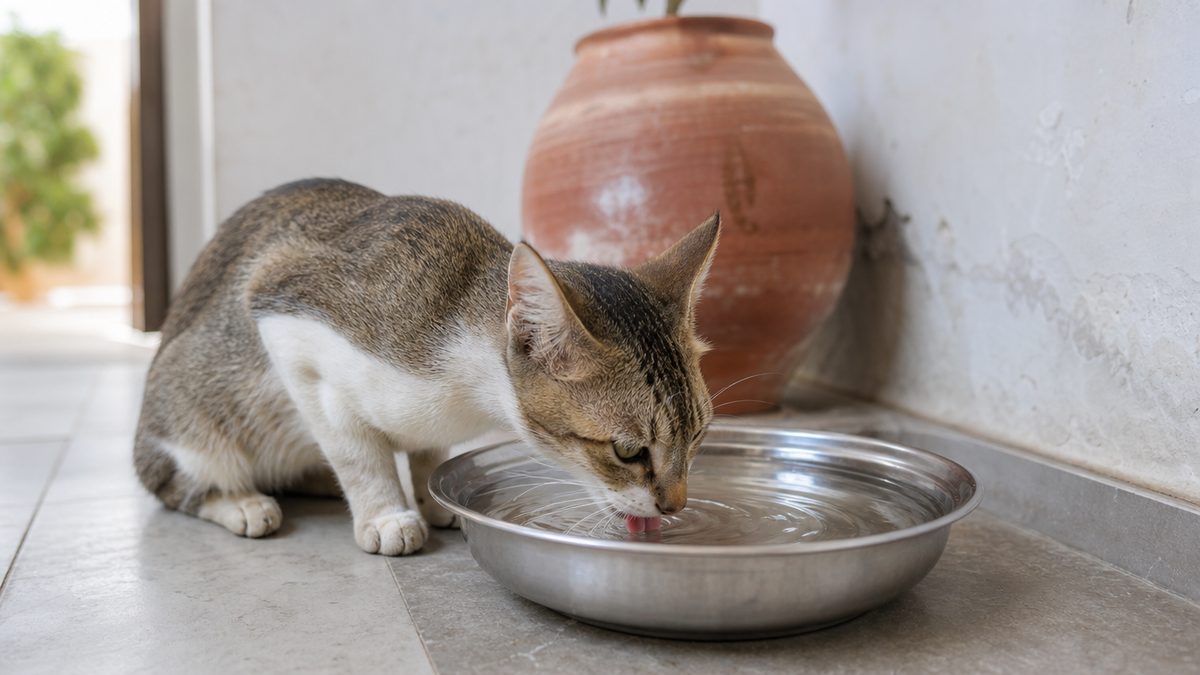
Water is the answer, and cats are bad at drinking it
To get more water into a cat, change the moisture content of the food first and the bowl second, because the controlled evidence on bowls is much weaker than the advice you will read.
Start with the requirement. Water is the most important nutrient, multiple water sources encourage consumption, and this is particularly important in cats, which often do not drink a lot of water; in a thermoneutral environment most mammalian species need about 44 to 66 ml per kilogram of body weight. For a 4 kg cat that is 176 to 264 ml a day from all sources, food included.
Food is the biggest lever anyone has, and it is the one least often pulled. Canned pet foods run from 60 to more than 87 percent moisture while dry foods contain 3 to 11 percent, and animals eating mostly canned food drink less from the bowl because they are getting the water in the meal. Cornell's feline health centre makes the same recommendation from the other direction, advising canned food partly because, at around 90 percent water, it increases the cat's fluid intake. Wet food hydrates a cat without spending a single kilocalorie of the treat budget on a drink.
- Shift part of the ration to wet food, which is the only change with a large and well-documented effect on total water intake.
- Put water in more than one place. Multiple sources encourage consumption, and a cat that will not cross a room for water will drink from a bowl it passes.
- Move the water bowl away from the food bowl and away from the litter tray, so a cat that avoids one is not avoiding the other by accident.
- Use a wide, shallow bowl of steel, glass or ceramic, filled near the brim, so the cat can drink without pressing its face into a narrow rim.
- Refill with fresh water at least twice a day in summer, and more often in a hot kitchen, because a bowl standing all day in a Pune or Ahmedabad May is warm and stale by evening.
- Keep one bowl where the cat sleeps, since a cat that wakes, drinks and settles again is adding intake you never see.
What the water fountain evidence actually shows
Water fountains are recommended on almost every cat page in existence, including by sources we respect, and the best controlled test of them found nothing. Sixteen laboratory cats on a dry diet were individually housed with urine collection systems and put through a randomised two-week crossover across still, circulating and free-falling bowls, with intake measured daily by bowl weight corrected for spillage and evaporation. Fourteen completed it. Average daily water intake was 27.5 plus or minus 5.8 ml/kg on the still bowl, 26.3 plus or minus 7.3 on the circulating bowl and 26.1 plus or minus 6.5 on the free-falling bowl, P = 0.942, and urine volume, specific gravity and relative supersaturation for struvite and calcium oxalate did not differ either.
Three of the fourteen cats, 21 percent, did show a statistically significant individual preference, in three different directions: one preferred circulating, one free-falling, one still. The authors' own conclusion is that water bowl type had no appreciable effect on water intake and that alternative methods should be implemented beyond providing unique water bowls.
The useful reading is not "fountains do not work". It is that a fountain is a reasonable experiment for your individual cat, with about a one in five chance of mattering, and is not a population-level fix you can rely on. Measure before and after if you buy one. No page on the first page of results for this query says any of that.
Hydration is not a cosmetic concern in cats. It sits underneath two common feline problems seen in Indian clinics, and both have their own pages: chronic kidney disease in cats and feline lower urinary tract disease. An older cat drinking noticeably more than it used to is a reason to see a vet rather than a reason to be pleased about cat hydration.
A cat that starts drinking much more, or much less, than its own normal needs a veterinary examination rather than a new bowl. Increased thirst is an early sign of chronic kidney disease, diabetes and hyperthyroidism, and it is often the only thing an owner notices for months. Our page on adult cat care in India covers what else to watch for year to year.
Milk for community cats
Put out clean water and cat-appropriate food for a community cat rather than milk, because the animal that gets the diarrhoea on the street is the one with nobody to rehydrate it.
Start by taking the impulse seriously. Leaving doodh at the gate for whatever turns up is one of the oldest and kindest habits in Indian street life, it is taught by grandmothers, and it is done by people who are not going to be argued out of caring. Nothing on this page is an argument against feeding community cats. It is an argument about what goes in the bowl.
The cost simply lands differently outdoors. A house cat with loose stool gets noticed, gets water and gets a vet. A community cat loses the same fluid in a humid Mumbai August with no one watching, no clean water in reach because the available puddles are not clean, and no second meal to replace what went through. The same saucer of milk that gives a flat cat an unpleasant night can take a thin street cat to the edge of dehydration.
India does have a legal framework for this, and it is worth knowing exactly what it says. Under rule 20 of the Animal Birth Control Rules, 2023, it is the responsibility of the Resident Welfare Association, the Apartment Owner Association or the local body's representative to arrange for the feeding of community animals in that area, involving the residents who feed them. They must designate mutually agreed feeding spots away from children's play areas, entry and exit points and staircases, designate feeding times around the movement of children and senior citizens, and ensure the designated feeder leaves no litter. Where there is a dispute, a named Animal Welfare committee decides, and its decision is final.
Now read the limit in the same rule. The feeding spots are to be fixed "keeping in mind the number of dog population and their respective territories". Cats appear in these rules under rule 19, which covers the sterilisation and immunisation of domestic or feral cats and requires that cats are not housed with or brought into contact with dogs. Community cat feeding is therefore protected by a rule that was drafted around dogs. If you feed cats in a society, say so explicitly when the feeding spot is agreed, because nothing in the text will say it for you.
- Put out clean water first and refresh it daily, because water is the thing street cats actually lack and the thing nobody puts out.
- Offer plain cooked chicken, cooked fish without bones, or commercial cat food if you can afford it, in small portions that get finished.
- Skip the milk entirely, and skip biscuits, bread and leftover sabzi, which are cereal calories a cat cannot use.
- Feed at a fixed time and a fixed spot, so the cats come to you rather than to a neighbour's doorstep, which is where the complaints start.
- Clear the bowls and any spill afterwards, which rule 20 requires of a designated feeder and which keeps the arrangement alive.
- Raise sterilisation with a local animal welfare organisation, because feeding without it grows the colony faster than you can feed it.
Two neighbouring pages carry the rest. Our guide to feeding stray dogs in India covers the dog side of rule 20, what to feed and the society politics in full. Cat sterilisation in India covers the rule 19 side, including what a cat birth control programme involves and who pays for it.
What this page can prove, and what it cannot
Five claims here are measurements with denominators and five common claims about cats and milk are not established, so the line between them is drawn below rather than left for the reader to guess.
Five claims on this page are established, and the study behind each one is named in the sources list below it.
- Intestinal lactase declines sharply after weaning in cats, measured in 26 adults and 32 kittens, and diet does not change it.
- At 4.5 g per kg of body weight, 29.5 percent of a lactose load escapes the small intestine in cats and ferments, dropping faecal pH to 5.36 and raising faecal water.
- Indian buffalo milk carries 1.7 times the fat of Indian cow milk and essentially the same lactose, measured at Anand Agricultural University.
- An average healthy 4 kg adult cat needs 225 to 250 kcal a day, and its treat ceiling is 22 kcal World Small Animal Veterinary Association.
- Water bowl type, still against circulating against free-falling, had no appreciable effect on water intake in a randomised crossover of 14 cats.
Five further claims are not established, and the list below marks where this page reasons rather than reports.
- No published trial has fed a measured volume of Indian buffalo milk to cats and recorded what happened. The composition and the physiology are each measured; the combination of the two on this page is arithmetic, not an experiment.
- The share of adult cats that keep useful lactase is unknown. Individual adults were recorded at up to 53 units per gram of protein, but no prevalence figure exists.
- The lactose gap between Indian cow and buffalo milk rests on five replications in one district, and the two ranges overlap.
- Dahi, curd and paneer for cats have no published feeding trial behind them at all, so every statement about them, ours included, is inference from composition.
- No reliable figure exists for how many Indian households offer milk to a cat. It is plainly common, and "plainly common" is as far as the evidence goes.
One phrase deserves retiring rather than answering. "Silent killer" is not a veterinary term and does not map to a single condition. The feline problems that genuinely progress without obvious signs are chronic kidney disease, hyperthyroidism, hypertrophic cardiomyopathy and the obesity that leads to diabetes, and the useful response to that worry is an annual examination with bloodwork from middle age, not a search for one hidden culprit.
Finally, the boundary of what a directory should say. Bonbeno does not recommend a drug, a dose or a specific product for any of this. If your cat has ongoing diarrhoea, is losing weight, or has stopped drinking, that is a veterinary consultation on the individual animal, which is why this page publishes under the medical disclaimer at the top.
Common questions
Can cats drink milk?
Most adult cats should not. Intestinal lactase, the enzyme that digests milk sugar, measured 96 units per gram of mucosal protein in newborn kittens and 7 in adult cats, and feeding lactose does not restore it. A few individual adults keep useful lactase, but no cat needs milk, and every cat pays for it in calories whether or not the stool goes loose.
What kind of milk is good for cats?
None is good for a cat, and the choice between cow and buffalo matters less than people think. Indian measurements put lactose at 4.76 percent in cow milk and 4.86 percent in buffalo milk, so the digestive load is the same, while fat runs 4.88 against 8.30 percent, so the buffalo bowl costs about 45 percent more calories. Water is the drink a cat needs.
What happens if a cat accidentally drinks milk?
Usually nothing dramatic. A small one-off amount in a healthy adult cat most often passes with soft stool or no visible effect. Undigested lactose ferments in the large intestine, which drops faecal pH and pulls water into the bowel, so the likely outcome is loose stool several hours later, typically overnight. Call a vet if diarrhoea lasts beyond 24 hours or the cat stops drinking.
What liquids can cats drink?
Clean fresh water, and nothing else is necessary. An adult cat needs roughly 44 to 66 ml per kilogram of body weight a day from all sources, which is 176 to 264 ml for a 4 kg cat, and the most effective way to raise it is wet food at 60 to more than 87 percent moisture rather than any drink. Avoid milk, tea, coffee, coconut water and flavoured drinks.
Is buffalo milk worse for cats than cow milk?
On calories yes, on lactose essentially no. Measured at Anand Agricultural University, buffalo milk carries 8.30 percent fat against cow milk's 4.88 percent, a 1.7 times difference, while lactose is 4.86 against 4.76 percent with overlapping ranges. A 100 ml saucer is about 111 kcal of buffalo milk against 76 of cow milk, which is 44 to 49 percent of a 4 kg cat's day.
Can kittens drink cow or buffalo milk?
No. Queen's milk runs 32 to 48 percent protein and about 28 percent fat on a dry matter basis, and the veterinary position is that milk from other mammals is not appropriate for nursing kittens, with cow milk specifically a poor source of taurine. An orphan needs a kitten milk replacer formulated to approximate queen's milk, not cow or buffalo milk from the fridge.
Is lactose-free milk safe for cats?
It removes the diarrhoea risk and leaves the calorie problem untouched. Indian regulations define lactose free milk as under 0.1 percent lactose and low lactose milk as under 1 percent, while requiring the base milk's fat and solids-not-fat to meet the ordinary standards. Lactose-free buffalo milk is still about 111 kcal per 100 ml against a 22 kcal daily treat ceiling for a 4 kg cat.