
Cat health: urinary
FLUTD in Cats: Why a Straining Male Cat Is a Same-Day Emergency, What Is Actually Causing It, and What It Costs in India
FLUTD is not a diagnosis. It is an umbrella over feline idiopathic cystitis, bladder stones, urethral plugs and infection, and the four look identical from the outside of a litter tray. Most of what sits under that umbrella is miserable and survivable. One part of it, a blocked male cat, kills within a day or two. This page separates the two, gives every rate its denominator and the population it was measured in, and prices the work-up and the diets in rupees.
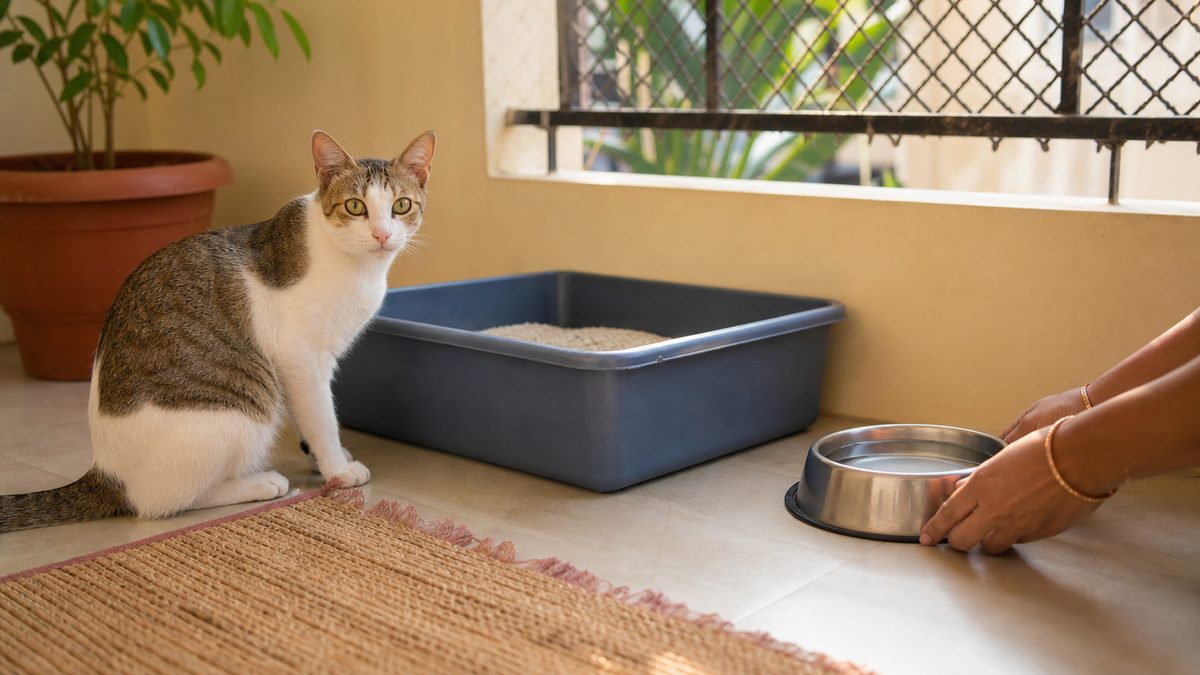
Urethral obstruction in cats is an emergency. Go to a veterinary clinic now, and call ahead, if you see any of these signs.
- A male cat straining in the tray and passing no urine at all
- Repeated trips to the tray with nothing in the litter for several hours
- Crying out while straining, or a hard, painful lower belly
- A cat that was straining earlier and is now vomiting, hiding or collapsed
- A dull, cold or unresponsive cat that has not urinated today
- Any straining cat at night, because the hours of delay are what kill
Quick answer
FLUTD is an umbrella term for bladder and urethra disease in cats rather than a diagnosis, and most of it is feline idiopathic cystitis. The part that kills is a blocked male cat, which dies often in less than 24 to 48 hours. Idiopathic cystitis was 45 of 78 cases at Chiang Mai. Struvite stones dissolve on a diet in two to three weeks and calcium oxalate stones do not. In India, Royal Canin Urinary S/O costs Rs 1,380 a kilogram.
This guide is general information for Indian pet owners and is not a diagnosis. Always consult a registered veterinarian near you before acting on anything you read here, and treat any sudden change in your pet's condition as urgent.
Signs of Urethral obstruction in cats
The 10 signs to watch for are listed below. Any one of them is a reason to consult your nearby vet; none of them is a diagnosis.
- Straining in the tray and producing little or no urine
- Going to the tray far more often than the cat used to
- Crying out, growling or yowling while trying to urinate
- Blood in the urine, or pink staining in pale litter
- Urinating outside the tray, on tiles, beds or in a corner
- Licking at the genital area far more than normal
- Squatting and straining in a way that looks like constipation
- Hiding, hunching, or resenting a hand on the lower belly
- A hard, tense lower belly the size of an orange
- Vomiting, refusing food, or becoming dull and unresponsive
Breeds on this site that document this condition
Each breed page below carries the figure for this condition with its denominator and its source. The 9 breeds listed are the ones on this site that document it, not a ranking of risk.
One published Indian series exists and it points the opposite way to the Western registries. At NTR College of Veterinary Science, Gannavaram, Andhra Pradesh, urinary disease was 22 of 118 cats in a two-year retrospective arm, 18.64 percent, and 21 of 91 in a seven-month prospective arm, 23.07 percent, where it was the single commonest surgical presentation. Struvite made up 80 percent of the stones and calcium oxalate 20 percent, the reverse of Canada and Germany, although the Indian stones were typed by crystal shape on a slide rather than by spectroscopy. The patient was a Persian tom under two years old in both arms. On money, ICAR-IVRI Izatnagar charges a Dog or Cat registration of Rs 50 in normal hours and Rs 300 after 5 pm and on holidays, and the Patna emergency window shuts at 8 pm. Royal Canin Urinary S/O, the only feline dissolution diet an Indian seller stocks, runs Rs 1,380 per kg in 1.5 kg packs with the economy 7 kg bag out of stock, and Hill's c/d Multicare is not sold at all.
What FLUTD is, who gets it, and why it is an umbrella and not a diagnosis
FLUTD is a set of signs, not a disease. Feline lower urinary tract disease is the term for anything that irritates or obstructs a cat's bladder or urethra, and the AVMA defines it in exactly those words, as an umbrella term for a group of problems associated with the lower urinary tract. Four different things sit under it, they produce the same behaviour in the tray, and one of them kills.
International Cat Care states plainly that FLUTD is not a diagnosis and has several causes that need investigating. Cornell goes further and says surveys suggest lower urinary tract disease is the number one reason cats visit veterinary practices. So the first honest thing a page like this can tell you is that the label your vet writes on day one is a description of what your cat is doing, and the diagnosis arrives later, after a urinalysis and usually after imaging.
How common it is, and why the published figures run from 1 percent to 7 percent
The rate depends entirely on which cats were counted. A cat population walking into a first-opinion clinic is not an emergency-hospital caseload, and neither is a teaching hospital's surgical register. The six figures below are all real, all published, and all measured in different places, which is why they disagree by a factor of seven.
| Source and population | Figure | What was counted |
|---|---|---|
| Gunn-Moore 2003, British cats | Around 1 percent a year | An annual incidence the review describes as believed, with no denominator printed |
| International Cat Care, owner advice page | 1 to 3 percent of cats each year | A range with no study named and no denominator |
| Piyarungsri 2020, Chiang Mai University teaching hospital | 2.24 percent, 78 of 3,486 cats | Cats diagnosed with FLUTD out of every cat that visited in twelve months |
| Jackson 2023, two Queensland emergency and referral hospitals, pre-pandemic year | 4.3 percent, 63 of 1,477 cats | Feline idiopathic cystitis with or without obstruction, in an emergency caseload |
| Jackson 2023, the same two hospitals, pandemic year | 5.4 percent, 113 of 2,081 cats | The same definition, one year later, no significant difference on relative risk |
| de Moraes 2025, Sao Paulo State University teaching hospital, 2010 to 2020 | 7.4 percent, 95 percent confidence interval 6.7 to 8.1 | Urethral obstruction in male cats only, among 5,230 cats over eleven years |
| Saranya 2024, NTR College of Veterinary Science, Andhra Pradesh, prospective arm | 23.07 percent, 21 of 91 cats | Urinary disease among cats presented with surgical affections, the single commonest group |
Two of those rows are worth pausing on. The Sao Paulo figure of 7.4 percent counts only obstruction and only male cats, so it is not comparable with the others, and it is the highest in the table anyway. The Andhra Pradesh figure of 23.07 percent counts only cats already referred for a surgical problem, so its denominator is a narrow one, and even so urinary disease outranked fractures, wounds and everything else on that register.
The cat this happens to
Middle-aged, overweight, indoor, male, and on dry food is the profile every source converges on. The AVMA lists middle-aged overweight cats that get little exercise and have little or no outdoor access, and adds stressors such as a change of routine, a move, or a multi-cat household. International Cat Care lists middle-aged, neutered, overweight, little exercise, little or no outdoor access and a dry diet. Cornell adds that male cats may be at increased risk.
The Indian series breaks the age half of that profile. At Gannavaram, cats under two years old were 12 of 22 urinary cases retrospectively, 54.5 percent, and 12 of 21 prospectively, 57.14 percent, with nothing at all recorded above eight years. Chiang Mai found the same skew, with most affected cats aged one to two years. So in two Asian teaching hospitals this is a young cat's disease, which is not what a page written for a British or American readership will tell an Indian owner.
FLUTD and a blocked bladder look identical from outside the tray. Straining, repeated trips, crying and licking are the signs of feline idiopathic cystitis, of a bladder stone, of an infection, and of a urethra that is completely shut. The only sign that separates them is whether urine is coming out, and clumping litter in a shared tray is precisely the situation in which an owner cannot tell. If your cat is male and you cannot confirm that it has passed urine, treat it as blocked and go now. Find a clinic through the vet directory and call ahead.
The blocked male cat: why this one is measured in hours
A completely blocked cat can die within twenty-four to forty-eight hours, and three independent bodies print that window. The AVMA writes that once the urethra becomes completely blocked, urine backs up into the kidneys, the kidneys fail, toxins build up and electrolyte imbalances occur, leading to death, often in less than 24 to 48 hours. Cornell gives the same figure. The 2025 iCatCare consensus guidelines put it clinically, that uraemia is seen within 24 to 48 hours when obstruction is complete and acute.
What actually kills is potassium. The iCatCare panel names hyperkalaemia as the most common life-threatening complication of obstruction and says it can lead to bradycardia and cardiac arrhythmias, made worse by low calcium. That is not a theoretical risk. In 50 male cats admitted with hyperkalaemia secondary to obstruction, electrocardiography at presentation was recorded in 41, and only 10 of those 41 had a normal sinus rhythm.
| Finding | Number | Share of those measured |
|---|---|---|
| Castrated males | 49 of 50 | 98 percent, with a single intact cat |
| Domestic shorthairs | 35 of 50 | 70 percent, with six mediumhair and three longhair |
| Obtunded on arrival | 31 of 49 | 63 percent, with a further 8 percent stuporous or moribund |
| Hypothermic | 30 of 43 | 70 percent of those with a rectal temperature recorded |
| Bradycardic, under 180 beats a minute | 24 of 50 | 48 percent |
| Abnormal cardiac rhythm on arrival | 31 of 41 | 76 percent, including absent P waves in nine and tented T waves in seven |
| Penis abnormal on examination | 17 of 17 | 100 percent of those in which it was described |
Read that table as an argument about timing rather than about cardiology. Three quarters of those cats already had an abnormal rhythm when the door opened, and half were already bradycardic. This is a selected group, because every cat in it was hyperkalaemic by definition, so it does not describe every blocked cat. It does describe what the last few hours of waiting buy.
How often a straining cat turns out to be blocked
Between a third and two thirds, depending on the population, and no source puts it low. At the Sao Paulo teaching hospital, 1,072 of 5,230 cats showed lower urinary tract signs and the mean annual incidence of obstruction within that subset was 36.0 percent, with a 95 percent confidence interval of 33.19 to 38.93. At Chiang Mai, urethral obstruction was the presenting sign in 43 of 78 FLUTD cats, 55.1 percent. In the two Queensland emergency hospitals, 43 of the 63 pre-pandemic idiopathic cystitis cases were obstructed, and 70 of 113 in the following year.
Those are hospital populations and they over-count obstruction, because a cat that is merely uncomfortable may never reach a referral centre. The point survives the caveat. An owner standing over a straining cat is not looking at a one-in-fifty chance of a blockage, and the cheapest correct action is to have the cat looked at today rather than to watch it overnight.
Why it is almost always a male cat
Anatomy decides it. Cornell states that male and neutered male cats are at greater risk because their urethra is longer and narrower, and the AVMA adds that obstruction is most often found in male cats one to ten years of age. The Indian series is starker than either. At Gannavaram, 20 of 22 retrospective urinary cases were male, and all six cats with urethral plugs were male. In the prospective arm, 20 of 21 were tom cats and 19 of 21 were Persian toms.
The paper prints the retrospective male share as 90.1 percent, and 20 divided by 22 is 90.9 percent; the female row of 9.1 percent only sums to 100 with the larger figure. The same table prints the domestic shorthair share as 8.1 percent when 4 of 22 is 18.2 percent, which is the number that makes the breed column add up. Neither slip changes the direction of the finding, and both are worth knowing before the figures are quoted onward.
Do not wait for morning and do not try to help the cat urinate at home. Call the nearest clinic that is open, say the words blocked cat and male cat so the phone is not handed to a queue, and travel. Take the cat in a carrier lined with an old towel rather than litter, so anything passed on the way is visible. Bring the name of any food it eats and any medicine it is on. If your usual clinic shuts at 8 pm, find the one that does not, through the vet directory, before you need it rather than on the night.
What is actually causing it, with the numbers from five populations
Feline idiopathic cystitis causes most of it, bladder stones a minority, and bacterial infection almost none. Across the published series the idiopathic share sits between 45 and 70 percent, and the ranking pages that quote a single figure are quoting one population as though it were the world.
| Source and population | Idiopathic cystitis | Stones | Infection | Plugs and other |
|---|---|---|---|---|
| Gunn-Moore 2003, non-obstructive cases, no denominator printed | 65 percent | 15 percent | Under 2 percent | Anatomical, neoplastic or behavioural, under 10 percent each |
| Gunn-Moore 2003, obstructive cases, no denominator printed | 29 percent | 10 percent | Not separated | Urethral plug 59 percent |
| International Cat Care, owner page, no study named | Around 60 to 70 percent | Around 10 to 15 percent | Relatively uncommon in cats | Not separated |
| Piyarungsri 2020, 78 cats, Chiang Mai teaching hospital | 45 of 78, 57.7 percent | 24 of 78, 30.8 percent across three stone types | 9 of 78, 11.5 percent | Counted within the stone and idiopathic groups |
| Cosford 2025, citing Norwegian and German retrospectives | Approximately 55 percent | Not separated | Not separated | Not separated |
| Saranya 2024, 22 cats, Andhra Pradesh, retrospective arm | Cystitis 10 of 22, 45.4 percent | Cystolithiasis 4 of 22, 18.18 percent | Not separated | Urethral plugs 6 of 22, 27.27 percent, and urethritis 3 of 22 |
The Chiang Mai row is the one with a clean denominator, and it breaks down further. Of 78 cats, 45 had idiopathic cystitis, 14 had struvite stones, 8 had stones of unknown composition, 9 had a urinary tract infection and 2 had calcium oxalate stones. Two calcium oxalate cats out of 78 is the figure to hold on to when a marketing page tells an Indian owner that oxalate is the modern problem.
Bacterial infection is the cause everyone reaches for and almost nobody has
Antibiotics are the wrong reflex in a young cat. International Cat Care states that bacterial cystitis is the most common cause of lower urinary tract disease in many animals but is relatively uncommon in cats, and that most cases of FLUTD do not require antibiotics. The AVMA explains why, noting that in younger cats the acidity and concentration of their urine prevents infection, while infection is a common cause in cats over ten, especially females, whose kidney disease or diabetes has changed the urine. Gunn-Moore's 2003 table put bacterial infection under 2 percent of non-obstructive cases.
The urethral plug, which is mostly not a stone
A plug is protein with crystals caught in it, not a small rock. Cornell describes urethral plugs as soft, compressible material containing variable quantities of minerals, cells and mucus-like protein. Gunn-Moore's review is blunter about the mechanism, saying it is usually the colloid that is of primary importance rather than the presence of crystals, and that in most cats crystalluria is clinically silent. That distinction matters commercially, because a cat with crystals on a urinalysis and no signs does not need a prescription diet bought on the strength of the crystals alone.
The Indian series found the plugs where the theory says they should be. Six of 21 prospective cases, 28.6 percent, had a urethral plug retrieved, every one of them from a Persian tom under four years old, and the plugs were composed mainly of struvite crystals with numerous amorphous crystals, plus rhomboid calcium oxalate dihydrate crystals in some.
Neutering, where two good studies point opposite ways
Chiang Mai found castration raised the risk and a Brazilian series found it delayed onset, and both are published with denominators. In the Chiang Mai multivariate model, castrated male status carried an odds ratio of 4.45 with a 95 percent confidence interval of 1.58 to 12.48, and intact male status 3.11, both against intact females. In 84 male cats treated for obstruction at the Federal Rural University of Pernambuco, intact cats obstructed at a mean age of 3.6 years against 5.7 years for cats neutered before puberty and 5.4 years for those neutered after, and the intact cats' earlier onset was statistically significant.
The two are not measuring the same thing, which is the resolution. Chiang Mai asked who gets FLUTD, and Pernambuco asked, among cats that are already obstructed, who obstructs first. The Brazilian authors also recorded that no intact cat in their series was overweight while 45.8 percent of prepubertally neutered and 58.3 percent of post-pubertally neutered cats were, which points at bodyweight rather than at surgery. Nothing here is a reason to leave a cat entire, and your nearby vet decides that for your cat.
Feline idiopathic cystitis, a diagnosis of exclusion, and why stress is the mechanism
Feline idiopathic cystitis is what is left when every other cause has been ruled out, and that is its definition rather than a criticism of it. Cornell calls FIC a catchall term used to describe cases of lower urinary tract signs in which all diagnostics fail to confirm the cat has another disease. The AVMA states there is no specific diagnostic test for FIC and that it is commonly diagnosed by ruling out other causes.
Being a diagnosis of exclusion has a practical consequence that owners are rarely told. It means the work-up is not optional theatre before the real treatment starts; the work-up is how the diagnosis is made. A cat labelled idiopathic without a urinalysis and without imaging has not been diagnosed, it has been guessed at, and a stone that is still sitting in the bladder will announce itself later.
Stress is not a soft factor here, it is the proposed mechanism
The 2025 iCatCare consensus calls FIC a threat-responsive disorder and says it should be considered a systemic disorder involving organs in addition to the bladder, affecting susceptible cats living in provocative environments. The AVMA says chronic anxiety from perceived threats, such as conflict with another cat in the household, is believed to play a major role. Cornell states that environmental enrichment and modification can reduce stress and decrease the severity and frequency of FIC episodes.
Gunn-Moore's 2003 review already described the machinery. Bladder biopsies from affected cats show a relatively normal epithelium with submucosal oedema and vasodilation, large numbers of mast cells, and increased numbers of pain fibres and substance P receptors, and stimulation of those fibres by central triggers such as stress produces the inflammation. That is why an environmental change is a treatment on this disease and not a lifestyle suggestion.
It usually settles by itself, and that is the trap
Most non-obstructive episodes resolve in days whatever you do. Gunn-Moore recorded that most cases of non-obstructive FLUTD are self-limiting and usually resolve within five to ten days, and the AVMA says cats without urethral obstruction often improve within a week without treatment. Cornell notes that signs often resolve within a couple of weeks regardless of treatment, which is why most veterinarians treat the condition in order to prevent the signs from recurring.
Two things follow. The first is that any remedy given during an episode will appear to work, including remedies that do nothing, so an owner's personal experience is a poor guide and a seller's testimonial is worthless. The second is that a large share of these cats come back. The AVMA records that a large proportion will have at least one other episode within one or two years.
If your vet asks whether the cat also vomits, over-grooms, hides or has bowel trouble, that is not a change of subject. The iCatCare panel states that FIC should be considered a systemic disorder involving organs in addition to the bladder, and the MEMO trial found that the same environmental changes that reduced urinary signs also produced significant reductions in fearfulness, nervousness and upper respiratory signs. The bladder is where it shows.
How FLUTD is diagnosed, and what each test can and cannot see
To diagnose FLUTD your vet starts with a urinalysis, because everything else depends on what the urine shows. The AVMA sets out the sequence, with history, a physical examination and a urine sample tested for pH, concentration or urine specific gravity, and the presence of crystals, blood and indicators of inflammation and infection, followed where the cause is still unknown by urine bacterial culture, abdominal radiographs or ultrasound, bloodwork and other urine tests.
| Test | The question it answers | What it cannot tell you |
|---|---|---|
| Urinalysis with urine specific gravity, sediment and pH | Is there blood, inflammation, infection or crystal, and how concentrated is the urine | Whether a crystal means anything, since most normal cats fed dry diets develop crystalluria |
| Urine culture on a cystocentesis sample | Is there a bacterial infection worth an antibiotic | Nothing about stones, and it is usually negative in a cat under ten |
| Plain radiography | Is there a radiodense stone, which calcium oxalate reliably is | A urate stone, which is radiolucent, and a struvite stone under about 3 mm |
| Abdominal ultrasound | Bladder wall thickness, sludge, stones the radiograph missed, and the kidneys | Stones sitting inside the urethra, which ultrasound images poorly |
| Contrast radiography, cystography or intravenous pyelography | Strictures, diverticula, tumours and the outline of the urethra itself | Nothing about mineral type, and it needs an anaesthetic |
| Blood potassium and an electrocardiogram in a blocked cat | Whether the cat is safe to anaesthetise right now | The cause of the obstruction |
| Quantitative analysis of a retrieved stone | Which mineral it actually is, by infrared spectroscopy or X-ray diffraction | Nothing until a stone has been retrieved, which is why the first episode is often treated blind |
A crystal is not a stone, and the two can disagree
The 2025 iCatCare panel states that struvite and calcium oxalate, the two commonest stones, are usually sterile and may not always be associated with crystalluria of the same composition. In its own table, struvite crystalluria is described as not a consistent finding. Gunn-Moore made the same point in 2003, writing that in most cats crystalluria is clinically silent and that most normal cats develop crystalluria when fed many dry cat diets.
So a slide showing struvite crystals is not a diagnosis of struvite stones, and it is certainly not a reason to buy an acidifying diet off a shelf. The Indian series typed its stones by the appearance and shape of crystals rather than by spectroscopy, and says so, which is the right thing to disclose and the reason its 80 percent struvite figure is a signal rather than a measurement.
What the bloods are looking for once a stone is found
The iCatCare panel recommends a complete blood count and biochemistry once uroliths are identified, to look for hypercalcaemia, which is diagnosed in around 35 percent of cats with calcium oxalate uroliths, for liver disease such as a portosystemic shunt behind urate stones, and for the chronic kidney disease, hyperthyroidism or diabetes mellitus that go with infection-associated struvite. A cat with calcium oxalate stones and untreated high blood calcium will make more of them, which is why this is not an optional extra.
If your cat has kidney disease as well, the two conditions interact and the tests overlap. The chronic kidney disease in cats page sets out the IRIS staging and what a kidney panel costs in India.
Expect the cause to change between episodes
The AVMA states that the specific cause may not be found even with a thorough diagnostic evaluation, that some cats can have multiple episodes with a different underlying cause each time, and that more than one cause is possible per episode, which is why it recommends a thorough evaluation for each episode. That is an uncomfortable message for a budget and an honest one. A cat treated for idiopathic cystitis in March and straining again in September has not necessarily got the same disease back.
Struvite dissolves, calcium oxalate does not, and the two diets pull in opposite directions
Struvite stones can be dissolved with a prescription diet and calcium oxalate stones cannot. The 2025 iCatCare consensus states for calcium oxalate that it cannot be medically dissolved and should be removed surgically or using non-invasive techniques, while for struvite it sets out medical management with a low phosphorus and magnesium diet to promote acidic urine and notes that dissolution may take two to three weeks. That single difference decides what an owner is agreeing to.
The ACVIM consensus puts the same thing as its first recommendation, that struvite uroliths should be medically dissolved, and adds that sterile struvite urocystoliths usually dissolve in less than two to five weeks, that dissolution avoids the risks of anaesthesia and surgery, and that in many cases it is less expensive than surgery. Its recommendations extend medical dissolution to urate and cystine stones as well, and calcium oxalate appears nowhere among them.
| Struvite | Calcium oxalate | |
|---|---|---|
| Can a diet dissolve it | Yes, usually in two to three weeks with imaging every two to three weeks | No. It has to be removed |
| Urine pH it forms in | Alkaline | Acidic |
| Urine pH the treatment aims for | Acidic, below 6.4 | Alkaline, with potassium citrate considered if pH stays below 6.5 |
| Visible on a plain radiograph | Mildly to moderately radiopaque if over 3 mm | Radiodense, usually 1 to 4 mm |
| Typical age | Younger cats | Mean 7 years |
| Breeds the panel names | Himalayan, Ragdoll, Chartreux, Oriental Shorthair, Siamese | Persian, Himalayan, British Shorthair, Ragdoll |
| Blood test that changes management | Culture, because infection-induced struvite needs the infection cleared | Total and ionised calcium, since hypercalcaemia is found in around 35 percent |
Why giving the wrong diet is worse than giving none
The prevention advice for the two stones is close to inverted. For sterile struvite the ACVIM panel recommends therapeutic maintenance foods with low magnesium and phosphorus that acidify the urine. For calcium oxalate it recommends decreasing urine concentration, avoiding urine acidification and avoiding diets with excessive protein content, and states outright that diets and medications designed to promote urine acidification below pH 6.5 should be avoided. Diets producing acidic urine below pH 6.25 in cats were associated with calcium oxalate urolith formation.
So an acidifying urinary food, bought over a counter for a cat whose stone was never analysed, is a coin flip that makes one disease better and the other worse. The stone type is established by analysis after an episode, not by guessing beforehand, and the only question worth asking your vet is which mineral came back.
The same mineral behaves differently in a dog, which is why advice does not transfer
Struvite in a cat is usually sterile and struvite in a dog is usually an infection, and that one difference changes the whole treatment. The ACVIM consensus states that sterile struvite uroliths most often occur in cats and are best prevented by therapeutic maintenance foods with low magnesium and phosphorus that acidify the urine, and separately that infection-induced struvite is the most common struvite urolith in dogs, whose primary prevention is early identification and elimination of the urinary tract infection. The 2025 iCatCare table says the same from the feline side, describing struvite in cats as only sometimes associated with urease-producing bacteria, which it calls uncommon in cats, with a positive bacterial culture likewise uncommon.
So a dog owner's advice about antibiotics for a struvite stone is correct for a dog and usually wrong for a cat, and a cat owner reading a canine page will be told to chase an infection that most cats with struvite do not have. The bladder stones in dogs page covers the canine side of the same chemistry, where the mineral is the same, the dissolution rule is the same and the cause is not.
Which stone an Indian cat is more likely to have
The three registries disagree by continent, and India looks like neither Canada nor Germany. In 20,183 Canadian feline submissions between 1998 and 2014, calcium oxalate was 10,115 submissions at 50.1 percent, struvite 8,071 at 40.0 percent and urate 893 at 4.4 percent, and the 21,426 total includes 1,243 international submissions. In 3,629 German uroliths analysed between 2016 and 2020, calcium oxalate was 59.5 percent and struvite 33.7 percent, with oxalate rising 6.6 percent and struvite falling 5.5 percent across the five years.
The Indian series ran the other way. At Gannavaram, struvite made up 80 percent of the stones and calcium oxalate 20 percent. The Chiang Mai series points the same direction, with 14 struvite stone cats against 2 calcium oxalate cats out of 78. Two Asian teaching hospitals, both struvite-dominant, against two Western registries that are oxalate-dominant.
Hold that finding loosely and act on it anyway. The Indian stones were typed by crystal shape under a microscope rather than by infrared spectroscopy, the number of stones behind the 80 percent is small, since cystoliths were detected in only 9.5 percent of the prospective cases, and neither Asian series is a registry. What it supports is asking for the stone to be analysed rather than assuming your cat has the stone that American pages talk about.
What the consensus admits it does not know
The ACVIM panel says selection of effective preventive treatment for calcium oxalate is challenging because properly designed clinical trials evaluating urolith recurrence have not been published, the exact mechanisms are not completely understood, associative factors from epidemiological studies have not been proven to cause disease, and surrogate endpoints such as relative supersaturation are mathematical models that may not correlate well with actual stone formation. Its lead author declares competitive research grants from Hill's Pet Nutrition on this topic, which is disclosed in the paper and is worth reading alongside the diet recommendations.
The ACVIM consensus recommends that urocystoliths associated with clinical signs be removed by minimally invasive procedures, including medical dissolution, voiding urohydropropulsion and basket retrieval rather than by cutting the bladder open, and it discourages urethral surgery for urolithiasis. One reason is that closing the bladder with sutures carries a risk of suture-induced recurrence that may be responsible for up to 9 percent of urolith recurrences. Not every Indian clinic offers lithotripsy or cystoscopy, so ask what is available locally before agreeing to an approach.
Treatment in general terms, and the survival and recurrence numbers nobody quotes
Unblocking a cat is a same-day procedure with a good immediate outcome and a poor quiet record afterwards. The 2025 iCatCare consensus reports survival to discharge for cats with urethral obstruction managed with an indwelling catheter as 91 to 94 percent, while the same studies record obstruction recurrence rates of 11 to 58 percent at various time points, leading to 21 percent of cats eventually being euthanased.
That pair of numbers is the most useful thing on this page for a family deciding what to do. Nine in ten cats walk out. One in five is eventually put to sleep because of the disease. Both are true, and the ranking pages carry neither.
What happens in the clinic
A blocked cat is stabilised first and unblocked second. Cornell describes treatment as catheterisation, the passage of a narrow tube up the urethra, usually requiring sedation or anaesthesia, with the catheter sometimes left in place for a few days to allow swelling to go down, dehydration and electrolyte imbalance treated with intravenous fluids, and hospitalisation ranging from a few days to several weeks depending on severity and duration. The iCatCare panel notes that most cats will require general anaesthesia to relax the urethra and avoid pain and stress, although one recent study found no difference between sedation and anaesthesia in catheterisation success or recurrence.
The Zurich series gives the length. Forty-five male cats were admitted between December 2000 and November 2002, hospitalisation ranged from 1 to 12 days with a median of 4.5 days, and 22 of 24 cats with idiopathic obstruction were catheterised with an indwelling catheter for up to 6 days, median 2 days.
Recurrence, measured three ways in one cohort
| Outcome | Number | Timing |
|---|---|---|
| Re-obstructed after idiopathic obstruction | 8 of 22, 36 percent | 3 to 728 days, median 17 days |
| Re-obstructed after obstruction caused by stones | 3 of 10, 30 percent | 10, 13 and 472 days |
| Re-obstructed after a urethral plug | 3 of 7, 43 percent | 4, 34 and 211 days |
| Any recurrent lower urinary tract signs | 20 of 39, 51 percent | Occurred at the same frequency whatever the original cause |
| Re-obstruction overall | 14 of 39, 36 percent | The most common reason for euthanasia in the series |
| Euthanased | 8 of 39, 21 percent | Recurrent obstruction was the stated reason |
A median of 17 days to re-obstruction is the number to plan around. The risky fortnight is the one straight after discharge, not the following year, and that is when an owner is most likely to relax.
Two comfortable beliefs the same study did not support
The Zurich authors reported that cats living entirely indoors after discharge developed recurrent signs at the same rate as cats with outdoor access, and that the percentage of wet food fed after discharge was not significantly different between cats that recurred and cats that did not. Housing was known for 14 cats and food for 17, so these are small numbers and not a refutation of wet feeding. They are a reason to be careful with confident claims, including the ones on this page.
Perineal urethrostomy, the operation of last resort
Perineal urethrostomy widens the urethra by removing its narrow portion. Cornell describes it as usually considered a last resort, with side effects including bleeding for up to ten days after surgery, constriction of the urethra at the surgical site, urinary incontinence and a greater incidence of other kinds of bladder disease. It is not rare in practice: 29 of 84 cats treated for obstruction in the Brazilian series, 34.5 percent, underwent the procedure.
The iCatCare panel adds the part owners most often miss, that the procedure can be considered in recurrent cases including where cost limits what else is possible, but that the underlying disease such as feline idiopathic cystitis should still be addressed, because the bladder pathology continues. The surgery removes the plumbing problem and leaves the painful bladder behind.
Bonbeno names drug classes and never prints a dose, because the dose is the veterinarian's decision for the animal in front of them. What is worth knowing is that the evidence on the alpha-1 antagonists used to relax the urethra has moved. The iCatCare panel reports that studies of antispasmodic therapy have produced conflicting results and that prazosin was not shown to reduce recurrence of obstruction in more recent studies despite earlier work suggesting it did. Ask your vet what the current evidence is rather than assuming an older protocol still stands.
Multimodal environmental modification, the treatment that is free and the one owners are not told about
Multimodal environmental modification is a treatment for feline idiopathic cystitis with a published effect, not a lifestyle suggestion. In 46 indoor cats with recurrent signs followed for about ten months, no signs referable to the lower urinary tract were observed in 70 to 75 percent, a highly statistically significant reduction in the frequency of lower urinary tract signs whether or not drug therapy was also used.
Read that trial's limits before leaning on it. The authors rejected an unmanaged comparison group for this exploratory study in favour of comparison with historical results, and they say plainly that observational studies provide weaker empirical evidence than experimental ones and that prospective controlled trials seem indicated. The 2025 iCatCare consensus nonetheless states that feline idiopathic cystitis is a threat-responsive disorder and that multimodal environmental modification has been shown to reduce its recurrence by lessening the cat's perception of threat and increasing its sense of control.
| Approach and population | Cats with recurrent signs | Follow-up |
|---|---|---|
| Environmental modification added to usual therapy, single-cat households | 3 of 12, 25 percent | About 10 months, mean 319 days |
| Environmental modification added to usual therapy, multi-cat households | 10 of 34, 29 percent | About 10 months, mean 304 days |
| Historical comparison, any treatment | 13 of 33, 39 percent | Within 1 year |
| A canned acidifying diet alone | 11 percent | The authors' own earlier diet study, biased toward single-cat homes |
| The dry form of the same acidifying diet | 39 percent | The same study |
| Oral glucosamine, placebo-controlled | 26 of 40, 65 percent | Within 6 months, despite 90 percent of owners also feeding more canned food |
The finding that reframes this whole page
The parts of environmental modification that carry the evidence are the parts owners are least often told about. A 2025 survey of 167 owners whose cats were medically managed for obstructive feline idiopathic cystitis found that 94 percent had received advice about diet and 86.2 percent about water intake, but only 56.9 percent about litter box management, 43.7 percent about private physical space, 26.3 percent about natural behaviour and 25.1 percent about social interaction.
The same survey found compliance rates of 88.9 to 97.6 percent across every category, and veterinarians as the main source of advice. Owners do the thing when they are asked. Three quarters of them are never asked about the social conflict that the stress model says is driving the disease.
The five systems, as the framework actually names them
Herron and Buffington's framework, as the 2025 survey sets it out, asks five questions about nutrition covering diet and water intake, elimination covering the litter box, physical space, social interaction, and engagement in natural behaviours, and recommends identifying what can be improved and then coaching the owner toward realistic goals. The AAFP and ISFM feline environmental needs guidelines express the same thing as five pillars, the second of which is to provide multiple and separated key environmental resources.
- Give the cat a safe place, a private raised spot it can get to and be unreachable in
- Separate the six resources, since feeding, drinking, toileting, scratching, play and resting each need their own location
- Provide daily predatory play, because indoor environments are monotonous and predictable
- Keep human interaction positive, consistent and predictable, and never punish a cat for urinating outside the tray
- Respect the cat's sense of smell, so avoid scented litter and strong cleaning products near resources
Pillar 2 gives the arithmetic for a single cat, and it is more than most Indian flats provide. The guidelines state that a cat should have a choice for each resource, a minimum of two resting areas, two feeding areas and two toileting areas, and that food and water resources should be separated from each other. In a multi-cat household every cat should have its own separate feeding station, and each social group should have physically separate resources so they do not have to share.
What the owners in the original trial actually changed
Nothing exotic. The most commonly followed recommendations were reading the information provided, increasing the amount of time spent interacting with the cat, changing to a canned diet, and adding another litter box. In the multi-cat households, owners reported changes to the cat's physical environment in twelve cases, more time with the cat in ten, a change to canned food in ten, changes to litter box number, location and cleaning frequency in nine, and specific efforts to reduce inter-cat conflict in three.
The authors also recommend that medication be reserved for recurrent severe cases and used only after environmental approaches have proven inadequate, partly because administering oral medicines is itself stressful for some cats and owners. That ordering is the opposite of how most first episodes are handled.
The litter tray arithmetic and the water arithmetic, both free and both measured
To lower a cat's risk without spending anything, add a litter tray and make the urine more dilute. Those two moves are the only interventions on this page with an odds ratio and a controlled measurement behind them respectively, and most pages that rank for this query mention neither with a number.
One tray per cat plus one, and the odds ratio behind it
Three bodies give the same count. The 2025 iCatCare consensus lists adequate numbers as one tray per cat plus one. Cornell writes an adequate number of litter boxes, usually one more than the number of cats in the household. The AVMA prints the identical rule. Agreement between three bodies is worth something, but it is the Chiang Mai study that turns the rule into a risk figure.
In that case-control study, having fewer litter boxes than cats in the household carried an odds ratio of 2.44 with a 95 percent confidence interval of 1.22 to 4.88 on univariable analysis, and 3.28 with an interval of 1.55 to 6.91 in the multivariate model, against households with at least as many boxes as cats. That was one of only four factors that survived the multivariate model, alongside intact male status, castrated male status and tap water.
Read the comparison carefully, because it is not the n plus 1 rule. The study compared fewer boxes than cats against at least as many, so its finding supports one tray per cat as a floor rather than proving the spare tray. The spare tray is the guidelines' recommendation and it is cheap; the measured risk is in going below one each.
| What the guideline says | What it means for one cat in a flat | What it means for two cats |
|---|---|---|
| Adequate numbers, one tray per cat plus one | Two trays | Three trays |
| Trays large enough for the size of the cat | A large plastic storage tub beats a moulded cat tray and costs less | The same, in two or three separate tubs |
| Open or closed according to the cat's preference, avoiding top-entering trays | Offer one open tray before buying a hooded one | Offer both shapes and let each cat choose |
| Carefully selected quiet locations, at least one on each storey, away from food and water | Two separate rooms, not two trays side by side in the bathroom | Trays out of sight of each other so one cat cannot guard both |
| Sandy, clumping-style litter, generally preferred by cats | Unscented clumping bentonite, since scent is for the owner | The same substrate in every tray until a preference is known |
| Deposits removed at least once and ideally twice daily | Scooped morning and night | Scooped morning and night, in every tray |
| Trays emptied, washed with mild detergent and rinsed with hot water every one to two weeks | A full change every week or two, sooner if soiled | The same |
The AVMA adds the cleaning cadence in owner terms, with waste ideally removed twice a day and litter changed once a week or more often as needed, and says that in multi-cat homes you should provide separate areas for sleeping, eating, water, litter box use, scratching, climbing and play to minimise conflict. The 2014 AAFP and ISFM house-soiling guideline is the longer treatment of the same problem, and the cat litter training guide for India works through tray size, substrate and placement for Indian homes.
Water, and the one controlled measurement that exists
Wetter food produces more dilute urine and a measurably lower calcium oxalate risk. Six cats were fed one dry food hydrated to four moisture levels in a randomised block cross-over design, and on the 73.3 percent moisture diet total fluid intake was 144.7 ml a day against 103.4 ml on the 6.3 percent dry version, urine specific gravity was significantly lower, and the relative supersaturation for calcium oxalate fell to 1.14 from 2.29.
The same study is the reason to be careful about claiming too much. The effect of diet on struvite relative supersaturation was less clear, with no significant difference between treatment groups. Adding water demonstrably lowers the oxalate risk in that experiment. It did not demonstrably lower the struvite risk, and six cats is six cats.
The ACVIM consensus turns it into a target. It recommends high-moisture foods above 75 percent water, or adding sufficient water to dry kibble, and striving for a urine specific gravity below 1.030 in cats. It also blocks the obvious shortcut, stating that feeding high-sodium dry foods should not be recommended as a substitute for high-moisture foods.
Chiang Mai found dry food alone carried an odds ratio of 2.64, with a 95 percent confidence interval of 1.27 to 5.48, against a diet of both dry and canned, and that cats with FLUTD that ate only dry food were more likely to have urolithiasis, 13 of 39 or 33.3 percent. Note the comparison again. The winning arm was not all-wet, it was mixed feeding, which is a realistic thing to ask of an Indian household.
In the same Chiang Mai model, drinking tap water carried an odds ratio of 3.78, with a 95 percent confidence interval of 1.31 to 10.89, against drinking filtered water. The authors note that a previous study outside Thailand found no association between FLUTD and water source, and they offer no mechanism. One study in one city is not a reason to buy a filter, and it is a reason to make water more attractive however you do it. Keep the bowl well away from the food, since the environmental needs guidelines require food and water resources to be separated.
What it costs in India, from two government rate cards and four Indian sellers
An unblocking at a government veterinary teaching hospital is priced in hundreds of rupees and the diet afterwards is priced in thousands. ICAR-IVRI at Izatnagar lists minor surgery including catheterisation at Rs 100 in its Pets column, with effect from July 2022 and plus tax as applicable, while the only feline dissolution diet an Indian seller stocks runs Rs 1,380 a kilogram.
| Item | ICAR-IVRI Izatnagar, Pets column, from July 2022 | BASU Patna, Canine and Feline |
|---|---|---|
| Registration in normal hours | Rs 50 | Rs 200 for the 9 am to 1 pm outpatient slot, valid 10 days |
| Registration out of hours | Rs 150 after 12:30 pm and Rs 300 after 5 pm and on holidays | Rs 300 for the 2 pm to 8 pm emergency slot, valid 5 days |
| Minor surgery, the line that names catheterisation | Rs 100 | Rs 500 for a minor operation |
| Cystotomy, opening the bladder to remove stones | Rs 400 | Rs 2,500 for a major operation |
| Tube cystostomy | Rs 300 | Not listed separately |
| Plain radiography | Rs 150 | Rs 400 |
| Contrast study, cystography or intravenous pyelography | Rs 300 | Not listed separately |
| Abdominal ultrasonography | Rs 250 | Rs 500 |
| Routine urine examination | Rs 100 | Rs 100 |
| Kidney function test | Rs 200 for blood urea nitrogen and creatinine | Rs 700 |
| Sodium, potassium and chloride | No electrolyte line appears anywhere on the published card | Rs 350 |
| Electrocardiogram | Not listed | Rs 500 |
Two things in that table matter more than the totals. The first is that the test which decides whether a blocked cat is about to arrest does not appear on the ICAR-IVRI published list at all. Its clinical laboratory schedule prices calcium and phosphorus at Rs 100 each and a kidney function test at Rs 200, and carries no line for sodium, potassium, chloride or electrolytes. BASU Patna does price it, at Rs 350 for sodium, potassium and chloride together, and prices an electrocardiogram at Rs 500. Both of those are the tests the hyperkalaemia literature says decide the first hour.
The second is the clock. ICAR-IVRI charges a cat six times as much to register after 5 pm and on holidays as in normal hours, Rs 300 against Rs 50, and the BASU emergency window runs 2 pm to 8 pm and then closes. A cat that blocks at 11 pm in Patna has no government option that night. The out-of-hours surcharge is trivial money and the closing time is not, so find the private clinic that stays open before you need it.
The prescription diet, and the exchange-rate test on every figure
| Product and type | Pack and price | Price per kg |
|---|---|---|
| Royal Canin Veterinary Diet Urinary S/O, the veterinary-exclusive dissolution diet | 1.5 kg at Rs 2,070 | Rs 1,380 |
| The same, larger packs | Two 1.5 kg packs at Rs 4,140, three at Rs 6,210 | Rs 1,380, so no bulk discount at all |
| The same, economy bag | 7 kg listed at Rs 8,000 and marked unavailable | Rs 1,143 if you could buy it |
| Royal Canin Urinary Care, the over-the-counter shelf range | 400 g at Rs 497, 2 kg at Rs 2,473, 6 kg at Rs 7,418 | Rs 1,236 to Rs 1,243 |
| Royal Canin Urinary Care wet gravy pouches | Three 85 g pouches at Rs 390, forty-eight at Rs 5,304 | Rs 130 down to Rs 110.50 a pouch |
| Drools VET PRO Urinary Tract, the Indian-made option | 1.2 kg at Rs 685, 3 kg at Rs 1,599 | Rs 533 to Rs 571 |
| Drools Ocean Fish adult, an ordinary Indian dry food for comparison | 5 kg at Rs 1,256 in stock, with the 3 kg pack at Rs 743 unavailable | Rs 251 |
Run the exchange-rate test before trusting any of those. Rs 2,070 divides to 24.53 United States dollars at 84.38 and to 27.97 at 74, and Rs 1,380 a kilogram divides to 16.35 and 18.65. Neither pair lands on a round dollar figure, so this is a rupee-native price list rather than a converted one, and the same holds for the Rs 497 and Rs 685 entries Supertails, Drools VET PRO Urinary Tract….
The comparison that lands is the last row. The prescription dissolution diet costs Rs 1,380 a kilogram against Rs 251 a kilogram for a mainstream Indian dry cat food from the same seller, which is 5.5 times as much Supertails, Drools Ocean Fish Adult Cat Dry…. The cat diet chart for India prices the ordinary end of that range in detail.
Royal Canin sells two different things in India with similar names. Urinary S/O is the veterinary-exclusive diet, listed by the seller under the Royal Canin V-Diet vendor, and it is the one the dissolution evidence is about. Urinary Care is an over-the-counter maintenance food on the ordinary shelf, and it costs almost as much per kilogram without being the same thing. Buying the second because the first is out of stock is not a substitution your vet made. Ask which one was prescribed, and take the empty bag to the clinic if you are not sure.
What is different in India, and the one Indian series that exists
India has one published feline urinary series and it disagrees with the Western registries in a way that matters. At NTR College of Veterinary Science, Gannavaram, in Krishna district, Andhra Pradesh, struvite made up 80 percent of the stones and calcium oxalate 20 percent, while the Canadian registry runs 50.1 percent oxalate against 40.0 percent struvite and the German one 59.5 against 33.7.
| Measure | Retrospective arm, two years | Prospective arm, May to December 2022 |
|---|---|---|
| Cats presented with surgical affections | 118 | 91 |
| Of those, urinary system affections | 22, 18.64 percent, second to fractures at 26 | 21, 23.07 percent, the largest single group |
| Cystitis | 10 of 22, 45.4 percent | 11 of 21, 52.38 percent |
| Urethral plugs | 6 of 22, 27.27 percent | 6 of 21, 28.6 percent, every one a Persian tom under four |
| Cystolithiasis | 4 of 22, 18.18 percent | Cystoliths detected in 9.5 percent of cases |
| Hydronephrosis | 5 of 22, 22.7 percent | 4 cases |
| Male | 20 of 22 | 20 of 21, 95.2 percent |
| Persian | 16 of 22, 72.7 percent | 19 of 21 were Persian toms, 90.5 percent |
| Under two years old | 12 of 22, 54.5 percent | 12 of 21, 57.14 percent |
The typical Indian patient in that series is a Persian tom cat under two years old, and that is not the middle-aged neutered domestic shorthair the Western pages describe. The authors attribute the breed pattern to which breeds are kept in that part of India rather than to biology, noting that the variations in breed-wise incidence could be attributed to prevalence of rearing particular breed in this geographical area. Persians are the commonest pedigree cat in Indian homes, so the finding is about the population, and it is still the population you live in.
The independent registries agree that the Persian is genuinely predisposed as well, which is the point at which the Indian finding stops looking like an artefact. Calcium oxalate was 326 of 482 Persian submissions in Canada, an odds ratio of 2.21 against domestic shorthairs, and 72.4 percent of Persian uroliths in Germany. Chiang Mai found Persians were 21 of its 78 FLUTD cats, 26.9 percent. Among the breeds at risk, the Persian is the one Indian readers are most likely to own, and the Persian cat page covers the rest of its health record.
What the search for Indian evidence actually returned
Both PubMed instruments were run through Europe PMC on 27 September 2026 and both came back thin. A title and abstract search for feline lower urinary tract disease, urethral obstruction, urolithiasis, urolith or cystitis in cats with India in the title or abstract returned 32 records, of which the first was a Kerala case report of Dirofilaria repens and Brugia microfilaruria in a cat, matching on urine and India and having nothing to do with FLUTD. An author-affiliation search returned 149 records, of which exactly one of the first hundred had a feline title, and it was the same Kerala parasitology paper. A tighter feline urinary search returned six records, the useful one being an Indian review of urinalysis in the dog and cat rather than a series. Positive controls in the same session returned 131 and 283 records and the negative control returned zero, so the instrument was working. The Gannavaram paper is not indexed in either search and was found by searching the Indian journal literature directly.
Heat, flats, and why an Indian cat drinks too little
Indian ambient temperature raises water loss in an animal that drinks poorly by design. NASA POWER climatology, queried by explicit latitude and longitude on 27 September 2026, puts the annual mean air temperature above 23 degrees C in every major Indian city and the hottest month above 28 in all of them. Against that, a cat on a dry diet took in 103.4 ml of fluid a day in the cross-over study and 144.7 ml on a wet one.
| City and state | Annual mean air temperature | Hottest month | Annual mean relative humidity | Most humid month |
|---|---|---|---|---|
| Chennai, Tamil Nadu | 27.95 degrees C | May, 31.51 | 72.39 percent | November, 82.33 percent |
| Mumbai, Maharashtra | 26.77 degrees C | May, 31.19 | 67.39 percent | August, 90.36 percent |
| Hyderabad, Telangana | 26.10 degrees C | May, 33.30 | 60.30 percent | September, 82.95 percent |
| Kolkata, West Bengal | 25.81 degrees C | May, 31.53 | 73.93 percent | September, 89.34 percent |
| Delhi | 25.60 degrees C | June, 35.88 | 45.56 percent | August, 74.90 percent |
| Pune, Maharashtra | 23.86 degrees C | April, 28.93 | 66.80 percent | August, 90.80 percent |
| Bengaluru, Karnataka | 23.74 degrees C | April, 28.37 | 67.94 percent | October, 81.01 percent |
The monsoon changes the humidity rather than the heat, and nothing in the sources read for this page links it to FLUTD. Mumbai and Pune both reach above 90 percent mean relative humidity in August and Kolkata 89.34 percent in September, while Delhi's annual mean sits at 45.56 percent. The one study that went looking for a temporal pattern in urethral obstruction says it was prompted by concerns about potential seasonal patterns or long-term trends, and what it found was a trend, a statistically significant annual increase of 2.6 percent in obstruction case rates across eleven years, not a season. Treat a straining cat in January exactly as you would in June.
A dry flat is its own problem, and Delhi is the case in point. At 45.56 percent annual mean relative humidity it is the driest of the seven cities above, and an air-conditioned room is drier still. That is the setting in which a cat on kibble alone reaches the 103.4 ml a day the cross-over study measured, against 144.7 ml on a 73.3 percent moisture diet, and the ACVIM target of a urine specific gravity below 1.030 gets harder to hit.
The flat compounds it. The environmental needs guidelines ask for a minimum of two resting areas, two feeding areas and two toileting areas for a single cat, with food and water separated, and the 2025 consensus asks for one tray per cat plus one, placed in quiet locations away from food and water, with at least one on each storey. A one-bedroom flat with a single tray wedged beside the food bowl in the bathroom fails four of those specifications at once, and it is the commonest set-up in urban India. The indoor cat safety guide covers the rest of the indoor picture.
The diet an Indian owner cannot buy
Hill's Prescription Diet c/d Multicare, the feline urinary diet half the international literature names, is not stocked by India's largest online pet pharmacy. Four separate searches of that seller's own product index on 27 September 2026, for Hill's, for Hill's Prescription Diet, for prescription diet c/d and for Hill's cat food, returned forty products between them and not one Hill's item. What comes back instead is Royal Canin Veterinary Diet Urinary S/O, whose economy 7 kg bag is listed and marked unavailable, Drools VET PRO Urinary Tract at a third of the price, and over-the-counter shelf foods with urinary on the label.
That is the practical India finding on this page. The mainstay of management for a struvite-dominant caseload is a prescription dissolution diet, the Indian caseload appears to be exactly that, and the supply is one imported brand sold in its least economical pack size. Ask your vet what the plan is if the pack is out of stock, because dissolution takes two to three weeks of continuous feeding and an interrupted course is not a course.
Living with it: recurrence, the fortnight that matters, and what to change after the first episode
Plan for a recurrence rather than hoping against one. The 2025 iCatCare consensus records obstruction recurrence of 11 to 58 percent across studies and at various time points, and the AVMA says a large proportion of cats with feline idiopathic cystitis will have at least one further episode within one or two years.
The Zurich cohort puts a date on the risk. Of 39 cats followed after obstruction, 20 had recurrent lower urinary tract signs and 14 re-obstructed, and for the idiopathic group the median time to re-obstruction was 17 days with a range of 3 to 728. The first fortnight after discharge is when the cat is most likely to block again and when the household is most likely to have stopped watching.
- Watch the tray for output, not for visits, every day for the first two weeks after discharge
- Scoop twice daily so you can see what came out, and count the clumps rather than guessing
- Add the spare tray on the day the cat comes home, in a second room away from food and water
- Ask which mineral the stone was, if one was retrieved, because that decides the diet
- Ask for a written plan covering all five systems, not just food and water
- Book the recheck before you leave, and monitor urine specific gravity at it
Is it a lifelong condition
Mostly it is episodic rather than permanent. The AVMA states that in most cases episodes of feline idiopathic cystitis are short-lasting, and that less commonly it can persist and never totally go away. Gunn-Moore recorded that most affected cats have episodes that recur with variable frequency but generally tend to decrease in frequency and severity over time. There is no cure for feline idiopathic cystitis in the sense of a treatment that removes it permanently, and the goal the AVMA sets is to decrease the severity and frequency of episodes.
What a second opinion is worth after a third episode
A cat that keeps blocking is a cat whose underlying disease has not been addressed. The iCatCare panel is explicit that perineal urethrostomy can be considered in recurrent cases, including where an owner's costs are a constraint, but that the underlying disease such as feline idiopathic cystitis should still be addressed to manage ongoing bladder pathology. It also flags urethral stricture as a complication, usually appearing within three months of a traumatic urethral catheterisation, which is one reason a cat that obstructs again soon after a difficult unblocking deserves imaging rather than a repeat of the same procedure.
Pain, and the sign owners misread as sulking
A cat in urinary pain hides and stops using the tray. The 2025 consensus notes that cats with lower urinary tract disease may suffer pain on urination and associate that pain with the litter tray, and suggests offering an additional choice of tray in a different location with a novel substrate, but only once the signs have resolved and the pain has been addressed. The house-soiling guideline makes the same point from the behaviour side. Punishing a cat for urinating on a bed after a painful episode guarantees the next one happens somewhere else.
Owners find this disease exhausting, and the guideline says so directly, noting that caregivers may provide long histories, show frustration and have anxiety for the welfare of their pet, and may have used forms of punishment that will have done nothing to improve tray avoidance and will likely have increased the cat's stress. If that describes your household, say so to your vet. It is a clinical finding, not an admission.
Everything here describes populations. Your cat's stone type, your cat's urethra and your household's budget decide what is right for your animal, and only the veterinarian who examines it can weigh those together. Take this page's numbers to that conversation as questions rather than as conclusions. Which mineral was it. Is dissolution an option here. What is the plan if the cat blocks again at midnight. Where is the nearest clinic that is open then, and the vet directory will find it.
FLUTD in cats: the questions owners actually ask
How long can a cat live with FLUTD?
Years, in most cases, because FLUTD is episodic rather than terminal. Survival to discharge after an unblocking is 91 to 94 percent in the studies the 2025 iCatCare consensus reviewed. What shortens a life is recurrence, since the same studies record obstruction coming back in 11 to 58 percent of cats and 21 percent eventually being euthanased for it.
Can FLUTD in cats be cured?
Partly. A bacterial infection can be cleared and a struvite stone can be dissolved, so those parts are curable. Feline idiopathic cystitis, which causes most cases, is not, and the AVMA states there is no specific treatment or cure for it. The stated goal is to decrease the severity and frequency of episodes rather than to end the condition.
What are the symptoms of FLUTD?
The signs are straining to urinate, going to the tray far more often than usual, crying out while urinating, blood in the urine, urinating outside the tray and licking the genital area. International Cat Care adds behaviour changes, including lost tray training, aggression or a cat that has gone unusually quiet. Straining while producing nothing is an emergency.
How long does it take for FLUTD to go away?
Five to ten days for most non-obstructive episodes, which are self-limiting. The AVMA puts it at about a week without treatment and Cornell at a couple of weeks regardless of treatment. That course is why any remedy given during an episode appears to work, and why the thing worth measuring is whether it comes back rather than how fast it settled.
How much does it cost to fix a urinary blockage in a cat?
Published Indian government rates give the floor rather than a private quote. ICAR-IVRI Izatnagar lists minor surgery including catheterisation at Rs 100, a cystotomy at Rs 400, plain radiography at Rs 150 and abdominal ultrasound at Rs 250 in its Pets column from July 2022, plus tax. BASU Patna prices a major operation on a cat at Rs 2,500 and an X-ray at Rs 400.
Can you treat a cat urinary blockage at home?
No. Once the urethra is completely blocked, urine backs up into the kidneys, the kidneys fail, toxins build and electrolytes go wrong, leading to death often in less than 24 to 48 hours, and the AVMA calls it an emergency requiring immediate veterinary care. Clearing it needs a catheter passed under sedation or anaesthesia. Nothing given by mouth opens a shut urethra.
Is FLUTD more common in male or female cats?
Male, and overwhelmingly so once obstruction is involved. In the Chiang Mai multivariate model, castrated males carried an odds ratio of 4.45 and intact males 3.11 against intact females. Cornell explains the anatomy, since the male urethra is longer and narrower. Non-obstructive cystitis affects both sexes, so a straining female cat still needs seeing.
Does a urinary diet dissolve all bladder stones in cats?
No, and this is the distinction that changes what you are agreeing to. The 2025 iCatCare consensus states that struvite dissolves on a low phosphorus and magnesium diet in about two to three weeks, and that calcium oxalate cannot be medically dissolved and has to be removed. The two prevention diets also pull opposite ways on urine pH.
How many litter trays does one cat need?
Two, because the rule is one tray per cat plus one, printed by the 2025 iCatCare consensus, by Cornell and by the AVMA. The measured risk sits below that floor, since households with fewer trays than cats carried an odds ratio of 3.28, with a 95 percent confidence interval of 1.55 to 6.91, in the Chiang Mai multivariate model.
Which cat breeds get bladder stones most often?
The breeds at highest risk of calcium oxalate in 21,426 Canadian submissions were the Tonkinese, Burmese, Himalayan, Devon Rex, Persian and Siamese, all significantly above domestic shorthairs, with Himalayans at 474 of 685 submissions. A German series put British Shorthairs highest at 85.2 percent. The Egyptian Mau forms urate instead, at an odds ratio of 118.