
Breed profile
Chien Francais Tricolore: The Complete India Guide
A large French pack scenthound whose 2023 FCI revision renamed it and changed nothing else, with 1,137 French studbook entries in eighteen years and no lawful route into India.
Quick answer
The Chien Francais Tricolore is a large French pack scenthound, FCI standard 219, standing 62 to 72 cm for males and 60 to 68 cm for females. France registered 1,137 in the eighteen studbook years to 2025, five of them at zero. Its 2023 FCI revision changed the breed's name and nothing else. No published lifespan rests on any dataset, no Indian price exists, and heat tolerance rates 2 of 5.
This page summarises published veterinary research, registry data and breed-standard text for general information. It is not a diagnosis and it is not treatment advice. Consult a registered veterinarian about your own dog before acting on anything here, and treat a rectal temperature at or above 41.0 degrees Celsius after exertion in heat as an emergency.
Chien Francais Tricolore at a glance
What the Chien Francais Tricolore actually is
The Chien Francais Tricolore is a large French pack scenthound of 62 to 72 cm for males and 60 to 68 cm for females, recognised by the Federation Cynologique Internationale as standard number 219 and accepted on a definitive basis on 15 December 1959.
It sits in FCI Group 6, which the nomenclature titles "Scent hounds and related breeds", inside the Section headed "Scent hounds" and the subsection "Large-sized Hounds". It is subject to a working trial, and France is its country of origin. The official authentic language of the standard is French, and the version in force was published on 1 August 2023Federation Cynologique Internationale.
The FCI gives it exactly one job. Under UTILIZATION the standard says Pack Hound for big game, and the French original says chien de meute pour gros gibier. That single line explains more about this dog than any temperament description you will find online, because French law attaches a number to it. To certify an equipage for hunting stag or wild boar, the Arrete du 18 mars 1982 requires that the pack be able to uncouple thirty specialised hunting hounds served by at least two mounted people; twenty are required for roe deer and fallow deer, ten for fox and six for hare, and no more than sixty hounds may be in action at once.
What the standard describes
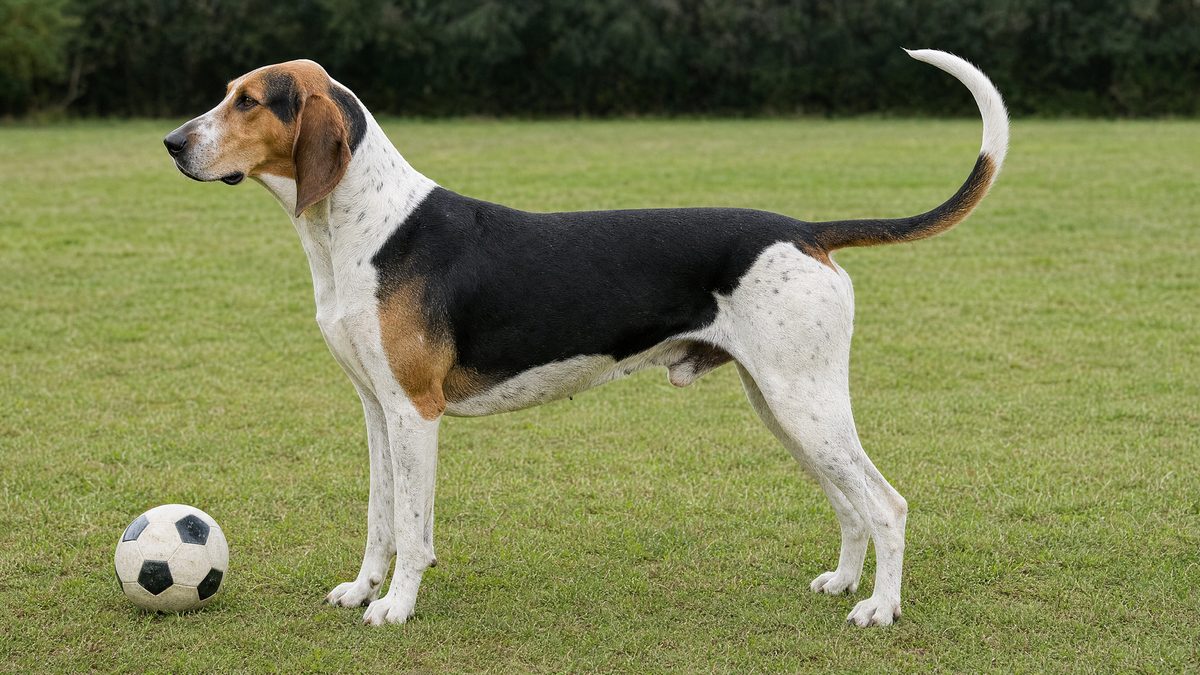
The general appearance clause reads "Large pack hound, elegant, sufficiently well boned and muscular", rendered in French as chien d'ordre, elegant, suffisamment charpente et muscle. The head is not too imposing but quite elongated with a marked occipital protuberance. The nose is black with open nostrils, and pink spots on the nose are a listed fault. The eyes are big and brown, sometimes circled with black. The ears are set at eye level, slightly curled, not too supple, and preferably extend to the set-on of the nose or to within two fingers of it.
The chest is deep and well let down, at least as far as the point of the elbows, with ribs long and not too flat. The tail is quite long, carried high and with elegance, and it is never docked. Forefeet and hind feet are lean. The gait is "easy and light". The coat is short-coated and rather fine, the skin quite fine.
The colour clause, in full
Colour is where the breed gets its name. The standard specifies "Tricolour, with black mantle more or less spread out. Tan preferably bright or even copper-taned. Neither black and tan on the cheeks and on the lips nor blue or tan fleckings on the legs and on the body are to be sought after. The grizzled 'wolf colour' is admitted." The French calls that last coat le poil louvard.
One fault deserves its own sentence, because it defines the breed against its neighbours. The standard faults "any apparent trace of English hound blood, especially in the head" and "'Smoky' coloured heads which indicate cross-breeding with the White and Black Hound";. A Tricolore is defined partly by what it must not contain.
The history, and where the dates disagree
Three creation dates circulate and they cannot all be right. Royal Canin says the breed "was only recognised as a breed in 1957, making it the youngest of all French hounds";. French Wikipedia also gives 1957, from poitevin, billy and anglo-francais tricolore stock with a possible grand bleu de Gascogne contribution, and adds that the first standard was written in 1965. The FCI's own nomenclature entry gives the date of acceptance on a definitive basis as 15 December 1959, and the superseded standard names 13 January 1965 as the publication date of the official valid standard. Those are three different things being reported as one, and the 1957 figure traces to no primary document reached here.
This is a working pack hound with no temperament clause in its own standard, a legal job requiring thirty hounds, and roughly 63 registrations a year in the only country that keeps itRepublique FrancaiseSociete Centrale Canine.
What the 2023 FCI revision actually changed
The 2023 revision changed the breed's name and the document's date, and nothing else: no measurement, no fault and no clause of substance differs from the text published on 13 January 1965.
This is checkable, and almost no page ranking for the breed has checked it. The current FCI French text was diffed here word by word against the superseded French text that the Societe Centrale Canine still distributes, which is dated 15 September 1997 and names 13 January 1965 as the standard in forceSociete Centrale Canine. The two texts agree to a similarity ratio of 0.95, and every real difference is listed below.
| Element | Superseded text (15.09.1997) | Current text (6.10.2023) |
|---|---|---|
| Breed name on the title page | CHIEN FRANCAIS TRICOLORE | FRANCAIS TRICOLORE |
| Standard in force | 13.01.1965 | 01.08.2023 |
| Attribution line | Texte mis a jour par le Dr. Paschoud | Revision de texte : Dr. Paschoud |
| Eyes and ears | Sub-entries under REGION FACIALE | Promoted to their own headings |
| Exclusion clause ending | ...comportemental sera disqualifie | ...comportemental |
| Size, males | 62 a 72 cm | 62 a 72 cm, unchanged |
| Size, females | 60 a 68 cm | 60 a 68 cm, unchanged |
| Colour clause | Tricolore, a manteau plus ou moins etendu... | Identical, word for word |
| Fault list | Eight faults | Identical, eight faults |
The same diff run on the English texts gives the same answer. The English standard archived on 31 July 2021 is headed CHIEN FRANCAIS TRICOLORE (French Tricolour Hound), dated 15.09.1997, with the standard in force given as 13.01.1965. Against the current 6.10.2023 English text the only differences are the deleted word CHIEN and the changed dateFederation Cynologique Internationale.
The breed has been called three different things in twelve years
The Internet Archive holds three distinct versions of the FCI's English standard file for this breed, and the naming moves each timeInternet Archive capture of FCI-Standard N…Federation Cynologique Internationale.
- Captured 6 September 2014: headed FRENCH TRICOLOUR HOUND (Chien francais tricolore), English name first.
- Captured 31 July 2021: headed CHIEN FRANCAIS TRICOLORE (French Tricolour Hound), French name first.
- Current, dated 6 October 2023: headed FRANCAIS TRICOLORE (French Tricolour Hound), with CHIEN removed.
That is why searching for this breed is confusing. The name most of the internet uses, Chien Francais Tricolore, is the one the FCI used between roughly 2014 and 2023 and has now dropped. This site keeps it because it is still the name Indian readers type.
Two French authorities are still publishing the old text
The Societe Centrale Canine, the French kennel club, serves Standard n 219 as a PDF headed CHIEN FRANCAIS TRICOLORE and dated 15.09.1997. The Societe de Venerie, the French hunting-with-hounds federation, transcribes the same 1997 text on its own breed page.
The Venerie transcription also carries two errors worth knowing if you are comparing sources. It prints the admitted grizzle coat as le poil "buvard", where the FCI text in both editions reads le poil "louvard"; buvard means blotting paper, louvard means wolf-coloured. And its ear clause reads attachees a hauteur de legerement tournees, with the words de l'oeil dropped, so the sentence no longer says where the ear is setFederation Cynologique InternationaleSociete Centrale Canine.
A current standard can only tell you the present state, never when something changed. The 2023 text does not say it renamed the breed; the 2021 archive proves it, because the same body text sits under the old name. Fetch the previous version before crediting a change to the version you happen to be holding.
What the French studbook shows, year by year
France registered 1,137 Chien Francais Tricolore across the eighteen annual studbook editions from 2008 to 2025, an average of 63 a year, with five years at zero and four consecutive years at zero confirmations.
Every figure below comes from a Societe Centrale Canine Statistiques LOF PDF downloaded and extracted here with pypdf, one edition per year. Where two editions overlap, the later edition prints the earlier year as a comparison column, which gives six independent two-edition agreements and is the strongest check available on this data.
| Year | Registrations | Year | Registrations |
|---|---|---|---|
| 2008 | 122 | 2017 | 98 |
| 2009 | 98 | 2018 | 32 |
| 2010 | 116 | 2019 | 0 |
| 2011 | 167 | 2020 | 62 |
| 2012 | 48 | 2021 | 28 |
| 2013 | 92 | 2022 | 74 |
| 2014 | 85 | 2023 | 0 |
| 2015 | 0 | 2024 | 115 |
| 2016 | 0 | 2025 | 0 |
| Total | 1,137 |
Read the shape rather than the total. The high point in the eighteen years is 167 in the 2011 edition, and the sharpest single fall is printed by the studbook itself: the 2018 edition sets the breed against its own 2017 column and prints minus 67 percent, from 98 to 32Societe Centrale Canine. Registrations arrive in bursts and then stop. The 2024 edition records 115 entries and the 2025 edition records zero, and the same on-off pattern hits the whole French pack-hound group: in 2024 the Poitevin took 110, the Grand Anglo-Francais Tricolore 65, the Grand Anglo-Francais Blanc et Noir 33, the Francais Blanc et Orange 4 and the Francais Blanc et Noir 1; in 2025 every one of those fell to zero except the Billy, which went from 1 to 12Societe Centrale Canine.
Almost nobody confirms these dogs
French registration and French confirmation are different steps, and this breed does the first without the second. The 2022, 2023, 2024 and 2025 editions all print zero confirmations for the Francais Tricolore, including the year it registered 115 dogsSociete Centrale CanineSociete Centrale CanineSociete Centrale Canine. Confirmation is the French adult conformation assessment. A working pack that never presents a dog for it is behaving exactly as you would expect of hounds bred for the field rather than the ring.
Two years when every single entry was an adult admission
The 2013 and 2014 editions split each breed into descendance, imports, DOM-TOM imports and titre initial. For the Francais Tricolore both years read the same way: zero descendants, zero imports, and every entry in the titre initial column, 92 in 2013 and 85 in 2014Societe Centrale Canine. Titre initial is admission of an unregistered adult on initial title. So in those two years the studbook grew entirely by taking in existing pack dogs, not by registering puppies from registered parents.
The scale, put next to a breed you know
The Beagle took 3,514 French registrations in 2024 and 3,089 in 2025Societe Centrale Canine. At the 2025 Beagle rate, France registers more Beagles in under five months than it registered Francais Tricolore in the whole of the eighteen years above. Against its own siblings the picture reverses: the Tricolore is by a wide margin the most numerous of the three Chien Francais breeds, at 1,137 against 135 Blanc et Noir and 13 Blanc et Orange over the same eighteen years.
The Beagle was used as the control. The 2024 edition prints Beagle 2024 as 3,514 and the 2025 edition prints its 2024 column as 3,514, so the extraction is reading the right columns. The same cross-edition agreement holds for this breed in 2017, 2020, 2021, 2022, 2023 and 2024Societe Centrale CanineSociete Centrale Canine.
Chien Francais Tricolore price in india, and why there is not one
No Indian price for a Chien Francais Tricolore exists, because no Indian seller lists the breed and Indian import law refuses any import application made for breeding or trading purposes.
That is the finding, and it is worth stating before anything else, because the honest answer to "what is the price in india" is that there is no market to have a price. What follows is how that was established, so you can check it.
Searching for one, with a control
A search for the breed name plus price, puppy and for-sale terms, run with the location set to India on 26 August 2026, returned no Indian breeder, no Indian listing and no Indian price. What it returned instead was an Etsy wall-art poster at Rs 586, an Amazon India training book, the English Wikipedia article, a Facebook post listing breed names, a Quora thread, an Australian pet blog and a dog-supplement bundle page.
That zero is only evidence if the search works, so the identical query form was run for a breed that certainly does sell in India. "Labrador retriever price in india" returned six Indian commercial pages carrying real figures, including Rs 30,000 to Rs 1,20,000 across three quality tiers and a city-by-city table. The control passed in the same session, so the absence is real rather than a broken query.
The breed is also absent from the Indian price tables
Supertails publishes a "Dog Price List in India: Top 40 Breeds" that runs from the Labrador down to the Mudhol Hound and the Indian Pariah. It contains no Chien Francais Tricolore and no French scenthound of any kind. The nearest scenthound on it is the Beagle at Rs 15,000 to Rs 60,000.
How to test a rupee figure if someone quotes you one
Indian pages routinely publish a "price" that is a US dollar figure run through one exchange rate, and the test is arithmetic you can do on a phone. Divide the rupee figure by 84.38, then by 74, then by 80, and see whether any of the three gives a round dollar amount a seller would actually print.
| Published Indian figure | Divided by 84.38 | Divided by 74 | Verdict |
|---|---|---|---|
| Rs 30,000 Labrador, basic | 355.5 | 405.4 | Rupee-native, no clean dollar value |
| Rs 60,000 Labrador, KCI registered | 711.1 | 810.8 | Rupee-native |
| Rs 90,000 Labrador, champion line | 1,066.6 | 1,216.2 | Rupee-native |
| Rs 1,20,000 Labrador, top of band | 1,422.1 | 1,621.6 | Rupee-native |
None of those four divides cleanly, which is what a genuinely Indian price list looks like. Treat the 80 test with suspicion whatever it returns, because 1,000 divided by 80 is 12.5, so any figure ending in three zeros divides cleanly at 80 by construction. The strong test is 84.38.
What a French dog would actually cost to bring here
Bonbeno will not quote an import cost, because doing so would imply a route that does not lawfully exist for a purchased dog. The Directorate General of Foreign Trade permits a dog to enter India as a pet with a valid pet book in the importer's name, and states that applications for trading or breeding purposes shall be duly rejected. A person moving to India from France with their own registered hound is inside the rules. A person buying one to bring in is not.
Any Indian page printing a specific rupee band for this breed is either converting a foreign figure or reusing a house price point across breeds it does not stock. Rs 98,999 in particular has been traced across ten separate pages of one Indian listing site, attached to whichever puppy was in stock. Ask for the pedigree number and the import authorisation before you discuss money at all.
Monthly cost of ownership in India
Budget Rs 8,000 to Rs 14,000 a month for a Chien Francais Tricolore-sized hound in an Indian metro, rising toward the Rs 12,000 to Rs 20,000 giant-breed band for a male at the top of the standard.
The standard puts males at 62 to 72 cm and females at 60 to 68 cm, with no weight figure given at all. That height straddles the boundary between the large and giant cost bands in the Indian figures below, so the honest budget is a range rather than a number.
| Cost line | Large breed | Giant breed |
|---|---|---|
| Dry and wet food | Rs 4,000 to Rs 6,000 | Rs 6,000 to Rs 10,000 |
| Routine vet visits | Rs 1,000 to Rs 2,000 | Rs 1,500 to Rs 3,000 |
| Vaccinations, annual | Rs 1,800 a year | Rs 2,000 a year |
| Grooming | Rs 500 to Rs 1,200 | Rs 600 to Rs 1,500 |
| Training, six months | Rs 3,000 to Rs 8,000 | Rs 5,000 to Rs 10,000 |
| Treats and toys | Rs 600 to Rs 1,200 | Rs 800 to Rs 1,500 |
| Flea, tick and deworming | Rs 500 to Rs 800 | Rs 600 to Rs 1,000 |
| Monthly total | Rs 8,000 to Rs 14,000 | Rs 12,000 to Rs 20,000 |
Three lines on that table behave differently for this breed than for the large breeds it is benchmarked against.
Grooming is the cheapest line and stays cheap
The coat is short and rather fine, with no undercoat clause and no feathering anywhere in the standard. Nothing here needs a professional strip, clip or de-shed. Realistically you spend on ear cleaner and a rubber curry brush rather than on a groomer, so treat the Rs 500 to Rs 1,200 line as an upper bound rather than an expectation.
Ear and skin care is the line that will run over
Drop-eared dogs carry measurably more otitis externa, and Indian conditions make it worse. In a Bengaluru series of 1,008 otitis externa cases, drop-eared dogs accounted for 481 of them, 47.72 percent, against 244 intermediate at 24.21 percent and 283 prick at 28.07 percent, with a chi-square of 26.4368 and p below 0.00001. Budget for a veterinary ear consult and cytology in the monsoon, not just for the flea and tick line, because a treated ear costs a fraction of a chronic one.
Food is the line that scales with work, not just size
This is a dog selected to run at the front of a pack across a French hunting day. Kept as a pet at a fraction of that workload it will hold condition on the large-breed band; worked or exercised hard it will eat at the giant-breed band. The Rs 4,000 to Rs 10,000 spread across those two rows is not a pricing error, it is the difference between a dog doing an hour a day and a dog doing three.
What the table does not include
- Boarding, which for a large vocal hound is priced at the top of a metro kennel's band and refused by some.
- Fencing, because a scenthound on a trail does not recall reliably and an unfenced Indian compound is not containment.
- Emergency heat treatment, which in a VetCompass cohort killed 14.18 percent of incident heat-related illness cases in 2016.
- Any import cost, which does not apply because there is no lawful purchase route.
At the midpoint of the large-breed band, Rs 11,000 a month, a twelve-year-old dog will have cost about Rs 15.8 lakh in upkeep alone. That is the number worth sitting with, not the purchase price that does not exist.
Heat tolerance and the Indian climate
Rate this breed 2 out of 5 for heat tolerance in India, because it was selected to run for hours at a French autumn mean of about 8 degrees Celsius and no Indian metro offers a month that cool.
Every climate figure below comes from a NASA POWER single-point query made with explicit latitude and longitude, and every query echoed its own coordinates back, so no figure here can belong to a different city by accident.
The temperature this dog was actually built for
The breed was made in the Poitou from Poitevin, Billy and Anglo-Francais stockRoyal Canin, Chien Francais Tricolore. At Poitiers the annual mean 2 m temperature is 11.90 degrees Celsius and the annual mean relative humidity is 80.86 percent. At Orleans, on the edge of the Sologne deer country where the big packs work, the annual mean is 11.22 degrees Celsius.
The working season matters more than the annual mean, because that is when the dog runs. Across the seven months a French pack is in the field, September to March, the Poitiers monthly means are 17.1, 13.0, 7.9, 4.5, 4.0, 4.4 and 7.4 degrees Celsius, which averages 8.3 degrees Celsius. That is the temperature at which a Chien Francais Tricolore was selected to gallop all day behind a stag.
What that becomes in India
| Place | Annual mean T2M | Coolest month, mean | Warmest month, mean | Jun to Sep mean RH |
|---|---|---|---|---|
| Poitiers, France | 11.90 C | 4.0 C (Jan) | 20.59 C (Jul) | 69.6 percent |
| Bengaluru | 23.74 C | 20.2 C (Dec) | 28.37 C (Apr) | 77.6 percent |
| Pune | 23.86 C | 19.6 C (Dec) | 28.93 C (Apr) | 87.4 percent |
| Delhi | 25.60 C | 13.6 C (Jan) | 35.88 C (Jun) | 60.9 percent |
| Kolkata | 25.81 C | 17.3 C (Jan) | 31.53 C (May) | 86.4 percent |
| Hyderabad | 26.10 C | 20.8 C (Dec) | 33.30 C (May) | 74.9 percent |
| Mumbai | 26.77 C | 23.2 C (Jan) | 31.19 C (May) | 87.0 percent |
| Chennai | 27.95 C | 24.1 C (Jan) | 31.51 C (May) | 70.4 percent |
Three lines in that table settle the question. In Chennai, Mumbai and Hyderabad the coolest month of the year runs warmer, in monthly mean, than the warmest month Poitiers ever averages. Bengaluru, the mildest Indian metro on this list, has a December mean of 20.2 degrees Celsius, fractionally below Poitiers in July and above it in every other month of the year.
Against the working season the gap is not close. Bengaluru's warmest month averages 28.37 degrees Celsius against the 8.3 degrees Celsius this breed hunts in, a difference of 20 degreesNASA POWER, Source Native Resolution…. Delhi's June mean of 35.88 degrees Celsius is 27.6 degrees above it, and NASA POWER records a June maximum at Delhi of 48.79 degrees Celsius.
Humidity is the part people get backwards
France is not dry. Poitiers averages 80.86 percent relative humidity across the year, higher than Chennai's 72.39 percentNASA POWER, Source Native Resolution…. The danger is not humidity alone, it is heat and humidity together, because a dog cools by evaporation from the respiratory tract and saturated warm air carries almost no evaporative capacity. Poitiers is humid and cold. Pune between June and September averages 87.4 percent relative humidity at a mean of 24.05 degrees Celsius, and Mumbai 87.0 percent at 26.88 degrees CelsiusNASA POWER, Source Native Resolution…. That combination is what removes the dog's cooling margin.
What the heat literature says about a dog of this build
The relevant study is not about hot cars. In a VetCompass cohort of 905,543 UK dogs, 1,259 heat-related illness events were identified in 1,222 dogs, and exertional heat-related illness was the predominant trigger at 74.2 percent of the 879 events where a cause was recorded, against environmental exposure at 12.9 percent and vehicular confinement at 5.2 percent. The authors conclude that in the UK, exertional heat-related illness affects more dogs, and kills more dogs, than confinement in a hot vehicle.
The risk factors in that study describe this breed closely. Dogs of 30 to under 40 kg carried 2.30 times the odds of exertional heat-related illness against dogs under 10 kg, and purebred dogs 1.84 times the odds of non-designer crossbreds. One factor runs the other way: dolichocephalic dogs, the long-muzzled group this breed belongs to, carried 0.72 times the odds, so the long muzzle is a genuine advantage. It is an advantage inside a high-risk profile, not an exemption from it.
Exercise this breed only between first light and roughly 8 am, and again after dark, in every Indian metro on the table above. Treat a rectal temperature at or above 41.0 degrees Celsius after exertion as an emergency and start active cooling on the way to the vet. The published fatality rate for incident heat-related illness cases in the 2016 VetCompass year was 14.18 percent.
Temperament and household fit
No temperament description of the Chien Francais Tricolore rests on its breed standard, because FCI-219 contains no behaviour clause at all, so treat every published character sketch as second-hand.
This is the most important sentence on any page about this breed, and it is checkable in thirty seconds. Read FCI-219 in either language: it moves from GENERAL APPEARANCE straight to HEAD, and there is no BEHAVIOUR or TEMPERAMENT heading anywhere in the documentFederation Cynologique Internationale. Its sibling FCI-220 does have one, which is how you know the omission is real and not a translation artefact: the Blanc et Noir standard praises "fine noses, diligence, seriousness and throat" and calls it "a friendly dog, close to humans and easy to manage in the kennels";.
French Wikipedia states the position plainly: le standard FCI ne decrit pas de temperament typique de la race. Its own character description, that the dog is independent, energetic, courageous and rather difficult to train, particularly on the recall, is footnoted to a 2008 De Vecchi print encyclopedia of 331 breeds rather than to any registry.
What can be said with confidence
Three things are documented rather than described, and all three come from function rather than from a character sketch.
- It is a pack animal by legal definition. French law will not certify an equipage for stag or wild boar unless it can uncouple thirty specialised hounds, and caps a hunt at sixty.
- It is bred to work under direction rather than alone. English Wikipedia notes that pack hunting dogs are always directed by a human rather than hunting by themselves, and adds that dogs bred to be pack hunting dogs do not usually make good pets.
- It gives tongue. The Blanc et Noir standard names throat, meaning voice on the line, as a prized quality of the French pack hounds. A vocal hound in an Indian apartment block is a neighbour problem, not a training problem.
Who this breed suits in India
Almost nobody, and that is a supply answer as much as a temperament one. If you have a fenced rural property, other dogs, a working reason for a scenthound and access to a vet who handles large breeds, the fit is arguable. If you have a metro flat, one dog, and evenings free, it is not. The honest comparison is with what is available: a Beagle gives you the same nose and the same voice at a fifth of the size and with a published Indian price of Rs 15,000 to Rs 60,000.
Children, other pets and strangers
There is no breed-specific evidence on any of these for the Chien Francais Tricolore, and this page will not invent it. What FCI-219 does say is that aggressive or overly shy dogs, and any dog clearly showing physical or behavioural abnormalities, are disqualified from the ring. That is a breeding standard, not a prediction about your living room. Assess the individual dog, and assume a large scenthound with a strong prey drive around small pets until proven otherwise.
Ask which document it comes from. If the answer is not FCI-219, FCI-220 or a named study, it is somebody's summary of somebody else's summary, and on this breed that chain usually terminates in one 2008 French print encyclopedia.
Training a French pack hound, and what it resists
To train a Chien Francais Tricolore, work with the nose rather than against it, accept that off-lead recall on a live scent line is unreliable in any scenthound, and build the routine around a fenced space you actually control.
Start from what the dog was selected for. A pack hound is bred to commit to a scent line and hold it under direction from a horn and a voice, in company, for hours. Nothing in that selection rewards checking back with a handler, and the French sources that describe the breed at all call it independent and rather difficult to train, particularly on the recall.
The four things that work
- Scent games first. Use the nose as the reward rather than competing with it. Tracking, food-trail work and simple find-it games give a working hound a job it recognises.
- Food over praise. A pack hound is not selected for handler focus, and social reinforcement alone is thin currency with this build.
- A long line, not a leap of faith. A 10 to 15 metre biothane line lets you practise recall at distance without ever giving the dog the chance to rehearse ignoring you.
- Company where possible. This is a pack animal by legal definition, and French law measures its job in thirty-hound units.
The three things that will not work
Off-lead reliability in an unfenced Indian park is the first. A scenthound on a fresh line is doing the thing it was bred to do, and no recall cue outranks it consistently. Second, punishment-based correction on a hound that gives tongue tends to produce a dog that is quieter with you and no less committed to the line. Third, apartment-only management. This is a 60 to 72 cm dog with no weight ceiling in its standard and a working brief measured in hours.
Timing the sessions to the Indian day
Train in the same window you exercise, because a hot dog does not learn. In every metro on this page the usable window is first light to about 8 am and after dark. Delhi averages 35.88 degrees Celsius through June and Chennai 31.51 degrees Celsius through May, and mid-morning sessions in either put a large working hound into the exact risk profile the VetCompass heat study describesHall EJ, Carter AJ.
The socialisation window, and one legal boundary
Socialise early and broadly, and take the pup's minimum age seriously. Rule 8(1)(a) of the Prevention of Cruelty to Animals (Dog Breeding and Marketing) Rules 2017 requires that pups less than eight weeks in age are not sold, and the Second Schedule Part III paragraph 9 notes that vaccination can start at seven to eight weeks and is usually complete by eighteen weeks. A pup separated earlier than eight weeks has missed litter learning that no training plan replaces.
Expect house training in three to six weeks, a solid on-lead walk by five months, and a recall that works at distance in a fenced space by twelve to eighteen months. Do not expect a recall that beats a live scent line at any age. Plan the fence instead.
Daily exercise requirement, and what happens without it
Give a Chien Francais Tricolore at least ninety minutes of real work a day, split across the cool ends of the Indian day, because this is a hound whose legal job is a full hunting day behind stag or wild boar.
The requirement is set by function, not by opinion. FCI-219 lists the breed's utilization as Pack Hound for big game, and French law defines what that means in practice: an equipage cannot be certified to hunt stag or wild boar unless it can uncouple thirty specialised hounds, and up to sixty may be in action at onceRepublique Francaise. A dog bred to be one of thirty running a French hunting day is not satisfied by a twenty-minute block walk.
What ninety minutes should contain
- Forty-five minutes of steady lead walking at the dog's pace, not yours, before 8 am.
- Thirty minutes of scent work, which tires a hound faster than distance and can be done indoors when the weather closes it out.
- Fifteen to thirty minutes of free running in a genuinely fenced space, after dark in summer.
- One longer outing a week, two to three hours on a cool morning, on a long line in open country if you have access to it.
Why the Indian day forces a split routine
The window is narrow and the table on the climate section says why. Delhi's June mean is 35.88 degrees Celsius, Chennai's May mean is 31.51 degrees Celsius, and Hyderabad's May mean is 33.30 degrees CelsiusNASA POWER, Source Native Resolution…NASA POWER, Source Native Resolution…. Even Bengaluru, the mildest metro here, averages 28.37 degrees Celsius in April. Exertional heat-related illness accounted for 74.2 percent of the heat-related illness events with a recorded trigger in a 905,543-dog VetCompass cohort, and a 30 to 40 kg dog carried 2.30 times the odds of it against a dog under 10 kg. A midday run is the single most dangerous thing you can do with this breed in India.
In the monsoon, change the surface not the amount
Rain is not a reason to skip the work, but standing water is a reason to change where you do it. Between June and September, Pune averages 87.4 percent relative humidity, Mumbai 87.0 percent and Kolkata 86.4 percentNASA POWER, Source Native Resolution…NASA POWER, Source Native Resolution…. Wet ears in that humidity are the mechanism behind the rainy-season otitis peak, so move the session to covered ground where you can, and dry the ears before the towel touches anything else.
What under-exercise produces
An under-worked scenthound does not become calm, it becomes creative. Expect scent-driven fence work and escape attempts, vocalising in the evening, destructive chewing and weight gain, in roughly that order. None of that is a character flaw. It is a hardy working animal with nothing to do.
A hound on a scent line will cross a road without looking, and Indian metro traffic gives it no margin. Long line or fenced space only, every time, for the whole of the dog's life.
Grooming and coat care in Indian humidity
Grooming a Chien Francais Tricolore takes ten minutes a week on the coat and five minutes a week on the ears, and in India the ears are the part that matters.
The coat clause is two words long. FCI-219 says the hair is "Short and rather fine" and the skin "Quite fine", with no undercoat clause, no feathering and no furnishings anywhere in the document. There is nothing here to strip, clip, hand-strip or de-shed. A rubber curry brush once or twice a week lifts dead hair and that is the whole coat routine.
Be careful with one third-party claim. Worldly Dogs prints that the coat is "short, harsh, and dense";. The FCI says fine, in both the English and the French authentic textFederation Cynologique Internationale. Harsh and dense describes the Blanc et Noir, whose standard reads "Short, quite strong and dense";. If you groom this dog expecting a Blanc et Noir jacket you will over-brush a fine coat.
The ear routine, which is the real job
The standard sets the ear that creates the problem: set at eye level, slightly curled, not too supple, and preferably extending to the set-on of the nose or within two fingers of it. That is a long, close-lying leather over a warm canal. Two independent datasets say what follows.
In the United Kingdom, O'Neill and colleagues sampled 22,333 dogs from a population of 905,554 under primary veterinary care in 2016 and found a one-year period prevalence of otitis externa of 7.30 percent, 95 percent confidence interval 6.97 to 7.65. Against breeds with erect ear carriage, breeds with pendulous ear carriage had 1.76 times the odds, 95 percent CI 1.48 to 2.10, and breeds with V-shaped drop ears had 1.84 times the odds, 95 percent CI 1.53 to 2.21. The two highest breed odds in that study were the Basset Hound at 5.87 and the Chinese Shar Pei at 3.44, with the Beagle at 2.54.
In India, a Bengaluru series of 1,008 otitis externa cases drawn from 76,161 dogs presented at Veterinary College Hebbal found drop-eared dogs accounted for 481 cases, 47.72 percent, against 244 intermediate at 24.21 percent and 283 prick at 28.07 percent, chi-square 26.4368 and p below 0.00001. The same series split by season and found the rainy season, defined there as July to October, carrying 41.87 percent of cases, winter 32.83 percent and summer 25.30 percent.
The weekly five minutes
- Lift the leather and look at the canal in daylight once a week.
- Smell it. A yeasty or sour smell is the earliest sign and precedes visible discharge.
- Wipe only what you can see with a vet-recommended cleaner, never a cotton bud down the canal.
- Dry actively after every bath, swim or monsoon walk, ears first, with a towel and then air movement.
- Book a cytology rather than repeating an over-the-counter drop if it recurs twice.
Where European guidance stops transferring
Northern-hemisphere guidance for smooth-coated hounds routinely says to towel the dog and let it air dry. That is correct at Poitiers in November, where the monthly mean is 7.9 degrees Celsius and evaporation is slow but the canal never warms. It is wrong in a Pune monsoon at 87.4 percent mean relative humidity, where a wet canal at 24 degrees Celsius is an incubatorChaudhary M, Mirakhur KK. Non-descript…. Dry actively. Do not air dry.
Its Table 1 gives a retrospective arm of 56,965 dogs and a current arm of 19,196, totalling 76,161, from which 1,008 otitis externa cases came, and 1,008 of the 1,921 dogs with any ear disease is exactly the 52.47 percent it prints. The internal arithmetic holds: 481 plus 244 plus 283 equals 1,008, and the seasonal percentages sum to 100.00. One flaw is worth naming: the methods section prints a retrospective window of 1.12.2022 to 31.05.2022, which runs backwards.
Health risks and life expectancy
No lifespan figure for the Chien Francais Tricolore rests on any dataset, no peer-reviewed paper names the breed, and no orthopaedic register holds a single evaluation for it, so this page publishes the disagreement rather than a number.
Three searches were run, each with a control in the same session, and all three came back empty for this breed. That absence is the finding.
The published life expectancies, and what they rest on
| Source | Figure published | Source it credits | Does that source contain it |
|---|---|---|---|
| Royal Canin | 12 to 15 years | Federation Cynologique Internationale | No. FCI-219 carries no life expectancy in either language |
| World Life Expectancy | 10 to 12 years | AnAge, UMICH, Max Planck, PanTHERIA, Arkive, UKC, AKC | No. The UKC standard has no lifespan and the AKC does not recognise the breed |
Those two figures disagree by three years at the bottom and three at the topWorld Life Expectancy. Royal Canin states its key facts are sourced from the FCI; the FCI standard, read in full in both the English and the authentic French text, contains no life expectancy, no weight and no health clause of any kindFederation Cynologique Internationale. The UKC standard likewise carries no lifespan, and the American Kennel Club's complete breed selector, which includes the Foundation Stock Service and Miscellaneous classes, has no entry for this breed under any of its four names. So neither figure has a dataset underneath it, and Bonbeno publishes no life expectancy for this breed.
Absent from the longevity literature, and the control that proves it
McMillan and colleagues analysed 584,734 dogs across 155 recognised purebred breeds and published Kaplan-Meier survival estimates per breed. Supplementary Table S3 was downloaded and read directly here, and it contains no Francais Tricolore, no Chien Francais and no French Tricolour HoundMcMillan et al 2024. The controls in the same table returned normally: Beagle, 1,552 deaths, median survival 12.5 years, 95 percent CI 12.3 to 12.7; Labrador Retriever, 16,155 deaths, 13.1 years, CI 13.0 to 13.1; Foxhound, 31 deaths, 13.0 years, CI 11.4 to 16.9; Bloodhound, 71 deaths, 9.3 years, CI 8.6 to 11.0, against a crossbred reference of 72,445 deaths at 12.0 years.
Absent from PubMed, and the query translation proves it is not a spelling problem
Four phrase searches were run against the PubMed E-utilities interface: "Chien Francais Tricolore", "Francais Tricolore", "French Tricolour Hound" and "French Tricolor Hound". All four returned zero records. PubMed reported that it had decomposed the phrases into loose AND queries, so "french" AND "tricolor OR tricolour" AND "hound OR hounds" still returned nothing, which rules out a spelling miss. Controls in the same session returned 1,107 for "Labrador Retriever", 10 for Poitevin combined with dog, and 1 for a Beagle otitis query.
Absent from the OFA registers, with a verified dump
The Orthopedic Foundation for Animals disease-statistics tables were retrieved in full, roughly 2.2 million characters covering every breed and disease, and searched case-insensitively. There is no TRICOL row of any kind. Neither is there a POITEVIN, PORCELAINE or FOXHOUND row, while LABRADOR returns 109 matches, BASSET 131, BEAGLE 61 and BRAQUE FRANCAIS 25, so the dump is complete and the search works. The retrieval was verified against the published BERGAMASCO control row, 105 evaluations and 24.8 percent dysplastic, which matched exactly. OFA's own threshold is 100 hip evaluations, or 50 for its other databases, before a breed appears at all, so absence here means the evaluations have not been done.
What can be said about risk, on structure rather than on breed data
- Otitis externa, from the standard's long eye-level drop ear: 1.76 times the odds for pendulous ears in a 22,333-dog UK sample, and 47.72 percent of 1,008 Indian cases in drop-eared dogs.
- Exertional heat-related illness, from size and working drive: 2.30 times the odds at 30 to under 40 kg, and 74.2 percent of heat events with a recorded trigger in the UK cohort.
- Tick-borne disease pressure, which is an Indian exposure risk for any dog that works in cover, not a breed predisposition.
- The genetic defects Indian law requires breeders to test for, which include hip dysplasia, progressive retinal atrophy, night blindness and hypothyroidism.
A rare breed page that borrows a related breed's numbers is worse than one that says nothing. There is no lifespan study, no screening dataset and no health clause in the standard for this breed, and this page says so three times rather than substituting a Beagle figure onceNational Library of MedicineOrthopedic Foundation for Animals.
Feeding, body condition and Indian availability
Feed a Chien Francais Tricolore as a large working breed on a nine-point body condition score rather than on a weight target, because its FCI standard gives no weight figure at all.
Check the standard before you accept a feeding chart. FCI-219 specifies height, 62 to 72 cm for males and 60 to 68 cm for females, and contains no weight clause anywhere. Worldly Dogs prints "76-78 lbs" for the breed, a two-pound band across a twelve-centimetre height range, and that figure appears in no standard reached here. Do not feed to it.
Use body condition, not a number on a bag
Score the dog on the WSAVA nine-point body condition scale every fortnight and adjust in 10 percent steps. On a short-coated hound with fine skin the landmarks are easy to read: ribs palpable with a thin fat cover, a visible waist from above, and an abdominal tuck from the side. A working scenthound should sit at 4 to 5 of 9, which will look leaner than most Indian pet dogs of the same height.
What to feed, in Indian terms
- A large-breed or giant-breed complete food, chosen for a controlled calcium and phosphorus profile through growth rather than for protein headline numbers.
- Two meals a day rather than one, to reduce the volume of any single meal in a deep-chested breed.
- Rs 4,000 to Rs 6,000 a month at the large-breed band, or Rs 6,000 to Rs 10,000 at the giant band for a male at the top of the standard.
- Fresh water available continuously, and more of it in every Indian month than a French chart assumes.
The deep chest and meal timing
The standard describes a chest that is deep and well let down, at least as far as the point of the elbows. Deep-chested large breeds are the conformational group associated with gastric dilatation and volvulus, and while there is no breed-specific figure for this hound, the sensible precautions cost nothing: split the daily ration into two meals, avoid hard exercise for an hour either side of a meal, and know where your nearest 24-hour surgical facility is before you need it. Treat a dog that is retching unproductively with a distending abdomen as a surgical emergency.
Life-stage adjustments
| Stage | Meals a day | Focus | Indian note |
|---|---|---|---|
| 8 weeks to 6 months | 3 to 4 | Controlled growth, large-breed puppy formula | Do not over-supplement calcium |
| 6 to 14 months | 2 to 3 | Steady growth, monitor BCS fortnightly | Cut portions in summer when activity drops |
| 14 months to 7 years | 2 | Maintenance at BCS 4 to 5 of 9 | Rs 4,000 to Rs 10,000 a month depending on workload |
| 7 years and older | 2 | Joint support, lower calorie density | Watch weight gain as the cool-hour walk shortens |
One Indian-specific adjustment matters more than any of the above. Appetite and activity both fall through April to June across most of the country, and the ration should fall with them. A dog eating a February portion through a Delhi June at a 35.88 degrees Celsius monthly mean will gain weight in the exact season when extra weight is most dangerous.
Nothing sold as a coat supplement is needed here. The standard describes a short, fine coat with no undercoat clause, and the grooming budget for this breed is a brush and an ear cleaner.
Month by month through the first year
A Chien Francais Tricolore puppy in India needs its socialisation done before the first hot season, its ear routine built before the first monsoon, and its growth kept deliberately slow all year.
The timeline below applies to a large French scenthound in Indian conditions. It is built from the legal minimum ages in the Indian rules, the vaccination window those rules describe, and the climate figures on this page, rather than from a generic puppy chart.
| Age | What matters most | Indian specific |
|---|---|---|
| 0 to 8 weeks | With the litter. Indian law requires that pups under eight weeks are not sold, under Rule 8(1)(a) | Refuse any seller offering a younger pup |
| 8 to 12 weeks | Home, house training, first vaccinations | Vaccination can start at seven to eight weeks per Second Schedule Part III para 9 |
| 12 to 16 weeks | Peak socialisation. People, surfaces, traffic noise, other dogs | Do this before the April to June heat closes the day down |
| 16 to 20 weeks | Vaccination course completes, usually by eighteen weeks | First full outdoor walks, dawn only in summer |
| 5 to 7 months | Lead manners, long-line recall, first scent games | Build the weekly ear check now, before the monsoon |
| 7 to 10 months | Growth plates still open. No forced running, no stairs drilling | Cut the ration as summer appetite drops |
| 10 to 14 months | Adolescence. Recall reliability drops, scent drive rises | Never off-lead outside a fence from here on |
| 14 to 18 months | Adult height reached, workload can rise to 90 minutes | Reassess BCS at the start of each season |
The two windows that do not move
The socialisation window closes at roughly sixteen weeks whatever the weather, and the Indian hot season does not wait for it. A pup that arrives in February has its window inside a workable climate; a pup that arrives in March in Delhi or Chennai has its window inside months averaging 23.6 and 28.4 degrees Celsius respectively and rising. Plan the arrival month around the window, not around convenience.
The second window is the ear routine. Build it before the pup's first monsoon, not during it. The Bengaluru series found 41.87 percent of 1,008 otitis externa cases in the rainy season, and a dog that already accepts having its ears lifted and dried is a far easier patient than one learning it while sore.
Growth, and what to keep slow
A dog that will stand 60 to 72 cm spends its first year building a skeleton. Keep growth steady rather than fast, keep the puppy lean, avoid repetitive forced exercise on hard surfaces before twelve months, and do not supplement calcium on top of a complete large-breed puppy food. Indian law lists hip dysplasia first among the genetic defects breeders must test for, which is a reasonable signal of what the regulators consider the main large-breed orthopaedic risk.
Legal checkpoints in the first year
- At purchase: pup must be at least eight weeks old, under Rule 8(1)(a).
- At purchase: tail must be natural and ears uncropped, under Second Schedule Part II para 6(8).
- By six months: a dog sold above six months must have been sterilised first unless sold to another licensed breeder, under Rule 8(1)(b).
- Before any breeding plan: read Second Schedule Part II para 6(3) on in breeding and incest breeding.
A fence. Everything else on this timeline can be adjusted later. A scenthound that learns in adolescence that it can leave the property on a scent line has learned something you will spend years managing.
Import law, registration and what Indian rules require
Indian law does not ban the Chien Francais Tricolore, it simply refuses every route by which one could be bought into the country, while the Kennel Club of India's full FCI membership means recognition itself is not the obstacle.
Two separate instruments govern this, and confusing them is the commonest error on Indian breed pages. One is import policy, the other is breeding regulation.
What the import policy actually says
Under ITC(HS) 01061900, mammals other than those separately listed are Restricted. DGFT Trade Notice 22/2022-23, dated 19 December 2022, sets out three permitted purposes for a dog to enter India and no others.
- A pet dog with a valid pet book and relevant records in the name of the importer.
- Dogs imported by R&D organisations for research with the recommendation of CPCSEA.
- Dogs for internal security by the Defence and Police Force.
Policy Condition 8 adds that import of commercial dogs for breeding or any other commercial activity is not permitted, and paragraph 6 states that any applications for trading or breeding purposes, or made on behalf of another person or entity, shall be duly rejected. Import is allowed only through the airports and seaports of Delhi, Mumbai, Chennai, Hyderabad, Bengaluru and Kolkata and, since October 2024, Kochi airport, and applicants are advised to start at least two months before travel Department of Animal Husbandry…. The full route is set out in how to import a dog to India.
One route stays open. A person transferring residence to India after two continuous years abroad may bring up to two pets as passenger baggage without a DGFT authorisation. That is the only realistic way a Chien Francais Tricolore reaches India, and it produces individual dogs, never a supply.
Recognition is not the barrier
It is worth verifying this against the register rather than assuming. The FCI's own members list records India as a Full member, represented by the Kennel Club of India at Anna Nagar, Chennai. The breed is FCI standard 219, recognised on a definitive basis since 15 December 1959. So the paperwork route exists in principle for a dog that arrives with a valid export pedigree. What does not exist is a lawful way to buy one and bring it in.
If you somehow have two and want to breed
The Prevention of Cruelty to Animals (Dog Breeding and Marketing) Rules 2017 make the Second Schedule binding on every breeder through Rule 6. Three of its paragraphs matter here.
| Provision | Where it sits | What it says |
|---|---|---|
| Minimum sale age | Rule 8(1)(a) | Pups less than eight weeks in age are not sold |
| Sterilisation on sale | Rule 8(1)(b) | Dogs over six months are not sold unsterilised, unless sold to another licensed breeder |
| In breeding prohibited | Second Schedule Part II para 6(3) | Prohibits second to fourth grade relatives within four generations, and parent to child or brother to sister |
| Mutilation prohibited | Second Schedule Part II para 6(8) | No tail docking, ear cropping, de-barking, de-clawing, branding or dyeing |
| New breeds prohibited | Second Schedule Part II para 6(9) | Breeding to create new breeds or unusual looks is strictly prohibited |
| Genetic testing required | Second Schedule Part III para 8(10) | Names hip dysplasia, progressive retinal atrophy, night blindness and hypothyroidism among others |
Paragraph 6(3) is the one that closes the door. It permits only out breeding and line breeding, and prohibits in breeding, defined as mating between relatives of the second to fourth grade within the first four generations, giving uncle to niece, cousin to cousin and grandparent to grandchild as examples. On a breed where France produced 1,137 registrations across eighteen years, and where two of those years consisted entirely of adult admissions rather than registered litters, any pair an Indian owner could assemble is very likely to fall inside that prohibitionSociete Centrale Canine.
These Rules number their clauses twice. There is a Rule 8 headed Conditions for sale and, separately, a Second Schedule paragraph 8 headed Veterinary care. Every provision above was grepped out of the machine-readable gazette text of G.S.R. 496(E) and is quoted with the numbering printed in that document.
Chien Francais Tricolore against the breeds it is confused with
The Chien Francais Tricolore differs from its two siblings on chest, feet, ear set, size and even stated purpose, not only on colour, and the three standards say so in their own words.
The claim you will read most often is that the three Chien Francais breeds "vary little besides coat color";. Read the three standards side by side and that falls apart. The table below is built only from clauses printed in the current FCI text of each breed, retrieved as PDFs and extracted here with pypdfFederation Cynologique InternationaleFederation Cynologique Internationale.
| Clause | Tricolore (FCI 219) | Blanc et Noir (FCI 220) | Blanc et Orange (FCI 316) |
|---|---|---|---|
| Standard in force | 1 August 2023 | 4 November 2008 | 1 February 1982 |
| Size, males | 62 to 72 cm | 65 to 72 cm | 62 to 70 cm, both sexes |
| Size, females | 60 to 68 cm | 62 to 68 cm | 62 to 70 cm, both sexes |
| Stated tolerance | None stated | Plus or minus 1 cm | 2 cm on the maximum only |
| Utilization | Pack Hound for big game | Pack Hound for big game | Scenthound |
| Behaviour clause | None at all | Present, names four qualities | None at all |
| Historical summary | None at all | Present | None at all |
| Ear set | At eye level | At eye level | Slightly below eye level |
| Chest | Deep, well let down, ribs long and not too flat | More deep than broad, ribs long and more flat than round | Broad, ribs rounded |
| Feet | Lean | Rather long, lean and resistant | Hare-feet |
| Coat | Short and rather fine | Short, quite strong and dense | Short and fine |
Four of those rows matter to a buyer rather than a judge. A dog with a broad chest and rounded ribs is not a Tricolore. Hare-feet are not a Tricolore's feet. An ear set below the eye line is not a Tricolore's ear. And the Tricolore is the only one of the three whose current standard carries no behaviour clause whatsoever, which is why every temperament description you will find for it comes from somewhere other than the standardWikipedia France, Francais tricolore.
The Grand Anglo-Francais Tricolore is a different breed and it dominates the search results
The single biggest confusion on this query is with the Grand Anglo-Francais Tricolore, which is a separate FCI breed with its own number. On the Google India results page for "chien francais tricolore", the third organic result is a Pinterest pin whose own caption describes the Grand Anglo-Francais Tricolore, and positions twelve to fourteen are all Grand Anglo-Francais Tricolore pages. The distinction is the whole point of the name. The Anglo prefix marks the crossed lines carrying English Foxhound blood; the plain Francais breeds are the French lines that do not. FCI-219 faults "any apparent trace of English hound blood, especially in the head" by name.
France registers both, and separately. In the 2024 studbook the Francais Tricolore took 115 entries and the Grand Anglo-Francais Tricolore 65; in 2025 both fell to zeroSociete Centrale Canine.
Against the scenthounds you can actually get in India
| Breed | Available in India | Published Indian price | Otitis externa odds vs crossbred | UK median survival |
|---|---|---|---|---|
| Chien Francais Tricolore | No lawful supply chain | None published | Not studied | Not studied |
| Beagle | Widely | Rs 15,000 to Rs 60,000 | 2.54 | 12.5 years, 1,552 deaths |
| Basset Hound | Occasionally | Not in the top-40 table | 5.87 | 12.5 years, 883 deaths |
| Labrador Retriever | Very widely | Rs 30,000 to Rs 1,20,000 | Not in the raised-odds set | 13.1 years, 16,155 deaths |
| Indian Pariah Dog | Free, from any shelter | Adoption only | Not studied | Not studied |
It is worth knowing how thin the alternative reading is. The ninth organic result in India, Europetnet, carries exactly 44 words about the breed, and they are a verbatim copy of the Wikipedia lead sentence, wrapped in navigation about pet-friendly hotels and European travel. That is the standard of coverage this page is measured against.
Read that table as a supply question, not a quality one. The Beagle and the Basset Hound carry the two highest otitis externa odds ratios in a 22,333-dog UK sample, 2.54 and 5.87 against crossbred dogs, so choosing a drop-eared scenthound in an Indian monsoon is a decision with published consequences whichever one you pick. The difference is that for the Beagle and the Labrador you can read a survival curve built on thousands of deaths, and for this breed there is nothing to read.
Ask which of the seven French pack-hound breeds it is, and ask for the FCI or Societe Centrale Canine pedigree number. France registered 1,137 Francais Tricolore in the eighteen studbook years to 2025, and Indian import law rejects any import application made for trading or breeding purposes outright, so a puppy offered locally is far more likely to be a Beagle cross or a Grand Anglo-Francais than the breed named.
What Indian owners get wrong with a French pack hound
The recurring mistake is treating a thirty-hound big-game pack dog as an ordinary large family dog, and the six errors below all follow from it.
Every mistake here is specific to this breed's construction and to Indian conditions. None of them is generic advice, and each is tied to a clause in the standard or to an Indian figure.
1. Reading the FCI standard for a temperament that is not in it
FCI-219 contains no behaviour or temperament section at all. It describes the head, body, limbs, gait, skin, coat, colour and size, then lists faults, and it stops. Its sibling FCI-220 does carry one, praising "fine noses, diligence, seriousness and throat";. So when a page tells you this breed is calm with children or difficult to recall, it is not quoting the standard. French Wikipedia is unusually honest about this and states plainly that the FCI standard describes no typical temperament for the breed, sourcing its own character description to a 2008 De Vecchi print encyclopedia instead.
2. Believing a published life expectancy
Two figures circulate and they disagree by five years at the top. Royal Canin prints 12 to 15 years and states that its key facts are "sourced from Federation Cynologique Internationale". The FCI standard contains no life expectancy, in either languageFederation Cynologique Internationale. World Life Expectancy prints 10 to 12 years and credits AnAge, UMICH, Max Planck, PanTHERIA, Arkive, UKC and AKC. The UKC standard carries no lifespan, and the AKC does not recognise the breed at allAmerican Kennel Club.
3. Copying a European drying routine through an Indian monsoon
Guidance written for a French kennel says to towel a short-coated hound and let it air dry. That is safe at Poitiers in November, where the monthly mean is 7.9 degrees Celsius. It is not safe in a Pune or Mumbai monsoon, where the June to September mean relative humidity is 87.4 and 87.0 percentNASA POWER, Source Native Resolution…. The largest Indian series available found the rainy season carrying 41.87 percent of 1,008 otitis externa cases against 25.30 percent in summer and 32.83 percent in winter. Dry this dog actively, and dry inside the ear leather first.
4. Assuming a short coat means a heat-tolerant dog
A short, fine coat is a poor guide to heat tolerance, because the limiting factor is evaporative cooling under load rather than insulation. In a VetCompass cohort of 905,543 UK dogs, exertional heat-related illness accounted for 74.2 percent of the 879 heat-related illness events with a recorded trigger, far ahead of environmental exposure at 12.9 percent and hot vehicles at 5.2 percent, and dogs weighing 30 to under 40 kg carried 2.30 times the odds of exertional heat-related illness against dogs under 10 kg. A large, athletic hound bred to run for hours is exactly the profile that study describes, and it is not made heat-tolerant by having short hair.
5. Under-budgeting because the purchase price looks like zero
There is no Indian purchase price to budget for, which people misread as a cheap dog. A large breed in India runs Rs 8,000 to Rs 14,000 a month on published Indian figures, and a giant one Rs 12,000 to Rs 20,000, before a single import cost. A 62 to 72 cm hound sits across that boundary. Food alone is Rs 4,000 to Rs 6,000 a month at the large-breed band and Rs 6,000 to Rs 10,000 at the giant band.
6. Planning to breed a pair you managed to import
This is the mistake with legal consequences. Indian import policy makes dogs a Restricted item and permits import only for a pet with a valid pet book in the importer's name, for research with a CPCSEA recommendation, or for Defence and Police use, and states that applications for trading or breeding purposes "shall be duly rejected";. Separately, the Second Schedule Part II paragraph 6(3) of the Dog Breeding and Marketing Rules 2017 prohibits in breeding between relatives of the second to fourth grade within the first four generations and incest breeding between parents and children or brother and sister. On a breed with 1,137 French registrations in eighteen years, any two dogs you could obtain are likely to be inside that window.
French law will not certify an equipage to hunt stag or wild boar unless it can uncouple thirty specialised hounds, and caps a hunt at sixty. The FCI gives this breed one job, Pack Hound for big game. Every error above comes from reading a dog built for a thirty-strong working pack as if it were a large companion breed.
Adoption and responsible sourcing in India
Adopt an Indian scenthound or a Pariah rather than chase this breed, because there is no lawful route to a Chien Francais Tricolore puppy in India and no verified Indian listing of one exists.
Bonbeno does not broker sales, recommend breeders or link puppy listings. What follows is what an Indian reader can actually do, in order.
Why there is nothing to source
Two independent facts close the route. Indian import policy classifies mammals under ITC(HS) 01061900 as Restricted and permits dog imports only for a pet with a valid pet book in the importer's name, for R&D with a CPCSEA recommendation, or for internal security by the Defence and Police Force, with imports allowed only through the airports and seaports of Delhi, Mumbai, Chennai, Hyderabad, Bengaluru and Kolkata and, since October 2024, Kochi airport Department of Animal Husbandry…. And France, the only country that keeps a meaningful population, registered 1,137 of these hounds across the eighteen studbook years from 2008 to 2025, with five of those years at zero.
Recognition is not the barrier, and it is worth being precise about that. The Kennel Club of India is a Full member of the Federation Cynologique Internationale, listed at Anna Nagar in Chennai on the FCI's own members register. An FCI standard 219 dog with a valid export pedigree is registrable in principle. Supply is what does not exist, not status.
What to adopt instead, and where
- Indian Pariah Dog, from any municipal shelter or street rescue, adapted to Indian heat over thousands of years and free to adopt.
- Mudhol Hound or Rajapalayam, through Indian breed conservation groups, if the draw is a lean working hound rather than a scenthound specifically.
- Beagle, through a breed-specific rescue, if the draw is genuinely the nose and the pack temperament. Indian shelters regularly hold surrendered Beagles bought for apartments.
- Any large adult mixed-breed dog from a metro shelter, if the draw is size and stamina. Adult temperament is already visible, which no puppy offers.
Adoption fees at Indian shelters typically cover vaccination and sterilisation rather than the dog, so the outlay is usually under Rs 3,000 against Rs 30,000 to Rs 1,20,000 for a pedigree Labrador puppy. That gap buys roughly three months of large-breed upkeep at Rs 8,000 to Rs 14,000 a month.
If you are offered one anyway, verify these five things
- Ask for the FCI or Societe Centrale Canine registration number and check it names Francais Tricolore, standard 219, not Grand Anglo-Francais Tricolore.
- Ask which DGFT import authorisation the dog entered on, and through which of the seven permitted ports.
- Ask to see the pup's age in writing, because Rule 8(1)(a) of the Dog Breeding and Marketing Rules 2017 requires that pups less than eight weeks in age are not sold.
- Ask whether the dog has a natural, undocked tail, because Second Schedule Part II paragraph 6(8) forbids tail docking, ear cropping, de-barking and de-clawing outright.
- Ask for the genetic-defect testing the Second Schedule Part III paragraph 8(10) requires, which names hip dysplasia, progressive retinal atrophy, night blindness and hypothyroidism among others.
Any seller who cannot answer the first two is not selling you this breedMinistry of Environment. Note also that Rule 8(1)(b) requires that dogs over six months in age are not sold without first being sterilised, unless the sale is to another licensed breeder.
If you have read this far because the dog looked handsome in a photograph, the photograph was probably of a Grand Anglo-Francais Tricolore. Adopt a Pariah or a shelter hound. You will get a dog that is already adapted to your climate, that you can meet as an adult, and that costs Rs 3,000 rather than an import authorisation that DGFT would reject anyway.
Chien Francais Tricolore questions Indian readers actually ask
What is the national dog of France?
The Poodle is widely described as the national dog of France, and it is not this breed. Google India returns that question inside the People also ask block for the query chien francais tricolore, which is a good measure of how thinly this breed is covered: the search engine could not generate an AI Overview for the breed itself and answered a Poodle question instead.
What is a rare French dog breed?
The Chien Francais Blanc et Orange is the rarest of the seven French pack-hound breeds by studbook count, with 13 French registrations across the eighteen years to 2025, against 135 for the Chien Francais Blanc et Noir and 1,137 for the Chien Francais Tricolore. So the Tricolore is the common one of its own family and still registers about 63 dogs a year in the only country that keeps it.
What are the top 5 dog breeds in France?
The largest breed entries in the 2025 French studbook include the Golden Retriever at 15,062, the Australian Shepherd at 14,609, the Staffordshire Bull Terrier at 8,694, the English Cocker Spaniel at 7,585 and the Belgian Shepherd at 7,405. The Chien Francais Tricolore registered zero that year, and the Beagle at 3,089 outnumbers its entire eighteen-year total in under five months.
What is the French slang term for a dog?
That question is not about this breed, and Google India returns it inside the People also ask block for this query anyway. The French term that does matter here is chien d'ordre, which is the phrase the FCI standard's French original uses for the Chien Francais Tricolore under ASPECT GENERAL. It means a hound worked in a pack under direction rather than a dog that hunts on its own, and it is the single most useful French word on this page.
What is the price of a Chien Francais Tricolore in India?
There is no Indian price, because no Indian seller lists the breed and Indian import policy rejects any import application made for trading or breeding purposes. A search run with the location set to India returned an Etsy poster and an Amazon book rather than a single listing, while the identical query form for a Labrador returned six Indian pages with real figures between Rs 30,000 and Rs 1,20,000.
How long does a Chien Francais Tricolore live?
No lifespan for this breed rests on any dataset. Royal Canin prints 12 to 15 years and credits the FCI, whose standard contains no life expectancy in either language. World Life Expectancy prints 10 to 12 years and credits sources including the UKC and AKC, neither of which publishes one. The breed is absent from McMillan 2024's 155-breed longevity study, so Bonbeno publishes no figure.
Is the Chien Francais Tricolore the same as the Grand Anglo-Francais Tricolore?
No, they are two separate FCI breeds and the Anglo prefix is the whole distinction. The Anglo-Francais lines carry English Foxhound blood; the plain Francais lines do not, and FCI-219 faults any apparent trace of English hound blood especially in the head. France registers them separately: 115 Francais Tricolore and 65 Grand Anglo-Francais Tricolore in 2024, both zero in 2025.
Can a Chien Francais Tricolore handle the Indian climate?
Poorly, and the figures are specific. The breed works a French hunting season averaging 8.3 degrees Celsius from September to March, while Bengaluru, the mildest Indian metro measured here, never averages below 20.2 degrees Celsius and reaches 28.4 in April. In Chennai, Mumbai and Hyderabad the coolest month of the year is warmer than the warmest month the breed's home region averages. Rate heat tolerance 2 of 5.
What did the 2023 FCI standard revision change?
It removed the word CHIEN from the breed's name and re-dated the document, and that is all. A word-by-word diff of the current French text against the superseded text the French kennel club still distributes shows the size, the colour clause and all eight faults are identical. The breed has been headed three different ways on the FCI's own file since 2014.
How big does a Chien Francais Tricolore get?
Males stand 62 to 72 cm at the withers and females 60 to 68 cm, with no tolerance stated in the standard and no weight figure given anywhere in it. Treat any published weight for this breed with suspicion: one page-one result prints 76 to 78 lb, a two-pound band across a twelve-centimetre height range, and that figure appears in no standard.
Is the Chien Francais Tricolore recognised by the Kennel Club of India?
Recognition is not the obstacle. The Kennel Club of India is a Full member of the Federation Cynologique Internationale, listed at Anna Nagar in Chennai on the FCI's own members register, and the breed holds FCI standard 219 on a definitive basis since 1959. What does not exist is a lawful way to buy one and bring it into India.
Do Chien Francais Tricolore dogs get ear infections?
The standard sets an ear that the evidence flags. FCI-219 requires ears set at eye level reaching to the set-on of the nose, and in a 22,333-dog UK sample pendulous ears carried 1.76 times the odds of otitis externa against erect ears. An Indian series of 1,008 cases found drop-eared dogs in 47.72 percent of them, with 41.87 percent presenting in the rainy season.
Does the Chien Francais Tricolore make a good family pet in India?
Almost certainly not, and its own standard offers no help on the question because FCI-219 contains no behaviour or temperament clause at all. What is documented is function: French law will not certify a pack for stag or boar unless it can uncouple thirty specialised hounds. A Beagle gives you the same nose and voice at a fifth of the size, for Rs 15,000 to Rs 60,000.
Compare with similar breeds
Chien Francais Tricolore sits in 1 Bonbeno group. Each one compares it directly against the breeds it is genuinely an alternative to, on the same figures.