
Breed profile
Grand Anglo-Français Tricolore: The Breed Guide For India
France's largest tricolour pack hound, read out of its own breed standard rather than copied from the aggregators, and judged honestly against an Indian climate it was never built for.
Quick answer
The grand anglo-francais tricolore is a large French pack scenthound, FCI standard 322, standing 60 to 70 cm and bred in hunting kennels rather than homes. France's own kennel club states plainly that Anglo-Français are not suited to city life and live in a kennel. No Indian price exists, no Indian breeder exists, and Indian import law closes the only lawful route.
This page reports published veterinary research and breed-standard documents for general information. It is not a diagnosis and it is not a treatment plan. Consult a registered veterinarian about any individual animal, especially before acting on anything here about ear disease, heat stress or feeding.
Grand Anglo-Français Tricolore at a glance
What a Grand Anglo-Français Tricolore actually is
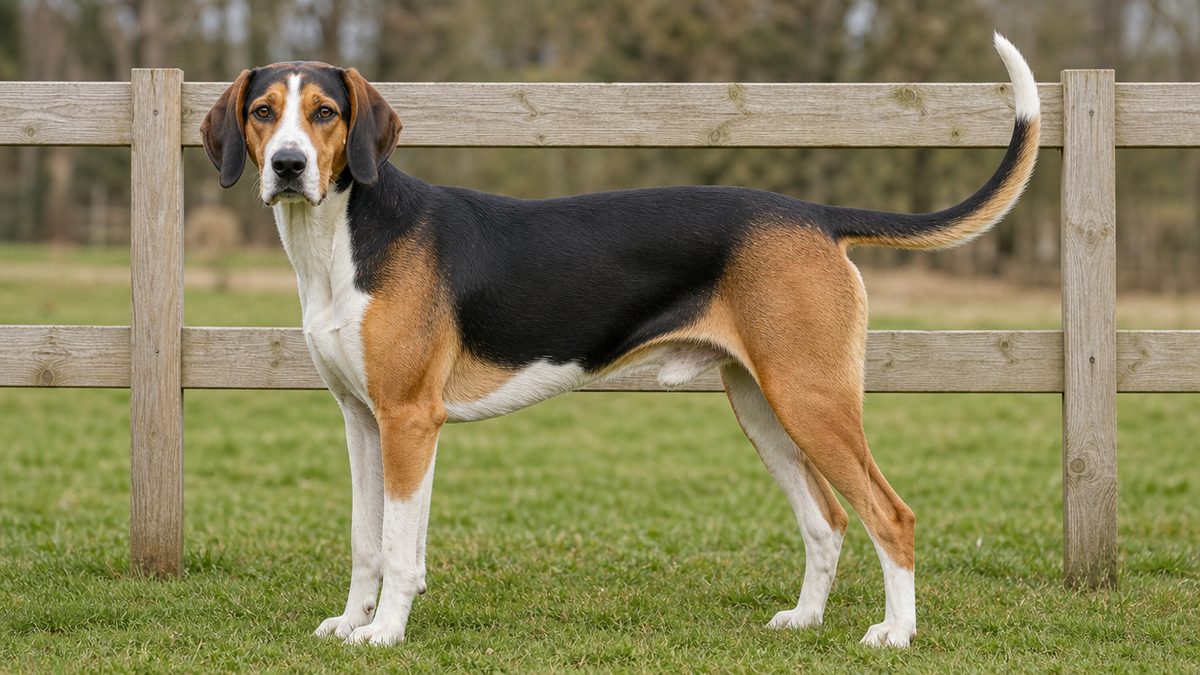
A Grand Anglo-Français Tricolore is a large French pack scenthound, registered by the Federation Cynologique Internationale as standard 322 in Group 6, Section 1.1 Large-sized Hounds, standing 60 to 70 cm at the withers, and bred inside hunting kennels rather than in homes.
The breed standard is short, and reading it directly is the fastest way past the aggregator noise. FCI-322 is a five-page document dated 18 June 1996, carrying an official valid standard dated 27 January 1983. The FCI's own nomenclature record confirms the same date as the day the breed was accepted on a definitive basis, gives France as country of origin, names French as the official authentic language, and marks the breed as subject to a working trial. A working trial requirement is not decoration. It means the FCI treats hunting performance as part of what makes the dog the breed.
The standard opens with one sentence of general appearance, and that sentence carries the whole identity: "Solid dog with French predominance, with a certain distinction, expressing at different degrees the Foxhound origin";. French predominance first, Foxhound second. The head is moderately broad and rather flat, with the occipital protuberance slightly apparent and the superciliary arches slightly prominent. The muzzle is of medium length, about equal to the skull. The eyes are big and brown, rimmed with black. The neck is rather long and strong, without pronounced dewlap.
The ears are medium, not Basset ears
The ear clause matters more than any other for an Indian reader, so here it is in full: "Leathers of medium length, broadly set at eye level, flat then slightly curled";. That describes a folded drop ear of moderate length, sitting level with the eye. It is not the long pendant leather of a Basset Hound or a Bloodhound. Anyone picturing a dog whose ears trail on the ground has the wrong animal, and the difference changes the ear-care argument later on this page.
The coat clause, and what it does not say
The entire coat description is five words: "Hair: Short, more or less strong";. The French original agrees, "Court, plus ou moins fort";. There is no undercoat, no double coat, no mention of density, and no seasonal shed described anywhere in the document. Colour is "Tricolour more often with black blanket or with more or less spread out black patches. Bright or copper tan without black overlay. Mixed hair called louvard is not excluded. The excess mottling is not desirable";. The skin clause is odd and worth noting: "Skin: White and black", which means the white areas of the dog carry unpigmented skin underneath.
Size is one line with no split by sex and no tolerance: height at the withers 60 to 70 cm. The Société Centrale Canine, the French national kennel club that actually holds the studbook, prints the same 60 to 70 cm on its own breed record, and records the breed's weight as NP, not provided. The registry that owns the breed publishes no weight for it. Hold that thought, because four other sites publish one.
| Clause | What FCI-322 says | What the ranking set says |
|---|---|---|
| Height | 60 to 70 cm, no sex split, no tolerance | Wikipedia body text 60 to 72 cm; Auberpets 60 to 72 cm |
| Weight | No weight clause exists | Wikipedia 34.5 to 35.5 kg; Basepaws 76 to 78 lb; Wisdom Panel 66 to 78 lb |
| Coat | Short, more or less strong | Wikipedia short, double coat |
| Ears | Medium length, at eye level, flat then slightly curled | Wikipedia long drop ears |
| Life expectancy | No lifespan clause exists | 10 to 12, 10 to 13 and 10 to 14 years across three sites |
| History | No history clause exists | Poitevin cross, or Bâtard Anglo-Saintongeois cross, depending on the page |
Three of the four Anglo-Français standards contain no brief historical summary at all, and 322 is one of them. Only FCI-323, the white and black, carries a history clause. That single fact explains most of the confusion on the internet about this dog, and the next two sections take it apart.
If you arrived here from the Anglo-French Hound hub, the short version is that the tricolore is the middle-sized-population one of the three Grands and the only one whose standard is still the 1983 text.
The three Grands compared clause by clause, and how little separates two of them
To separate the three Grand Anglo-Français breeds you have to open all three standards side by side, and when you do, the honest answer is that FCI-323 is genuinely a different dog while FCI-322 and FCI-324 are separated by colour, an ear length and a set of adjectives about the head.
Colour is the separation everyone knows about, and it is real. Standard 323, the white and black, lists "Colour: Tricolour coat" among its disqualifying faults, so a tricolour dog cannot be a blanc et noir. Standard 324, the white and orange, cross-references the tricolore once, in its general appearance clause, describing a dog "showing more English blood in his head than his tricolour colleague";. Standard 322 cross-references nobody at all. Beyond that, almost nothing published anywhere tells you what else differs, so here is the comparison read out of the three documents.
| Clause | 322 Tricolore | 323 Blanc et Noir | 324 Blanc et Orange |
|---|---|---|---|
| Current standard adopted | 27.01.1983 | 04.11.2008 | 01.08.2023 |
| Utilization line | Scenthound | Pack Hound for big game | Scenthound |
| History clause | None | Present, dated | None |
| Temperament clause | None | Present | None |
| Important proportions | None | Present | None |
| Height | 60 to 70 cm | Males 65 to 72, females 62 to 68, plus or minus 1 cm | 60 to 70 cm |
| Occipital protuberance | Slightly apparent | Hardly marked | Absent |
| Superciliary arches | Slightly prominent | Prominent | Not prominent |
| Muzzle to skull | About equal | A little less long | Bridge of nose rather short |
| Ear length | Medium | Medium, and measurable | Rather short |
| Neck | Rather long, no pronounced dewlap | Strong, rather short, slight dewlap tolerated | Straight, slight dewlap |
| Coat | Short, more or less strong | Short, quite strong and dense | Short and not too thick |
| Severe-faults tier | None | Present | None |
| Disqualifications beyond temperament | None | Frail limbs, severe limb deviation, long feet, tricolour coat | None |
Only one of the three can disqualify a dog for its body
Standard 322 lists exactly two disqualifying faults, and both are generic: aggressive or overly shy dogs, and any dog clearly showing physical or behavioural abnormalities. Standard 324 lists the same two and no others. Standard 323 lists those two and then adds frail limbs, severe deviation of limbs, long feet and a tricolour coat, and it is also the only one of the three carrying a separate severe faults tier above the ordinary fault list. In plain terms, a tricolore cannot be disqualified for being the wrong colour, the wrong size or structurally weak. Its standard has no mechanism for it.
The tan question is a matter of degree, not a switch
It is tempting to read "tricolour is a disqualifying fault in 323" as a clean line, and it is not. Standard 323 explicitly permits "tiny tan freckles but the latter only on the limbs", plus "a pale tan dot above each eye as well as pale tan on the cheeks, below the eyes, below the ears", and notes that the roebuck mark on the thigh is rather frequent. So a blanc et noir may lawfully carry tan on its head and legs. What it may not be is tricolour. Where the pale tan points stop and a tricolour coat begins is a judgement made in a ring, which is exactly why two of these breeds can appear in the same litter's ancestry and be told apart by a person rather than a rule.
Mottling runs the other way. Standard 323 accepts "black or bluish speckles" as normal, while 322 says "The excess mottling is not desirable"; Federation Cynologique Internationale. A heavily ticked tricolore is being marked down for something a blanc et noir is allowed.
The head gradient is the real 322-versus-324 difference
Read the three head clauses in order and a gradient appears. The occipital protuberance goes from slightly apparent in 322, to hardly marked in 323, to entirely absent in 324. The superciliary arches go from slightly prominent, to prominent, to not prominent. The muzzle goes from about equal to the skull, to a little less long, to a bridge of nose that is simply "rather short"; Federation Cynologique Internationale Federation Cynologique Internationale. That progression is what standard 324 means when it says more English blood in the head. The blanc et orange has the shortest, plainest skull of the three; the blanc et noir keeps the heaviest brow, which its own history clause attributes to Gascon-Saintongeois bone.
Strip out coat colour and the Grand Anglo-Français Tricolore and the Grand Anglo-Français Blanc et Orange are separated by a slightly longer ear, a slightly longer muzzle, a marginally more apparent occiput and a coat described as more or less strong rather than not too thick. Both stand 60 to 70 cm. Neither has a temperament clause, a history clause or a structural disqualification. That is a genuinely thin separation, and no amount of writing makes it thicker.
The blanc et noir is the outlier. It is the only one with a stated purpose of hunting big game rather than a generic scenthound line, the only one bigger than 70 cm, the only one with a dense coat, the only one whose ears carry a measurable limit, and the only one whose standard describes what the dog is like to live with. Sibling guides are at Grand Anglo-Français Blanc et Noir and Grand Anglo-Français Blanc et Orange.
The English Foxhound cross that made the breed, and who actually says so
The breed's own standard says almost nothing about the English Foxhound cross: FCI-322 contains no history clause at all, and its single reference to English ancestry is one phrase in the general appearance line, "expressing at different degrees the Foxhound origin", with no date, no named French ancestor and no source.
That absence is the whole story of this section, so it is worth confirming rather than asserting. The English text of FCI-322 runs from Translation through Origin, Date of publication, Utilization, Classification and straight into General Appearance, with no brief historical summary in between. The French original, which is the authentic text because French is the official language of this standard, does the same Federation Cynologique Internationale. The 2007 Word version archived by the Internet Archive is identical on this point. Standard 324 has no history clause either, and neither does 325, the Anglo-Français de Petite Vénerie. Of the four Anglo-Français standards, exactly one carries a dated history, and it is not this breed's.
What the one real history clause says, and which breed it belongs to
FCI-323, the Grand Anglo-Français Blanc et Noir, states: "This breed originates from the Bâtard Anglo-Saintongeois, a type which appeared in the middle of the XIXth century and which was the result of crossing between the Saintongeois and the Fox hound. The breed presently counts approximately 2000 subjects with around 200 births per year. It makes up the packs of twenty or more deer hunts and one stag hunt." The clause names its author: the 2007 text was drafted by Pierre Astié, President of the Club du chien d'ordre, with Raymond Triquet. That is a dated, attributed, primary statement of an English Foxhound cross. It is about the white and black hound.
The French kennel club has printed that paragraph on the tricolore's page
The Société Centrale Canine's official breed record for the Grand anglo-francais tricolore opens its Historique with: "Le Grand Anglo Français a pour origine le Bâtard Anglo-Saintongeois, type apparu au milieu du XIXème siècle et résultant d'un croisement entre le chien de Saintonge et le Fox Hound. Son effectif actuel est de l'ordre de 2000 chiens, donnant naissances à environ 200 sujets chaque année. Il constitue les meutes d'une vingtaine d'équipage de chevreuil et celle d'un équipage de cerf";. Compare it with the paragraph above. It is the same text, same century, same 2,000 dogs, same 200 births a year, same twenty roe-deer equipages and one stag equipage. The French national kennel club has published the blanc et noir's history and population figures on the tricolore's breed page.
The SCC page then adds a sentence the FCI does not: "Il est le plus marqué par le sang anglais", it is the most marked by English blood. Standard 324 says the opposite, that the blanc et orange shows more English blood in his head than his tricolour colleague. Two French sources, one registry and one standard, disagree about which of these dogs is the most English.
What everyone else claims, and where it came from
Wikipedia, position 1 on this query, says the breed "is descended from crosses between tricoloured Poitevins and Foxhounds". That sentence carries no footnote. Wisdom Panel says the breed "came about by crossing English Foxhounds with native scent hounds from the west of France, like the Bâtard Anglo-Saintongeois", and lists the SCC breed page among its four resources. So the two most prominent accounts of this breed's origin give two different French ancestors, one of them uncited and one of them traceable back through the SCC page to the sibling breed's standard.
| Source | Claimed French ancestor | Date given | Evidence offered |
|---|---|---|---|
| FCI-322, the breed's own standard | None named | None | One phrase: expressing the Foxhound origin |
| FCI-323, the blanc et noir standard | Saintongeois, via the Bâtard Anglo-Saintongeois | Mid 19th century | Attributed to a named club president and a named cynologist, but for a different breed |
| Société Centrale Canine tricolore page | Saintongeois, via the Bâtard Anglo-Saintongeois | Mid 19th century | Verbatim reuse of the FCI-323 clause |
| Wikipedia | Tricoloured Poitevin | None | No citation on the sentence |
| Wisdom Panel | Bâtard Anglo-Saintongeois | The 1800s | Lists the SCC page as a resource |
| UKC breed standard | None named | None | History section says only that the breed originated in France |
The United Kennel Club's history section is two sentences long and gives no cross and no date at all, recording only that the breed originated in France and was recognised by UKC in 2006. So the defensible statement is narrow and it is this. An English Foxhound cross is real, because the tricolore's own standard names the Foxhound in its opening line and every registry agrees the Anglo prefix means exactly that. The date, the specific French ancestor and the population figures attached to it on English-language pages are all borrowed from the blanc et noir. Anyone who tells you the Grand Anglo-Français Tricolore was created from Poitevins in a particular decade is telling you something no primary document on the breed supports.
The French studbook numbers, and why a zero year is normal
The Grand Anglo-Français Tricolore recorded 65 registrations in the French studbook in 2024 and zero in 2025, and reading that zero as collapse would be wrong, because the breed's own six-year series oscillates between zero and a batch and has already sat at zero three times.
The Société Centrale Canine publishes an annual table of Livre des Origines Français registrations, breed by breed, with the previous year as a comparison column. Pulling six consecutive editions gives the whole series rather than one alarming snapshot.
| Year | Tricolore | Blanc et Noir | Source table |
|---|---|---|---|
| 2020 | 0 | 0 | Statistiques LOF 2021, prior-year column |
| 2021 | 5 | 67 | Statistiques LOF 2021 and 2022 |
| 2022 | 0 | 12 | Statistiques LOF 2022 |
| 2023 | 0 | 0 | Statistiques LOF 2023 |
| 2024 | 65 | 33 | Statistiques LOF 2025, prior-year column |
| 2025 | 0 | 0 | Statistiques LOF 2025 |
| Six-year total | 70 | 112 | Sum of the above |
Seventy dogs in six years is an average of 11.7 a year, and the annual figures are 0, 5, 0, 0, 65, 0 Societe Centrale Canine Societe Centrale Canine Societe Centrale Canine. Four of the six years are zero. A single year of 65 accounts for 93 percent of the six-year total. That is not a population curve. It is the signature of one equipage enrolling a whole pack at once and nobody registering anything in between.
The series does not run back further than that, and the reason is the same one. The Grand Anglo-Français Tricolore has no row in the Statistiques LOF 2019 table and none in the 2020 table either, both of which do list the Anglo Français de Petite Vénerie and other Group VI breeds registering in single and double figures. Six consecutive editions of the French studbook, and this breed appears in three of them.
One clarification about 2023, because an absent row is not the same as a zero row
The Grand Anglo-Français Tricolore has no row at all in the 2023 table. That table does list breeds that registered nothing in 2023, including Français Tricolore at 74 then 0, Poitevin at 82 then 1, and the Grand Anglo-Français Blanc et Noir at 12 then 0. So the SCC keeps a breed in the table when either year is non-zero and drops it when both are zero. The tricolore's omission therefore means 2022 and 2023 were both zero, which is consistent with the 2022 table showing 5 then 0. The series is complete.
The control: half the French pack breeds read zero in the same year
A zero could mean a breed is dying, or it could mean the registration channel stopped. The 2025 table settles it, because the tricolore is not alone. In the same Group VI table, Français Tricolore fell from 115 to 0, Français Blanc et Orange from 4 to 0, Français Blanc et Noir from 1 to 0, and Poitevin from 110 to 1. Meanwhile Group VI as a whole only fell from 12,894 to 11,720, a decline of 9 percent. Four French pack breeds did not simultaneously go extinct in a group that shrank by 9 percent.
The contrast inside the same table is sharper still. The scenthounds that individual French owners keep grew: Anglo Français de Petite Vénerie rose from 125 to 147, up 18 percent, with 76 of those 147 confirmed; Basset Artésien Normand doubled from 79 to 158; Grand Griffon Vendéen rose from 82 to 107. Breeds owned one at a time by people register. Breeds kept fifty at a time in an equipage kennel do not.
How big the paperwork gap is, measured on the sibling breed
The gap can be quantified without guessing, using the one breed for which a claimed birth rate and a studbook series both exist. FCI-323 states that the Grand Anglo-Français Blanc et Noir has around 200 births per year. The SCC's own studbook recorded 0, 67, 12, 0, 33 and 0 for that breed across 2020 to 2025, a total of 112 and an average of 18.7 a year. Divide: 18.7 into 200 is 9.3 percent. Roughly nine births in a hundred reach the studbook and about 91 percent never do. Apply nothing across breeds and the point still stands, because the comparison is same breed, same registry, same document family.
A zero in the LOF table means no puppy was entered in the studbook that year. It does not mean no puppy was born, and for a breed kept in packs it barely correlates with how many dogs exist. The SCC's own tricolore page still describes the breed as making up the packs of around twenty roe-deer equipages, which is a real population regardless of what the register says that year.
The practical consequence for an Indian reader is small but worth stating plainly. There is no export pipeline to tap. A breed that produces zero registered puppies in four years out of six is not producing surplus dogs for anybody, anywhere, and certainly not for a country with no importer, no breed club and no lawful route in.
Grand Anglo-Français Tricolore price in India: there is none
No Grand Anglo-Français Tricolore price in India exists, because no Indian seller lists the breed at all, and the only prices attached to the breed name in Indian and international commerce are for merchandise rather than dogs.
That is a strong claim, so it was tested rather than assumed. An India-targeted search for the breed name plus puppy price returned, in order, an eBay etched pint glass, an Etsy canvas portrait at 100.44 euros, a Walmart beer glass at 24.99 dollars, a Facebook post, three breed encyclopedias, a Pinterest board, a scraped spam domain and a PNAS genetics paper. Not one Indian listing. Not one price for a live dog.
The control, because an empty search proves nothing on its own
A search returning nothing can mean the breed is absent or it can mean the search never ran. Running "Labrador Retriever puppy price in India" in the same tool in the same session returned Mr n Mrs Pet, Wrapinfur, TradeIndia, Supertails and Barfindia, with real bands including INR 30,000 to 60,000 for basic quality, 60,000 to 90,000 for KCI registered and 90,000 to 1,20,000 for champion bloodline. The apparatus works and it reaches Indian listing sites. The absence is real.
A second, positive test on the listing sites themselves
Searches can also be blocked in ways that look like zero results, so the two largest Indian puppy retail sites were probed directly by URL. Both control pages loaded with full content. Every URL pattern for this breed failed: Puppiezo returned a hard 404 for the breed slug and for anglo-french-hound, and Mr n Mrs Pet served a page titled "404 Page Not Found" for both patterns. Worth noting for anyone repeating this: Mr n Mrs Pet returns HTTP 200 on that 404 page, so a checker trusting the status code alone would record the page as existing.
The 98,999 rupee figure is a template default, not a price
Indian puppy retail sites recycle one house price point across whatever is in stock, and this site has now caught it repeatedly. Puppiezo prints 98,999 rupees on product pages for the Basenji, the Mudi, the Affenpinscher, the Miniature Pinscher and a page titled Abrax, and it appears three times on a single page. Five unrelated breeds cannot share a price to the rupee. It is a template value.
Run the currency test on it anyway, because that is the usual explanation for an implausible rupee figure. Dividing by 84.38, the exchange rate that has produced fake rupee prices three times on this site, gives 98,999 divided by 84.38 equals 1,173.25 dollars, which is not a round dollar amount and not a recognisable US price point. So 98,999 is not a converted dollar figure either. It is a rupee-native charm price sitting just under 99,000, chosen by a template and attached to whatever puppy the page happens to be about. Do not treat it as a price for this breed or any other.
The only published price for the breed anywhere is French, and unsourced
One figure does exist. A French commercial breed page gives 500 to 1,000 euros for an LOF-registered puppy, alongside a lifespan, a weight and a feeding quantity, none of which carries a source. Report it as what it is: a French retail estimate for a French dog in a French market, published without evidence. It is not an Indian price, it cannot be converted into one, and converting it would invent the very number this section exists to say does not exist.
| Figure | What it buys | Source type | Usable as an Indian dog price |
|---|---|---|---|
| 24.99 US dollars | An etched beer glass | US retail listing | No |
| 100.44 euros | A framed canvas print | Etsy marketplace | No |
| 500 to 1,000 euros | A puppy in France | Unsourced French commercial page | No |
| 98,999 rupees | Nothing specific; a template default on five unrelated breeds | Indian puppy retail template | No |
| Any Indian rupee figure | Does not exist for this breed | None found | No |
Anyone in India quoting you a price for a Grand Anglo-Français Tricolore is selling you something else. The likeliest candidates are a Beagle-cross, a tricolour Indian pariah-type dog, or a foxhound-type mixed hound, any of which can look broadly right to someone who has only seen a photograph. Ask for the LOF or FCI export pedigree number and the DGFT import authorisation. Neither will exist.
Because this breed is not sold in India, the rest of the price question becomes an import question, and Indian import law answers it in a single paragraph. That is the next section.
Indian import law closes the only route that was left
Indian law permits a dog to enter the country in three situations only, and buying a rare breed abroad to bring home is not one of them, which is why no lawful supply of this breed can form in India however much demand there is.
The governing document is DGFT Trade Notice No. 22/2022-23, dated 19 December 2022, issued by the Directorate General of Foreign Trade under the Ministry of Commerce and Industry. It classifies live mammals under ITC (HS) 01061900 as Restricted, not freely importable, and then narrows the permitted purposes in Policy Condition 7.
- A pet dog with a valid pet book and relevant records or documents in the name of the importer.
- Dogs imported by R&D organisations for conducting research, with the recommendation of CPCSEA.
- Dogs for internal security by the Defence and Police Force.
Policy Condition 8 then removes the obvious workaround: "Import of commercial dogs for breeding or any other commercial activities other than the purposes mentioned above is not permitted";. Paragraph 6 of the same notice repeats it as an instruction to the officers processing applications: "any applications for trading/breeding purposes, or applications made on behalf of some another person/entity shall be duly rejected." Not discouraged, not scrutinised. Duly rejected.
The pet-book route is narrower than it sounds
The first limb of Policy Condition 7 is the only realistic one, and it is a transfer-of-residence provision rather than a purchase provision. Up to two pets may enter as passenger baggage without a DGFT authorisation, and only for a person transferring their residence to India after two years of continuous stay abroad. If the stay abroad was under two years, or the animal is not travelling as baggage, an import authorisation from DGFT is required. More than two animals always requires an authorisation, examined by the Department of Animal Husbandry and Dairying.
The pet book must be in the importer's name, which is the clause that does the real work. A dog bought last month in France to be flown to Chennai has no history in the buyer's name and is not the family pet of a returning resident. It is an import for acquisition, and it fails the test on the document rather than on anybody's judgement.
The practical machinery, for the one reader this applies to
If you genuinely are a returning resident who already owns one of these dogs, the notice sets out the steps. Applications go in as ANF-2M against your Importer Exporter Code, or against the permanent IEC number IIHIE0153E reserved for persons importing goods for personal use not connected with trade. DGFT advises starting at least two months before travel. Entry is restricted to the airports and seaports of Delhi, Mumbai, Chennai, Hyderabad, Bengaluru and Kolkata and, since October 2024, Kochi airport, seven ports in total, and animals may be quarantined at the government quarantine station of those ports. An Advance No Objection Certificate must be obtained from the Regional Officer or Quarantine Officer of the Animal Quarantine and Certification Service, submitted with the DGFT import licence and a health certificate from a veterinarian in the exporting country, seven days before travel and relaxable to three days. The full route is set out in how to import a dog to India.
| Route | Who it is for | Does it fit a buyer wanting this breed |
|---|---|---|
| Pet dog with valid pet book in the importer's name | A person moving to India with a dog they already own | No, unless you already own the dog abroad |
| R&D organisation with CPCSEA recommendation | Registered research institutions | No |
| Defence and Police Force internal security | Government forces | No |
| Purchase abroad for import | Nobody; Policy Condition 8 forbids it | No, and the application is duly rejected |
Both ends of the pipe are shut, which is why the shortage is permanent
Two separate facts have to hold for a breed to become available in India. Someone must be able to bring breeding stock in, and someone abroad must be producing surplus puppies. Indian law blocks the first, since import for breeding is not permitted and applications for it are to be rejected. The French studbook shows the second is not happening either, with the breed registering nothing at all in four of the last six years. A supply chain cannot form when every link is missing. For scale, the Kennel Club of India registered 32,219 puppies in 2025 across 80 member clubs, a register published as totals rather than by breed, so it can neither confirm nor exclude a single dog of this breed. Every route that can be tested comes back empty.
The law is not the obstacle it looks like. Everything in the following sections about heat, ear disease, exercise load and pack behaviour says this dog would have a hard life in an Indian city. The import rules are simply the reason you will not have to find that out the expensive way.
Heat tolerance in India: Bonbeno rates this breed 2 out of 5
The Grand Anglo-Français Tricolore is not heat-tolerant in Indian conditions, and the reason is mechanical rather than impressionistic: the breed's homeland has no month whose mean temperature reaches 25 degrees, while Chennai has ten, and the coat the standard describes gives the dog nothing to work with.
Every figure below comes from one source, NASA's Prediction Of Worldwide Energy Resources climatology, queried by explicit latitude and longitude rather than by place name, so no lookup can quietly substitute a different city NASA Prediction Of Worldwide Energy…. The origin point is 46.5802 N, 0.3404 E, Poitiers in Poitou, the western French pack country. The Indian points are Chennai 13.0827 N 80.2707 E, Delhi 28.6139 N 77.2090 E, Mumbai 19.0760 N 72.8777 E, Bengaluru 12.9716 N 77.5946 E, Pune 18.5204 N 73.8567 E and Kolkata 22.5726 N 88.3639 E.
The methodology, stated so you can check it
The measure used is the monthly mean air temperature at 2 metres, plus the monthly mean relative humidity, from which the vapour pressure deficit is calculated with the standard Tetens formula. The deficit is the useful number for a dog, because a dog cools mainly by evaporating water from its respiratory tract when it pants, and evaporation stops paying when the air is already close to saturated. Two numbers, one source, arithmetic anybody can repeat.
NASA POWER also publishes T2M_MAX, and using it here would produce a confidently wrong page. In the climatology series it is the maximum recorded across the whole period, not a typical daily high, so Poitiers reads 42.3 degrees in July against Bengaluru's 40.4 in April. Taken at face value that says this breed's homeland is hotter than Bengaluru. On the mean, Poitou's hottest month is 20.6 degrees and Bengaluru's is 28.4.
| Location | Months at or above 25 C mean | Hottest month mean | Worst humid month, temp and vapour deficit |
|---|---|---|---|
| Poitou, France (origin) | 0 | 20.6 C in July | August, 20.5 C, 0.82 kPa |
| Chennai | 10 | 31.5 C in May | November, 25.8 C, 0.59 kPa |
| Mumbai | 9 | 31.2 C in May | August, 26.1 C, 0.33 kPa |
| Kolkata | 8 | 31.5 C in May | September, 27.7 C, 0.40 kPa |
| Delhi | 7 | 35.9 C in June | August, 29.8 C, 1.05 kPa |
| Pune | 4 | 28.9 C in April | August, 23.3 C, 0.26 kPa |
| Bengaluru | 3 | 28.4 C in April | May, 27.0 C, 1.29 kPa |
Read the first row again. The breed's home region has zero months averaging 25 degrees or more, and its warmest month averages 20.6 degrees. Chennai's coolest month, January, averages 24.1 degrees, which is 3.5 degrees hotter than the hottest month Poitou ever manages. There is no season in Chennai that resembles a French summer, let alone a French winter.
India defeats this dog two different ways
In Delhi in May the mean is 35.0 degrees with humidity at 23.4 percent, giving a vapour deficit of 4.32 kPa. Panting works beautifully in that air, and it is still dangerous, because once ambient temperature approaches the dog's own surface temperature the convective route stops carrying heat away and can reverse. The dog is left with evaporation alone, in a large body with a poor surface-to-mass ratio, and it dehydrates fast.
In Pune in August the failure runs the other way. The mean is only 23.3 degrees, which sounds mild, but humidity averages 90.8 percent and the vapour deficit collapses to 0.26 kPa. That is under a third of the 0.82 kPa the dog's own homeland offers at its driest. Mumbai in August is 0.33 kPa at 26.1 degrees, Kolkata in September 0.40 kPa at 27.7. A dog panting in that air is moving a great deal of humid air in and out and shedding very little heat with it. Monsoon heat is not the mild season it looks like on a thermometer.
The coat the standard describes offers no help
Three clauses in FCI-322 decide this, and all three point the same way. The coat is "Short, more or less strong", with no undercoat named anywhere in the standard, so there is no insulating layer holding radiant load off the skin the way a true double coat does. The colour is tricolour "more often with black blanket", meaning a dark dorsal surface facing the sun across the dog's largest area. And the skin clause reads "White and black", so the skin under the white markings is unpigmented and will burn. The French registry records the same short single coat and, tellingly, records no weight for the breed at all.
Exercise before 6 am and after 8 pm, never in the middle of the day from March to June. Do not shave the coat; a short single coat gives some protection against direct sun on unpigmented skin and removing it makes sunburn worse without improving cooling. Offer shade and moving air rather than a cold bath, and treat heavy panting that does not settle within a few minutes of rest as an emergency and call a veterinarian.
Ear care: what a folded scenthound ear actually costs in Indian humidity
A folded scenthound ear roughly doubles the one-year risk of otitis externa compared with an erect ear, and the best evidence puts a dog like this at about 9.9 percent a year against 5.3 percent for a prick-eared dog, before any Indian humidity is added on top.
Start with the ear the standard actually describes, because most writing about this breed gets it wrong. FCI-322 says "Leathers of medium length, broadly set at eye level, flat then slightly curled";. That is a folded drop ear of moderate length. Wikipedia calls them "long drop ears";; the standard does not. This is not a Basset, and pretending it is would overstate the risk as badly as ignoring the ear altogether.
The study with real denominators
The strongest evidence is the VetCompass cohort of O'Neill and colleagues: a random sample of 22,333 dogs drawn from 905,554 under UK primary veterinary care in 2016, giving a one-year period prevalence of otitis externa of 7.30 percent, 95 percent confidence interval 6.97 to 7.65. Crucially it classifies breeds by ear carriage using stated exemplars: erect means prick, as in a German Shepherd Dog; semi-erect means cocked, as in a Rough Collie; V-shaped drop means folded, as in a Hungarian Vizsla; pendulous means drop or pendant, as in a Basset Hound.
A medium-length ear set at eye level, flat at the base then slightly curled, is a folded ear. It belongs in the V-shaped drop category, not the pendulous one. That distinction turns out not to rescue the dog.
| Ear carriage | Cases | Dogs in group | Crude one-year risk | Adjusted odds ratio vs erect |
|---|---|---|---|---|
| Erect (prick) | 220 | 4,118 | 5.3% | Base |
| Semi-erect (cocked) | 276 | 4,930 | 5.6% | 1.03, CI 0.86 to 1.24, not significant |
| V-shaped drop (folded) | 299 | 3,033 | 9.9% | 1.84, CI 1.53 to 2.21 |
| Pendulous (Basset type) | 395 | 4,147 | 9.5% | 1.76, CI 1.48 to 2.10 |
| Variation within breed | 441 | 6,105 | 7.2% | 1.36, CI 1.15 to 1.60 |
| Whole cohort | 1,631 | 22,333 | 7.3% | n/a |
The counts reconcile exactly: 220 plus 276 plus 299 plus 395 plus 441 gives 1,631 cases, and 1,631 divided by 22,333 is 7.30 percent, the prevalence the paper reports. The group sizes sum to 22,333. Every number in that table can be checked against the paper.
The folded ear is not the safer option
The adjusted odds ratio for a V-shaped drop ear is 1.84, marginally higher than the 1.76 for a frankly pendulous one, and the confidence intervals overlap across almost their whole length. The authors call this a novel finding and say so explicitly. So arguing about whether this breed's ear counts as folded or pendulous changes nothing useful: either way the multiplier is close to 1.8 and the crude annual risk sits near 10 percent. A semi-erect ear, by contrast, carries no detectable extra risk at all, odds ratio 1.03 with a p value of 0.757.
Being a hound is not the problem; the ear is
The same model shows the Kennel Club Hound group carries an odds ratio of 1.23 with a confidence interval of 0.94 to 1.60 and a p value of 0.128, which does not reach significance. Gundogs do, at 1.42. Individual breeds vary enormously, from Basset Hound at 5.87 and Beagle at 2.54 down to Chihuahua at 0.20 and Border Collie at 0.34. This matters because it tells you what to act on. You are not managing a hound; you are managing a flap of skin that keeps a warm canal dark and closed.
Why Indian humidity multiplies it
The mechanism the O'Neill authors cite for pendulous ears is heat and moisture retention in the canal, and India supplies both for months at a stretch. The climate figures earlier on this page put Mumbai at 90.4 percent mean relative humidity in August, Pune at 90.8 percent, Kolkata at 89.3 percent in September and Chennai above 80 percent from October to December. An Indian series from Palam Valley in Himachal Pradesh found 48 of 81 otitis cases presenting in the rainy season of July and August, 59.25 percent of the year's caseload in two months. Dividing out confirms it: 48 into 81 is 59.26 percent.
Check inside both ears every week and daily through the monsoon, looking for redness, a yeasty smell or head shaking. Dry the canal after every swim and every bath rather than letting the dog air dry, because overseas grooming guides that say to air dry were written for a dry summer. Use a veterinary ear cleaner your vet has recommended, never cotton buds pushed into the canal, and treat a smell plus head shaking as a reason to book an appointment rather than to try another bottle.
One caution about the Palam Valley numbers before leaning on them, because they do not survive an arithmetic check intact. That is the next section.
The Indian ear study everyone quotes has a broken number in it
The Palam Valley otitis paper reports that 53 of 81 cases occurred in pendulous-eared breeds, 69.13 percent, and those two figures cannot both be right, because 53 divided by 81 is 65.43 percent while 69.13 percent requires 56.
The study is worth using. Nainika and Pardeep Sharma screened 2,476 dogs presented to the veterinary clinics at CSK Himachal Pradesh Krishi Vishvavidyalaya, Palampur, between June 2022 and July 2023, and diagnosed otitis externa in 81, a hospital prevalence of 3.27 percent. It is one of very few Indian series on this disease, and its seasonal finding is directly relevant to any long-eared dog kept here. But one figure in it does not survive division, and this page will not repeat a number it cannot reconstruct.
Three checks, all pointing at 56
- The percentage. 56 divided by 81 is 69.1358 percent, which truncates to the 69.13 percent printed. 53 divided by 81 is 65.4321 percent, which appears nowhere as the pendulous figure.
- The total. The paper presents pendulous and erect as exhaustive, writing that 69.13 percent were pendulous-eared and "In contrast, 30.86% were found in erect-eared breeds". 56 plus the 25 erect-eared cases is exactly 81, the full case count. 53 plus 25 is 78, which would leave three cases belonging to neither category. The two printed percentages also sum to 99.99, as two truncated halves of a whole should.
- Where the stray 53 came from. The same paper reports cocci-shaped bacteria in 30 of 81 cases and rod-shaped in 23 of 81. Thirty plus 23 is 53, and the paper prints "Bacterial infections were present in 65.43%", which is exactly 53 divided by 81. The 53 in the pendulous-ear row is the bacterial total, copied one row across.
The truncation point is what makes this conclusive rather than a guess. The paper truncates every percentage instead of rounding: 34 of 81 is 41.975 and is printed as 41.97; 48 of 81 is 59.259 and is printed as 59.25; 8 of 81 is 9.876 and is printed as 9.87; 25 of 81 is 30.864 and is printed as 30.86. Under that convention 56 of 81 gives exactly 69.13. Under no convention does 53.
What else the audit turned up
Dividing out every percentage in the paper found four more problems, none of which affects the headline results but all of which a reader quoting the paper should know about.
| Figure as printed | What the arithmetic gives | Verdict |
|---|---|---|
| Pendulous ear breed, 53 cases, 69.13% | 69.13% requires 56; 53 gives 65.43% | Count wrong, percentage right; read as 56 |
| Pomeranian and Mongrel, 10 cases each, 12.43% | 10 of 81 is 12.345, truncating to 12.34 | Digit transposition, 12.34 not 12.43 |
| Pug, 8 cases, 9.80% | 8 of 81 is 9.876, truncating to 9.87 | Minor misprint |
| "In a study of 50 cases of Otitis externa... 45.67% (37/81)" | 37 of 81 is 45.67, correct; the denominator is 81 | The "50 cases" phrase contradicts the paper's own n |
| Moisture accumulation in 33.33% of cases | 33.33% of 81 is 27, but Table 5 gives excessive moisture as n=17, 20.98% | Two moisture figures, one with no matching count |
| Ulceration 16.8% | 13 of 81 is 16.04, 14 of 81 is 17.28 | Maps to no whole number of cases |
What still stands
Every table that sums to 81 reconciles perfectly. The breed table sums to 81 across eleven breeds, the age table to 81 across four bands, the sex table to 81 as 65 males and 16 females, and the season table to 81 as 48, 15, 10 and 8. So the finding that matters most to an Indian owner of a long-eared dog, that 48 of 81 cases presented in the July and August rains, is arithmetically sound at 59.26 percent and can be quoted with confidence.
Even at 56, this figure is a case-mix statistic and not a risk estimate. The paper never reports how many of the 2,476 dogs presented had pendulous ears, so there is no denominator by ear type. If most dogs walking into that clinic are Labradors, most otitis cases will be Labradors whatever ears do. The paper also lumps Labradors and Pugs together as pendulous and calls Pomeranians erect, which is far too coarse to separate a folded foxhound ear from a Basset leather. For actual risk by ear shape, use the VetCompass cohort, which has the denominators.
Health issues and life expectancy: 51 dogs is the entire world literature
The whole published health evidence for this breed is two PubMed records covering 51 dogs, there is no screening data anywhere, and every list of breed health issues you will read online is generic large-hound boilerplate with no source attached to it.
Both of those are absences, and absences have to be earned rather than asserted, so each was tested with a control in the same session.
PubMed: two records, and both were opened
Control queries ran first. "Labrador Retriever hip dysplasia" returned 126 records, "canine otitis externa" 683 and "Beagle breed" 696, and the query translations PubMed returned were inspected in each case to confirm the search had not been silently rewritten into something else. The database was working. Then the breed: "Grand Anglo-Francais Tricolore" returned 0, "Grand Anglo-Francais" 0, and "Great Anglo-French Tricolour Hound" 0. Two searches returned one record each, and both records were retrieved and read rather than counted.
- Collignon and colleagues, 2012, American Journal of Veterinary Research 73(11):1841-7. The animals line reads "50 Great Anglo-Francais Tricolor Hounds with various degrees of renal function". It is a pharmacokinetics methods paper comparing creatinine and iohexol as estimates of glomerular filtration rate. Iohexol plasma clearance averaged 3.4 plus or minus 0.8 mL/min/kg against creatinine at 3.0 plus or minus 0.7, and the two agreed to within 0.6 mL/min/kg for 34 of the 50 dogs, which the paper gives as 68 percent and which divides out exactly.
- Lange and Beaudu-Lange, 2009, Journal of Small Animal Practice 50(6):311-6. A single case report of a septal myocardial abscess in a seven-year-old male great Anglo-French hound with concurrent renal failure and urinary infection. The dog died, and post-mortem confirmed the diagnosis; the authors describe it as the first septal myocardial abscess reported in a dog. The title does not say which of the three Grands it was.
Both records involve kidney function, and it would be easy and wrong to turn that into a renal predisposition. The 50 dogs in the 2012 study were assembled precisely because they spanned a range of renal function; that is the study's inclusion criterion, not a prevalence finding, and the paper reports no rate of kidney disease in the breed. A single fatal case report establishes nothing about a population. Bonbeno publishes no renal risk figure for this breed, because none exists.
OFA holds nothing, and neither does it hold any Foxhound
The Orthopedic Foundation for Animals statistics were pulled in full, roughly 2.2 million characters covering 269 distinct breed row labels, and searched case-insensitively. Controls first: LABRADOR appears 109 times, POODLE 97, BEAGLE 61, BASSET HOUND 45, BLOODHOUND 41, HARRIER 14. The dump had loaded. Then the target: "anglo" appears zero times, "tricolor" zero, "tricolore" zero. The only "francais" rows are Braque Francais and its neighbours.
One further result is worth more than the absence itself. Searching the 269 row labels for "foxhound" returns nothing at all. Neither the English Foxhound nor the American Foxhound clears OFA's inclusion threshold, which the foundation states as at least 100 evaluations for hips and at least 50 for other databases. So this is not a fact about the Grand Anglo-Français Tricolore. It is a fact about pack hounds: dogs bred and kept fifty at a time in a hunting kennel are not radiographed and submitted one at a time by owners, so no register ever accumulates enough of them to publish.
What the ranking pages list, and what backs it
Basepaws states the breed can suffer hip and elbow dysplasia, degenerative myelopathy and progressive rod-cone degeneration, with no source attributed to the claim. A French commercial page lists gastric dilatation-volvulus, hip dysplasia, chronic otitis and arthrosis, also unsourced. Every item on both lists is a condition of large, deep-chested or long-eared dogs in general. Not one is supported by a study of this breed, by an OFA figure, or by a breed-club health survey, because none of those exist. Progressive rod-cone degeneration in particular is a specific mutation detected by a DNA test, and no result for it has ever been published in this breed.
That is not the same as saying the breed is free of those conditions. It is a large deep-chested hound with a folded ear, so bloat, joint disease and ear disease are all biologically plausible and worth screening for in any individual dog. It is saying that anybody printing a list as though it were breed data is printing an assumption.
Life expectancy: nobody knows
Neither FCI-322, nor the UKC standard, nor the Société Centrale Canine record publishes a lifespan for this breed United Kennel Club Societe Centrale Canine. Three commercial sites publish three different ones and none names a cohort. That audit is the next section, because it applies to the weight and height figures too.
Every published number for this breed, followed back to its source
Four of the most-read pages about this breed publish a weight, a height and a life expectancy, and following each figure back to the document it cites shows that the two registries which define the breed publish none of the three.
Wikipedia holds position one for this breed name and its appearance paragraph carries a single footnote, pointing at an Internet Archive capture of the FCI's old Word version of standard 322. That document is still retrievable, so it was retrieved. Here is what it actually contains.
| Wikipedia claim | What the cited 2007 FCI document says | Holds up |
|---|---|---|
| Stand 60 to 72 cm | "Height at the withers: 60 to 70 cm" | No |
| Short, double coat | "HAIR : Short, more or less strong" | No, no undercoat is mentioned |
| Weigh 34.5 to 35.5 kg | The document contains no weight clause at all | No |
| Long drop ears | "Leathers : Of medium length... flat then slightly curled" | No, medium not long |
| Recognised by the FCI in 1983 | "DATE OF PUBLICATION OF THE ORIGINAL VALID STANDARD : 27.01.1983" | Yes |
Four claims out of five fail against the source named for them. The current 1996 standard and the French original say the same thing as the 2007 capture on every point Federation Cynologique Internationale, so this is not a case of the standard having changed underneath the article. The citation loop simply closes on a document that does not contain the figures.
The 72 centimetre figure belongs to a different breed
The stray 72 is traceable. FCI-323, the Grand Anglo-Français Blanc et Noir, gives males 65 to 72 cm and females 62 to 68 cm. That is the only 72 in the Anglo-Français family, and it is the sibling's. This is the same borrowing that put the blanc et noir's 2,000 dogs and 200 births a year onto the tricolore's registry page. When a number about this breed looks oddly specific, check standard 323 first.
The 76 to 78 pound weight refutes itself
Wikipedia gives 34.5 to 35.5 kg, which is 76 to 78 lb, and Basepaws prints 76 to 78 pounds Basepaws, Great Anglo-French Tricolour…. A two-pound band across a breed whose own standard allows a ten-centimetre height range is not a measurement of anything. Scale it: 70 divided by 60 is 1.167, and mass goes with the cube of length, so 1.167 cubed is 1.59. If a 60 cm dog of this build weighs 76 lb, a 70 cm one should be near 121 lb. A real breed weight range for 60 to 70 cm would be wide, and the French national kennel club, which is the body that would know, records the breed's weight as NP, not provided.
Four life expectancies, no cohort
| Source | Life expectancy | Height | Weight | Evidence named |
|---|---|---|---|---|
| FCI-322 (breed standard) | Not stated | 60 to 70 cm | No weight clause | n/a, it is the primary document |
| Société Centrale Canine | Not stated | 60 to 70 cm | NP, not provided | n/a, it holds the studbook |
| UKC breed standard | Not stated | 23.5 to 27.5 in (59.7 to 69.9 cm) | Not stated | n/a |
| Wisdom Panel | 10 to 14 years | 24 to 28 in (61.0 to 71.1 cm) | 66 to 78 lb | Four resources listed, none containing a lifespan |
| Basepaws | 10 to 14 years | 23.5 to 27.5 in | 76 to 78 lb | None |
| World Life Expectancy | 10 to 13 years | Not stated | Not stated | No sample size or methodology anywhere on the page |
| Auberpets (France) | 10 to 12 years | 60 to 72 cm | 30 to 36 kg | None |
The World Life Expectancy entry is the one worth pausing on, because that site exists to publish life expectancy and its page for this breed carries a figure with no cohort, no sample size and no methodology statement of any kind. Wisdom Panel's page is the most carefully made of the four, reviewed by a named veterinarian in July 2023 and listing its resources at the foot, and not one of those four resources contains a lifespan figure to review.
No life expectancy, and no weight. There is no cohort study, no insurance dataset, no breed-club survey and no registry figure for either. A plausible-looking range invented from other large scenthounds would be more comfortable to read and would be exactly the fabrication this site exists to avoid. Height we do publish, as 60 to 70 cm, because two independent primary sources state it and agree.
Temperament and household fit: the French registry says this is not a house dog
The Société Centrale Canine states the household question directly on its own breed record: "Les Anglo-Français ne sont pas adaptés à la vie en ville. Chiens de meute, ils vivent en chenil", which means Anglo-Français are not suited to city life, and being pack dogs, they live in a kennel.
That sentence is not a Bonbeno opinion about apartments. It is the French national kennel club, describing a breed it holds the studbook for, in a section of its own breed page headed Vivre en ville, living in town. It continues: "Il leur faut de l'espace et de l'exercice", they need space and exercise. For an Indian reader deciding between breeds, this is the single most decisive line available, and it comes from the registry rather than from a care blog.
FCI-322 has no temperament clause at all
The standard says nothing about what this dog is like to live with. There is no behaviour section, and the only temperament content anywhere in the document is a disqualification for "Aggressive or overly shy dogs";. That is a working-kennel requirement, not a description of a companion. FCI-323, the blanc et noir, does carry a behaviour clause, and even that one is careful about where the friendliness happens: "It is a friendly dog, close to humans and easy to manage in the kennels";. In the kennels. Not in the sitting room.
What the registry does describe
The SCC's Comportement section gives a clear picture of a working pack hound. English blood brought the build, the bone and the vigour; French blood brought the nose and the voice. The dog is described as "un passionné de chasse, résistant, courageux, puissant, rapide et tenace", a hunting obsessive, hardy, courageous, powerful, fast and tenacious, able to work on any terrain, and it closes with "Son éducation sera ferme", his education will be firm.
Read that as a specification rather than as praise. Every quality on the list is a quality you want in a dog that runs deer through wet scrub for hours alongside twenty others. Tenacity in a flat is a dog that does not stop. A powerful voice in a hunting kennel is an asset; the same voice at 2 am in a Pune housing society is a complaint from every neighbour on the floor.
The recall problem is the one that ends badly
Every independent description converges on the same warning. Wikipedia notes that letting these dogs off the leash may be hazardous because the hunting instinct is very high, and that they are normally kept in large packs in rural areas and may not adapt well to city or family life. Wisdom Panel puts it as being prone to wandering off when following a scent, and advises keeping them leashed or in an enclosed area. A dog selected across two centuries for the willingness to follow a line of scent for hours is not going to weigh your voice against a fresh trail and choose your voice.
| Situation | Realistic fit | Why |
|---|---|---|
| Apartment in any Indian metro | Unsuitable | The registry says the breed is not adapted to city life and lives in a kennel |
| Independent house with a small compound | Unsuitable | A 60 to 70 cm pack hound needs running distance, not a yard |
| Farmhouse with securely fenced acreage | Possible in principle | Space exists, but the fence has to beat a scenting hound and the heat still does not work |
| Home with young children | Not the deciding factor | Nothing in the sources suggests unfriendliness; size and drive are the issues, not temper |
| Home with cats or poultry | Unsuitable | A big-game pack hound with high prey drive |
| First-time dog owner | Unsuitable | The registry's own advice is that training must be firm and consistent |
This is a sociable, biddable, good-natured dog with other dogs and with the people who handle it, and none of that makes it a house pet. It was built to live in a group, work all day, and be managed rather than lived with. Wikipedia's line that in France it is bred and kept primarily as a hunting dog, not as a pet or showdog, matches everything the registry says.
If the appeal is a large, friendly, tricolour scenthound, the sensible move is to want the type rather than this particular breed. The comparison section further down names the dogs that actually deliver it in India.
Training: everything is learnable except recall on a live scent
To train a Grand Anglo-Français Tricolore, work with the pack instincts rather than against them, accept that off-lead recall over a fresh trail is the one thing that will not become reliable, and manage that with equipment instead of hoping obedience will cover it.
The registry's own training advice is four words long: "Son éducation sera ferme", his education will be firm. Firm here means consistent and clear, not harsh. Wisdom Panel describes the breed as eager to please with a stubborn streak, responding best to consistent techniques and positive reinforcement with food or a favourite toy. Those two descriptions are compatible and they point at the same method: high-value rewards, short sessions, the same rules every day from every person in the house.
What this breed learns easily
A dog bred to live and work in a group of forty is a dog that reads other dogs well and tolerates handling. Kennel manners, walking beside a handler, waiting at gates, being examined, being loaded into a vehicle, coexisting with other dogs, all of that is what a pack hound is selected for, and FCI-323's line about being "easy to manage in the kennels" is describing exactly this. Crate training, station training and settling on a mat are usually straightforward. So is nosework, which is the one activity where the breed's actual talent gets a legitimate outlet.
What it will resist, and why the resistance is not disobedience
Recall away from a scent is the hard limit. This is a breed subject to a working trial in FCI's own nomenclature, meaning hunting performance is part of the breed definition, and the trait being tested is the willingness to stay on a line for hours regardless of what else is happening. When a dog like this ignores you over a trail it is not defying you, it is doing the thing two centuries of selection installed. Wikipedia's warning that letting them off the leash may be hazardous is the practical consequence.
The second resistance is voice. Pack hounds are bred to give tongue so that a handler can follow them out of sight. The SCC credits French blood specifically with "le nez et la gorge", the nose and the voice. You can teach a quiet cue and you cannot train the voice out of the breed, because the voice is the breed.
A realistic timeline
| Skill | Realistic timeline | Ceiling |
|---|---|---|
| Name response and food-lure basics | 1 to 3 weeks | Reliable |
| Lead walking without pulling | 3 to 6 months of daily work | Good, never effortless |
| Settle on a mat, crate, handling for grooming | 4 to 8 weeks | Reliable |
| Recall in a quiet enclosed space | 4 to 8 weeks | Reliable |
| Recall in a park with distractions | 6 to 12 months | Usually good |
| Recall off a live scent trail | Do not plan for it | Never treat as reliable; use a long line |
| Quiet on cue | 3 to 6 months | Reduces frequency; will not silence the dog |
Socialisation, on an Indian calendar
Socialise deliberately between roughly three and sixteen weeks, and in India the heat decides when. From March to June, take the puppy out before 6 am and after 8 pm only, and use the cool hours for the whole exposure list: traffic noise, autorickshaws, two-wheelers, lifts, tiled floors, street dogs at a safe distance, cattle, children, umbrellas, the doorbell, the pressure cooker. A puppy that misses this window because the middle of the day was unusable and nobody rescheduled ends up under-socialised, and the fix is much harder than the prevention.
Use a well-fitted harness and a 10 to 15 metre long line for any open space that is not fully fenced. Do not use a retractable lead with a dog of this size and drive; the handle is dropped the moment the dog hits the end of it. Microchip the dog and keep the registration details current, because a scenthound that leaves on a trail can cover a great deal of ground before it notices you are not there.
Everything above assumes the dog is getting the exercise the breed needs. Where it is not, none of this training holds, and the exercise requirement is larger than most people expect.
Daily exercise: the requirement is a hunting pack's, and India shrinks the window
No published figure exists for this breed's daily exercise requirement, so the honest benchmark is the job the standard was written around: running with a pack of twenty or more behind mounted hunters, across country, for hours at a stretch.
FCI-322 gives the utilization as Scenthound and marks the breed as subject to a working trial, meaning field performance is part of what the FCI considers the breed to be. FCI-323 describes the closest relative as making up the packs of twenty or more deer hunts and one stag hunt. The Société Centrale Canine adds only "Il leur faut de l'espace et de l'exercice", they need space and exercise, and precedes it with the statement that as pack dogs they live in a kennel. Nobody publishes minutes per day, and inventing one would be dishonest.
The care advice you will find was written for a different climate
Wisdom Panel's exercise guidance is that the breed requires daily brisk walks at a minimum, with a fenced yard for more vigorous running. That is reasonable advice in Wisconsin or Normandy, where a fenced yard is usable at noon in July. Apply the same instruction in Chennai and it fails, because for ten months of the year the mean air temperature is at or above 25 degrees and the middle of the day is not available at all. The advice does not transfer, and repeating it here without saying so would be the commonest failure on Indian breed pages.
How much usable time an Indian owner actually has
Work it out for the city rather than in general. From March to June across most of India, the only safe exercise hours for a large dark-blanketed short-coated hound are roughly before 6 am and after 8 pm. That is perhaps two to three usable hours a day, in the dark, shared with everything else the household has to do. Through the monsoon the temperature drops but the vapour pressure deficit collapses to 0.26 kPa in Pune in August and 0.33 kPa in Mumbai, under half the evaporative headroom the breed's homeland offers at its driest, so panting sheds far less heat and the dog tires sooner than the thermometer suggests.
| City | Months at or above 25 C mean | Hardest season | Practical window |
|---|---|---|---|
| Chennai | 10 | April to June, and humid all year | Before 6 am, after 8.30 pm, year round |
| Mumbai | 9 | April to May dry heat, July to September humid | Before 6 am, after 8.30 pm |
| Kolkata | 8 | April to June, then a humid September | Before 6 am, after 8 pm for eight months |
| Delhi | 7 | May to June, extreme dry heat | Before 5.30 am and after 9 pm, May to June |
| Pune | 4 | April, then a saturated August | Morning and late evening, April to September |
| Bengaluru | 3 | March to May | The widest window in urban India, still not enough |
What happens when the requirement is not met
An under-exercised pack hound does not become calm. It becomes vocal, destructive and a persistent escaper, because the drive that makes it good at its job has nowhere to go. The voice is the part most Indian households underestimate: the SCC credits French blood with giving this breed "la gorge", the tongue, and a bored hound in a housing society uses it. Escape attempts follow the same logic, and Wikipedia's warning about the very high hunting instinct applies just as much to a gate left ajar as to an off-lead walk.
Split the load. Two long walks in the cool hours, on a harness and long line, plus twenty to thirty minutes of scentwork indoors during the heat of the day, which tires a scenthound far more efficiently than distance does. Scatter feeding, tracking a dragged scent trail down a corridor, and find-the-item games use the part of the dog that actually needs the work. Never substitute a midday walk for a missed morning one.
Exercise and coat care intersect in one place, which is the ear, because a dog worked in the monsoon comes home wet.
Grooming a short-coated pack hound in Indian humidity
The coat takes about ten minutes a week and the ears take the rest, because a short-coated hound in an Indian monsoon has almost no grooming needs above the neck line and one significant one at it.
FCI-322 describes the entire coat in five words, "Short, more or less strong", with no undercoat, no feathering and no furnishings anywhere in the document. The Société Centrale Canine records the same, "Court, plus ou moins fort";. The UKC standard calls it "Short, and fairly coarse";. Three independent primary sources agree, and none mentions a double coat, whatever Wikipedia says.
So the coat routine is genuinely light. Groom weekly with a rubber curry or a hound glove to lift dead hair, which is what Wisdom Panel recommends and which is right for this coat in any climate. Expect steady low-grade shedding rather than a seasonal blow, and expect more of it in an Indian home than in a French kennel, because a dog living indoors under artificial light and stable temperature loses the photoperiod cue that concentrates moulting into spring.
Do not shave this dog, and the reason is in the skin clause
FCI-322's skin clause reads "Skin: White and black";. That means the skin beneath the white markings, which on a tricolour hound covers the legs, chest, muzzle and often a good part of the flank, carries no pigment. Unpigmented skin under a clipped short coat burns, and repeated sun damage on white-marked dogs is a well-recognised route to solar dermatitis. A short single coat is already the thinnest barrier the dog has; removing it gains nothing on cooling, because a dog does not sweat through its trunk, and it removes the only shade the skin has.
The instruction from overseas guides that is wrong here
Grooming guidance written for temperate countries routinely says to towel a wet dog and let it air dry. In an Indian monsoon that instruction is actively harmful for a drop-eared breed. The Indian series from Palam Valley recorded 48 of its 81 otitis externa cases in the July and August rains, 59.26 percent of a year's caseload in two months, and identified excessive moisture and water entry among the predisposing factors. Air drying in air that is 90 percent saturated is not drying.
- Dry the ear canal opening with a dry cotton pad after every bath, every swim and every wet walk, never with a cotton bud pushed into the canal.
- Lift and check both ear leathers weekly in the dry season and daily through the monsoon, looking for redness, a yeasty smell, discharge or head shaking.
- Clean only with a veterinary ear cleaner your own vet has recommended, and stop if the dog shows pain.
- Book an appointment for a smell plus head shaking rather than trying a second product, because a canal that is already inflamed narrows quickly.
- Trim nails every three to four weeks, and check between the pads for grass seeds and grit after any country walk.
Ticks and the monsoon skin problem
A dog with this coat is easy to inspect, which is the one real advantage of the short jacket in India. Run your hands over the whole dog after every outdoor session and check the standard hiding places: inside the ear leathers, in the folds where the neck meets the shoulder, between the toes, and around the tail base. Damp skin under a black blanket in the rains is also where hot spots start, so dry the dog properly and part the coat over any patch it keeps returning to.
| Task | Dry season | Monsoon | Why it changes |
|---|---|---|---|
| Brushing | Weekly | Weekly | Short single coat, no seasonal blow |
| Ear check | Weekly | Daily | 59.26% of one Indian otitis series presented in July and August |
| Drying after wetting | Towel dry | Towel dry plus dry the ear opening | Air drying does not work in saturated air |
| Tick and skin check | After outdoor sessions | Daily | Damp coat and warm skin |
| Nails | Every 3 to 4 weeks | Every 3 to 4 weeks | Less road work in the rains means less natural wear |
| Bathing | Only when dirty | Only when dirty | Frequent bathing adds moisture events without benefit |
Ten minutes of brushing a week, nails every month, and an ear routine you never skip. If you would not commit to looking inside both ears every single day from June to September, choose a prick-eared breed instead, where the VetCompass data shows no measurable extra ear risk at all.
Feeding: no weight chart works for this breed, and the registry shows why
Feed this breed to body condition rather than to a chart, because every kibble feeding guide is indexed to adult bodyweight and no registry publishes an adult bodyweight for the Grand Anglo-Français Tricolore.
The Société Centrale Canine, which holds the studbook, records the breed's weight as NP, not provided. FCI-322 has no weight clause. Neither does the UKC standard. The figures circulating online are 30 to 36 kg, 34.5 to 35.5 kg, 66 to 78 lb and 76 to 78 lb, from four sources, none of which names its evidence Wisdom Panel, Grand Anglo-Francais… Basepaws, Great Anglo-French Tricolour…. Turn the bag over and the feeding table asks you for a number you do not have.
Body condition scoring is the answer, and it is free
The nine-point body condition score is what a veterinarian uses and what you should use. Three checks, done weekly with your hands rather than your eyes, because a short coat flatters and a black blanket hides outline.
- Feel along the ribcage with flat palms. The ribs should be easy to find under a thin layer, like the back of your knuckles, not buried and not sharp.
- Look down at the standing dog from above. There should be a visible waist behind the ribs.
- Look from the side. The belly should tuck up toward the hindquarters, which FCI-322 describes as "Flank very slightly tucked up and rather full";.
- Adjust the daily quantity by about ten percent and hold it for two to three weeks before judging, rather than changing it every few days.
- Weigh the dog monthly at the same clinic scale and record it, because your own animal's weight is the only weight figure that will ever be reliable for this breed.
The one published feeding figure, and why not to use it
A French commercial page gives 400 to 550 g of premium kibble a day and names no source, no calorie density and no dog weight to index it to. Kibble energy density varies roughly between 3,300 and 4,200 kcal per kilogram across brands sold in India, so the same 500 g scoop can differ by several hundred kilocalories a day depending on the bag. A gram figure with no kcal per kg attached is not a feeding instruction.
Bloat precautions, and an honest note about the evidence
This is a large, deep-chested dog. FCI-322 describes the chest as "Well let down and quite broad. Ribs long and rounded; never flat";. Deep-chested conformation is a recognised risk factor for gastric dilatation and volvulus in dogs generally, and it is sensible to take the standard precautions: split the daily ration into two or three meals rather than one, feed from floor level, and leave a clear hour either side of hard exercise. There is a caveat that most pages skip. No study has ever measured bloat incidence in this breed, OFA holds no records for it, and the online lists naming gastric dilatation-volvulus as a breed predisposition cite nothing Orthopedic Foundation for Animals. Take the precautions because they cost nothing, not because a breed risk has been demonstrated.
Life stage and Indian availability
Feed a large-breed puppy formulation until roughly 15 to 18 months, because large-breed puppy diets are formulated with controlled calcium and energy to slow skeletal growth, and a hound that grows to 60 to 70 cm on an adult or a small-breed puppy food is being pushed too fast. Large-breed puppy and adult formulations are widely stocked in India across the usual chains and online retailers, so availability is not the constraint. Cost is, and the food line dominates the monthly bill for a dog this size.
| Stage | Meals per day | Formulation | What to watch |
|---|---|---|---|
| 8 weeks to 4 months | 4 | Large-breed puppy | Steady growth, never a rounded belly between meals |
| 4 to 8 months | 3 | Large-breed puppy | Ribs findable at all times; do not free-feed |
| 8 to 18 months | 2 to 3 | Large-breed puppy | Slow the growth curve rather than chasing size |
| 18 months onward | 2 | Large-breed adult | Monthly weigh-in, weekly rib check |
| Working or hot-season days | 2, unchanged | Adult, water always available | Feed after the dog has cooled, not before exercise |
| Senior | 2 | Adult or senior, vet-guided | Weight loss matters more than weight gain at this stage |
Monthly cost of ownership, bounded honestly
Keeping a dog of this size in India runs roughly 8,000 to 14,000 rupees a month on published Indian figures for the large-breed bracket, and for this breed specifically that number is an estimate borrowed from comparable dogs, because no Indian population of Grand Anglo-Français Tricolores exists to cost.
Say the limitation before the numbers. There is no Indian cost data for this breed, because there are no Indian dogs of this breed. What follows is the published Indian large-breed cost structure, applied to an animal that the FCI puts at 60 to 70 cm at the withers. Treat it as a bracket to plan against, not as a measurement.
Supertails publishes a monthly cost breakdown by size bracket for Indian households: small breeds 4,000 to 8,000 rupees, medium 6,000 to 10,000, large 8,000 to 14,000 and giant 12,000 to 20,000. Its large bracket is exemplified by the Labrador, German Shepherd and Golden Retriever, which is the right comparison group for a hound of this height.
| Line | Published large-breed range | Adjustment for this breed | Why |
|---|---|---|---|
| Food | ₹4,000 to ₹6,000 | Top of range or above | A 60 to 70 cm working hound, and no published weight to index the ration to |
| Vet visits | ₹1,000 to ₹2,000 | Add for ear consultations | Folded ear carriage carries roughly 1.8 times the odds of otitis externa |
| Grooming | ₹500 to ₹1,200 | Bottom of range | Short single coat, weekly brushing, no clipping |
| Parasite control | Not itemised | Full monthly cover | Tick and flea pressure through the Indian monsoon |
| Ear cleaner and consumables | Not itemised | A recurring line, not an occasional one | Daily monsoon ear routine |
| Published total | ₹8,000 to ₹14,000 | Plan at the upper half | Size, ear load and exercise demand all push upward |
One arithmetic note on that published table
The three itemised lines do not sum to the stated total. Food, vet and grooming at the bottom of each range give 4,000 plus 1,000 plus 500, or 5,500 rupees; at the top they give 6,000 plus 2,000 plus 1,200, or 9,200. The published large-breed total is 8,000 to 14,000. So somewhere between 2,500 and 4,800 rupees a month sits in categories the breakdown does not itemise, which will be treats, accessories, deworming, parasite prevention and boarding. That is not an error in the source, but it does mean the itemised lines alone will underestimate your bill by roughly a third, and it is worth knowing before you budget off the table.
The costs this breed adds that a Labrador does not
- Ear care as a standing line. The VetCompass cohort puts crude one-year otitis externa risk near 9.9 percent for a folded ear against 5.3 percent for a prick ear. Budget for one to two ear consultations a year that a prick-eared dog would not need, and expect them clustered in the monsoon.
- Secure containment. A high-drive scenthound needs fencing that a determined dog cannot get under or through, and a long line for every open space. This is a one-off capital cost that people discover after the first escape rather than before it.
- Space, priced honestly. The French registry's position is that these dogs live in a kennel and are not adapted to city life. Meeting that in urban India means either a property with real ground or a daily transport cost to somewhere the dog can run.
- Air conditioning or at least reliable cooling through the months when the mean temperature sits above 25 degrees, which is ten months of the year in Chennai and nine in Mumbai.
The one-off costs, and the one that does not exist
Purchase price is the line that cannot be filled in, because no Indian seller lists the breed and no lawful import route exists for acquiring one. If you already own one and are relocating to India, the one-off costs are the DGFT import authorisation process, the Advance No Objection Certificate from the Animal Quarantine and Certification Service, air freight for a large crated dog, and any quarantine period at one of the seven permitted ports Department of Animal Husbandry…. Those are real and substantial, and they are the only circumstance in which any of this applies.
Budget 10,000 to 15,000 rupees a month for a dog of this size and ear type in an Indian city, plus a contingency for the ear consultations that cluster in July and August. Anyone quoting you a lower running cost is either costing a smaller dog or leaving out parasite control.
The first year month by month, on an Indian calendar
Plan the first year of a large scenthound around two Indian constraints rather than around a generic puppy schedule: the socialisation window closes at about sixteen weeks whatever the weather is doing, and the ear routine has to be established before the first monsoon rather than during it.
Indian law sets the starting line. Rule 8(1)(a) of the Prevention of Cruelty to Animals (Dog Breeding and Marketing) Rules 2017 states that a breeder shall ensure "pups less than eight weeks in age are not sold";. A puppy of any breed offered to you at six or seven weeks is being sold in breach of that rule, and the rule exists because early separation costs the dog behaviourally for life.
| Age | Priority | The Indian adjustment |
|---|---|---|
| 8 to 10 weeks | Settling, house routine, first vet visit and your vet's vaccination plan | Outdoors only before 6 am and after 8 pm from March to June; carry the puppy in the heat rather than walking it |
| 10 to 16 weeks | The socialisation window, and it does not wait | Book the exposure list into the cool hours daily: traffic, lifts, tiled floors, cattle, children, street noise, the pressure cooker |
| 10 to 16 weeks | Start the ear habit now, before it matters | Lift both leathers and look inside every day, rewarding with food, so that monsoon checks are boring rather than a wrestle |
| 4 to 6 months | Lead work, name response, settling on a mat | Two short cool-hour sessions a day beat one long one; a growing large-breed puppy should not be route-marched |
| 6 to 9 months | Long-line work in open ground; recall built with distraction | Never off-lead in unfenced space; adolescence is when the hunting instinct switches on properly |
| 6 to 9 months | Discuss neutering timing with your vet | Rule 8(1)(b) requires dogs over six months to be sterilised before sale unless sold to another licensed breeder |
| 9 to 12 months | Consolidation, not expansion | Expect an adolescent regression in recall and lead manners; keep the rules identical rather than escalating |
| 12 to 18 months | Stay on large-breed puppy food | Slowing the growth curve matters more than reaching adult size early |
Time the arrival against the monsoon, not against your holidays
A puppy that arrives in June in Mumbai or Pune spends its entire socialisation window indoors, because the streets are wet, the humidity averages above 89 percent and every outing produces wet ears. A puppy that arrives in October has a dry, cool run at the same window. If there is any choice in the timing, take the post-monsoon one. If there is not, book the cool hours ruthlessly and accept that a wet walk means a proper drying routine every single time, because air drying in saturated air does not dry anything.
Growth, and the one measurement worth taking
Weigh the puppy at the same clinic scale every two weeks and write it down. This matters more for this breed than for most, because no registry publishes an adult weight to check the dog against, so its own growth curve is the only reference that will ever exist for it. A curve that flattens or dips is worth a conversation with your vet; a curve climbing faster than the food label predicts usually means the ration needs trimming, not that the dog is thriving.
What to expect behaviourally, in order
- Weeks 8 to 16. Sociable, biddable, food-motivated. Everything you teach now sticks. This is the cheapest training you will ever do.
- Months 4 to 6. Teething, chewing and a sharp rise in interest in ground scent. Start channelling the nose into games rather than suppressing it.
- Months 6 to 10. The hunting instinct arrives properly and recall degrades. This is normal and it is not the dog forgetting; it is the dog developing.
- Months 10 to 14. Voice develops. A hound that never barked starts giving tongue, and in a housing society this is the point at which the exercise budget stops being optional.
- Months 12 to 18. Physical maturity, and the settled adult temperament the registry describes as courageous, tenacious and obsessed with hunting.
This timeline is built from the breed's own registry description and from general large-breed developmental practice, not from a study of Grand Anglo-Français Tricolore puppies, because no such study exists. It is also, for almost every reader, hypothetical: no lawful route exists to acquire one of these puppies in India. Use it as a template for a large drop-eared scenthound and check every step with your own veterinarian.
Head to head against the hounds you can actually get in India
If what appeals is a large, friendly, tricolour scenthound, three breeds deliver most of it inside India while this one delivers none of it, and the comparison below is built from registry documents rather than from breed-marketing copy.
Start with the family, because the three Grands and their smaller relative are constantly confused with one another and only one of them is being bred in any quantity.
| Breed | FCI standard | Height | LOF 2024 | LOF 2025 |
|---|---|---|---|---|
| Grand Anglo-Français Tricolore | 322, adopted 1983 | 60 to 70 cm | 65 | 0 |
| Grand Anglo-Français Blanc et Noir | 323, adopted 2008 | M 65 to 72, F 62 to 68 cm | 33 | 0 |
| Grand Anglo-Français Blanc et Orange | 324, adopted 2023 | 60 to 70 cm | No row in the table | No row in the table |
| Anglo-Français de Petite Vénerie | 325 | 48 to 56 cm | 125 | 147, of which 76 confirmed |
The pattern is stark. The one Anglo-Français breed that individual French owners keep, the Petite Vénerie at 48 to 56 cm, registered 147 puppies in 2025 and grew 18 percent, with 52 percent of them going on to confirmation. The three Grands, which live in equipage kennels, registered nothing at all. The blanc et orange does not even appear as a row in the 2025 Group VI table, which lists breeds down to a single registration.
Against the hounds an Indian buyer can actually find
| Breed | Available in India | Otitis odds vs erect-eared | Heat suitability | Published Indian price |
|---|---|---|---|---|
| Grand Anglo-Français Tricolore | No, and no lawful import route | Folded ear, about 1.84 | 2 of 5 | None exists |
| Beagle | Widely, and it is the closest look-alike | 2.54 as a breed | 3 of 5, still a drop ear | Listed by Indian retailers |
| Basset Hound | Yes | 5.87, the highest in the cohort | 2 of 5 | Listed by Indian retailers |
| Labrador Retriever | Very widely | Drop-eared, gundog group at 1.42 | 3 of 5 | ₹30,000 to ₹1,20,000 |
| Indian pariah type, from a shelter | Everywhere, free to adopt | Usually prick-eared, no measurable extra risk | 5 of 5 | Adoption fee only |
| Rajapalayam or other Indian breed | Regionally | Prick or semi-erect | 5 of 5 | Varies regionally |
Two figures in that table deserve emphasis. The Beagle, which is the breed most Indian buyers actually end up with when they wanted a tricolour hound, carries an odds ratio of 2.54 for otitis externa against crossbred dogs, higher than the 1.84 for a folded ear generally. And the Basset Hound at 5.87 is the highest of any breed in a cohort of 22,333 dogs. Wanting a hound in India means accepting an ear routine whichever hound you choose. The Labrador's published Indian price bands, 30,000 to 60,000 rupees for basic quality and 60,000 to 90,000 for KCI registered, are the only real prices in this comparison.
The one alternative that beats this breed on every Indian axis
An Indian pariah-type dog from a shelter is prick-eared, which the VetCompass data shows carries no measurable extra otitis risk over the baseline, is adapted to a climate where the mean temperature exceeds 25 degrees for most of the year, is available in every Indian city, and costs an adoption fee. Many are tricolour. If the appeal of this breed was a big friendly short-coated dog with a black saddle and tan points, that description fits a great many dogs currently in Indian shelters, and they can be met in person before any commitment is made.
Decide which attribute you actually wanted. If it was the look, an Indian shelter dog or a Beagle gets you there. If it was the working nose, any scenthound will out-track you and nosework classes exist in most Indian metros. If it was the rarity, that is the one attribute this breed genuinely has, and it is also the reason you cannot have one.
Nine mistakes Indian readers make with this breed
Almost every error made with this breed traces to the same root cause: the internet describes the Grand Anglo-Français Tricolore using figures borrowed from its siblings, so a reader ends up planning for a dog that does not exist.
- Believing the dog has a double coat. Wikipedia says short, double coat and cites an archived FCI standard that says "HAIR : Short, more or less strong" and nothing else. The mistake matters because a double coat is the standard reason given for never clipping and for tolerating sun. Here the reason not to clip is different: the skin under the white markings is unpigmented and burns.
- Planning for a 72 cm dog. The 72 belongs to standard 323, where males run 65 to 72 cm. Standard 322 says 60 to 70, and so does the French registry.
- Feeding to a 34.5 to 35.5 kg weight. No registry publishes a weight for this breed at all; the Société Centrale Canine records it as NP, not provided. A two-pound band across a ten-centimetre height range is not a measurement, and feeding to it will make a dog fat or thin depending on which dog you have.
- Repeating the 2,000 dogs and 200 births a year figure. That is the blanc et noir's population paragraph from FCI-323, printed on the tricolore's registry page Societe Centrale Canine. The tricolore's own studbook shows 70 registrations across six years.
- Reading the 2025 zero as extinction. The breed registered zero in four of the last six years and 65 in one of them Societe Centrale Canine Societe Centrale Canine Societe Centrale Canine. Pack hounds are rarely entered in the studbook individually, and four other French pack breeds read zero in the same table.
- Assuming a rare breed can be imported if you pay enough. DGFT Trade Notice 22/2022-23 permits import only for a pet with a valid pet book in the importer's name, for CPCSEA-recommended research, or for Defence and Police use, and paragraph 6 directs that applications for trading or breeding purposes "shall be duly rejected";.
- Paying 98,999 rupees for one. That figure is a template default printed on Basenji, Mudi, Affenpinscher, Miniature Pinscher and other unrelated pages on the same Indian retail site, three times on a single page. Divide it by 84.38 and it does not resolve to a round dollar figure either, so it is not even a currency conversion. It is a charm price attached to whatever is in stock.
- Treating the folded ear as the safe kind of drop ear. The VetCompass cohort gives folded, V-shaped drop ears an odds ratio of 1.84 against erect ears, marginally higher than the 1.76 for frankly pendulous ones, with overlapping confidence intervals. There is no safe drop ear.
- Air drying the dog after a monsoon walk. Overseas grooming guides say to towel off and let the dog air dry, which is correct in a dry summer and wrong in air averaging above 89 percent humidity. One Indian series recorded 48 of 81 otitis cases in July and August alone.
The tenth mistake, which is the expensive one
The mistake that costs an actual dog its welfare is buying something else under this name. Because no Indian supply exists, any Indian offer of a Grand Anglo-Français Tricolore is an offer of a different animal: a Beagle cross, a tricolour indie, or an unregistered foxhound-type hound with an invented pedigree. The buyer pays a rare-breed premium, the dog arrives with no verifiable parentage and no health history, and nobody can even establish what the dog is, let alone what it needs.
Ask any seller for the LOF or FCI export pedigree number for the dog and its parents, and for the DGFT import authorisation reference under which the animal entered India. A genuine imported dog has both. Neither can be produced for a dog that was never imported, and neither can be faked into a form that survives a check against the issuing registry.
Every one of these mistakes is cheap to avoid, because every one of them is settled by opening a primary document that takes two minutes to read. That is the entire method of this page.
Adoption and responsible sourcing: what to do instead
You cannot adopt a Grand Anglo-Français Tricolore in India, so the useful advice is how to verify any dog offered to you under that name, and what to adopt instead if the appeal was the type rather than the paperwork.
Three conditions would all have to hold for this breed to be adoptable here, and none of them does. There is no Indian population, because no lawful import route exists for acquisition. There is no French surplus, because the breed registered nothing at all in four of the last six years. And there is no Indian breed club and no breed-specific rescue to point you to, so no rescue network could form around the breed even if dogs existed. One qualification on that, stated because this site does not publish unproven absences. The Kennel Club of India registered 32,219 puppies with its studbook in 2025 across 80 member clubs, and that table is published as totals only rather than broken down by breed. Bonbeno could not retrieve a KCI recognised-breed list, so no claim is made here about whether this breed appears on it. What is testable is the market, and the market carries nothing.
How to verify a dog offered to you as this breed
- Ask for the Livre des Origines Français or FCI export pedigree number, for the dog and for both parents, and check the numbers against the issuing registry rather than against the seller's photograph of a certificate.
- Ask for the DGFT import authorisation reference and the Advance No Objection Certificate from the Animal Quarantine and Certification Service, both of which a lawfully imported dog must have.
- Confirm which of the seven permitted ports the animal entered through, since import is allowed only through Delhi, Mumbai, Chennai, Hyderabad, Bengaluru, Kolkata or, from October 2024, Kochi Department of Animal Husbandry….
- Check the coat against standard 322 rather than against a stock photograph: a tricolour with a black blanket and bright or copper tan, medium ears at eye level, short single coat.
- Walk away if any of the above cannot be produced. An unregistered dog with no verifiable parentage may be a perfectly good dog, and it is not this breed, and you should not pay a rare-breed price for it.
What Indian law requires of anyone selling you any puppy
The Prevention of Cruelty to Animals (Dog Breeding and Marketing) Rules 2017 apply to every breeder in India regardless of breed, and three provisions are worth knowing before you buy anything. Rule 8(1)(a) requires that pups less than eight weeks in age are not sold. Rule 8(1)(b) requires that dogs over six months are not sold without first being sterilised, unless the sale is to another licensed breeder. And Second Schedule paragraph 6(3) prohibits in breeding and incest breeding, permitting only out breeding and line breeding, with in breeding defined to cover relatives of the second to fourth grade within the first four generations, including uncle to niece, cousin to cousin and grandparent to grandchild.
Paragraph 6(8) of the same schedule states that "There shall be no tail docking, ear cropping, de-barking, de-clawing, branding, dyeing, injecting substances to enhance visual appeal" or any other mutilation or change of appearance by artificial means. This breed raises no conflict there, which is worth stating plainly: FCI-322 describes a natural undocked tail "of good length, carried elegantly, well furnished with hair" and natural uncropped ears, so nothing in the standard asks for a procedure Indian law forbids. Not every breed standard passes that test, and this one does.
What to adopt instead
Adopt from an Indian shelter, and look for the attributes rather than the name. If the appeal was a large tricolour short-coated dog with a black saddle and tan points, that description fits a great many Indian pariah-type dogs in shelters in every city, and they arrive climate-adapted, usually prick-eared, and already assessed for temperament by people who have lived with them. If the appeal was a scenthound's nose, adopt any hound-type dog and enrol in a nosework class; the dog will out-track you within a month whatever its ancestry.
| Route | Available | What you get | Verdict |
|---|---|---|---|
| Indian shelter adoption | Yes, everywhere | A known temperament, a climate-adapted dog, an adoption fee | Best route by a wide margin |
| Indian breed-specific rescue for this breed | Does not exist | Nothing | No such network |
| Import from France for purchase | Prohibited | A rejected application | Applications for this purpose are duly rejected |
| Bringing your own dog on transfer of residence | Yes, if you already own it | A lawful import with authorisation and quarantine | The only real route, and it is not a purchase |
| Indian seller offering the breed | Offers exist, the breed does not | A different dog at a rare-breed price | Refuse |
This page exists so that an Indian reader searching this breed name gets the truth in two minutes rather than a translated European care sheet. The truth is that the Grand Anglo-Français Tricolore is a genuine, documented, rare French pack hound that would be miserable in an Indian city, that nobody in India can lawfully sell you, and that the sensible response is to enjoy having learned about it and then go and meet a dog that is actually waiting for a home.
Grand Anglo-Français Tricolore: the questions Indian readers actually ask
Is the Grand Anglo-Francais Tricolore available in India?
No. No Indian breeder, retailer or rescue lists this breed, and probe testing of the two largest Indian puppy listing sites returned 404 pages for every breed URL pattern while control pages on the same sites loaded normally. There is also no Kennel Club of India recognition and no Indian breed club.
What is the Grand Anglo-Francais Tricolore price in India?
There is no Indian price, because no Indian seller offers the breed. The only figures attached to the breed name in commerce are merchandise: a 24.99 dollar etched beer glass and a 100.44 euro canvas print. Ignore any rupee figure quoted to you, especially 98,999, which is a template default printed on unrelated breeds.
How is the Grand Anglo-Francais Tricolore different from the Blanc et Noir?
Beyond colour, standard 323 is the only one of the three Grands with a history clause, a temperament clause, a sex-split height range reaching 72 cm in males, a dense coat, a measurable ear-length limit and structural disqualifications for frail limbs, deviated limbs, long feet and a tricolour coat. Standard 322 can disqualify a dog only for temperament or gross abnormality.
How is the Grand Anglo-Francais Tricolore different from the Blanc et Orange?
Very little beyond coat colour, and the honest answer is that the separation is thin. Both stand 60 to 70 cm and neither has a history, temperament or proportions clause. Standard 324 describes a shorter, plainer skull with no occipital protuberance and shorter, thicker ears, and says the dog shows more English blood in his head than his tricolour colleague.
Can a Grand Anglo-Francais Tricolore handle Indian heat?
Poorly. Bonbeno rates heat tolerance 2 of 5. The breed's home region in Poitou has zero months with a mean temperature at or above 25 degrees and a warmest month of 20.6 degrees, while Chennai has ten such months and Chennai's coolest month is 3.5 degrees hotter than Poitou's hottest.
How long does a Grand Anglo-Francais Tricolore live?
Nobody knows, and Bonbeno publishes no figure. Neither the FCI standard, nor the UKC standard, nor the French national kennel club states a lifespan. Three commercial sites publish 10 to 12, 10 to 13 and 10 to 14 years, and not one of them names a cohort, a sample size or a methodology.
How big does a Grand Anglo-Francais Tricolore get?
Sixty to seventy centimetres at the withers, with no split by sex and no tolerance, which both the FCI standard and the French national kennel club state. Weight is unknown: the registry that holds the studbook records it as NP, not provided, and the FCI standard contains no weight clause at all.
Does the Grand Anglo-Francais Tricolore have a double coat?
No. The FCI standard describes the coat in five words, short and more or less strong, with no undercoat mentioned. The French original and the UKC standard agree. Wikipedia's claim of a short double coat is attributed to an archived FCI standard that does not contain the word.
Is the Grand Anglo-Francais Tricolore extinct?
No. The French studbook recorded zero registrations in 2025, and zero years are normal for this breed rather than exceptional: the 2020 to 2025 series reads 0, 5, 0, 0, 65, 0. Four other French pack breeds also read zero in the same 2025 table, in a group that shrank only 9 percent overall.
Can I import a Grand Anglo-Francais Tricolore into India?
Only if you already own the dog and are moving to India. DGFT Trade Notice 22/2022-23 permits dog imports for a pet with a valid pet book in the importer's name, for CPCSEA-recommended research, or for Defence and Police use. Paragraph 6 directs that applications for trading or breeding purposes shall be duly rejected.
Do Grand Anglo-Francais Tricolore dogs get ear infections?
The ear shape puts them at roughly double the baseline risk. The VetCompass cohort of 22,333 UK dogs gives folded, V-shaped drop ears an odds ratio of 1.84 against erect ears, and a crude one-year otitis externa risk near 9.9 percent against 5.3 percent. Indian humidity adds to that.
How much does it cost to keep a large hound in India per month?
Published Indian figures put the large-breed bracket at 8,000 to 14,000 rupees a month, with food at 4,000 to 6,000, vet visits at 1,000 to 2,000 and grooming at 500 to 1,200. Budget the upper half for a drop-eared hound, because monsoon ear consultations are a recurring line rather than an occasional one.
Is the Grand Anglo-Francais Tricolore a good family dog?
Not in an Indian home. The French national kennel club states on its own breed record that Anglo-Français are not suited to city life and that as pack dogs they live in a kennel. Nothing suggests they are unfriendly; the problems are size, a very high hunting instinct, a carrying voice and an exercise demand a city cannot meet.
What are tricolored dog breeds?
This is one of them, by its standard's own colour clause: FCI-Standard 322 gives the Grand Anglo-Français Tricolore a coat that is tricolour, more often with a black blanket or with more or less spread out black patches, on a large French pack scenthound of 60 to 70 cm. The colour is also what separates it from its closest relative, because standard 323, the Grand Anglo-Français Blanc et Noir, lists a tricolour coat among its disqualifying faults, so a tricolour dog cannot be a blanc et noir. Where the pale tan points stop and a tricolour coat begins is a judgement made in a ring.
What is the French hound breed?
There is no single one. The Anglo-Français family alone is four FCI breeds: the Grand Anglo-Français Tricolore, standard 322; the Grand Anglo-Français Blanc et Noir, 323; the Grand Anglo-Français Blanc et Orange, 324; and the Anglo-Français de Petite Vénerie, 325, the medium-sized one. The three Grands are large pack scenthounds in Group 6, Section 1.1, standing 60 to 70 cm, or 62 to 72 cm for the Blanc et Noir, and beyond colour their standards differ in only five clauses and are near-identical in about twenty. All are bred inside French hunting kennels rather than in homes.
Compare with similar breeds
Grand Anglo-Français Tricolore sits in 1 Bonbeno group. Each one compares it directly against the breeds it is genuinely an alternative to, on the same figures.