
Breed profile
Grand Anglo-Francais Blanc et Orange: the rarest of the three Grands
FCI standard 324 runs to one page and has posted no registration in the French studbook in any edition Bonbeno checked from 2005 to 2025. Six breeder affixes say the dogs still exist.
Quick answer
The Grand Anglo-Francais Blanc et Orange is a large French pack scenthound, FCI standard 324, standing 60 to 70 cm and weighing 30 to 35 kg. It is the rarest of the three Grand Anglo-Francais breeds. The French studbook records no registration for it in any edition Bonbeno checked from 2005 to 2025, yet the French kennel club still lists six breeder affixes, so the honest verdict is unregistered rather than proven extinct.
This guide is general information for Indian pet owners and is not a diagnosis. Consult a veterinarian registered under the Indian Veterinary Council Act before acting on anything here, and treat collapse, laboured panting after exercise, a head held tilted, a foul smell from an ear or blood in the urine as emergencies rather than as things to read about.
Grand Anglo-Francais Blanc et Orange at a glance
What the Grand Anglo-Francais Blanc et Orange actually is
The Grand Anglo-Francais Blanc et Orange is a large French pack scenthound recognised by the FCI as standard 324, standing 60 to 70 cm at the withers and weighing 30 to 35 kg. It is one of four breeds whose name carries Anglo-Francais, and the rarest of the three large ones.
The breed standard is one page long. FCI-Standard 324 gives a general appearance, a head, a body, limbs, a gait, a skin, a coat, a colour, a size and a fault list, and then it stops. It carries no brief historical summary, no behaviour or temperament clause, no weight, no proportions and no life expectancy. That is unusual even among rare breeds, and it means most of what the internet says about this dog's character comes from somewhere other than its breed standard.
The FCI accepted the breed on a definitive basis on 27 January 1983, publishes it in Group 6 Scent hounds and related breeds, Section 1.1 Large-sized Hounds, subject to a working trial, and lists France as the country of origin. The current text was published on 1 August 2023.
Appearance, from the standard rather than from a stock photo
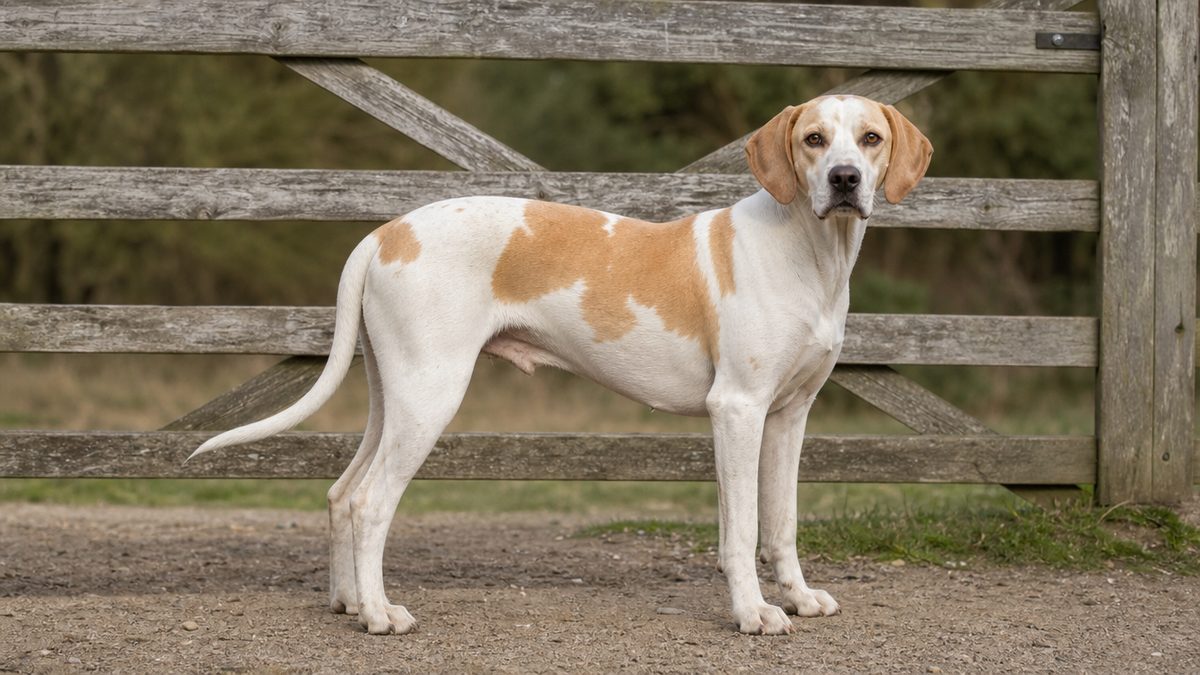
The standard describes a strong, powerful dog whose head shows more English blood than its tricolour sibling. The skull is rather broad and flat with no occipital protuberance and superciliary arches that are not prominent. The nose is black or orangy brown. The eyes are big, brown and dark. The coat colour is white-lemon or white-orange, and the standard adds a condition, that the orange must not be too dark tending to red. Black or red hair in the coat is a listed fault.
The ears matter more than anything else on this page, so read the clause carefully. They are set on quite broadly at eye level or slightly above, quite thick, slightly turned in, and rather short. That is not a Bloodhound ear and it is not a Basset ear. Several pages ranking in India describe this dog as having long pendulous ears that hang to the muzzle GoofyTails, Grand Anglo-Francais Blanc et…, which the standard does not say.
| Clause | What standard 324 says |
|---|---|
| Height at the withers | 60 cm to 70 cm, with no split between males and females |
| Weight | Not stated. The French kennel club record gives 30 to 35 kg |
| Coat | Short and not too thick |
| Colour | White-lemon or white-orange, orange not too dark tending to red |
| Ears | Set at eye level or slightly above, quite thick, slightly turned in, rather short |
| Utilization | Scenthound, Group 6 Section 1.1, with working trial |
| Life expectancy | Not stated anywhere in the document |
| Temperament | Not stated anywhere in the document |
Put together, those clauses describe an athletic dog rather than a heavy one, built broad and strong through the back, loin and forequarters but without the bone the blanc et noir standard calls for.
The Societe Centrale Canine, the kennel club of the country of origin, fills two of those gaps and leaves the rest. Its record gives the same 60 to 70 cm, adds a weight of 30 to 35 kg, and describes the coat as ras et pas trop gros, short and not too coarse. It supplies no lifespan either.
One Indian site lists this breed as Medium size at 15 to 24 inches and 20 to 60 lbs. Converted, the standard's 60 to 70 cm is 23.6 to 27.6 inches, and the registry's 30 to 35 kg is 66 to 77 lbs. The two weight ranges do not overlap at any point. A buyer using that page would be expecting a dog roughly a third of the real animal's mass.
This page is one of four Bonbeno guides on the group. If you arrived here unsure whether these are separate breeds at all, start with the Anglo-French Hound explainer, which sets out why one name covers four FCI standards.
The French studbook has never recorded one of these dogs, in any year Bonbeno checked
Bonbeno opened twelve editions of the Societe Centrale Canine's Statistiques LOF, covering registration years from 2005 to 2025, and extracted each one from the PDF. The Grand Anglo-Francais Blanc et Orange appears as a row in only three of them, and every time it reads zero.
The Livre des Origines Francais is the French national studbook, and its annual statistics table is the closest thing this breed has to a census. Bonbeno pulled the 2005, 2007, 2009, 2011, 2013, 2015, 2017, 2019, 2021, 2022, 2023 and 2025 editions, each of which reports one or two registration years, and searched every one for the breed name.
| Edition | Blanc et Orange | Tricolore | Blanc et Noir |
|---|---|---|---|
| 2009 | row present, 0 | 26 | 26 |
| 2011 | row present, 0 | 43 | 11 |
| 2017 (2016 and 2017) | row present, 0 and 0 | 0 then 99 | 0 and 0 |
| 2019 | no row | no row | no row |
| 2021 (2020 and 2021) | no row | 0 then 5 | 0 then 67 |
| 2022 (2021 and 2022) | no row | 5 then 0 | 67 then 12 |
| 2023 (2022 and 2023) | no row | no row | 12 then 0 |
| 2025 (2024 and 2025) | no row | 65 then 0 | 33 then 0 |
Read across that table and two different things are happening. The tricolore and the blanc et noir register in bursts, nothing for years and then 99 dogs, or 67, or 65 Societe Centrale Canine Societe Centrale Canine. The blanc et orange never bursts. In 21 years of tables it has not posted a single registration.
A missing row is not the same as a recorded zero
Be careful with the second column. In 2009, 2011 and 2017 the SCC printed the breed with a zero beside it, which is a positive statement that the studbook recorded nothing that year Societe Centrale Canine. In the later editions the row is simply absent, and absence is weaker evidence, because the composition of this table is not stable. The 2019 edition prints an alphabetically complete Group 6 block that does include zero rows for other breeds, BASSET SUEDOIS at 0 and CHIEN COURANT ESPAGNOL at 0, and yet omits all three Grand Anglo-Francais breeds entirely. Whatever rule the SCC applies when deciding which breeds to print, it is not simply dropping the ones that recorded nothing.
So the defensible statement is narrower than a headline. Across every edition Bonbeno examined from 2005 to 2025, the Grand Anglo-Francais Blanc et Orange recorded no LOF registration, and the last edition that even names it is the one covering 2016 and 2017.
The two most recent editions that do carry Grand Anglo-Francais rows make the contrast plain. The 2022 table gives the blanc et noir 67 registrations in 2021 falling to 12 in 2022, and the tricolore 5 falling to 0. The 2023 table carries only one of the three, the blanc et noir at 12 then 0, and drops the other two. Through both, this breed has no line at all.
The 2025 table does contain the string BLANC ET ORANGE at 2,101 and 1,946. Those are the colour-variety rows of the Epagneul Breton, whose own totals of 3,953 and 3,793 are exactly the sum of its BLANC ET ORANGE and AUTRES COULEURS rows. A separate breed, the Francais Blanc et Orange, also has its own row, at 4 in 2024 and 0 in 2025. A keyword search that stops at the first hit would report a thriving breed.
One more comparison sets the scale. In the same 2025 table the Beagle recorded 3,514 registrations in 2024 and 3,089 in 2025, and FCI Group 6 as a whole recorded 12,894 then 11,720. The breed this page is about contributed none of them.
Is the breed extinct, or just unregistered? The evidence says unregistered
The breed is unregistered rather than demonstrably extinct. The French kennel club that records no puppies for it also lists six breeder affixes under its name, and the national body representing French hunting packs states in print that studbook registrations do not represent what is actually in the kennels.
Start with the directory, because it is the single piece of evidence that stops this page from writing an obituary. The Societe Centrale Canine runs a breeder listing per breed, and the page for the Grand Anglo-Francais Blanc et Orange prints the heading 6 eleveurs de race, with a department filter offering exactly five departments, Allier, Cher, Saone-et-Loire, Seine-Maritime and Vienne. Two of the six affixes are not kennel names at all. They are the names of hunting packs, which is what you would expect if the dogs live in equipages rather than in breeding kennels.
The control, because a small number is only meaningful if the widget works
Bonbeno ran the same directory on the same day for the Beagle. It returned 2,780 eleveurs de race Beagle across 278 pages of results. The widget works, it paginates, and it is capable of returning thousands. Six is therefore a real six. The two siblings sit between: 32 affixes for the tricolore and 7 for the blanc et noir, with two affixes appearing on all three lists, which suggests the same handful of packs keep more than one colour.
The litter listing returns nothing, and that proves less than it looks
The Club du Chien d'Ordre publishes a litter finder per breed. For this breed it returns Aucun resultat, no litter available and none expected. Before treating that as a death certificate, note that the identical page for the Grand Anglo-Francais Tricolore returns Aucun resultat too, and so does the Poitevin page, and both of those breeds recorded LOF registrations in 2024, 65 and 110 respectively. An empty litter finder on this club means the club's members do not advertise puppies, not that no puppies exist.
Why French pack hounds do not appear in the studbook
The Societe de Venerie says this itself, in print, without being asked. Its own article states that the annual number of registrations is not really representative of the situation of scenthounds in the hunting field, that owners of packs of several dozen dogs are reluctant to do the paperwork and pay the fees, that selling is not the main purpose of their breeding, and that veneurs have kept their own kennel books for centuries.
The arithmetic supports them. A French Senate committee report counts around 400 equipages and 10,000 veneurs, and puts the number of hounds currently kept by them at more than 30,000. In 2025 the entire FCI Group 6 recorded 11,720 LOF registrations across every scenthound breed in France. The working pack population is larger than one year's registrations for the whole group, which is exactly the gap the Societe de Venerie describes.
No source Bonbeno reached publishes an equipage count for this breed, a headcount of living dogs, a litter recorded in any year, or a date after which none was born. The Societe de Venerie's own breed page carries no population figure at all, and its advantages section is published as three asterisks. Bonbeno therefore names no living population, no number of dogs and no breeder, and states no year of extinction. Six affixes on a registry list is evidence that people declare the breed. It is not a headcount.
Bonbeno's rule on this is simple. A living population is only reportable when it is verifiable, and nothing here is verifiable beyond the six affixes themselves.
The honest verdict is a two-part one. On the studbook axis the breed is as close to invisible as a recognised breed can be, with nothing recorded in 21 years of tables. On the living-dogs axis the evidence points the other way, weakly but consistently, and nothing Bonbeno found supports calling it extinct.
How the three Grands differ, read clause by clause from all three standards
The three Grand Anglo-Francais breeds differ by more than colour, but not by much, and the differences are not evenly distributed. Standards 322 and 324 are near-twins with different head clauses and different coats. Standard 323 is a genuinely different document about a genuinely bigger dog.
A widely-read page states that the three breeds are distinguished by their coat colour alone. Bonbeno downloaded all three FCI standards, extracted them with pypdf and confirmed the breed name printed on page one of each before taking a single line, then set the clauses side by side.
| Clause | 324 Blanc et Orange | 322 Tricolore | 323 Blanc et Noir |
|---|---|---|---|
| English text dated | 6.10.2023 | 18.06.1996 | 12.01.2009 |
| Standard published | 01.08.2023 | 27.01.1983 | 04.11.2008 |
| Utilization | Scenthound | Scenthound | Pack Hound for big game |
| Historical summary | None | None | Yes, Batard Anglo-Saintongeois, mid 19th century |
| Behaviour clause | None | None | Yes, friendly, close to humans, easy in the kennels |
| Height | 60 to 70 cm, no sex split | 60 to 70 cm, no sex split | Males 65 to 72, females 62 to 68, plus or minus 1 cm |
| Head | Quite short and broad | No head summary clause | Strong, rather short, parallel lines |
| Occipital protuberance | Absent, arches not prominent | Slightly apparent, arches slightly prominent | Hardly marked, arches prominent |
| Nose | Black or orangy brown | No nose clause at all | Black, developed, rather raised |
| Ears | Quite thick, slightly turned in, rather short | Medium length, flat then slightly curled | Medium length, curling, tips rather pointed, stopping two fingers short of the nose leather |
| Neck | Straight, slight dewlap | Rather long and strong, no pronounced dewlap | Strong, rather short, slight dewlap tolerated |
| Croup | Rather round | Sloping and of good length | Slightly sloping |
| Gait | Easy | Easy with an impression of solidity | Effortless, preferred gait supple and extended gallop |
| Disqualifying faults | Temperament only | Temperament only | Temperament plus frail limbs, severe limb deviation, long feet, tricolour coat |
So the claim is wrong, but only just, and only in one direction. Against the Grand Anglo-Francais Blanc et Noir the differences are substantial. Standard 323 is a longer, later, better-maintained document. It gives a dated origin, a temperament, important proportions, sex-split heights that run up to 72 cm, a preferred gait, and four physical disqualifying faults that 324 does not have.
Against the Grand Anglo-Francais Tricolore the honest answer is that the difference is very little. The two share an identical height range, an identical section, an identical Scenthound utilization, and an identical absence of history and temperament. What separates them is the head and the coat. Standard 324 asks for a shorter, broader head with a flat skull and no occipital bump; 322 asks for a muzzle about as long as the skull and allows a slightly apparent occipital bump. Standard 324 asks for drop ears that are thick and rather short; 322 asks for medium-length leathers that lie flat then curl.
Of the three, this breed has the shortest ear the standard will allow. Standard 323 measures its ears against the nose leather and standard 325, the medium-sized Anglo-Francais, requires ears reaching at least two fingers past the border of the nose. Standard 324 just says rather short Federation Cynologique Internationale. In a hot, humid country that is the single most useful thing the clause list tells you, and the ear section below works out why.
One caution on the table above. It compares documents, not dog populations. Two of the six breeder affixes listed for this breed also appear on the tricolore and blanc et noir lists, so in the field the three colours are not necessarily three closed gene pools.
The 2023 standard is the 1997 standard, typos included
FCI-Standard 324 was republished on 1 August 2023, and the republication changed no descriptive clause. Bonbeno recovered the 1997 English text from an archived copy of the FCI's own file and compared it word by word against the 2023 PDF. Both typographical errors in the 1997 document are still there.
The 1997 file is headed FCI-Standard N 324 / 21.04.1997 / GB and credits the same translator pairing as the current text, Mrs Peggy Davis brought up to date by Dr J.-M. Paschoud. Set the two side by side and the general appearance, head, skull, nose, muzzle, lips, eyes, ears, neck, body, tail, limbs, gait, skin, coat, colour, size and fault list are identical, sentence for sentence.
- Renamed ELIMINATING FAULTS to DISQUALIFYING FAULTS, which is FCI house style rather than a judgement about dogs.
- Split the single FEET clause into Forefeet and Hind feet, each carrying the same words as before.
- Relabelled Flank as Underline and belly, again a template heading.
- Added the boilerplate sentence that only functionally and clinically healthy dogs with breed typical conformation should be used for breeding, which the FCI added across its standards.
- Changed the header date from the original valid standard of 27.01.1983 to a publication date of 01.08.2023.
Nothing else moved. Twenty-six years passed between the two documents and the description of the dog did not change by one adjective Federation Cynologique Internationale.
Two typos survived the revision, and one of them is checkable in seconds
The English text says the muzzle has a Bridge of nose rather shrot, and it describes both the forefeet and the hind feet as Rather ground. Open the French version, which is the official authentic language, and the corresponding clauses read Chanfrein plutot court and Pieds anterieurs plutot ronds, Pieds posterieurs plutot ronds. Ronds means round. The English translation has been printing ground for round, in two places, since at least 1997, and the 2023 revision reprinted it.
FCI-324's general appearance reads that the dog shows more English blood in his head than his tricolour colleague. The UKC's 2006 standard for the same breed renders the same sentence as more English influence in his head than his White and Black cousin. Two registries, one comparative clause, two different sibling breeds named. Since that sentence is the only place the standard positions this dog against another, the disagreement matters more here than it would on a breed with three pages of description.
The UKC text is not simply a reprint either. It adds a TEETH clause requiring a complete set of evenly spaced white teeth in a scissors bite, which the FCI text does not contain, and it adds three disqualifications the FCI does not have, cryptorchidism, viciousness or extreme shyness, and albinism. Its height, 23.5 to 27.5 inches, converts to 59.7 to 69.9 cm, so on size the two registries agree.
The Societe de Venerie, the body representing the packs, publishes a breed page still running a French text headed 24.07.1996, three years older than the version above, with a shorter fault list and an advantages section consisting of three asterisks and no words. Between the FCI's unchanged clauses, the UKC's different sibling and the venerie's blank field, the picture is of a breed standard nobody has needed to argue about for a generation.
The English Foxhound cross, with dates, and who is actually claiming what
FCI-Standard 324 states no history at all, so every dated claim about this breed's ancestry comes from somewhere other than its own standard. Three separate parentage stories circulate, they name different French breeds, and none of them cites a primary document.
Take the standard first, because it is the shortest part. Standard 324 contains one historical statement, that the dog shows more English blood in his head than his tricolour colleague. That is a comparison, not a pedigree. It names no French breed, no english foxhound, no century and no breeder.
| Source | Claimed cross | Date given | What it cites |
|---|---|---|---|
| FCI-Standard 324 | None stated | None | Not applicable, the clause does not exist |
| Societe Centrale Canine | English dogs crossed with French dogs, generically | First crosses almost certainly 16th century, prized late 19th century | Nothing. The same paragraph appears on every Anglo-Francais breed record |
| Royal Canin | Francais Blanc et Orange with the English Foxhound | None | Credits the FCI, which says none of this |
| Wikipedia, after Clark and Brace 1995 | Billy with Foxhounds | Late 1800s | One page of an offline 1995 encyclopedia |
The Societe Centrale Canine's Historique reads that the Anglo-Francais is the result of the alliance of English and French dogs, that the first crosses almost certainly date from the sixteenth century, and that the type was prized towards the end of the nineteenth century under the great masters of hounds. It is worth knowing that this paragraph is not written about this breed. The identical text appears on the SCC's records for the other Anglo-Francais breeds, so it describes the group.
Royal Canin's page, which ranks in India, says the cross is the Francais Blanc et Orange with the English Foxhound, and prints the line that its key facts are sourced from the Federation Cynologique Internationale. Standard 324 contains no parentage clause, so that sourcing line cannot be right about this claim.
Wikipedia says Billy crossed with Foxhounds in the late 1800s, and the reference is page 87 of a 1995 book. The Billy and the Francais Blanc et Orange are related lines, both white-and-orange Poitou hounds, so the two claims are not as far apart as they look, but neither is documented on a page a reader can open.
What is documented, and it is not a breed-specific story
The English infusion into French pack hounds has a date and a motive on the record. Louis XV, who reigned from 1715 to 1774, brought in English dogs because they were reputed faster and he wanted to take stags more quickly. That is the eighteenth-century root, well before either the Billy or the Francais Blanc et Orange existed as named breeds.
The naming has a date too. In 1957 an additif changed the French classification, and the anglo-poitevin, the anglo-gascon saintongeois and the anglo-francais a poil long disappeared from the nomenclature, leaving the varieties recognised today. Wikipedia gives the same year from its offline source, so two independent routes agree on 1957, which is more than can be said for the parentage.
The 1930 French manual of standards addressed the term directly, saying the word was adopted for want of a better one and warning that it should not suggest a half-and-half split, since that would give foxhound blood too large a share. It goes on that a good anglo-francais is much less a crossbreed than a French dog modified, infused with English, but with French predominance. Anyone reading the breed name as fifty percent Foxhound is reading it in a way the people who coined it explicitly rejected.
Grand Anglo-Francais Blanc et Orange price in india: there is none, and here is what you are shown instead
No Grand Anglo-Francais Blanc et Orange price in india exists, because no Indian seller lists the dog and no lawful route brings one here for sale. The Indian search result for this breed name returns a canvas print, dog-show judges' breed licences, and dropdown menus on French rescue sites.
Bonbeno ran the breed name plus price, for sale, india and rupees through a search restricted to India. The ten results were an Etsy listing for a personalised impressionist dog portrait at 100.44 euros, two Facebook posts listing the breeds a Serbian all-rounder judge is licensed for, a Scribd copy of a dog-breed book, a European classified-ads site, a UK litter-registration form, a French lost-dog register and two French shelter pages where the breed name appears only as an option in a filter. Not one Indian puppy listing.
The control, run the same day with the same tool
An empty result set can mean a broken search, so Bonbeno ran a breed that India genuinely trades. The same tool, the same India location, the same session, returned ten pages of live Indian Labrador listings with prices on them, led by a page publishing a band of 30,000 to more than 1,20,000 rupees, split into 30,000 to 60,000 for basic quality, 60,000 to 90,000 for KCI registered and 90,000 to 1,20,000 for champion bloodline, repeated for Hyderabad, Bangalore, Delhi, Chennai, Lucknow, Mumbai, Jaipur and Pune. The search works. The absence is real.
The two Indian pages that do rank sell something other than a dog
One Indian puppy site carries a page for the breed. Under Price Range it says Contact for pricing, and it then offers a 25 percent deposit to reserve, doorstep delivery in major cities in climate-controlled transit, a vaccination booklet, microchip registration assistance and a 100 percent Health and Purebred Guarantee. The page's only descriptive sentence, that a detailed profile will be expanded in upcoming updates, appears word for word on its Aidi, Alpenlandische Dachsbracke and American Akita cards. It is a template with a breed name dropped into it.
The other is an Indian pet-food retailer's breed encyclopedia entry, which sells food rather than dogs and prints no price at all.
Bonbeno found no rupee price for this breed anywhere, which is the honest finding. If a seller quotes you one, do the check that has caught fabricated Indian pricing repeatedly. Divide the figure by 84.38 and see whether a round dollar amount falls out, because Indian pages routinely publish a US price run through one exchange rate. Treat a quote of 98,999 rupees with particular suspicion. Bonbeno found that exact figure printed on eight pages of one Indian seller's catalogue on the same day, covering the Rat Terrier, Bulldog Dual Colour, Great Dane, Borzoi, Shih Tzu and Golden Retriever among others. A Shih Tzu and a Great Dane do not cost the same. It is a catalogue price point, not a valuation, and it has nothing to do with this dog.
The nearest published price to this breed anywhere belongs to a different breed. Google's own AI answer for this search prices the tricolore at 500 to 1,000 euros for a puppy, with annual upkeep of 450 to 700 euros and kennel boarding at 60 to 90 euros a month, citing two French pet sites. Even the search engine substitutes the sibling.
There is a structural reason no price forms, quite apart from scarcity. The Societe de Venerie notes that a scenthound changes hands for on average half what another hunting dog costs, and that selling is not the main purpose of pack breeding. These dogs move between equipages, not through a market.
Bonbeno does not broker sales, does not link puppy listings, and names no seller. If you want a hound in India, the Beagle has a real price band, a real rescue route and real health data behind it.
Indian law closes the supply route, and then closes the kennel door
Two Indian instruments decide this breed's Indian future between them. Trade Notice 22/2022-23 makes it unlawful to import a dog into India for breeding or trade, and the 2017 Dog Breeding and Marketing Rules make it unlawful to kennel a breed outdoors if it cannot tolerate the local temperatures without written veterinary approval.
Take supply first. India classifies mammals other under ITC (HS) 01061900 as Restricted. Policy Condition (7) allows a dog in for three purposes only, a pet dog with a valid pet book and records in the importer's name, an R&D organisation with a CPCSEA recommendation, or internal security by the Defence and Police Force. Policy Condition (8) states that import of commercial dogs for breeding or any other commercial activity outside those purposes is not permitted, and paragraph 6 states that applications for trading or breeding purposes shall be duly rejected.
Entry is also geographically narrow. Paragraph 7 permits import of pet animals only through the airports and seaports of Delhi, Mumbai, Chennai, Hyderabad, Bangalore and Kolkata, with quarantine where required, and paragraph 8 requires an advance No Objection Certificate from the quarantine officer seven days before travel. DAHD added a seventh port, Cochin International Airport at Kochi, for pets arriving under the baggage rules in October 2024. The full route is set out in how to import a dog to India.
Put that next to the studbook finding and the position is closed at both ends. A founder pair cannot be lawfully imported to breed from, and the country of origin has registered no puppy of this breed in any table Bonbeno examined since 2005, so there is no pedigree stock to import even if the law allowed it. The Kennel Club of India registered 33,880 pure-bred dogs in 2025 across all breeds, and no route exists by which any of them could be this one.
The kennelling rule that lands squarely on a French pack hound
The 2017 Rules include a provision most Indian buyers have never read. Second Schedule paragraph 21(1) provides that dogs not accustomed to the temperatures prevalent in the area or region in question, and dog breeds that cannot tolerate the temperatures prevalent in the area, shall not be kept in outdoor facilities unless that practice is specifically approved by the attending veterinary practitioner in writing. Paragraph 21(2) requires separate outside areas of shade large enough to contain all the animals at once, and paragraph 15 requires indoor housing to be at an ambient and comfortable temperature for the breeds housed inside.
The Societe Centrale Canine's own guidance for this group reads that the Anglo-Francais are not suited to city life, that as pack dogs they live in a kennel, and that they need space and exercise. That instruction is written for a country whose warmest month averages 20.6 C. Followed literally in an Indian summer, it collides with paragraph 21(1), and a licensed Indian breeder doing it would need the vet's written approval on file.
Three further provisions are worth knowing before repeating any European breeding advice on an Indian page. Rule 8(1)(a) prohibits selling pups under eight weeks. Second Schedule paragraph 6 permits only out breeding and line breeding, and 6(9) prohibits breeding to create new breeds or unusual looks. Paragraph 6(8) strictly forbids tail docking, ear cropping, de-barking, de-clawing and any other mutilation.
That de-barking clause is not incidental here. A pack scenthound is bred to give tongue on a line, and an Indian owner who finds the noise unmanageable has no lawful surgical exit. Part III paragraph 8(10) also requires genetic-defect testing including hip dysplasia, progressive retinal atrophy and hypothyroidism, and for this breed there is no screening scheme anywhere in the world to produce those results from.
What one would cost to keep in India, bounded honestly
No Indian cost of ownership figure exists for this breed, because no Indian household keeps one. What can be done honestly is to bound the cost from the physical facts, a 30 to 35 kg working dog, and from the only published French upkeep figures, which belong to the tricolour sibling.
The French numbers first, with the caveat attached. Google's AI answer for this breed's name gives an annual upkeep of 450 to 700 euros for basic care and food, and kennel boarding of 60 to 90 euros a month, sourced to two French pet sites. Those figures are published for the Grand Anglo-Francais tricolore, not for this breed. They are quoted here as the nearest available anchor and nothing more, and they describe a European cost base that does not transfer.
What does transfer is bodyweight, because food cost scales with it. At 30 to 35 kg this dog sits in the largest Indian size band for feeding, boarding and medication dosing, which is the band every Indian cost guide prices highest. Bonbeno is not going to convert that into a monthly rupee figure, because doing so would mean borrowing another breed's number and printing it under this one's name.
The four costs that would be unusual for this breed specifically
- Ear care, weekly and year-round, because a thick drop ear in Indian humidity is the standing risk this dog carries. Budget for cleaner, and budget for the vet visits the section below explains.
- Exercise infrastructure, because two hours of hard daily work is the requirement and an Indian city cannot supply it free. Either you own land or you are paying for transport to somewhere you can run a hound.
- Tick and vector prophylaxis every month without a gap, because 49.7 percent of 525 Indian dogs sampled by PCR carried at least one tick-borne pathogen and a scenthound works nose-down in exactly the vegetation the vectors sit in.
- Veterinary uncertainty, because no breed-specific screening scheme, no lifespan study and no OFA record exists to tell an insurer or a vet what to expect.
Every quantified cost above assumes the dog is here lawfully and that a vet who has seen the breed before is available. Neither assumption holds. Trade Notice 22/2022-23 rejects breeding and trading applications outright, so the realistic Indian scenario is a single relocated pet dog whose owner will be the first client any Indian clinic has had of this breed.
Compare that with a breed India actually keeps. A Labrador puppy is published at 30,000 to more than 1,20,000 rupees with city-by-city bands, and behind it sit 324,662 OFA hip evaluations and a UK primary-care dataset of 905,554 dogs. The price is not the difference. The evidence base is.
Bonbeno's position on the cost question is therefore that it cannot be answered responsibly for this breed in India, and that anyone publishing a confident monthly rupee figure for it has generated it rather than measured it.
Heat tolerance in India: Bonbeno rates this breed 2 of 5
Chennai's coolest month is 3.50 C warmer than the warmest month of this breed's origin climate. That single comparison, not an adjective, is why Bonbeno rates its heat tolerance 2 out of 5 rather than 1 or 3.
The method, stated before the numbers
One climate source is used throughout, NASA POWER's climatology API, queried by explicit latitude and longitude, with the coordinates the server echoes back checked against the coordinates requested. That matters because slug-based climate URLs on other services have repeatedly served the wrong city on this project. Standard 324 names only France as the origin, with no region, so Bonbeno declares its choice rather than implying one. The reference point is Poitiers, Vienne, at 46.5802 N and 0.3404 E, chosen because the Vienne is one of the five departments where the French kennel club lists a breeder affix for this breed and because both published parentage claims, the Billy and the Francais Blanc et Orange, are Poitou lines.
| Location | Annual mean temp | Warmest month | Coolest month | Annual mean humidity |
|---|---|---|---|---|
| Poitiers, France (46.5802 N, 0.3404 E) | 11.90 C | 20.59 C in July | 4.01 C in January | 80.86 percent |
| Chennai (13.0827 N, 80.2707 E) | 27.95 C | 31.51 C in May | 24.09 C in January | 72.39 percent |
| New Delhi (28.6139 N, 77.2090 E) | 25.60 C | 35.88 C in June | 13.61 C in January | 45.56 percent |
| Pune (18.5204 N, 73.8567 E) | 23.86 C | 28.93 C in April | 19.62 C in December | 66.80 percent |
| Kolkata (22.5726 N, 88.3639 E) | 25.81 C | 31.53 C in May | 17.31 C in January | 73.93 percent |
Now count months rather than compare averages, because a dog lives through months. Taking Poitiers' warmest month, 20.59 C, as the ceiling this breed was selected under, Chennai exceeds it in 12 months of 12, Pune in 10, Kolkata in 10 and New Delhi in 8. The annual mean gap between Poitiers and Chennai is 16.05 C.
Why the mechanism matters more than the average
A dog sheds heat chiefly by evaporation from the respiratory tract, so panting is only as effective as the air's capacity to accept water vapour. Two of the four Indian cities above run their humidity peak in the same months as their heat load. Pune sits at 89.09 percent relative humidity in July and 90.80 in August, and Kolkata at 89.07 percent in August with a mean of 28.24 C. That combination is where a large, hard-working dog loses the most cooling capacity, and it is a combination Poitiers never produces, since its humidity peaks in the cold months and falls to 68.13 percent in July.
Two things count in this breed's favour and one counts heavily against. In its favour, the coat is short and not too thick, and the head is a normal-muzzled one rather than a flattened face, so it is not carrying the brachycephalic penalty that raises the odds of every category of heat illness. Against it, the job. This is a pack hound whose preferred working gait among its siblings is described as a supple and extended gallop, and exertional heat illness is the dominant trigger in the only large primary-care dataset on the subject, at 74.2 percent of the events with a recorded trigger, ahead of environmental at 12.9 percent and hot cars at 5.2 percent.
The India Meteorological Department treats a heat wave as declared when a plains station reaches at least 40 C, heat waves typically run March to June and occasionally into July, five to six events occur in an average year over northern India, and May is the peak month. That is a four-month window in which a dog bred to gallop for hours behind mounted hunters simply cannot be worked, in a country whose law separately requires written veterinary approval before kennelling outdoors a breed that cannot tolerate local temperatures.
So the rating is 2 rather than 1 because the coat and the muzzle are genuinely on the right side, and 2 rather than 3 because everything the breed exists to do has to stop for a third of the Indian year. If you want this dog's shape in a climate it can work in, the Mudhol Hound is the heat-adapted Indian answer.
Nothing above needs a study of this breed, which is fortunate, because none exists. It needs the standard, one climate dataset and the physiology, and all three are checkable.
Long-eared scenthound ear load in Indian humidity, and why this breed carries less of it
A dropped ear roughly doubles the odds of otitis externa against an erect ear, and Indian monsoon humidity is the condition under which that risk is realised. This breed carries a drop ear, so the risk applies, but its standard specifies the shortest ear of any Anglo-Francais, which matters.
The best-powered number available comes from UK primary care rather than India. A VetCompass random sample of 22,333 dogs, drawn from 905,554 dogs under veterinary care in 2016, put the one-year period prevalence of otitis externa at 7.30 percent, with a 95 percent confidence interval of 6.97 to 7.65. Against breeds with erect ear carriage, breeds with pendulous ear carriage had 1.76 times the odds, confidence interval 1.48 to 2.10, and breeds with V-shaped drop ear carriage had 1.84 times the odds, 1.53 to 2.21.
Read the denominator honestly. Those odds attach to ear-carriage classes across UK breeds, and the Grand Anglo-Francais Blanc et Orange is not in that sample. The mechanism transfers because ear anatomy is ear anatomy. The exact multiplier does not, and this page will not pretend otherwise.
Where this ear sits, measured against its own relatives
| Standard | Ear clause | How far it hangs |
|---|---|---|
| 324, Blanc et Orange | Set at eye level or slightly above, quite thick, slightly turned in, rather short | Not specified, but described as rather short |
| 322, Tricolore | Leathers of medium length, broadly set at eye level, flat then slightly curled | Medium length |
| 323, Blanc et Noir | Set rather broad at eye level, curling towards the end, tips rather pointed | Should stop two fingers before the base of the nose leather |
| 325, Petite Venerie | Finely attached below the eye level line | Reaches at least two fingers past the border of the nose |
That table is the practical difference between the breeds, and it favours this one. Standard 324 asks for the shortest ear leather in the group Federation Cynologique Internationale Federation Cynologique Internationale, and a shorter leather lifts and dries faster than one that reaches past the nose. Against that, the same clause calls the leather quite thick, and thickness reduces air exchange in the canal, so the two features pull in opposite directions.
The Indian condition the ear meets
Humidity is the variable, and India supplies it seasonally rather than constantly. Pune runs 89.09 percent relative humidity in July and 90.80 percent in August, Kolkata 89.07 percent in August and 89.34 in September, and New Delhi jumps from 23.38 percent in May to 74.90 percent in August. An Indian hospital series in Palam valley found otitis cases concentrated in exactly that window, 48 of 81 diagnoses falling in July and August.
European guidance for short-coated pack hounds treats the ear as a low-maintenance item, because in a French kennel it is. Poitiers' humidity falls to 68.13 percent in July, its driest month, so a wet ear dries. Copy that instruction into a Pune August at over 90 percent humidity and the ear does not dry, it incubates. Dry the canal actively after every soaking, every swim and every wet walk, and check it weekly with the leather lifted.
Put plainly, ear infections in this breed are a monsoon problem rather than a year-round one, and they are driven by warm humid air sitting in a canal that a thick leather has covered. The dog is not unusually prone to them by the standards of drop-eared hounds. The climate is unusually good at producing them.
Two more Indian specifics attach to a nose-down working dog. Grass seeds and vegetation debris enter a hanging canal that an erect ear would have shed, and tick exposure is high, with potential tick vectors found on 278 of 525 dogs sampled across four Indian cities, 53 percent. Both argue for the same weekly routine rather than for a different one.
The comparison worth holding is with the Basset Hound, which sits at odds ratio 5.87 for otitis externa against crossbred dogs in the UK data. This breed is not that. It is a drop-eared dog with a short leather, which puts it in the risk class without putting it at the top of it.
The Indian ear study everyone quotes has a broken number in it, and it is the count, not the percentage
The Palam valley otitis series prints its pendulous-ear group as n=53 at 69.13 percent. Divide it out and 53 of 81 is 65.43 percent, while 69.13 percent of 81 is 56. The count is the error, and the arithmetic proves which of the two figures to keep.
The study screened 2,476 dogs presented to a veterinary teaching hospital in Palampur, Himachal Pradesh, between June 2022 and July 2023, and diagnosed 81 with otitis externa. That is a hospital prevalence of 3.27 percent, and 81 divided by 2,476 is 3.271 percent, so the headline figure checks out.
Table 5 of the same paper lists predisposing factors against the same denominator of 81. Three of its five rows divide out cleanly. Excessive moisture at 17 gives 20.99 percent against a printed 20.98. Treatment error at 9 gives 11.11 percent against a printed 11.11. Aural polyps at 6 gives 7.41 percent against a printed 7.40. Erect ear breed at 25 gives 30.86 percent against a printed 30.86.
The fifth row does not. Pendulous ear breed is printed as n=53 at 69.13 percent, and 53 divided by 81 is 65.43 percent.
Which number is wrong, and how the paper itself settles it
- 69.13 percent of 81 is 55.995, which rounds to 56. So the count implied by the printed percentage is 56, not 53.
- The two ear rows are exhaustive, and 69.13 plus 30.86 is 99.99 percent, which is 100 percent after rounding. The two counts must therefore sum to the full 81.
- 56 plus 25 is exactly 81. 53 plus 25 is 78, leaving three cases of the study's own total unaccounted for.
- The percentage is therefore the reliable figure and the count is the typographical error. The pendulous-ear group is 56 dogs.
The paper's own text reports bacterial infections in 65.43 percent of cases, made up of cocci-shaped bacteria in 30 of 81 and rod-shaped in 23 of 81. Thirty plus 23 is 53, and 53 divided by 81 is 65.43 percent. So 53 is a real number in this dataset, correctly calculated, sitting in the wrong row of Table 5. Bonbeno reports that as the most likely explanation rather than as an established fact, because only the authors can confirm it.
Bonbeno checked every other percentage in the paper on the same principle, and the study holds up well. The four seasonal counts, 48 rainy, 15 summer, 10 winter and 8 autumn, sum to 81 and give 59.26, 18.52, 12.35 and 9.88 percent against printed values of 59.25, 18.51, 12.34 and 9.87. The four age bands sum to 81. The two sex rows, 65 male and 16 female, sum to 81 and give 80.25 and 19.75 percent exactly as printed. The eleven breed rows sum to 81.
Three smaller slips, listed so a later reader does not have to redo the work
- Pomeranian and Mongrel are each printed at 12.43 percent on a count of 10. Ten of 81 is 12.35 percent, so the digits are transposed.
- Pug is printed at 9.80 percent on a count of 8. Eight of 81 is 9.88 percent.
- The narrative text opens a paragraph with In a study of 50 cases while every denominator inside that same paragraph is 81, and it reports moisture accumulation at 33.33 percent, which is 27 of 81, where Table 5 gives excessive moisture as 17 at 20.98 percent. Body text and table disagree on that row.
None of that overturns the two findings this page relies on, that Indian otitis cases cluster in July and August and that drop-eared breeds dominate the caseload. It does mean that anyone quoting 53 of 81 is quoting a number the paper's own percentage contradicts, and that the correct figure to publish is 56 of 81.
This is the cheapest fabrication check there is. Any figure offered as n of N at X percent can be divided out in a calculator before it is believed, and doing it here changed a number that three separate pages on this site would otherwise have carried forward unexamined.
Health issues: no study, no screening scheme, and the searches that prove it
No published health data exists for the Grand Anglo-Francais Blanc et Orange. Bonbeno ran the two databases that would hold it, proved each search works with controls in the same session, and found the whole Anglo-French group represented by two papers covering 51 dogs, neither of which is about this breed.
PubMed, and the query that broke before it returned zero
Searching the exact breed name returns zero records, and that zero is worthless. PubMed silently rewrote the phrase, mapping et to etiology as a MeSH subheading and orange to citrus sinensis as a MeSH term, so the query it actually ran was not the query submitted. A zero from a mangled search is not evidence of anything, and the query translation is the only way to see it.
Two queries do translate cleanly. Anglo-Francais returns exactly one record and Anglo-French AND hound returns exactly one, and both were opened and read rather than counted. Controls in the same session returned Basset Hound 101 records, Labrador Retriever with hip dysplasia 52, Beagle with otitis 13, Braque Francais 5 and English Foxhound 1, all with clean translations. The index responds to rare French breed names, so the two-record result is real.
| Paper | Dogs | Which breed | What it reports |
|---|---|---|---|
| Collignon et al 2012, Am J Vet Res | 50 | Great Anglo-Francais Tricolor Hounds | Iohexol plasma clearance 3.4 plus or minus 0.8 mL/min/kg against creatinine 3.0 plus or minus 0.7; the two agreed within 0.6 mL/min/kg for 34 of the 50 dogs, which is 68 percent; three dogs had a glomerular filtration rate below 2 mL/min/kg |
| Lange and Beaudu-Lange 2009, J Small Anim Pract | 1 | An unspecified great Anglo-French hound | First described septal myocardial abscess in a dog, in a seven-year-old with renal failure and urinary infection; the dog died |
Fifty-one dogs, one of them a case report, and not one of them identified as a white and orange. The Collignon study is explicitly on Tricolor Hounds and the Lange abstract states only Anglo-French hound with no colour or breed given. Neither can be used to describe this breed's health without borrowing another breed's dogs, which this page will not do.
OFA, with the control that makes the absence usable
Bonbeno retrieved the Orthopedic Foundation for Animals disease-statistics tables in full, 2,225,910 characters, saved them and searched case-insensitively. The dump returns zero occurrences of ANGLO, VENERIE, FOXHOUND, POITEVIN, BILLY, PORCELAINE, GASCON, SAINTONGEOIS and TRICOLORE.
The controls in the same retrieval returned complete rows, which is what makes that zero meaningful. LABRADOR RETRIEVER shows 324,662 hip evaluations at 87.5 percent normal and 11.3 percent dysplastic, BEAGLE 1,777 at 79.3 and 18.5, BASSET HOUND 286 at 57.7 and 39.5, HARRIER 416 at 84.4 percent normal, BRAQUE FRANCAIS 135 at 97.0 percent normal, and ALL BREEDS 1,711,996 evaluations at 84.3 percent normal and 14.2 percent dysplastic.
OFA states that a breed needs at least 100 hip evaluations, or 50 in its other databases, to appear at all. It would be easy to assume the Anglo-French breeds are simply under that floor. The same dump carries BASSET FAUVE DE BRETAGNE on 86 evaluations and BRAQUE D AUVERGNE on 53, so genuinely small French entries do appear. The Anglo-French breeds are absent because essentially nobody has submitted a radiograph, not because a large dataset was filtered out.
So what should an Indian buyer conclude about health issues in this breed. That the honest answer is nobody knows, that the hip dysplasia and bloat warnings printed on the pages ranking for its name carry no prevalence, no sample and no source, and that Wikipedia's line, that no unusual health problems have been documented for this breed, is a statement about the documentation rather than about the dogs.
One page ranking in India is at least candid about it. DogZone writes that this is a rare breed for which health studies are non-existent and anecdotal evidence is seriously lacking, which is the correct posture, and then lists three conditions anyway.
Life expectancy: four published figures, four different answers, zero sources
No life expectancy figure for this breed rests on data. Four pages ranking for the breed name publish four different ranges, none of them cites anything, and the FCI standard that one of them credits contains no lifespan clause at all.
| Source | Claimed lifespan | Source cited on the page |
|---|---|---|
| FCI-Standard 324 | None given | Not applicable, the clause does not exist |
| Societe Centrale Canine breed record | None given | Not applicable |
| Royal Canin India | 12 to 13 years | Credits the Federation Cynologique Internationale |
| DogZone | 10 to 13 years | None |
| GoofyTails | 10 to 12 years | None |
| Furrfam | 10 to 14 years | None |
The Royal Canin entry is the one worth examining, because it is the only one that names a source. Its page carries the line that key facts and characteristics are sourced from the Federation Cynologique Internationale, and then gives an average life expectancy of 12 to 13 years. Bonbeno extracted FCI-Standard 324 from the FCI's own PDF and read it end to end. It contains no life expectancy. The French text contains none either, and neither did the 1997 version.
The same page also states that of the three Anglo-French breeds, White and Oranges are the least numerous. The FCI nomenclature lists four breeds carrying the Anglo-Francais name, standards 322, 323, 324 and 325, which is set out in full on the Anglo-French Hound page.
Why the spread is 10 to 14 rather than a number
Look at what the four ranges have in common. They all start at 10, 12 or 13, they all end at 12, 13 or 14, and together they cover 10 to 14 years, which is simply the default lifespan band for a large working dog. That is what a writer produces when there is no breed data and a field on the template needs filling.
Breed lifespan figures that mean anything come from national studbook mortality records, insurance databases or primary-care datasets like VetCompass, all of which need a registered population to draw from. This breed has recorded no French studbook registration in any edition Bonbeno examined from 2005 to 2025 Societe Centrale Canine and appears in no orthopaedic register. There is no population for a lifespan study to sample.
Bonbeno therefore publishes no life expectancy for this breed. That is a worse answer than a number and a more truthful one, and it is the same conclusion the honest end of the ranking set reaches when it says health studies are non-existent.
If a lifespan matters to your decision, note what the nearest evidence actually covers. The one study of any size on an Anglo-French breed measured kidney function in 50 tricolour hounds and was not a longevity study at all.
Temperament and household fit: the standard says nothing, and that is the finding
FCI-Standard 324 contains no behaviour or temperament clause. Every personality claim published about this breed therefore comes from somewhere else, and the two registries that do describe the group describe it as a kennel-living pack dog unsuited to city life.
Check the document before believing the adjectives. Standard 324 runs from general appearance to disqualifying faults without a behaviour clause, and its only temperament-adjacent line is the disqualification of aggressive or overly shy dogs. Standard 322 for the tricolore is the same. Only standard 323, for the blanc et noir, carries a behaviour clause, and it reads that the dog is friendly, close to humans and easy to manage in the kennels.
That last phrase is the tell. It is a temperament written for a kennel manager handling a pack, not for a family choosing a house dog.
What the country of origin says about living with one
The Societe Centrale Canine's Comportement text for this breed is written about the Anglo-Francais collectively and states that the English blood contributed the build, the bone and the vigour while the French blood contributed the nose and the voice, that the dog is a hunting enthusiast, resistant, powerful, fast, courageous and tenacious, and that its education must be firm. Its Vivre en ville field is blunt, that the Anglo-Francais are not adapted to city life, that as pack dogs they live in a kennel, and that they need space and exercise.
That is the kennel club of the country of origin advising against urban keeping, in a country whose cities are cooler and less dense than any Indian metro.
| Claim | Who publishes it | Evidence behind it |
|---|---|---|
| Patient with children and other animals | Royal Canin India, crediting the FCI | FCI-324 has no temperament clause |
| Balanced, Loyal, Alert, Intelligent, Friendliness 4 of 5 | Furrfam | None stated; the page's descriptive text is a template used for other breeds |
| Friendly, sociable, cooperative with other dogs | GoofyTails | None stated |
| Respectful and tolerant, anecdotally can be trusted with children, rarely keen to play | DogZone, which labels it anecdotal | Explicitly anecdotal |
| Friendly, close to humans, easy to manage in the kennels | FCI-Standard 323 | A primary document, but for a different breed |
Tolerance of other dogs is not a guess. French packs run to dozens of hounds housed together, and the national total kept in equipages exceeds 30,000 dogs. A dog that could not live alongside twenty others would not survive that system. Dog-to-dog tolerance is selected for in this breed in a way that dog-to-apartment tolerance simply is not.
So the household fit is narrow and it is honest to say so. This breed suits a rural or semi-rural Indian household with land, other dogs, a working purpose and a tolerance for a vocal hound. It does not suit a flat, a first-time owner, a household that leaves the dog alone all day, or anyone who read that it is patient with children on a page that credited a standard containing no such sentence.
Wikipedia puts the same point in one line, that in general dogs bred to be pack hunting dogs do not make good pets. It is a generalisation, and on the evidence available for this breed it is better supported than the alternative.
Training: everything is learnable except recall off a live scent
To train this breed, treat recall as the one skill that will not generalise and build every other behaviour around that assumption. A pack scenthound is selected to keep running a line after the handler stops being interesting, and no amount of obedience work removes that.
Start from what the breed was bred to do rather than from a generic obedience plan. The Societe Centrale Canine describes the group as hunting enthusiasts, resistant, powerful, fast, courageous and tenacious, and says plainly that their education must be firm. Tenacity on a line is the selected trait. It is not a training failure when it appears.
The five things worth training, in the order they pay off
- Build a long-line habit first, before any off-lead work, because a scenthound that has once self-rewarded by running a line off-lead has learned something you cannot untrain.
- Train a stop cue rather than a recall cue, since stopping a running hound is achievable where calling one back mid-line often is not.
- Socialise the dog to traffic, crowds and Indian street noise early and deliberately, because a kennel-reared pack breed gets none of that by default.
- Feed the nose on purpose with scent games and tracking work, so the drive has a legal outlet and the dog is not inventing one in your neighbour's compound.
- Clean and check the ears as part of daily handling from week one, so the weekly ear routine described above is a non-event rather than a wrestling match.
Expect an independent worker rather than a biddable one. A pack hound is bred to solve the line itself and to keep going when the handler cannot see it, and that independent cast of mind is the same trait that makes recall hard.
Notice what is not on that list. Nothing about dominance, and nothing about suppressing the voice. Giving tongue on a line is a working trait the French registry credits to the breed's French ancestry, and in India there is no surgical shortcut available, because de-barking is strictly forbidden under the 2017 Rules.
One Indian page scores this breed Trainability 4 of 5 and Energy Level 3 of 5. Those numbers sit on a page that also files a 60 to 70 cm scenthound as a Medium-size Non-Sporting dog. A breed whose standard contains no behaviour clause at all cannot be scored on trainability from any document, and an energy score of 3 for a dog bred to gallop behind mounted hunters is not a rating, it is a default.
Indian conditions change the timetable rather than the method. Train in the first and last light of the day from March to June, when the India Meteorological Department's heat wave window is open and plains stations are reaching 40 C or more, and treat any session that leaves the dog still panting hard after ten minutes of rest as too long, because exertional heat illness is the dominant trigger in the primary-care evidence.
One realistic expectation to set. There is no Indian trainer with experience of this breed, because there are no Indian dogs of it. Anyone working with one will be extrapolating from other pack scenthounds, and the closest available reference points in India are the Beagle and the Basset Hound, both smaller and both slower.
Daily exercise: the requirement is a hunting day, not a walk
Two hours of hard daily work is the honest floor for this breed, and in most of India that floor cannot be met for four months of the year. The exercise requirement and the heat calendar are the two facts that decide whether keeping one here is possible at all.
The standards describe the workload indirectly but consistently. Standard 324 gives the gait as Easy, standard 322 as easy with an impression of solidity, and standard 323, the fullest of the three, names the preferred gait as a supple and extended gallop. An extended gallop is not a walking pace, and the dog is expected to sustain it while hunters follow on horseback.
The French Senate's own description of the sport puts numbers on the day. Hunting with hounds is defined as hunting an animal only with the help of a pack trained for it, grande venerie is practised on horseback for stag, roe deer and wild boar, and across roughly 400 equipages the packs succeed no more than one time in four across 18,000 hunting days a year. Three days in four, the dogs run and nothing is caught. That is the fitness this breed is built on.
What that translates to for an Indian household
- Two hours a day of real work, split into two sessions, for an adult in condition. A lead walk around a colony does not count and will not settle the dog.
- Free running on secure land, because a hound that hits a scent line will leave and an Indian city has no safe place to discover that.
- Scent work as a substitute in the hot months, since nose work delivers mental load at a fraction of the heat load of running.
- Complete rest between roughly 10 a.m. and 5 p.m. from March to June, when heat wave conditions are declared at 40 C or more on the plains and May is the peak month.
A heat-sensitive dog that lies down all day is manageable. A heat-sensitive dog that must run hard every day to stay sane is not, because exertional heat illness accounted for 74.2 percent of the heat-related illness events with a recorded trigger in a review of 905,543 dogs, well ahead of environmental heat at 12.9 percent. The risk is created by the exercise the breed needs, not by the weather alone.
The living conditions that make this work are rural ones, and they are the same living conditions the French registry describes. Space, a kennel or a run, other dogs, and a job.
There is a knock-on nobody mentions. Cutting the exercise to survive the summer means four months of an under-worked 30 to 35 kg pack hound in a household, and the French registry's own advice is that these dogs need space and exercise and are not adapted to city life. The behaviour cost of that is not documented for this breed, because nothing about this breed is documented, but it is not hard to predict.
A rural Indian household in the Nilgiris, Himachal or Uttarakhand hills could meet the requirement most of the year. A flat in Chennai, where every one of the twelve months averages warmer than the warmest month of the breed's origin climate, cannot meet it in any month.
Grooming a short-coated pack hound in Indian humidity: the coat is easy, the ears are the job
To groom this breed in India, brush the coat weekly and treat the ears as the real task. Standard 324 specifies hair that is short and not too thick, so there is no coat work to speak of, and every genuine grooming risk this dog carries sits inside the ear canal.
The coat clause is four words long in effect. Short and not too thick, white-lemon or white-orange, orange not too dark tending to red. The French registry describes it identically as ras et pas trop gros. A weekly rubber brush removes the dead hair and that is the whole coat routine. This is a short-coated dog and it should never be clipped, because the coat is the barrier between white-marked skin and Indian sun.
The white coat problem nobody raises
A predominantly white dog carries unpigmented skin under the white areas, and the standard describes the skin itself as white with orange or yellow patches. In a country whose plains routinely exceed the 40 C heat-wave threshold from March to June, sun exposure on a thin white coat is a real consideration for the nose, ear tips and belly. Shade rather than sunscreen is the practical answer, and Indian law already requires outdoor facilities to include separate shaded areas large enough for all the animals at once.
The weekly ear routine, written for an Indian monsoon
- Lift the leather every week and look into the canal in daylight, because a thick drop ear hides everything until it smells.
- Dry the canal actively after every soak, swim, bath or wet walk. Do not let the ear air dry, which is guidance written for a climate whose driest month is its warmest.
- Clean only when there is something to clean, using a product your vet names, because over-cleaning macerates the canal lining.
- Escalate on the four signs that matter, a foul smell, a head held tilted, scratching at one ear, or a reddened canal, and escalate the same week rather than the next month.
Poitiers records its lowest relative humidity, 68.13 percent, in July, its warmest month, so a wet ear in a French summer dries. Pune records 89.09 percent in July and 90.80 percent in August, and Kolkata 89.07 percent in August. In those conditions the ear does not dry on its own, and an Indian series found 48 of its 81 otitis diagnoses falling in July and August.
Nails, teeth and eyes are unremarkable on this breed, and no standard or registry record flags anything about them Societe Centrale Canine. Ticks are not a grooming item in India, they are a health item, and with potential vectors found on 53 percent of 525 dogs sampled across four Indian cities the weekly groom is the right moment to run hands over the whole dog.
One page ranking for this breed scores its Grooming Needs 3 out of 5. On coat alone the honest score is 1. On ears in an Indian August it is 4, and the average of those two is the least useful number you could publish.
Feeding: no growth chart exists for this breed, so feed the body rather than the table
To feed this breed correctly, feed to body condition and to workload rather than to a breed chart, because no breed-specific growth curve or adult weight table exists. The only adult weight published anywhere is the French registry's 30 to 35 kg, and even the FCI standard omits weight entirely.
Establish the target first. FCI-Standard 324 gives a height of 60 to 70 cm and no weight at all. The Societe Centrale Canine supplies 30 to 35 kg. One Indian page publishes 20 to 60 lbs, which is 9 to 27 kg and does not overlap the registry range at any point, and another publishes 30 to 36 kg for males and 27 to 34 kg for females, which are the sex-split figures belonging to a different breed's standard. Use 30 to 35 kg, and use the ribs.
Four rules that hold without a breed chart
- Feed a large-breed puppy formulation through growth, because a 60 to 70 cm frame grows for longer than a mid-size dog and skeletal loading during growth is the risk that matters in any large hound.
- Split the adult ration into two meals and never feed immediately before or after hard work, since deep-chested large breeds are the classic bloat shape and this dog is one.
- Weigh the food rather than scooping it, and reassess monthly against a hand check on the ribs and waist, because workload swings hard between the Indian working season and the hot months.
- Cut the ration through the summer rest period rather than carrying a working dog's intake into four months of enforced inactivity.
Large-breed and working-dog diets are widely available in Indian metros and thinly available outside them. A 30 to 35 kg working hound in a semi-rural district is the exact profile that ends up on an improvised home diet, and that is where a growing large-breed skeleton gets into trouble. Plan the supply line before the dog arrives, not after.
Two Indian conditions change what feeding has to support. Tick-borne infection is common enough that appetite loss and anaemia have a differential diagnosis here they would not have in France, with 261 of 525 dogs across four Indian cities PCR-positive for at least one tick-borne pathogen and Hepatozoon canis leading at 30 percent. And in the hot months a dog eating a working ration it is not burning gains weight, which reduces heat tolerance further, in a breed already rated 2 out of 5 for it.
There is one thing this page will not do, which is publish a gram figure. Daily intake for a 30 to 35 kg dog varies by food density, neuter status, age and workload by more than the precision such a number would imply, and inventing one for a breed with no feeding literature would be exactly the kind of confident filler the rest of this page is auditing.
For a worked example of Indian large-breed feeding on a breed that does have data behind it, the Beagle page is smaller-framed but sits on a real evidence base, and the Basset Hound page covers the weight-management problem in a hound that gains easily.
The first year month by month, on an Indian calendar
A first-year plan for this breed has to be built around the Indian heat calendar rather than around a European one, because the months when a large hound puppy most needs to build fitness are the months an Indian plains summer takes away.
One legal point sets the start date. Rule 8(1)(a) of the 2017 Rules requires that pups less than eight weeks in age are not sold, so eight weeks is the earliest lawful arrival in India whatever a seller offers.
| Age | Priority | The Indian adjustment |
|---|---|---|
| 8 to 12 weeks | Socialisation to people, traffic, surfaces and household noise; daily ear handling begins | Do it in the early morning; a plains afternoon is not a socialisation window from March to June |
| 3 to 4 months | Lead manners, name response, crate and rest routine; complete the vaccination course | Monsoon arrives in most of India in this window for a spring puppy, so the ear-drying habit starts now |
| 4 to 6 months | Long-line work; introduce scent games; no forced running on hard surfaces | Shift all exercise to first and last light; heat-wave conditions are declared at 40 C on the plains |
| 6 to 9 months | Stop cue, recall groundwork, controlled exposure to other dogs | Watch weight, because a growing large-breed frame plus reduced summer exercise adds fat quickly |
| 9 to 12 months | Begin building real endurance; extend sessions gradually | Build it in the cool season, October to February, and expect to hold rather than progress through the next summer |
| 12 months and beyond | Two hours of daily work, split into two sessions | Four months a year that target is not achievable on the plains, and planning for that is the whole job |
Three things this timeline deliberately does not include
- A weight-for-age chart, because no growth data exists for this breed and borrowing another breed's curve would be a guess dressed as a schedule.
- A breed-specific screening milestone, because there is no screening scheme, no OFA entry and no club health programme to book anything with.
- A socialisation claim about children, because the only registry temperament clause in the group belongs to a different breed and reads that the dog is easy to manage in the kennels.
Second Schedule Part III paragraph 8(10) of the 2017 Rules requires that breeding dogs have been tested for genetic defects including hip dysplasia, progressive retinal atrophy, night blindness and hypothyroidism. For this breed there is no breed database to compare a result against, since the OFA statistics tables carry no Anglo-French entry at all while listing genuinely small French breeds such as the Basset Fauve de Bretagne on 86 evaluations. An Indian breeder could obtain the tests and would still have no breed baseline to interpret them with.
One realistic note on the whole timeline. Trade Notice 22/2022-23 permits a dog into India as a pet with a valid pet book in the importer's name and rejects applications for breeding or trading outright, so the only lawful version of this first year in India begins with a relocating owner and a single dog, not with a litter.
Head to head against the hounds an Indian buyer can actually get
Compared with the scenthounds available in India, this breed loses on every axis a buyer can check, and the gap is in evidence rather than in quality. The comparison below uses only figures Bonbeno retrieved and verified, and leaves a cell blank rather than filling it from a similar breed.
| Breed | Height | French registrations 2024 and 2025 | OFA hip evaluations | Published in India |
|---|---|---|---|---|
| Grand Anglo-Francais Blanc et Orange | 60 to 70 cm | No row in either year, and none in any edition since 2005 | None | No listing, no price |
| Grand Anglo-Francais Tricolore | 60 to 70 cm | 65 then 0 | None | No listing |
| Grand Anglo-Francais Blanc et Noir | 65 to 72 cm males, 62 to 68 cm females | 33 then 0 | None | No listing |
| Anglo-Francais de Petite Venerie | 48 to 56 cm | 125 then 147 | None | No listing |
| Beagle | 33 to 40 cm | 3,514 then 3,089 | 1,777, 79.3 percent normal, 18.5 percent dysplastic | 30,000 to over 1,20,000 rupees, city by city |
| Basset Hound | Not compared here | Not compared here | 286, 57.7 percent normal, 39.5 percent dysplastic | Widely listed |
| All breeds, for scale | 1,711,996, 84.3 percent normal, 14.2 percent dysplastic |
Read the fourth column first. Three of the four Anglo-Francais breeds have no orthopaedic record of any kind, while the Beagle carries 1,777 hip evaluations and the Basset Hound 286. A buyer choosing a Beagle can see that 18.5 percent of evaluated hips were dysplastic against an all-breed 14.2 percent. A buyer choosing this breed can see nothing, and cannot be told they are choosing a healthier dog, only a less examined one.
Against its own siblings
On registrations the Grand Anglo-Francais Tricolore and the Grand Anglo-Francais Blanc et Noir both posted numbers in 2024 and neither did in 2025. On breeder affixes the tricolore lists 32, the blanc et noir 7, and this breed 6. On documentation the blanc et noir is far ahead, since its standard carries a dated history, a temperament clause and the only population estimate any of the three has, approximately 2000 subjects with around 200 births per year, recorded in the standard itself.
That last figure deserves care. It is a statement inside a standard published in 2008, not a current census, and no equivalent number exists for this breed at any date.
Most people who reach a page like this want a large, calm, short-coated, low-grooming dog that gets on with other animals. Every one of those boxes is ticked by breeds that are already here, already acclimatised and free to adopt. The Indian Pariah Dog is the heat-adapted default, and the Mudhol Hound is the Indian answer if what appeals is a lean distance-running hound.
One honest point in this breed's favour. Of the four Anglo-Francais standards it specifies the shortest ear leather, which in Indian humidity is a genuine advantage over the 48 to 56 cm Anglo-Francais de Petite Venerie, whose ears must reach at least two fingers past the border of the nose. That is a real difference, and it is the only column in this comparison where the rarest of the three comes out ahead.
Eight mistakes Indian readers make with this breed name
Most of the errors around this breed are made before anyone meets a dog, in the reading. Eight recur often enough to be worth naming, and every one of them is checkable against a document in a few minutes.
1. Treating a missing studbook row as proof of extinction
The SCC's table composition is not stable. Its 2019 edition prints an alphabetically complete Group 6 block that includes zero rows for other breeds and yet omits all three Grand Anglo-Francais breeds entirely. An absent row is weaker evidence than a printed zero, and the same registry still lists six breeder affixes for this breed.
2. Treating six breeder affixes as proof of a living population
The opposite error. A directory entry records that someone declared the breed, not that puppies exist. No litter appears in the club listing and no source Bonbeno reached publishes a headcount.
3. Believing a lifespan figure
Four pages publish four different ranges and none cites anything, while the one page that names a source credits an FCI standard containing no lifespan clause Federation Cynologique Internationale.
4. Reading a sibling's measurements as this breed's
An Indian retailer publishes a sex-split table of 65 to 72 cm for males and 62 to 68 cm for females. Those are the heights in standard 323, which belongs to the Grand Anglo-Francais Blanc et Noir. Standard 324 gives a single range of 60 to 70 cm with no sex split.
5. Expecting a long, low-hanging ear
Two ranking pages describe ears hanging to the muzzle GoofyTails, Grand Anglo-Francais Blanc et…. The standard says rather short, and on this page that difference is the health argument, not a detail.
6. Assuming the three Grands are the same dog in three colours
They are not. Standard 323 has a history, a temperament clause, sex-split heights, a different stated utilization and four extra disqualifying faults. Standards 322 and 324 are close, but they differ on head, skull, nose, ear and croup.
7. Searching the studbook for the colour rather than the breed
The 2025 LOF table returns 1,946 dogs under the string blanc et orange. They are Epagneul Breton colour-variety rows, and a separate breed named Francais Blanc et Orange has its own row at 4 then 0. Three different things share two words.
8. Paying a deposit on a dog that has no lawful route into India
One Indian site offers a 25 percent deposit to reserve, doorstep delivery and a purebred guarantee on this breed. Trade Notice 22/2022-23 states that applications to import dogs for trading or breeding purposes shall be duly rejected, and no lawful supply chain exists for a breed with no recorded litters in its own country.
Open FCI-Standard 324, which is a single free PDF, and read it before believing anything about this dog. It is under 3,400 characters of text. If a claim about temperament, lifespan, parentage or ear length is not in it, ask the page making the claim where the claim came from.
Adoption and responsible sourcing: what to do instead
There is no adoption route to a Grand Anglo-Francais Blanc et Orange in India, and there is no purchase route either. What there is, in every Indian city, is a large supply of heat-adapted dogs that need homes, and that is the honest recommendation this page ends on.
Take the sourcing question seriously before dismissing it. If you are determined to pursue this breed, the only lawful path into India runs through Policy Condition (7) of Trade Notice 22/2022-23, which admits a pet dog with a valid pet book and records in the importer's own name, through one of six named airports and seaports, with an advance No Objection Certificate obtained seven days before travel. DAHD added a seventh port, Cochin International Airport at Kochi, for pets arriving under the baggage rules in October 2024. That path exists for a person relocating with a dog they already own. It does not exist for buying one.
Why no rescue route exists either
Breed rescue depends on a population to rescue from. This breed has recorded no French studbook registration in any edition Bonbeno examined from 2005 to 2025 Societe Centrale Canine, has no advertised litters in its own breed club, and appears in no Indian listing of any kind. There are no surrendered Indian dogs of this breed because there are no Indian dogs of this breed.
Four checks worth running on any rare-breed offer in India
- Ask which registry the dog is registered with and ask to see the pedigree number. For this breed the French studbook has no registrations to issue one from.
- Divide any quoted rupee figure by 84.38 and see whether a round dollar amount falls out, because that arithmetic has repeatedly exposed Indian pages republishing a US price.
- Check whether the page's descriptive text appears verbatim on its other breed pages, which is how a template shell reveals itself.
- Ask the seller which of the three Grand Anglo-Francais breeds the dog is, and check the answer against the coat. White and black is standard 323, tricolour is 322, and only white with lemon or orange is this breed.
The Indian Pariah Dog is already acclimatised to the temperatures that make this page rate a French pack hound 2 out of 5 for heat tolerance, is free to adopt from any Indian shelter, and carries an erect ear rather than one that traps moisture through a monsoon. If the appeal is a big lean running hound, the Mudhol Hound and the Rampur Greyhound are Indian breeds built for this heat. If the appeal is specifically a scenthound nose, the Beagle is here, has a real price band and has 1,777 OFA hip evaluations behind it.
Bonbeno takes no payment from breeders or sellers, links no puppy listings, and names no breeder. The six affixes recorded on the French kennel club's directory are reported on this page as registry evidence about whether the breed still exists, not as a route to a dog, and they are not reproduced here with contact details for that reason.
One last thought on the breed itself. A dog whose standard has not changed a clause since 1997, whose national body publishes an advantages section consisting of three asterisks, and whose own registry has not recorded a puppy in twenty-one years of tables is not a dog anybody is competing to own. It is a working animal held by a handful of French packs, and the most respectful thing an Indian reader can do with it is leave it there.
Grand Anglo-Francais Blanc et Orange questions, answered from the documents
Quel est le prix d'un Grand Anglo-Français tricolore ?
Google asks this question in French on the Indian results page for the white and orange breed, and it is about a different dog. Google's own AI answer prices the tricolore at 500 to 1,000 euros for a puppy with annual upkeep of 450 to 700 euros. No price of any kind is published for the Grand Anglo-Francais Blanc et Orange, in euros or rupees.
Quelle est la taille d'un grand anglo-français tricolore ?
FCI-Standard 322 gives the tricolore a height at the withers of 60 to 70 cm, with no split between males and females. The white and orange breed, standard 324, gives exactly the same range, so on size the two are indistinguishable and the question does not separate them.
Quelle est l'espérance de vie moyenne d'un Anglo-Français ?
No Anglo-French breed has a life expectancy in its FCI standard, and no lifespan study exists for any of the four. Four commercial pages publish four different ranges for this breed, 12 to 13, 10 to 13, 10 to 12 and 10 to 14 years, and none of them cites a source. Bonbeno publishes no figure.
Quelles sont les races de chiens géants ?
This question appears in Google's People also ask box for this breed and is not about it. For the record, the Grand Anglo-Francais Blanc et Orange is a large breed rather than a giant one, standing 60 to 70 cm and weighing 30 to 35 kg, and the word Grand in its name refers to the size of the pack rather than the size of the dog.
Is the Grand Anglo-Francais Blanc et Orange extinct?
No source Bonbeno reached supports calling it extinct. The French studbook has recorded no registration in any edition checked from 2005 to 2025, but the same kennel club still lists six breeder affixes for the breed across five departments, and the national vénerie body states that studbook numbers do not represent the dogs actually in the packs. Unregistered is the defensible word, not extinct.
What is the Grand Anglo-Francais Blanc et Orange price in india?
There is none. No Indian seller lists the breed, no lawful import route exists for buying one, and an India-located search for the breed name plus price returns a canvas print, dog-show judges' breed licences and dropdown menus on French rescue sites. The same search for a Labrador the same day returned ten pages of Indian listings with prices.
How is this breed different from the Grand Anglo-Francais Tricolore?
By coat and by head, and by very little else. Both standards give 60 to 70 cm, the same section and the same utilization, and both omit history and temperament. Standard 324 asks for a shorter, broader head with no occipital bump and rather short thick ears, where 322 allows a longer muzzle and medium-length leathers that curl.
Can it live in an Indian apartment?
No, and the kennel club of its own country says so directly. The Societe Centrale Canine states that the Anglo-Francais are not adapted to city life, that as pack dogs they live in a kennel, and that they need space and exercise. Add an Indian summer and the requirement becomes land, shade and a working purpose rather than a balcony.
What health problems does the breed have?
Nobody knows, and that is the honest answer. PubMed holds two papers on the entire Anglo-French group covering 51 dogs, neither about this breed, and the OFA statistics tables contain no row for any Anglo-French breed while listing French breeds with as few as 86 evaluations. The hip dysplasia and bloat warnings on other pages carry no prevalence figures.
Does it get ear infections in Indian weather?
The risk is real but this breed sits at the milder end of it. Breeds with pendulous ear carriage have 1.76 times the odds of otitis externa against erect-eared breeds in UK primary care, and an Indian series found 48 of 81 cases in July and August. Standard 324 specifies the shortest ear of the four Anglo-Francais breeds, which helps, though it also calls the leather quite thick.
Can I import one into India?
Only as your own relocating pet. India lists dogs as Restricted under ITC (HS) 01061900, permits entry for a pet dog with a valid pet book in the importer's name, for CPCSEA-recommended research, or for Defence and Police use, and states that applications for trading or breeding purposes shall be duly rejected. Entry is limited to seven airports and seaports.
Is it recognised by the Kennel Club of India?
No breed-specific Indian recognition exists, and there is nothing for it to recognise. The Kennel Club of India registered 33,880 pure-bred dogs in 2025 across all breeds, and the FCI recognises this breed internationally as standard 324 on a definitive basis, but no Indian dog of the breed exists to be entered in any studbook here.
Why do the three Grand Anglo-Francais breeds keep getting mixed up?
Because the sources mix them up too. One Indian retailer publishes the blanc et noir's sex-split heights under this breed's name, Google's People also ask box answers questions about the tricolore on a search for the white and orange, and the FCI and UKC standards name different sibling breeds in the very sentence that compares them.
Compare with similar breeds
Grand Anglo-Francais Blanc et Orange sits in 1 Bonbeno group. Each one compares it directly against the breeds it is genuinely an alternative to, on the same figures.