
Breed profile
Sapsali: The Korean Natural Monument Rebuilt From Thirty Dogs
Korea's own heritage register carries three different heights for this dog on one page, two different populations and two different dynasties. It also carries a designation date, a registered-individual count and an owning foundation, which is more than almost any landrace on this site can show.
Quick answer
The Sapsali dog is a Korean native breed designated a Natural Monument on 10 March 1992 and rebuilt from about 30 surviving animals collected from the late 1960s. Korea's own heritage register gives its height as 51 cm, its on-site signage says 58 cm and the owning foundation's breed standard says 55 to 63 cm, so three official Korean figures disagree. No FCI standard exists and Korea's own kennel federation will not register it.
This page reports what the published record contains. The Sapsali has more veterinary literature than any other breed in this batch, but almost all of it is genomics rather than clinical medicine, no screening scheme covers the breed outside Korea and no published life expectancy exists for it. Guidance written for registered Western breeds may not transfer. Nothing here is a diagnosis or a treatment plan. Consult your nearby vet before acting on anything on this page, and take any dog showing heat distress, collapse, pale gums, breathlessness or an unexplained fever to a veterinary surgeon the same day.
Sapsali at a glance
What the Sapsali is, and what Korea's own register says
The Sapsali is a Korean native dog designated a Natural Monument on 10 March 1992, held by the Korean Sapsaree Foundation and managed by Gyeongsan City.
Start with the register rather than with the folklore, because the register is a state document with fields in it. Korea's national heritage portal carries the breed under the name 경산의 삽살개, the Sapsari Dog of Gyeongsan, classified as Natural Heritage / Natural Monument / Cultural-Historical Monument / Livelihood.
| Field | As printed |
|---|---|
| Name | 경산의 삽살개 (慶山의 삽살개), English heading Sapsari Dog of Gyeongsan |
| Classification | 자연유산 / 천연기념물 / 문화역사기념물 / 생활 |
| Quantity | 적정 사육개체수 400마리, 등록개체수 200마리, an appropriate breeding population of 400 and a registered population of 200 |
| Designation date | 1992.03.10 |
| Location | 경상북도 경산시 와촌면 박사리 산 21-1, Gyeongsangbuk-do, Gyeongsan City, Wachon-myeon, Baksa-ri |
| Owner | 한국삽살개재단, the Korean Sapsaree Foundation |
| Manager | 경산시, Gyeongsan City |
| Designation number | NONE PRINTED |
That last row is the finding. Every English-language page about this breed prints Natural Monument No. 368, and Korea's own register today prints no number at all. The digits survive on the state's page only inside the URL query string, as `ccbaAsno=0003680000000`. The number is real as history and as the holder's own usage, since the Korean Sapsaree Foundation's site still carries 천연기념물 제368호 in its breadcrumb. It is not what the state record says now.
The name, which the register translates for you
삽살개 means the dog that drives out ghosts and misfortune, and the register says so directly, calling the word purely Korean and noting that it appears in song lyrics, folk tales and old paintings. That is not marketing copy; it is the official description of a designated national monument.
What the dog looks like
The owning foundation publishes the standard, and it describes two very different animals under one name.
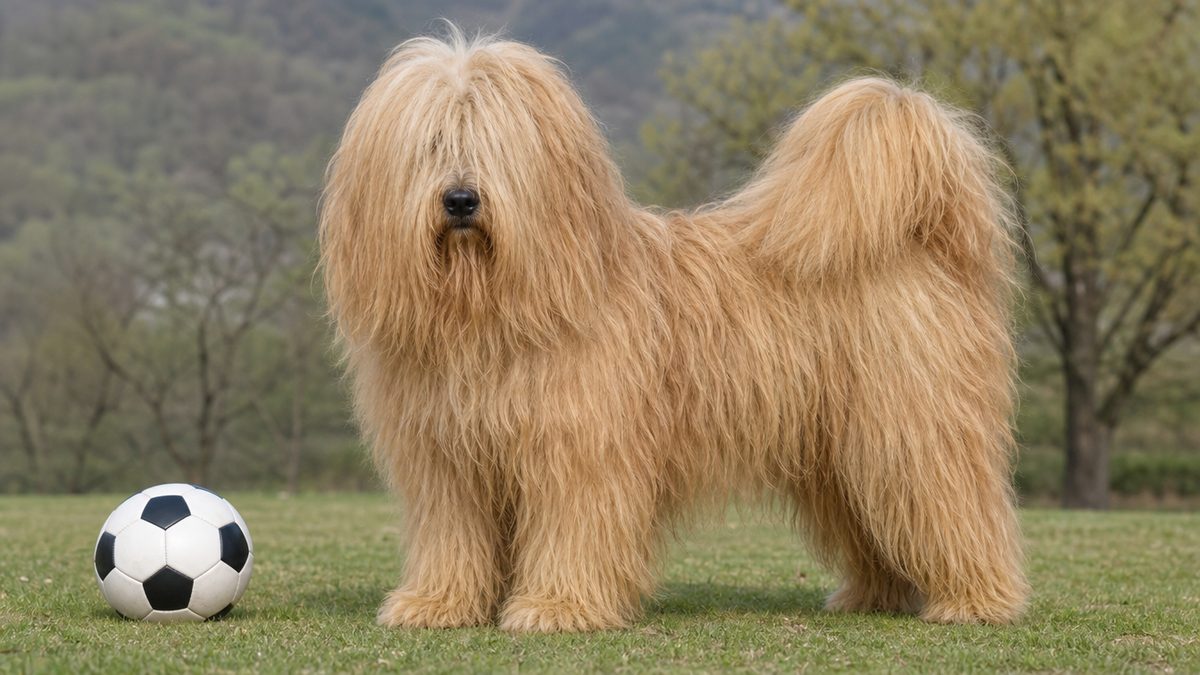
- Long-coated (장모). Long hair covers the face so completely that the eyes and ears cannot be told apart and only the nose stands out. Three textures exist: straight, semi-curly and curly. The foundation says the effect recalls a maned male lion, which is why the dog was traditionally called 사자개, lion dog.
- Short-coated (단모). Features clearly visible, body hair somewhat longer than other Korean native dogs, with feathering on the hindquarters and neck on some individuals. Both outer and undercoat are straight, so it does not tangle and is easy to manage.
- Ears generally dropped, occasionally erect or semi-erect.
- Nose black and glossy, occasionally dark brown, and often pink on white dogs.
- Tail thick and long, carried in a clean bow shape.
- Colours most commonly black-blue (청) and yellow (황), less often white (백) and piebald (바둑).
Nothing on an English page prepares a reader for how different the two coat varieties are to live with. The long coat is the heaviest grooming load in this batch. The short coat, in the foundation's own words, does not tangle and is easy to manage. If you meet Sapsali care advice that does not say which variety it is about, it is not care advice.
Three official Korean heights for one dog
Korea publishes three different heights for the Sapsali, two of them on the same state web page, and no English source mentions the discrepancy.
This is the cheapest available proof that a breed standard and a heritage description are different kinds of document. Bonbeno read all three sources on 9 September 2026.
| Source | Male height | Female height | Weight | Status of the text |
|---|---|---|---|---|
| Korea Heritage Service, 국가유산 설명 | 51 cm | 49 cm | Not given | The legacy heritage description, and the one mirrored into the portal's English, Chinese and Japanese translations |
| Korea Heritage Service, 안내판 설명 | up to 58 cm | up to 54 cm | Not given | On-site signage text, stated to derive from signage-improvement projects of 2019 to 2023 and 2025 |
| Korean Sapsaree Foundation breed standard | 55 to 63 cm | 52 to 60 cm | 22 to 30 kg male, 20 to 28 kg female | The owning body's own standard, and the only one with a weight |
The gap between the low figure and the high one is 12 cm on the male, which is the difference between a Border Collie and a Golden Retriever. The 51 cm figure is the one that has propagated furthest, because the heritage portal's own English translation carries it verbatim as The male grows up to 51cm long, whereas the female, 49cm long, and English-language writing about the breed has taken it from there.
Which to use, and why
Bonbeno uses the foundation's standard, 55 to 63 cm and 22 to 30 kg for a male, and says so rather than silently picking. Three reasons. It is the only figure published by the body that actually owns and breeds the animals. It is the only one with a weight, and a height without a weight is not a size. And it is the figure a 2024 genome-wide association study implicitly works from, having phenotyped 378 Sapsarees for body height, body length, chest width, hair length and hip laxity.
Three more contradictions on the same state page
- Population. The heritage description says the number has recently grown to about 500. The signage text says about 400 are conserved and managed at the Gyeongsan Sapsaree Breeding Research Institute. The register's own quantity field says 400 appropriate, 200 registered.
- History. The heritage description says the dog was raised by the nobility in the Silla period and passed to common people when Unified Silla fell. The signage says the nobility raised it in the Three Kingdoms period and common people took it up from Goryeo.
- Institution. The register's English translation says the dog has been preserved by the Association for Sapsaree Conservation of Korea, while the register's own owner field names a different body, the Korean Sapsaree Foundation, so the state's Korean text and its own English translation name two different organisations as responsible for the same animal.
A fourth is a plain typo worth recording because it shows how these translations are maintained. The register's Chinese-language description prints 公狗, male dog, twice, once for each sex, so it reads that the male is about 51 cm and the male is about 49 cm.
A state register is a primary source for what the state has designated, not automatically for the animal's measurements. Designation records are written once and revised slowly, while a breed standard is maintained by people who handle the dogs. Where the two disagree, say so, name both, and state which you followed.
Is the Sapsali a breed? Applying the two-condition test
The Sapsali is a breed, and it is the only animal in this batch that clears both conditions of the test outright.
To count as a breed on this site an animal needs a written standard describing what it should be, and a register recording individual animals generation after generation so the standard is applied to real dogs. Most pages here fail one or both. This one passes both, and the evidence is unusually strong on the second condition, which is the one landraces normally fail.
| Condition | Verdict | Evidence |
|---|---|---|
| A written breed standard | MET | The Korean Sapsaree Foundation publishes a full standard with group, size class, coat lengths, height, weight and colours, plus point-by-point descriptions of eyes, nose, mouth, ears, body, tail, gait and colour |
| A register of individuals | MET | Korea's own heritage register carries a 등록개체수, registered-individual count, of 200 animals registered to the standard breed type |
| Generational pedigree | MET | A 2024 study estimated heritabilities of 0.32 to 0.55 across five traits, which is arithmetically impossible without a multi-generation pedigree |
| State designation | MET | Natural Monument, designated 10 March 1992, with a named owner and a named managing body |
| Kennel-club recognition | NOT MET | The FCI holds one Republic of Korea breed in Group 5, the Korea Jindo Dog at 334. Korea's own FCI member body states that dogs not in the FCI standard cannot apply for a pedigree, naming the Sapsal among them |
| Population viability | AT RISK | Effective population size estimated at 16 to 51 five to 13 generations ago, and described in 2019 as currently insufficient for long-term viability |
The evidence that settles condition two
Heritability is the giveaway, and it is worth explaining because it is the strongest single argument on this page. Haque and colleagues phenotyped 378 Korean Sapsaree dogs, genotyped 234 of them on a 170k Illumina CanineHD BeadChip, and reported heritabilities of 0.45 for body height, 0.39 for body length, 0.32 for chest width, 0.55 for hair length and 0.50 for hip laxity.
You cannot compute a heritability without knowing who is related to whom. The paper's methods use a pedigree-based relationship matrix across all individuals, which means a multi-generation studbook exists and is in working order. That is condition two demonstrated by a third party rather than asserted by the breed's owners.
The condition it fails, and why that is a different question
No kennel club anywhere holds the Sapsali, and Korea's own is explicit about why. The Korea Kennel Federation, which is the FCI member body for Korea, states in its pedigree-application rules that registration follows the FCI breed standard and that dogs not registered in the FCI breed standard cannot apply, naming the Pungsan dog, the Sapsal dog and the Danggyeon.
Read that carefully, because it is not a judgement on the animal. It is a member body declining to paper a breed its parent federation has not adopted. The FCI's Group 5, Section 5 Asian Spitz and related breeds, lists exactly one Republic of Korea entry, the Korea Jindo Dog at standard 334. So Korea has two internationally famous native dogs and only one of them has a route into the international system.
Compare this page with the Xiasi Dog, where a Chinese state body publishes a standard and then writes that no scientific breeding work has been carried out. The Sapsali has the opposite profile: a working programme with DNA verification since 1985, a registered-individual count on the state register, published heritabilities that require a pedigree, and a cloned individual produced for conservation purposes in 2009. Recognition is a document. A breed is a practice, and here the practice is documented.
What the genetics says, and one result that will surprise you
The Sapsaree carries higher genetic variance than the seven similar breeds it was compared against, and shows the highest haplotype sharing with German Shepherds of any East Asian breed studied.
This breed has the deepest literature of any animal in this batch, and it is worth reading rather than summarising, because two of its findings cut against what a national-monument native dog is supposed to look like.
The surprise: West Eurasian ancestry in Korea's ghost-chasing dog
Ahn and colleagues analysed whole-genome sequences from 205 canid individuals and reported, verbatim: Sapsaree, Northern Chinese indigenous dog, and Tibetan Mastiff were largely related to West Eurasian ancestry. Jindo, Donggyeongi, Shiba, Southern Chinese indigenous (SCHI), Vietnamese indigenous dogs (VIET), and Indonesian indigenous dogs were related to Southeast and East Asian ancestry.
So Korea's two most famous native dogs land on opposite sides of that split, with the Jindo in East Asia and the Sapsaree with West Eurasia. The paper goes further: Among East Asian dog breeds, Sapsaree presented the highest haplotype sharing with German Shepherds, indicating ancient admixture of European ancestry to modern East Asian dog breeds.
Bonbeno reports that as the authors framed it, which is as ancient admixture rather than as recent crossing. Gajaweera and colleagues separately found a small genetic introgression from European breeds and a relationship between the Sapsaree and the Tibetan breeds Tibetan Terrier and Lhasa Apso. Two independent teams, two compatible results, and neither of them supports a story of pure isolated descent.
The diversity result, which is genuinely good news
A breed rebuilt from about 30 animals ought to be genetically impoverished. Gajaweera and colleagues compared the Sapsaree against seven foreign breeds of similar morphology and found the opposite, verbatim: The results suggest that Sapsarees have higher genetic variance compared with the other breeds analyzed.
That is a real achievement by a conservation programme, and it is the strongest argument that the restoration was done carefully rather than quickly.
The diversity result that is not good news
The same paper's conclusion is blunt: The effective population size of the Sapsaree has contracted dramatically over the past generations, and is currently insufficient to maintain long-term viability of the breed's genetic diversity.
Alam and colleagues had already quantified it. Using pedigree inbreeding rates plus SNP panels across 134, 60 and 183 animals, they reported effective population size of 16 to 51 about five to 13 generations ago, with point estimates at 5, 20 and 50 generations ago of 64 to 75, 245 to 286 and 573 to 646.
| Generations ago | Estimated effective population size |
|---|---|
| 50 | 573 to 646 |
| 20 | 245 to 286 |
| 5 | 64 to 75 |
| 5 to 13, from inbreeding rate | 16 to 51 |
Read that column downwards. The population's effective size fell by roughly an order of magnitude across fifty generations, and the authors conclude a strong necessity for minimising inbreeding through genomic selection or other breeding strategies to avoid future bottlenecks.
The coat gene, and an unexpectedly old insertion
Long hair in the Sapsaree is dominant, and Kang and colleagues traced it to a previously reported 167 bp insertion in the RSPO2 3' untranslated region, with an epistatic interaction between FGF5 and RSPO2 determining hair length over the whole body. Across 118 dog breeds and wolves they found something worth noting, verbatim: The genetic diversity in the neighboring region linked to the insertion was higher in Sapsarees than in other Asian and European dog breeds carrying the same variation, suggesting an older history of its insertion in the Sapsaree genome.
That is a testable, published statement that this breed has carried its long coat for longer than the Western breeds that share the mutation, and it is a far better piece of evidence for antiquity than any folk tale. It also sits alongside the wider Asian picture, where Y-chromosome work argues for a Neolithic expansion of dogs out of Southeast Asia that replaced earlier populations to the west and north.
Because it is the model of what a landrace page can look like when a country invests in one. The Xiasi Dog has one PubMed record. The Indian Pariah Dog has a handful. The Sapsaree has sixteen, including heritability estimates, an effective-population-size series and a coat-gene mechanism. The difference is not the animal. It is thirty years of a funded conservation programme attached to a university.
The Sapsali was cloned, and the paper says why
Two cloned Sapsali puppies were born in 2009 from 309 transferred embryos, in a study whose stated purpose was breed conservation.
Almost no breed page anywhere can say this, and it is worth setting out precisely because the numbers are the point.
| Step | Figure |
|---|---|
| Donor | Fibroblasts from a nine-year-old male Sapsaree |
| Method | Donor cells placed into the perivitelline spaces of enucleated in vivo matured oocytes, then fused electrically |
| Cloned embryos transferred | 309 |
| Recipient bitches | 15, naturally synchronised |
| Pregnancies | 2 |
| Puppies born | 2, one each |
| Birth weight | 530 g each |
The efficiency is what a reader should take from that table. 309 embryos into 15 recipients produced two puppies, which is roughly one live birth per 155 transferred embryos. The authors' conclusion is measured, that the study demonstrated an endangered canine breed can be conserved by somatic cell nuclear transfer.
What it does and does not tell you
It tells you the Korean state and its universities treated this animal as worth an expensive, low-yield intervention seventeen years after designating it. Set that against China, whose national livestock genetic-resources catalogue of 29 May 2020 removed dogs from livestock management altogether, so no Chinese dog can enter a comparable state programme. Set it also against the world's unrecognised village-dog populations: Shannon and colleagues genotyped 549 village dogs from 38 countries and found the Indian population among the least European-admixed anywhere, and nobody has funded a conservation programme for it. That is a measure of institutional seriousness, and it sits alongside the DNA-based breeding work the programme has run since 1985.
It does not tell you that cloning solved anything. A clone adds an individual and adds no new genetic variation at all, which is precisely the resource Gajaweera and colleagues found to be running short. Copying a nine-year-old male does not raise effective population size. Bonbeno reports the study as published and draws no conclusion the authors did not.
A breed that has been cloned, sequenced, phenotyped for heritability and given a state register is not a folk animal with a story attached. It is a managed conservation population. Whether that is what a reader wants from a dog is a separate question, and for an Indian household the climate answer below settles it long before the genetics does.
Sapsali price in india, and why the question has no object
No Sapsali is available in India at any price, because Korea's own FCI member body will not issue a pedigree for the breed and the animal is a designated Natural Monument under a conservation programme.
Three separate closures stack here, and each would be sufficient on its own.
- No international pedigree exists. The Korea Kennel Federation registers on the basis of the FCI breed standard and states verbatim that dogs not registered in the FCI breed standard cannot apply, naming the Sapsal dog. The FCI holds one Republic of Korea breed in Group 5, the Korea Jindo Dog at standard 334.
- The animal is a national monument. Korea's register records 200 individuals registered to the standard breed type, held by a foundation and managed by a city. That is a conservation register, not a supply chain.
- India's import route needs paperwork nobody can issue. Dogs enter India as a restricted good, with the practical route being a pet with a valid pet book in the importer's name. A breed no registry papers cannot travel that route.
What the Indian search actually returns
No Indian breeder, listing or rupee price for this breed was found. That is a cleaner result than most pages in this batch produce, and it is worth saying why: the Sapsali has a real international profile, so the search results are dominated by genuine encyclopedic and Korean sources rather than by generated Indian price pages.
The one Indian-facing answer a reader will meet is Google India's AI Mode, and on this breed it behaves unusually well. Asked whether Sapsali dogs shed, it answers Yes, Sapsali dogs shed heavily and are considered high-shedding dogs, elaborates with a thick double coat that drops a large amount of undercoat and seasonal blows twice a year, and recommends brushing several times a week. Bonbeno records that because it is consistent with the Korean foundation's own coat description rather than contradicting it, and this site more often finds the opposite.
| What you asked for | Available in India? | Realistic cost |
|---|---|---|
| A Sapsali with papers | No. Korea's own FCI member body will not issue them | Not purchasable at any price |
| An imported Sapsali | No. Conservation register, not an export programme | Not available |
| A large long-coated dog with Tibetan affinities | Yes. The Tibetan Terrier and Lhasa Apso are the breeds the genetics links it to | See those breed pages for India price bands |
| A hardy native landrace | Yes, free at any Indian shelter | Rs 500 to Rs 2,000 |
Ask which registry issued the pedigree, then check whether that registry holds the breed. Korea's does not, the FCI does not, and no other kennel club does. A Sapsali sold in India with papers is a dog with papers from somewhere that does not recognise the breed, which is a different animal from what you were promised.
Monthly cost of keeping a large long-coated dog in India
Budget the top of the Rs 3,000 to Rs 10,000 monthly band for a 22 to 30 kg long-coated dog in India, because both the food line and the grooming line sit at their maximum.
The Sapsali cannot be bought in India, so this section prices the animal a reader would actually keep if they wanted this kind of dog: a large, heavy double-coated, cold-adapted breed. Every line is a live figure from a named source read on 9 September 2026.
| Line | Figure | Source and caveat |
|---|---|---|
| Acquisition | Not obtainable | No pedigree route exists |
| Food, upper medium to large | Rs 4,000 to Rs 5,000 a month and up | VOSD gives medium Rs 1,500 to 4,000 and large Rs 5,000 plus. A 22 to 30 kg dog straddles the boundary |
| Professional grooming | Rs 300 to Rs 2,000 a session, every 4 to 6 weeks | VOSD. This is the line that a short-coated landrace avoids entirely |
| Consultation | Rs 500 to Rs 1,000 | VOSD. Count as ONE data point; a general insurer publishes the identical range |
| Annual vaccination | Rs 1,500 to Rs 3,000 | VOSD, same caveat |
| Vetic anti-rabies, single | Rs 699 | One chain's Starts-at floor, not a market average |
| Vetic 9-in-1 DHPPiL | Rs 899 | Same |
| Vetic puppy course, 7 visits from day 30 | Rs 6,499, struck through from Rs 8,111 | Same |
| Vetic annual booster package | Rs 3,199, struck through from Rs 3,806 | Same |
| Boarding | Rs 500 to Rs 2,000 a day | VOSD |
| Total monthly, realistic | Rs 7,000 to Rs 10,000 and above | VOSD's band, read at its top for coat and size |
| Lifetime, 10 to 15 years | Rs 3 lakh to Rs 10 lakh | VOSD |
The cost line nobody budgets for
Cooling. A heavy double-coated northern dog in an Indian plains city needs indoor temperature control through the hot months, and that is an electricity cost rather than a pet cost, so it never appears in a breed-price article. A Bengaluru boarding directory carries a load-shedding warning about generator backup for air conditioning between March and May, which is exactly the risk a coat-heavy dog faces when the power goes.
Grooming, done properly. Google India's own answer for this breed says brushing several times a week is necessary to prevent painful mats and tangles in the undercoat, and the Korean foundation confirms that only the short-coated variety is tangle-free. Over ten years at even the low end of Rs 300 a session every six weeks, that is roughly Rs 26,000 in salon costs alone, plus the time.
VOSD gives the first year as Rs 30,000 to Rs 80,000 including setup, vaccination, food, grooming, training and routine vet visits, and names financial unpreparedness as a leading driver of dog abandonment in India. A large coat-heavy dog sits at the top of that range before anything goes wrong.
Heat tolerance, and the clearest disqualification in this batch
The Sapsali is a cold-adapted dog whose homeland averages minus 3.44 C in January, and Chennai's coolest month is within half a degree of the hottest month that homeland has ever averaged.
Bonbeno queries NASA POWER by explicit latitude and longitude and echoes back the grid-cell elevation, because POWER returns a cell rather than a point. Two things must be said about the Korean figures before they are used.
Gyeongsan and Daegu return the SAME CELL, byte for byte. Both queries came back with a cell elevation of 241.05 m, an annual mean of 11.22 C, an annual relative humidity of 77.89 percent and identical monthly series. That is one cell queried twice, not two towns agreeing. The cell sits 196.05 m above Gyeongsan's real elevation of about 45 m and 192.05 m above Daegu's. So the figures below describe a hill cell above the Gyeongsan basin rather than the breeding institute's own ground, and they should be read as slightly cooler than the town.
| Point | Cell elevation vs real | Annual mean | Hottest month | Coolest month | Annual RH | Peak wet bulb |
|---|---|---|---|---|---|---|
| Gyeongsan cell, Korea | 241.05 m vs 45 m, +196.05 m | 11.22 C | Aug 24.53 C | Jan -3.44 C | 77.89 % | Aug 22.42 C |
| Chennai | 48.95 m vs 6 m, +42.95 m | 27.95 C | May 31.51 C | Jan 24.09 C | 72.39 % | May 26.11 C |
| Mumbai | 97.15 m vs 14 m, +83.15 m | 26.77 C | May 31.19 C | Jan 23.19 C | 67.39 % | Jun 25.77 C |
| Delhi | 206.37 m vs 216 m, -9.63 m | 25.60 C | Jun 35.88 C | Jan 13.61 C | 45.56 % | Jul 26.50 C |
| Kolkata | 7.35 m vs 9 m, -1.65 m | 25.81 C | May 31.53 C | Jan 17.31 C | 73.93 % | Jun 27.09 C |
| Bengaluru | 841.72 m vs 920 m, -78.28 m | 23.74 C | Apr 28.37 C | Dec 20.22 C | 67.94 % | May 21.86 C |
| Pune | 635.99 m vs 560 m, +75.99 m | 23.86 C | Apr 28.93 C | Dec 19.62 C | 66.80 % | Jun 22.97 C |
The single comparison that decides it: the homeland's hottest month averages 24.53 C, and Chennai's coolest month averages 24.09 C. A Sapsali in Chennai in January would be living through the warmest weather its ancestral climate ever produces, in the coolest week of the Indian year. In May it would face 31.51 C.
The annual range is the real problem
Korea's annual swing at that cell runs from minus 3.44 C in January to 24.53 C in August, a spread of nearly 28 degrees. That is the climate a double coat evolves for: shed it in summer, grow it back for a freezing winter. An Indian plains city gives the dog no winter at all, so the seasonal shed that the coat depends on never gets its trigger.
Humidity is not the differentiator here, which is worth saying because it is the usual assumption. Korea at that cell runs 77.89 percent annual relative humidity, higher than Chennai's 72.39, Mumbai's 67.39 and Delhi's 45.56. The problem is heat, and specifically heat carried under an insulating coat.
If you keep a heavy-coated dog in India anyway
- Never clip a double coat to cool the dog. Removing the guard hair removes the air gap and the sun barrier, and on a white or piebald dog it exposes pale skin.
- Walk before 07:00 and after 19:00 from March to June, and shorten rather than reschedule on the worst days.
- Watch wet bulb, not temperature. Kolkata's June wet bulb of 27.09 C is the hardest figure in the table and beats Delhi's despite Delhi being 4.35 C hotter.
- Treat collapse as an emergency. Hall's UK cohort of 905,543 dogs recorded 395 confirmed heat-related illness events with an event fatality rate of 14.18 percent, and found dogs over 50 kg and dogs above the breed and sex mean bodyweight at greater risk.
- Know the Indian legal clause. Second Schedule Part IV paragraph 21(1) of the Dog Breeding and Marketing Rules 2017 bars outdoor housing, without a vet's written approval, for dog breeds that cannot tolerate the temperatures prevalent in the area, such as long-haired breeds in high temperature locations. That clause names this kind of dog explicitly.
Bonbeno cannot recommend a long-coated Sapsali for plains India on any reading of the data. Bengaluru and Pune are the least bad Indian cities on wet-bulb load, at 21.86 C and 22.97 C peaks against the homeland's 22.42 C, and both are still 12 degrees warmer year round. Indian hill stations look better on paper and cannot be measured with this instrument, because POWER's cells for them are wrong by 700 to 1,935 m. Consult your nearby vet about heat management before taking on any dog from a climate this much colder than yours.
Temperament and household fit
The Korean state describes the Sapsali as bold, brave and loyal to its owner, and the breed is used in Korea for animal-assisted therapy and cultural-heritage work.
The register's wording is 성격은 대담하고 용맹하며, 주인에게 충성스럽다, the temperament is bold and brave, and loyal to its owner. That is a state document rather than a marketing page, and both official descriptions on the register carry the same sentence, which is one of the few things they agree on.
The owning foundation runs the breed in four public roles, which tells you more about workable temperament than any adjective: Dokdo guardian dogs, Sapsaree in the world, animal-assisted therapy helper dogs and cultural-heritage guardians. A dog used for animal-assisted therapy is a dog that tolerates strangers and handling, which is not true of every guardian landrace.
What has actually been measured
Behaviour in this breed has been studied genetically, which is rare. A 2015 genome-wide association study looked for single nucleotide polymorphisms associated with behaviour in the Sapsaree specifically, and a 2016 whole-transcriptome analysis examined the breed before and after exercise-induced stress. Bonbeno cites those as evidence that the breed is studied rather than as evidence for any particular trait, because neither produces a number an owner can act on.
| Situation | Verdict | Why |
|---|---|---|
| A temperate-climate home with time for coat work | Good fit | Loyal, bold, tolerant enough for therapy work, and physically robust |
| An Indian plains apartment | Poor fit | The coat, not the temperament, is what rules it out |
| A first-time owner | Workable on temperament, hard on grooming | A long coat that mats is a welfare problem, not a cosmetic one |
| A household wanting a guard dog | Partial fit | Bold and loyal, but the breed's public roles are ceremonial and therapeutic rather than protective |
| A household in an Indian hill town | The closest thing to a fit | Still not obtainable, and still not measurable with satellite climate data |
Ghost-chasing dog sounds fierce. The Korean meaning the register gives is 귀신과 액운을 쫓는 개, a dog that drives out ghosts and misfortune, which is closer to a luck-bringing household animal than to a guard dog. That is consistent with the therapy work and with a dog whose long coat covers its own eyes.
Training a Korean native dog
To train a Sapsali, work with the loyalty the Korean state description names rather than against the independence a landrace usually brings, because this breed has been selected inside a formal programme for three decades.
That is an unusual sentence to write on a landrace page, and the reason is the pedigree. A breed with published heritability estimates has been under recorded selection since at least 1985, and selection inside a programme that also runs animal-assisted therapy work tends to keep the biddable animals.
What works
- Socialise through the coat. A long-coated puppy whose vision is partly obscured needs more, not less, exposure to sudden movement, traffic and strangers approaching from the side.
- Handle the face and feet from week eight. This is a dog that will need face brushing, eye cleaning and mat checks for its whole life, so make handling a paid behaviour before it is a necessity.
- Reward the check-in. A loyal dog offers attention freely; pay it, and you get a recall almost for nothing.
- Keep sessions short and cool. Five minutes, several times a day, and never in the Indian afternoon.
- Teach a stand-for-grooming position. It is the single highest-value trained behaviour for any coat-heavy breed and almost nobody teaches it.
What it resists
Expect the usual landrace resistance to repetition without purpose, and expect the coat to complicate everything else. A dog that cannot see a hand signal clearly will not learn hand signals well, so verbal cues carry more weight in this breed than in most, and a trainer who relies on body language will get poorer results than the dog deserves.
One more practical point that comes straight from the Korean standard: ear carriage varies, with most dogs dropped and some erect or semi-erect. A dropped ear under a heavy coat is a hearing dampener as well as a moisture trap, so check that a dog that ignores you is not simply not hearing you, and ask your nearby vet to look in the ear canal before you conclude anything about attitude.
Second Schedule Part IV of the Dog Breeding and Marketing Rules 2017 requires separate housing for a vicious or aggressive dog and forbids sedation to control its behaviour. If a groomer or trainer proposes sedation to get through a matted coat, the answer is to prevent the matting, not to sedate the dog.
Daily exercise needs
Give a Sapsali 60 to 90 minutes a day across two cool-hour outings, and cut volume rather than pace when the Indian heat index climbs.
This is a medium-to-large working-built dog rather than a sighthound or a scenthound, and the Korean standard describes a body made for covering hill ground: back straight, waist tucked, chest and hind-leg muscles developed, forelegs thick and straight, suited to running over hills and mountainous terrain.
| Slot | Duration | Content |
|---|---|---|
| Daily, before 07:00 | 35 to 50 min | The main outing, on lead, varied ground |
| Daily, after 19:00 | 25 to 40 min | Sniffing walk rather than pace |
| Daily, indoors | 10 min | Scentwork or training, under a fan |
| Weekly | One longer outing | Only in genuinely cool conditions |
| March to June, plains cities | Cut hard | Chennai, Delhi and Kolkata peak in May or June. Shift the load indoors |
| Any day the pavement fails the hand test | Skip the walk | Five seconds, back of the hand, before you leave |
The failure mode for this breed is not under-exercise, it is exercising it at the wrong hour. A coated dog will keep going past the point where it should stop, because the coat delays the owner's perception of overheating as much as the dog's ability to shed it. Hall's cohort found exertional causes to dominate heat-related illness, and the event fatality rate in that study was 14.18 percent.
Replace distance with nose work and training, not with a longer evening walk in worse air. Ten minutes of hunting a scattered meal tires a dog more than twenty minutes of pavement, costs nothing, and happens indoors.
Grooming and coat care in Indian humidity
Brush a long-coated Sapsali several times a week, to the skin, and never clip the coat, because the Korean foundation records three coat textures of which the curly one mats and only the short coat is tangle-free.
This is the heaviest grooming load in this batch and it should be treated as a welfare requirement rather than a cosmetic choice. The Korean register's own description is that the hair covers the eyes so they cannot be seen, and the foundation adds that the long coat comes in straight, semi-curly and curly textures.
Google India's own answer for this breed agrees, which is worth noting because this site more often finds an answer engine contradicting the primary source. It states verbatim that these dogs have a thick, long, double-layered coat that drops a large amount of undercoat, that they shed significantly during seasonal coat transitions twice a year, and that daily or frequent brushing (several times a week) is necessary to remove dead hair and prevent painful mats and tangles in the undercoat.
| Task | Long coat | Short coat | Cost |
|---|---|---|---|
| Brushing | 3 to 5 times a week, line-brushed to the skin | Weekly | Rs 0 after a Rs 600 to 1,500 slicker and comb |
| Face and eye area | Every 2 to 3 days | As needed | Rs 0 |
| Bath | Every 4 to 6 weeks, dried thoroughly | Every 6 to 8 weeks | Rs 0 at home |
| Ear drying after wetting | Every time | Every time | Rs 0 |
| Professional session | Every 4 to 6 weeks | Rarely | Rs 300 to Rs 2,000 |
| Clipping | Never | Never | Removes the coat's own heat protection |
The Indian-specific parts
- Dry the coat completely after every bath and every monsoon soaking. Overseas breed clubs routinely advise towelling and air drying, which is written for a temperate climate. A damp undercoat in Indian humidity is a hot-spot and yeast problem within days.
- Check for matting behind the ears, in the armpits and around the hindquarters weekly. Those are the three places a heavy coat felts first, and a felted mat pulls at skin.
- Do not shave for summer. The double coat is the dog's insulation against heat as well as cold, and a piebald or white dog has pale skin underneath.
- Watch for ticks despite the coat. The West Bengal series found 72.9 percent of 584 dogs screened carrying two or more blood-borne pathogens, and a heavy coat hides a tick for days.
On seasonality, the Indian evidence disagrees with itself and this page publishes the disagreement rather than tidying it. A southern Indian series of 120 clinically affected dogs recorded a peak in the pre-monsoon season, March to May, while an eastern Indian study of 178 dogs in Bhubaneswar found 55 percent of ehrlichiosis cases in the summer months. Both point at the hot months rather than the rains.
A matted coat is not untidiness. It pulls the skin, traps moisture and hides parasites and wounds, and in a hot climate it does all of that faster. If you cannot commit to brushing a long-coated dog several times a week for its whole life, choose the short-coated variety or a different breed. Consult your nearby vet at the first sign of skin redness, odour or hair loss under a mat.
Health issues, screening and life expectancy
No life expectancy has been published for the Sapsali, and the breed's real health story is hip laxity with a heritability of 0.50 and a shrinking effective population size.
Say the absence first. There is no OFA row, no kennel-club health survey and no longevity study for this breed, and the sixteen PubMed records are overwhelmingly genomics rather than clinical medicine. What exists instead is better than most landraces get.
Hip laxity, and a number an owner can use
Haque and colleagues measured the distraction index, the standard quantitative measure of hip joint laxity, across 378 Sapsarees and reported a heritability of 0.50, with candidate genes DDHD1, BMP4, SEMA3C and FOXP1. A heritability of 0.50 means about half the variation in hip laxity in this population is genetic, which is high enough that selection can move it and high enough that ignoring it will not.
That is a more useful health fact than an OFA percentage would be, because it tells a breeder what to do rather than telling an owner what the average is. It is also, on the evidence Bonbeno could find, published nowhere in English outside the paper itself.
The hereditary variants that have actually been typed
Kang and colleagues whole-genome-sequenced 32 individuals across DongGyeongi, Sapsaree and Jindo and typed four disease-associated variants. The result is a rare thing on this site: a clean set of positives and negatives for a named landrace.
| Gene and association | Sapsaree | DongGyeongi | All breeds |
|---|---|---|---|
| BTBD17, abortion | present | present | 0.33 across all breeds |
| MLPH, coat colour dilution | 0.20 | 0.18 | Found ONLY in these two |
| SLC2A9, urolithiasis | NOT FOUND | 0.18 | DongGyeongi only |
| T gene, bobtail phenotype | NOT FOUND | 0.20 | DongGyeongi only |
Two of those rows are negatives and they are worth as much as the positives. The Sapsaree does not carry the SLC2A9 urolithiasis allele found in the DongGyeongi at 0.18, and does not carry the T-gene bobtail variant. A citable absence, established by sequencing rather than by nobody having looked.
The MLPH row matters differently. Coat-colour dilution at an allele frequency of 0.20 in a breed whose standard names black-blue as a principal colour is a finding a breeder should hold alongside the standard, because dilute coats carry a known association with colour dilution alopecia in other breeds. Bonbeno makes no prevalence claim for this breed, because none has been published.
The one clinical case report in the literature
Pentalogy of Fallot in a Korean Sapsaree dog, published in 2007, is a single case report and is cited here as exactly that. One dog is not a breed prevalence, and Bonbeno will not turn it into one. It is worth knowing only because it is the entire clinical record.
What would actually threaten this dog in India
Heat first, and then the ordinary Indian infectious and parasitic burden. The West Bengal series screened 584 client-owned dogs and found Babesia gibsoni in 76.54 percent (447/584), Anaplasma species in 55.75 percent and Ehrlichia canis in 16.61 percent, with 72.9 percent of the 584 dogs screened carrying two or more pathogens. Those dogs presented at a clinic rather than being randomly sampled, so read the figures as the burden among dogs brought in for testing.
One diagnostic point is directly actionable. Microscopy missed 130 of 158 Babesia canis positives and 146 of 169 Hepatozoon positives in that study, and the authors conclude real-time PCR should be the standard. Ask your nearby vet whether the tick-fever panel is a smear or a PCR.
Nothing here diagnoses anything. There is no breed-specific screening protocol available outside Korea, and OFA's own FAQ notes that it does not require dogs to be purebred or registered to accept an evaluation while a breed enters its published tables only at 100 hip evaluations, or 50 for other databases. Given a published hip-laxity heritability of 0.50, hips are the thing to screen if you ever have the chance.
Feeding a large coated dog in India, by life stage
Feed a growing Sapsali-type puppy three to four meals a day to twelve weeks, then two, and budget Rs 4,000 to Rs 5,000 a month or more for a 22 to 30 kg adult.
No breed-specific nutrition research exists for the Sapsali, so what follows is the general large-dog case with the coat and the heat added. Say that plainly rather than dressing a generic plan as breed knowledge.
| Stage | Meals a day | What matters most |
|---|---|---|
| 8 to 12 weeks | 4 | Small volumes, growth-appropriate food, water at every meal |
| 3 to 6 months | 3 | Body condition. Ribs easy to feel through the coat, not to see |
| 6 to 14 months | 2 | Slow, steady growth. Large-breed growth rates and joint health are linked |
| Adult, 1 to 7 years | 2 | Weight control. Never a heavy meal before exercise in a deep-chested dog |
| Senior, 8 years and over | 2 | Smaller, more digestible meals, plus a vet check on kidneys, joints and teeth |
Three specifics for this dog
- Body condition is harder to see under a long coat, so use your hands weekly. An overweight coated dog is invisible until it is obese, and Hall's 905,543-dog cohort found higher bodyweight relative to the breed and sex mean to be a significant heat-illness risk factor.
- Feed the larger meal at the cool end of the day, because a heavy meal followed by activity in an Indian May is a bloat and heat risk in a large dog.
- Get a home diet checked rather than guessed. VOSD is direct that home cooking reduces the bill but that the cost in ingredients and time is still real. Ask your nearby vet to check calcium and phosphorus balance for a large growing dog, where the consequences of getting it wrong are skeletal and permanent.
One genuinely breed-relevant note. Korean research groups have published on nutrient digestibility in Sapsaree dogs and on life-stage differences in digestibility and physiological parameters in the breed. Bonbeno cites those as evidence the breed is studied nutritionally rather than quoting figures from them, because the studies were not read in full for this page and a digestibility coefficient quoted out of context would be worse than no figure.
VOSD puts medium-dog food at Rs 1,500 to Rs 4,000 a month and large working breeds at Rs 5,000 and up. A 22 to 30 kg Sapsali straddles that boundary, so plan for the upper figure. Over a decade the difference between this animal and a 15 kg Indian landrace is a six-figure sum in food alone.
Puppy timeline, month by month through the first year
To raise a coated large-breed puppy in India, start coat handling and vaccination together at week eight, because Indian law puts the vaccination window at seven to eighteen weeks and the coat habit has to be built before the coat arrives.
Two clauses of the Dog Breeding and Marketing Rules 2017 set the frame. Rule 8(1)(a) requires that pups less than eight weeks in age are not sold, and Second Schedule Part III paragraph 8(9) states that all pups shall be vaccinated which can start at the age of seven-eight weeks, and are usually completed at the age of eighteen weeks.
| Age | What happens | What it costs |
|---|---|---|
| Under 8 weeks | Stays with the litter. Indian law bars sale below this age | Nothing |
| 8 to 10 weeks | Home, settling, first vaccines, first face and foot handling | Puppy DP Rs 849, or the 7-visit course from Rs 6,499 |
| 10 to 14 weeks | Peak socialisation, and daily two-minute brushing sessions on a puppy coat that does not yet need them | Free, and the reason grooming is possible at three years old |
| 12 to 16 weeks | Anti-rabies and 9-in-1 completed by 18 weeks | Anti-rabies Rs 699, 9-in-1 Rs 899 |
| 4 to 8 months | The adult coat starts coming through. Brushing frequency rises with it | Slicker and comb Rs 600 to Rs 1,500 |
| 6 to 12 months | Adolescent coat change, the first heavy shed, and the first real matting risk | First professional session Rs 300 to Rs 2,000 |
| 9 to 14 months | Slow growth to adult size. Do not push it | Adult food |
| 12 months | First annual booster planned | Booster package from Rs 3,199 |
The milestone this breed makes non-negotiable
Build the grooming habit before the coat needs it. A twelve-week-old puppy with a soft short coat does not need brushing, which is exactly why that is the moment to teach it. An eight-month-old dog meeting a slicker brush for the first time, on a coat that is already felting, will learn that grooming is unpleasant, and you will have that argument for a decade.
The 2017 gazette forbids tail docking, ear cropping, de-barking, de-clawing, branding, dyeing, injecting substances to enhance visual appeal and any change of appearance by artificial means, at Second Schedule Part II paragraph 6(8), and prohibits breeding to create new breeds of dogs or unusual looks at paragraph 6(9). Rule 8(1)(b) separately bars sale of a dog over six months without prior sterilisation, unless to another licensed breeder.
Head to head against the dogs an Indian buyer can actually get
The Sapsali loses to every obtainable alternative on availability and heat, and beats all of them on published breed-specific science.
The useful comparison is not Sapsali against Labrador. It is against the two Tibetan breeds the genetics links it to, both of which an Indian buyer can obtain, and against Korea's other native dog.
| Sapsali | Jindo | Tibetan Terrier | Indian Pariah Dog | |
|---|---|---|---|---|
| State recognition | Korean Natural Monument, 10 Mar 1992 | Korean Natural Monument | None needed | Indian native |
| FCI standard | None | 334 | Yes | None, but KCI holds the breed |
| Own country's kennel body will register it | No, expressly refused | Yes | Yes | Yes |
| Obtainable in India | No | No | Yes | Yes, free |
| Coat work | Very high for the long variety | Moderate | High | Weekly brush |
| Homeland annual mean | 11.22 C | Korean | Tibetan plateau | Indian |
| Heat suitability, plains India | Very poor | Poor | Poor | Excellent |
| Published breed-specific papers | 16 | 60 under Jindo | Few | Few |
| Genetic relationship to the Sapsali | n/a | Different ancestry cluster | Among its closest relatives | Distant |
The row worth pausing on is the third. Korea's own FCI member body will register a Jindo and will not register a Sapsali, and says so in its published rules naming the Sapsal dog explicitly. Two Korean Natural Monument dogs, one route into the international system between them.
The genetics row is the other one. Gajaweera and colleagues place the Sapsaree closest to the Tibetan Terrier and Lhasa Apso among the breeds they compared. Both of those are available in India, both are long-coated, and both carry the same grooming burden at a fraction of the size, which for an Indian household is a real advantage rather than a compromise.
If the appeal is the shaggy face and the ancient-native story, the Tibetan Terrier and Lhasa Apso pages cover the two breeds the genetics actually links this one to, and both are obtainable in India. If the appeal is a hardy heat-adapted native dog, read the Indian Pariah Dog page. If the appeal is Korean native breeds specifically, the Jindo page covers the one with an FCI standard.
The legal position in India, and what a Natural Monument means for export
No Indian law names the Sapsali, and no lawful import route exists, because the animal is a designated Korean Natural Monument with no internationally recognised pedigree.
The obstacle here is not Indian law. It is that Korea has classified this dog as national heritage, and the paperwork that a pet import normally travels with does not exist for it.
Import
India regulates dog import as a restricted good, and the practical route is a pet with a valid pet book in the importer's name, with applications for trading or breeding purposes rejected. A pet book presupposes a registry. Korea's own FCI member body states that dogs not registered in the FCI breed standard cannot apply for a pedigree and names the Sapsal dog among them, and the FCI holds one Republic of Korea breed in Group 5, the Korea Jindo Dog at 334.
The heritage designation
Korea's register lists the breed as Natural Heritage, with an owning foundation, a managing city, an appropriate breeding population of 400 and a registered population of 200. Bonbeno makes no claim about what Korean law permits or forbids in respect of moving designated animals, because that was not established for this page. What can be said is that a register of 200 individuals is a conservation instrument and not a supply chain, and that the owning foundation runs an adoption programme within Korea.
The 2024 Indian breed circular does not reach it
In March 2024 a letter from a Joint Secretary at the Department of Animal Husbandry and Dairying circulated a list of dog breeds proposed for import and breeding restrictions. It is not an Act, rule or notification, the Karnataka High Court quashed it on 10 April 2024, and the Union told the Madras High Court that the quashed circular had lost its effect entirely. No Indian law in force today bans owning, breeding or selling any dog breed.
What applies to any dog you do own in India
- Sale below eight weeks is prohibited, at Rule 8(1)(a).
- Sale over six months without prior sterilisation is prohibited, unless to another licensed breeder, at Rule 8(1)(b).
- Docking, cropping, de-barking, de-clawing, branding and dyeing are strictly forbidden, at Second Schedule Part II paragraph 6(8).
- Breeding to create new breeds or unusual looks is strictly prohibited, at Second Schedule Part II paragraph 6(9).
- Outdoor housing is restricted for breeds that cannot tolerate local temperatures, such as long-haired breeds in high temperature locations, at Second Schedule Part IV paragraph 21(1). That clause describes this dog.
The Rules run 1 to 13 and stop. Everything numbered above 13, and every 6(N) and 8(N) form on this page, is a Second Schedule paragraph, not a Rule, and the string Rule 21 appears zero times in the gazette. Rule 8(1)(a), the eight-week minimum, is a genuine Rule.
Mistakes Indian readers make with this breed
The commonest mistake is searching the wrong romanisation, which hides the breed's entire scientific literature.
- Searching Sapsali instead of Sapsaree. Sapsali[tiab] returns zero in PubMed with a phrase-not-found report. Sapsaree[tiab] returns 16. One romanisation hides a cloning paper, an effective-population-size series and a genome-wide association study.
- Quoting 51 cm as the height. That is the legacy heritage description, and it has propagated into the state's own English, Chinese and Japanese translations. The owning foundation's standard says 55 to 63 cm for a male.
- Printing Natural Monument No. 368 as what the register says. The state record today prints no number at all, and 368 survives on that page only inside the URL parameters.
- Treating this as a low-maintenance native dog. It is a native dog with the heaviest coat in this batch, and the short-coated and long-coated varieties are not the same animal to keep.
- Assuming a native breed means pure isolated ancestry. Whole-genome work places the Sapsaree with West Eurasian ancestry and reports the highest haplotype sharing with German Shepherds of any East Asian breed studied.
A sixth mistake, and it is the one that hurts the dog
Shaving the coat for the Indian summer. A double coat insulates in both directions, and removing it exposes pale skin to sun and removes the air gap that keeps the dog cooler. If the coat is unmanageable, the answer is more frequent brushing or the short-coated variety, and if it is already matted, the answer is a professional groomer working carefully rather than a clipper run over the whole dog.
Sapsali returns nothing and Sapsaree returns everything. This site has recorded the same failure for Pungsan against Poongsan, where each romanisation returns exactly one record and they are different papers with zero overlap, and for the Polish Lowland Sheepdog, whose entire clinical literature is indexed under Owczarek Nizinny. Before writing that a breed has no literature, run every romanisation the breed has.
Adoption, and the honest close
Adopt a heat-adapted Indian dog rather than pursuing a Sapsali, because the Sapsali cannot lawfully be obtained in India and its coat is built for a climate India does not have.
This page has been more positive about its subject than most on this site. The breed is real, it is documented, it is scientifically studied, and its conservation programme is a genuine achievement. None of that makes it a sensible dog for an Indian household, and the reason is a single number: the hottest month its homeland averages is 24.53 C, and Chennai's coolest month averages 24.09 C.
What to do instead
- Start with a registered shelter or rescue rather than a listing site. VOSD puts shelter adoption at around Rs 500 to Rs 2,000 against Rs 1,50,000 for a pedigreed puppy.
- If you want the shaggy look, look at the Tibetan breeds. Gajaweera and colleagues place the Tibetan Terrier and Lhasa Apso among the Sapsaree's closest relatives, and both are obtainable in India.
- Ask for the medical history. Sterilisation, deworming, first vaccines and any tick treatment, with records.
- Budget the first year at Rs 30,000 to Rs 80,000, VOSD's figure including setup, vaccination, food, grooming and routine vet visits.
- Register where your city requires it, and keep rabies vaccination current, which is a legal requirement rather than a preference.
What Bonbeno will not do
This site sells no dogs, brokers no puppy sales, recommends no breeder and links no listing. On this breed that matters less than usual, because no supply exists to be tempted by, and more than usual in one specific way: an animal offered in India as a Sapsali would have to be a different dog, since the only registry that could paper one has published its refusal to do so.
A country found about thirty surviving dogs in the late 1960s, put a university behind them, designated them a Natural Monument in 1992, cloned one for conservation in 2009, and by 2024 could publish a heritability for hip laxity in the resulting population Haque MA, Kim NK, Yeji R, Lee B, Ha JH. That is what a landrace looks like when a state decides to keep it. India has landraces of its own and has not done any of it yet, and that comparison is the most useful thing this page has to offer an Indian reader.
Sapsali questions people actually ask
Do Sapsali dogs shed?
Yes, the long-coated Sapsali sheds heavily. Google India's own answer describes a thick, long, double-layered coat that drops a large amount of undercoat, with significant shedding during seasonal coat transitions twice a year and steady loss in between, and recommends brushing several times a week to prevent painful mats and tangles. That is consistent with the Korean Sapsaree Foundation's own standard, which records three long-coat textures, straight, semi-curly and curly. The short-coated variety is a genuinely different proposition: the foundation states that both its outer and undercoat are straight, so it does not tangle and is easy to manage.
What does Sapsali mean in Korean?
Sapsali, written 삽살개, means the dog that drives out ghosts and misfortune. Korea's own national heritage register gives the meaning as 귀신과 액운을 쫓는 개 and describes the word as purely Korean, noting that it appears in song lyrics, folk tales and old paintings. The traditional nickname 사자개, lion dog, refers to the long coat framing the face like a mane. The state also registers the breed under a place-specific name, 경산의 삽살개, the Sapsari Dog of Gyeongsan.
What is the temperament of a Sapsali?
Korea's own heritage register describes the temperament as bold, brave and loyal to its owner, and both of the register's two official descriptions carry that same sentence. The owning foundation runs the breed in four public roles that say more than any adjective: Dokdo guardian dogs, cultural-heritage guardians, international ambassadors and animal-assisted therapy helper dogs. A dog used for therapy work tolerates strangers and handling, which is not true of every guardian landrace. Behaviour has also been studied genetically in this breed, in a 2015 genome-wide association study and a 2016 whole-transcriptome analysis of exercise-induced stress.
Is the Sapsali recognised as a breed?
Yes by the Korean state and no by any kennel club, and Bonbeno files it as a breed because it clears both conditions of the two-condition test. Korea designated it a Natural Monument on 10 March 1992, its register names an owning foundation and a managing city and records 200 individuals registered to the standard breed type, and the foundation publishes a full standard. A 2024 study computed heritabilities from a pedigree-based relationship matrix, which is impossible without a working multi-generation studbook. Against that, Korea's own FCI member body states that dogs not registered in the FCI breed standard cannot apply for a pedigree, naming the Sapsal dog.
What is the Sapsali dog price in india?
There is no Sapsali price in india, because no Sapsali can lawfully reach India. Korea's own FCI member body publishes a refusal to issue a pedigree for the breed, the FCI holds one Republic of Korea breed in Group 5, and the animal is a designated Natural Monument whose register lists 200 individuals under a conservation programme. No Indian breeder or listing was found. The affordable and heat-appropriate alternative is an Indian landrace from a shelter at Rs 500 to Rs 2,000, and the closest obtainable long-coated relatives are the Tibetan Terrier and Lhasa Apso.
How big is a Sapsali?
The Korean Sapsaree Foundation's own breed standard gives 55 to 63 cm and 22 to 30 kg for a male, and 52 to 60 cm and 20 to 28 kg for a female. Be careful with other figures, because Korea publishes three different heights. The state heritage register's legacy description says 51 cm and 49 cm, and that figure has been carried into the register's own English, Chinese and Japanese translations and from there into most English writing about the breed. The register's on-site signage text says up to 58 cm and 54 cm. Bonbeno uses the foundation's standard because it is the only one with a weight and the only one published by the body that breeds the animals.
Can a Sapsali live in India?
A long-coated Sapsali is poorly suited to plains India. NASA POWER, queried by explicit latitude and longitude with the grid-cell elevation echoed back, returns an annual mean of 11.22 C for the Gyeongsan cell, a January mean of minus 3.44 C and a hottest month of 24.53 C in August. Chennai's coolest month averages 24.09 C, so the coolest Indian week is within half a degree of the hottest month the homeland ever averages. The problem is heat under an insulating coat rather than humidity, since the Korean cell runs 77.89 percent relative humidity, higher than every Indian city measured here. Indian law also names long-haired breeds in high temperature locations in its outdoor-housing restriction.
Was the Sapsali really cloned?
Yes. A 2009 study in the Journal of Veterinary Medical Science took donor fibroblasts from a nine-year-old male Sapsaree, placed them into the perivitelline spaces of enucleated in vivo matured oocytes, fused them electrically, and transferred 309 cloned embryos into 15 naturally synchronised recipient bitches. Two recipients became pregnant and each delivered one cloned puppy, both weighing 530 g. The authors' stated purpose was breed conservation. Note what cloning does not do: it adds an individual and no new genetic variation, which is the resource a 2019 study found to be running short in this breed.
How healthy is the Sapsali?
No life expectancy has been published for the breed and no screening scheme covers it outside Korea, so the honest answer is that the breed is studied rather than surveyed. What is published is more useful than an average. A 2024 genome-wide association study measured hip laxity as the distraction index across 378 Sapsarees and reported a heritability of 0.50, with candidate genes DDHD1, BMP4, SEMA3C and FOXP1, so roughly half the variation in hip dysplasia risk in this population is genetic and selectable. Whole-genome sequencing of 32 native Korean dogs also established that the Sapsaree does not carry the SLC2A9 urolithiasis allele found in the DongGyeongi, while carrying the MLPH coat-dilution allele at 0.20.
Why does PubMed find nothing for Sapsali?
Because the romanisation is wrong for that index. Sapsali[tiab] returns zero with PubMed reporting the phrase not found, and so do Sapsalis, Sapsaru, Sapsalgae and the quoted forms Sapsal dog and Sapsal dogs. Sapsaree[tiab] returns 16 records. Controls run in the same session returned Labrador Retriever 1,109 and Chow Chow 169, so the instrument was working. This site has recorded the same failure for Pungsan against Poongsan, where each spelling returns exactly one record and they are different papers with no overlap. Run every romanisation a breed has before writing that it has no literature.
Is the Sapsali related to the Jindo?
Less closely than you would expect for two Korean native breeds. Whole-genome analysis of 205 canids places the Sapsaree, the Northern Chinese indigenous dog and the Tibetan Mastiff largely with West Eurasian ancestry, and the Jindo, Donggyeongi, Shiba, southern Chinese, Vietnamese and Indonesian indigenous dogs with Southeast and East Asian ancestry. The same study reports that among East Asian dog breeds the Sapsaree shows the highest haplotype sharing with German Shepherds, which the authors read as ancient admixture of European ancestry. A separate study places the breed's closest relationships with the Tibetan Terrier and Lhasa Apso, so the two Korean natives sit in different ancestry clusters despite sharing a country and a monument status.
Does OFA hold any data on the Sapsali?
No. OFA's own breed-code list, parsed from its markup, carries 474 breed rows and contains a SAPSAREE entry under the code SAP, but the breed has no row in the published statistics tables. OFA's FAQ explains why: a breed enters those tables only once it has at least 100 hip evaluations, or 50 for the other databases, and it states separately that it does not require dogs to be purebred or registered in order to perform an evaluation. So the breed holds a code and no data, which is a different thing from being absent from the database, and given a published hip-laxity heritability of 0.50 it is a gap worth filling.
Compare with similar breeds
Sapsali sits in 1 Bonbeno group. Each one compares it directly against the breeds it is genuinely an alternative to, on the same figures.