
Breed profile
Tibetan Terrier: The India Guide to a Dog That Is Not a Terrier
The breed India named. A Delhi dog show and the Kennel Club of India settled what this dog is called in 1930, and the Federation Cynologique Internationale still prints the correction in its own standard.
Quick answer
No trustworthy tibetan terrier price in india exists. Two Indian breed sites print Rs 25,000 to Rs 50,000, and both figures sit inside a cost row that one of those sites also prints, to the rupee, for the Welsh Terrier. The Kennel Club of India named this breed in 1930, but neither it nor any Indian rescue publishes a current population or price figure.
This page summarises published breed-standard text, registry health-scheme documents, peer-reviewed veterinary genetics and Indian government records for general information. It is not a diagnosis, it is not a treatment plan, and it is not a substitute for examining your own dog. Screening results, drug doses and vaccination timing all change with the individual animal. Consult your nearby vet before acting on anything here, and take any dog showing night blindness, a painful red eye, sudden weight loss or a failure to grow to a veterinary surgeon the same day.
Tibetan Terrier at a glance
What the Tibetan Terrier actually is
The Tibetan Terrier is a medium, square, long double-coated companion dog from Tibet that the Federation Cynologique Internationale files as standard 209 in Group 9, Companion and Toy Dogs, Section 5 Tibetan breeds, and that the Royal Kennel Club files in the Utility group.
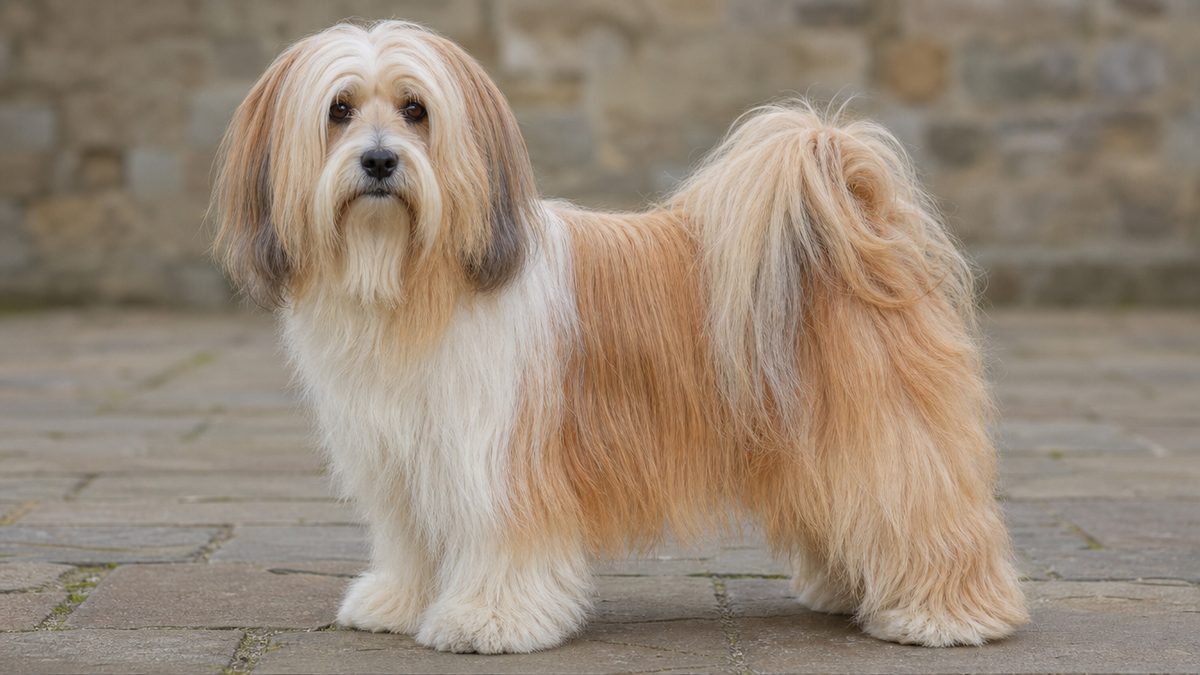
It stands 36 to 41 cm at the withers for a male, with females slightly smaller, and FCI Standard 209 gives no weight figure at all. Length from point of shoulder to root of tail equals the height at withers, which is what produces the square outline every judge looks for first. The coat is double, with a fine woolly undercoat under a profuse top coat that is long and either straight or waved but never curled and never silky. Any colour is permitted except chocolate, liver and merle.
Three facts separate this dog from every other shaggy Tibetan breed an Indian buyer will be shown. The feet are large, round and flat, heavily furnished with hair between the toes and pads, standing well down with no arch, which reads as a snowshoe rather than a foot. The head carries a fall of hair forward over the forehead that must not cover the eyes, and a small unexaggerated beard on the lower jaw. And the tail is set on fairly high and carried in a curl over the back, very well feathered, with a kink near the tip that the standard expressly permits.
The one-line version
A Tibetan Terrier is a 36 to 41 cm herding and companion dog with a hip-length double coat, snowshoe feet, a deep bark, a 13.8-year median lifespan and five separate genetic screens its parent registry says a breeder should run before mating The Royal Kennel Club, Breeds A to Z McMillan KM, Bielby J, Williams CL. Everything else on this page follows from those numbers. Its published life expectancy is long, its coat care burden is daily, and its health issues are unusually well mapped for a breed this uncommon.
| Point | What FCI Standard 209 says | Why it matters in India |
|---|---|---|
| Group | Group 9, Companion and Toy Dogs, Section 5 Tibetan breeds | Not a terrier group, not a working group, so no working trial and no guarding role |
| Height | Males 36 to 41 cm, females slightly smaller | A medium dog, not the small lapdog Indian listings imply |
| Weight | Not stated anywhere in the standard | Any weight quoted to you comes from somewhere other than the standard |
| Coat | Double. Fine woolly undercoat, profuse long top coat, never curled, never silky | The undercoat is the part that will not dry in an Indian monsoon |
| Feet | Large, round, heavily furnished between toes and pads, no arch | Hair between the pads collects grit, tar and moisture on Indian streets |
| Colour | Any colour except chocolate, liver or merle | A merle Tibetan Terrier is outside the standard, whatever the seller says |
| Temperament | Outgoing, alert, intelligent and game, neither fierce nor pugnacious | A watchdog by voice, not by bite |
The Royal Kennel Club adds the practical numbers a standard never carries. It rates the breed Medium in size, puts its exercise at up to one hour per day, its coat length at Long, its lifespan at over 12 years, its size of home at Small house, and its grooming at Every day. That last figure is the one Indian buyers discover late.
The FCI's own standard opens its history with the sentence 'In spite of the name, the Tibetan Terrier is not a terrier but a herding dog'. The Royal Kennel Club's breed page says the same thing in its own words. This is not a technicality. A buyer who expects terrier behaviour will train the wrong dog.
Why the Tibetan Terrier is not a terrier, in four documents
The Tibetan Terrier is not a terrier because no registry files it as one and a 170K SNP study rejected the hypothesis outright, and the misleading half of the name is a nineteenth-century European resemblance label rather than a description of what the dog does FCI-Standard No 209 TIBETAN TERRIER.
Four separate documents settle it, and they were produced independently of one another.
- The breed standard says so in its own words. FCI Standard 209's Brief Historical Summary begins 'In spite of the name, the Tibetan Terrier is not a terrier but a herding dog, doubling as a guard for traders as they journeyed to and from China'.
- The FCI's terrier group excludes it. FCI Group 3, Terriers, holds 32 breeds and the Tibetan Terrier is not among them. Fourteen in-document controls were present in the same retrieval, including the Airedale, Bedlington, Border, Lakeland, Manchester, Welsh and Kerry Blue Terriers, so the search was working and the absence is real. The breed sits instead in FCI Group 9, whose 26 entries also hold the Lhasa Apso at 227, the Shih Tzu at 208 and the Tibetan Spaniel at 231.
- The Royal Kennel Club files it in Utility and says so in prose. Its breed page reads 'The breed is not a terrier but has been used as a herding dog for sheep', and serves the standard from its own /breed-standards/utility/ path.
- The genetics rejected the hypothesis. Janes 2019 genotyped 64 Tibetan Terriers on an Illumina HD Canine 170K array plus 18 microsatellite loci and compared them with 348 published genotypes from other breeds. Western and native Tibetan Terriers clustered with other Asian breeds while every other terrier breed formed a separate group. The paper's conclusion is verbatim: 'we were able to reject the initial hypothesis that Tibetan Terriers belong to the group of terrier breeds'.
Where the word terrier came from
The word arrived through size confusion, not through function. Before the 1930s the terms Lhasa Terrier, Bhutan Terrier and Thibetan Terrier were used without clear distinction for what are now two separate breeds, because limited Western exposure reduced both to shaggy coats, curled tails and a monastery association. The Tibetan name is Tsang Apso, which translates roughly as shaggy or bearded dog and contains no equivalent of terrier at all.
The consequence is a live one for buyers. A terrier is bred to work alone against a quarry underground and to keep going when corrected. This dog was bred to herd, to alert and to live inside a monastery. Train it like a terrier and you will meet resistance the breed does not deserve.
The Orthopedic Foundation for Animals describes primary lens luxation as heritable 'in many breeds, including many terrier breeds (Jack Russell, Bedlington, Fox, Manchester, Miniature Bull, Scottish, Sealyham, Welsh, West Highland White), Tibetan Terrier, Border Collie, Brittany Spaniel, German Shepherd and Welsh Corgi'. The Tibetan Terrier sits outside the terrier bracket, beside the Border Collie. Even the disease it shares with terriers is filed with it as a non-terrier.
The Kennel Club of India named this breed, in 1930
The Kennel Club of India changed this breed's name from Lhasa Terrier to Tibetan Terrier in 1930, which makes it one of very few internationally recognised breeds whose name was settled in India Wikipedia, Tibetan Terrier.
The chain runs through one person and one dog show. Dr Greig, described by the Royal Kennel Club as 'an English surgeon, Dr Greig who was working in a hospital on the Indian/Tibetan border in the early 1920s', was given a gold and white female puppy in 1922 after a successful operation on a patient's relative. She named the bitch Bunti and exhibited her at the Delhi Dog Show. Judges unfamiliar with the type asked her to acquire a mate and produce three consistent generations before the breed could be accepted as distinct.
She acquired a male named Rajah, a first litter followed in 1924 and was registered as Lhasa Terriers, and in 1930 the Kennel Club of India changed the breed name to Tibetan Terrier. The Lhasa Apso was formally recognised as a separate breed by the same club in the same year. Her kennel prefix was Lamleh, and her Lamleh strain established the breed in Britain and in the United States.
Why this is checkable rather than folklore
Three independent sources carry the same chain and one of them is a genetics paper. The Royal Kennel Club records Dr Greig, the Indian/Tibetan border hospital and the Lamleh strain. Wikipedia records Bunti, Rajah, the 1924 litter registered as Lhasa Terriers and the 1956 US imports from the Lamleh kennel. And Janes 2019, working from SNP genotypes rather than from records, found that the western population splits into exactly two lineages and named them Lamleh and Luneville, descended from a small number of founders brought to Europe in the 1920s. A kennel prefix recorded in club history and a lineage detected in DNA ninety years later are the same object.
| Year | What happened | Source that records it |
|---|---|---|
| 1922 | Dr Greig, a surgeon working on the Indian/Tibetan border, is given a gold and white bitch named Bunti | Royal Kennel Club; Wikipedia |
| 1920s | Bunti is exhibited at the Delhi Dog Show; judges ask for three consistent generations | National Purebred Dog Day |
| 1924 | First litter born, registered as Lhasa Terriers | Wikipedia |
| 1930 | The Kennel Club of India changes the name to Tibetan Terrier and separately recognises the Lhasa Apso | National Purebred Dog Day; Wikipedia |
| 1937 | The Kennel Club in Britain recognises the breed | Royal Kennel Club |
| 1956 | First US imports, from Dr Greig's Lamleh kennel | Wikipedia |
| 18 December 1957 | FCI accepts the breed on a definitive basis as standard 209 | FCI nomenclature record |
| 1973 | American Kennel Club recognises the breed in the non-sporting group | Wikipedia |
The irony is worth stating plainly. India settled what this dog is called, and India is now one of the few markets where you cannot reliably buy one.
The Kennel Club of India publishes no breed list and no historical register that a reader could check, so the 1930 name change cannot be confirmed at the club's own source. Two independent secondary sources carry it and the Royal Kennel Club independently corroborates the surrounding chain, which is why it appears here. If the KCI ever publishes its historical records, this is the first thing worth looking up.
How big a Tibetan Terrier actually gets
A male Tibetan Terrier stands 36 to 41 cm at the withers under FCI Standard 209, and the standard states no weight at all, so every kilogram figure you will be quoted comes from somewhere else.
Two published size accounts disagree slightly and both are worth having, because an Indian seller will quote whichever is convenient.
| Measure | FCI Standard 209 | The account Wikipedia carries | Comment |
|---|---|---|---|
| Height, male | 36 to 41 cm | 35 to 41 cm | A 1 cm difference at the floor, so a 35.5 cm dog is inside one and outside the other |
| Height, female | Slightly smaller, no figure | Not separately stated | No number exists for a bitch in the standard |
| Weight | Not stated | 8 to 14 kg, 9.5 to 11 kg preferred for either sex | The preferred band is a club convention, not a standard requirement |
| Proportion | Length from shoulder point to tail root equals height at withers | Square | Both say square; this is the most useful shape test |
For a buyer the proportion matters more than the height. Measure the dog from the point of the shoulder to the root of the tail and compare it with the height at the withers. If the dog is markedly longer than tall, it is not built to the standard, whatever its papers say.
The size claim to distrust
Indian template sites routinely assign a breed to a size bucket that is not its own, and a wrong bucket propagates into food quantity, crate sizing and drug dosing. Both Indian sites carrying this breed label it Medium, which is defensible for a 36 to 41 cm dog happypet.care, Tibetan Terrier guide. McMillan 2024's Table S5, working from a different classification, files it as Small. Neither is wrong; they are different schemes. What matters is that you never let a size label decide a dose. Weigh the dog.
At approximately nine months a Tibetan Terrier puppy sloughs its entire coat before growing its adult one. Owners regularly report that the dog has shrunk. It has not. The puppy coat comes out, the adult coat comes in over several months, and the dog looks two sizes smaller in between.
Tibetan Terrier price in India, and what the published figure actually is
The only tibetan terrier price in india published anywhere is Rs 25,000 to Rs 50,000, it appears on exactly two Indian sites, and on one of those sites it sits inside a monthly cost row printed byte-identically for the Welsh Terrier happypet.care, Welsh Terrier guide.
Start with what the two sites print. poodles.in gives a buying price of Rs 25,000 to Rs 50,000, monthly food Rs 2,250 to Rs 3,000, monthly health Rs 1,200 to Rs 1,800 and monthly grooming Rs 1,200 to Rs 1,800. happypet.care gives the same Rs 25,000 to Rs 50,000 buying price, the same Rs 2,250 to Rs 3,000 food line, and an average monthly expense of Rs 4,650 basic and Rs 6,600 premium.
Now do the arithmetic that gives the game away. Add poodles.in's three monthly component lines at their floors: 2,250 plus 1,200 plus 1,200 is 4,650. Add them at their ceilings: 3,000 plus 1,800 plus 1,800 is 6,600. Those are exactly happypet.care's two headline monthly figures. The total is not an observation of what a Tibetan Terrier costs in India. It is the sum of three preset component lines drawn from a shared table.
The control that settles it
Pull an unrelated breed from the same site and compare the row to the rupee. happypet.care's Welsh Terrier page prints average monthly expenses of Rs 4,650 basic and Rs 6,600 premium and monthly food of Rs 2,250 to Rs 3,000, which is the Tibetan Terrier's row exactly. A Welsh Terrier is a hand-stripped wire-coated dog. A Tibetan Terrier carries a hip-length double coat that needs daily line-brushing. They cannot possibly share a grooming budget, and the site gives them one.
A second control runs the other way. poodles.in's Lhasa Apso row is food Rs 1,200 to Rs 1,800, health Rs 900 to Rs 1,800 and grooming Rs 1,200 to Rs 1,800, which sums to Rs 3,300 and Rs 5,400 and matches happypet.care's Lhasa Apso headline exactly. So the Lhasa Apso, a long-coated Tibetan breed of very similar grooming load, is put in a different tier from the Tibetan Terrier, while sharing the identical grooming line of Rs 1,200 to Rs 1,800 with it. The component lines cross the totals. That is the signature of a preset table, not of research.
| Breed | Food | Health | Grooming | Sum at floor | Sum at ceiling | Site headline |
|---|---|---|---|---|---|---|
| Tibetan Terrier | Rs 2,250-3,000 | Rs 1,200-1,800 | Rs 1,200-1,800 | Rs 4,650 | Rs 6,600 | Rs 4,650-6,600 |
| Welsh Terrier | Rs 2,250-3,000 | not printed | not printed | - | - | Rs 4,650-6,600 |
| Lhasa Apso | Rs 1,200-1,800 | Rs 900-1,800 | Rs 1,200-1,800 | Rs 3,300 | Rs 5,400 | Rs 3,300-5,400 |
| Labrador Retriever | Rs 3,000-4,500 | Rs 1,200-1,950 | Rs 700-1,200 | Rs 4,900 | Rs 7,650 | Rs 4,900-7,650 |
Does the price divide?
It does not, and that is worth saying because the commonest contamination on Indian breed pages is a US dollar figure run through one exchange rate. Rs 25,000 divided by 84.38 is 296.28, by 80 is 312.50 and by 74 is 337.84. Rs 50,000 gives 592.56, 625.00 and 675.68. None of those is a price a seller anywhere would print. So the Rs 25,000 to Rs 50,000 band is rupee-native and arbitrary rather than a converted list, which is a different defect from conversion and needs saying differently: nobody converted a foreign price here, and nobody measured an Indian one either.
One consequence is worth stating for buyers who are price-shopping. A puppy price that looks affordable against a Labrador or a Golden Retriever tells you nothing about this breed, because the number was never derived from a Tibetan Terrier litter. The genuinely affordable route into this breed is not a cheaper puppy price; it is doing the daily coat care yourself instead of paying a groomer, which is the only line where an Indian owner can move thousands of rupees a year without cutting a corner.
We will not quote you a Tibetan Terrier price in India as though it were an observation. Two template pages agreeing on Rs 25,000 to Rs 50,000 is one data point at best, and the row it sits in is demonstrably shared with an unrelated breed. If you are quoted a puppy price, ask the seller which litter it is for, ask to see the dam, and ask for the four DNA test certificates named further down this page. The certificates are worth more than the price.
What a Tibetan Terrier actually costs to keep in India, month by month
Budget roughly Rs 4,000 to Rs 9,000 a month for a Tibetan Terrier in an Indian metro, and expect grooming rather than food to be the line that surprises you, because this is the rare breed where the coat is the recurring cost.
Ignore the template totals above and build the figure from prices you can check yourself. Every rupee figure below was read live on a named provider's own page on 9 September 2026.
| Line | Published figure | Provider and scope |
|---|---|---|
| Puppy vaccination course | From Rs 6,499 (list Rs 8,111) | Vetic national page, a promotional floor from one chain |
| Annual booster | From Rs 3,199 (list Rs 3,806) | Vetic national page |
| Anti-rabies, single | Rs 699 | Vetic |
| 9-in-1 DHPPiL | Rs 899 | Vetic |
| Kennel cough | Rs 1,349 | Vetic |
| Anti-rabies at a municipal clinic | Free of cost | Greater Chennai Corporation's six pet clinics |
| Professional haircut | From Rs 1,359 (list Rs 1,599) | Vetic Delhi, includes dematting |
| Bath, 60 minutes | From Rs 934 (list Rs 1,099) | Vetic Delhi, includes blow drying |
| Consultation | Rs 500 to Rs 1,000 | VOSD, treated here as one data point |
| Food, medium dog | Rs 1,500 to Rs 4,000 per month | VOSD |
| Boarding, overnight to 24 hours | Rs 899 | PawSpace Bengaluru, festive rates 25 to 30 percent higher |
| Municipal registration, Delhi | Rs 500 new, Rs 500 renewal | MCD, dogs only, late fee Rs 100 per month |
| Municipal licence, Chennai | Rs 50 | Greater Chennai Corporation, 9,115 issued in 2024 |
Three of those lines are worth reading carefully. Delhi's Municipal Corporation registers pet dogs only, ties the certificate's one-year validity to the anti-rabies vaccination date, and charges Rs 100 per month in late fees after a one-month grace period. Greater Chennai Corporation licenses pet animals generally at Rs 50 and issued 9,115 licences during 2024, and its pet clinics provide all treatment and anti-rabies vaccination free of cost. And boarding is the line that moves most: PawSpace Bengaluru publishes Rs 899 for an overnight stay of up to 24 hours and states on its own page that festive-season rates run 25 to 30 percent higher, with food charged separately.
The grooming line is the one that breaks budgets
The Royal Kennel Club rates this breed's grooming requirement as Every day. That is not a suggestion for show dogs. A retained double coat that is not brushed to the skin daily mats, and a matted double coat in Indian humidity is a skin problem within weeks rather than months. If the daily brushing does not happen at home, you are buying a professional groom, and at Vetic Delhi's published Rs 1,359 for a haircut with dematting a six-weekly cycle is about Rs 900 a month before add-ons.
That single line is why the template rows are misleading in the specific direction that costs Indian owners money. They give this breed the same grooming budget as a wire-coated terrier that is stripped twice a year.
- Budget Rs 1,500 to Rs 2,500 a month for food, at the medium-dog rate rather than the small-dog rate.
- Budget Rs 900 to Rs 1,400 a month for grooming if you do not brush daily at home, and near zero if you do.
- Budget Rs 400 to Rs 700 a month amortised for vaccination, deworming and parasite control.
- Budget Rs 500 to Rs 1,000 for one consultation, and assume at least two unplanned ones a year.
- Budget Rs 42 a month for the Delhi registration, or Rs 4 a month for the Chennai licence, both of which are legally required and both of which most owners skip.
Greater Chennai Corporation's six pet clinics provide all treatment and anti-rabies vaccination free of cost for pet animals, and the pet licence itself is Rs 50. Against Vetic's Rs 699 for a single anti-rabies shot, that is a 12x spread on one identical vaccine, and the spread is a function of the delivery model rather than of the drug.
Can a Tibetan Terrier handle the Indian climate?
A Tibetan Terrier can live in most of urban India with air conditioning, a shaded midday routine and a coat that is genuinely dried after every wash, and the honest answer about how far it is from home is that nobody can measure its homeland climate reliably.
Most breed pages open this section with a plateau temperature. This one will not, because the satellite record cannot deliver one. NASA POWER returns a grid cell rather than a point, and on the Tibetan plateau the cell misses the ground badly. Its Lhasa cell sits at 4,316.71 m against a real 3,656 m, an error of +660.71 m. Shigatse is +910.18 m and Gyantse is +510.32 m. At roughly 6.5 C per 1,000 m those errors are worth four to six degrees, which is larger than most of the differences a climate section would try to describe. So the homeland baseline for this breed is unmeasurable with the instrument available, and this page publishes no plateau temperature rather than a cell it cannot stand behind.
The Indian half is measurable, and here it is
Indian plains cities are exactly where NASA POWER works. Every cell below was elevation-checked against the real city and every one is within 100 m.
| City | Cell elevation vs real | Annual mean | Hottest month | Annual humidity | What it means for this coat |
|---|---|---|---|---|---|
| Delhi | 206.37 m vs 216 m | 25.60 C | June, 35.88 C | 45.56 percent | Hardest heat, easiest drying. Indoors 10am to 5pm from April to July |
| Chennai | 48.95 m vs 6 m | 27.95 C | May, 31.51 C | 72.39 percent | Warm all year with high humidity, so the undercoat rarely dries fully |
| Mumbai | 97.15 m vs 14 m | 26.77 C | May, 31.19 C | 67.39 percent | August humidity is the real problem, not August heat |
| Kolkata | 7.35 m vs 9 m | 25.81 C | May, 31.53 C | 73.93 percent | Highest annual humidity of the six, worst monsoon drying |
| Bengaluru | 841.72 m vs 920 m | 23.74 C | April, 28.37 C | 67.94 percent | The most workable Indian city for this breed |
| Pune | 635.99 m vs 560 m | 23.86 C | April, 28.93 C | 66.80 percent | Close second to Bengaluru, and cooler in December than January |
Two of those rows contradict what most Indian pages print. Delhi peaks in June, not May, and Bengaluru and Pune both peak in April, with their coolest month in December rather than January. If a page tells you the hottest month is May everywhere, it has not queried anything.
Humidity is the specific enemy here, and heat is the general one
The risk to a double-coated dog in India divides into two problems that need two different answers. Heat is a load problem: a dog carrying an insulating undercoat sheds heat slowly, so the answer is shade, air conditioning and moving exercise to before 7am and after 7pm. Humidity is a drying problem: at Kolkata's 73.93 percent and Mumbai's 67.39 percent annual relative humidity, an undercoat that is towelled and left will stay damp against the skin for hours.
That second problem is where overseas care advice actively misleads Indian owners. Guidance written for a British or American climate routinely says to towel the dog and let the coat air dry. In an Indian monsoon that instruction produces damp skin under a dense undercoat, and it is the single most transferable mistake on this page. Dry this breed to the skin with a forced-air dryer or a hair dryer on cool, every time, and pay particular attention behind the pendant ears.
Second Schedule Part IV paragraph 21(1) of the Prevention of Cruelty to Animals (Dog Breeding and Marketing) Rules, 2017 bars keeping in outdoor facilities, without the attending veterinary practitioner's written approval, dogs not accustomed to local temperatures and 'dog breeds that cannot tolerate the temperatures prevalent in the area or region in question, such as long-haired breeds in high temperature locations'. A long-coated Tibetan breed in an Indian summer is the textbook case that clause describes. Note the citation form: this is a Second Schedule paragraph, not a Rule. The Rules stop at 13, so there is no Rule 21.
The hill-station answer you will be given, and why it is not evidence
Indian buyers are routinely told a Tibetan breed belongs in Shimla, Darjeeling, Manali, Gangtok or Leh. That may well be true, and this page cannot prove it with satellite data, because every one of those cells is wrong by hundreds or thousands of metres. Manali's cell reads +1,934.73 m against the real town, Gangtok +1,589.61 m, Leh +1,032.61 m, Shimla -1,302.35 m and Darjeeling -731.48 m. The errors run in both directions, so no rule of thumb corrects them. Hill stations are plausibly better for this dog. They are not measurably better, and a page that prints a hill-station temperature has printed a cell rather than a place.
Temperament, and who should not buy this breed
A Tibetan Terrier is outgoing, alert, intelligent and game, neither fierce nor pugnacious, and sparing of affection to strangers, which is the FCI standard's own description and an accurate one.
Read that description carefully, because each clause has a household consequence. Outgoing and game means a dog that wants to be involved in whatever is happening and will invent work if none is given. Alert means a dog that announces arrivals. Neither fierce nor pugnacious means it is not a guard dog and should never be bought as one. Sparing of affection to strangers means a reserved greeting rather than a fearful or aggressive one, and a dog that is fearful or aggressive with strangers is outside the standard rather than typical of it.
The bark is the trait that ends Indian ownerships
This breed has a deep bark for its size and a documented tendency to overuse it. In an Indian apartment with shared walls, a resident welfare association and neighbours who did not choose your dog, barking is what generates complaints, and complaints are what generate rehoming. Plan for it before the puppy arrives rather than after the first notice.
- Teach a reliable quiet cue in the first four months, before barking has been rehearsed for a year.
- Remove the trigger where you can: a dog that watches a corridor through a gap under the door will bark at the corridor.
- Exercise the dog properly, because an under-exercised alert breed barks more, not less.
- Avoid shouting, which a dog reads as joining in.
- Accept that a silent Tibetan Terrier is not a realistic target; a controllable one is.
Who should not buy one
Four households should choose another breed, and saying so is more useful than a list of virtues.
- Anyone who will not brush a dog daily. The Royal Kennel Club's grooming rating for this breed is Every day, and in Indian humidity that is a floor rather than a target.
- Anyone buying a guard dog. The standard says neither fierce nor pugnacious, and a dog bred to alert is not a dog bred to intervene.
- Anyone in a household where barking will not be tolerated and cannot be trained.
- Anyone who wants a dog that will not be left alone. This breed was bred to live among people and does poorly in a household that is empty twelve hours a day.
Wikipedia's Temperament section for this breed carries an unsourced-material banner dated August 2026, so nothing on this page is taken from it. What appears above comes from the breed standard, the Royal Kennel Club's own ratings and the structural facts of Indian apartment living.
Some dogs of this breed guard resources, which can make life with a second pet harder than expected. Ask the breeder directly whether the dam guards food or toys, watch the litter eat if you can, and treat a defensive puppy over a bowl as information rather than as a phase.
How to train a Tibetan Terrier, and what it resists
To train a Tibetan Terrier, use short reward-based sessions and give the dog a reason to comply, because this is an intelligent and independent breed that negotiates rather than obeys and that shuts down under correction.
The breed's working history explains the training profile. A herding and alerting dog that lived semi-independently in a monastery was selected to make decisions, not to wait for instructions. That produces a dog which learns a behaviour quickly and then asks, reasonably, what it is for.
A realistic first-year timeline
| Age | Priority | Why now |
|---|---|---|
| 8 to 12 weeks | Handling and grooming tolerance; name; house training | Indian law prohibits sale below eight weeks under Rule 8(1)(a), so 8 weeks is your earliest legal start |
| 10 to 16 weeks | Socialisation to lifts, stairs, traffic, gate guards, delivery riders | The window closes early and Indian apartment life is full of triggers |
| 3 to 6 months | Quiet cue; settle on a mat; alone-time in short doses | Barking and separation distress are both far cheaper to prevent than to fix |
| 4 to 9 months | Full-body brushing as a settled daily routine | The adult coat is coming and the dog must already accept the brush |
| 6 to 12 months | Recall in a securely fenced space; loose-lead walking | An independent breed's recall needs a year of paid practice, not a month |
| 9 to 12 months | Grooming endurance through the coat change | This is when most owners give up and clip off |
What this breed resists
It resists repetition without purpose, it resists physical correction, and it resists being told rather than shown. Three sessions of five minutes will beat one session of fifteen. A dog that has decided a request is pointless will not be argued out of that position, so change the pay-off rather than raising your voice. Owners describe this breed as stubborn, and the description is accurate as a report of behaviour and misleading as an explanation of it: a stubborn Tibetan Terrier is usually a dog that has correctly worked out that compliance pays nothing.
It also resists recall in the presence of anything more interesting than you, which is a herding legacy rather than disobedience. Treat off-lead freedom in an unfenced Indian park as a privilege the dog has not yet earned, and remember that a small shaggy dog is hard to see and easy to lose in scrub.
The highest-value thing you can teach this breed in its first year is to lie on its side and stay there while you line-brush from the skin outward. Ten minutes a day of that, paid well, is the difference between a dog that keeps its coat for fifteen years and a dog that is shaved every summer because the mats have won.
Daily exercise, and what happens without it
A Tibetan Terrier needs up to one hour of exercise a day, split across two or three outings, and an under-exercised one becomes a barker and a chewer rather than a calm house dog.
The Royal Kennel Club puts the requirement at up to one hour per day and both Indian template pages put it at 30 to 60 minutes poodles.in, Tibetan Terrier price in India. Those are compatible. Treat one hour as the working figure for a healthy adult and 30 minutes as the floor for a hot day or a senior.
The Indian timing problem
The hour is easy to find in Bengaluru and hard to find in Delhi in June, and the difference is not effort but arithmetic. Delhi's June mean is 35.88 C, which means the afternoon is well above that, while the January mean is 13.61 C. A dog carrying an insulating undercoat cannot do an hour in a Delhi June afternoon safely, so the hour has to move.
- Walk before 7am and after 7pm from April to July in Delhi, Ahmedabad, Hyderabad and Kolkata.
- Test the pavement with the back of your hand for five seconds; if you cannot hold it, the dog cannot walk on it.
- Replace a midday walk with indoor work: scent games, a food puzzle, five minutes of trick training.
- Watch for heavy panting with a wide flat tongue, stumbling, or brick-red gums, and treat any of them as an emergency.
- Swap distance for difficulty in the monsoon, because a shorter walk with more thinking tires this breed as well as a longer one.
This is also the breed that suits Indian dog sports better than most. It is agile, it is light and it enjoys problem-solving, so agility and scent work fill the exercise requirement without needing an hour of open ground you may not have.
In Hall 2020, Scientific Reports, dogs at or above their breed and sex mean bodyweight carried 1.42 times the odds of heat-related illness (95% CI 1.12 to 1.80), and dogs over 50 kg carried 3.42 times the odds (1.54 to 7.57). A Tibetan Terrier is nowhere near 50 kg, so the second figure does not apply to it, and the breed is not separately modelled in that paper's Table 2 either. The first factor does transfer, and it is the one you control. An overweight Tibetan Terrier in an Indian summer is carrying an avoidable risk on top of an unavoidable coat.
Grooming a Tibetan Terrier in Indian humidity
Grooming a Tibetan Terrier in India means line-brushing the whole dog to the skin every day and drying it fully after every wash, because the Royal Kennel Club rates this breed's grooming requirement as Every day and its shedding as No, and those two ratings describe the same coat behaviour.
The mechanism is worth understanding, because it changes what you do. Most dogs grow hair on a short cycle and drop it. This breed's hair has a long growth cycle and is sloughed at a rate closer to human hair than to a short-coated dog's. Hair that is shed but not dropped stays in the coat, tangles with the woolly undercoat, and becomes a mat. So the coat does not fall on your floor; it accumulates on your dog.
Line-brushing, which is the only method that works
- Lay the dog on its side, which is why the training section puts this in the first year.
- Part the coat in a horizontal line and brush only the hair below the parting, from the skin outward.
- Move the parting up a centimetre and repeat, working from the belly to the spine.
- Check the friction points last: behind the ears, in the armpits, the groin, between the toes and under the tail.
- Finish with a metal comb, which is the only tool that tells you whether you actually reached the skin.
A slicker brush over the top of the coat feels productive and reaches nothing. If a comb will not pass from skin to tip anywhere on the dog, the coat is matted there regardless of how it looks.
The Indian complication is drying, not brushing
Overseas breed-club and kennel-club grooming advice commonly says to towel a dog and let it air dry. That instruction is written for a climate where air dries things. In Kolkata at 73.93 percent annual relative humidity, or Mumbai at 67.39 percent with an August that runs far higher, a woolly undercoat that is towelled and left stays damp against the skin for hours. Damp skin under a dense coat is where hot spots, yeast and bacterial dermatitis begin.
Indian veterinary evidence points at the ears specifically. Published Indian otitis series concentrate in the monsoon months and identify bathing without protecting the ears as a leading cause, and this breed carries heavily feathered pendant ears that trap moisture by design. Plug the ears before a bath, dry inside the leather afterwards, and check them weekly through the monsoon.
| Frequency | Task | Why in India specifically |
|---|---|---|
| Daily | Full line-brush to the skin, 10 to 20 minutes | Humidity accelerates matting; a skipped day costs three |
| Daily in monsoon | Dry the feet and between the pads after every walk | Hair between the pads holds water and grit against skin |
| Weekly | Check and dry inside both ear leathers | Pendant feathered ears plus monsoon humidity is the otitis recipe |
| Every 3 to 6 weeks | Bath, then dry completely to the skin | Never air dry a double coat in India |
| Every 6 to 10 weeks | Trim feet, sanitary area and any coat dragging on the ground | Ground-length coat picks up Indian street contamination |
| Every 6 weeks if not brushing daily | Professional groom, from Rs 1,359 with dematting | This is the real cost of skipping the daily brush |
| Never | Shave to the skin | Removes heat insulation and sun protection, and can permanently change the coat |
FCI 209 requires large, round, flat feet heavily furnished with hair between the toes and pads, standing well down with no arch. That is an excellent design for snow and a poor one for an Indian street. Hair between the pads collects grit, tar, thorns and water, and holds all of it against the skin. Trim the hair level with the pads, check between the toes after every monsoon walk, and rinse and dry the feet after walking on a hot road.
Health risks and lifespan, from the published record
A Tibetan Terrier has a median survival of 13.8 years with a 95 percent confidence interval of 13.5 to 14.2, measured on 583 deaths, and its main health issues are four inherited conditions with named causal mutations that a DNA test can eliminate from a breeding programme.
Take the life expectancy figure first, because it is unusually solid for a breed this uncommon. McMillan 2024 analysed 584,734 UK dogs from 18 sources. Its Supplementary Table S3 gives the Tibetan Terrier a median survival of 13.8 years (13.5 to 14.2) on 583 deaths, with a hazard ratio of 0.58 (0.54 to 0.63) at p below 0.001. That hazard ratio is against the crossbred group, not against all dogs and not against a breed average, so the correct reading is that this breed died later than the study's crossbreds. It ranks 28th of the 155 purebred breeds in the table.
One caution on the sample size. Table S3's first column reads 1,947 for this breed and Table S6 gives a total of 1,990, a known systematic disagreement in this paper's supplements. The death count of 583 is identical in both tables, which is why this page quotes deaths and the median rather than either denominator.
The four mutations, and what each one does
| Condition | Gene and variant | Onset | What the paper actually found |
|---|---|---|---|
| Neuronal ceroid lipofuscinosis | ATP13A2 c.1620delG, exon 16 skipping | First visible signs at 5 to 7 years | All 24 known cases homozygous, all 35 obligate carriers heterozygous, absent from 144 dogs of 11 other breeds |
| Progressive retinal atrophy, PRA3 | FAM161A intronic SINE insertion | Adult | Segregated with disease in 22 of 35 cases tested; PRA is genetically heterogeneous in the breed, so a clear result is not a guarantee |
| Progressive retinal atrophy, rcd4 | rcd4 variant, recessive | Adult | One of only eight breeds for which the Animal Health Trust test is sold |
| Primary lens luxation | Named by OFA as heritable in this breed | Most commonly 3 to 6 years | Often affects both eyes, though not necessarily at the same time |
| Pituitary dwarfism | LHX3, 7 bp deletion in intron 5 | Detectable from a few weeks | 3 dwarfs from 3 related litters, both alleles affected, all parents carriers |
The neuronal ceroid lipofuscinosis story is the most important one on this page, because it is late-onset. A dog that will develop it looks entirely normal through puppyhood, adolescence and early adulthood, and first shows signs at five to seven years. Two independent groups reached ATP13A2 in the same year, publishing in PLoS Genetics and in Neurobiology of Disease Farias FH, Zeng R, Johnson GS, Wininger FA. In humans, ATP13A2 mutations cause the familial Parkinson syndrome PARK9, which is why this breed is used as a model.
The best evidence anywhere that a DNA test works
German breeders provided a natural experiment. Kluth 2014 typed 1,120 of 1,240 Tibetan Terriers registered with the Internationaler Klub fur Tibetische Hunderassen between 1987 and 2012, including 405 of 420 registered breeding dogs. The NCL mutant allele frequency before DNA testing was introduced in 2010 was 0.20 in the registered population and 0.28 in breeding dogs. After testing, it was 0.09 and 0.14. The frequency halved in two years, without culling and without closing the gene pool, purely because breeders could see the genotype.
That is the single strongest argument for asking an Indian seller for certificates. The test is not a formality. It is the intervention that changed the disease.
Other findings in the breed's literature
- Hip dysplasia has published correspondence specific to this breed in the Veterinary Record, and hip scoring under the BVA/KC scheme sits in the Royal Kennel Club's Good Practice tier rather than its Best Practice tier.
- Pituitary dwarfism drew a separate Veterinary Record correspondence item in 2021, which is how a breed-level concern reaches practitioners before a prevalence figure exists.
- Cardiac reference intervals now exist for the breed specifically. Wang 2025 published vertebral heart size and vertebral left atrial size reference intervals for the Tibetan Terrier alongside three other breeds, which matters because a generic interval misclassifies breeds that sit away from the all-breed mean.
- Hypothyroidism in UK primary-care dogs was characterised by a large VetCompass study retrieved in the same literature search, and hypothyroidism is one of the conditions Indian law names in its mandatory breeder testing clause.
- Tick-borne disease is not breed-specific but is the dominant Indian risk. Among dogs tested at Indian veterinary clinics, a West Bengal series of 584 screened dogs reported Babesia gibsoni in 76.54 percent and two or more pathogens in 72.9 percent of those screened, and a Kerala series of 120 found Babesia species in 66.7 percent with a pre-monsoon peak PubMed record PMID 41651622. A long coat makes tick checks harder, not easier.
- The literature itself is real and checkable, which is not true of every breed on this site. A PubMed phrase search returns 50 records for 'Tibetan Terrier'[tiab] and 26 for the plural, and the two sets differ, so either query alone understates the breed's literature. Both native-name forms tried, Tsang Apso and Dokhi Apso, returned genuine zeros with clean unrewritten translations.
OFA's disease-statistics page returned only a JavaScript shell in this session, carrying 1,927 characters of text including the string 'Searching Database, Please wait' and zero occurrences of TIBETAN, LABRADOR or HIPS. Both of OFA's API endpoints refused TCP connections from this environment, and no renderer was available. Rather than guess a breed code, which returns another breed's table with no error, Bonbeno publishes no OFA hip, elbow, patella or eye figure for this breed at all. What we could read directly is OFA's own DNA-test pages, which name the Tibetan Terrier for primary lens luxation, for neuronal ceroid lipofuscinosis as one of exactly seven breeds, and for rcd4 progressive retinal atrophy as one of exactly eight.
The screening load, and how it compares with the Tibetan Spaniel
The Royal Kennel Club lists five named Good Practice screens for the Tibetan Terrier and a single unnamed line for the Tibetan Spaniel, which is the sharpest available measure of how differently two closely related Tibetan breeds are placed The Royal Kennel Club, Breeds A to Z.
The Royal Kennel Club publishes screening requirements in two tiers and the distinction matters, because a reader will act differently on 'the registry names a test' than on 'a breed club suggests something'. Good Practice means the club strongly recommends the test before breeding because evidence indicates the condition is a significant concern in the breed. Best Practice means the condition is still significant but may be less common or newly identified.
| Tier | Tibetan Terrier | Tibetan Spaniel |
|---|---|---|
| Good Practice | DNA test for NCL12 | Prioritising genetic diversity |
| Good Practice | DNA test for primary lens luxation | (no further named test) |
| Good Practice | DNA test for PRA (rcd4) | (no further named test) |
| Good Practice | DNA test for pituitary dwarfism (DP-LXH3) | (no further named test) |
| Good Practice | Hip testing, BVA/KC Hip Dysplasia Scheme | (no further named test) |
| Best Practice | DNA test for PRA3 | DNA test for PRA3 |
| Best Practice | Eye testing, BVA/RKC/ISDS Eye Scheme | Eye testing, BVA/KC/ISDS Eye Scheme |
| Breed-specific breeding restrictions | None currently in place | None currently in place |
Four of the five Good Practice items on the Tibetan Terrier's side have a named causal mutation in a peer-reviewed paper this page has read Downs LM, Mellersh CS. An Intronic SINE… Thaiwong T, Corner S, Forge S Orthopedic Foundation for Animals. That is unusual. On most breeds a screening list is a set of clinical examinations; on this one it is mostly a set of genotypes, which means an unscreened litter carries a risk that is measurable rather than vague.
What to ask an Indian seller for, in order
- Request the NCL12 DNA certificate for both parents, because the disease is late-onset and an affected dam can produce three litters before showing a sign.
- Request the primary lens luxation certificate for both parents, because luxation at three to six years is a painful surgical emergency.
- Request both PRA certificates, rcd4 and PRA3, and understand that a clear result is not a guarantee because PRA is genetically heterogeneous in this breed.
- Request the pituitary dwarfism DP-LXH3 result, which is the cheapest of the five to run and the one most often skipped.
- Request hip scores under a recognised scheme, and treat 'the vet said the hips are fine' as no answer at all.
- Verify each certificate against the dog's own identity rather than accepting a photograph of a document.
If a seller cannot produce these, the honest conclusion is not that the dog is unhealthy. It is that nobody knows, and that on this particular breed nobody knowing is expensive.
Second Schedule Part III paragraph 8(10) of the Dog Breeding and Marketing Rules 2017 requires that 'The dogs shall have been tested for genetic defects, including hip dysplasia, progressive retinal atrophy, night blindness, hypothyroidism, entropion, ectropion, overshot, undershot jaw (when incisors do not touch or mesh), wry mouth, two or more missing teeth, unilateral cryptorchid or full cryptorchid males'. Two of those, hip dysplasia and progressive retinal atrophy, are exactly what this breed needs. The word is 'including', so the list is illustrative rather than closed. Note the citation form: this is a Second Schedule paragraph, not a Rule, and writing it as 'Rule 8(10)' points a reader at a provision that does not exist.
Feeding a Tibetan Terrier in India
Feed an adult Tibetan Terrier to a body condition score you can verify with your hands rather than to a number on a bag, because the breed carries no weight figure in its own standard and a coat this dense hides the waist completely.
Start from the fact that makes this breed different: FCI Standard 209 states no weight at all. There is no standard-derived target to feed towards. The commonly quoted 8 to 14 kg range, with 9.5 to 11 kg preferred, is a club convention rather than a registry requirement. So condition scoring is not a refinement here, it is the primary method.
How to score a coated dog
- Feel the ribs with flat fingers. You should find them under a thin fat cover without pressing.
- Look down at the standing dog from above after wetting the coat flat, because a dry coat hides the waist entirely.
- Check the tuck-up from the side with the coat parted at the flank.
- Weigh monthly on the same scale for the first year, because a coat change masks a weight change.
- Adjust by ten percent at a time and re-score after three weeks, rather than switching food.
Indian feeding realities
Quality dog food for a medium dog in India runs Rs 1,500 to Rs 4,000 a month, and small-dog feeding runs Rs 500 to Rs 1,500. This breed sits at the bottom of the medium band. The two Indian template pages put its daily energy at 1,000 kcal for puppies and 700 kcal for adults happypet.care, Tibetan Terrier guide, and those figures should be treated with the same suspicion as the cost row they sit beside, since the same sites give the Lhasa Apso 500 and 450. Use them as a starting point and let body condition correct them.
- Split the adult ration into two meals, which suits a dog that will otherwise eat fast and beg.
- Store kibble in an airtight container, because an opened bag in Indian humidity goes rancid and grows mould faster than the best-before date suggests.
- Avoid free-feeding, which makes it impossible to notice the appetite drop that is often the first sign of illness.
- Add water to the food in summer rather than relying on the bowl, and check the water bowl three times a day in April and May.
- Feed the last meal at least two hours before the evening walk, not after it.
Home-cooked feeding is common and workable in India, and the honest caveat is that a home diet that is not formulated is usually short on calcium, and often on iodine and zinc. If you cook, get the recipe balanced by a veterinary nutritionist once, then keep it fixed.
At approximately nine months this breed sloughs its entire puppy coat and grows an adult one. Coat growth is protein-expensive and the dog often looks thinner during it. Resist the urge to increase the ration on appearance alone. Score the body, weigh the dog, and only then decide.
The first year, month by month
A Tibetan Terrier puppy timeline divides into three jobs: socialise before sixteen weeks, build the grooming habit before the adult coat arrives, and get the health certificates in writing before you pay The Royal Kennel Club, Breeds A to Z.
| Age | What is happening | What you do |
|---|---|---|
| Before purchase | Nothing yet, and this is the highest-leverage moment | Collect the five parental certificates. Verify each against the dog's identity |
| 8 weeks | Earliest lawful sale age in India under Rule 8(1)(a) | Refuse any younger puppy. Start vaccination on the vet's schedule |
| 8 to 10 weeks | Fear period; house training | Handle feet, ears and mouth daily. Introduce a brush without brushing |
| 10 to 16 weeks | Socialisation window closing | Lifts, stairs, traffic, gate guards, delivery riders, other vaccinated dogs |
| 3 months | Puppy vaccination course running | From Rs 6,499 at one chain, or free anti-rabies at a Chennai municipal clinic |
| 4 months | Barking becomes rehearsed | Teach the quiet cue now, before it is a year-old habit |
| 5 to 6 months | Coat lengthening; first real mats | Daily line-brushing must already be routine, not a new imposition |
| 6 months | Legal note on sale | Rule 8(1)(b) bars sale of dogs over six months without prior sterilisation, except to another licensed breeder |
| 7 to 9 months | Registration and licensing | Delhi MCD Rs 500, or Chennai Rs 50. Both tie to the rabies certificate |
| 9 months | Entire puppy coat sloughs | Brushing time doubles for roughly eight weeks. Do not shave through it |
| 10 to 12 months | Adult coat coming in; adolescence peaks | Recall practice, alone-time practice, and a monthly weigh-in |
| 12 months | Adult | Book the annual booster, from Rs 3,199, and set a grooming cadence you can sustain |
The month that catches everyone
Month nine is the failure point for this breed. The entire puppy coat comes out while the adult coat comes in, matting accelerates, the dog looks smaller and scruffier than it did, and adolescence makes the dog less patient about being brushed at exactly the moment brushing matters most. Owners who clip off here often never go back to a full coat.
Plan for it. Book a professional groom for that window if you need help, keep the sessions short and well paid, and accept that a shorter working clip is a legitimate choice for an Indian household. What is not a legitimate choice is shaving to the skin.
Rule 8(1)(a) of the Dog Breeding and Marketing Rules 2017 requires that pups less than eight weeks in age are not sold. Second Schedule Part II paragraph 6(8) forbids tail docking, ear cropping, de-barking, de-clawing and any change of appearance by artificial means. A Tibetan Terrier should never be docked or cropped in any case, since the standard requires a natural curled tail and pendant ears, but de-barking is a live risk on a breed sold as vocal, and it is illegal.
Tibetan Terrier compared with the breeds Indian buyers cross-shop
Indian buyers cross-shop the Tibetan Terrier against the Lhasa Apso, the Shih Tzu and the Tibetan Spaniel, and the decisive differences are grooming load, apartment suitability and how many named health screens the registry asks for McMillan 2024 Supplementary Table S3.
| Breed | Median survival | Deaths in study | RKC size of home | RKC grooming | Named RKC Good Practice screens |
|---|---|---|---|---|---|
| Tibetan Terrier | 13.8 years (13.5-14.2) | 583 | Small house | Every day | 5 |
| Tibetan Spaniel | 15.2 years (14.8-15.7) | 137 | Flat/Apartment | More than once a week | 0 named |
| Lhasa Apso | 14.0 years (13.9-14.2) | 2,723 | not compared here | not compared here | not compared here |
| Shih Tzu | 12.8 years (12.6-12.9) | 5,894 | not compared here | not compared here | not compared here |
| Tibetan Mastiff | 13.3 years (10.9-NA) | 22 | not compared here | not compared here | not compared here |
| Crossbred comparator | 12.0 years (12.0-12.1) | 72,445 | - | - | - |
Three things fall out of that table that no Indian page carries.
- The Tibetan Spaniel outlives the Tibetan Terrier by 1.4 years at the median, and is second of all 155 purebred breeds in the study, behind only the Lancashire Heeler at 15.4 years.
- All four Tibetan-descended breeds beat the crossbred comparator at 12.0 years, which is the opposite of the usual purebred story and worth knowing before someone tells you a pedigree dog is inherently less healthy.
- The Tibetan Mastiff's 13.3-year median rests on only 22 deaths and its upper confidence bound is not even estimable, so it is the least reliable figure in the table despite being the breed with the biggest Indian market.
The apartment question, decided by the registry
The Royal Kennel Club rates the Tibetan Spaniel's size of home as Flat/Apartment and the Tibetan Terrier's as Small house The Royal Kennel Club, Breeds A to Z. It rates the Spaniel's grooming as more than once a week and the Terrier's as every day, and the Spaniel's coat as Medium against the Terrier's Long. Those are not a template; they are per-breed judgements by the registry, and they line up with the standards, since the Spaniel stands about 25.4 cm against the Terrier's 36 to 41 cm.
For an Indian flat-dweller who likes the Tibetan look and does not want a daily coat job, that is a clear answer: the Tibetan Spaniel is the breed the registry actually recommends for a flat.
Median survival compares breeds in a UK primary-care population. It does not predict how long a dog lives in Chennai, where the risk profile includes tick-borne disease at rates the UK does not see. Use these figures to compare breeds against each other, not to forecast your own dog.
Is the Tibetan Terrier legal in India?
No Indian law in force today bans owning, breeding or selling a Tibetan Terrier, and the 2024 circular that came closest reached this breed only through the bare undefined word Terriers, which the Karnataka High Court quashed along with the rest of it High Court of Karnataka.
This section exists because most Indian buyers of this breed will meet a confident claim that some breeds are banned, and because the bare word 'Terriers' is on the list. A page that checked only proper names would clear this breed wrongly.
The instrument was a D.O. letter of 12 March 2024 from the Department of Animal Husbandry and Dairying, reproduced in full in CBIC Instruction No 05/2024-Customs of 14 March 2024. Its operative sentence identifies 'breeds (including mixed and cross breeds) like Pitbull Terrier, Tosa Inu, American Staffordshire Terrier, Fila Brasileiro, Dogo Argentino, American Bulldog, Boerboel, Kangal, Central Asian Shepherd Dog (ovcharka), Caucasian Shepherd Dog (ovcharka), South Russian Shepherd Dog (ovcharka), Tornjak, Sarplaninac, Japanese Tosa and Akita, Mastiffs (boerbulls), Rottweiler, Terriers, Rhodesian Ridgeback, Wolf dogs, Canario, Akbash dog, Moscow Guard dog, Cane corso and every dog of the type commonly known as a Ban Dog (or Bandog)'.
Four words on that list are undefined categories, and one of them is Terriers
The instrument never defines Terriers, Mastiffs (boerbulls), Wolf dogs or Canario. On its face the word Terriers reaches every dog whose breed name contains it, which is roughly thirty FCI breeds and, by name alone, this one. Whether the drafters meant it to is unknowable from the document. What is certain is that a breed whose registry says it is not a terrier would nonetheless have been caught by a customs officer reading the word on the page.
| Date | Court or authority | What the record says |
|---|---|---|
| 12 March 2024 | Dept of Animal Husbandry and Dairying | D.O. letter identifying the breeds, recommending prohibition of import, breeding and sale, and directing that dogs already kept as pets be sterilised |
| 14 March 2024 | CBIC | Instruction 05/2024-Customs reproduces the letter in full for customs officers |
| 27 March 2024 | Kerala High Court | Interim order staying all further proceedings against two licensed Rottweilers under the circular |
| 28 March 2024 | Madras High Court | Interim stay granted in W.P.No.8927 of 2024 |
| 10 April 2024 | Karnataka High Court | Writ petition allowed; the circular 'stands quashed' |
| 16 April 2024 | Delhi High Court | Reported as setting the circular aside in Sikander Singh Thakur v Union of India |
| 2 May 2024 | Dept of Animal Husbandry and Dairying | Public notice inviting objections, comments extended to 30 June 2024 |
| 14 June 2024 | Madras High Court | Records the Union's written clarification that 'the quashed circular has lost its effect entirely' |
What is settled, and what this page will not characterise
Two things are settled from documents read in full. The Karnataka High Court's operative order reads '(i) Writ Petition is allowed. (ii) Circular dated 12-03-2024, issued by the 1st respondent stands quashed. (iii) The quashment of the Circular will not come in the way of the Government acting in accordance with law'. And on 14 June 2024 the Madras High Court recorded the Department's own written words, that 'the quashed circular has lost its effect entirely' and that 'all actions will proceed afresh'.
One thing is deliberately not characterised here. The Delhi High Court's order of 16 April 2024 was not reached in this session. Published legal reporting gives it as *Sikander Singh Thakur v Union of India*, 2024 SCC OnLine Del 2803, decided by a Division Bench, setting the circular aside and directing a public notice inviting objections. Bonbeno records that reporting and declines to summarise the court's reasoning, because the order itself was not read. The dates reported for it also differ between outlets.
A second gap is worth naming. Importing a live dog into India is governed by the Directorate General of Foreign Trade under ITC(HS) 01061900, and neither DGFT instrument could be retrieved in this session: its pet-import FAQ returned HTTP 403 and the published bucket for its trade notice now returns an access-denied error. This page therefore quotes no clause from either and states no port list. If you are importing rather than buying locally, obtain the DGFT instrument itself.
You may lawfully own, breed and sell this breed. The Rules that do apply to you are the ordinary ones: sale not below eight weeks, no docking, cropping, de-barking or de-clawing, mandatory genetic-defect testing of breeding dogs, and municipal registration where your city requires it. Register the dog. In Delhi that is Rs 500 and in Chennai Rs 50, and an unregistered dog is the thing that turns a neighbour's complaint into a municipal problem.
Mistakes Indian owners actually make with this breed
Six mistakes account for most of what goes wrong with a Tibetan Terrier in India, and five of the six are about the coat or the climate.
- Buying on the price rather than on the certificates. Rs 25,000 to Rs 50,000 is a template figure printed for an unrelated breed on the same site, and the five parental DNA and scheme results are worth more than any discount.
- Brushing the top of the coat instead of line-brushing to the skin. A slicker over the surface leaves a felted layer against the dog that only a comb will find.
- Air drying after a bath, on advice written for a drier climate. At Kolkata's 73.93 percent annual humidity the undercoat stays damp for hours and the skin pays for it.
- Shaving the dog to the skin in April. A double coat insulates both ways, shaving removes sun protection, and the regrowth is often permanently coarser.
- Walking at the wrong hour. Delhi's June mean is 35.88 C and the afternoon is hotter still; the same hour of exercise at 6.30am is safe and at 3pm is not.
- Treating the bark as a phase. It is a monastery alerting behaviour with two thousand years behind it, and it needs training rather than patience.
The mistake that costs the most money
Skipping the daily brush and paying for it at the groomer is not a mistake exactly, but it is a decision most owners make without noticing they made it. At Vetic Delhi's published Rs 1,359 for a haircut with dematting, a six-weekly cycle is roughly Rs 11,800 a year. Ten to twenty minutes a day at home is free. Decide deliberately.
The mistake that costs the most welfare
Believing a late-onset disease is not your problem. Neuronal ceroid lipofuscinosis in this breed first shows at five to seven years. A puppy bought without an NCL12 certificate looks perfect for five years, and the German data show what testing achieves: the mutant allele frequency in breeding dogs fell from 0.28 to 0.14 within two years of the test becoming available. An Indian buyer who asks for the certificate is doing the same work.
Searching for this breed online in India is genuinely broken. Every query containing the word Tibetan returns the same ten results about Tibet the region on the one search engine that works from here, including for the Tibetan Mastiff, which has a real Indian market. That is a property of the search engine and not of the breed. Add the word puppy, the word coat or a health-test name to your query, or search the breed clubs directly.
Adoption, and how to source a Tibetan Terrier responsibly in India
Adopting a Tibetan Terrier in India means waiting, because no breed-specific rescue exists here and no published count of the breed in the country exists either, so the realistic routes are a general metro rescue that will flag a long-coated Tibetan-type dog and a breeder who will show you certificates.
Say the hard part first. Bonbeno could not find any Indian rescue, register or count for this breed, and could not run a search that would have found one, because the only working search engine in this session collapses every query containing the word Tibetan onto the same set of results about Tibet. So this page claims neither that Indian Tibetan Terriers in rescue exist nor that they do not. It says the search was not possible and tells you how to do it yourself.
How to search when the search engines will not
- Register with two or three general metro rescues rather than searching listings, and ask to be contacted about any medium shaggy double-coated dog.
- Describe the dog rather than naming the breed, because a shelter volunteer is far more likely to recognise 'medium, square, long coat, curled tail, hairy feet' than a breed name.
- Search the term Lhasa Terrier as well, which is what this breed was called before 1930 and what an older Indian record may still call it.
- Contact the national breed clubs directly rather than through a search engine; the Tibetan Terrier Club of America is an American Kennel Club parent club and maintains breed contacts.
- Expect to wait years rather than months, and decide in advance whether you would take an adult rather than a puppy.
If you buy, buy on evidence
Bonbeno does not recommend breeders, link puppy listings or quote a live price as an offer. What it will do is tell you what a defensible purchase looks like for this specific breed.
- See the dam with the litter, in the place the litter was raised, and be suspicious of any meeting arranged elsewhere.
- Collect the five parental results named by the Royal Kennel Club and match each certificate to the dog in front of you.
- Refuse any puppy under eight weeks, which Rule 8(1)(a) prohibits selling.
- Check the puppy's feet, which should already be large, round and flat with hair between the pads, because that is the feature that most often signals a dog of another type sold under this name.
- Ask what the breeder does about the nine-month coat change, and listen for whether the answer is a plan or a shrug.
- Walk away from anyone offering a merle, chocolate or liver Tibetan Terrier, all three of which FCI 209 excludes.
One more point that is easy to miss. India named this breed and India's kennel club separated it from the Lhasa Apso in 1930, but that history does not mean the dogs are here now. A hundred-year-old Indian connection is a reason to write this page carefully. It is not evidence that a puppy is available down the road.
If what you want is a medium, shaggy, affectionate, long-lived dog for an Indian home, an Indian street dog will give you all four and will cost Rs 500 rather than Rs 50,000, with a documented adaptation to the local climate no imported breed can match. Choose the Tibetan Terrier because you want this specific coat, this specific history and this specific screening burden, and not because you want a shaggy dog.
Tibetan Terrier questions Indian buyers actually ask
What is the Tibetan Terrier price in India?
No reliable tibetan terrier price in india exists. Two Indian sites print Rs 25,000 to Rs 50,000, and on one of them that figure sits beside a monthly cost row printed byte-identically for the Welsh Terrier, a breed with a completely different coat. Treat the number as a template value rather than an observation, and judge a litter by its DNA certificates instead.
Is the Tibetan Terrier a terrier?
No. FCI Standard 209 opens with the sentence that in spite of the name the Tibetan Terrier is not a terrier but a herding dog, the Royal Kennel Club files it in the Utility group and says the same thing, the breed is absent from all 32 entries in FCI Group 3 Terriers, and Janes 2019 rejected the terrier hypothesis on 170K SNP data.
How long do Tibetan Terriers live?
Median survival is 13.8 years with a 95 percent confidence interval of 13.5 to 14.2, measured on 583 deaths in McMillan 2024, the largest UK companion-dog longevity study. That ranks the breed 28th of 155 purebred breeds and gives it a hazard ratio of 0.58 against the crossbred comparator, so it lives longer than a typical crossbred.
Do Tibetan Terriers shed?
Barely, and that is the problem rather than the benefit. The Royal Kennel Club records Sheds: No and Grooming: Every day for this breed, which are two halves of one fact. The hair grows on a long cycle and is retained rather than dropped, so instead of falling on your floor it mats against the dog's skin.
Are Tibetan Terriers hypoallergenic?
No dog breed is. Vredegoor 2012 measured Can f 1 across 196 dogs of so-called hypoallergenic breeds against 160 control dogs and found the hypoallergenic group higher rather than lower, at 2.26 against 0.77 micrograms per gram on hair, with no difference in airborne allergen. A low-shedding coat is not a low-allergen coat.
What health tests should a Tibetan Terrier breeder have done?
Five, under the Royal Kennel Club's Good Practice tier: DNA tests for neuronal ceroid lipofuscinosis NCL12, primary lens luxation, progressive retinal atrophy rcd4 and pituitary dwarfism DP-LXH3, plus hip scoring under the BVA/KC Hip Dysplasia Scheme. A DNA test for PRA3 and eye testing under the BVA eye scheme sit at Best Practice. Ask for certificates on both parents.
Is the Tibetan Terrier banned in India?
No Indian law in force today bans owning, breeding or selling this breed. The 2024 circular that listed ferocious breeds carried the bare undefined word Terriers, which reaches this breed on its face by name, and the Karnataka High Court quashed that circular on 10 April 2024. The Union told the Madras High Court in June 2024 that it has lost its effect entirely.
Can a Tibetan Terrier live in an Indian apartment?
Yes, with two conditions. The Royal Kennel Club rates this breed's size of home as Small house rather than Flat, which is a deliberate distinction because it rates the Tibetan Spaniel as Flat/Apartment. A flat works when the daily hour of exercise genuinely happens and when the barking is trained early, and fails when either is skipped.
Should I shave my Tibetan Terrier in Indian summer?
No. A double coat insulates against heat as well as cold, and shaving to the skin removes both that insulation and the dog's protection from sunburn, while the undercoat frequently grows back coarser and patchier. Clip to a practical short length if you must, keep at least a couple of centimetres, and never take a double-coated dog to the skin.
What is the difference between a Tibetan Terrier and a Lhasa Apso?
Size, shape and screening load. The Tibetan Terrier stands 36 to 41 cm and is square; the Lhasa Apso is smaller and longer than tall. The Royal Kennel Club lists five named Good Practice DNA and scheme tests for the Tibetan Terrier. Both were separated and named by the Kennel Club of India in the same year, 1930.
How much exercise does a Tibetan Terrier need?
Up to one hour a day, which the Royal Kennel Club states and which both Indian pages roughly agree with at 30 to 60 minutes. Split it across two or three outings, move it before 7am and after 7pm from April to July in the hot cities, and substitute scent work or a food puzzle when the pavement is too hot to touch.
Where can I adopt a Tibetan Terrier in India?
There is no breed-specific Tibetan Terrier rescue in India and no published count of the breed in the country. Register with general metro rescues and with the Indian arms of breed-agnostic adoption networks, ask them to flag any long-coated Tibetan-type dog, and be prepared to wait years rather than months.
Is a Tibetan Terrier a good family dog?
Yes, for a household that is usually home and will brush daily. FCI Standard 209 describes the breed as outgoing, alert, intelligent and game, neither fierce nor pugnacious, and sparing of affection to strangers, which means a reserved greeting rather than a fearful or aggressive one, and a dog that is not a guard dog. It was bred to live among people, so it does poorly in a home that is empty twelve hours a day, and its deep bark needs training from the first four months.
What is the cost of a Tibetan Terrier?
No reliable purchase price exists for India. Two Indian sites print Rs 25,000 to Rs 50,000, and on one of them that figure sits beside a monthly cost row printed byte-identically for the Welsh Terrier, a breed with a completely different coat, so treat the number as a template value rather than an observation and judge a litter by its DNA certificates instead.
Can Tibetan Terriers be left alone?
Not for long. This breed was bred to live among people and does poorly in a household that is empty twelve hours a day, which is one of the four reasons this page gives for choosing another breed. An under-exercised alert dog left watching a corridor also barks more, not less, so a home where somebody is usually present and the daily hour of exercise genuinely happens is the condition for keeping one in an Indian flat.
Do Tibetan Terriers bark?
Yes, and it is the trait that ends Indian ownerships. The breed is a monastery watchdog with a deep bark for its size and a documented tendency to overuse it, and in an apartment block with shared walls barking is what generates complaints and rehoming. Teach a reliable quiet cue in the first four months, remove triggers such as a gap under the door, exercise the dog properly, never shout, and aim for a controllable dog rather than a silent one.
Compare with similar breeds
Tibetan Terrier sits in 1 Bonbeno group. Each one compares it directly against the breeds it is genuinely an alternative to, on the same figures.