
Breed profile
Tibetan Spaniel: The India Guide to the Second Longest-Lived Breed
Second of 155 breeds for median survival, first of 192 dogs for dentigerous cysts, and not a spaniel. The Kennel Club says in its own words where the name came from.
Quick answer
No verified tibetan spaniel price in india exists. Both Indian breed-price sites that carry the Tibetan Terrier have no page for this breed at all, one returning a genuine 404 and the other a soft 404 titled Dog Breed Not Found. What is verified is that the breed has the second longest median survival of 155 purebred breeds, at 15.2 years, and that it is not a spaniel.
This page summarises published breed-standard text, registry health-scheme documents, peer-reviewed veterinary research and Indian government records for general information. It is not a diagnosis, it is not a treatment plan, and it is not a substitute for examining your own dog. Consult your nearby vet before acting on anything here. Take any dog showing night blindness, a puppy that fails to grow, a dog that presses its head against a wall or one that reacts unusually strongly to a sedative to a veterinary surgeon the same day.
Tibetan Spaniel at a glance
What the Tibetan Spaniel actually is
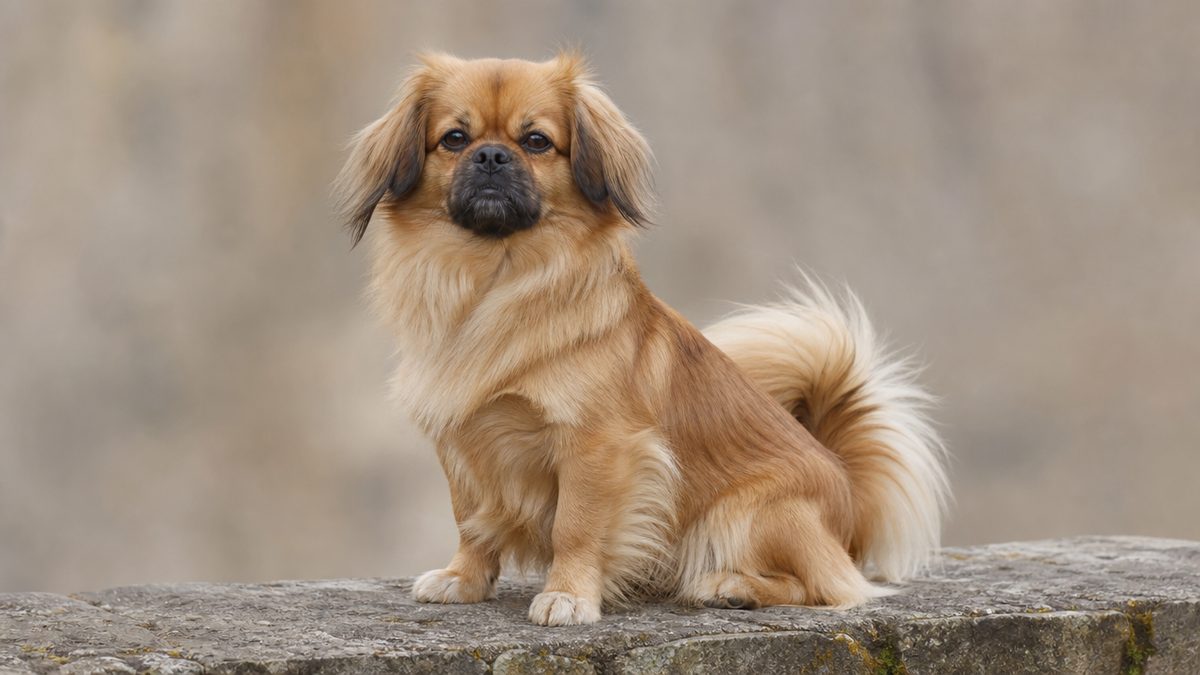
The Tibetan Spaniel is a small, alert Tibetan companion dog of about 25.4 cm and 4.1 to 6.8 kg that the Federation Cynologique Internationale files as standard 231 in Group 9 Companion and Toy Dogs, Section 5 Tibetan breeds, and that the Royal Kennel Club files in the Utility group The Royal Kennel Club, Breeds A to Z.
Three features separate it from every other small coated dog an Indian buyer will be shown. It is slightly longer in body than it is tall, never square. It has a medium muzzle, blunt with cushioning and free from wrinkle, so it is not a flat-faced dog. And its feet are harefeet, small and neat with feathering between the toes, with round cat feet expressly called undesirable, which is the opposite of what most toy breeds specify.
The coat is silky rather than woolly, smooth on the face and the front of the legs, of moderate length on the body and lying rather flat, over a fine dense undercoat. A mane or shawl of longer hair covers the neck and is more pronounced in a dog than a bitch. The standard is explicit that the breed should not be overcoated. All colours and mixtures of colours are permissible, which is unusual and which means no colour is rare enough to justify a premium.
The one-line version
A Tibetan Spaniel is a 25 cm, 4 to 7 kg alert companion with a flat-lying silky coat, a life expectancy the published record puts second of 155 breeds at 15.2 years, and one very specific dental problem. Its coat care burden is moderate rather than punishing, and its health issues are concentrated in the eye, the kidney and the mouth.
| Point | What FCI Standard 231 says | Why it matters in India |
|---|---|---|
| Group | Group 9, Companion and Toy Dogs, Section 5 Tibetan breeds | Not a gundog group, so no working trial and no retrieving instinct |
| Height | About 25.4 cm (10 ins) at the withers | Genuinely small, and the registry rates it as a flat dog |
| Weight | Ideal 4.1 to 6.8 kg (9 to 15 lbs) | A real range, unlike the Tibetan Terrier standard which states none |
| Size, second opinion | The AKC standard agrees at about 10 in and 9 to 15 lb | Two registries agreeing on size is rarer than it sounds |
| Proportion | Slightly longer from withers to tail root than height at withers | A square dog of this type is more likely a Lhasa Apso cross |
| Muzzle | Medium length, blunt with cushioning, free from wrinkle | Mesocephalic, not brachycephalic; this is the heat-relevant difference |
| Mouth | Slightly undershot, teeth evenly placed, full dentition desirable | Indian law's breeder-testing clause names undershot jaw as a defect |
| Feet | Harefoot, small and neat; round cat-feet undesirable | Feathering between the toes still traps monsoon moisture |
| Colour | All colours and mixture of colours permissible | No colour can honestly command a premium in this breed |
The Royal Kennel Club adds the practical ratings a standard never carries: Size Small, Exercise up to one hour per day, Size of home Flat/Apartment, Grooming more than once a week, Coat length Medium, Sheds Yes, Lifespan over 12 years. That apartment rating is the single most useful line on this page for an Indian urban buyer.
McMillan 2024's Table S5 files the Tibetan Spaniel as MESOCEPHALIC while filing the Lhasa Apso and the Shih Tzu as BRACHYCEPHALIC. Its own standard demands a medium muzzle free from wrinkle. In an Indian summer that is a real advantage over the two breeds it is most often confused with, because a dog with a functioning muzzle can cool itself by panting in a way a flat-faced dog cannot.
Why the Tibetan Spaniel is not a spaniel
The Tibetan Spaniel is not a spaniel because it is absent from the FCI's spaniel group, sits in the companion group instead, and was given the name by European visitors who thought it looked like a toy spaniel, which the Kennel Club states in its own words The Royal Kennel Club, Breeds A to Z.
A spaniel, as a working category, is a flushing gundog. The FCI keeps those in Group 8, Retrievers, Flushing Dogs and Water Dogs, which holds 22 breeds. The Tibetan Spaniel is not one of them. Nine in-document spaniel controls were present in the same retrieval, including the Clumber, English Cocker, English Springer, Field, Sussex, Welsh Springer, American Cocker, Irish Water and American Water Spaniels, so the search worked and the absence is a finding.
Where it does sit is Group 9, Companion and Toy Dogs, alongside the Tibetan Terrier, the Lhasa Apso, the Shih Tzu, the Boston Terrier and the two King Charles Spaniels. Group 9 is, in effect, where the FCI keeps the breeds whose names mislead.
The registry says where the name came from
The Royal Kennel Club does not hedge. Its breed page reads: 'The title of spaniel was given to the breed by early European visitors in Tibet who likened it to a toy spaniel and the Kennel Club later adopted this name'. That is a registry recording that it inherited a foreign resemblance label and kept it.
The consequence for a buyer is behavioural. A spaniel is bred to work in front of a gun, to quarter ground and to want to retrieve. This dog was bred to sit on a wall and alarm bark. Do not buy it expecting a soft, biddable, fetch-driven gundog temperament, because the standard requires the opposite: gay and assertive, highly intelligent, aloof with strangers, alert, loyal but independent.
| Breed | What the name implies | FCI group actually held | Absent from | Controls that passed in the same retrieval |
|---|---|---|---|---|
| Tibetan Spaniel | A flushing gundog | Group 9, Companion and Toy Dogs | Group 8, 22 breeds | 9 spaniels, from Clumber to American Water |
| Tibetan Terrier | An earth-working terrier | Group 9, Companion and Toy Dogs | Group 3, 32 breeds | 14 terriers, from Airedale to Kerry Blue |
FCI Standard 231's English text prints its disqualifying fault as 'Any dog clearly showing physical of behavioural abnormalities', with 'of' where FCI 209's parallel sentence correctly reads 'or'. It changes nothing about the breed and it is a useful reminder that a primary document is a primary source for what the body said, not an error-free text.
The second longest-lived breed of 155, and what that is built on
The Tibetan Spaniel has a median survival of 15.2 years with a 95 percent confidence interval of 14.8 to 15.7, which places it second of the 155 purebred breeds in the largest UK companion-dog longevity study, behind only the Lancashire Heeler.
The figure comes from McMillan 2024, which analysed 584,734 dogs from 18 UK sources. Its Supplementary Table S3 gives this breed 137 deaths, a median of 15.2 years, and a hazard ratio of 0.45 (0.38 to 0.53) at p below 0.001. Read that hazard ratio correctly: the comparator is the study's crossbred group, not all dogs and not a breed average, so it says this breed died substantially later than the crossbreds in the same dataset.
| Rank | Breed | Median survival | 95% CI | Deaths | Hazard ratio |
|---|---|---|---|---|---|
| 1 | Lancashire Heeler | 15.4 years | 14.7 to 15.9 | 110 | 0.49 |
| 2 | Tibetan Spaniel | 15.2 years | 14.8 to 15.7 | 137 | 0.45 |
| 3 | Bolognese | 14.9 years | 14.0 to NA | 32 | 0.49 |
| 4 | Shiba Inu | 14.6 years | 14.0 to 15.1 | 91 | 0.45 |
| 16 | Lhasa Apso | 14.0 years | 13.9 to 14.2 | 2,723 | 0.62 |
| 28 | Tibetan Terrier | 13.8 years | 13.5 to 14.2 | 583 | 0.58 |
| 83 | Shih Tzu | 12.8 years | 12.6 to 12.9 | 5,894 | 0.94 |
| Comparator | Crossbreed | 12.0 years | 12.0 to 12.1 | 72,445 | reference |
| 156 | Caucasian Shepherd Dog | 5.4 years | not quoted here | 22 | not quoted here |
Two honest caveats
- The sample is modest. 137 deaths is a real number and it is far smaller than the Lhasa Apso's 2,723 or the Shih Tzu's 5,894, which is why the confidence interval is nearly a full year wide. The rank is trustworthy; the exact decimal is less so.
- The two supplementary tables disagree on the denominator. Table S3's first column gives 351 and Table S6 gives a total of 330 for the same breed. The DEATH COUNT of 137 is identical in both, which is why this page quotes deaths and the median rather than either sample size.
One more comparison is worth making because Indian buyers are frequently told that pedigree dogs are inherently less healthy than mixed ones. In this dataset all four Tibetan-descended Group 9 breeds outlived the crossbred comparator: Tibetan Spaniel 15.2, Lhasa Apso 14.0, Tibetan Terrier 13.8 and Shih Tzu 12.8 against 12.0. That is not an argument for buying rather than adopting. It is an argument against a blanket claim.
Median survival was measured in a UK primary-care population. It does not forecast how long a dog lives in Chennai, where the risk profile includes tick-borne disease at rates a UK dataset never sees. Use it to compare breeds against each other, not to predict your own dog's life.
Tibetan Spaniel price in India: there is no page, let alone a price
No tibetan spaniel price in india exists in any form this page could verify, and the strongest evidence is that both Indian breed-price sites which carry the Tibetan Terrier have no page for this breed at all.
Say the negative properly, because a negative claim needs evidence rather than an empty search result.
- poodles.in/dog-breeds/tibetan-spaniel returns HTTP 200 with the page title 'Dog Breed Not Found' and 874 characters of text. That is a soft 404 which a status check passes, and reading the title rather than the status code is what exposes it.
- happypet.care/dog-breeds/tibetan-spaniel returns a genuine HTTP 404 titled '404 - Page Not Found'.
- The control passed in the same run. poodles.in's Lhasa Apso and Welsh Terrier pages both returned full breed guides of 16,000 to 18,000 characters, so the site was working and the absence is real rather than an artefact of a broken retrieval.
- Both sites do carry the Tibetan Terrier, with a price of Rs 25,000 to Rs 50,000. So the omission is specific to this breed rather than to Tibetan breeds generally.
Why the search engines cannot settle this either
Every query containing the word Tibetan returns the same ten results about Tibet the region on the only search engine whose control passed in this session, and the isolating test is that 'tibetan mastiff price in india' returns that identical set too, under the identical count of 'About 49,600 results'. The Tibetan Mastiff has a genuine Indian market. So the failure is the token, not the breed, and nothing about this breed's Indian availability can be read off those results in either direction.
That is why the absence claim on this page rests on direct HTTP tests of named sites rather than on a search.
The nearest honest Indian comparison
What an Indian reader can have is the cost row for the closest comparable breed, with its mechanism exposed. poodles.in gives the Lhasa Apso a buying price of Rs 20,000 to Rs 50,000, monthly food Rs 1,200 to Rs 1,800, monthly health Rs 900 to Rs 1,800 and monthly grooming Rs 1,200 to Rs 1,800. Add the three monthly floors: 1,200 plus 900 plus 1,200 is Rs 3,300. Add the ceilings: 1,800 plus 1,800 plus 1,800 is Rs 5,400. Those are exactly happypet.care's headline monthly figures for the same breed. The totals are the arithmetic sum of three preset component lines, not a measurement of what any dog costs.
So even the comparison figure is a template. A puppy price quoted to you for a Tibetan Spaniel in India has, at best, been reasoned across from a template row for a different breed.
We will not invent a Tibetan Spaniel price in India, and we will not convert a foreign asking price into rupees and present it as one. Both are fabrication. If somebody quotes you a figure, ask which litter it is for, ask to see the dam in the place the litter was raised, and ask for the PRA3 DNA result on both parents. In a breed with no Indian market, the certificate is the only thing that distinguishes one seller from another.
What a Tibetan Spaniel actually costs to keep in India
Budget roughly Rs 3,000 to Rs 6,000 a month for a Tibetan Spaniel in an Indian metro, which is lower than for most breeds because at 4.1 to 6.8 kg it eats like a small dog and its coat needs weekly rather than daily professional attention.
Build the figure from prices you can check rather than from a template total. Every rupee figure below was read live on a named provider's own page on 9 September 2026.
| Line | Published figure | Provider and scope |
|---|---|---|
| Puppy vaccination course | From Rs 6,499 (list Rs 8,111) | Vetic national page, a promotional floor from one chain |
| Annual booster | From Rs 3,199 (list Rs 3,806) | Vetic national page |
| Anti-rabies, single | Rs 699 | Vetic |
| 9-in-1 DHPPiL | Rs 899 | Vetic |
| Kennel cough | Rs 1,349 | Vetic |
| Anti-rabies at a municipal clinic | Free of cost | Greater Chennai Corporation's pet clinics |
| Bath, 60 minutes | From Rs 934 (list Rs 1,099) | Vetic Delhi, includes blow drying |
| Haircut with dematting | From Rs 1,359 (list Rs 1,599) | Vetic Delhi, rarely needed on this coat |
| Consultation | Rs 500 to Rs 1,000 | VOSD, treated here as one data point |
| Food, small dog | Rs 500 to Rs 1,500 per month | VOSD small-dog band, which is the right band for 4 to 7 kg |
| Boarding, overnight to 24 hours | Rs 899 | PawSpace Bengaluru, festive rates 25 to 30 percent higher |
| Municipal registration, Delhi | Rs 500 new, Rs 500 renewal | MCD, dogs only, late fee Rs 100 per month |
| Municipal licence, Chennai | Rs 50 | Greater Chennai Corporation, 9,115 issued in 2024 |
Three of those lines repay reading closely. Delhi's Municipal Corporation registers pet dogs only, ties the certificate's one-year validity to the anti-rabies vaccination date, and charges Rs 100 per month in late fees after a one-month grace period. Greater Chennai Corporation licenses pet animals at Rs 50, issued 9,115 licences in 2024, and provides all treatment and anti-rabies vaccination free of cost at its pet clinics. And boarding moves seasonally: PawSpace publishes Rs 899 for an overnight stay and states on its own page that festive-season rates run 25 to 30 percent higher with food charged separately.
The line this breed adds that others do not
Budget for dentistry. This breed is the most affected in a ten-year study of 279 dentigerous cysts in 192 dogs, contributing 58 dogs and 30 percent of the series. A dentigerous cyst is diagnosed on a dental radiograph and treated surgically, and neither is included in any Indian monthly cost row on any site. A conscious oral examination will not find it. Ask your vet about dental radiographs at the first anaesthetic, which is usually the neuter.
- Budget Rs 800 to Rs 1,500 a month for food, using the small-dog band rather than the medium one.
- Budget Rs 300 to Rs 900 a month for grooming, since the Royal Kennel Club rates this coat at more than once a week rather than daily.
- Budget Rs 400 to Rs 700 a month amortised for vaccination, deworming and parasite control.
- Budget one dental radiograph series at the first anaesthetic, which is the breed-specific line nobody else lists.
- Budget Rs 42 a month for the Delhi registration or Rs 4 a month for the Chennai licence, both legally required and both routinely skipped.
Greater Chennai Corporation's pet clinics provide all treatment and anti-rabies vaccination free of cost, and the licence is Rs 50. Against Vetic's Rs 699 for a single anti-rabies shot, that is a 12x spread on one identical vaccine. The spread is a function of the delivery model rather than of the drug, which is worth knowing before you assume a private clinic price is the market price.
Can a Tibetan Spaniel handle the Indian climate?
A Tibetan Spaniel handles the Indian climate better than most Tibetan breeds because it is small, mesocephalic and moderately rather than heavily coated, and the honest limit on this section is that its homeland climate cannot be measured with the instrument available NASA POWER climatology API.
Deal with the homeland first and briefly. NASA POWER returns a grid cell rather than a point, and on the Tibetan plateau the cell misses the ground badly: its Lhasa cell reads 4,316.71 m against a real 3,656 m, an error of +660.71 m, with Shigatse +910.18 m and Gyantse +510.32 m. At roughly 6.5 C per 1,000 m those errors are worth four to six degrees. This page therefore publishes no plateau temperature at all rather than a cell it cannot stand behind.
The Indian half is measurable
| City | Cell elevation vs real | Annual mean | Hottest month | Annual humidity | Verdict for this breed |
|---|---|---|---|---|---|
| Bengaluru | 841.72 m vs 920 m | 23.74 C | April, 28.37 C | 67.94 percent | The best Indian city for this breed by a clear margin |
| Pune | 635.99 m vs 560 m | 23.86 C | April, 28.93 C | 66.80 percent | Close second, and coolest in December rather than January |
| Delhi | 206.37 m vs 216 m | 25.60 C | June, 35.88 C | 45.56 percent | Workable in winter, an indoor dog from April to July |
| Mumbai | 97.15 m vs 14 m | 26.77 C | May, 31.19 C | 67.39 percent | Lower peak heat than Delhi, worse monsoon drying |
| Kolkata | 7.35 m vs 9 m | 25.81 C | May, 31.53 C | 73.93 percent | Highest annual humidity of the six; watch the ears |
| Chennai | 48.95 m vs 6 m | 27.95 C | May, 31.51 C | 72.39 percent | Warm all year with no cool season to recover in |
Two rows there contradict what most Indian pages print. Delhi peaks in June, not May, and Bengaluru and Pune both peak in April, with their coolest month in December rather than January. A page that gives every Indian city a May peak has queried nothing.
Why this breed does better than its cousins
Three structural reasons, and all three are checkable rather than impressionistic.
- It is mesocephalic. McMillan 2024's Table S5 files this breed as mesocephalic and files the Lhasa Apso and the Shih Tzu as brachycephalic. A dog with a functioning muzzle cools itself by panting; a flat-faced dog does it badly, which is why brachycephalic breeds dominate every heat-illness study.
- It is small. At 4.1 to 6.8 kg it sits far below the over-50 kg band that carries the heaviest heat-illness odds, and small dogs shed heat over a larger surface area relative to their mass.
- Its coat lies flat and is moderate rather than profuse. The standard says explicitly that the breed should not be overcoated, and the Royal Kennel Club rates the coat as Medium rather than Long.
None of that makes it a hot-climate dog. It remains heat-sensitive, it still carries a fine dense undercoat, it still must never be shaved to the skin, and it still belongs indoors during a Delhi June whose mean is 35.88 C. Apartment living suits it, and an air-conditioned apartment suits it a great deal better than a balcony does.
Humidity is the drying problem
Overseas grooming advice routinely says to towel a dog and let the coat air dry. That instruction assumes air that dries things. At Kolkata's 73.93 percent and Chennai's 72.39 percent annual relative humidity, a dense undercoat that is towelled and left stays damp against the skin for hours. On this breed the ears are the specific risk, because they are pendant and well feathered, and Demodex canis has been reported as a cause of chronic otitis externa in a Tibetan Spaniel. Plug the ears for a bath, dry inside the leather afterwards, and check them weekly through the monsoon.
Second Schedule Part IV paragraph 21(1) of the Prevention of Cruelty to Animals (Dog Breeding and Marketing) Rules 2017 bars keeping in outdoor facilities, without the attending veterinary practitioner's written approval, dogs not accustomed to local temperatures and dog breeds that cannot tolerate them, naming 'long-haired breeds in high temperature locations'. Note the citation form: this is a Second Schedule paragraph, not a Rule. The Rules stop at 13, so a citation reading Rule 21 points at a provision that does not exist.
Temperament, and who should not buy one
A Tibetan Spaniel is gay and assertive, highly intelligent, aloof with strangers, alert, loyal but independent, which is the wording both the FCI and the Kennel Club standards require, and it is an accurate description of a dog bred to make its own decisions on a monastery wall.
The monastery account explains the behaviour, and it is worth stating as tradition rather than as sourced history, because Wikipedia's account of it carries a citations-needed banner and several citation-needed tags. On that account the dogs sat on the monastery walls as lookouts, alarm barked to alert the monks and the Tibetan Mastiffs below, turned the prayer wheels and slept with the monks for warmth. Whether or not every detail holds, the behaviour the breed shows today is exactly what a lookout would show.
Four traits with household consequences
- Alarm barking at strangers is the job, not a fault. A Tibetan Spaniel that announces a delivery rider is doing what it was selected to do. Manage it, and do not expect to remove it.
- Aloof is not fearful and not aggressive. The standard asks for a reserved greeting. A dog that cowers or snaps at strangers is outside the standard rather than typical of it.
- Independent means it will wander. This breed is described as fiercely independent with a tendency to explore rather than come when called, and that is a legacy of the lookout role rather than disobedience.
- Social means it does badly alone. It was developed as a companion and does not respond well to being left alone for long periods, which for an Indian household with two working adults and a twelve-hour empty flat is the trait that decides suitability.
Who should not buy one
Four households should choose differently, and saying so is more useful than a list of virtues.
- Anyone whose building will not tolerate alarm barking and who is not prepared to train around it from month four.
- Anyone who wants a reliable off-lead recall in an unfenced Indian park, which this breed will resist for years.
- Anyone whose flat is empty twelve hours a day, because this is a companion breed rather than a self-sufficient one.
- Anyone buying a small dog to be a lap ornament, because the standard asks for assertive and alert rather than placid.
What it does suit is an Indian flat where somebody is usually home, where the daily hour of exercise is realistic, and where a dog that watches the front door is a feature rather than a problem. In that household it is genuinely affectionate, and devoted to its own people in a way the word aloof conceals. The Royal Kennel Club's Flat/Apartment rating is a genuine recommendation and it does not extend it to the Tibetan Terrier The Royal Kennel Club, Breeds A to Z.
It is an accurate report of behaviour and a poor explanation of it. A dog selected for two thousand years to decide for itself whether something on the horizon mattered is not going to treat your recall cue as binding unless you make it worth more than the horizon. Pay better, do not shout louder.
How to train a Tibetan Spaniel, and what it resists
To train a Tibetan Spaniel, use very short reward-based sessions and pay generously for recall specifically, because this is an independent alert breed that learns quickly and complies selectively.
Two things make this breed different from a biddable gundog. It learns a behaviour fast, and it evaluates whether performing the behaviour is worth it. Neither is a defect and neither responds to correction.
| Age | Priority | Why now |
|---|---|---|
| 8 to 12 weeks | Handling, mouth handling, name, house training | Indian law bars sale below eight weeks under Rule 8(1)(a), so this is your earliest legal start |
| 8 to 12 weeks | Daily mouth checks specifically | This is the dentigerous cyst breed; a dog that accepts mouth handling gets diagnosed earlier |
| 10 to 16 weeks | Socialisation to lifts, stairs, traffic, gate guards, delivery riders | The window closes early and an alert breed rehearses suspicion fast |
| 3 to 6 months | Quiet cue and settle on a mat | Alarm barking becomes a rehearsed habit by six months if left alone |
| 4 to 9 months | Alone-time in graded doses | A companion breed left suddenly alone at a year old develops separation distress |
| 6 to 12 months | Recall, paid at a rate you would not use for another breed | The hardest single behaviour in this breed, and the one that keeps it alive on an Indian road |
| 9 to 12 months | Loose-lead walking and traffic confidence | A 5 kg dog on an Indian street needs to be steady, not brave |
What this breed resists
It resists repetition, it resists correction and it resists coming away from something interesting. Three sessions of three minutes beat one session of ten. A dog that has decided your cue is worth less than the thing it is looking at will not be argued out of that view, so change the pay-off.
Recall deserves separate treatment. The breed is described as tending to wander off and explore rather than come when called, and a 5 kg dog that has decided to investigate something on an Indian street is both hard to see and hard to retrieve. Treat off-lead freedom in an unfenced space as a privilege the dog has not yet earned, keep a long line on for the first year, and pay recall at a rate you would consider excessive.
The single highest-value habit you can build in this breed's first year is a dog that lets you lift both lips and look at every tooth without objecting. It costs a minute a day. Given that this breed contributed 58 of 192 dogs to the largest published dentigerous cyst series, that minute is the difference between finding a problem at the annual check and finding it when the jaw is already involved.
Daily exercise, and what happens without it
A Tibetan Spaniel needs up to one hour of exercise a day, which the Royal Kennel Club states and which is easily achievable inside an Indian city if it is split and timed around the heat.
One hour is the working figure for a healthy adult. Split it into two or three outings rather than one long walk, because a 5 kg dog with short legs covers ground slowly and gets more out of frequency than distance.
The Indian timing rule
Delhi's June mean is 35.88 C and its January mean is 13.61 C, so the same hour is trivial in one month and dangerous in another. The rule is not effort, it is arithmetic.
- Walk before 7am and after 7pm from April to July in Delhi, Ahmedabad, Hyderabad, Chennai and Kolkata.
- Test the pavement with the back of your hand for five seconds, and if you cannot hold it, neither can a dog with 25 cm legs and its body close to the surface.
- Substitute indoor work at midday: scent games, a food puzzle, three minutes of trick training.
- Watch for heavy panting with a wide flat tongue, stumbling or brick-red gums, and treat any of them as an emergency.
- Shorten the walk and lengthen the thinking during the monsoon, because a wet flat-lying coat on a small dog chills faster than owners expect.
A small dog close to the ground takes more radiant heat off an Indian road than a tall dog does, which is a genuinely underappreciated point and applies to this breed more than to its taller Tibetan cousins.
What under-exercise produces
Not destruction, usually. In this breed the failure mode is barking. An alert dog with nothing to do watches the door and reports on it, and that is what turns into a neighbour complaint in an Indian apartment block. If the barking has increased, add a walk before adding a correction.
In Hall 2020, Scientific Reports, dogs at or above their breed and sex mean bodyweight carried 1.42 times the odds of heat-related illness, at a 95 percent confidence interval of 1.12 to 1.80. The over-50 kg figure in the same paper does not apply to a 5 kg dog, and this breed is not separately modelled in that paper's breed table. The bodyweight factor does transfer, and on a 4 to 7 kg dog half a kilogram is a large proportion. Weigh monthly.
Grooming a Tibetan Spaniel in Indian humidity
Grooming a Tibetan Spaniel means brushing two or three times a week rather than daily, and drying the dog fully after every wash, because the Royal Kennel Club rates this coat at More than once a week and Medium length against the Tibetan Terrier's Every day and Long The Royal Kennel Club, Breeds A to Z.
The coat is silky rather than woolly and lies rather flat, so it tangles less than a profuse standing coat. Three areas do mat and they are predictable: the mane or shawl around the neck, the feathering on the backs of the forelegs and behind the ears, and the plume on the tail and buttocks.
- Brush the body with a soft slicker, following the lie of the coat rather than against it.
- Comb the mane, the ear feathering and the tail plume separately, from the skin outward.
- Check between the toes, because the standard specifies feathering that often extends beyond the foot and that feathering collects Indian street grit.
- Wipe the face daily if the dog is prone to weeping eye, which is a common cosmetic condition in the breed.
- Dry completely after every bath, to the skin, with a dryer on cool.
| Frequency | Task | Why in India specifically |
|---|---|---|
| 2 to 3 times a week | Full brush plus comb through mane, feathering and tail | The registry's own rating, and enough for a flat-lying coat |
| Daily in monsoon | Dry feet and between the toes after every walk | Feathering between the toes holds water against skin |
| Weekly | Check and dry inside both ear leathers | Pendant feathered ears plus monsoon humidity is the otitis recipe |
| Daily if needed | Wipe the face and under the eyes | Weeping eye is common and stains quickly in dusty Indian air |
| Every 4 to 6 weeks | Bath, then dry completely to the skin | Never air dry a double coat in Indian humidity |
| Every 8 to 12 weeks | Trim feet and sanitary area only | This breed does not need and should not have a body clip |
| Never | Shave to the skin | Removes insulation and sun protection on a dog that already tolerates heat only moderately |
This is one of the few coated breeds where an Indian owner can reasonably do all the coat care at home, which makes it the most affordable coated breed on this site to keep properly. At Vetic Delhi's Rs 934 for a bath with blow drying, professional grooming every six weeks is roughly Rs 8,100 a year, and this coat does not require it.
The Royal Kennel Club records Sheds: Yes for this breed, so it does not attract the hypoallergenic claim as often as its cousins do. Where the claim is made about any breed, the evidence settles it: Vredegoor 2012 measured Can f 1 across 196 dogs of so-called hypoallergenic breeds against 160 controls and found the hypoallergenic group HIGHER, at 2.26 against 0.77 micrograms per gram on hair, with no difference in airborne allergen.
Health issues in the Tibetan Spaniel, from the published record
The Tibetan Spaniel's health issues concentrate in five places, and the breed is either the most affected or among the three most affected in the published series for two of them, while its overall life expectancy remains the second longest of 155 breeds Hoppe A, Denneberg T. Cystinuria… McMillan 2024 Supplementary Table S3.
That combination is the honest picture and it is unusual. This is a long-lived breed with several specific, well-documented problems rather than a fragile breed with a short life. Both halves need saying.
| Condition | What was measured | The number | Study design caveat |
|---|---|---|---|
| Dentigerous cyst | 279 cysts in 192 dogs over 10 years | 58 dogs, 30 percent, the most affected breed | A private referral dental clinic caseload, not a population prevalence |
| Cystinuria | 88 cystinuric dogs across 26 breeds over 14 years | One of the three commonest breeds | A treatment series, so it counts diagnosed dogs rather than a rate |
| Progressive retinal atrophy | 51 dogs in Norway and Sweden | 24 male and 27 female, all interrelated | A regional case series with a traced common ancestry |
| Primary hyperoxaluria | 2 pups of a litter of 3 | Enzyme activity markedly reduced in liver and kidney | A single litter, which is why the paper says probable |
| Mast cell tumour | 476 tumour cases from 147,802 dogs | A significantly increased odds ratio, newly identified | One Austrian laboratory database, 2000 to 2010 |
The mast cell tumour finding deserves its own sentence because it is easy to overstate. Leidinger 2014 ranked breeds across 147,802 Austrian dogs with a known breed, identified 476 with mast cell tumours, and found that only four of the country's twenty most popular breeds carried an increased risk. It then named several breeds not previously flagged in the literature as carrying a significantly increased risk, and the Tibetan Spaniel is among them, alongside the Dogo Argentino, the Pyrenean Mountain Dog, the Beauceron and the Austrian Smooth-haired Hound. That is one country's laboratory caseload over eleven years, not a population prevalence, and the age distribution peaked at 6.1 to 8.0 years with 70 percent of tumours on the head and trunk. Treat it as a reason to have lumps checked promptly rather than as a reason not to buy the breed.
The literature itself is small and the search for it is a trap worth describing, because it changes what a reader can trust. A PubMed phrase search returns 8 records for 'Tibetan Spaniel'[tiab] and 5 for the plural, and the two sets are not nested: the dentigerous cyst paper and the cystinuria paper both appear only in the PLURAL set. A writer who searched the singular alone, which is the natural thing to do, would have missed this breed's two largest clinical series entirely.
Dentigerous cysts, where this breed leads every other
A dentigerous cyst forms around the crown of a tooth that never erupted, and it destroys the surrounding bone quietly while the mouth looks normal from outside. Vesterinen 2024 reviewed ten years of records from a private referral dental clinic and found 279 such cysts in 192 dogs. Verbatim: 'The most affected were Tibetan Spaniels with 58 dogs (30%) and Boxers with 48 dogs (25%)'. Both of those percentages reproduce from the counts, at 30.2 and 25.0.
Two further details matter for an owner. The most commonly affected tooth was the mandibular first premolar, reported as 238 cysts. And of the 279 cysts, 208 were examined histopathologically and none contained malignant changes, giving a probability of malignancy of 0 to 1.4 percent. So this is a bone-destroying problem rather than a cancer risk, and it is found on a radiograph rather than on a look.
The paper gives the mandibular first premolar as '238 (84%) cysts', and 238 divided by 279 is 85.3 percent rather than 84. Eighty-four percent of 279 would be 234. The discrepancy is small and it does not affect the breed finding, but this page quotes the count of 238 rather than the rate, because a percentage that does not reproduce from the numbers beside it should not be repeated as though it did.
Progressive retinal atrophy, and what the DNA test does and does not do
Bjerkas and Narfstrom diagnosed late-onset PRA in 51 Tibetan Spaniels in Norway and Sweden, aged three to seven years at diagnosis, with approximately one year from the first sign of night blindness to complete loss of vision. Twenty-four males and 27 females were affected, which sums to 51. All were interrelated and traceable to common English ancestors, and the authors postulated autosomal recessive inheritance. With 15 further cases reported elsewhere they called it a worldwide problem in the breed.
Twenty years later the mutation was found. Downs and Mellersh mapped a novel locus, PRA3, on chromosome 10 using 22 Tibetan Spaniel cases and 10 controls, and identified a short interspersed nuclear element inserted near a splice acceptor site in an intron of FAM161A, which causes exon skipping, a frame shift and a premature termination codon. A DNA test based on it became available in July 2013.
The important qualification is in the paper itself. The variant segregated with disease in 22 of 35 cases tested, and the authors state plainly that PRA is genetically heterogeneous in both Tibetan Spaniels and Tibetan Terriers. So a PRA3-clear parent reduces the risk and does not eliminate it, and any breeder who tells you a clear certificate means the puppy cannot go blind is overstating what the test does.
Kidney and bladder: two separate stories
Cystinuria puts this breed among the three commonest in an 88-dog series across 26 breeds treated over 14 years, alongside Dachshunds and Basset Hounds. Medical treatment prevented re-formation of cystine uroliths in 76 of 88 dogs, which the paper states as 86 percent and which divides out at 86.4, and moved the recurrence interval from 7 months to 18. Adverse effects occurred in 11 dogs, the most severe being aggressiveness and myopathy, and all resolved when treatment stopped.
Primary hyperoxaluria is rarer and more striking. Jansen and Arnesen found severe oxalate nephropathy with end-stage kidney lesions in two pups of a litter of three Tibetan Spaniels, with no exposure to anything that causes secondary hyperoxaluria, and noted that the condition had not previously been reported as a spontaneous disease in the dog. A follow-up paper measured the enzymes and found alanine:glyoxylate aminotransferase and serine:pyruvate aminotransferase markedly reduced in liver and kidney, with a severe deficiency of immunoreactive enzyme on immunoblotting, concluding the condition is analogous to human primary hyperoxaluria type 1. That is a single litter, thirty-five years ago, and it should be read as a case report rather than as a breed risk.
Portosystemic shunt, and the anaesthetic point
A portosystemic shunt lets blood bypass the liver. The signs reported in this breed include poor weight gain, seizures, head pressing, weakness, salivation, vomiting, increased drinking and urinating, early bladder stones, and a dramatic worsening after eating. The detail worth carrying to a vet is sensitivity to sedatives, especially diazepam. If a small Tibetan Spaniel reacts unusually strongly to a sedative, that is information rather than an oddity, and it belongs in the record before the next anaesthetic.
- Tell your vet the breed's dentigerous cyst rate before the first anaesthetic, and ask about full-mouth dental radiographs while the dog is already under.
- Ask for the PRA3 DNA result on both parents, and understand it is a risk reduction rather than a guarantee.
- Watch for a puppy that fails to grow at the rate of its littermates, which is the commonest way a shunt is caught early.
- Report any unusual reaction to sedation, and have it written into the dog's file.
- Check for tick-borne disease in India regardless of breed: among dogs tested at Indian veterinary clinics, a West Bengal series of 584 screened dogs reported Babesia gibsoni in 76.54 percent and two or more pathogens in 72.9 percent of those screened.
The Royal Kennel Club names NO test at all in its Good Practice tier for this breed, listing only 'Prioritising genetic diversity', with a PRA3 DNA test and eye testing at Best Practice. Compare the Tibetan Terrier, which carries five named Good Practice screens. Read the tiers rather than the count: Good Practice means the club judges the condition a significant concern, Best Practice means significant but less critical or newly identified. A short list here is a considered position, not an oversight.
The Indian legal position, including a mouth the law names
No Indian law bans this breed, and the one place Indian law touches it directly is its mouth, because Second Schedule Part III paragraph 8(10) of the Dog Breeding and Marketing Rules 2017 names undershot jaw among the genetic defects a breeding dog must have been tested for, and the breed standard requires a slightly undershot bite.
Start with the ban question, because Indian buyers meet it constantly. The 2024 circular that listed ferocious breeds, reproduced in full in CBIC Instruction 05/2024-Customs, contains no spaniel of any kind and does not name this breed. Its four bare undefined category words are 'Terriers', 'Mastiffs (boerbulls)', 'Wolf dogs' and 'Canario', and none of the four reaches a Tibetan Spaniel on any reading. The circular was quashed by the Karnataka High Court on 10 April 2024, whose order reads '(ii) Circular dated 12-03-2024, issued by the 1st respondent stands quashed', and on 14 June 2024 the Madras High Court recorded the Department's own written words that 'the quashed circular has lost its effect entirely'.
The clause that does apply, and the collision it creates
Second Schedule Part III paragraph 8(10) reads, verbatim from the gazette: 'The dogs shall have been tested for genetic defects, including hip dysplasia, progressive retinal atrophy, night blindness, hypothyroidism, entropion, ectropion, overshot, undershot jaw (when incisors do not touch or mesh), wry mouth, two or more missing teeth, unilateral cryptorchid or full cryptorchid males'.
Two items on that list are this breed's own standard. Progressive retinal atrophy is the breed's best-documented inherited disease, and Indian law requires a breeding dog to have been tested for it, which is the same thing the Royal Kennel Club asks for at Best Practice. That is a rare case of Indian law and a British registry asking for the identical test.
Undershot jaw is the interesting one. FCI 231 and the Kennel Club standard both require a mouth that is 'slightly undershot'. The Rules' qualification matters and must be read carefully: the clause names undershot jaw specifically when the incisors do not touch or mesh. The standard also requires teeth evenly placed and full dentition desirable. So a correct Tibetan Spaniel mouth is slightly undershot with meeting incisors, and the collision is narrower than it first looks. What is unambiguous is that an Indian breeder of this breed must be able to show that the dog's bite was assessed, because the law names the feature the standard requires.
What the Rules do not contain, and why it matters here
Counted across all fourteen pages of the gazette by three methods including a whitespace-tolerant pattern, the words 'dental' and 'tooth' occur zero times, and 'teeth' occurs once, inside 8(10)'s phrase 'two or more missing teeth'. So there is no Indian dental requirement of any kind in the breeder rules.
For most breeds that absence is a footnote. For the breed that contributes 58 of 192 dogs to the largest published dentigerous cyst series, it is the gap that matters most. Nothing in Indian law will prompt anyone to radiograph this dog's jaw. You have to ask.
| Provision | Correct citation form | What it requires |
|---|---|---|
| Minimum sale age | Rule 8(1)(a) | Pups less than eight weeks in age are not sold |
| Mutilation | Second Schedule Part II para 6(8) | No docking, cropping, de-barking, de-clawing or change of appearance by artificial means |
| Close breeding | Second Schedule Part II para 6(3) | In breeding within four generations and incest breeding are prohibited |
| Genetic testing | Second Schedule Part III para 8(10) | Testing for named defects including progressive retinal atrophy and undershot jaw |
| Outdoor housing | Second Schedule Part IV para 21(1) | Bars outdoor housing of breeds that cannot tolerate local temperatures without written veterinary approval |
| Municipal registration | Local, not the 2017 Rules | Delhi Rs 500, Chennai Rs 50 |
The Rules run from 1 to 13 and there is no Rule 14, so the strings 'Rule 14' and 'Rule 21' each occur zero times in the whole gazette. Any Indian page citing 'Rule 21' for the outdoor-housing clause, or 'Rule 8(10)' for the genetic-testing clause, is pointing a reader at a provision that does not exist. Both live in the Second Schedule, whose four Parts are numbered continuously from 1 to 30.
Feeding a Tibetan Spaniel in India
Feed a Tibetan Spaniel from the small-dog band, roughly Rs 500 to Rs 1,500 a month, and score its body condition by hand every month, because at an ideal 4.1 to 6.8 kg half a kilogram of gain is a tenth of the dog.
This breed has a real published weight range, which makes feeding easier than for its Tibetan Terrier cousin, whose standard states no weight at all. FCI 231 gives an ideal of 4.1 to 6.8 kg. Treat the midpoint of your own dog's healthy adult weight as the target and defend it.
- Feel the ribs with flat fingers; you should find them under a thin fat cover without pressing in.
- Look from above for a waist behind the ribs, parting the coat at the flank if it obscures the outline.
- Weigh monthly on the same scale, because on a 5 kg dog a 300 g drift is invisible by eye and significant in fact.
- Adjust by ten percent at a time and re-score after three weeks, rather than switching food.
- Count treats, which on a dog this size are a much larger share of daily calories than owners assume.
Indian feeding realities
Quality food for a small dog in India runs Rs 500 to Rs 1,500 a month against Rs 1,500 to Rs 4,000 for a medium dog. Use the small band. The nearest Indian template figure available for a comparable Tibetan breed gives 500 kcal a day for puppies and 450 for adults, which sits in a plausible range for a 5 kg dog and should still be corrected by body condition rather than trusted.
- Split the adult ration into two meals, which suits a small stomach and a dog that will otherwise beg.
- Store kibble airtight, because an opened bag in Indian humidity goes rancid faster than the best-before date suggests.
- Avoid free-feeding, which makes it impossible to notice the appetite drop that is often an illness's first sign.
- Check the water bowl three times a day in April and May, and add water to the food in summer.
- Feed the last meal at least two hours before the evening walk rather than after it.
Two feeding notes specific to this breed
Watch what happens after eating. A dramatic increase in neurological signs after a meal is the classic indicator of a portosystemic shunt, and it is the one thing an owner is better placed to notice than a vet. If a puppy is dull, wobbly or head-pressing an hour after dinner, that is a same-day veterinary matter.
Encourage water. Cystinuria is managed in large part by increasing water intake, and this breed is one of the three commonest in the published treatment series. Wet food, added water and multiple bowls are cheap insurance in a hot country, and they cost nothing if the dog never develops the problem.
Home-cooked feeding is common and workable in India. The honest caveat is that an unformulated home diet is usually short on calcium and often on iodine and zinc, and on a 5 kg dog the margins are small. Get the recipe balanced by a veterinary nutritionist once, then keep it fixed rather than improvising weekly.
The first year, month by month
A Tibetan Spaniel puppy timeline has three jobs: socialise before sixteen weeks, build mouth handling into a daily habit, and get the eyes and the parents' PRA3 results documented before you pay Downs LM, Mellersh CS. An Intronic SINE….
| Age | What is happening | What you do |
|---|---|---|
| Before purchase | The highest-leverage moment | Get PRA3 results on both parents in writing and match them to the dogs |
| 8 weeks | Earliest lawful sale age in India under Rule 8(1)(a) | Refuse any younger puppy; begin vaccination on the vet's schedule |
| 8 to 10 weeks | Fear period; house training | Handle the mouth daily. Lift both lips, look at every tooth, pay well |
| 10 to 16 weeks | Socialisation window closing | Lifts, stairs, traffic, gate guards, delivery riders, vaccinated dogs |
| 3 months | Vaccination course running | From Rs 6,499 at one chain, or free anti-rabies at a Chennai municipal clinic |
| 4 months | Alarm barking becomes rehearsed | Teach the quiet cue now, not at a year |
| 4 to 6 months | Adult teeth erupting | This is the window to notice a tooth that never arrives |
| 6 months | Legal note on sale | Rule 8(1)(b) bars sale of dogs over six months without prior sterilisation, except to another licensed breeder |
| 6 to 9 months | Registration and licensing | Delhi MCD Rs 500 or Chennai Rs 50, both tied to the rabies certificate |
| 6 to 12 months | Neuter or spay decision | Whenever the dog is anaesthetised, ask for full-mouth dental radiographs |
| 9 to 12 months | Adolescence; recall gets worse before better | Keep a long line on. Pay recall at a rate you would call excessive |
| 12 months | Adult | Annual booster from Rs 3,199, and a baseline weight you will defend |
The tooth that never arrives
Between four and six months a puppy's adult teeth come through. In this breed that is the moment to count them. A dentigerous cyst forms around a tooth that never erupted, most commonly the mandibular first premolar, and the gum above it looks entirely normal. If a tooth you expected does not appear by seven months, that is a reason for a radiograph rather than a reason to wait.
The practical route is to combine it with an anaesthetic you were going to have anyway. Most dogs are anaesthetised once in their first year for neutering. Full-mouth dental radiographs at that visit cost far less than a second anaesthetic later and are the only way this problem is found early.
Rule 8(1)(a) of the Dog Breeding and Marketing Rules 2017 requires that pups less than eight weeks in age are not sold. Second Schedule Part II paragraph 6(8) forbids tail docking, ear cropping, de-barking, de-clawing and any change of appearance by artificial means. This breed should never be docked or cropped in any case, since its standard requires a high-set plumed tail carried in a curl and medium pendant ears, but de-barking is a live risk on a breed sold as vocal, and it is illegal.
Tibetan Spaniel compared with the breeds Indian buyers cross-shop
Indian buyers cross-shop the Tibetan Spaniel against the Lhasa Apso, the Shih Tzu and the Tibetan Terrier, and the decisive differences are life expectancy, whether the dog is flat-faced, and whether the registry rates it for a flat McMillan 2024 Supplementary Table S5 The Royal Kennel Club, Breeds A to Z.
| Breed | Median survival | Deaths | Skull type | RKC size of home | RKC grooming | Named RKC Good Practice screens |
|---|---|---|---|---|---|---|
| Tibetan Spaniel | 15.2 years (14.8-15.7) | 137 | Mesocephalic | Flat/Apartment | More than once a week | 0 named |
| Lhasa Apso | 14.0 years (13.9-14.2) | 2,723 | Brachycephalic | not compared here | not compared here | not compared here |
| Tibetan Terrier | 13.8 years (13.5-14.2) | 583 | Mesocephalic | Small house | Every day | 5 |
| Shih Tzu | 12.8 years (12.6-12.9) | 5,894 | Brachycephalic | not compared here | not compared here | not compared here |
| Crossbred comparator | 12.0 years (12.0-12.1) | 72,445 | mixed | - | - | - |
Three conclusions fall out of that table and no Indian page carries any of them.
- The Tibetan Spaniel outlives all three cross-shopped breeds, by 1.2 years over the Lhasa Apso, 1.4 over the Tibetan Terrier and 2.4 over the Shih Tzu at the median.
- It is the only one of the three small ones that is not flat-faced. McMillan's Table S5 files the Lhasa Apso and Shih Tzu as brachycephalic and this breed as mesocephalic, which in an Indian summer is the difference between a dog that can pant efficiently and one that cannot.
- All four beat the crossbred comparator at 12.0 years, which is worth knowing before anyone tells you a pedigree dog is inherently less healthy.
The trade-off, stated honestly
The Tibetan Spaniel wins on lifespan, on skull shape and on apartment suitability. It loses on one thing: the Tibetan Terrier's five named Royal Kennel Club Good Practice screens mean that with a Tibetan Terrier you can buy a documented dog, and with a Tibetan Spaniel there is far less to document The Royal Kennel Club, Breeds A to Z. On this breed the only DNA test the registry names is PRA3, and the paper behind it says plainly that a clear result does not exclude PRA.
So the two breeds fail differently. One asks you to do more homework and rewards it. The other has less homework available, and you buy on the breeder rather than on the certificates.
Both Indian breed-price sites carry a Tibetan Terrier page with a price and neither carries a Tibetan Spaniel page at all. Whatever the merits, an Indian buyer will find the Tibetan Terrier being offered and will not find this breed. Weigh that before falling in love with a table.
Mistakes Indian owners actually make with this breed
Six mistakes account for most of what goes wrong with a Tibetan Spaniel in India, and two of them are about a mouth nobody looks inside.
- Buying it as a Lhasa Apso substitute. The two are different shapes with different skulls and different lifespans, and the Lhasa Apso's brachycephalic filing matters in Indian heat.
- Never radiographing the mouth. This breed contributed 58 of 192 dogs to the largest published dentigerous cyst series, and a conscious oral examination cannot find the problem.
- Treating alarm barking as a training failure. It is the breed's original job. Manage it with an early quiet cue and adequate exercise rather than expecting to eliminate it.
- Trusting a PRA3-clear certificate as a guarantee. The paper behind the test states that PRA is genetically heterogeneous in this breed and the variant segregated with disease in 22 of 35 cases tested.
- Air drying after a bath, on advice written for a drier climate. At Kolkata's 73.93 percent annual humidity a dense undercoat stays damp for hours.
- Leaving it alone for a full working day. This is a companion breed that does not respond well to long solitude, and separation distress in an apartment becomes a barking complaint.
The mistake that costs the most welfare
Assuming a long-lived breed is a low-maintenance one. A 15.2-year median means you are signing up for fifteen years of dentistry, eye checks and water intake management, not fifteen easy years. The longevity is real. It is also the reason a problem found at year eight has seven more years to matter.
The mistake made by everyone writing about this breed
Repeating Wikipedia's claim that the FCI recognised the breed in 1987. The FCI's own nomenclature record gives definitive acceptance as 22 August 1961, and the date format is proven inside that record because the 22 in the acceptance date and the 24 in the standard publication date cannot be months. That is a 26-year error sitting in the most-copied source about this breed.
Searching for this breed online in India is broken. Every query containing the word Tibetan returns the same ten results about Tibet the region on the one engine that works from here, and the Tibetan Mastiff control returns the identical set under the identical result count, which proves it is the token and not the breed. Search for the breed clubs by name, or add a health-test name to your query, rather than concluding anything from what comes back.
Adoption, and how to source a Tibetan Spaniel responsibly in India
Adopting a Tibetan Spaniel in India means waiting, because no breed-specific rescue exists here, no Indian breed-price site even carries a page for the breed, and the search engines cannot be used to check Search-instrument audit for this page.
State the limit first. Bonbeno could not find any Indian rescue, register or count for this breed, and could not run a search that would have found one, because the only search engine whose control passed collapses every query containing the word Tibetan onto results about Tibet. So this page claims neither that Indian Tibetan Spaniels in rescue exist nor that they do not. What it can say, from direct HTTP tests, is that the two Indian sites which sell this breed's cousin have no page for it at all.
How to search when the search engines will not
- Register with two or three general metro rescues rather than searching listings, and ask to be told about any small flat-coated dog with a curled tail and a mane.
- Describe the dog rather than naming the breed, because a shelter volunteer will recognise 'small, gold, mane round the neck, plumed tail over the back' faster than a breed name.
- Contact national breed clubs and the international breed working party directly rather than through a search engine.
- Ask specifically about small Tibetan-type dogs surrendered by expatriate families, which is the likeliest route by which one reaches an Indian shelter.
- Expect to wait years rather than months, and decide in advance whether you would take an adult rather than a puppy.
If you buy, buy on evidence
Bonbeno does not recommend breeders, link puppy listings or quote a live price as an offer. What follows is what a defensible purchase looks like for this specific breed.
- See the dam with the litter, in the place the litter was raised.
- Collect the PRA3 DNA result on both parents and match each certificate to the dog in front of you.
- Ask whether either parent has had dental radiographs, and treat a blank look as information.
- Refuse any puppy under eight weeks, which Rule 8(1)(a) prohibits selling.
- Check the feet, which should be harefeet rather than round cat feet, because that is the standard's own distinguishing detail and a cross is likelier to have cat feet.
- Check the muzzle, which should be medium and free from wrinkle; a flat wrinkled face on a dog sold as a Tibetan Spaniel is a different breed or a cross.
One structural point about this breed in India. There is no Indian supply chain, no Indian price, no Indian rescue and no Indian breed count. Everything on this page that is Indian is climate, law and running costs, and all of it is real. What is not real is a market, and no amount of wanting one creates it.
If what you want is a small, alert, long-lived, apartment-suited companion for an Indian home, an Indian street dog will give you all four for a Rs 500 adoption fee, with an adaptation to the local climate no imported breed can match. Choose the Tibetan Spaniel because you want this specific flat-lying coat, this specific aloof-but-devoted temperament and this specific dental homework, and not because you want a small shaggy dog.
Tibetan Spaniel questions Indian buyers actually ask
What is the Tibetan Spaniel price in India?
No verified tibetan spaniel price in india exists. Both Indian breed-price sites that publish a Tibetan Terrier price have no page for this breed at all: one returns a genuine HTTP 404 and the other returns HTTP 200 titled Dog Breed Not Found, which is a soft 404 that a status check passes. A control on the same run proved the sites were working.
How long do Tibetan Spaniels live?
Median survival is 15.2 years with a 95 percent confidence interval of 14.8 to 15.7, measured on 137 deaths in a study of 584,734 UK dogs. That is the second longest median of all 155 purebred breeds in the study, behind only the Lancashire Heeler at 15.4 years, and well ahead of the crossbred comparator at 12.0 years.
Is the Tibetan Spaniel a spaniel?
No. It is absent from FCI Group 8, the retrievers, flushing dogs and water dogs, where all nine control spaniels were present in the same retrieval, and it sits in Group 9 Companion and Toy Dogs instead. The Kennel Club states plainly that early European visitors gave it the name because it looked like a toy spaniel.
Can a Tibetan Spaniel live in an Indian apartment?
Yes, and it is the Tibetan breed the registry actually recommends for one. The Royal Kennel Club rates this breed's size of home as Flat/Apartment while rating the Tibetan Terrier's as Small house. The two conditions are that somebody is usually home, because it does badly alone, and that the alarm barking is trained from month four.
What health problems do Tibetan Spaniels have?
Five appear in the peer-reviewed record: progressive retinal atrophy with a known FAM161A mutation, dentigerous cysts at the highest rate of any breed in a 192-dog series, cystinuria as one of three commonest breeds in an 88-dog series, primary hyperoxaluria described first in this breed, and an increased mast cell tumour risk newly identified in an Austrian study.
Are Tibetan Spaniels yappy?
Yes, and it is the trait to plan around. The breed was developed as a monastery lookout and alarm barks at strangers, which the Kennel Club and FCI standards describe as alert and aloof rather than as a fault. It can be managed with an early quiet cue and adequate exercise, and it cannot realistically be removed.
Is the Tibetan Spaniel banned in India?
No. No Indian law in force today bans owning, breeding or selling this breed, and it is named nowhere on the 2024 ferocious-breeds circular, which contains no spaniel of any kind and none of whose four undefined category words reaches it. That circular was quashed by the Karnataka High Court on 10 April 2024 in any case.
How much grooming does a Tibetan Spaniel need?
More than once a week, which is the Royal Kennel Club's own rating, against Every day for the Tibetan Terrier. The coat is silky and lies flat, so the body needs a brush two or three times a week and only three areas genuinely mat: the neck mane, the ear and foreleg feathering, and the tail plume.
What is the difference between a Tibetan Spaniel and a Lhasa Apso?
Face shape, coat and lifespan. McMillan 2024 files the Tibetan Spaniel as mesocephalic and the Lhasa Apso as brachycephalic, which matters in Indian heat because a functioning muzzle cools better. The Spaniel's coat lies flat and moderate, the Apso's is profuse and long, and their medians are 15.2 against 14.0 years.
When was the Tibetan Spaniel recognised by the FCI?
On 22 August 1961, on a definitive basis, according to the FCI's own nomenclature record. Wikipedia states 1987 and is wrong by 26 years. The date format is proven inside the FCI record itself, because the 22 in the acceptance date and the 24 in the standard publication date cannot be months.
Do Tibetan Spaniels have dental problems?
Yes, and they are the most affected breed on record for one specific problem. In a ten-year study of 279 dentigerous cysts in 192 dogs, Tibetan Spaniels contributed 58 dogs and 30 percent of the series, more than any other breed. The cyst forms around an unerupted tooth, most often the mandibular first premolar, and only a dental radiograph finds it.
Where can I adopt a Tibetan Spaniel in India?
No breed-specific Tibetan Spaniel rescue exists in India and no published count of the breed in the country exists either. Register with two or three general metro rescues, describe the dog rather than naming the breed, and be prepared to wait years. The realistic Indian alternative is an Indian street dog, which costs Rs 500 to adopt.
What is the cost of a Tibetan Spaniel?
No verified purchase price exists for India: both Indian breed-price sites that publish a Tibetan Terrier price have no page for this breed, one a genuine 404 and one a soft 404 titled Dog Breed Not Found. What can be budgeted is upkeep, roughly Rs 3,000 to Rs 6,000 a month in an Indian metro, which is lower than for most breeds because a 4 to 7 kg dog eats in the small-dog band of Rs 500 to Rs 1,500 and the coat needs weekly rather than daily attention.
Are Tibetan Spaniels rare?
In India, yes: neither Indian breed-price site carries a page for the breed while both publish a Tibetan Terrier price, no breed-specific rescue exists and no published count of the breed in the country exists. In the UK it is established enough that the Royal Kennel Club records a breed association formed in 1957 and does not flag it as a vulnerable native breed, and the largest UK longevity study measured 137 deaths in it.
What are the pros and cons of owning a Tibetan Spaniel?
The pros are a 15.2-year median survival, second longest of 155 purebred breeds in a 584,734-dog UK study, a Royal Kennel Club home-size rating of Flat/Apartment, and a silky flat coat rated at more than once a week rather than daily grooming. The cons are alarm barking at strangers that can be managed but not removed, doing badly when left alone, and five conditions in the peer-reviewed record including progressive retinal atrophy and dentigerous cysts at the highest rate of any breed in a 192-dog series.
Compare with similar breeds
Tibetan Spaniel sits in 1 Bonbeno group. Each one compares it directly against the breeds it is genuinely an alternative to, on the same figures.