
Dog and cat civics guide
How to report animal cruelty in India: the first five minutes, the section that decides everything, and the FIR
Almost every Indian page on this subject still tells you to cite two sections of the Indian Penal Code that were repealed in July 2024. The section that actually works carries five years and is cognizable.
Quick answer
How to report animal cruelty in India starts with naming the right offence. Most Prevention of Cruelty to Animals Act clauses are non-cognizable, so the police only record them, but killing, poisoning or maiming an animal is section 325 of the Bharatiya Nyaya Sanhita, which carries five years and is cognizable. Name both, and the whole case is cognizable, so an FIR must be registered. Record evidence first, intervene in nothing, and file within three months.
This guide is general information for Indian pet owners and is not a diagnosis. Always consult a registered veterinarian near you before acting on anything you read here, and treat any sudden change in your pet's condition as urgent.
The first five minutes, and the four things not to do
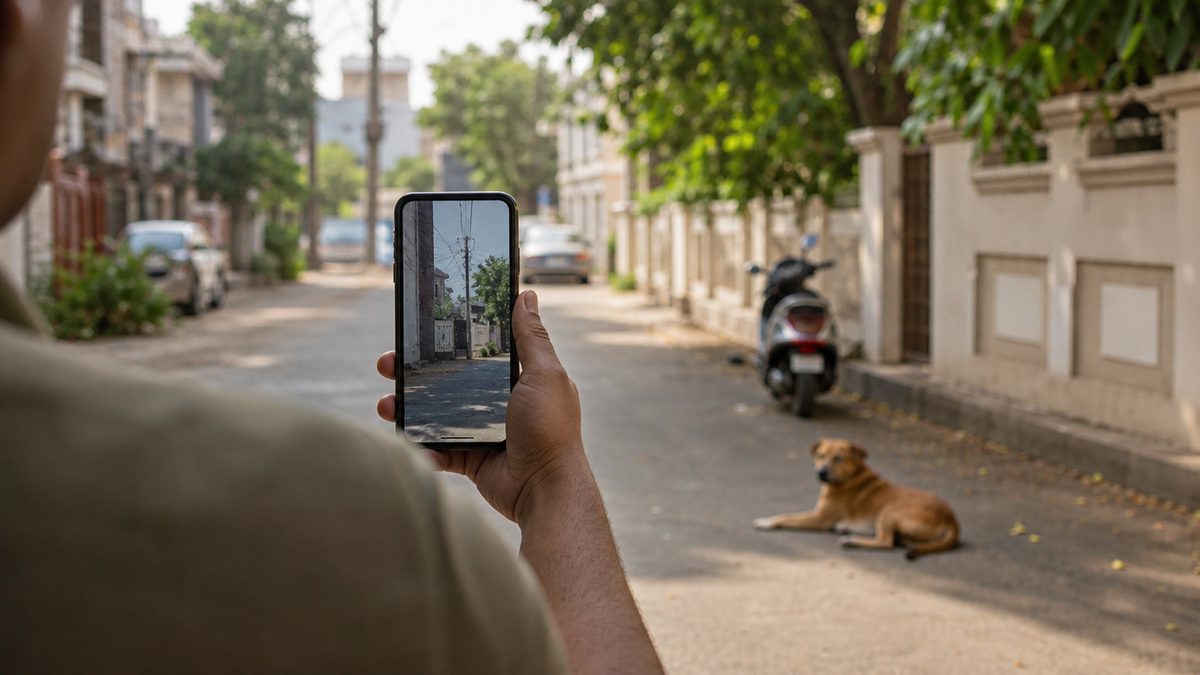
Spend the first five minutes recording, not intervening. Film continuously, note the exact place and time, get the faces and any vehicle number, and find one other person who saw it. Everything you do after that is built on what you capture now.
The order matters because the thing most people do first is the thing that costs them the case. A phone raised for ten seconds, a shout, and a confrontation produces no usable record, one frightened animal and an argument about who said what. A phone held steady for two minutes produces a document.
Eight things to do, in this order.
- Film in one unbroken clip rather than several short ones, and keep filming while you walk to the nearest landmark, so the location is in the same file as the act.
- Say the date, the time and the street name aloud into the recording.
- Photograph the animal, the surroundings, any weapon, chain, cage or vehicle, and the registration plate.
- Write down what you saw in plain sentences while it is fresh, with times, not adjectives.
- Get one witness's name and phone number. A second person who will answer a call is worth more than a third video.
- Call the police on 112 if the animal is still being harmed or is bleeding, and call a local animal welfare organisation at the same time, because only one of those two will bring a vehicle for the animal.
- Keep the original file on the device it was shot on. Do not re-record, trim or re-upload it.
- Go to the police station the same day, with the written note and the recording.
Four things that will damage your own complaint
Do not step in physically. The Animal Welfare Board of India's standard operating procedure of 20 January 2022 is unusually blunt about the second item in particular, stating that search and seizure undertaken by any unauthorised person is illegal and would attract legal consequences, and that only law enforcement, inspectors or officers duly authorised for the purpose are empowered to do it. A member of the public who takes the animal away has moved from witness to accused.
- Do not intervene physically. A fight makes you a party to a cross-complaint, and a cross-complaint can be enough to end an animal cruelty case.
- Do not seize the animal yourself. The seizure power sits with the police, with a Society for the Prevention of Cruelty to Animals, or with a person authorised in writing, and nowhere else The Prevention of Cruelty to Animals.
- Do not post the clip before you have reported it. A video circulating for two days gives the accused the time to dispose of the animal, the chain and the cage, and gives the defence an argument about when and where it was really shot.
- Do not accept an apology instead of a complaint. The Act gives you three months and no more, which the section below explains.
Where the animal is already dead, change nothing at the scene and say so at the station. The body is evidence, and the published procedure is that it must be seized immediately and sent to the jurisdictional veterinary officer for a post-mortem, with the viscera sent to a forensic laboratory, sealed and stamped by the veterinarian, where poisoning is suspected.
Which offence you are reporting, and why that single choice decides everything
Name two laws rather than one. The Prevention of Cruelty to Animals Act, 1960 covers almost everything and punishes almost nothing, while section 325 of the Bharatiya Nyaya Sanhita, 2023 covers killing and maiming and carries five years. Which one you cite decides whether a police station is obliged to act.
Start with what the older Act actually says, because it is both broader and weaker than its reputation. Section 2(a) defines an animal as any living creature other than a human being, and section 2(f) defines owner to include not only the owner but also any other person for the time being in possession or custody of the animal, with or without the owner's consent. Section 11(1)(a) makes it an offence to beat, kick, over-ride, over-drive, over-load, torture or otherwise treat any animal so as to subject it to unnecessary pain or suffering. Then the penalty, in the same sub-section: a fine which may extend to fifty rupees for a first offence, and a fine up to one hundred rupees or three months or both for a second within three years.
That fifty-rupee figure is published on half the Indian internet and on several of our own pages, including the one on manja injuries to animals. It is accurate and it is not the heaviest instrument on the table.
The section almost nobody names
Section 325 of the Bharatiya Nyaya Sanhita reads in full that whoever commits mischief by killing, poisoning, maiming or rendering useless any animal shall be punished with imprisonment of either description for a term which may extend to five years, or with fine, or with both. Under the First Schedule to the Bharatiya Nagarik Suraksha Sanhita it is cognizable and bailable, triable by a Magistrate of the first class. It carries forward section 429 of the Indian Penal Code, which the Animal Welfare Board's own enforcement handbook also classifies as cognizable.
Two things about that are worth pausing on. Ordinary mischief under section 324, with no animal involved, is punishable with six months and is non-cognizable; the moment the property is an animal, the same conduct becomes a five-year cognizable offence The Bharatiya Nyaya Sanhita. And the Indian Penal Code was repealed on 1 July 2024, so a complaint citing IPC 428 or 429 today names two provisions that no longer exist.
Whether mischief reaches a street dog nobody owns
Mischief is defined in section 324(1) as causing destruction of any property with intent to cause, or knowing that one is likely to cause, wrongful loss or damage to the public or to any person. The obvious objection is that a community dog belongs to nobody, so there is no owner to suffer loss. Explanation 1 to the same section answers half of it, providing that it is not essential that the offender should intend to cause loss or damage to the owner of the property injured or destroyed, and that it is sufficient if he intends to cause wrongful loss or damage to any person by injuring any property, whether it belongs to that person or not.
The other half has been argued in court on animals that belong to nobody at all. In three Rajasthan High Court orders of 24 July 2012 arising from the blackbuck poaching prosecutions, the court held that damage to wildlife, even if not calculable in monetary terms, constitutes loss to ecology and society at large, and therefore falls inside the definition of mischief. That reasoning is about wild animals rather than street dogs and no court has yet applied it to a community animal, so treat it as an argument available to you and not as a settled answer.
| Offence | Instrument | Maximum punishment | Cognizable |
|---|---|---|---|
| Beating, kicking, overloading, torturing, or any unnecessary pain or suffering | PCA Act 1960, section 11(1)(a) | Rs 50 first offence, Rs 100 or 3 months on a repeat within 3 years | No |
| Failing to provide food, drink or shelter; abandonment; cruel confinement; short or heavy chaining | PCA Act 1960, section 11(1)(e), (f), (h), (i) | The same fifty-rupee scale | No |
| Needless mutilation, or killing in an unnecessarily cruel manner | PCA Act 1960, section 11(1)(l), made cognizable by section 31 | The same fifty-rupee scale | Yes |
| Animal fighting, or a shooting match using released captive animals | PCA Act 1960, section 11(1)(n) and (o), made cognizable by section 31 | The same fifty-rupee scale | Yes |
| Phooka or doom dev on a milch animal | PCA Act 1960, section 12, made cognizable by section 31 | Rs 1,000 or 2 years or both, and the animal is forfeited | Yes |
| Killing, poisoning, maiming or rendering useless any animal | Bharatiya Nyaya Sanhita 2023, section 325 | 5 years, or fine, or both | Yes |
| Keeping an animal without guarding against probable danger to human life | Bharatiya Nyaya Sanhita 2023, section 291 | 6 months, or Rs 5,000, or both | Yes |
| Threatening a person to stop them keeping or feeding animals | Bharatiya Nyaya Sanhita 2023, section 351 | 2 years, or fine, or both | No |
| Breach of any rule made under the Act, including the transport and breeding rules | PCA Act 1960, section 38(3) | Rs 100 or 3 months or both | No |
Section 31 is the provision that settles the cognizability question for the older Act, and it is short. Notwithstanding anything in the Code of Criminal Procedure, an offence punishable under clause (l), clause (n) or clause (o) of sub-section (1) of section 11, or under section 12, shall be a cognizable offence. Three clauses out of fifteen, plus phooka. Everything else in section 11 is non-cognizable, including the beating that most complaints are about.
The one sentence that decides whether a police station must register an FIR
One sentence in the Bharatiya Nagarik Suraksha Sanhita decides it. Section 174(4) provides that where a case relates to two or more offences of which at least one is cognizable, the case shall be deemed to be a cognizable case, notwithstanding that the other offences are non-cognizable.
Read that against the table above and the practical consequence falls out. You cannot file an FIR on a non-cognizable offence, and a complaint that says only section 11(1)(a) of the PCA Act is exactly that. A complaint that says section 11(1)(a) of the PCA Act together with section 325 of the Bharatiya Nyaya Sanhita is a cognizable case in its entirety.
What happens on each track is set out in the law rather than left to the officer. For a non-cognizable offence the officer in charge enters the substance of the information in a book, refers the informant to the Magistrate, and forwards the daily diary report fortnightly; no police officer may investigate it without the order of a Magistrate. That is a Non-Cognisable Report, an NCR, and it is not an FIR. For a cognizable offence, registration follows, and our guide to finding a lost dog or cat in India already sets out the Supreme Court directions on mandatory registration, so this page will not repeat them.
The fourteen-day window most pages have not caught up with
One statutory change since those directions matters here and is rarely reported. Section 173(3) of the Bharatiya Nagarik Suraksha Sanhita allows the officer in charge, on information about a cognizable offence punishable with three years or more but less than seven, to obtain the prior permission of an officer not below the rank of Deputy Superintendent of Police and then either conduct a preliminary enquiry within fourteen days to see whether a prima facie case exists, or proceed straight to investigation.
Section 325 carries five years, so it sits squarely inside that band. Expect the question to be asked, know that the enquiry needs a Deputy Superintendent's written permission and cannot run past fourteen days, and ask on day fifteen.
A complaint that names only the Prevention of Cruelty to Animals Act invites an NCR. A complaint that also names section 325 of the Bharatiya Nyaya Sanhita engages section 174(4), under which the whole case is deemed cognizable. Write both section numbers into the body of the complaint rather than leaving the classification to the officer on duty, and keep a signed copy of what you handed in.
None of this makes the police a hostile party by default. The Board's own procedure assumes the opposite, expecting the complainant to accompany the officers for the search and seizure of the animals. Arrive with the sections written down and you have given the duty officer the easiest version of a job most stations rarely do.
Writing the complaint, the zero FIR, and what to do when a station refuses
Write the complaint before you reach the police station, in two copies, and read it out rather than describing the incident from memory. Ten things belong in it, and one of them is a request almost nobody makes.
- Your full name, address and phone number, and the same for every witness.
- The exact place, with a landmark, and the exact date and time of the incident.
- What you saw, in short factual sentences, in the order it happened.
- The animal: species, approximate age, colour, any collar, ear notch or identifying mark, and whether it is alive.
- The accused, by name if you know it, otherwise by description, address, vehicle number and anything else that identifies the person.
- The sections you say are made out, written in full, both the PCA Act clause and the Bharatiya Nyaya Sanhita section.
- A list of the evidence you are handing over, item by item, with file names for digital files.
- A request that the animal be seized and produced for veterinary examination under section 34 of the PCA Act.
- A request that the Jurisdictional Veterinary Officer be asked for a medical examination or a post-mortem.
- A statement that on conviction you will ask the court to prohibit the accused from keeping animals.
That last line is the one people leave out, and it is the only one the Act makes a precondition. Section 29(3) lets a court bar a convicted person from having custody of any animal, permanently or for a fixed period, but section 29(4)(b) allows that order only where it is stated in the complaint upon which the conviction was made that it is the intention of the complainant to request it. Say it in the complaint or the court cannot make the order. Section 29(4)(c) adds a second condition that the offence must have been committed in an area where a licence is needed to keep such an animal, which in most Indian cities means a dog, and our guide to pets in Indian apartments covers municipal licensing.
A zero FIR, and why the jurisdiction argument is over
A zero FIR is simply an FIR registered by a station that is not the station for the area where the offence happened, and the Sanhita now says so in the first line of the FIR provision. Section 173(1) provides that every information relating to the commission of a cognizable offence, irrespective of the area where the offence is committed, may be given orally or by electronic communication to an officer in charge of a police station. Information given by electronic communication is taken on record on being signed within three days by the person giving it, and a copy of the recorded information is to be given forthwith, free of cost, to the informant.
Those three clauses answer the three excuses a reporting citizen meets most often. This is not our area is answered by irrespective of the area. We will note it and you come back is answered by the electronic route and the three-day signature. We do not give copies is answered by forthwith and free of cost.
When the station will not register it
Section 173(4) sets out how to escalate, in one sentence, and the form it prescribes is specific. Any person aggrieved by a refusal to record the information may send the substance of it, in writing and by post, to the Superintendent of Police concerned, who, if satisfied that it discloses a cognizable offence, shall either investigate the case himself or direct an investigation by a subordinate officer, failing which the aggrieved person may make an application to the Magistrate.
Two details in that sentence are load-bearing. It says in writing and by post, so send it by registered post or speed post and keep the receipt, because the receipt is what proves the date. And the Magistrate comes after the Superintendent, not instead of him. Section 175(3) then lets a Magistrate, after considering an application supported by an affidavit made under section 173(4) and after such inquiry as he thinks necessary, order an investigation. An affidavit means a sworn statement, so budget for a notary.
The sequence is a signed complaint at the station, then a written complaint by post to the Superintendent of Police, then an application to the Magistrate supported by an affidavit The Bharatiya Nagarik Suraksha Sanhita. Each step needs proof that the one before it was taken, so keep the station copy, the postal receipt and the delivery confirmation together. Skipping a step is the commonest reason a Magistrate declines an application.
The three-month deadline nobody mentions
A prosecution under the Prevention of Cruelty to Animals Act cannot be instituted after three months from the date of the offence. Section 36 says exactly that, in one line, and it is the quietest trap in the whole Act.
The wording leaves no room. A prosecution for an offence against this Act shall not be instituted after the expiration of three months from the date of the commission of the offence. Three months, from the act, not from the day you found out and not from the day the police got round to it.
The Bharatiya Nyaya Sanhita offences are on a different clock, and this is the second reason to name section 325. Section 514 of the Bharatiya Nagarik Suraksha Sanhita bars cognizance after six months for an offence punishable with fine only, one year where the maximum is one year, and three years where it exceeds one year but not three. The list stops there. An offence punishable with five years has no limitation period at all, so a section 325 case is not time-barred by delay the way a PCA case is.
The practical reading for anyone sitting on a video from six weeks ago is simple. File now, and file both sections. Wait past the three-month mark and the PCA count is gone whatever the evidence shows.
The Government's own draft amendment, circulated in November 2022, proposes replacing three months in section 36 with twelve months. That draft has not been enacted, so the three-month bar is the law today. Diarise the date on which the three months expire on the day you file, and chase the station against that date rather than against a vague sense of how long is reasonable.
Who to call, in what order, and what each one can actually do
Call four kinds of body, and expect only one of them to be able to start a criminal case. The police register the FIR, the veterinary officer produces the medical evidence, an animal welfare organisation moves the animal, and the boards collect paper.
The jurisdictional veterinary officer is the one most people skip, and the published procedure puts a duty on that officer independent of the police. Identification, tagging and the medical examination or post-mortem of a seized animal are carried out by the Jurisdictional Veterinary Officer, and it is that officer's duty to conduct the examination and tender a report to the police, as mandated under section 34 of the PCA Act, notwithstanding the registration of an FIR or NCR by the police until such time. In plain terms, the veterinary examination does not wait for the FIR. The Board even prints a sample letter for a police station to send that officer requesting a medical or post-mortem examination.
A district Society for the Prevention of Cruelty to Animals exists on paper in every district in India, whether or not anyone in your neighbourhood has heard of it. Rule 3(1) of the SPCA Rules 2001 required every State Government to establish one for every district within six months of the rules commencing, and rule 3(4) gives the Society, or any person it authorises, the power to require production of an animal, to stop any vehicle, to enter premises to search, and to seize an animal where it has reason to believe an offence under the Act is being committed. That is a wider power than most residents realise sits locally, and asking the Collector's office for the district SPCA by name is worth one phone call.
| Who | What they can do | What they cannot do |
|---|---|---|
| The police station for the area, or any station under a zero FIR | Register an FIR, seize the animal under PCA section 34, seize the weapon, chain, cage and vehicle, and investigate | Investigate a purely non-cognizable complaint without a Magistrate's order |
| Jurisdictional Veterinary Officer, Department of Animal Husbandry | Examine or post-mortem the animal and report to the police, whether or not an FIR has been registered yet | Register a case or take custody of an accused |
| District SPCA, or a person it authorises in writing | Require production of an animal, stop a vehicle, enter and search premises, and seize an animal | Act without producing the animal to the police for registration and the vetero-legal protocol |
| A recognised animal welfare organisation | Transport and treat the animal, apply to the Magistrate for interim custody, and support the complaint | Search or seize on its own authority unless it is an SPCA or is authorised in writing |
| Municipal body or ABC centre | Handle street-animal capture, sterilisation and release, and run the animal helpline | Prosecute cruelty |
| State Animal Welfare Board | Take a complaint, inspect establishments and press the district administration | Register an FIR or impose a penalty |
| Animal Welfare Board of India | Advise government, issue advisories, fund shelters and forward a grievance | Prosecute, fine, seize or compel a police station |
What the Animal Welfare Board of India can and cannot do
The Board's functions are listed in section 9 of the Act and every one of them is advisory, financial or educational. It keeps the law under constant study and advises the Government on amendments, advises on the making of rules, encourages pinjrapoles and sanctuaries, gives financial assistance to animal welfare organisations, and imparts education on humane treatment. There is no power to prosecute anywhere in the list, and none to direct a police officer.
That matters because the page ranking first in Google India for this query is the Board's own grievance page, and it is not a cruelty complaint form. It is a searchable register of 184 grievances filed since 2023-24, with a category dropdown offering Humane Education, Regular Grant, Administration or Establishment, Accounts Section, Circus Registration, Race Horse or Polo Pony Registration, Pre-Shoot Permission or NOC, Legal Matters, Recognition and Other. Cruelty is not one of the ten. The cruelty complaints that do appear sit under Legal Matters or Other, including a cat feeder in Mumbai, Maharashtra whose account of harassment ends with a complaint to the nearest Govandi police station on which no further action has been taken, and a Kolkata resident's complaint about two neighbours arranging the removal of street dogs. Other entries on the same page come from Jaipur, Mayur Vihar in Delhi, Alappuzha and Nandyala, so the register is genuinely national and the destination is the same from every state, which is a filing cabinet rather than a prosecution.
The one online cruelty complaint form we could document
Tamil Nadu runs the only state-level online animal cruelty complaint form we could open. The Tamil Nadu Animal Welfare Board's form takes the complainant's name, mobile, email, Aadhaar and address, offers Animal Cruelty as the first of seven complaint types alongside Illegal Animal Trade, Neglect or Abandonment, Illegal Slaughter, Stray Animal Issue and Jallikattu or Bullock Cart Race related, covers all 38 districts of the state, asks for the accused's name and address, and accepts photo, video and document uploads under a declaration that false information is punishable. Residents of Chennai, Coimbatore and Madurai therefore have a route that residents of Delhi, Mumbai, Bengaluru and Kolkata do not, and the only way to know whether your own state board has added one is to open its website rather than a blog post.
For a street animal the civic machinery is a different conversation from the criminal one, and our guides to stray dogs in India and street cats in India set out the helpline, the capture rules and what a resident welfare association may lawfully do.
Evidence: what makes a case stick, and what makes it collapse
Evidence in an animal cruelty case comes in four kinds, and three of them have a legal formality attached that nobody warns you about. Photographs and video need a certificate, the animal needs a veterinary report, and the seizure needs a memo.
Your phone video is admissible, with a condition. Section 63 of the Bharatiya Sakshya Adhiniyam, 2023, which replaced section 65B of the Indian Evidence Act, makes information in an electronic record a document admissible without production of the original, provided the conditions in the section are met. Sub-section (4) then requires that a certificate be submitted along with the electronic record at each instance where it is being submitted for admission, identifying the record and describing the manner in which it was produced, giving particulars of the device, and signed by the person in charge of the device or the relevant activities and by an expert, in the form specified in the Schedule.
Read at each instance literally, because courts do. A certificate filed once with the charge sheet does not cover the clip when it is produced again at trial. Ask the investigating officer, in writing, whether the section 63 certificate has been taken, and keep the original file untouched on the original device until it has.
The veterinary record is the evidence that decides the case
A cruelty case is what the published procedure calls a vetero-legal case, handled the way a medico-legal case is handled, and the medical document is the spine of it. On seizure, the officer arranges identification tagging and a medical examination through the Jurisdictional Veterinary Officer; where the animal is injured or sick it must be given the necessary medical treatment under section 35 of the PCA Act; and where it is dead, the post-mortem report identifying the cause of death must be included with the investigation report and in the case diary The Prevention of Cruelty to Animals Act.
Nine items belong in the evidence bundle you hand over.
- The original unedited video and photographs, on the device they were shot on.
- Your written account, dated and signed, naming times rather than durations.
- Names and numbers of every witness, and a short signed note from each if they will give one.
- The treating veterinarian's records, bills and any imaging, if the animal reached a clinic privately.
- The Jurisdictional Veterinary Officer's examination report or post-mortem report.
- A copy of the seizure memo, which must be given to the person from whom the animal was seized.
- Photographs of the weapon, chain, cage or vehicle, each of which is itself seizable as evidence.
- CCTV footage from a shop, gate or society camera, requested in writing within days because most systems overwrite inside a week.
- The FIR or NCR number, and the date.
Two specific failures end these cases. The first is a photograph with no location, no date and no face, which proves an injured animal existed and nothing else. The second is a dead animal buried or taken away before a post-mortem, after which the cause of death is a matter of opinion. A third is slower and just as common, which is waiting. In humid Indian conditions, and through the monsoon months in particular, an untreated open wound on an outdoor animal becomes a different injury within a day or two, as our page on maggot wounds in dogs in India sets out, so the wound a veterinarian photographs on day four no longer matches the act you filmed on day one.
Bonbeno names no drug and no dose for an injured animal, and nothing on this page replaces an examination by a veterinarian. What the law needs from a vet and what the animal needs from a vet are the same visit, so make it the same day.
What happens next, honestly
Expect a slow case, a small penalty and no published statistic about either. The Government has said so itself, twice, in answers to the Lok Sabha in 2026, and those two answers are the most honest account of this system that exists.
Asked on 17 March 2026 how many times the penalties under the PCA Act had been revised since enactment, the Minister of Fisheries, Animal Husbandry and Dairying answered that the Government of India has not carried out revision of penalties under the Prevention of Cruelty to Animals Act, 1960 since its enactment, and that it has not conducted any study or impact assessment to evaluate the deterrent effectiveness of existing penalties. Sixty-six years, no revision, no assessment.
Asked on 4 August 2026 for the number of inspections, cases registered, prosecutions launched and convictions secured over five years, the same Minister answered that this information is maintained by the respective State Governments and Union Territory Administrations and the concerned enforcement agencies, and is not maintained centrally by the Department of Animal Husbandry and Dairying. The same answer records that the Government of India has reviewed the existing penalties under the Act, which is very low and not having deterrent effect.
So there is no national conviction rate for animal cruelty in India, and this page is not going to invent one. Any page quoting a percentage should be asked where it came from.
The only national series that exists, and what it actually counts
Asked in the same March 2026 answer for the number of animal cruelty cases reported under the PCA Act since 2014, the Department answered with a different thing: the number of cruelty complaints reported by citizens and organisations to the office of the Animal Welfare Board of India. Those are complaints to a Board, not cases in a court, and the Board has no power to prosecute. Published as the answer to a question about cases, they are the closest thing India has to a national series, and they are not a measure of enforcement.
| Year | Complaints received |
|---|---|
| 2014-15 | 155 |
| 2016-17 | 256 |
| 2018-19 | 172 |
| 2019-20 | 300 |
| 2020-21 | 383 |
| 2021-22 | 820 |
| 2022-23 | 1,132 |
| 2023-24 | 1,220 |
| 2024-25 | 1,015 |
| 2025-26 | 1,000 |
The Board's own published register shows the pace. A grievance filed on 12 September 2023 is marked disposed on 13 January 2026, and four other grievances from October, November and December 2023 carry the same disposal date. Two years and four months is the gap between filing and the entry being closed, on the Board's own page.
A registered FIR is a dated public record that the conduct happened, and that record is what a housing society, an employer, a municipal licensing office or a later court has to deal with. It is also the only thing that produces a seizure, and a seizure is what gets the animal away from the person harming it the same week. The system is slow at conviction and fast at seizure, so report for the seizure and treat the conviction as a longer game.
The amendment that has not moved since 2022
The amendment people keep referring to is a draft that was circulated for public comment for sixteen days in 2022 and has not been introduced in Parliament since. On 17 March 2026 the Government confirmed that position in a single sentence.
Two different documents get conflated, and only one of them is the Government's. The Department of Animal Husbandry and Dairying issued a public notice on 21 November 2022 placing a draft Prevention of Cruelty to Animals (Amendment) Bill, 2022 on its own website and the Board's, inviting comments from all interested stakeholders and the general public by 5.30 pm on 7 December 2022. That draft runs to 61 amendments. Separately, a private member's bill numbered 8 of 2022, introduced by Shri Shyam Singh Yadav, proposes only to raise the section 11 fines to a band of Rs 1,000 to Rs 5,000 for a first offence and Rs 3,000 to Rs 10,000 or three months for a repeat. A private member's bill is not government policy.
Asked in March 2026 whether any proposals or draft amendments had been prepared and what their present status was, the Minister answered that a draft amendment of the Prevention of Cruelty to Animal Bill has been prepared and circulated during 2022 for public comments. That is the whole answer, more than three years after the comment window closed.
| Provision | In force today | Proposed in the 2022 draft |
|---|---|---|
| Section 11(1), first offence | Rs 10 to Rs 50 | Rs 1,000 to Rs 2,500 per animal |
| Section 11(1), repeat within three years | Rs 25 to Rs 100, or 3 months, or both | Rs 2,500 to Rs 5,000 with 6 months to 1 year, or both |
| Gruesome cruelty, including bestiality and permanent disabling | No such offence | New section 11A: Rs 50,000 to Rs 75,000 or the cost of the animal, whichever is more, or 1 to 3 years |
| Killing an animal | Covered by section 11(1)(l) at the fifty-rupee scale | New section 11B: Rs 75,000 to Rs 1 lakh per animal or three times the cost, whichever is more, or 3 to 5 years |
| Section 36, limitation | Three months from the offence | Twelve months |
| Section 38(3), breach of any rule | Rs 100 or 3 months | Rs 50,000 or up to 2 years |
| Section 31, cognizability | Clauses (l), (n), (o) and section 12 | Clauses (c), (i), (j), (k), (m), plus new sections 11A, 11B, 11C, section 12 and section 38(1) |
| A national record of cruelty cases | None, as the Government confirmed in 2026 | New section 11(4): the investigating officer reports every case to district police headquarters, records kept there and shared with the State Board |
That last row is the quiet one. The draft contains the exact fix for the data gap that the Lok Sabha answers expose, requiring the investigating officer to report each case to district police headquarters, the records to be maintained there and shared with the State Animal Welfare Board, and the information to be provided to the Animal Welfare Board of India on request. India would have a national count of animal cruelty cases the year after that clause commenced.
The draft would also delete section 11(3)(b), the exemption that currently places the destruction of stray dogs in lethal chambers outside section 11 altogether, and would put State Animal Welfare Boards on a statutory footing in a new Chapter VII. Our page on street cats in India sets out why that exemption matters and why it names dogs and not cats.
Six situations, and what each one actually is
Six situations account for most of the cruelty an Indian pet owner witnesses, and the sections differ in each. Reporting the right one is the difference between an FIR and an entry in a register.
| What you are looking at | Sections to name | Who to call first |
|---|---|---|
| A neighbour beating a dog, animal alive and injured | PCA 11(1)(a); BNS 325 if there is maiming or a real risk of death | Police station, then an animal welfare organisation for transport |
| A guard or committee removing, poisoning or dumping street animals | BNS 325; PCA 11(1)(i) for abandonment; BNS 351 for threats to a feeder | Police station, then the municipal animal helpline |
| Animals transported without papers, overcrowded or tied by the legs | PCA 11(1)(d); PCA 38(3) for breach of the Transport of Animals Rules 1978 | Police station; under rule 97 the police must stop the transport and seize |
| A pet shop or breeder keeping animals in cages too small, or selling sick animals | PCA 11(1)(e) and 11(1)(k); PCA 38(3) for the 2017 and 2018 Rules | State Animal Welfare Board, then the police |
| An injured animal nobody will treat, owner absent or refusing | PCA 13(3) for a mortally wounded animal; PCA 35 for treatment in an infirmary | A police officer above the rank of constable, who must summon the veterinary officer |
| Cruelty filmed and circulated online | BNS 325 and PCA 11; the video is an electronic record under BSA 63 | Police station, with the URL, the account handle and a screen recording |
Transport is the category with the most rules and the least attention. A police officer above the rank of constable who believes an offence against the Transport on Foot Rules is being committed may require the owner to present the animal to the nearest Magistrate and, on refusal, take the animal there directly; and under rule 97 of the Transport of Animals Rules 1978, where the rules have not been complied with, any permit is cancelled and the police must stop the further transport of the animals and seize them. Use the phrase the Rules use at the station rather than describing a crowded truck.
The breeder and pet shop case has its own paper trail, and the checks a buyer can make before it ever becomes a complaint are on our guide to dog breeder checks in India.
The mortally wounded animal nobody will help
Section 13(3) gives a route that very few people know exists. Any police officer above the rank of a constable, or any person authorised by the State Government, who finds an animal so diseased or so severely injured or in such a physical condition that it cannot be removed without cruelty, may, if the owner is absent or refuses consent, forthwith summon the veterinary officer in charge of the area; and if that officer certifies the animal is mortally injured or that it would be cruel to keep it alive, the animal may be destroyed after obtaining orders from a Magistrate. The decision is veterinary and judicial, never the finder's.
Threatening a person to make them stop keeping pets or feeding street animals is criminal intimidation, punishable with two years under section 351 of the Bharatiya Nyaya Sanhita, and the Board's own handbook records it as a provision that applies to exactly this Animal Welfare Board of India. It is non-cognizable, so it produces an NCR rather than an FIR on its own, which is a further reason to name it alongside a cognizable section. The civic side of a feeding dispute is on our guide to feeding community dogs in India.
Two pages ranking on page one of Google India for this query still instruct readers to cite Indian Penal Code sections 428 and 429, which were repealed on 1 July 2024. One of them was published in May 2026 and updated in August 2026 and repeats the instruction in its own FAQ. The other, published in January 2026, describes section 428 as a provision of the Code of Criminal Procedure. Both are written by organisations doing real rescue work, and the section numbers are still wrong. Check any section number you are told to use against the text of the Act before you put it in a complaint.
Nothing on this page is a reason to put yourself in front of a violent person, and nothing here asks you to run an investigation. The job is narrow: record it properly, name both laws, hand it in the same day, and keep the receipt.
Common questions
How do I report animal cruelty in my area?
Go to the nearest police station the same day with a written complaint in two copies. Name both the Prevention of Cruelty to Animals Act clause and, where the animal has been killed or maimed, section 325 of the Bharatiya Nyaya Sanhita, because section 174(4) of the Bharatiya Nagarik Suraksha Sanhita makes the whole case cognizable when one offence in it is. Hand over your video and photographs, ask for the FIR number, and take a free copy of what was recorded.
Is there any law for animal cruelty in India?
Yes, two. The Prevention of Cruelty to Animals Act, 1960 defines an animal as any living creature other than a human being and lists fifteen forms of cruelty in section 11, with a maximum fine of fifty rupees for a first offence. The Bharatiya Nyaya Sanhita, 2023 covers the serious end: section 325 punishes killing, poisoning, maiming or rendering useless any animal with up to five years.
Can I report animal cruelty online?
In most of India, not in a way that starts a criminal case. The Bharatiya Nagarik Suraksha Sanhita does allow information about a cognizable offence to be given by electronic communication, taken on record once you sign it within three days. Tamil Nadu's Animal Welfare Board runs the one state-level online cruelty complaint form we could open, covering all 38 districts, with Animal Cruelty as a complaint type and photo and video upload. Check your own state board's website rather than a blog post.
Where to report for animal cruelty?
The police station is the only body that can register an FIR, so it comes first. In parallel, call a local animal welfare organisation to move and treat the animal, and ask the police to request the Jurisdictional Veterinary Officer for an examination or post-mortem, which is that officer's duty whether or not an FIR has been registered yet. Your district has a Society for the Prevention of Cruelty to Animals with its own powers of search and seizure.
Is beating a dog a crime in India?
Yes. Section 11(1)(a) of the Prevention of Cruelty to Animals Act makes it an offence to beat, kick, over-ride, over-drive, over-load, torture or otherwise treat any animal so as to subject it to unnecessary pain or suffering, and it applies to a street dog and a pet alike. The penalty is a fine up to fifty rupees for a first offence, and the offence is non-cognizable, so on its own it produces a register entry rather than an FIR.
What is the legal punishment for killing a dog in India?
Up to five years. Section 325 of the Bharatiya Nyaya Sanhita, 2023 provides that whoever commits mischief by killing, poisoning, maiming or rendering useless any animal shall be punished with imprisonment which may extend to five years, or with fine, or with both. It is cognizable and bailable and is tried by a Magistrate of the first class. It replaced sections 428 and 429 of the Indian Penal Code, which were repealed on 1 July 2024.
What to do if someone is beating a dog?
Film it in one unbroken clip, say the date, time and street name aloud into the recording, and get one witness's phone number. Do not intervene physically and do not take the animal yourself, because search and seizure by an unauthorised person is itself unlawful. Call 112 if the beating is still happening, and call an animal welfare organisation at the same time, because only they will bring transport for the animal.
Can you be prosecuted for animal cruelty?
Yes, and nobody can tell you how often it succeeds. Asked in the Lok Sabha on 4 August 2026 for the number of cases registered, prosecutions launched and convictions secured, the Government answered that this information is held by the States and is not maintained centrally. The same answer records the Government's own view that the penalties under the Act are very low and not having deterrent effect.