
Dog legal guide
How to check a dog breeder in India under the 2017 Breeding and Marketing Rules
Seven checks with the clause behind each one, what the State Board certificate looks like, which state publishes its register, what a KCI paper does and does not prove, the health tests by breed, the red flags, the Rs 100 penalty, and where a complaint actually goes.
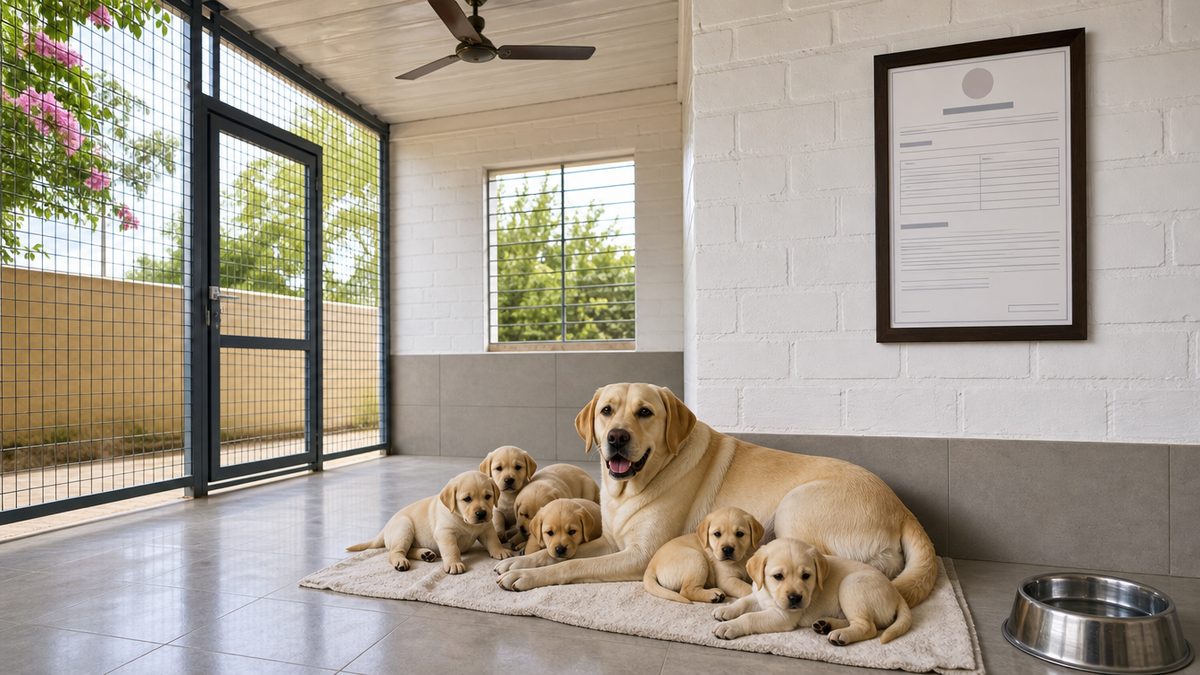
Quick answer
Under the dog breeding rules India notified on 23 May 2017, a breeder must hold a State Animal Welfare Board certificate (Form II, Rs 5,000, two years, displayed on the premises), breed a bitch only from eighteen months, once a year and five times in all, and sell no pup under eight weeks, unchipped, or without a receipt, a written vaccination record and a contract. A KCI paper registers the dog, not the breeder. A breach costs up to Rs 100 or three months under section 38(3).
The two instruments: the 2017 Rules for breeders and the 2018 Rules for shops
Two sets of rules made under section 38 of the Prevention of Cruelty to Animals Act, 1960 decide who may breed and sell a dog in India: the Prevention of Cruelty to Animals (Dog Breeding and Marketing) Rules, 2017, G.S.R. 496(E) of 23 May 2017, for breeders, and the Prevention of Cruelty to Animals (Pet Shop) Rules, 2018, G.S.R. 844(E) of 6 September 2018, for shops and for 'online platforms over which the sale and purchase of pet animals is carried out';. Both make the State Animal Welfare Board the registering authority, and neither names a kennel club.
The 2017 Rules bind more people than the word suggests. Rule 2(1)(c) defines a breeder as 'an individual or group of persons who own dogs of specific breeds for breeding and sale of dogs and pups, and includes boarding kennel operator, intermediate handler and trader', and Rule 2(1)(k) makes a trader anyone who sells dogs 'acquired from any breeder or pet shop, or from his or their own breeding facility, or imported for sale';. The family that mates its Labrador once and sells the litter is a breeder; the man who resells a farm's puppy is a trader; both need the certificate in the next section, 'a non-refundable fee of five thousand rupees' on Form I under Rule 4(2), valid two years under Rule 4(9), after which the breeder renews it at the same fee. Rs 5,000 divides to USD 59.26 at 84.38 and USD 67.57 at 74, a rupee-native figure.
| Item | Dog Breeding and Marketing Rules, 2017 | Pet Shop Rules, 2018 |
|---|---|---|
| Who is bound | A 'breeder', including a boarding kennel operator, intermediate handler and trader (Rule 2(1)(c)) | A 'pet shop', including a market stall and 'online platforms over which the sale and purchase of pet animals is carried out' (Rule 2(1)(k)) |
| Registering authority | The State Animal Welfare Board (Rule 3(1)) | The State Animal Welfare Board (Rule 3(1)), with powers it may delegate to the district SPCA (Rule 17) |
| Application and fee | Form I, 'a non-refundable fee of five thousand rupees' (Rule 4(2)) | Form I with an affidavit, 'a non-refundable fee of five thousand rupees' (Rules 4(2) and 4(4)) |
| Certificate | Form II, 'Certificate of Registration of Dog Breeding Centre', naming the breeds the holder may deal with (Rule 4(6)) | Form II, 'Certificate of Registration of Pet Shop', naming the animals the shop may sell (Rule 4(5)) |
| Validity | Two years, renewable at Rs 5,000 (Rule 4(9)) | Five years, renewable at Rs 5,000 (Rule 4(11)) |
| Register the Board must keep | None prescribed; Form III is the breeder's own register of breeders and suppliers (Rule 9(1)) | 'A Register of certificate of registration in Form III' kept by the Board (Rule 4(5)) |
| Inspection | Before registration by a Board representative and a vet (Rule 4(4)); at least once a year after (Rule 7(3)) | Within three months of registration by a State Government vet (Rule 4(6)); at least once a year after (Rule 10(3)) |
| Minimum sale age | 'pups less than eight weeks in age are not sold' (Rule 8(1)(a)) | No 'un-weaned or underage' sale (Rule 7(15)); 'kittens and pups below eight weeks' are un-weaned (Rule 2(1)(p)(ii)) |
| Penalty clause inside the Rules | None; the words 'penalty' and 'punish' do not occur | None in the Rules; sealing and confiscation of the shop's animals (Rule 3(1)) |
The Animal Welfare Board of India's handbook for municipalities, issued with a ministerial message of 27 February 2025, calls the pair 'a mandatory two-tier regulatory framework' with 'primary oversight vested in State Animal Welfare Boards', and quotes the Karnataka High Court's order of 5 February 2020 in W.P. No. 4151 of 2019 that 'no establishment which engages in breeding and selling dogs can be allowed to function unless they have obtained the necessary certificates of registration under Rule 3' of both Rules. Rule 13 of the 2017 Rules and Rule 14 of the 2018 Rules say the same from the municipality's side: no local-body licence without the State Board's certificate Ministry of Environment.
One ranking page quotes a different document. The CJ Memorial Trust's 2019 post reproduces a 117-clause text in which registration costs 'Rs500 per animal registered', lasts '12 months', is issued by the AWBI, and 'the various Kennel Clubs in India shall not register any pup' from an unregistered breeder. None of that is in the gazette: '500' occurs 0 times in the 2017 Rules, the certificate runs two years from the State Board, and 'club' occurs 0 times. That text is an earlier draft; the notified Rules are the fourteen pages the AWBI hosts.
Check 1: the State Animal Welfare Board certificate, Form II
The first check on a dog breeder in India is the certificate of registration from the State Animal Welfare Board, because Rule 3(1) bars a breeder from 'any breeding activity' without one, Rule 3(2) says 'every breeder shall prominently display the certificate of registration in the establishment', and Rule 13 bars the municipality from licensing the premises without it. A breeder who cannot show it is, on the Rules' own terms, not permitted to be breeding.
Form II, as printed in the First Schedule, is granted to a named person 'to establish a Dog Breeding Centre', states the location, says the owner 'is permitted to deal with the following dog breeds', carries a validity date and is 'non-transferable'; Rule 4(6) also has the Board 'fix the maximum holding capacity for each dog breeding establishment to avoid overcrowding';. Three lines do the work: the name, which must be the person selling to you; the breeds, which must include the one on offer; and the date. Rule 4(3) requires 'separate applications for every establishment', so a certificate for a farm outside the city does not cover the flat where the puppies are shown, and the certificate issues only after 'an authorised representative of the State Board and a veterinary practitioner' have inspected the premises under Rules 4(4) to 4(6).
How to ask, and what a real registration number looks like
- Ask to see the original Form II on the wall of the premises where the puppies are, not a photograph on a phone; Rule 3(2) puts it in a prominent place in the establishment.
- Read the three lines: the name, the breeds permitted and the validity date, then the holding capacity if the Board wrote one in.
- Match the name on the certificate to the name on the receipt and the KCI litter form, since Rule 4(10) makes the certificate non-transferable.
- Check the number against the Board's register where one exists; Tamil Nadu's numbers run TNAWB/BR-0001/2026 upward.
- Write the number into your sale contract, because Rule 9(3) requires a written contract and the number is the one fact on it a Board can look up.
Form I tells you what the Board has seen: accommodation, ventilation, cooling, food storage, veterinary support, the breeds, number and age of the dogs, the cages, and the applicant's 'qualification and experience'; a renewal adds every dog mated by microchip number, every death with its post-mortem report and every pup sold with its 'sale price';. Tamil Nadu's Board runs the process online: its guidelines quote G.S.R. 496(E), ask for a Rs 5,000 demand draft in favour of the Member Secretary, give the certificate two years, and state that 'License cannot be obtained from the Local bodies without obtaining the Registration Certificate from the Board'.
Which State Boards publish a register: three checked on 18 September 2026
One of the three State Boards checked publishes a breeder register. The Tamil Nadu Animal Welfare Board's home page links a 'List of registered breeder in Tamil Nadu' with six entries, each giving name, address, district, 'Breeds Permitted' and a registration number; two of the six are state-run units, the Regional Center for Conservation of Native Dogs at Tenkasi and the Dog Breeding Unit at the Veterinary Integrated Complex in Chennai, four are private kennels, and entries 5 and 6 share the number TNAWB/BR-0005/2026. The pet-shop register on the same page runs to 471 numbered entries with none missing. Haryana's State Animal Welfare Board page hosts the 2017 Rules, six grant forms and a numbered register of the state's SPCAs with registration numbers, and no breeder list. Maharashtra's Board page lists inspections 'for registration of shops/establishments under pet shop rules and dog breeding and marketing rules' among its functions, gives an email and its Aundh, Pune address, and publishes no list. Haryana's SPCA table is the control: the page publishes registers, and the breeder register is the one it lacks.
'Registered' has two meanings and only one of them is this check. A KCI certificate registers a dog's declared parentage with a private society; the State Board's Form II registers the breeder and the premises under the law. A seller who answers 'registered' by producing a KCI paper has not shown you the paper Rule 3(1) requires. In the one state that publishes its register, six breeders held a certificate on 18 September 2026, against 471 pet shops Tamil Nadu Animal Welfare Board.
Check 2: the premises, and what Second Schedule Part IV requires of housing
The Rules give the right to inspect to the State Board's inspector, not to the buyer: Rule 3(3) keeps the establishment 'open for inspection by a person authorised in writing by the State Board', and Rule 7(2) lets that inspector 'enter into the establishment at any reasonable time', 'take pictures, record videos, and make copies of the records';. A buyer's visit is a request the breeder may refuse, and the refusal is itself the answer.
For a shop the position is better. Rule 8(5) of the 2018 Rules makes the shop's records of breeders, suppliers, customers and deaths 'available at the pet shop for inspection by the State Board or any intending purchaser', Rule 7(12) requires 'the species and numbers of pet animals, and the prices' to be 'prominently displayed', and Rule 7(25) bars the shop from selling 'any pet animal acquired from a breeder unless the breeder is registered';. At a shop, ask to read the supplier register and see which breeder the puppy came from.
| What to look at | Clause | What the gazette says |
|---|---|---|
| Floor space per dog | Part IV para 21(5) | Length 'four times the length of the dog, measured from the tip of its nose to the base of its tail'; breadth 'two times' that length; weaned pups included |
| Height of the enclosure | Part IV para 21(7) | 'at least six inches higher than the head of the tallest dog in the enclosure when it is in a normal standing position' |
| Caging | Part IV para 21(9) | 'Dogs shall not be caged except at night when the caregiver retires, or when necessary for medical reasons' |
| Adults per enclosure | Part IV para 23(2) | 'Not more than twelve adult dogs shall be housed in the same primary enclosure' |
| Pups and the dam | Part IV para 23(4) | 'pups less than four months of age shall not be housed in the same primary enclosure with adult dogs other than their dam or foster dam' |
| Bitches in heat | Part IV para 23(3) | 'Female dogs in heat shall not be housed in the same primary enclosure with sexually mature males, except for breeding' |
| Exercise | Part IV para 24(6)(d) | 'exercising for at least thirty minutes twice per day', under a written plan signed by the breeder and the vet (24(2)) |
| Human contact | Part IV para 24(6)(e) | 'at least three hours per day for adult and five hours per day for pups less than four months of age' |
| Materials | Part I para 2(2) | 'All housing shall be made of impervious materials that can be sanitised and wood shall not be allowed' |
| Feeding interval | Part I para 4(a) | 'wholesome food at suitable intervals of not more than eight hours' |
| Other business on site | Part IV para 10(3) | 'Housing facilities shall be physically separated from any other business' |
| Outdoor housing | Part IV para 21(1) | Not for 'long-haired breeds in high temperature locations' or 'sick, infirm, aged or young animals' without the vet's written approval |
| Vet visits | Part III para 8(2) | 'medical examination of each dog at the establishment shall be conducted at least once every month and a record of the same shall be maintained' |
| Rabies | Part IV para 28 | 'annually vaccinated against rabies (and preferably against canine distemper, parvo-virus, leptospirosis and viral hepatitis)' |
The arithmetic is the visit. A 60 cm Labrador bitch needs a run 2.4 m by 1.2 m to herself under paragraph 21(5); thirteen adults in one enclosure break paragraph 23(2); a nursing bitch in with other adults breaks paragraph 23(4) on its face; and the count of dogs against the capacity on the certificate needs no expertise at all. The things to do on the premises are listed below.
- Measure one run against the dog in it, four lengths by two lengths, and look for a wooden floor or wall, which Part I paragraph 2(2) forbids.
- Count the adults in the largest enclosure against twelve, and against the capacity on the certificate.
- Find the dam with her litter in an enclosure with no other adults, which is where paragraph 23(4) says she is.
- Ask for the vet's monthly examination record under Part III paragraph 8(2) and the written exercise plan under Part IV paragraph 24(2).
- Look for the fire extinguisher and smoke detector that paragraph 20 requires in every indoor facility, and for the food store 'outside the animal area' under paragraph 11(1).
Where the housing fails, the Act reaches it directly. Section 11(1)(e) makes it an offence to confine 'any animal in any cage or other receptacle which does not measure sufficiently in height, length and breadth to permit the animal a reasonable opportunity for movement', and 11(1)(k) reaches anyone who 'offers for sale' an animal 'suffering pain by reason of mutilation, starvation, thirst, overcrowding or other ill-treatment';. The AWBI's handbook for investigating officers classifies both as non-cognizable, which shapes the complaint route below.
Check 3: the dam, her age and her litter history
The dam of a lawful litter in India is a 'normal, healthy, mature' female 'that has reached her eighteenth month', certified healthy by a veterinary practitioner 'at least ten days prior' to mating, under eight years old, and bred at a breeding frequency of 'only one litter' a year, never 'in two consecutive breeding seasons', never within twelve months of her last whelping and never for a sixth litter, under Second Schedule Part II paragraphs 5(2) to 5(6) and 6(4). Every one of those is a question with a documentary answer.
Record keeping is the breeder's duty, so the documents exist. Paragraph 6(5) says 'every breeder shall furnish the proof of age of their breeding female dogs certified by a veterinary practitioner', paragraph 6(6) requires 'a full record of the litter that the male dog or female dog has previously produced', paragraph 6(7) requires the dam to be 'up-to-date with their vaccination boosters and de-worming prior to mating', paragraph 5(7) puts the sire under the same eighteen-month and ten-day certificate, and paragraph 5(5) bars 'artificial insemination and rape stands' outright. The breeder's register under Rule 9(2) must hold the dam's date of birth, the 'date and place of mating', the sire's name and microchip number, the 'date of whelping' and the 'number of pups whelped', and Rule 9(5) keeps it 'for a period of eight years';. The five papers to ask for are listed below.
- The vet's health certificate for the dam, dated within the ten days before the mating date in the register (paragraph 5(2)).
- Proof of age certified by a vet, which puts her past eighteen months at mating and under eight years (paragraphs 6(4) and 6(5)).
- Her litter record, with each whelping date at least twelve months apart and no more than five in all (paragraphs 5(4), 5(6) and 6(6)).
- The sire's certificate and ownership, since the KCI litter form requires the breeder to be 'recorded as the OWNER of the DAM' and names the sire's owner separately (paragraph 5(7)).
- The booster and deworming dates before mating (paragraph 6(7)), read against the dog vaccination schedule for India and the dog deworming schedule for India Ministry of Environment.
The heat calendar makes the first two rules bite. A bitch comes into season at six to twenty-four months and about twice a year, so the earliest lawful mating is her second or third heat, and one litter a year means every other season at most; the calendar is on the dog heat cycle guide, and the 63 days after it on dog pregnancy care. A dam with a litter at fourteen months, or two litters ten months apart, has been bred outside paragraphs 5(2) and 5(4), whatever the pedigree says.
Paragraph 6(3) adds the pedigree check. It prohibits 'in breeding', mating 'between relatives of the 2nd to 4th grade in straight or side line within the first four generations e.g. uncle to niece, nephew to aunt, cousin to cousin, grandparents to grandchildren', and 'incest breeding', 'between parents and children or between brother and sister';. Put the two pedigrees side by side and look for a shared name within four generations; both exist if the litter is registrable, since the KCI's litter form requires both parents to hold K.C.I. numbers.
Check 4: the puppy's age at sale, the written record and the microchip
A puppy may leave a breeder in India at eight weeks or later, microchipped, inoculated, with a receipt, a written feeding, vaccination and deworming record naming the attending vet, a copy of its Form V health record and a Form IV contract, under Rule 8, headed 'Conditions for sale', and Rule 9. Six papers, each with a clause, in the order to ask for them.
- Confirm the age. Rule 8(1)(a): 'pups less than eight weeks in age are not sold'; the 2018 Rules call a pup under eight weeks 'un-weaned' and bar a shop from selling 'un-weaned or underage animals' (Rules 2(1)(p)(ii) and 7(15)) Ministry of Environment.
- Take the receipt. Rule 8(1)(g): a 'receipt for sale is provided to each purchaser and copy thereof is retained with the micro-chip number of the pup sold and name, address and phone number of the purchaser';.
- Take the written record. Rule 8(2): the breeder 'shall furnish to the purchaser in writing, details of feeding, dates of inoculations and de-worming of the pup and the name and address of the veterinary practitioner who was attending to it';.
- Take the Form V copy. Rule 9(4): 'a copy of the records of any dog or pup that is sold shall be provided to the purchaser', from the Form V 'Register of health and medical records of Dogs/Pups', whose columns are vaccination date, sex, age, litter details, date of sale, medical attention and microchip number; Part III paragraph 8(4) adds that health records 'shall accompany all animals upon transfer of ownership';.
- Sign the Form IV contract. Rule 9(3): 'clear and concise contracts to document sales' in Form IV.
- Read the vaccination position against the calendar. Part III paragraph 8(9): 'all pups shall be vaccinated which can start at the age of seven-eight weeks, and are usually completed at the age of eighteen weeks', so an eight-week puppy carries one dose at most, and the rest are on the dog vaccination schedule for India Ministry of Environment.
Form IV needs a second look, because the gazette disagrees with itself about it. Rule 9(3) calls it a contract, but Form IV as printed in the First Schedule is headed 'Register of Sale of Dogs/Pups', an eleven-column register: purchaser, contact number, sale amount, breed, colour, microchip number, sex, age, vaccination and remarks. Ask for both: your line in that register, and a signed written contract with the same eleven facts, the State Board registration number and the return terms. What to read aloud at the kennel and the first 48 hours after are on bringing a puppy home in India.
Three more conditions of sale sit in Rule 8. Rule 8(1)(b): 'dogs over six months in age are not sold without first being sterilised, unless they are being sold to another licensed breeder'; Rule 8(3): the breeder 'shall screen prospective purchasers to ascertain their potential to take proper care of the breed', so a breeder who asks you nothing has skipped a duty; and Rule 8(5): the breeder follows up 'the progress and state of health of all dogs sold by him, at least once each year', which is why a serious breeder wants your number.
The microchip: three clauses and one disagreement
The chip is a condition of every sale. Rule 8(1)(e) says 'each pup sold is micro-chipped', Rule 9(2)(c) puts the number in the breeder's register, and Second Schedule Part IV paragraph 30(d) requires 'a record of the tag number and micro-chip number' to 'accompany each dog that is sold or otherwise moved out of the establishment';. The disagreement is paragraph 30(b), which has 'pups over three months' chipped 'by a veterinary practitioner'; the sale condition governs an eight-week sale, so ask for the chip number on the receipt, and if the breeder chips at three months, write that into the contract. A shop has no gap: Rule 7(16) of the 2018 Rules says 'only micro-chipped puppies shall be sold' and requires 'a functional micro-chip reader within the premises', so have the shop scan the puppy in front of you. The cost, who may implant it, and the city that requires it are on pet microchipping in India.
Check 5: the KCI papers, and what 'KCI registered breeder' means on the club's own forms
'KCI registered breeder' has no meaning on the Kennel Club of India's own forms: the single-dog form defines a breeder as 'the person who is the owner of the Dam at the time of its whelping', the litter form lets that person register a litter when 'BOTH the SIRE and DAM of the puppies' are registered with the K.C.I., and no form registers, inspects or approves a breeder Kennel Club of India, K.C.I. Form C. The KCI registers dogs; the State Board registers breeders.
Two lines on the KCI's 1 April 2024 tariff touch a breeder, and neither is a licence. Line 15, 'Registration for Prefix/Affix for life only', is Rs 10,000, and the litter form says a prefix 'serves as an indication that the dog has been registered or bred by a particular person'; line 22, 'Breeder's Diploma', is Rs 1,000, undefined on the sheet Kennel Club of India, K.C.I. Form C. Rs 10,000 divides to USD 118.51 at 84.38 and USD 135.14 at 74, a rupee figure. A kennel name and a diploma are the whole of what a breeder can buy from the KCI; the litter registration, Rs 750 per puppy within 60 days or Rs 1,000 for a German Shepherd with a five-generation record, is bought for the dog.
The KCI's website on 18 September 2026 is fourteen downloadable forms, the tariff sheet and a block headed 'Temporary Arrangement as the new website is being deployed' giving one office at Anna Nagar, Chennai; it has no breeder directory, no search box and no certificate lookup. Two ranking pages say otherwise. SniffSociety writes that the KCI 'maintains a breeder directory';; Fluffyn tells buyers to verify a certificate number 'by contacting the Kennel Club of India directly at their Delhi office' and that a KCI-registered breeder 'agrees to their breeding standards';. Every KCI form prints Chennai, and none prints a breeding standard. The fees and what the certificate does prove are on KCI registration explained; the checks that matter at a kennel are below.
- Read the sire's and dam's K.C.I. numbers on the litter form or certificate, and the 'Chip No' fields beside them, against the chips on the dogs in front of you.
- Match the 'Breeder' line to the person selling; on the KCI's definition that is the owner of the dam at whelping, so a seller who does not own the dam is a trader under Rule 2(1)(k) of the 2017 Rules Ministry of Environment.
- Expect the litter to have been inspected: the litter form 'must be sent to the KCI after 30 Days of the birth of the pups to enable Litter Inspection' and registered within 180 days.
- Budget the transfer, Rs 500 within twelve months of the puppy's birth or Rs 1,000 after, which the KCI charges to put the dog in your name.
- Treat a photocopy or a screenshot as a claim, not a document, until the original certificate is in your hand.
The gazette returns the compliment: the 2017 Rules mention a litter registration number once, at Rule 9(2)(q), as 'litter registration number if any', and the words 'kennel club' do not occur in their fourteen pages. The paper that says a person may breed is Form II from the State Board; the paper that records a dog's parents is the KCI's. A breeder with both has answered two questions; a breeder with only the second has answered neither of the ones the law asks.
Check 6: the health tests the Rules require, breed by breed
Second Schedule Part III paragraph 8(10) requires that breeding dogs 'shall have been tested for genetic defects, including hip dysplasia, progressive retinal atrophy, night blindness, hypothyroidism, entropion, ectropion, overshot, undershot jaw (when incisors do not touch or mesh), wry mouth, two or more missing teeth, unilateral cryptorchid or full cryptorchid males';. The word is 'including', so the list is open, and the test that matters differs by breed.
The Rules name no scheme, no grade and no laboratory, so the buyer borrows the schemes the breed pages cite and asks for the certificate each one issues.
| Breed | Test to ask for on both parents | What the screened population shows | Where the figure comes from |
|---|---|---|---|
| Labrador Retriever | Hip and elbow grades under a scheme | 11.3 percent of 325,053 hips dysplastic; 9.9 percent of 148,916 elbows abnormal | OFA disease statistics, read 18 September 2026 |
| German Shepherd | Hip and elbow grades, DNA test for degenerative myelopathy | 20.4 percent of 146,794 hips dysplastic; 18.7 percent of 68,260 elbows abnormal | OFA; the Kennel Club lists BVA/KC hip and elbow schemes as good practice and the DM DNA test as best practice The Royal Kennel Club, German Shepherd Dog |
| Cavalier King Charles Spaniel | Heart grade under a cardiologist scheme, eye examination | 1,313 of 2,279 Cavaliers graded under the Kennel Club's heart scheme since 2019, 57.6 percent, carried mitral valve prolapse of grade 1 or above; 16.3 percent of 13,125 hips dysplastic | Kennel Club CKCS Heart Scheme report to 31 December 2025; OFA Orthopedic Foundation for Animals |
| Pug | Respiratory Function Grading Scheme grade, from 12 months | 72.7 percent of 1,282 hips dysplastic, the second-highest rate of any breed in the OFA table | OFA; Kennel Club and University of Cambridge RFGS The Royal Kennel Club and University… |
| French Bulldog | Respiratory Function Grading Scheme grade, from 12 months | 33.1 percent of 5,168 hips dysplastic | OFA; RFGS The Royal Kennel Club and University… |
The grading scheme for the flat-faced breeds is the one an Indian buyer is least likely to have heard of and the one whose certificate is easiest to read. The Kennel Club and University of Cambridge scheme assesses a dog 'from the age of 12 months', repeats 'every two years for their lifetime, or until you stop using them for breeding', and grades 0 to 3; at Grade 3 the dog 'has severe respiratory signs of BOAS' and the scheme says 'We do not recommend that you breed from your dog';. A Pug or French Bulldog sire with a Grade 0 or 1 certificate under two years old is the paper to ask for; the breed pages carry the BOAS and heat-illness figures that explain why.
Two cautions belong beside the table. The OFA figures are voluntary submissions from North American dogs; they show that the certificate exists, what it grades and how often a screened parent fails, not the Indian litter in front of you. And the Rules never mention deafness, patella luxation or dental testing, so where a breed page asks for a BAER or patella result, that rests on the breed's evidence, not on paragraph 8(10). Your nearby vet reads the certificate against your own puppy; this page says which certificate to ask for.
The red flags, each with its clause
Six red flags at a dog breeder in India each break a named clause, and together they are the portrait of a puppy mill: more breeds on offer than the certificate permits, no dam on the premises, a puppy under eight weeks, cash with no receipt, 'import papers' with no AQCS trail, and puppies displayed for immediate sale in a market, a mall or a car park.
| Red flag | The clause it breaks | What to ask instead |
|---|---|---|
| Five or six breeds available at once | Form II names the breeds the holder 'is permitted to deal with', and Rule 4(6) fixes a holding capacity; breeds and numbers beyond the certificate are outside it | 'Show me the breeds line on your Form II.' |
| No dam on site, or 'she is at the other farm' | Part IV paragraph 23(4) houses pups under four months with 'their dam or foster dam'; Rule 4(3) requires a separate certificate for each establishment | 'Which certificate covers this address, and where did she whelp?' |
| A puppy offered at five, six or seven weeks | Rule 8(1)(a): 'pups less than eight weeks in age are not sold'; Rule 2(1)(p)(ii) of the 2018 Rules calls a pup under eight weeks un-weaned | 'What is the whelping date in your Rule 9 register?' |
| Cash only, no receipt, 'papers are coming later' | Rule 8(1)(g) requires a receipt with the chip number; Rule 8(2) requires the record 'in writing'; Rule 9(4) requires the Form V copy at sale | 'I will pay when the receipt, the written record and the Form V copy are in my hand.' |
| 'Imported parents' with no quarantine papers | DGFT Policy Condition (8): import 'for breeding or any other commercial activities' is 'not permitted'; the 2018 Rules' Rule 15 requires DGFT, Sanitary Import Permit and AQCS approvals | 'Show me the AQCS No Objection Certificate in the importer's name.' |
| Puppies in a market, a mall or a car park | Rule 8(1)(f): 'pups are not displayed in public places for the purpose of immediate sale'; the 2018 Rules' Rule 7(1) bars display 'outside pet shops, or in show windows' | 'Where is the registered establishment, and can I visit it?' |
| An entire adult dog for sale to a pet home | Rule 8(1)(b): dogs over six months 'are not sold without first being sterilised, unless they are being sold to another licensed breeder' | 'Is she sterilised, or am I a licensed breeder?' |
| No questions asked of you | Rule 8(3): the breeder 'shall screen prospective purchasers' | None; the silence is the finding. |
The import flag deserves its paperwork spelt out, because 'imported bloodline' is the phrase most often used to justify a price. The DGFT's Trade Notice 22/2022-23 makes dogs a Restricted import, states in Policy Condition (8) that 'Import of commercial dogs for breeding or any other commercial activities other than the purposes mentioned above is not permitted', and adds that 'any applications for trading/breeding purposes ... shall be duly rejected';. A lawfully imported pet travelled in one named person's name with an AQCS Advance and Final NOC, the papers the importing a dog to India guide walks through; a breeder who imported stock 'for the kennel' has described an import the notice rejects.
The 2018 Rules put the same duty on a shop. Rule 15 requires the owner to 'ensure that the suppliers who supply imported, exotic breeds' obtained 'all necessary approvals or license or both from the Director General of Foreign Trade, Sanitary Import Permit and Permission from Regional or State Animal Quarantine and Certification Services';. Ask the shop for the supplier's entry in its register, which Rule 8(5) lets an intending purchaser inspect, and for the import papers behind it.
Ask for Form II first, by phone, before the visit. A breeder who has it will say the breeds on it and the year it expires without looking. A breeder who answers with a KCI number, a WhatsApp video of the puppies or 'we are fully registered' has answered a different question, and the rest of the checklist is not needed. In Tamil Nadu, the Board's published list settles it in one search.
What the law can do about it: the penalties, how to complain, and the online-classifieds problem
The 2017 Rules carry no penalty clause of their own; a breach is punished under section 38(3) of the Prevention of Cruelty to Animals Act, 1960, 'with fine which may extend to one hundred rupees, or with imprisonment for a term which may extend to three months, or with both', and the Animal Welfare Board of India's handbook for investigating officers says exactly that against Rules 3 and 8 Animal Welfare Board of India. The money is small; the Board's power to close the kennel is not.
The cruelty section is smaller still. Section 11(1) fixes the fine for a first offence at 'not less than ten rupees but which may extend to fifty rupees', and for a second within three years at 'not less than twenty-five rupees but which may extend to one hundred rupees or with imprisonment for a term which may extend to three months, or with both';. Rs 10 to Rs 50 divides to USD 0.12 to USD 0.59 at 84.38; these are the 1960 sums, unrevised in the text opened. The AWBI's handbook classifies 11(1)(e) on cages, 11(1)(f) on chains and 11(1)(k) on offering for sale an animal suffering from 'overcrowding, or other ill-treatment' as non-cognizable, so police record them and refer them to a magistrate; only 11(1)(l), mutilation, is cognizable The Prevention of Cruelty to Animals Act.
What bites is administrative. Rule 7(5) lets the Board, after an inspection report and a chance to show cause, 'revoke the registration of the breeder in respect of that establishment'; Rule 10(3) says that once an appeal is rejected, 'all dogs over six months of age, in the breeding establishment shall be neutered at an Animal Birth Control facility and all pups that are not six months of age shall be given to the Animal Welfare Organisation for adoption';. For a shop the 2018 Rules go further: under Rule 3(1) the Board or SPCA 'shall seal the shop, and confiscate the pet animals' of an unregistered trader after thirty days' notice, and under Rule 9(2) a sick animal not treated within seven days of an inspection is confiscated to a shelter at the owner's expense. The Karnataka High Court's 2020 order is the judicial version of the same rule.
How to complain, in the order that works
- Write to the State Animal Welfare Board first, because Rule 7(1) lets it inspect 'upon receipt of a complaint' and Rule 9(1) of the 2018 Rules opens an inquiry on 'a written complaint'. Tamil Nadu's Board takes it online, with 'Illegal Animal Trade' as a complaint type, the district and date of the incident, and a tracking page; the home page counted 1,118 complaints resolved on 18 September 2026 Ministry of Environment. Maharashtra's Board publishes an email and its Pune address.
- Copy the Animal Welfare Board of India. Its online cruelty register for 2021 shows complaints headed 'Illegal Dog Breeding', 'Illegal Pet Shop' and 'Violation of Dog Breeding and Marketing Rules, 2017' forwarded to the District Magistrate, the Commissioner of Police and the state Animal Husbandry department and marked 'Action Taken';.
- Go to the police with the clause written down. For section 11(1)(e), (f) or (k) the officer must enter the information in the station register and refer it to the magistrate, who may order an investigation; for 11(1)(l), mutilation, the officer may investigate at once.
- Tell the municipal corporation. Rule 13 bars it from licensing the premises without the State Board certificate, and the AWBI's municipal handbook tells it so in as many words.
- Keep the evidence: the receipt, the chip number, the vaccination card, photographs of the enclosures with something of known length in frame, and the advertisement.
The online-classifieds problem is a gap in the 2017 Rules and a clause in the 2018 ones. The 2017 gazette says nothing about advertising: 'advertis', 'online' and 'internet' occur 0 times each in its fourteen pages, and its nearest provision is Rule 8(1)(f), no display 'in public places for the purpose of immediate sale';. The 2018 Rules define a pet shop to include 'online platforms over which the sale and purchase of pet animals is carried out wherever the context permits' (Rule 2(1)(k)), bar a shop from selling an animal from an unregistered breeder (Rule 7(25)), and require a Form IV receipt with the shop's certificate number for every animal sold (Rule 7(13)). A seller trading through a classifieds page is therefore inside the 2018 definition where the context permits, needs the Form II a shop needs, and can be complained about under Rule 9(1); the listing sites are where the AWBI's 2021 register shows the complaints starting.
Price context: why the cheap puppy is the expensive one
The purchase price is the one number a seller controls, and the breed pages carry the published Indian bands for the Labrador Retriever, the German Shepherd, the Pug, the French Bulldog and the Cavalier King Charles Spaniel, so this page does not restate them; what it adds is the arithmetic of a puppy priced below every band.
A puppy priced below every published band has skipped something with a cost attached: the State Board's Rs 5,000 registration and inspection, the vet's certificate within ten days of mating, the monthly examination, a hip or heart grade on the parents. The Pug's screened population is 72.7 percent dysplastic and the Cavalier's 57.6 percent with a prolapsing mitral valve; a puppy from ungraded parents is priced without that information, not without that risk The Royal Kennel Club. One marketplace page puts its warning line at Rs 10,000 for a 'KCI-registered' puppy; the Rules put the line wherever the paper stops.
The other end of the scale is Rs 0. People For Animals Mysuru states that 'There is no charge for adopting a pet' and asks for an adopter of at least 18 with photo ID and proof of address; the AWBI protocol and the shelters that print a fee are on how to adopt a dog in India, and the dog most of them hand over is the Indian pariah dog. The Rules point the same way from inside the trade: Rule 8(6) sends a pup unsold after six months to 'an Animal Welfare Organisation', and Rule 10(3) sends a closed kennel's pups to one 'for adoption';.
Common questions about dog breeding rules in India
Is it legal to breed dogs in India?
Yes, it is legal to breed dogs in India with a certificate of registration from the State Animal Welfare Board. Rule 3(1) of the Dog Breeding and Marketing Rules, 2017 bars 'any breeding activity' without one, the application is Form I with a non-refundable Rs 5,000 fee, the certificate is valid two years, and the breeder must display it prominently and keep the premises open to the Board's inspector. Breeding without it is punishable under section 38(3) of the Prevention of Cruelty to Animals Act, 1960.
How many times are you allowed to breed a dog?
Under the 2017 Rules a female dog may be bred at most once a year, never in two consecutive breeding seasons, never so that she whelps within twelve months of her last litter, and never for more than five litters in her lifetime; she must have reached her eighteenth month before the first mating and may not be mated after eight years (Second Schedule Part II paragraphs 5(2) to 5(6) and 6(4)). A male is bred only from his eighteenth month, certified healthy by a vet within ten days before mating.
Who are the KCI registered breeders in India?
There is no list of KCI registered breeders, because the Kennel Club of India registers dogs and litters, not breeders: its single-dog form defines a breeder as 'the person who is the owner of the Dam at the time of its whelping', and its website on 18 September 2026 was fourteen forms and a Chennai contact block with no directory. The only official breeder register found is the State Animal Welfare Board's; Tamil Nadu publishes one, with six entries, under the 2017 Rules.
What does it mean when a dog is KCI registered?
A KCI registered dog has an entry in the Kennel Club of India's register recording its breed, sex, colour, date of birth, registered name, K.C.I. number, sire and dam with their K.C.I. numbers, breeder and owner. The forms record no health test, no inspection of the breeder and no State Board registration; the litter is registered by the owner of the dam within 180 days of birth, at Rs 750 per puppy within 60 days, after a litter inspection notice sent at 30 days.
Can I check if my dog is KC registered?
In India there is no public online lookup: the Kennel Club of India's site on 18 September 2026 offered downloadable forms and a Chennai contact block, with no search by K.C.I. number or registered name. The check is the original certificate itself, whose K.C.I. number, sire and dam lines you read, and a written enquiry to the Administrative Manager at Anna Nagar, Chennai, quoting the number. A duplicate certificate costs Rs 1,000 on the 2024 tariff.
How much does a KCI registered German Shepherd puppy cost?
The KCI's own part of the price is on its 1 April 2024 tariff: Rs 1,000 per German Shepherd puppy for litter registration within 60 days of birth with a five-generation record, rising to Rs 1,500 within 120 days and Rs 2,500 within 180, plus Rs 500 to transfer the dog into your name within twelve months of birth or Rs 1,000 after. The published Indian price bands for the puppy itself, and how widely the sellers disagree, are on the German Shepherd breed page.
Who is the top 1 dog breeder in India?
No regulator or registry opened for this page ranks dog breeders in India. The Kennel Club of India's tariff prices a 'Breeder's Diploma' at Rs 1,000 and a kennel prefix at Rs 10,000 for life, and publishes no ranking or directory; the State Animal Welfare Boards register breeders without grading them, and the one published register, Tamil Nadu's, is a six-line list of names, districts and permitted breeds. A 'top breeder' claim on a listing site is the seller's own.
Where can I find dog breeders in India?
The only official lists of dog breeders in India are the State Animal Welfare Boards' registers under the 2017 Rules, and one of the three Boards checked on 18 September 2026 publishes one: Tamil Nadu's home page links a 'List of registered breeder in Tamil Nadu' with six entries and permitted breeds. Haryana's and Maharashtra's Board pages publish none, and the Kennel Club of India publishes no breeder list. The listing sites that rank for the query are advertisements, not registers.
What is the penalty for breeding or selling dogs without registration in India?
A breach of the Dog Breeding and Marketing Rules, 2017 is punishable under section 38(3) of the Prevention of Cruelty to Animals Act, 1960 with a fine of up to Rs 100, or imprisonment of up to three months, or both; the Rules themselves contain no penalty clause. The heavier consequence is administrative: the State Board can revoke the registration, and after a failed appeal every dog over six months in the establishment is neutered and every younger pup goes to an animal welfare organisation for adoption under Rule 10(3).
Can I inspect a breeder's kennel before I buy a puppy?
Not as a right under the 2017 Rules, which give the power to enter, photograph and copy records to a person 'authorised in writing by the State Board' (Rules 3(3) and 7(2)); a buyer's visit is a request, and a refusal is a finding. At a pet shop the 2018 Rules do give you a right: Rule 8(5) makes the shop's records of breeders, suppliers and customers available 'for inspection by the State Board or any intending purchaser', and Rule 7(12) requires the animals and their prices to be displayed.