
Dog health guide
Dog pregnancy: how long it lasts, the signs, feeding and whelping
Sixty-three days from ovulation, and almost nobody in India knows the ovulation date. This guide gives the count from every starting line the veterinary manuals use, the signs and tests week by week with a government polyclinic's charges, the energy formulas behind the feeding advice with a rupee cost per day, whelping stage by stage with the intervals that mean call the vet now and the dystocia rates behind them, the first days after, and the three Indian instruments that bind a litter: the Dog Breeding and Marketing Rules 2017, the KCI litter window, and the ABC Rules 2023 for a community dog.
Quick answer
Dog pregnancy lasts about 63 days from ovulation, or 63 plus or minus 7 days from the first mating. A relaxin blood test from the fourth week, an ultrasound between day 25 and 35 and an X-ray after day 55 confirm it and count puppies. Feed her normally for six weeks, then up to 1.5 times by the end. Whelping runs 6 to 12 hours of nesting, then a puppy every 0 to 30 minutes with rests of up to two hours; longer means call the vet. A breeder's bitch is bound by the 2017 Rules, a community dog by the ABC Rules 2023, and your nearby vet decides.
This guide is general information for Indian pet owners and is not a diagnosis. Always consult a registered veterinarian near you before acting on anything you read here, and treat any sudden change in your pet's condition as urgent.
How long a dog is pregnant: 63 days from ovulation, and why the mating date misleads
A dog is pregnant for about 63 days counted from ovulation, and for 63 days plus or minus 7 counted from the first mating, because the day she was mated and the day she conceived are rarely the same day. Sperm survives for days inside her, the egg needs 2 to 3 days after ovulation to mature, and she accepts mating for several days on either side of ovulation, so a bitch mated on the first day she stood can conceive most of a week later.
The Merck Veterinary Manual gives three counts for the gestation period, and only the starting line moves: 56 to 58 days from the first day of dioestrus on a vaginal smear, 64 to 66 days from the initial rise in progesterone or the LH surge, and 58 to 72 days from the first day the female permitted breeding. Its owner edition rounds this to 62 to 64 days, VCA prints 57 to 65 with an average of 63, PDSA 57 to 71. The spread is about day zero, not about dogs.
| Counted from | Expected whelping | Source |
|---|---|---|
| Ovulation, fixed by a progesterone blood test during the heat | 63 days, plus or minus 1 to 2 days | Cornell Riney Canine Health Center |
| The initial rise in progesterone, or the LH surge | 64 to 66 days | Merck Veterinary Manual, professional edition, full review June 2025 |
| The first day of dioestrus on a vaginal smear | 56 to 58 days | Merck Veterinary Manual, professional edition |
| The first mating, with no hormone timing | 63 days plus or minus 7 (Cornell); 58 to 72 days (Merck) | Both |
| No timing at all, which is the usual Indian pet mating | Prepare for day 57, expect anything to day 70, and call the vet if nothing has begun 70 to 72 days after mating | PDSA, November 2021 |
The ovulation-timed count governs. Cornell calls ovulation timing 'the most reliable and preferred method for predicting parturition date';; breed, parity and litter size move the date only at the margin, which is why Merck warns that breeding dates and conception dates 'do not correlate closely enough to permit accurate prediction of whelping dates'.
Most Indian pet matings are not timed, so the wide answer is the honest one. A bitch comes into heat about twice a year, at intervals of 5 to 11 months, from a first heat at 6 to 24 months of age; the day-by-day heat is on the dog heat cycle guide. If the mating was unplanned, do not assume a pregnancy: 60 percent of misbred dogs do not become pregnant, so confirm before anyone treats it, ends it or plans a litter around it.
Signs of dog pregnancy week by week: what you can see, and when
The signs of dog pregnancy arrive in a fixed order: nothing visible for three weeks, uterine swellings a vet can palpate from about day 21, a positive relaxin test and a readable ultrasound in the fourth and fifth weeks, a rounding abdomen and enlarging mammary glands from the sixth week, and puppy skeletons on an X-ray from day 42 to 45. What you can see at home lags what a vet can measure by two to three weeks.
Inside, the timetable is precise: embryos implant at about day 18; by day 21 swellings along the uterine horns can be felt if the dog is relaxed, doubling in diameter every seven days; after day 35 to 38 they merge and stay indistinct until late pregnancy, when fetal heads and rumps are palpable low in the belly. Outside, the early weeks are quiet. The first visible change is the teats, pinker and larger around day 30; weight gain begins about day 35 and reaches up to 50 percent above normal; the belly shows from about day 40, later in a first-time mother or a small litter. Early vomiting and a quieter mood can be pregnancy or illness, one more reason to confirm rather than watch.
| Week (days) | Inside | What you can see or test |
|---|---|---|
| Week 1 (days 0 to 7) | Fertilisation in the oviducts; sperm survives for days, so conception may follow the mating by most of a week | Nothing. Keep her from other males; the heat continues and a second sire is possible |
| Week 2 (days 8 to 14) | Embryos travel to the uterine horns | Nothing visible |
| Week 3 (days 15 to 21) | Implantation at about day 18; uterine swellings by day 21 | A vet can palpate the swellings from day 21; ultrasound before day 21 gives false negatives |
| Week 4 (days 22 to 28) | Swellings double every 7 days; skeleton starts to calcify from day 28 | Relaxin blood test from day 22 to 27 (professional edition) or day 30 to 35 (owner edition); ultrasound from day 25 |
| Week 5 (days 29 to 35) | Rapid growth; swellings begin to merge from day 35 to 38 | Best window for ultrasound, day 25 to 35; teats enlarge around day 30; weight gain from day 35 |
| Week 6 (days 36 to 42) | Abdomen enlarging; palpation now unreliable | Belly visible from about day 40; food unchanged until now, then increased step by step |
| Week 7 (days 43 to 49) | Skeleton radiographic from day 42 to 45, prominent by day 47 to 48 | X-ray can now show pregnancy; mammary glands developing |
| Week 8 (days 50 to 56) | Puppies near full size; heads and rumps palpable low in the abdomen | Radiograph after day 55 counts the litter; nesting begins |
| Week 9 (days 57 to 65) | Progesterone falls; rectal temperature dips 8 to 24 hours before whelping | Whelping at 63 days plus or minus 1 to 2 from ovulation; clear to white discharge; a sac at the vulva means a puppy is imminent |
Phantom pregnancy: the same signs without the puppies
A phantom pregnancy shows the same outward signs because the same hormone drives them: after every heat progesterone rises through dioestrus and, in Cornell's words, 'will increase during this stage, whether a dog is pregnant or not';. Enlarged teats, nesting and even milk after a heat prove nothing alone. Ultrasound settles it, and also separates a pregnancy from pyometra and the other causes of a swollen uterus.
How to confirm a dog pregnancy: the relaxin test, ultrasound, X-ray, and what each costs at a government polyclinic
To confirm a dog pregnancy, use the three tests in the order their timing allows: a relaxin blood test from the fourth week, an abdominal ultrasound between day 25 and 35 to confirm and to check that the puppies are alive, and a radiograph after day 55 to count them. There is no at-home dog pregnancy test.
Relaxin test. Relaxin comes from the placenta, so the test detects placentas, not a hormone the bitch makes anyway. The two Merck editions disagree on timing: the professional page, reviewed June 2025 and updated January 2026, says 'after 22 to 27 days gestation';; the pet-owner page, reviewed 2018 and updated June 2026, says 'by day 30 to 35';. The newer clinical review governs; the practical reading is that a negative in the fourth week is repeated a week later. VCA names the failure modes, too early or a litter of one or two, and warns that a positive 'does not mean that the pregnancy will be successful';.
Ultrasound. Merck calls ultrasonography the most useful method of pregnancy diagnosis, best at day 25 to 35, with false negatives before day 21. VCA puts reliability at any scan after day 28 and says counting puppies on ultrasound is inaccurate; palpation at three to four weeks is cheaper and depends 'more upon the female dog's relaxation than the veterinarian's experience';.
Radiograph. An X-ray shows the skeletons from day 42 to 45, is 'not teratogenic' at that stage, and after day 55 is the best method for litter size. VCA says it 'should be done on all pregnant dogs so you will know when your dog is finished having puppies';: the count is what tells you, at 2 a.m., whether a two-hour gap is a rest or a stalled labour.
| Service | Charge for pets | Where it sits in the pregnancy |
|---|---|---|
| Vaginal cytology | Rs 150 | During the heat, to time the mating and fix day zero |
| Abdominal ultrasonography | Rs 250 | Day 25 to 35, to confirm and check viability |
| Plain radiography | Rs 150 | After day 55, to count the litter |
| Dystocia or uterine inertia | Rs 400 | A stalled whelping, managed medically |
| Caesarean section | Rs 400 | A stalled whelping, managed surgically |
| Metritis | Rs 200 | A uterine infection after whelping |
Those are government teaching-hospital charges published as a rate card, and they pass the currency test: Rs 400 divides to USD 4.74 at 84.38 and USD 5.41 at 74, not a dollar list. A private clinic in Mumbai, Pune or Bengaluru charges many times these figures and publishes no rate card, so ask your nearby vet for a written estimate for the scan, the late X-ray and a caesarean before day 55. The rate card is a floor, not a forecast.
What to feed a pregnant dog and how much: the body condition score, the energy formulas and the rupee cost per day
Feed a pregnant dog her normal ration for the first six weeks, then raise it step by step to about 1.5 times normal over the last three weeks, in smaller and more frequent meals, on a food whose label states gestation and lactation or all life stages. The increase comes late because the puppies gain most of their weight late; feeding for a litter from week one only fattens the mother.
Start from her body condition score, not from the bag. On the WSAVA nine-point chart the ideal is a 4 or 5: ribs palpable without excess fat, a waist visible from above, the abdomen tucked up from the side; at 7 and above the ribs are hard to find and the waist is gone. Score her before mating and weekly after day 42; AAHA says body condition is monitored more often in pregnant and lactating dogs.
The energy numbers, two ways
Every ranking page's feeding advice rounds two published formulas. AAHA's factor sheet multiplies a resting energy requirement of 70 times body weight in kilograms to the power 0.75 by a life stage factor: 1.6 to 1.8 for an intact adult, 3.0 for the last 21 days of gestation, 3.0 to 6.0 or more in lactation. FEDIAF works from the same metabolic weight with a litter term in lactation that rises with the number of puppies and each week. The table works both through for one dog.
| Stage | AAHA factor sheet (2021) | FEDIAF Table VII-8b (2024) |
|---|---|---|
| Resting energy requirement | 897 kcal a day (70 x 12.82) | Not used; FEDIAF works from metabolic weight directly |
| Intact adult, before mating | 1,435 to 1,615 kcal (1.6 to 1.8 x RER) | 1,692 kcal (132 x 12.82) |
| First four to six weeks of gestation | No separate factor: feed as an intact adult | 1,692 kcal for the first four weeks |
| Last 21 days (AAHA) or last five weeks (FEDIAF) | 2,692 kcal (3.0 x RER), about 1.7 times her intact ration | 2,472 kcal (1,692 + 26 x 30) |
| Peak lactation, week four, six puppies | 2,692 to 5,384 kcal or more (3.0 to 6.0+ x RER) | 6,179 kcal (145 x 12.82 + 120 x 30 x 1.2) |
The two bodies' late-pregnancy figures sit within 10 percent of each other and close to VCA's 1.5 times, so the rule of thumb is sound. Lactation, not pregnancy, is where the food bill is: a mother nursing six needs three to four times her pre-mating ration, which is why gestation foods are fed ad libitum to the lactating bitch. Merck adds a point the marketing skips: pup survival and the bitch's condition at whelping 'appear to be improved by a diet in which 20 to 30 percent of the energy is derived from carbohydrates', so an all-meat home diet in late pregnancy is the wrong instinct; the homemade dog food guide covers balancing, and in pregnancy that is your vet's job.
What it costs per day in India
A manufacturer's own table turns kilocalories into grams. Royal Canin India's Maxi Starter, for the 26 to 44 kg bitch at the end of gestation and during lactation, lists 417 g a day for a 30 kg bitch in week six, 455 g in week seven, 493 g in week eight and 531 g in week nine, then ad libitum while she nurses. On 18 September 2026 Supertails listed the 15 kg bag at Rs 11,660 against an MRP of Rs 13,250 and the 4 kg bag at Rs 3,714 against Rs 4,220, so week nine costs Rs 413 a day at the 15 kg selling price, Rs 469 at its MRP and Rs 560 on 4 kg bags at MRP. Rs 4,220 happens to divide to USD 50.01 at 84.38, but the 15 kg and 1 kg MRPs give USD 157.03 and USD 13.27 and nothing divides cleanly at 74: an Indian MRP list with one round coincidence.
Calcium supplementation during pregnancy is listed by VCA among the causes of eclampsia, the calcium crash that hits nursing mothers, most often when the puppies are one to four weeks old. PDSA gives the mechanism: a supplemented body becomes reliant on the tablet and 'unable to use its own calcium when necessary' once the puppies drain it. A complete gestation and lactation diet carries the calcium she needs; bone meal, calcium syrups and pet-shop 'pregnancy tonics' stay on the shelf unless your nearby vet prescribes them for your dog.
How to take care of a pregnant dog in India: the vet check, vaccines and deworming, medicines, exercise, heat, and the whelping box
To take care of a pregnant dog in India, do five things: bring her vaccination boosters and deworming up to date before mating, which the Dog Breeding and Marketing Rules require of any breeding female; give no medicine without the vet's say-so; let her set her own exercise pace; keep her out of the heat; and have the whelping box ready a week before the due date.
The pre-mating check. The 2017 Rules make the vet visit a condition of breeding: a female is bred only if 'normal, healthy, mature', past her eighteenth month, 'certified as healthy by a veterinary practitioner at least ten days prior' to mating and 'up-to-date with their vaccination boosters and de-worming prior to mating';. AAHA adds breeding ages and frequency, genetic counselling and whether to test for brucellosis to that visit. The booster is on the dog vaccination schedule for India, the dose by weight on the dog deworming schedule; which dewormer she can take once pregnant is the vet's call, since 'some commonly used medications should be avoided' in pregnancy.
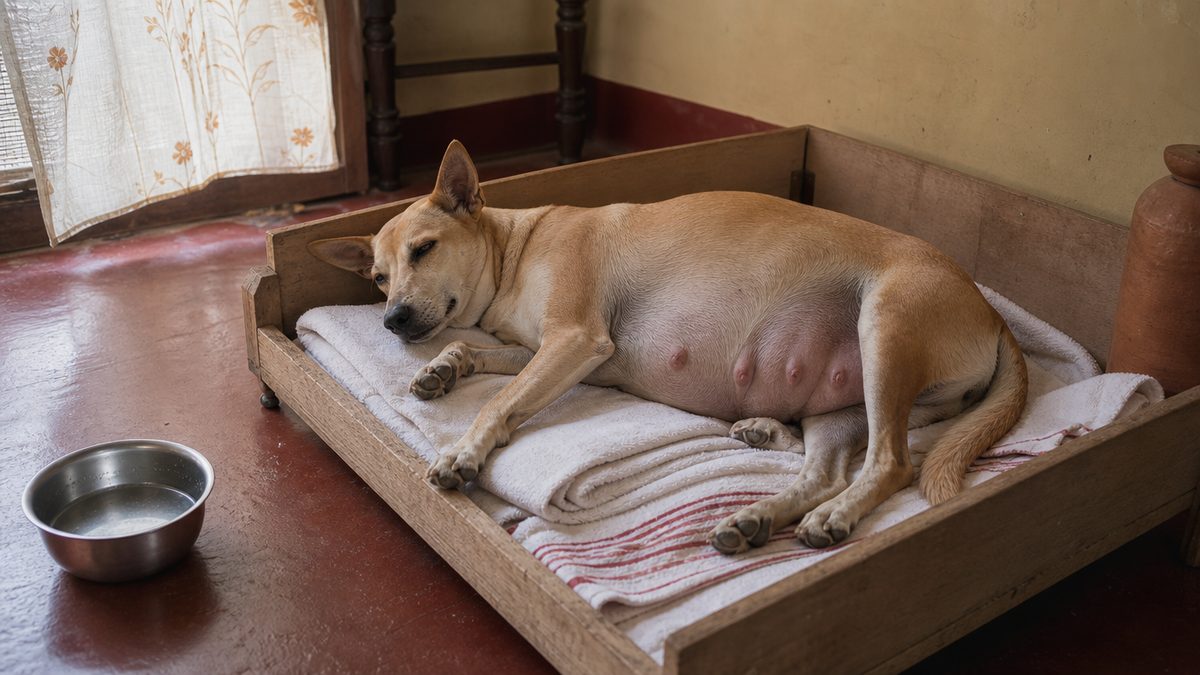
- Confirm the pregnancy before you change anything: a relaxin test from the fourth week or an ultrasound from day 25, since 60 percent of misbred dogs do not conceive.
- Keep her away from every other male for the rest of the heat; 'she could become pregnant from another dog during this period'.
- Weigh her weekly and hold a body condition score of 4 or 5 until week six.
- Walk her early and late in summer and let her decide the distance: 'do not over-exercise a pregnant female'. The heat safety guide gives the hour-by-hour rules by city.
- Switch her food in week six to a gestation and lactation diet and begin the step-by-step increase.
- Book the radiograph for after day 55 so you go into whelping knowing the count.
- Save the vet's night number and the address of a clinic that operates at 2 a.m., and ask for a written caesarean estimate now.
- Set up the whelping box a week before the due date so she has chosen it before she needs it.
The whelping box, and the two temperatures
PDSA's box is rigid, in a quiet secluded room, lined with clean washable bedding, big enough for her to stretch out and turn, with sides high enough to keep newborns in and low enough for her to step over, and fitted with inner rails so a puppy cannot be squashed against a wall. On temperature the two vet-reviewed sources answer different questions: PDSA sets the room at around 22 degrees C; VOSD, writing from Bengaluru in February 2026, sets the immediate whelping area at around 29 degrees because 'newborn puppies cannot regulate their own body temperature', and 29 to 32 for their first week. The room is for the mother, the warm corner for the puppies. In most Indian cities the room already sits above 29 degrees from March to October, so the problem is the reverse of the British one: a fan on the room, not on the box, and the heating pad kept for a winter litter.
Two rules cover the last three weeks. Feed smaller meals more often, since 'the dog usually needs to have an increased number of smaller meals rather than an increased quantity per meal' as the litter compresses her stomach. And watch the discharge: clear or white mucus near term is normal; anything bloody, discoloured or foul before labour is a vet call.
Whelping stage by stage: the normal intervals, the signs that mean call the vet now, and how often birth goes wrong
Whelping runs in three stages: 6 to 12 hours of restlessness, panting and nesting while the cervix opens, then the puppies, each taking 0 to 30 minutes to be born with rests of up to two hours between them, each followed by its placenta, and a vet call the moment a rest passes two hours or hard straining passes 30 minutes without a puppy. The normal whelping process is the one you leave alone; the job is recognising the minute it stops being normal.
The temperature dip. In most dogs the rectal temperature falls to a mean of 37.1 degrees C, range 36.7 to 37.8, some 8 to 24 hours before whelping as progesterone collapses; Cornell gives the same event as a reading below 99 degrees F within 24 hours of birth, lasting about eight hours, with the caveat the blogs drop: 'it is not always detected';. A reading twice a day from day 57 catches the dip if it comes; a missed dip proves nothing. A planned caesarean is safe only from day 62, before which the puppies' lungs may lack surfactant.
| Stage | What you see | Normal length | Call the vet if |
|---|---|---|---|
| Stage one: cervix dilates | Nesting and shredding bedding, panting, shivering, refusing food, hiding, a clear to white discharge; no visible straining | 6 to 12 hours, up to 24 to 36 (Cornell), the long end especially in a first-time or nervous mother (PDSA); 12 to 24 hours (Merck) | Stage one passes 24 hours with no puppy, or no labour follows the temperature dip within 24 hours |
| Stage two: puppies delivered | Visible abdominal straining, a fluid-filled sac at the vulva, then a puppy, head first or tail first, normal as long as the legs are extended | 0 to 30 minutes per puppy; rests of up to 2 hours between puppies (Cornell); most litters finished within 6 hours and never more than 24 (PDSA) | Strong straining for 20 to 30 minutes with no puppy; a rest of more than 2 hours with puppies remaining; a green discharge before the first puppy; more than a few drops of blood; a puppy visible but stuck |
| Stage three: placentas | One placenta per puppy, often two puppies then two placentas because they come from alternate horns; she may eat them | Alternates with stage two until the last puppy; a placenta about 15 minutes after each puppy (PDSA) | Fewer placentas than puppies by the end, or straining that continues after the last puppy you counted |
The signs that mean call the vet now
- Straining hard for 20 to 30 minutes without a puppy: PDSA's line is that 'a delay could be the difference between life and death';.
- Resting more than two hours between puppies when the radiograph says more remain.
- Passing a green discharge before the first puppy; green means a placenta has separated and 'should be followed immediately by a fetus'.
- Bleeding more than a few drops, at any point.
- Stalling with a puppy visible at the vulva that does not come, or a mother who stops straining from exhaustion.
- Reaching 70 to 72 days after mating with no labour, or 24 hours after a temperature dip with none.
- Seeing stillborn puppies, or puppies not breathing or moving.
PDSA's instruction on a stuck puppy is 'do not touch or try to pull out the puppy without specific advice and guidance from your vet';. Merck's on the injections is that calcium and oxytocin, the drugs a vet uses to strengthen weak contractions, are given by nobody without a vet's specific advice, because oxytocin into a uterus that cannot pass the puppy tears it. The decision to intervene is made at the clinic, on an examination and often an X-ray.
Dystocia: how often it happens, and in which dogs
Difficulty giving birth is uncommon across dogs and common in a short list of breeds, and both halves have numbers. Among 195,931 insured Swedish bitches, 3,894, or 2 percent, had a dystocia claim over 1995 to 2002, 5.7 cases per 1,000 dog-years, and 63.8 percent of them were delivered by caesarean section. Among almost 20,000 bitches at 50 UK emergency clinics, 3.7 percent were there for dystocia, and against crossbred bitches the French Bulldog was 15.9 times more likely to be, the Boston Terrier 12.9, the Pug 11.3 and the Chihuahua 10.4. In 22,005 litters from 13,141 bitches across 151 breeds, the Boston terrier, the bulldog and the French bulldog were born by caesarean more than 80 percent of the time. The Bulldog and French Bulldog pages carry those figures because a brachycephalic bitch is planned for surgery, not a whelping box; the Labrador and German Shepherd are not in that survey's ten highest rates, so a Labrador Retriever or German Shepherd whelps naturally in the large majority of cases, and the two-hour rule protects the minority.
A stalled labour is handled in the clinic: an examination, often a radiograph, then calcium or oxytocin if the puppy can pass, or a caesarean if it cannot. At the IVRI polyclinic that surgery is on the rate card at Rs 400 plus tax for pets, and dystocia managed without surgery at the same Rs 400; a private clinic at night charges more, hence the written estimate in the checklist above.
The first days after whelping: lochia, the puppies' weight, and the three complications (eclampsia, mastitis, metritis)
The first three weeks after whelping are watched on four things: the vaginal discharge, the mother's temperature and appetite, her mammary glands, and the puppies' weight, taken as soon as each is dry and then twice a day for the first week. Postpartum care is mostly counting: placentas against puppies, grams against yesterday, and days against the window in which the complications strike.
Lochia. A discharge after birth is normal. Cornell describes lochia from green to red or brown, lasting about three weeks and up to eight, darkening and decreasing; it 'should not have a foul odor', and a foul smell or an increasing amount means infection. Merck adds that it is dark red to black and heavy for the first few days; PDSA allows it for up to six weeks provided it does not smell. VOSD recommends a check within 24 to 72 hours of delivery whatever the birth looked like.
The puppies. Weigh each twice daily for the first week; a newborn should gain about 10 percent of its body weight a day, and 'any weight loss after the first 24 hours indicates a potential problem';. Disinfect each umbilical stump with tincture of iodine. Every puppy must nurse within its first hours, because the gut absorbs the antibodies in colostrum for only about twelve hours. Their own schedule, deworming from two weeks and the first vaccine at six to eight weeks, is on the dog deworming schedule and the dog vaccination schedule for India, and the first weeks at home on the puppy care guide.
Eclampsia, the calcium crash
Eclampsia is a life-threatening drop in blood calcium in a nursing mother, most often when the puppies are one to four weeks old and milk output peaks. Merck puts the risk highest in dogs under 20 kg with a large litter or an improper diet; VCA names the small breeds India keeps in flats, the Chihuahua, Pomeranian, toy Poodle, Miniature Pinscher and Shih Tzu. The signs start subtle, restlessness, panting and a stiff walk, then progress to an inability to walk, whole-body spasms and convulsions. VCA's instruction: stop the pups suckling and contact the vet immediately, because treatment is intravenous calcium under monitoring, not a tablet.
Mastitis and metritis
Mastitis is inflammation of a mammary gland, usually a bacterial infection that has climbed a nipple; its first sign is often the puppies, who stop gaining, then the gland swells, turns red or purple and painful, and the milk carries blood or pus. Many cases follow sudden weaning or the death of a puppy, so check every gland daily. Metritis is infection of the uterus, uncommon but serious, tied by PDSA to a difficult birth or retained placentas: low energy, poor appetite, fever, a smelly discharge and less milk. Merck adds the tell that separates it from lochia, continued straining as if still in labour, and notes that a retained placenta 'usually leads to metritis';.
- A gland that is hot, hard, discoloured or painful, or milk that is bloody, cloudy or thick.
- A discharge that smells foul, turns to pus, or increases instead of fading.
- A fever, a refusal to eat, or a mother who ignores the puppies.
- A stiff, twitching or panting mother in the first four weeks of nursing: eclampsia until proven otherwise.
- A puppy that loses weight after its first day, cries constantly, feels cold or is pushed away.
The gap before a next litter is not a matter of taste in India. The uterus needs about four months to involute after a litter, and the 2017 Rules go further for anyone they bind: no litters in two consecutive seasons, no birth within twelve months of the last, one litter a year, five in a lifetime. If there will be no next litter, the dog sterilisation guide covers the spay after weaning; Cornell's rule is to wait about two months after a heat so the surgery bleeds less.
The rules in India if you breed: the 2017 Rules clause by clause, KCI litter registration, and where the puppies go
In India, anyone who owns dogs of specific breeds 'for breeding and sale of dogs and pups' is a breeder under the Prevention of Cruelty to Animals (Dog Breeding and Marketing) Rules, 2017, must hold a State Animal Welfare Board registration before breeding, may breed a bitch only from her eighteenth month, once a year and five times in her life, and may not sell a pup under eight weeks. The clauses below are quoted from the gazette, G.S.R. 496(E), notified in New Delhi on 23 May 2017 and read through pypdf.
The definition decides who is bound. Rule 2(1)(c) defines a breeder as 'an individual or group of persons who own dogs of specific breeds for breeding and sale of dogs and pups, and includes boarding kennel operator, intermediate handler and trader'; Rule 3(1) bars 'any breeding activity' without a certificate of registration; Rule 4(2) sets the application in Form I with 'a non-refundable fee of five thousand rupees';. Whether one household with one litter that gives the puppies away sits inside 'for breeding and sale' is for the State Board; the moment puppies are sold, the seller is inside the definition. Rs 5,000 divides to USD 59.26 at 84.38 and USD 67.57 at 74, an Indian figure.
| Provision | What it says, quoted | Where it sits |
|---|---|---|
| Age at first breeding | 'Only normal, healthy, mature female dogs that have reached their eighteenth month shall be bred and shall be certified as healthy by a veterinary practitioner at least ten days prior to their being bred' | Second Schedule, Part II, paragraph 5(2) |
| Consecutive seasons | 'No female dog shall be exploited to produce litters in two consecutive breeding seasons' | Second Schedule, Part II, paragraph 5(3) |
| Twelve-month gap | Female dogs 'shall not be used such that they give birth to pups before the end of the period of twelve months beginning with the day on which they last gave birth to pups' | Second Schedule, Part II, paragraph 5(4) |
| One litter a year, no artificial insemination | 'Only one litter shall be produced in one year and artificial or unnatural techniques such as artificial insemination and rape stands shall not be used to impregnate dogs' | Second Schedule, Part II, paragraph 5(5) |
| Lifetime cap | 'No female dog shall be exploited to give birth to more than five litters of pups during her lifespan' | Second Schedule, Part II, paragraph 5(6) |
| The stud | No male used for breeding 'unless he is a healthy, mature dog, and only after he has reached his eighteenth month', certified healthy at least ten days before mating | Second Schedule, Part II, paragraph 5(7) |
| Upper age | 'Female dogs shall not be mated after the age of eight years' | Second Schedule, Part II, paragraph 6(4) |
| Vaccines and worming | 'Every breeding female dog shall be up-to-date with their vaccination boosters and de-worming prior to mating' | Second Schedule, Part II, paragraph 6(7) |
| Age at sale | 'Pups less than eight weeks in age are not sold' | Rule 8(1)(a) |
| Health, microchip, records at sale | Only dogs 'in good health, that have been provided the medical inoculations' are sold; 'each pup sold is micro-chipped'; the breeder gives the purchaser in writing 'details of feeding, dates of inoculations and de-worming of the pup and the name and address of the veterinary practitioner' | Rule 8(1)(d), 8(1)(e) and 8(2) |
| Unsold pups | 'Every breeder shall rehabilitate a pup not sold within a period of six months, through an Animal Welfare Organisation' | Rule 8(6) |
| The whelping record | Records of each dog include 'date of whelping', 'number of pups whelped, by sex colour and markings' and 'litter registration number if any' | Rule 9(2)(o), (p) and (q) |
Two things in that table are easy to miss. Paragraph 5(5) prohibits artificial insemination outright, which puts the imported-semen pedigree litter outside Indian law. And Rule 8(1)(b) surprises most buyers: 'dogs over six months in age are not sold without first being sterilised, unless they are being sold to another licensed breeder';. The Rules never mention pregnancy, gestation or whelping care; 'whelping' appears only in the records paragraph, so everything above this section is veterinary practice and only this section is law.
KCI litter registration: the 30-day inspection rule and the fee bands
A pedigree litter is registered with the Kennel Club of India on Form C, posted with the fee to its Anna Nagar office in Chennai, and the form carries two deadlines and a fee that climbs with delay: the application 'must be sent to the KCI after 30 days of the birth of the pups to enable litter inspection', and litter registration 'MUST BE DONE within 180 days from the date of birth';. Both sire and dam must already be KCI-registered with the breeder recorded as the dam's owner, all live puppies are registered at one time, and an IKG subscription is compulsory. Rs 750 divides to USD 8.89 at 84.38 and USD 10.14 at 74, an Indian fee. What the certificate proves and does not is on KCI registration explained.
| Litter | Within 60 days of birth | 61 to 120 days | 121 to 180 days |
|---|---|---|---|
| All breeds except the two below | Rs 750 | Rs 1,200 | Rs 2,000 |
| German Shepherd Dog | Rs 1,000 | Rs 1,500 | Rs 2,500 |
| Indian breeds | Rs 375 | Rs 600 | Rs 1,000 |
Where the puppies go
The puppies leave at eight weeks at the earliest, microchipped, inoculated, and with the written feeding, vaccination and deworming record the Rules require, which is also the record the buyer asks to see; the buyer's side is on bringing a puppy home in India. Rule 8(3) obliges the breeder to 'screen prospective purchasers to ascertain their potential to take proper care of the breed, especially if it is a large one';. The breed pages carry the published Indian price bands, for instance the Labrador Retriever and the German Shepherd; this page does not advise on selling, and a puppy that cannot be placed is rehomed through an animal welfare organisation, which is Rule 8(6) and the route on how to adopt a dog in India.
An unplanned litter in a community dog: what the ABC Rules 2023 say, and sterilisation after weaning
An unplanned litter in a community dog is governed by the Animal Birth Control Rules, 2023, which keep the mother out of the catching van until her puppies are two months old, keep puppies under six months out of it altogether, and return every sterilised, vaccinated dog to the spot it was picked up from. The resident's job is the 63 days and the eight weeks after; the local authority's job is the surgery.
The clause is Rule 11(9): 'Street dogs under the age of six month shall not be captured for and undergo sterilisation and female animals with puppies shall not be captured for sterilisation till their litter is two months of age';. Rule 11(8) requires release 'in the same area from where it was captured, after sterilisation and immunisation', and Rule 11(10) that surgery happens only at an Animal Birth Control Centre holding the Board's Certificate of Project Recognition. Feeding a nursing community dog is a duty the Rules assign: Rule 20 makes the Resident Welfare Association, apartment owners' association or local body responsible for arranging feeding at designated spots and times. The wider law is on stray dogs in India, the feeding rules on feeding community dogs in India.
What a resident does in the 63 days is the pet owner's list, cheaper. Confirm before assuming, since 60 percent of misbred dogs do not conceive; if she is pregnant, the last three weeks and the weeks of nursing are where the food matters, and a nursing Indian pariah dog of 15 to 20 kg needs two to three times her usual ration on the AAHA factors. Give her a sheltered, dry corner she chooses rather than moving her across the colony, which the release-to-the-same-place principle exists to prevent. A community dog in dystocia is an emergency like any other, and the IVRI rate card is the floor of what that costs at a government hospital.
Puppies stay with the mother until at least eight weeks. The mother is sterilised after that, either through the local authority's ABC programme, which is free and must ear-notch, vaccinate and release her to the same spot, or privately, where Cornell's timing applies: about two months after a heat, and about four months for the uterus to involute after a litter. The puppies are sterilised in their turn from six months, the age below which Rule 11(9) forbids capture, if they stay on the street, or go to homes through the AWBI adoption protocol. Every step is on the dog sterilisation guide and how to adopt a dog in India.
A litter of Indies vaccinated, dewormed and placed at eight weeks, with the mother sterilised once the litter is two months old, is the outcome the 2023 Rules describe; the alternative, an unsterilised mother back in heat next season, is the arithmetic the stray dogs guide counts.
Common questions about dog pregnancy, asked the way Google India asks them
How many months is a dog pregnant?
A dog is pregnant for about two months: an average of 63 days from ovulation, or 63 days plus or minus 7 from the first mating, because sperm survives for days inside her and the egg takes 2 to 3 days to mature. A bitch still not in labour 70 to 72 days after mating needs a vet.
Can a dog be 3 months pregnant?
No, a dog cannot be three months pregnant. Gestation runs 58 to 72 days from the first mating and 64 to 66 days from the progesterone rise, so a 90-day pregnancy does not exist. A dog that looks pregnant three months after a mating has a wrong date, a phantom pregnancy, or a swollen uterus from pyometra, which an ultrasound separates.
What are the first signs a dog is pregnant?
The first signs a dog is pregnant are ones a vet finds: uterine swellings palpable from about day 21, a positive relaxin test from day 22 to 27, and an ultrasound image from day 25. At home the first visible change is the teats, pinker and larger around day 30, then weight gain from day 35 and a rounding belly from day 40.
What is the process of dog pregnancy?
The process of dog pregnancy runs on a fixed timetable: fertilisation in the oviducts, implantation at about day 18, uterine swellings by day 21 that double every seven days, skeletons calcifying from day 28 and visible on X-ray from day 42 to 45, a countable litter on a radiograph after day 55, then a fall in progesterone, a temperature dip 8 to 24 hours before birth, and whelping at about 63 days from ovulation.
How long is a dog pregnant for the first time?
A dog is pregnant for the same 63 days from ovulation the first time as any other time; breed, parity and litter size shift the date only at the margin. What differs in a first litter is the whelping: stage one runs 6 to 12 hours in most dogs and can stretch to 24 to 36, the long end especially in a first-time or nervous mother.
How to take care of a first time pregnant dog?
To take care of a first time pregnant dog, confirm the pregnancy from the fourth week, keep her ration unchanged for six weeks and then raise it step by step to about 1.5 times normal in smaller meals, give no medicine without the vet, let her set her exercise pace out of the heat, book an X-ray after day 55 to count the puppies, and set up the whelping box a week early.
What to avoid when a dog is pregnant?
Avoid calcium supplements, which VCA lists among the causes of eclampsia in nursing mothers; avoid any medicine, dewormer, tick product or painkiller the vet has not cleared for pregnancy; avoid overfeeding in the first six weeks; avoid other males for the rest of the heat, since a second sire is possible; and avoid the midday heat of an Indian summer.
How do I help my dog during pregnancy?
Help your dog during pregnancy by counting rather than fussing: a pre-mating vet check with boosters and deworming current, a body condition score held at 4 or 5 of 9 until week six, a switch to a gestation and lactation diet in the sixth week, smaller and more frequent meals as the litter compresses her stomach, exercise at her own pace, and a late X-ray so you know how many puppies to count on the night.
What is the normal delivery time for a dog?
The normal delivery time for a dog is 0 to 30 minutes per puppy with rests of up to two hours between puppies, after a first stage of 6 to 12 hours of nesting and panting that can run to 24 to 36 hours in a first-time mother. Most litters finish within six hours; none should take more than 24. Call the vet if straining passes 30 minutes without a puppy or a rest passes two hours.
Is labour painful for dogs?
Yes, labour is uncomfortable for dogs, and the signs are those of stage one: restlessness, panting, trembling, refusing food, vomiting and hiding for 12 to 24 hours before the first puppy, then visible straining. What matters is its shape: straining that produces no puppy in 20 to 30 minutes, or a dog too exhausted to strain, is pain that has become dystocia and needs a clinic, not comfort.
Can dogs get pregnant at 3 months?
No, dogs cannot get pregnant at 3 months of age. A bitch conceives only once she has her first heat, which arrives between 6 and 24 months, earlier in small breeds and later in large ones, and then about twice a year at intervals of 5 to 11 months. A three-month-old puppy has not cycled; a three-month-long pregnancy does not exist either.
How many days does a dog give birth in India?
A dog gives birth in India after the same 63 days from ovulation as anywhere else, or 63 plus or minus 7 days from the first mating; gestation does not change with the country. What changes is what follows: the Kennel Club of India wants a pedigree litter's Form C sent after 30 days for inspection and registered within 180 days, and the 2017 Rules bar a breeder from selling a pup under eight weeks.
What is Indian puppy pregnancy syndrome?
Indian puppy pregnancy syndrome is a culture-bound delusion in humans, not a condition of dogs: a person bitten or touched by a dog believes puppies are growing inside them. Psychiatrists at the Institute of Postgraduate Medical Education and Research, Kolkata, described six male and one female case from rural West Bengal in 2003. A dog bite needs rabies post-exposure treatment, not this page.
What is the new rule for dogs in India?
The rule that governs a pregnant or nursing street dog is the Animal Birth Control Rules, 2023, notified 10 March 2023. For a litter it says three things: dogs under six months are not captured for sterilisation, a female with puppies is not captured until her litter is two months old, and every sterilised, vaccinated dog is released where it was picked up. Rule 20 makes the RWA or local body responsible for arranging feeding.