
Dog and cat travel guide
Are pets allowed in Uber or Ola in India: what each operator publishes, and what happens at the pickup point
Every page answering this question in India is a forum thread or a guess. The operators do publish rules, two of Uber's own pages contradict each other on what a pet ride costs you, and India's aggregator guidelines mention animals exactly zero times.
Quick answer
Are pets allowed in Uber or Ola depends on which app you open. Uber publishes a real policy. Uber Pet is live in Delhi, Mumbai and Bengaluru only, carries one pet, and costs more. Everywhere else, and on Ola, a pet rides at the driver's discretion, because neither operator publishes an Indian pet rule. Message the driver before pickup, carry a leashed dog or a closed carrier, and book a pet taxi when the trip cannot fail.
This guide is general information for Indian pet owners and is not a diagnosis. Always consult a registered veterinarian near you before acting on anything you read here, and treat any sudden change in your pet's condition as urgent.
What Uber, Ola and Rapido actually publish about pets
Uber publishes a real pet policy and a paid product to go with it, Ola publishes nothing a customer can read, and Rapido mentions animals only in the list of things you may not send as a parcel. Those three positions are not equivalent, and the difference decides which app you open with a cat in a carrier at nine at night.
We went to the operators' own pages rather than to the blogs summarising them, and read every one on 21 October 2026. The table below is what those pages say, with the document named in each row so you can check whether it has changed by the time you read this.
| Operator | Published position on pets | Where we read it |
|---|---|---|
| Uber, in a city with Uber Pet | Uber Pet is a paid ride option carrying one dog or cat with up to three passengers, live in Delhi, Mumbai and Bengaluru | Uber India's Uber Pet product page and Uber's India newsroom post of 11 July 2025 Uber India Newsroom |
| Uber, any other ride option or city | "If you're traveling with a pet that's not a service animal, drivers may choose whether or not to allow the pet in their vehicle", and pets are barred from UberX Share outright | Uber Help, Riding with pets |
| Ola | No pet policy found on the Ola help centre or the Ola website. The only Ola-sourced statement we could find is a support account post on X, not a help-centre document | help.olacabs.com support home, searched 21 October 2026 Ola Support (@ola_supports) |
| Rapido | An Auto Pet option appears in Rapido's own app-store listing of services. The Customer Terms contain no passenger pet clause and list animals only among items you may not send as a package | Rapido's Google Play listing, updated 14 October 2026, and rapido.bike Customer Terms |
| Auto rickshaws and kaali-peeli taxis hailed off the street | No published national policy exists, because no national body publishes one | Searched for one and found none, 21 October 2026 |
Read the table as a snapshot with a date on it. Operator policies change without notice and this page will be read months after it was written, so treat every row as what the document said on 21 October 2026 and open the linked page before you rely on it.
Uber Pet launched in Bengaluru on 8 October 2024 as a pre-booking service only, and by 11 July 2025 Uber described it as "On-demand or reserve-only rides" in three cities Uber India Newsroom. The product changed substantially inside nine months. Anyone quoting a 2024 description of Uber Pet today is already wrong, and anyone quoting this page in 2027 may be too.
Uber Pet in India, and the two Uber pages that contradict each other
Uber Pet is a separate ride option you select in the app, it carries exactly one dog or cat, it costs more than the equivalent ordinary ride, and Uber publishes it in three Indian cities. Two of Uber's own pages then disagree about how many people may travel with that animal and about whether shed hair can be charged for.
Start with what is consistent. Uber's rider help article says you may bring one pet, that it may be "one small animal such as a dog or a cat", that "it is the driver's discretion whether any additional pets are allowed", and that "there are no breed or size restrictions";. Uber India's product page adds the practical instructions, which are to keep the animal secure with a leash, harness or carrier, to stay with it, to ask the driver where the animal should sit, and to bring a blanket or towel to protect the seat.
The city list is the part people get wrong. Uber brought Uber Pet to Bengaluru on 8 October 2024 and described it then as "this new reserve-only service", bookable only in advance, "anywhere from 60 minutes to 90 days" ahead. On 11 July 2025 Uber's India newsroom listed it as "On-demand or reserve-only rides with drivers who know you're traveling with a pet, now live in Delhi, Mumbai, and Bengaluru". Chennai, Hyderabad, Pune, Kolkata and Ahmedabad are not on that list. If you live in one of them, Uber Pet is not the answer to your problem and the general driver-discretion rule is.
Two contradictions, printed rather than averaged
Uber maintains a rider-facing set of pages and a driver-facing set, and they do not say the same thing. We are publishing both versions rather than picking the one that reads better, because the difference affects what you are charged and how many people can get in the car.
| Question | Rider-facing page | Driver-facing page |
|---|---|---|
| How many people may travel with the pet? | "Travel with up to 3 passengers and 1 pet"; | "A maximum of two riders and one pet may ride with Uber Pet. Additional riders will be left to the discretion of the driver-partner"; |
| Can you be charged for shed hair? | "If your pet leaves waste, excessive hair, or causes damage to the vehicle, you may also be charged a cleaning fee"; | "For minor issues related to pet hair, animal odour, or typical wear-and-tear, a cleaning fee will not apply"; |
| Must a driver accept a service animal? | Service animals "are permitted to accompany riders at all times without extra charge"; | "You are encouraged to accept riders with service animals (e.g. guide dogs), even if you have chosen not to receive Uber Pet requests"; |
The second row is the one that costs money. Hair is the single most common thing a driver objects to after a dog has been in the back, and Uber tells riders it is chargeable while telling drivers it is not. Photograph the seat you are getting out of if the animal has shed on it, because a dispute over hair is a dispute you can win with that page and that photograph.
The third row matters more than it looks. "Permitted at all times" is an entitlement. "You are encouraged to accept" is a suggestion. We return to that gap in the service-animal section below, because Indian law, rather than Uber's wording, is what settles it.
What Ola publishes about pets, which is nothing we could find
Ola publishes no pet policy a customer can read. We looked for an Ola pet policy on the Ola help centre and on the Ola website on 21 October 2026, found no page on the subject, and are reporting the absence rather than filling it with a forum answer.
Ola's support home at help.olacabs.com organises its articles under My Account, Fares, Charges and Transaction FAQs, Ola Money, Safety, All About Ola Services, A Guide to Ola, ONDC Foods, and Grievance and Nodal Officer. Nothing in that structure addresses animals. A request for olacabs.com/terms redirected to the Ola home page on the same date.
What does exist is one reply from Ola's support account on X, posted on 21 April 2024 to a customer asking for a pet option in the app. It reads in full: "Hey Prachi, we love pets at Ola. There is no restriction on bringing pets in the cab. You can bring in pets at the driver's discretion. For any further queries, we are only a few clicks away :)";. We opened that post rather than quoting a search result, and it is the most Ola has said on the subject anywhere we could find.
Treat it as what it is. A support reply on a social platform is not a published policy. It carries no version, no review date and no scope, nobody at a pickup point can be shown it as a rule, and the thread under it contains a rider from February 2026 asking Ola why its drivers say the opposite. The operational position is complete driver discretion with nothing written behind it.
The pages currently answering this question in India are a Reddit thread, two Quora threads, a Facebook group post and a Change.org petition. None of them is a policy and none of them binds anybody. If you are standing at a gate at nine at night, the only thing that works is a driver who has already agreed on the phone, which is why the message you send before the ride is the most useful thing on this page.
The absence is itself worth knowing. An operator with no published pet policy cannot be appealed to when a driver refuses, cannot be held to a rule it has never written, and gives its own support staff nothing to work from. That is a materially worse position for you than Uber's, even in a city where Uber Pet does not run, because Uber at least publishes the driver-discretion rule in writing.
Rapido, bike taxis and the Auto Pet option
Rapido lists an Auto Pet option among its services in its own app-store listing, which makes it the only Indian operator besides Uber with a named pet product, and its Customer Terms still contain no clause about a passenger travelling with an animal.
Rapido's Google Play listing, published by Roppen Transportation Services Private Limited of Bengaluru, Karnataka and updated on 14 October 2026, reads: "Rapido additionally offers services such as Bike Lite, Bike Metro, Parcel, Auto share, Auto Pet, and Auto Parcel under one umbrella";. Rapido Auto Pet therefore exists in the company's own words. What the listing does not give is a city list, a fare, a size limit or a set of conditions, and we found none of those on any Rapido-hosted page.
The Customer Terms at rapido.bike are the company's binding document, and they say nothing at all about a passenger's pet. Animals appear once, inside the Package Services section, in the list of contents you agree not to send, which runs through "livestock, fish, insects, animals, plants and plant material" among many other prohibited items. That clause governs parcels, not passengers, and it answers a question people ask separately. You cannot send an unaccompanied animal through a delivery app in India, and Rapido's own terms say so.
A bike taxi is a different physical problem from a car
The bike is where the question stops being about policy and starts being about physics. A pillion passenger on a two-wheeler has one hand free at best, no restraint for an animal, no enclosure, and nothing between the animal and the carriageway. A frightened cat that gets out of a carrier on a bike taxi in traffic is not a refusal problem, it is the beginning of a search. Our guide on how to find a lost dog or cat in India is the one you would be reading next, and it opens by telling you that most of the useful work happens in the first hour.
An auto is better than a bike and worse than a car. It is enclosed on three sides, has no door, and has a floor a carrier will slide across at the first speed breaker. If you use an auto, put the carrier on the floor between your feet rather than on the seat, keep a hand on it, and accept that a loose dog in an auto has an open side to leave through.
No Rapido, Uber or Ola document we read authorises carrying an animal on a two-wheeler, and nothing about a pillion seat makes it survivable for a loose dog or an unlatched carrier. If the only ride available is a bike, wait for a different ride. This is the one recommendation on this page we make without a study behind it, because the mechanism does not need one.
Auto rickshaws, kaali-peeli taxis and the operators with no policy at all
No published national policy governs whether an auto rickshaw or a kaali-peeli taxi carries your dog, because no national body has written one, and we are saying that rather than inventing a rule that sounds plausible.
Street-hailed transport in India is licensed and priced by state transport authorities and municipal bodies, not by an app, and the instruments that set those fares deal with metres, permits and refusal to ply. We looked for a clause about animals in India's central aggregator guidelines and found none, which we set out in the next section. For the black and yellow taxis of Mumbai and Kolkata, and for autos everywhere, the position is simpler and bleaker. You are negotiating with one person, at the kerb, with no app, no record and no complaint route beyond the local transport authority.
That has one practical advantage worth naming. A street auto driver who says yes has said yes in person, to the actual animal, with the carrier visible. There is no later cancellation, no reassignment, and no second driver who has not been told. Many Indian pet owners end up relying on one auto driver's number for exactly this reason, and keeping that number is a more reliable plan than any app.
Check an operator still exists before you plan around it
BluSmart is the reason this warning is here. It ran more than 8,000 electric taxis across Delhi, Mumbai and Bengaluru, and its drivers were not allowed to cancel bookings, which made it the obvious recommendation for anybody travelling with an animal. On 17 April 2025 it suspended all ride bookings, telling customers by email, "We've decided to temporarily close bookings on the BluSmart app". The suspension has not been reversed and the company is recorded as defunct from 2025.
Note the gap between those two sources, because it is instructive rather than embarrassing. The company's own word was "temporarily". The encyclopaedic record, written later, says defunct. We publish both. For a reader planning a vet trip the operational answer is the same either way, which is that BluSmart is not a service you can book, and any page still recommending it was written before April 2025 and has not been checked since.
This market changes faster than the advice written about it. Before you rely on any named cab company for a journey that matters, open its app and confirm it returns a fare on your route today. Three of the pages we read while researching this guide still describe services that no longer run.
Why a driver refuses, and who pays for the cancellation at pickup
A driver refuses because the next passenger pays for a clean car and he does not, and the cancellation at pickup then costs you rather than him, because the rules make a passenger cancellation chargeable and leave the definition of a valid driver cancellation to the aggregator.
Start with the driver's arithmetic, because it is not unreasonable. In a car he owns, on fares set by a state government, with at least 80 percent of each fare coming to him under India's aggregator guidelines, hair on the upholstery is a cost he absorbs between rides. A soiled seat takes him off the road. He has met your animal for the first time at the gate and has no way to judge it. Driver discretion is not prejudice in most cases, it is an uninsured risk with a queue of waiting passengers behind it.
Now the part nobody writes down. Uber's driver-facing FAQ tells drivers exactly what to do when a rider turns up with a pet on an ordinary UberX: "It will be left to the driver-partner's discretion to either continue with the trip (Uber Pet rates will not apply) or kindly ask the rider to cancel the trip and request an Uber Pet ride";. The driver is instructed to ask you to cancel. That is the mechanism behind an experience thousands of Indian pet owners describe and nobody has explained.
The cancellation trap, in the regulator's own words
India's Motor Vehicles Aggregator Guidelines, 2025 were issued by the Ministry of Road Transport and Highways on 1 July 2025 and set the rule for both sides. Clause 18.1 says that where a driver cancels after accepting a journey, "a penalty of 10% of the Fare not exceeding Rs. 100, shall be imposed where such cancellation is made without a reason identified as valid by the aggregator and duly and specifically mentioned on its website and App". Clause 18.2 says a passenger who cancels without a valid reason pays a fee on the same 10 percent and Rs 100 terms.
Read clause 18.1 twice. The penalty only bites where the reason is not one the aggregator has itself listed as valid. The aggregator decides what counts. So when a driver asks you to cancel instead of cancelling himself, he moves the charge from a rule he might fail to a rule you will certainly meet, and he keeps his acceptance rate.
| What happens | What the guidelines say | Who pays |
|---|---|---|
| The driver cancels because of the animal | Clause 18.1, 10 percent of the fare capped at Rs 100, only if the aggregator has not listed that reason as valid | The driver, if the reason is not on the aggregator's list |
| The driver asks you to cancel and you do | Clause 18.2, 10 percent of the fare capped at Rs 100 | You |
| You cancel after seeing the car is too small | Clause 18.2, same terms | You |
| Nobody cancels and you are left waiting | No clause covers a stand-off; the booking simply expires or the driver marks arrival | Nobody, until the app times out |
If a driver refuses your animal at pickup, say that you will not cancel and ask him to. Be polite and be immovable on that single point. You then have a driver cancellation on the trip record, which is the thing a grievance officer can look at, and you have not paid a fee for a ride you were refused. Under clause 11.2 of the aggregator guidelines an aggregator must inquire into a passenger complaint against a driver within three days and inform you of the outcome.
Every licensed aggregator must also appoint a Grievance Officer whose name, email address and telephone number appear on its app and website, and must run a 24x7 call centre responsible for redressal of passenger grievances. Those are the two routes that exist. Neither is fast, and both are better than a rating.
The cleaning fee, what triggers it and who gets the money
A cleaning fee is charged to you and paid to the driver, it is assessed on the extent of the mess rather than on a fixed rate card, and Uber publishes no rupee schedule for India at all.
Uber's rider help article on cleaning fees says riders "are responsible for damage to the interior or exterior of a vehicle caused by incidents such as vomiting or food spills", that "cleaning fees are assessed and charged according to the extent of damage", that "these fees are paid in full to the vehicle's driver", and that you will receive an updated trip receipt if you are charged one. Nowhere on any Uber page we opened is there a rupee figure for India.
The United States version of Uber's driver article does publish numbers, and the gap is worth seeing. It sets a self-cleaning maximum of USD 80 and an overall maximum of USD 225, bands a minor mess at USD 30 to 60, a moderate mess at USD 55 to 85 and a severe mess at USD 80 to 225, requires the claim within three calendar days with at least one clear photograph of the mess, and excludes routine cleaning, unpleasant smells and normal wear and tear. It also states that "Cleaning Fee payments are never guaranteed" and that Uber decides each request "within Uber's sole discretion";.
An Indian rider gets the liability without the schedule. You can be charged, the amount is at the platform's discretion, and no published band tells you whether a muddy paw print is a Rs 200 problem or a Rs 2,000 one. That is the single clearest thing Uber could fix for Indian pet owners and has not.
- Photograph the seat before the animal sits on it, with the door open and the upholstery visible, on every ride. One photograph takes four seconds and is the only evidence you will have.
- Lay your own cover down, which is what Uber itself asks for on its India page, recommending "a towel also, to protect the vehicle's seats".
- Photograph the seat again as you get out, in the same frame, before you shut the door.
- Dispute through the app, not the driver, using the route Uber publishes, which is Trip Issues and Refunds, then Review my fare or fees, then I was charged a cleaning fee.
- Quote the driver FAQ if the charge is for hair, because Uber's own driver page says a cleaning fee will not apply to minor issues of pet hair, animal odour or typical wear and tear.
A wet dog on a cloth seat in humid weather is the complaint that generates a cleaning claim, and a coat that was merely damp at pickup is soaked through the fabric by the time you get out. Towel the animal dry before the car arrives, not after you are in it, and put a second dry towel under it. Our guide to monsoon care for dogs in India covers what the wet months do to a coat and to skin.
What to say when messaging the driver before they arrive
To get a driver to accept your animal, message them in the thirty seconds after the ride is assigned, state the species, the size and the containment in one line, and give them a reason to say yes rather than a request to agree to something unspecified.
Uber tells you to do this in writing. Its help article says that if you are travelling with a pet that is not a service animal, "it's good practice to contact the driver who accepted your ride request to let them know", using the in-app text message or call. That is the whole intervention, and it works because the driver's objection is to an unknown animal rather than to yours.
The message has to do three jobs in one screen. It has to tell the driver what is actually coming, show that the mess risk has been handled, and make cancelling feel worse than accepting. Most people send a question instead, which invites a no.
- Name the animal and its size. "Small cat" and "35 kg dog" produce completely different answers and the driver deserves the real one.
- Name the containment. "In a closed carrier" or "on a leash and harness" is the sentence that changes most minds.
- Name the cover. "I have my own bedsheet for the seat" removes the objection before it is made.
- Name the destination if it helps. "Going to the vet" is true, short, and does more work than any other four words in this conversation.
- Offer the cleaning undertaking. "If there is any mess I will pay for the cleaning" costs you nothing you were not already liable for.
- Do not ask whether it is allowed. It is allowed at his discretion, and asking permission in the abstract is how you get a cancellation.
A workable line, in English or in whichever language the driver is likely to read, runs along these lines. "Namaste, I have a small dog with me, on a leash, going to the vet. I have a bedsheet for the seat and will pay for cleaning if there is any mess. Is that okay?" Send it the moment the driver is assigned, before he starts moving, because a driver who has already driven two kilometres towards you is a driver who feels he has lost something by cancelling.
What to do when the answer is no
Accept it quickly and do not argue, because the clock matters more than the principle when an animal is unwell. Ask him to cancel, as set out above. Then change one variable before you rebook, which usually means switching to a larger vehicle class, moving the pickup to a spot where you can be seen standing with a carrier rather than a loose dog, or waiting ten minutes for a different pool of drivers. Rebooking the same class from the same pin at the same minute often reaches the same handful of cars.
Keep a second plan ready before you need it. The pet-taxi section below is that plan, and the time to find the number is a quiet Tuesday rather than the evening your cat stops eating.
Carrier or leash, the front seat, and an animal in someone else's car
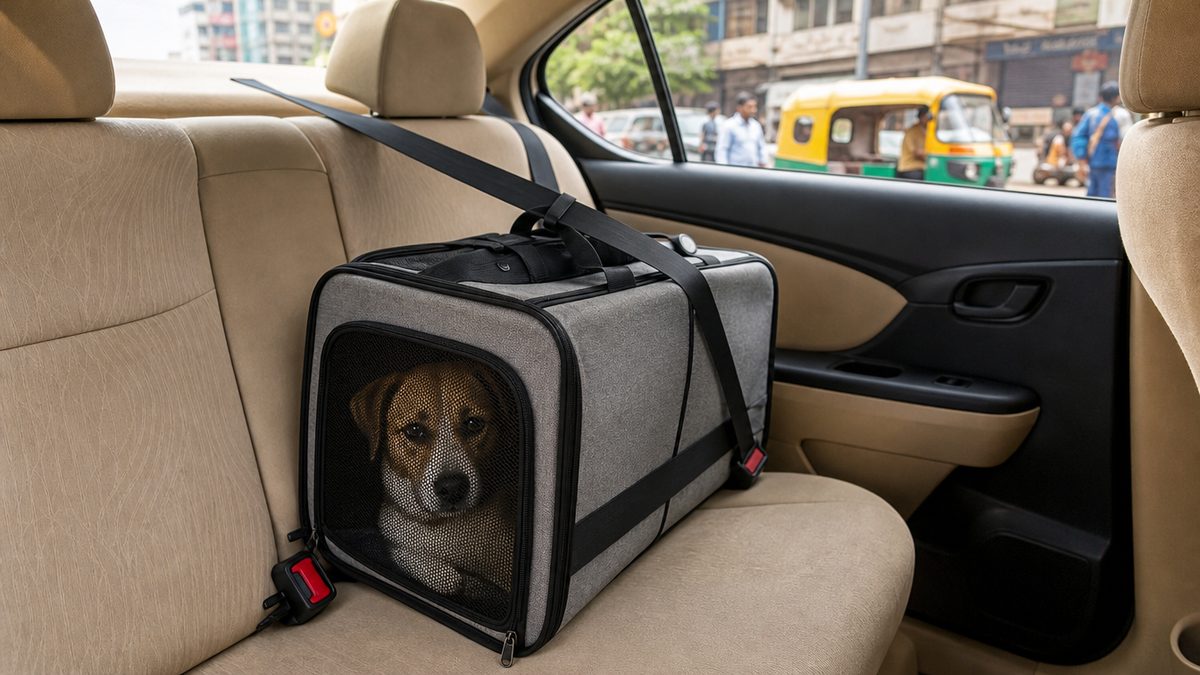
Use a closed carrier for a cat and for any dog that fits one, use a leash and a well-fitted harness for a dog that does not, and keep the animal in the back, because the risk you are managing in a stranger's car is different from the risk you manage in your own.
Uber's instruction is unambiguous and is the same on both of its pages. Keep the dog or cat "safe and secure with a leash, harness, or carrier", and any other species must travel in a carrier. Its driver FAQ goes further and tells drivers they "maintain the right to refuse animal types beyond dogs and cats and refuse animals they deem unsafe or uncontrolled";. A visibly contained animal is the single strongest argument you can make without speaking.
The safety case is thinner than the internet suggests and we are going to be honest about it. A study of 2,000 licensed drivers aged 70 and over, of whom 691 owned pets, found that pet owners who drove with their animals had no elevated crash rate overall, at a rate ratio of 0.97 with a 95 percent confidence interval of 0.75 to 1.26, and no elevated at-fault rate either. The one group that did show a raised rate was drivers who reported always travelling with a pet, at a rate ratio of 1.89 with a confidence interval of 1.10 to 3.25.
Three caveats travel with that figure. The sample is American and elderly, the exposure is the owner's own animal rather than a stranger's, and the finding is about frequency rather than about any single trip. What survives the caveats is the mechanism the driver is worried about, which is an animal moving unpredictably in a vehicle he is responsible for. A carrier on the floor removes that worry entirely.
The front seat is the wrong seat
Put the animal in the back, with you, every time. The front passenger seat of an Indian hatchback is where the driver reaches for the gear lever, and a cat that comes out of a carrier there goes into the footwell with the pedals. Uber's own advice is to ask the driver where he would prefer the animal to sit, and asking is good manners, but the answer you want is the rear seat or the rear footwell.
A walking collar is not a car restraint and nothing in an app-hailed cab makes it one. Our guide on collar or harness for dogs in India sets out why a harness beats a collar for lead work and why a licence tag belongs on the collar regardless. Our guide to how to travel with a dog in a car covers proper car restraint, and our guide to a road trip with your dog in India covers the heat risk in a vehicle you control. In a cab you control neither the vehicle nor the stopping, so the carrier does the work the restraint would have done.
- Latch the carrier and test the latch before you leave the flat, not at the kerb with a driver waiting.
- Leash the dog inside the gate and keep the lead short through the whole pickup, because the kerb is where dogs bolt. The Animal Welfare Board of India advises leashing pets in public places, partly to keep the animal from being run over and partly because it reassures the people around it.
- Carry your own sheet or towel, which is what both Uber and common sense ask for.
- Carry water and a small bowl for anything longer than a short city hop, because a cab window is not ventilation in Indian heat.
- Carry the vaccination card if the destination is a clinic or a boarding place, and keep a photograph of it on your phone as the backup.
- Check that the tag on the collar has a number that rings, because the moment a carrier opens in traffic is the moment that tag earns its cost. Our guide to microchipping a dog or cat in India covers the backup for a collar that comes off.
For a cat specifically, the carrier is not negotiable and the cover over it is almost as important. A cat that can see a strange moving world through mesh spends the ride trying to leave. Drape a towel over three sides, leave one side open for air, and keep the carrier on the floor where it cannot slide off a seat under braking. Our guide to indoor cat safety in India covers the wider point, which is that a cat escaping once is a cat that may not come back.
Service animals are a separate question, and Indian law treats them differently
A service animal is not a pet, and refusing one is not the same act as refusing a pet, but the Indian legal position is weaker and vaguer than most people assume, and we are going to set out exactly what it does and does not say.
Uber's own position is the strongest thing available to you in a cab. Its rider help article states that "service animals are permitted to accompany riders at all times without extra charge, regardless of whether it is a Pet Friendly Trip";, and its India product page says that "you do not need to select Uber Pet when traveling with a service animal" and that you may request any ride option. Uber's driver FAQ puts the same thing more softly, telling drivers they "are encouraged to accept riders with service animals (e.g. guide dogs), even if you have chosen not to receive Uber Pet requests";.
One limitation is worth knowing before you rely on it. The Service Animal and Assistive Device Policy that Uber's Indian product page links to resolves to Uber's United States jurisdiction document, last modified 3 February 2025, which is written around state and federal law and says service animals are not required to wear a tag, be registered or display proof, and that riders with service animals are not required to pay cleaning fees for hair or shedding. Those are good protections. They are published as United States policy, and we did not find an India-jurisdiction equivalent.
What Indian law actually says, and what it does not
The Rights of Persons with Disabilities Act, 2016 does not mention a dog. We searched the full text of the Act and the words dog and animal appear nowhere in it. There is no Indian statutory definition of an assistance animal, no registration scheme, and no provision naming the refusal of one as an offence.
What the Act does give you is broader and less specific. Section 3(3) states that "no person with disability shall be discriminated on the ground of disability, unless it is shown that the impugned act or omission is a proportionate means of achieving a legitimate aim", and that provision binds any person rather than only the government. Section 2(h) defines discrimination to include "denial of reasonable accommodation". Section 46 requires that "the service providers whether Government or private shall provide services in accordance with the rules on accessibility" framed under section 40. Section 41 directs the appropriate Government to provide access to all modes of transport. Section 89 sets the penalty for contravening the Act at a fine up to ten thousand rupees for a first offence, rising to between fifty thousand rupees and five lakh rupees for a subsequent one.
Compare that with aviation, where the rule is explicit. The Directorate General of Civil Aviation's requirement on carriage of persons with disability states at paragraph 4.1.1 that "no airline shall refuse to carry persons with disability (Divyangjan) or reduced mobility and their assistive aids/devices, escorts and guide dogs including their presence in the cabin", provided the airline is told at booking. Paragraph 4.1.17 adds that guide dogs may travel in the cabin if they are properly trained, remain on the floor at the passenger's feet, are harnessed and vaccinated, and that the passenger produces written proof of training, vaccination and medication.
That is what a binding transport rule for an assistance animal looks like in India. It exists for aircraft and it does not exist for taxis. Our guide on flying with a dog or cat in India covers the airline side in full.
We read the Motor Vehicles Aggregator Guidelines, 2025 in full looking for one. The words pet and animal do not appear. The clause headed "Non-discrimination policy to be followed by the aggregator" turns out to be about vehicles, requiring an aggregator to treat drivers' own cars at parity with its own. Divyangjan passengers are named in four clauses, namely driver induction training on "Divyangjan sensitivity and mobility needs", a requirement that the app be accessible, a passenger-safety clause, and a clause directing states to set a Divyangjan fleet target. None of those four mentions an assistance animal.
Where to complain if an assistance dog is refused
Go to the Chief Commissioner for Persons with Disabilities, which is the statutory office created under section 75 of the Act. A complaint may be filed in person, by registered post, by email to ccpd@nic.in, or through the online portal at ccpdcourt.gov.in, and Rule 38 of the Rights of Persons with Disabilities Rules, 2017 sets out what it must contain, which is your name and address, the name and address of the party complained against, the facts and when and where they arose, supporting documents and the relief claimed. A copy of the disability certificate is mandatory; other documents are not. Once filed, the complaint is referred to the other party for its version, the parties may be heard, and a recommendation follows.
Run the aggregator's own grievance route in parallel, because it is faster. The Grievance Officer's name, email address and telephone number must be on the app and the website, the aggregator must inquire into a complaint against a driver within three days, and it must tell you the outcome. Record the trip identifier, the driver's name and the time before you leave the app, because the driver's contact information is only guaranteed to remain visible to you for seven days after the journey ends.
When a ride-hail app is the wrong tool, and a pet taxi is the right one
Book a pet taxi or a pre-arranged car whenever the journey cannot be allowed to fail, because a ride-hail app gives you a probability and a dedicated service gives you a booking.
This is the honest conclusion of everything above, and it is not the conclusion a page sponsored by an app would reach. On Uber you have a published product in three cities and driver discretion everywhere else. On Ola you have no published policy. On Rapido you have an Auto Pet option with no documented terms. None of those is a guarantee, and a guarantee is exactly what you need when a cat has stopped eating or a dog is due in theatre at seven in the morning.
A dedicated pet taxi costs more and is priced like a pet taxi rather than like a cab. One Bengaluru operator publishes ₹500 for the first 5 km and then ₹30 per km in a hatchback or ₹35 per km in an SUV, with waiting charged at ₹150 for thirty minutes and ₹300 for an hour, and an optional pet-handling charge of ₹500 where the driver takes the animal in without you. Those are one operator's published rates on 21 October 2026, quoted here as evidence of what this market charges rather than as a recommendation. Bonbeno does not rank or recommend a named service, because a verdict needs first-hand testing.
Set that against the cab you were trying to book. India's aggregator guidelines fix the base fare at the rate the state government notifies for that vehicle class, charge a minimum of three kilometres to cover dead mileage, and allow dynamic pricing of up to two times the base fare. A pet taxi is therefore several times a short cab fare on a short trip and much closer on a long one, and the premium buys you a booking that will not be cancelled at the gate.
- Find the service now, before you need it. Save two numbers in your phone today, one dedicated pet taxi and one auto or cab driver who has already carried your animal.
- Ask what the vehicle is. A hatchback does not take a large crate, and the answer decides whether the booking is real.
- Ask whether you ride too. Some services quote a handling charge for taking the animal unaccompanied, which is a different service and a different risk.
- Ask what waiting costs, because a vet appointment overruns more often than it does not.
- Get the quote in a message, not on a call, so the number exists in writing when you arrive.
If you are moving an animal between cities rather than across one, the cab is probably the wrong question entirely. Our guides to Indian Railways rules for pets and to flying with a dog or cat in India set out what each mode actually costs and requires, and our guide to moving house with a pet in India covers the day itself.
What none of the operators publishes, and what to do about it
No Indian ride-hailing operator publishes the three things a pet owner most needs, namely a rupee figure for the cleaning risk, a city-level list of where a pet product actually runs, and a rule that survives contact with a driver at a gate. Plan around the absence rather than hoping it has been fixed.
Six things are true at once, and holding all six is what makes this question hard to answer in a sentence.
- Uber Pet is real, it is published, and it covers three Indian cities out of the dozens where people own pets.
- Outside those three cities, Uber's written rule is driver discretion, which is a rule about who decides rather than an answer.
- Ola publishes no pet policy we could find, so there is nothing to appeal to.
- Rapido names an Auto Pet service in its own store listing and documents none of its terms.
- India's central aggregator guidelines, issued in July 2025, do not mention animals once.
- A service animal has a far stronger case than a pet, and even that case rests on a general non-discrimination provision rather than on a transport rule written for taxis.
The practical consequence is a two-track habit. For a routine trip, open the app, message the driver in the first thirty seconds, carry a carrier and a cover, and accept that one booking in a few will fail. For a trip that cannot fail, do not use a ride-hail app at all. Book a pet taxi or a car you have arranged in advance, and pay the premium, because the alternative cost is a sick animal standing at a gate while you rebook.
Two situations deserve a specific warning. A dog that has panicked before will panic in a stranger's car with the windows up, and a festival evening in Delhi, Mumbai, Chennai or Kolkata is the worst possible time to discover that. Our guide on firecracker fear in dogs in India covers the preparation, and the short version here is that a cab is not the place to find out. Separately, heat is a real risk in a vehicle you do not control, because you cannot insist on the air conditioning and you cannot stop. Our guide to heat safety for dogs in India sets out the hours to avoid, and the first signs of heat stroke in dogs are covered on our page about heat stroke in dogs.
If your animal is unwell enough that the journey is urgent, call the clinic before you call a cab and tell them you are coming and why. A veterinarian can tell you whether the animal should travel at all, and that is a clinical judgement about the animal in front of them rather than a transport question. Bonbeno publishes this page under its medical disclaimer for that reason.
Finally, write down what worked. Which driver said yes, which vehicle class had room for the crate, which pet taxi answered at nine at night and what it charged. Nobody publishes that list for your city, the operators change their products faster than anyone documents them, and the list you build yourself is the only one that will still be accurate the next time you need it.
Common questions
Are pets allowed in Uber or Ola?
Yes on Uber in three Indian cities, and at the driver's discretion everywhere else. Uber Pet is a paid ride option carrying one dog or cat, live in Delhi, Mumbai and Bengaluru by Uber's own newsroom post of 11 July 2025. On any other Uber option Uber states that drivers may choose whether or not to allow a pet. Ola publishes no pet policy we could find on its help centre or website, which leaves the decision entirely to the driver.
Can I take my pet in a normal Uber?
Sometimes, because it is the driver's call. Uber's help article says that if you are travelling with a pet that is not a service animal, drivers may choose whether or not to allow the pet in their vehicle, and it advises contacting the driver through the app to let them know. Pets are barred from UberX Share outright unless the animal is a service animal. Uber's driver FAQ tells drivers they may either continue the trip at ordinary rates or ask you to cancel and rebook as Uber Pet.
Does Uber pets still exist?
Yes. Uber Pet launched in Bengaluru on 8 October 2024 as a pre-booking service, bookable from 60 minutes to 90 days ahead, and by 11 July 2025 Uber described it as on-demand or reserve-only rides live in Delhi, Mumbai and Bengaluru. Uber India still publishes a dedicated Uber Pet product page, read on 21 October 2026. It is not available in Chennai, Hyderabad, Pune, Kolkata or Ahmedabad on the strength of anything Uber has published.
How much more does Uber pet cost?
Uber does not publish a figure for India. Its India page says Uber Pet trips may include an additional fee compared with other ride options, and its rider help article says Uber Pet will cost more than other vehicle options. Neither states a rupee amount or a percentage, and the price appears only as an upfront fare in the app before you request. Uber also publishes no rupee cleaning-fee schedule for India, although its United States driver page bands cleaning fees from USD 30 to a maximum of USD 225.
Can I take my dog in rapido?
Rapido lists an Auto Pet option among its services in its own Google Play listing, updated 14 October 2026, which makes it the only named pet product in India besides Uber Pet. Rapido publishes no terms for it that we could find, no city list and no fare. Its Customer Terms contain no clause about a passenger's pet and mention animals only among the items you may not send as a package. Never put an animal on a bike taxi.
Can I take my dog in Uber Auto?
Uber publishes no auto-specific pet policy, so the general rule applies and the driver decides. Uber's help article states that drivers may choose whether or not to allow a pet that is not a service animal, and its Uber Pet product page says that not all ride options allow pets. Uber Pet is a car product and does not cover autos. If you use an auto, keep a cat in a latched carrier on the floor between your feet, because an auto has an open side.
Are pets allowed in Ola Cabs India?
Ola publishes no answer. We searched the Ola help centre and the Ola website on 21 October 2026 and found no pet policy, and a request for olacabs.com/terms redirected to the home page. The only Ola-sourced statement we located is a reply from Ola's support account on X on 21 April 2024, which says there is no restriction on bringing pets in the cab and that you can bring them at the driver's discretion. That is a social post rather than a policy document. Treat Ola as full driver discretion with no written rule to appeal to.
Which taxi service is pet friendly?
Uber is the only large Indian operator with a published pet-friendly product, and only in Delhi, Mumbai and Bengaluru. Rapido names an Auto Pet option without documenting it. Beyond those, dedicated pet taxis are the reliable option, and one Bengaluru operator publishes ₹500 for the first 5 km then ₹30 or ₹35 per kilometre. Bonbeno recommends no named service, because a verdict requires first-hand testing. Do not plan around BluSmart, which stopped taking bookings on 17 April 2025.
Can a cab driver in India refuse an assistance dog?
Uber says no, Indian law is less direct, and the two should not be confused. Uber states that service animals are permitted at all times without extra charge, regardless of the ride option. The Rights of Persons with Disabilities Act, 2016 never uses the word dog, but section 3(3) bars discriminating against a person on the ground of disability and section 2(h) includes denial of reasonable accommodation. Complaints go to the Chief Commissioner for Persons with Disabilities under section 75.