
Breed profile
Eurasier: a breed built in 1960, and what that means in India
One breed, three founder breeds, a dated paper trail, and a clause of Indian law that would have made the whole project illegal here.
Quick answer
The Eurasier is a 22 to 30 kg German companion breed created from 1960 by crossing a Chow Chow with a Wolfspitz and later a Samoyed. It is FCI standard 291, definitively recognised in 1973, and it is the one breed on this site that Indian law would have prohibited outright: Second Schedule Part II para 6(9) of the 2017 Rules bans breeding to create new breeds.
This guide summarises kennel-club breed standards, German breeding regulations, peer-reviewed veterinary literature, registry statistics, Indian import and breeding law and satellite climate data as general information for Indian pet owners. It is not a diagnosis and it is not treatment advice. Consult a registered veterinarian near you before acting on anything you read here, and treat collapse, laboured panting that will not settle, a distended abdomen with unproductive retching, seizures or a suspected heat stroke as an emergency.
Eurasier traits, rated for India
What the Eurasier is
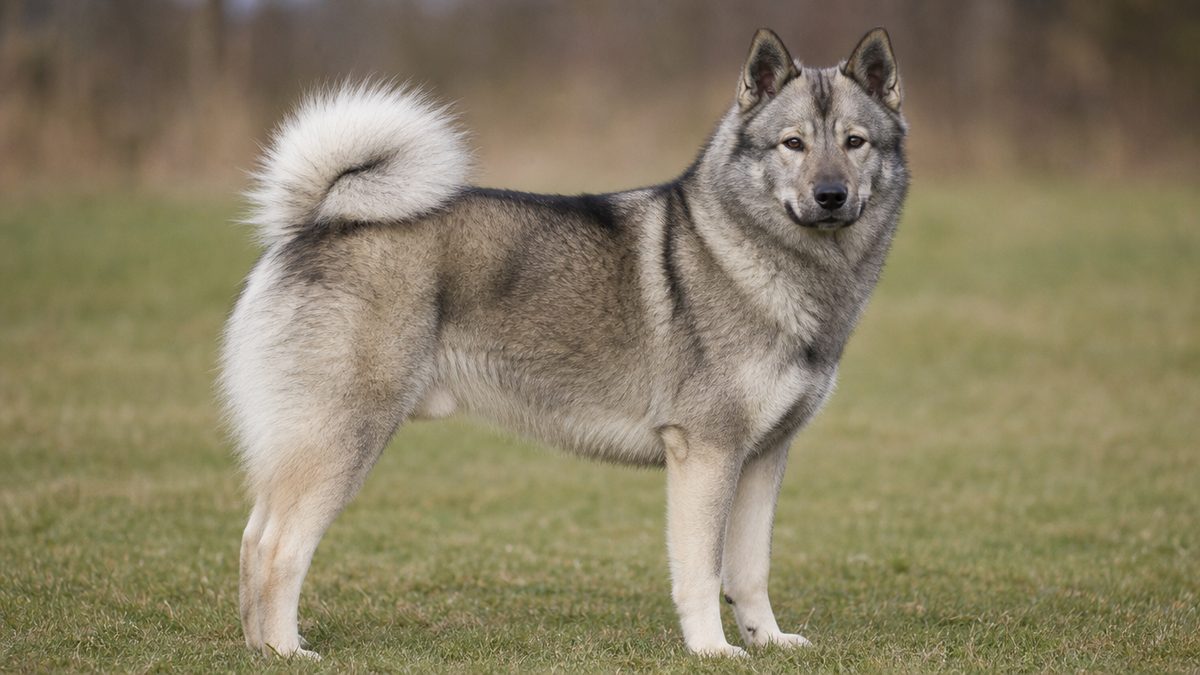
The Eurasier is a medium-sized German spitz-type companion breed standing 52 to 60 cm and weighing 22 to 30 kg in males, with a thick double coat, prick ears and a tail carried over the back. Its FCI standard lists one utilisation and one only: companion dog.
Every measurement above comes from FCI-Standard No 291, read from the standard's own PDF after confirming that the document's first page prints EURASIER (Eurasian). Females stand 48 to 56 cm and weigh 18 to 26 kg. The standard then does something most breed standards do not: it names an ideal point inside those ranges, 56 cm and 26 kg for a male, 52 cm and 22 kg for a female, while saying that the balance of the proportions matters most.
That ideal-versus-range distinction is where the secondary sources go wrong, and this page returns to it in the comparison section. Read the standard once and you will never be confused by a page printing 22 to 26 kg as the breed's weight.
A breed standard with only one job listed
The FCI files the Eurasier in Group 5, Spitz and primitive type, Section 5, Asiatic Spitz and related breeds, without a working trial, and gives its utilisation as companion dog Federation Cynologique Internationale. There is no herding, no guarding, no draught work and no hunting in the entry. For a spitz-type breed that is unusual, and it is not an accident: this breed was designed around temperament from the start.
The standard's behaviour paragraph reads: self-assured, calm, even-tempered with high resistance against any provocation; watchful and alert without being noisy; very strongly developed link to his family; relaxed towards strangers and not obtrusive. Then it adds a sentence that almost no other FCI standard contains, which is a housing instruction rather than a description: for the full development of these qualities, the Eurasian needs constant close domestic contact with his family and understanding, yet consistent training.
A breed standard telling you the dog must live in constant close domestic contact with its family is telling you the temperament it describes will not appear otherwise. An independent veterinary panel arrived at the same conclusion from the other direction, rating the breed 1 out of 5 for tolerating being alone, its lowest possible score. If your household leaves a dog alone for a working day, this breed is the wrong choice and its own standard says so.
The dog the standard describes
Physically the Eurasier is a balanced medium spitz. The head is wedge-shaped seen from above and in profile, with a flat forehead, a barely defined stop and a straight bridge of nose parallel to the skull. The ears are pricked, medium, triangular with slightly rounded tips, and set so that the ear tips and the centre of the stop form a nearly equilateral triangle. The tail is set on high, reaches the hocks, and is carried lying forward over the back, bent slightly sideways or rolled up.
The coat is the part an Indian reader must weigh. The standard specifies thick undercoat over the whole body with medium-long, straight, loosely lying guard hair, short on muzzle, face, ears and the front of the limbs, and longer on the tail, the backs of the front legs and the breeches. Colour is permissive: all colours and colour combinations except pure white and piebald.
| Item | Males | Females |
|---|---|---|
| Height at withers | 52-60 cm | 48-56 cm |
| Weight | 22-30 kg | 18-26 kg |
| Ideal to aim for | 56 cm and 26 kg | 52 cm and 22 kg |
| Coat | thick undercoat, medium-long straight guard hair | thick undercoat, medium-long straight guard hair |
| Colour | all except pure white and piebald | all except pure white and piebald |
| Bite | scissor or pincer, 42 teeth | scissor or pincer, 42 teeth |
| Utilisation | companion dog | companion dog |
Two fault lists in that standard matter later. Severe faults include lack of pigmentation, absence of three or four second premolars, a tail visibly open and not lying over the back, and, unusually, lack of sexual dimorphism. Disqualifying faults include ectropion and entropion, semi-pricked or pendulous ears, a kinked tail, pied colouring and pure white. Entropion and ectropion appear by name both there and in Indian law, which is a coincidence worth returning to.
History and origins: a breed with a mating date
The Eurasier was created from 1960 by Julius Wipfel of Weinheim an der Bergstrasse, who crossed a Chow Chow with a Wolfspitz to produce a dog first called the Wolf-Chow, then crossed in a Samoyed in 1972 and renamed the result Eurasier. That is not folklore. It is printed in the breed's own FCI standard and dated to the day by the club Wipfel founded.
Start with the primary document. The Brief Historical Summary of FCI-Standard 291 reads, verbatim: In 1960 a breed was evolved by crossing a Chow Chow and a Wolfspitz. This was first called Wolf-Chow and then, after crossing with a Samoyed, was re-named Eurasier (Eurasian) and recognized by the F.C.I. The breed was founded by Julius Wipfel.
Very few breed standards state their own founding crosses. Most open with a passage about origins lost in time. This one names two founder breeds, a third added later, a year and a person, which makes the Eurasier one of the easiest breeds on this site to write about honestly and, as the legal section shows, the hardest to justify under Indian law.
The dated timeline, from the founding club
The KZG Eurasier e.V., the Kynologische Zuchtgemeinschaft founded in Weinheim with Wipfel as its first chairman, publishes a timeline that goes further than the standard.
| Date | Event | Detail |
|---|---|---|
| 24 April 1960 | Mating day | Aroko vom Felsensteig (Chow Chow) to Bella von der Waldmuehle (Wolfsspitz) |
| 22 June 1960 | The Wolf-Chow is born | B-litter von der Bergstrasse, bred by Julius Wipfel |
| 27 March 1972 | The Samoyed is crossed in | Cito vom Pol (Samoyed) to A-Leila vom Stechersee (Wolf-Chow), C-litter vom Stechersee, bred by Walter Nagel |
| 4 April 1973 | FCI recognition of the breed | as recorded by the club |
| 15 April 1973 | The breed is renamed Eurasier | from Wolf-Chow |
| 5 May 1973 | First official Eurasier litter | A-litter vom Kurfuerstendam, Cinok vom Stechersee out of Deyna vom Weinheimer Schloss |
| 6 October 1974 | First FCI standard 291 | the breed's first written description |
| 10 April 1978 | KZG founded and registered | first chairman Julius Wipfel, second chairman Eberhard Zodrow |
Two entries in that table are worth pausing on. The twelve-year gap between the first Wolf-Chow litter in 1960 and the Samoyed cross in 1972 is not a detail; it is the whole middle of the story, and the next section explains what went wrong in it. And the first FCI standard came in 1974, a year after recognition, which means the breed was recognised before its written description existed.
One date disagrees, and it is worth naming
The FCI's own nomenclature entry gives the date of acceptance on a definitive basis as 27 July 1973, while the founding club's timeline dates FCI recognition to 4 April 1973 and the renaming to 15 April 1973 KZG Eurasier e.V.. Both are 1973 and both are from parties who would know. Bonbeno prints both rather than choosing, and a reader quoting either should say which document it came from.
A second disagreement is larger and easier to resolve. The Royal Kennel Club's breed page says the programme started in the 1950s, against the FCI standard's 1960 and the club's mating date of 24 April 1960. The reconciliation is in the German community record: in the 1950s several cynologists were already experimenting with Chow Chow crosses toward a polar-spitz type, and the best known of them was Konrad Lorenz, whose Chow Chow and German Shepherd crosses predate Wipfel's work. The idea is from the 1950s. Wipfel's own programme is from 1960.
The FCI publishes the breed as EURASIER in German and French and as EURASIAN in English, and the standard's own cover carries both. Dog Breeds List calls it Eurasian, Eurasian Spitz or Eurasian Dog. If you search under the English name you will find less than under the German one, and every serious source on this breed is German.
The people behind the breed, and why that matters
Three people shaped the Eurasier: Julius Wipfel conceived it, Charlotte Baldamus built the foundation kennel, and the ethologist Eberhard Trumler advised her. Konrad Lorenz is often credited and did not create it, though he did own one. Knowing who did what tells you what the breed was actually selected for.
The origin story starts with a dog that had already died. Wipfel had kept a large black spitz-like mongrel with pronounced wild-dog behaviour; looking for a successor he chose a Wolfsspitz bitch, found her far more pleasant to live with, and missed the primitive quality of the previous dog. Out of that gap came the wish to breed a dog combining the good qualities of both.
Read that sentence carefully and you have the breed's design brief. Not a job, not a quarry, not a flock. A combination of temperaments, one urbane and one primitive, in a dog a family could live with. That is why the standard's utilisation line reads companion dog and nothing else.
Charlotte Baldamus and the vom Jaegerhof kennel
The foundation work was done by Charlotte Baldamus, who acquired the Wolfsspitz bitch Asta von der Bergstrasse from Wipfel in 1959 and two years later mated her to a Chow Chow, founding the vom Jaegerhof kennel on the Mittelberg in the Black Forest. That kennel produced the dogs that defined the breed: Droll vom Jaegerhof in early 1965, whose stock gave the first largely uniform generation; the 1966 E-litter that produced the first black-and-tan Eurasiers, which Baldamus called the true Eurasiers; and Rurik vom Jaegerhof, who sired successfully at 14 and died at 17 in 1991.
The Trumler connection matters because it explains the breed's method. Eberhard Trumler, the ethologist, was in dialogue with Baldamus and was himself breeding and studying Husky and Chow Chow crosses at the time. A breeding programme advised by a behavioural scientist and aimed at a temperament rather than a task is genuinely unusual in dog breeding, and it is the reason the modern clubs still assess breeding candidates on a group walk rather than only in a ring.
The Konrad Lorenz question, answered plainly
Lorenz did not create the Eurasier. The German community's own account is unambiguous: Lorenz is often called the intellectual father of the breed because of his 1950s Chow Chow crosses, but that was undoubtedly Julius Wipfel, who was the first to consider the Chow Chow and Wolfsspitz mating and who went looking for breeders willing to take that path with him. What Lorenz did do was own one: he obtained the puppy Nanette vom Jaegerhof from Charlotte Baldamus, and called her Babett.
The distinction is worth getting right because the Lorenz name is used to sell the breed. A Nobel laureate liking a dog is not a health claim, a temperament guarantee or a reason to pay more, and this page makes no use of it beyond the historical record.
Wipfel wrote the philosophy down
In 1974 Julius Wipfel published a book, simply titled *Eurasier*, setting out his ideals for how the breed should be cared for, kept and bred. That is the seed of what this page later calls a surviving philosophy: the German clubs' modern breeding regulations are not generic kennel-club boilerplate, they are the written continuation of a founder's stated intent, and they read that way. Bonbeno has not obtained a copy of the 1974 book and quotes nothing from it.
Most breed histories are reconstructions. This one has a mating date, named founder animals, a documented crisis, a documented correction and a founder who wrote his intentions down. That makes the Eurasier unusually honest to write about, and it makes every claim on this page checkable in a way that a page on an ancient landrace can never be.
The bottleneck the breed nearly did not survive
Saturating the young breed with one popular stud narrowed its base so far that the dogs got shorter-legged, lost vitality and fertility, and became almost hostile to strangers. Three separate outcrosses fixed it, and one of them is the Samoyed that gave the breed its modern name. This is the most useful thing anyone can tell a buyer about the Eurasier.
The German community's own history of the foundation kennel records the problem in one sentence: through the generalised crossing-in of the stud Droll vom Jaegerhof, the breeding base became too narrow, the Eurasiers became shorter-legged, vitality and fertility declined, and the dogs became almost hostile to strangers. That is a textbook popular-sire bottleneck described from inside the breed rather than by a critic.
The same account is internally inconsistent about when it happened, and that is worth stating rather than smoothing. It first describes Droll as the first high point of the breeding in early 1965, at which time he was used as stud on all the breeding bitches, and later dates the ordered general crossing-in to 1972. The mechanism and the outcome are consistent; the date is not. Bonbeno reports both.
Three outcrosses, and what each one was for
- A fresh original mating, a Chow Chow bitch to a Spitz male at the von der Wittekindsburg kennel. Those dogs showed a strong wild drive: Asko von der Wittekindsburg could only be walked in the woods with work gloves and a 20-metre lead, and still pulled his owner over and disappeared for hours.
- A white Samoyed, Cito vom Pol, later renamed Orion von der Bergstrasse. Mated to Lotus vom Jaegerhof at the Birkenbruch kennel in November 1972, he produced a litter of entirely black puppies, including the black short-haired Alf vom Birkenbruch, which surprises people until you remember that the Samoyed is only recessively white.
- A further Chow Chow, Darius vom Schrattenbach, brought in to widen the base again. The account is candid that he brought some problems, hip dysplasia among them, along with many positive traits.
The result is stated plainly in the same source: the A-Birkenbruch dogs showed elegance in body and movement and a greater friendliness to strangers. So the outcross that gave the breed its name also gave it back the temperament the breed exists for. A Eurasier that is relaxed towards strangers, as the standard requires, owes that partly to a Samoyed introduced to rescue a failing gene pool.
How close the founding matings actually were
The same history records breeding practice that no modern club would permit and that Indian law names by definition. Charlotte Baldamus bred in pure inbreeding up to the U-litter, and Rurik vom Jaegerhof, who sired more than 60 puppies, was the last pure inbred stud used. More specifically, Jago mated to his own mother Cara produced Lotus and Loki in summer 1970, and the account describes that litter as a high point of the breeding.
Second Schedule Part II paragraph 6(3)(ii) of the Prevention of Cruelty to Animals (Dog Breeding and Marketing) Rules, 2017 defines incest breeding as mating between parents and children or between brother and sister, and prohibits it. Paragraph 6(3)(i) defines in breeding as mating between relatives of the second to fourth grade within the first four generations and prohibits that too, permitting only out breeding and line breeding. The Eurasier's founding programme used both. That is a statement about 1970, not about any breeder today, and the modern German rules go further than Indian law in the other direction.
Two other stud dogs illustrate the scale of the concentration. Boris vom Blumenhag contributed 60 puppies to the ongoing breeding, and Rurik more than 60. In a population of a few hundred dogs, two males with 120 puppies between them is most of a generation. Everything the health section of this page has to report about inherited disease in the Eurasier follows from arithmetic like that.
The honest conclusion is not that the breed is doomed. It is that a designed breed inherits its founders' pedigree structure permanently, and that the clubs which now cap the inbreeding coefficient at 4 percent over five generations are managing a problem their own founders created and documented.
Recognition: definitive since 1973, and still called a crossbreed
The FCI has recognised the Eurasier on a definitive basis since 1973, and Germany is its country of origin with German as the standard's authentic language. Consumer sites still classify it as a crossbreed, which is wrong once a studbook has been closed for fifty years, and worth answering directly.
The FCI's nomenclature entry gives the date of acceptance on a definitive basis as 27 July 1973, the breed status as 'Recognized on a definitive basis', the country of origin as Germany, and the official authentic language as German. The current valid standard was published on 4 September 2019 and its English translation on 17 February 2020 FCI-Standard No 291, EURASIER (Eurasian). Earlier standards were amended on 6 January 1994 and 16 June 1999.
German being the authentic language has a practical consequence for anyone quoting this breed. Where the English and German texts differ in nuance, the German governs, and the standard credits the English translation to Mrs C. Seidler with changes and additions by Mrs C. Bailey.
Is the Eurasier a crossbreed?
No, and the confusion is understandable. Dog Breeds List classifies the breed as Type: Cross Breed while simultaneously calling it purebred in its own body copy. The Royal Kennel Club calls it a perfect hybrid of European and Asian spitz breeds. Both are describing its origin rather than its present status.
The operative test is whether a closed studbook exists and a registry issues pedigrees against a written standard. For the Eurasier both have been true since the mid-1970s KZG Eurasier e.V.. Every FCI breed was assembled from something; the Eurasier's assembly is simply recent enough to be documented. Calling it a crossbreed in 2026 is like calling the Doberman one.
How the FCI status reaches an Indian buyer
India is a full FCI member represented by the Kennel Club of India, so an Indian pedigree is issued against FCI nomenclature, and the FCI's own register is therefore the operative answer to whether a breed is recognised in India. The KCI publishes no per-breed list, so a query there returns nothing for this breed and nothing for a control breed either, which makes it a broken instrument rather than a finding. State the limit rather than the absence.
The other registries
The Royal Kennel Club places the Eurasier in the Utility group, marks it Breed Watch Category 1 with no breed-specific points of concern for judges, and answers 'Vulnerable native breed: No';. It offers no breed-specific DNA testing package, which is notable given that a validated genetic test for one of this breed's conditions has existed since 2015 and is mandatory in German club rules Zuchtverein Eurasier Deutschland e.V..
The American Kennel Club publishes a breed page with height 19-24 inches, weight 40-70 pounds and life expectancy 12-16 years, and a popularity line reading 'Ranks of 210' with the rank number left blank and the group field empty, which is how the AKC renders a breed outside its ranked roster. The Orthopedic Foundation for Animals carries a live breed code, EU, filed under a Non-Sporting key and cross-referenced to the AKC Non-Sporting Group, the CKC Working Group, the UKC Northern Group and the Kennel Club Utility Group. Unlike many rare breeds, this one has enough evaluations to generate real OFA statistics, and the health section uses them.
How many Eurasiers there are, and where
France registered 2,375 Eurasiers in 2025 while Germany, the breed's country of origin, registered 181. That thirteen-fold gap is the most surprising number on this page, and both figures were read from the two national kennel clubs' own published tables rather than from any secondary source.
The German figure comes from the VDH's national puppy statistics, which publish every breed's registrations year by year from 2011 to 2025. The Eurasier row reads 181 in 2025, 222 in 2024, 206 in 2023, 324 in 2022, 349 in 2021 and back through 282, 322, 242, 235, 303, 301, 326, 267, 338 and 289 to 2011. The 2025 figure is the lowest of those fifteen years, a fall of 48 percent from the 2021 peak.
The French figure comes from the Societe Centrale Canine's LOF statistics, downloaded and extracted directly: 2,306 registrations in 2024 and 2,375 in 2025, with 285 confirmations, an increase of 3 percent in a year when the French Group 5 as a whole fell. So the breed is growing slightly in France and shrinking sharply in Germany.
| Breed | Germany, VDH puppies 2025 | France, LOF registrations 2025 |
|---|---|---|
| Eurasier | 181 | 2,375 |
| Chow Chow | 54 | 532 |
| Wolfsspitz / Keeshond | 192 | 346 |
| Samoyed | 64 | 1,274 |
| The three founder breeds combined | 310 | 2,152 |
| All breeds, national total | 55,053 | not comparable |
Read that table across and the two countries disagree about what the breed is. In Germany the three founder breeds together still out-register the Eurasier, 310 to 181, and the Wolfsspitz alone out-registers it, 192 to 181. In France the Eurasier out-registers all three of its founders combined, 2,375 to 2,152. A breed created in Germany is now more popular in France than the parts it was made from, while in Germany it is not.
The German context matters before that becomes a decline narrative. The VDH's total across all breeds fell from 85,595 puppies in 2021 to 55,053 in 2025, a drop of 36 percent. The Eurasier's 48 percent fall over the same window is steeper than the national trend but not wildly out of line with it. The breed is 0.33 percent of all German VDH puppies in 2025.
The VDH counts puppies born to German member clubs. The SCC counts dogs entered in the French studbook, which includes imports. So part of the gap is that French buyers register dogs bred elsewhere. That does not explain a factor of thirteen on its own, and it does explain why anyone quoting a single national figure as the breed's population is quoting the wrong thing. Say which registry, which year, and what it counts.
For an Indian reader the practical translation is short. Roughly 2,500 Eurasier puppies are registered across these two countries in a year, they are spoken for, and the German clubs breed only to demand by their own written rule. There is no surplus anywhere for an export market, which is the real reason no Indian supply chain exists, quite apart from the law.
The breeding restrictions the German clubs actually impose
A German Eurasier club caps the five-generation inbreeding coefficient at 4 percent, admits only hip grades A and B to breeding, limits a dog to five litters or matings in its life, and breeds only to demand. Those are numbers written into a club rulebook, and they are stricter and more measurable than anything in Indian law.
The document quoted throughout this section is the Zuchtordnung of the Zuchtverein Eurasier Deutschland e.V., version of 21 June 2025, downloaded and extracted in full: 59 pages and 175,677 characters of real text. Other German Eurasier clubs publish their own versions; this is the one Bonbeno read cover to cover.
The stated purpose, which is unusual
The rulebook opens by naming its own supreme principle: improvement of the breed, not multiplication of pedigree dogs, in service of breeding healthy family dogs with good social behaviour. It then adds a sentence that has real operational teeth: the ZVED is a directed breeding programme, so that the number of dogs bred happens exclusively according to demand. A breed club that regulates supply rather than encouraging it is describing the same philosophy the founder set out in 1974, and it is the reason there is no export surplus of this breed anywhere.
What a dog must pass before it can breed
Health examinations run from the completed fifteenth month to the twenty-fourth month, and the thresholds are explicit.
- Hip dysplasia: only grades A and B are admitted to breeding. Grades C, D and E are breeding exclusions.
- Patellar luxation: only grades 0 and 1, and a grade 1 dog may be mated only to a grade 0 partner. Grade 2 and above is a breeding exclusion.
- Eyes: examination for entropion, ectropion and distichiasis. Entropion and ectropion are excluded from breeding outright; a symptomless distichiasis-positive dog may be mated only to a distichiasis-negative partner.
- Thyroid: an examination is required before the next litter or mating.
- Cerebellar hypoplasia: a genetic test for DWLM, or DWLM status proven through the ancestors, must be produced. Carriers may be mated only to tested-free animals, and puppies of a carrier-by-free mating must be blood tested at their health check, with the club paying for it.
- Lumbosacral transitional vertebra: a radiographic finding is required, and a dog at grade I or above may be mated only to a free partner.
- Coat colour genetics: E-locus and S-locus testing, so that at least one parent of any litter is proven clear of the white and white-piebald variants.
Breeding restrictions: the numbers, and how they compare with Indian law
The German club caps the five-generation inbreeding coefficient at 4 percent and limits a dog to five litters or matings in its lifetime. Set those rules beside the Indian Dog Breeding and Marketing Rules 2017 and the two documents agree on almost every age and frequency limit, and diverge exactly where a number is possible.
Section 5.2 of the rulebook is headed Inzucht und Inzestzucht and runs to two lines. Incest breeding and close inbreeding are forbidden, and the ancestor loss coefficient over five generations must not fall below 80 percent while the inbreeding coefficient over five generations must not exceed 4 percent. Breeders are given access to the club's own breeding software so they can see those coefficients before planning a mating.
That is the whole difference between a rule and a principle. Indian law prohibits in breeding and incest breeding by definition and stops there. The German club sets a number a breeder can calculate before the mating happens.
How often a dog may be used
| Question | German club rule | Indian Rules 2017 |
|---|---|---|
| Earliest breeding age, female | 18 months | eighteenth month, Second Schedule Part II para 5(2) |
| Latest breeding age, female | the eighth birthday, counted on the mating day | not after eight years, para 6(4) |
| Earliest breeding age, male | on gaining breeding approval, after the 15 to 24 month health checks | eighteenth month, para 5(7) |
| Latest breeding age, male | the tenth birthday | no upper limit stated |
| Lifetime litters or matings | generally limited to 5 | no more than five litters, para 5(6) |
| Litter frequency | one litter in 12 months; a bitch with one season a year must skip one | one litter per 12 months, para 5(4) |
| Caesarean limit | retired from breeding after two caesareans | no provision |
| Litters per kennel per year | two, regardless of breed | no provision |
| Inbreeding limit | five-generation IK not above 4 percent, AVK not below 80 percent | in breeding and incest breeding prohibited by definition, no number |
Two rows in that table are the story. The Indian Rules and the German rulebook agree almost exactly on female breeding age, the eight-year cut-off, the five-litter lifetime cap and the twelve-month interval. Where they diverge, the German rules are the stricter document, and they are stricter in the places where a number is possible.
The rest of the process, briefly
Litter planning and the stud owner's consent must be submitted to the breeding commission at least three weeks before the expected season, and the commission must answer in writing within seven days, refusing only on written grounds that the rulebook is not met. A bitch may be covered by one male only in a season, and if there is any doubt a DNA paternity test is required for every puppy. Every mating and every litter must be reported within three days. Breeding approvals can be withdrawn at any time if serious hereditary defects appear in the offspring. Selling a pregnant bitch is forbidden.
Phenotype assessment before a first litter is carried out by trained breed wardens, and the rulebook specifies that the assessment takes place at a Eurasierspaziergang, a Eurasier walk. Breed wardens may not assess their own dogs' offspring. Judging a companion breed's breeding candidates on a group walk rather than only in a show ring is exactly what a breed selected for temperament rather than conformation should do, and it is the founder's philosophy still operating fifty years later.
Price in india: one unsourced band, and what it is worth
No verified Indian seller of the Eurasier exists, and the single India-facing figure, Rs 60,000 to Rs 80,000, sits on a page that also prices this breed above both of its founder breeds with no explanation and gives it a daily calorie figure below its own resting requirement. Treat the band as an unsourced number, not a market rate.
HappyPet.care ranked first on an India-located search for this breed and prints 'Cost of buying Rs 60,000 - Rs 80,000', with the sentence 'The price of a Eurasier can be anywhere from Rs.60,000 to Rs.80,000';. There is no source, no seller, no city and no date.
Running the conversion tests
Indian breed pages routinely publish a dollar list divided by one exchange rate, so the first thing to do with a rupee band is divide it. The arithmetic is below so you can check it in a calculator.
| Rate tested | Rs 60,000 becomes | Rs 80,000 becomes | Verdict |
|---|---|---|---|
| 84.38 | USD 711.07 | USD 948.09 | Fails. Neither is a price anyone prints |
| 74.00 | USD 810.81 | USD 1,081.08 | Fails. Neither is a price anyone prints |
| 80.00 | USD 750.00 | USD 1,000.00 | Clean, but proves nothing (see below) |
| 66.67 | USD 899.96 | USD 1,199.94 | Close to USD 900 and USD 1,200 |
The strong test, 84.38, fails on both figures. The 80.00 test passes and is worthless here, because 1,000 divided by 80 is 12.5, so any rupee figure ending in three zeros divides cleanly at 80 by construction and both of these end in four. So the band cannot be shown to be a converted dollar list, and it cannot be shown to be a real Indian price either, because nothing underneath it is checkable.
The internal test that is more revealing than the division
The same site publishes price bands for the Eurasier's founder breeds. It gives the Chow Chow Rs 40,000 to Rs 1,00,000 and the Samoyed Rs 30,000 to Rs 1,50,000. So a breed with no verified Indian presence is priced with a floor above both breeds it was made from, and above the German Shepherd's Rs 8,000 to Rs 25,000 on the same site. Nothing on the page explains why, and no seller is named for any of them.
The overseas figures, left in their own currency
Published United States prices for this breed vary by a factor of two before you leave the first page of results. Dog Breeds List gives an average of USD 2,000 to 2,500 and says most breeders fall in that range. Bonbeno does not convert those into rupees, because converting a foreign price and printing it as an Indian one is precisely the fabrication mechanism this section exists to describe.
The largest Indian dog-price reference on the same result set is Supertails' 'Dog Price List in India: Top 40 Breeds'. It was downloaded and searched: Eurasier appears zero times, while Labrador appears ten times. India's most-cited dog price list does not contain this breed.
DGFT Trade Notice 22/2022-23 classifies dogs under ITC(HS) 01061900 as Restricted and permits import only for a pet dog with a valid pet book in the importer's own name, for R&D with a CPCSEA recommendation, or for Defence and Police use, adding that applications for trading or breeding purposes shall be duly rejected. Add the German clubs' rule that breeding happens only to demand, and there is no supply and no lawful channel for one. Both halves of that sentence have a document behind them.
If you want this breed and you live in India, the realistic paths are two. Relocate with a dog you already own, using the personal pet route with a valid pet book, which is a documentation exercise rather than a purchase. Or accept that the breed is not available here and read the adoption section, which is where this page thinks an Indian reader's effort belongs.
Monthly expenses: the Indian estimate, checked against the dog
The only published Indian monthly cost for a Eurasier is Rs 4,650, and the same page gives an adult 900 kcal a day, which is below the maintenance requirement of every weight in the breed standard. The figure is not slightly low. It is a diet.
HappyPet.care gives average monthly expenses of Rs 4,650 for the Eurasier and a daily adult energy figure of 900 kcal. Test the calorie figure against the standard veterinary calculation. The Merck Veterinary Manual gives resting energy requirement as 70 multiplied by body weight in kilograms to the power 0.75, with maintenance at 1.6 times RER for a neutered adult dog and 1.8 times for an intact one.
| Body weight | RER (70 x kg^0.75) | Neutered adult (1.6 x RER) | Intact adult (1.8 x RER) |
|---|---|---|---|
| 18 kg (female, standard minimum) | 612 kcal | 979 kcal | 1,101 kcal |
| 22 kg (male, standard minimum) | 711 kcal | 1,138 kcal | 1,280 kcal |
| 26 kg (male ideal, female maximum) | 806 kcal | 1,290 kcal | 1,451 kcal |
| 30 kg (male, standard maximum) | 897 kcal | 1,436 kcal | 1,615 kcal |
So 900 kcal is below the neutered maintenance requirement of the smallest female the standard permits, and for a 30 kg male it is roughly the energy he burns lying still FCI-Standard No 291, EURASIER (Eurasian). Feed to that number and you are running a weight-loss programme on a healthy adult.
The control that shows the number is not breed-specific
The same site was checked on other breeds to see whether the Eurasier figure was an isolated slip. It is not. HappyPet.care gives the Samoyed, a 20 to 30 kg arctic spitz, 400 kcal a day, the identical figure it gives a Pug. A number that puts a Samoyed and a Pug on the same ration is not a nutrition calculation, and it is on the same site that supplies the only Indian price for this breed.
The cost lines an Indian Eurasier household would actually carry
- Air conditioning through the hot months, running for the dog rather than for you. This is the largest genuinely breed-specific Indian cost for a double-coated northern breed and it appears in no published estimate.
- Grooming equipment and time, not salon visits. Purina's panel rates this breed 5 out of 5 for shedding, its maximum.
- Year-round tick prevention, not seasonal, which is the Indian adjustment to every European care schedule.
- Thyroid screening from middle age, given the breed's position in the OFA thyroid table and an independent Norwegian finding, both covered in the health section.
- Company, which costs nothing in rupees and is the one requirement the breed standard itself writes down.
A monthly cost estimate is only as good as the number of real households it is drawn from, and there is no verifiable population of Eurasiers in India to draw from. Rather than invent an average, this page gives you the arithmetic to build your own from your own city's prices, using the actual energy requirement of a 22 to 30 kg dog rather than a generic one.
One last check you can run yourself. Rs 4,650 a month is Rs 155 a day for food, healthcare and grooming combined. Price a month of any large-breed kibble at your local shop, work out what weight of food those rupees buy, and set it against the 979 to 1,615 kcal a real Eurasier needs. If the arithmetic does not close, the estimate was never about this dog.
Suitability for the Indian climate, worked from satellite data
Weinheim, the town where the Eurasier was created, averages 9.8 C across the year against Chennai's 27.9 C, and every month of the year in Mumbai, Chennai, Bengaluru and Pune has a higher wet-bulb temperature at the daily maximum than Weinheim reaches at its annual peak. Only a Delhi winter is inside this breed's home range.
Every figure below comes from NASA's POWER daily point series for 1991 to 2020, queried by explicit latitude and longitude so no place-name lookup could return the wrong location. The home point is Weinheim an der Bergstrasse at 49.5450 N, 8.6700 E, which is where Julius Wipfel lived and bred the first Wolf-Chow litter. Each query returned 10,958 daily records with no fill values NASA POWER daily point series, 1991-2020.
Wet-bulb temperature is used rather than air temperature because a dog sheds heat by evaporation, and evaporation is limited by humidity rather than by heat alone. The conversion uses Stull's 2011 approximation, validated against the paper's own worked example, where 20.0 C at 50.0 percent relative humidity returns 13.7 C. Our implementation returns exactly that, so the arithmetic behind every figure below is checkable.
| Location | Annual mean air temp | Annual mean humidity | Hottest month, mean daily max | Highest monthly wet bulb at daily max | Coolest monthly wet bulb at daily max |
|---|---|---|---|---|---|
| Weinheim, Germany | 9.8 C | 79.6 % | 26.0 C (August) | 21.0 C (July) | 2.5 C (January) |
| Delhi | 25.6 C | 44.0 % | 43.0 C (May) | 30.7 C (July) | 15.0 C (January) |
| Mumbai | 26.6 C | 67.2 % | 39.2 C (April) | 31.1 C (May) | 24.3 C (January) |
| Chennai | 27.9 C | 72.2 % | 36.6 C (May) | 30.6 C (April) | 24.7 C (December) |
| Bengaluru | 23.6 C | 68.0 % | 35.8 C (April) | 27.5 C (May) | 23.6 C (December) |
| Pune | 23.7 C | 66.5 % | 38.5 C (April) | 29.7 C (May) | 21.8 C (January) |
Read the last two columns together
Weinheim's worst month by wet bulb at the daily maximum is July at 21.0 C. Now take the coolest month in each Indian city. Pune's January is 21.8 C, Bengaluru's December 23.6 C, Mumbai's January 24.3 C and Chennai's December 24.7 C. All four are above the German figure. In those four cities there is no time of year that is as easy for this dog as a German July.
Delhi is the exception and the reason is dryness rather than coolness. Delhi's January wet bulb at the daily maximum is 15.0 C and December's is 15.7 C, both well below Weinheim's annual peak, because Delhi's winter humidity sits near 40 percent. Delhi's July, at 30.7 C wet bulb, is 9.7 C above anything Weinheim produces. A Delhi Eurasier is a comfortable dog for four months and an at-risk one for five.
The page selling the breed to India already published the answer
HappyPet.care lists an Ideal Weather band of 15 to 25 degrees Celsius for the Eurasier on the same page that quotes its Indian price. Test that band against the satellite record. Mumbai's mean daily maximum never falls below 28.3 C in any month, Chennai's never below 27.5 C, Bengaluru's never below 26.7 C and Pune's never below 26.3 C NASA POWER daily point series, 1991-2020 NASA POWER daily point series, 1991-2020 NASA POWER daily point series, 1991-2020. By its own stated criterion the breed is outside its ideal weather in those four cities in all twelve months. Only Delhi's January at 22.7 C and December at 24.3 C fall inside the band.
The standard specifies thick undercoat over the whole body under medium-long guard hair, and the breed's three founders are a Chow Chow, a Wolfsspitz and a Samoyed, all heavy-coated northern types. Nothing in that combination was selected for shedding heat. The practical consequence is that the coat is not the variable you can change; the clock and the air conditioner are.
The practical translation by city is short. In Bengaluru and Pune a Eurasier can live an ordinary life if the day is planned around dawn and dusk and the middle of it is spent indoors. In Delhi you are keeping two different dogs, one from November to February and another from April to September. In Chennai or coastal Mumbai the humid months remove the evaporative headroom the dog depends on, all year round, and the climate table above says so in numbers rather than adjectives.
Heat tolerance: what the evidence supports and what it does not
The Eurasier is not named in the largest heat-illness study available, so no breed-specific odds ratio for it exists, but its standard weight range sits across the two highest-odds bodyweight bands in that study's model. Coat was not a variable in the model at all, so this breed's double coat is an unquantified addition rather than a proven one.
Hall, Carter and O'Neill reviewed the primary-care records of 905,543 UK dogs at 886 VetCompass clinics in 2016 and identified 1,259 heat-related illness events from 1,222 dogs. Of those events, 380 had no trigger recorded. Of the 879 events with a recorded trigger, 652 were exertional, which is 74.2 percent, followed by environmental at 113 events, 12.9 percent, and vehicular confinement at 46 events, 5.2 percent.
The denominator is the point. Exertional heat illness is 74.2 percent of the events where somebody wrote down a cause, not of all 1,259 events. Get that wrong and 652 dogs become 934. The paper also records 40 events under the care of a veterinary clinic or groomer and 24 from building confinement.
What transfers to this breed
The Eurasier is not named anywhere in that paper, so its breed-specific odds ratio does not exist and cannot be borrowed. What can be transferred is the bodyweight finding, because that measures the dog rather than the label. In the final model for exertional heat-related illness, against a base of dogs under 10 kg, the odds ratios were 2.52 for 10 to under 20 kg, 2.27 for 20 to under 30 kg, 2.30 for 30 to under 40 kg, 2.15 for 40 to under 50 kg and 2.21 for 50 kg and over.
A male Eurasier at the standard's 22 to 30 kg sits in the 20 to under 30 band, and a female at 18 to 26 kg straddles the 10 to under 20 and 20 to under 30 bands. Note which band is highest: 10 to under 20 kg, at 2.52, is the single highest odds ratio in that column, so a small Eurasier bitch is not in a safer weight class than a large male. The intuition that bigger dogs overheat and smaller ones do not is not what this model found.
The variables considered were breed type, purebred status, skull shape, adult bodyweight, bodyweight relative to the breed and sex mean, sex and neuter status, and age. Coat is not among them. The paper mentions a thick coat once, in a rationale sentence explaining why purebred dogs might thermoregulate less well. So the honest statement about a Eurasier's double coat is that it is biologically expected to add heat risk and has not been quantified in the largest study available. Anyone printing a coat-specific odds ratio for a heavy-coated breed is printing a number nobody has measured.
One founder breed is named, and not favourably
Hall and colleagues note in their discussion that a larger primary-care study reported the Chow Chow and the Bulldog with the greatest odds of heat-related illness among the breeds it examined. The Chow Chow is one of the Eurasier's two original founder breeds. That is not a finding about the Eurasier and this page does not present it as one, but a buyer weighing a heavy-coated breed of partial Chow Chow descent for an Indian city is entitled to know it exists.
The one measurement that speaks directly to coat is thermographic rather than epidemiological. Kwon and Brundage imaged 50 privately owned dogs after 15 minutes indoors at 23 plus or minus 2.0 degrees Celsius and found mean body surface temperature of 28.25 C in double-coated dogs against 31.77 C in short-coated dogs. Surface temperature is not core temperature, and the authors found no significant correlation between the two (r = -0.24, P = 0.07). Read it as what it is: a thick coat keeps the skin surface cooler because it is holding heat in, measured at 23 C in California rather than at 31 C wet bulb in Mumbai.
The rules that follow
- Walk before sunrise and after full dark, and treat the wet-bulb column in the climate table as the constraint rather than the air temperature on your phone.
- Cancel exercise rather than shortening it on any day the dog is panting before you leave the gate.
- Never leave the dog in a vehicle, which accounted for 46 of the 879 triggered events even in a cool country.
- Watch after grooming and boarding, since 40 triggered events happened under the care of a clinic or a groomer.
- Weigh the dog monthly and hold it at the standard's ideal rather than its maximum, because bodyweight is the one variable in that model an owner can move.
Bonbeno rates this breed's heat tolerance at 1 out of 5 for India. That rating rests on three verifiable things: a home-town annual mean of 9.8 C, a standard weight range spanning the two highest-odds bodyweight bands in the largest heat-illness study available, and a standard that specifies thick undercoat over the whole body. It is not a number copied from another site.
Temperament and household fit
The Eurasier is calm, watchful, reserved with strangers and intensely attached to its own household, and its FCI standard states in terms that these qualities will only develop fully if the dog lives in constant close domestic contact with its family. That single sentence rules out more Indian households than anything else on this page.
The standard's behaviour paragraph reads: self-assured, calm, even-tempered with high resistance against any provocation; watchful and alert without being noisy; very strongly developed link to his family; relaxed towards strangers and not obtrusive. Every clause there is a design decision. A breed created for company and nothing else was selected for exactly the traits that make company tolerable.
An independent veterinary panel reached the same conclusion from the other direction. Purina rates the breed 1 out of 5 for tolerating being alone, its lowest possible score, alongside 4 out of 5 for family friendliness, 4 for liking other pets, 4 for energy level and 3 for ease of training. A kennel-club-adjacent panel and an FCI standard agreeing on the same point, from different evidence, is about as close to consensus as breed information gets.
Who this breed genuinely suits in India
- Households where somebody is home most of the day. This is not a preference; the standard makes it a condition of the temperament appearing at all.
- Bengaluru, Pune, Dehradun, Shillong or the hill districts, on the climate evidence rather than on temperament.
- Owners who want a watchful dog rather than a guarding one. The standard's phrase is watchful and alert without being noisy, which is a different animal from a livestock guardian.
- Families with children old enough to leave a resting dog alone. A spitz that dislikes being disturbed is not aggressive; it is a spitz.
- People who will do the grooming themselves, because the coat needs regular work and Indian salons rarely handle a northern double coat well.
Who should not buy one
- Anyone out of the house for a working day. Purina's 1 out of 5 and the standard's own sentence say the same thing twice.
- Anyone in Chennai, coastal Mumbai or Kochi, where the wet-bulb figures never fall to the breed's home range in any month.
- Anyone wanting a guard dog. The standard asks for relaxed towards strangers, and a Eurasier bred to standard will not do the job an Indian buyer usually means.
- Anyone who wants a dog that will live outdoors, which is the direct opposite of the standard's stated requirement.
- Anyone buying on the Konrad Lorenz association, which is a piece of history rather than a property of the dog in front of you.
Wikipedia's summary of the breed's own community consensus is blunt and worth repeating: Eurasiers were bred as companion dogs, so they do poorly in a kennel environment such as those used for institutionally trained service dogs, and are not well suited to that work. A breed that fails in kennels also fails in an Indian house where the dog lives on a balcony or a terrace.
Aggressive or overly shy dogs are a disqualifying fault under FCI 291, and lack of pigmentation and lack of sexual dimorphism are severe faults. A correct Eurasier is confident and uninterested in strangers rather than frightened of them. A breeder describing a fearful puppy as merely reserved is describing a dog the standard would put out of the ring.
Training: understanding, yet consistent
Train a Eurasier with reward-based methods, front-load the socialisation window before 16 weeks, and expect a dog that cooperates rather than obeys. The FCI standard's own prescription is understanding yet consistent training, and it puts that phrase in the same sentence as its requirement for constant domestic contact.
The standard says the breed's qualities develop fully only with constant close domestic contact with his family and understanding, yet consistent training. Read the two halves together. The training instruction is not separable from the housing instruction; a Eurasier that is trained well and left alone all day will not become the dog the standard describes.
Purina rates the breed 3 out of 5 for ease of training, describing it as not too difficult if you know and like spitz types. That is an honest middle score. A spitz is not a retriever, and our Golden Retriever guide describes a dog that wants to be told what to do next. This is not that dog, and it is not the German Shepherd either.
Harsh handling fails specifically here
The community consensus that reaches Wikipedia is that Eurasiers are extremely sensitive to harsh words or discipline and respond best to positive reinforcement. That is consistent with the standard's disqualification of overly shy dogs: a breed selected for calm self-assurance has no reserve of resilience against a handler who creates conflict. Compulsion methods produce a withdrawn Eurasier rather than a compliant one.
The socialisation window, and the Indian version of it
Socialise the puppy hard and early. The practical target is a large number of calm, neutral, single exposures before four months, and the Indian list is specific: gate visitors, two-wheelers, autorickshaws, hawkers, cattle on the road, temple loudspeakers, firecrackers and monsoon thunder. A reserved breed under-socialised in that window does not become friendly later; it becomes a dog that finds Indian street life permanently unreasonable.
The Indian vaccination clash is real and the resolution is controlled exposure rather than isolation. Carry the puppy where it cannot yet walk, use clean private spaces, and invite known vaccinated dogs to your home. India's own breeding Rules note that pup vaccination can start at seven to eight weeks and is usually completed at eighteen weeks, which is precisely the window you cannot afford to spend indoors.
What to train first
- A settle on a mat, held while a stranger enters and leaves, which converts the breed's watchfulness into a manageable behaviour.
- A recall trained with food and never with a correction, because a Eurasier that associates coming back with conflict stops coming back.
- Handling and grooming tolerance from week nine, long before the coat needs the work, because a dog that objects to a rake at 25 kg is a real problem.
- Alone-time in graded seconds, started on day one, which is the only way to give a breed rated 1 out of 5 for tolerating solitude any tolerance at all.
- Loose-lead walking finished before 20 kg, which for this breed means before roughly seven months.
The Eurasier is not a guarding breed, not a protection breed and not a working service breed, and its own community says it does poorly in kennel-based institutional training. If your reason for wanting a large fluffy dog is security, the standard's phrase relaxed towards strangers should end the conversation. Buying a companion breed and then trying to train guarding into it is how a calm dog becomes an anxious one.
A last note on honesty. No published training study exists on this breed. Everything above is inference from the standard's own behaviour and training sentences, a veterinary panel rating and the breed community's own written consensus. Where a page tells you a Eurasier learns a command in a specific number of repetitions, ask where that number came from.
Exercise needs: an hour on paper, less in an Indian summer
The Royal Kennel Club puts this breed at up to one hour a day and Purina rates its exercise needs 4 out of 5, which is a real disagreement about a medium spitz. Plan 45 to 60 minutes in the cool season and let the wet-bulb figures rather than the clock decide in the hot one.
The Royal Kennel Club's breed characteristics panel gives exercise as up to 1 hour per day, size of home as a small house, size of garden as small or medium, and town or country as either. Purina rates exercise needs 4 out of 5 and energy level 4 out of 5. Those two are not describing the same dog, and the gap is worth naming rather than averaging.
The reconciliation is probably that a Eurasier's physical requirement is modest while its need to be *with* you is high. A dog that follows its household from room to room and joins whatever is happening reads as a 4 out of 5 energy dog to a panel and a one-hour dog to a kennel club. In practice the walk is not the point; the company is.
A workable Indian schedule
| City | Best window | Realistic daily total, hot season | Realistic daily total, cool season |
|---|---|---|---|
| Delhi | 05:15-06:30 and after 21:00 | 25-35 minutes, split | 60-75 minutes |
| Mumbai | 05:30-06:30 only | 20-30 minutes, split | 40-50 minutes |
| Chennai | 05:00-06:15 only | 20-25 minutes, split | 35-45 minutes |
| Bengaluru | 06:00-07:30 and after 19:30 | 40-55 minutes | 60-75 minutes |
| Pune | 05:45-07:00 and after 20:00 | 35-50 minutes | 60-75 minutes |
Those windows follow from the satellite record rather than from habit. Bengaluru's highest monthly wet bulb at the daily maximum is 27.5 C against Mumbai's 31.1 C NASA POWER daily point series, 1991-2020, which is why the same breed gets roughly twice the usable outdoor time in one city as in the other.
What fills the gap on a hot day
- Scatter feeding part of the daily ration on a shaded floor, which turns food into twenty minutes of low-heat work.
- Short trained sessions indoors, three or four a day, which suit a breed that wants contact more than distance.
- A cooling mat and a fan, used before the dog is hot rather than after.
- Nose work in the house, hiding a marked object and letting the dog find it, which tires a spitz far faster than a walk.
- Nothing on sun-heated concrete, at any hour, for a dog carrying this coat.
Compensating for a missed hot-weather walk with a long cool-weather one is exactly the pattern Hall's data are full of: ordinary dogs doing ordinary exercise. Exertional heat illness accounted for 652 of the 879 heat-related illness events with a recorded trigger, 74.2 percent. A Eurasier that has missed a walk is restless. A Eurasier that has overheated is an emergency.
Growth-plate discipline applies here as it does to any breed, though less severely than in a giant one. Until roughly 12 to 14 months, avoid forced running beside a cycle, repeated stair work and long hard-surface distance. Free movement on grass is the safe default, and it costs nothing to wait.
Grooming a northern double coat in Indian humidity
Brush a Eurasier to the skin at least twice a week and daily through a coat blow, and never shave it. Two published sources disagree on the workload, with the Royal Kennel Club saying once a week and Purina rating shedding at its maximum 5 out of 5, and in Indian humidity the higher estimate is the safer one to plan around.
The standard specifies thick undercoat over the whole body with medium-long, straight, loosely lying guard hair, shorter on muzzle, face, ears and the front of the limbs, longer on the tail, the backs of the front legs and the breeches, and only moderately longer on the neck without forming a mane. That is a classic northern double coat with slightly less top coat than a Samoyed and rather more than a short-coated dog.
The Royal Kennel Club lists grooming as once a week, coat length medium and sheds yes. Purina rates grooming needs 4 out of 5 and shedding 5 out of 5, its maximum on the second. Bonbeno plans around the higher figure in India, because a coat that mats in a European autumn mats faster in a Mumbai monsoon.
A routine that fits Indian conditions
- Line-brush to the skin twice weekly with an undercoat rake and a long-pin slicker, working in sections, and daily through a coat blow.
- Check the ruff, the breeches, behind the ears and the tail every session, because those four places mat first on a spitz.
- Bathe rarely, roughly every eight to twelve weeks or when genuinely dirty, using a shampoo your veterinarian approves.
- Dry to the skin with a forced-air dryer after every bath and every soaking, and never leave a double coat damp in an Indian monsoon.
- Plug the ears before bathing and dry the canal afterwards, which is the single most transferable piece of Indian-specific grooming advice on this page.
- Trim nails fortnightly and check the thick hair the standard specifies between the pads, where grit and moisture collect.
No published trial shows that clipping a double-coated dog lowers heat risk, and the largest heat-illness study available does not include coat as a variable at all. What shaving reliably removes is the guard hair that shades skin. A thermographic study measured double-coated dogs at 28.25 C body surface temperature against 31.77 C in short-coated dogs at the same ambient temperature, which is a measure of insulation, not of comfort. Manage the clock and the room temperature instead.
Ears, and the Indian evidence
The Eurasier's prick ears are an advantage in a humid climate, because an erect ear ventilates a canal that a hanging ear does not. That advantage is real and it is not absolute. In an Indian series from Durg, Chhattisgarh, 51 of 281 dogs screened were positive for otitis externa, a prevalence of 18.14 percent, and of those 51 cases 21 or 41.18 percent presented in summer, 17 or 33.33 percent in the rainy season and 13 or 25.49 percent in winter. Those are shares of the case series rather than seasonal incidence rates, which you can tell because the three sum to exactly 100 percent.
The same paper names excessive trauma from over-enthusiastic cleaning and from instruments in the canal as a route to bacterial colonisation. So check the ears weekly, dry them after water, and treat a head shake or an odour as a reason to see a veterinarian rather than to buy an ear cleaner.
Nobody should be selling this dog as hypoallergenic
The FCI standard says nothing about the coat being low-shedding or allergy-friendly, and Purina's shedding score is the maximum. The general claim is settled anyway: Vredegoor and colleagues measured Can f 1 in the hair and coat of 196 dogs of so-called hypoallergenic breeds against a control group and found the hypoallergenic group higher, not lower, at a geometric mean of 2.26 micrograms per gram in hair and 27.04 in coat samples, concluding there is no evidence for classifying any dog breed as hypoallergenic.
Health issues: better joints than any founder breed, and a thyroid problem
The Eurasier has better hips than all three of the breeds it was made from, at 5.9 percent dysplastic across 341 OFA evaluations, and it sits eleventh of all breeds in the OFA thyroid table with only 75.2 percent normal. Fifty years of hard screening thresholds show in one number and their absence shows in the other.
Unlike most rare breeds, the Eurasier has real OFA statistics, because enough dogs have been evaluated to clear the threshold. All figures below were read from OFA's disease-statistics tables retrieved in full on 27 August 2026, with the breed label printed in capitals as OFA prints it.
| Database | Rank | Evaluations | Normal % | Key abnormal figure |
|---|---|---|---|---|
| Hips | 174 | 341 | 93.8 | 5.9 % dysplastic (3.8 mild, 2.1 moderate, 0.0 severe) |
| Elbow | 91 | 236 | 95.8 | 4.2 % abnormal (3.4 grade 1, 0.8 grade 2) |
| Patella | 17 | 280 | 92.9 | 7.1 % abnormal (6.8 grade 1, 0.4 grade 2) |
| Thyroid | 11 | 322 | 75.2 | 7.8 % compensative autoimmune thyroiditis, 1.6 % autoimmune thyroiditis, 14.6 % equivocal |
| Dentition | 35 | 71 | 94.4 | 5.6 % abnormal |
| Eyes (summary) | 139 | 265 | 94.0 | 3.8 % abnormal, but see the eye section below |
The joints: what a hard threshold does over fifty years
Set the Eurasier's hip figure beside its own founder breeds in the same OFA retrieval and the result is striking.
| Breed | Hip evaluations | Hips dysplastic % | Elbow abnormal % | Patella abnormal % | Thyroid normal % |
|---|---|---|---|---|---|
| Eurasier | 341 | 5.9 | 4.2 | 7.1 | 75.2 |
| Chow Chow | 6,463 | 21.6 | 51.5 | 6.2 | 90.9 |
| Samoyed | 20,362 | 11.1 | 2.8 | 1.0 | 87.0 |
| Keeshond (Wolfsspitz) | 6,236 | 6.4 | 10.1 | 2.5 | 86.3 |
Read that table row by row. The Eurasier's hips are better than all three founders, at 5.9 percent dysplastic against the Chow Chow's 21.6, the Samoyed's 11.1 and the Keeshond's 6.4. Its elbows are dramatically better than the Chow Chow's, which sits at rank 1 in the whole OFA elbow table with 51.5 percent abnormal across 1,782 evaluations. That is what a rule admitting only hip grades A and B and excluding elbow dysplasia outright produces over five decades.
Then read the last two columns. The Eurasier's patella figure of 7.1 percent is worse than all three founders, and its thyroid normal rate of 75.2 percent is the worst of the four by more than 11 percentage points. A breed that beat its own parents on the two traits everyone screens hardest lost ground on the two that are screened differently, which is exactly what selection theory predicts and what almost no breed page ever shows.
The thyroid finding, confirmed from a second country
Rank 11 of the OFA thyroid table is not a fluke of a small sample. A Norwegian retrospective analysing canine serum submissions to the Norwegian University of Life Sciences between 2001 and 2018 found that for hypothyroidism, the Schnauzer, the Eurasier, the Dunker and the English Setter were at highest risk, with the same breeds at the extremes under both of its comparator groups. Two independent datasets, one North American and one Norwegian, using different methods, naming the same breed.
The German club rulebook already treats this as a problem. It requires a thyroid examination before the next litter or mating, and lists hypothyroidism among the metabolic diseases that are outright breeding exclusions, alongside diabetes mellitus and pancreatic insufficiency. So the club is acting on it. The OFA population is largely North American and the club rules govern German breeding, so the contrast is between two registries rather than proof that the rules have failed.
Ask a breeder for both parents' thyroid results and the date they were taken, because a normal reading at 18 months says little about autoimmune thyroiditis at six years. For your own dog, ask your veterinarian about baseline thyroid testing from middle age, and be aware that OFA classified 14.6 percent of tested Eurasiers as equivocal rather than normal or abnormal, which is a large grey zone and a reason to retest rather than to relax.
The eye data contradicts itself, and both halves are worth publishing
OFA's summary eye table reports 94.0 percent of 265 Eurasiers normal with 3.8 percent abnormal, while its own detail rows for the same 265 dogs record only 140 as normal, which is 52.8 percent, and distichiasis alone in 72, which is 27.2 percent. A part cannot exceed its whole, so the two figures cannot be measuring the same thing.
Both figures come from the same retrieval of the same source on the same day. The summary row reads: Eyes, rank 139, 265 evaluations, Normal 94.0 percent, Breeder Option 0.0 percent, Abnormal 3.8 percent. Those three do not sum to 100 either, which is the first sign something is off.
The detail rows, each with the same denominator of 265, tell a different story.
| Finding | Affected | Percent |
|---|---|---|
| Normal (other .000) | 140 | 52.8 |
| Distichiasis (eyelids 25.110) | 72 | 27.2 |
| Cataract, significance unknown (lens 100.210) | 14 | 5.3 |
| Other, suspected as not inherited (other 900.110) | 13 | 4.9 |
| Persistent pupillary membranes, iris to iris (uvea 93.710) | 11 | 4.2 |
| Persistent hyaloid artery, punctate and incipient lens findings, and a long tail | 1 to 6 each | 0.4 to 2.3 each |
| Retinal atrophy, generalized (fundus 120.310) | 1 | 0.4 |
Distichiasis alone, at 72 of 265 or 27.2 percent, is more than seven times the summary table's entire abnormal figure of 3.8 percent. Neither number should be quoted as the breed's eye-abnormality rate without saying which table it came from and that the two disagree. Bonbeno publishes both, shows the arithmetic and draws no single conclusion from them.
What the German rules do about exactly this
The clubs treat distichiasis as real and manage it rather than excluding it. The ZVED rulebook requires an eye examination for entropion, ectropion and distichiasis, excludes entropion and ectropion from breeding outright, and provides that a symptomless distichiasis-positive dog may be mated only to a distichiasis-negative partner. A club writing a mating restriction for a condition rather than a ban is a club that knows the condition is common in its population.
That is a useful independent signal. If distichiasis in this breed were as rare as the OFA summary row implies, no club would need a pairing rule for it. The detail rows and the rulebook agree with each other and disagree with the summary.
Glaucoma, where a real study exists
A French-led team examined 28 apparently healthy Eurasier dogs by ophthalmoscopy, tonometry, gonioscopy, biometry and ultrasound biomicroscopy, in a breed where a suspected inherited form of glaucoma had been identified and pedigrees are readily available. They found that the prevalence of pectinate ligament abnormalities was significantly higher in adult Eurasiers than in young ones, that in adult females high intraocular pressure correlated with a short axial globe length, and that plasma glutathione peroxidase activity was significantly lower in Eurasiers than in a randomised control group of dogs while plasma taurine was higher.
A 28-dog study of morphological and biochemical susceptibilities is not a prevalence estimate and does not tell you what proportion of Eurasiers develop glaucoma. What it does support is a practical instruction: have the eyes examined by a veterinary ophthalmologist rather than a general practitioner, ask specifically about the iridocorneal angle, and take any sudden eye pain, cloudiness or vision change in this breed to an emergency clinic the same day.
Four inherited conditions with named variants, in a breed 66 years old
Eurasier researchers have identified a VLDLR deletion causing cerebellar hypoplasia, a PLEC non-sense variant causing epidermolysis bullosa simplex, a suspected inherited glaucoma and a presumed hereditary polioencephalopathy with two candidate variants. That is a lot of named disease for a breed founded in 1960, and it is the direct arithmetic consequence of the bottleneck described earlier.
PubMed returns 11 records for the search term Eurasier, with a clean query translation and no rewriting, against controls of 126 for Labrador Retriever with hip dysplasia and 455 for Chow Chow run in the same session. So the count is real rather than an artefact. Opening them shows a genuinely disease-focused literature.
1. Dandy-Walker-like malformation, and a test that exists
A German and Swiss team described a uniform cerebellar malformation in 14 closely related Eurasier dogs, characterised by consistent absence of the caudal portions of the cerebellar vermis and, to a lesser degree, of the caudal cerebellar hemispheres, with large retrocerebellar fluid accumulations and hydrocephalus in some dogs. Every affected dog showed non-progressive ataxia, already noticeable at five to six weeks of age.
A companion genetic study ran a genome-wide association study with 9 cases and 11 controls, mapped the disease to a 3.35 Mb interval on chromosome 1, sequenced an affected dog against the reference genome and 47 controls from other breeds, and found perfect association with a single base deletion in the very low density lipoprotein receptor gene, VLDLR:c.1713delC, predicted to cause a frameshift and premature stop codon, p.W572Gfs*10. Inheritance is monogenic autosomal recessive.
That is the most useful sentence on this page for a buyer. A validated DNA test exists, and the German club rules make it compulsory: a genetic test for DWLM or proof of status through the ancestors must be produced, carriers may be mated only to tested-free animals, and puppies of a carrier-by-free mating must be blood tested at their health check with the club paying. A third paper established normal caudal fossa ratio values in 130 dogs, with adults falling between 0.255 and 0.330, so that an affected skull can be recognised on imaging.
2. Epidermolysis bullosa simplex, from a PLEC variant
Three 20-day-old Eurasier puppies, two females and a male from a litter of six, were presented for failure to thrive with ulcers on the lips, tongue, nasal planum, paw pads and abdomen, and were euthanised on a poor prognosis. Immunolabelling showed patchy to absent plectin staining; ultrastructurally the hemidesmosomes were irregular. A premature stop codon in exon 27 of PLEC produced a severely truncated protein, and pedigree analysis supported autosomal recessive inheritance.
The authors describe it as the first documented spontaneous epidermolysis bullosa simplex associated with a PLEC variant in domestic animals. Three affected puppies in one litter of six is the signature of a recessive variant meeting itself in a small population.
3. Polioencephalopathy, described in 2024
Three Eurasier littermates presented with early-onset movement disorders, at nine weeks in two of them and four to six months in the third, with generalised ataxia, a hypermetric thoracic limb gait, dystonia and, in one dog, persistent divergent strabismus, while consciousness and behaviour remained intact. One was euthanised at 25 months. MRI showed symmetrical bilateral lesions of the caudate nucleus, geniculate nuclei, thalamus, hippocampus and rostral colliculus with mild generalised brain atrophy.
Whole genome sequencing identified a homozygous MECR missense variant in all three dogs and a homozygous ATG4D missense variant in two, and a cohort of 115 Eurasier controls was genotyped for those variants. The authors describe a presumed hereditary and progressive polioencephalopathy and say plainly that further research is needed. This page treats it the same way: a real, published, breed-specific finding, not yet a screening test.
Two stud dogs contributed more than 120 puppies between them in the breed's first two decades, and the foundation kennel bred in pure inbreeding up to its U-litter. Recessive variants concentrate under exactly those conditions, in any species. What distinguishes this breed is not that it has recessive disease but that its clubs found the variants, published them, built tests and wrote the tests into binding rules. A breed with no named genetic disease is usually a breed nobody has looked at.
For an Indian reader the practical checklist is short. Ask for the DWLM genetic status of both parents, in writing, with the laboratory named. Ask whether the litter's parents were thyroid tested and when. Ask for hip and elbow grades and the scheme they were graded under. And if a seller in India cannot produce those documents, the honest reading is that they do not have a Eurasier to sell you.
The Indian health risks this breed walks into
Three risks matter more in India than in Germany for a heavy-coated 22 to 30 kg dog: tick-borne blood parasites, heat, and the bloat that the German clubs already treat as a breeding exclusion. None is breed-specific and all three are missing from the overseas breed pages.
Tick-borne blood parasites, an Indian baseline rather than an event
A 2024 molecular survey of 719 canine blood samples in Punjab found, by multiplex PCR, Babesia gibsoni in 8.9 percent, Hepatozoon canis in 5.1 percent, Ehrlichia canis in 2.6 percent and Babesia vogeli in 1.1 percent, with concurrent infections in a further small share. The clinically important number is the comparison: by microscopy alone the same samples returned 5.0, 1.0, 1.4 and 0.1 percent. Microscopy missed roughly half the Babesia gibsoni and four fifths of the Hepatozoon canis.
Two rules follow for an Indian Eurasier household. Run tick prevention year round rather than seasonally, because Indian tick pressure has no closed season the way a German one does. And if your dog is unwell and a blood smear comes back clean, ask whether PCR is available, because a negative smear is weaker evidence than it looks. A thick double coat makes daily tick checks harder rather than easier, which is a coat consequence that appears under grooming on no other page.
Gastric dilatation-volvulus, and why the German rules mention it
The Eurasier is not a classically deep-chested giant, and it appears in none of the large gastric dilatation-volvulus cohorts. A UK emergency-practice study of 77,088 dogs found 492 presumptive cases, a prevalence of 0.64 percent, with the highest odds ratios in the Great Dane, the Akita and the Dogue de Bordeaux. No Eurasier odds ratio exists and this page does not invent one.
What is notable is that the German club rulebook lists gastric torsion and splenic torsion among its breeding exclusions. A club does not write a condition into an exclusion list unless it has seen it. So the honest position is that the breed's own governing body treats bloat as a heritable-enough risk to remove affected dogs from breeding, while no published epidemiology quantifies it for this breed.
The prevention advice is the same as for any deep-chested medium dog, and it comes from a prospective cohort of 1,637 large and giant breed dogs in which the factors significantly associated with increased risk were increasing age, having a first-degree relative with a history of the condition, a faster speed of eating, and a raised feeding bowl.
Raised feeding stands are still sold in India as a medium and large breed accessory, and the best evidence available associates them with increased rather than decreased gastric dilatation-volvulus risk. Feed from the floor, split the ration into two or three meals, slow a fast eater with a maze bowl rather than by lifting the food, and leave an hour either side of exercise.
Heat, and the limit of what can be said
Heat is the fourth Indian risk and the one where an honest page stops short of a number. The largest available study does not name this breed and does not model coat at all, and no Indian veterinary series on heat-related illness in double-coated northern breeds was found. What can be said is what the climate section says: the wet-bulb environment in Mumbai, Chennai, Bengaluru and Pune exceeds this breed's home range in every month of the year NASA POWER daily point series, 1991-2020. What cannot be said is by how much that raises its risk, and any page giving you that percentage has made it up.
Two things Indian owners get right by accident
The prick ear is a genuine advantage in Indian humidity, because an erect ear ventilates a canal that a pendulous one does not, and ear disease is common enough in Indian dogs to matter: an Indian series found 51 of 281 screened dogs positive for otitis externa, 18.14 percent. And the breed's dislike of being left alone, which is a liability in a working household, keeps the dog indoors and air conditioned during the hours when an Indian outdoor dog is at most risk.
Neither of those cancels the climate arithmetic. They are the two small things in this breed's favour in India, and it is worth naming them honestly alongside everything that is not.
Feeding across the life stages
Feed an adult Eurasier roughly 979 to 1,615 kcal a day depending on weight and neuter status, split into two or three meals from a floor-level bowl. Those figures come from the standard veterinary formula applied to the breed standard's own weight range, not from a breed page.
Do the arithmetic once and you can redo it for your own dog on any day. Resting energy requirement is 70 multiplied by body weight in kilograms to the power 0.75; maintenance is 1.6 times that for a neutered adult, 1.8 times for an intact one, 1.4 times for a dog prone to obesity, 3 times for a puppy and 2 times for a puppy over four months old.
| Stage | Typical weight | Multiplier | Daily target |
|---|---|---|---|
| Puppy under 4 months | 8 kg | 3 x RER | 999 kcal |
| Puppy over 4 months | 15 kg | 2 x RER | 1,067 kcal |
| Adolescent over 4 months | 20 kg | 2 x RER | 1,324 kcal |
| Adult female, neutered | 22 kg | 1.6 x RER | 1,138 kcal |
| Adult male, neutered | 26 kg | 1.6 x RER | 1,290 kcal |
| Adult male, intact | 28 kg | 1.8 x RER | 1,534 kcal |
| Senior or obesity-prone adult | 26 kg | 1.4 x RER | 1,128 kcal |
Compare the adult rows against the 900 kcal a day the one India-facing page publishes for this breed and the shortfall runs from about 80 kcal on the smallest permitted female to more than 600 on an intact male. Over a year that is not a rounding error.
How to feed, not just how much
- Split the ration into two or three meals, and never feed within an hour either side of exercise.
- Feed from the floor, because a raised bowl was among the factors associated with increased gastric dilatation-volvulus risk in a 1,637-dog cohort.
- Slow a fast eater with a maze bowl or a snuffle mat, because eating speed was another of those factors.
- Weigh the food rather than scooping it, since a 10 percent scoop error on a 1,290 kcal ration is 129 kcal a day.
- Body-condition score every fortnight, feeling ribs under light pressure with a visible waist from above, and adjust by 10 percent at a time.
- Watch the winter-to-summer swing, because a dog that stops walking in April needs a smaller ration in April, not the same one.
The thyroid caveat that changes feeding advice
A Eurasier that gains weight without a change in ration is not simply greedy. With this breed sitting eleventh of all breeds in the OFA thyroid table and named among the highest-risk breeds for hypothyroidism in a Norwegian retrospective, unexplained weight gain, lethargy or coat change is a reason to ask your veterinarian about thyroid testing rather than to cut the food further.
Medium-breed adult and puppy diets from the major international brands are widely stocked in Indian metros and available online almost everywhere. The genuine difficulty outside the big cities is a consistent supply of one formula, and repeatedly switching formula is its own gastrointestinal risk. Before committing to any imported breed, check that the food you intend to use is reliably available where you live, not merely available once.
Two things this page will not do. It will not name an Indian brand as best for the breed, because Bonbeno has not tested one for this page. And it will not quote a monthly rupee food cost, because that requires a real price per kilogram in your city multiplied by a ration you can now compute yourself from the table above.
Month by month through the first year
Plan a Eurasier's first year around three deadlines: socialisation finished by 16 weeks, graded alone-time started on day one, and hard-surface exercise kept back until roughly 12 to 14 months. The alone-time is the one most owners skip and the one this breed punishes hardest.
| Age | Priority | What to avoid |
|---|---|---|
| 0-8 weeks | With the litter. Indian law prohibits the sale of pups under eight weeks, so a seller offering one earlier is breaking Rule 8(1)(a). | Any collection before eight weeks, whatever the reason given |
| 8-12 weeks | Home, crate and toilet routine. Begin socialisation immediately and start graded alone-time in seconds, not minutes. | Constant company with no separation practice, which builds the problem you are trying to avoid |
| 12-16 weeks | Finish the socialisation window. Carry the puppy where it cannot yet walk. Introduce the grooming rake as a game. | Isolation while waiting for the vaccination course to finish |
| 4-6 months | Loose-lead walking, settle on a mat, recall paid with food. Start weighing weekly. | Any correction-based training, which this breed answers by withdrawing |
| 6-9 months | Adolescence. Hold the standard rather than raising it. Keep the dog lean through the growth period. | Free feeding, and long runs on hard surfaces |
| 9-12 months | Reserve toward strangers becomes adult. Manage it with structure, not with force or with encouragement. | Rewarding barking at the gate, which turns watchfulness into noise |
| 12-14 months | Growth plates close. Distance work can begin. Hip, elbow and patella screening becomes meaningful. | Assuming maturity because the coat looks adult |
| 15-24 months | The window in which German club rules require the full health workup, so a good benchmark for your own dog. | Skipping thyroid testing because the dog looks well |
The eight-week rule is a genuine Indian legal requirement rather than a courtesy. Rule 8(1)(a) of the Dog Breeding and Marketing Rules 2017 provides that every breeder shall ensure that pups less than eight weeks in age are not sold, and Rule 8(1)(b) provides that dogs over six months are not sold without first being sterilised unless they go to another licensed breeder.
The German 15-to-24 month window is a useful benchmark
The ZVED rulebook requires the full health examination set between the completed fifteenth month and the twenty-fourth month: hips, patellae, eyes, thyroid, DWLM status and a lumbosacral radiograph. You are not bound by a German club's rules, but that window is a well-considered schedule for a medium breed and it is a reasonable one to hold your own veterinarian to.
Two Indian adjustments
First, the vaccination and socialisation clash is sharper here. Indian parvovirus and rabies pressure is real, so the temptation is to keep the puppy in until the course finishes and land at 16 weeks with an unsocialised reserved breed. Controlled exposure is the resolution: carry the puppy, use clean private spaces, invite known vaccinated dogs home. The Rules themselves note vaccination can start at seven to eight weeks and is usually completed at eighteen weeks.
Second, heat rhythm is set in the first weeks and kept for life. A puppy that learns to sleep through the Indian afternoon indoors and to work at dawn will keep that pattern as an adult. A puppy that learns to expect a midday walk will demand one at 28 kg in May.
A breed whose own standard requires constant close domestic contact, and which an independent veterinary panel rates 1 out of 5 for tolerating solitude, still has to be able to be left for an hour. Build it deliberately from the first week in graded steps, with the dog fed, exercised and settled before you go. Waiting until there is a problem to start is how a Eurasier becomes a dog that cannot be left at all.
The Eurasier against its founder breeds, and against the published figures
The Eurasier is smaller than a Samoyed, taller than a Chow Chow and within a few centimetres of a Wolfsspitz, and it is the only one of the four whose standard prints a weight range at all. Three widely read consumer sources print sizes for it that do not match the standard, and one of them has quietly turned two ideal points into a range.
| Breed and FCI number | Male height | Male weight | Female height | Female weight |
|---|---|---|---|---|
| Eurasier (291) | 52-60 cm | 22-30 kg | 48-56 cm | 18-26 kg |
| Chow Chow (205) | 48-56 cm | none stated | 46-51 cm | none stated |
| Wolfsspitz / Keeshond, in German Spitz (97) | 49 cm plus or minus 6 | only 'corresponding to its size' | 49 cm plus or minus 6 | only 'corresponding to its size' |
| Samoyed (212) | ideal 57 cm, tolerance 3 cm | none stated | ideal 53 cm, tolerance 3 cm | none stated |
Two of those founder standards give no weight at all FCI-Standard No 212 and the third gives only a proportionality statement. Any page printing a weight range for a Chow Chow, a Keeshond or a Samoyed as though it came from the standard is printing something else. The Eurasier's own standard is the outlier here for being specific, which is what you would expect of a document written in the 1970s rather than assembled from tradition.
Where the consumer sources go wrong
| Source | Height | Weight | Life expectancy |
|---|---|---|---|
| FCI-Standard 291 | males 52-60 cm, females 48-56 cm | males 22-30 kg, females 18-26 kg | not stated |
| American Kennel Club | 19-24 inches (48-61 cm) | 40-70 pounds (18-32 kg) | 12-16 years |
| Purina UK | 52-56 cm | 22-26 kg | 13-15 years |
| Wikipedia | males 52-60 cm, females 48-56 cm | males 23-32 kg, females 18-26 kg | not stated |
| Dog Breeds List | males 52-60 cm, females 48-56 cm | males 23-32 kg, females 18-26 kg | 11-13 years |
| Royal Kennel Club | not stated | not stated | Over 10 years |
| HappyPet.care | not stated | not stated | 12-14 years |
Purina's row is the interesting one. Its published height of 52 to 56 cm and weight of 22 to 26 kg are not a range from the standard at all: they are the standard's two ideal points, 56 cm and 26 kg for a male and 52 cm and 22 kg for a female, printed as though they were the limits. A male Eurasier of 59 cm and 29 kg is entirely within his standard and outside Purina's published figures.
Wikipedia and Dog Breeds List both give male weight as 23 to 32 kg against the standard's 22 to 30 Dog Breeds List, 'Eurasier'. Classifies…. Those two agree with each other and with nothing else, which is what a shared upstream source looks like rather than independent confirmation. Purina also lists merle among the excluded colours; the standard excludes only pure white and piebald and does not mention merle.
Life expectancy: four sources, four answers
Published life expectancy runs from over 10 years at the Royal Kennel Club through 11 to 13 at Dog Breeds List, 12 to 14 at HappyPet.care, 13 to 15 at Purina and 12 to 16 at the AKC Dog Breeds List, 'Eurasier'. Classifies… HappyPet.care, 'Eurasier' breed guide Purina UK, 'Eurasier' breed information… American Kennel Club. The FCI standard states none. No longevity study on this breed was found, so none of these figures rests on a mortality dataset this page could open, and Bonbeno publishes the spread rather than picking the friendliest end of it.
In coat and cold-adaptation, all three. In heat risk, the Chow Chow is the one to think about, because Hall's discussion notes a larger primary-care study reporting the Chow Chow and Bulldog with the greatest odds of heat-related illness. In joints the Eurasier is now materially better than any of its founders on OFA figures. In temperament it is unlike all three, which was the point of making it.
The clause that would have prohibited this breed in India
Second Schedule Part II paragraph 6(9) of the Prevention of Cruelty to Animals (Dog Breeding and Marketing) Rules, 2017 states that breeding to create new breeds of dogs or unusual looks shall be strictly prohibited. The Eurasier is, by its own FCI standard's account, a new breed created by deliberate crossing. It could not lawfully have been created in India.
The clause reads, verbatim from the gazette text of G.S.R. 496(E): (9) Breeding to create new breeds of dogs or unusual looks shall be strictly prohibited. It is a single sentence and it has no qualification, no exemption for kennel clubs and no distinction between creating a breed for looks and creating one for temperament.
Set that beside the Brief Historical Summary of FCI-Standard 291: In 1960 a breed was evolved by crossing a Chow Chow and a Wolfspitz. This was first called Wolf-Chow and then, after crossing with a Samoyed, was re-named Eurasier and recognized by the F.C.I. The breed was founded by Julius Wipfel. There is no reading of those two documents on which the Eurasier project would have been lawful in India.
This is not a hypothetical, and we have made the argument before
Bonbeno has run this argument once already, on the Continental Bulldog, another deliberately created modern breed whose own standard describes a crossbreeding programme. The conclusion there and here is the same and it is worth stating carefully: owning a Eurasier in India would break no law. Creating one here would. Paragraph 6(9) governs breeding, not ownership, and no Indian rule bans keeping any breed on this basis.
The clause also reaches further than most readers expect. Second Schedule Part II paragraph 6(8) forbids tail docking, ear cropping, de-barking, de-clawing, branding, dyeing, injecting substances to enhance visual appeal, surgery to camouflage a defect, any other mutilation, and any change of appearance by artificial means. Nothing in FCI-Standard 291 requires any of that, so on mutilation the standard and Indian law agree completely: the Eurasier's ears are naturally pricked, its tail is naturally carried over the back, and a kinked or shortened tail is a fault or a disqualification.
The founding matings, against 6(3)
Paragraph 6(3) prohibits two named techniques and defines both. In breeding is breeding between relatives of the second to fourth grade in straight or side line within the first four generations, with uncle to niece, nephew to aunt, cousin to cousin and grandparent to grandchild given as examples. Incest breeding is mating between parents and children or between brother and sister. Only out breeding and line breeding are permitted.
The breed's own community history records that the foundation kennel bred in pure inbreeding up to its U-litter, and that Jago mated to his mother Cara produced Lotus and Loki in 1970, a litter the account calls a high point. That is 6(3)(ii) by definition. It describes 1970 rather than any breeder today, and the modern German rules are stricter than the Indian ones in exactly this area, capping the five-generation inbreeding coefficient at 4 percent.
Where Indian law is weaker than a German club rulebook
| Requirement | Indian Rules 2017 | ZVED rulebook 2025 |
|---|---|---|
| Hip dysplasia | must have been tested for it, para 8(10). No grade threshold | only grades A and B admitted; C, D and E excluded |
| Elbow dysplasia | not named | not a listed threshold, but grades are recorded |
| Patellar luxation | the word patella appears nowhere in the Rules | grades 0 and 1 only; grade 1 to grade 0 partners only; grade 2 and above excluded |
| Deafness | the words BAER and deaf appear nowhere in the Rules | deafness is a breeding exclusion |
| Entropion and ectropion | named in para 8(10) as defects to be tested for | both excluded from breeding outright |
| Hypothyroidism | named in para 8(10) as a defect to be tested for | thyroid examination required, and hypothyroidism is a breeding exclusion |
| A genetic test for a breed-specific variant | no provision | DWLM test or proven ancestral status is compulsory |
| Inbreeding | in breeding and incest breeding prohibited by definition, para 6(3) | prohibited, plus a five-generation coefficient cap of 4 percent |
| Missing teeth | two or more missing teeth named in para 8(10) | a detailed premolar, molar, incisor and canine exclusion list |
Two rows in that table are absences rather than differences, and both are citable. Across the whole gazette the word patella never appears, and neither does BAER or deaf. So there is no Indian patella-testing requirement and no Indian deafness requirement, while the German club excludes both. Never write that Indian law mandates a patella grade.
An Indian buyer of an imported breed has no Indian breeder to hold to a standard, so the practical question is what standard to hold anyone to. The German rulebook is a good answer: it is public, it is specific, it is numeric, and it was written by people who breed this dog. Ask for what it asks for, and the fact that Indian law asks for less stops mattering.
Import: there is no commercial route, and the supply does not exist either
Indian law permits a dog to be imported as your own pet and forbids importing one for sale or breeding, and the German clubs breed only to demand. Both halves of that sentence have a document behind them, and together they explain why no Eurasier supply chain exists in India.
DGFT Trade Notice No. 22/2022-23 of 19 December 2022 classifies dogs under ITC(HS) 01061900 as Restricted. Policy Condition (7) permits import of dogs only for a pet dog with a valid pet book and relevant records in the name of the importer, for R&D organisations with a CPCSEA recommendation, or for internal security by the Defence and Police Force. Policy Condition (8) states that import of commercial dogs for breeding or any other commercial activity other than those purposes is not permitted.
The notice adds that applications for trading or breeding purposes, or made on behalf of another person or entity, shall be duly rejected, and that import of pet animals is allowed only through the airports and seaports of Delhi, Mumbai, Chennai, Hyderabad, Bangalore and Kolkata, with quarantine at the relevant station where required. DAHD added a seventh port, Cochin International Airport at Kochi, for pets arriving under the baggage rules in October 2024. Pet owners are advised to start the authorisation process at least two months before travel. The full route is set out in how to import a dog to India.
The supply side closes the door from the other end
Even if the law allowed it, there would be nothing to import. Roughly 2,500 Eurasier puppies were registered across Germany and France combined in 2025 Societe Centrale Canine, and the German rulebook states that the number of dogs bred happens exclusively according to demand. A directed breeding programme with a waiting list does not produce an export surplus.
The United States Eurasier Club's own guidance to prospective owners reflects the same culture: it treats selecting a breeder as a considered process rather than a transaction, and starts from whether the household actually suits the breed's temperament, size, energy level and grooming requirements. That is the posture an Indian enquirer should expect to meet, and it is a good sign rather than a barrier.
What the sale rules say if a dog does appear
- Rule 8(1)(a): every breeder shall ensure that pups less than eight weeks in age are not sold.
- Rule 8(1)(b): dogs over six months in age are not sold without first being sterilised, unless they are being sold to another licensed breeder.
- Second Schedule Part II paragraph 6(4): female dogs shall not be mated after the age of eight years.
- Second Schedule Part II paragraph 5(2) and 5(7): neither sex may be bred before the eighteenth month, and both must be certified healthy by a veterinary practitioner at least ten days before mating.
- Second Schedule Part III paragraph 8(9): pup vaccination can start at seven to eight weeks and is usually completed at eighteen weeks.
Every one of those was quoted from the gazette text of G.S.R. 496(E) as extracted from the AWBI PDF, 14 pages and 51,953 characters of real text layer. Note the citation form: these are paragraphs of the Second Schedule, not Rules, except 8(1)(a) and 8(1)(b) which genuinely are Rule 8. The document numbers clauses twice and the distinction changes what a reader finds when they look it up.
A genuine dog will have an FCI-member pedigree, a DWLM genetic status for both parents, hip and elbow grades under a named scheme, and either an Indian birth to two documented imported parents or its own personal-pet import file. A dog imported for sale is a dog imported against Policy Condition (8), and that paperwork will not exist. Ask for it before you ask the price.
Common mistakes Indian buyers make with this breed
The most expensive mistake is buying a Eurasier for a household that is empty all day, because the breed's own standard makes constant domestic contact a condition of its temperament developing at all. The rest of the list follows from a rare breed with almost no honest Indian coverage.
1. Buying one for a house that is empty from nine to six
FCI-Standard 291 says the breed's qualities develop fully only with constant close domestic contact with his family, and an independent veterinary panel rates the breed 1 out of 5 for tolerating being alone. Two sources, different methods, same answer. If your household cannot supply company, no amount of exercise, enrichment or training substitutes for it.
2. Buying it as a guard dog because it looks like a wolf
The standard asks for a dog relaxed towards strangers and not obtrusive, and lists its utilisation as companion dog and nothing else. A wolf-grey coat and prick ears are not a security system. Training guarding into a companion breed produces an anxious dog and, in an Indian city, a liability.
3. Believing the one published Indian price
Rs 60,000 to Rs 80,000 appears on a single India-facing page with no source, no seller and no city, the strong 84.38 conversion test fails on both ends, and the same page prices this breed above both of its founder breeds without explanation HappyPet.care, 'Samoyed' breed guide. Its daily adult calorie figure of 900 kcal is below the maintenance requirement of the smallest female the standard permits, which tells you how carefully its other numbers were assembled.
4. Assuming a designed breed is a healthy breed
The Eurasier does have better hips and elbows than any of its founders on OFA figures. It also has a VLDLR deletion causing cerebellar hypoplasia, a PLEC variant causing epidermolysis bullosa simplex, a described polioencephalopathy and a thyroid problem confirmed from two countries Ringstad NK, Lingaas F. Selection fixed what was screened and concentrated what was not.
5. Shaving the coat in April
No published trial shows clipping a double coat lowers heat risk, and the largest heat-illness study available has no coat variable at all. What shaving reliably removes is the guard hair that shades skin. The lever is the clock and the room, not the coat.
6. Skipping the DWLM question
A validated genetic test for the cerebellar hypoplasia variant has existed since 2015 and German club rules make it compulsory before breeding. Any seller who cannot produce both parents' DWLM status in writing, with the laboratory named, is either not selling a club-bred Eurasier or has not asked.
7. Taking one lifespan figure as settled
Five published sources give five different answers, from over 10 years to 12 to 16 American Kennel Club Purina UK, 'Eurasier' breed information… Dog Breeds List, 'Eurasier'. Classifies… HappyPet.care, 'Eurasier' breed guide, and no longevity study on the breed was found. Plan for the shorter figure and be pleased with the longer one.
8. Reading Purina's weight as the standard's
Purina prints 22 to 26 kg and 52 to 56 cm, which are the standard's two ideal points rather than its ranges. A 29 kg male Eurasier is correct and is outside those figures. Buyers who worry that their dog is oversized are usually reading the wrong table.
9. Treating tick prevention as seasonal
An Indian survey found Babesia gibsoni in 8.9 percent of 719 dogs by PCR against 5.0 percent by microscopy. A thick double coat hides ticks rather than repelling them. Prevention runs all year here.
10. Calling it a crossbreed, or letting a seller call it one
The FCI has recognised the Eurasier on a definitive basis since 1973. A seller offering an unregistered dog and describing the breed as a designer cross is describing their own dog, not the breed.
Deciding against this breed after reading the climate section is the correct outcome for most Indian households, and it is not a failure of nerve. A dog whose home town averages 9.8 C and whose three founders are all northern heavy-coated breeds is being asked to do something genuinely hard in Chennai. Wanting the dog and not buying it is the responsible version of wanting the dog.
Adoption, sourcing and what to do instead
No Eurasier rescue population exists in India, so adopting this specific breed is not a realistic Indian route. What is realistic is holding any dog offered to you to the German clubs' own paperwork standard, and adopting an Indian dog that actually needs a home.
Start with the honest position. India has no breed-specific Eurasier rescue, no verified Indian breeder and no lawful import route for a purchased dog. A search from India for a Eurasier puppy returns substituted results, and the largest Indian dog price list does not mention the breed at all. So the adoption section of this page cannot point you at a Eurasier in a shelter, and pretending otherwise would be the kind of invention this site exists to avoid.
How the breed is actually placed, and why that is good news
In Germany the clubs run a directed breeding programme in which the number of dogs bred follows demand rather than the market, and the North American club's guidance to prospective owners starts from whether the household suits the dog rather than from availability. That is a healthy culture and it is the opposite of a supply chain. It also means anyone promising you a Eurasier puppy quickly is not working inside that culture.
If someone offers you a Eurasier in India, verify it
- Ask for the pedigree and the issuing body. A genuine dog traces to a VDH, SCC or other FCI member registry against FCI standard 291.
- Ask for both parents' DWLM genetic status in writing, with the testing laboratory named. German club rules make this compulsory, so a club-bred dog will have it.
- Ask for hip and elbow grades and the scheme. German rules admit only hip grades A and B, so anything worse means the dog was bred outside those rules.
- Ask for the thyroid results and their date, because the breed sits eleventh of all breeds in the OFA thyroid table.
- Check the colour against the standard. All colours are permitted except pure white and piebald. A pure white dog is not a Eurasier by its own standard; it may be a Samoyed.
- Ask for the import paperwork. A dog imported for sale was imported against Policy Condition (8) of the DGFT trade notice, and that file will not exist.
What to adopt instead, if the temperament is what you wanted
If what drew you to the Eurasier was a calm, medium-sized, family-bonded dog that is watchful without being noisy, India already has that animal in large numbers and it is free. The Indian pariah type is heat-adapted by thousands of years of local selection rather than by a German winter, needs a fraction of the grooming, has no double coat to fail in a Chennai May, and carries none of the named recessive variants this page has just listed.
The practical route is the same everywhere: a registered municipal shelter or an established local rescue, a home visit both ways, a written adoption agreement, and a full veterinary check with a tick-borne disease screen before the dog comes home. That last step is not optional in India, where PCR detects roughly twice the Babesia gibsoni that microscopy does.
We do not recommend breeders, link puppy listings or quote a live price as an offer. Where a breed has no lawful Indian supply chain and no Indian rescue population, the most useful thing an encyclopedia can do is say so clearly, show the documents that make it so, and point at the dog you can actually help. That is not a consolation prize. It is the correct answer to the question you searched.
One closing note on rehoming. If a Eurasier does surface in India, it will almost certainly be an owner-relinquished adult from a diplomatic or expatriate household rather than a shelter dog. Take those placements seriously. An adult of this breed with a known history, a pedigree and health paperwork is a far safer proposition than an unverified puppy, and a companion breed rehomed at four years old will bond to a new household given structure, patience and, above all, company.
Eurasier questions Indian buyers actually ask
How much does a Eurasier cost in India?
No verified Indian seller of the Eurasier exists, and the only India-facing figure, Rs 60,000 to Rs 80,000, sits on one page with no source, no seller and no city. The strong 84.38 conversion test fails on both ends of that band, and the same site prices this breed above both of its founder breeds without explaining why. Indian import law separately makes buying one for sale impossible.
Is the Eurasier a crossbreed?
No. The FCI has recognised the Eurasier on a definitive basis since 1973, with Germany as its country of origin and German as its standard's authentic language. It was created by crossing a Chow Chow, a Wolfspitz and later a Samoyed, which is a statement about its origin rather than its present status. Consumer sites that file it under Cross Breed are describing how it was made, not what it is.
Who created the Eurasier and when?
Julius Wipfel of Weinheim an der Bergstrasse created it, and the FCI standard names him. The first Wolf-Chow litter was born on 22 June 1960 from a Chow Chow sire and a Wolfsspitz dam mated on 24 April 1960, a Samoyed was crossed in on 27 March 1972, and the breed was renamed Eurasier in April 1973. Charlotte Baldamus built the foundation kennel and the ethologist Eberhard Trumler advised her.
Can a Eurasier survive Indian heat?
Poorly outside a Delhi or Pune winter, and the satellite record shows why. Weinheim, where the breed was created, averages 9.8 C across the year against Chennai's 27.9 C, and every month in Mumbai, Chennai, Bengaluru and Pune has a higher wet-bulb temperature at the daily maximum than Weinheim reaches at its annual peak of 21.0 C. Only Delhi's December and January fall below it.
Can a Eurasier be left alone during the working day?
No, and its own breed standard says so. FCI-Standard 291 states that the breed's qualities develop fully only with constant close domestic contact with his family, and an independent veterinary panel rates the breed 1 out of 5 for tolerating being alone, its lowest possible score. This is a loyal, affectionate companion breed that fails in an empty house rather than merely disliking one.
How long do Eurasiers live?
Published life expectancy runs from over 10 years at the Royal Kennel Club through 11 to 13, 12 to 14, 13 to 15 and 12 to 16 at four other sources, and the FCI standard states none at all. No longevity study on the breed was found, so none of those figures rests on a mortality dataset. Plan for the shorter end and be pleased with the longer one.
What health problems do Eurasiers have?
Joints are good and endocrine and eyes are not. OFA figures give 5.9 percent hip dysplasia across 341 evaluations, better than all three founder breeds, but rank the breed eleventh of all breeds for thyroid with only 75.2 percent normal, and a Norwegian retrospective names it among the four highest-risk breeds for hypothyroidism. The breed also carries a VLDLR deletion causing cerebellar hypoplasia, for which a genetic test exists.
What is DWLM in Eurasiers?
Dandy-Walker-like malformation is a cerebellar hypoplasia caused in this breed by a single base deletion in the VLDLR gene, VLDLR:c.1713delC, inherited as a monogenic autosomal recessive. Affected dogs show non-progressive ataxia noticeable at five to six weeks of age. A validated DNA test exists, and German club rules make testing or proven ancestral status compulsory before breeding.
Are Eurasiers rare?
Yes, and unevenly. Germany, the country of origin, registered 181 Eurasier puppies in 2025, its lowest in the fifteen years the VDH publishes, while France registered 2,375. In Germany the three founder breeds together still out-register the Eurasier, 310 to 181; in France the Eurasier out-registers all three combined. No verified Indian population exists at all.
Is it legal to breed Eurasiers in India?
Breeding registered Eurasiers to each other would be lawful, but creating the breed would not have been. Second Schedule Part II paragraph 6(9) of the Prevention of Cruelty to Animals (Dog Breeding and Marketing) Rules, 2017 states that breeding to create new breeds of dogs or unusual looks shall be strictly prohibited, and the Eurasier is by its own FCI standard's account a new breed created by deliberate crossing.
Do Eurasiers shed a lot?
Yes. Purina's veterinary panel rates shedding 5 out of 5, its maximum, and the Royal Kennel Club lists the breed as shedding. The FCI standard specifies thick undercoat over the whole body under medium-long guard hair. Expect a heavy seasonal coat blow plus continuous background shedding, and an air conditioner filter that needs cleaning more often than the manual says.
Is the Eurasier hypoallergenic?
No, and no dog breed is. Vredegoor and colleagues measured Can f 1 in 196 dogs of so-called hypoallergenic breeds against controls and found the hypoallergenic group higher, not lower, concluding there is no evidence for classifying certain dog breeds as hypoallergenic. A heavy-shedding double-coated spitz was never a candidate for the claim.
Does a Eurasier make a good guard dog?
No. Its FCI standard lists one utilisation, companion dog, and asks for a dog relaxed towards strangers and not obtrusive, watchful and alert without being noisy. A wolf-grey coat and prick ears are not a security system, and training guarding into a companion breed produces an anxious dog rather than a protective one.
How strict are the German Eurasier breeding rules?
Stricter than Indian law and more measurable. A German club rulebook admits only hip grades A and B to breeding, permits patellar luxation grades 0 and 1 only, excludes deafness and hypothyroidism outright, makes the DWLM genetic test compulsory, caps the five-generation inbreeding coefficient at 4 percent and limits a dog to five litters or matings in its life. Indian law names no patella and no deafness provision at all.
Are Eurasier dogs aggressive?
No, and a correct one cannot be. FCI-Standard 291 asks for a dog that is self-assured, calm and even-tempered with high resistance against any provocation, relaxed towards strangers and not obtrusive, and it makes aggressive or overly shy dogs a disqualifying fault. A Eurasier is confident and uninterested in strangers rather than frightened of them, and a spitz that dislikes being disturbed while resting is not aggressive; it is a spitz.
Is an Eurasier a good family dog?
Yes, for a family that is home. It was created as a companion dog and nothing else, Purina's veterinary panel rates it 4 out of 5 for family friendliness and 4 for liking other pets, and it suits families with children old enough to leave a resting dog alone. The catch is in its own standard, which says its qualities develop fully only with constant close domestic contact with its family; the same panel rates it 1 out of 5 for tolerating being alone, so a household out for the working day is the wrong home.
Do Eurasier dogs bark a lot?
No. The standard asks for a dog that is watchful and alert without being noisy, and lists companion dog as its only utilisation, so it is not a guard dog and a wolf-grey coat with prick ears is not a security system. The one way to make a Eurasier noisy is to reward barking at the gate, which turns watchfulness into noise, and de-barking is in any case prohibited in India under the 2017 Dog Breeding and Marketing Rules.
Are Eurasier dogs healthy?
Joints are good and endocrine and eyes are not. OFA figures give 5.9 percent hip dysplasia across 341 evaluations, better than all three founder breeds, but rank the breed eleventh of all breeds for thyroid with only 75.2 percent normal, and a Norwegian retrospective names it among the four highest-risk breeds for hypothyroidism. It also carries a VLDLR deletion causing cerebellar hypoplasia, Dandy-Walker-like malformation, for which a genetic test exists.
Compare with similar breeds
Eurasier sits in 2 Bonbeno groups. Each one compares it directly against the breeds it is genuinely an alternative to, on the same figures.