
Breed profile
Griffon Bruxellois (Brussels Griffon): The India Guide
A Belgian toy dog that three registries cannot agree is one breed or three, ranked fourth worst of all breeds on OFA hips, and sold in India by pages that cannot show you one.
Quick answer
The griffon bruxellois price in india runs from Rs 35,000 to Rs 2,00,000 across the four Indian pages that publish a figure, and none of those pages could show a dog of the breed when checked. Registries disagree on what it even is: the FCI recognises three breeds numbered 80, 81 and 82, while the AKC and the Royal Kennel Club recognise one. It is brachycephalic, ranks fourth worst of all breeds on OFA hips, and needs indoor cooling in every Indian metro.
This guide summarises breed-standard documents, kennel-club register data, peer-reviewed veterinary research and Indian legal texts. It is general information and it is not a diagnosis or a treatment plan. Brachycephalic obstructive airway syndrome, hip dysplasia, patellar luxation, syringomyelia and heat-related illness are all conditions that require an examination. Consult a registered veterinarian about your own dog before acting on anything here, and treat any change in breathing sound, sudden collapse, or an eye held shut as an emergency needing same-day veterinary attention.
Griffon Bruxellois at a glance
What the Griffon Bruxellois actually is
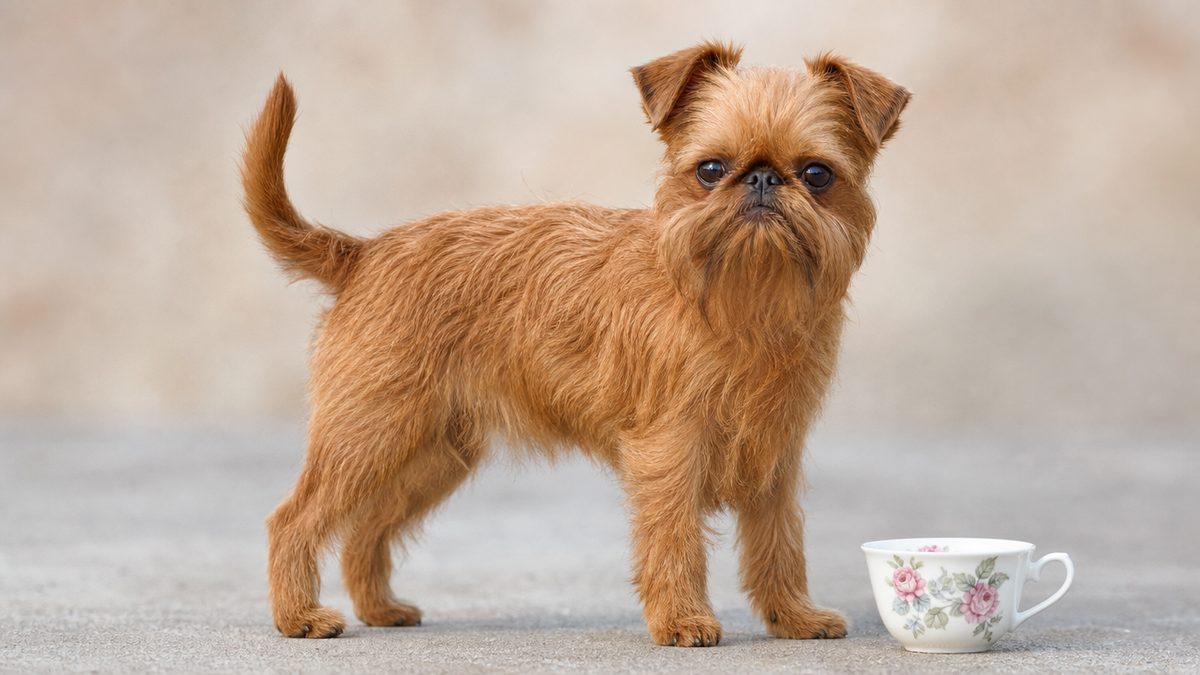
The Griffon Bruxellois is a 3.5 to 6 kg Belgian companion dog with a deliberately flattened face, an undershot jaw and a coat that comes rough or smooth, and the single most useful thing an Indian buyer can know about it is that the world's kennel clubs do not agree on whether it is one breed or three. The Royal Kennel Club breed standard…
The Federation Cynologique Internationale, the body whose nomenclature governs any pedigree issued in India, files it in Group 9 Companion and Toy Dogs, Section 3 Small Belgian Dogs. Its official standard describes a small guardian and companion dog, practically square, with good bone, and states that the head is the most characteristic part of the body, attracting attention by an almost human expression. The weight range is 3,5 to 6 kg, and the standard prints no height at all, which matters later because every Indian page selling this dog prints a height.
The breed's own history section says the three Belgian griffon types descend from a small rough-coated dog called a Smousje found for centuries around Brussels, and that nineteenth-century crosses to the Ruby King Charles Spaniel and the Pug produced the short black coat and fixed the current type. Two dogs, Topsy and Foxine, were entered in the Saint-Hubert stud book in 1883 at numbers 163 and 164. The Pug cross is not a footnote. It is where the flat face came from, and it is why this dog now sits in the same veterinary literature as the Pug and the French Bulldog.
The measurement that defines the breed
One line in the FCI standard does more work than any other. The foreface including the nose must not exceed 1.5 cm, the nose is set at the same level as the eyes, and the tip of the nose is tilted back so that in profile the chin, the nose and the forehead lie on the same plane. That is a written instruction to breed a dog with almost no muzzle, expressed as a hard number. Neither the British nor the American standard puts a figure on it; the Royal Kennel Club says relatively short and wide, and the American Kennel Club says extremely short with the tip set back deeply between the eyes to form a lay-back. American Kennel Club
The jaw is written the same way. The FCI says flatly that the breed is undershot, with the lower jaw curved upwards, broad and jutting beyond the upper. The AKC goes further and says jaws must be undershot, with the incisors of the lower jaw protruding over the upper incisors. The Royal Kennel Club softens it to slightly undershot with even teeth. All three then require that neither teeth nor tongue show when the mouth is closed, and all three treat a permanently visible tongue as a fault or a disqualification.
Rough and smooth, and why the coat is a naming problem
The rough coat is harsh, slightly wavy and carries an undercoat, with beard and moustache furnishings running from ear to ear and longer hair above the eyes forming eyebrows. The smooth coat is harsh, flat, gleaming and at most 2 cm long. A silky or woolly coat is a serious fault in the rough, and the AKC directs that coats prepared with scissors or clippers should be severely penalised, because the rough coat is meant to be hand-stripped. Purina's Indian breed library, one of the few ranking pages that is not selling a puppy, gets this right and says both varieties need brushing more than once a week.
One Indian seller page states that the breed is hypoallergenic and hardly sheds. Another Indian page prints Shedding YES on its own spec card. The Royal Kennel Club's breed data flags Sheds Yes. The allergy claim is dealt with in full in the grooming section, and the evidence against it is settled.
So the short version of the identity question is that this is a very small, very flat-faced, hand-stripped Belgian companion dog whose defining features are written into its standards as requirements rather than tolerated as faults. Everything difficult about keeping one in Chennai or Delhi follows from that, and nothing about it is the dog's fault.
One breed or three? The registries genuinely disagree
The Federation Cynologique Internationale recognises three breeds where the American Kennel Club and the Royal Kennel Club each recognise one, and the disagreement is not a translation artefact or a historical leftover. It is live, it is written into current documents, and it decides what an Indian pedigree will say.
Read the FCI's own Group 9 index rather than any summary of it. Section 3, Small Belgian Dogs, contains sub-section 3.1 Griffons, which holds GRIFFON BELGE (81) and GRIFFON BRUXELLOIS (80), and sub-section 3.2, which holds PETIT BRABANCON (82) on its own. All three are filed under Belgium, all three carry a validity date printed as 3/25/2003, and all three are entitled to the CACIB in their own right.
The date format is worth settling before it is quoted. Other rows in that same column read 11/13/2015 and 10/31/2016, and 13 and 31 cannot be months, which fixes the format as month/day/year across the whole table and the griffon validity date as 25 March 2003.
Then the FCI publishes one standard for all three
Follow any of the three standard links and the same seven-page PDF arrives. Its cover carries three headings, FCI-Standard N 80 GRIFFON BRUXELLOIS, FCI-Standard N 81 GRIFFON BELGE and FCI-Standard N 82 PETIT BRABANCON, and its running footer reads FCI-St. N 80-81-82 / 05.05.2003. Every paragraph on head, body, limbs, gait, weight, faults and disqualifications is shared. Only two passages split by breed at all, and they are Colour and one sentence of Coat.
So the FCI's position, stated precisely, is that these are three breeds with one body and three appearances. Its own historical note says as much, describing the three breeds as all descending from the Smousje and adding that the two Griffons are rough-coated and distinguished from each other by colour, whereas the Petit Brabancon is short-coated.
| The dog | FCI | Royal Kennel Club | American Kennel Club |
|---|---|---|---|
| Rough coat, red | Griffon Bruxellois, breed 80 | Griffon Bruxellois, rough variety, colour Red Rough | Brussels Griffon, rough coat, colour Red |
| Rough coat, black or black and tan | Griffon Belge, breed 81 | Griffon Bruxellois, rough variety, colours Black Rough and Black & Tan Rough | Brussels Griffon, rough coat, colours Black and Black & Tan |
| Smooth coat, any of those colours | Petit Brabancon, breed 82 | Griffon Bruxellois, smooth variety, three smooth colours | Brussels Griffon, smooth coat, informally termed Brabancon |
| Number of recognised breeds | 3 | 1 | 1 |
| Number of published standards | 1, numbered 80-81-82 | 1 | 1 |
The last two rows are the point. The FCI has three breeds and one standard. The other two have one breed and one standard. Nobody has three standards, and nobody except the FCI has three breeds.
India is listed in the FCI's own members index, and the Kennel Club of India issues pedigrees against FCI nomenclature. So a puppy registered in India is registered as breed 80, 81 or 82, while being advertised under the single American name Brussels Griffon. The registration document and the sale listing will not use the same word.
What the AKC and the Royal Kennel Club do instead
Both English-speaking registries collapse the three FCI breeds into one, and they do it by different routes, which is why their documents disagree with each other as well as with the FCI.
The American Kennel Club recognised the Brussels Griffon in 1910 and registers one breed in the Toy Group. Its official standard, approved 8 November 2022 and effective 1 February 2023, opens by stating that there are two distinct types of coat, rough or smooth, and then says plainly that except for coat, there is no difference between the two. Belge survives only as a registrable colour, listed as reddish brown mixed with black usually with a black mask, alongside Red, Black and Tan, and Black. Brabancon survives only as a nickname, and the AKC's own breed page records it as such, saying smooth-coated Brussels Griffons are termed Brabancons.
The Royal Kennel Club takes the opposite route to the same destination. It keeps both Belgian names and demotes them to varieties, its standard reading that the breed has two varieties, rough coated Griffon Bruxellois and smooth coated Petit Brabancon. Registration follows that structure literally: smooth is selectable when a litter is registered online, and if selected the word smooth appears after the breed name on the certificate, otherwise the dog is treated as rough. Six breed standard colours exist, three rough and three smooth. The Griffon Belge disappears entirely, its colours absorbed as Black Rough and Black & Tan Rough.
Three registries, three different dogs on paper
Set the three standards side by side on the points where they can be compared numerically and they do not agree. This is not nitpicking. A dog can be inside one standard and outside another on the same day.
| Point | FCI 80-81-82 | Royal Kennel Club | American Kennel Club |
|---|---|---|---|
| Weight | 3,5 to 6 kg | 3.2 to 5 kg, most desirable 3.6 to 4.5 kg | Usually 8 to 10 lb, must not exceed 12 lb, about 5.4 kg |
| Height | Not stated anywhere | Not stated | Not stated in the standard |
| Muzzle length | Foreface including nose must not exceed 1.5 cm | Relatively short, wide muzzle | Extremely short, tip set back deeply to form a lay-back |
| Skull | Broad and round, forehead well-rounded | Rounded but in no way domed | Large and round, with a domed forehead |
| Bite | The breed is undershot | Slightly undershot with even teeth | Jaws must be undershot |
| Cropped ears | Cropped and uncropped equally acceptable | Not mentioned; cropping is unlawful in the UK | May be shown cropped or natural |
| Docked tail | Docked tail shortened by two thirds | Previously customarily docked; both forms described | If docked, docked to one third |
Two rows deserve to be read twice. On the skull, the Royal Kennel Club requires a head rounded but in no way domed while the American standard requires a domed forehead. American Kennel Club That is a flat contradiction between two national registries about the same breed. On weight, a 5.5 kg dog is correct under the FCI, oversized under the Royal Kennel Club and inside the American ceiling, all at once.
Both the FCI and the AKC still contemplate cropped ears and a docked tail. Neither procedure is lawful in India. Second Schedule Part II paragraph 6(8) of the Dog Breeding and Marketing Rules 2017 forbids tail docking, ear cropping, de-barking, de-clawing and any change of appearance by artificial means. An Indian reader following the international standard on those two lines would be breaking Indian law.
The 1.5 cm rule, and what a standard can require
The Griffon Bruxellois is brachycephalic by written instruction rather than by accident, and the FCI standard's 1.5 cm foreface limit is the most explicit statement of that anywhere in the toy group.
Brachycephalic means short-headed, and the practical consequence is that the soft tissue inside the nose and throat is sized for a longer skull than the dog has. Panting is how a dog sheds heat, and panting works by moving air across the nasal turbinates, so a shortened face reduces the surface area available for evaporative cooling. Hall's team put it exactly that way when explaining why brachycephalic dogs carried higher heat odds in their model.
Three separate standard clauses build that head. The FCI caps the foreface including the nose at 1.5 cm, requires the nose set at the same level as the eyes, and requires the nose tip tilted back so the chin, nose and forehead lie on one plane. It calls the stop very pronounced. The AKC requires the nose tip set back deeply between the eyes to form a lay-back, with a deep stop and a domed forehead.
Twenty per cent of the judging score
The American standard publishes a Scale of Points totalling 100, and the arithmetic inside it is worth spelling out. The head takes 35 points. Within that, Nose and stop takes 10 and Bite, chin and jaw takes 10. So 20 of 100 points, a fifth of the entire assessment, are awarded for the two features that produce the airway obstruction and the malocclusion. Skull takes another 5, Eyes another 5 and Ears another 5.
| Section | Points | Share of 100 |
|---|---|---|
| Nose and stop | 10 | 10 per cent |
| Bite, chin and jaw | 10 | 10 per cent |
| Skull, eyes and ears | 15 | 15 per cent |
| Head, total | 35 | 35 per cent |
| Coat colour and texture | 25 | 25 per cent |
| Body and general conformation | 40 | 40 per cent |
Nothing in that table is a criticism of any individual breeder or judge. It is simply what the document says, and it explains why the conformation has not drifted back toward a longer muzzle on its own. A scoring system that pays 20 points for the flattest face and the most undershot jaw in the ring is a scoring system that will keep producing them.
The one registry that has started to push back
The Royal Kennel Club places the Griffon Bruxellois in Breed Watch Category 2, its band for breeds with particular points of concern, and runs a public page on health issues in flat-faced dogs that names breathing difficulties and teeth crowding as the two consequences of a shortened skull. Its teeth point is straightforward and rarely mentioned by sellers: a shortened jaw still carries the same number of teeth at the same size, so they crowd.
In August 2026 the Royal Kennel Club recognised breathing testing under the Kennel Club Respiratory Function Grading scheme as a Best Practice test for this breed, with formal addition to the Health Standard and to Find a Puppy from January 2027. That is the first time a graded airway assessment has been named for the Griffon Bruxellois by a national registry, and it gives an Indian buyer a defined thing to ask a breeder for.
What the 2026 Cambridge data says about this breed's breathing
A February 2026 University of Cambridge study graded 898 dogs across fourteen brachycephalic breeds and placed 52 Griffon Bruxellois in the moderate risk band, meaning between 25 and 50 per cent of the sampled dogs were Grade 0 and at least half graded 1 to 3 for brachycephalic obstructive airway syndrome.
Until this paper, airway disease in short-skulled dogs had been studied intensively in only three breeds, the Bulldog, French Bulldog and Pug. The Cambridge team adapted the respiratory functional grading assessment for fourteen more, and the Griffon Bruxellois was one of them. That makes this the first breed-specific airway evidence a Griffon buyer has ever been able to consult, and it is four months old.
Where the breed landed
The paper sorted the fourteen breeds into three bands. Pekingese and Japanese Chin were high risk, with only 10.9 per cent and 17.4 per cent of dogs grading 0. Five breeds were moderate risk, the Griffon Bruxellois among them with the Boston Terrier, King Charles Spaniel, Dogue de Bordeaux and Shih Tzu. Six were mild, including the Affenpinscher and Pomeranian, and only the Maltese and Pomeranian had no dogs with clinically significant disease at all.
Three findings from that paper apply directly to an Indian owner.
- The Griffon is one of the four flattest breeds in the study. Its mean craniofacial ratio was under 0.1, a group it shares with the King Charles Spaniel, Japanese Chin and Pekingese.
- Severe nostril stenosis was recorded in only six of the fourteen breeds, and this is one of them. The others were the Boston Terrier, Boxer, Dogue de Bordeaux, Japanese Chin and Pekingese. The paper also notes the Griffon has higher rates of nostril stenosis than most breeds in the sample.
- You cannot pick a safe individual by muzzle length within the breed. Among the four flattest breeds, craniofacial ratio did not significantly separate Grade 0 dogs from Grade 1 to 3 dogs, and for the Griffon Bruxellois the p value was 0.18. Below a certain flatness, a slightly longer nose stops predicting anything.
What does predict it
Across the whole 898-dog population, three factors were significantly correlated with airway grade: higher body condition score, nostril stenosis, and a lower craniofacial ratio. Body condition score alone carried an odds ratio of 1.8 (95 per cent CI 1.3 to 2.6). Together the three accounted for about 20 per cent of the variation in airway status, with an area under the ROC curve of 0.74.
Twenty per cent is a modest figure and the authors treat it as one, concluding that the assumption that facial hypoplasia is the primary cause of airway disease is likely an oversimplification. For an owner that cuts a useful way. Two of the three predictors, weight and nostril shape, are things you can see and one of them is something you control.
The paper records that in smaller breeds such as the Chihuahua, Griffon Bruxellois and Japanese Chin the obstruction tends to produce a quiet nasal stertor, whereas heavy-set breeds make a loud pharyngeal noise. An Indian owner listening for the loud snorting they associate with a Pug will not hear the equivalent signal from a Griffon, and will conclude the dog is fine.
The Royal Kennel Club scheme now recognised for this breed grades a dog 0 to 3 on exactly this assessment. No Indian body offers the scheme, but the grading criteria are public, and an Indian veterinarian can be shown them.
Griffon Bruxellois price in India, and why the sources disagree by Rs 1,65,000
The published griffon bruxellois price in india runs from Rs 35,000 to Rs 2,00,000 depending entirely on which Indian page you read, and the two ends of that range come from two pages that rank on the same search results page for the same query.
Four Indian pages publish a figure for this breed. They do not agree, they do not overlap cleanly, and none of them shows a Griffon Bruxellois actually for sale at the price quoted. The table records what each one prints rather than an average, because averaging four numbers that were arrived at by four unknown methods produces a fifth number with no method at all.
| Source | Published band | Spread | Dogs of this breed shown on the page |
|---|---|---|---|
| Premium Pet House | Rs 80,000 to Rs 2,00,000 | Rs 1,20,000 | None; stock photos only |
| Best For Pets | Rs 35,000 to Rs 1,00,000 | Rs 65,000 | None; stock photos only |
| Puppiezo | No band published for the breed | n/a | Zero of eight in its own carousel |
| Mr n Mrs Pet | No band published for the breed | n/a | Zero of three results shown |
| Asia Pets | No band published; title promises best price | n/a | Showing 0 results |
The full published range therefore spans Rs 35,000 to Rs 2,00,000, a gap of Rs 1,65,000, or 5.7 times from bottom to top. For comparison, the same country's Labrador Retriever listings sit inside a much tighter band because there is a real supply to price. A 5.7-fold spread is what a price looks like when nobody is transacting at it.
The city table that is not a city table
Premium Pet House prints a ten-row table of prices by Indian city. Eight of the ten rows read Rs 80,000 to Rs 2,00,000 identically, for Mumbai, Pune, Kolkata, Bangalore, Delhi, Ahmedabad, Kolhapur and Goa. Chennai and Hyderabad read Rs 80,000 to Rs 1,50,000. A table in which eight of ten cells are the same value is not reporting local market conditions; it is a template with city names substituted in. The two exceptions are not explained anywhere on the page.
What an answer engine has already done with these numbers
Bing's India results for this query lead with an AI-generated summary stating that the price of Brussels Griffon puppies in India typically ranges from INR 35,000 to INR 100,000, then adding that some breeders may charge between INR 80,000 to INR 2,00,000, and attributing the whole passage primarily to Premium Pet House. The Premium Pet House page contains no figure of 35,000 anywhere. Two incompatible bands from two sites have been merged into one confident sentence and credited to the site that carries only half of it.
A defensible statement is that Indian pages publish Rs 35,000 to Rs 2,00,000, that no page evidences a transaction, and that the arithmetic in the next section shows two of those figures fail every conversion test that would explain them. What is not defensible is quoting a single number as the price of this breed in India, and Bonbeno will not do it.
One number on these pages is real and checkable, and it is not a puppy price. The Kennel Club of India's own tariff sheet puts litter registration at Rs 750 per puppy within 60 days. Every seller page leans on the phrase KCI registered. That is what it costs.
Testing the Indian price figures with arithmetic
Run every published Indian figure for this breed through the four exchange rates that have produced fake rupee prices on this site before, and the result is clear: none of them is a converted dollar price, and the ones that appear to pass do so by construction rather than by evidence.
The strong test is 84.38, the rate that has caught converted price lists three times on Bonbeno. The secondary tests are 74.00 and a flat 80.00. A fourth rate, 66.67, is exactly 200 divided by 3, so any figure that is a multiple of 1,000 passes it automatically and it proves nothing on its own. The same weakness applies to 80: because 1,000 divided by 80 is 12.5, only multiples of 2,000 yield a whole dollar figure, and a whole dollar figure is still not a price unless a shop would print it.
| Rupee figure | at 84.38 | at 74.00 | at 80.00 | at 66.67 |
|---|---|---|---|---|
| Rs 35,000 | 414.79 | 472.97 | 437.50 | 524.97 |
| Rs 80,000 | 948.09 | 1,081.08 | 1,000.00 | 1,199.94 |
| Rs 1,00,000 | 1,185.11 | 1,351.35 | 1,250.00 | 1,499.93 |
| Rs 1,50,000 | 1,777.67 | 2,027.03 | 1,875.00 | 2,249.89 |
| Rs 2,00,000 | 2,370.23 | 2,702.70 | 2,500.00 | 2,999.85 |
Not one figure divides to a whole number of dollars at 84.38 or at 74.00. Three divide cleanly at 80.00, to 1,000, 1,250 and 2,500, and those three are all multiples of 2,000, so the clean division is arithmetic rather than evidence. The quotients are at least plausible as American prices, which is why the flat-80 test must never be run alone. The honest verdict is that these are rupee-native figures, chosen in rupees, not converted from anything.
The maintenance table that cannot hold one rate
Best For Pets prints its monthly cost block with paired rupee and dollar figures, and the pairs give three different implied rates across four rows. A table that cannot hold a single exchange rate across its own rows was generated by division rather than by pricing anything in India, and this is the second time Bonbeno has caught that specific pattern.
| Line | Rupee figure | Dollar figure | Implied rate |
|---|---|---|---|
| Food, low | Rs 1,500 | USD 20 | 75.00 |
| Food, high | Rs 3,000 | USD 40 | 75.00 |
| Grooming, low | Rs 1,500 | USD 20 | 75.00 |
| Grooming, high | Rs 2,500 | USD 35 | 71.43 |
| Medical, low | Rs 1,000 | USD 15 | 66.67 |
| Medical, high | Rs 2,000 | USD 30 | 66.67 |
| Toys, low | Rs 500 | USD 7 | 71.43 |
| Toys, high | Rs 1,000 | USD 15 | 66.67 |
Eight pairs, three different rates, 75.00 three times, 71.43 twice and 66.67 three times. Both sides of every pair are round numbers, which is the tell. Nobody converted 1,500 rupees and got 20 dollars; somebody wrote a round rupee figure and a round dollar figure that looked about right beside it. The rupee figures may still be roughly correct for India, but they were not derived, and the dollar column should be ignored entirely.
The Puppiezo carousel on the Brussels Griffon page prints Rs 98,999 three times on one page, attached to a Maltipoo named Fizey, a Maltipoo named Samy and a Doxiepoo named Yoki. It divides to 1,173.25 dollars at 84.38 and to no whole number at any rate tested, so it is not a conversion either. It is a charm price this site attaches to whichever puppy is in stock, and Bonbeno has now recorded it across eleven separate breed pages on that site. Never treat it as this breed's price.
The last test: does the Indian range match the American one?
A converted list should land on the source country's real prices, so the final check is to look at what the breed actually costs where it is common. The US aggregator ranking eighth for this Indian query publishes an average of USD 1,800 to 2,800, an average of USD 2,300 in the United States, and most puppies between USD 1,500 and 4,000. Divide the Indian ceiling of Rs 2,00,000 by the strong 84.38 rate and it gives 2,370.23 dollars, which is not any of those numbers. Dividing it by the US average of 2,300 implies a rate of 86.96, which is not a rate anybody uses. The Indian floor of Rs 35,000 gives 414.79 dollars at 84.38, which sits below the bottom of the entire American range. So the Indian band is not the American band converted at any rate, in either direction, and the rupee-native verdict stands.
What Indian listings for this breed actually contain
Every Indian marketplace ranking for this term was checked on 31 August 2026, and not one of them could display a Griffon Bruxellois. Three of them displayed other breeds instead, under headings that said otherwise.
Puppiezo: eight animals, none of them the breed
The Puppiezo product page carries a block headed Available Brussels Griffon Puppies For Sale. It lists eight animals with names, prices and breed tags. Reading the breed tag on each one gives the following.
| Name | Breed as tagged by the site | Price shown |
|---|---|---|
| Fizey | Maltipoo | Rs 98,999 |
| Kuzo | Poodle | Rs 92,599 |
| Dugu | Poodle | Rs 92,599 |
| Kazuka | Cane Corso | Rs 94,999 |
| Doir | Goldendoodle | Rs 1,20,000 |
| Samy | Maltipoo | Rs 98,999 |
| Tugi | Rottweiler | Rs 76,499 |
| Yoki | Doxiepoo | Rs 98,999 |
Zero of eight are Brussels Griffons. A Cane Corso and a Rottweiler are in a carousel for a four-kilogram toy breed. The same page's spec card gives the breed as 7 to 9 inches and 3 to 4 kg, and prints Shedding YES.
Mr n Mrs Pet: three results, three other breeds
The Mr n Mrs Pet listing page prints 3 Result Found beneath a heading reading Brussels griffon Puppies For Sale. The three animals shown are a Border Collie in Dehradun and two French Bulldogs, in Gurgaon and Bangalore. Its own most-popular-breeds sidebar lists ten breeds with counts, from Shih Tzu at 650 down to Cane Corso at 134, and the Brussels Griffon appears on none of them.
Asia Pets: zero results under a heading that says otherwise
Asia Pets is the cleanest case because the page is honest in one line and misleading in the next. Its body prints Showing 0 results. It then offers three animals under the heading Here are available pets of the same breed from other locations, and those three are a Chihuahua, a Yorkshire Terrier and a Toy Pom. A heading containing the words the same breed is followed by three different breeds. The page's title and meta description promise best prices and the page publishes no price at all.
Three independent Indian marketplaces, ranking in the top four for this query, could not show one dog of this breed between them on the same day. Read that as the supply signal it is. If a seller responds to your enquiry with a photograph of a puppy within an hour, ask which of these three sites it came from.
The five size specs on offer are worth collecting too, because they cannot all be right. Puppiezo gives 7 to 9 inches and 3 to 4 kg, Premium Pet House gives 9 to 11 inches and 8 to 10 pounds, Asia Pets gives 18 to 20 cm and 3 to 6 kg, Best For Pets gives about 7 to 8 inches, and the AKC gives 7 to 10 inches. Premium Pet House Asia Pets, Brussels Griffon Puppies… Best For Pets, Brussels Griffon: Price American Kennel Club breed page… The FCI standard, which governs any Indian pedigree, prints no height at all, and its weight range of 3,5 to 6 kg is wider at the top than three of the four Indian pages allow.
A sixth spec arrives from the US aggregator that ranks in India's top ten for this query, giving height 7 to 8 inches or 18 to 20 cm and weight 6 to 12 pounds or 2.5 to 5.5 kg. Its weight floor of 2.5 kg sits a full kilogram below the FCI standard's 3,5 kg minimum, and its ceiling of 5.5 kg sits half a kilogram below the standard's 6 kg. Six published specifications, no two alike, for a breed whose governing standard states a weight and refuses to state a height at all.
What KCI registered actually buys you
Kennel club registration in India records a puppy's parentage against Federation Cynologique Internationale nomenclature and costs Rs 750 per puppy within 60 days of whelping. It certifies no health screening of any kind.
Every Indian seller page for this breed uses the phrase KCI registered as a quality signal. Asia Pets, Brussels Griffon Puppies… It is worth knowing precisely what the phrase covers, because the answer is narrow and the fee schedule is public.
| Service | Fee |
|---|---|
| Litter registration per puppy, within 60 days | Rs 750 |
| Litter registration per puppy, 61 to 120 days | Rs 1,200 |
| Litter registration per puppy, 121 to 180 days | Rs 2,000 |
| Registration of an imported dog | Rs 2,500 |
| Certified pedigree, four generations | Rs 1,000 |
| Export pedigree | Rs 2,000 |
| Transfer of ownership within 12 months of birth | Rs 500 |
A Rs 2,00,000 puppy therefore carries a Rs 750 document. That is not an argument against registration, which is genuinely useful for tracing parentage and for anything you may later want to do in the show ring. It is an argument against paying a premium for the phrase.
The naming problem the registration creates
India appears in the FCI's own members index, and Indian pedigrees are issued against FCI nomenclature. Under that nomenclature there is no breed called Brussels Griffon. There are three breeds, numbered 80, 81 and 82. So the following is true of any KCI-registered dog of this type in India.
- A red rough-coated dog registers as Griffon Bruxellois, breed 80.
- A black or black and tan rough-coated dog registers as Griffon Belge, breed 81, and is a different FCI breed from the dog above.
- A smooth-coated dog of any of those colours registers as Petit Brabancon, breed 82.
- None of them registers under the name the Indian seller used in the advertisement.
This is not a technicality when money changes hands. A buyer paying Rs 1,50,000 for a black smooth puppy advertised as a Brussels Griffon will receive paperwork naming a Petit Brabancon, and will reasonably wonder whether the wrong dog arrived. Nothing is wrong with the dog. The advertisement used the American name for a breed grouping India does not use.
Ask the breeder which FCI breed number will appear on the pedigree, and whether the litter was registered within 60 days at Rs 750 or later at a higher fee. A breeder who knows the answer to both has read the paperwork. A breeder who says the question does not matter is telling you something useful.
One more clause is worth knowing before a purchase. Rule 8(1)(b) of the 2017 Rules provides that dogs over six months in age are not sold without first being sterilised, unless they are being sold to another licensed breeder. An adult Griffon offered for sale unsterilised to a pet home is outside that rule.
Suitability for the Indian climate: the homeland numbers
Chennai's coolest month is warmer than the hottest month in Brussels, and that single comparison is the honest starting point for anyone keeping a flat-faced Belgian dog in India. NASA POWER climatology API queried…
The figures below come from NASA POWER queried by explicit latitude and longitude, because a place-name lookup on a climate site can silently serve another city and this project has caught that happening six times. The service returns a grid cell rather than a point, so its reported elevation is echoed here and checked against each city's real altitude before any figure is used.
| Place | Coordinates echoed | Cell elevation | Real elevation | Annual mean | Hottest month | Coolest month |
|---|---|---|---|---|---|---|
| Brussels | 4.352 E, 50.85 N | 36.84 m | roughly 13 to 100 m | 10.26 C | 18.44 C, July | 2.51 C, January |
| Chennai | 80.271 E, 13.083 N | 48.95 m | about 6 m | 27.91 C | 31.57 C, May | 23.99 C, January |
| Delhi | 77.209 E, 28.614 N | 206.37 m | about 216 m | 25.65 C | 35.95 C, June | 13.83 C, January |
Two of those elevation checks pass without comment. The Brussels cell at 36.84 m sits inside the real range of the conurbation, and the Delhi cell at 206.37 m is about 10 m below the city's real 216 m, which at the standard lapse rate of 6.5 C per 1,000 m is a rounding error. NASA POWER climatology API queried…
The Chennai cell does diverge. It reports 48.95 m against a real city elevation near 6 m, so the model is standing about 43 m too high. At 6.5 C per 1,000 m that is roughly 0.28 C, which changes nothing here, but it is stated rather than hidden because on hill stations the same effect has been over a kilometre. Coastal flat terrain is where this failure mode is harmless, and this is coastal flat terrain.
The gap, stated plainly
- Annual mean. Chennai runs 17.65 C warmer than Brussels, 27.91 against 10.26.
- Hottest month against hottest month. Chennai's May at 31.57 C is 13.13 C above Brussels' July at 18.44 C.
- The comparison that decides it. Chennai's January, its coolest month, averages 23.99 C. Brussels' July, its hottest, averages 18.44 C. The coolest Indian month is 5.55 C warmer than the warmest Belgian one.
- Delhi's peak. June averages 35.95 C, which is 17.51 C above the hottest month this breed's conformation evolved under.
A dog that cools itself by moving air across nasal turbinates, and whose standard caps the entire foreface at 1.5 cm, is being asked to do that work in air that is on average 17 C warmer than the air its breed was fixed in. That is the whole argument, and no amount of air conditioning changes the underlying physiology when the power goes off.
Hall's 905,543-dog UK cohort found brachycephalic dogs carried 2.10 times the odds of heat-related illness against mesocephalic dogs, with a 95 per cent confidence interval of 1.68 to 2.64. The Griffon Bruxellois itself was not individually modelled, because the breed variable only included breeds with at least five cases or five thousand dogs, and the breed appears nowhere in the paper. So the transferable claim is the skull-shape odds ratio, not a breed-specific one, and the over-50 kg odds ratio in the same paper does not apply to a four-kilogram dog at all.
One further figure from that cohort is worth carrying. The event fatality rate for heat-related illness was 14.18 per cent (95 per cent CI 11.08 to 17.96). Roughly one dog in seven that reached a vet with heat-related illness did not survive it, in a temperate country.
Heat management city by city, and what triggers the illness
Exertion, not a parked car, is what puts most dogs in a veterinary clinic with heat-related illness, and that reframes the Indian advice from avoid the car to avoid the walk.
The companion paper to the UK incidence study analysed 1,259 heat-related illness events from 1,222 dogs in the same 905,543-dog cohort. Of those events, 380 had no trigger recorded, leaving 879 events with a recorded trigger. Of those 879, 652 were exertional, 113 environmental and 46 vehicular confinement. So 652 of the 879 events with a recorded trigger, or 74.2 per cent, followed exercise.
Read that against Indian practice and the implication is uncomfortable. The dangerous moment for a Griffon Bruxellois in Pune is not a car. It is the 6 pm walk on a road surface that has been absorbing sun since noon.
| City | The problem month | The mechanism | What changes |
|---|---|---|---|
| Delhi and Gurugram | May and June, 35.1 C and 35.95 C monthly means | Dry extreme heat; radiant load from road surfaces persists after dark | Walk before 6 am. Skip the evening walk entirely in June and use indoor scent games |
| Chennai | April to June, never below 23.99 C in any month | Sustained warmth with 72 per cent mean humidity, so panting sheds less heat | There is no cool season to recover in. Treat cooling as a year-round system, not a summer measure |
| Mumbai and Kolkata | May, then the monsoon | High humidity suppresses evaporative cooling exactly when the dog needs it most | Dehumidify the room the dog sleeps in. A fan moving saturated air does very little |
| Bengaluru and Pune | April, 28.4 C and 28.7 C monthly means | The mildest Indian option, still 10 C above the homeland annual mean | Early morning and late night walks work for most of the year here |
The practical protocol
- Walk in the dark. Both walks, from March to October, in every metro except the Deccan cities.
- Test the road with your hand. Five seconds on the tarmac. A dog whose chest sits 20 cm off the ground takes far more radiant heat than your face does.
- Keep the dog lean. Body condition score carried an odds ratio of 1.8 for airway grade, and airway grade is what limits heat shedding.
- Use a harness, never a collar. Tracheal pressure on a dog with an already-compromised airway is a bad trade for a small convenience.
- Cool the groin and armpits, not the back. Wetting a rough coat's outer layer traps heat under it. Wet the thin-skinned areas and use a fan.
- Do not shave. The harsh coat shades the skin. Stripping keeps the structure, clipping destroys it.
Second Schedule Part IV paragraph 21(1) of the Dog Breeding and Marketing Rules 2017 provides that dogs not accustomed to local temperatures, breeds that cannot tolerate them, and sick, infirm, aged or young animals shall not be kept in outdoor facilities without the attending veterinary practitioner's written approval. The clause is a Second Schedule paragraph, not a Rule; the string Rule 21 appears zero times in the gazette. Paragraph 21(2) separately requires shelters with roofs plus one or more separate outside areas of shade.
Paragraph 15 of the same Schedule requires that the temperature within indoor housing facilities be ambient and comfortable depending on the breeds of dogs that are housed inside, and that it be such as provides for their health and well-being. That wording puts the burden on the breed, which for this breed is a demanding standard.
Temperament and who should not buy this dog
The Griffon Bruxellois is an affectionate, sensitive, self-important small dog that attaches intensely to one household and does badly when left alone, and the standards themselves describe it as a watchful guardian rather than a lap ornament.
The FCI puts its utilisation as small guardian and companion dog, and its behaviour clause reads well-balanced, alert, proud, very attached to its owner, very watchful, neither timid nor aggressive. The AKC standard's temperament clause is three phrases long and one of them is telling: intelligent, alert and sensitive, full of self-importance. The Royal Kennel Club describes a smart little dog with the disposition of a terrier.
Those three descriptions agree, and they do not describe a placid toy breed. A dog originally kept to keep stables free of rodents and to guard carriages carries a working temperament in a four-kilogram body.
Who this breed suits
- Households where somebody is home most of the day. This is the single biggest predictor of the dog doing well.
- Adults and older children. A dog weighing four kilograms with prominent eyes is genuinely fragile, and both eyes and airway make rough handling dangerous rather than merely unpleasant.
- Apartment dwellers who want a small watchdog. The breed will announce every visitor, and its exercise requirement is genuinely modest.
- Owners prepared to socialise deliberately. The sensitivity cuts both ways, and an under-socialised Griffon becomes suspicious rather than aggressive.
Who should not buy one
- Anyone out ten hours a day. Separation distress is the commonest behavioural complaint, and even the selling pages say so.
- Families with toddlers. The combination of prominent eyes, a compromised airway and a four-kilogram frame makes accidental injury more likely and more serious.
- Anyone who wants a running companion. Exercise above a walk is a physiological problem for this conformation, not a training problem.
- Anyone buying for a hypoallergenic household. The claim is unsupported and the grooming section explains why.
- Anyone in an Indian city without reliable indoor cooling. This is the honest one, and it excludes more buyers than the others combined.
Both Indian selling pages describe a dog that will not think twice before confronting a much larger dog. That is accurate and it is not charming. A four-kilogram brachycephalic dog picking a fight in a Bengaluru park is a veterinary emergency waiting to happen, and it is why lead work and recall matter more here than in a breed that can absorb a mistake.
The breed is genuinely sensitive to harsh handling, which the Puppiezo spec card gets right in one of its few accurate lines. Correction-based training produces a shut-down dog rather than a compliant one, and the training section deals with what works instead.
Training a small dog that thinks it is a large one
To train a Griffon Bruxellois, use short reward-based sessions and treat socialisation as the primary curriculum rather than obedience, because this breed's failure mode is suspicion of the unfamiliar rather than disobedience.
The breed is trainable in the sense that it learns quickly and retains well. It is not biddable in the sense of working for the sake of compliance. The AKC's own standard names self-importance as a temperament trait, and the practical translation is that the dog will ask what the exercise is for.
The first sixteen weeks decide most of it
Socialisation matters more in this breed than obedience does, and it matters more in India than in Europe because the environment is louder and more crowded. Socialise deliberately to traffic, lifts, marble floors, doorbells, delivery riders, other dogs at a distance and being handled around the face. The face handling is not optional, because this dog will need its eyes checked daily and its airway assessed by a vet who has to look into a very small mouth.
- Weeks 8 to 16. Two short exposures a day to something new, each ending before the dog is tired. Reward calm looking, not approach.
- Weeks 12 to 20. Introduce handling of the muzzle, ears and feet, paired with food, every day. This is what makes a vet visit possible later.
- Months 4 to 8. Recall and lead manners on a harness. A collar loads the trachea of a dog whose airway is already narrowed.
- Months 6 to 12. Alone-time training in graded steps, starting at thirty seconds. Left untrained, separation distress in this breed is very hard to reverse.
House-training in an Indian monsoon
A four-kilogram dog with a small bladder that refuses to go out in heavy rain is the commonest house-training failure here, and it is a management problem rather than a training one. Establish an indoor toilet option before the monsoon rather than during it, and keep the outdoor spot under cover if one exists. Do not punish an accident during a downpour; you are training the dog to hide rather than to hold.
Training sessions are exertion, and exertion accounted for 652 of the 879 heat-related illness events with a recorded trigger in the UK cohort. Move all training indoors from March to October in most Indian metros, keep sessions to five minutes, and stop at the first change in breathing sound rather than at the first sign of tiredness.
What this breed resists
- Repetition without purpose. Five repetitions land better than twenty.
- Correction. The breed shuts down rather than pushing back, and a shut-down Griffon looks like a well-behaved one for about a week.
- Being ignored. Attention is the reinforcer that works, so withdrawing it is the only correction worth using.
- Crate training introduced late. Start at eight weeks or expect a fight.
The breed will walk politely on a harness within a few weeks if lead work is taught before the dog is strong enough to pull, which in a four-kilogram dog is early. Nothing about this breed is difficult to train. Everything about it is easy to get wrong through force.
The daily exercise requirement, and why more is worse here
Give an adult Griffon Bruxellois about 30 minutes a day, split into two walks in the coolest hours, and treat that as a ceiling rather than a target, because exertion is the trigger behind most veterinary heat-related illness and this dog has the least airway to spare.
The Royal Kennel Club's breed data gives up to 30 minutes per day and Puppiezo's spec card independently gives 30 minutes with a medium energy level. Puppiezo, Buy Brussels Griffon Puppies… Those two agree, which is unusual on this page, and 30 minutes is a sound figure for a temperate country.
In India the number is the same and the timing is not. Of the 879 UK heat-related illness events with a recorded trigger, 652 were exertional, against 113 environmental and 46 from vehicular confinement. Exercise is the leading trigger in a country whose hottest month averages under 20 C. In a country whose Delhi June averages 35.95 C, exercise timing is the whole intervention.
The Indian exercise plan
| Period | Outdoor allowance | Indoor substitute |
|---|---|---|
| November to February, north India | Two walks of 15 minutes, any daylight hour | None needed |
| November to February, Chennai and coastal south | Two walks of 15 minutes, before 8 am and after 7 pm | Scent games on the worst days |
| March to June, everywhere | One walk of 15 minutes before sunrise only | Ten minutes of nose work plus a food puzzle, twice |
| Monsoon, June to September | Short covered walks, watch humidity not temperature | Full indoor substitution when the dog will not go out |
| Any day above 30 C ambient | Nothing outdoors | Indoor only, air-conditioned or well ventilated |
Nose work is the substitute that actually satisfies this dog. A breed developed to find rats in stables has a working nose and no idea it is a toy dog, and ten minutes of searching for hidden food tires it more thoroughly than twenty minutes of walking, at zero thermal cost.
What under-exercise looks like
- Barking at everything. An alert breed with nothing to be alert about invents targets.
- Weight gain. Body condition score carried an odds ratio of 1.8 for airway grade, so a bored dog becomes a wheezing one.
- Destructive chewing. Uncommon in this breed and a reliable sign the dog is genuinely under-occupied.
- Escalating attention-seeking. The self-importance the standard describes finds an outlet whether you provide one or not.
Stop immediately for a change in the sound of breathing, a widened stance, tongue that broadens and darkens, or a dog that sits down and will not move. In this breed the airway noise is quiet and nasal rather than loud and pharyngeal, so the sound change is subtle. Carry water and a wetting cloth for the groin and armpits on every walk from March onwards.
Coat care in Indian humidity, and the hypoallergenic claim
Groom a rough-coated Griffon Bruxellois by hand-stripping every eight to twelve weeks and brushing more than once a week, and never clip it, because clipping removes the harsh outer coat that the standard requires and that shades the skin.
The rough coat is harsh, slightly wavy and carries an undercoat, with beard and moustache furnishings and longer hair above the eyes. The AKC directs that it be hand-stripped and that coats prepared with scissors or clippers be severely penalised. The smooth coat is harsh, flat, gleaming and at most 2 cm long, and needs a rubber mitt once a week and nothing else.
Purina India, one of the few ranking Indian pages that is not selling a puppy, gives brushing more than once a week for both varieties, and the Royal Kennel Club's breed data says the same. The Royal Kennel Club, Breeds A to Z That is the correct instruction for India too, with one addition.
The face is the grooming job, not the coat
A flat face with a deep stop and heavy furnishings collects moisture and food in the folds, and Indian humidity keeps it there. Wipe the muzzle fold and under the eyes daily with a dry cloth, then a barely damp one, then dry again. A fold that stays damp in Mumbai in July becomes a dermatitis within a fortnight. The nasal fold sits directly beneath a prominent eye, so material trapped there reaches the cornea, which is one plausible route to the exposure keratopathy OFA records in 15 of 1,104 tested dogs.
The hypoallergenic claim is settled, and it is false
One Indian page states that the breed is hypoallergenic and that its fur grows long without shedding. Another says allergy sufferers may find the breed more tolerable due to minimal shedding, in an FAQ that two answers earlier calls both varieties moderate shedders. A third prints Shedding YES on its own spec card. The Royal Kennel Club's breed data flags Sheds Yes.
The evidence behind the claim does not exist. Vredegoor and colleagues measured Can f 1, the principal dog allergen, in the hair and homes of 196 dogs of so-called hypoallergenic breeds against 160 control dogs, and the hypoallergenic group came back with more allergen in hair and coat, not less, with no difference in airborne allergen. Their conclusion is that there is no evidence for the classification of certain dog breeds as being hypoallergenic.
Do not buy this breed on the strength of the word hypoallergenic, and do not pay a premium for it. Nothing in any of the three breed standards says anything about reduced shedding, and the only measured evidence points the other way. Test the allergic person against an adult dog of the breed before committing, and accept that the result may be no.
The monsoon routine
- Dry the dog fully, including the ears, after any wetting. Do not follow overseas club advice to towel off and air dry, which assumes a Wisconsin or Yorkshire summer rather than an Indian July.
- Check the ears weekly and plug them before a bath. Water in the ear canal is the commonest avoidable cause of otitis in Indian dogs.
- Strip on schedule even when the coat looks fine. A blown coat in humidity mats faster than in dry air.
- Keep nails short. Black nails on a small dog are hard to judge, so trim little and often rather than a lot occasionally.
A fourth source makes the same claim and contradicts itself in the same table. The US aggregator ranking for this Indian query prints Hypoallergenic: Yes and a Shedding Level of one star described as minimal shedding, while its own grooming row says the coat is high maintenance and then adds that no trimming or stripping is needed. That last instruction is flatly wrong for a rough coat, and it is the opposite of the AKC standard's direction that the coat be hand-stripped and that coats prepared with scissors or clippers be severely penalised. An Indian owner following it would end up with a clipped dog, a soft coat and no shade over the skin.
Health: the hip figure nobody expects from a toy dog
The Orthopedic Foundation for Animals ranks the Brussels Griffon fourth worst of every breed in its hip table, at 58.1 per cent dysplastic across 227 evaluations, behind only the Olde English Bulldogge, the Pug and the Bulldog.
That figure was read from the printed breed label in OFA's disease statistics tables rather than from a breed code, because guessed OFA codes return complete, plausible tables for the wrong breed and this project has been caught by that three times. The whole dump was retrieved and searched case-insensitively, with a Labrador Retriever control returning 109 rows in the same session to prove the search worked.
| Breed | Rank | Evaluations | Normal % | Dysplastic % | Mild | Moderate | Severe |
|---|---|---|---|---|---|---|---|
| Olde English Bulldogge | 1 | 318 | 24.2 | 73.3 | 41.2 | 24.5 | 7.5 |
| Pug | 2 | 1,282 | 25.7 | 72.7 | 41.0 | 26.6 | 5.1 |
| Bulldog | 3 | 1,660 | 26.9 | 70.9 | 34.2 | 24.6 | 12.0 |
| Brussels Griffon | 4 | 227 | 38.8 | 58.1 | 39.2 | 12.3 | 6.6 |
| Dogue de Bordeaux | 5 | 1,013 | 40.0 | 57.2 | 27.6 | 23.0 | 6.5 |
| All breeds | n/a | 1,712,643 | 84.3, see caution | 14.2 | 8.8 | 4.6 | 0.8 |
The breed row's arithmetic reconciles exactly: mild 39.2 plus moderate 12.3 plus severe 6.6 equals the 58.1 dysplastic figure, and excellent 0.4 plus good 19.4 plus fair 18.9 gives 38.7 against a printed 38.8, which is rounding. The remaining 3.1 points are borderline gradings.
OFA's ALL BREEDS hip row prints 84.3 per cent normal alongside Excellent 14.6, Good 0.0 and Fair 0.0, which cannot sum to 84.3. Its dysplastic side is sound, with mild 8.8 plus moderate 4.6 plus severe 0.8 equalling 14.2 exactly. So the 14.2 per cent all-breeds dysplastic baseline is usable and the 84.3 per cent normal figure is not. Every individual breed row checked here sums correctly; only the aggregate fails.
Against that usable baseline, 58.1 per cent is 4.1 times the all-breeds dysplastic rate. On a sample of 227 evaluations, which clears OFA's own publication threshold of 100 hip evaluations comfortably.
The knee, and the Indian legal blank
The patella tells a milder story. The Brussels Griffon sits 18th on OFA's patella table with 552 evaluations, 92.9 per cent normal and 7.1 per cent abnormal, of which grade 1 is 4.5, grade 2 is 2.0 and grade 3 is 0.5. That is twice the all-breeds abnormal rate of 3.5 per cent, and well short of the Pomeranian's 29.1 per cent at the top of the table. Patellar luxation is a real risk in this breed and it is not the defining one.
Nothing in Indian law requires either test. The words patella and luxation appear zero times across all fourteen pages of the Dog Breeding and Marketing Rules 2017. So no Indian breeder is obliged to grade a hip or a knee, and any grading you receive was paid for voluntarily.
The heart data is reassuring and worth recording for balance. Basic cardiac gives 174 evaluations at 99.4 per cent normal, and congenital cardiac gives 73 evaluations at 100 per cent normal. Small samples, but no signal of a cardiac problem in this breed.
The eye numbers that contradict each other inside one database
OFA's own eye figures for this breed disagree with themselves by 27.9 percentage points, and neither number should be quoted as the rate without the other beside it.
The eye summary row reads 1,107 evaluations, 93.0 per cent normal, 7.0 per cent abnormal, ranking the breed 51st. The eye detail rows are computed on a denominator of 1,104 tested dogs, and the row labelled NORMAL reads 719 of 1,104, which is 65.1 per cent. Both are OFA's, published on the same page, three dogs apart in denominator.
719 divided by 1,104 is 0.6512, so the detail figure is arithmetically sound. The gap between 93.0 and 65.1 is not rounding, and Bonbeno has now recorded this same contradiction on seven breeds in the same shape, always with the summary flattering the breed.
A part that exceeds its whole
The clearest proof that the two cannot be measuring the same thing is that a single diagnosis exceeds the summary's entire abnormal figure. Persistent pupillary membranes running iris to iris were recorded in 135 of 1,104 dogs, which is 12.2 per cent, against a summary abnormal rate of 7.0 per cent. One finding cannot be larger than all findings combined.
| Finding | Affected | Per cent |
|---|---|---|
| Normal | 719 | 65.1 |
| Persistent pupillary membranes, iris to iris | 135 | 12.2 |
| Vitreous degeneration, syneresis | 79 | 7.2 |
| Other, suspected as not inherited | 47 | 4.3 |
| Vitreous degeneration, anterior chamber | 37 | 3.4 |
| Incipient cataract, anterior cortex | 31 | 2.8 |
| Cataract, significance unknown | 30 | 2.7 |
| Retinal dysplasia, folds | 30 | 2.7 |
| Persistent pupillary membranes, lens pigment foci | 27 | 2.4 |
| Distichiasis | 26 | 2.4 |
| Exposure keratopathy syndrome | 15 | 1.4 |
| Entropion | 7 | 0.6 |
| Ectopic cilia | 3 | 0.3 |
Two rows in that table are direct consequences of the skull. Exposure keratopathy syndrome, recorded in 15 dogs, is corneal damage caused by an eye that the lids do not fully cover and that sits too far forward to be protected, which is exactly what a shallow orbit in a flattened skull produces. Its presence at all in a breed list is a conformation signal.
Neither OFA figure is the answer. Quote the pair. The defensible sentence is that OFA's summary reports 93.0 per cent normal across 1,107 evaluations while its own detail rows report 719 of 1,104 normal, or 65.1 per cent, and that the two are inconsistent. The Royal Kennel Club independently lists eye testing under the BVA, Kennel Club and ISDS Eye Scheme as a Best Practice test for this breed, which is a clearer instruction than either percentage.
The practical Indian consequence is simple and it is about dust. A prominent eye in a shallow orbit in a city with high particulate loads gets more foreign material in it and has less lid to clear it. Check the eyes daily, and treat any squint, rub or held-shut eye as same-day veterinary work rather than something to watch.
Chiari-like malformation and syringomyelia, the condition this breed is studied for
Chiari-like malformation was found in 60.7 per cent of one Griffon Bruxellois sample and 65 per cent of another, and syringomyelia, the fluid cavity in the spinal cord that follows from it, in 46.4 per cent and 52 per cent respectively. The two studies disagree, and both are published here rather than averaged. Freeman AC, Platt SR, Kent M, Huguet E
This is the only condition for which the Griffon Bruxellois has its own dedicated veterinary literature. PubMed returns eleven records for the breed name, and five of them are about this one skull and spinal-cord problem, which tells you where the research attention has gone.
The malformation is a mismatch between the volume of the skull and the volume of the brain it has to hold. Knowler's quantitative analysis of the breed found it is characterised by an apparent shortening of the entire cranial base, with compensatory increases in the height of the rostral cranial cavity, lengthening of the dorsal vault, ventral deviation of the olfactory bulbs and rostral invagination of the cerebellum under the occipital lobes. In plain terms, the brain has been rearranged to fit a skull that was shortened by selection.
| Study | Population | n | Chiari-like malformation | Syringomyelia |
|---|---|---|---|---|
| Rusbridge 2009, J Small Anim Pract | UK, MRI, described as a selected sample | 56 | 60.7 per cent | 37.5 per cent with the malformation plus 8.9 per cent without, so 46.4 per cent overall |
| Freeman 2014, J Vet Intern Med | US, AKC-registered American Brussels Griffons, recruited prospectively | 84 | 65 per cent | 52 per cent |
Neither is a random population sample and both papers say so, Rusbridge explicitly describing its figure as applying to a selected sample. So the honest reading is that between roughly three fifths and two thirds of imaged Griffons carried the malformation in two independent studies fifteen years apart on two continents, and that the true population rate is unknown.
The finding that matters most to an owner
Freeman's cohort produced one number that changes how a buyer should think. Of the 84 dogs, 28 per cent had neurologic deficits and 20 per cent had neck pain, but 52 per cent of the dogs that had syringomyelia were clinically normal. Half the affected dogs looked fine. A breeder telling you the parents show no symptoms is telling you something, but it is much less than it sounds.
Syrinx size increased with age in that cohort, and larger syrinxes were significantly associated with neurologic deficits. So a two-year-old dog that is comfortable now is not evidence about the same dog at seven.
What this means practically in India
- MRI is the only diagnostic. Rusbridge's team developed a radiographic ratio that predicted the malformation with 87 per cent sensitivity and 78 per cent specificity, offered explicitly as a screening test until a genetic test exists. Radiography is available in Indian metros; MRI for a four-kilogram dog is not routine and is expensive.
- The signs are easy to misread. Scratching at the neck or shoulder without contacting the skin, sensitivity to being lifted under the chest, yelping on waking, and reluctance to jump are the pattern. Indian owners commonly read the first as fleas and the last as laziness.
- Do not breed a symptomatic dog. No Indian rule addresses this condition, so the decision is entirely the breeder's, and Second Schedule Part III paragraph 8(10) does not list it among the genetic defects a breeding dog must be tested for.
The same research group worked on the Cavalier King Charles Spaniel, the Affenpinscher and the Chihuahua, and the Griffon Bruxellois earned its own papers because the effect is large enough to study in a small population. That is a sign of research attention, not of the breed being uniquely afflicted. The Cavalier's figures are worse.
Life expectancy, measured at 13.3 years in McMillan's Table S3
The largest UK longevity dataset does contain this breed, filed under its American name. McMillan 2024 gives the Brussels Griffon a median survival of 13.3 years, 95 percent CI 12.7 to 13.9, on 102 recorded deaths, at a hazard ratio of 0.82 (0.67 to 0.99) against the crossbred group. Supplementary Table S5 records that the analysed breed labelled Brussels Griffon is the Griffon Bruxellois.
The convergence is worth noting before it is dismissed. The AKC gives 12 to 15 years, the Royal Kennel Club's breed data says over 12 years, Purina India's library and three Indian selling pages all give 12 to 15. The Royal Kennel Club, Breeds A to Z Purina India, Brussels Griffon breed… Best For Pets, Brussels Griffon: Price A figure repeated by six sources that all appear to be copying each other is not six pieces of evidence.
Searching McMillan's article body for this breed returns nothing, and that is exactly the trap. Brussels appears zero times in the body text and so does Griffon, but so does Whippet, and the Whippet is in the study. The per-breed rows are published only in the supplementary tables, so the measured answer is 13.3 years and the body-text zero means nothing.
What does transfer
What McMillan's team did publish is a partition by cephalic index across the whole 584,734-dog dataset, and that is a conformation finding rather than a breed finding, so it applies.
| Skull shape | Median survival | 95 per cent CI | n | Deaths | Hazard ratio |
|---|---|---|---|---|---|
| Mesocephalic | 12.8 years | 12.7 to 12.8 | 267,753 | 138,357 | reference |
| Dolichocephalic | 12.1 years | 12.0 to 12.1 | 66,369 | 33,224 | 1.1 |
| Brachycephalic | 11.2 years | 11.2 to 11.3 | 88,103 | 40,644 | 1.4 |
Brachycephalic purebreds died a median 1.6 years earlier than mesocephalic ones, at a hazard ratio of 1.4, on a sample of 88,103 dogs of which 40,644 had died. Small breeds as a whole reached a median of 12.7 years in the same dataset, so a small brachycephalic dog is being pulled in two directions by its own conformation.
Bonbeno's build notes previously recorded that McMillan 2024 was not retrievable in PubMed and should be cited by its Nature URL. It is retrievable. Resolving the DOI 10.1038/s41598-023-50458-w through NCBI returns PMID 38302530, and Europe PMC gives PMCID PMC10834484, with the title read back and confirmed as Longevity of companion dog breeds: those at risk from early death. The identifier is usable and this page uses it.
The honest statement
Bonbeno's position on life expectancy for this breed is that one measured figure exists, 13.3 years from 102 recorded deaths in McMillan's Table S3, and that the widely repeated 12 to 15 years appears in registry and commercial material without a cited source behind it. The measured median sits below the bottom of that repeated range. A buyer should plan on thirteen years rather than fifteen, and should read the conformation finding above alongside it, because skull shape is what the same dataset says drags the number down.
One thing is measurable and pulls the other way. OFA's hip figure of 58.1 per cent dysplastic and the Cambridge airway grading both describe conditions that shorten comfortable life rather than total life. A dog can reach fourteen and spend six of those years on analgesia.
Feeding a four-kilogram dog that must not gain 400 grams
Feed an adult Griffon Bruxellois two measured meals a day from a small-breed formulation, and weigh the food rather than scooping it, because body condition score was one of only three factors significantly associated with airway grade across 898 brachycephalic dogs.
The odds ratio for body condition score was 1.8 (95 per cent CI 1.3 to 2.6), and it sat alongside nostril stenosis and craniofacial ratio in the final model. Of those three, two were set before you bought the dog. Weight is the one you control, and on a four-kilogram frame the margin is unforgiving: 400 grams is ten per cent of bodyweight, and it is roughly one biscuit a day for a year.
Life-stage feeding
| Stage | Meals per day | What to watch |
|---|---|---|
| 8 to 16 weeks | 4 | Hypoglycaemia risk in a very small puppy. Never leave more than five hours between meals |
| 4 to 6 months | 3 | Growth plates and the start of adult jaw crowding. Kibble size matters more than protein level |
| 6 to 12 months | 2 | The period when most Indian owners overfeed. Ribs should be easy to feel |
| Adult | 2 | Weigh weekly on a kitchen scale. A 200 g change is 5 per cent of bodyweight |
| Over 8 years | 2 | Dental disease reduces intake before it reduces appetite. Check the mouth monthly |
The jaw is a feeding problem
All three standards require an undershot jaw and the AKC requires that the lower incisors protrude over the upper. A shortened jaw carries the same number of teeth at the same size, so they crowd, which the Royal Kennel Club names directly as a consequence of flat-faced conformation. Crowded teeth trap food and accumulate calculus faster.
Practically, choose a small kibble the dog can pick up without scooping with the tongue, and brush the teeth. Daily brushing in a breed with crowded dentition is not a refinement; it is the difference between keeping teeth to twelve and extracting them at seven.
Availability in India
Small-breed dry diets are widely available in Indian metros from the mainstream international brands, and there is no need for anything exotic. What is worth avoiding is a large-kibble adult formulation bought because it was cheaper per kilogram, since a dog that cannot pick up a piece cleanly bolts it, and a brachycephalic dog that bolts food aspirates more readily than a long-nosed one.
The only published Indian monthly food figure for this breed comes from a page whose cost block prints paired rupee and dollar figures at three different implied exchange rates, so the dollar column is worthless. The rupee figure it gives, Rs 1,500 to Rs 3,000 a month, is nevertheless plausible for a four-kilogram dog on a premium small-breed diet in an Indian metro, and Bonbeno carries it with that caveat attached rather than either dropping it or laundering it.
Treats count against the daily ration rather than adding to it. Ten per cent of daily calories is the usual ceiling, and on this dog that is a very small quantity of anything.
Indian law, and the three standard clauses it contradicts
Three provisions of the Prevention of Cruelty to Animals (Dog Breeding and Marketing) Rules 2017 bear directly on this breed, and two of them contradict what the international standards permit or require.
The gazette was extracted with pypdf in this session, giving 51,953 characters of real text across 14 pages, so every clause below was read rather than summarised. The Rules themselves run 1 to 13, ending at Rule 13, No licence without registration. The Second Schedule runs to paragraph 30 across four Parts. Any citation reading Rule 14 or higher is wrong by construction, and the string Rule 21 appears zero times in the document.
Cropping and docking
Second Schedule Part II paragraph 6(8) provides, verbatim, that there shall be no tail docking, ear cropping, de-barking, de-clawing, branding, dyeing, injecting substances to enhance visual appeal, performing a surgery or procedure to camouflage or hide any defect or infirmity or any other kind of mutilation of any body part of the pup, and that any change of appearance by artificial means is strictly forbidden.
Against that, the FCI standard states that cropped and uncropped ears are equally acceptable and describes a docked tail as shortened by two thirds. The AKC standard says ears may be shown cropped or natural and that a docked tail is docked to one third. Both procedures are unlawful in India. An Indian owner should expect and require natural ears and an undocked tail, and any Indian-bred Griffon shown with cropped ears has had an unlawful procedure performed on it.
The undershot jaw, which the standards require and the Rules list as a defect
Second Schedule Part III paragraph 8(10) provides that dogs shall have been tested for genetic defects, including hip dysplasia, progressive retinal atrophy, night blindness, hypothyroidism, entropion, ectropion, overshot, undershot jaw (when incisors do not touch or mesh), wry mouth, two or more missing teeth, unilateral cryptorchid or full cryptorchid males.
The FCI standard says the breed is undershot. The AKC says jaws must be undershot, with the lower incisors protruding over the upper. So a breed standard mandates a conformation that Indian law names among the genetic defects a breeding dog must have been tested for. The word in the clause is including, so the list is illustrative rather than closed, and nothing in it prohibits breeding a dog that carries a listed defect. What it requires is testing. The collision is real and it has no clean resolution, which is why it is stated here rather than smoothed over.
New breeds and unusual looks
Second Schedule Part II paragraph 6(9) is one sentence: breeding to create new breeds of dogs or unusual looks shall be strictly prohibited. Whether a 1.5 cm foreface counts as an unusual look under that clause has not been tested by any Indian court that Bonbeno could find, and no reader should be told the answer is settled. It is worth knowing that the question exists.
The words patella and luxation appear zero times across the whole gazette, and so do BAER and deaf. So there is no Indian patella-grading requirement and no hearing-test requirement for any breed. Anyone claiming Indian law mandates a patella grade is mistaken, and any patella grading you receive was voluntary.
One import point closes the section. DGFT Trade Notice 22/2022-23 places live dogs under ITC(HS) 01061900 as Restricted and directs that applications for trading or breeding purposes shall be duly rejected, permitting entry only for a pet accompanying a transferee of residence with a valid pet book, for research with a CPCSEA recommendation, or for Defence and Police use. Nobody can lawfully import Griffons into India to sell them.
What a Griffon Bruxellois actually costs to keep in India
Budget roughly Rs 4,500 to Rs 9,500 a month for an adult Griffon Bruxellois in an Indian metro, and treat the airway and dental lines as the ones that will eventually dominate the total rather than food.
Only one Indian page publishes a monthly cost breakdown for this breed, and its dollar column is unusable because the eight rupee and dollar pairs imply three different exchange rates. Its rupee figures are plausible and are carried below with that provenance stated. Everything else in the table is a structure with its assumptions on the surface, so a reader in Kochi and a reader in Gurugram can each adjust it.
| Line | Indicative monthly range | What actually drives it |
|---|---|---|
| Food | Rs 1,500 to Rs 3,000 | A four-kilogram dog on a premium small-breed diet. This is the one line a bigger dog would multiply |
| Preventive veterinary care | Rs 1,000 to Rs 2,000 | Vaccination, monthly tick and flea control, deworming. Tick control is not optional in India |
| Grooming | Rs 1,000 to Rs 2,500 | Hand-stripping every 8 to 12 weeks amortised, plus daily face care. Smooth coats sit at the bottom of this range |
| Dental care | Rs 300 to Rs 800 | Brushes, paste and the scaling fund. Crowded dentition is a conformation consequence, not neglect |
| Cooling and electricity | Rs 500 to Rs 1,500 | Six to eight months of the year in most metros. This line does not exist on a European cost sheet |
| Enrichment and consumables | Rs 200 to Rs 700 | Food puzzles, harness replacement, wetting cloths, toys |
That totals roughly Rs 4,500 to Rs 9,500 a month, and the honest headline is that this is a cheap dog to feed and an expensive dog to maintain. Cooling is a real line here and it appears on no overseas cost sheet for the breed.
The costs that are not monthly
- Airway assessment. The Royal Kennel Club recognised graded breathing testing for this breed in August 2026, formally entering its Health Standard from January 2027. India has no scheme, so this is a private consultation you arrange and pay for.
- Airway surgery, if needed. Nostril and soft-palate correction in an Indian metro runs into tens of thousands of rupees, and it is the single most likely large bill this breed will present.
- Dental extractions. Crowding makes this a when rather than an if, and general anaesthesia in a brachycephalic dog carries its own premium because recovery needs closer monitoring.
- Hip radiographs under sedation. Voluntary in India, since the Rules require no orthopaedic grading, and worth considering given the breed's OFA position.
- Registration. Rs 750 per puppy for litter registration within 60 days, if you are the breeder.
Anaesthesia is more expensive and more dangerous in a brachycephalic dog than in a mesocephalic one of the same weight, because the airway that is compromised while awake is more compromised while sedated and during recovery. Every routine procedure this dog needs across its life, from dental scaling to a lump removal, carries that premium. Budget for it once rather than being surprised by it five times.
Set against the purchase price, the arithmetic is stark. A dog bought at the bottom of the published Indian range, Rs 35,000, costs more than that to keep properly every four to seven months. The purchase price is the smallest number in this section.
The first year, month by month
The first year of a Griffon Bruxellois in India is organised around three things: socialisation before sixteen weeks, heat management from the first March, and getting the dog comfortable with having its face handled before it needs a vet to look inside its mouth.
| Age | What is happening | What you do |
|---|---|---|
| Before 8 weeks | The puppy is legally not for sale. Rule 8(1)(a) requires that pups less than eight weeks in age are not sold | Refuse any earlier collection, whatever the reason offered |
| 8 to 10 weeks | Arrival, four meals a day, vaccination course under way. Paragraph 8(9) notes vaccination can start at seven to eight weeks and usually completes by eighteen | Start face, ear and foot handling paired with food on day one. Set up the indoor toilet spot |
| 10 to 14 weeks | The socialisation window is open and closing | Two short new experiences daily. Lifts, marble floors, traffic noise, delivery riders. Reward calm looking |
| 14 to 16 weeks | Vaccination completing, confidence consolidating | Introduce the harness. Never a collar on this airway |
| 4 to 5 months | Teething. Adult jaw crowding becomes visible | Begin daily tooth brushing now, while the mouth is still easy to open |
| 5 to 6 months | First Indian hot season if born in winter | Move both walks into darkness. Record a ten-second breathing video as a baseline |
| 6 months | Rule 8(1)(b) becomes relevant if the dog is ever resold | Discuss neutering timing with your vet. Anaesthesia planning matters more in this breed |
| 6 to 9 months | Adolescence. The self-important streak arrives | Hold the training standard. Five-minute indoor sessions |
| 9 to 12 months | Adult coat coming in on roughs | First proper hand-strip. Book a groomer who strips rather than clips |
| 12 months | Adult weight reached, 3.5 to 6 kg under the FCI standard | Weigh weekly from here. Airway grade tracks body condition |
The three appointments that matter
- At 16 weeks, a baseline airway note. Ask your vet to record breathing sounds at rest and after two minutes of movement, in writing. You want the comparison at four years old.
- At 6 months, a dental assessment. Crowding is visible before it causes disease, and knowing which teeth are stacked tells you where to concentrate the brush.
- At 12 months, an eye examination. OFA's detail rows record persistent pupillary membranes in 12.2 per cent of 1,104 tested dogs, and the Royal Kennel Club lists eye screening as a Best Practice test for the breed.
Film your puppy breathing for ten seconds after mild exercise, once a month, in the same place with the same phone. Airway disease in this breed presents as a quiet nasal stertor rather than loud snorting, and a slow change is invisible day to day and obvious across twelve monthly clips. It costs nothing and it is the closest thing an Indian owner has to the graded scheme the Royal Kennel Club has just recognised.
One thing not to do in the first year is push exercise. A young Griffon will happily follow you further than it should, its enthusiasm is not a measure of its airway, and the 30-minute ceiling applies from the start.
Head to head against the breeds Indian buyers cross-shop
Indian buyers looking at a Griffon Bruxellois are usually also looking at a Pug, a French Bulldog, a Shih Tzu or an Affenpinscher, and the honest comparison is that the Griffon is worse than two of them on hips, better than two of them on airway, and the most expensive of the five to buy.
The table below is built from one source per column wherever a single source covers all five, so the rows are comparable rather than assembled from whichever page happened to publish a number. Hip figures come from the Orthopedic Foundation for Animals disease statistics tables, matched on the printed breed label. Airway risk bands come from the Cambridge study that graded 898 dogs across fourteen breeds.
| Breed | OFA hips, per cent dysplastic | OFA hip evaluations | OFA hips rank | BOAS risk band, Cambridge 2026 |
|---|---|---|---|---|
| Pug | 72.7 | 1,282 | 2 of all breeds | High, comparator breed |
| Bulldog | 70.9 | 1,660 | 3 of all breeds | High, comparator breed |
| Griffon Bruxellois | 58.1 | 227 | 4 of all breeds | Moderate, 25 to 50 per cent Grade 0 |
| Shih Tzu | not among the worst ranks | 2,454 eye-tested | outside the top band | Moderate, 25 to 50 per cent Grade 0 |
| Affenpinscher | not among the worst ranks | 370 eye-tested | outside the top band | Mild, at least 50 per cent Grade 0 |
Read the third row against the first two and the picture is uncomfortable. A dog weighing four kilograms sits one place behind the Bulldog in a hip table led by breeds four to ten times its size. The usual mental model, that hip dysplasia is a large-breed problem, is simply wrong for this breed.
Where the Griffon is genuinely the better choice
- Against the Pug. The Cambridge study placed the Pug among the comparator breeds with the highest rates of clinically significant airway disease and put the Griffon Bruxellois a band below it. On breathing alone, the Griffon is the less extreme animal.
- Against the French Bulldog. The Griffon is roughly a third of the bodyweight, and Hall's cohort found bodyweight over 50 kg carried the highest heat odds while brachycephaly carried its own separate odds ratio of 2.10. A small brachycephalic dog carries one of those two risks rather than both.
- Against the Shih Tzu. The Griffon's coat is harsh and short or harsh and stripped, never long and silky, so it mats far less in Indian humidity and needs no daily detangling.
- Against the Affenpinscher. Almost nothing. The Affenpinscher graded better on airway in the same Cambridge sample, and is the closer relative of the two to a dog you can walk at noon.
The comparison nobody runs
Compare the Griffon Bruxellois to the Griffon Belge and the Petit Brabancon and there is no comparison to make, because under the FCI they are three breeds and under the AKC and the Royal Kennel Club they are one animal in three coats and colours. American Kennel Club An Indian buyer choosing between a red rough dog and a black smooth dog is choosing between two FCI breeds while being sold one name. That is not a health difference and it is not a temperament difference. It is a paperwork difference, and it is the one that will show up on the pedigree.
The Affenpinscher is the closest thing to a Griffon Bruxellois with a longer muzzle, and it graded in the mild band in the same 898-dog study that put the Griffon in the moderate band. A Griffon crossed with anything is not a solution either, because the Cambridge work found nostril stenosis and a low craniofacial ratio predicted airway grade across the whole population rather than by pedigree.
What Indian owners actually get wrong with this breed
The commonest mistake Indian owners make with a Griffon Bruxellois is treating quiet breathing as normal breathing, and the Cambridge researchers say so explicitly: in small breeds like this one the obstruction produces a quiet nasal stertor rather than the loud pharyngeal noise a Staffordshire Bull Terrier makes, so the owner does not hear it.
- Assuming a small flat-faced dog is a safe flat-faced dog. Grade 1 to 3 airway disease was found in at least half the Griffon Bruxellois sampled in the Cambridge study, and the noise it makes is quiet. Record a ten-second video of your dog breathing after a walk in April and show it to your vet.
- Skipping hip radiographs because the dog is four kilograms. The Orthopedic Foundation for Animals ranks this breed fourth worst of all breeds on hips, at 58.1 per cent dysplastic across 227 evaluations, with 6.6 per cent graded severe. Nobody screens a toy dog's hips in India, and on these numbers somebody should.
- Buying on the word hypoallergenic. Vredegoor's 196-dog study found so-called hypoallergenic breeds carried more Can f 1 in hair and coat than 160 controls, not less. Two Indian pages sell this breed on that word and one of them prints Shedding YES on the same page.
- Walking at the wrong hour. Delhi's June mean is 35.95 C and Chennai's coolest month averages 23.99 C, which is warmer than the hottest month in the breed's homeland. NASA POWER climatology API queried… Move both walks into the dark.
- Letting the dog carry an extra 500 grams. Higher body condition score was one of only three factors significantly correlated with airway grade across the whole 898-dog population, at an odds ratio of 1.8. On a 4 kg dog, 500 grams is 12 per cent of bodyweight.
- Clipping the rough coat in summer. Clipping destroys the harsh outer coat that the standard requires and that shades the skin, and the American standard says coats prepared with clippers should be severely penalised. Strip it, do not shave it.
- Trusting a marketplace listing. One Indian page prints 3 Result Found under a Brussels Griffon heading and shows a Border Collie and two French Bulldogs. Another shows eight animals under an Available Brussels Griffon carousel and none of them is the breed.
- Treating a syrinx as something you would notice. In 84 American Brussels Griffons, 52 per cent had syringomyelia and 52 per cent of the dogs that had it were clinically normal. A dog with no symptoms is not evidence of a dog without the lesion.
The mistake sellers encourage
One Indian page answers the question of whether the breed can live healthily in the Indian climate with the words that buyers need not worry about bringing them to India. Another Indian page, on the same breed, tells owners to keep them indoors in hot weather because of their brachycephalic nature. Those two pages rank for the same query and give opposite advice, and Bonbeno's position is that the second one is right. Indian law agrees with it in substance: Second Schedule Part IV paragraph 21(1) of the Dog Breeding and Marketing Rules 2017 bars keeping in outdoor facilities, without an attending veterinary practitioner's written approval, dogs that are not accustomed to local temperatures and breeds that cannot tolerate them.
Buying a puppy at Rs 1,50,000 and then declining a Rs 4,000 airway assessment is the most expensive sequence available. Corrective airway surgery in an Indian metro costs several times the assessment, and the Royal Kennel Club has just recognised a graded breathing test for this exact breed, which means the assessment now exists as a defined procedure rather than an opinion.
Adoption and responsible sourcing
Adopt a Griffon Bruxellois in India through a toy-breed or brachycephalic rescue rather than a marketplace, and expect the wait to be long, because the population here is small enough that Indian sellers cannot reliably show you one of the breed at all. Asia Pets, Brussels Griffon Puppies…
Three of the four Indian selling pages that rank for this term could not display a single Brussels Griffon on the day they were checked. Puppiezo, Buy Brussels Griffon Puppies… Asia Pets, Brussels Griffon Puppies… That is the clearest available signal about supply, and it cuts both ways: it means you will wait, and it means anyone who can produce a puppy immediately deserves more scrutiny, not less.
Where to look
- Breed-specific and toy-breed rescues. A surrendered Griffon in India will usually reach a small-dog foster network rather than a general shelter, because of its size.
- Brachycephalic rehoming groups. Pug and French Bulldog rescue volunteers are the people most likely to know where a flat-faced Griffon has ended up, and they already understand airway management.
- Veterinary clinics in the metros. A clinic that has treated the breed knows its owners. Ask directly.
- Owner communities. The population is small, so word of a dog needing a home moves through it faster than any listing site.
How to verify a breeder, if you buy
Ask for the four things that are checkable and ignore everything that is not. The Kennel Club of India's own tariff sheet prices litter registration at Rs 750 per puppy within 60 days and registration of an imported dog at Rs 2,500, so the phrase KCI registered describes a document costing a few hundred rupees, not a health guarantee.
- See both parents breathe. Watch them after five minutes of movement, not at rest. Nostril stenosis and a low craniofacial ratio were two of the three factors that predicted airway grade in the Cambridge study, and both are visible.
- Ask which FCI breed the pedigree will name. A red rough dog is Griffon Bruxellois 80, a black or black and tan rough dog is Griffon Belge 81, and a smooth dog is Petit Brabancon 82 under the nomenclature India's registry works to. A breeder who cannot answer this has not read the paperwork.
- Ask what was screened and see the report. Nothing in Indian law requires a hip or patella grade, and the Rules never mention the patella at all, so any screening you get is voluntary and has to be evidenced.
- Check the age. Rule 8(1)(a) of the 2017 Rules requires that pups less than eight weeks in age are not sold. A breeder offering a six-week-old puppy is breaking a rule, not doing you a favour.
We do not recommend breeders, link puppy listings or broker sales. Every price on this page is reported editorial content drawn from published Indian pages, and several of those pages are cited here as evidence of how the market misdescribes itself rather than as sources of fact.
One legal point closes the sourcing question. Importing a dog into India for trading or breeding purposes is not available to you. DGFT Trade Notice 22/2022-23 places live dogs under a Restricted heading and directs that applications for trading or breeding purposes shall be duly rejected, permitting entry only for a pet accompanying a transferee of residence with a valid pet book, for research with a CPCSEA recommendation, or for Defence and Police use. So the Indian population grows from dogs already here, which is exactly why it stays small and why a genuine breeder in this breed is rare enough to be worth waiting for.
Griffon Bruxellois: the questions Indian buyers actually ask
How much does a Brussels Griffon cost?
Indian pages publish Rs 35,000 to Rs 2,00,000, a spread of Rs 1,65,000, and the two ends come from two sites ranking on the same results page. No Indian page evidences an actual transaction at any of those figures. None of them divides cleanly into whole US dollars at 84.38 or 74, so they are rupee-native figures rather than converted ones.
Where can I find Brussels Griffon puppies for sale?
Not easily, and that is the finding. Three Indian marketplaces ranking for this term showed zero dogs of the breed on 31 August 2026. One printed 3 Result Found and showed a Border Collie and two French Bulldogs, one showed eight animals of six other breeds, and one printed Showing 0 results. Bonbeno does not link puppy listings or recommend breeders.
Is a Brussels Griffon a good dog?
It is an affectionate, alert, genuinely charming companion and it is a demanding one to keep well in India. The temperament suits apartment life. The conformation does not suit Indian heat, and the breed sits fourth worst of all breeds in OFA's hip statistics at 58.1 per cent dysplastic. Good is the wrong question; suited to your household is the right one.
What is a Joval Brussels Griffon?
Joval is a kennel name, not a variety or a type of the breed. American kennels register a prefix or affix that then appears in the registered names of every dog they breed, and Joval is one such American Brussels Griffon prefix. The Kennel Club of India charges Rs 10,000 to register a prefix or affix for life, so the Indian equivalent exists and works the same way.
Is the Griffon Bruxellois one breed or three?
It depends entirely on the registry. The Federation Cynologique Internationale recognises three breeds, Griffon Bruxellois 80, Griffon Belge 81 and Petit Brabancon 82, and then publishes one combined standard for all three whose footer reads 80-81-82. The American Kennel Club and the Royal Kennel Club each recognise one breed. India registers against FCI nomenclature, so an Indian pedigree will name one of the three.
Can a Griffon Bruxellois survive the Indian climate?
It can live in an Indian metro with reliable indoor cooling and walks moved into darkness, and it should not be kept anywhere it cannot get out of the heat. Chennai's coolest month averages 23.99 C, which is warmer than the hottest month in Brussels at 18.44 C, and Delhi's June averages 35.95 C. Brachycephalic dogs carried 2.10 times the odds of heat-related illness in a 905,543-dog UK study.
Are Brussels Griffons hypoallergenic?
No. Vredegoor and colleagues measured Can f 1 in 196 dogs of so-called hypoallergenic breeds against 160 controls and found more allergen in the hypoallergenic group's hair and coat, not less, concluding there is no evidence for classifying any breed as hypoallergenic. The Royal Kennel Club flags this breed as Sheds Yes, and one Indian seller prints Shedding YES on its own spec card while another calls the breed hypoallergenic.
What health problems do Brussels Griffons have?
Four matter. Hip dysplasia at 58.1 per cent of 227 OFA evaluations, fourth worst of all breeds. Brachycephalic obstructive airway syndrome, with the breed placed in the moderate risk band by a 2026 Cambridge study of 898 dogs. Chiari-like malformation and syringomyelia, found in 60.7 to 65 per cent and 46.4 to 52 per cent of two imaged samples. And patellar luxation at 7.1 per cent of 552 evaluations, twice the all-breeds rate.
How long do Brussels Griffons live?
A median of 13.3 years, with a 95 per cent confidence interval of 12.7 to 13.9, from 102 recorded deaths in McMillan 2024's Supplementary Table S3, where the breed is filed under its American name, Brussels Griffon. Registries and Indian sellers repeat 12 to 15 years without citing a study, and the measured median sits below that range. The same dataset shows brachycephalic UK purebreds reaching a median 11.2 years against 12.8 for mesocephalic ones, at a hazard ratio of 1.4.
Is it legal to crop a Griffon Bruxellois in India?
No. Second Schedule Part II paragraph 6(8) of the Dog Breeding and Marketing Rules 2017 forbids tail docking, ear cropping, de-barking, de-clawing and any change of appearance by artificial means. The FCI standard says cropped and uncropped ears are equally acceptable and the AKC standard permits ears shown cropped or natural, so on this point both international standards describe something Indian law prohibits.
Does KCI registration mean the puppy is healthy?
No. KCI registration records parentage against FCI nomenclature and costs Rs 750 per puppy for litter registration within 60 days. It certifies no health screening whatsoever. Indian law requires no hip or patella grading either, and the words patella and luxation appear zero times in the entire Dog Breeding and Marketing Rules 2017 gazette.
How much exercise does a Griffon Bruxellois need each day?
About 30 minutes, split into two walks, and in India both walks belong in darkness from March to October. The Royal Kennel Club gives up to 30 minutes per day and an Indian seller's spec card independently gives the same. Treat it as a ceiling, because exertion accounted for 652 of the 879 heat-related illness events with a recorded trigger in a UK cohort of 905,543 dogs.
Should I buy the rough coat or the smooth coat?
Choose the smooth coat if you live in Chennai, Mumbai or Kolkata and want less work, because it is harsh, flat and at most 2 cm long and needs a rubber mitt once a week. Choose rough if you will commit to hand-stripping every 8 to 12 weeks. Under FCI nomenclature the smooth dog is a Petit Brabancon, breed 82, so the pedigree will use a different name from the advertisement.
Can I import a Brussels Griffon into India?
Only as your own pet, not to sell or breed from. DGFT Trade Notice 22/2022-23 places live dogs under ITC(HS) 01061900 as Restricted and directs that applications for trading or breeding purposes shall be duly rejected, permitting entry for a pet accompanying a transferee of residence with a valid pet book, for research with CPCSEA recommendation, or for Defence and Police use.
Compare with similar breeds
Griffon Bruxellois sits in 2 Bonbeno groups. Each one compares it directly against the breeds it is genuinely an alternative to, on the same figures.