
Breed profile
Griffon Fauve de Bretagne: FCI Standard 66 read against the Indian reality
The medium Fauve de Bretagne, FCI Standard 66, with a real French market and no Indian one.
Quick answer
The Griffon Fauve de Bretagne is a medium French scent hound from Brittany, 48 to 56 cm tall in one solid fawn colour, carrying FCI Standard N 66. There is no verified Griffon Fauve de Bretagne price in India because no Indian market exists. In France it is priced at 500 to 1500 euros and can be adopted through rescue.
This page is general editorial information, not veterinary advice, and no page can examine your dog. Health content here summarises published research and registry data. If your dog is unwell, injured, shaking its head, or showing eye pain or cloudiness, consult a registered veterinarian in person without delay.
Griffon Fauve de Bretagne at a glance
What a Griffon Fauve de Bretagne is, and which Fauve it is not
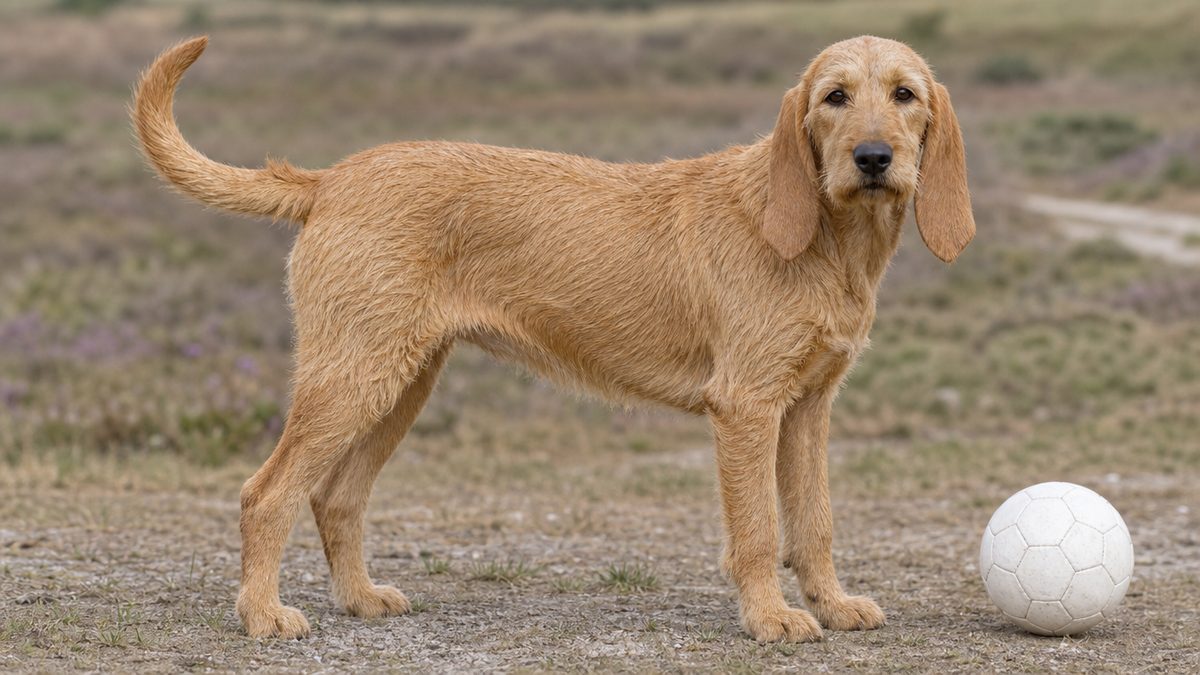
The Griffon Fauve de Bretagne is a medium French scent hound from Brittany, 48 to 56 cm at the withers in one solid fawn colour, carrying a very rough harsh coat and FCI Standard N 66. It is the middle member of a three-breed family, and the one English-language search most often mislabels.
Start with the register, because it settles the identity questions the ranking pages leave open. The FCI lists this breed as GRIFFON FAUVE DE BRETAGNE (66) (FAWN BRITTANY GRIFFON), in Group 6, Scent hounds and related breeds, Section 1.2 medium-sized hounds, under France, with a validity date of 3/25/2003 and both a CACIB and a working trial marked against it. The standard itself confirms the date on its own face: DATE OF PUBLICATION OF THE OFFICIAL VALID STANDARD: 25.03.2003, with the English translation dated 05.05.2003.
The FCI prints dates as month, day, year, and its own register proves the format: the provisional table carries rows reading 9/17/2024, 6/21/2022, 2/26/2020, 3/30/2022 and 4/29/2019, and 17, 21, 26, 30 and 29 cannot be months. So 3/25/2003 is 25 March 2003, and it matches the PDF.
The breed in the standard's own words
The FCI describes a bony and muscular dog, very resistant to weather and fatigue, and a quite active hound, particularly suitable to difficult terrain, with good scenting ability and the sustained voice of a chopper, meaning short and repeated notes. Its stated job is unambiguous: a scent hound used for hunting hare, fox, roe deer and wild boar.
- Head: rather long skull with a marked occipital protuberance, only a slightly marked stop, a black or dark brown nose, and a scissors bite in which absence of first premolars is not penalised.
- Ears: finely attached, in line with the eye, just reaching the end of the nose when drawn forward, ending in a point, turned inwards, and covered by finer and shorter hair than the rest of the body.
- Neck and skin: rather short and well muscled, with rather thick supple skin and absence of dewlap.
- Tail: carried slightly sickle-fashion, of medium length, large at the base, often bristly, and natural rather than docked.
- Feet: compact with tight arched toes and hard pads, and no dewclaws, which the standard disqualifies with the note that this breed is always free from them.
Which Fauve this is, in one paragraph
Three Fauve de Bretagne breeds are named in English-language sources and two exist in any register. This one is the medium one at 48 to 56 cm. The Basset Fauve de Bretagne is the short-legged derivative at 32 to 38 cm, carrying FCI Standard N 36. The Grand Fauve de Bretagne was the large wolf hound and is extinct, with no standard, no register entry and no dated year of extinction.
The FCI's own history clause treats this breed as the parent and the Basset as the derivative, describing the establishment since the 1980s of the griffon fauve de Bretagne (as well as the derived breed, the basset fauve de Bretagne). The UK Basset club agrees from the other direction, writing that the origin of the Basset Fauve must be sought in the much larger variety of Fauve.
On the India-localised pull for the term grand fauve de bretagne, three of the top ten results were pages about the Basset, including the second result, which is the American Kennel Club's Basset history article. On the pull for griffon fauve de bretagne, the AKC result that ranks is again a Basset page. English-language search does not reliably separate these three breeds, which is why this site gives each of them its own page and cross-links them explicitly.
Size and weight: what the standard says, and what the ranking pages add to it
FCI Standard N 66 gives one height range for both sexes, 48 to 56 cm with a 2 cm tolerance, and gives no weight at all. Both of those facts are routinely altered in transit, and the alterations are checkable against a four-page PDF anyone can download.
Here is the size clause verbatim: MALES and FEMALES: 48 cm minimum (19 inches), 56 cm maximum (22 inches), with a tolerance of 2 cm (0.8 inches) for exceptional specimens. One range. Both sexes. A stated tolerance.
| Source | Height | Weight |
|---|---|---|
| FCI Standard N 66 | 48 to 56 cm, males and females, tolerance 2 cm | No weight clause exists |
| UKC standard | 19 to 22 inches, both sexes, no tolerance | No weight clause exists |
| English Wikipedia | 48 to 56 cm, 19-22 ins, same for males and females | Not given |
| Wamiz, the top French ranking page | Female 48 to 54 cm, male 50 to 56 cm | 18 to 22 kg, both sexes |
Two separate things have happened to the standard on that last row. A single range has been split by sex, moving the female maximum down 2 cm and the male minimum up 2 cm, and a weight has been added that no standard for this breed contains. This is the same failure mode documented elsewhere on this site, where a secondary source tidies a standard into numbers that appear in no document.
The tolerance, which almost nobody carries
With its 2 cm tolerance, the FCI standard actually permits 46 to 58 cm for an exceptional specimen. Drop the tolerance and you have narrowed the breed by 4 cm without saying so. The UKC's range converts to 48.26 to 55.88 cm, which is materially the same window, but the UKC attaches no tolerance and makes Oversize or undersize an Eliminating Fault outright.
So a dog at 57 cm is a tolerable exceptional specimen under one standard and eliminated from competition under the other. That is a real difference between two registers describing one breed, and no ranking page mentions it.
Why the missing weight matters more than it looks
A weight clause is what stops a breed drifting heavier, and this breed has none in either standard. That is not unusual for French scent hounds, but it does mean any weight you read is somebody's estimate. For an Indian reader the point is practical rather than pedantic: heat risk scales with mass, and the one transferable finding from the largest heat-illness study is that dogs with bodyweight equal to or greater than the relative breed and sex mean had higher odds of heat-related illness, at an odds ratio of 1.42 with a 95 per cent confidence interval of 1.12 to 1.80. Without a standard weight there is no published breed mean to measure your dog against.
Colour is the one area where the standard and the secondary sources agree. The FCI gives fawn from golden wheaten to red brick, tolerates a few black hairs dispersed on the back and ears, and notes that a small white star on the chest occurs but is not sought after. The UKC gives any shade of fawn from golden to red with a white chest star tolerated. The Royal Kennel Club lists exactly four breed-standard colours: Fawn, Golden Fawn, Red and Red Fawn.
History: one continuous breed, or the survivor of an extinct one?
The FCI and the English-language literature tell two different origin stories for this breed, and neither is obviously wrong. The FCI describes one continuous fauve de Bretagne that declined and recovered; English sources describe a separate extinct Grand Fauve from which this breed was bred down.
Take the FCI's version first, because it is the recognising authority's own account. The fauve de Bretagne is one of the oldest French scent hound breeds and as early as the XIV century a gentleman by the name of Huet des Ventes had a pack of these dogs. Much used until the XIX century for wolf hunting in Brittany, it suffered a decline when these animals disappeared.
Read that clause carefully and notice what is absent from it: any separate Grand Fauve de Bretagne. The FCI treats the fauve de Bretagne as a single breed with a single history that dipped and recovered. The Royal Kennel Club tells the same story in the same shape: From the 14th century the Griffon Fauve was used for hunting wolves. As wolves died out, numbers of the breed declined but in 1949 a few dedicated enthusiasts revived interest in the breed.
The English-language version, and where it comes from
English sources describe a two-breed sequence instead. Wikipedia says Grand Fauve hounds had been crossed with Briquet Griffon Vendeens to create the Griffon Fauve de Bretagne, sourcing that to Clark and Brace 1995. The specialist article Old French Hounds says something related but not identical: that the Grand Fauve became extinct but the type was preserved in the Briquet Fauve, whose name was later changed to Griffon Fauve de Bretagne, and that the outcross a nineteenth-century breeder was advised to use was the Grand Griffon Vendeen, not the Briquet.
So there are three accounts of this breed's descent and they differ on the cross: a Briquet Griffon Vendeen cross, a Grand Griffon Vendeen cross, or no cross at all with a simple name change from Briquet Fauve. This page does not adjudicate between them. It reports that the FCI, which writes the standard, describes continuity, and that the two English accounts describe derivation and disagree with each other about the breed used.
The dates everyone agrees on
- 14th century: a pack kept by a gentleman named Huet des Ventes, per the FCI's own history clause.
- 1949: Marcel Pambrun founded the Club de Fauve de Bretagne, named in the FCI standard itself and echoed by the Royal Kennel Club's 1949 revival date The Royal Kennel Club.
- Since the 1980s: under the direction of Bernard Vallee, the griffon fauve de Bretagne and the derived basset has established a place among the French scent hound breeds.
- 1 January 1996: recognised by the United Kennel Club.
- 25 March 2003: the current FCI standard takes effect.
The club's motto, quoted in the standard, tells you what the breed has been selected for throughout: hunting first. That is a working breed maintained by working people, not a show breed, and it explains almost everything about its temperament and its exercise requirement.
Recognition status, register by register, each checked with a control
The Griffon Fauve de Bretagne is recognised by the FCI as Standard N 66, by the United Kennel Club since 1 January 1996, and by the Royal Kennel Club on its imported breed register. It is absent from the American Kennel Club's breed list, and that absence was verified rather than assumed.
Recognition is the question the orchestrating brief for this page was least reliable on, and the rule is to establish it from the register rather than from any summary. Each check below names its control.
| Register | Status | How it was checked |
|---|---|---|
| FCI, definitive | Recognised, Standard N 66, Group 6 Section 1.2, France, with CACIB and working trial | Read off the Group 6 register and the alphabetical index |
| FCI, provisional | Not on it, and correctly so, since it is on the definitive list | The provisional table carries 20 entries, none a Fauve |
| United Kennel Club | Recognised 1 January 1996, Scenthound Group, standard revised 1 July 2009 | Read off the UKC's own standard page |
| Royal Kennel Club | Listed as Griffon Fauve De Bretagne (Imp), Hound group, Breed Watch category 1 | Read off the RKC breed page |
| Societe Centrale Canine | Official French breed page, with breeder and puppy directories attached | Read off the SCC breed page |
| American Kennel Club | Absent from the breed list | The AKC's own complete breed dropdown, which contains four other Griffon-named breeds |
| Kennel Club of India | No breed list published for any breed, so no answer is obtainable | The KCI publishes no breed list, which is a broken instrument rather than a finding |
The AKC absence deserves its method spelled out, because a guessed URL can manufacture a false absence. A first attempt at the AKC's Foundation Stock Service page returned a 404 on an assembled URL, which proves only that the guess was wrong. The register's own navigation was then followed to the working page, and the AKC's complete breed list was read out of the AKC's own breed dropdown as reproduced inside its Basset Fauve history article.
That list contains the Basset Fauve de Bretagne, the Grand Basset Griffon Vendeen, the Petit Basset Griffon Vendeen, the Brussels Griffon and the Wirehaired Pointing Griffon. Four Griffon-named breeds present is a strong control. It does not contain the Griffon Fauve de Bretagne, and it does not contain the Grand Fauve de Bretagne either.
What FCI recognition means for an Indian owner
India is a full FCI member represented by the Kennel Club of India, based in Chennai, so the KCI issues pedigrees against FCI nomenclature. That is what makes the FCI answer the operative one for an Indian reader: a breed carrying FCI Standard N 66 is a breed for which an Indian pedigree route exists in principle, even where no dogs do in practice.
The KCI itself publishes no breed list for any breed, so querying it returns zero for this breed and zero for every control. That is a broken instrument, not evidence of non-recognition, and this page states the limit rather than reporting a false absence.
This is a genuinely rare breed outside France, and the registers show it in a specific way: recognised by three bodies, absent from a fourth, with no OFA statistics row and no place in the largest longevity study. Rarity is not obscurity. The breed has a national club dating to 1949, a current standard, a working trial attached to it in the FCI register, and a French breeder directory.
What the scientific record holds, and the search that hides it
The Griffon Fauve de Bretagne has no scientific literature of its own. The whole Fauve de Bretagne family has three records in PubMed, all three about the Basset, and reaching that number requires defeating a query rewrite that returns zero.
Search PubMed for the exact phrase and the answer is zero, and the zero is an artefact of the search rather than of the literature. The quoted query "Griffon Fauve de Bretagne" returns a count of 0, and PubMed's own translation line shows why: it rewrote the phrase to `("griffon" OR "griffons") AND "fauve" AND de bretagne[Author]`. It parsed de Bretagne as an author surname.
That the rewrite is wrong can be demonstrated in one step. The quoted query "Basset Fauve de Bretagne" also returns zero, yet PubMed record 26474315 is titled Two Independent Mutations in ADAMTS17 Are Associated with Primary Open Angle Glaucoma in the Basset Hound and Basset Fauve de Bretagne Breeds of Dog. The phrase sits in the title of a record PubMed itself indexes, and the search for that phrase returns nothing.
| Query | Count | What PubMed actually searched |
|---|---|---|
| "Griffon Fauve de Bretagne" | 0 | griffon OR griffons AND fauve AND de bretagne[Author] |
| "Basset Fauve de Bretagne" | 0 | basset AND fauve AND de bretagne[Author] |
| "Fauve de Bretagne" | 0 | fauve AND de bretagne[Author] |
| fauve[All Fields] AND bretagne[All Fields] | 3 | the query as written |
| Labrador Retriever hip dysplasia (control) | 126 | normal expansion, worked |
| Beagle glaucoma (control) | 128 | normal expansion, worked |
Both controls returned large, sane counts in the same session, so the database was working and only the breed phrases were rewritten. Remove the quotation marks and the entire literature appears: three records.
The three records, and what they are about
- PMID 26474315, Oliver and colleagues, PLoS ONE 2015, on ADAMTS17 and primary open angle glaucoma in the Basset Hound and the Basset Fauve de Bretagne.
- PMID 27192202, the 2016 Correction to that paper, replacing one figure.
- PMID 16420259, Leroy and colleagues 2006, on pedigree-based genetic variability in nine French dog breeds.
None of the three concerns the Griffon Fauve de Bretagne. The Leroy study is the clearest illustration: it names its nine breeds, and the Fauve among them is the Basset fauve de Bretagne, abbreviated BAF, with an effective number of ancestors of 40.2 for dogs born 1997 to 2001 and an average inbreeding coefficient of 3.9 per cent, respectively the highest and the second lowest of the nine breeds analysed. The Griffon was not studied.
So the honest statement is that this breed has no peer-reviewed literature at all, that its family's three papers concern its short-legged descendant, and that a page reporting a lifespan, a disease prevalence or a screening figure for the Griffon Fauve de Bretagne is reporting an estimate rather than a result.
Griffon Fauve de Bretagne price in India, and the one real price band that exists
There is no verified Griffon Fauve de Bretagne price in India, because no Indian market for the breed exists. The only published purchase band anywhere is French, at 500 to 1500 euros, and it is not convertible into an Indian offer because no lawful commercial import route exists.
Front-load the answer. Indian search returns no for-sale listing for this breed, no Indian breeder, and no rupee figure attached to a dog. What it returns instead is merchandise, auto-generated directory shells, and editorial pages about the Basset. One Indian pet retailer does name this breed in a scenthound directory, correctly giving its origin as France, which is an editorial mention rather than a supply signal.
The absence, and the control that makes it a finding
An absence is only evidence if the instrument works, so a control was run in the same session with the same tool. The query griffon fauve de bretagne puppy price India buy, localised to India, returned ten results: a French rescue post, an Indian pet-store scenthound directory entry, a puppy-name index, Etsy stickers, Dutch dog boarding, an eBay decal, a Walmart garden flag, a Czech judge's post, a US breed blog, and a French Royal Canin listing for a Basset. Not one was an Indian dog for sale.
The control, labrador retriever puppy price in india, run in the same tool in the same session, returned ten dense Indian pricing pages with rupee bands and city-by-city tables. So the instrument works for Indian dog pricing, and the zero for this breed is a real result rather than a broken query.
The French price band, quoted as printed
France is where this breed actually trades, and the top-ranking French page gives a purchase band: le Griffon fauve de Bretagne coute entre 500 euros et 1500 euros. That is the only published purchase price band this page could find for the breed in any country. It is a European price for a European dog, and it is offered here as context rather than as anything convertible.
| Figure | What it is |
|---|---|
| Rs 400 or more | A dog leash on an auto-generated Justdial pet-shop page |
| Rs 1,000 or more | A dog accessory on the same template |
| Rs 799, offered at Rs 120 | An 18 inch wall sticker of a dog's face |
| No figure at all | Any actual Griffon Fauve de Bretagne, anywhere in India |
The Justdial pattern is worth naming because it is the commonest source of a false Indian price signal. Pet Shops For Basset Fauve De Bretagne Dog appears as a navigation link on Justdial's German Shepherd pages in Balasore and in Dehradun, cities more than 1,500 km apart, with identical accessory pricing. A page that exists identically for every breed in every city is a template, not a market.
Bonbeno could produce an Indian-looking number in one line by converting the French band at some exchange rate. It would be fabrication with arithmetic attached, because no seller in India is offering this dog at that price or any price. The next section runs the division tests anyway, so that a reader shown a rupee figure elsewhere can check it themselves.
The currency tests, and the quotient that gives a converted list away
Divide any rupee price you are shown by 84.38, by 74 and by 66.67, and look at the quotient rather than at whether it divided. A converted list leaves a quotient a real shop would print; an invented rupee figure leaves one nobody would.
Indian breed pages routinely publish a foreign figure run through one exchange rate. Three rates recur on this site's audits, and the discipline is to print the quotient every time.
Test one: the rupee figures that do exist for this name
| Rupee figure | / 84.38 | / 74 | / 66.67 |
|---|---|---|---|
| Rs 799, wall sticker list price | 9.47 | 10.80 | 11.98 |
| Rs 120, wall sticker offer price | 1.42 | 1.62 | 1.80 |
| Rs 400, leash | 4.74 | 5.41 | 6.00 |
| Rs 1,000, accessory | 11.85 | 13.51 | 15.00 |
Every quotient there is a price for a sticker or a leash, which is what those objects are. The test returns nothing because there is nothing to find, and that is the correct outcome when the figures are rupee-native prices for rupee-native goods.
Test two: what a converted Indian page would print
Run the arithmetic forward and you get the numbers to be suspicious of. Using the three published US dollar bands for the family's living, tradeable member, the Basset, a converted Indian page would land on these:
| US price | At 84.38 | At 74 | At 66.67 |
|---|---|---|---|
| USD 1,000 | Rs 84,380 | Rs 74,000 | Rs 66,670 |
| USD 1,200 | Rs 101,256 | Rs 88,800 | Rs 80,004 |
| USD 1,500 | Rs 126,570 | Rs 111,000 | Rs 100,005 |
| USD 2,500 | Rs 210,950 | Rs 185,000 | Rs 166,675 |
| USD 3,500 | Rs 295,330 | Rs 259,000 | Rs 233,345 |
Rs 74,000 is the single figure to distrust most. One thousand US dollars at 74 lands exactly on it, and that same rupee value has been documented on this site appearing against nineteen unrelated breeds in one Indian price table. A Fauve de Bretagne priced at Rs 74,000 anywhere is a thousand dollars wearing a rupee sign.
Why 66.67 must never be run on its own
66.67 is 200 divided by 3, so any rupee figure ending in three zeros divides by it to within five hundredths of a whole number, by construction rather than by evidence.
- Rs 1,000 gives 14.9993 at 66.67, against 11.8511 at 84.38 and 13.5135 at 74.
- Rs 5,000 gives 74.9963 at 66.67, against 59.2557 and 67.5676.
- Rs 20,000 gives 299.9850 at 66.67, against 237.0230 and 270.2703.
- Rs 1,00,000 gives 1499.9250 at 66.67, against 1185.1150 and 1351.3514.
That is the same structural weakness that makes a flat rate of 80 useless on its own, where 1,000 divided by 80 is 12.5 and every multiple of a thousand passes. 84.38 is the strong test. Treat a hit at 66.67 or 80 as evidence only when the quotient is also a figure a human would quote, and say so on the page when it is the only rate that matches.
The 500 to 1500 euro band is not a rupee figure, and dividing it as though it were confirms that: 500 divided by 84.38 is 5.93, by 74 is 6.76, and by 66.67 is 7.50, none of which is a price for anything. The test is included so the method is visible on every figure this page touches, not only the convenient ones.
What a 20 to 25 kg scent hound costs to keep in India each month
Budget roughly Rs 3,500 to Rs 6,500 a month for food and parasite control for a hound of this size in an Indian city, before veterinary care. Every figure below was read off a live Indian page, and the two inputs that could not be sourced are marked as gaps rather than filled.
The cost of ownership arithmetic is the part of this page that transfers to any medium hound, so it is shown rather than summarised.
| Product | Pack | Price | Rs per kg |
|---|---|---|---|
| Drools Chicken and Egg Adult | 20 kg | Rs 3,041 | 152.05 |
| Pedigree Chicken and Vegetables Adult | 20 kg | Rs 3,300 | 165.00 |
| Pedigree Chicken and Vegetables Adult | 15 kg | Rs 2,584 | 172.27 |
| Pedigree Chicken and Vegetables Adult | 10 kg | Rs 2,016 | 201.60 |
Buying the 20 kg pack instead of the 10 kg cuts the cost per kilogram by about 18 per cent. The same 10 kg pack also sells at Rs 2,437 on a different Indian retailer on the same day, a 21 per cent spread, and the two sites print different maximum retail prices for it.
Parasite control, the line item that is not optional
Tick and flea cover for a dog in this weight band has a clean published price. Bravecto 1000 mg fluralaner, one tablet covering 20 to 40 kg, costs Rs 1,805 and lasts 12 weeks, which is about Rs 602 a month, and it requires a prescription.
The exposure justifying it is real. A 2025 survey across 28 villages in the Western Ghats examined 2,877 domestic animals and reported tick prevalence in dogs of 42.60 per cent, with a 95 per cent confidence interval of 30.33 to 55.84, on a dog arm of only 54 animals, with Rhipicephalus sanguineus the dominant species. Quote that only with its confidence interval and its n, because a 25-point interval on 54 dogs is wide.
Veterinary care, where the public and private prices differ enormously
| Item | Government, Chandigarh | Private, Vetic Delhi |
|---|---|---|
| Consultation or outdoor ticket for a pet | Rs 30 | No rupee figure published |
| Anti-rabies vaccination | Rs 30 | From Rs 699 |
| Nine-in-one DHPPiL | Not listed | From Rs 899 |
| Kennel cough | Not listed | From Rs 1,349 |
| Adult annual booster package | Not listed | From Rs 3,199 |
| Minor operation | Rs 50 | Not listed |
| Major operation | Rs 100 | Not listed |
Both columns are current and both are real. A government veterinary institution charges Rs 30 for an anti-rabies shot and Rs 30 for the consultation ticket; a private chain in Delhi starts at Rs 699 for the same vaccine Vetic, dog vaccination prices, Delhi. For a working hound needing regular care, that difference compounds.
No Indian retailer and no brand page publishes a grams-per-day feeding chart for adult dry food in machine-readable text; the chart exists only inside product photographs. And the private chain's own consultation page, headed Most Affordable Pet Consultations In Delhi, carries no rupee figure at all, which was confirmed as a genuine absence because the same tool in the same session rendered a full price list on that chain's vaccination page. So this page prices food per kilogram rather than per month, and quotes the government consultation fee rather than a private one.
Can a Griffon Fauve de Bretagne handle the Indian climate? The heat maths
A Griffon Fauve de Bretagne would struggle in Indian heat, and its own French sources say so. Its homeland averages 11.62 degrees Celsius across the year against Chennai's 27.95, and the top French breed page states plainly that the breed is not equipped for very high temperatures.
Climate figures here come from NASA POWER queried by explicit latitude and longitude rather than by place name, because a name-based lookup can silently return a different city. Brittany is sampled at Rennes, 48.1113 N and 1.6778 W.
| Location | Annual mean temp, C | Annual mean RH, % | Warmest month mean, C |
|---|---|---|---|
| Rennes, Brittany | 11.62 | 82.54 | 18.71 in July |
| Chennai | 27.95 | 72.39 | 31.51 in May |
| Delhi | 25.60 | 45.56 | 35.88 in June |
| Mumbai | 26.77 | 67.39 | 31.19 in May |
| Bengaluru | 23.74 | 67.94 | 26.97 in May |
Chennai's annual mean of 27.95 degrees is 9.24 degrees hotter than the hottest month Brittany ever averages. A dog from a place whose warmest month sits at 18.71 would spend every day of an Indian year above the top of its native range. Delhi's June mean of 35.88 is 17.17 degrees above Brittany's July.
What the breed's own sources say about heat
The heat tolerance answer does not have to be inferred, because a French source states it. The top-ranking French page says under its health section that the breed's activities must be adjusted during a heatwave because it is not armed to withstand very high temperatures, while noting that it generally lives outdoors and does not much fear the cold. The same page describes the breed as rustic and therefore particularly robust, which is a claim about hardiness in its own climate, not about heat.
The FCI standard calls the dog very resistant to weather and fatigue without specifying which weather, in a document written in and for France. The Royal Kennel Club places it in country rather than town. Nobody in the primary literature claims heat adaptation.
Why Hall's odds ratios cannot be quoted for this breed
The two 2020 studies on the same 905,543-dog UK cohort are the best canine heat evidence available, and neither modelled this breed. Hall 2020 in Scientific Reports found 395 confirmed heat-related illness events, an incidence of 0.04 per cent and a case fatality rate of 14.18 per cent. Hall 2020 in Animals found 1,259 events from 1,222 dogs, of which 879 had a recorded trigger.
Both papers required at least five heat-illness cases and at least 5,000 dogs before modelling a breed separately, and neither contains the strings Fauve, Bretagne, Griffon or Basset anywhere. The only hound breeds named in either are the Greyhound and the Beagle. So this page claims only the transferable within-breed finding, that dogs at or above their breed and sex mean bodyweight carried an odds ratio of 1.42, and states that the Griffon Fauve de Bretagne was absorbed into an other purebred category and never modelled.
Of the 879 heat-illness events with a recorded trigger, 652 were exertional, which is 74.2 per cent, against 113 environmental and 46 from vehicular confinement. Quote it as 652 of the 879 events with a recorded trigger, never as 74.2 per cent of 1,259, because 74.2 per cent of 1,259 is 934. For a hound bred to work all day, the practical translation is that the walk is the danger, not the parked car.
The humidity finding that reverses the usual assumption
Brittany is more humid than Chennai, not less. Rennes averages 82.54 per cent relative humidity across the year against Chennai's 72.39, so what changes for this breed in India is heat alone, and the coat argument has to be made carefully.
The instinctive assumption about a European hound in India is that the damp is the shock. For this breed it is wrong by 10.15 percentage points in the opposite direction NASA POWER climatology by latitude….
| Location | Annual mean RH, % | Difference from Rennes |
|---|---|---|
| Rennes, Brittany | 82.54 | - |
| Chennai | 72.39 | 10.15 points drier |
| Bengaluru | 67.94 | 14.60 points drier |
| Mumbai | 67.39 | 15.15 points drier |
| Delhi | 45.56 | 36.98 points drier |
Brittany's winter is wetter still, at 92.12 per cent in January and 92.61 in December. A cool, saturated Atlantic climate is exactly the environment a harsh coat on a bramble-working hound is for.
What actually changes, stated precisely
The variable that changes is heat, and a humid Indian summer combines moisture the breed knows with temperatures it does not. Chennai in May averages 31.51 degrees at about 72 per cent humidity; Rennes in July averages 18.71 at about 74 per cent NASA POWER climatology by latitude…. Similar air moisture, nearly 13 degrees apart, and high humidity is what limits evaporative cooling by panting.
- Chennai and Mumbai are the closest match on humidity and the worst on heat, which is the combination that most restricts a panting dog.
- Delhi is hard in the other direction, 13.98 degrees hotter and 36.98 points drier, with a climatological maximum of 48.79 degrees.
- Bengaluru is the mildest listed city at 23.74 degrees annual mean, and the only one whose warmest month comes within 8.3 degrees of Brittany's July.
- No Indian city listed here has an annual mean below 23.74 degrees, against Brittany's 11.62.
So the climate verdict is narrower and firmer than the usual one. The problem is not damp, because Brittany is damper. The problem is that every month of an Indian year sits above the warmest month this breed was built for, and the heat-illness literature puts the risk squarely on the period of work.
Temperament and the household this breed actually suits
The Griffon Fauve de Bretagne is sociable and affectionate with people and relentless with quarry, and both registers say so in almost the same words. The household it suits has a garden, a securely fenced boundary and tolerance for noise.
Two independent standards describe the same dog. The FCI says Fauves de Bretagne are impassioned hunters but are good natured with people, sociable, affectionate and equable, and adds that in the field they are courageous, wily, tenacious and steady and, when well conducted, obedient and return readily. The UKC compresses it to Enterprising and efficient hunters, but also sociable, equable and affectionate with people.
Timidity is a severe fault under the FCI standard, and aggressive or overly shy dogs are disqualified. So the breed is selected for confidence, not for edge.
The three traits that decide whether it fits your home
- It is very vocal. The French source says it barks enormously when working and attributes it to the pack effect. The standard itself describes the sustained voice of a chopper, short repeated notes, as a breed characteristic rather than a nuisance.
- It runs. The same source rates the breed very prone to running off, because a highly developed hunting instinct takes it onto a trail if the boundary is not secure.
- It is genuinely good with children and other dogs. The French page describes particular attachment to children and great patience with them, and very high compatibility with other dogs from being raised in packs.
The contradiction in the ranking pages, and how to read it
One widely-read page rates this breed very recommended as a first dog and, two screens earlier under education, says a puppy must be taken in hand early and by experienced hands to become the pleasant dog it claims to be. Both cannot be true as written.
The resolution is probably in the same page's own qualifier, that it is a good first dog notably for a young hunter wanting to build a working pack. That is a specific reader, not a general one. For an Indian household, a vocal, escape-prone, independent working scent hound is not a beginner's dog, and the Royal Kennel Club's placement of the breed in country rather than town says the same thing more quietly.
The French page is unambiguous where the English ones hedge: it is better for the breed to live in the country than in a town, and in any case apartment life absolutely does not suit it. For an Indian buyer in a metro flat that is the single most decision-relevant sentence written about this breed anywhere.
Training a Griffon Fauve de Bretagne, and the one thing it will resist
Train recall first and everything else afterwards, because the standard describes a hound that harks in when well conducted and the breed's own French sources describe one that runs off when it is not. Independence, not stubbornness, is what you are working with.
The FCI standard sets the training target explicitly: the dogs show themselves equally capable of harking in, and when well conducted, they are obedient and return readily. Harking in means coming back to the pack when called off a line. That is the behaviour the breed is selected for, and it is the behaviour that fails first without work.
The French sources describe the same dog from the owner's side. It is very independent, described as resourceful by nature and needing to be well conducted if you want a receptive and obedient animal, and very prone to running off because a highly developed hunting instinct takes it onto a trail if the environment is not secured.
What works, in the order it matters
- Start recall on a long line from week one and never let the dog rehearse a successful self-release. A scent hound that learns it can leave has learned the wrong lesson permanently.
- Use food. The French source describes the breed as rather greedy and says treats are a very good way to motivate a dog that is sometimes stubborn and obstinate.
- Socialise early and widely. In an Indian city that means traffic, street dogs, cattle, goats and crowds inside the first sixteen weeks, because a confident hound is the standard's own requirement and timidity is a severe fault.
- Train the voice, not against it. The sustained chopping voice is a breed characteristic in the standard, so the realistic goal is a quiet default at home, not silence.
- Secure the boundary before you train the recall, because no recall survives a fence a determined hound can leave.
What Indian law adds to the training question
One training-adjacent area is legally constrained in India and worth knowing. Second Schedule Part II paragraph 6(8) of the Dog Breeding and Marketing Rules 2017 forbids de-barking outright, along with tail docking, ear cropping, de-clawing, branding, dyeing and any change of appearance by artificial means. For a breed this vocal, that closes a route some owners of noisy dogs ask about, and it closes it correctly.
Write Second Schedule Part II paragraph 6(8), not Rule 6(8). The Rules' own Rule 6 is a different provision headed Requirements to be met by breeders and establishments, and its job is to make the Second Schedule binding. Rule 8(1)(a), the eight-week minimum sale age, genuinely is a Rule.
Daily exercise requirement, and what the ranking pages disagree about
Plan on at least an hour of real exercise a day, and treat that as a floor rather than a target. The Royal Kennel Club rates the breed at up to one hour per day, while the French sources describe a working dog needing daily physical, mental and olfactory stimulation.
The two published figures do not conflict so much as describe different readers. The Royal Kennel Club, writing for a UK pet home, gives up to 1 hour per day and marks the breed as suited to country rather than town, with a small or medium garden. The French source, writing closer to the working population, says it is above all a working dog that needs to be stimulated physically, mentally and olfactorily every day to be right in itself.
The standard sits behind both: a bony and muscular dog, very resistant to weather and fatigue, and a quite active hound, particularly suitable to difficult terrain. Resistance to fatigue describes an animal built to work a full day, and the FCI attaches a working trial to this breed in its register.
How to schedule it in an Indian city
Exercise is where the heat risk lands, and that is evidence rather than caution. Of the 879 heat-illness events with a recorded trigger in the larger Hall study, 652 were exertional, which is 74.2 per cent. So the scheduling advice is not generic.
- Work the dog before sunrise and after dark in any month where the daily mean exceeds the mid-twenties, which in Chennai is every month of the year.
- Substitute scent work for distance in summer. A hound bred for nose work gets more out of thirty minutes of tracking in shade than an hour of road walking in sun.
- Carry water and stop early. Heat-related illness in the study cohort had an event fatality rate of 14.18 per cent, so it is not a minor event.
- Never exercise straight after a meal, and split the ration so the larger part falls at night in summer.
The uncomfortable conclusion for an Indian reader is that the exercise requirement and the climate ceiling point in opposite directions for this breed. A dog needing an hour of daily work in a city averaging 27.95 degrees has a narrow window in which that work is safe, and the window closes further in May and June.
Grooming the harsh coat, and the drying instruction that does not travel
Brush a Griffon Fauve de Bretagne once a week and dry its ears deliberately after every wetting. The coat is the lowest-maintenance jacket a working hound can carry, and the ears are where Indian humidity does its damage.
The standard describes what you are grooming: coat very rough, harsh, rather short, never woolly or curly, with the note that the face shouldn't be too bushy. Sparse, smooth, fine or soft coat is a severe fault, and a long woolly coat is a disqualifying one. The UKC repeats the same language. The Royal Kennel Club rates grooming at once a week with a medium coat length and confirms the breed sheds.
One ranking page describes the coat in prose as long, harsh and smooth while its own icons on the same screen say short and hard. Trust the standard: short, harsh, rough, never smooth.
The care instruction written for Brittany that fails in India
Overseas guidance assumes an origin climate averaging 11.62 degrees, where a towelled dog left to air dry is fine. In an Indian monsoon a damp ear canal on a drop-eared hound is how otitis externa starts, and the Indian evidence on that is substantial enough to have its own section below.
- Dry inside the ear flap after every bath, swim and heavy rain, rather than letting it air dry.
- Brush weekly with a bristle or slicker brush. A short harsh coat needs nothing more.
- Never clip or shave the coat to cope with heat. A harsh working jacket does not regrow with the same texture, and it is the layer shading the skin.
- Check between the toes and under the elbows through the monsoon, where damp sits longest on a low-slung hound.
The hypoallergenic claim, settled
This breed is not hypoallergenic, and no breed is. Vredegoor and colleagues measured the major dog allergen Can f 1 across 196 dogs of so-called hypoallergenic breeds against 160 control dogs and found the hypoallergenic group higher, not lower, on both measures: hair 2.26 against 0.77 micrograms per gram and coat 27.04 against 12.98, with no difference in airborne allergen. Their conclusion is that there is no evidence for the classification of certain dog breeds as being hypoallergenic. The Royal Kennel Club's own entry for this breed simply records Sheds: Yes.
Health, lifespan, and the screening vacuum nobody names
The Griffon Fauve de Bretagne has no breed-specific health screening scheme, no validated DNA test, no row in the OFA statistics and no place in the largest UK longevity study. Its published life expectancy of 12 to 14 years rests on breed-club estimate rather than on a cohort.
This is the part of the breed that every ranking page states confidently and nobody sources. The most common sentence, in one form or another, is that the breed has no particular health problems. The French page says exactly that: la race ne connait pas de problemes de sante particuliers. English Wikipedia says the same more carefully: No unusual health problems or claims of extraordinary health have been documented for this breed.
Wikipedia's phrasing is the honest one, and the difference matters. Nothing documented is not the same as nothing there. For a breed with no screening scheme and no registry dataset, an absence of documented disease is an absence of documentation.
Four databases, four absences, each with a control
| Source | Result for this breed | Control in the same session |
|---|---|---|
| OFA disease statistics tables | No row. GRIFFON FAUVE appears zero times in the full dump | Four other Griffon breeds present, plus 21 rows for the Basset Fauve |
| McMillan 2024 survival analysis | Listed and marked N, explicitly excluded | PBGV, Basset Hound, Brussels Griffon and Brittany all included |
| PubMed | Nothing. The family's whole corpus is three records, all about the Basset | Labrador hip dysplasia 126, Beagle glaucoma 128 |
| Royal Kennel Club DNA testing services | No breed-specific DNA testing package offered | The RKC does list the breed and does publish its health page |
The OFA absence is a genuine finding rather than a failed search. The full statistics dump runs to about 2.2 million characters and contains the string FAUVE 21 times, every one of them BASSET FAUVE DE BRETAGNE, alongside four other Griffon-named breeds. OFA publishes a breed only once it has 100 hip evaluations, or 50 for its other databases, so the correct phrasing is that this breed has no row in OFA's published statistics tables, not that it is absent from the OFA database.
What the Royal Kennel Club actually recommends, which is almost nothing
The Royal Kennel Club's pre-breeding health screening section for this breed lists exactly one good-practice item, and it is not a disease test. It is prioritising genetic diversity. Under DNA testing services it says plainly that we don't currently offer a breed-specific DNA testing package for this breed. Its Breed Watch category is 1, meaning no points of concern specific to this breed have been identified for special attention by judges, and it records the breed as not a vulnerable native breed, which is expected for an imported breed.
So the entire official screening programme for this dog is: manage inbreeding. That is a defensible position for a small population, and it is very different from what a buyer assumes when a page says the breed is healthy.
Lifespan, and why no cohort figure exists
Published life expectancy figures for this breed are estimates. The Royal Kennel Club gives over 10 years; the French page gives 12 to 14 years and an average of about 13 Wamiz (France), Griffon fauve de Bretagne. Neither is derived from a mortality cohort.
The reason is checkable. McMillan 2024, the largest UK canine longevity study, lists Griffon Fauve De Bretagne (Fawn Brittany Griffon) in its supplementary breed table and marks it N for inclusion in the survival analysis, with its phylogeny reclassification left as NA. Relatives that did make the cut have real numbers to compare against.
| Breed | Deaths | Median survival, years | 95% CI |
|---|---|---|---|
| Petite Basset Griffon Vendeen | 148 | 13.7 | 13.2 to 14.0 |
| Basset Hound | 883 | 12.5 | 12.2 to 12.7 |
| Brussels Griffon | 102 | 13.3 | 12.7 to 13.9 |
| Brittany | 734 | 11.1 | 10.9 to 11.3 |
| Griffon Fauve de Bretagne | Excluded | No estimate | None |
McMillan 2024's supplementary tables S3 and S6 disagree on the sample-size column for the same breeds, while the death counts agree exactly across both. Build any sentence on the death count and the median with its confidence interval, and never silently pick one N. This page quotes deaths and medians only.
The one DNA test in this family, and why it is not this breed's test
The Fauve de Bretagne family has exactly one validated DNA test, for primary open angle glaucoma, and it was developed in the Basset Fauve de Bretagne. The Griffon appears nowhere in that research, so the test cannot be assumed to apply to it in either direction.
Oliver and colleagues investigated ADAMTS17 as a candidate gene for primary open angle glaucoma in two breeds. Their method was to resequence the gene in three affected Basset Hounds and three affected Basset Fauve de Bretagne dogs, then genotype larger cohorts.
The findings are specific. All affected Basset Fauve de Bretagne dogs were homozygous for a missense mutation in exon 11 causing a glycine to serine substitution at position 519 in the disintegrin-like domain of ADAMTS17. Of 24 unaffected Basset Fauves genotyped, 5 were heterozygous and 19 were homozygous for the wild type allele, which sums correctly to 24. In the Basset Hound the mutation was different, a 19 base-pair deletion in exon 2, with an association statistic of p = 1.26 x 10 to the minus 10 and a mutation frequency of 0.081 across 223 dogs.
The study's ophthalmic cohort was 226 Basset Hounds and 27 Basset Fauve de Bretagne dogs, and the phrase Griffon Fauve appears in the paper zero times. The Griffon Fauve de Bretagne was not sampled, not genotyped and not mentioned.
What that does and does not license
- It does not license attributing the mutation to this breed. Importing a finding into a population the authors never sampled is fabrication with a citation attached, whatever the family relationship.
- It does not license declaring the breed clear either. Nobody has looked, so an absence of reported cases is an absence of testing.
- It does license a clinical recommendation, which is that an owner of any Fauve de Bretagne should have the eyes examined by a veterinary ophthalmologist rather than relying on a test that has not been validated for their dog.
- It does license naming the gap, which no ranking page for this breed does.
Note also that the paper carries a Correction, published 18 May 2016, which replaces one figure showing the electropherograms at the mutation site and changes nothing in the results. Reading the original tables directly avoids the issue entirely.
The Indian legal angle, which cuts the other way
Indian law requires genetic-defect testing before breeding, and the list it gives does not include the one condition this family is known for. Second Schedule Part III paragraph 8(10) requires that dogs shall have been tested for genetic defects, including hip dysplasia, progressive retinal atrophy, night blindness, hypothyroidism, entropion, ectropion, overshot and undershot jaw, wry mouth, two or more missing teeth, and cryptorchidism.
Searching the whole gazette returns glaucoma zero times, patella zero, BAER zero and deaf zero, while hip dysplasia and progressive retinal each appear once as controls proving the search worked. So there is no Indian patella requirement and no Indian hearing requirement, and glaucoma is not named. The clause says including, which makes the list illustrative rather than closed, so a breeder could not argue that an unlisted defect is outside it.
The only pre-breeding item the Royal Kennel Club recommends for this breed is prioritising genetic diversity, and that is the right emphasis for a small imported population. For context on what pedigree analysis can show in this family, the one French study that includes a Fauve found the Basset Fauve de Bretagne had the highest effective number of ancestors of nine French breeds, 40.2 for dogs born 1997 to 2001, and an average inbreeding coefficient of 3.9 per cent, the second lowest of the nine. The Griffon was not among the nine breeds studied.
The Indian health risk that would actually bite: ears, and three studies that disagree
Ear disease is the condition a drop-eared hound in India is most likely to meet, and the Indian evidence on when it peaks is genuinely unsettled. Three published Indian series give three answers, and this page prints all three rather than choosing one.
The ear this breed carries is not a heavy pendulous flap. The standard describes ears finely attached, in line with the eye, just reaching the end of the nose when drawn forward, ending in a point, turned inwards and covered by finer and shorter hair than on the rest of the body. That is a lighter, better-ventilated ear than a Basset Hound's, and it is one of the few structural advantages this breed has in a humid climate. It is still a drop ear.
| Study | Location and window | Screened, cases | Seasonal finding |
|---|---|---|---|
| Nainika and Sharma | Palampur, Himachal Pradesh, June 2022 to July 2023 | 2,476 screened, 81 cases, 3.27% | Rainy July to August, 48 cases, 59.25% |
| Roy, Kashyap and Roy 2018 | Durg, Chhattisgarh, July 2016 to June 2017 | 281 screened, 51 cases, 18.14% | Summer 21 cases, 41.18%, against rainy 33.33% |
| Singh and colleagues 2024 | Jabalpur, Madhya Pradesh, May to October 2022 | 651 screened, 92 cases, 14.13% | Monsoon 16.46%, not statistically significant |
Two peak in the monsoon and one peaks in summer, and the third one's monsoon peak is not statistically significant, at a chi-squared of 1.822 with p greater than 0.05 Roy M, Kashyap R, Roy S. Every arithmetic check reproduces: 81 of 2,476 is 3.27 per cent, 48 of 81 is 59.25, 51 of 281 is 18.14, 21 of 51 is 41.18, and 40 of 243 is 16.46. So the honest Indian answer is regional variation rather than a settled monsoon rule.
Two cautions on the figure that travels furthest
The Palampur 59.25 per cent is the number most quoted, and two things should travel with it. Its window runs 14 months, from June 2022 to July 2023, so June and July are each sampled twice while every other month is sampled once, and July is counted as rainy. And its rainy season is defined as two months against a winter of four, so the percentage rests on unequal seasons. Neither point is flagged in the paper.
Its ear-carriage table also fails arithmetic, and only the sound half is quoted here. It prints Pendulous ear breed 53, 69.13 per cent and Erect 25, 30.86 per cent. But 53 of 81 is 65.43 per cent, and 53 plus 25 is 78 rather than 81, whereas 56 of 81 is 69.14 per cent and 56 plus 25 balances at 81. The count 53 is the error and the percentage is sound, so quote 69.13 and 30.86 per cent, or 56 and 25 of 81, and never the printed 53.
What to actually do about it
- Dry the ear canal after every bath, swim and soaking, which is where the imported grooming advice fails.
- Look inside the ear weekly rather than waiting for a smell or a head-shake.
- Treat a head-shake as a reason to see a veterinarian, not a reason to buy a drop over the counter.
- Do not assume your city follows the monsoon pattern. Durg's peak was in summer, and the local pattern is what matters.
Beyond ears, the Indian risk profile for any medium hound is dominated by ticks. Western Ghats surveillance reported tick prevalence in dogs of 42.60 per cent, 95 per cent confidence interval 30.33 to 55.84, on 54 dogs, with Rhipicephalus sanguineus dominant. That is the justification for the parasite line in the cost section.
Feeding a working scent hound in India, and the ration nobody publishes
Feed a Griffon Fauve de Bretagne by body condition rather than by a printed cup count, because neither breed standard gives a weight and no Indian retailer publishes a machine-readable feeding chart. What can be priced is the food, at Rs 152 to Rs 165 per kilogram in 20 kg packs.
Start with why a gram figure is not offered here. Neither the FCI nor the UKC standard contains a weight clause for this breed, so there is no published breed mean to size a ration against. The commonly quoted 18 to 22 kg comes from a secondary source and appears in no standard. And no Indian retailer or brand page publishes a grams-per-day chart in text; the chart exists only inside product photographs.
What is solid is the shape of the requirement. This is a hardy working hound the FCI calls very resistant to weather and fatigue, with a high maintenance energy demand in its working season and a much lower one at rest. The French source rates its tendency to gain weight as low, on the basis that its daily activity should prevent it, which is a claim about a working dog rather than about a city pet.
Four things that change when you feed this dog in India
- Shift the larger meal to the night in summer. Digestion generates heat, and in a city averaging 27.95 degrees the middle of the day is the worst moment to add any.
- Never feed immediately before or after exercise. With 74.2 per cent of recorded-trigger heat events being exertional, the working period is already the risk window.
- Buy the 20 kg pack if you have dry storage, which is roughly 18 per cent cheaper per kilogram than the 10 kg.
- Store the sack against humidity. Even Bengaluru, the mildest city on this page's list, averages 67.94 per cent relative humidity across the year.
Ask a veterinarian to set the ration against your own dog's body condition score and re-check it every six weeks. For a breed with no standard weight, no cohort data and a workload that swings seasonally, that is the only honest instruction this page can give.
The first year, month by month, under Indian rules
The first year of any Griffon Fauve de Bretagne puppy in India is governed by two things: the socialisation window, which closes at about sixteen weeks, and Indian breeding law, which fixes several dates outright. Breed-specific developmental data does not exist, so this timeline uses what is checkable.
| Age | What applies | Source |
|---|---|---|
| Under 8 weeks | The pup may not lawfully be sold in India at all | Rule 8(1)(a) |
| 3 to 16 weeks | The socialisation window, when traffic, livestock, street dogs and strangers become ordinary | General canine development |
| Any age | No tail docking, ear cropping, de-barking, de-clawing, branding or dyeing | Second Schedule Part II para 6(8) |
| From week 1 at home | Recall on a long line, before the hunting instinct outruns it | The breed's own standard on harking in |
| Before any breeding | Testing for a listed set of genetic defects | Second Schedule Part III para 8(10) |
| Before any mating | In-breeding within four generations and incest breeding are prohibited | Second Schedule Part II para 6(3) |
The socialisation window is the part that matters most for this breed specifically. The FCI standard makes timidity a severe fault and disqualifies overly shy dogs, so a confident adult is the breed's own requirement rather than a nice-to-have. In an Indian city, building that confidence means deliberate, positive exposure to cattle, goats, poultry, free-roaming dogs, autorickshaws and crowds inside those sixteen weeks.
The two habits to build before the dog is strong enough to test them
Recall and boundary tolerance are both far easier to build at four months than at fourteen. The French source rates the breed very prone to running off, and the standard's own praise for harking in tells you the behaviour is trainable rather than absent. A hound that has never successfully self-released is a very different animal from one that has.
Ear care is the second habit, and it should start before there is anything wrong. Handle the ears daily from the first week home so that inspection and drying are routine rather than a fight, because the Indian otitis evidence makes this the single most likely recurring problem the dog will have.
Write Second Schedule Part III paragraph 8(10), not Rule 8(10), when discussing genetic-defect testing. Rule 8 of the main Rules is a different provision headed Conditions for sale, and its sub-clause 8(1)(a) is the eight-week minimum. Confusing the two has caused at least one published page to report a real requirement as absent.
What Indian law says about importing or breeding this dog
Indian law permits this breed in only as a relocating family's own pet and rejects any commercial import outright. Two separate instruments apply and they are frequently conflated, so this section keeps them apart.
Dogs sit at ITC(HS) 01061900 and are Restricted. DGFT Trade Notice 22/2022-23 of 19 December 2022 sets the terms. Policy Condition 7 permits import only for a pet dog with a valid pet book and relevant records in the importer's own name, for research organisations with CPCSEA recommendation, and for internal security by the Defence and Police Force. Policy Condition 8 states that import of commercial dogs for breeding or any other commercial activity other than those purposes is not permitted.
Paragraph 6 of the notice is blunter: any applications for trading or breeding purposes, or applications made on behalf of some another person or entity, shall be duly rejected. Paragraph 7 limits entry to six named places: import of pet animals is allowed only through airports and seaports of Delhi, Mumbai, Chennai, Hyderabad, Bangalore and Kolkata, with quarantine at the government station of those ports where required. DAHD added a seventh port, Cochin International Airport at Kochi, for pets arriving under the baggage rules in October 2024. The full route is set out in how to import a dog to India.
That is the whole answer to why this breed has no Indian market. It is not that nobody wants a French scent hound. It is that the only lawful route is a family already abroad relocating with its own dog, which cannot scale into a supply chain by design.
The six ports above belong to the DGFT commercial and restricted route under ITC(HS) 01061900. Personal pet import under baggage rules runs on a different instrument, the Livestock Importation Act 1898, under which a 2024 order additionally permits pet dogs and cats through Cochin International Airport, Kochi. Whether that changes the DGFT notice's own port list is a separate question this page has not tested against the notice, so the six-port sentence is quoted from the notice itself and left alone.
Breeding, if anyone did establish a population
Three clauses would govern any Indian breeding programme for this breed, and one of them matters more than the others for a population that would start tiny. Second Schedule Part II paragraph 6(3) prohibits in-breeding, defined as breeding between relatives of the second to fourth grade in straight or side line within the first four generations, giving uncle to niece, nephew to aunt, cousin to cousin and grandparent to grandchild as examples, and separately prohibits incest breeding between parents and children or brother and sister.
For a founder group of a handful of imported dogs, that is a hard constraint rather than a formality, and it is the same constraint the Royal Kennel Club's genetic diversity recommendation is pointing at from the other direction. Paragraph 6(9) adds that breeding to create new breeds of dogs or unusual looks shall be strictly prohibited, and paragraph 6(8) forbids docking, cropping, de-clawing, de-barking and any change of appearance by artificial means.
None of those clauses is a problem for this breed's own standard, which requires a natural undocked tail, natural ears and an absence of dewclaws that occurs naturally rather than surgically. This is one of the few imported breeds whose breed standard and Indian law do not collide anywhere, which is worth saying plainly given how often they do.
Griffon Fauve de Bretagne against the three hounds buyers confuse it with
Compare the Griffon Fauve de Bretagne with its own family first, because that is where the confusion actually happens. English-language search treats the three Fauves as interchangeable, and the register does not.
The Fauve de Bretagne family has three members in the literature and two in any register, and the American Kennel Club states the structure plainly on its own Basset page: there are three hounds originating from the Brittany region of France, the Grand Fauve de Bretagne (extinct), the Griffon Fauve de Bretagne, and the Basset Fauve de Bretagne.
| Griffon Fauve de Bretagne | Basset Fauve de Bretagne | Grand Fauve de Bretagne | Petit Basset Griffon Vendeen | |
|---|---|---|---|---|
| FCI standard number | 66 | 36 | None, absent | 67 |
| FCI section | 1.2, medium-sized hounds | 1.3, small-sized hounds | None | 1.3, small-sized hounds |
| Height in the standard | 48 to 56 cm, both sexes, 2 cm tolerance | 32 to 38 cm | No standard ever written | Published separately |
| Weight in the standard | None given | None given | No standard ever written | None given |
| United Kennel Club | Recognised 1 January 1996 | Listed | Not listed | Listed |
| AKC breed list | Absent | Present, recognised 2026 | Absent | Present |
| Row in OFA statistics | None | Yes, 357 eye evaluations | None | Yes, 751 evaluations |
| In McMillan 2024 survival analysis | Marked N, excluded | Folded into the PBGV tip | Absent | Yes, 148 deaths, median 13.7 y |
| Validated breed DNA test | None | ADAMTS17 G519S for POAG | None | ADAMTS17 inversion for POAG |
Read the last two rows together, because they are the whole health argument of this page. The Basset Fauve and the Petit Basset Griffon Vendeen each have a validated DNA test and a place in the longevity tables. The Griffon Fauve de Bretagne has neither, and its exclusion from McMillan 2024 is explicit rather than accidental: the paper's supplementary breed table lists Griffon Fauve De Bretagne (Fawn Brittany Griffon) and marks it N for inclusion in the survival analysis.
The two standards for this same breed do not say the same thing
Two registers publish a breed standard for this dog, and they differ in ways a buyer or a judge would notice.
| Point | FCI, 25.03.2003 | UKC, revised 1 July 2009 |
|---|---|---|
| Height | 48 cm minimum, 56 cm maximum, males and females, with a 2 cm tolerance for exceptional specimens | 19 to 22 inches for both sexes, which is 48.26 to 55.88 cm, with no tolerance |
| Outside the height range | A disqualifying fault | An Eliminating Fault, oversize or undersize |
| Dewclaws | Disqualifying. This breed is always free from dewclaws | Disqualification |
| Overshot or undershot | Disqualifying | Disqualification |
| Albinism | Not mentioned | Disqualification |
| Unpigmented nose, eyelid or lip edges | Disqualifying | Not mentioned |
| Kinked tail | Disqualifying | Not mentioned |
| Cryptorchidism | Noted under N.B. as two normal descended testicles | Disqualification, unilateral or bilateral |
| Weight | No weight clause at all | No weight clause at all |
Neither standard contains a weight. That matters because the pages quoting them do, and the figures they print have no document behind them.
What an Indian buyer would actually be choosing between
None of the three Fauves is available in India, so the honest comparison for an Indian reader is against dogs that exist here. A Rajapalayam or a Mudhol Hound is a recognised Indian hound with genuine heat adaptation and a real registry route. The Indian pariah dog needs no import clearance at all. The Basset Fauve de Bretagne and the extinct Grand Fauve de Bretagne are covered separately on this site.
Ten mistakes made about this breed, in the order they cost money
Ten errors recur across the pages ranking for this breed, and eight of them are settled by opening one four-page PDF. They are ordered below by what they cost a reader, starting with the ones that misdescribe the dog itself.
- Quoting a weight. FCI Standard N 66 contains no weight clause at all, and neither does the UKC standard. The top French page prints 18 to 22 kg for both sexes with no source Wamiz (France), Griffon fauve de Bretagne.
- Splitting the height range by sex. The standard gives one range for both, MALES and FEMALES: 48 cm minimum, 56 cm maximum. The same French page splits it into 48 to 54 for bitches and 50 to 56 for dogs, a 2 cm change at each end that appears in no document.
- Dropping the tolerance. The FCI allows 2 cm either way for exceptional specimens, so the standard actually permits 46 to 58 cm. The UKC's 19 to 22 inch range has no tolerance and makes oversize an eliminating fault. Those are different rules for one breed.
- Calling the coat long or smooth. The standard says very rough, harsh, rather short, never woolly or curly, and lists sparse, smooth, fine and soft as severe faults. One ranking page describes the coat in prose as long, harsh and smooth while its own icons on the same screen say short and hard.
- Assuming it is AKC recognised. It is not. The AKC's own complete breed list contains the Basset Fauve de Bretagne, the Grand Basset Griffon Vendeen, the Petit Basset Griffon Vendeen, the Brussels Griffon and the Wirehaired Pointing Griffon, and does not contain this breed.
- Recommending it as a first dog. One page rates it very recommended as a first dog and, two screens earlier, says the puppy must be taken in hand early and by experienced hands. Both cannot be true.
- Treating it as an apartment dog. The Royal Kennel Club places it in country rather than town and asks for a small or medium garden. The French source is blunter: apartment life absolutely does not suit it Wamiz (France), Griffon fauve de Bretagne.
- Borrowing the Basset's DNA test. The ADAMTS17 G519S mutation was found in the Basset Fauve de Bretagne. The phrase Griffon Fauve appears zero times in that paper, whose cohort was 226 Basset Hounds and 27 Basset Fauves.
- Borrowing Hall's heat odds ratios. Neither Hall 2020 paper contains the strings Fauve, Bretagne, Griffon or Basset, and both required at least five cases and 5,000 dogs before modelling a breed separately.
- Expecting an Indian price. There is none. Every rupee figure Indian search attaches to the family name is merchandise or auto-generated directory overhead.
Two things recur across the competitor set and check out against the standard. The temperament description is accurate: sociable, affectionate and equable with people while being a hard and independent hunter, which is what both the FCI and UKC standards say in almost the same words. And the French sources are honest about heat, with the top-ranking one stating that activities must be adjusted during a heatwave because the breed is not equipped for very high temperatures.
Adoption, responsible sourcing, and the route that actually exists
Adopt rather than import, because in India there is nothing to import and no lawful route to bring one in for breeding or sale. In France, by contrast, adoption of this breed is a live option with named dogs currently listed.
France is where this breed exists, and it exists there as both a bred and a rescued dog. The Societe Centrale Canine, France's FCI member, publishes an official breed page for the Griffon fauve de Bretagne with a breeders directory and a puppies-of-the-breed listing attached to it. Separately, a French rescue listing carried four adult dogs of the breed on the day this page was written, in Niort, Laon and Fos-sur-Mer.
That contrast is the single most useful fact on this page. A breed with a functioning national club, a breeder directory, a rescue pipeline and a 500 to 1500 euro price band in its home country has zero presence in India, and the reason is not demand. It is law and logistics.
Why importing one into India is not a plan
Indian import law treats dogs as a Restricted item at ITC(HS) 01061900. DGFT Trade Notice 22/2022-23 of 19 December 2022 permits import only for a pet dog with a valid pet book in the importer's own name, for research organisations with CPCSEA recommendation, or for Defence and Police internal security, and states that import of commercial dogs for breeding or any other commercial activity is not permitted. Its paragraph 6 adds that any applications for trading or breeding purposes shall be duly rejected.
So the only lawful path is a family already resident abroad relocating with its own dog, entering through one of seven named airports and seaports, Delhi, Mumbai, Chennai, Hyderabad, Bengaluru, Kolkata and, since October 2024, Kochi, with quarantine where required Department of Animal Husbandry…. That is a real route and it is why a handful of unusual breeds do turn up in Indian cities. It is not a supply chain, and it cannot become one.
The four things worth doing instead
- Adopt an Indian shelter dog or street dog. The Indian pariah dog is the best-adapted dog for this climate and needs no clearance of any kind.
- Consider a recognised Indian hound if the scent-and-stamina appeal is what draws you, such as the Mudhol Hound, which has a real registry route in India.
- Verify any pedigree offered to you against the issuing register, not against the seller's website. The Kennel Club of India issues pedigrees against FCI nomenclature, and this breed's FCI number is 66.
- Check the law before anyone quotes you a price. Anyone offering to import this breed for you commercially is describing an application the DGFT notice says shall be rejected.
A small number of these dogs may be in India with relocating families. If you have one, the three things this page would ask you to prioritise are ear care in the monsoon, an eye examination by a veterinary ophthalmologist given the family's glaucoma history and the absence of any test validated for this breed, and rigorous heat management during exercise rather than only during the hottest hours.
Common questions
What is the Griffon Fauve de Bretagne price in India?
There is no verified price, because no Indian market for the breed exists. A control search proved the instrument works, returning ten Indian pricing pages for Labrador puppies in the same session, while the Griffon query returned no Indian listing at all. The only published purchase band anywhere is French, at 500 to 1500 euros.
How big is a Griffon Fauve de Bretagne?
FCI Standard 66 gives 48 cm minimum and 56 cm maximum for males and females alike, with a 2 cm tolerance for exceptional specimens, so the standard actually permits 46 to 58 cm. The UKC gives 19 to 22 inches for both sexes with no tolerance at all and makes oversize an eliminating fault.
How much does a Griffon Fauve de Bretagne weigh?
Neither breed standard gives a weight. FCI Standard 66 contains no weight clause and neither does the UKC standard, so every weight figure you will see is a secondary estimate. The most widely quoted, 18 to 22 kg, comes from a French breed directory and appears in no registry document.
Is the Griffon Fauve de Bretagne recognised by the AKC?
No. The AKC's complete breed list contains the Basset Fauve de Bretagne, the Grand Basset Griffon Vendeen, the Petit Basset Griffon Vendeen, the Brussels Griffon and the Wirehaired Pointing Griffon, but not this breed. Four Griffon-named breeds present makes that a controlled check rather than a failed search.
What is the difference between the Griffon and the Basset Fauve de Bretagne?
Height and derivation. The Griffon stands 48 to 56 cm and carries FCI Standard 66; the Basset stands 32 to 38 cm and carries Standard 36. The FCI's own history clause describes the Basset as the derived breed, and the UK Basset club agrees that the origin of the Basset must be sought in the larger Fauve.
Is the Griffon Fauve de Bretagne a healthy breed?
Nothing adverse is documented, which is not the same as nothing being there. The breed has no row in the OFA statistics tables, is explicitly excluded from the largest UK longevity study, has no peer-reviewed literature of its own, and the Royal Kennel Club offers no breed-specific DNA testing package for it.
Does the Griffon Fauve de Bretagne get glaucoma?
Nobody knows, and that is the honest answer. The ADAMTS17 mutation associated with primary open angle glaucoma was found in the Basset Fauve de Bretagne, in a study whose cohort was 226 Basset Hounds and 27 Basset Fauves. The phrase Griffon Fauve appears in that paper zero times, so the breed was never tested.
How long does a Griffon Fauve de Bretagne live?
Published figures are estimates rather than cohort results. The Royal Kennel Club says over 10 years and a French source gives 12 to 14 years with an average around 13. The largest UK longevity study lists the breed and marks it N for exclusion from its survival analysis, so no median exists.
Can a Griffon Fauve de Bretagne live in an Indian apartment?
No, on the evidence of its own sources. The Royal Kennel Club places it in country rather than town and asks for a garden, and the top-ranking French page states that apartment life absolutely does not suit it and that it is better off in the country than in a town.
Can a Griffon Fauve de Bretagne tolerate Indian heat?
Poorly. Its homeland around Rennes averages 11.62 degrees Celsius against Chennai's 27.95, so every month of an Indian year sits above the hottest month Brittany averages. The French source says directly that activities must be adjusted in a heatwave because the breed is not equipped for very high temperatures.
Is the Griffon Fauve de Bretagne rare?
Yes, outside France. It has a national club dating to 1949, a current FCI standard, a working trial attached in the register and a French breeder directory, but no OFA statistics row, no place in the largest longevity study and no AKC listing. Rare here means small and localised, not undocumented.
Can I import a Griffon Fauve de Bretagne into India?
Only as your own pet if you are relocating. Indian import law treats dogs as Restricted and permits entry for a pet with a valid pet book in the importer's own name, for CPCSEA-recommended research, or for Defence and Police use. Applications for trading or breeding purposes shall be duly rejected.
Is a Griffon a good family dog?
With people, yes by both standards; with a flat, no. The FCI says Fauves de Bretagne are impassioned hunters but good natured with people, sociable, affectionate and equable, and the French breed page describes particular attachment to children, great patience with them, and very high compatibility with other dogs from being raised in packs. Three traits decide the fit: it is very vocal, with the sustained voice of a chopper written into the standard as a characteristic; it runs off on a trail if the boundary is not secure; and it needs a garden, a securely fenced boundary and tolerance for noise. The Royal Kennel Club places it in country rather than town.
What is the temperament of a Griffon Fauve de Bretagne?
Two independent standards describe the same dog. The FCI says Fauves de Bretagne are impassioned hunters but good natured with people, sociable, affectionate and equable, that in the field they are courageous, wily, tenacious and steady, and that when well conducted they are obedient and return readily. The UKC compresses it to enterprising and efficient hunters, but also sociable, equable and affectionate with people. Timidity is a severe fault under the FCI standard and aggressive or overly shy dogs are disqualified, so the breed is selected for confidence, not for edge.
Compare with similar breeds
Griffon Fauve de Bretagne sits in 1 Bonbeno group. Each one compares it directly against the breeds it is genuinely an alternative to, on the same figures.