
Breed profile
Löwchen: testing the rarest-dog claim against the registers
A German name, a French origin, a French breed standard, and a reputation built on two claims that are both testable. Here is what the registration tables and the allergen literature actually say, and what any of it means for an Indian household.
Quick answer
The Lowchen, or Löwchen, is a small French companion breed carrying a German name, recognised by the FCI as Petit Chien Lion Standard 233 and shown in an obligatory lion clip. It is genuinely rare, at 19 UK Kennel Club registrations in 2025, but it is not the rarest breed: six breeds registered fewer that year, one of them in its own Toy group. It is also not hypoallergenic, and no ranking page says so.
This page reports published registry screening data, one peer-reviewed allergen study and Indian care costs for general information. It is not a diagnosis and it is not treatment advice. Patellar luxation, progressive retinal atrophy and cataract are conditions that need an in-person veterinary examination, and an allergic reaction to a dog is a matter for a doctor rather than a breeder. Take limping, a skipping hind leg, visual difficulty in dim light or any sudden change in eye appearance to a veterinarian rather than waiting.
Löwchen at a glance
What a Löwchen is, and why the FCI files it under P
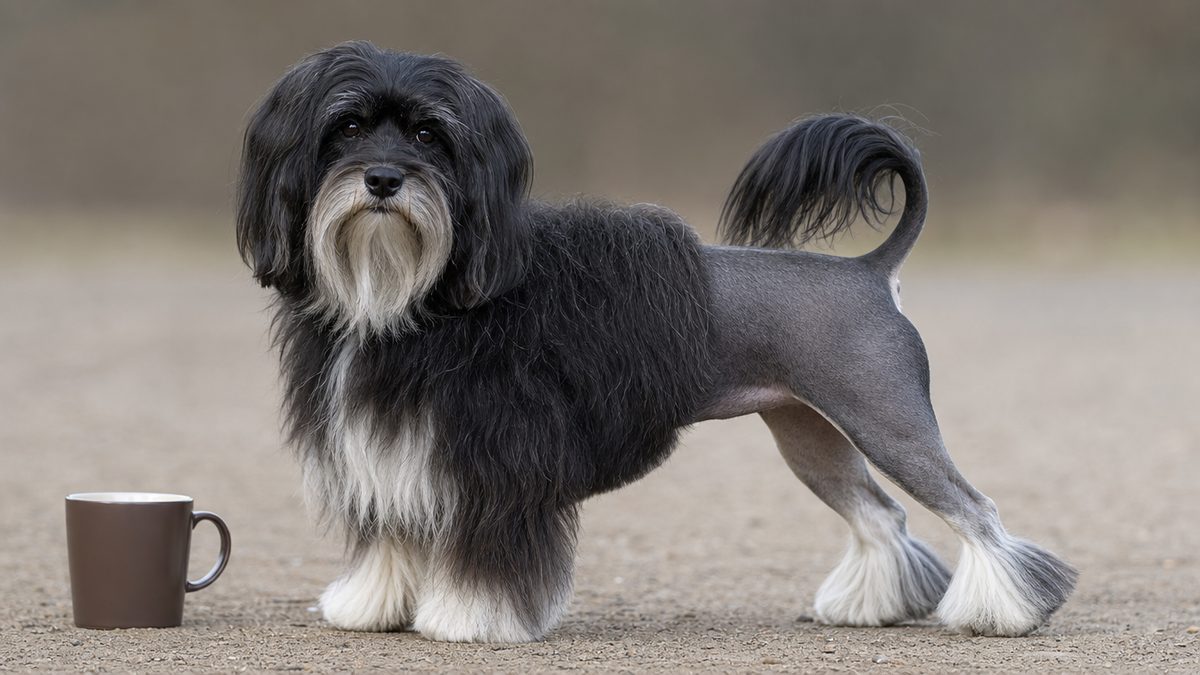
A Löwchen is a small, square, single-coated French companion dog shown in an obligatory lion clip. The name is German for little lion, the breed standard is French, and the FCI does not list it under L at all. Search the FCI's letter L index and you get eight breeds, from Labrador Retriever to Lhasa Apso, with no Löwchen among them.
It is filed under P, as PETIT CHIEN LION, breed number 233, with the English name Little Lion Dog. That is not a technicality. An Indian buyer checking whether the breed is FCI-recognised, and typing the only name they have ever seen, finds nothing and concludes wrongly.
The size and weight the standards actually give
Club recognition is settled and unanimous, which is unusual for a breed this rare. The FCI recognises it on a definitive basis as number 233, the Kennel Club lists it in the Toy group, and the American Kennel Club has recognised it since 1996 The Kennel Club, Lowchen American Kennel Club. Where the three clubs disagree is not recognition but measurement, and the rest of this section is about that.
FCI Standard 233 gives height at the withers as 26 to 32 cm with a tolerance of plus or minus 1 cm, and weight as 6 kg approximately. That is the only weight figure any of the three standards prints, which makes it worth holding onto.
The heights disagree, and the disagreement is one-sided.
| Body | Height given | In centimetres | Weight given |
|---|---|---|---|
| FCI Standard 233 | 26 to 32 cm, tolerance plus or minus 1 cm | 25 to 33 cm | 6 kg approximately |
| The Kennel Club | 25-33 cms (10-13 ins) | 25 to 33 cm | none stated |
| American Kennel Club | 12-14 inches | 30.5 to 35.6 cm | 15 pounds |
The FCI and the Kennel Club land on exactly the same 25 to 33 cm once the FCI tolerance is applied The Kennel Club, Lowchen. The AKC is the outlier at 12 to 14 inches, which is 30.5 to 35.6 cm. Its floor sits about 5 cm above the FCI's floor and its ceiling about 2.6 cm above the FCI's ceiling, so a 27 cm dog is a correct Löwchen in Europe and an undersized one in an American ring. Nobody writing about this breed puts those three rows next to each other.
The coat, and the sentence that decides everything else
One clause in FCI 233 governs the grooming, the heat tolerance and the allergy question at once. The coat is described as silky, long, wavy, dense, and expressly without undercoat. Bonbeno checked the French text, which is the authentic language for this standard, and it reads the same: soyeux, long, ondulé, dense, pas de sous-poil.
That negative check matters. FCI standards can drift between languages, and on this one they do not. The height, the tolerance, the 6 kg and the no-undercoat clause are identical in the authentic French and the English translation, so nothing on this page turns on which version you read.
The Kennel Club describes the same coat as fairly long, wavy, never curly, a single coat of silky texture. Three documents, one coat, and it is the opposite of a Nordic or mountain breed's.
Coat colour, where the registries part company
On coat colour the FCI is permissive and the Kennel Club is not. FCI 233 says all colours and combinations of colours are permitted, full stop. The Kennel Club says any colour or combination of colours, except merle which is unacceptable.
That exception is worth understanding rather than skipping. Merle is not a historic colour in the bichon family, and a merle dog in a breed that never carried the pattern usually means the pattern was introduced from outside. A Kennel Club standard that names it and rules it out is telling you what it has seen. An Indian buyer offered a merle Löwchen should treat the coat colour as the first question, not the last.
Where the breed comes from, on its own standard's account
FCI 233's own historical summary is unusually specific. It says that in Amiens Cathedral, whose construction dates back to the 13th century, two Lowchen are carved in stone; that the distinctive silhouette appears in 15th century tapestries; that the breed was cherished by the ladies of the court of Burgundy; that Buffon describes it precisely in his Histoire Naturelle while stressing its rarity; that Linné also mentions it; that it was once called Bichon Little Lion Dog; and that the French breed club was founded on 18 November 1947.
So the rarity claim is not a modern invention. An 18th-century naturalist was already remarking on it. What has changed is that we now have registration tables, and the next section uses them.
A Löwchen is a 6 kg French companion dog with a German name, a single silky coat and no undercoat, shown in a lion clip that the FCI standard makes obligatory. It is compact, playful and easy to live with. It is also almost impossible to buy in India.
The rarest-dog claim, tested against the registration statistics
To test whether the Löwchen is the rarest dog, read a registry's own registration statistics rather than a directory's history paragraph. Bonbeno downloaded the Royal Kennel Club's Toy group tables, extracted them with pypdf and checked the arithmetic. The breed is genuinely rare and it is not the rarest.
Start with the claim as it circulates. English Wikipedia says the Löwchen once had the dubious distinction, like the Portuguese Water Dog and the Havanese, of being the rarest dog in the world, and that in 1973 there were only 65 registered examples. A ranking directory tells it differently, saying the breed was named rarest breed in the Guinness Book of World Records in the early 1960s. Two sources, two decades, one claim. Bonbeno could not trace either version to a primary record and publishes neither as fact. What can be traced is the present, and the Kennel Club publishes it: one quarterly and one ten-yearly registration PDF per breed group, plus a vulnerable-breeds file, all linked from a single index.
What the UK register actually holds
The Kennel Club's ten-yearly Toy table gives the breed a full decade of numbers.
| 2016 | 2017 | 2018 | 2019 | 2020 | 2021 | 2022 | 2023 | 2024 | 2025 |
|---|---|---|---|---|---|---|---|---|---|
| 82 | 34 | 73 | 75 | 39 | 83 | 68 | 30 | 40 | 19 |
Nineteen dogs registered in the whole of the United Kingdom in 2025, the lowest figure of the decade and a fall of 76.8 percent from 2016. That is a real number and it is a small one.
It also sits inside a collapse rather than standing alone. The whole Toy group fell from 27,237 registrations in 2016 to 10,500 in 2025, a drop of 61.4 percent, driven mostly by the Pug going from 10,408 to 834. A breed losing three quarters of its registrations in a group that lost three fifths of its own is declining with the tide, not uniquely.
Six breeds registered fewer in the same year
Now the test. If the Löwchen were the rarest breed, no breed would sit below it.
| Breed | 2025 registrations | Where the figure comes from |
|---|---|---|
| Australian Silky Terrier | 4 | The same Toy group table as the Löwchen |
| Bloodhound | 5 | Vulnerable breed stats |
| Foxhound | 5 | Vulnerable breed stats |
| Otterhound | 10 | Vulnerable breed stats |
| Greyhound | 10 | Vulnerable breed stats |
| Sussex Spaniel | 15 | Vulnerable breed stats |
| Lowchen (Little Lion Dog) | 19 | Toy group table |
The Australian Silky Terrier is the one that settles it. It sits in the same Toy group table on the same page of the same PDF, and it registered four dogs in 2025 against the Löwchen's nineteen. The Löwchen is not the rarest breed in the world, in the United Kingdom, or in its own group.
One more honest qualification. The Löwchen does not appear in the Kennel Club's vulnerable native breeds document at all, and it should not: that list covers British and Irish native breeds, and this is a French one. Absence from a vulnerable-breeds list is not evidence of health here, only of nationality.
The two Kennel Club documents agree on this breed, and that is worth saying
This site treats the Kennel Club's Toy tables as known-unreliable, so Bonbeno checked the cells it uses rather than assuming them. The result is agreement.
The quarterly table gives the Löwchen's 2025 quarters as 5, 9, 3 and 2, which sum to 19, and prints 19 as the year total. The ten-yearly table also prints 19 The Royal Kennel Club. Two independent documents and one internal sum, all three matching. Every figure this page takes from the Kennel Club is therefore corroborated twice.
The known defect is real and it is somewhere else. Summing all 24 rows of the ten-yearly Toy table gives 10,503 for 2025 against a printed total of 10,500, while every other column from 2016 to 2024 reconciles exactly. The quarterly table's 24 rows sum to 10,500 exactly. The whole three-dog gap is one cell: Yorkshire Terrier 2025 reads 385 in the ten-yearly table and 382 in the quarterly, and the quarterly figure is self-corroborating because its own quarters read 85, 112, 111 and 74 The Royal Kennel Club. Prefer the quarterly table where the two disagree, and note that this breed is not affected.
Somebody is actively trying to reverse this
The rarity story has a second half that no ranking page carries. A breed-recovery campaign called Save the Lowchen was started in 2017 with the stated aim of growing the American Lowchen population to a level that could sustain a viable breeding population, working by recruiting established breeders into the breed, enabling existing breeders to produce more litters, and promoting the breed digitally and in person. Its mid-2019 update reports AKC registrations projected to double 2018 levels.
Bonbeno quotes no figure from that page, because the underlying registration numbers are published only inside an image rather than as text. What is quotable is the shape of the thing: a small breed with an organised, dated recovery plan behind it, run by the same breeder whose separate page debunks the price myth. A reader deciding whether this breed is dying should know that somebody is counting and somebody is working on it.
The Löwchen registered 21 dogs in the first quarter of 2026 and 5 in the second, so 26 in half a year against 19 in the whole of 2025. A single year is not a trend, and 2025 may well be the floor rather than the direction.
Löwchen price in india: one figure exists, and it comes with problems
One published Löwchen price in india exists, Rs 50,000 to Rs 1,00,000, and Bonbeno recommends against acting on it. The page that prints it also states the country of origin as Germany when the FCI's own record says France, and its monthly cost block turns out to be shared with an unrelated breed on the same site Federation Cynologique Internationale.
Before that, the honest position on supply. Bonbeno searched Indian marketplaces and classifieds for this breed on 2 September 2026 and found no Indian seller, no Indian breeder and no Indian listing. The results that came back were United States breeders, United States adoption sites and the AKC marketplace. India's largest pet retailer publishes a 40-breed price table that includes the Saint Bernard, the Great Dane and the Mudhol Hound, and contains no Löwchen and no Little Lion Dog.
What the breed actually costs where it is bred
The useful comparison is the real price in a country with breeders, and one of those breeders publishes it.
| Source | Figure printed | What the source is |
|---|---|---|
| Roman Reign, current litters | USD 3,800 | A live asking price from an AKC Breeder of Merit, including registration, insurance, vaccines and microchip |
| Roman Reign, myth page | USD 2,000 to 4,000 | The same breeder's stated typical United States range |
| Dogbreedslist | USD 4,000 to 8,000 | A directory average with no methodology stated |
| The circulating claim | up to USD 12,000 | Repeated across thirteen articles the breeder lists, and named by that breeder as a myth |
| Happy Pet | Rs 50,000 to Rs 1,00,000 | The only Indian figure, on a page that misstates the country of origin |
The breeder's own page is titled MYTH: Most Expensive Dogs and it does the work most buyers never do. It states that while our beloved Lions are rare, they are truly not expensive dogs, gives the typical United States purchase cost as about 2,000 to 4,000 dollars, and proposes that the myth began when someone asked a handler at a dog show what their top winning Löwchen would cost and was told 10,000 dollars, because top winning show dogs are often worth well over that.
That is a specific, checkable explanation for a specific, widely repeated number, offered by the people who actually sell the dogs. It is the most useful sentence written about this breed's price anywhere, and it appears on none of the pages that quote the 12,000-dollar figure.
The claim reaches Indian readers too. An Indian business publication ran a Top 10 most expensive dog breeds in the world gallery in November 2016 whose lead image file is named lowchen660 and whose keyword list includes Lowchen. Bonbeno could not render the individual slide captions and therefore quotes no figure from it, only the fact that the breed features.
Run the division tests on the Indian figure
Indian pages routinely publish a foreign price converted at one rate and presented as rupees, so Bonbeno tested the only Indian figure available.
Rs 50,000 divided by 84.38 is 592.56 and Rs 1,00,000 divided by 84.38 is 1,185.12. At 74 the quotients are 675.68 and 1,351.35. At a flat 80 they are 625 and 1,250, which proves nothing, because both figures end in three zeros and 1,000 divided by 80 is 12.5, so any such number divides cleanly at 80 by construction.
None of those quotients is a price anyone charges for this breed. The verdict is that Rs 50,000 to Rs 1,00,000 is a rupee-native round number rather than a converted foreign one. What makes it stranger is the direction of the error: at 84.38, the real United States range of 2,000 to 4,000 dollars is Rs 1,68,760 to Rs 3,37,520, so the Indian figure is roughly a third to a half of what the dog costs where it exists. Indian price inflation is the usual failure on this site. This is the opposite one.
Why the number cannot be a transaction price
A price needs a seller. Bonbeno found none in India, and the legal route makes one unlikely. Under the Dog Breeding and Marketing Rules 2017 a breeder must be registered, and every dog sold must meet the Second Schedule's conditions, including Rule 8(1)(a)'s prohibition on selling pups under eight weeks. There is no registered Indian population of this breed to breed from.
So treat any Indian Löwchen offer as an import proposition rather than a purchase, and price it accordingly: the dog, the export paperwork, the flight, and quarantine. A United States breeder's own page notes that Lowchen are available for export to all allowable countries, which is the realistic route and a very different transaction from buying a puppy in Bengaluru.
If an Indian seller offers you a Löwchen at Rs 50,000, ask for the pedigree naming Petit Chien Lion or Little Lion Dog, ask which registry issued it, and ask to see the parents. A small white or cream curly-coated dog in a fluffy trim can be sold as almost anything, and the breeds it is most easily confused with, the Bichon Frise and the Havanese, are both available in India at real prices from real sellers.
Monthly cost in India, and the number that turned out to be shared
Budget Rs 4,000 to Rs 8,000 a month for a small dog in India, and expect a Löwchen to sit at the top of that band because of grooming. That range is the small-breed column of the monthly cost table published by Supertails, India's largest online pet retailer, in its 2026 dog price guide.
The line items matter more than the total, because this breed loads exactly one of them.
| Line | Published small-breed figure | What a Löwchen does to it |
|---|---|---|
| Dry or wet food | Rs 1,500 to Rs 2,500 | Bottom of the band. A 6 kg dog eats very little. |
| Routine vet visits | Rs 500 to Rs 1,000 | Unchanged. |
| Vaccinations | Rs 1,200 a year | Unchanged. Vaccine dosing is not weight-based. |
| Grooming | Rs 1,500 to Rs 3,000 | Top of the band, and the single largest line. A lion clip is a skilled trim, not a bath. |
| Training, first six months | Rs 0 to Rs 3,000 | Worth spending. This is a vocal breed and the quiet cue is the whole job. |
| Treats and toys | Rs 300 to Rs 800 | Unchanged. |
| Flea, tick and deworming | Rs 300 to Rs 600 | Unchanged, and a small dose is cheap. |
| Printed monthly total | Rs 4,000 to Rs 8,000 | Realistic, with grooming rather than food driving the top end. |
That inversion is the honest headline. For almost every other breed on this site, food is the biggest monthly line and grooming is a rounding error. Here it is the other way round, and a household that cannot spend Rs 3,000 a month on a groomer will end up with a matted dog.
The Indian figure that is not about this breed at all
The one Indian page that publishes a Löwchen cost gives average monthly expenses of Rs 3,300 basic and Rs 5,400 premium, itemised as food Rs 1,200 or Rs 1,800, veterinary Rs 900 or Rs 1,800, and grooming Rs 1,200 or Rs 1,800.
Bonbeno tested that the way this site tests every Indian running-cost figure, by pulling an unrelated breed from the same site and comparing the lines to the rupee. The control was the Maltese, a Mediterranean toy breed with no relationship to the Löwchen beyond being small and white.
| Line | Löwchen basic / premium | Maltese basic / premium |
|---|---|---|
| Food | Rs 1,200 / Rs 1,800 | Rs 1,200 / Rs 1,800 |
| Veterinary | Rs 900 / Rs 1,800 | Rs 900 / Rs 1,800 |
| Grooming | Rs 1,200 / Rs 1,800 | Rs 1,200 / Rs 1,800 |
| Monthly total | Rs 3,300 / Rs 5,400 | Rs 3,300 / Rs 5,400 |
Every line matches to the rupee Happy Pet, Maltese Dog Breed page. Rs 3,300 to Rs 5,400 is a template constant shared across breeds on that site, not an observation about a Löwchen. It is also implausible on its face for this breed specifically: a grooming line of Rs 1,200 a month will not buy a professional lion clip in an Indian metro, and the same site rates the breed's shedding as low and its grooming as low-maintenance, which is the opposite of what every breed standard implies.
Say what that does and does not prove. It does not prove the figure is wrong for a Maltese, and it does not prove the site is dishonest. It proves the number is a category default, so it carries no information about this breed and should not be used to plan a budget for one.
First-year costs outside the monthly band
- Full puppy vaccination course, Rs 3,000 to Rs 6,000 across all visits, made up of DHPPi doses at Rs 500 to Rs 1,200 each and anti-rabies at Rs 300 to Rs 600, plus a consultation or injection charge of Rs 300 to Rs 800 per visit.
- Annual booster thereafter, roughly Rs 1,000 to Rs 2,000 for one DHPPi and one rabies dose together.
- A patella examination and an eye examination, which are the two screens this breed's national club actually asks for.
- Grooming tools you will use daily: a pin brush, a slicker, a good metal comb and a pair of blunt-nosed scissors. Buy them before the puppy arrives.
- Import cost, if you go that route, which is the dog plus export paperwork plus a flight plus quarantine and dwarfs everything above.
Set the risk side against it. A parvo hospital stay in India runs Rs 15,000 to Rs 50,000, which makes the vaccination course the cheapest money in the budget.
A Löwchen in an Indian metro costs roughly Rs 60,000 to Rs 96,000 a year to run before any illness, with grooming the largest single line rather than food. Over a 13 to 15 year life expectancy that is a long commitment for a dog whose purchase price, if you can find one at all, is an import.
Heat tolerance: the surprise is that this one is workable
A Löwchen has moderate heat tolerance in India, which is better than almost any other long-coated breed on this site, and the reason is one clause in its standard. FCI 233 specifies a coat that is silky, long, wavy and dense, and expressly without undercoat. No undercoat on a 6 kg body is a fundamentally different heat problem from a double-coated giant's.
That is not the same as saying the breed is heat-adapted. It is not. The homeland gap is enormous and the standard's own history names the place to measure it against.
| Place | Annual mean C | Warmest month C | Annual mean RH % | Cell elevation m | Real elevation m |
|---|---|---|---|---|---|
| Amiens, France | 10.09 | 17.66 (Jul) | 85.54 | 107.6 | about 30 |
| Paris, France | 10.93 | 19.34 (Jul) | 81.43 | 92.41 | about 35 |
| Lyon, France | 11.45 | 21.69 (Jul) | 78.11 | 276.62 | about 173 |
| Bengaluru | 23.74 | 28.37 (Apr) | 67.94 | 841.72 | about 920 |
| Pune | 23.86 | 28.93 (Apr) | 66.80 | 635.99 | about 560 |
| Delhi | 25.60 | 35.88 (Jun) | 45.56 | 206.37 | about 216 |
| Kolkata | 25.81 | 31.53 (May) | 73.93 | 7.35 | about 9 |
| Mumbai | 26.77 | 31.19 (May) | 67.39 | 97.15 | about 14 |
| Chennai | 27.95 | 31.51 (May) | 72.39 | 48.95 | about 6 |
Amiens is the right comparison because FCI 233's own historical summary names Amiens Cathedral as the place where two Lowchen are carved in stone. Chennai's annual mean of 27.95 C sits 17.9 C above it, and Chennai's coolest month at 24.09 C is 6.4 C warmer than Amiens's warmest.
Why the same gap matters less here
Two things change the arithmetic for this breed. Body mass is the first. Hall and colleagues studied 905,543 UK dogs and found heat-related illness risk rising with weight, with dogs over 50 kg carrying an odds ratio of 3.42 and dogs at or above their breed and sex mean weight carrying 1.42. A 6 kg dog is at the opposite end of that distribution.
Coat structure is the second. An undercoat is the layer that traps a warm air envelope against skin, and this breed does not have one. The lion clip removes coat from the hindquarters entirely as well, and the Kennel Club specifies that the body is clipped to the last rib. A clipped Löwchen in July is carrying a mane and very little else.
So the honest rating is moderate rather than poor. This is a dog that can live in a Chennai flat with a fan and sensible walk timing, which is not true of a Newfoundland or a Samoyed.
The rules that still apply
Heat kills small dogs too, and exertion is the trigger that does it. Of 879 heat-related illness events with a recorded trigger in the same UK cohort, 652, or 74.2 percent, were exertional. The same paper's cohort had an overall incidence of 0.04 percent and a case fatality of 14.18 percent, so the event is uncommon and serious when it happens.
- Walk before 07:00 and after 20:00 from March to October in any plains city.
- Test the pavement with the back of your hand. A small dog's belly is centimetres from hot tarmac, and a 30 cm dog cannot walk above the heat the way a tall one can.
- Keep the mane brushed out rather than matted. A matted mane is a solid insulating pad over the shoulders and chest.
- Never leave the dog in a parked car, and never assume a shaded balcony is cool enough in a Chennai May.
- Watch for panting that does not settle within two minutes in shade, and treat that as a same-day veterinary matter.
Where the Indian pages get the climate advice wrong
The one Indian page carrying this breed prints an ideal weather band of 15 to 25 degrees C. Take that at face value and four of the six Indian metros in the table above are outside it on annual mean alone, and Chennai's warmest month sits 6.5 C above the top of the band. A page that publishes an ideal band and then recommends the breed for Indian apartment life has not read its own field.
Bonbeno's answer is different and less tidy. The band is not the point. A single-coated 6 kg dog in an air-conditioned or well-ventilated Indian home, walked at dawn, is fine. The same dog left on a terrace at noon is not, and Indian law agrees with that specific framing.
The mountain data this page does not use
Two of the points Bonbeno queried came back unusable and are excluded rather than quietly published. NASA POWER returns a grid cell, not a point, and in mountains the cell elevation misses the town. Shimla returned a cell at 897.65 m against a real town near 2,200 m, and Ooty a cell at 784.64 m against a town near 2,240 m.
Applying the standard lapse rate of about 6.5 C per 1,000 m gives estimated real annual means of roughly 12.7 C for Shimla and 14.0 C for Ooty, against the 21.15 C and 23.50 C the cells report. Those two figures are labelled estimates and no argument on this page rests on them. Every plains city in the table checked out within 84 m of its true elevation.
Of the long-coated breeds this site has assessed, the Löwchen is among the more workable in India, and the reason is a single line in a French standard written in 2004. No undercoat, 6 kg, and a clip that strips the back half. The obstacle to owning one in India is that you cannot buy one, not that it would suffer.
Temperament, and the one trait that will annoy your neighbours
A Löwchen's temperament is affectionate, obedient, playful and adaptable, and the only reliable complaint is noise. FCI Standard 233 describes a dog very affectionate and obedient with its masters, attentive and receptive, at ease in all circumstances, and capable of being calm and discreet on command.
That last clause is unusual for a breed standard and worth taking seriously. A standard that specifies calm and discreet on command is describing a dog that is not calm by default and can be taught to be.
The Kennel Club puts it more briefly: characteristics, a gay, happy, lively little dog; temperament, intelligent, affectionate, showing no sign of aggression. The AKC calls the breed affectionate, outgoing and positive, and describes a small dog with enormous heart.
Barking is the trait to plan for
The AKC is explicit about it. With the Löwchen's history as a companion to royalty who were under constant threat, it says, he is a very alert fellow and reacts quickly to suspicious noise or activity, and he should be taught as a young puppy that barking excessively at every sound or motion is not necessary nor appreciated. One directory rates barking tendencies as frequent.
In an Indian apartment building, with a shared corridor, a lift, a doorbell, a watchman and deliveries all day, that is the trait that determines whether ownership works. It is trainable, it is not self-limiting, and the window to fix it is the first six months.
Who this breed suits
- Suits a flat, and this is the best apartment rating this site gives. A 6 kg square companion dog bred for indoor life needs no yard.
- Suits a household with someone at home. This is a companion breed by declared utilization, and FCI 233 lists its use simply as companion dog.
- Suits a family with children, on every standard's account, with the usual supervision any small dog needs around small children.
- Suits an owner who will actually groom, or actually pay a groomer, every single month for the next thirteen years.
- Does not suit a household that cannot tolerate alarm barking, or one that will not train it out early.
Strangers, other dogs and Indian street life
Openness to strangers is high once the dog is introduced, and alertness comes first. That combination reads as a dog that announces a visitor loudly and then greets them warmly, which is exactly what an apartment neighbour finds irritating and a burglar finds irrelevant.
Around other dogs the breed is generally sociable, but a 6 kg dog on an Indian street shares that street with free-ranging dogs several times its weight. Walk on a short lead in a harness, avoid retractable leads entirely, and pick routes rather than wandering. That is a size problem, not a temperament problem, and it applies to every toy breed here.
The gap between the standard and the marketing
One thing worth noticing across the ranking pages is how consistent the temperament description is and how inconsistent everything else is. The registries and the directories agree almost word for word on character, and then disagree about origin, height, shedding, allergy risk and price.
That pattern is useful to a reader. Where every independent source agrees, believe it. Where they diverge, the divergence is usually the point, and this page's remaining sections are mostly about the divergences.
You are buying an easy, adaptable, apartment-sized temperament and a coat that will take three hours a month of somebody's attention for over a decade. Nothing about this dog's character will fight you. The brush, the groomer's bill and the doorbell will.
Training: positive methods, and a quiet cue before anything else
To train a Löwchen, use positive reinforcement and start with the quiet cue rather than with sit. The AKC states plainly that this breed lives to please its owner, which makes training fairly easy so long as you use positive methods, and that it does not respond well to harsh correction.
FCI 233 supports that from the other direction. It describes a dog attentive and receptive, whose forthright and tender look tries to understand what is expected of him. A standard that phrases willingness that way is describing a dog that shuts down under pressure.
The order to teach things in, for an Indian flat
- Quiet on cue, from week nine. Mark and reward silence after one bark rather than punishing the bark. This is the single behaviour that decides whether the dog is welcome in the building.
- Grooming tolerance, from week nine, before the coat needs it. Two minutes of brushing a day builds a dog that stands for a lion clip at eight months.
- Name response and a settle on a mat, weeks nine to twelve.
- Handling of feet, ears, mouth and tail, daily, because this dog will be on a grooming table every eight weeks for its whole life.
- Recall and loose-lead walking, weeks twelve to twenty, moved entirely into the cool hours.
- Crate as a cool quiet den rather than a punishment, throughout.
Socialise around the vaccination gap, not through it
The behavioural window closes before immunity is complete, and Indian practice sets the timing. The core course starts at 6 to 8 weeks, repeats every three to four weeks, and finishes at or after 16 weeks, with the standard advice to keep an unfinished pup off unknown ground until about a week after the last booster.
Resolve the conflict the way Indian veterinarians do: carry the puppy, invite vaccinated adult dogs home, and use clean private terraces. A 6 kg breed makes this easy, because you can carry the dog everywhere for four months without effort. Expose it to lifts, doorbells, pressure cookers, the watchman, autorickshaw horns, umbrellas and the sound of a hair dryer, which is the one that pays off for the next thirteen years.
What this breed resists
Very little, and the two failure modes are both owner-created. The first is barking that was never addressed because a small dog's noise seems manageable at four months and does not at four years. The second is grooming refusal in a dog that was never taught to stand still, which turns every trim into a wrestling match and eventually into a sedated clip.
Both are cheap to prevent and expensive to fix. Neither is a training problem in the ordinary sense; they are scheduling problems, and the schedule is the first six months.
Sport and work, if you want it
This is a genuinely capable little dog. The AKC calls it very intelligent, notes that it loves having new challenges, and describes it as a great candidate for obedience or agility, while adding that it will not be suited to long-distance runs. One Indian page lists agility training among its recommended activities.
For an Indian owner that is a useful outlet, because indoor agility and trick training are heat-independent. A dog that gets fifteen minutes of shaping a day is a quieter dog, which loops back to the barking.
Teach the dog to lie on its side on a towel for two minutes on cue. Every grooming session, every ear check, every tick removal and every nail trim for the next decade runs off that one behaviour, and on a heavily coated breed it is the difference between a calm groom and a sedation.
Exercise needs: a daily walk, and an easy fit with Indian hours
A Löwchen's exercise needs are a daily walk plus indoor play, which one Indian page puts at 30 to 45 minutes a day. That is genuinely low, and it is the reason this breed fits Indian conditions better than its coat suggests: the whole requirement fits inside the cool hours.
FCI 233 describes the gait it wants as lively, energetic and with good reach, with the legs parallel in action and the head carried proudly. That is a dog that likes to move, not a lap ornament, but the distances involved are short.
The AKC frames it well: the Löwchen loves to play in a fenced yard or accompany its owner on long walks, is a great candidate for obedience or agility, and will not be suited to long-distance runs, but is a sturdy little dog that can be happy doing just about any activity with its people.
The Indian daily shape
- Morning walk of 20 to 25 minutes, before 07:00 from March to October in any plains city.
- Evening walk of 20 to 25 minutes, after 20:00 in the same months.
- Ten to fifteen minutes of indoor training, shaping or scent work, split across the day.
- Free play indoors, which for a 6 kg dog on a tiled floor mostly means a runner or a rug so it is not sliding.
- One weekly outing somewhere new, because this breed is curious and boredom shows up as barking.
In the cool season those windows widen considerably. Delhi's January mean is 13.61 C and Pune's December mean is 19.62 C, which is comfortable walking weather for a dog whose homeland runs about 10 C annually.
Why exertion timing still matters on a small dog
Small size lowers heat risk; it does not remove it. The dominant trigger in the largest UK dataset was exercise, with 652 of 879 events with a recorded trigger, or 74.2 percent, being exertional. A small dog also sits closer to hot ground, so radiant heat off tarmac reaches its belly directly.
The practical rule is unchanged from any Indian breed page on this site: walk in the cool hours, carry water, check the pavement with your hand, and turn back at the first panting that will not settle.
Growth, joints and the patella problem
Restrict jumping in the first year, and keep doing it afterwards. This is the breed's genuine orthopaedic weak point: OFA's patella table records 7.8 percent of 359 Löwchen evaluations as abnormal, made up of grade 1 at 5.0 percent, grade 2 at 2.5 percent and grade 3 at 0.3 percent, which places the breed 15th on that table.
Those numbers add up exactly, 5.0 plus 2.5 plus 0.3 giving 7.8, which is a small sign that the row is internally consistent and worth trusting. What it means in a flat is concrete: no jumping off beds and sofas onto tile, a step or ramp if the dog is allowed up, and a rug wherever the dog lands.
Hips are a smaller worry. The same registry records 6.8 percent dysplastic of 368 evaluations against 91.8 percent normal, with excellent at 12.8, good at 69.8 and fair at 9.2. Those components reconcile exactly in both directions, 12.8 plus 69.8 plus 9.2 giving 91.8 and 5.7 plus 1.1 plus 0.0 giving 6.8.
Put a non-slip runner along the route the dog actually runs, usually the corridor between the door and the living room. Indian homes are tiled or stone-floored, a 6 kg dog accelerating on polished tile has no traction, and a slipping stifle is exactly the joint this breed is already 15th worst on.
Grooming: the lion clip, and why low shedding costs more not less
To groom a Löwchen, comb the whole coat to the skin every day and book a professional trim every eight weeks. This is the breed's real cost, and it comes from one structural fact: a long wavy single coat with no undercoat does not shed its loose hair onto your floor, it holds it in the coat until it becomes a mat.
One ranking directory states the routine plainly and calls it high maintenance: expect to spend ten minutes a night removing tangles and mats from his single coat, give him a more thorough brushing at least weekly, and take him to a professional groomer for his lion trim every two months. The same page rates shedding at one star and calls it minimal. Both are true at once, and the second causes the first.
What the lion clip actually is
The lion clip is not a styling choice at shows. FCI Standard 233 states that the lion clip is obligatory for showing, and that the unclipped areas should be completely natural and on no account should they be shaped. The Kennel Club specifies the coat is to be shown in its natural state without scissoring or sculpting apart from the traditional Lion Clip, clipped to the last rib.
So the trim has a defined line. The mane runs over the head, neck, chest and forequarters; the body is clipped from the last rib backwards; the hindquarters and legs are clipped close with cuffs left at the ankles; and the tail is clipped with a plume at the tip. The Kennel Club describes the tail as clipped with a tuft of hair to resemble a plume.
For a pet dog none of that is compulsory. The AKC notes owners can keep the dog in a puppy cut instead of the traditional lion trim, and in an Indian summer a shorter all-over cut is a sensible choice. What is not sensible is leaving a long coat untrimmed and unbrushed.
The Indian humidity problem, stated precisely
A mat is a sealed pad of hair pressed against skin. In Bremen or Amiens that is uncomfortable. In Chennai in August, at 72.39 percent mean annual relative humidity, or Mumbai in August at 90.36 percent, a mat is a warm, damp, airless microclimate on a dog's skin.
That is the mechanism behind most Indian coated-breed skin disease, and it is entirely preventable. The rule is simple and unpopular: comb to the skin, not through the top of the coat. A slicker brush that glides over the surface while a mat sits underneath is the most common grooming mistake there is.
- Comb daily with a metal comb, in sections, working from the skin outwards. Ten minutes.
- Line brush weekly with a pin brush and slicker, parting the coat and working row by row from the rear forward. Thirty minutes.
- Check the four places that mat first every session: behind the ears, in the armpits, in the groin and under the collar.
- Bathe as often as the coat needs, and dry mechanically to the skin. Do not let a single coat air dry in Indian humidity.
- Book a professional lion clip or puppy cut every eight weeks, and budget Rs 1,500 to Rs 3,000 a month for it.
What the Indian ranking page gets wrong here
The one Indian page carrying this breed says that even though Lowchen dogs have long, dense coats they are relatively low-shedding dogs and hence, they are low-maintenance.
That sentence contains the exact inversion this section exists to correct. Low shedding is why the breed is high-maintenance, not why it is low-maintenance. The AKC is gentler about the workload, saying the grooming requirements are surprisingly few, a good brushing every few days followed by a bath every couple of weeks, with a professional groomer every couple of months. Bonbeno follows the directory's ten-minutes-a-night figure rather than the AKC's every-few-days one, because the Indian variable is humidity and the cost of being wrong is a skin infection rather than a scruffy dog. Where two credible sources differ on effort, an Indian page should quote the higher one.
Ears, eyes and nails
The ears are pendant, moderately long and well fringed, set level with the eyes, which is the anatomy most prone to otitis externa. Dry the canals after every bath, check weekly, and see a veterinarian at the first head shake rather than the third.
The eyes need attention for a different reason covered in the health section: OFA's detail rows record distichiasis, extra eyelashes growing into the eye, in 92 of 1,140 Löwchen examined, or 8.1 percent. Long face furnishings plus a possible extra lash means any persistent squinting or tearing is a veterinary visit, not a wipe.
Budget ten minutes a day plus half an hour a week, which is about three hours a month, every month, for thirteen to fifteen years, plus a groomer every eight weeks. That is the real price of this breed and it is paid in time rather than rupees. Households that will not do it should choose a short-coated dog instead.
Health issues, life expectancy, and a literature that does not exist
The Löwchen's health issues are orthopaedic and ophthalmic, and the registry tables are the only evidence there is. Bonbeno searched PubMed in four name forms on 2 September 2026, Lowchen, Lowchen[All Fields], Lowchen AND dog and Loewchen, plus the quoted French name Petit chien lion. Every one returned zero records.
That absence is a real finding rather than a broken search, and it was tested. Three controls run in the same session returned Bichon AND dog 123 records, patellar luxation AND dog breed 122, and labrador retriever AND patellar luxation 6. The instrument worked. One of the queries is stronger still: PubMed broadened the quoted French phrase into three AND-ed all-fields terms on its own initiative and still returned nothing, and a broadened query that returns zero is a stronger negative than a strict one.
So there is no breed-specific veterinary literature on the Löwchen at all. Everything below comes from screening registries and breed clubs, and this page says so rather than dressing club opinion as evidence.
What the national breed club actually asks for
Three tests, named by the AKC's parent club: patella evaluation, hip evaluation and ophthalmologist evaluation. The AKC's own health note says the majority of Lowchen are healthy little dogs and that responsible breeders screen for hip dysplasia, patellar luxation, cataracts and progressive retinal atrophy.
| Database | Evaluations | Normal % | The finding |
|---|---|---|---|
| Patella | 359 | 92.2 | 7.8 percent abnormal: grade 1 5.0, grade 2 2.5, grade 3 0.3. Ranks the breed 15th on this table |
| Hips | 368 | 91.8 | 6.8 percent dysplastic: mild 5.7, moderate 1.1, severe 0.0 |
| Elbow | 105 | 99.0 | 0.0 percent abnormal across all three grades |
| Basic cardiac | 77 | 98.7 | 1.3 percent abnormal, on a small sample |
| Eyes, summary line | 1,139 | 97.2 | 2.8 percent abnormal, and see the contradiction below |
Two of those rows deserve a note. The patella row reconciles exactly, 5.0 plus 2.5 plus 0.3 giving 7.8, and so does the hip row in both directions. The elbow row does not: 99.0 percent normal against 0.0 percent abnormal leaves one percent unaccounted for, which is worth flagging rather than smoothing over, and on 105 evaluations it carries little weight either way.
The eye tables contradict themselves, and by a lot
OFA's eye summary reports the Löwchen at 97.2 percent normal across 1,139 evaluations. Its own per-diagnosis detail table, on a denominator of 1,140, records 772 dogs as normal, which is 67.7 percent. That is a gap of 29.5 percentage points inside one registry on one breed, with the two denominators differing by a single dog.
The detail rows make the contradiction sharper. Persistent pupillary membranes running iris to iris are recorded in 170 of 1,140 dogs, or 14.9 percent, which alone is more than five times the summary's entire 2.8 percent abnormal figure. Distichiasis appears in 92 of 1,140, or 8.1 percent, and cataract of unknown significance in 36, or 3.2 percent.
A part cannot exceed its whole, so the two figures are not measuring the same thing and neither is the breed's eye rate. Bonbeno publishes both with the arithmetic shown and quotes neither as definitive. This is a documented property of OFA's eye tables rather than anything specific to this breed.
What survives the contradiction is useful anyway. Persistent pupillary membranes and distichiasis are the two findings that recur, both are congenital, and both are exactly what an ophthalmologist evaluation is for.
Life expectancy
The published estimates are long and they broadly agree. The AKC gives 13 to 15 years, one directory gives 12 to 15, and the Indian page gives 12 to 14.
None of those is a mortality study, and none can be, because no such study exists for this breed. Treat 12 to 15 years as the working range, note that it is club and directory estimate rather than measured data, and plan for the long end when you budget grooming.
A hind leg that skips or is carried for a few steps and then used normally is a luxating patella until proved otherwise, and it is the breed's commonest orthopaedic finding. Persistent squinting, tearing or rubbing at an eye may be an extra eyelash rubbing the cornea. Difficulty in dim light is the earliest sign of progressive retinal atrophy. None of these three is a wait-and-see.
The hypoallergenic claim, and the study that settles it
No dog breed is hypoallergenic, including this one, and the evidence has been published since 2012. The claim matters here because it is printed as fact on the pages that rank for this breed, and because an Indian family paying an import premium for an allergy-safe dog is exactly the buyer who gets hurt by it.
Start with what is being claimed. English Wikipedia's description of the breed states that the Löwchen does not shed, that the breed has very low allergic effects, and that they are considered hypoallergenic. A ranking directory prints Hypoallergenic: Yes in its breed characteristics table. The AKC's own summary describes the portable, non-shedding Löwchen.
What the measurement actually found
Researchers at Utrecht University measured Can f 1, the major dog allergen, in hair and coat samples from dogs and in settled floor dust and airborne dust from their homes, comparing so-called hypoallergenic breeds against non-hypoallergenic ones.
| Sample | Hypoallergenic breeds (n = 196) | Control breeds (n = 160) | Direction |
|---|---|---|---|
| Hair, micrograms per gram | 2.26 | 0.77 | Higher in the hypoallergenic group |
| Coat, micrograms per gram | 27.04 | 12.98 | Higher in the hypoallergenic group |
| Airborne dust | No difference found between breeds | No difference found between breeds | No difference |
The hypoallergenic group carried roughly three times as much allergen in hair and roughly twice as much in coat as the controls, and the authors concluded that there is no evidence for the classification of certain dog breeds as being hypoallergenic. The paper's own title says it: lack of evidence to describe any dog breed as hypoallergenic.
Two honest caveats. The study did not test Löwchen specifically; its hypoallergenic group was Labradoodles, Poodles, Spanish Waterdogs and Airedale Terriers, against Labrador Retrievers and a control group. And it found no difference in airborne allergen between groups, which is the exposure route that matters most for a person in a room. Neither caveat rescues the claim. The finding is that coat type does not predict allergen load in the direction the marketing assumes, and the Löwchen is sold on exactly that assumption.
Why low shedding is not low allergen
The confusion is mechanical and easy to fix. Can f 1 is produced in saliva, skin and dander. A coat that holds its loose hair rather than dropping it holds the dander with it, which is why the measured levels in coat samples were higher rather than lower in the hypoallergenic group.
So a Löwchen leaves less hair on your sofa and is not carrying less allergen. What changes is where the allergen sits, and a coat that is brushed out weekly releases what it has been holding.
What an allergic Indian household should actually do
- See a doctor and get tested, rather than choosing a breed. Dog allergy is a human medical question and a breeder cannot answer it.
- Spend time with an adult dog of the breed you are considering, in a home, for several hours, before committing to anything.
- Assume individual variation matters more than breed. The study found differences between breeds were small relative to the variability within a breed.
- Control the environment rather than the dog: keep the bedroom dog-free, use a HEPA filter, wash bedding hot, and vacuum often.
- Never pay a breed premium for an allergy claim. No registry makes it, and the only body that measured it found the opposite.
There is no evidence for the classification of certain dog breeds as being hypoallergenic. That is the published conclusion of a study of 356 dogs, and it is not a fringe position. Any Indian seller quoting a hypoallergenic premium for a Löwchen is selling something no registry claims and one measurement contradicts.
Feeding a 6 kg dog in India, and the mistake that makes it a 9 kg dog
Feed a Löwchen a small-breed formula measured by weight and judged by body condition, and expect the whole ration to be small. FCI Standard 233 gives the weight as 6 kg approximately, and the AKC gives 15 pounds, so the daily quantity is a fraction of what an Indian household is used to buying.
The AKC's nutrition note is the standard modern advice and it applies here: a high-quality dog food, commercially manufactured or home-prepared with veterinary supervision, appropriate to the life stage, with an eye on calorie consumption because some dogs are prone to getting overweight.
The Indian page carrying this breed gives calorie figures of 600 kcal a day for puppies and 300 kcal a day for adults, and describes Lowchen as laid-back and relaxed and often prone to obesity. Treat those calorie numbers as a rough order of magnitude rather than a prescription, because they come from the same page whose cost block turned out to be a template constant and whose country of origin is wrong.
Why weight discipline matters more on a small dog than it sounds
Two hundred grams of extra weight on a 6 kg dog is proportionally what three kilograms is on a Labrador. It loads exactly the joint this breed is weakest at, the stifle, where OFA records 7.8 percent of 359 evaluations as abnormal. It also reduces heat tolerance, since body weight at or above the breed mean carried an odds ratio of 1.42 for heat-related illness in the largest UK study.
- Weigh the food on a kitchen scale. On a 6 kg dog, an eyeballed scoop can be a quarter of the daily ration out.
- Weigh the dog monthly on the same scale, and write the number down. A 400 g gain is 6.7 percent of body weight.
- Feed twice a day rather than free-feeding, and count treats against the daily total.
- Judge body condition by hand every month: ribs felt easily under a thin fat cover, a waist visible from above, a tuck visible from the side.
- Do the hand check on a groomed dog. On a coated breed the eye is useless and a full mane hides a great deal.
Indian availability, honestly
Small-breed dry formulas are widely available in Indian metros from the international brands and from Indian manufacturers, and the food line is the cheapest part of owning this dog. India's largest online pet retailer prices small-breed food at Rs 1,500 to Rs 2,500 a month, and a 6 kg dog sits at the bottom of that band.
Home-prepared feeding is common in Indian households and is workable for a small adult dog, provided somebody has calculated it. The risk on a growing puppy is calcium and phosphorus balance rather than protein, and on an adult it is simply portion creep. If you feed home food, do it on a written plan from a veterinarian.
Water, heat and the small-dog margin
Keep clean water available at all times, and put a second bowl wherever the dog actually rests rather than only in the kitchen. A 6 kg dog dehydrates faster in absolute terms than a large one and has less reserve, so a hot afternoon with an empty bowl matters more than it would to a Labrador.
During the hot months add a shallow tray of water the dog can stand in if it wants, and keep the coat combed out. Wet fur on a matted coat cools nothing, because the water never reaches skin.
Feeding through the coat cycle
There is no coat blow to feed through, because there is no undercoat to shed. What the coat does need is steady nutrition rather than seasonal supplementation: adequate protein and fat, and no fad restriction. If the coat becomes dull or brittle, treat that as a reason to see a veterinarian rather than a reason to add oil.
Part the coat over the last rib and run a flat hand along the ribs. You should feel each rib with light pressure. If you cannot, cut the daily ration by ten percent and re-check in a month. On a 6 kg dog with a documented patellar weakness, that single habit is worth more than any supplement.
The first year, month by month, on an Indian calendar
Plan a Löwchen's first year around three things that all start early: the vaccination course, the socialisation window and the grooming habit. Indian law sets the earliest legal collection at eight weeks, because Rule 8(1)(a) of the Dog Breeding and Marketing Rules 2017 requires every breeder to ensure that pups less than eight weeks in age are not sold.
| Age | What is happening | What you do |
|---|---|---|
| 8 weeks | Legal earliest collection. First DHPPi usually given at 6 to 8 weeks. | Collect only with a vaccination card. Start two minutes of brushing a day and the quiet cue on day one. |
| 9 to 11 weeks | Second DHPPi booster. Socialisation window wide open, immunity not sealed. | Carry the puppy everywhere. Introduce the hair dryer, the doorbell, the lift and the pressure cooker indoors. |
| 12 to 14 weeks | Third DHPPi plus first anti-rabies. | Handling of feet, ears and mouth daily. First lie-on-side-on-a-towel repetitions. |
| 14 to 16 weeks | Final puppy booster; anti-rabies completed. Immunity sealed about a week later. | First short dawn walks on a harness. Book the first groomer visit for familiarisation, not a full clip. |
| 4 to 6 months | Adult teeth. Coat lengthening and starting to tangle. | Move to daily combing to the skin. First proper trim, usually a puppy cut rather than a lion clip. |
| 6 to 9 months | Adolescence. Barking habits set. First full Indian summer for a winter litter. | Hold the quiet cue. Non-slip runners down. All exercise into the cool hours. |
| 9 to 12 months | Near adult height at 25 to 33 cm; weight settling near 6 kg. | Veterinary check with a patella palpation and a body condition score. |
| 12 to 15 months | Adult coat. Lion clip becomes an option if you want it. | Establish the eight-weekly grooming rhythm the next decade runs on. |
| 18 months | Fully mature. | Book the first ophthalmologist evaluation if you intend to breed, and keep the monthly weigh-in going. |
The socialisation window, and the Indian conflict inside it
The behavioural window closes before the vaccination course finishes, which is a real conflict rather than a theoretical one. Indian practice completes the core course at or after 16 weeks and advises keeping an unfinished pup off unknown ground until about a week after the final booster.
A 2 kg puppy makes this easy to solve. Carry it. Everything a Löwchen needs to meet in its first four months, it can meet from your arms or on a clean private terrace, and the breed's small adult size means you will never regret having taught it that lifts and traffic are boring.
Three habits to fix before month six
- Grooming tolerance. Two minutes a day from week nine, whether or not the coat needs it. Retrofitting this to a matted eight-month-old is a fight you lose and a bill you pay.
- The quiet cue. This breed reacts fast to noise and the AKC says so explicitly, so mark and reward silence from the first week rather than waiting for the habit to form.
- Non-slip flooring. A small dog accelerating on Indian tile is loading a stifle that OFA already ranks the breed 15th worst on.
If the puppy is an import
For this breed in India it almost certainly is, so plan the logistics as part of the first year rather than as a preliminary. Confirm the export paperwork and the registry the pedigree is issued against, budget for the flight and for quarantine, and get a full veterinary examination in India within 48 hours of arrival.
Add a fortnight of quiet at home before any socialisation programme starts. A puppy that has just flown between continents is not in a state to meet the neighbourhood, and the socialisation window is forgiving enough to absorb two weeks.
A seller offering a puppy at six or seven weeks is breaking Rule 8(1)(a) of the 2017 Rules, and a seller willing to break that one is telling you about everything else they do. For a breed with no Indian population, an offer of a young Indian-bred puppy should raise the question of what the puppy actually is before it raises the question of price.
Head to head against the small companions you can actually buy in India
Compare a Löwchen against the three bichon-family companions an Indian buyer can realistically get, and the differences that matter are availability and coat rather than temperament. All four are small, affectionate, apartment-suited indoor dogs. Only one of them is unobtainable in India.
| Löwchen | Bichon Frise | Havanese | Maltese | |
|---|---|---|---|---|
| FCI classification | Group 9, Section Bichons and related breeds, number 233 | Group 9, bichon family | Group 9, bichon family | Group 9, bichon family |
| FCI country of origin | France | See that breed's own page | See that breed's own page | See that breed's own page |
| Height in its own standard | 26 to 32 cm, tolerance 1 cm | Smaller | Smaller | Smaller |
| Weight in its own standard | 6 kg approximately | Lighter | Lighter | Lighter |
| Traditional trim | Lion clip, obligatory for showing | Rounded all-over trim | Usually untrimmed | Usually untrimmed long coat |
| Grooming load | Very high | Very high | High | Very high |
| UK Kennel Club registrations, 2025 | 19 | 217 | 294 | 490 |
| Available from Indian sellers | None found | Yes, widely | Yes | Yes, widely |
| In India's top-40 price list | No | Yes, Rs 30,000 to Rs 80,000 | No | Yes, Rs 25,000 to Rs 80,000 |
One row does the work. India's largest pet retailer publishes a 40-breed price table that lists the Bichon Frise at Rs 30,000 to Rs 80,000 and the Maltese at Rs 25,000 to Rs 80,000, and contains no Löwchen. Bonbeno's own searches for Indian Löwchen sellers returned nothing.
That is not a small difference. Two of these four are ordinary purchases in an Indian city. One of them is an import project.
Löwchen against the Bichon Frise
The FCI files both in Group 9 among the bichons and related breeds, and the Löwchen's own standard notes that the breed was once called Bichon Little Lion Dog. They are relatives, they behave similarly, and one of them you can buy.
The difference a buyer will feel is the trim. The Löwchen's lion clip is a defined pattern with a mane and a clipped rear, and the FCI makes it obligatory for showing; the Bichon's traditional trim is a rounded all-over shape. The Löwchen's own standard states expressly that it carries no undercoat, which is a modest advantage in Indian heat, and readers should check the sibling page rather than this one for what the Bichon's standard says about its own coat.
For most Indian households wanting this look and this temperament, the honest recommendation is the Bichon, on availability alone.
Löwchen against the Havanese
The Havanese is the closer temperament match and shares the rarest-breed history: Wikipedia's own sentence groups the Löwchen with the Portuguese Water Dog and the Havanese as breeds that once held that distinction. In the UK the Havanese now registers 294 dogs a year against the Löwchen's 19, a fifteen-fold difference inside the same Toy group.
That contrast is the clearest illustration of what recovery looks like. Two breeds with the same rarity story, forty years apart in outcome.
Löwchen against the Maltese
The Maltese is the control breed for this page's cost test, and it is worth saying why that matters to a buyer rather than only to a fact-checker. The Indian site that publishes a Löwchen cost prints the identical monthly expense block for the Maltese, which means the Indian internet is not describing these two breeds separately at all.
In reality they differ, and one number shows how much. The Maltese registered 490 dogs with the Kennel Club in 2025 against the Löwchen's 19, which is twenty-six times as many in the same Toy group table. It is also in India's 40-breed price list at Rs 25,000 to Rs 80,000 while the Löwchen is absent from it. If the appeal of the Löwchen is a small, coated, affectionate indoor companion, the Maltese delivers it today at a price you can check.
The fourth option is an adopted Indian street dog, priced at Rs 0 to Rs 3,000, climate-adapted, short-coated and free of every screening burden on this page. It will not have a mane. It will also not need a groomer every eight weeks for fifteen years.
Mistakes Indian buyers actually make with this breed
Six mistakes account for most of what goes wrong with a Löwchen in India, and the first three happen before the dog arrives. None of them is about the dog's character.
1. Paying a rarity premium the registers do not support
The breed is rare and it is not the rarest. The Kennel Club recorded 19 UK registrations in 2025, and at least six breeds recorded fewer in the same year, one of them the Australian Silky Terrier at 4 in the same Toy table The Royal Kennel Club. A seller quoting a premium for the rarest dog in the world is quoting a claim with two circulating dates and no primary record behind either.
2. Paying a hypoallergenic premium that no registry claims
Wikipedia says the breed is considered hypoallergenic and a ranking directory prints Hypoallergenic: Yes Dogbreedslist, Lowchen: Price, Temperament. A 2012 study of 356 dogs found higher allergen levels in so-called hypoallergenic breeds and concluded there is no evidence for the classification. If somebody in your household is allergic, see a doctor, not a breeder.
3. Trusting an Indian cost figure that belongs to another breed
The one Indian page carrying this breed prints monthly expenses of Rs 3,300 and Rs 5,400. Bonbeno pulled the same site's Maltese page and found the identical food, veterinary and grooming lines to the rupee Happy Pet, Maltese Dog Breed page. That is a category default, not a costing. Budget from the retailer's small-breed column and expect grooming, not food, to be the biggest line.
4. Reading the German name as a German origin
The same Indian page gives the country of origin as Germany. The FCI's own record for breed 233 gives it as France, with French as the official authentic language of the standard. One directory hedges by printing both flags. The name is German; the registry file is French; the standard's own history is set in Amiens and the court of Burgundy.
5. Buying the low-maintenance story and skipping the comb
Low shedding is why this coat is high-maintenance, not why it is low. A long wavy single coat with no undercoat holds its loose hair as mats, and in Indian humidity a mat is a warm damp pad against skin. One directory puts the routine at ten minutes a night plus a professional trim every two months; the Indian page calls the breed low-maintenance. Follow the first.
6. Letting a small dog jump onto Indian tile
OFA records 7.8 percent of 359 Löwchen patella evaluations as abnormal, which ranks the breed 15th on that table. Indian homes are hard-floored, a 6 kg dog jumping off a sofa lands on stone, and the joint it lands on is the one the breed is already weak at. Put down runners and a ramp, and do it in month two rather than after the first limp.
The mistakes a seller makes that you inherit
- Selling a merle dog as a Löwchen, when the Kennel Club standard names merle as unacceptable and the FCI's colour clause is permissive enough to hide the problem Federation Cynologique Internationale.
- Releasing puppies before eight weeks, which Rule 8(1)(a) of the 2017 Rules prohibits outright.
- Selling a Bichon or a Maltese cross under this breed's name, which is easy to do to a buyer who has never seen one and cannot check a pedigree.
- Skipping the patella and eye screens because the dog is small and looks fine, when those are precisely the two the national breed club asks for.
- Quoting a rupee price for a dog that has to be imported, without the export paperwork, the flight and the quarantine in the number.
Every load-bearing figure on the Indian pages for this breed failed a check that took one extra fetch. The cost block matched an unrelated breed. The country of origin contradicted the FCI's own record. The rarity claim carried two different decades. None of that required special access, only opening a second page.
Adoption, import, and how to verify a Löwchen before any money moves
There is no Löwchen rescue in India, because there is no Indian Löwchen population to rescue from. That is the honest starting point, and it changes what responsible sourcing means for this breed: the choice is between importing from a country that has breeders and adopting a different dog that is already here.
Bonbeno found no Indian seller, no Indian breeder and no Indian breed club for the Löwchen on 2 September 2026, and India's largest pet retailer omits the breed from a 40-breed price list that does include the Saint Bernard, the Great Dane and four Indian native breeds. Nothing about that is a gap in the research; it is the finding.
If you import, verify these five things
- The registry the pedigree is issued against, and the breed name printed on it. A genuine document names Petit Chien Lion, Little Lion Dog or Löwchen depending on the registry, and India runs on FCI nomenclature through the Kennel Club of India in Chennai.
- The patella, hip and eye certificates for both parents, with numbers and dates, because those are the three the national breed club names.
- The breeder's club standing. A United States breeder of merit publishes its price, its inclusions and its return policy openly, which is the transparency to expect.
- The export route and the paperwork, in writing, before any deposit. One breeder states that Lowchen are available for export to all allowable countries, which is the normal arrangement rather than a favour.
- The date of birth, counted. Under Indian rules a pup under eight weeks may not be sold, and no reputable exporter ships one that young anyway.
Ask one more question that has nothing to do with paperwork: what did the litter's grandparents die of and at what age. No registry captures it, no study exists for this breed, and the breeder's answer is the only longevity evidence available.
The seller signals this search turned up
Two patterns are worth naming because they recur across Indian pet content, not just here.
The first is the shared cost block. When a page's running costs match another breed's to the rupee, as this breed's do against the Maltese, you are reading a template rather than a description Happy Pet, Maltese Dog Breed page. The second is the breed-agnostic health list. The same page's common health issues for the Löwchen are bloat, canine distemper, heartworm, hip dysplasia, kennel cough, leptospirosis, Lyme disease, parasites and parvovirus, which are mostly infectious diseases of any dog anywhere, and the list omits patellar luxation, the one finding OFA actually ranks this breed badly on Orthopedic Foundation for Animals.
Neither pattern proves bad faith. Both mean the page cannot tell you anything about the specific dog you are considering.
The alternative worth taking seriously
Most people drawn to this breed want a small, affectionate, apartment-sized coated dog with a cheerful temperament. Three things deliver that in India today. A Bichon Frise or a Maltese is available from real sellers at Rs 25,000 to Rs 80,000. A Havanese is available and is the closest temperament match. And an adopted Indian street dog costs Rs 0 to Rs 3,000, is adapted to the climate, and carries none of the screening burden on this page.
None of those is a Löwchen. All of them are dogs you can meet this week, and two of them look enough like the pictures that the difference will stop mattering within a month.
If you already have one
Do four things. Get a patella palpation at the next routine visit and every year after. Get an ophthalmologist evaluation once, because persistent pupillary membranes and distichiasis are both congenital and both show up in the registry detail rows. Set the grooming rhythm at daily combing plus an eight-weekly trim and hold it. And weigh the dog monthly, because 400 g on a 6 kg frame is 6.7 percent and it lands on the stifle.
Bonbeno does not broker puppy sales, does not take payment from breeders and does not link to listings. The prices on this page are reported as editorial evidence about what the internet publishes for this breed, and several of them are reported precisely because they do not survive a check.
Löwchen questions Indian buyers actually ask
Why is Löwchen so expensive?
The Löwchen is not as expensive as the internet says, and the breed's own breeders say so. A Lowchen Club of America top breeder publishes a page titled MYTH: Most Expensive Dogs, gives the typical United States purchase cost as about 2,000 to 4,000 dollars, lists thirteen articles repeating an up-to-12,000-dollar figure, and suggests the myth began when a show handler was asked what a top winning dog would cost.
How much is a Löwchen dog?
A companion Löwchen puppy from a United States breeder of merit is currently listed at 3,800 dollars, including AKC registration, two thirty-day insurance policies, vaccines, microchip registration and lifetime support. Published ranges elsewhere run from about 2,000 to 4,000 dollars at the low end and 4,000 to 8,000 at the high end. Nobody in India sells one, so no rupee price is a real transaction price.
What is the average price of a Löwchen dog in India?
One Indian page publishes Rs 50,000 to Rs 1,00,000 and it is the only Indian figure Bonbeno could find. Treat it with care: the same page gives the country of origin as Germany when the FCI's own record says France, and its monthly cost block is byte-identical to the same site's Maltese page. The figure is also well below the real United States purchase price, so it is not a converted foreign price either.
Are Lowchens good family dogs?
Yes, and every standard agrees on it. FCI 233 calls the breed very affectionate and obedient with its masters, attentive and receptive, at ease in all circumstances and capable of being calm and discreet on command. The Kennel Club standard reads intelligent, affectionate, showing no sign of aggression, and describes a gay, happy, lively little dog. The caveats for an Indian family are grooming, barking and availability, not character.
Is the Löwchen really the rarest dog in the world?
No, and the registration tables settle it. The Royal Kennel Club recorded 19 Löwchen registrations in the UK in 2025, which is very low, but at least six breeds recorded fewer in the same year, including the Australian Silky Terrier at 4 in the same Toy group table, the Bloodhound and the Foxhound at 5 each, and the Otterhound and Greyhound at 10 each. The breed is rare. It is not the rarest.
Is the Löwchen hypoallergenic?
No dog breed is, and this one is marketed on the claim harder than most. Wikipedia states the breed does not shed and is considered hypoallergenic, and one ranking directory prints Hypoallergenic: Yes. A 2012 study measured Can f 1 in 196 dogs of so-called hypoallergenic breeds against 160 controls and found higher levels in the hypoallergenic group, concluding there is no evidence for classifying any breed as hypoallergenic.
How big does a Löwchen get?
Between 25 and 33 cm at the withers depending on which standard you read, at about 6 kg. FCI 233 gives 26 to 32 cm with a tolerance of plus or minus 1 cm, the Kennel Club gives 25 to 33 cm, and the American Kennel Club gives 12 to 14 inches, which is 30.5 to 35.6 cm. The AKC is the outlier: its floor sits about 5 cm above the FCI's.
What is the lion clip and is it compulsory?
The lion clip is the traditional trim that leaves a full mane over the front of the dog and clips the body from the last rib back, with a plume left on the tail. FCI Standard 233 states plainly that the lion clip is obligatory for showing, and the Kennel Club requires the coat to be shown in its natural state apart from that clip. For a pet dog it is optional, and a shorter puppy cut is common.
What health tests should a Löwchen breeder show me?
Three, and they are the ones the AKC's national breed club names: a patella evaluation, a hip evaluation and an ophthalmologist evaluation. OFA's own tables show why: 7.8 percent of 359 patella evaluations came back abnormal, which ranks the breed 15th worst on that table, and the eye detail rows record persistent pupillary membranes in 170 of 1,140 dogs and distichiasis in 92.
Can a Löwchen live in Indian heat?
Better than most long-coated breeds, and this is where the breed surprises. FCI 233 specifies a coat with no undercoat at all, and a 6 kg dog loses heat far more easily than a giant. Chennai's annual mean of 27.95 C is still 17.9 C above Amiens, the French cathedral town the standard names in its own history, so a Löwchen in India lives indoors and walks at dawn, but the coat is not the trap it is on a double-coated breed.
Where can I buy a Löwchen in India?
Nowhere that Bonbeno could find. No Indian marketplace, breeder or classified listing for the breed turned up in searches on 2 September 2026, no Indian breed club exists for it, and India's largest pet retailer omits it from a 40-breed price list that does include the Saint Bernard and the Great Dane. Any Indian Löwchen is an import, and importing a dog for sale or breeding is not permitted.
Is the Löwchen recognised by the Kennel Club of India?
The KCI issues pedigrees against FCI nomenclature, because the FCI lists India as a full member represented by the Kennel Club of India in Chennai, and the FCI does recognise this breed as Petit Chien Lion number 233. Bonbeno could not retrieve a published KCI breed list, so this is stated from the FCI's members register rather than from any KCI document, and the practical answer is that no Indian dog of the breed was found to register.
Does the Löwchen shed?
Very little, and that raises the grooming burden rather than lowering it. The coat is a long wavy single coat with no undercoat, so hair that loosens stays in the coat and becomes a mat instead of falling on the floor. One ranking directory puts the routine at ten minutes a night of detangling plus a professional trim every two months, and calls grooming high maintenance while calling shedding minimal on the same page.
Compare with similar breeds
Löwchen sits in 1 Bonbeno group. Each one compares it directly against the breeds it is genuinely an alternative to, on the same figures.