
Dog nutrition guide
Can dogs eat fish? The Indian fish a dog and a cat actually get, weighed against what they need
Every page on this query is written around salmon. India buys rohu, katla, bangda, surmai, pomfret and hilsa, and the four things that matter most about them have never been put in one place with numbers on them.
Quick answer
Can dogs eat fish? Yes, cooked and deboned, and which fish matters far more than most pages admit. India's own food tables put rohu at 193 grams of protein per 1,000 kilocalories against the 45 grams a dog's diet must hold, and hilsa at only 84, because hilsa is nearly eight times fattier. Always cook it. Cooking destroys thiaminase, and freshwater tropical fish carry that enzyme most often. Cats are the restricted species throughout.
This guide is general information for Indian pet owners and is not a diagnosis. Always consult a registered veterinarian near you before acting on anything you read here, and treat any sudden change in your pet's condition as urgent.
Can dogs eat fish, and what does an Indian fish actually deliver?
Dogs can eat fish, cooked and deboned, and every common Indian fish clears an adult dog's protein minimum several times over. Which fish you pick changes the answer by a factor of two and a half.
The unit that settles this is protein per 1,000 kilocalories, because it asks the only question that matters once food is in a bowl. A food can be rich in protein and still dilute the diet, if it brings more energy than protein with it. Our page on can dogs eat rice in India established that method for a cereal, and can dogs eat dal extended it to the amino acids inside a pulse. This page extends it to fish, and the arithmetic is not re-derived here.
The composition comes from the Indian Food Composition Tables 2017, published by the ICMR-National Institute of Nutrition in Hyderabad, which analysed fish group by fish group from regions across the country. The last two columns below are computed from those rows at 4.184 kilojoules to the kilocalorie and are not printed in the book.
| Fish, ICMR-NIN code | Samples | Protein, g | Fat, g | Energy, kcal | Protein per 1,000 kcal | Times the dog 45 g and cat 65 g floors |
|---|---|---|---|---|---|---|
| Nethili, anchovy, P003 | 2 | 19.88 | 0.78 | 87.7 | 227 | 5.0x dog, 3.5x cat |
| Tuna, P084 | 5 | 24.50 | 1.44 | 112.3 | 218 | 4.8x dog, 3.4x cat |
| Bangda, Indian mackerel, P034 | 3 | 21.51 | 1.53 | 101.1 | 213 | 4.7x dog, 3.3x cat |
| Prawns, big, S008 | 1 | 19.24 | 0.52 | 90.8 | 212 | 4.7x dog, 3.3x cat |
| Bombil, Bombay duck, P007 | 2 | 13.53 | 1.03 | 68.6 | 197 | 4.4x dog, 3.0x cat |
| Rohu, rui, S006 | 6 | 19.71 | 2.39 | 102.3 | 193 | 4.3x dog, 3.0x cat |
| Katla, catla, S002 | 6 | 17.94 | 2.15 | 94.2 | 190 | 4.2x dog, 2.9x cat |
| Surmai, vanjaram, P087 | 2 | 22.28 | 5.18 | 136.2 | 164 | 3.6x dog, 2.5x cat |
| Pomfret, white, P057 | 2 | 19.02 | 5.12 | 122.6 | 155 | 3.4x dog, 2.4x cat |
| Sardine, mathi, P071 | 1 | 17.91 | 8.99 | 152.2 | 118 | 2.6x dog, 1.8x cat |
| Hilsa, ilish, P017 | 2 | 21.80 | 18.49 | 258.8 | 84 | 1.9x dog, 1.3x cat |
Read the bottom row twice. Hilsa carries more protein per 100 grams than rohu does, 21.80 grams against 19.71, and less than half the protein per calorie, because it also carries 18.49 grams of fat against rohu's 2.39. The adult minimums it is measured against are AAFCO's published figures of 45.0 grams of crude protein per 1,000 kcal for an adult dog and 65.0 grams for an adult cat.
Hilsa is the one Indian fish that behaves like a fat, not a protein
A piece of hilsa is two and a half times the meal a piece of rohu is. At 258.8 kilocalories per 100 grams against rohu's 102.3, the same visible slab of fish on the same plate costs the animal two and a half times as much of its day. In a Kolkata kitchen, where the ilish and the rui come off the same fishmonger's slab, that is the single most useful thing on this page, and no page we found states it.
That fat load is also why hilsa trimmings are not a casual treat for a dog with a history of pancreatic disease. The clinical side of a high-fat meal sits on our pancreatitis in dogs page and is not repeated here.
Nothing here turns fish into a diet. It prices fish as a topper against a complete food, the way the dog diet chart for India and the cat diet chart for India set the daily grams it has to be subtracted from. If you are building a bowl from scratch, start at homemade dog food in India instead.
Which Indian fish, and what the pages ranking in India leave out
Pick the fish by what your market actually sells, not by the American list, because the three pages ranking in India for this query between them carry no composition figure for any fish and one carries figures that do not match the source it names.
The American Kennel Club holds position one in India on the bare query. Its safe list is salmon, ocean whitefish, lake whitefish, herring, walleye, flounder and Arctic char, which it describes as the species most used in commercial dog food. Not one of those seven is sold in an ordinary Indian fish market. The page gives no portion in grams, no body weight, no protein figure, no calorie figure and no mercury concentration, does not mention thiaminase, does not mention vitamin E, and does not mention cats at all.
Two Indian pages do better on local names and worse on numbers. A South India guide at position one on the India-specific query lists sardine, bangda, vanjaram, nethili, pomfret, shark and tuna with Tamil, Malayalam and Kannada names, which is genuinely useful, and then rules out vanjaram outright for high mercury without citing a measurement. It covers sea fish only, which leaves out the freshwater carps most of the country eats.
The seer fish warning that India's own measurements do not support
India measured surmai and found no detectable mercury in it. IFCT 2017 reports mercury for the fish group in micrograms per 100 grams, and the vanjaram row, from two samples, is blank, which the tables define as below the detectable limit. The four highest measured mercury values in that same dataset belong to rohu at 1.71 micrograms per 100 grams, black pomfret at 1.70, katla at 1.59 and sardine at 1.49, and the ranking pages wave all four through.
That is not a reason to feed surmai daily and we are not going to pretend it is. Two samples is two samples, below the detection limit is not the same as zero, and the general principle that a long-lived predator accumulates methylmercury is sound. It is a reason to stop repeating a species-level ban that India's own national dataset does not support, and to say what the real exposure is, which the mercury section below does.
Where the rohu page's numbers do not match the table it cites
The page ranking first in India for rohu prints a nutrition panel sourced to USDA FoodData Central and the National Institute of Nutrition, Hyderabad. Against the NIN table it names, the protein figure is 16.6 grams where IFCT 2017 measured 19.71 from six samples, the energy is 97 kilocalories against 102.3, iron is 0.8 milligrams against 1.04, phosphorus is 174 milligrams against 200, and the omega-3 figure of 0.3 grams is more than four times the 0.070 grams IFCT measured dogeats.in, Can Dogs Eat Rohu? Benefits.
The direction of that last error matters for a reader. The page is right that rohu is a poor omega-3 source next to sea fish, and India's tables make the gap far wider than its own figure suggests: 0.070 grams of cis omega-3 per 100 grams in rohu against 1.163 in surmai, 1.157 in hilsa, 0.764 in white pomfret and 0.614 in sardine. If omega-3 is why you are feeding fish, a freshwater carp is close to pointless and the Indian sea fish carry nine to sixteen times as much.
Where you live decides which fish you are choosing between
An inland household in Delhi, Pune or Hyderabad is choosing mostly between a freshwater carp sold fresh or live and a sea fish that has travelled on ice. A coastal household in Chennai, Mumbai, Kolkata or Mangaluru is choosing between several sea fish landed that morning. That geography decides more of this page's answer than any list of safe species does, because the fish most available inland is exactly the freshwater tropical fish with the highest modelled probability of carrying thiaminase, and the fish most available on the coast is the one with the least vitamin E per gram of polyunsaturated fat.
Neither of those is a reason to avoid the fish your market sells. Both are reasons to cook it and to keep it as one protein in a rotation rather than the only one, which is the same instruction from two different directions.
Thiaminase: which fish carry it, and why the Indian bowl is the worst case
Thiaminase sits in fewer than half of the fish species that have been tested for it, and the four traits that predict it are precisely the four traits of the fish an Indian household puts in a pet's bowl.
Thiaminase is the enzyme that destroys thiamine, vitamin B1. It is the only known enzyme that evolved to destroy a vitamin, and it is present in the flesh of dead fish, in some shellfish and in some bacteria. Every page on this query mentions it. None of them says which fish have it, and the answer turned out to be more interesting than the question.
The largest survey of the question assembled 300 fish species that had either been assayed for thiaminase activity or searched for thiaminase proteins in their expressed sequence libraries, spanning 124 families, 56 orders and three classes. Fewer than half, 119 of the 300, had thiaminase.
You cannot predict it from the family, so the usual shortcut fails
The authors looked for an evolutionary pattern and found none. Thiaminase appears in the most primitive ray-finned fishes and is scattered across the entire phylogeny to the most derived orders, and a Markov model gave equal probability of thiaminase at every node of the tree. In plain terms, knowing that a fish is a carp, a mackerel or a shad tells you nothing about whether it carries the enzyme.
Ecology does predict it, and this is where India comes in. Ecological traits explained about 40 percent of the variation in thiaminase presence, with a Bayesian R-squared of 0.36. Four findings came out of that model: only 21.8 percent of marine fishes carried thiaminase against 59.5 percent of freshwater fishes; the probability fell as trophic level rose, so species feeding near the base of the food web were likelier to have it than top predators; omega-3 concentration raised the probability, with a coefficient of 0.94 and a 95 percent credible interval of 0.07 to 1.82; and a tropical climate raised it, with a coefficient of 1.16 and an interval of 0.03 to 2.23.
| Fish | Freshwater | Tropical | Feeds low in the food web | High omega-3 | How many of the four |
|---|---|---|---|---|---|
| Rohu and katla | Yes | Yes | Yes | No | Three of four |
| Tilapia | Yes | Yes | Yes | No | Three of four |
| Hilsa | Spawns in rivers | Yes | Yes, a plankton feeder | Yes | Four of four |
| Bangda and nethili | No | Yes | Yes | Moderate | Two to three of four |
| Surmai and tuna | No | Yes | No, top predators | Yes | Two of four |
| Salmon, the fish every foreign page recommends | Part of its life | No | No | Yes | One to two of four |
The reading is uncomfortable and it is the point of this page. The fish an Indian household most often hands a dog or a cat, a freshwater tropical carp that feeds low in the water column, sits in the group with the highest measured probability of carrying thiaminase. The fish every foreign page recommends sits in the lowest. That inversion has never been stated anywhere we could find.
Nobody has measured thiaminase in rohu or katla, and we are not going to imply they have
We searched for an Indian measurement of thiaminase activity in Labeo rohita or Catla catla and found none. Neither species is named in the main text of the 300-species survey, whose species list sits in a supplementary table we did not open. So the statement above is a model-based expectation about a group, not a measurement of a species, and anyone who tells you rohu has been shown to contain thiaminase is going beyond the published record.
The practical instruction does not depend on resolving that, which is the useful part. Thiaminases in fish are denatured by heat, with varying sensitivity between species, so cooking removes the question rather than answering it.
Cook the fish through, every time, for a dog and for a cat. Cooking is the only step that makes the thiaminase question irrelevant, and it is free. Do not sear it, do not serve it rare, and do not let a raw head or frame sit in the bowl, because the viscera of a thiaminase-containing fish hold more of the enzyme than the muscle does.
Thiamine: how much each species needs, and why the cat is the restricted one
A 4 kg cat needs 0.354 mg of thiamine a day and a 10 kg dog needs 0.416 mg, so the cat gets through 85 percent of the dog's requirement on 40 percent of its body weight. That single comparison is the whole species difference.
Neither species can make thiamine, so both need a daily dietary supply. The National Research Council sets its recommended allowance three ways, and the metabolic body weight version is the one that gives a number for a particular animal: 0.14 mg per kilogram to the power 0.67 for a cat, and 0.074 mg per kilogram to the power 0.75 for a dog.
| Animal | Daily thiamine, mg | Against a 10 kg dog |
|---|---|---|
| 3 kg cat | 0.292 | 70 percent of it |
| 4 kg cat | 0.354 | 85 percent of it |
| 5 kg cat | 0.412 | 99 percent of it |
| 5 kg dog | 0.247 | 59 percent of it |
| 10 kg dog | 0.416 | The reference |
| 20 kg dog | 0.700 | 168 percent of it |
| 30 kg dog | 0.949 | 228 percent of it |
A 5 kg cat and a 10 kg dog need essentially the same amount of thiamine every day. That is why a fish habit that a Labrador shrugs off can empty a cat, and it is arithmetic rather than folklore.
The multiple everyone quotes, and the three different answers in the literature
The review that sets out the requirement says cats need approximately two to four times more thiamine per day than dogs, and bases that on research in which deficiency was induced by feeding a thiamine-deficient diet. Its own table does not give two to four. On a caloric basis the NRC recommended allowance is 1.4 mg per 1,000 kcal for a cat against 0.56 for a dog, which is 2.5 times, and on a dry matter basis it is 5.6 mg per kg against 2.25, which is 2.49 times. The words and the numbers in one paper disagree, and we are publishing both rather than picking the one that reads better.
The honest answer to why a cat needs more is that nobody knows. The same review states plainly that the underlying differences in metabolism between cats and dogs are currently unknown. The requirement is measured. The mechanism is not.
What is measured in dogs, which is less than most readers expect
Thiamine deficiency from fish is documented in dogs, not only in cats. The review records that deficiency has been documented in animals fed diets containing predominantly raw fish, including dogs and foxes. What does not exist is a rate. The prevalence of thiamine deficiency in companion animals presenting to veterinary hospitals and intensive care units is stated in the same paper to be currently unknown.
Two further figures belong here because they change what a home cook should assume. Cooking is not free either: AAFCO's own footnote to both the dog and cat profiles warns that processing and specific ingredients may destroy up to 90 percent of the thiamine in a diet, and tells formulators to allow for that so the minimum is still met after processing. And recovery is slow, with mild ataxia reported to persist for up to two years after treatment.
The clinical picture of thiamine deficiency, the timeline from the first signs and what to do about it, is set out on our page about Indian food safe for cats and is not repeated here.
A kitchen that boils the fish destroys the thiaminase and a large share of the thiamine in the same pot, and then boils the rice and the vegetables too. A complete commercial food is formulated to meet the minimum after processing; a home-boiled bowl is not formulated at all. That is the real argument for keeping fish as a topper rather than a diet, and it applies to both species.
Yellow fat disease: the vitamin E arithmetic nobody has run on Indian fish
Steatitis follows too much unsaturated fat against too little vitamin E, and AAFCO publishes the exact ratio. Run it across India's own fish table and the Indian fish separate into two clear groups.
AAFCO states the rule in a footnote to the dog profile, in numbers. It recommends that the ratio of international units of vitamin E to grams of polyunsaturated fatty acids be greater than 0.6 to 1, notes that a diet containing 50 IU of vitamin E meets that when PUFA content is 83 grams or less, and instructs that diets above 83 grams of PUFA carry an additional 0.6 IU of vitamin E for every extra gram. The cat profile carries the companion instruction, which is to add 10 IU of vitamin E above the minimum for each gram of fish oil per kilogram of diet.
IFCT 2017 measures both halves of that ratio for Indian fish. It prints alpha-tocopherol in milligrams per 100 grams and total polyunsaturated fatty acids in grams per 100 grams, species by species. Nobody appears to have divided one by the other. The table below does, converting at 1.49 IU per milligram of natural alpha-tocopherol.
| Fish | PUFA, g per 100 g | Alpha-tocopherol, mg per 100 g | IU per g of PUFA | Times the 0.6 floor |
|---|---|---|---|---|
| Rohu | 0.747 | 2.40 | 4.79 | 8.0x |
| Katla | 0.815 | 2.35 | 4.30 | 7.2x |
| Bombil, Bombay duck | 0.252 | 0.75 | 4.43 | 7.4x |
| Nethili, anchovy | 0.290 | 0.73 | 3.75 | 6.3x |
| Bangda, Indian mackerel | 0.470 | 0.71 | 2.25 | 3.8x |
| Pomfret, white | 0.919 | 1.26 | 2.04 | 3.4x |
| Tuna | 0.575 | 0.57 | 1.48 | 2.5x |
| Hilsa | 1.801 | 1.35 | 1.12 | 1.9x |
| Pomfret, black | 1.161 | 0.60 | 0.77 | 1.3x |
| Sardine, mathi | 0.770 | 0.38 | 0.74 | 1.2x |
| Surmai, vanjaram | 1.384 | 0.67 | 0.72 | 1.2x |
Every Indian fish clears the floor, and three of them clear it by almost nothing
Read the right-hand column as headroom. Rohu arrives with eight times the vitamin E that AAFCO's ratio asks for, so a rohu topper leaves the rest of the bowl untouched on this nutrient. Surmai, sardine and black pomfret arrive with between 1.2 and 1.3 times it, which clears the rule and leaves nothing spare. Feed one of those three as most of the diet, as the published steatitis cases did, and there is no margin left anywhere.
Three caveats keep that honest. AAFCO's ratio is written for a complete diet rather than for one ingredient, so a fish that clears it alone has not proved a bowl safe. IFCT measures raw fish, and cooking changes both tocopherol and polyunsaturated fat. And the conversion from milligrams of alpha-tocopherol to international units depends on the isomer, so the ratio column moves if you assume a synthetic form instead.
What the case literature actually shows, which is older and broader than usually reported
The Lisbon series of ten cats, eight of them fed mainly oily fish, is set out in full on our Indian food safe for cats page and is not repeated here. What that page does not carry is the rest of the record, and two parts of it change the picture.
First, this was produced experimentally and prevented experimentally. The same paper's reference list records Cordy's 1954 work on the experimental production of steatitis in kittens fed a commercial canned cat food, and its prevention by vitamin E. That is a controlled demonstration of both halves of the mechanism, seventy years old, and it is why the vitamin E ratio above is the right thing to measure.
Second, it is not only oily fish. The published cases relate pansteatitis to oily fish such as tuna and sardines, and also to white fish including coley, herring and cod, and to combinations of sardines, anchovies and mackerel. The two cats in that series who had never eaten fish had been fed mainly pig's brain. The disease is about the ratio, not about the word oily, which is exactly what the table above measures.
Third, and in the other direction, cases of pansteatitis in cats fed fish-based diets are reported in that paper to be becoming scarcer. A cat getting a piece of cooked fish twice a week on top of a complete food is not the animal in those case series.
If fish is an occasional topper on a complete food, the vitamin E question is already handled by the complete food. It only becomes live when fish is most of what the animal eats, which is the Indian failure mode this section exists for: the cat that gets the fish head every day and a little rice.
Pin bones: 104 in a rohu, and why that is a different problem from a chicken bone
A table-size rohu contains 104 intermuscular bones, 60 of them branched and buried inside the muscle rather than lying along a line you can lift out. That is the fish-specific risk, and the evidence behind it is counts and case reports rather than series.
Indian researchers dissected table-size Indian major carps of around 1,200 grams after microwave cooking and counted what was inside them. Rohu held 104 pin bones, 60 of them Y-shaped and 44 straight; katla held 108, with 68 Y-shaped and 40 straight; mrigal held 110, with 70 Y-shaped and 40 straight. The Y-shaped bones sit embedded in the dorsal broad muscle and the straight ones in the lateral tail muscle.
The shape is the point. The paper notes that because of their stiffness and branched form, the intermuscular bones of cyprinids pose a health hazard to fish eaters. A branched bone inside a flake of muscle does not come away when you lift the fillet off the frame, which is why deboning a rohu by eye does not work and deboning it by finger does.
| Fish | Counted pin bones | What the deboning job actually is |
|---|---|---|
| Rohu | 104, with 60 branched | Flake the dorsal muscle apart by hand; the tail meat is the worst part |
| Katla | 108, with 68 branched | The same job and slightly worse |
| Mrigal | 110, with 70 branched | The worst of the three Indian major carps |
| Pomfret | Not counted in this study | A simple frame with fine rib bones, the easiest Indian fish to debone |
| Surmai | Not counted in this study | Sold as steaks with one central bone, easy to clear |
| Nethili and small prawns | Not applicable | Eaten whole by people; for a pet, head and shell off |
What the evidence is, stated honestly
There is no published series on fish bone injury in dogs. Our bones for dogs in India page owns the clinical picture of obstruction and perforation, reports that the bone which lodges in a dog's oesophagus in published series is usually a chop or a vertebra rather than a fine bone, and says plainly that it found no fish-bone series to quote. Nothing we found changes that, and this section writes no clinical content.
For cats there is one denominator worth knowing and it points the other way. A Cairo University study examined 30 cats presented with an oesophageal foreign body and found two types: sewing needles in 25 of 30, 83.3 percent, and bone, chicken and fish bones together, in 5 of 30, 16.7 percent. In the species most likely to be handed a fish head, the object that actually fills the clinic is a threaded sewing needle, not a bone.
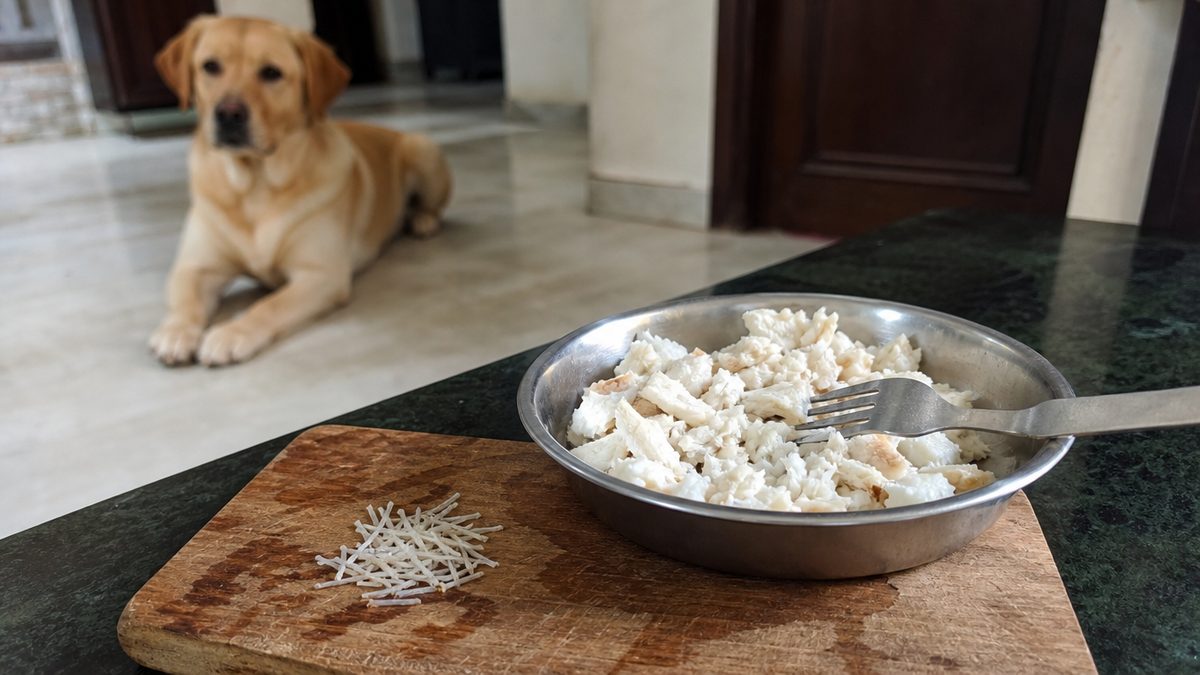
Cook the piece, let it cool, then break the flesh apart with your fingers rather than a fork, feeling for bone as you go. Check the dorsal muscle and the tail meat twice, because that is where the counted bones are. If a bone has already gone down, do not induce vomiting and telephone a veterinary surgeon; the clinical steps are on the bones for dogs page.
Mercury and heavy metals, measured in Indian fish and set against a pet's body weight
Mercury in the fish an Indian household buys runs between 1 and 3.4 percent of the legal limit, and at a sensible portion it lands near a human reference dose for the smallest animals and well below it for the largest. It is not the thing to worry about on this page.
India sets the limits and India has the measurements, which is unusual on a question like this. The Food Safety and Standards contaminants regulation caps mercury at 0.5 parts per million in non-predatory fish and at 1.0 part per million in predatory fish, naming tuna, marlin, swordfish and elasmobranchs, and caps methyl mercury in all foods at 0.25 parts per million calculated as the element. IFCT 2017 reports measured mercury for the fish group in micrograms per 100 grams.
| Fish | Samples | Mercury, micrograms per 100 g | mg per kg | Share of the 0.5 mg per kg limit |
|---|---|---|---|---|
| Rohu | 6 | 1.71 | 0.0171 | 3.4 percent |
| Pomfret, black | 1 | 1.70 | 0.0170 | 3.4 percent |
| Katla | 6 | 1.59 | 0.0159 | 3.2 percent |
| Sardine | 1 | 1.49 | 0.0149 | 3.0 percent |
| Prawns, big | 1 | 0.94 | 0.0094 | 1.9 percent |
| Bombil, Bombay duck | 2 | 0.90 | 0.0090 | 1.8 percent |
| Prawns, small | 3 | 0.78 | 0.0078 | 1.6 percent |
| Hilsa | 2 | 0.52 | 0.0052 | 1.0 percent |
| Bangda, surmai, tuna, white pomfret, nethili | 1 to 5 each | Below the detection limit | Not reported | Not reported |
The small animal is the one at the limit, and that is the opposite of what people assume
Convert those concentrations into what an animal takes in. The United States Environmental Protection Agency's reference dose for methylmercury is 0.0001 mg per kg of body weight per day, that is 0.1 micrograms per kg, derived from developmental neuropsychological impairment in children exposed before birth with an uncertainty factor of 10. Cap the fish at a tenth of the day's energy, take each animal's energy range from the WSAVA charts, and the arithmetic falls out.
| Animal | Daily energy, kcal | Rohu at 10 percent, g | Mercury, micrograms per day | Per kg of body weight, against the 0.1 reference |
|---|---|---|---|---|
| 3 kg cat | 200 to 210 | 20 to 21 | 0.33 to 0.35 | Up to 117 percent of it |
| 4 kg cat | 225 to 250 | 22 to 24 | 0.38 to 0.42 | Up to 104 percent of it |
| 5 kg cat | 250 to 290 | 24 to 28 | 0.42 to 0.49 | Up to 97 percent of it |
| 5 kg dog | 280 to 351 | 27 to 34 | 0.47 to 0.59 | Up to 117 percent of it |
| 10 kg dog | 470 to 590 | 46 to 58 | 0.79 to 0.99 | Up to 99 percent of it |
| 20 kg dog | 790 to 993 | 77 to 97 | 1.32 to 1.66 | Up to 83 percent of it |
| 30 kg dog | 1080 to 1346 | 106 to 132 | 1.81 to 2.25 | Up to 75 percent of it |
A small animal lands higher than a large one on every row, which surprises most readers. Energy requirement rises more slowly than body weight does, so a 3 kg cat eats far more food per kilogram of itself than a 30 kg dog does, and it therefore takes in more of anything the food contains, per kilogram of itself. The honest headline is that a daily rohu topper at the full ten percent cap puts the smallest animals at about the level a human reference dose allows, and a big dog at three quarters of it.
Run the same arithmetic on hilsa and it collapses to nothing: 9 to 14 percent of the reference dose across every animal, because hilsa is so energy-dense that the ten percent cap only buys 8 to 52 grams of it. The oiliest, most expensive Indian fish is the lowest-mercury way to feed fish, purely because you feed so little of it.
Four limits on this dataset, and we would rather you knew them
- IFCT reports total mercury, not methylmercury, while the reference dose is set for methylmercury, so the per-kilogram figures above are an upper bound rather than a like-for-like comparison.
- Sample counts run from 1 to 6 per species, which is a national reference dataset rather than a surveillance programme.
- A blank is below the detectable limit, not zero, so the five fish reported as undetected have an unknown small value rather than none.
- No reference dose has been derived for a dog or a cat, so the human figure is a yardstick and not a limit for an animal.
On the other metals in the same dataset, lead in rohu measured 0.014 mg per 100 grams, which is 0.14 mg per kg, the highest of the fish we extracted; katla measured 0.005 and tilapia 0.011. Arsenic in katla measured 7.70 micrograms per 100 grams and rohu 3.71. We are reporting those because they exist, not because we can convert them into a pet exposure the way mercury converts.
At the quantities a pet eats, mercury from ordinary Indian market fish does not decide anything. The thiaminase, the salt in dry fish and the 104 bones in a rohu all matter more. What would change that is a daily habit of a genuinely high-mercury predator such as shark, for which India's national tables carry no measurement at all.
Dry fish: the number Indian law sets, and what it does to a bowl
Indian law requires dry salted fish to contain not less than 12 percent sodium chloride, which is a floor rather than a ceiling, and which puts at least 4,721 mg of sodium in every 100 grams. That is 133 times the sodium in fresh rohu.
Karuvadu in Tamil Nadu, sukat and bombil on the Maharashtra coast, shutki in Bengal and dried bangude in coastal Karnataka are the cheapest animal protein in the country and the most likely fish to be handed to a street dog or a house cat without a second thought. No pet page we found carries a salt figure for any of them.
The figure exists and it is a legal requirement. The Food Safety and Standards regulation for salted fish and dried salted fish sets four characteristics: water activity below 0.78, salt content not less than 12 percent sodium chloride, histamine not more than 200 mg per kg, and acid insoluble ash on a dry basis not more than 1 percent. Twelve percent sodium chloride is 4.72 grams of sodium in every 100 grams of fish.
| Food or comparison | Sodium | What that is |
|---|---|---|
| Fresh rohu, per 100 g | 35.56 mg | The baseline, measured by IFCT 2017 |
| Fresh bangda, per 100 g | 83.01 mg | The saltiest fresh fish in the carp and mackerel group |
| Fresh big prawn, per 100 g | 849 mg | The outlier; a prawn is salty before anyone salts it |
| Dry salted fish at the 12 percent floor, per 100 g | 4,721 mg | 133 times fresh rohu and 57 times fresh bangda |
| One 20 g piece of dry salted fish | 944 mg | Eight to ten times a 10 kg dog's whole-day sodium minimum |
| The same 20 g for a 4 kg cat | 944 mg | Seven and a half to eight and a half times its whole-day minimum |
The whole-day comparison uses AAFCO's adult minimums of 0.20 grams of sodium per 1,000 kcal for a dog and 0.5 grams for a cat, run against the WSAVA energy ranges World Small Animal Veterinary Association. Those are minimums rather than ceilings, and neither body sets a maximum for a healthy adult, so this is a scale comparison and not a toxicity claim.
Toxicity is a separate question with a published dose, and our page on spices, salt and masala for pets owns it. What belongs here is the conversion that page cannot make. At the 12 percent legal floor, a 10 kg dog would have to eat about 167 grams of dry salted fish and a 4 kg cat about 67 grams to reach the threshold at which that page reports signs can appear. A cat finding a handful on a drying mat is inside that range.
Two of the other three characteristics in the same standard matter for a bowl. A water activity below 0.78 is what stops the fish spoiling without refrigeration, which is also why dry fish survives a humid monsoon week in Mumbai or Chennai when fresh fish does not. The histamine cap applies only to dried and dry-salted products made from fish species associated with histamine poisoning, which is the scombroid group: bangda, surmai and tuna. We found no case literature on histamine poisoning in dogs or cats and are not going to invent a risk, but a legal cap exists because the species are known to form it when handled badly.
One Indian page recommends dried nethili as a crunchy treat and tells the reader to use fresh or dried anchovies with no added salt. A dried fishery product sold in an Indian market is required to carry at least 12 percent salt if it is salted at all, and fresh nethili already measures 212 mg of sodium per 100 g, six times fresh rohu, before anybody salts it. Unsalted dried fish has to be bought as such and verified on the label, not assumed.
Raw fish, and what the Indian parasite evidence actually amounts to
Raw fish is a no for both species, and the reason is thiaminase rather than parasites, because India has almost no parasite prevalence data on its market fish and the one study we found covers a single species on one coast.
The Indian measurement we could find is recent and narrow. Researchers examining Indian sand whiting, Sillago sihama, from the central west coast of India between 2021 and 2024 recovered 367 third-stage larvae from the small intestines of their fish, and reported a prevalence of 6.84 percent for Anisakis typica and 13.65 percent for a co-occurring anisakiasis agent in the same fish.
That is one species, from one stretch of coast, in one laboratory's sampling. There is no national survey of parasite prevalence in Indian market fish that we could find, nothing at all on the freshwater carps that make up most of the country's fish, and no case series of parasitic disease in Indian dogs or cats traced to raw fish. A page that tells you Indian raw fish carries a specific parasite risk is extrapolating, and so would we be.
Which is why the argument for cooking does not rest on parasites. Thiaminase is denatured by heat, the fish most likely to carry it are the freshwater tropical species an Indian household buys, and the requirement the enzyme attacks is one a cat burns through at nearly a 10 kg dog's rate. Three measured things point the same way, and none of them needs a parasite to make the case.
Raw feeding as a whole, with its bacterial risks to the animal and to the household, is a separate argument covered elsewhere on this site and is not reopened here.
Cats and fish, where the answer stops being the dog answer
A cat is the restricted species on every row of this page, and the reason is not that fish is worse for cats but that a cat is small, eats more food per kilogram of itself, and needs nearly a medium dog's thiamine.
The obligate-carnivore case, the taurine requirement and the four separate problems with a fish-based bowl are set out in full on Indian food safe for cats, which lists cooked boneless fish among the few things from an Indian kitchen a cat can be given. This section extends that page on the parts it does not quantify, and does not restate it.
Three numbers from the sections above change their meaning when you put a cat on the other side of them. A 4 kg cat needs 85 percent of a 10 kg dog's daily thiamine. A 3 kg cat at the ten percent fish cap takes in more mercury per kilogram of itself than a 30 kg dog does, by a factor of about 1.6 World Small Animal Veterinary Association. And a cat's protein floor is 65 grams per 1,000 kcal against a dog's 45, so hilsa at 84 clears it by only 29 percent where it clears the dog floor by 87 percent ICMR-National Institute of Nutrition.
AAFCO sets an explicit fish threshold for cat food, and nobody quotes it
Buried in the cat profile footnotes is a line that names a quantity of fish. Vitamin K does not need to be added to a cat food unless the diet contains more than 25 percent fish on a dry matter basis. That is the only published number we found anywhere that says how much fish turns a cat's diet into a different nutritional problem, and it comes from the body that writes the profiles.
Twenty-five percent of dry matter is a high bar for a topper and a low one for a habit. A cat on a complete food with a piece of cooked fish twice a week is nowhere near it. A cat living on fish and rice passed it a long time ago, and the vitamin K footnote is one of several reasons why.
The fish-fixated cat, and the one thing that is not true about it
Cats do form strong preferences and a cat that has been fed fish daily often refuses everything else, which is the practical reason vets ask owners to rotate proteins. How to move a fixed cat onto a complete food, and the hard rule about never starving a cat onto a new one, are covered on the Indian food safe for cats page.
What is not supported is the common claim that fish is addictive to cats in any pharmacological sense. We looked for a measurement behind it and found none. It is a strong learned preference for a strongly flavoured food, which is a behaviour problem with a behaviour solution, and calling it an addiction makes owners think it cannot be changed.
Twenty-two to twenty-four grams of cooked rohu is a 4 kg cat's entire ten percent allowance for the day, and nine to ten grams of hilsa is the same allowance ICMR-National Institute of Nutrition. Weigh it once on a kitchen scale and you will never need to again, because the eye reliably over-serves a small animal.
How much fish, worked for four sizes of dog and three of cat
Cap fish at a tenth of the day's energy and subtract it from the meal rather than adding it, and the grams follow from the fish you picked, because an Indian fish ranges from 65 to 259 kilocalories per 100 grams.
The daily energy ranges are the WSAVA charts for an average healthy adult in ideal body condition World Small Animal Veterinary Association. The energy densities are IFCT 2017's, converted at 4.184 kilojoules to the kilocalorie. Both tables assume the fish is cooked plain, with no oil, salt or masala, and fully deboned.
| Dog | Daily energy, kcal | Rohu at 102 kcal per 100 g | Surmai at 136 | Big prawn at 91 | Hilsa at 259 |
|---|---|---|---|---|---|
| 5 kg | 280 to 351 | 27 to 34 g | 21 to 26 g | 31 to 39 g | 11 to 14 g |
| 10 kg | 470 to 590 | 46 to 58 g | 35 to 43 g | 52 to 65 g | 18 to 23 g |
| 20 kg | 790 to 993 | 77 to 97 g | 58 to 73 g | 87 to 109 g | 31 to 38 g |
| 30 kg | 1080 to 1346 | 106 to 132 g | 79 to 99 g | 119 to 148 g | 42 to 52 g |
| Cat | Daily energy, kcal | Rohu | Surmai | Big prawn | Hilsa |
|---|---|---|---|---|---|
| 3 kg | 200 to 210 | 20 to 21 g | 15 g | 22 to 23 g | 8 g |
| 4 kg | 225 to 250 | 22 to 24 g | 17 to 18 g | 25 to 28 g | 9 to 10 g |
| 5 kg | 250 to 290 | 24 to 28 g | 18 to 21 g | 28 to 32 g | 10 to 11 g |
Why a piece of hilsa is not a piece of rohu
Across those two tables the hilsa column is roughly two and a half times smaller than the rohu column for the same animal, and that single ratio is the thing an Indian household gets wrong. Fish is served by the piece, and a piece of ilish and a piece of rui look the same on the plate. By energy they are not remotely the same food.
The one portion on the Indian SERP that fails its own rule
The South India guide states the ten percent cap and then gives half a mackerel, 75 to 100 grams, for a medium 15 kg dog. A 15 kg dog's WSAVA range is 640 to 800 kilocalories and bangda measures 101.1 kilocalories per 100 grams, so 75 grams is 9.5 to 11.8 percent of that dog's day and 100 grams is 12.6 to 15.8 percent ICMR-National Institute of Nutrition. The top of its own range breaks the rule it states two columns earlier. In fairness, its pomfret and sardine rows sit inside the cap.
Six steps, in the order they have to happen
- Weigh the raw fish against the row above for your animal's weight.
- Cook it through by boiling, steaming or baking, with no oil, salt, masala, onion or garlic.
- Cool it to room temperature, because a cat will not touch food served hot and a dog will bolt it.
- Flake it apart with your fingers twice, feeling the dorsal muscle and the tail meat for the branched bones counted above.
- Subtract the same number of calories from the meal rather than adding the fish on top.
- Refrigerate the rest within half an hour, because cooked fish on a counter through a humid afternoon is not the food it was at lunch.
Ten percent of the day in fish means ten percent less of everything else that day, weighed out before the fish goes in. Added on top, the same piece is a ten percent daily surplus, which is how a flat-living Indian dog gains a kilogram a year without anyone noticing a change.
What this page can prove, and what it cannot
Most of the figures on this page come from Indian government datasets and peer-reviewed measurement, and three of its most interesting statements are inferences rather than measurements. Here is which is which.
| Claim | Status | What it rests on |
|---|---|---|
| Composition, mercury, sodium and vitamin E of 14 Indian fish | Measured | IFCT 2017, 1 to 6 samples per species, read in the published PDF |
| Protein per 1,000 kcal, and every ratio in this page's tables | Computed | Our arithmetic on those rows; not printed in the book |
| 119 of 300 fish species carry thiaminase; freshwater and tropical species more often | Measured and modelled | A 300-species survey with a Bayesian model behind the ecological part |
| Rohu and katla specifically carry thiaminase | NOT established | Neither species is named in that survey's main text; this is a group-level expectation |
| A cat needs two to four times a dog's thiamine | Measured, with the paper's own words and numbers disagreeing | NRC allowances as reported in the 2017 review |
| Why a cat needs more thiamine than a dog | NOT established | The review states the mechanism is currently unknown |
| Vitamin E to PUFA ratios for Indian fish against AAFCO's 0.6 floor | Computed from measured inputs | A ratio written for a complete diet, applied to one ingredient |
| 104 pin bones in a table-size rohu | Counted | Dissection of roughly 1,200 g Indian major carps |
| Parasite prevalence in Indian market fish generally | NOT established | One species on one coast is the only Indian figure we found |
| Histamine risk to dogs and cats from dry scombroid fish | NOT established | A legal cap exists; no veterinary case literature was found |
Four things circulating on this query that do not survive a check
- That seer fish is unsafe for dogs because of high mercury. India's own national tables found mercury below the detection limit in vanjaram, while rohu, black pomfret, katla and sardine, which the same pages wave through, carry the four highest measured values in the dataset momoandco, Sea Fish for Dogs in South India….
- That rohu is a useful omega-3 source. IFCT measured 0.070 g of cis omega-3 per 100 g in rohu against 1.163 in surmai, so surmai carries sixteen times as much.
- That dried fish can be assumed to be low in salt. Indian law requires dry salted fish to carry not less than 12 percent sodium chloride.
- That cooking solves the thiamine problem. Cooking solves the thiaminase problem and creates a thiamine one, because processing may destroy up to 90 percent of the thiamine in a diet.
Two things we wanted and could not get. There is no Indian measurement of thiaminase activity in any Indian major carp that we could find, which is the single most useful study nobody has run. And India's national food tables carry no row for dry fish at all, so the sodium figure in this page is a legal floor rather than a measurement of what is actually sold in a Chennai or Bengaluru market.
Fish for dogs and cats in India: the questions people actually ask
Which Indian fish can dogs eat?
Dogs can eat rohu, katla, bangda, surmai, pomfret, nethili, Bombay duck, prawn and hilsa, all cooked plain and fully deboned. Every one of them clears an adult dog's protein minimum of 45 g per 1,000 kcal by between 1.9 and 5 times, measured from India's own food tables. Pick by energy density rather than by reputation: rohu is 102 kcal per 100 g and hilsa is 259, so the same looking piece is two and a half times the meal.
Is fish ok for dogs every day?
Fish is fine every day only as a capped topper on a complete food, at about a tenth of the day's energy, which is 46 to 58 g of cooked rohu for a 10 kg dog and 106 to 132 g for a 30 kg dog. Daily fish as most of the diet is a different thing and has a published failure mode, because the steatitis case series were animals fed almost nothing else. Rotate the protein rather than repeating one fish.
Which fish is toxic for dogs?
No fish sold in an Indian market is toxic to a dog in the way chocolate or onion is. Raw fish is the real hazard, because thiaminase destroys thiamine and 59.5 percent of freshwater species carry the enzyme against 21.8 percent of marine ones. Dry salted fish is the second, because Indian law requires it to hold at least 12 percent salt. Cooked, plain, deboned fish is not toxic at a sensible portion.
Can I give my dog salted fish?
No, not as a routine treat. Indian law sets a floor of 12 percent sodium chloride for dry salted fish, which is 4,721 mg of sodium in 100 g, about 133 times fresh rohu. A single 20 g piece carries 944 mg of sodium, eight to ten times a 10 kg dog's whole-day sodium minimum. Rinse nothing and substitute nothing; use fresh or genuinely unsalted dried fish instead, and read the label rather than assuming.
Is rohu fish full of bones?
Yes, and the count is published. Indian researchers dissected table-size rohu of around 1,200 g and found 104 intermuscular pin bones, 60 of them Y-shaped and branched and 44 straight. The Y bones sit embedded in the dorsal broad muscle and the straight ones in the lateral tail muscle, so they do not lift off with the frame. Katla holds 108 and mrigal 110. Debone by hand, by feel, twice.
How many prawns can I give my dog?
Work it in grams rather than in prawns, because Indian prawns vary enormously in size. A big freshwater prawn measures 91 kcal per 100 g, so a tenth of the day is 31 to 39 g for a 5 kg dog, 52 to 65 g for a 10 kg dog and 119 to 148 g for a 30 kg dog. Cook them, shell and devein them, and note that prawn is naturally the saltiest thing in India's fish tables at 849 mg of sodium per 100 g.
Can dogs eat cooked fish?
Yes, and cooked is the only form either species should be given. Cooking denatures the thiaminase that destroys thiamine, which is the single clearest reason to heat the fish through. Cook it plain by boiling, steaming or baking with no oil, salt, masala, onion or garlic, let it cool, flake it apart by hand to find the bones, and subtract its calories from the meal instead of adding them.
What fish can dogs not eat?
Avoid any raw fish, any dry salted fish, any fish cooked in a masala base, and any fish you cannot fully debone. Shark is worth avoiding on general grounds as a long-lived predator, though India's national food tables carry no mercury measurement for it to quote. Everything else sold in an ordinary Indian market is acceptable cooked, plain and deboned, inside a tenth of the day's energy.