
Dog and cat nutrition guide
Can dogs eat eggs? The arithmetic for both species, and what the Indian Salmonella figures actually say
Three Indian studies have counted Salmonella in retail eggs and not one pet page quotes them. The yolk-only habit is backwards, the desi egg is not what it is sold as, and one egg is a far bigger meal than anybody says.
Quick answer
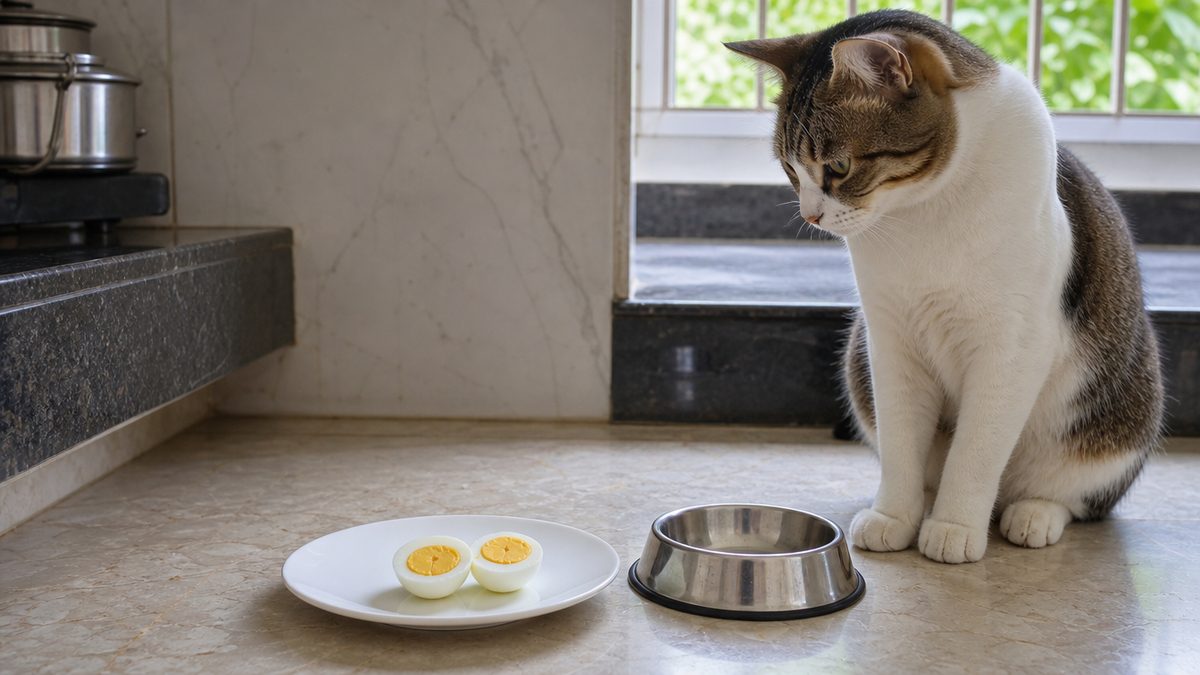
Can dogs eat eggs? Yes, cooked and plain, and the portion is the whole question. A boiled hen egg carries about 91 grams of protein in every 1,000 kilocalories against the 45 grams an adult dog's diet must hold, so it is unusually good food. It is also dense. Fifty grams of boiled egg is roughly a quarter of a five-kilogram dog's day and a third of a four-kilogram cat's. Cook it. Cooking settles the Salmonella question and the avidin one together.
This guide is general information for Indian pet owners and is not a diagnosis. Always consult a registered veterinarian near you before acting on anything you read here, and treat any sudden change in your pet's condition as urgent.
Can dogs eat eggs, and what does an egg actually deliver?
Dogs can eat plain cooked eggs, and what an egg delivers is protein at about twice the density an adult dog's diet is required to hold: India's own food composition tables put a boiled hen egg at 13.43 g of protein and 618 kJ per 100 g, which works out at 90.9 g of protein per 1,000 kcal against a published minimum of 45 g.
The ICMR-National Institute of Nutrition measured six poultry-egg samples for the Indian Food Composition Tables 2017 and printed every form separately, raw and boiled, whole, white and yolk. The Merck Veterinary Manual states the minimums the egg is being measured against: an adult dog's diet needs at least 45 g of protein per 1,000 kcal of metabolisable energy under the AAFCO profiles, and an adult cat's needs 65 g.
Converting the kilojoule column to kilocalories and dividing gives the only number that matters, because a food's protein percentage means nothing until you know how many calories came with it. Our page on rice for dogs established that method on this site and showed what it does to a staple; the egg is the same arithmetic pointed at the opposite kind of food.
| IFCT row | Protein, g | Fat, g | Energy, kJ | kcal | Protein per 1,000 kcal | Against dog 45 / cat 65 |
|---|---|---|---|---|---|---|
| Egg, poultry, whole, raw (M001, n=6) | 13.28 | 9.15 | 564 | 134.8 | 98.5 g | 2.2x dog, 1.5x cat |
| Egg, poultry, whole, boiled (M004, n=6) | 13.43 | 10.54 | 618 | 147.7 | 90.9 g | 2.0x dog, 1.4x cat |
| Egg, poultry, white, raw (M002, n=6) | 10.84 | 0.06 | 187 | 44.7 | 242.5 g | 5.4x dog, 3.7x cat |
| Egg, poultry, yolk, raw (M003, n=6) | 15.74 | 26.34 | 1,242 | 296.8 | 53.0 g | 1.2x dog, 0.8x cat |
| Egg, country hen, whole, raw (M008, n=1) | 13.14 | 13.00 | 704 | 168.3 | 78.1 g | 1.7x dog, 1.2x cat |
| Egg, country hen, whole, boiled (M009, n=1) | 14.43 | 14.10 | 767 | 183.3 | 78.7 g | 1.7x dog, 1.2x cat |
Read the last column and the whole case for the egg is there. Almost nothing an ordinary Indian kitchen holds clears both minimums at once. Milled rice carries about 22 g of protein per 1,000 kcal and wheat atta about 33 g, so both sit well below even the dog figure. A boiled egg sits at double it. That is what people mean when they call egg protein complete, and it is why a vegetarian-leaning household that will not buy meat will often still buy eggs for the animal. Our guide to feeding a dog in a vegetarian household sets out what eggs and dairy close in a meat-free bowl and what they leave open.
The yolk-only habit is exactly backwards
Give the white rather than the yolk, if you are going to split the egg at all, because the protein is in the white and the calories are in the yolk. The table above says it plainly. Raw egg white carries 242.5 g of protein per 1,000 kcal; raw yolk carries 53.0 g. A great many Indian households give the dog the yolk and keep the white, or the reverse, on the belief that the yolk is the nutritious half.
For a cat the split matters more than for a dog. Yolk alone at 53.0 g of protein per 1,000 kcal does not reach the 65 g an adult cat's food is required to hold. A bowl built around egg yolk is a bowl diluted below the feline minimum by the very ingredient that was supposed to be the protein.
Merck prints both standards side by side, and they are far apart. An adult dog's minimum is 45 g of protein per 1,000 kcal under AAFCO and about 20 g under the NRC; an adult cat's is 65 g under AAFCO and 40 g under the NRC. This page uses the higher AAFCO figure throughout, which is the harder test. The one place the gap changes an answer is egg yolk for a cat: at 53.0 g it fails the AAFCO minimum and clears the NRC one, so the honest verdict is that yolk-heavy feeding is unsafe by one standard and marginal by the other.
The egg also brings fat, and in quantity. A boiled egg carries 71.4 g of fat per 1,000 kcal and raw yolk carries 88.7 g. For a healthy adult animal that is simply energy. For a dog with a history of pancreatitis it is the reason the answer changes, and that section is further down this page.
How much egg, worked for four sizes of dog and for a cat
To size an egg for an animal, take 10 percent of its published daily energy, divide by 1.48 kilocalories per gram of boiled egg, and subtract those calories from the meal rather than adding them to it. For a 5 kg dog that comes to about 20 g, which is less than half an egg.
The WSAVA's ceiling is unambiguous: treats should always make up less than 10 percent of a dog's daily calorie intake. Its published energy ranges give the denominator for four weights of dog and for cats World Small Animal Veterinary Association. A boiled poultry egg runs at 147.7 kcal per 100 g by IFCT, which is 1.48 kcal in every gram.
One caveat before the table. No Indian egg pack we could find declares a weight per egg, and we found no Indian consumer weight class we could verify, so the per-egg column below uses 50 g of edible egg, the weight the USDA assigns a large egg once the shell is off. If your eggs are the smaller ones common in local shops, scale the figures down; if you want to be exact, weigh one.
| Animal | Daily energy, kcal | One 50 g egg, as a share of the day | 10 percent treat ceiling, kcal | That ceiling in boiled egg | In eggs |
|---|---|---|---|---|---|
| Dog, 5 kg | 280 to 351 | 21 to 26 percent | 28 to 35 | 19 to 24 g | about two fifths |
| Dog, 10 kg | 470 to 590 | 13 to 16 percent | 47 to 59 | 32 to 40 g | two thirds to four fifths |
| Dog, 20 kg | 790 to 993 | 7 to 9 percent | 79 to 99 | 53 to 67 g | one to one and a third |
| Dog, 30 kg | 1,080 to 1,346 | 5 to 7 percent | 108 to 135 | 73 to 91 g | one and a half to one and four fifths |
| Cat, 4 kg | 225 to 250 | 30 to 33 percent | 22 to 25 | 15 to 17 g | about a third |
The cat row is the one nobody publishes. A single egg is about a third of a 4 kg cat's entire daily energy. Fed on top of a full bowl it is a third of a day's calories added to a day's calories, every time. Fed instead of part of the bowl it displaces a third of whatever that bowl was carrying, which for a cat is a serious matter and is dealt with in the cat section below.
Why one egg is a different food for a small animal
An egg does not scale with the animal. It is roughly 74 kilocalories whether a Labrador eats it or an Indie pup does, so the same object is 6 percent of one animal's day and 33 percent of another's. That is the whole reason a rule stated as "one egg" cannot be right for every dog, and the reason this page gives grams. Cap the portion by body weight, not by the shape of the thing in your hand.
Half an egg for a dog under about 12 kg, a whole egg for a dog of 20 kg or more, and a quarter to a third of an egg for an average cat, all of it counted inside the day's food rather than on top of it. Weigh the piece once with a kitchen scale and you will not need to again.
What the ranking Indian pages advise, run through the same arithmetic
The page ranking first in India on "egg for dogs india" on 21 October 2026 advises two to three eggs, four or five times a week, for a dog over 25 kg. Three eggs is 222 kcal, which is 16 to 21 percent of a 30 kg dog's published day, and two eggs is 11 to 14 percent. Both are over the 10 percent ceiling the same page's category routinely cites World Small Animal Veterinary Association. Its advice for dogs up to 10 kg, half to one egg, puts a whole egg at 13 to 16 percent of the day.
The page ranking first on "boiled egg for dogs india" states that a typical large egg contains about 60 calories. A 50 g large egg is 71.5 kcal raw by the USDA figure and 73.9 kcal boiled by the IFCT one ICMR-National Institute of Nutrition. The understatement is about 20 percent, and it runs straight into the portion advice on the same page, which invokes the 10 percent rule and then never performs the division.
Neither page is dishonest and both get the big things right. The point is narrower: every Indian page on this query names the 10 percent treat ceiling and not one of them turns it into grams.
Raw against cooked, part one: the Salmonella numbers that exist for India
Raw eggs carry a measurable Salmonella risk in India, and the figure that decides it is Indian rather than Western: 38 of 492 retail eggs in Coimbatore tested positive across one year, 7.7 percent, with contamination peaking in the monsoon months.
Three Indian studies have counted this, and none of them appears on any pet page we read. Suresh and colleagues sampled 492 eggs and 82 egg-storing trays from retail outlets in a residential area of Coimbatore over a full year. Salmonella contamination was recorded in 38 of 492 eggs, 7.7 percent, of which 29 were on the eggshell and 9 in the egg contents. Around 7.5 percent of the egg-storing trays were contaminated as well.
Two details in that paper matter more than the headline. The first is the serovar: 89.7 percent of the eggshell strains and 100 percent of the egg-content strains were Salmonella Enteritidis, the serovar most associated with egg-borne human illness. The second is the season. The authors identified seasonal variation in the prevalence pattern, with a higher prevalence during monsoon months followed by post-monsoon and pre-monsoon. An Indian raw-egg habit is not one risk all year.
Singh and colleagues ran the same question in north India on 560 chicken eggs collected between April 2006 and July 2007, 260 from poultry farms and 300 from marketing channels. Twenty seven, 4.82 percent, were positive. Ten of the farm eggs, 3.84 percent, and 17 of the market eggs, 5.5 percent, carried Salmonella, and Salmonella Typhimurium was the predominant serovar.
The three studies disagree, and the disagreement is the useful part
The third study found nothing at all. Saravanan and colleagues screened 1,215 samples from 154 commercial layer farms in southern India and isolated Salmonella from 21 of them, 1.73 percent overall, but from 0 of the 213 eggs they tested. Eggs were the single cleanest sample type in the whole survey, below liver, yolk from dead birds, feed and drag swabs.
| Study | Where the eggs came from | Eggs tested | Positive | What it points at |
|---|---|---|---|---|
| Saravanan and others, 2015 | 154 commercial layer farms, southern India | 213 | 0 | The hen and the farm are not the main source |
| Singh and others, 2010 | Poultry farms, north India | 260 | 10 (3.84 percent) | Low but not zero at the farm |
| Singh and others, 2010 | Wholesale and retail markets, north India | 300 | 17 (5.5 percent) | Higher once the egg has moved |
| Suresh and others, 2006 | Retail outlets, Coimbatore, over one year | 492 | 38 (7.7 percent) | Highest at the end of the chain, and worst in the monsoon |
Two of those three studies were run in Tamil Nadu, which is not an accident of sampling. The authors of the 2015 survey record that mass poultry production regions sit in several parts of the country and especially in the southern states, Tamil Nadu and Andhra Pradesh. The eggs in those papers are close to where a very large share of India's table eggs are laid.
Lay the three side by side and a pattern comes out that no single one of them states. The contamination rises as the egg travels. It is lowest at the farm gate, higher in the market, highest on a retail shelf, and 7 of 82 of the trays those retail eggs were sitting in were themselves contaminated Singh, Yadav, Singh and Bharti Saravanan, Purushothaman, Murthy, Sukumar. That is a handling and storage problem rather than a hen problem, which is good news, because handling and storage are the two things a household controls.
Where one of these papers disagrees with itself
The Coimbatore paper prints two different eggshell figures. Its abstract reports 29 of 492 as 5.9 percent, which is the correct division; its results section states that Salmonella contamination was recorded in 6.1 percent of eggshells. The same mismatch appears for the trays: the abstract says around 7.5 percent while the results section reports 7 of 82, which is 8.5 percent. We are publishing both rather than silently choosing, and we have used the fractions rather than the percentages wherever the two conflict, because a fraction can be checked.
One more honest limit. The Coimbatore sampling ran from June 1997 to May 1998 and the north India sampling from 2006 to 2007. Both are old. We found no recent Indian survey of Salmonella in retail table eggs, so these are the best Indian denominators available rather than current ones.
A dog that eats a contaminated raw egg can shed the organism, and the people who handle the bowl, the floor and the dog are in the same exposure as the dog. Our page on raw meat and your pet at Eid sets out the household side of raw animal products in an Indian kitchen in full. FSSAI's own instruction after handling eggs is the shortest version of it: always wash your hands thoroughly with soap and water after handling eggs.
Cooking ends this question. The FDA's instruction is to cook eggs until both the yolk and the white are firm, and it adds that scrambled eggs should not be runny. A hard-boiled egg, a plain scrambled egg with no oil and no salt, or a plain unsalted omelette all clear that bar.
Raw against cooked, part two: avidin and biotin, with the dose
The avidin problem in raw egg white is real and it needs a sustained, egg-white-heavy diet rather than an occasional egg: the smallest experimental dose that produced deficiency in a cat was dried raw egg white at 18.5 percent of the whole diet, fed for 25 weeks.
Raw egg white contains avidin, a glycoprotein that binds biotin and prevents its absorption in the gut. The Merck Veterinary Manual lists it with thiaminase in raw fish and trypsin inhibitors in raw soybeans as an antinutritional factor destroyed by cooking, and records the clinical signs of biotin deficiency as poor growth, dermatitis, lethargy and neurologic abnormalities.
What almost nobody supplies is the quantity. Avidin has been used for eighty years as the standard laboratory method of producing biotin deficiency on purpose, so the doses are published, and they are nothing like a boiled egg on a Sunday.
| Species | What was fed | How much of the diet | For how long | Study |
|---|---|---|---|---|
| Cat (growing kittens) | Dried, raw egg white | 18.5 percent | 25 weeks | Carey and Morris, 1977 |
| Cat (growing kittens) | Dried, raw egg white | 32 percent | 12 weeks | Carey and Morris, 1977 |
| Pig | Desiccated egg white | 30 percent | Not stated in the abstract | Cunha and others, 1946 |
| Mink | Commercial spray-dried whole eggs | 10 percent | Not stated in the abstract | Wehr and others, 1980 |
| Mink | Fresh frozen whole chicken eggs | 20 percent | Not stated in the abstract | Wehr and others, 1980 |
| Chick | Spray-dried whole egg | 43 percent | Not stated in the abstract | Kratzer and others, 1988 |
The cat figures are the most useful to a pet owner because they are the only ones in a species on this page. Carey and Morris produced biotin deficiency in growing kittens with a diet containing dried, raw egg white at 18.5 percent for 25 weeks or 32 percent for 12 weeks, after which the kittens showed alopecia and scaly dermatitis, and an injection of 0.25 mg of biotin every other day reversed the signs even while the egg-white diet continued. Note what those numbers describe: not an egg, but a purified diet built around dried egg white as a principal ingredient, for three to six months.
The yolk's own biotin does not cancel the white's avidin
Do not rely on feeding the whole egg to solve this, because it has been tested and it does not. Kratzer and colleagues fed chicks diets containing 43 percent dried whole egg, yolk and white together. The birds grew poorly and developed perosis and dermatitis, and the signs were prevented progressively by adding biotin to the diet. Their conclusion was explicit: the biotin contained in egg yolk is inadequate to counteract the deficiency of biotin caused by the avidin in egg white. The mink work points the same way, since fresh frozen whole chicken eggs at 20 percent of the ration produced classical biotin deficiency signs in young mink.
So the commonly repeated reassurance that a whole raw egg is self-correcting is not supported. The correct reassurance is a different one, and it is about dose rather than about the yolk.
There is no controlled dog study, and we are not going to pretend otherwise
We could not find a controlled feeding study in which raw egg white produced biotin deficiency in a dog. The experimental literature runs through cats, pigs, rats, chicks and mink. Every one of those studies used a large fraction of the whole diet for weeks to months, and the one species closest to a dog's size and metabolism in that list, the pig, needed 30 percent desiccated egg white in the ration.
Read against that, an occasional raw egg over a dog's rice is not a plausible route to biotin deficiency. It remains a plausible route to Salmonella, which is the reason this page still says cook it.
Heat denatures avidin, so a cooked egg white binds no biotin, and heat kills Salmonella, so a firm-yolked egg carries none United States Food and Drug Administration. One two-minute decision retires both problems, and it costs the egg nothing a dog or a cat needs.
The shell, which Indian households grind for calcium
Ground eggshell is a usable calcium carbonate source and the dose is the part that goes wrong, so this page gives the verdict and the hygiene caveat and sends the dosing question to the page that owns it.
Bonbeno's full treatment of calcium in a home-cooked bowl, including eggshell powder, the calcium-to-phosphorus ratio and the dosing rules that circulate in India, is on our page about balancing a home-cooked diet for calcium. Nothing on this page should be used to set a calcium dose.
Two things belong here rather than there. The first is that the Indian pages ranking on this query do not agree with each other at all, and a reader moving between them gets three different answers to the same question.
- Purina India: "Can dogs eat eggshells? No. Eggshells contain very high levels of certain minerals, particularly calcium which can make their dietary intake imbalanced.";
- Vetic: eggshells are "primarily composed of calcium carbonate" and feeding them "is not routinely recommended", with sharp fragments and improper calcium balance named as the concerns.
- The Doggos: "Yes, dogs can totally eat eggshells! And honestly, they're an excellent, natural source of calcium", with a dosing rule attached.
- The resolution is not a vote. Eggshell is calcium carbonate and it works as a calcium source; what decides whether it helps or harms is the grams against the animal's energy, which is a calculation rather than a spoon.
The second is hygiene, and it is specific to eggs. FSSAI's guidance is to avoid washing dirty eggs, because they become more porous when wet and that makes an easy entry for bacteria inside the egg, and to dispose of any egg that is cracked or too dirty. A shell being saved for grinding is by definition a shell that has been handled, and the outside of an Indian retail eggshell is the surface that carried Salmonella in 29 of 492 Coimbatore eggs. If shells are being used, they are baked or boiled first, not rinsed and dried.
Cats: where the answer changes, and why it is not the dog answer
An egg is excellent protein for a cat and closes none of the gaps that make a cat an obligate carnivore, because measured hen egg carries no taurine at all.
The obligate-carnivore case, the taurine requirement and the protein-density method for cats are set out in full on our page about Indian food safe for cats, which lists a plain cooked egg among the five things from an Indian kitchen a cat can safely be given. This section extends that page on the one question it does not answer: what an egg does and does not do for a cat specifically.
The answer rests on a measurement from UC Davis. Spitze and colleagues assayed taurine across animal feed ingredients and printed eggs in three forms. Large grade AA eggs measured 0 mg of taurine per kg wet weight. Large grade AA egg whites measured 0. Large grade AA egg yolks measured 12.14 mg per kg. Raw boneless skinless chicken breast in the same table measured 159 mg per kg and raw chicken dark meat measured 1,690 mg per kg.
| Ingredient | Samples | Taurine, mg per kg | Against egg yolk |
|---|---|---|---|
| Large grade AA eggs, whole | 1 | 0 | - |
| Large grade AA egg whites | 3 | 0 | - |
| Large grade AA egg yolks | 2 | 12.14 | 1x |
| Chicken, raw, boneless skinless breast | 2 | 159 | 13 times higher |
| Chicken, dark meat, raw | 6 | 1,690 | 139 times higher |
| Chicken, liver | 1 | 1,100 | 91 times higher |
Now put that next to the portion arithmetic from earlier on this page. One 50 g boiled egg is 30 to 33 percent of a 4 kg cat's daily energy ICMR-National Institute of Nutrition. If it is fed instead of part of the bowl, about a third of that cat's day has been handed over to a food with no measurable taurine in it. If it is fed on top, the cat is being overfed by a third of a day.
The egg fills, and on the one nutrient that matters most it does not help
This is the cleanest way to state the species difference on this page. For a dog, an egg is simply very good protein and the only question is how much. For a cat, an egg is very good protein that arrives carrying none of the taurine the species cannot make for itself, in a portion large enough to displace the food that was carrying it. The egg is not harmful. It is just not the thing a cat's diet was short of.
That is also why no quantity of egg turns an incomplete cat bowl into a complete one, and why this page gives a cat a quarter to a third of an egg rather than a whole one. Our guides to homemade cat food in India and the cat diet chart cover what the rest of that bowl has to carry.
The second organic result in India for "can cats eat eggs" on 21 October 2026 was a three-year-old Reddit thread asking exactly this, whether an egg can replace an expensive tin. On the protein density it can. On taurine it cannot, and on the other nutrients only animal tissue supplies it cannot either. Cost is a real constraint for a lot of Indian cat households and the honest answer is to buy a cheaper complete food rather than a better ingredient.
One practical note for cats that does carry over from dogs. Cook it plain. No salt, no masala, no oil, no butter, and nothing from the pan the family's omelette came out of.
Desi against poultry eggs: what the one Indian measurement shows
The desi egg carries no more protein than the poultry egg and about 42 percent more fat, on the only Indian measurement that exists, and that measurement is a single sample, so treat the whole comparison as thin rather than settled.
Desi or country-hen eggs sell at a sharp premium across India on a nutritional claim, and India has measured the question exactly once. The IFCT 2017 tables carry both birds. Raw poultry egg, from six samples, measured 13.28 g of protein, 9.15 g of fat and 564 kJ per 100 g. Raw country-hen egg, from one sample, measured 13.14 g of protein, 13.00 g of fat and 704 kJ per 100 g.
| Measure | Poultry egg (n=6) | Country hen egg (n=1) | Difference |
|---|---|---|---|
| Protein, g | 13.28 | 13.14 | 1 percent lower in the desi egg |
| Fat, g | 9.15 | 13.00 | 42 percent higher in the desi egg |
| Energy, kJ | 564 | 704 | 25 percent higher in the desi egg |
| Energy, kcal | 134.8 | 168.3 | 25 percent higher in the desi egg |
| Protein per 1,000 kcal | 98.5 g | 78.1 g | 21 percent lower in the desi egg |
| Samples behind the row | 6 | 1 | The reason this table settles nothing |
Read as a feeding question rather than a marketing one, the comparison reverses the usual claim. On a per-calorie basis, which is the basis that matters for a bowl, the desi egg is the weaker protein source of the two, because its extra calories are fat rather than protein. A dog or cat eating a desi egg gets 78 g of protein per 1,000 kcal where a poultry egg gives 98.5 g.
And then the caveat that is larger than the finding. IFCT prints the number of samples behind every row, and the country-hen row rests on one. Six samples against one is not a comparison that can carry a conclusion, and we are not going to pretend it does. The defensible statement is narrow: the only Indian measurement of a desi egg shows no protein advantage and more fat, and it is a single sample.
The National Egg Co-ordination Committee publishes suggested rates for commercial eggs across two dozen Indian zones and quotes no desi rate at all, so the premium a desi egg commands is not a figure we can source. On 21 October 2026 NECC's suggested prices ran from Rs 5.45 an egg in Hyderabad to ₹6.35 in Kolkata, with Chennai at ₹6.25, Delhi at ₹6.15, Mumbai at ₹6.10, Bengaluru at ₹6.05, Pune at ₹6.00 and Ahmedabad at ₹5.85. Its zone list runs from Barwala and Ludhiana in the north to Namakkal in Tamil Nadu, Hospet and Mysuru in Karnataka and Pune in Maharashtra, so you can look up something close to your own local rate rather than ours. At those rupee prices the ordinary poultry egg is among the cheapest complete animal proteins an Indian household can buy, which is the comparison our page on why biscuits are not dog food already works through in full.
Shell colour is not a nutritional variable and brown eggs are not desi eggs. Nothing in the IFCT rows is sorted by shell colour, and the difference between the two rows above is the bird and its diet, not the colour of what it laid.
Monsoon storage, and the raw egg cracked over rice
To keep eggs safe through a humid Indian month, refrigerate them in their carton, never rinse a dirty one, and throw away anything cracked, because FSSAI puts the room-temperature cost at as much quality lost in one day as in four to five days in a fridge.
FSSAI issued a guidance note on egg quality and safety in 2018 and its storage advice is specific enough to act on. Eggs kept at room temperature maintain their freshness for up to 10 to 12 days after being laid at about 28 plus or minus 2 degrees Celsius, and the shelf life reduces as the storage temperature rises. Eggs that are clean, free of visible defects or cracks, and stored in their carton in a refrigerator remain fresh for 4 to 5 weeks from the time they are laid.
Two of its instructions cut against what an Indian household instinctively does.
- Do not wash a dirty egg. FSSAI's wording is that dirty eggs become more porous when wet, thus making an easy entry for bacteria inside eggs, and that an egg too dirty to use should be disposed of rather than cleaned. An eggshell carries more than 20,000 pores, which is the mechanism.
- Do not use a cracked egg at all. Cracked egg shells are a perfect foil for bacterial infections, and a dirty egg may be contaminated without smelling bad.
- Refrigerate as soon as you get home, and do not leave the tray in a hot vehicle or a hot room on the way.
- Keep eggs in the carton in the main body of the refrigerator rather than loose in the door, which is the compartment whose temperature swings every time the door opens.
- Wash your hands with soap and water after handling eggs, every time, before touching the dog's bowl or anything else.
Set that next to the Coimbatore seasonality and the monsoon instruction writes itself. Contamination in those retail eggs peaked in the monsoon months, which is also the stretch of the year when an unrefrigerated tray on a humid kitchen shelf is at its worst. If there is one period to stop buying eggs loose off an open tray and start buying fewer at a time and refrigerating them, it is the rains.
This is the single most counter-intuitive instruction on this page and it comes straight from the Indian regulator. Rinsing a muddy or soiled egg under the tap makes the shell porous and moves what was on the outside to the inside. Wipe it dry if you must handle it, or throw it away. Do not wash it.
The raw egg cracked over rice
Cracking a raw egg over a dog's rice is one of the most common feeding habits in India and it is the exact practice this page's two risk sections were written about. Run it through both and the verdict is straightforward. The avidin side is not the problem: no published dose anywhere near one raw egg has produced biotin deficiency in any species Cunha, Lindley and Ensminger Wehr, Adair and Oldfield. The Salmonella side is the problem, because the egg is uncooked, the shell goes through the same hands and the same bowl, and the Indian retail prevalence is 4.82 to 7.7 percent rather than the fractions of a percent reported from refrigerated Western supply chains.
The replacement costs nothing. Boil the egg, cool it, chop it and put it on the same rice. You lose no protein worth counting, the IFCT boiled row is 13.43 g against the raw row's 13.28 g per 100 g, and you retire both risks and the hand-washing one at the same time. Our guide to Indian food safe for dogs covers what else is going into that bowl.
Leftover cooked egg has its own short rule. Serve it soon after cooking, refrigerate what is left rather than leaving it out, and do not leave cooked egg out of the refrigerator for more than two hours, or more than one hour when the temperature is above about 32 degrees Celsius. In a Chennai or Mumbai summer kitchen that second figure is the one that applies.
Five animals for whom the answer changes
Five animals have no ordinary egg allowance, and for each of them the fat, the calories or the growth requirement turns a harmless treat into a clinical decision.
- A dog with a history of pancreatitis. A boiled egg carries 71.4 g of fat per 1,000 kcal and raw yolk carries 88.7 g, which puts it among the fattier things in an Indian kitchen on a per-calorie basis. Whether any egg fits a low-fat plan is a veterinary decision, not a page's; our pancreatitis in dogs page covers the condition.
- An overweight dog or cat. One egg is 21 to 26 percent of a 5 kg dog's day and 30 to 33 percent of a 4 kg cat's World Small Animal Veterinary Association, so an egg added daily to a bowl that was already right is a large standing surplus. See obesity in dogs and cats.
- A puppy or kitten. Growth has a calcium and phosphorus requirement that an egg worsens rather than helps, because egg is a phosphorus-rich, calcium-poor food. The balance question belongs to our home-cooked calcium page and the ration to the dog diet chart.
- An animal with a suspected food allergy. Egg is a recognised protein for dogs and cats to react to, and adding it while an elimination diet is running destroys the trial. Stop and ask the veterinary surgeon running it.
- An animal already on a complete and balanced food that is eating the right amount. For that animal an egg is not nutrition, it is calories, and it has to come out of the bowl rather than go on top of it.
Two things this page does not do, deliberately. It names no supplement, premix or branded product, and it sets no dose of anything. Where an animal's egg allowance turns on a diagnosis, the figure comes from the veterinary surgeon who has examined it.
If you take one thing from this page, take the size. An egg looks small and it is a third of a small cat's day. Count it as food, weigh the portion once, and take the calories out of the bowl.
What this page can prove, and what it cannot
Eight claims here are published measurements with denominators and seven widely repeated claims about eggs and pets are not established, so the line between them is drawn below rather than left for you to guess.
| Claim | Status | What it rests on |
|---|---|---|
| A boiled egg carries 90.9 g of protein per 1,000 kcal | Measured | IFCT 2017, six samples, arithmetic shown |
| Egg yolk alone fails the adult cat protein minimum | Measured | IFCT 53.0 g against the AAFCO 65 g in Merck |
| 7.7 percent of 492 Coimbatore retail eggs carried Salmonella | Measured | Suresh and others, one year of retail sampling |
| Contamination peaked in the monsoon months | Measured | Same paper, stated as a finding |
| 0 of 213 farm-gate eggs in southern India carried Salmonella | Measured | Saravanan and others, 154 layer farms |
| Biotin deficiency needs egg white at 18.5 percent of the diet for 25 weeks | Measured, in cats | Carey and Morris, growing kittens |
| Hen egg carries no measurable taurine | Measured | Spitze and others, whole eggs and whites at 0 mg per kg |
| FSSAI says not to wash a dirty egg | Published guidance | Guidance Note 03/2018 |
| Raw egg white causes biotin deficiency in dogs | Not established | No controlled dog study found; the literature is cats, pigs, rats, chicks and mink |
| Desi eggs are more nutritious than poultry eggs | Not established, and the one measurement points the other way | IFCT country-hen row is a single sample |
| Eggs make a dog's coat shiny | Not established | No trial found; repeated on every ranking page |
| Eggs are heating or cause garmi | Not established | No measurement of any kind exists |
| A raw egg settles an upset stomach | Not established | No evidence found either way |
| Eggshells are safe for dogs to eat | Contested | Three Indian pages give three different answers |
| A typical large egg is 60 calories | Wrong by about 20 percent | 50 g large egg is 71.5 kcal raw, 73.9 kcal boiled |
Three limits on this page's own numbers
First, the Indian Salmonella denominators are old. The Coimbatore sampling ran in 1997 and 1998 and the north India sampling in 2006 and 2007 Singh, Yadav, Singh and Bharti. India's cold chain has changed since, in both directions and unevenly, and nobody has re-measured.
Second, the per-egg figures on this page use 50 g of edible egg, the USDA weight for a large egg, because we found no Indian consumer weight class we could verify and the Indian retail packs we checked declare no weight per egg. If your eggs are smaller, every share-of-day figure above is smaller too.
Third, none of the Indian Salmonella work measured transmission to an animal or to a household. It counted contaminated eggs. The step from a contaminated shell to a sick dog or a sick person is a step this evidence does not take, and our page on bones for dogs makes the same point about raw pet food, where the Indian measurement is missing entirely. The honest framing is a risk worth cooking away rather than a quantified chance of illness.
Common questions
How much egg can I give my dog?
Give a dog no more than 10 percent of its daily energy as egg, which works out at 19 to 24 g of boiled egg for a 5 kg dog, 32 to 40 g for a 10 kg dog, 53 to 67 g for a 20 kg dog and 73 to 91 g for a 30 kg dog. In whole eggs that is roughly two fifths of an egg at 5 kg and one to one and a half eggs at 20 to 30 kg. Subtract those calories from the meal rather than adding them to it.
Can I give my dog one boiled egg a day?
For a dog of about 20 kg or more, yes, counted inside the day's food. For a smaller dog, no. One 50 g boiled egg is 73.9 kilocalories, which is 21 to 26 percent of a 5 kg dog's day and 13 to 16 percent of a 10 kg dog's, both well over the 10 percent ceiling the WSAVA sets for treats. Give a small dog a third to a half of an egg instead, and take the calories out of the bowl.
Is it better to give dogs raw eggs or boiled eggs?
Boiled, and the deciding reason in India is Salmonella rather than biotin. Indian surveys found Salmonella in 7.7 percent of 492 retail eggs in Coimbatore and 4.82 percent of 560 eggs in north India, with contamination peaking in the monsoon months. The avidin in raw egg white does bind biotin, but the experimental doses that caused deficiency were 18.5 to 43 percent of the whole diet for weeks to months. Cooking ends both questions at once.
Can I crack an egg in my dog's food?
Boil it first, then chop it over the food. Cracking a raw egg over rice is common across India and it is the one habit that keeps the Salmonella risk live, because the egg is uncooked and the shell passes through the same hands and the same bowl. Boiling costs the egg nothing that matters: IFCT measures 13.43 g of protein per 100 g boiled against 13.28 g raw. Wash your hands with soap after handling the shell either way.
What is the healthiest way to give dogs eggs?
Hard-boil it, cool it, chop it and serve it plain, with nothing added. The FDA's test for a safely cooked egg is that both the yolk and the white are firm and that scrambled eggs are not runny. Plain scrambled egg or a plain omelette cooked without oil, butter, salt, masala, onion or garlic works equally well. Weigh the portion against the dog's size rather than serving a whole egg by default.
Which type of egg is best for dogs?
The ordinary poultry egg, on the only Indian measurement that exists. IFCT 2017 puts raw poultry egg at 13.28 g of protein and 9.15 g of fat per 100 g, and raw country hen egg at 13.14 g of protein and 13.00 g of fat. The desi egg carries no extra protein and about 42 percent more fat, so per calorie it is the weaker protein source. That country-hen row rests on a single sample, so treat the comparison as thin rather than settled.
Can I give an egg to my cat daily?
No, not a whole egg. One 50 g boiled egg is 30 to 33 percent of a 4 kg cat's daily energy, so a daily egg either overfeeds the cat by a third of a day or displaces a third of the bowl. A quarter to a third of an egg, roughly 15 to 17 g, fits inside the 10 percent treat allowance. Egg also carries no measurable taurine, so it fills a cat without helping on the nutrient a cat cannot make for itself.
Can I give my cat scrambled eggs?
Yes, if they are plain and small. Scramble the egg with no oil, no butter, no salt and no masala, cook it until it is not runny, and serve about 15 to 17 g to a 4 kg cat, which is a quarter to a third of an egg. Cooking matters for the same two reasons it matters for a dog: it kills Salmonella and it denatures the avidin in raw white that otherwise binds biotin.