
Dog nutrition guide
Indian food safe for dogs: the four questions that sort anything on your plate
Every page on this subject publishes the same toxic-food list, and that list does not contain rice, dal, curd, paneer, achaar, papad or the pakora. This is the framework that does: four categories, a thali audited item by item, the right unit for a portion, and what to do when the dog has already eaten.
Quick answer
Indian food safe for dogs is the wrong question asked one dish at a time. Sort any plate with four questions. Does it poison acutely, does it add a chronic load of oil, salt or sugar, what does it displace from a balanced bowl, and can it injure physically. Plain rice, plain roti and plain curd fail only the third. Anything carrying onion, garlic, chocolate or kishmish fails the first and is refused outright. Everything else is an energy question, capped at 10 percent of the day.
This guide is general information for Indian pet owners and is not a diagnosis. Always consult a registered veterinarian near you before acting on anything you read here, and treat any sudden change in your pet's condition as urgent.
The four questions that sort any Indian food for a dog
To sort any Indian food for a dog, ask four questions in order: can it poison the dog acutely, does it add a chronic load of oil, salt or sugar, what does it displace from a balanced bowl, and can it injure the dog physically. Almost everything on an Indian plate fails on the last three rather than the first, which is why a list of toxic foods answers almost nothing a reader actually needs.
Start with what the lists contain. The United States Food and Drug Administration names 15 edible dangers for pets, which are alcohol, avocado, caffeine, chocolate, fatty foods, garlic, grapes and raisins, macadamia nuts, marijuana, human medicine, onions, salt, tobacco, xylitol and yeast dough. Count how many of those sit in an Indian kitchen on an ordinary Tuesday and the answer is eight, because the chai carries caffeine, the kishmish is in the kheer, and the onion and garlic are in everything. That list is accurate and it is also not the problem.
The problem is what the list does not contain. Rice, dal, curd, paneer, achaar, papad, chutney, the pakora and the sweet are not on it, and those are what is actually on the plate your dog is looking at. The same page says so in its own words, noting that toxicity varies by the type of animal, by how much the animal ate, and, for plants, by which part. Dose is the whole subject, and a yes-or-no list cannot carry a dose.
Search for Indian food safe for dogs and every result returns a version of that same list, assembled for a kitchen that holds blueberries and peanut butter rather than besan and hing. The list is not wrong. It is answering a different question from the one you asked, which was about the plate in front of you.
The four categories, and why the order matters
| Category | The question it answers | What a yes means for you | What it looks like on an Indian plate |
|---|---|---|---|
| 1. Acute toxicity | Does a quantity I might plausibly hand over injure the dog within days? | Refuse it at any size, and telephone a veterinary surgeon if it has already happened | Onion and garlic, chocolate, kishmish and raisins, sugar-free sweeteners, alcohol |
| 2. Chronic load | Does repeating this add oil, salt or sugar the bowl does not need? | No single meal is the event. The habit is the event | Achaar, papad, fried items, sweetened curd, anything that has met a tadka |
| 3. Displacement | Is this harmless in itself and still taking the place of a complete food? | Cap it by energy and subtract it from the main meal | Plain rice, plain roti, plain curd, boiled potato, plain dal |
| 4. Physical hazard | Can this injure mechanically rather than chemically? | Refuse the object rather than the food around it | Bone in the curry cut, corn cob, fruit pit, the stick in a kebab |
Check them in that order because only the first has a same-day consequence. A dog that has eaten a gravy made on an onion base needs a telephone call tonight; a dog that has eaten a spoon of plain rice needs you to feed it less dinner. Treating those two as the same question is what produces the two failure modes on the Indian search results, which are panic about rice and complacency about sabzi.
The fourth category, a physical hazard, is the odd one out and worth naming separately for that reason. A physical hazard injures by shape rather than by chemistry, so the dose logic that governs the first three does not apply to it at all. You refuse the object and keep the food, which is why the answer to a mutton curry is to take the bone out rather than to throw the meat away.
Separate the dog's portion before the tadka goes in, not after the plate is cleared. That single change removes the whole of category one from an Indian kitchen, and it costs one extra bowl. Everything else on this page is about categories two, three and four, which are arithmetic rather than emergencies.
The case that proves a toxicity list is not enough
A boiled potato appears on nobody's toxic list and will still make a dog fat if it arrives daily on top of a full bowl. A plain chapatti is not poisonous, and four of them is most of a 10 kg dog's day, which our guide to whether dogs can eat roti works out in grams of atta against a published energy requirement. Neither of those is a toxicity question, and neither has an answer anywhere on a page that publishes only a list of poisons.
So the useful page is not a longer list. It is a test you can run on a food nobody has written about, which is most Indian food, because the international sites that rank for these queries were written for a kitchen that holds blueberries and peanut butter rather than besan and hing.
Your thali, audited item by item
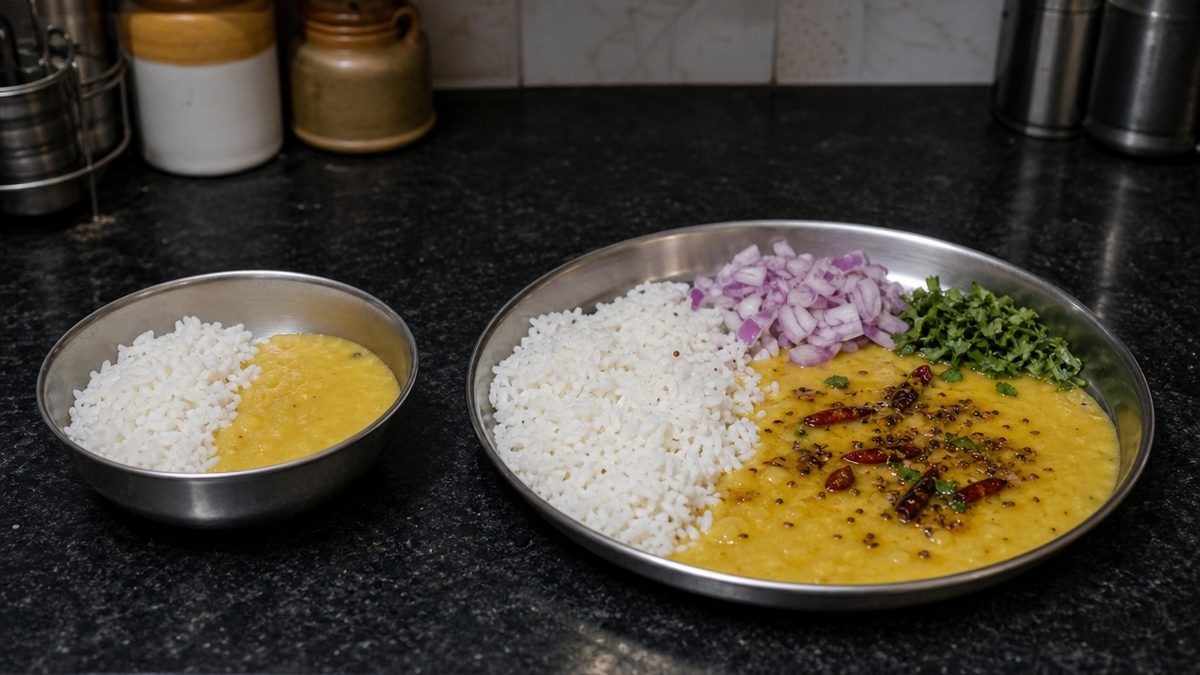
To audit a thali for a dog, take each item as it is actually served rather than as an ingredient, because the same food changes category between the pot and the plate. Plain dal is a displacement question and the identical dal after its tadka of onion, garlic, oil and salt is an acute toxicity question.
That sentence is the most useful thing on this page, so it is worth saying twice. Indian cooking adds its hazards at the end. The pulse, the rice and the vegetable go into the pot clean, and the onion, the garlic, the oil, the salt and the masala arrive in the last two minutes. An owner who thinks in ingredients will conclude that dal is fine for dogs. An owner who thinks in plates will refuse the katori in front of them and keep a ladle of the dal back before the tempering, which is the correct answer.
So the practical instruction is a timing instruction rather than a food one. Lift the dog's plain unsalted share out of the pot before the tadka, the namak and the oil go in, and the same cooking feeds both of you. Do it after the plate is served and you are picking through a finished dish trying to guess what is in the gravy, which nobody can do reliably.
| On the plate | What is actually in it as served | Which of the four | Verdict |
|---|---|---|---|
| Rice, plain boiled | Starch and water, nothing added | 3, displacement | Fine as a counted part of a balanced bowl |
| Roti, plain | Atta and water, usually a little salt in the dough | 3, displacement | Fine, capped and counted. The arithmetic is on our roti page |
| Dal, as served to the family | Pulse, plus a tadka of onion, garlic, oil and salt | 1 and 2 | Refuse the tempered version. Keep a ladle back before the tadka |
| Sabzi, curry or gravy | An onion and garlic base in almost every recipe | 1, acute toxicity | Refuse outright. See onion and garlic toxicity |
| Curd or dahi, plain and unsweetened | Milk solids, no added salt or sugar | 3, displacement | Small counted amounts. Sweetened lassi and shrikhand are a different food |
| Paneer | Milk fat and protein, concentrated | 2 and 3 | Small counted amounts, because it is energy-dense |
| Achaar or pickle | The highest concentration of salt and oil on the plate | 2, chronic load | Never, and not because it is a poison |
| Papad | Salt, often hing, roasted or fried | 2, chronic load | No. A whole papad is salt with a texture |
| Chutney | Frequently garlic, green chilli or coconut | 1 if garlic, otherwise 2 | Refuse the garlic ones. Coconut chutney is a fat question, covered below |
| Fried item: samosa, pakora, poori, vada | Whatever it was, plus the oil it absorbed | 2, chronic load | No. The measured numbers are in the next section but one |
| Mithai or any sweet | Sugar, khoya, ghee, sometimes kishmish or cocoa | 1 if kishmish or chocolate, otherwise 2 | See chocolate poisoning in dogs for cocoa and grapes and raisins toxicity in dogs for kishmish |
| The bone in the curry cut | Cooked bone, which behaves differently from raw | 4, physical hazard | Remove it. See bones for dogs |
The thali is not one thing, and the region changes the audit
Nothing written for a Delhi kitchen transfers cleanly to a Chennai one. A north Indian plate in Delhi or a Punjab household is built on wheat, so its dominant risk is energy, and our roti page measures exactly that. A plate in Chennai or Bengaluru is built on rice and carries coconut in the chutney and the sambar, so its dominant risk is fat. A Kolkata plate carries fish and its mustard oil. A Maharashtra or Pune thali sits somewhere between the two. What does not change between any of them is the Allium, which is on all four plates and is the only category-one item that arrives every single day.
So the honest regional reading is short. Change which number you worry about, not which framework you use. In Karnataka and Tamil Nadu count the coconut and the oil; in the wheat belt count the calories; everywhere, refuse the onion.
What Indians actually feed, measured on veterinarians' own dogs
There is one recent Indian measurement of this and it is more uncomfortable than any survey of ordinary owners would be. Researchers at the Tamil Nadu Veterinary and Animal Sciences University surveyed 162 veterinarians across Tamil Nadu about the dogs they keep themselves. Of those dogs, 52 percent were fed home-made food made for humans, 31 percent home-made food cooked specially for the dog, 15 percent commercial feed and 2 percent both.
The treat column is sharper still. Human snacks were the treat for 32 percent of those dogs, against 27 percent given dog treats and 35 percent given none, and the paper notes in its own discussion that these are owners aware of the list of items toxic to dogs. Milk and curd went to 54 percent, meat to 93 percent, and 72 percent received no feed supplement of any kind.
Read that as the reason this page exists. If half the dogs owned by Tamil Nadu's veterinarians eat the family's cooking, then an article whose entire answer is "feed a complete commercial food and share nothing" is not advice, it is a refusal to engage with the kitchen the reader actually has. The useful work is telling that owner which ladle to keep back and how much of it counts.
A katori of rice and dal that has sat out through a humid monsoon afternoon in Mumbai or Kolkata is not the food it was at lunch. Food safety and nutrient adequacy are different subjects and this page is about the second one. Store the dog's share the way you store your own, refrigerate it if it is going to sit, and throw it out rather than feed it if it smells off.
Why a little bit is the wrong unit, and what the right one is
To size any human food for a dog, use a share of daily energy rather than a little bit, because a little bit of a 409 kilocalorie food and a little bit of a 90 kilocalorie food are different amounts of the same thing. The published ceiling is explicit: treats should always make up less than 10 percent of a dog's daily calorie intake, and treats should never replace a meal.
That ceiling is useless without two numbers, which is where every page on this query stops. The page ranking fourth for this keyword lists boiled chicken, rice, curd, paneer, boiled eggs and coconut as safe foods for an Indian dog and attaches no quantity, no calorie figure and no body weight to any of them, while naming a specific commercial coconut oil inside the advice. A reader finishes it knowing what is allowed and not how much, which is the half that decides whether the dog gets fat.
A percentage needs a denominator, and the World Small Animal Veterinary Association publishes one. A healthy adult dog in ideal body condition needs 280 to 351 kcal a day at 5 kg, 470 to 590 at 10 kg, 790 to 993 at 20 kg, 940 to 1,174 at 25 kg and 1,080 to 1,346 at 30 kg, calculated from the 2006 National Research Council maintenance equations at 130 kcal and 95 kcal times body weight to the power 0.75. A flat dog in a Mumbai or Bengaluru apartment walked once a day sits near the bottom of its range, so use the lower figure.
| Dog weight | Daily energy | The entire 10 percent treat budget | Fresh coconut kernel, at 409 kcal per 100 g | Bread pakora, counting only its oil |
|---|---|---|---|---|
| 5 kg | 280 to 351 kcal | 28 to 35 kcal | 7 to 9 g | at most 16 to 20 g |
| 10 kg | 470 to 590 kcal | 47 to 59 kcal | 11 to 14 g | at most 27 to 34 g |
| 20 kg | 790 to 993 kcal | 79 to 99 kcal | 19 to 24 g | at most 46 to 57 g |
| 25 kg | 940 to 1,174 kcal | 94 to 117 kcal | 23 to 29 g | at most 54 to 68 g |
| 30 kg | 1,080 to 1,346 kcal | 108 to 135 kcal | 26 to 33 g | at most 62 to 78 g |
Where those two gram figures come from, and their limits
The coconut column is a measurement. India's own national food tables record fresh coconut kernel, sampled in six regions, at 41.38 g of total fat and 1,711 kJ per 100 g, which converts to 409 kcal. That makes a handful of fresh coconut one of the most energy-dense things in an Indian kitchen, ahead of most fried snacks by weight.
The bread pakora column is deliberately labelled as a floor rather than a figure. A bread pakora carries 19.25 g of fat per 100 g on a dry weight basis after one frying cycle at 180 degrees, and fat supplies 9 kcal per gram, so the oil alone is about 173 kcal per 100 g before any of its flour or bread is counted. The real number is higher. We are publishing the floor because the floor is what we measured.
Two worked examples already exist on this site and we are not computing a third. Our roti page puts a 35 g atta roti at about 112 kcal, close to a quarter of a 10 kg dog's day. Our Diwali sweets page puts one 25 g piece of khoa mithai at roughly 108 kcal, which clears the treat ceiling for every dog under about 30 kg on its own. The pattern generalises: almost nothing Indians eat is cheap in a dog's budget.
India's own definition of a junk food, read against a dog
There is a cleaner way to see this, and India supplies it. The ICMR-National Institute of Nutrition's Dietary Guidelines for Indians classify high fat, sugar and salt foods using an allowance of 250 kcal for 100 g of cooked or packaged food as the cut-off. That number was written to warn adults. Run it against a dog instead.
- For a 30 kg dog, 100 g of a food at India's HFSS cut-off is 19 to 23 percent of its entire day.
- For a 20 kg dog, it is 25 to 32 percent.
- For a 10 kg dog, it is 42 to 53 percent.
- For a 5 kg dog, it is 71 to 89 percent of everything it should eat that day.
A small Indian dog can reach most of its daily energy from 100 g of a food its own country classifies as junk. That is not a toxicity finding and it is the finding that explains most of what walks into an Indian clinic.
The treat budget is carved out of the day, not bolted onto it. If the dog gets 50 kcal of curd rice at lunch, 50 kcal comes out of dinner. An owner who counts the treat and still fills the bowl has not capped anything. Weigh the dog monthly on the same scale, because the scale is the only thing that tells you whether the arithmetic was right.
Oil, salt and chilli: the three things Indian cooking adds
Indian cooking adds three things a dog's bowl does not need, and cooking oil is the largest of them by a wide margin. ICMR-NIN tells Indians that no more than 27 to 30 g of visible fat is required for a 2,000 kcal day, which works out at 13.5 to 15.0 g of added oil in every 1,000 kcal of that food.
Set that against the only published fat ceiling a dog has. For a dog being managed for pancreatitis, the Merck Veterinary Manual's instruction is that a ration with less than 20 g fat per 1,000 kcal should be chosen. Indian family cooking at the level India's own guidelines recommend therefore delivers 68 to 75 percent of that entire ceiling from the cooking oil alone, before counting a gram of the fat already inside the dal, the paneer, the chicken or the coconut.
That is the cleanest way to state the oil problem. It is not that Indian food is greasy. It is that Indian food at its officially recommended oil level is already near a sick dog's limit, and most households cook above that level rather than below it. The same guidelines put the whole range at 20 to 50 g of visible fat a day depending on activity, and add a separate line asking readers to limit ghee or butter to just 1 to 2 teaspoons a day or avoid it if possible.
Frying makes a different food, and India has measured it
A fried item is not the same food as the thing that went into the kadhai, and the size of the change is published. Researchers from Amity University, the Institute of Home Economics at the University of Delhi and the Nutrition Foundation of India measured Indian fried foods before and after frying. Bread pakora went from 0.18 g of fat per 100 g to 19.25 g after a single frying cycle at 180 degrees. Poori went from 5.12 g to 20.78 g. Both figures are on a dry weight basis and both are means of three readings.
The second finding in that paper is the one that separates a home kadhai from a street stall. Trans fat in poori rose from 0.04 g per 100 g after one frying cycle to 0.84 g after 32 cycles in the same oil, and bread pakora from 0.04 g to 0.85 g. Expressed as a share of the food's own fat, that is a rise from 0.19 percent to 3.34 percent in poori and to 3.44 percent in bread pakora.
India's own law sets the comparison. Food products in which edible oils and fats are used as an ingredient shall not contain industrial trans fatty acids more than 2 percent by mass of the total oils and fats present in the product, on and from 1 January 2022. The 32-cycle figures sit above that. Two caveats belong with the comparison and we are not burying them: the study used a laboratory frying protocol rather than a sampled shop, and whether trans fat generated by repeated heating falls inside the regulation's definition of industrial trans fatty acids is a legal question this page does not settle.
The guidelines themselves describe the practice that produces those numbers. Reusing vegetable oils that have been repeatedly heated is very common both at homes and in commercial establishments, and oil once used for frying should be filtered and may be used for curry preparation, but using the same oil for frying again should be avoided.
Coconut is the fat an Indian kitchen never counts
Coconut deserves its own line because nobody thinks of it as a fat. Fresh coconut kernel measures 41.38 g of fat per 100 g, which is more fat per 100 g than the bread pakora above carries after being deep fried. A coconut chutney in Chennai, a sambar thickened in Bengaluru, a Karnataka curry built on coconut paste: each of those is a fat delivery system that looks like a vegetable. This page is not the place for the full coconut answer, and the arithmetic above is enough to make the point.
Salt is the third addition and this site has already costed it. Our roti page sets a dog's published sodium minimum against measured Indian salt intake and works out the multiple, so read it there rather than here.
Chilli: the mechanism is real and the measurement does not exist
Every page on Indian food and dogs asserts that chilli hurts dogs, and the only published comparison points the other way. Capsaicin acts on the TRPV1 receptor, dogs have that receptor, and when the dog version was cloned and expressed in cells it did respond to capsaicin, but at a higher EC50 than the rat, mouse and human versions, meaning it took more capsaicin to trigger it. The same review records an earlier reading that canine TRPV1 may be less sensitive to capsaicin than other orthologs because it lacks a conserved protein kinase A phosphorylation site at position 117.
Three limits sit on that, and stating them is the point. A receptor in a cell line is not a dog eating a chilli. The comparison is of sensitivity thresholds, not of what a mouthful of chutney does to a gut. And we could find no oral feeding study of chilli in dogs. That is a narrower gap than no measurement at all, so here is what has been measured. Capsaicin placed directly into the proximal colon of conscious dogs at 5 and 10 mg evoked giant migrating contractions and induced defecation in more than 90 percent of trials in neurally intact dogs, an effect abolished by atropine and hexamethonium. And EFSA's FEEDAP Panel, assessing capsaicin as a feed additive in April 2025, sets the safe maximum in complete feed at 31.7 mg per kg for dogs and 5.3 mg per kg for cats and the other species it did not assess separately, which makes the cat the named exception rather than the dog. Our guide to spices, salt and masala for pets carries the measured gut half in full. What is still missing is the dose this page is actually about, what a mouthful of food-borne chilli does to a dog, so every confident statement about chilli in a dog's bowl remains a mechanism being asserted rather than a measurement being reported.
The honest position is that chilli in a dog's bowl has no measured benefit, no measured dose and no reason to be there. Nothing above is a licence to share a chutney. It is a correction to pages that claim dogs feel chilli more acutely than people do, which is the opposite of the only published comparison, and a flag that this is one of the places where the evidence is genuinely thin.
The cost nobody counts: what the human food pushes out
The largest cost of human food in an Indian dog's bowl is not what the food contains but what it replaces, because every kilocalorie of plain rice is a kilocalorie not spent on the food that was carrying the calcium, the zinc, the vitamin D and the amino acids.
This is category three, and it is invisible by design. A dog eating a third of its day as plain rice and curd looks well for months. Nothing on a routine blood panel moves, because the body defends the blood before it defends the skeleton. Our guide to whether a home-cooked bowl is balanced sets out what actually checks a bowl and why a normal blood test does not, and we are not repeating that work here.
The Tamil Nadu survey supplies the matching number. Among those 162 veterinarians' dogs, 72 percent received no feed supplement of any kind, while 52 percent ate food cooked for humans. A bowl that is half household cooking and carries nothing to close the gap is the commonest arrangement in the data we have, not an edge case.
Three live pages carry the rest of this, and the division of labour is deliberate. Homemade dog food in India runs the Indian kitchen bowl against the published nutrient minimums and prices it. The dog diet chart for India gives the daily grams the human food has to be subtracted from. Feeding a dog in a vegetarian household covers the protein-source question, which is where a meat-free Indian bowl gets hard.
Why displacement is worse in a small dog
Run the HFSS arithmetic from the previous section again and the reason is obvious. A 5 kg Indie or a Pomeranian in a Pune flat has 280 to 351 kcal of room for everything it needs in a day. Two spoons of curd rice and a corner of paneer can take a fifth of that, and the fifth they take is the fifth that was carrying the micronutrients. The same two spoons in a 30 kg dog are a rounding error. Body weight is not a detail on this page; it is the whole calculation.
Five dogs for whom the answer changes completely
Five dogs have no ordinary treat budget, and for each of them a decision that is merely untidy in a healthy adult becomes a clinical one. Each is listed below with the reason and the page that covers it.
- A growing puppy. Its requirement per 1,000 kcal is higher than an adult's, so household cereal dilutes its bowl faster. The figures are on our puppy feeding chart for India.
- An overweight dog. Its daily allowance has already been cut, so there is no 10 percent to spend. Start at obesity in dogs and cats.
- A dog treated for pancreatitis. The published target is under 20 g of fat per 1,000 kcal, which one Indian fried item can breach on its own. See pancreatitis in dogs.
- A dog with kidney or heart disease. Its prescription diet's sodium and phosphorus levels are set deliberately, and achaar, papad or a salted gravy undoes that setting silently.
- A dog on a formulated or prescription diet of any kind. The formulation assumes it is the whole bowl, so topping it with household food is changing a prescription without telling anyone.
For all five, the decision belongs to the veterinarian who has examined the animal rather than to a web page, which is why this page publishes under the medical disclaimer at the top. Bonbeno names no product, recommends no supplement and prescribes no diet.
Your dog has already eaten something: how urgent is it?
To judge urgency after a dog eats something off the table, sort what to do into three groups, which are telephone a veterinary surgeon now, telephone today, and watch while being ready to call. The instruction for the first group is unqualified: if you think your pet has eaten something potentially dangerous, call your veterinarian or a pet poison control center right away.
| Tier | What belongs here | What to do |
|---|---|---|
| Telephone now | Anything in category one in a quantity that matters: chocolate, kishmish or raisins, a sugar-free sweet, a gravy or masala with a real onion or garlic load, alcohol. Also any swallowed bone, skewer or pit, and any dog already showing signs | Telephone a veterinary surgeon immediately and follow the advice given. Do not wait for a symptom |
| Telephone today | A large fatty or deep-fried meal, especially in a dog with a history. A small Allium exposure. A dog that vomited once and is otherwise bright. A dog on a prescription diet that ate a plateful of household food | Call the clinic during the day, describe the amount by weight, and ask whether they want to see the dog |
| Watch and be ready | A small plain item with no onion, garlic, cocoa, kishmish or sweetener in it, eaten by a healthy adult dog that is bright, eating, drinking and passing normal stool | Subtract it from the next meal, watch for 48 hours, and call if anything changes |
Five things to have ready before you telephone
- What the dog ate, named as precisely as you can, including whether the dish had an onion or garlic base.
- How much, estimated by weight or by katoris rather than by the word "some".
- When it happened, to the nearest half hour.
- The dog's current body weight, because every dose in veterinary toxicology is per kilogram.
- The packet, if there was one, so the clinic can read the ingredients itself.
Why he seems fine is not reassurance on this list
Three of the commonest Indian exposures have a delay built into them, and that delay is what makes the watch-and-wait instinct dangerous. Allium damage to red cells begins within a day and the anaemia appears days after the meal, which is set out in full on our onion and garlic page. A bone that has lodged in the oesophagus does more damage with every hour it sits there, which our bones page measures. And Merck's own position on pancreatitis is that in only a few cases can a risk factor or cause be identified at all, so a normal evening after a fatty meal proves nothing either way.
Bonbeno names no medicine and no dose, and nothing on this page tells you to make a dog vomit at home. Inducing vomiting is a clinical decision that depends on what was eaten, how long ago and the animal in front of the clinician, and it is wrong often enough to be dangerous. Telephone first and do what you are told.
The honest list: never, counted, or fine
The list readers actually want is below, sorted into three tiers and honest about which rows rest on thin evidence. Each row names which of the four problems applies, because a row that only says avoid does not tell you whether you are avoiding a poison or a calorie.
| Item | Tier | Which problem | Where the evidence stands |
|---|---|---|---|
| Onion, garlic, spring onion, chives | Never | 1 | Published doses per kilogram exist. Named on the FDA list and the WSAVA treats guide World Small Animal Veterinary Association |
| Chocolate, cocoa, coffee, chai dregs | Never | 1 | Dose-dependent and well characterised. On both lists World Small Animal Veterinary Association |
| Kishmish, raisins, sultanas, currants | Never | 1 | On both lists. The dose relationship is genuinely unsettled, which the Diwali page sets out |
| Sugar-free sweets and gum | Never | 1 | Xylitol is named explicitly by the FDA |
| Achaar, papad, namkeen, any salted snack | Never | 2 | Not a poisoning risk at plate quantities. A chronic salt and oil load, which is a different argument |
| Samosa, pakora, poori, vada and any fried item | Never | 2 | Measured in India: 19 to 21 g of fat per 100 g after one frying cycle |
| Cooked bone of any kind | Never | 4 | Mechanism and case series are published. Covered on our bones page |
| Mithai, jalebi, gulab jamun, kheer | Never | 1 or 2 | Category depends on whether it carries kishmish or cocoa. Doses are on the Diwali page |
| Paneer, plain and unsalted | Counted | 2 and 3 | Energy-dense. No Indian figure for how much Indian dogs actually get |
| Fresh coconut and coconut chutney | Counted | 2 | 41.38 g of fat per 100 g, measured in six Indian regions |
| Ghee, butter, malai and any added oil | Counted, and ideally not at all | 2 | India's own guidance limits human ghee to 1 to 2 teaspoons a day |
| Curd or dahi, plain and unsweetened | Counted | 3 | Tolerance varies between individual dogs and nobody has measured it in Indian dogs |
| Chilli, garam masala, any hot spice | Counted as never, on principle | Unresolved | No canine feeding study found. The receptor evidence points the opposite way to the usual claim |
| Plain boiled rice | Fine as part of a balanced bowl | 3 | Displacement only. The bowl around it is the question |
| Plain roti, no salt, no ghee | Fine as part of a balanced bowl | 3 | Costed in full on our roti page |
| Plain dal, kept back before the tadka | Fine as part of a balanced bowl | 3 | Displacement only once the tempering is removed |
| Plain boiled vegetables, no masala | Fine as part of a balanced bowl | 3 | Displacement only, excluding the Alliums above |
Four rows above say nobody has measured this in Indian dogs, and we have left them that way rather than borrowing a confident sentence from a page that had nothing behind it either. A row that admits a gap is more use to you than a row that invents a number, because it tells you which questions to take to your own veterinarian.
What this page can prove, and what it cannot
Seven claims on this page are measurements with denominators and six widely repeated claims about Indian food and dogs are not established, so the line between them is drawn below rather than left for you to guess.
Seven claims here are established, and each names its source.
- Treats should always make up less than 10 percent of a dog's daily calorie intake, and human food and table scraps can be unhealthy and potentially dangerous to dogs.
- A healthy adult dog needs 280 to 351 kcal a day at 5 kg and 1,080 to 1,346 at 30 kg, from the 2006 NRC maintenance equations.
- Of 162 Tamil Nadu veterinarians surveyed, 52 percent fed their own dogs home-made food cooked for humans, 32 percent used human snacks as treats and 72 percent gave no supplement.
- ICMR-NIN allows no more than 27 to 30 g of visible fat in a 2,000 kcal human day, and classifies a cooked food as high in fat, sugar and salt above 250 kcal per 100 g.
- A dog being managed for pancreatitis should be fed under 20 g of fat per 1,000 kcal.
- Bread pakora rises from 0.18 g to 19.25 g of fat per 100 g after one frying cycle, and poori's trans fat rises from 0.04 g to 0.84 g per 100 g over 32 cycles in the same oil.
- Fresh Indian coconut kernel carries 41.38 g of fat and 409 kcal per 100 g, sampled across six regions.
Six further claims are not established, and the list below marks where this page reasons rather than reports.
- No canine oral feeding study of chilli or Indian masala exists that we could find. What exists is intracolonic instillation in conscious dogs, a feed-additive safe maximum, and the receptor work. The receptor work shows dog TRPV1 responding to capsaicin at a higher EC50 than the rat, mouse and human versions in a cell line, which is a long way from telling you what a chutney does to a gut.
- No Indian authority publishes composition for cooked mixed dishes, only for ingredients, so nobody can tell you the calories in a katori of rajma or a bowl of sambar. Any page that prints such a figure has estimated it. So has anyone who tells you otherwise.
- The fried-food fat figures are on a dry weight basis from a laboratory frying protocol, not from sampled shops, so they are an upper bound on what is in the samosa in front of you rather than a reading of it.
- Whether trans fat generated by repeatedly reheating household oil falls inside India's legal definition of industrial trans fatty acids is a regulatory question, and the 2 percent cap is quoted here as a yardstick rather than as a finding of breach.
- No study has measured how much human food Indian dogs eat by weight. The Tamil Nadu survey counted practices rather than grams, and it sampled veterinarians, who are not representative of owners in either direction.
- Nobody has measured dairy tolerance in Indian dogs, so the curd row above rests on the general veterinary position rather than on a local denominator.
Two figures circulating on this query that do not survive a check
The first is a statistic. A page ranking second for this keyword states that a 2023 report by the Pet Obesity Research Group India found that nearly 35 percent of pet dogs in major Indian cities are overweight or obese and that over 40 percent of pet parents did not realise it. We searched for that organisation and that report on 20 October 2026 and found three pages, all of them blogs repeating the same sentence, and no organisation, no report and no primary document anywhere. Treat it as unverified until someone produces the document. The same page attributes a protein digestibility comparison to an unnamed Kerala study and a feeding-practice share to an unnamed peer-reviewed survey, neither with a link.
The second is a recommendation rather than a number. Google's own AI Overview for this query, captured on 21 October 2026, lists "a few drops of plain ghee, coconut oil, or flaxseed oil" under healthy fats for an Indian dog, and on the closely related query names two commercial brands with a rupee price inside what reads as nutrition advice. The ghee line sits badly beside the fat arithmetic in this page's oil section. We record it because an answer engine is now the first thing many Indian owners read, and it is currently giving them a brand recommendation where a denominator should be.
Finally, the boundary this page keeps. Bonbeno names no product, ranks no brand, prescribes no diet and gives no dose. If your dog is losing or gaining weight, itching, passing loose stool for more than a day, or has ever been treated for pancreatitis, what goes in its bowl is a decision for the veterinarian who has examined it, which is why this page publishes under the medical disclaimer at the top.
Common questions
Can my dog safely eat Indian food?
Parts of it, prepared separately. Plain rice, plain roti, plain dal kept back before the tadka, plain unsweetened curd and plain boiled vegetables are safe in a counted amount for a healthy adult dog. The plate as served is usually not, because almost every Indian savoury dish is built on an onion and garlic base and carries added oil and salt on top.
Can dogs eat besan chilla?
A plain besan chilla made with gram flour and water only is a displacement question rather than a toxicity one, so a small counted piece inside the 10 percent treat ceiling is reasonable. A chilla as actually cooked carries onion, green chilli, salt and a film of oil, and the onion alone makes that version a refusal. Cook the dog's portion before any of that goes into the batter.
What do they feed dogs in India?
Mostly the family's own cooking. In a 2026 survey of 162 veterinarians across Tamil Nadu, 52 percent fed their own dogs home-made food made for humans, 31 percent cooked separately for the dog and only 15 percent used commercial feed. Human snacks were the treat for 32 percent of those dogs, and 72 percent received no feed supplement of any kind.
Can dogs eat curry?
No. Curry is the clearest case of this page's rule that a food changes category between the pot and the plate. Almost every Indian curry is built on an onion and garlic base, both of which the FDA names as edible dangers for pets, and it carries added cooking oil and salt on top of that. Keep the dog's plain share back before the masala goes in.
Can I give ghee to my puppy?
No, keep ghee out of a puppy's bowl unless your veterinarian has asked for it. Ghee is effectively pure fat at 9 kcal per gram, and a puppy's bowl has the least room of any for energy that carries no calcium, protein or micronutrients. India's own dietary guidance limits ghee to 1 to 2 teaspoons a day for an adult human, who weighs several times what the puppy does.
How much human food can a dog have in a day?
Under 10 percent of its daily calories, which is 28 to 35 kcal for a 5 kg dog, 47 to 59 for a 10 kg dog and 108 to 135 for a 30 kg dog. Those budgets are small in Indian terms: at 409 kcal per 100 g, fresh coconut fills a 10 kg dog's entire daily allowance in 11 to 14 grams. Subtract whatever you give from the main meal.
Is curd rice a complete meal for a dog?
No. Curd rice is safe and it is not complete, which are two different statements. Plain rice and plain curd carry neither the calcium to phosphorus balance nor the micronutrient profile a dog needs, so a bowl built on them is short in ways that no routine blood test will show for months. Use it as a counted part of a formulated diet, not as the diet.
My dog ate something off the table. How do I know if it is an emergency?
Sort it by what was in it. Telephone a veterinary surgeon now if it contained onion or garlic in quantity, chocolate, kishmish, a sugar-free sweetener or alcohol, or if a bone or skewer was swallowed, or if the dog looks unwell. Telephone today for a large fatty or fried meal. Watch for 48 hours if it was a small plain item and the dog is bright.