
Dog nutrition guide
Can dogs eat roti? What a chapatti actually costs an Indian dog
Roti is the single most-fed human food in the Indian dog bowl, and nobody has published what it costs. Here is the arithmetic from the ICMR-NIN tables, what the ghee and the sabzi add, and how small the documented gluten problem in dogs actually is.
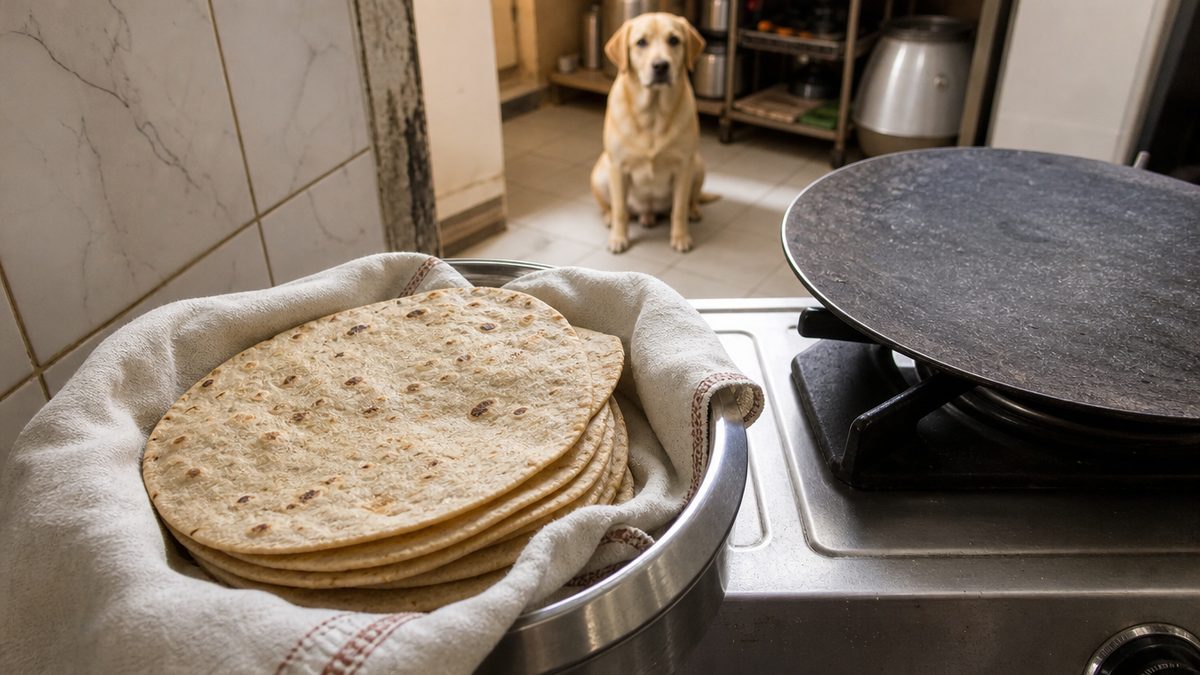
Quick answer
Can dogs eat roti? Yes, a plain unsalted atta roti is safe for a healthy adult dog, and the problem is quantity rather than wheat. Atta measures 320 kcal per 100 g in the ICMR-NIN tables, so two 35 g rotis are about 224 kcal, close to 40 percent of a 10 kg dog's daily energy. A smear of ghee adds about 45 more. Punjab surveys recorded dogs eating 2.8 to 7.2 chapattis a day. Wheat allergy is real and uncommon, reported in 38 of 297 dogs.
This guide is general information for Indian pet owners and is not a diagnosis. Always consult a registered veterinarian near you before acting on anything you read here, and treat any sudden change in your pet's condition as urgent.
Can a dog digest wheat at all?
A dog digests cooked wheat starch almost completely, and the measurement is unambiguous: when six high-starch flours including wheat were fed to dogs, the starch component of all diets was nearly completely digested, at greater than 99 percent, at the ileum and over the whole tract.
That study is the one to know, because it tested the exact question. Researchers built six diets around flours from barley, corn, potato, rice, sorghum and wheat, extruded and kibbled them, and measured digestibility at the ileum and over the total tract. Ileal organic matter and crude protein digestibility were lowest on the potato flour. Starch digestibility differed statistically between treatments, yet every diet cleared 99 percent. The authors' summary is one sentence long: any of these flours could be used without negative effects on digestion at either the ileum or in the total tract.
The veterinary reference position says the same thing from a different direction. Both dogs and cats can digest properly cooked starches, such as those from grains, with greater than 90 percent efficiency. So wheat digestion is not where the roti problem lives. Anyone telling you a dog cannot break down chapatti is contradicting the only published measurements of it.
The genetic half of this question is already answered on another Bonbeno page and we will not run it again. Dogs carry on average about seven times the pancreatic amylase gene copies of a wolf, and our guide to feeding a dog in a vegetarian household sets out that evidence in full, including how far it varies between breeds. Read it there.
Carbohydrate is not essential, and that is not the same as useless
The strongest claim on the ranking pages is that a dog has zero requirement for carbohydrate. That is half right, and the half it leaves out changes the conclusion. Dietary carbohydrates are not considered essential nutrients in the diet for adult, nonreproducing dogs and cats, because the body makes glucose by gluconeogenesis. Two sentences later the same source says what happens when the carbohydrate is absent: if adequate amounts of dietary carbohydrates are not provided in their diet, gluconeogenesis will occur, diverting amino acids from functions such as synthesis of nonessential amino acids and building muscle.
And for some dogs the requirement is real. Carbohydrates can become conditionally essential in dogs when energy needs are high, such as during growth, gestation and lactation, and pup survival and metabolic status of the bitch at whelping appear to be improved by a diet in which 20 to 30 percent of the energy is derived from carbohydrates. A pregnant Indie in a Pune backyard is the animal for which the roti is doing the most obvious job.
So the honest framing is not that roti is empty filler. It is that roti is cheap energy that spares protein, and cheap energy is exactly the thing most Indian house dogs already have too much of.
Rice is not the gentler grain people assume
Every Indian page on this subject reaches for the same substitution, which is to feed rice instead. One controlled canine comparison exists and it does not support the glycaemic half of that advice. Thirty-six dogs, six per diet, were fed extruded diets built on cassava flour, brewer's rice, corn, sorghum, peas or lentils. Starch digestibility was greater than 98 percent in all of them. The immediate post-prandial glucose and insulin responses, measured as area under the curve to 30 minutes, were greater for brewer's rice, corn and cassava flour, while the later responses were greater for sorghum, lentil and pea diets.
Rice was the fast carbohydrate in that trial, not the slow one. Two limits belong with that finding. No wheat was tested, so this is not a direct roti-versus-rice measurement, and all the diets were extruded, which is not what happens on a tawa. What it does establish is that "rice is gentler" is a statement about stool consistency and bland diets, not about blood glucose, and the pages that blur the two are overreaching.
Both canine digestibility studies on this page used extruded, kibbled diets made in a feed mill. A chapatti is a thin sheet of hydrated dough cooked dry for a minute or two. Nobody has measured the starch digestibility of a tawa-cooked chapatti in a dog. The species-level finding that cooked cereal starch is almost fully digested is solid; the exact figure for your roti is an inference, and we are flagging it as one.
What is actually in a roti
A roti is almost entirely wheat flour and water, and India's own national food composition tables measure wheat flour, atta, at 1,340 kJ per 100 g, which converts to 320 kcal, with 10.57 g of protein, 1.53 g of fat, 64.17 g of available carbohydrate and 11.36 g of total dietary fibre.
Those figures come from the Indian Food Composition Tables 2017, published by the ICMR-National Institute of Nutrition in Hyderabad, which sampled atta from six regions of the country and reports food code A019. This is the right table for an Indian kitchen because it measured Indian atta rather than a foreign database's version of it.
| Component | Wheat flour, atta (A019) | Wheat flour, refined, maida (A018) | Rice, raw, milled (A015) |
|---|---|---|---|
| Energy | 1,340 kJ, about 320 kcal | 1,472 kJ, about 352 kcal | 1,491 kJ, about 356 kcal |
| Protein | 10.57 g | 10.36 g | 7.94 g |
| Total fat | 1.53 g | 0.76 g | 0.52 g |
| Available carbohydrate | 64.17 g | 74.27 g | 78.24 g |
| Total dietary fibre | 11.36 g | 2.76 g | 2.81 g |
| Insoluble fibre | 9.73 g | 2.14 g | 1.99 g |
| Moisture | 11.10 g | 11.34 g | 9.93 g |
One cross-check before we build anything on that top row. The Food and Agriculture Organization's general Atwater factors are 4.0 kcal per gram of protein, 9.0 per gram of fat and 4.0 per gram of carbohydrate. Applied to the atta row, those give 42.3 plus 13.8 plus 256.7, which is about 313 kcal. The IFCT figure of 320 kcal is seven higher because specific factors and the fermentable share of fibre are handled differently. The two agree closely enough that 3.2 kcal per gram of atta is a number you can work with.
Why nobody can tell you the calories in one roti
No Indian authority publishes a standard weight for a roti, and that is the gap that keeps this question unanswerable on every page that attempts it. A food-science group at CSIR-CFTRI and Jamia Hamdard describes preparing chapatis by mixing 100 g of flour, resting the dough, rolling it to about 1.5 mm and cutting 15 cm circles, and the same paper records that on average 90 percent of wheat produced in India is consumed in the form of chapati. It never says how many chapatis 100 g of flour makes, because for a laboratory that is not the question.
So the honest method is to work in grams of atta and let you pick your own roti. A thin phulka from a small household uses roughly 25 to 30 g of atta. A thicker roti or a tandoori roti uses 40 to 45 g. We use 35 g as a middle figure throughout this page, and we are labelling it as this page's stated assumption rather than a measurement.
- A 25 g roti carries about 80 kcal.
- A 30 g roti carries about 96 kcal.
- A 35 g roti carries about 112 kcal.
- A 40 g roti carries about 128 kcal.
- A 45 g roti carries about 144 kcal.
The one competitor page that attempts a figure puts a medium roti at roughly 70 to 100 calories with 15 to 20 g of carbohydrate and 2 to 3 g of protein, and cites nothing for it. By the IFCT table that range corresponds to 22 to 31 g of atta, which is a small phulka. It is not wrong so much as unanchored, and an owner cannot check it.
How much of a dog's day two rotis actually are
Two rotis made from 35 g of atta each come to about 224 kcal, which is close to 40 percent of a 10 kg dog's daily energy and about 20 percent of a 25 kg dog's, against the World Small Animal Veterinary Association's published range of 470 to 590 kcal at 10 kg and 940 to 1,174 kcal at 25 kg.
Those daily figures are not an estimate. The WSAVA chart is built on the 2006 National Research Council maintenance energy requirement for dogs, using 130 kcal times body weight in kilograms to the power 0.75 for an active adult and 95 kcal for an inactive one, which is why each weight carries a range rather than a single number. A flat dog in a Mumbai or Delhi apartment walked once a day sits at the bottom of its range, so the lower figure is the one most Indian house dogs should be measured against.
| Rotis a day, at 35 g of atta each | Atta | Energy | Share of a 10 kg dog's 470 to 590 kcal | Share of a 25 kg dog's 940 to 1,174 kcal |
|---|---|---|---|---|
| One | 35 g | 112 kcal | 19 to 24 percent | 10 to 12 percent |
| Two | 70 g | 224 kcal | 38 to 48 percent | 19 to 24 percent |
| Three | 105 g | 336 kcal | 57 to 71 percent | 29 to 36 percent |
| Four | 140 g | 448 kcal | 76 to 95 percent | 38 to 48 percent |
| Six | 210 g | 672 kcal | 114 to 143 percent | 57 to 71 percent |
Read the four-roti row twice, because that is the row most households are actually in. Four rotis is three quarters to the whole of a 10 kg dog's daily energy, delivered by one ingredient that supplies no calcium worth counting and no taurine at all. Nothing else that goes into that bowl has anywhere to go.
What the measured Indian bowl adds up to
India has two real measurements of how much chapatti a dog is given, both from the Department of Animal Nutrition at Guru Angad Dev Veterinary and Animal Sciences University in Ludhiana, and together they cover 270 owners in four Punjab districts. In Fatehgarh Sahib and Ludhiana, 138 owners reported district means of 2.97, 3.55, 2.80 and 4.72 chapattis a day across urban and rural groups. In Ferozepur and Fazilka, 132 owners reported 3.50, 7.17, 5.13 and 6.38.
The prevalence behind those numbers is the reason this page exists. Chapatti was fed by 100 percent of the Fatehgarh Sahib owners and 91.9 percent of those in Ludhiana, while rice reached only 34.4 and 27 percent. The north Indian dog bowl is a wheat bowl. Our page on whether a home-cooked bowl is balanced covers what that does to the mineral column and why a blood test will not show it, and we are not repeating that work here.
| Rotis a day | At 25 g of atta | At 35 g of atta | At 45 g of atta | Share of a 10 kg dog's day at 35 g |
|---|---|---|---|---|
| 2.80, the lowest district mean | 224 kcal | 314 kcal | 403 kcal | 53 to 67 percent |
| 4.72, the Ludhiana rural mean | 378 kcal | 529 kcal | 680 kcal | 90 to 113 percent |
| 7.17, the highest district mean | 574 kcal | 803 kcal | 1,033 kcal | 136 to 171 percent |
At the lowest district mean in the published Indian data, chapatti alone is more than half of a 10 kg dog's daily energy. At the highest, it exceeds the entire day. That is before the milk, the curd and the dal that the same surveys recorded in the same bowls.
Nobody in these households thinks they are giving their dog half a day's calories. They are giving it leftovers. The roti is the single largest uncounted item in the Indian dog bowl, and it is uncounted precisely because it is leftover. Weigh your dog monthly on the same scale, and read our page on obesity in dogs and cats before you decide the chart is wrong about your dog.
Two things follow. If roti stays in the bowl, something else has to come out, and the portion arithmetic for the rest of the day belongs on the dog diet chart for India. And if roti is the base of a home-cooked diet rather than a scrap on top of a complete food, the whole bowl needs formulating, which is the subject of homemade dog food in India.
What goes on the roti is usually the real problem
What goes on the roti costs more than the roti does, in two specific ways: a 5 g smear of ghee adds about 45 kcal to a 112 kcal roti, and leftover sabzi or dal tadka carries onion and garlic, which are toxic to dogs at ordinary kitchen quantities.
Start with the fat, because it is the one that surprises people. Ghee is clarified butter and is effectively all fat, and fat supplies 9.0 kcal per gram on the FAO general factors. A 5 g smear therefore adds about 45 kcal, which is 40 percent of the energy of the 35 g roti it is spread on, and about 8 to 10 percent of a 10 kg dog's entire daily allowance. Two rotis with a smear each are 314 kcal rather than 224.
There is a second, sharper reason to keep ghee off a dog's roti, and it has a published ceiling attached. Dietary indiscretion is believed to be a common risk factor for pancreatitis in dogs, and for a dog being managed for it the veterinary instruction is specific: a ration with less than 20 g fat per 1,000 kcal should be chosen. Run the roti against that ceiling and the result is counter-intuitive.
- Two plain 35 g rotis carry 1.07 g of fat in 224 kcal, which is 4.8 g per 1,000 kcal, under a quarter of the ceiling.
- Add one 5 g teaspoon of ghee across both and the bowl reaches 6.07 g of fat in 269 kcal, which is 22.6 g per 1,000 kcal, already over the ceiling.
- Add a teaspoon to each roti and it reaches 11.07 g in 314 kcal, which is 35.3 g per 1,000 kcal, close to double the ceiling.
Plain atta roti is a genuinely low-fat food. The ghee is what turns it into a high-fat one, and it does so at a quantity nobody thinks twice about. If your dog has ever been treated for pancreatitis in dogs, the smear is the part of this page to act on first.
The sabzi is the part to refuse outright
Leftover sabzi, dal tadka and gravy are where onion and garlic reach a dog, and they are in almost every Indian savoury preparation. This page does not carry the toxicology, because onion and garlic toxicity in pets does. The practical rule here is short. A plain roti torn off before the sabzi touches it is a different food from a roti used to mop up a gravy, and only the first one is under discussion on this page.
Butter, malai, jam, sugar and jaggery belong in the same category as ghee, which is to say they are pure added energy on an item that already carries more than the dog needs. A dog with diabetes in dogs should not be getting sweetened roti at all, and that is a veterinary instruction rather than a preference.
A roti left out through a humid monsoon afternoon in Mumbai, Chennai or Kolkata is not the same roti it was at lunch. Store the dog's share the way you store your own food, refrigerate it if it is going to sit, and throw it out rather than feed it if it smells off or has gone sticky. Food safety and nutrient adequacy are separate questions, and this page is about the second one.
Salt: what Indian food carries and what a dog needs
Indian family food carries two to six and a half times the sodium density a dog's food needs, because FEDIAF sets the adult dog minimum at 0.29 g of sodium per 1,000 kcal while an Indian adult's recommended intake works out at about 0.95 g per 1,000 kcal and actual intake runs higher.
Take the dog's side first. FEDIAF's 2025 table for adult dogs on a maintenance energy requirement of 95 kcal per kg of metabolic weight sets sodium at a minimum of 0.29 g per 1,000 kcal of metabolisable energy, which is 0.12 g per 100 g of dry matter, and it sets no nutritional maximum at all. That absence is deliberate. The guidelines' own change log records that the nutritional maxima for sodium and chloride in dogs were removed in 2016 and replaced with a footnote about known safe levels. A 10 kg dog eating 530 kcal needs about 0.15 g of sodium a day. A 25 kg dog eating about 1,060 kcal needs about 0.31 g.
Now the human side, from India's own national guidance. ICMR-NIN states that the current Indian as well as WHO recommendation for sodium intake is 2,300 mg per day, which translates to around 5,000 mg or 5 g, one teaspoon, of common salt. It also states that Indian food intake data indicates that average consumption of salt ranges from 3 g to 10 g a day in different states. A sedentary Indian adult man's energy requirement is 2,110 kcal a day at a reference body weight of 65 kg, and a sedentary woman's is 1,660 kcal at 55 kg.
| Diet | Sodium per day | Energy per day | Sodium per 1,000 kcal | Against the dog's minimum |
|---|---|---|---|---|
| FEDIAF adult dog minimum | 0.15 g for a 10 kg dog | 530 kcal | 0.29 g | 1.0 times |
| Indian adult man at the recommended 5 g of salt | 2.0 g | 2,110 kcal | 0.95 g | 3.3 times |
| Indian adult man at the 3 g state average | 1.2 g | 2,110 kcal | 0.57 g | 2.0 times |
| Indian adult man at the 10 g state average | 4.0 g | 2,110 kcal | 1.90 g | 6.5 times |
The crucial point is where that sodium comes from, and ICMR-NIN answers it directly. Though all foods contain some amount of sodium, the contribution to total dietary intakes from food sources is less than 10 percent and a major amount comes from added salt either through cooking or processing. An unsalted atta roti is therefore not a sodium problem. The namak in the dough, and far more importantly the sabzi and dal the roti is eaten with, are.
What this does and does not mean
Do not read those multiples as a poisoning risk, because the dose that actually poisons a dog is nowhere near a bowl of sabzi. The acute oral lethal dose of salt in dogs is about 4 g per kg, and clinical signs of toxicosis can appear after ingestion of 2 to 3 g per kg. For a 10 kg dog that is 20 to 30 g of salt in one sitting, which is four to six teaspoons, or six household days' worth of salt eaten at once. The same source adds the condition that matters most: salt toxicosis is unlikely to occur as long as sodium-regulating mechanisms are intact and fresh drinking water is available.
So a healthy adult dog with a full water bowl is not in danger from a salted roti. Three groups are a different conversation, and each of them should be having it with a veterinarian rather than with a web page.
- A dog with heart disease, where sodium restriction is part of the management plan, which our page on mitral valve disease in dogs covers.
- A dog with kidney disease, where a prescription diet's sodium level is set deliberately and household food undoes it.
- A dog without constant access to clean water, since water availability is the condition the toxicosis figures assume.
The ICMR-NIN guidelines state in one place that the sodium recommendation is 2,300 mg per day, equal to about 5 g of salt, and in another that a positive balance can be achieved with intakes of not more than 5 g of salt per day, equivalent to 2 g of sodium. Five grams of sodium chloride is 2.0 g of sodium, so 2,300 mg of sodium is closer to 5.75 g of salt. We have used the 2 g figure, which is the conservative one, and we are publishing the discrepancy rather than quietly picking a side.
Wheat allergy and gluten in dogs, with the denominators
Wheat is a genuine but uncommon food allergen in dogs, reported in 38 of 297 dogs in the best available review, which places it fourth behind beef in 102 dogs, dairy products in 51 and chicken in 45.
That review pooled every study since 1985 in which a dog's offending allergen was confirmed by a positive rechallenge, which is the only solid evidence for identifying one. Across 297 dogs the most frequently reported food allergens were beef at 102 dogs or 34 percent, dairy products at 51 or 17 percent, chicken at 45 or 15 percent, wheat at 38 or 13 percent and lamb at 14 or 5 percent. Soy appeared in 18 dogs, corn in 13, egg in 11, pork in 7, and fish and rice in 5 each.
| Food | Dogs | Share | Relevance to the Indian bowl |
|---|---|---|---|
| Beef | 102 | 34 percent | Uncommon in Indian dog bowls |
| Dairy products | 51 | 17 percent | The milk and curd that go with the roti |
| Chicken | 45 | 15 percent | The commonest Indian protein for dogs |
| Wheat | 38 | 13 percent | The roti itself |
| Soy | 18 | 6 percent | In some vegetarian foods |
| Corn | 13 | 4 percent | Makki roti in winter |
| Rice | 5 | 2 percent | The substitution every Indian page recommends |
Two readings of that table are worth more than the rest of this section. First, in the same dataset the dairy served alongside the roti was reported more often than the wheat in it, so a household that blames the chapatti and keeps the doodh may have the wrong suspect. Second, rice appears in 5 of 297 dogs, which is low but not zero, so swapping to rice is a reasonable first experiment rather than a guaranteed answer.
The authors state their own limits plainly, and we are repeating them rather than borrowing their authority. Most reports listed only the allergens associated with deterioration on rechallenge and not those associated with negative provocations, the previous diet history was generally not provided, and the information gathered does not allow a true estimate of the prevalence of offending allergens, which is likely to be higher than reported. The three authors also disclose that they lectured for and received research funding or consulting honoraria from a named pet food manufacturer, which paid the publication charges.
The two gluten diseases that are actually documented
Gluten-specific disease in dogs is documented in exactly two breeds, and the total published evidence is small enough to describe in a paragraph each.
The first is gluten-sensitive enteropathy in Irish Setters, studied at the University of Liverpool. Affected setters reared on a normal wheat-containing diet showed partial villus atrophy, intraepithelial lymphocyte infiltration, reduced brush border alkaline phosphatase activity and increased intestinal permeability. A gluten-free diet resolved the morphological and biochemical abnormalities and reduced the permeability, and a subsequent gluten challenge produced relapse. The authors concluded that this documents a gluten-sensitive enteropathy in Irish setters and indicates that exclusion of dietary cereal from birth may modify subsequent expression of the disease.
The second is a neurological condition in Border Terriers. Six client-owned Border Terriers with canine epileptoid cramping syndrome were tested for anti-transglutaminase 2 IgA and anti-gliadin IgG antibodies at presentation and at 3, 6 and 9 months on a gluten-free diet. Transglutaminase-2 IgA titres were raised in 6 of 6 and anti-gliadin IgG in 5 of 6 against controls. After 9 months there was clinical and serological improvement in all 5 dogs strictly adhering to the diet, and the two dogs whose gluten was reintroduced at the end of the study both relapsed.
That is the whole picture: a setter family in Liverpool and six Border Terriers. Both breeds are uncommon in India. Neither finding generalises to the Indie, the Labrador or the Pomeranian in front of you, and no page should imply that it does.
What the itching is more likely to be
The commonest claim on the Indian SERP is that roti causes itchy skin and ear infections through gluten. The page ranking second for this keyword goes much further, stating that rotis are toxic for your dog and that 1 out of every 2 dogs tested show adverse reactions to rotis, without naming a study, a test or a denominator, on a site that sells gluten-free dog food. Its own headline says roti is slowly killing your pet. There is no published evidence for a 50 percent figure in any species of companion animal, and the review above puts confirmed wheat reactivity at 13 percent of dogs who already had a confirmed food allergy, which is a different and much smaller number again.
A clinic page ranking high on the India-qualified query contradicts itself inside one article, putting chapati's risk of allergy at "High" and rice's at "Low" in a comparison table, then stating in its own FAQ that most dog food allergies are caused by proteins, rather than grains. Both statements cannot be doing work at the same time.
If your dog itches, the realistic differential is dominated by things that are not food at all. Our page on atopic dermatitis in dogs covers environmental allergy, which is far commoner than food allergy in Indian clinics, and an elimination diet run properly with your veterinarian is the only way to implicate wheat in your individual dog.
A food trial means one novel protein and one novel carbohydrate, nothing else by mouth, for the period your veterinarian specifies, followed by a deliberate rechallenge with the suspect food. Removing roti while the dog still gets biscuits, milk and a bite of everyone's dinner proves nothing. Bonbeno does not recommend a diet, a product or a duration for this; it is a veterinary decision about one animal, which is why this page publishes under the medical disclaimer.
Atta versus maida: does whole wheat matter for a dog?
Atta is the better of the two for a dog, and the reason is energy dilution rather than nutrition, because refined maida carries about 10 percent more energy per 100 g than atta while supplying essentially the same protein.
The numbers are in the table above and they overturn the usual assumption. Atta measures 320 kcal per 100 g against maida's 352, so the whole wheat flour is the less energy-dense of the two. That is the opposite of the intuition that maida is the lighter flour; it is lighter in the mouth and heavier in the bowl.
The protein claim does not survive contact with the table either. Atta carries 10.57 g of protein per 100 g with a standard deviation of 0.37, and maida 10.36 g with a standard deviation of 0.29. The gap is 0.21 g, which sits inside the measurement variation. Whoever told you whole wheat gives your dog more protein was repeating something nobody checked.
What genuinely separates them is fibre, and atta carries 4.1 times as much: 11.36 g of total dietary fibre per 100 g against 2.76 g, with 9.73 g of the atta figure insoluble. Whether that is a benefit for a dog is a more interesting question than it looks.
There is no dietary requirement for fibre in dogs and cats, although there are health benefits from having certain fibre sources in the diet. Insoluble fibre increases faecal volume or bulk, and in turn this causes stretch in the colonic smooth muscle, thereby stimulating peristalsis and decreasing intestinal transit time. The same source warns in the other direction: fibre can bind with nutrients, and a diet too high in fibre can interfere with the absorption of nutrients in the GI tract, potentially causing nutrient deficiencies.
Put a measured Indian bowl against that. Four rotis of 35 g is 140 g of atta, which carries 15.9 g of total dietary fibre, 13.6 g of it insoluble, going into a 10 kg dog eating roughly 530 kcal a day. That is about 30 g of total dietary fibre per 1,000 kcal from one ingredient. The bulkier, more frequent, softer stool that households notice and attribute to gluten has a simpler and better-evidenced explanation sitting in the fibre column.
Choose atta over maida if a roti is going in the bowl, because it is 10 percent less energy-dense and that is the only difference that reliably matters. Do not switch to maida to reduce fibre unless a veterinarian managing a specific gut problem has told you to, and do not expect whole wheat to add nutrition the IFCT table says is not there.
How much roti is acceptable, and how to prepare it
To feed roti safely, cap it at 10 percent of the dog's daily energy, cook it plain with no salt, ghee, oil or masala, weigh the atta rather than counting pieces, and subtract the calories from the rest of the day instead of adding them to it.
Here is the position, stated plainly rather than hedged. Roti is not toxic, a dog digests it almost completely, and a plain one is a perfectly reasonable thing to hand a healthy adult dog. It is also energy-dense enough that the quantities Indian households actually feed are the problem, and nothing on the first page of Indian results tells anyone that in numbers. Ten percent of daily energy is the standard treat ceiling and it is the right ceiling here, because roti is a treat in nutritional terms however it is served.
- Work out the dog's daily energy from its ideal weight, which is 470 to 590 kcal at 10 kg and 940 to 1,174 kcal at 25 kg on the WSAVA chart.
- Take 10 percent of that number, which is 47 to 59 kcal for a 10 kg dog and 94 to 117 kcal for a 25 kg dog.
- Divide by 3.2 kcal per gram of atta, which gives 15 to 18 g of atta for a 10 kg dog and 29 to 37 g for a 25 kg dog.
- Weigh the atta on a kitchen scale once, so you know what half a roti looks like for your household's roti, and then stop weighing.
- Cook that share plain, with atta and water only, before any salt, ghee, oil, ajwain or masala goes near the dough.
- Cut the roti into pieces rather than giving it whole, which slows the dog down and makes the portion look larger than it is.
- Subtract those calories from the dog's main meal the same day, rather than treating the roti as free.
- Weigh the dog monthly on the same scale and adjust, because the scale is the only thing that tells you whether the arithmetic was right.
A 10 kg dog's honest roti allowance is therefore about half a 35 g roti a day, and a 25 kg dog's is about one. That is a long way from the two to seven chapattis the Punjab surveys recorded, and it is the single most useful number on this page.
Compare that with the only portion guidance currently on the Indian first page, which gives 1 to 2 small bites for a small dog like a Pug or Beagle, about a quarter of a roti for a medium dog or an Indie, and half a roti occasionally for a Golden Retriever or Labrador. The direction is right and the basis is missing: a Pug of 7 kg and a Beagle of 11 kg are given the same answer, a Labrador of 32 kg gets less roti than our arithmetic allows, and no body weight or calorie figure appears anywhere on that page. Portion size follows from energy, and energy follows from weight.
What the roti displaces, which is the cost nobody counts
Calories are only half of it. Every kilocalorie of roti in a capped bowl is a kilocalorie not spent on the complete food that was carrying the calcium, the zinc, the vitamin D and the amino acids. A dog eating four rotis has filled most of its day with an ingredient that contributes almost none of those, and the deficiency that follows is not visible for months. Our page on whether a home-cooked bowl is balanced sets out why a routine blood test will not catch it and what does.
Two groups should not be on roti at all until a veterinarian says otherwise. A growing puppy has a nutrient-dense requirement that household cereal dilutes fastest, and the figures for that life stage are on our puppy feeding chart for India. An overweight dog on a reduction plan has no treat budget to spend, because its daily allowance has already been cut.
If your dog eats home food, write down what goes in the bowl by weight before the next appointment, including the number of rotis and whether they carry ghee. A veterinarian cannot assess a diet described as "ghar ka khana". The diet history is the part of this consultation that only you can supply, and it is worth more than any test.
The astrological question, kept separate
Feeding roti to dogs carries religious and astrological meaning for many Indian households, and Google surfaces that question alongside the nutrition one, so this section reports what the belief is and keeps it strictly apart from everything else on this page.
What the belief says can be stated from a mainstream source rather than paraphrased. The Times of India's astrology desk reports that in Vedic astrology black dogs have been seen as symbols of protection and transformation, that one of the primary beliefs is that feeding a black dog, particularly with sweet bread or roti, acts as a shield against negative energy and evil spirits, and that this practice is thought to invite blessings from God Bhairava. It further reports the black dog's association with pacifying the malefic influences of Saturn and Rahu, that individuals experiencing Sade Sati often turn to this practice as a remedy, and that feeding a black dog daily is held to alleviate Kaal Sarp Dosha. It notes the reverence reflected in the Mahabharata, in which, it says, Yudhishthira is accompanied by a black dog named Dharma. We checked that against the text rather than against the retelling, and the epic says neither half. Kisari Mohan Ganguli's translation of the Mahaprasthanika Parva gives the dog no colour in either section 2 or section 3, and the dog is not named Dharma, it becomes Dharma: "Hearing these words of king Yudhishthira the just, (the dog became transformed into) the deity of Righteousness";. The passage is set out in full in our guide to dogs in Indian culture and belief.
Bonbeno takes no position on whether any of that works, and nothing in it is presented here as established. It is reported because it is a real and widely held reason for a real feeding practice, and because a page that pretends the reason does not exist will not be read by the people doing it.
There is one place where the belief and the evidence on this page actually meet, and it is worth saying without any sneering. The version reported above specifies sweet bread or roti, and other popular descriptions of the same remedy specify a roti smeared with oil. Sweetening and oiling are precisely the two additions that this page's arithmetic flags: a 5 g smear of ghee or oil adds about 45 kcal to a 112 kcal roti and takes the meal over the fat ceiling used for a dog with pancreatitis. A plain roti satisfies the practice as commonly described and costs the animal less.
The roti that goes out of the gate
Most roti fed for these reasons goes to a community dog rather than a house dog, and the arithmetic changes in one important way out there. A thin street dog is usually under its energy requirement rather than over it, so a roti is doing something a house dog's roti is not. It is still a wheat-only food with no calcium and no complete protein, so a daily roti is a poor substitute for anything better, and the dog that gets only roti is being kept alive rather than fed.
The law, the designated feeding spot, the Supreme Court's orders and the full list of what to put down are all covered on our guide to feeding stray dogs in India, and we are not duplicating any of that here. The one thing to add from this page is the measurement: at 3.2 kcal per gram of atta, two 35 g rotis carry about 224 kcal, roughly 20 percent of a 25 kg street dog's daily energy, so a roti is a meaningful contribution and nothing close to a meal.
Put clean water down with the roti, every time. Water is the thing street dogs most reliably lack in a Delhi May or an Ahmedabad summer, it costs nothing, and the salt arithmetic earlier on this page depends on an animal having it. Leave no litter behind, which the Animal Birth Control Rules require of a designated feeder and which keeps the arrangement alive with your neighbours.
What this page can prove, and what it cannot
Six claims here are measurements with denominators and five common claims about roti and dogs are not established, so the line between them is drawn below rather than left for the reader to guess.
Six claims on this page are established, and the source for each is named in the list below it.
- Dogs digest cooked cereal starch almost completely, with wheat flour among six flours all exceeding 99 percent starch digestibility at the ileum and over the total tract.
- Indian atta measures 320 kcal per 100 g, maida 352, and atta carries 4.1 times the total dietary fibre, measured in six regions of India.
- A healthy adult dog of 10 kg needs 470 to 590 kcal a day and one of 25 kg needs 940 to 1,174, from the 2006 NRC maintenance equations.
- Chapatti was fed by 100 percent of surveyed dog owners in Fatehgarh Sahib and 91.9 percent in Ludhiana, at district means of 2.80 to 7.17 chapattis a day across four Punjab districts.
- Wheat was the fourth most frequently reported food allergen in 297 dogs with rechallenge-confirmed food allergy, in 38 dogs or 13 percent, behind beef, dairy and chicken.
- Gluten-sensitive enteropathy is documented in Irish Setters and gluten-sensitive dyskinesia in Border Terriers, in a setter family and six dogs respectively Lowrie M, Garden OA, Hadjivassiliou M.
Five further claims are not established, and the list below marks where this page reasons rather than reports.
- No standard weight for a roti is published by any Indian authority, so every calorie figure on this page rests on the stated assumption of 25 to 45 g of atta per roti, with 35 g used as the middle.
- The two measured Indian surveys counted chapattis without weighing them, and the Fatehgarh Sahib and Ludhiana table prints its chapatti column under a heading of grams while reporting values between 2.80 and 4.72, which cannot be grams of chapatti. The companion paper from the same department heads the identical column with a number sign. The best Indian data on roti intake therefore cannot be converted to energy without an assumption.
- No canine digestibility or glycaemic study has used a tawa-cooked chapatti. Both studies cited here used extruded, kibbled diets, and one of them tested no wheat at all Carciofi AC, Takakura FS, de-Oliveira LD.
- The sodium comparison on this page is arithmetic on two published figures, a dog's minimum and an Indian adult's intake. No study has measured the sodium intake of dogs fed Indian household food, and we could not find one.
- No reliable figure exists for how many Indian households feed roti to a dog nationally. The Punjab surveys are the best data available, they cover four districts of one state, and the bowl in Tamil Nadu, Karnataka or Maharashtra is a rice bowl rather than a wheat one.
One claim circulating on this exact query deserves retiring rather than answering. "One out of every two dogs tested show adverse reactions to rotis" has no study, no test and no denominator behind it, and it appears on a page selling gluten-free dog food. Treat any figure about gluten and dogs that arrives without a denominator the same way.
Finally, the boundary of what a directory should say. Bonbeno names no product, recommends no supplement and prescribes no diet. If your dog is itching, losing or gaining weight, passing loose stool for more than a day, or has ever been treated for pancreatitis, the decision about what goes in its bowl belongs to the veterinarian who has examined it, which is why this page publishes under the medical disclaimer at the top.
Common questions
Is chapati okay for dogs?
Plain chapati is okay for a healthy adult dog in a small, counted quantity. The limit is energy rather than safety: atta measures 320 kcal per 100 g, so a 35 g roti is about 112 kcal, which is a fifth to a quarter of a 10 kg dog's whole day. Keep it inside the 10 percent treat ceiling, which is about half a roti for a 10 kg dog.
Can dogs be given roti?
Yes, dogs can be given roti, and they digest it well. Wheat flour was one of six flours fed to dogs in a controlled trial in which the starch component of every diet was digested at greater than 99 percent, and the authors concluded that any of these flours could be used without negative effects on digestion. The quantity and what is smeared on it are the real questions.
Can dogs eat roti every day?
Daily roti is fine only if it is counted and capped. Punjab surveys recorded district means of 2.80 to 7.17 chapattis a day, which at 35 g of atta each is 314 to 803 kcal, more than half and sometimes more than all of a 10 kg dog's daily energy from one ingredient. A daily half-roti subtracted from the main meal is a different practice from a daily four.
Is roti or rice better for dogs?
Neither is clearly better, and the usual reasons given are wrong. Measured raw, atta is 320 kcal per 100 g and milled rice 356, so rice is not the lighter grain. In the one controlled canine comparison of cereal sources, rice produced the greatest immediate post-prandial glucose and insulin response, not the gentlest. Rice is the better bland food during gut upset; that is a different claim.
Can dogs eat roti with ghee or butter?
No, keep ghee and butter off the dog's roti. A 5 g smear is effectively all fat at 9 kcal per gram, so it adds about 45 kcal to a 112 kcal roti. Two plain rotis carry 4.8 g of fat per 1,000 kcal, well under the 20 g per 1,000 kcal ceiling used for a dog with pancreatitis, while one teaspoon of ghee across them takes the meal to about 23.
Is wheat or gluten bad for dogs?
Wheat is a real but uncommon allergen, not a general danger. In 297 dogs with rechallenge-confirmed food allergy, wheat was implicated in 38, or 13 percent, behind beef at 34 percent, dairy at 17 and chicken at 15. Gluten-specific disease is documented only in Irish Setters and Border Terriers, both uncommon in India, and no published evidence supports the claim that half of all dogs react to roti.
Is salted roti or leftover sabzi bad for a dog?
Salted food is a chronic-load issue, not a poisoning risk, and leftover sabzi is a separate and more serious problem. Indian family food at the recommended 5 g of salt runs about 3.3 times a dog's minimum sodium density, while poisoning needs 2 to 3 g of salt per kg of body weight in one go. Refuse sabzi outright, because onion and garlic are toxic to dogs.
Can puppies eat roti?
Leave roti out of a puppy's bowl until your veterinarian says otherwise. A growing puppy needs a nutrient-dense diet and household cereal dilutes it faster than it dilutes an adult's, because the puppy's calcium, phosphorus and protein requirements per 1,000 kcal are higher. Carbohydrate is conditionally useful during growth, but that argues for a formulated growth food rather than for leftovers.
What is the astrological significance of feeding roti to dogs?
Reported belief, not established fact. The Times of India's astrology desk reports that feeding a black dog, particularly with sweet bread or roti, is believed to shield a home from negative energy and to invite blessings from God Bhairava, and that the practice is used as a remedy during Sade Sati and for Kaal Sarp Dosha. Bonbeno takes no position on it; a plain unsweetened roti costs the dog least.