
Dog nutrition guide
Can dogs eat rice? The portion, the arsenic and the rice water, in numbers
Rice is the most common thing an Indian household puts in a dog's bowl and the honest answer has more in it than yes. Here is what a cup actually costs, why brown rice is the worse choice, what the published Indian arsenic measurements say, and why yesterday's rice is the real risk.
Quick answer
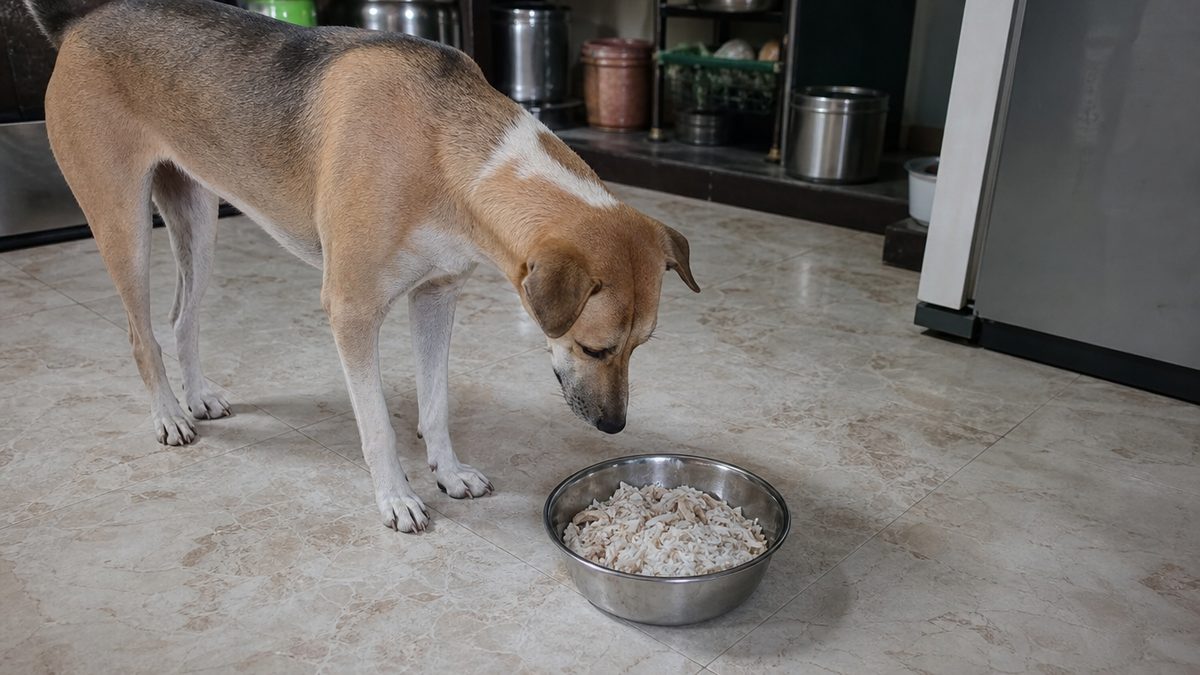
Can dogs eat rice? Yes, plain cooked rice is safe for a healthy adult dog, and quantity is the whole question. Rice carries about 21 g of protein per 1,000 kcal against the 45 g an adult dog's diet must hold, so it dilutes the bowl rather than filling it. One cup of cooked rice is 35 to 44 percent of a 10 kg dog's day. Cook it plain in plenty of water, drain it, and never serve it from yesterday.
This guide is general information for Indian pet owners and is not a diagnosis. Always consult a registered veterinarian near you before acting on anything you read here, and treat any sudden change in your pet's condition as urgent.
Can dogs eat rice, and what does rice actually deliver?
Dogs can eat plain cooked rice safely, and what rice delivers is energy and very little else: milled white rice measures 7.94 g of protein and 1,491 kJ per 100 g in India's national food composition tables, which works out at 22.3 g of protein per 1,000 kcal against the 45.0 g an adult dog's diet is required to hold.
Those composition figures come from the Indian Food Composition Tables 2017, published by the ICMR-National Institute of Nutrition in Hyderabad, which sampled each rice form in six regions of the country. This is the right table for an Indian kitchen, because it measured Indian rice rather than a foreign database's version of it.
The requirement figure comes from the AAFCO dog food nutrient profiles expressed per 1,000 kcal of metabolisable energy, where adult maintenance sets crude protein at a minimum of 45.0 g, lysine at 1.58 g, calcium at 1.25 g and phosphorus at 1.00 g. Put the two side by side and the answer to this question stops being a yes or no.
| Food, ICMR-NIN code | Protein | Energy | Total dietary fibre | Protein per 1,000 kcal | Share of the 45 g dog minimum |
|---|---|---|---|---|---|
| Rice, raw, milled (A015) | 7.94 g | 1,491 kJ (356 kcal) | 2.81 g | 22.3 g | 50 percent |
| Rice, parboiled, milled (A014) | 7.81 g | 1,471 kJ (352 kcal) | 3.74 g | 22.2 g | 49 percent |
| Rice, raw, brown (A013) | 9.16 g | 1,480 kJ (354 kcal) | 4.43 g | 25.9 g | 58 percent |
| Rice puffed, murmura (A012) | 7.47 g | 1,514 kJ (362 kcal) | 2.56 g | 20.6 g | 46 percent |
| Wheat flour, atta (A019) | 10.57 g | 1,340 kJ (320 kcal) | 11.36 g | 33.0 g | 73 percent |
Read the last column rather than the first. Every form of rice an Indian kitchen holds supplies between 46 and 58 percent of the protein density a dog's food is required to carry, and the atta in the same kitchen supplies 73 percent. That is the single most useful fact about rice and dogs, and no page currently ranking in India states it.
Our page on whether dogs can eat roti does the wheat half of this arithmetic in full, including why a dog digests cooked cereal starch almost completely. We are not running that evidence again. The method here is the same one our Indian food safe for cats page uses for the feline minimum of 65 g, applied to the dog figure of 45 g, and that page already notes in one line that rice fails the dog test too. This page is the long version of that line, because what a dog is allowed to do about it is completely different from what a cat is allowed to do about it.
Why cooked weight is the only honest unit
Work in cooked grams, because that is what goes in the bowl and raw rice roughly triples. Cooked white rice measures 68.4 g of water, 130 kcal, 2.69 g of protein, 0.28 g of fat and 0.4 g of total dietary fibre per 100 g, and one cup weighs 158 g. Against the ICMR-NIN moisture figure of 9.93 g per 100 g for raw milled rice, a dry matter balance puts 100 g of raw rice at about 285 g once cooked.
That conversion is Bonbeno's arithmetic on two cited moisture figures rather than a published yield, and it cross-checks. One cup of cooked rice contains about 55 g of raw rice, which the ICMR-NIN table prices at 198 kcal against the 205 kcal the USDA record gives for the cup itself. Two independent databases landing within 4 percent of each other is as good as this gets.
The protein figures cross-check the same way. Cooked white rice carries 20.7 g of protein per 1,000 kcal by the USDA row and 22.3 g by the ICMR-NIN row, so the protein density of rice is somewhere near 21 g whichever table you prefer, and that is less than half the dog minimum either way.
One cup of cooked rice is 205 kcal. Against the World Small Animal Veterinary Association's published daily ranges that is 59 to 73 percent of a 5 kg dog's whole day, 35 to 44 percent of a 10 kg dog's, 21 to 26 percent of a 20 kg dog's and 15 to 19 percent of a 30 kg dog's. A cup is a small serving to a person and most of the day to a Pomeranian.
What a rice-heavy bowl demands of everything else in it
A rice-heavy bowl forces every other ingredient to carry the protein rice did not, and the arithmetic escalates fast: at a quarter of the energy from rice the rest of the bowl must hold 53 g of protein per 1,000 kcal, at half it must hold 69 g, and at 70 percent it must hold 101 g, which is more than AAFCO publishes for any life stage of either species.
This is the cost nobody counts, and it is not the same argument as calories. A dog eating rice is not merely eating something low in protein. It is spending energy it cannot spend twice, and the protein that was going to fill the gap has to arrive in a smaller and smaller share of the bowl.
The calculation is simple enough to check. Take 21 g of protein per 1,000 kcal for rice, take 45.0 g as the target for the whole bowl, and solve for what the non-rice fraction has to carry. Crude protein is additive on an energy basis, so the sum works.
| Share of daily energy from rice | Protein the rest of the bowl must carry, per 1,000 kcal | What that figure is above |
|---|---|---|
| 10 percent, the treat ceiling | 48 g | Barely above the adult dog minimum of 45 g. Comfortable. |
| 25 percent | 53 g | Approaching the dog growth and reproduction minimum of 56.3 g |
| 50 percent | 69 g | Above the adult cat minimum of 65 g, which is the densest ordinary pet food on the market |
| 70 percent | 101 g | Above every AAFCO figure for either species at any life stage, the highest of which is 75 g |
| 90 percent | 261 g | Not achievable with any food |
Read the 70 percent row twice, because it is the row most Indian rice-bowl households are actually in. At that share there is no ingredient you can add that fixes the bowl. Chicken does not fix it, egg does not fix it, dal certainly does not. The bowl has to have less rice in it.
India's own national guidance makes the parallel point about people, and the comparison is instructive rather than decorative. ICMR-NIN's Dietary Guidelines for Indians 2024 recommend 250 g of cereals and millets a day in a 2,000 kcal diet, state that intake of cereals should be limited to 45 percent of total energy, and then record that as per the data, cereals contribute to 50 to 70 percent of total energy per day. Indians are being told to cut their own cereal share. A dog's protein requirement per 1,000 kcal is more than double an adult human's, so the ceiling for a dog sits far below 45 percent, not at it.
The one place the published minimums disagree
Two published figures for the dog protein minimum differ by more than a factor of two, and our page on whether biscuits are dog food already sets that disagreement out in full, so we are pointing at it rather than re-arguing it. The Merck Veterinary Manual states that adult dogs require a minimum of 18 percent protein as dry matter or 45 grams per 1,000 kcal ME under the AAFCO guidelines, or about 20 g of protein per 1,000 kcal under the NRC guidelines.
For rice the distinction matters more than it did for biscuits, and we are not going to pretend otherwise. At about 21 g per 1,000 kcal, rice sits at half the AAFCO floor and just at the NRC figure. A biscuit at 15.2 g fails both. Rice does not fail both, and a page that tells you it does is overstating its case. What rice fails is the formulation floor used to decide whether a food may be sold as complete, which is the standard that matters when rice is most of the bowl rather than a spoon in it.
The displacement argument is strongest where it is least dramatic, which is minerals. Rice carries almost none of the calcium a dog's bowl is required to hold, and every kilocalorie of rice displaces a kilocalorie of the food that was carrying it. Dilute and displace are the two verbs that describe what rice does to a bowl, and neither of them is poison. Our page on balancing a home-cooked diet for calcium covers that in full, including why a routine blood test will not catch the deficit, and we are not duplicating it here.
White against brown, where the folk answer is backwards for a dog
Choose white rice over brown for a dog, which reverses the usual instinct, because brown rice saves no energy worth counting, concentrates more arsenic in the bran that makes it brown, is harder to wash that arsenic out of, and is the wrong food for the gut upset most Indian rice-feeding is for.
Start with the claim that brown rice is lighter, because the measurement kills it. Brown rice measures 1,480 kJ per 100 g and milled white rice 1,491 kJ, which is 354 kcal against 356. The difference is under 1 percent. Nobody's dog has ever got thinner on brown rice.
The genuine credits for brown rice are two, and both are smaller than they sound. It carries 9.16 g of protein per 100 g against white rice's 7.94 g, which lifts protein density from 22.3 to 25.9 g per 1,000 kcal. That is better and it is still 58 percent of the dog minimum. It also carries 4.43 g of total dietary fibre against 2.81 g, of which 3.60 g is insoluble against 1.99 g.
Whether that fibre is a benefit depends entirely on the dog in front of you. Insoluble fibre increases faecal volume or bulk, and in turn this causes stretch in the colonic smooth muscle, thereby stimulating peristalsis and decreasing intestinal transit time. For a constipated dog that is useful. For the far commoner Indian case, a dog with loose stool whose owner has reached for rice precisely to firm it up, that is the opposite of what was wanted.
| Question | Milled white rice | Brown rice | Which wins for a dog |
|---|---|---|---|
| Energy per 100 g | 356 kcal | 354 kcal | Neither. The gap is under 1 percent. |
| Protein per 1,000 kcal | 22.3 g | 25.9 g | Brown, by 3.6 g against a 45 g minimum |
| Insoluble fibre per 100 g | 1.99 g | 3.60 g | Depends. White for loose stool, brown for a sluggish gut. |
| Inorganic arsenic | Lower, and 73 percent removable by cooking | Higher, and only 54 percent removable | White, clearly, and on two counts at once |
The arsenic row is the one that settles it, and the mechanism is simple. Arsenic concentrates in the outer bran layer of the grain, which is exactly the layer that milling removes and brown rice keeps. When six rice types were put through four home-style cooking treatments, the best method removed 73 percent of inorganic arsenic from white rice and only 54 percent from brown, and it raised the margin of exposure by 3.7 times for white rice against 2.2 times for brown. Brown rice therefore starts higher and ends higher.
Parboiled rice, the default across the south and east
Treat parboiled rice as a third category rather than a variety of white, because regulators already do. Parboiled rice, called ukda chawal in the north and sold as idli rice across Tamil Nadu and Karnataka, is partly boiled inside the husk before drying and milling, which drives some of the bran's contents into the grain. EU maximum levels for inorganic arsenic set 0.15 mg per kg for non-parboiled polished white rice and 0.25 mg per kg for parboiled rice, husked rice and rice flour, a 67 percent higher ceiling for the same food.
Nutritionally parboiled rice sits almost exactly where white rice sits, at 7.81 g of protein and 1,471 kJ per 100 g, giving 22.2 g per 1,000 kcal. So the practical reading for a household in Chennai, Kolkata or coastal Karnataka is that your default rice is nutritionally interchangeable with plain white rice for a dog and carries a higher arsenic allowance under the one regulatory table that bothers to distinguish them.
Puffed rice measures 362 kcal per 100 g, the highest energy density of any rice form in the ICMR-NIN table, and 20.6 g of protein per 1,000 kcal, the lowest. It feels like air because it is mostly air by volume, which is exactly why people hand over far more of it than they would of cooked rice. Weigh it if it is going in the bowl.
The arsenic question, with the numbers rather than the adjectives
Arsenic in rice is real, measured and genuinely higher in parts of India than almost anywhere else, and the exposure for a dog eating rice as a capped treat is under half the per-kilogram exposure of the person feeding it. The figures are below, and they say the portion is the control, not panic.
Rice accumulates arsenic because of how it is grown. India's own food regulator states the mechanism plainly: rice plants take up more arsenic, approximately 10 fold, as compared to other cereal crops, and arsenic in rice is elevated when grown on arsenic-rich groundwater and soil. That is a published FSSAI position, not an activist claim.
The Indian measurements exist and they have denominators. A study of 44 rice cultivars grown in arsenic-affected West Bengal found arsenic in rice grain ranging from less than 0.0003 to 2.6 mg per kg dry weight, with 42 of the 44 varieties exceeding the Codex Alimentarius limit for polished rice of 0.2 mg per kg, and high yielding varieties accumulating more than local varieties. A separate study of 29 paired raw and cooked rice samples from households in the same region found that inorganic arsenic, the toxic form, was the predominant species in both, at 93.8 percent of total arsenic in raw rice and 88.1 percent in cooked rice.
Those 44 cultivars were grown where the groundwater measured 0.26 to 0.73 mg of arsenic per litre, against a World Health Organization drinking water limit of 0.01 mg per litre. That is an arsenic-endemic pocket of the Bengal basin, not a description of rice in Pune or Bengaluru. We could not find an all-India market survey of arsenic in retail rice and we are not going to invent the national figure. Treat the Bengal numbers as the upper end of what Indian rice can carry, not as what your bag of rice contains.
India sets no arsenic limit for rice at all
India has no rice-specific maximum limit for arsenic, which is the finding on this page we least expected. FSSAI's own guidance note on heavy metals reproduces the maximum limits from the Food Safety and Standards (Contaminants, Toxins and Residues) Regulations, 2011 and lists, for arsenic, a single applicable row reading foods not specified at 1.1 parts per million. The same table in the same note gives cadmium a dedicated row for rice polished at 0.4 ppm. The regulation's own metal contaminants table names only milk, soft drinks, carbonated water, infant foods and turmeric under arsenic.
So the limit that applies to Indian rice is the catch-all 1.1 ppm, which is 5.5 times the Codex Alimentarius maximum level of 0.20 mg per kg for polished rice and 3.1 times the 0.35 mg per kg for husked rice. Thirty-eight of the 42 Bengal cultivars that breached the Codex limit would sit inside India's own. We are reporting that gap, not editorialising about it, and we note that the guidance note itself says to refer to the Regulations for specific limits.
What the exposure actually is for a dog
Work the arithmetic at the Codex limit of 0.20 mg per kg, treated as a reference concentration rather than a measurement of anybody's rice, and the dog comes out below the person. A 10 kg dog fed rice at the standard 10 percent treat ceiling eats 13 to 17 g of raw rice a day, which carries 2.6 to 3.3 micrograms of inorganic arsenic, or 0.26 to 0.33 micrograms per kilogram of body weight.
Set that against the person holding the spoon. ICMR-NIN recommends 250 g of cereals a day for a 2,000 kcal Indian adult, at a reference body weight of 65 kg for an adult man. If all of that cereal is rice at the same concentration, which it is across most of the south and east and is not in the wheat-eating north, the person takes in 50 micrograms a day, or 0.77 micrograms per kilogram of body weight. The capped dog is on under half the person's per-kilogram intake.
| Who is eating | Rice a day, raw equivalent | Inorganic arsenic a day | Per kg of body weight | Against the adult human figure |
|---|---|---|---|---|
| 5 kg dog, rice capped at 10 percent of energy | 8 to 10 g | 1.6 to 2.0 micrograms | 0.31 to 0.39 micrograms | About half |
| 10 kg dog, rice capped at 10 percent of energy | 13 to 17 g | 2.6 to 3.3 micrograms | 0.26 to 0.33 micrograms | Under half |
| 30 kg dog, rice capped at 10 percent of energy | 30 to 38 g | 6.1 to 7.6 micrograms | 0.20 to 0.25 micrograms | About a third |
| Indian adult man, 250 g of cereals, 65 kg | 250 g | 50 micrograms | 0.77 micrograms | The reference |
| 10 kg dog, rice at half the day's energy | 74 g | 14.9 micrograms | 1.49 micrograms | 1.9 times |
| 10 kg dog, rice at 70 percent of the day's energy | 104 g | 20.8 micrograms | 2.08 micrograms | 2.7 times |
The table says one thing and it is not that rice is dangerous. It says the portion is the whole control. A dog on a counted spoonful of rice carries less arsenic per kilogram than its owner does. A dog whose bowl is mostly rice carries two to three times what its owner does, because its body is small and its rice share is large. The same cap that protects the dog's protein density protects it here, which is a convenient thing to be able to say honestly.
For completeness and for honesty about what these numbers are not: the European Food Safety Authority's contaminants panel selected a benchmark dose lower confidence limit of 0.3 to 8 micrograms per kilogram of body weight per day in 2009, and in its 2024 update established a BMDL05 of 0.06 micrograms per kilogram of body weight per day from a skin cancer case-control study. Those are human points of departure for estimating cancer risk, not safe intakes, and most human populations sit above the 2024 figure. No canine equivalent has been published. That is exactly why the comparison worth making is dog against person rather than dog against benchmark.
How you cook the rice changes how much arsenic is in it
Cooking method moves the arsenic in rice more than variety does, and two Indian studies point in opposite directions for a reason that is useful rather than confusing: the arsenic in your cooking water decides whether boiling removes arsenic or adds it.
Take the removal side first. In the 29 paired household samples from West Bengal, cooking rice with water low in arsenic, below 10 micrograms per litre, significantly decreased the total and inorganic arsenic content in cooked rice compared with raw rice, and the authors identify the mechanism precisely: arsenic concentration is mainly decreased during boiling of rice grains with excess water. Washing the grains made almost no difference.
The controlled kitchen test agrees and puts a number on the best method. Of four home-friendly treatments, parboil-and-absorb, where the rice is briefly boiled in excess water, drained, and then finished by absorption, removed 73 percent of inorganic arsenic from white rice and 54 percent from brown.
Where the two Indian studies point in opposite directions
The second Indian study found the reverse, and both are right. Examining paired raw and cooked rice from households in arsenic-endemic rural West Bengal, it found that the use of arsenic-rich groundwater for cooking could elevate the arsenic concentration in cooked rice up to 129 percent above the raw sample, and named the cooking method, the rice variety, the background arsenic in the raw rice and the arsenic in the cooking water as the four predisposing factors.
So boiling in excess water is not a technique that removes arsenic. It is a technique that exchanges the grain's arsenic with the water's. Where the water is clean, the grain loses. Where the water carries 0.26 to 0.73 mg per litre, as the groundwater in those districts does, the grain gains. We are publishing both findings rather than averaging them, because the direction depends on something the reader can actually check about their own kitchen.
The Mandal study names the specific habit that makes this worse, and it is the exact habit Indian households apply to dogs. The risk is heightened, it records, by the habit of drinking the stewed rice water, the gruel, in the local communities. Maand, kanji or chawal ka pani is the drained starch water, and if the arsenic has moved out of the grain, that is where it has gone. Pouring it over the dog's bowl pours the arsenic back in. Drain it and discard it.
The pressure cooker problem
Most Indian kitchens now cook rice by the absorption method in a pressure cooker, with a measured quantity of water that is entirely taken up by the grain, and nothing is drained. Nothing drained means nothing removed. The grain keeps whatever it started with plus whatever the water brought.
No study has measured arsenic in pressure-cooked rice specifically, and we are flagging that as an inference rather than a finding. The established part is the mechanism: inorganic arsenic in rice is described as surface-bound and soluble, which is why draining removes it. A method that drains nothing cannot use that route.
- Cook the dog's rice in plenty of water, several times the volume of the grain, rather than in a measured absorption quantity.
- Drain the water off and throw it away, which removes most of what draining can remove.
- Skip the maand. It is the fraction you just paid to separate out.
- Use the drinking water you would use for yourself, because the cooking water sets the direction of the whole exchange.
- Choose white over brown where arsenic is a live concern in your district, since more of it leaves white rice.
- Do not make rice most of the bowl, which is the control that outperforms every cooking technique on this list.
One caution about swapping this advice wholesale into a human kitchen. Boiling in excess water and draining also removes water-soluble nutrients, which is why national dietary advice does not simply tell everyone to do it. For a dog, where rice is capped at a tenth of the day and the nutrition is meant to come from elsewhere, that trade is easy. For a household's own rice it is a question for a dietitian, not for a pet page.
Rice water and the bland diet: what the evidence supports
The evidence supports rice as a short-term bland food and does not support rice water as a treatment, and the modern veterinary position is that a long bland diet is not the default it once was. Here is what each claim rests on and when to stop.
Boiled rice and its water are the universal Indian home remedy for a dog with loose motions, and the first thing to say is that plain boiled white rice genuinely is a sensible short-term food for an upset gut. It is low in fat at 0.28 g per 100 g cooked, low in fibre at 0.4 g, and almost entirely digestible starch. Dogs digest properly cooked starches from grains with greater than 90 percent efficiency. A bland diet of rice with a little plain boiled chicken is not folk nonsense.
Rice water is a different claim and it has been tested, in people. The Cochrane review of polymer-based oral rehydration solution, which is mostly rice-based, pooled 35 trials and 4,284 participants. Against the older, saltier glucose solution of 310 mOsm per litre or more, polymer-based solution reduced total stool output in the first 24 hours by about 65 mL per kg across 16 trials and 1,483 participants, and reduced the duration of diarrhoea by about 8.6 hours across 16 trials and 1,137 participants, both on low quality evidence. Against the modern lower-osmolarity solution of 270 mOsm per litre or less, the review found insufficient evidence to show that one is better than the other.
Read that carefully, because it is the honest answer to a question nobody has answered for Indian dog owners. Rice water beat the formulation that has been superseded, and did not clearly beat the one that replaced it. It was tested as a rehydration solution with measured electrolytes, not as the starch water off the top of a pot. And every participant in all 35 trials was a human being. Nothing in that review is evidence about dogs.
Rice water as it comes off an Indian pot is water, starch and whatever salt went into the pan. It is not an oral rehydration solution, because it has no measured sodium, potassium, chloride or glucose. It will not rehydrate a dehydrated dog and it should not be used to try. A dog that needs rehydrating needs a veterinary surgeon, and in a small dog or a puppy that need arrives fast.
Why a long bland diet is no longer the default
A bland diet is a short bridge, not a diet, and the arithmetic on this page is the reason. A bowl that is 75 percent rice and 25 percent boiled chicken, the ratio Indian clinic pages commonly give, is a bowl where the rice carries about 21 g of protein per 1,000 kcal and nothing in it carries calcium, and the table earlier on this page says the remaining quarter cannot make that up. Over three days that does not matter. Over three weeks it is a nutritional problem laid on top of whatever caused the diarrhoea.
The wider shift in veterinary practice is real and it is about what you do rather than what you feed. The European Network for Optimization of Veterinary Antimicrobial Therapy guidelines for canine acute diarrhoea recommend against antimicrobial treatment in dogs with acute diarrhoea and mild disease, defined as dogs in good general condition with no signs of dehydration or systemic illness. That is a strong recommendation on high-certainty evidence with 100 percent panel agreement, and the same recommendation and strength apply to haemorrhagic diarrhoea with mild disease, and to both forms with moderate disease.
For an Indian owner that is the most useful sentence in this whole section. The reflex of taking a dog with one day of loose motions for an antibiotic injection is the thing the current guideline argues against, and supportive care with a bland food is what it leaves standing. We do not recommend any drug or dose; that is a veterinary decision on the individual animal, which is why this page carries the medical disclaimer.
When to stop the rice and see a veterinary surgeon
Stop and call when the dog crosses out of the mild category, and the guideline's own severity definitions give you the ladder. Mild means good general condition, no dehydration, no systemic illness. Moderate means impaired general condition with varying degrees of dehydration or hypovolaemia, where signs of systemic disease resolve with adequate fluid therapy. Severe means impaired general condition with signs of systemic disease that persist despite adequate fluid therapy.
- Call today if the dog is dull, flat, refusing water, or its skin is slow to spring back when lifted at the scruff.
- Call today if there is blood in the stool, repeated vomiting, or a painful or distended belly.
- Call today, and say so on the phone, if the patient is a puppy, a toy breed, a senior dog, or a dog with an existing condition. Small bodies dehydrate fast.
- Call now if the dog has not had its full course of vaccination, because canine parvovirus presents as exactly this and is an emergency.
- Call rather than extend the bland diet if loose stool is still there after two or three days, instead of running the rice for a week.
Two dogs should not be on a rice bland diet at all without a veterinary instruction. A dog with diabetes is being managed on a controlled carbohydrate load, and a bowl of white rice undoes that. A dog recovering from pancreatitis needs a fat ceiling that plain rice meets easily and that the ghee somebody will add does not.
Leftover rice, the risk Indian pet pages do not mention
Cooked rice left at room temperature is the classic vehicle for Bacillus cereus, whose emetic toxin is heat-stable, which means reheating yesterday's rice does not make it safe. India has a documented outbreak with 202 people in it, and no Indian pet page mentions any of this.
On 2 February 2021, 202 people in Diphu, Assam became ill after eating fried rice with eggs at a public gathering. Most suffered abdominal pain and vomiting, symptoms started about two hours after the meal, and all 202 were hospitalised the same evening and discharged within 48 hours. Culture of the leftover fried rice grew Bacillus cereus; culture of the dessert served alongside it was sterile.
The detail that matters for a kitchen is how the rice was handled. The food was cooked the previous day, kept at room temperature for the whole night, and next day it was just pan-fried, packed and delivered. That is not an exotic failure. It is what happens to the extra rice in a very large number of Indian homes, and it is often the rice that ends up in the dog's bowl.
The emetic toxin is cereulide, a cyclic depsipeptide that is highly resistant to heat and pH, and the authors state the consequence directly: the inactivation of preformed cereulide by food processing steps is unlikely to occur. Once the toxin is in the rice, frying it, boiling it or microwaving it leaves the toxin there. An Indian clinic page currently ranking for this query answers the question is leftover rice safe for dogs with yes, provided it is reheated safely. Reheating is not the safeguard. Temperature before reheating is.
Two syndromes come from the same organism and they look different. The emetic syndrome is a food intoxication with nausea and vomiting and a short incubation of 0.5 to 6 hours. The diarrhoeal type is a toxico-infection with diarrhoea and abdominal cramps appearing 8 to 16 hours after the contaminated food. A dog that vomits within an hour or two of eating yesterday's rice fits the first pattern.
The honest limit on all of this is that the Diphu outbreak and the cereulide literature are human. We could not find a published Indian case series of Bacillus cereus intoxication in dogs, and we are not going to assert a canine incidence that nobody has measured. What is established is that the toxin is in the food, that it survives reheating, and that the food is one Indian households give dogs routinely.
Note also that the Diphu outbreak happened in February, not in the rains. Warm and humid conditions shorten the safe window and a Chennai or Mumbai kitchen in August is the worst case, but a cool-season kitchen produced 202 cases, so monsoon is a reason to be stricter rather than the only time to bother.
- Refrigerate the dog's share within two hours of cooking, in a covered container, not left in the cooker.
- Cool it fast by spreading it in a shallow dish rather than leaving a hot mass to cool slowly in a deep vessel.
- Use refrigerated rice within a day, and throw out anything that sat overnight on the counter however clean it looks.
- Judge it by how it was stored, not by how it smells, because cereulide has no smell and no taste.
- Serve it cool or at room temperature to the dog, since reheating adds nothing except the illusion of safety.
Food safety and nutritional adequacy are separate questions and this page keeps them separate. Rice that is perfectly safe can still be the wrong share of the bowl, and rice that is the right share can still make a dog sick if it spent the night out.
The rice that actually reaches the dog
Almost no Indian dog is given plain boiled rice, and the dish it arrives in usually decides the answer, because biryani, pulao, sambar sadam and curd rice are four different problems and only one of them is about the rice.
Our page on whether dogs can eat roti makes the general case that what goes on an Indian staple costs more than the staple does, and the four-question method for sorting any dish is on our hub page, Indian food safe for dogs. We are not repeating either argument. The rice-specific version is narrower and worth stating on its own, because rice is almost never served plain and is almost always served in a named dish.
| Dish | The problem | The answer |
|---|---|---|
| Biryani, pulao, fried rice, jeera rice | Onion and garlic in almost every recipe, plus oil | Refuse outright. This is a toxicity question, not a portion question. |
| Sambar sadam, rasam rice, dal chawal | The tadka carries onion, garlic and chilli, and the dal adds salt | Refuse the mixed version. Plain rice set aside before mixing is a different food. |
| Curd rice, thayir sadam | Two questions at once, the curd and the rice | The rice half is this page. The dairy half is its own question. |
| Ghee rice, rice with a spoon of ghee | Added fat on an already energy-dense food | Leave the ghee off, particularly for a dog with a pancreatitis history. |
| Plain boiled rice, drained | Energy and protein dilution only | Fine, counted and capped at a tenth of the day. |
The first row is the only one that is a poisoning question and it is the commonest dish. Onion and garlic are toxic to dogs at ordinary kitchen quantities, and our page on onion and garlic toxicity in pets carries that toxicology in full. A spoon of biryani is not a small portion of a safe food. It is a small portion of an unsafe one.
Curd rice deserves one line and no more here, because the dairy half of it has its own measurements on our page about curd, paneer and ghee for dogs. Salt and masala likewise: an unsalted boiled rice is not a sodium problem and the sambar poured over it is, and the spice rack is rated on our page about spices, salt and masala for pets.
Most of the rice handed out in Indian streets goes to a dog that is under its energy requirement rather than over it, which flips the whole argument on this page. A thin street dog is not being diluted by rice; it is being kept alive by it. It is still a food with half the protein density a dog's diet needs and essentially no calcium, so a daily plate of rice is a poor substitute for anything better. Our guide to feeding community dogs in India covers the law, the designated spot and what else to put down.
One group should not be getting rice at all until a veterinary surgeon says otherwise. A growing puppy has the highest nutrient density requirement of any life stage and household cereal dilutes it fastest, and the figures for that are on our puppy feeding chart for India. An overweight dog on a reduction plan has no treat budget to spend, which is covered on our page about obesity in dogs and cats.
How much rice, worked for three sizes of dog
To work out a dog's rice allowance, take 10 percent of its daily energy from the published chart, divide by 1.3 kcal per gram of cooked rice, and subtract those calories from the main meal rather than adding them to it. For a 10 kg dog that comes to about a quarter of a cup.
The 10 percent ceiling is the standard treat allowance and it is the right one here, because rice is a treat in nutritional terms however it is served. Everything below follows from two published numbers, the daily energy chart and the energy density of cooked rice.
| Dog | Daily energy | 10 percent of it | Cooked rice | In cups | Raw rice equivalent |
|---|---|---|---|---|---|
| 5 kg, a Pomeranian or a small Indie pup grown | 280 to 351 kcal | 28 to 35 kcal | 22 to 27 g | Under a sixth of a cup | 8 to 10 g |
| 10 kg, a Beagle or a small Indie | 470 to 590 kcal | 47 to 59 kcal | 36 to 45 g | About a quarter cup | 13 to 17 g |
| 20 kg, a medium Indie | 790 to 993 kcal | 79 to 99 kcal | 61 to 76 g | About two fifths of a cup | 22 to 28 g |
| 30 kg, a Labrador or a German Shepherd | 1,080 to 1,346 kcal | 108 to 135 kcal | 83 to 104 g | About two thirds of a cup | 30 to 38 g |
Use the lower end of each energy range for a flat dog in Mumbai, Delhi or Pune that gets one walk a day. The chart's ranges come from the 2006 National Research Council maintenance equations, 130 kcal times body weight to the power 0.75 for an active adult and 95 kcal for an inactive one, and most Indian apartment dogs are the inactive case.
- Read the dog's daily energy off the chart at its ideal weight, not its current weight if it is overweight.
- Take a tenth of that figure, which is the whole treat budget for the day and rice has to share it.
- Divide by 1.3 to get grams of cooked rice, or by 3.56 to get grams of raw rice Longvah T, Ananthan R.
- Weigh that amount once on a kitchen scale so you know what it looks like in your own katori, then stop weighing.
- Boil it plain in plenty of water, with no salt, oil, ghee, haldi or tadka, and drain the water away.
- Cool it before serving, and refrigerate anything the dog does not finish within two hours.
- Subtract those calories from the main meal the same day rather than treating the rice as free.
- Weigh the dog monthly on the same scale, because the scale is the only thing that tells you whether the arithmetic was right.
Compare that with the portion guidance currently on the Indian first page. One veterinary clinic chain gives 1 to 2 tablespoons per serving for small dogs, 2 to 4 for medium and a quarter to half a cup for large, and separately states that rice should make up no more than 10 percent of daily calories. The percentage is right and the tablespoons are not tied to it, so a 7 kg Pug and a 15 kg Indie get the same answer. Another Indian page, written by a certified canine nutritionist who sells meat-based products on the same page, caps rice at 10 to 15 percent of total meal volume. Volume is the wrong unit, because a spoon of rice and a spoon of chicken are not the same amount of anything that matters.
Portion size is a calculation from body weight and nothing else, which is why the table above begins with the dog rather than with the spoon. A tablespoon is a measure of a kitchen; a kilocalorie is a measure of an animal.
One cup of cooked rice is 205 kcal and a 45 g packet of glucose biscuits is 204 kcal, and both come to 58 to 73 percent of a 5 kg dog's entire daily energy. Our page on why biscuits are not dog food makes that case for biscuits. The uncomfortable point is that plain, wholesome, home-cooked rice lands a small dog in the same place, because the unit of harm is calories and the mechanism is displacement.
Where rice is the base of a home-cooked diet rather than a scrap on top of a complete food, the whole bowl needs formulating and this page is the wrong tool. Our guide to homemade dog food in India does that work, and the day's grams by weight are on our dog diet chart for India. A vegetarian household has a further set of constraints, covered on feeding a dog in a vegetarian household.
What this page can prove, and what it cannot
Seven claims here are published measurements with denominators and six widely repeated claims about rice and dogs are not established, so the line between them is drawn below rather than left for you to guess.
Seven claims on this page are established, and the source for each is named beside it.
- Indian milled white rice measures 7.94 g of protein and 1,491 kJ per 100 g, sampled in six regions, which is 22.3 g of protein per 1,000 kcal.
- An adult dog's food must carry a minimum of 45.0 g of crude protein per 1,000 kcal under the AAFCO profiles, so rice supplies about half of it.
- Cooked white rice measures 130 kcal, 2.69 g of protein and 0.4 g of total dietary fibre per 100 g, with a cup weighing 158 g.
- Arsenic in 44 rice cultivars grown in arsenic-affected West Bengal ranged from under 0.0003 to 2.6 mg per kg, with 42 of 44 over the Codex limit for polished rice.
- Inorganic arsenic was 93.8 percent of total arsenic in raw rice and 88.1 percent in cooked rice across 29 paired household samples, and boiling in excess low-arsenic water is what reduces it.
- The emetic toxin of Bacillus cereus is highly resistant to heat and pH, and 202 people in Diphu, Assam fell ill after eating rice cooked the previous day and held overnight at room temperature.
- Rice was implicated in 5 of 297 dogs with rechallenge-confirmed food allergy, 2 percent, the joint lowest of the ten foods reported.
Six further claims are not established, and the list below marks where this page reasons rather than reports.
- No all-India market survey of arsenic in retail rice was found. Every Indian arsenic figure on this page comes from arsenic-endemic districts of the Bengal basin, which is the upper end of the national picture rather than its middle.
- The raw-to-cooked conversion of about 285 g per 100 g is Bonbeno's dry matter arithmetic on two cited moisture figures, not a published yield. It cross-checks on energy to within 4 percent and it will vary with how wet you like your rice.
- No study has measured arsenic in pressure-cooked rice. The surface-bound and soluble nature of inorganic arsenic is established; that a sealed absorption method removes none of it is an inference from the mechanism.
- No canine case of Bacillus cereus intoxication from leftover rice was found in the published literature. The toxin, its heat stability and the outbreak are all documented in people.
- The arsenic exposure table is arithmetic at the Codex reference concentration of 0.20 mg per kg. It is not a measurement of any particular rice, and the human comparison assumes all 250 g of an Indian adult's recommended cereal is rice, which is true in the south and east and false in the north.
- No published study has measured the digestibility, glycaemic response or arsenic content of rice cooked the way an Indian household cooks it, in a pressure cooker, fed to a dog. Everything here is assembled from human food science and from canine studies done on extruded diets.
One claim circulating on this query deserves retiring rather than answering. The page ranking first in India on the unqualified query lists fibre among the reasons rice helps a dog's gut, describing it as containing fibre which helps with stool formation and relieving constipation. Cooked white rice carries 0.4 g of total dietary fibre per 100 g, which makes it one of the lowest-fibre foods in any kitchen. Rice firms stool because it is low in fibre and highly digestible, not because it is a fibre source. Getting the mechanism backwards matters, because it is the reason the same page then recommends rice for constipation.
Finally, the boundary of what a directory should say. Bonbeno names no product, recommends no supplement and prescribes no diet. If your dog has loose stool lasting more than a day or two, is losing or gaining weight, is itching, or has ever been treated for pancreatitis or diabetes, the decision about what goes in its bowl belongs to the veterinary surgeon who has examined it, which is why this page publishes under the medical disclaimer at the top.
Common questions
How do I cook rice for my dog?
To cook rice for a dog, boil plain white rice in several times its volume of water, with no salt, oil, ghee, haldi or tadka, then drain the water off and discard it rather than pouring it over the bowl. Let it cool to room temperature before serving. Draining is what removes most of the inorganic arsenic a grain carries, and it only works if you use the drinking water you would use yourself.
Can white rice cause itching in dogs?
White rice rarely causes itching. In the pooled review of dogs whose food allergy was confirmed by rechallenge, rice was implicated in 5 of 297 dogs, or 2 percent, the joint lowest of the ten foods reported, behind beef at 34 percent, dairy at 17 and chicken at 15. That is low rather than zero. Environmental allergy is a far commoner cause of itching in Indian clinics, which our page on atopic dermatitis in dogs covers, and only a properly run elimination diet can implicate any food in your individual dog.
Can white rice cause constipation in dogs?
White rice can contribute to constipation, and the reason is what it lacks. Cooked white rice carries 0.4 g of total dietary fibre per 100 g, among the lowest of any kitchen food, and insoluble fibre is what increases faecal bulk and speeds intestinal transit. Rice firms stool for exactly that reason, which is useful for a day of loose motions and unhelpful for a dog that is already straining. Keep water available, and do not run a rice-heavy bland diet for longer than your veterinary surgeon advises.
Can dogs eat rice every day?
Daily rice is fine only if it is counted and capped. The limit is energy, not safety: a 10 kg dog's tenth-of-the-day allowance is 36 to 45 g of cooked rice, about a quarter of a cup, and a single full cup is already 35 to 44 percent of its day. A daily quarter cup subtracted from the main meal is a completely different practice from a daily bowlful added on top of it.
Is white rice or brown rice better for dogs?
White rice is the better choice for a dog, which reverses the usual instinct. Brown rice saves no energy worth counting, at 354 kcal per 100 g against white rice's 356, and its one real credit is protein density at 25.9 g per 1,000 kcal against 22.3, both well under the 45 g minimum. Against that, arsenic concentrates in the bran that makes brown rice brown, and the best home cooking method removes 73 percent of inorganic arsenic from white rice and only 54 percent from brown.
Can I give my dog rice water for diarrhoea?
Plain rice water is not a rehydration fluid and should not be used as one. The Cochrane review of rice-based oral rehydration solution pooled 35 trials and 4,284 human participants and found it reduced stool output against the older high-osmolarity solution but showed insufficient evidence of benefit against the modern low-osmolarity one. Those trials used measured electrolytes, not maand off a pot, and every participant was a person. A dog that is dehydrated needs a veterinary surgeon, not starch water.
Is leftover rice safe for a dog?
Leftover rice is safe only if it was refrigerated quickly, and reheating does not rescue rice that was not. Bacillus cereus produces cereulide, a toxin highly resistant to heat and pH, so once it has formed in rice held at room temperature, frying or microwaving leaves it there. In Diphu, Assam, 202 people fell ill after eating rice cooked the previous day, left out overnight and then pan-fried. Refrigerate the dog's share within two hours and throw out anything that sat on the counter.
Can dogs eat biryani, pulao or curd rice?
No to biryani, pulao and fried rice, because almost every recipe carries onion and garlic, which are toxic to dogs at ordinary kitchen quantities. That is a poisoning question rather than a portion question, so a small spoonful is not a safe small amount. Curd rice raises two separate questions, the rice and the dairy. Plain rice set aside before the tadka, the sambar or the curd goes in is a completely different food from the dish on your plate.