
Dog and cat health guide
Dog or cat scratch in India: when a rabies injection is needed, and how late is too late
Five of 19 rabies deaths reviewed at one Shimla hospital followed scratches that never bled, and nobody in those five sought treatment. The national guideline grades a scratch by the skin, not by nail or tooth, and it turns no one away for arriving late.
Quick answer
Dog scratch rabies injection decisions in India rest on the skin, not on whether a nail or a tooth did it. The national guideline grades a scratch without bleeding as Category II, which gets the vaccine, and a scratch that bleeds as Category III, which adds immunoglobulin. A pet's vaccination certificate changes neither. Wash the scratch under running water with soap for 15 minutes and see a doctor the same day. Late still counts, because treatment starts whenever you report, even months later.
This guide is general information for Indian pet owners and is not a diagnosis. Always consult a registered veterinarian near you before acting on anything you read here, and treat any sudden change in your pet's condition as urgent.
Does a dog or cat scratch need a rabies injection in India?
Yes, a dog or cat scratch that marks or breaks the skin needs a rabies injection under India's national guideline, and only contact with unbroken skin needs none.
The National Guidelines for Rabies Prophylaxis, issued by the National Centre for Disease Control in Delhi, open their decision-to-treat section with the rule that settles most arguments at home. In a rabies endemic country like India, 'every animal bite is suspected as a potentially rabid animal bite, and treatment should be started immediately after exposure'. The same document says the virus enters the human body 'through a bite or scratch', and its surveillance annexure defines exposure as 'a bite or scratch from a rabies-susceptible animal (usually dogs)'.
The World Health Organization uses the same frame. Its fact sheet states that dog bites and scratches cause 99 percent of human rabies cases, that rabies is fatal once clinical symptoms appear, and that a person bitten or scratched by a potentially rabid animal 'should immediately and always wash the wound with water and soap for at least 15 minutes and seek medical attention'.
The guideline sorts every contact into three categories of exposure, and post-exposure prophylaxis follows the category. The three are listed below in the guideline's own words.
- Category I. Touching or feeding an animal, or a lick on intact skin. Wash the area; no injection, if a reliable history is available.
- Category II. 'Minor scratches or abrasions without bleeding', and nibbling of uncovered skin. Wound washing plus rabies vaccine.
- Category III. 'Single or multiple transdermal bites or scratches', licks on broken skin, and saliva on a mucous membrane. Wound washing, rabies immunoglobulin and rabies vaccine.
The full table, with the vaccination schedule a doctor works from, is already on our page How to Stop Puppy Biting, and this page does not repeat it. What follows is the part that page leaves open: the scratch itself, the late start and the missed dose.
Scratch-grade exposure is the ordinary case, not the unusual one. At the District Hospital of Shivpuri in Madhya Pradesh, 301 of 422 animal-exposure patients interviewed between January and September 2023, or 71 percent, were Category II, the grade a scratch without bleeding falls in, and the other 121 were Category III.
The category is a doctor's decision made on the skin in front of them. The guideline itself says risk assessment 'can be complex and confusing' and that 'when in doubt PEP should be initiated', with the physician consulting a specialist at an anti-rabies clinic. Read the cases below so that you go, not so that you decide at home.
Which category is your scratch? Eight common cases
Your scratch is Category II if the skin is marked and did not bleed and Category III if it bled, and the eight cases below apply that line in the guideline's own wording.
| What happened | How the guideline words it | Category | What it recommends |
|---|---|---|---|
| A paw or nail drags across your arm and leaves a white or red line, no blood | Minor scratches or abrasions without bleeding | II | Wound washing and rabies vaccine |
| A scratch from a nail or a tooth that bleeds, even a few drops | Single or multiple transdermal bites or scratches; 'a bleeding wound at any site indicates severe exposure' | III | Wound washing, rabies immunoglobulin and rabies vaccine |
| A puppy mouths your hand and leaves tooth marks without blood | Nibbling of uncovered skin | II | Wound washing and rabies vaccine |
| The animal licks a scratch or cut you already had | Licks on broken skin | III | Wound washing, rabies immunoglobulin and rabies vaccine |
| Saliva reaches your eye, nose or mouth | Contamination of mucous membrane with saliva | III | Wound washing, rabies immunoglobulin and rabies vaccine |
| Paws land on you and the skin is unmarked | Touching or feeding of animals; contact of intact skin | I | Wash with soap and running water; nothing further if the history is reliable |
| A scratch from a wild animal, or any exposure in a forest area | 'Exposures to all wild animals should be treated as Category III exposure' | III | Wound washing, rabies immunoglobulin and rabies vaccine |
| A scratch without bleeding on a person whose immune system is suppressed | In immunocompromised individuals immunoglobulin is given 'in both Category II and III exposure' | II, treated as severe | Wound washing, rabies immunoglobulin and a complete vaccine course by the intramuscular route |
Nail or tooth: the guideline does not ask
The exposure table never asks which part of the animal made the mark. Its test is the skin, which is intact, marked without bleeding, or broken. That matters because 'it was only the nail' is the sentence people use to cancel a clinic visit. Dogs and cats lick their paws, and in the half second it takes few people can say whether a claw or a tooth drew the line.
The United States immunisation committee states the mechanism in one sentence. The contamination of open wounds or abrasions, including scratches, with saliva from a rabid animal 'constitutes a nonbite exposure'. The scratch is the door and the saliva is what walks through it.
Bleeding is the line, and one Indian expert says it is drawn in the wrong place
The line between vaccine alone and vaccine plus immunoglobulin is bleeding, and the best-known Indian critic of that line helped write the guideline. Dr Omesh Kumar Bharti, listed among the 2019 guideline's experts as State Epidemiologist for Himachal Pradesh, argued in 2017 that 'the confusion of scratches with blood or without blood' needs to be rectified, and proposed rewording Category II as bruises that do not involve a breach of the skin surface.
His letter adds a field test, that a breach of the skin is likely where spirit on the mark produces a burning sensation. That is one author's proposal in a letter to a journal. The guideline still draws the line at bleeding, and it tells a doctor in doubt to start treatment.
Say whether the scratch bled, where on the body it is, what animal did it, whether that animal can be watched for the next 10 days, and whether you have ever had rabies injections before. The category, the immunoglobulin decision and the length of the course all turn on those five answers.
Can a scratch give you rabies? The evidence, and where it disagrees
Yes, a scratch can give you rabies, and the strongest Indian evidence is a hospital death review in which 5 of 19 rabies deaths followed scratches that never bled.
The review covered the 19 rabies deaths registered at Indira Gandhi Medical College, Shimla, over a seven-year period from 2009. Five were caused by 'scratches/abrasions without any bleeding', and in none of the five was post-exposure prophylaxis sought. All of those injuries came from unvaccinated pups below three months of age or from stray unvaccinated dogs.
The incubation period is the detail to hold on to. The shortest in the series was 22 days, after scratches on the face in front of the ear, and the longest was 102 days, after what the authors call a trivial scratch on the right forearm by a furious rabid dog. A scratch that healed weeks ago and was forgotten is exactly the history those deaths carried.
Iran's rabies reference centre recorded the same route from the other direction. Of six laboratory-confirmed rabies deaths with no biting incident between 1990 and 2010, four were people whose already-scratched hands met the saliva of a rabid animal: a veterinary technician who put an uncovered scratched hand into the mouth of a rabid bovine, and a shepherd and his two sons who dressed sheep that a rabid wolf had attacked. The other two followed corneal transplants from one donor.
| Source | What it says about scratches | What kind of statement it is |
|---|---|---|
| National Guidelines for Rabies Prophylaxis, India, 2019 | Scratches without bleeding get the vaccine; transdermal scratches get immunoglobulin and the vaccine | The national treatment guideline for an endemic country |
| World Health Organization rabies fact sheet | Dog bites and scratches cause 99 percent of human rabies cases; a minor scratch without bleeding is an exposure requiring immediate vaccination | Global guidance |
| US Advisory Committee on Immunization Practices, 2008 | A scratch contaminated with saliva is a nonbite exposure; nonbite exposures other than transplants 'have almost never been proven to cause rabies'; dry material can be considered noninfectious | A national recommendation for a country where dog rabies is mostly controlled |
| Bharti and colleagues, Shimla, 2017 | 5 of 19 rabies deaths followed scratches or abrasions without bleeding, none of them treated | A retrospective death review at one hospital, published as a letter |
Why the American sentence does not transfer to an Indian street
The American and Indian positions answer different questions, and both are printed here because the American one is the one a search engine tends to surface. The US committee wrote for a country where the WHO describes dog-mediated rabies as mostly controlled and bats as the primary source US Centers for Disease Control…. In India the dog is the reservoir. The 2019 guideline attributes about 95 percent of human rabies to dogs, and it treats every exposure as potentially rabid for that reason.
The limits of the Indian evidence deserve the same plain statement. The Shimla review is 19 deaths at one hospital, reported in a letter, and it does not separate nail scratches from tooth scratches. We found no study that measures rabies virus on a dog's or a cat's claws. What the review does establish is narrower and sufficient: people in India have died of rabies after marks that never bled, from animals they did not think dangerous.
That a scratch without blood carries no risk, that a pup under three months cannot carry rabies, and that a living or vaccinated animal makes treatment unnecessary. The first two are recorded in the Shimla death review and the third in the Shivpuri delay interviews Gupta RK, Dhoundiyal A, Choudhary S. The national guideline makes no exception for a young animal, sets the animal's vaccination status aside, and starts treatment while the animal is still being watched.
What to do in the first hour after a scratch
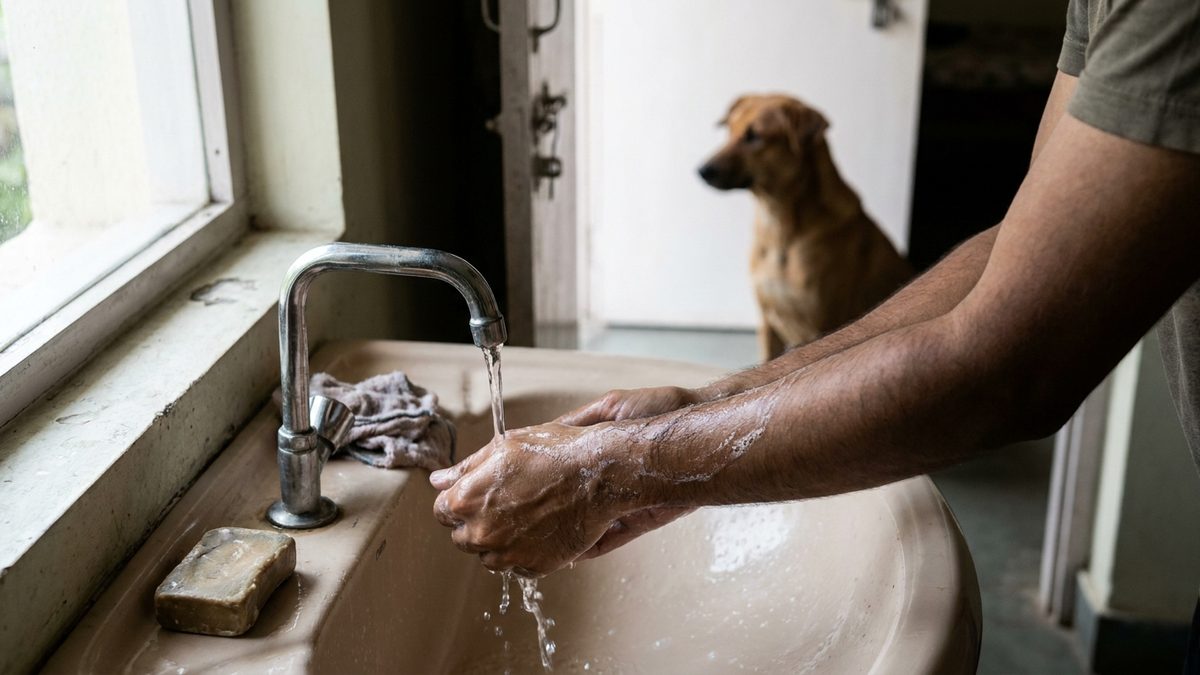
To handle a scratch in the first hour, wash it under running water with soap for 15 minutes, apply an antiseptic, leave it open, and reach a doctor or an anti-rabies clinic the same day.
First aid is the first of the guideline's three prongs, and wound washing carries real weight in it. The guideline calls the three prongs, which are wound management, immunoglobulin and vaccine, equally important and to be done together according to the category. The five steps are listed below.
- Wash under a running tap with soap for 15 minutes. The guideline describes running water as mechanical removal of virus from the wound and soap as inactivation of it.
- Apply an antiseptic after washing and drying. Any available virucidal agent is applied once the wound is clean.
- Keep bare hands and irritants off the wound. The guideline's own list of don'ts names soil, chillies, oil, lime, herbs, chalk and betel leaves.
- Leave it undressed and unstitched. The cover of the earlier edition puts it in one line, 'Do not apply dressing & Do not get the wound stitched'.
- Reach a doctor the same day. Take the animal's vaccination card and your own injection record, if either exists.
Home remedies are the usual reason the clock runs. The guideline's answer on chillies, lime, salt and mustard oil is that they confer no advantage, that the irritation 'may provide more avenues to the virus to gain entry into nerves', and that they give 'a false sense of security that some treatment has been administered'. Our page Why does my cat bite me? carries the survey figures on how common those remedies are.
Washing still counts when you are late. The guideline says the victim 'should not be deprived of the benefits of wound management as long as there is an unhealed wound which can be washed', and that the virus can persist and even multiply at the site for a long time.
Tetanus is a separate decision from rabies. The rabies guideline gives it a single line, that tetanus prophylaxis is given as per national guidelines and that an antibiotic course may be prescribed against sepsis in the wound. The treating doctor sets that against your own immunisation record, so carry it.
Keep the dog or cat confined and observe it for 10 days, and report what you see to the doctor. The observation period runs alongside your own treatment and never replaces it, and it is valid for dogs and cats only. What the watch involves is on our page on rabies in dogs and cats in India.
How late is too late for a rabies injection after a scratch?
No number of hours or days is too late to start, because India's guideline tells clinics to begin treatment whenever the patient reports, irrespective of the time elapsed since the exposure.
The guideline says it twice. Its section on deviations opens, 'The PEP should be started as soon as patients report to the health facility, irrespective of time-lapse after the animal exposure'. Its section on precautions goes further: 'people who present for treatment even months or years after a possible rabies exposure should be evaluated and treated as if the event had occurred recently'. The American committee reaches the same place, that prophylaxis is administered 'regardless of the length of the delay', provided signs of rabies are not present in the exposed person.
So 72 hours is not too late, 7 days is not too late, and a scratch from last month still earns a visit. Sooner remains better, because the treatment works only while the virus is still short of the nervous system. The guideline calls the long and variable incubation period 'a window of opportunity', and the WHO puts that period at typically 2 to 3 months, with a range from one week to one year. The shortest incubation in the Shimla scratch deaths was 22 days, so a week of delay spends about a third of that.
| When you report | Wound washing | Vaccine | Immunoglobulin, where the category calls for it |
|---|---|---|---|
| The same day | Greatest benefit, on a fresh wound | Starts that day | Given at or as soon as possible after the first vaccine dose |
| After 72 hours | Still done while the wound is unhealed | Starts the day you report | Still indicated |
| After 7 days, with no vaccine started yet | Still done while the wound is unhealed | Starts the day you report | The guideline's limit counts from the first vaccine dose, not from the scratch |
| Vaccine started, immunoglobulin missed, and day 7 after the first dose has passed | Already done | Course continues | 'Not indicated beyond the seventh day after the first dose', because an active antibody response has started |
| Weeks or months later, with no symptoms | Only where a wound remains | 'Evaluated and treated as if the event had occurred recently' | The doctor's decision, on the same footing |
The one deadline that is real: immunoglobulin and day seven
Rabies immunoglobulin is the only part of the treatment with a closing date. It is ready-made antibody infiltrated into and around the wound to cover the days before the vaccine produces your own, it is given once, and it is 'not indicated beyond the seventh day after the first dose of rabies vaccine'. Its absence shows in the death record. Four of the 19 Shimla deaths were people who received proper wound care and at least three doses of vaccine, where immunoglobulin 'were not given or were not available'.
The practical reading for a scratch that bled is short. Ask about immunoglobulin at the first visit, and where that facility has none, ask where it is stocked before the first week runs out.
Why people with scratches arrive late
People delay for reasons that have little to do with medicine, and Category II patients are most of them. In the Shivpuri study 157 of the 422 patients, 37 percent, started more than 24 hours after the exposure, and 109 of those 157 had Category II exposures. The reasons they gave are listed below, with more than one allowed per person.
- Work that could not be left: 51 of 157.
- Health centres closed on Sundays or national holidays: 45 of 157.
- Unawareness that treatment had to be prompt: 38 of 157.
- Nobody to go with: 22 of 157.
- Money to reach the health centre: 21 of 157.
- The animal was alive, 5 of 157, or the animal was vaccinated, 4 of 157.
Delay was significantly more common among rural residents, people living 10 km or more from the facility, and households earning under ₹10,000 a month. Not going at all is commoner still. In the national community survey led by the ICMR National Institute of Epidemiology in Chennai, with partner institutes from Pune and Hyderabad to Dibrugarh and Agartala, 323 of 1,576 people bitten by a dog in the previous year, 20.5 percent, received no rabies vaccine.
Go today. Nothing in the guideline turns a patient away for being late, and the doctor evaluates the scratch as if it had happened recently. The days already gone are not a reason to lose more of them.
Your own vaccinated dog or cat scratched you: does the certificate count?
No, the certificate does not decide it, because the national guideline says post-exposure prophylaxis is given irrespective of the vaccination status of the animal.
A vaccinated dog that is truly protected cannot transmit rabies, and the guideline says so. Its reservation is about proof. Animal vaccine failures occur 'because of improper administration, inadequate doses, poor quality of the vaccine or poor health status of the animal', so 'in the absence of laboratory documentation of immunization (antibody titre), it cannot be presumed that a vaccinated dog is actually protected'. Its conclusion follows in the same paragraph: 'irrespective of the vaccination status of the biting animal, the PEP should be given'.
What the pet's health changes is the end of the course, not the start. Treatment begins at once, the dog or cat is observed for 10 days, and where it stays healthy a course given by the intramuscular route can be converted to a pre-exposure schedule by skipping the day 14 dose and taking the day 28 one.
The guideline is not perfectly consistent with itself here, and we print both passages. Section 2.2 says that with the intradermal route the 'complete course of vaccination should be given irrespective of the status of the animal'. Its own FAQ 9 says that where the animal remains healthy through the observation period, prophylaxis 'can be discontinued after 10 days or converted into a pre-exposure regimen'. Which sentence applies to your course depends on the route your clinic uses, and the doctor is the one who resolves it.
Four things that feel like reasons to skip the visit are listed below, and none of them is one.
- The vaccination card. It lowers the odds and does not close the question, for the reason above.
- The healthy-looking animal. Observation runs beside treatment, and simply watching the animal without starting is ruled out by name in FAQ 9.
- The provocation. A provoked animal is not thereby a safe one, and a provoked exposure is managed the same way.
- The young age of a puppy or kitten. The belief that a pup under three months carries no risk is recorded in the Shimla deaths.
A scratch from a vaccinated dog is therefore still a clinic visit. Keeping the pet's own vaccination schedule current is the other half, since the guideline's advice to owners is to keep rabies vaccinations up to date for all pet animals and to supervise them outdoors. The dates are on our dog vaccination schedule and cat vaccination schedule pages.
Cat scratches: the same rabies rule, and one extra infection
A cat scratch is graded exactly as a dog scratch is, and it carries one further risk a dog scratch does not, the bacterial infection called cat scratch disease.
Cats are a small and real share of India's rabies. The 2019 guideline attributes about 95 percent of human rabies to dogs, 2 percent to cats and 1 percent to jackals, mongoose and others. The 2015 edition gave dogs 97 percent with the same 2 and 1. The newer figures add up to 98 as printed, so both editions are quoted here and neither is tidied.
The clinic data agree on scale. Cats accounted for 16 of the 422 exposures in the Shivpuri study, or 4 percent. One of the 19 Shimla deaths was a patient bitten by a cat two years earlier, which is the long end of the incubation period in a single line. The 10-day observation applies to a cat as it does to a dog.
The extra infection is bacterial and far more common than rabies. Cat scratch disease is caused by Bartonella henselae, which 'can be transmitted from a cat to a person when the scratch is contaminated with flea feces'; it shows as a papule or pustule at the scratch and as enlarged, tender lymph nodes one to three weeks later, and the US Centers for Disease Control and Prevention advises cleaning scratch wounds with soap and water. The flea side of that story is on our page on cat ticks and fleas in India.
An indoor cat gets no written exemption. The sections of the guideline that govern the decision carve out none, and the only place a reliable history removes treatment altogether is Category I, where the skin was never marked. Tell the doctor the cat's history and let them weigh it.
Most cat scratches are collected while putting the cat down, and the handling that prevents them is on how to hold a cat.
If you have had rabies injections before
A person who can document a complete earlier course needs a shorter one, two vaccine visits on day 0 and day 3 and no immunoglobulin.
The guideline's section on re-exposure sets out three things for a person who can document previous complete prophylaxis: proper wound management, no need for immunoglobulin, and vaccine on days 0 and 3. It then adds a shorter rule still. 'Only adequate wound washing would be required in case of re-exposure where animal bite victim has documented proof of complete PEP or PrEP within last three months'.
Everything in that section hangs on the word document. A person who cannot document a previous complete course, or whose earlier course used a nerve tissue vaccine or a vaccine of unproven potency, 'should be treated as fresh case and given full PEP'. A remembered course counts for nothing at the counter.
No single-dose vaccine gives lifelong cover. The guideline's first FAQ says none exists anywhere in the world, and that 'regardless of previous vaccination, if exposed to the virus, you will require another series of vaccines'. The three records worth keeping are listed below.
- The card or prescription that shows every dose date of your last course.
- The route used, intradermal or intramuscular, as written by the clinic.
- The date of the exposure that course was for, so the three-month rule can be applied.
The shortened course exists only for people who can show the earlier one was complete. People who handle animals every week have a further option, vaccination before any exposure, which our guide on how to volunteer at an animal shelter sets out.
Missed a dose? What the guideline says about late and skipped injections
A dose taken a day or two late does not restart the course, but the first three doses, on day 0, day 3 and day 7, belong inside 10 days.
The deviations section is four sentences long and worth reading whole. The first three doses 'should be completed maximum within 10 days to achieve effective immunity'. 'One or two days deviation do not necessitate re-starting of the vaccination schedule.' Where a patient misses one or more of the first three, 'the administration of additional doses should be considered'. And the patient is to be told the schedule 'verbally and in a written prescription'.
Starting is where most Indian courses stop. In the national survey, 615 of the 1,253 people who received a first dose, 49.1 percent, did not complete the full course, and 1,043 of the 1,576 bitten, 66.2 percent, received at least three doses. An incomplete course is one of the three things the guideline names behind the occasional rabies death despite treatment, alongside delayed vaccination and immunoglobulin not used in Category III.
Where the community survey and the clinic study disagree
A clinic that follows its patients reports far better completion than the household survey does. At the anti-rabies clinic of the Kempegowda Institute of Medical Sciences in Bengaluru, Karnataka, 735 patients were followed between October 2021 and December 2022 on the five-dose intramuscular course. Attendance fell from 100 percent at the first dose to 93.7, 86.4, 82.3 and 80.4 percent at the fifth. That leaves 19.6 percent incomplete against the survey's 49.1 percent.
The two numbers measure different people. The survey asked households in 60 districts across 15 states what happened after a bite; the clinic counted people who had already reached an urban teaching hospital. Both are true, and the gap between them is roughly the gap between having a clinic nearby and not. The reasons for dropping out in Bengaluru were ordinary ones: negligence 27.7 percent, work timings 26.3, forgotten dates 22.9, travel distance 13.2 and school timings 9.7.
Four habits that answer those reasons are listed below.
- Ask for every date in writing at the first visit, which the guideline already requires of the clinic.
- Set a phone alarm for each date before you leave the building.
- Return even when a date has slipped, since a late dose is taken rather than abandoned.
- Mention long-term steroids, cancer treatment or anti-malarial tablets, because the guideline changes the route or adds immunoglobulin for those patients.
Where to go in India, and what it costs
Go to a government hospital or anti-rabies clinic, where both the vaccine and the immunoglobulin are free of cost under the National Free Drug Initiative.
The Union health ministry put it on the parliamentary record on 19 August 2025. Anti-rabies vaccine and anti-rabies serum or rabies immunoglobulin 'are provided free of cost in the public health facilities under National Free Drug Initiative' of the National Health Mission, and both sit on the National and State Essential Drug Lists. Not one rupee is charged for either at a public facility, which matters because the WHO put the average cost of post-exposure prophylaxis worldwide at 108 US dollars as of 2018 before travel and lost income.
The National Rabies Control Programme runs a toll-free rabies helpline on 15400 that gives information on nearby facilities holding vaccine and serum. Its own page describes it as running 16 hours a day, 7 days a week, and as presently serving five places, Andhra Pradesh, Madhya Pradesh, Assam, Puducherry and Delhi.
Two states that have written their own rule down
Karnataka's State Action Plan for Dog Mediated Rabies Elimination, first edition February 2026, records that rabies was made a notifiable disease in the state in 2022, that vaccine and immunoglobulin are available 'in all PHC, CHC, Taluk and District Hospitals free of cost to all', and that every private medical establishment is to give first aid and life-saving emergency measures to dog or animal bite victims without insisting on advance payment.
That plan contains a line every Karnataka reader with a scratch ought to know, and it disagrees with a table in the same document. Its programme-status chapter says rabies immunoglobulin 'is administered to all Category II and III bite cases', while its own prophylaxis table gives Category II the vaccine alone, as the national guideline does National Centre for Disease Control. We print both. Ask at the facility which one it follows.
Tamil Nadu's health department policy note for 2024-25 states that the government has prioritised bite treatment 'in all Government Hospitals and Primary Health Centre' by ensuring anti-snake venom, immunoglobulin and anti-rabies vaccine for dog bites are available 24x7. A round-the-clock rule is the direct answer to the Shivpuri finding that 45 delayed patients met a health centre closed for a Sunday or a holiday.
No official price list for a private-clinic course turned up in this research, so this page prints no figure for one. Where a street dog did the scratching, the reporting route and the municipal side are on our page on stray dogs in India, and the employer's side of an injury to someone who works in your home is on pets and house help.
Common questions
Can you get rabies if scratched by a dog?
Yes, you can get rabies if scratched by a dog whose saliva reaches broken skin. In a seven-year review of 19 rabies deaths at Indira Gandhi Medical College, Shimla, five followed scratches or abrasions without any bleeding, and none of the five people had sought treatment. India's national guideline grades a scratch without bleeding as Category II and recommends the vaccine for it.
Can I get rabies if a cat scratched me?
Yes, you can get rabies if a cat scratched you and the cat was infected. India's national guideline attributes about 2 percent of human rabies to cats and grades a cat scratch exactly as it grades a dog scratch: no bleeding is Category II and gets the vaccine, bleeding is Category III and adds immunoglobulin. The 10-day observation period applies to cats as well as dogs.
When to get rabies shot after dog scratch?
Get the first rabies shot the same day as the dog scratch, after washing the wound under running water with soap for 15 minutes. India's guideline says treatment is started immediately after exposure, and that it is started as soon as the patient reports, irrespective of the time elapsed. The first three doses, on days 0, 3 and 7, are completed within 10 days.
Is 72 hours too late for rabies vaccine?
No, 72 hours is not too late for rabies vaccine. India's national guideline tells clinics to start post-exposure prophylaxis as soon as a patient reports, irrespective of the time-lapse after the exposure, and to wash the wound even then if it is unhealed. Earlier is better because the vaccine works only before the virus reaches the nervous system, so go the day you read this.
Is 7 days too late for rabies vaccine?
No, 7 days is not too late for rabies vaccine. The guideline says people who present even months or years after a possible exposure are evaluated and treated as if the event had occurred recently. The seven-day limit people remember belongs to immunoglobulin, which is not indicated beyond the seventh day after the first vaccine dose, and it counts from that dose rather than from the scratch.
Should I worry about a minor cat scratch?
Yes, enough to wash it and have it seen the same day. In India a minor cat scratch without bleeding is a Category II rabies exposure that gets the vaccine. A cat scratch can also carry cat scratch disease, a bacterial infection that shows as a bump at the scratch and tender, swollen lymph nodes one to three weeks later, which is a second reason to tell a doctor.
Do I need a rabies injection if the scratch did not bleed?
Under India's national guideline, yes. A minor scratch or abrasion without bleeding is Category II, and the recommended treatment is wound washing with soap and running water for 15 minutes, an antiseptic, and the rabies vaccine. Immunoglobulin is added only where the skin was broken, or where the person's immune system is suppressed. The treating doctor confirms the category on examination.
My vaccinated pet dog scratched me. Does the certificate change anything?
It does not change the first decision. The guideline says that without laboratory proof of the animal's antibody level a vaccinated dog cannot be presumed protected, so post-exposure prophylaxis is given irrespective of the animal's vaccination status. What a healthy pet changes is the end of the course: after 10 days of observation a doctor can shorten or convert it.
I finished a full rabies course last year. Do I need it all again after a new scratch?
No, provided you can document it. A person with proof of a complete earlier course needs wound washing and two vaccine visits, on day 0 and day 3, with no immunoglobulin. Where the documented course ended within the last three months, the guideline asks for adequate wound washing only. A person who cannot produce the record is treated as a fresh case.