
Dog and cat civics guide
How to volunteer at an animal shelter in India: what shelters actually need, and what day one asks of you
Nine of the nine areas Blue Cross of India lists for volunteers ask for disinfection. One asks for dog walking. Almost everything else written about volunteering in India has that ratio backwards.
Quick answer
How to volunteer at an animal shelter in India starts with reading that shelter's own volunteer page rather than turning up. Cleaning, not dog walking, is the task Indian shelters list most. Expect an induction, a signed disclaimer form that makes your own medical costs yours, and a minimum commitment measured in months. Ask about rabies pre-exposure prophylaxis before your first shift, and check that the organisation's AWBI recognition is current.
This guide is general information for Indian pet owners and is not a diagnosis. Always consult a registered veterinarian near you before acting on anything you read here, and treat any sudden change in your pet's condition as urgent.
What Indian animal shelters actually need from a volunteer
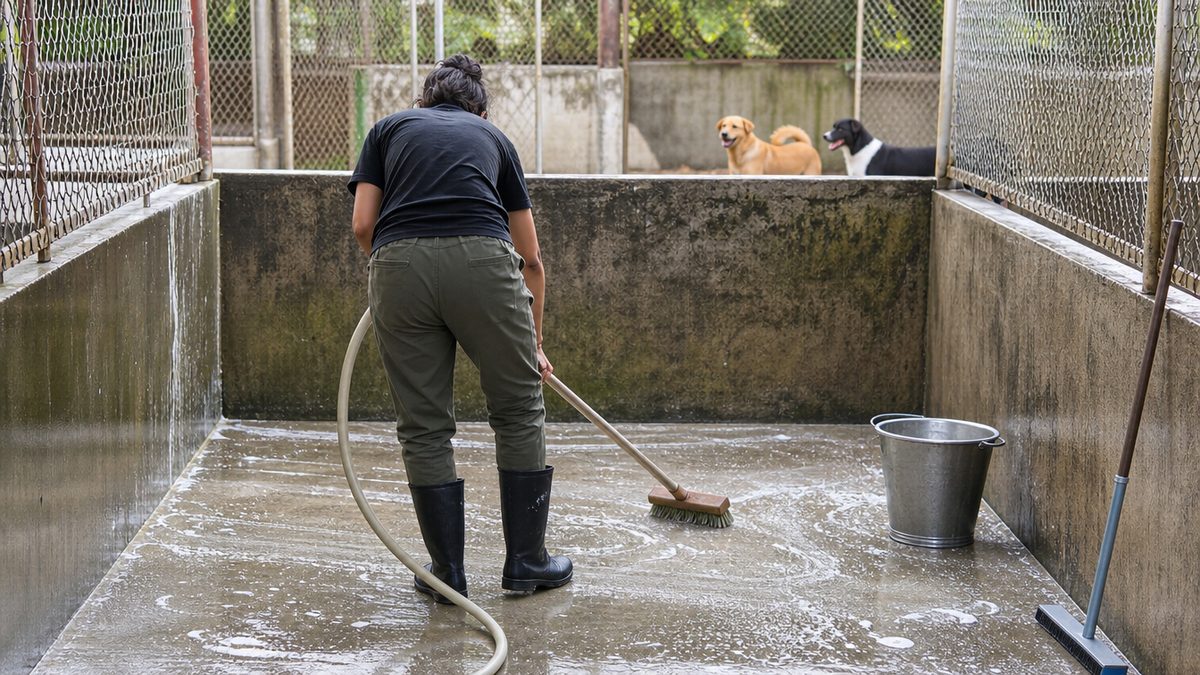
Indian animal shelters need cleaning before they need company. Blue Cross of India sets out the volunteer tasks at its Chennai hospital and shelter in Tamil Nadu area by area, and section disinfection appears in all nine areas it names, while dog walking appears in exactly one.
That ratio is the single most useful thing on this page, and it is published, not inferred. The list below is the shelter's own, area by area, as its volunteer page reads on 21 to 22 October 2026.
| Area | Tasks the shelter lists | Cleaning included |
|---|---|---|
| Abandoned pets | Section disinfection, bath, dog walking | Yes |
| Geriatric dogs | Section disinfection, bath | Yes |
| Mange dogs | Medicated bath of 20 to 30 minutes per dog, Rajamundry and neem oil, sulphur ointment and coconut oil, section disinfection | Yes |
| Paraplegic dogs | Section disinfection, hand feeding sick dogs, therapy support | Yes |
| Puppy and kitten shelter | Section disinfection, hand feeding, deworming, wiping and cleaning, de-tick and de-flea | Yes |
| Cattle section | Section disinfection, bathing, feeding | Yes |
| Donkey, goat and horse stables | Section disinfection, bathing, walking | Yes |
| Aviary | Section disinfection, sawdust replacement, hand feeding, cage wash, vegetable cutting | Yes |
| Casualty, dog treatment, corporation ABC, cat shelter, elective surgery, TVT and pig sty | Section disinfection | Yes |
Section disinfection is not sweeping. The same page defines it as dry cleaning, high pressure water washing, medicated wash and blow torching. That is biosecurity work, it is physical, and it is what keeps a kennel block from passing one dog's infection to the next.
The hand feeding entries are worth reading twice. They appear under paraplegic dogs and under the puppy and kitten shelter, which is where the animals that cannot feed themselves are. A volunteer who wants to feed is useful. A volunteer who wants to feed only the healthy, friendly dogs is asking for the one version of the job nobody needs help with.
The jobs that never touch an animal
A large share of the volunteer opportunities Indian shelters publish is office work. CUPA in Bengaluru, Karnataka runs one application form across six centres, its Trauma and Rescue Centre, Large Animal Rescue and Rehabilitation Centre, Geriatric Centre, Second Chance Adoption Centre, Spay and Neuter Centre and its admin office, and the form's own menu of how you would like to volunteer lists helping out with tasks at the shelters, graphic design, content creation for the website and social media, fundraising, and research. Four of those five named options are desk work.
The Stray Animal Foundation of India, in Hyderabad, goes further and says which need is largest. Its volunteer page states that one of its greatest needs is people to tell its animals' stories, and it profiles the volunteers who filled that need, including a front-end web developer, a UI and UX designer whose work the organisation says saved it around 2,000 dollars, a blog writer and a grant researcher. The page's own summary is that both phases of its website were designed by volunteers and that donations of time and skill have saved the organisation thousands of dollars.
Blue Cross runs a parallel track for people who cannot reach Guindy, asking for visual communication design, creative writing, animal awareness workshops in schools, and grassroots awareness work on sterilisation and vaccination in your own neighbourhood. Sanjay Gandhi Animal Care Centre in Delhi frames the same thing as a neighbourhood watch, asking volunteers to get to know the animals in their area and watch for abuse, neglect and permanently tied-up pets.
- Photograph animals for adoption listings. A Workaway listing for a privately run shelter in Kerala puts taking photos of animals for adoption profiles at the top of its adoption-effort tasks, alongside social media and finding suitable adopters.
- Write. Grant applications, case notes and the stories that move donations are the work SAFI names as its biggest gap.
- Design. Graphic design and content creation are two of the six options on CUPA's form.
- Run fundraising. Blue Cross asks for help with online campaigns on its Ketto page and for hosts to place a physical donation box in an office or shop with good footfall.
- Support adoption drives. Blue Cross names adoptathons and puppy and kitten yoga sessions as volunteer-run events.
The Welfare of Stray Dogs in Mumbai, Maharashtra puts the whole selection problem in two sentences on its own front page: love for animals is of course what drives volunteers to it, but more importantly, it is the ability to act rationally and responsibly that makes them truly valuable. Write your enquiry to that standard rather than to the first one.
How to find a shelter, and what AWBI recognition tells you
To find a shelter worth your time, check the Animal Welfare Board of India's recognised-organisation list, then read that organisation's own volunteer page before you write to it. AWBI recognition is a real and checkable status, and it certifies much less than most people assume.
The Board publishes the list as a single PDF, and the current one, dated as on 31 May 2026, runs to 222 pages with columns for serial number, code number, name, address, district, state, date of recognition, date of renewal and valid upto. How to search it, and the recognition codes of five well-known shelters, are already set out in our guide to how to adopt a dog in India; this section covers the part that matters to a volunteer rather than to an adopter, which is what the status actually tests.
What the five documents actually verify
Recognition is granted on paperwork plus an inspection. The Board's own guidance names five things an applicant organisation must produce, and states in plain words what each one is called for.
| What the Board asks for | What the Board says it verifies | What it does not test |
|---|---|---|
| Registration certificate under the Societies Registration Act or a Trust Act | That the organisation is a registered body | Anything about the animals |
| Memorandum of association and bylaws | That the organisation carries on animal welfare activities exclusively | Whether those activities are done well |
| Annual reports and statements of accounts for the last three years | That the organisation is reasonably active | Outcomes for any animal |
| A resolution of the organisation seeking recognition | That the body considered the matter at a meeting and accepts the Board's terms | Current practice |
| A bylaw clause letting a Board representative sit on the managing committee | That the Board has a seat if it wants one | Whether anyone takes it |
On top of those five, the Board states that new organisations are inspected by Board members or authorised inspection agencies, and that recognition is considered only if the inspection report is satisfactory. So there is a welfare inspection, once, at the point of grant. Nothing in the published requirements is a recurring test of how the animals are kept.
The practical reading is narrow and worth being precise about. Recognition is the one verifiable fact you can establish about an Indian shelter before you set foot in it, and what it verifies is that the organisation is legally constituted, exists for animal welfare alone, has filed three years of accounts, and passed an inspection at some point. It does not tell you that the kennels are clean this week, that a veterinarian is on site, or that the volunteer coordinator will know your name. Only a visit tells you that.
Why a name on the list is not proof of a current recognition
The Board's recognition page carries a note that changes how the list should be read. Under its current policy every recognised organisation must apply for renewal every five years, exclusively through the Board's online portal, with a fee of Rs 5,000 that is waived for gaushalas holding under 10 percent milking animals, and the note states that recognitions over five years old that have not been renewed will be considered invalid.
Set that against the list itself. Reading the first 480 entries, the first 30 of its 222 pages, covering ten states and union territories from Andhra Pradesh through Haryana, 442 of the 480 rows carry no date in the Valid upto column at all, 467 carry no date of renewal, and 101 carry no original date of recognition either. Only 38 rows in that stretch, 7.9 percent, print a validity date you can check, and four of those 38 had already lapsed before the list's own as-on date of 31 May 2026.
A missing date is a record-keeping gap, not evidence that an organisation's recognition has lapsed, and this page is not suggesting otherwise. What it does mean is concrete. For roughly nine entries in ten in the stretch read, the published list cannot tell you whether the recognition is current, so the honest check is to ask the organisation for its code number and the date its recognition runs to, and to compare that with the row in the list.
Recognition is a grant-and-standing status under the Board, not a licence to run a shelter, so an unlisted rescue is doing nothing unlawful and many good ones are small, new or simply have not applied. Treat the list as one checkable signal among several and never as a ranking. This page names no shelter as good or bad, and the organisations named here are named only because their own published pages were opened and read on 21 to 22 October 2026.
What to look at on your first visit
Judge a shelter on the first visit by what it does with you, not by how the animals look. A frightening-looking shelter can be a good one halfway through a rescue surge, and a photogenic one can have no system at all. Five things are visible in an hour and all five are answerable from the documents.
The Board's own description of an animal welfare organisation gives you the checklist for free. It lists the roles such a body employs, including a veterinary surgeon responsible for the shelter and the dispensary, veterinary assistants responsible for the upkeep of the inmates and for keeping the campus clean, and a night watchman, and it says the number and designation of staff in each category depends on the organisation and that there is no hard and fast rule about the structure. That last sentence is the licence a bad shelter uses, so ask for the names rather than the organogram.
The Board also prints what a rescue service needs to function, and the list is unglamorous: a telephone, a vehicle, a veterinary doctor, medicines and food, a place to house the animals, supervision of feeding and cleaning, and publicity for the rescue service. A shelter missing several of those seven is not running a rescue service, whatever it is doing instead, and the vehicle is the one people forget to ask about.
- Ask who the volunteer coordinator is, by name. Animal Aid Unlimited in Udaipur, Rajasthan states that there will always be a volunteer coordinator on hand to guide and work with you, and that the coordinator builds a personal schedule suited to each volunteer's experience level. A shelter that cannot name that person has not thought about you.
- Ask what the induction is. At Animal Aid it is a 40 minute tour on your first day, followed by a safety and activities orientation. Ask what yours will be and how long it takes.
- Ask for the disclaimer form before you arrive. CUPA requires applicants to download, print, fill, sign, scan and upload it as part of the application, with a separate form for minors. A shelter with a written form has thought about what can go wrong.
- Ask who supervises handling. CUPA's form commits you not to interact with or attempt to feed the animals unless under supervision by a CUPA employee. A shelter that hands you a lead in the first ten minutes is not supervising anybody.
- Ask what the minimum commitment is. If the answer is come whenever you like, the shelter is not planning around you, which usually means it has stopped expecting volunteers to come back.
Two warning signs are structural rather than visual. The first is a shelter that cannot say who its veterinarian is, because the Board's own staffing description puts the veterinary surgeon at the centre of the shelter and the dispensary. The second is a shelter with no written rule about photographs, which is covered in the next section and is a quick proxy for whether anything else is written down.
RESQ Charitable Trust in Pune, Maharashtra is a long-established and well-documented rescue organisation, and its /volunteer/ URL redirected to its homepage on this attempt, 21 to 22 October 2026, so no volunteer process could be read from it. The absence of a published volunteer page says nothing about an organisation's quality. It does mean the only way to find out what it needs is to write and ask.
Day one: the induction, the form and the photograph rule
Day one at an Indian animal shelter is a tour, an orientation and a signature, in that order. The signature is the part people skim, and it is the part with consequences.
Animal Aid Unlimited publishes the fullest day-one account of any Indian shelter page read for this guide. Volunteers and visitors are welcome every day between 10 am and 12 pm and between 2.30 pm and 3.30 pm, previous confirmation is not needed, and the first day runs as a 40 minute tour explaining the work and introducing the animals, after which the volunteer coordinator gives a safety and activities orientation and makes your personal schedule.
The form is a different kind of document. CUPA's volunteer disclaimer form runs to six numbered declarations, and the two that matter most are declarations three and four.
The clause that decides who pays for a bite
Declaration three has you confirm that you understand animals are unpredictable at times and that you accept the risks, which include but are not limited to bites, abrasions, fractures, bruises, injuries and illness or other similar risks caused due to exposure to animals. Declaration four goes further: you understand and agree that CUPA is not responsible for any medical expense or any other loss, damage or expense that you may incur during your time spent volunteering or from exposure to shelter animals, and that CUPA will not be liable for any claim or damages in this regard.
Read plainly, a bite you take as a volunteer is yours to treat and yours to pay for. That is not unusual and it is not unreasonable for an organisation running on donations, but it is a fact worth knowing before you sign rather than after, and it is the strongest practical argument for settling the vaccination question in the next section first.
The disclaimer form at CUPA states that the organisation is not responsible for any medical expense you may incur during your time volunteering or from exposure to shelter animals. Assume the same elsewhere unless a shelter tells you otherwise in writing. Know where the nearest hospital with an anti-rabies clinic is before your first shift, not after an incident.
You may not post the photographs
Declaration five commits you to the organisation's policy of not uploading any pictures you may take on any social media sites, and, where uploading is absolutely necessary, to seeking prior permission from the respective centre managers and trustees. This surprises people who arrived wanting to help with adoption photography, and the rule is sensible: a cruelty case in progress, an animal whose owner is contesting a seizure, and a dog whose adopter has not yet been approved are all reasons a shelter controls its own images. Offer the photographs to the shelter. Do not publish them yourself.
If the volunteer is under 18
Age rules differ and both common patterns are written down. Animal Aid welcomes children aged 8 to 14 as visitors but states that they will not be able to volunteer, with limited access and up to half a day with the sheep, goats and calves under parental supervision, and allows teenagers aged 14 to 18 to volunteer with a parent or guardian accompanying them at all times. CUPA instead runs a separate disclaimer form for under-18s, signed by the parent or guardian, which asks whether the parent will accompany the child and includes the declaration that the parent is solely responsible for determining if the child is physically fit or properly skilled for any volunteer activity.
Plan the practical details the same way. Wear closed shoes you are willing to disinfect or throw away, clothes you do not mind losing, and nothing loose enough for a frightened dog to catch. Carry your own water. Tell the coordinator about any medical condition that matters before you are in a kennel block, not during.
Rabies, tetanus and the scratch you did not report
Settle the rabies question before your first shift, because India's national guideline names animal handlers as a group pre-exposure vaccination may be offered to, and because the protection it gives is not the protection most people think it is.
India's National Guidelines for Rabies Prophylaxis, issued by the National Centre for Disease Control under the National Rabies Control Programme, lists the high-risk groups for pre-exposure prophylaxis in four lines, and the second line reads: veterinarians, animal handlers and dog catchers. Neither that guideline nor the World Health Organization's rabies fact sheet uses the word volunteer. WHO's own wording is people whose professional or personal activities might lead to direct contact with infected animals, and it gives animal disease control staff and wildlife rangers as the examples. A person who will handle shelter dogs every week is plainly an animal handler in substance; whether that makes you a candidate is a decision for a doctor, not for a website.
What pre-exposure vaccination buys you, and what it does not
Three doses are the Indian course. The guideline specifies one full vial intramuscularly, or 0.1 ml intradermally at one site, on days 0, 7 and a booster on either day 21 or day 28. For high-risk groups it adds serological monitoring: neutralising antibody titres checked every six months through the first two years after the primary course, a booster dose if the titre is below 0.5 IU per ml, and sero-monitoring every two years after that.
What it changes after an exposure is the specific thing to understand. The guideline states that a person exposed after successful pre-exposure immunisation requires only two booster injections, on day 0 and day 3, and that there is no need for rabies immunoglobulin. It says separately that immunoglobulin should be administered to all patients with a category III exposure except those who have previously received complete pre-exposure or post-exposure prophylaxis. Immunoglobulin is the scarce and expensive half of post-exposure treatment, so skipping it is the real benefit.
What it does not do is make you safe. WHO states it flatly: pre-exposure prophylaxis does not replace the need for post-exposure prophylaxis, and any person exposed to a suspected rabid animal should still seek post exposure care.
WHO classifies a minor scratch or abrasion without bleeding as a category II exposure requiring wound washing and immediate vaccination, and a transdermal bite or scratch, or saliva on broken skin or a mucous membrane, as category III requiring immunoglobulin as well. A scratch you did not mention because it did not bleed much is the one that gets missed. Wash it, tell the coordinator, and go to a doctor the same day. What to do after a bite in detail is on our guides to rabies in dogs and cats in India and stopping puppy biting, and this page does not repeat it.
Tetanus is handled by reference rather than by schedule, and knowing that saves an argument. The national rabies guideline's single line on it says tetanus prophylaxis should be given as per national guidelines, and that to prevent sepsis in the wound a suitable course of an antibiotic may be prescribed. In other words the rabies guideline does not set your tetanus schedule; the doctor treating the wound does, against your own immunisation history. Take that history with you.
Shelters apply the vaccination question to what they let you do. Animal Aid encourages volunteers to have their rabies vaccinations complete at least one month before arriving, especially for stays of several weeks or longer, and states that volunteers who are fully vaccinated and staying at least two weeks will be able to help with dogs who have recently been rescued and are receiving treatment, while an unvaccinated volunteer can still work in the sanctuary, which it says holds over 300 animals of all species. That is a transparent structure, access graded by vaccination status and length of stay, and it is the shape worth asking any shelter for.
Bonbeno recommends no specific vaccine, brand or schedule for any individual. Pre-exposure prophylaxis is a medical decision taken with a doctor who knows your history, and this page publishes under the medical disclaimer for that reason.
What you can carry home to your own animals
Treat the journey home as part of the shift, because several of the commonest reasons a dog is in an Indian shelter at all are contagious, and your own dog did not sign anything.
Rabies is the zoonotic risk that sets a shelter's handling rules, and the World Health Organization describes it as a vaccine-preventable, zoonotic, viral disease affecting the central nervous system, spread through bites, scratches or direct contact with mucosa. It is not, though, the infection most likely to travel home with you, because the dog that bites is the dog you report and the dog you treat. The quieter routes are the skin and gut conditions nobody files as an incident.
Blue Cross runs a whole volunteer workflow for its mange dogs, consisting of a medicated bath of 20 to 30 minutes per dog, Rajamundry and neem oil application, sulphur ointment and coconut oil application, and section disinfection. A volunteer who has spent a morning on that has had prolonged skin contact with animals with an active skin condition. The same page's definition of section disinfection, which includes medicated wash and blow torching, is itself the clearest statement of how seriously a working shelter takes transmission between its own kennels.
What each of those conditions is, how it spreads and what it needs belongs on the condition pages rather than here. Our guides to mange in dogs in India, ringworm in dogs and cats and canine parvovirus in India each set that out, and leptospirosis in dogs in India covers the one that follows the monsoon. This page covers only the part that is yours, which is what you do between the shelter gate and your own front door. The routine below is short, and it is the whole of it.
- Wash before you leave. WHO's category I is touching or feeding animals and licks on intact skin, and its prescribed response is washing of exposed skin surfaces, with no further treatment needed. Do that at the shelter, not at home.
- Keep one set of shelter clothes and shoes. Wear them nowhere else and wash them separately.
- Change before you greet your own animals, not after. The greeting is the contact.
- Ask the coordinator which sections are under isolation that day and stay out of them unless you are rostered to them and shown how.
- Keep your own dog's and cat's vaccinations current. That is the one protection that does not depend on you remembering anything at the gate, and the schedules are on our dog vaccination schedule and cat vaccination schedule guides.
If you foster, this stops being housekeeping and becomes a quarantine question, which is the next section's business.
The emotional half, which almost nobody writes about
Compassion fatigue in shelter volunteers is documented, measurable and counter-intuitive in two specific ways, and no Indian study of it was found for this page.
The one study that looked directly at volunteers rather than paid staff surveyed 530 active shelter volunteers across Michigan, in the United States. Sixty-one percent said, in answer to a single question, that they were consistently preoccupied with thoughts of the animals in their care. The authors' headline conclusion is that shelter-level factors may be relatively stronger predictors of compassion fatigue than personal ones, which matters here because it means where you volunteer is not a neutral choice.
Two of their findings read backwards at first. Compassion fatigue was inversely associated with satisfaction in the volunteer work, which is unsurprising, but positively associated with time per week spent volunteering and with gratitude expressed by the shelter. More hours and more thanks both tracked with more fatigue. The plausible reading, and it is a reading rather than a finding, is that both measure how deeply a person has been drawn in.
Where two scoring thresholds give opposite answers
The nearest study to an Indian shelter volunteer's situation is a 2026 cross-sectional survey of 172 informal caregivers of feral cat colonies in Portugal, people doing animal care outside any employment relationship. It is worth citing for its disagreement with itself. Scored against Stamm's published thresholds, 47 percent of participants showed moderate secondary traumatic stress and 10 percent high. Scored against the thresholds proposed by De La Rosa and colleagues, on exactly the same data, 32 percent were moderate and 61 percent high.
The authors explain the gap by the normative populations the two sets of cut-offs came from, the De La Rosa thresholds having been derived from military personnel and health and social care professionals exposed to human suffering. Publish both numbers rather than either. Any page quoting a single prevalence figure for compassion fatigue in animal care is quoting a threshold choice as if it were a measurement.
What protected people, and what did not
In the same study, caring for a colony of more than 25 cats and being unemployed were both associated with higher secondary traumatic stress, while older age, higher perceived family support and the serenity dimension of resilience were protective. Two findings are uncomfortable and both are useful. Finding meaning in life was positively correlated with fatigue, which the authors read as caregivers who see the role as central to their purpose becoming more emotionally invested and more vulnerable when they cannot help an animal. And official colony registration and formal institutional support were not significantly associated with lower fatigue. Being recognised by a body does not, on this evidence, protect the person doing the work.
The 2015 systematic review of occupational stress in animal care found only 12 articles meeting its criteria, seven of them on shelter personnel, and concluded that it provided insufficient foundation from which to identify consistent causal factors and outcomes to use as a basis for evidence-based stress management programmes. Treat anyone selling a compassion fatigue protocol accordingly. Our guide to pets and elderly family members reaches the same conclusion about the wellbeing claims made for animal contact, and this page is not going to oversell the other direction either.
What the review does establish is narrower and firmer. Personnel directly engaged in euthanasia reported significantly higher work stress and lower job satisfaction, which may have fed into higher turnover and psychological distress. That single finding is the one that travels least well to India, for reasons the next section sets out.
Three practical things follow for a new volunteer. Pick the shelter, not just the cause, because the organisation was the stronger predictor in the one study of volunteers. Treat rising hours as a signal to check in with yourself rather than as proof of commitment, because hours tracked with fatigue rather than against it. And do not use how warmly a shelter thanks you as your measure of whether it is good for you, because expressed gratitude tracked with more fatigue too, not less.
Why the euthanasia question is different in India
The euthanasia pressure that drives the overseas shelter-worker literature does not arise the same way in Indian street-dog work. Our guide to stray dogs in India establishes the legal position from the instruments themselves, and this page states that guide's conclusion in a line, links to it, and writes no policy section of its own.
That guide's conclusion, in one line, is that euthanasia of a street dog in India is confined to narrow cases, incurably ill and mortally wounded animals assessed by qualified veterinary experts, with no lawful route for culling healthy dogs. Read the rules and the court orders there rather than here. This page takes no position on the law and quotes no instrument.
The consequence for a volunteer is emotional rather than legal, and it cuts both ways. The dogs you meet in an Indian shelter mostly stay, and the shape of a shelter shows it: Blue Cross maintains a geriatric dog section and a paraplegic dog section as standing areas with their own volunteer tasks. You are also not going to be asked to hold an animal while a decision you disagree with is carried out, and that removes what the systematic review identifies as the sharpest documented source of distress, the work of personnel directly engaged in euthanasia.
What sits in its place has not been measured, and this page is not going to invent it. The Jacobs and Reese finding that volunteers at shelters with lower live release rates reported more compassion fatigue came from a system where intake and euthanasia are routinely counted, so it does not transfer cleanly to a shelter whose equivalent pressure is a kennel block that never empties. No study of compassion fatigue in Indian shelter volunteers was found while researching this page. That is a real gap, and it is worth saying plainly rather than filling with a borrowed number.
Ask a shelter what happens to a dog that is never adopted. The answer, and how readily it comes, tells you more about what volunteering there will feel like than any photograph on its website.
Fostering, in short
Fostering is volunteering with the shelter's hardest constraint moved into your house, and almost none of the Indian volunteer pages read for this guide advertises it.
A foster home takes an animal a shelter cannot hold well: a litter too young for a kennel block, a dog recovering from surgery, a cat that will not eat in a cage. Of the six Indian organisations' own pages read for this guide, exactly one names it. Sanjay Gandhi Animal Care Centre in Delhi lists fostering abused or frightened animals alongside walking dogs, feeding animals and organising fundraising events as the things it wants volunteers for. Animal Aid, Blue Cross, CUPA, the Welfare of Stray Dogs and the Stray Animal Foundation of India do not list fostering among their volunteer options at all, which does not mean any of them would refuse an offer, only that you will have to make it rather than apply for it.
Three questions decide whether you can do it, and all three are answerable before you offer. Can you isolate the foster animal from your own animals completely for the period the shelter specifies? Who pays for treatment, and is that in writing? And what is the exit, meaning who takes the animal back and on what notice if the arrangement fails?
Our guides to adopting a dog in India and adopting a cat in India set out how Indian shelters screen a home, and the same screening applies to a foster home. A dedicated guide to fostering is a separate piece of work; this section exists to say that fostering is not a lighter commitment than volunteering at the shelter, it is a heavier one.
Donating well: what shelters say they want, and what arrives
Ask before you buy, because the one Indian shelter page that answers this question directly says it would rather have the money.
Animal Aid Unlimited addresses it head on. Its volunteer page notes that many future volunteers ask what they can bring as a donation, and answers that it prefers monetary donations, because these allow it to plan and manage its resources, make bulk purchases and get more value from each donation, while asking people to email for an up-to-date list of the specific items that are not easily available in India. Both halves of that matter. The default answer is money; the exception is a short, current, shelter-specific list you have to ask for.
The reasoning is arithmetic rather than ingratitude. A shelter buying dog food by the sack pays less per kilogram than you do, knows which food its animals are already on, and does not have to store a random assortment of brands that may cause digestive upsets as it switches between them. A rupee given monthly is also worth more to it than the same rupee given once, for the same reason Animal Aid gives, which is that a predictable income can be planned against.
- Give money where you can, and give it monthly. Animal Aid's stated reason for preferring it is planning and bulk purchasing.
- Use the published wishlist when there is one. Blue Cross links an Amazon India wishlist from its volunteer page as the from-your-home option.
- Host a donation box if you run an establishment with good footfall, which is a specific ask Blue Cross makes.
- Donate a skill instead. SAFI's own accounting of this is that volunteer design work saved it around 2,000 dollars on one project and that donations of time and skill have saved it thousands of dollars overall.
- Buy from the shelter. The Welfare of Stray Dogs sells merchandise starting at ₹50, in its own notation, and runs thrift-style garage sales, with proceeds going to street dogs and cats.
One line is worth holding on to when you are deciding how much to give. The Welfare of Stray Dogs states that it offers all its services for free so that money is not a deterrent to someone who wants to help animals, and asks for donations to ease the financial strain that follows from that choice. SAFI states that 100 percent of contributions go to the rescue. Both are claims by the organisations themselves, and the way to test a claim like that is the audited statement of accounts, which every AWBI-recognised body has to produce for the Board anyway.
No Indian shelter read for this page publishes a list of what it has to throw away, so this guide prints no such list either. What one of them does publish is the test to apply. Animal Aid's useful-item category is specific items that are not easily available in India, and it asks you to email for the current version. Send that one message before you buy anything. An in-kind donation nobody asked for is a storage problem with a ribbon on it.
A realistic commitment ladder
Start smaller than you think and commit for longer than you think, because Indian shelters' own forms ask for duration in months and almost nothing for intensity.
The national baseline is useful for calibration. India's Time Use Survey 2024, which enumerated 4,54,192 persons aged 6 and above across 1,39,487 households, found a participation rate of 1.0 percent for unpaid volunteer, trainee and other unpaid work on the survey day, and that the people who did participate spent an average of 122 minutes on it, 121 in rural India and 123 in urban India. Two caveats keep that honest. The category bundles trainee work in with volunteering, so 1.0 percent is a ceiling rather than a count of volunteers, and the reference period is a single 24 hours, so a person who volunteers one Sunday a month is mostly counted as a non-participant.
What it does establish is that unpaid work outside the household is rare in India on any given day and that the people who do it do a lot of it. On that evidence there is no large pool of casual two-hours-a-month volunteers for a shelter to build a roster around, which is one plausible reason the forms ask what they ask.
CUPA's application form is the clearest published statement of a shelter's expectation. It asks how much time you can dedicate, offering weekends only, 2 to 4 hours per week, 5 to 8 hours per week, more than 8 hours per week, or other, and then asks the minimum duration you can commit, offering one month, three months or six months. There is no option shorter than a month. The lightest combination the form permits is weekends only for one month.
Other organisations draw the line in their own way. The Workaway listing for a privately run Kerala shelter caring for around 50 dogs and 40 cats asks for a minimum stay of at least a week, and the host's own note says the daily tasks that are there have to be finished and that it is not a place to hang out and hide from work. Animal Aid is the most open of the pages read, inviting volunteers for a few hours, a few days or a few months, and still gates the newly rescued dogs behind full vaccination and a two-week stay.
Five rungs, in order
- Give money or a wishlist item once. Costs an hour, commits nothing, and is genuinely the thing most shelters say they need first.
- Do one remote task. A single piece of design, a set of adoption write-ups or one grant application, delivered on the date you promised. Four of the five named options on CUPA's form are remote-capable.
- Visit once, inside published hours. Animal Aid's tour hours are published and walk-ins are welcome. Take the tour, sign nothing, and decide afterwards.
- Commit to weekends for one month. The shortest commitment CUPA's own form offers, and the right first real rung.
- Go to three or six months, or foster. Only after a month tells you what the work is actually like, and after you have settled the vaccination question.
Rung three is the one to insist on. An induction costs a shelter a coordinator's afternoon, and Animal Aid's is a 40 minute tour plus a one-to-one orientation and a personal schedule, so a volunteer who signs up and then stops coming has spent somebody's working time rather than saved it. Visiting once and deciding not to go on is a completely respectable outcome, and it is cheaper for everybody than a commitment you quietly abandon.
One last practical thing. Put your first month's dates in a calendar, tell the coordinator which ones they are, and treat them as fixed. The shelters quoted on this page manage rosters, kennel cleaning schedules and feeding rounds around who said they were coming. Turning up on the days you said is, on the evidence of what these organisations publish about themselves, the most useful quality a volunteer has.
Common questions
Where are volunteers most needed?
Volunteers are most needed on cleaning and on skilled desk work, not on walking dogs. Blue Cross of India lists section disinfection in all nine shelter areas it names and dog walking in one. The Stray Animal Foundation of India says one of its greatest needs is people to tell its animals' stories, and names web development, design, blog writing and grant research among the volunteer roles it has filled.
Can I volunteer at an animal sanctuary in India?
Yes. Animal Aid Unlimited in Udaipur, Rajasthan takes volunteers and visitors every day between 10 am and 12 pm and 2.30 pm and 3.30 pm, with no previous confirmation needed, and runs a 40 minute tour followed by a safety orientation on your first day. Volunteers who are not vaccinated against rabies can still work in its sanctuary, which it says holds over 300 animals of all species.
Where can I volunteer for free in India?
At Indian shelters themselves, because not one of the six Indian animal welfare organisations whose own pages were opened for this guide asks a volunteer to pay anything to take part. The paid route is the international placement platforms, which gate contact with a host behind a membership. Two of the top ten Google India results for this query are such platforms rather than shelters, which is worth knowing before you pay anyone to volunteer.
How can I donate to help animals in India?
Give money rather than goods unless the shelter has published a wishlist. Animal Aid Unlimited states that it prefers monetary donations because they let it plan, manage resources and make bulk purchases, and asks people to email for the current list of items that are hard to get in India. Blue Cross of India links an Amazon India wishlist and asks establishments with good footfall to host a donation box.
What is the biggest problem in animal shelters?
Nobody has measured that for India, and this page will not guess. What has been measured abroad is that the shelter matters more than the person: in a survey of 530 volunteers across Michigan, shelter-level factors were relatively stronger predictors of compassion fatigue than personal ones, and volunteers at shelters with lower live release rates and open intake reported more of it.
Do I need a rabies vaccination before volunteering at a shelter in India?
Ask a doctor, and ask before your first shift. India's National Guidelines for Rabies Prophylaxis name veterinarians, animal handlers and dog catchers among the high-risk groups pre-exposure vaccination may be offered to, on a three-dose course given on days 0, 7 and either day 21 or 28. Neither that guideline nor the World Health Organization names shelter volunteers specifically, so the decision is a clinical one.
How do I check that an Indian animal shelter is AWBI recognised?
Open the Animal Welfare Board of India's list of recognised organisations, dated as on 31 May 2026, and find the organisation's row. Then look at the Valid upto column, because the Board's current policy requires renewal every five years and treats an unrenewed recognition over five years old as invalid. In the first 480 entries read, only 38 carried a validity date at all, so ask the organisation for its code number and expiry date too.
What is the minimum time commitment to volunteer at an Indian animal shelter?
A month, on the clearest published form. CUPA in Bengaluru asks applicants to choose a minimum duration of one month, three months or six months, with no shorter option, and separately asks for intensity ranging from weekends only to more than eight hours a week. A Workaway listing for a Kerala shelter asks for a minimum stay of at least a week.