
Dog and cat health guide
How to give a cat a tablet, and a dog: the dry swallow, the vehicles that work, and what to do when it comes back out
Your vet has already decided the drug and the dose. This page is about the twenty seconds after that, which is where a course of treatment is actually won or lost, and which almost no Indian page describes.
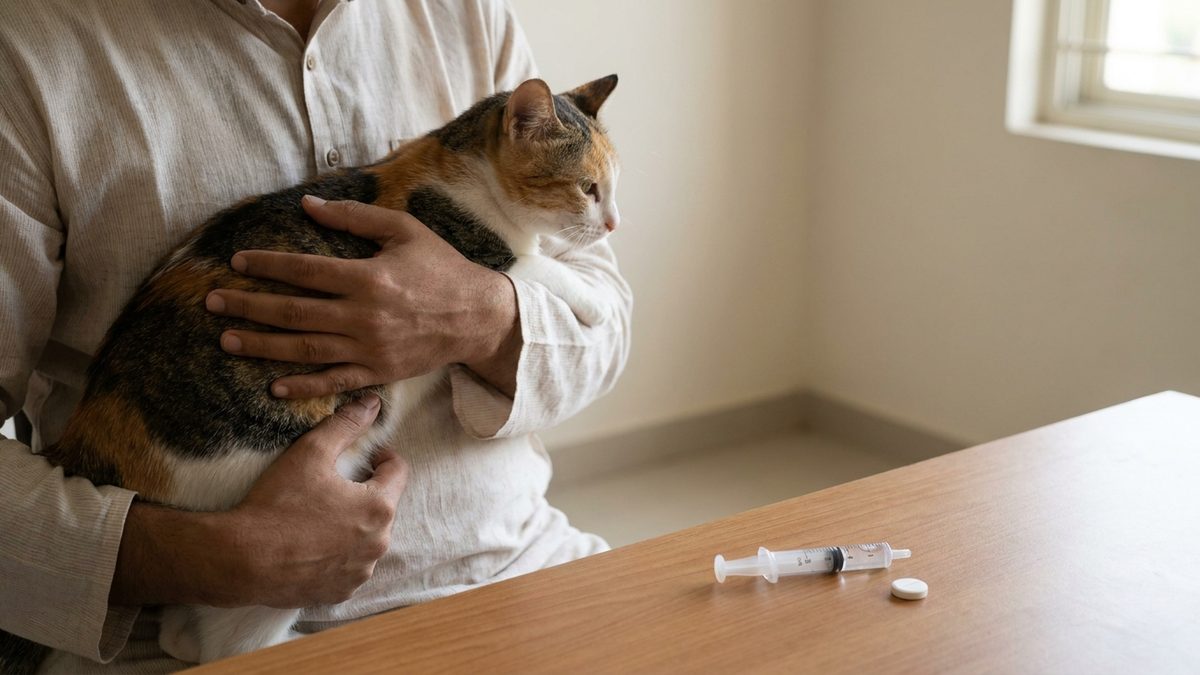
Quick answer
How to give a cat a tablet comes down to four moves. Hide it in a small amount of soft food, never in the main meal. If that fails, hold the head from above, tilt the chin up, and drop the tablet as far back on the tongue as you can see. Then follow it with water, because a dry-swallowed tablet can sit in a cat's oesophagus for minutes. Never crush a modified-release or coated tablet, and ask your vet before you split one.
This guide is general information for Indian pet owners and is not a diagnosis. Always consult a registered veterinarian near you before acting on anything you read here, and treat any sudden change in your pet's condition as urgent.
Why a dry-swallowed tablet does not reach a cat's stomach
A tablet given to a cat with nothing after it usually stops in the oesophagus and stays there for minutes. In the only study to film this, not one dry-swallowed tablet had reached the stomach at 30 seconds, and only 36.7 percent had got there after five full minutes.
Researchers at Colorado State University gave tablets and capsules to 30 cats and watched each one travel under fluoroscopy, which is a live x-ray film rather than a single picture. For dry tablet swallows, the percentage that had passed into the stomach was 0.0 percent at 30 seconds and at 60 seconds, 6.7 percent at 90 seconds, 13.3 percent at 120 seconds, 26.7 percent at 180 and at 240 seconds, and 36.7 percent at 300 seconds.
Then they repeated it with a swallow of water straight afterwards. Wet tablet swallows passed 90.0 percent of the time at 30 seconds, 93.3 percent at 60 seconds and 100 percent at every point after that. One change, from nothing to a mouthful of water, moves the figure from zero to nine in ten inside half a minute.
Capsules behave worse and do not improve with waiting. Only 16.7 percent of dry capsule swallows reached the stomach, and that number was the same at 30 seconds and at 5 minutes, because a gelatine capsule sticks to a dry oesophagus and simply stops. Followed by water, capsules passed 96.7 percent of the time at 30 seconds and 100 percent thereafter.
| Time after the dose | Tablet, dry | Tablet, with water | Capsule, dry | Capsule, with water |
|---|---|---|---|---|
| 30 seconds | 0.0 percent | 90.0 percent | 16.7 percent | 96.7 percent |
| 60 seconds | 0.0 percent | 93.3 percent | 16.7 percent | 100 percent |
| 90 seconds | 6.7 percent | 100 percent | 16.7 percent | 100 percent |
| 2 minutes | 13.3 percent | 100 percent | 16.7 percent | 100 percent |
| 3 to 4 minutes | 26.7 percent | 100 percent | 16.7 percent | 100 percent |
| 5 minutes | 36.7 percent | 100 percent | 16.7 percent | 100 percent |
What a tablet sitting in the oesophagus actually does
A tablet held against the lining of the oesophagus can burn it, and the scar that follows can narrow the tube permanently. The Colorado team set out to explain exactly that, having already reported tablet-induced focal oesophagitis and stricture formation in cats, and concluded by recommending the routine administration of a water bolus to cats receiving tablets or capsules by mouth.
The clinical end of it is documented. A British group reported four cats that developed an oesophageal stricture after doxycycline, all young to middle-aged, median age 3 years, range 1 to 7. In every case the main sign was regurgitation, appearing at variable times after the drug was given. One was diagnosed only at post mortem; the other three were diagnosed by endoscopy and treated successfully with balloon dilation.
Four cats is a case series, not a rate, and nobody can tell you the odds for your own cat. What it does establish is that the mechanism is real and the consequence is a general anaesthetic and a balloon, not a mild tummy upset.
Follow every tablet and every capsule with water or food. VCA's own instruction for doxycycline is to follow the pill with at least 6 mL of water or food and never to give the pill dry, and it adds that this is particularly important in cats. Cornell's veterinary pharmacy names the same job in the same words, to help prevent tablets or capsules from becoming lodged in the oesophagus, and puts the volume at about a teaspoonful, 5 to 6 mL, given with a dropper or an oral syringe.
The follow-up study, and the limit it admits
A later study asked whether the delivery method itself could do the job. Eight healthy cats were given tablets and capsules four ways: with a one-step pill gun loaded with flavoured liquid, and inside a pill delivery treat. Estimated average transit times were 36 seconds for a tablet in the pill glide, 60 seconds for a tablet in a pill pocket, 16 seconds for a capsule in the glide and 24 seconds for a capsule in a pill pocket.
Both methods worked, and the authors said so plainly, that either delivery method is acceptable for successful passage into the stomach. They also said it rested on a single replicate in eight cats. Read that as encouraging rather than settled: a lubricated or food-wrapped tablet moves far better than a dry one, and the three-second rule is still that something wet follows the dose.
How to give a cat a tablet, step by step
To give a cat a tablet by hand, set everything out first, hold the head from above, tilt the chin up, and place the tablet as far back on the centre of the tongue as you can see. The whole thing takes under ten seconds when it is rehearsed and much longer when it is not.
Prepare before you fetch the cat. Tablets and capsules go out individually and liquids get drawn into an oral syringe before the cat is anywhere near the room. If you are using a pill popper, load it and bring the plunger just into contact with the tablet so it releases with no extra push.
- Put the cat on a stable, non-slip surface, sitting upright and facing away from you. A slick counter stops a cat getting a grip and running.
- Hold each front leg above the elbow, hands pressed softly against the cat's sides. This controls the paws and keeps the cat upright without any force.
- Place your other hand on top of the head, approaching from the side rather than from above, which is less threatening, and extend thumb and forefinger down to either side of the jaw.
- Tilt the head gently upwards so the chin points at the ceiling, then use the middle finger of the tablet hand to pull the lower jaw down.
- Drop the tablet as far back on the centre of the tongue as you can see. The further back it goes, the harder it is for the cat to do anything but swallow.
- Hold the jaw closed for a few seconds and rub the throat under the chin. A lick of the lips or the nose means it has gone down.
- Follow immediately with 5 to 6 mL of water from a dropper or oral syringe, or with a small amount of food the vet has approved.
- Finish with something the cat likes, a treat, a brush or a minute with a wand toy, so the next dose is not a fight you have already lost.
Two details are worth getting right. Blowing gently on the face or rubbing the throat stimulates a swallow if you are not sure one happened. And excessive drooling straight after a dose is normal and not harmful, so do not read it as a reaction.
The towel, when there is nobody to help
Wrap the cat when you are on your own. Put a mid-sized soft towel on a flat surface, sit the cat on it facing away from you, bring one side up and then the other around the neck so the front legs cannot come out, and hold firmly but gently. International Cat Care recommends two people where possible, one to hold and one to medicate, and names the towel wrap as the alternative for a very wriggly cat.
Never heavily restrain a cat, and let go if it is struggling or trying to bite or scratch. How a cat is picked up, held and put down, and what the welfare bodies now say about scruffing, is a whole subject of its own and lives on our guide to how to hold a cat.
Ask the clinic to show you once, on your own animal, in the room, before you leave with the strip. Both of the studies that measured this concluded with the same recommendation, that demonstrating administration techniques to clients may improve compliance Odom, Riley, Benschop and Hill. It costs the vet two minutes and it is the only intervention in this whole subject with evidence behind it.
The pill popper, and what it costs in India
A pill popper, also sold as a pill giver or a pill dispenser, is a plunger with a soft nozzle that holds the tablet and releases it at the back of the tongue, so your fingers never go past the teeth. It is the single most useful object in this article for a cat that has learned to bite.
They are stocked in India and they are cheap. On 22 October 2026 a pet pill syringe was listed at ₹169 and in stock on Amazon India, and a comparable dispenser was selling at ₹144 on Flipkart. That is under two hundred rupees either way, delivered. Bonbeno ranks no brand here, and the differences between these devices are not the point; owning any of them is.
Do not force a pill popper into a cat's mouth, because that can cause injury. An empty gelatine capsule is the other trick worth knowing: two or more small pieces of tablet go inside one capsule so they are given in one go, and a smear of butter on the outside makes it slide. Ask the vet first, because giving two drugs together is not always safe.
How to give a dog a tablet, which is a different problem
To give a dog a tablet, back the dog into a corner so it cannot reverse away from you, grasp the muzzle from above, squeeze behind the upper canines to open the jaw, and place the tablet on the back of the tongue. The grip is different from a cat's because the leverage is.
Call the dog in a happy voice rather than fetching it, and position its rear end into a corner of the room so it cannot back away. That one piece of staging removes most of the wrestling, and nothing in the cat method substitutes for it.
Speed is the kindness here. Cornell's advice is that the quicker you get through it the easier it is for both of you, and that it does get less stressful with time and experience. A first attempt that takes two minutes of negotiation teaches the dog that this is a long unpleasant event; a five-second one teaches it that it is not.
- Set out the tablets and draw up any liquid into an oral syringe before you call the dog.
- Grasp the muzzle from above, fingertips at the corner of the mouth on one side and thumb at the corner on the other.
- Tip the head back so the chin points up, and squeeze behind the upper canine teeth, which opens the lower jaw a little.
- Push on the lower front teeth with your other hand to open the jaw further.
- Place the tablet as far back as possible, preferably on the back of the tongue, without putting your hand deep into the mouth.
- Lower the head, wrap your fingers round the muzzle to hold the mouth closed, and rub or blow on the nose to stimulate a swallow.
- Follow with water or food, and finish with praise in the same happy voice and a treat.
Cornell's instruction is explicit: do not place your hand too far into the mouth, as this may cause the dog to choke and gag. The tablet goes to the back of the tongue, not down the throat, and the difference is a dog that swallows against a dog that panics.
For a liquid, the rule reverses. Do not tilt a dog's chin upward. Put the syringe into the side of the mouth just past the lower teeth and squirt small amounts, pausing between each so the dog can swallow without gagging. The same reversal applies to a cat.
A dog that objects to being handled at all is a separate problem, and medicating it harder will make it worse. Tolerance work, cooperative care and the evidence behind them are on our guide to teaching your dog to accept handling. Do that in the weeks around a course, not during the thirty seconds of a dose.
Hiding a tablet in food: what works, and what ruins the bowl
Hiding a tablet in food works when the portion is tiny, the animal is hungry, and the medicated mouthful is separate from the meal. It stops working the moment you bury the tablet in the dinner, because the animal learns to distrust the bowl.
Make the animal hungry first. International Cat Care's first tip is to take food away for 12 hours where that is appropriate, so the cat actually wants what you are about to offer. Most cats will not eat a bare tablet, because the flavour and the texture are unfamiliar, so do not take a refusal personally.
Then keep the medicated portion small and separate. Hide the tablet completely, offer only a small amount of food, and check afterwards that it has not been left behind or spat out. Once that mouthful is gone, serve the rest of the meal normally.
International Cat Care says it twice, once for tablets and once for liquids: do not mix medication into the main meal, because it could deter the animal from eating and makes it impossible to see whether the whole dose went in. A food aversion built this way outlasts the course by months, and a sick animal that has stopped trusting its own bowl is a bigger problem than the one you were treating.
The Indian kitchen, vehicle by vehicle
The published advice names soft foods rather than recipes. International Cat Care lists soft cheese, a small piece of soft meat or fish, or a treat that can be moulded round the tablet. Cornell names a small piece of meat, bread or cheese for a dog, and for a cat suggests coating the tablet with butter or a savoury paste such as tuna or anchovy, which both flavours it and lubricates it. Translated to an Indian kitchen, that gives the table below.
| Vehicle | Verdict | What the source says |
|---|---|---|
| Plain boiled chicken or fish, a piece the size of the tablet | First choice for most drugs | A small piece of soft meat or fish is named directly, and tuna paste is named as a coating Cornell University College of Veterinary… |
| A smear of ghee or butter on the tablet or capsule | A lubricant, not a hiding place | Butter both flavours the tablet and lubricates it, which Cornell says may make it easier to medicate a reluctant cat, and a smear of it makes a gelatine capsule slide International Cat Care |
| Paneer or any soft cheese | Works for many drugs, never for a tetracycline | Soft cheese is named, and Cornell warns that not all medications are compatible with cheese products Cornell University College of Veterinary… |
| Curd, dahi or a spoon of chaas | Same dairy caution, and the portion counts | Dairy can block absorption of some antibiotics; the portion arithmetic is on our dairy page |
| A pinch of roti, bread or a rice ball | Fine for a dog, rarely works for a cat | Bread is named for dogs; nothing in the feline guidance suggests a cat will take it |
| Anything labelled sugar-free or diet | Never | Xylitol is the reason, and it has its own page |
| The full bowl of dinner | Never | Do not mix into the main meal |
Two routes out of this page rather than repeats of it. Cheese as a pilling vehicle has a calorie cost most people underestimate, and the gram-by-gram arithmetic for curd, paneer and ghee is on our guide to dairy for dogs. Sugar-free products are a separate emergency with two syndromes and two doses, set out on our guide to xylitol poisoning in dogs. Check a peanut butter jar there before you use it as a vehicle.
The dairy trap, and where the sources do not fully agree
Some antibiotics should not go into curd or paneer at all. VCA's instruction for doxycycline is to give it with food to ease stomach upset, but not with food containing dairy or iron, because calcium and iron can block the medication's efficacy. The mechanism is chelation: the calcium ion binds the drug in the gut so less of it is absorbed.
How strong that effect is for doxycycline specifically is less settled than the blanket warning suggests. A study at the Department of Pharmacology, MGM Medical College and Hospital, Kamothe, Navi Mumbai, Maharashtra, compared oxytetracycline and doxycycline in vitro by an EDTA method and a calcium binding assay, and concluded that oxytetracycline has more calcium chelating property than doxycycline. For doxycycline the authors saw only a minor shift in the absorption coefficient and no shift in wavelength when calcium was added.
We are publishing both rather than choosing. An in-vitro assay is not a dog or a cat, and a dispensing instruction is written to be safe across patients rather than to be exact. The practical reading: if the strip in your hand is a tetracycline, use chicken or fish and not curd, and ask the dispensing vet rather than deciding from a kitchen.
This is also where a widely copied instruction deserves a second look. Cornell offers milk as an alternative to water for washing a cat's tablet down. Many adult cats digest milk sugar poorly, and a loose stool on day one of a course is the fastest way to lose a week. Water does the same mechanical job and carries no risk at all.
Which tablets must never be crushed, split or opened
Never crush a modified-release or an enteric-coated tablet, and never open a soft capsule. The reason is mechanical rather than pharmacological: the release rate lives in the physical structure of the tablet, and crushing destroys the structure.
A modified-release tablet gets its behaviour from one of three physical designs, a coating that dissolves slowly or only under specific conditions, a matrix that releases the drug slowly as it erodes, or granules and beads each carrying their own coating. Crush any of them and the modified-release properties are lost and all the drug is released at once.
The NHS Specialist Pharmacy Service names the two ways that goes wrong. The patient receives the drug more quickly, giving higher blood levels and a risk of toxic effects, or the drug is released at the wrong site in the gastrointestinal tract and does not work at all. Modified-release products often carry MR, SR, XL or LA in the name.
Enteric coating is a different mechanism with the same answer. Enteric-coated and gastro-resistant tablets are not suitable for crushing, because the coating is there to stop stomach acid destroying the drug, and once the coating is damaged the protection is gone and the drug may not work. Plain film coating and sugar coating are not the same thing and do not change absorption, so those tablets can usually be crushed, although they may taste bitter afterwards.
- Hard capsules can often be pulled apart and the powder given with food, but not always, and the leaflet decides.
- Soft capsules are squashy, sealed, and usually hold a liquid or a paste. They are usually not suitable for opening.
- Modified-release granules or beads may sometimes be dispersed in water, but the granules themselves must never be crushed or chewed.
- Chewable tablets may be crushed.
- Cytotoxic and teratogenic medicines are not crushed unless there is no alternative, and the risk to the person doing the crushing also rises with antibiotics, immunosuppressants and hormones.
Crushing a tablet is a risk to the person doing it as well as to the animal. The guidance asks you to consider the risk the medicine poses to the operator by inhalation or by contact with skin, which is why cytotoxic, teratogenic and hormone products are not crushed casually. Some tablets should not even be handled once split or crushed. Crush over a dish rather than a kitchen counter, wash your hands afterwards, and keep children out of the room.
Splitting a tablet, and the rule that bites hardest in a humid month
Splitting is a separate decision from crushing and has its own rules. If a tablet is approved to be split, that is printed in the product information and the tablet carries a score mark; if the information says nothing, the two halves have not been evaluated for equal weight or equal drug content. Most sustained, controlled or timed release medications are not meant for splitting at all.
Two of the FDA's splitting rules matter more in India than anywhere they were written for. The first is that you should not split the whole strip in advance and store the halves: take both halves before splitting the next tablet, because split tablets are affected by heat, humidity and moisture, and a half stored somewhere damp such as a bathroom cabinet can be affected. In a monsoon month in Mumbai or Kolkata that is not a theoretical caution.
The second is that switching brand changes the answer. The same medicine made by a different manufacturer may not have been developed to be split, so confirm again after a substitution. Indian chemists substitute brands routinely, and nobody tells the owner.
Storage temperature is the companion problem. Medicines have an optimum temperature range, and storing them too hot or too cold can affect how well they work. A strip left on a kitchen shelf in Delhi or Chennai through a summer afternoon is not being stored at room temperature in any meaningful sense, and asking the vet where a particular medicine should live is a fair question rather than a fussy one.
A tablet splitter or a pill cutter divides tablets into halves or quarters more accurately than a knife, and some will crush as well, but the device does not change which tablets may be divided. Check with the vet first, every time, and note that some tablets must not even be handled once split or crushed.
Liquids, eye drops, ear drops and spot-on treatments
Each non-tablet route has one thing that goes wrong most often, and knowing it is most of the job. A liquid is given into the side of the mouth with the chin level, and a spot-on goes onto skin high enough that the animal cannot reach it.
Liquid medication is measurably easier to get into a cat than a tablet. In the Finnish survey, liquid formulations were significantly more palatable than solid ones, with an odds ratio of 4.8, and drugs registered for cats were significantly more palatable than drugs registered for another species, at an odds ratio of 4.9.
What makes that finding useful is what the same owners then said. Most of them, 22 of 38, still preferred a solid dosage form, and only 4 of 38 chose a liquid. Owners prefer the form that is harder for the animal, probably because a tablet is easy to measure and a syringe is messy. Ask the vet whether a liquid exists for your animal's drug before you assume a tablet is the only option.
- Liquids by mouth: insert the syringe into the side of the mouth just past the lower teeth, keep the chin level rather than tilted, and squirt small amounts with a pause between each Cornell University College of Veterinary….
- Liquids in food: a liquid can go into a small amount of food or a liquid treat if the vet approves, but never into the main meal.
- Crushed tablet as a liquid: some crushed tablets can be mixed with a little water or oil, for example from a tin of tuna in spring water, drawn into a needle-free syringe and dribbled into the side of the mouth. Always check first, because it does not suit every tablet.
- Shaking: some liquid medicines settle, so shaking distributes the drug and is the difference between the right amount and the wrong one.
- Eye and ear products are not interchangeable. Using an ear medicine in the eye, or the reverse, can cause harm. Read which it is before you open it, every time.
Spot-on treatments, and the four minutes before you open the pipette
Read the pipette instructions before you pick the animal up, because they vary between products. Then part the fur high on the back of the neck and apply to skin, because too low and the animal can turn round and lick it off. Wear gloves where the leaflet asks for them and wash your hands afterwards.
Two practical additions worth having. Have someone hold the animal, with or without a towel, so you can concentrate on the application, and distract with a treat. Some cats bolt the instant it goes on because the liquid feels cold, so shut the door and, in a wet month, keep them in until it dries.
Which spot-on product class does what, and which dog products can kill the cat in the same house, is covered in full on our guide to tick prevention for dogs in India. Eye drops given for a diagnosed condition, and how long a course runs, sit with the condition: see our page on dry eye in dogs for the lifelong version of that routine.
Insulin at home has its own rules, its own storage problem and its own never-double-up warning, and it is not a technique you should pick up from a general page. Our page on diabetes in dogs and cats covers the insulin sold in India and what home monitoring costs here.
When the dose is spat out, vomited or refused
Do not repeat a dose on a guess. Whether to give it again depends on the drug and on how fast it breaks down, and the honest answer for most owners most of the time is to ask the vet before the next scheduled dose is due.
The regulator's own answer is the clearest one published. Asked what to do if a pet vomits or spits out the medicine, the FDA's Center for Veterinary Medicine answers that it depends on the medicine, that some medicines break down in the stomach faster than others, and that a pet which immediately vomits a fast-breaking medicine may already have absorbed it into the bloodstream. Giving another dose could cause too much to be absorbed and lead to side effects, so the veterinarian guides what to do based on the drug.
Spitting out the tablet before it was ever swallowed is a different case from vomiting a dose back after ten minutes, and you can usually tell them apart. If the cat spits the tablet out and is not distressed, International Cat Care says you can simply repeat the procedure, and suggests a pill popper for the second attempt. That is about a tablet that never went down, not about a dose that came back up.
- Look at what came out. An intact tablet on the floor was never swallowed; a wet fragment in vomit was, at least partly.
- Note the clock. How many minutes passed between the dose and the vomit is the first thing the vet will ask.
- Do not give a second dose yet, and never give two at once to catch up.
- Call or message the clinic with the drug name, the strength on the strip, the time of the dose and what you saw. The answer depends on the drug and nobody can give it generically.
- Ask at the same time about the dose you missed, because some medicines have to be evenly spaced to stay effective and the vet decides when the next one goes in.
Owners panic about a single missed dose and then quietly abandon the course a week later, which is the far bigger risk. Report the miss, take the instruction, and carry on. If the animal is getting more frightened with every attempt, say that too: if medicating is causing significant stress, that will not help recovery, and the clinic may be able to give the medication or suggest a different formulation.
Persistent refusal is information, not stubbornness. An animal that suddenly fights a dose it accepted last week may be nauseated by the drug, sore in the mouth, or simply exhausted by the routine. Side effects are the other possibility: if you see them, the general rule is to stop the medicine and call the vet rather than push through.
The course your animal is winning, and the measured reason why
Roughly two in five owners do not finish a prescribed course as instructed, and the commonest reason they give is a resistant pet. The second commonest cause is not the animal at all: nearly half of owners were never shown how.
A New Zealand primary care study followed 66 cat owners from prescription to the end of the course. Medication noncompliance was recorded for 39 percent, 26 of 66. A quarter, 16 of 66, reported challenges in administering the medicine, and the most commonly cited reason was a resistant pet. Oral administration of antibiotics was significantly associated with noncompliance, at P equal to 0.01.
The same team ran it on 151 dog owners and the picture was worse. Noncompliance was recorded for 47 percent, 71 of 151. One third, 47 of 151, reported challenges, and again the commonest reason was a resistant pet. And 47 percent of owners, 71 of 151, said that nobody had shown them how to administer the medication.
| Study | Who was counted | Headline finding | Worth noting |
|---|---|---|---|
| Odom and colleagues, cats, 2025 | 66 cat owners, followed to the end of the course | 39 percent noncompliant; 16 of 66 reported difficulty | Oral antibiotics were significantly linked to failure, P equal to 0.01 |
| Odom and colleagues, dogs, 2024 | 151 dog owners, same programme and dates | 47 percent noncompliant; 47 of 151 reported difficulty | 47 percent said nobody had shown them how |
| Sivén and colleagues, cats, 2017 | 46 owners, 46 cats, 67 oral medications | Owners could not give one quarter of the medications as prescribed, 16 of 67 | 36 percent of the drugs were human products used off-label |
None of these studies was done in India, and we are not pretending otherwise. What they establish is that the failure rate is high in well-served, high-income settings with short distances to a clinic, which is a floor rather than a ceiling for what to expect elsewhere.
Why an unfinished antibiotic course is the one that matters most
Antibiotics need doses at set intervals across the whole treatment period so that enough drug stays in the bloodstream to work. Skipping a dose or two can be the difference between clearing the infection and having to extend the course or switch to a different antibiotic because the bacteria have become resistant to the first one, and the FDA says the same of not finishing the entire prescription. Finishing the course is therefore not a tidiness rule, it is the treatment.
Set that beside the finding that oral antibiotics were the drug class significantly associated with cat owner noncompliance, and the shape of the problem is clear. The hardest drug to give is also the one where giving up quietly causes the most damage, and the damage is not confined to your animal.
When to stop struggling and call the clinic
Call before the third bad attempt, not after the tenth. The honest triggers are listed below, and none of them is a failure on your part.
- You have been scratched or bitten. A cat bite is a medical event for you, and the clinic needs to know before the next dose.
- The animal now hides when it sees you coming, or has stopped eating from its bowl.
- Two or more consecutive doses have failed to go in.
- The animal is already unwell and the struggle is visibly costing it more than the drug is buying.
- You cannot tell whether the dose went down, which is itself a reason to ask rather than to repeat.
Ask the clinic three things when you call. Whether this drug exists in another form, whether the clinic can give it instead, and whether a different drug in the same class would be easier. For a cat on a lifelong drug that is a bigger decision than a fortnight's antibiotic, and the alternatives include a route that is not the mouth at all: see our page on hyperthyroidism in cats for what the skin route and long-term monitoring involve in India.
What is different about medicating a pet in India
Three things change in India: the strip you are handed is usually a human brand, the law explicitly allows that, and the vehicles, the heat and the humidity are not the ones the foreign guidance assumes.
Start with the law, because it settles a question most Indian owners worry about. The Drugs and Cosmetics Act, 1940 defines a drug to include all medicines for internal or external use of human beings or animals, and all substances intended to be used for the diagnosis, treatment, mitigation or prevention of any disease or disorder in human beings or animals. Animal medicines are not a separate legal category in India; they sit inside the same Act as yours.
That is why the strip your vet hands you so often carries a human brand name. It is lawful, it is routine, and it is not unique to India: in the Finnish survey, 36 percent of the drugs given to those cats were products registered for human medicine and used off-label, against 54 percent registered for cats.
The label says Registered Medical Practitioner, and your vet counts
Indian prescription medicines carry a red box whose text names a doctor, not a vet, and owners read it and hesitate. Rule 97 of the Drugs Rules, 1945 requires a Schedule H product to be labelled with the Rx symbol and the words "SCHEDULE H PRESCRIPTION DRUG - CAUTION Not to be sold by retail without the prescription of a Registered Medical Practitioner" in black on a red rectangle.
The definition is the part nobody quotes. Rule 2(ee) of the same Rules defines a Registered Medical Practitioner, and sub-clause (v) of that definition is a person "who is engaged in the practice of veterinary medicine and who possesses qualifications approved by the State Government";. A qualified veterinarian's prescription is therefore a valid prescription for the purposes of that label, and a chemist who dispenses against it is doing so lawfully.
Take the written prescription, not a photograph of the strip and not a WhatsApp message. The red box asks for the prescription of a Registered Medical Practitioner, and Rule 2(ee)(v) of the Drugs Rules, 1945 puts a qualified veterinarian inside that definition. If a chemist refuses, that is a commercial decision rather than a legal requirement, and another chemist will dispense it.
The mix-up risk that the foreign advice does not anticipate
The FDA tells owners to store pet medications away from people medications to prevent a mix-up, and says it receives calls from owners who have mistakenly taken their pet's medicine or given their own medicine to their pet. That advice assumes the two look different. In an Indian house where the dog's antibiotic is a human brand in a human blister strip, often from the same chemist as yours, they frequently do not.
Our reading, stated as a reading rather than a finding: write the animal's name and the dose on the strip in marker the day you get it, and keep it in a separate box. Keeping medicines in their original containers with intact labels, so the directions and the animal's name stay legible, is the FDA's own first storage rule, and in India the second half of that rule usually needs a pen.
There is a related hazard in the other direction. Many pet medications are flavoured to taste good, which helps when the animal takes the dose and hurts when it sniffs out the supply and eats the lot, and pets are known to chew through plastic pill vials, boxes and blister packages. Human painkillers left within reach are the standing Indian household danger, and the toxicology, the paracetamol numbers and what to do in the first minutes are on our guide to pet first aid at home.
What we could not establish about flavoured and compounded forms in India
We could not find a veterinary compounding pharmacy serving Indian pet owners. A search run from India on 22 October 2026 for a veterinary compounding pharmacy offering flavoured suspensions or custom strengths returned ten results and every one of them was American. That is a negative search result, not proof that no such service exists in India, and we are recording it as the former.
What follows for an Indian owner is practical. The flavoured liquid, the chicken-flavoured mini-treat and the custom-strength suspension that American and British pages routinely tell you to request are not reliably available here, so the two realistic levers are a different licensed product and a different route. Ask the vet which licensed liquid or palatable formulation exists for this drug in India, and ask whether a drug in the same class comes in an easier form. Both are questions the FDA itself puts on the list to ask: whether there are other medicine options that may be better for your pet.
Heat and the monsoon are the last India-specific layer, and they are mostly a storage problem. Split tablets are affected by heat, humidity and moisture, and every medicine has a temperature range outside which it may not work properly. In a humid month, a half tablet in a bathroom cabinet in Mumbai, Chennai or Kolkata is the worst place in the house for it. Split one at a time, keep the strip in a closed box away from a sunny shelf, and ask the vet whether anything needs the fridge.
What this page can prove, and what it cannot
The transit evidence is strong and small, the compliance evidence is foreign, and no Indian figure exists for any of it. Here is exactly where each claim stands.
The oesophageal transit finding is the firmest thing here and it rests on 30 cats in one laboratory, filmed under fluoroscopy, with a clean experimental contrast between a dry and a wet swallow. The follow-up on delivery devices used eight cats and a single replicate, and its authors said so. Neither tells you the probability that your cat will get a stricture. The case series that shows strictures do happen counts four cats.
The compliance figures are from New Zealand and Finland Odom, Riley, Benschop and Hill Sivén, Savolainen, Räntilä, Männikkö. We searched for an Indian equivalent, a published figure for how often Indian owners complete a prescribed course, and found none. If one exists we would rather cite it than extrapolate, and we have not extrapolated: the figures above are labelled with the country they were measured in, every time.
An Indian study of owner medication compliance with a denominator, a published Indian figure for the availability of palatable veterinary formulations, or a transit study in dogs equivalent to the feline one. We have found none of the three, and the dog section of this page therefore rests on technique guidance from a veterinary pharmacy rather than on filmed evidence.
This page names no drug, no dose, no frequency and no duration, and that is deliberate rather than cautious. Those four things are set by the veterinarian who has examined your animal, and no page can set them from a distance. If you are still choosing a clinic, our guide to choosing a vet in India covers what to ask.
Deworming is the one course most Indian owners give themselves, and the schedule, the active ingredients, the milligrams per kilogram and the Indian prices are all on the two pages that own that question: cat deworming and dog deworming. This page is only about getting the thing swallowed.
Common questions
What is the best way to give a tablet to a cat?
The best way to give a tablet to a cat is to hide it in a small, separate portion of soft food the cat loves, and if that fails, to place it by hand at the very back of the centre of the tongue and follow it with water. Hold the head from above with the chin tilted up, use a pill popper if your fingers are at risk, and never mix the tablet into the main meal.
How long does it take for a cat to absorb a pill?
A pill has to reach the stomach before any of it is absorbed, and given dry it often does not. In 30 cats filmed under fluoroscopy, no dry-swallowed tablet had reached the stomach at 30 or 60 seconds, and only 36.7 percent had after five minutes. Followed by a swallow of water, 90 percent were in the stomach within 30 seconds and 100 percent within 90 seconds.
Can I dissolve a pill in water and give it to my cat?
Sometimes, and only after checking. Some crushed tablets can be mixed with a little water or with oil from a tin of tuna in spring water, drawn up into a needle-free syringe and dribbled into the side of the mouth, but this does not suit every tablet. Modified-release and enteric-coated tablets must never be crushed or dissolved, because the coating or matrix is what controls the dose.
What to do if a cat spits out medicine?
Check whether it was ever swallowed. An intact tablet spat onto the floor was not, and if the cat is not distressed you can repeat the procedure, using a pill popper for the second attempt. A dose that was swallowed and then vomited is different: do not repeat it on a guess, note how many minutes had passed, and ask the vet, because giving another dose of a fast-absorbed drug can cause side effects.
Can you crush up tablets for dogs?
Some tablets, not all, and never a modified-release or enteric-coated one. Crushing a modified-release tablet releases the whole dose at once, which risks toxic blood levels or releases the drug at the wrong part of the gut. Enteric coating exists to protect the drug from stomach acid and is destroyed by crushing. Plain film-coated and sugar-coated tablets can usually be crushed, but ask your vet about the specific tablet first.
Can I crush my dog's pills and put it in water?
Only with the vet's approval for that specific tablet. If the tablet may be crushed, mixing the powder into a small volume of water or a liquid treat and giving it by needle-free syringe is a recognised method. Do not do it with a modified-release, enteric-coated or soft capsule product, do not crush over an open kitchen surface because the dust can be inhaled, and never put the mixture into the full dinner bowl.
How to give an unwilling dog a pill?
Back the dog into a corner of the room so it cannot reverse away, grasp the muzzle from above, squeeze behind the upper canine teeth to open the jaw, and place the tablet on the back of the tongue without putting your hand deep into the mouth. Lower the head, hold the muzzle closed, and rub or blow on the nose to trigger a swallow. Follow with water and finish with praise and a treat.
Can dogs smell pills in their food?
No study has measured canine detection of a hidden tablet, so treat any confident number you read as invented. What is documented is that animals do find and reject hidden tablets, which is why the guidance tells you to check the bowl afterwards and to consider crushing the tablet for a pet clever at finding it. Flavoured medicines carry the opposite risk, because pets sniff them out and eat the whole supply.
Why does my cat need water after a tablet?
Because a cat's oesophagus does not clear a dry tablet. A tablet held against the lining can cause focal oesophagitis and, in reported cases, a stricture needing endoscopy and balloon dilation. Follow every tablet or capsule with at least 6 mL of water, about a teaspoonful, from a dropper or oral syringe, or with food your vet has approved. This matters most with doxycycline and other tablets known to irritate.
Can an Indian chemist dispense medicine on a vet's prescription?
Yes. The red Schedule H box on an Indian strip says the product may not be sold by retail without the prescription of a Registered Medical Practitioner, and Rule 2(ee)(v) of the Drugs Rules, 1945 includes within that definition a person engaged in the practice of veterinary medicine who holds qualifications approved by the State Government. Carry the written prescription rather than a photograph of the strip.