
Dog and cat nutrition guide
How to store dog food in Indian humidity: the bag, the bin, the pack size and the clock
Every ranking page tells you to buy an airtight container. The FDA tells you not to empty the bag into it, and the reason is a number printed on the bag that you will need if the food ever makes your animal ill.
Quick answer
How to store dog food in an Indian kitchen comes down to four decisions. Keep the kibble in its original bag and put the whole bag inside the airtight bin rather than tipping it in, because the bag is the barrier and carries the lot code. Store it off the floor and out of the sun. Buy the pack your animal finishes inside a month. Wash and dry the bin before every new bag, and never top up old food with new.
This guide is general information for Indian pet owners and is not a diagnosis. Always consult a registered veterinarian near you before acting on anything you read here, and treat any sudden change in your pet's condition as urgent.
The one correction that changes how you store kibble
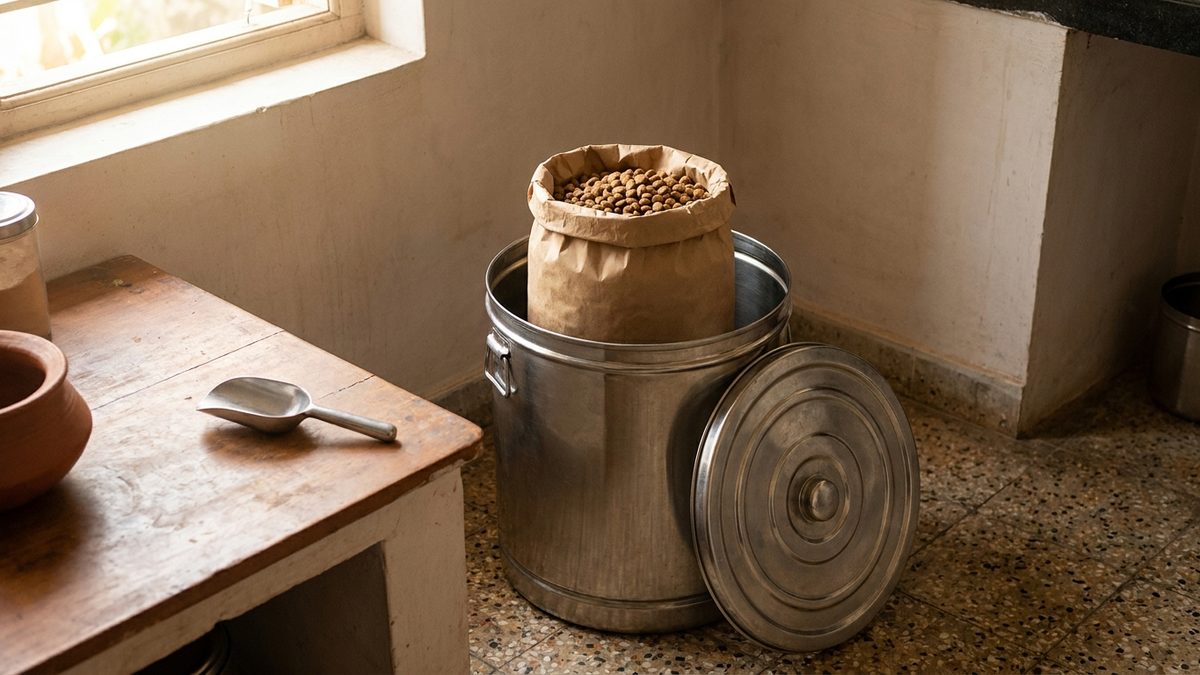
The correction is to keep the kibble inside its own bag and put that bag into the container, rather than emptying the kibble in. The United States Food and Drug Administration puts it in two sentences. "Store pet food and treats in the original container or bag", and "If you want to store dry pet food in another storage container, put the entire bag into the container rather than pour the kibble directly into it";. The Association of American Feed Control Officials gives the same instruction to consumers, asking them to "store in original container inside a clean, dedicated plastic container with a lid";. Purina's own storage page orders it as three steps: keep the food in the original bag, squeeze out the extra air and clip it shut, then place that bag inside a metal or plastic bin with an airtight seal.
The first reason is not freshness. It is traceability. The bag carries the UPC code, the lot number, the product name, the manufacturer and the best-before date, and the FDA says plainly why that matters: "When you file a complaint about a pet food, the lot number and 'best by' date, along with the full product name, are important for you to provide";. Then it gives the number that should end the argument. "Less than half of the pet food complaints that FDA receives include the lot number";. An owner who tipped the kibble into a bin and threw the bag away has no lot number to give, and a vet investigating a sudden liver failure has no sample packaging to send anywhere.
The second reason is the bag itself. A retail kibble bag is a laminated multi-layer barrier built to hold fat and oil in and air out, which is why both Chewy's veterinary-reviewed guide and Purina describe it as an added barrier rather than packaging to be discarded Purina Pet Expert Team. Nobody has published a side-by-side permeability measurement of an Indian retail pet food bag against a household bin, and we are not going to invent one. What is published is that every authority that has written guidance says to keep the bag.
Why an almost-empty bin is the worst part of the system
The bottom of a pet food bin holds crushed kibble, dust and a film of the oil sprayed on at the end of extrusion, and pouring a new bag on top of it is the single commonest storage mistake. The FDA asks owners to "wash and dry the storage container between finishing up one bag of kibble and filling it with another to get residual fat and crumbs off the container's surfaces";. Purina says the same in harder words: "do not dump the new food over the old food. Use the old food and wash out the container before filling it with new food";. Chewy adds the method, hot soapy water or white vinegar, rinsed and dried completely before refilling. In a humid Indian flat the point is sharper, because a bin that is wiped but not dried puts free water back on top of food formulated to sit under 14 percent moisture.
Roll the bag down, clip it, stand the whole bag inside a bin with a lid that seals. Keep the scoop outside the bin. When the bag is finished, wash the bin, dry it completely, and only then open the next bag. If you must decant, tape the cut-out panel with the lot number and best-before date to the outside of the bin.
There was a disagreement on our own site, and we would rather record it than quietly erase it. Our monsoon care guide for dogs in India told readers to decant kibble into an airtight bin the day the pack was opened, our monsoon care guide for cats in India softened that to bag and all where it fits, and our guide to pets and elderly family members told an older reader to decant once into a waist-height bin. Our guide to reading a pet food label in India and our guide to feeding a dog in a vegetarian household already said to keep the original bag, the second of them for the right reason. The evidence above is one-directional, so the three that disagreed were corrected in October 2026 and all five now give the same instruction.
Is it better to store dog food in plastic or metal?
No published study has compared a plastic airtight container with a stainless steel one for keeping kibble fresh, so anyone who tells you which is better is guessing. Chewy, whose page is reviewed by a veterinarian, recommends "airtight plastic or stainless steel" and gives exactly one reason to prefer steel, that it is easier to clean. That is a real reason, because washing the bin between bags is the step the authorities all insist on, and a smooth steel surface releases a fat film more readily than scratched plastic. It is not a freshness finding.
What has been measured is container type against arthropod invasion, and those results are useful. A critically appraised topic published in BMC Veterinary Research reviewed every study on storage mites in commercial pet food and summarised four that bear on this question. In a Scottish field study, identical bags of one dry dog food were split between the original resealable sack, a paper bag rolled shut and a plastic box with a sealed lid, then stored side by side in ten households and sampled monthly. After three months, six of ten paper bags had detectable mites, four mites were found across three of ten resealable plastic bags, and a single mite turned up in one of ten plastic boxes. In a Czech laboratory study, mites were placed near nine closed plastic food packages and a lidded cup for three months: Tyrophagus storage mites got into five of nine bags, most often those made of single-layer polypropylene or polyethylene film, and the review is specific about the route, that the mites "had not made holes in the packaging itself but had entered the bags via faulty seals". The lidded cups were not contaminated.
| Study and place | Container | Storage | Result |
|---|---|---|---|
| Gill and colleagues, Scotland, 10 households | Paper bag, top rolled | 3 months, household conditions | Mites detected in 6 of 10 |
| Gill and colleagues, Scotland | Original sack with resealable closure | 3 months | 4 mites across 3 of 10 (30 percent) |
| Gill and colleagues, Scotland | Plastic box with sealed lid | 3 months | 1 mite in 1 of 10 (10 percent) |
| Hubert and colleagues, Czech laboratory | Nine sealed plastic film bags | 3 months, mites placed alongside | Tyrophagus in 5 of 9 (55 percent), entering through faulty seals |
| Hubert and colleagues, Czech laboratory | Lidded cup | 3 months | No contamination |
What the container actually has to do
Judge a bin on four things rather than on its material. The four checks are listed below, in the order the evidence supports.
- Check the seal first. The only failure mode anybody has demonstrated is a defective closure rather than a chewed wall, and in the Czech laboratory work the mites entered five of nine sealed film bags through faulty seals without boring a single hole.
- Check that it washes and dries to the corners. Washing the bin between bags is the one step the FDA, AAFCO, Purina and Chewy all name, and a bin with a textured base keeps the fat film that seeds the next bag.
- Check that it matches the pack you buy. A 20 kg bin holding 4 kg of food is mostly a reservoir of warm air, and oxidation needs oxygen rather than space.
- Check that you can lift it to the sink. A bin you cannot carry is a bin that never gets washed, which in a small Indian flat usually rules out the top shelf of the loft.
The temperature the storage advice assumes, and the Indian number that breaks it
The advice assumes a room below 80 degrees Fahrenheit, and most Indian homes are not one for most of the year. The FDA's instruction is "Store dry pet food and unopened canned food in a cool and dry place. The temperature should be less than 80 F. Excess heat or moisture may cause the nutrients to break down";. AAFCO repeats the same ceiling, "Keep dry pet food in a cool, dry place (less than 80 degrees F)";. Eighty degrees Fahrenheit is 26.7 degrees Celsius. Every storage guide on the first page of Google India repeats that number and not one of them checks it against an Indian room.
The best measured Indian indoor dataset we could find is the field study behind the India Model for Adaptive Comfort, run by CEPT University in Ahmedabad with partners in Sydney. Researchers surveyed 16 buildings across five cities chosen to represent the five climate zones of the Energy Conservation Building Code, in three seasons, and recorded air temperature and humidity beside each of 6,330 respondents. Across all 16 buildings the mean indoor air temperature was 28.4 degrees in summer, 25.6 in the monsoon and 23.5 in winter, with the highest single reading 39.8 degrees in summer and the lowest 13.4 in winter, and the highest relative humidity recorded in the monsoon at 88.8 percent.
| City and climate zone | Summer mean | Monsoon mean | Winter mean | Seasons above 26.7 C |
|---|---|---|---|---|
| Ahmedabad, hot and dry | 36.4 | 29.6 | 23.8 | Summer and monsoon |
| Chennai, warm and humid | 34.5 | 29.3 | 27.9 | All three |
| Bangalore, moderate (building B1) | 28.3 | 26.6 | 27.2 | Summer and winter |
| Bangalore, moderate (building B3) | 29.2 | 25.9 | 26.7 | Summer |
| Shimla, cold | 26.2 | 21.8 | 16.3 | None |
| All 16 buildings pooled | 28.4 | 25.6 | 23.5 | Summer |
Read the Chennai row twice. In a naturally ventilated building in Tamil Nadu the mean indoor air temperature sat above the storage ceiling in summer, in the monsoon and in winter. There is no season in which that room complies with the instruction printed on an American pet food page.
The caveat, stated rather than buried
Those are offices, not kitchens, and the honest reading has to say so. The IMAC survey was administered in office buildings, and a kitchen differs from an office in exactly the direction that makes this worse rather than better, because it contains a burner, a refrigerator compressor and often the least ventilation in the flat. We could find no published measurement of air temperature in Indian domestic kitchens, so treat the table as the order of magnitude it is, and treat your own kitchen as warmer than the matching row.
The reason a kitchen in Mumbai or Kolkata is not quietly air-conditioned is also measurable. A 2024 household survey run by CLASP with the Bureau of Energy Efficiency covered 4,321 households in 20 states and found air conditioners in 13 percent of them overall, 4 percent in rural households and 17 percent in urban ones, while ceiling fans reached 97 percent of rural and 100 percent of urban homes. The report states its own limitation, that the sample "is not statistically representative of all Indian households";. Even read loosely, it says that the typical Indian pet food store cupboard is a fan-cooled room tracking the outdoor air, not a climate-controlled pantry.
No bin, at any price, holds food below the temperature of the room it stands in. The only levers an Indian owner actually has are where in the flat the bag sits, how much air is in the container with it, and how few weeks the bag spends open. That is why most of this page is about pack size rather than about containers.
What happens to the fat in an opened bag, and whether rancid food is harmful
What happens is that the fat sprayed onto the kibble after extrusion starts to oxidise the moment the bag is opened, and the structure of kibble makes it unusually vulnerable. Deterioration runs by two routes, hydrolytic rancidity, in which lipase, moisture and heat split free fatty acids off the triglycerides, and oxidative rancidity, in which oxygen attacks the double bonds in the unsaturated fat. A study of lipid oxidation in extruded dry pet food during storage reports the mechanism that matters for a kibble rather than for a bottle of oil: "The expanded, porous nature of extrudates causes them to be susceptible to the development of oxidation during storage", and "Products with a higher degree of expansion, which had larger cells and thinner cell walls, were more susceptible to oxidation";. A puffed kibble is mostly surface. That is what makes it crunchy and what makes it oxidise.
That study also produced a result that contradicts the intuition every blog repeats. Across the formulations tested, "Control (no fat) samples had the highest lipid oxidation rate, as compared to the samples with fat addition", and "Samples containing a higher fat content resulted in a lower rate of lipid oxidation during storage";. So a higher declared fat percentage on the pack is not by itself a reason to expect a bag to spoil faster. The fat's type matters more than its quantity, with poultry fat oxidising faster than beef tallow in the same trial.
The threshold the industry admits it does not have
Ask how rancid is too rancid and the answer is that nobody has established it, and the people who buy the ingredients say so in print. A Fats and Proteins Research Foundation report by a Kansas State University food scientist describes the state of play without euphemism: "The question has been asked repeatedly when negotiating specifications between the renderer/broker of these protein meals and the pet food manufacturer as to what protein meal peroxide value is acceptable. The answer to this has typically been a fairly ambiguous number (e.g. Peroxide value of less than 10 meq/kg) based minimally on human food or livestock feed data and largely on personal bias and conjecture". The project's stated purpose was "to determine the level of oxidation in pet foods after which the foods are not accepted by pet owners";, which tells you the threshold in use is a palatability and acceptance threshold rather than a toxicity one.
So the two claims that circulate interchangeably are not equally supported. That oxidised, stale kibble is less palatable and loses nutrients is supported, and the FDA states the nutrient half directly, that excess heat or moisture "may cause the nutrients to break down";. That a bag of kibble gone slightly stale in an Indian October will make a dog ill is not something we found a measurement for, in India or anywhere. The honest position is that rancidity is a quality problem with a nutritional cost, that the dose at which it becomes a clinical problem in a pet has not been published, and that a food your animal has stopped eating is telling you something before any laboratory would. A sudden refusal of a food the animal has always eaten is worth taking seriously rather than disguising with a topper, and our guide on fussy eating and appetite loss covers when that becomes a veterinary question.
One practical consequence of the mechanism is worth stating. Oxidation needs oxygen, so the half-empty bin is the problem and not the full one. Squeezing the air out of the bag before you clip it, which Purina asks for explicitly, does more than the bin does, because the bin's job is to keep the outside out rather than to remove what is already inside.
How long an opened bag of dry food actually keeps
An opened bag keeps somewhere between one month and three months, and the sources that say so are not close to agreeing. Chewy's veterinary-reviewed page says "Vets typically recommend using dry kibble within one month of opening if stored properly", and lists "Dry kibble has been opened for longer than one month" among its reasons to throw food out. Purina says "dry food, once opened, should be used within two-to-three months if properly stored";. Natural Balance says "dry food should stay fresh for two to three months after the bag is opened, when stored correctly";. The two regulators give no figure at all: the FDA and AAFCO both stop at a storage temperature and say nothing about a window after opening Association of American Feed Control….
| Source | What it says | Figure given |
|---|---|---|
| US Food and Drug Administration | Store below 80 F in a cool, dry place; nutrients break down with heat or moisture | No figure |
| AAFCO consumer handling guidance | Keep dry pet food in a cool, dry place (less than 80 degrees F) | No figure |
| Chewy, reviewed by a veterinarian | "Vets typically recommend using dry kibble within one month of opening" | 1 month |
| Purina | "dry food, once opened, should be used within two-to-three months if properly stored" | 2 to 3 months |
| Natural Balance | "dry food should stay fresh for two to three months after the bag is opened" | 2 to 3 months |
A factor of three on the most practically important number on the subject is not a rounding difference. It decides whether a 10 kg bag is the right purchase for a 7 kg dog or the wrong one, and every page that quotes one of those figures without saying the others exist is presenting a guess as a fact. Where sources disagree this badly, the honest reading is to take the shorter figure when conditions are worse than the ones the figure assumes, and Indian conditions are worse than the ones all five of those sources assume.
Why the monsoon shortens every one of them
Each of those windows is quoted for a bag stored below 26.7 degrees in dry air, which is the condition the previous section shows an Indian room does not meet for much of the year. Three things speed up together as a room gets warmer and wetter. Fat oxidation accelerates with temperature. Mould growth needs available water, which a humid room supplies and which the guide to homemade dog treats covers in detail for food made at home. And storage mites, which are the subject of the next section but one, need both. None of those three has been measured on an opened bag in an Indian kitchen, so we are not going to put a number on the shortening. The direction is not in doubt, and a month is a defensible working ceiling through the monsoon rather than three.
There is one figure you can rely on finding and should. The date of manufacture is a binding declaration on an Indian pack while the best-before is not, and our guide to reading a pet food label in India sets out which Indian instrument requires which. Write the date you opened the bag on the bag itself in marker pen. It costs nothing and it is the only record of the clock that actually governs the food in your house.
Aflatoxin, and where the risk actually sits
Aflatoxin risk sits in the grain the food was made from, not in your storage bin, and that reframing changes what an owner should do about it. Aflatoxins are produced by the mould Aspergillus flavus growing on ingredients such as corn and groundnut, and the FDA states the part that undoes most home storage advice: "The toxins can be present even if there is no visible mold on the pet food";. It also explains why pets are the animals this happens to. "Pets are highly susceptible to aflatoxin poisoning because, unlike people, who eat a varied diet, pets generally eat the same food continuously over extended periods of time";. A dog eating the same kibble twice a day for a year is running a long exposure that a human diet never does.
The best denominator available comes from a nationwide FDA sampling assignment run after the 2020 and 2021 recalls. Investigators collected 200 kibbled dog and cat foods containing corn or corn by-products from retail shops in 36 states and Puerto Rico between 15 March and 30 September 2021: 127 dog foods across 24 brands and 73 cat foods across 21 brands. Aflatoxins were detected in five dog food samples, at 0.50, 0.54, 1.23, 1.50 and 6.52 parts per billion, and in three cat food samples, at 0.70, 1.56 and 2.02 parts per billion. The report's own conclusion is that "no sample of kibbled dog and cat food collected at retail locations in the U.S. was found to contain aflatoxins above 20 ppb, the action level established by FDA for aflatoxins in dog and cat food";. Every positive sample but one listed corn as the first grain in its ingredient list.
What those numbers do and do not say
They say that eight bags in 200, all of them far below the regulatory ceiling, carried any detectable aflatoxin at all, and that the route in was the corn. They do not say the risk is theoretical, because the same agency's recall record is the other half of the picture. In December 2020 the FDA warned the public about potentially fatal aflatoxin levels in recalled Sportmix products made by Midwestern Pet Foods, and "As of December 30, 2020, FDA is aware of at least 28 deaths and 8 illnesses in dogs that ate the recalled product". The sampling report, written later, describes the same episode differently, as incidents in 2020 and 2021 "that led to hundreds of illnesses and deaths in pets that ate food contaminated with unsafe levels of aflatoxin, some of the levels reaching more than 500 ppb";. We print both figures rather than choosing between them: 28 is what one agency page knew on one date, hundreds is the same agency's later summary of the whole episode, and the gap is the shape of a toll that grows as reports arrive.
India has a standard for this and it is stricter than the American action level, which is worth knowing and is not this page's ground to re-derive. IS 11968:2019, the Bureau of Indian Standards specification for dog and cat food, caps aflatoxin B1 at 10 parts per billion, against the FDA's 20 ppb action level for total aflatoxins. Our guide to reading a pet food label in India reads that standard at source, sets out what else its contaminant table covers, and explains why it is voluntary. Our monsoon care guide for dogs in India carries the published series of fatal aflatoxicosis outbreaks in dogs fed contaminated dry food, with their fatality rates. Neither question belongs here.
We looked for an Indian survey measuring aflatoxin in commercial pet food, with a denominator, and did not find one. There is a substantial Indian literature on aflatoxin in human staples and in cattle and poultry feed, and none of it tells you what is in an Indian kibble bag. That gap is worth stating plainly rather than filling with a foreign figure.
The FDA lists the signs of aflatoxin poisoning as sluggishness, loss of appetite, vomiting, jaundice as a yellow tint in the eyes, gums or skin, unexplained bruising or bleeding, and diarrhoea, and notes that some pets suffer liver damage without early signs and then die suddenly. Stop feeding the suspect food immediately and see a veterinary surgeon the same day. Take the bag, or at minimum a photograph of the lot number and best-before date, and keep the remaining food in its original packaging in case it is needed for testing. Bonbeno does not diagnose, and nothing on this page is a substitute for an examination.
Storage mites, and why Indian conditions are the experiment
Storage mites are microscopic arthropods that breed in cereal-rich, fat-rich food, and the conditions at which they take over a bag of kibble are the conditions of an ordinary Indian kitchen in July. The evidence is collected in a critically appraised topic in BMC Veterinary Research, which searched two databases and found ten studies, five laboratory and five field, on mite growth in commercial dog foods. The species that matters is Tyrophagus putrescentiae, and the review's summary of the laboratory work is that these mites "can multiply on protein- and fat-rich dog foods", that growth is faster when the starting mite density is high and when kibbles are crushed, and that "When storage conditions lead to the overgrowth of molds on the kibbles, the mite proliferation is higher";.
The field numbers are where India comes in. A Spanish study stored duplicate bags for six weeks in two places: a laboratory averaging 16 degrees and 68 percent relative humidity, and a ventilated garage averaging 23 degrees and 71 percent. In the laboratory, mites were not detectable by either of two methods. In the garage, Tyrophagus mites were found in 8 of 10 open bags, which is 80 percent, and in 2 of 3 sealed replicates, which is 67 percent. An Australian study incubated nine newly purchased bags at 26 degrees and 80 percent humidity: mites appeared in 2 of 9 samples, 22 percent, as early as three weeks, and after six weeks 7 of 9 foods, 78 percent, had detectable Tyrophagus putrescentiae.
Twenty-six degrees and 80 percent humidity is not an unusual laboratory challenge in India. It is a flat in Mumbai, Kochi or Kolkata through the monsoon, and our monsoon care guide for cats in India carries the measured humidity record for eleven Indian cities, including how many days a year the air sits at or above 80 percent and how long the unbroken runs are. Set that record beside the Australian incubation and the implication is uncomfortable: the condition that produced mites in seven of nine bags in six weeks is the condition a large part of coastal India lives in for months.
| Condition | Duration | Mites found |
|---|---|---|
| 16 C, 68 percent relative humidity, laboratory | 6 weeks | Not detectable by either of two methods |
| Mean 23 C, mean 71 percent humidity, ventilated garage, open bags | 6 weeks | 8 of 10 (80 percent) |
| Same garage, sealed replicates | 6 weeks | 2 of 3 (67 percent) |
| 26 C and 80 percent humidity, incubated | 3 weeks | 2 of 9 (22 percent) |
| 26 C and 80 percent humidity, incubated | 6 weeks | 7 of 9 (78 percent) |
| Newly purchased bags, opened and examined | At purchase | Usually undetectable; where present, numbers very low |
Why a mite in the bag is an allergy problem rather than a poisoning one
The clinical consequence is not food poisoning. It is a false trail in an allergy workup. Storage mite allergens cross-react extensively with house dust mite allergens, and the review notes that beagles sensitised experimentally to the house dust mite Dermatophagoides farinae flared when challenged with Tyrophagus, by the environment or by mouth. The practical result is that an allergic dog can appear to react to a diet when it is reacting to what grew in the diet, and the review's own conclusion for clinicians is to choose newly purchased bags of both the original and the test diet for an elimination trial, because mite contamination "might lead to an erroneous diagnosis of food allergy in HDM-sensitized dogs";. If your dog or cat is being worked up for allergy in an Indian monsoon, that paragraph is worth showing your vet. Our guide on pets and allergies in the family covers the household side of the same question.
The insects you can see, and what we cannot tell you about them
AAFCO names the two storage insects that turn up in pet food, the Indian meal moth and the sawtoothed grain beetle, and says webbing along the bag seams usually means the moth; our label guide quotes that passage and its shop-inspection advice in full. What nobody has published is whether a dog that has eaten kibble from a beetle-infested bag comes to any harm, and we are not going to assert either answer. What can be said is that visible insect infestation puts the food outside the Indian standard's own description of what pet food should be, that an infested bag has by definition been held warm and damp long enough for a life cycle to complete, and that the same conditions favour the mould and the mites you cannot see. Throw the bag out, wash and dry the bin, and check the shop you bought it from rather than only the bag.
Wet food, and the clock nobody agrees on
Wet food keeps two to five days in a refrigerator once opened, and the spread between the sources is a factor of two and a half. The regulators give no number at all. The FDA says "Promptly refrigerate or throw out unused or leftover canned and pouched pet food" and asks owners to set the refrigerator to 40 F, which is 4.4 degrees Celsius, or below. AAFCO says "Refrigerate or discard unused, leftover, wet pet food" and stops there. The manufacturers and retailers fill the gap with figures that do not match.
| Source | In the refrigerator | Left out in the bowl |
|---|---|---|
| US Food and Drug Administration | "Promptly refrigerate or throw out"; fridge at 40 F or below; no number of days | Not specified |
| AAFCO consumer handling guidance | "Refrigerate or discard unused, leftover, wet pet food"; no number of days | Raw food: "Throw food away after two (2) hours if not eaten" |
| Natural Balance | "Refrigerate canned products within two hours of opening. An opened can has a shelf-life of two to three days when stored airtight in the refrigerator" | Not specified |
| Purina | "If there is any food left in the can after three days, it should go in the trash" | "Wet food shouldn't be left in your dog's bowl for more than a few hours" |
| Chewy, reviewed by a veterinarian | "Once opened, wet food should be used within three to five days" | Not specified |
Two to five days is the honest range to quote, and the lower end is the one to work to in a warm room, because every figure above was written for a 4 degree refrigerator in a temperate country and none of them was measured. The one instruction all of them share is a covered container, so decant the remainder into a lidded box rather than putting a half-open tin back on the shelf.
The Indian layer: refrigeration is not a given
Refrigerate-the-rest is advice that assumes a refrigerator, and about a third of Indian households do not have one. The BEE and CLASP survey of 4,321 households found refrigerators in 64 percent overall, 76 percent of urban households and 36 percent of rural ones. In a household without one, the only correct answer is to buy the pack size that is one meal, which is why the small pouch costs more per gram and is still the right purchase. Opening a large tin for a 4 kg cat and keeping the rest on a shelf in a Chennai August is not a storage decision, it is a disposal decision taken later.
A second Indian detail belongs here. A wet pouch is defined by the Indian standard as a food of up to 60 percent moisture, and our monsoon care guide for cats in India works through what that means for a saucer standing out all afternoon in a Mumbai July, including the hygiene routine for the bowl itself. This page covers the container and the clock; that one covers the bowl.
Buy the smallest wet pack sold, feed it in one sitting, and wash the bowl rather than topping it up. Where a smaller pack is not available, split the tin at the moment of opening into the day's portions, cover both, and treat anything not eaten within a few hours in a warm room as food to discard. Do not keep a part-used tin overnight outside a refrigerator.
Home-cooked and fresh food, and the two-hour rule
Home-cooked food follows the kitchen's own rules rather than the pet aisle's, and the working limit is two hours at room temperature. AAFCO's handling guidance for raw pet food gives the figure plainly, "Throw food away after two (2) hours if not eaten", alongside keeping raw foods separate from other foods and surfaces and covering and refrigerating any excess. A cooked bowl is more forgiving than a raw one but not by much in a warm, humid room, and the Indian summer kitchen is the environment that two-hour rule was written against.
Cook in batches sized to the refrigerator rather than to the week. Our guide to homemade dog food in India and our guide to homemade cat food in India cover the formulation, which is the hard part and the part a storage page has no business improvising on. What this page adds is the holding discipline: cool the batch quickly before it goes in, store it covered, portion it so you open one container per meal rather than reheating the same large box daily, and label every box with the date it was cooked.
We could find no measurement of how fast cooked pet food spoils at Indian ambient temperatures, for dogs or cats, and we are not going to supply a number by analogy. What is measurable is the direction, and the two-hour rule is the most defensible published limit we found that applies.
How long a bag lasts your dog, which is what decides the pack size
A bag lasts as long as its weight divided by your animal's daily ration, and running that division before you buy is the whole of good storage practice. The arithmetic below uses the feeding directions printed on one widely sold Indian dry dog food, read from its Amazon.in listing on 22 October 2026: adult toy dogs under 5 kg, 50 g to 125 g a day; adult small dogs of 6 to 10 kg, 125 g to 200 g a day; adult medium dogs of 10 to 15 kg, 200 g to 300 g a day. We have used the midpoint of each band. The days are Bonbeno's arithmetic on the manufacturer's own figures, not a claim about any product.
| Dog | Midpoint ration | 3 kg pack | 10 kg pack | 20 kg pack |
|---|---|---|---|---|
| Toy, under 5 kg | 88 g a day | 34 days | 114 days | 227 days |
| Small, 6 to 10 kg | 163 g a day | 18 days | 61 days | 123 days |
| Medium, 10 to 15 kg | 250 g a day | 12 days | 40 days | 80 days |
Four readings come out of that table and none of them appears on the ranking pages. A toy dog on a 10 kg bag keeps that bag open for 114 days, past even the most generous three-month figure any manufacturer gives. A small dog on a 20 kg bag keeps it open for 123 days, which is four months. A medium dog on a 20 kg bag finishes in 80 days, inside the three-month window and well outside the one-month one. And the only combinations that clear a one-month ceiling, which is the ceiling we would work to through an Indian monsoon, are the 3 kg pack for every size of dog and the 10 kg pack for nothing smaller than a medium dog eating at the top of its band.
A gap in the feeding table on the listing itself
Read the bands again and two things are missing. They run out at 15 kg, on a product sold as a large-breed food, so an owner of a 25 kg dog gets no instruction at all from the panel as published on that listing. And they skip the 5 to 6 kg range entirely, since the toy band ends at under 5 kg and the small band starts at 6 kg. Neither gap is dangerous, and both are the kind of thing a reader notices and assumes is their own misreading. Work out your animal's ration from a source that covers it. Our dog diet chart for India and our cat diet chart for India set out how a daily ration is actually derived, and our guide to slow feeding and fast eaters covers what happens to that ration once it is in the bowl.
Weigh the ration rather than scooping it, at least once. A kitchen scale settles the division above in thirty seconds, and the same weighing is what makes the rest of your feeding arithmetic honest. A cup is a volume and kibble densities differ between foods, so two foods measured by the same cup are not the same weight of food.
The price gradient that pushes you towards the wrong bag
The price gradient is real, it is about 12 percent, and for most Indian pets it buys a bag that stays open three times as long. One dry dog food listed on Amazon.in on 22 October 2026 showed three live pack sizes: 3 kg at Rs 1,025.00 against a list price of ₹1,200.00, 10 kg at ₹3,171.00 against ₹3,820.00, and 20 kg from ₹5,999.00. Divide each by its weight and the per-kilogram prices are ₹341.67, ₹317.10 and ₹299.95. The gap from the smallest live pack to the largest is ₹41.72 a kilogram, which is 12.2 percent.
| Pack | Listed price | Per kilogram | Saving against the 3 kg pack | Days open for a 6 to 10 kg dog |
|---|---|---|---|---|
| 3 kg | ₹1,025.00 | ₹341.67 | - | 18 days |
| 10 kg | ₹3,171.00 | ₹317.10 | 7.2 percent | 61 days |
| 20 kg | from ₹5,999.00 | ₹299.95 | 12.2 percent | 123 days |
Put the saving in rupees and the decision gets easier to see. Buying 20 kg as a single sack rather than as 3 kg packs saves about ₹834 across those twenty kilograms. For a dog that finishes it in 80 days that is a straightforwardly good purchase. For a 7 kg dog that takes four months to finish it, the same ₹834 has bought a bag that spends most of its life open in a room the storage advice says is already too warm, and any food thrown out at the end wipes the saving out several times over. Two kilograms discarded from a 20 kg sack costs ₹600, which is 72 percent of what the bulk purchase saved.
When the big sack is the right answer
Buy the big sack when the arithmetic clears your window, not when the per-kilogram price is lower, because the per-kilogram price is always lower. The conditions are specific. The animal finishes it inside the window you are working to, which through the monsoon we would set at a month. You have a sealable bin large enough to hold the sack whole. The sack can live somewhere you can reach to wash under. And you are not splitting it across two animals on different foods, which is how one bin ends up holding two part-sacks and neither gets washed out. A household with two large dogs eating the same food meets all four conditions comfortably; a flat with one small dog meets none of them.
Our guide to the monthly cost of a dog in India works out the whole feeding budget rather than this one decision, and is the page to read if you are deciding what you can afford rather than which pack to carry home today.
Pet food sold loose by weight, scooped from an open sack at a shop counter, is a real practice in parts of India and we could find no published measurement of how common it is, how long those sacks stand open, or what is in them. We are flagging it as an unmeasured risk rather than quantifying it. A buyer taking food that way has no lot number, no best-before date and no sealed barrier, which removes every traceability protection the FDA guidance is built on.
Where the bag goes in an Indian home, and the habit that undoes everything else
Put the bag in the coolest, driest, most reachable place in the flat, and then protect it from the one habit that defeats every other precaution. The ranking of places below follows from the temperature evidence rather than from preference, and the last item is the one that matters most.
- Choose a cupboard on an interior wall, at waist height, away from the window and out of direct sun. Heat and moisture are the two things the FDA names as degrading the food, and an interior cupboard is the coolest storage most Indian flats have.
- Rule out the four warm spots first. The top of the refrigerator sits above a working compressor. The shelf above or beside the stove takes the burner's heat twice a day. A loft or storage mezzanine is the hottest air in the flat. A balcony or utility area is outdoor temperature and outdoor humidity with a roof.
- Keep the bag off the floor and off an outside wall. Those are the two surfaces in an Indian flat that stay coldest and sweat during the rains, and condensation is liquid water arriving on a food formulated to sit under 14 percent moisture.
- Keep the scoop outside the bin. The FDA asks owners to "wash and dry scooping and measuring utensils after each use and use them only for pet food", and AAFCO adds "Do not use a pet dish as a food scoop";. A scoop left buried in the kibble carries whatever was on it back into the middle of the bag.
- Never top up old food with new. This is the habit that undoes everything above, and it is the only instruction on which the FDA, AAFCO, Purina, Natural Balance and Chewy all agree without qualification. Finish the bag, wash the bin in hot soapy water, dry it completely, and only then open the next one Gould WR, reviewed by Manucy T DVM.
One more habit is worth building because it costs nothing. When you open a bag, write the date on it. Every window on this page, from Chewy's one month to Purina's three, is counted from the day the bag was opened, and nobody remembers that date three weeks later. A marker pen on the bag turns five contested expert opinions into a decision you can actually make.
If any of this reads as a lot of fuss over a sack of kibble, compare it with the alternative. A bag of dry food is the single thing your animal eats every day for months, and our guide to why biscuits are not dog food is about the same principle from the other end, that the thing eaten daily deserves more scrutiny than the thing eaten occasionally.
What this page can prove, and what it cannot
Six claims on this page rest on a measurement, and several of the questions readers arrive with do not have one. Both lists are below.
- The instruction to keep kibble in its original bag inside the container is the stated position of the FDA, AAFCO, Purina and a veterinary-reviewed retailer guide, with traceability as the named reason and fewer than half of FDA pet food complaints arriving with a lot number as the supporting figure Association of American Feed Control….
- Measured mean indoor air temperature in the naturally ventilated Indian buildings of the IMAC field study exceeded the 26.7 degree storage ceiling in summer at every city except Shimla, and in all three seasons at Chennai.
- Storage mites reached 7 of 9 dog food samples within six weeks at 26 degrees and 80 percent humidity, and 8 of 10 open bags in six weeks in a garage at 23 degrees and 71 percent.
- No kibbled dog or cat food sampled at US retail in FY 2021 exceeded the 20 ppb aflatoxin action level, with eight detections across 200 samples running 0.50 to 6.52 ppb, while the 2020 recall that prompted the survey involved levels above 500 ppb.
- Published advice on how long opened dry food keeps spans one month to three months across five sources, none of which cites a measurement Purina Pet Expert Team Natural Balance Pet Food.
- A 20 kg sack of one Indian dry dog food costs 12.2 percent less per kilogram than the 3 kg pack of the same food and stays open 123 days rather than 18 for a dog in the 6 to 10 kg band.
What is not established is as worth knowing. No study has measured peroxide value, mould or mite counts in an opened bag of pet food in an Indian home, so every window on this page is a foreign figure applied to a warmer, wetter room. No study has compared a plastic storage bin with a stainless steel one. No Indian survey of aflatoxin in commercial pet food with a denominator exists that we could find, although there is a large Indian literature on human staples and on cattle feed. No measurement exists of how common loose, scooped pet food sales are in India or what condition that food is in. And the dose at which oxidised fat in kibble becomes a clinical problem for a dog or a cat has not been established by anyone, which the industry's own research report says in its own words.
One boundary, stated plainly. Bonbeno does not name, rank or recommend a storage container, a brand of food or a pack. Where this page names a product category, the choice is yours; where it names a sign, the decision belongs to the veterinary surgeon who examines your animal. The one Indian product referenced here is used as a source of published prices and a published feeding table, and nothing on this page is a judgement about it.
Common questions
What is the best way to store dog food to keep it fresh?
The best way is to keep the kibble in its original bag, squeeze the air out, clip the bag shut, and stand the whole bag inside an airtight bin with a lid that seals. Store the bin in an interior cupboard away from the window, the stove and the top of the refrigerator, keep the scoop outside it, and wash and dry the bin completely before the next bag goes in. Write the opening date on the bag.
Is it better to keep dry dog food in the original bag or in a container?
Both, in that order. The FDA asks owners to store pet food in the original container or bag, and adds that if you want to use another container you should "put the entire bag into the container rather than pour the kibble directly into it". The bag is a laminated barrier built to hold fats in, and it carries the UPC code, lot number and best-before date you will need if the food is ever recalled or makes your animal ill. Fewer than half of the pet food complaints the FDA receives include that lot number.
Is it better to store dog food in plastic or metal?
No published study has compared the two for keeping kibble fresh, so treat any confident answer with suspicion. The only reason given by a veterinary-reviewed source for preferring stainless steel is that it is easier to clean, which matters because washing the bin between bags is the step every authority insists on. What has been measured is container type against storage mites: a plastic box with a sealed lid held 1 mite in 1 of 10 households over three months, against 6 of 10 paper bags. Judge a bin on its seal, not its material.
Do I refrigerate dog food after opening?
Dry food, no. Wet food, yes. Kibble goes into a sealed bag inside a bin at room temperature, because a refrigerator adds humidity every time the door opens and condensation is the thing you are trying to avoid. Opened wet food is different: the FDA says to promptly refrigerate or throw out unused canned and pouched pet food and to set the refrigerator to 40 F or below. Published holding times for an opened tin range from two to five days across manufacturers, so work to the lower end in a warm room.
How long can dry dog food sit out before it goes bad?
A bag of dry food that is open but sealed and stored below 26.7 degrees keeps somewhere between one month and three months, and the published sources genuinely disagree by that factor of three. Chewy's veterinary-reviewed page says one month, Purina and Natural Balance both say two to three months, and the FDA and AAFCO give no figure at all. Through an Indian monsoon, treat one month as the working ceiling, because every one of those figures was written for a cooler, drier room than yours.
How long does an opened bag of dog food stay good in the Indian monsoon?
Shorter than the figure on the pack, and nobody has measured by how much. Three things speed up together as a room gets warmer and wetter: fat oxidation, mould growth and storage mites. The mite evidence gives the clearest marker, because at 26 degrees and 80 percent humidity, which describes a coastal Indian flat for months, mites reached 7 of 9 dog food samples within six weeks. Buy a pack your animal finishes inside a month through the wet season, write the opening date on it, and do not carry a part-used sack from June into August.
Can mouldy or musty kibble make my dog ill?
Treat a musty or discoloured bag as food to discard rather than food to assess. The dangerous contaminant, aflatoxin, is not reliably visible: the FDA states that the toxins "can be present even if there is no visible mold on the pet food", and pets are unusually exposed because they eat the same food continuously. If your animal has eaten from such a bag and then vomits, goes off its food, passes dark stool, bruises easily or shows yellow gums, that is a same-day veterinary visit. Take the bag with you, or at least a photograph of its lot number and date.