
Dog nutrition guide
Homemade dog treats in India: the arithmetic, the training piece and the storage problem
A shop treat tells you its calories. A biscuit out of your own oven does not, and the fix is not guesswork. Weigh the batch, divide by the pieces, and the whole page follows from there.
Quick answer
Homemade dog treats are simple to bake and hard to count, because nothing out of your own oven carries a label. Weigh the ingredients that go into a batch, add up their energy, and divide by the number of pieces you cut. Keep the whole day's treats under ten percent of your dog's calories. Cut training pieces much smaller than feels generous, go carefully with goat liver, and store everything against damp.
This guide is general information for Indian pet owners and is not a diagnosis. Always consult a registered veterinarian near you before acting on anything you read here, and treat any sudden change in your pet's condition as urgent.
What makes a treat a treat, and why a homemade one is harder to count
A treat is defined by a ceiling rather than by a recipe. The World Small Animal Veterinary Association's guide to treats states that treats should always make up less than 10 percent of a dog's daily calorie intake, and that treats should never replace a meal, because every dog needs a complete and balanced diet.
That guide also sets out what counts, and the list is wider than most people assume. Treats are any food items given in addition to a complete and balanced diet, including snacks, chews, supplements and foods used to administer medication, whether commercially available or home prepared using food intended for people. The biscuit you baked on Sunday, the cube of paneer that hides a tablet, and the thirty crumbs you hand out during a training session all come out of one budget.
That budget is small. An average healthy adult dog in ideal body condition needs 280 to 351 kcal a day at 5 kg, 470 to 590 kcal at 10 kg, and 1,080 to 1,346 kcal at 30 kg. Ten percent of those ranges is 28 to 35 kcal, 47 to 59 kcal, and 108 to 135 kcal. A small Indian house dog has roughly the energy of one slice of bread to spend on everything you hand it in a day.
Treats come out of the day's energy, not on top of it. If the treats add up to 50 kcal, the bowl loses 50 kcal. A dog that gets its full dinner plus a full day of rewards is being fed 110 percent of its requirement, every day, and that is how a dog gains weight with nobody feeling they overfed it.
Bonbeno has already done this arithmetic twice, for things you buy rather than things you bake. Our guide to why biscuits are not dog food reads three Indian nutrition panels and prices their protein per gram, and our guide to Indian food safe for dogs sorts what is on your thali against the same ceiling. This page extends that method to the one case neither covers, which is food you made yourself and for which no panel exists.
Why a homemade treat is the hard case
A commercial treat has a declared energy value, and where it does not, WSAVA tells owners to contact the manufacturer for calorie information. There is no manufacturer to telephone about your own kitchen. The 10 percent rule is perfectly clear and completely unusable unless you know what your own biscuit carries, and almost nobody who writes about homemade treats closes that gap.
We checked the pages ranking in India on 22 October 2026. One Indian recipe page that offers ten homemade recipes does state the rule, in the words "Treats should make up no more than 10% of your dog's daily calories", and then gives no calorie figure for any of its own ten recipes, so a reader cannot apply the rule it just stated. A major pet-food brand's Indian advice page on choosing training treats says they "should be bite-sized" and "should be high on protein and low in fat", names its own product, and carries no calorie figure, no percentage and no limit anywhere on the page.
Weigh the batch, not the biscuit
To count a homemade treat, weigh every ingredient that goes into the batch, add up its energy from a food composition table, and divide by the number of pieces you cut. Baking drives off water, not calories, so the energy you put into the dough is the energy that comes out of the oven.
The right table for India is the ICMR-National Institute of Nutrition's Indian Food Composition Tables 2017, compiled in Hyderabad, which measured most staples across six regions of the country rather than importing a foreign figure. Its energy column is in kilojoules, so divide by 4.184 to get kilocalories.
| Ingredient | IFCT code | Energy per 100 g | kcal per gram | Grams that fill a 10 kg dog's lowest daily allowance of 47 kcal |
|---|---|---|---|---|
| Bajra, pearl millet | A003 | 1,456 kJ, 348 kcal | 3.48 | 13.5 g |
| Jowar, sorghum | A005 | 1,398 kJ, 334 kcal | 3.34 | 14.1 g |
| Bengal gram dal, the pulse besan is milled from | B001 | 1,377 kJ, 329 kcal | 3.29 | 14.3 g |
| Ragi, finger millet | A010 | 1,342 kJ, 321 kcal | 3.21 | 14.7 g |
| Atta, wheat flour | A019 | 1,340 kJ, 320 kcal | 3.20 | 14.7 g |
| Paneer | L003 | 1,278 kJ, 305 kcal | 3.05 | 15.4 g |
| Chicken breast, skinless | N003 | 704 kJ, 168 kcal | 1.68 | 27.9 g |
| Hen egg, whole, boiled | M004 | 618 kJ, 148 kcal | 1.48 | 31.8 g |
| Goat liver | O008 | 526 kJ, 126 kcal | 1.26 | 37.4 g |
| Chicken liver | N005 | 518 kJ, 124 kcal | 1.24 | 38.0 g |
| Carrot, orange | F002 | 139 kJ, 33 kcal | 0.33 | 141.5 g |
| Pumpkin, orange, round | D066 | 97 kJ, 23 kcal | 0.23 | 202.7 g |
Two things jump out of that column. Every flour is around 3.2 to 3.5 kcal per gram, so flours are interchangeable on energy and the choice between atta, ragi and jowar is about fibre and habit rather than calories. And the gap between a flour and a vegetable is roughly fourteenfold, so the same weight of pumpkin and the same weight of besan are not remotely the same treat.
That first point is worth leaning on, because the millet question comes up constantly and the answer is boring. Ragi, the staple of Karnataka and of parts of Tamil Nadu, sits at 321 kcal per 100 g. Jowar, which Maharashtra eats as bhakri, sits at 334. Bajra sits at 348, the highest of the three. Atta sits at 320. Swapping atta for ragi in a dog biscuit changes the fibre and changes nothing you can measure about the calories, so bake with whichever flour is already in your kitchen and spend the effort on piece size instead.
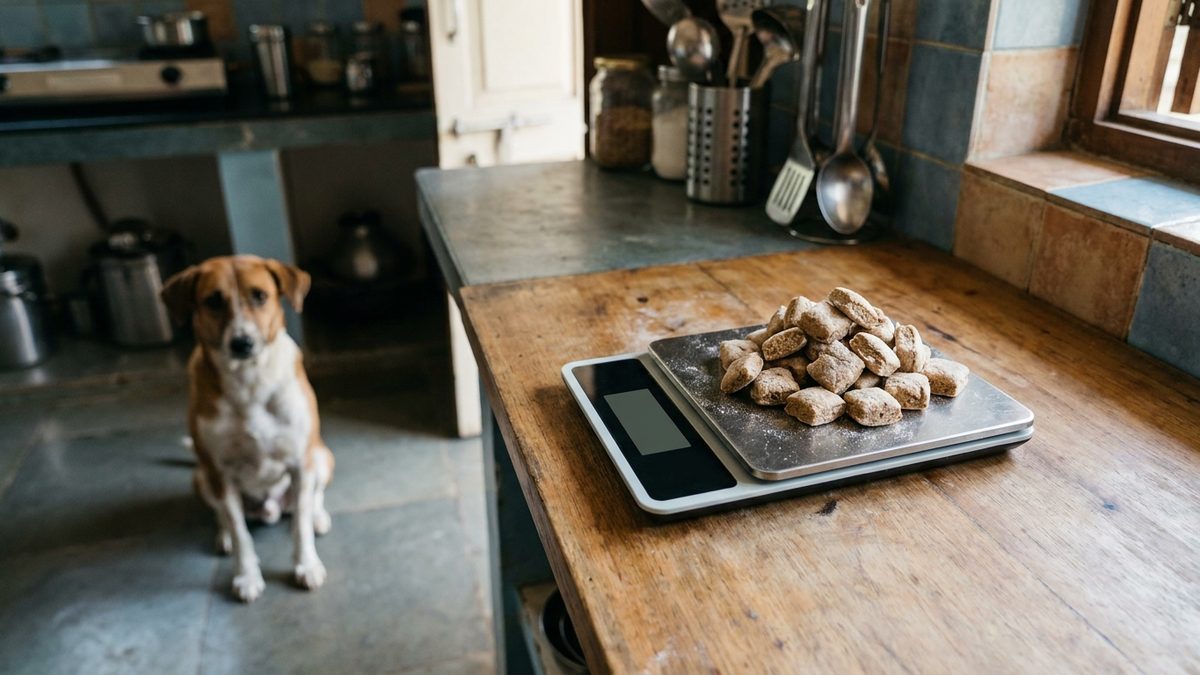
Here is the whole method on one batch. One hundred grams of atta is 320 kcal, one 50 g hen egg is 67 kcal, and a teaspoon of oil at 5 g is about 45 kcal, which makes the batch 433 kcal. Cut into 30 pieces, each piece is 14.4 kcal. A 5 kg dog can have about two of those in a day and nothing else; a 10 kg dog can have three or four. Cut the same batch into 12 large biscuits and each one is 36 kcal, which is a 5 kg dog's entire day of treats in a single biscuit.
A baked piece is at least as energy-dense as the flour it was made from. Atta measures 3.20 kcal per gram at 11.1 percent moisture, and baking takes the moisture lower rather than higher, so a crisp biscuit sits somewhere above 3.2 kcal per gram. This is why you weigh the dough's ingredients instead of weighing the finished biscuit and hoping.
What IFCT 2017 does not analyse
Three of the ingredients Indian treat recipes lean on hardest are not in the table at all, and that is worth saying plainly rather than quoting a number that came from somewhere else. IFCT's milk and milk products group holds exactly four entries, which are buffalo milk, cow milk, paneer and khoa. Curd is not among them, so no Indian measured figure for dahi comes out of IFCT. Besan is not listed either; the table carries Bengal gram as whole grain and as dal, and besan is milled from the dal, which is why the row above names the pulse rather than the flour. Coconut and the common vegetables are in the table, and our guides to coconut for dogs and vegetables for dogs already work their portions out, so we link rather than repeat them.
Where a page quotes a precise Indian figure for curd, check where it came from. Our guide to curd, paneer and ghee for dogs sets out what is actually known about an Indian pot of dahi and how much of it a dog can have.
The training treat, which is the half of this nobody writes
To pay for a training session without wrecking the day's budget, cut the piece far smaller and make it tastier, because the one published experiment that varied both found that piece size did not change how hard a dog worked and food quality did.
Riemer and colleagues trained pet dogs to run a 20 metre runway for food, then changed the reward. In the first study they varied quantity, one piece of dry food against five. In the second they varied quality, one piece of sausage against one piece of dry food. There was no significant effect of food quantity on running speed at any stage, and dogs ran significantly faster for the higher quality food, which the authors read as greater reinforcer effectiveness of the preferred food type.
The detail that makes this useful is that the dogs did prefer the bigger pile when simply offered a choice. In the preference test they spent 9.67 plus or minus 2.56 seconds investigating five pieces against 4.83 plus or minus 1.6 seconds for one piece, a significant preference on a paired t-test with t equal to 3.674 and p equal to 0.006 in nine dogs. They wanted more and they did not work harder for it. Preference and motivation came apart, and the authors' conclusion is that higher quality rewards entail greater incentive motivation than a greater quantity of a lower value reward.
For an owner with a jar of homemade biscuits, that is the whole design brief. Halving the piece costs you nothing you can measure. Swapping to something bland to save calories costs you a great deal. So the right homemade training treat is the smallest piece of the smelliest thing you are willing to make.
| Reward | Piece size | kcal per piece | 30 rewards | Against a 5 kg dog's 28 kcal day | Against a 10 kg dog's 47 kcal day |
|---|---|---|---|---|---|
| Baked atta biscuit | 3 g, a small cube | 9.6 | 288 kcal | over ten times the allowance | over six times |
| Baked atta biscuit | 1 g, a pea | 3.2 | 96 kcal | three and a half times | twice |
| Baked atta biscuit | 0.5 g, a crumb | 1.6 | 48 kcal | over one and a half times | just over the whole allowance |
| Paneer | 1 g | 3.1 | 92 kcal | over three times | nearly twice |
| Goat liver, dried and broken | 1 g | 1.26 | 38 kcal | one and a third times | 80 percent of it |
| Goat liver, dried and broken | 0.5 g | 0.63 | 19 kcal | 67 percent of it | 40 percent of it |
How small is small
Read down that table and one line answers the question. A thirty repetition session is affordable for a 10 kg dog only at half a gram of liver, or at a crumb of biscuit if nothing else is given all day. A three gram cube of baked biscuit, which is what most people actually pinch off, costs a 5 kg dog ten days of treats in twenty minutes.
Half a gram is smaller than it sounds and larger than it looks. It is roughly a grain of cooked rice in volume for a dried meat, or a quarter of a pea for a baked biscuit. The practical way to hit it is to make the treat in a form that breaks small rather than to cut thirty pieces with a knife, which is why dried liver and crumbled paneer beat a cutter-shaped biscuit for training.
Two honest limits. Nobody has measured whether a soft treat trains better than a hard one, so the common advice to use soft, quick-to-eat rewards is a practical observation about not interrupting the session rather than a finding; we are flagging it as such instead of dressing it up. And the Riemer runway measured motivation, not learning, so it does not tell you that a bigger reward never helps anything.
For the training method itself, including session length, markers and when to fade the food, see our guide to puppy training basics in India, which sets out the reward-based sequence the veterinary behaviour bodies recommend. Where the treats are going into a puzzle or a scatter rather than a session, our guide to dog boredom and enrichment in India covers what the enrichment trials actually found, and every gram still comes out of the same allowance.
Liver, the classic Indian training treat, and the one number worth knowing
Liver is the highest value training reward an Indian butcher sells and the one ingredient on this page with a hard ceiling attached, because goat liver carries 15,655 plus or minus 972 micrograms of retinol per 100 grams, which is four and a half times what chicken liver carries.
Those figures are measured, not estimated. IFCT 2017 puts goat liver at 15,655 plus or minus 972 micrograms of retinol per 100 g across six regions, and chicken liver at 3,486 micrograms from a single region. The two are not interchangeable, which matters in India because kaleji at the butcher is usually goat and the cheap tray at the supermarket is usually chicken.
Set that against what a dog needs. The National Research Council's daily recommended allowance of vitamin A for an adult dog weighing 33 pounds and eating 1,000 Calories a day is 379 micrograms. Two point four grams of goat liver supplies all of it. Ten point nine grams of chicken liver does the same. A single training session paid in liver covers a dog's vitamin A requirement several times over, which is the real reason this ingredient needs a number rather than a vague warning about moderation.
Where the authorities disagree, by a factor of eight
The safe upper limit is genuinely unsettled, and we are publishing the disagreement rather than picking the figure that reads better. On the same question, for the same species, the National Research Council recommends a safe upper limit of 12,500 IU of vitamin A per 1,000 kcal for growing dogs, the American Association of Feed Control Officials recommends 71,429 IU, and FEDIAF sets 100,000 IU. FEDIAF's own 2025 table confirms the top of that range, listing a nutritional maximum of 100,000 IU per 1,000 kcal of metabolisable energy against an adult minimum of 1,515 to 1,754 IU.
The study behind the high end is the largest controlled one there is. Forty-nine puppies of two breeds, Labrador Retriever and Miniature Schnauzer, were fed four concentrations of vitamin A from weaning at 8 weeks to 12 months of age, up to 100,000 IU per 1,000 kcal, with blood and urine sampled nine times and bone assessed by dual-energy X-ray absorptiometry. There was no effect of vitamin A concentration on any parameter except serum retinyl esters, and no effect of dose on adverse events. FEDIAF adds that its maximum is about 45 percent of a no-adverse-effect intake established over one year, and that one earlier study reported an intake of at least three times the FEDIAF maximum as safe in adult dogs fed for ten months.
There is a mechanism behind the dog's tolerance, and it is the reason human intuition misleads here. Dogs, unlike humans and rodents, carry vitamin A in the plasma mainly as retinyl esters in both adequate and deprived states, store the excess in liver stellate cells and the kidneys, and excrete vitamin A in the urine as both retinol and retinyl esters. In people, plasma retinyl esters show up only in intoxication or straight after a vitamin A rich meal. A dog is not a small person with a liver habit.
| Dog | Goat liver at the NRC limit of 12,500 IU per 1,000 kcal | Goat liver at the FEDIAF maximum of 100,000 IU | Chicken liver at the NRC limit | Chicken liver at the FEDIAF maximum |
|---|---|---|---|---|
| 5 kg, 280 kcal a day | 6.7 g | 53.7 g | 30.1 g | 241 g |
| 10 kg, 470 kcal a day | 11.3 g | 90.1 g | 50.6 g | 404 g |
| 30 kg, 1,080 kcal a day | 25.9 g | 207 g | 116 g | 929 g |
One figure from that table deserves stating on its own, because it does not depend on the size of the dog. Goat liver carries about 415 IU of vitamin A in every kilocalorie. If you spent a dog's entire 10 percent treat allowance on goat liver, you would deliver 41.5 percent of FEDIAF's whole-day nutritional maximum, or 332 percent of the NRC's, whatever the dog weighs, before the main food contributes anything at all. Chicken liver at the same allowance delivers 9.4 percent of the FEDIAF figure and 75 percent of the NRC's.
Keep goat liver to a few grams a day rather than a few dozen, and treat chicken liver as the everyday one. The disagreement above is not a reason to relax: the lowest published ceiling is the one a cautious owner works to, and no controlled study has fed a dog goat liver specifically. Vitamin A accumulates, so the question is what you do every week, not what happened once. Talk to your own veterinary surgeon before feeding liver daily, and especially if your dog is also on a supplement or a liver-based commercial treat.
The pages ranking for this question in India give numbers with nothing behind them. One American veterinary hospital's blog tells owners to limit beef liver to about one ounce per week for small dogs, two ounces for medium and three for large, with no source, no species of liver beyond beef, and no reference to how much the dog eats in a day. A flat weekly ounce says the same thing to a 3 kg dog and a 14 kg one, which is exactly the mistake a per-calorie figure avoids.
Liver is cheap, which is part of why it is the default Indian training treat. A 450 g tray of chicken liver was Rs 82 on BigBasket on 22 October 2026, which is ₹18.22 per 100 g. Thirty one-gram training pieces therefore cost about five and a half rupees, and a session is cheaper than a single shop-bought treat stick.
What never goes in a homemade treat
Leave eight things out of any batch, each for a different reason, and follow the link where you want the toxicology rather than the rule.
WSAVA's own list of toxic ingredients for dog treats names chocolate, macadamia nuts, onions, leeks, shallots, garlic and chives, grapes, raisins, currants and sultanas, xylitol, alcohol and raw yeast dough, and caffeinated drinks including coffee, tea and energy drinks. Two of those are specific to baking and are easy to get wrong at home.
- Raw yeast dough. WSAVA lists it as toxic alongside alcohol. A dog that steals proving dough is a different emergency from a dog that eats a baked biscuit, so keep dough off the counter while it rises.
- Chocolate, cocoa and anything containing them. Never in a dog biscuit, in any quantity. The dose-by-weight treatment is on our guide to chocolate toxicity in dogs.
- Xylitol and sugar-free sweeteners, which hide in peanut butter and in sugar-free baking mixes. See xylitol and sugar-free products.
- Grapes, raisins, kishmish and currants, which Indian baking reaches for by habit. See grapes and raisins toxicity.
- Onion, garlic, ginger-garlic paste and any masala that contains them. See onion and garlic toxicity.
- Salt, chilli and tadka. A treat needs none of them, and the dog cannot taste the difference the way you can. See spices, salt and masala for pets.
- Cooked bone of any kind, including a bone baked into a biscuit for shape or flavour. See bones for dogs.
- Added sugar, gur and honey. These add energy and nothing a dog needs, and they make the ten percent arithmetic worse for no benefit. Our guide to Diwali sweets and your dog answers the jaggery question directly, and why biscuits are not dog food prices what added sugar costs.
For anything not on this list, and for what to do in the first hour after a dog eats something it should not have, our guide to foods toxic to dogs in India is the page that owns it. This one is a baking page and does not restate toxicology.
Storage in an Indian kitchen, and where the aflatoxin risk actually sits
Store a homemade treat against humidity rather than against a date on a calendar, because the mould that spoils a grain-based treat has an optimum of 25 to 35 degrees at high water activity, which describes a Mumbai or Chennai kitchen through most of the year.
A home-baked treat has no preservative, no hermetic pack and no shelf-life test. What decides whether it spoils is water activity, which is the water available to microbes rather than the total water in the food. Reviewing the storage literature, Mannaa and Kim report that optimal growth of Aspergillus flavus occurs at 30 to 35 degrees and 0.99 water activity, while the optimum conditions for aflatoxin production are 25 to 30 degrees at 0.99 and 30 to 35 degrees at 0.95, with conditions becoming non-conducive below about 0.93. An Indian monsoon kitchen sits inside that window for months at a time, and a soft treat sits higher up the water-activity scale than a crisp one.
The aflatoxin risk is in the ingredient, not in your jar
This is the part the storage advice on the ranking pages gets backwards, and it is worth being careful about. There is no published measurement of aflatoxin in home-baked dog treats anywhere that we could find, so nobody can tell you how much a week-old biscuit in a humid cupboard carries. What has been measured, repeatedly and in India, is the raw commodity that goes into it.
The best household-level study sampled 595 staple food samples from 160 households in nine villages across four districts, Maharajganj in Uttar Pradesh, Munger in Bihar, Kandhamal in Odisha and Mahabubnagar in Telangana. Between 30 and 80 percent of households yielded at least one contaminated sample, 18 percent of all samples exceeded India's regulated limit of 15 micrograms per kg, and 9 percent of households had a sample above it, with the worst reaching concentrations approaching 3,000 micrograms per kg. Groundnut had the highest detection rate and maize the highest mean contamination.
An earlier Indian Council of Medical Research multicentre study analysed 2,062 groundnut samples from rural and urban areas of 11 states. Twenty-one percent exceeded the then permissible Indian regulatory limit of 30 micrograms per kg, 37.4 percent exceeded 15 and 44.9 percent exceeded 5. The maximum recorded was 833 micrograms per kg, in Gujarat, and there was no statistically significant difference between pooled rural contamination at 22.9 percent and urban at 19.9 percent. Buying from a shop in a city does not get you out of this.
India's own limits are the yardstick those figures are measured against. FSSAI sets total aflatoxins at 15 micrograms per kg for cereals and cereal products, nuts, oilseeds and pulses, 30 for spices and spice mixes, and 20 for a food product containing any of those articles, with aflatoxin B1 capped at 10. A biscuit of atta, besan and groundnut is exactly "a food product containing any of the above mentioned food articles". That regulation governs human food made for sale rather than your kitchen, so treat it as the standard a batch would be judged by if anyone ever judged it, not as a rule you are breaking.
One practical finding comes out of the same Indian literature and is worth more than any container. Reviewing the control measures, Vasanthi and Bhat report that methods involving the segregation of contaminated or mouldy grains by hand picking and density segregation resulted in a reduction of 70 to 90 percent of the aflatoxin and fumonisin present in the grains. Sorting the discoloured, shrivelled and mouldy groundnuts out before you grind them removes most of the problem, and it costs nothing.
Visible mould on one biscuit means the batch has been held in conditions that suit mould, and the toxins a mould produces diffuse beyond the visible colony. Throw the whole container out, wash and dry it, and start again. The same applies to the flour and the groundnuts in your kitchen: a musty smell is a reason to discard, not to toast and carry on.
- Bake it drier than feels right. A crisp biscuit holds less available water than a soft one, which moves it down the water-activity scale and away from the range where mould grows well.
- Cool completely before the jar goes on. Warm treats in a sealed container condense, and the condensation lands on the biscuits.
- Refrigerate anything containing meat, liver, egg, curd or paneer, and freeze what you are not using this week. A freezer sits far below the growth range in the review above.
- Make small batches. A week of treats for one dog is a handful. A month's batch in an Indian August is an experiment in mycology.
- Smell the jar before every session, and look at a piece in daylight. Musty, soft when it should be crisp, or spotted means the batch goes.
For the wider damp-season picture, including what humidity does to an opened bag of commercial food, see our guide to monsoon care for dogs in India.
Four methods, given as techniques rather than as recipes
Use four techniques rather than four recipes, because a technique survives whatever is actually in the house and a recipe sends you to the shop. Each one below is described by what it does to energy density, piece size and storage, which are the three things that decide whether a treat works.
- Dry a single ingredient. Slice chicken liver, chicken breast or paneer thin, lay it on a rack, and hold it in the oven at its lowest setting until it is brittle rather than leathery. One ingredient means you know exactly what is in it, drying drops the water activity to the safest end of the range in the review above, and a brittle sheet snaps into crumbs that are naturally training-sized. Liver dried this way is the single most useful treat on this page.
- Freeze a wet one. Spoon curd, mashed pumpkin or grated carrot into an ice tray and freeze. Nothing needs baking, the energy density stays low at 0.23 to 0.33 kcal per gram for the vegetables, and the storage problem disappears entirely because the freezer sits far below the temperature range where the moulds grow. These are hot-weather treats rather than training rewards, because a frozen cube takes a dog several minutes to finish.
- Bake a counted batch. Mix a flour with an egg and the smallest amount of fat the dough tolerates, roll it thin, score it into very small squares before baking rather than cutting shapes after, and write the batch's total calories and the number of pieces on a label taped to the jar. Scoring before baking is what gets you to half-gram pieces; a cutter does not.
- Break a crumb at the moment. For a short session, tear up a piece of plain boiled chicken or a cube of paneer as you go. Nothing is stored, nothing is baked, nothing can go mouldy, and the only arithmetic is the weight of what you started with. This is the method to use in the monsoon, when anything you bake is competing with the humidity.
What you cannot know without a lab
Three things about your own batch are genuinely unknowable at home, and any page that implies otherwise is guessing. You cannot measure the water activity of your biscuit, so you cannot say how long it will keep, only that drier keeps longer. You cannot know whether the flour or the groundnut you used carries aflatoxin, because the Indian survey figures above are population rates and not a test of your packet. And you cannot know the energy of a finished biscuit by weighing it, because the water it lost is unknown; you can only know the energy of what went in, which is why this page keeps telling you to weigh the batch.
The entire method on this page collapses to one habit. When the batch comes out, tape a label to the container with two numbers on it: the total calories that went in, and the number of pieces. Everyone in the house can then work out what a treat costs, and the ten percent rule becomes something you can actually follow instead of something you have read.
A treat is not a meal, and nothing on this page is a diet
Treat nothing in this guide as nutrition. WSAVA is explicit that treats should never replace a meal and that every dog needs a complete and balanced diet, and no recipe built from one or two kitchen ingredients can be complete or balanced by accident.
This matters because the two questions get mixed up constantly. A homemade meal has to meet a published nutrient profile across dozens of nutrients, and the published evidence is that most home recipes do not. That is a separate problem with a separate page: our guide to homemade dog food in India sets out the minimums a home-cooked diet has to meet and what the Indian kitchen bowl actually delivers against them, and our guide to balancing a home-cooked diet covers the calcium question that sinks most of them.
A treat has the opposite job. It is deliberately incomplete, it is there to pay for behaviour or to carry a tablet, and it is capped precisely so that its incompleteness cannot matter. Ten percent of the day cannot unbalance a diet. Thirty percent can, which is what happens the moment you stop counting.
How much food the dog should get in the first place is also a different question. See our dog diet chart for India for adults and our puppy feeding chart for growing dogs, and subtract the treats from those numbers rather than adding them on top.
Some dogs need the allowance cut further or dropped entirely, and that is a veterinary decision rather than a reading of this page. A dog being managed for weight carries a tighter budget than the 10 percent ceiling, and our condition page on obesity in dogs and cats covers how that is set. A dog with a history of pancreatitis has a fat ceiling that rules out several of the ingredients above, and our page on pancreatitis in dogs explains why. Ask your own veterinary surgeon before changing anything for a dog with a diagnosis.
What this page can prove, and what it cannot
Separate the measured from the inferred, because a page about homemade food is exactly where unsourced confidence does damage.
Proven, with the source in the list below.
- Treats must stay under 10 percent of a dog's daily calories and must never replace a meal, which is 28 to 35 kcal a day at 5 kg and 47 to 59 kcal at 10 kg.
- Atta measures 320 kcal per 100 g, Bengal gram dal 329, ragi 321, jowar 334, bajra 348 and paneer 305, all measured across six regions of India.
- Reward quantity did not change running speed in a 20 metre runway task, and reward quality did.
- Goat liver carries 15,655 micrograms of retinol per 100 g against chicken liver's 3,486, and 2.4 g of goat liver supplies an adult dog's whole daily recommended allowance of 379 micrograms.
- NRC, AAFCO and FEDIAF put the safe upper limit for vitamin A at 12,500, 71,429 and 100,000 IU per 1,000 kcal respectively, and 49 puppies fed to the top of that range for a year showed no adverse effect.
- Eighteen percent of 595 Indian household staple samples exceeded India's 15 microgram per kg aflatoxin limit, and hand picking mouldy grain removes 70 to 90 percent of the toxin present.
Not proven, and stated here as unknown rather than quietly left out.
- No study has measured aflatoxin in home-baked dog treats, in India or anywhere else. The commodity surveys above describe the ingredients, not your jar.
- No study has fed goat liver to dogs at a measured dose, so the liver arithmetic on this page is composition data applied to a published ceiling rather than a feeding trial.
- No study has compared soft against hard training treats for training outcome, so the universal advice to use soft rewards rests on practical experience.
- IFCT 2017 does not analyse curd or besan as such, so any precise Indian figure you see for either came from somewhere other than India's own food composition tables.
- The chicken liver retinol figure comes from a single region, while the goat liver figure is a six-region mean with a stated error, so the two carry different weight.
Where the authorities disagreed, on the safe upper limit for vitamin A, we printed all three figures and the study behind the highest one rather than averaging them into a number nobody published.
Common questions
What is the best homemade treat for dogs?
The best homemade treat is a single ingredient, dried hard and broken small. Dried liver or dried chicken breast gives you the highest value per gram with the lowest energy per piece, no flour, no added fat and the longest safe life in a humid kitchen. There is no best recipe, because a treat is judged by its energy density and its piece size rather than by its ingredient list.
What are the best treats for dogs when training?
The best training treat is the smallest piece of the highest value food you are willing to prepare. In a runway experiment that varied both, dogs ran significantly faster for sausage than for dry food, while one piece against five made no significant difference to how hard they worked. Cutting the piece smaller is therefore free, and making it blander is not. Half a gram of dried liver is a realistic target.
What are some good treats for dogs in India?
Good Indian options are dried chicken liver, dried chicken breast, plain paneer broken into crumbs, boiled egg, and frozen cubes of pumpkin or carrot for hot afternoons. Paneer runs at 305 kcal per 100 g and pumpkin at 23, so pick by what job the treat is doing. Keep everything inside the ten percent ceiling and leave out salt, masala, onion, garlic and sugar.
How to make homemade dog treats with 3 ingredients?
Use a flour, a binder and a flavour, in that order. One hundred grams of atta, one hen egg and two tablespoons of mashed pumpkin makes a stiff dough that rolls thin. Score it into very small squares before baking rather than cutting shapes afterwards, bake until crisp rather than soft, and write the batch's total calories and the piece count on the jar. That batch is roughly 400 kcal, so thirty pieces are about 13 kcal each.
Can I give liver to my dog daily?
Only in very small amounts, and chicken liver is the safer daily choice. Goat liver carries 15,655 micrograms of retinol per 100 g, so 2.4 grams covers an adult dog's whole daily recommended allowance of vitamin A. A few grams a day is a reasonable ceiling for goat liver and the bigger tray of chicken liver gives you more room. Ask your own veterinary surgeon before making liver a daily habit, particularly if your dog also takes a supplement.
Is liver harmful to dogs?
Liver is not harmful in the quantities a treat involves, and the ceiling is disputed. The National Research Council sets a safe upper limit of 12,500 IU of vitamin A per 1,000 kcal, AAFCO sets 71,429 and FEDIAF sets 100,000, an eightfold spread on the same question. Forty-nine puppies fed to the top of that range from weaning to one year showed no adverse effect on any measure. Work to the lowest figure anyway, because vitamin A accumulates.
How to keep homemade dog treats from molding?
Bake them drier, cool them completely before sealing, and refrigerate or freeze anything containing meat, egg, curd or paneer. Aspergillus flavus grows best at 30 to 35 degrees and high water activity and becomes much less active below about 0.93, so a crisp biscuit in a dry jar is safer than a soft one. Make a week's worth rather than a month's, and throw out the whole container at the first sign of mould rather than cutting the affected piece away.
How long do homemade dog treats stay fresh?
Nobody can give you an honest number, because freshness depends on the water activity of your particular batch and no home kitchen can measure it. A hard-baked flour biscuit in a sealed jar in an air-conditioned room lasts far longer than a soft one in a Chennai kitchen in July. Treat anything containing meat, egg or dairy as refrigerator food, freeze what you will not use this week, and judge each batch by smell and texture rather than by a date.