
Dog health guide
Foods toxic to dogs: how to work out the dose, and why making your dog vomit is the decision most pages get wrong
Five published sources give five different hydrogen peroxide doses for the same dog, and the bottle an Indian chemist sells is twice the strength all of them assume. This is the page about the hour after, not the list of foods.
Quick answer
Foods toxic to dogs are dangerous by dose, not by name. Work out four things before anything else: your dog's weight, how much went in, how concentrated the agent was, and how long ago. Telephone a veterinary surgeon with those four numbers. Do not induce vomiting unless a vet tells you to, because the published hydrogen peroxide doses disagree with each other and the Indian bottle is twice the strength they assume.
This guide is general information for Indian pet owners and is not a diagnosis. Always consult a registered veterinarian near you before acting on anything you read here, and treat any sudden change in your pet's condition as urgent.
The four numbers that decide what happens next
Four numbers decide what happens next, and they are your dog's body weight, how much went in, how concentrated the agent was in what went in, and how long ago it happened. Every other question a clinic asks is downstream of those four.
Foods toxic to dogs are dangerous by dose, not by name. The same grape that is a telephone call for a Great Dane is a drive to the clinic for a 3 kg Indian Spitz puppy, and the difference is arithmetic rather than opinion. Veterinary toxicology is written almost entirely in milligrams or grams per kilogram of body weight, which is why the first question on every call is the dog's weight and why a guess costs you accuracy at the only moment it matters.
Get the four numbers before you telephone anyone. Writing them on your hand takes ninety seconds and converts a panicked description into something a clinician can act on.
| Number | Why it decides the outcome | How to get it, right now |
|---|---|---|
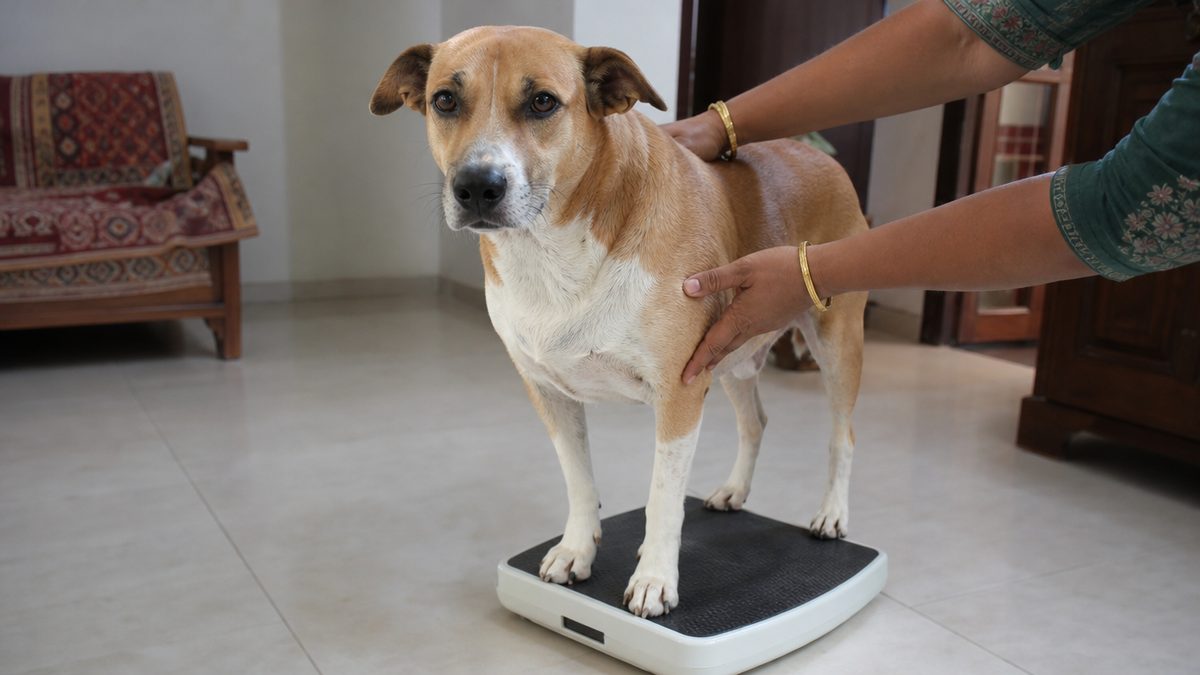
| Body weight in kilograms | Every published toxic threshold and every treatment dose is per kilogram. Halving the weight doubles the dose per kilogram from the same mouthful | Weigh the dog if you own a scale. Otherwise weigh yourself, pick the dog up, weigh again, subtract. Do not use the puppy's weight from last year |
| Quantity actually swallowed | This is the numerator. It is also the number owners get most wrong, because the honest answer is usually a range rather than a figure | Find the pack size printed on the label, count or weigh what is left, subtract, and report the worst case rather than the likely one |
| Concentration of the agent in what was eaten | A percentage on a label is a multiplier most owners skip entirely. The same mass of two products can carry a fourfold difference in agent | Read the label and keep it. If there is no label, say so plainly rather than estimating |
| Time since ingestion | It decides whether decontamination is still worth attempting, and for several agents it decides nothing at all | Give a clock time, not a feeling. Work backwards from the last moment you know the dog was fine |
Why milligrams per kilogram, and not spoons
A per-kilogram threshold exists because a dog's body dilutes what it swallows in proportion to its size. Cornell's canine health centre asks a caller for the product's brand name and ingredient list, the amount eaten, when it was eaten, and the dog's approximate weight, which is the same four numbers in the order a clinician uses them. India's dog population makes this sharper than it is elsewhere, because the gap between a 3 kg pug and a 35 kg Rajapalayam in the same housing society is more than tenfold, and one leftover plate reaches both.
If the pack held twelve pieces and you can find eight, report four eaten, not two. A clinic can always step down from a worst case once the dog is in front of it. It cannot step up from a number you rounded down to feel better.
How to work out the dose, with the arithmetic shown
To work out the dose, divide the amount of the agent that went in by your dog's weight in kilograms, then compare the result against the published threshold for that specific agent. Three of those four quantities you can establish yourself in the kitchen.
The sum has four steps and you can do all of them on a phone's calculator. Most Indian pages on this query never show it, which is why their readers arrive at a clinic saying that the dog ate some.
- Establish the quantity of product swallowed, in grams or millilitres, by subtracting what is left from what the pack held.
- Multiply that quantity by the agent's concentration, read off the label as a percentage or a milligrams-per-gram figure.
- Divide the result by your dog's body weight in kilograms, which gives the dose per kilogram.
- Compare that dose per kilogram against the published threshold for that agent, which lives on the page that covers it.
Worked example one: turning some into a number
A 200 g pack is open on the counter and 130 g of it is still in the pack. Subtract and 70 g went somewhere, so report 70 g, not a handful. For a 7 kg dog that is 10 g of product per kilogram of dog. For a 28 kg dog the same 70 g is 2.5 g per kilogram, a quarter of the exposure from an identical accident. Nothing about the food changed; only the denominator did.
Weigh the leftovers on a kitchen scale rather than estimating, and if you have no scale, count units instead. Four barfi pieces out of twelve is a far better input than a hand gesture, because the clinic can convert pieces into grams and cannot convert a gesture into anything.
Worked example two: the concentration step everybody skips
Concentration is the multiplier that turns a quantity of product into a quantity of agent, and leaving it out is how an owner reports a frightening number for a harmless exposure or a reassuring one for a dangerous exposure. Take the same 70 g from above. At 5 percent agent by weight, 70 g of product carries 3.5 g of the agent. At 20 percent, the identical 70 g carries 14 g. One accident, one weight, four times the dose, decided entirely by a line on the label you did not read.
This is not a hypothetical. It is exactly the trap in the hydrogen peroxide advice circulating on Indian search results, set out further down this page, where the strength of the bottle sold here is twice the strength that every published dose assumes.
When you genuinely cannot know the numerator
Say so, and give the maximum. An unwitnessed exposure is common and it is not a failure: you walked in, the pack is chewed open, and you have no idea how long the dog had. The correct report is the whole pack and the earliest possible time, because those are the only defensible worst cases. A clinician who is told the maximum can decontaminate and then stand down. A clinician who is told a reassuring guess cannot un-decide.
Body weight is the one number you can always nail, and it is the number that scales everything else. A clinic asked for a dose per kilogram of activated charcoal works from 1 to 2 g/kg by mouth, repeatable at 4 to 6 hour intervals, so a 20 kg dog is a 20 to 40 g dose and a 5 kg dog is 5 to 10 g. That ratio runs through every drug, every antidote and every threshold in the subject.
When minutes matter, and when they do not
Minutes matter when decontamination is still possible, which is a window measured from the swallow rather than from the first symptom, and they stop mattering once the agent has been absorbed. The window is agent-specific and the published guidance does not converge on one figure.
Three professional sources give three different answers about time since ingestion, and the honest reading is that they are describing different agents rather than contradicting each other. The Merck Veterinary Manual states that emesis is generally of value in dogs, cats and pigs if induced within a few hours of the exposure, and adds that this can vary substantially depending on the toxic agent. A step-by-step emergency protocol written by Vincent J. Thawley, VMD, DACVECC is tighter: if the toxicant was ingested less than two hours previously, the patient is asymptomatic, and there are no contraindications, induce emesis. And Today's Veterinary Practice is tighter still at one end and far looser at the other, noting that rapidly dissolving medications may be absorbed in as little as 15 to 30 minutes while emesis may still be warranted 4 to 6 hours after a sustained-release product.
Read that spread correctly. It is not a reason to delay. It means the window is short for the fastest agents and you do not know which category yours is in, so the call is urgent even where the drive might not be.
- Minutes matter most when the swallow was recent, the dog is still asymptomatic, and the agent is known to be absorbed quickly.
- Minutes matter less when hours have already passed, because the agent is in the bloodstream and emptying the stomach recovers nothing.
- Minutes matter differently when the agent is slow, because the emergency is the delayed organ damage rather than the next hour.
- Minutes never stop mattering for a physical obstruction, where the object does more damage the longer it sits.
Signs are not a clock, and the denominator proves it
Waiting for a symptom is the single most expensive mistake available on this subject, and there is a number for it. In a retrospective series of 349 dogs with confirmed anticoagulant rodenticide intoxication, clinical signs were reported in 30 percent of intoxications. Seven in ten confirmed poisonings therefore reached a clinic looking well, and the dogs that did show signs showed lethargy in 86 percent and laboured breathing in 55 percent, which is to say the signs arrived late and arrived serious.
A dog that seems fine is telling you nothing about whether it was poisoned. It is telling you only that the agent has not yet produced an effect you can see, which for several common exposures is the expected state during the exact hours when decontamination still works. Our guide to Indian food safe for dogs sets out which Indian exposures have a delay built into them.
The telephone call is urgent even when the drive is not. Deciding whether this is a phone call, a morning appointment or a 2 am drive is a clinical judgement that depends on the agent, the dose and your dog. Make the call and let someone qualified make the judgement.
Inducing vomiting at home: what the evidence actually says
Do not induce vomiting at home unless a veterinary surgeon has told you to, for that exposure, in that dog, in that hour. That is the position of the professional sources themselves, and the reasons are specific rather than defensive.
The American Red Cross, whose pet first aid material is provided by Dr. Deborah C. Mandell, BS, VMD, Professor of Emergency and Critical Care Medicine at the University of Pennsylvania's veterinary hospital, puts the instruction in capital letters: do not induce vomiting until you speak with a vet or the ASPCA's Animal Poison Control Center. The Merck Veterinary Manual permits home hydrogen peroxide narrowly, saying it can be used in dogs only and when veterinary care or prescription options are not available. Those two are the honest boundary: a vet's instruction, or a genuine absence of reachable veterinary care. Not a forum post, and not this page.
Emesis is worth attempting under those conditions because it works. A prospective study of 147 dogs run through the ASPCA Animal Poison Control Center found that apomorphine and 3 percent hydrogen peroxide successfully induced emesis in 59 of 63 dogs (94 percent) and 76 of 84 dogs (90 percent) respectively, with a mean time to vomiting of 14.5 minutes for hydrogen peroxide and 18.6 minutes for apomorphine.
The number that reframes the whole instinct
Emesis that works still leaves about half of it inside. In the same 147-dog study, mean estimates for recovery of ingested agents were 48 percent for hydrogen peroxide and 52 percent for apomorphine. A dog that vomits spectacularly on your floor has given back roughly half of what it swallowed, which means successful vomiting is a reason to keep driving to the clinic rather than a reason to cancel the trip. No page currently ranking in India for this question prints that figure.
The procedure also has a cost. Adverse effects were reported in 16 of 112 dogs for which information was available, which is 14 percent. The authors judged those effects mild and self-limiting, and that is the fair summary of their data. A separate controlled study is less comfortable. Seven healthy dogs were examined by endoscopy after emesis induction, six of them given oral 3 percent hydrogen peroxide and one given apomorphine as a control. Gastric mucosal lesions were visible in all of the hydrogen peroxide dogs at 4 hours and had worsened by 24 hours, with histopathology showing haemorrhage at 4 hours, degeneration, necrosis and oedema at 24 hours, and inflammation at one week, mostly resolving by two weeks. The apomorphine control dog had minimal gross lesions and no histopathologic lesions at any time point.
Those are healthy dogs, correctly dosed, and every one of them finished with a damaged stomach lining. Today's Veterinary Practice states the same thing in its guidance, that even at recommended doses small haemorrhages can be seen in the stomach but are usually subclinical. The point is not that hydrogen peroxide is forbidden. The point is that it is a deliberate injury accepted in exchange for recovering about half the poison, which is a trade a clinician should be making rather than a frightened owner at midnight.
Five published doses that do not agree with each other
Here is the strongest argument against improvising, and we have not seen it made anywhere. Five reputable sources publish five different hydrogen peroxide doses for a dog, two of them from the same reference work.
| Source | Published dose | What that gives a 20 kg dog | Repeat allowed |
|---|---|---|---|
| Merck Veterinary Manual, Principles of Toxicosis Treatment in Animals | 1 to 2 mL/kg, up to 45 mL | 20 to 40 mL | Not stated on that page |
| Merck Veterinary Manual, its own Emetic Drugs table | 5 to 10 mL total, no weight in the figure | 5 to 10 mL | Not stated |
| Today's Veterinary Practice, Eric Dunayer MS VMD DABT DABVT | 2.2 mL/kg, maximum 45 mL | 44 mL | One repeat after 10 to 15 minutes, only if no emesis |
| dvm360, Vincent J. Thawley VMD DACVECC | 1 to 5 mL/kg, maximum 50 mL | 20 to 50 mL | One repeat after 10 to 15 minutes |
| American Red Cross, Dr. Deborah C. Mandell BS VMD | 1 teaspoon per 10 pounds, about 1.1 mL/kg, no maximum stated | about 22 mL | Every 15 to 20 minutes, up to two further doses |
The spread for one 20 kg dog runs from 5 mL to 66 mL, a thirteenfold range, and the sources disagree on whether there is a ceiling and on how many times you may repeat. Merck's narrative page and Merck's own drug table do not match each other Merck Veterinary Manual. An owner who reads two pages and averages them has invented a sixth dose.
The exposures where emesis is contraindicated outright
Emesis is contraindicated when the substance would do more damage coming back up than it did going down, when the dog cannot protect its airway, and when too much time has passed. Merck lists four situations in which emesis should not be induced: the swallowing reflex is absent, the patient is not neurologically stable, the ingested substances are corrosive agents, volatile hydrocarbons or petroleum distillates, and the risk of aspiration pneumonia is high. ASPCApro's companion guidance adds the cases where the pet has an underlying health issue, or is already showing signs that emesis would complicate, naming seizures, arrhythmias, loss of gag reflex and depression, and the case where the pet is already vomiting.
- Corrosive agents, meaning strong acids and strong bases, including the cleaning products under an Indian kitchen sink. A caustic burns the oesophagus twice if you bring it back up.
- Petroleum distillates and volatile hydrocarbons, such as kerosene, lamp oil, paint thinner and polish, which are easily aspirated into the lungs.
- Any dog already seizing, tremoring, unsteady, unusually drowsy or unable to swallow, because the airway is not protected.
- Any brachycephalic dog, which in India overwhelmingly means the pug, the Shih Tzu and the bulldogs, because an already compromised airway raises the aspiration risk that Merck names as a contraindication in its own right. Our page on brachycephalic obstructive airway syndrome explains why those airways are different.
- Any cat, in every circumstance. Hydrogen peroxide should not be administered to cats as it can result in severe, even fatal, haemorrhagic gastritis even at recommended doses, and Merck lists hydrogen peroxide, apomorphine and ropinirole as all unsuitable in cats.
Salt or salt water, syrup of ipecac, dry mustard powder and liquid dish soap are all named as emetics that should not be used, and Merck's emetic drugs table marks sodium chloride, powdered mustard and syrup of ipecac NOT RECOMMENDED outright Merck Veterinary Manual. Salt is the dangerous one, because a dose large enough to make a dog vomit is approaching a dose large enough to poison it on its own.
Bonbeno names no emetic dose for you to use. The figures in the table above are published so you can see that the professionals disagree, not so you can pick one. Which dog, which agent, which hour and which dose is a veterinary decision, which is why this page carries the medical disclaimer.
The bottle an Indian chemist sells is not the bottle in the advice
Indian pharmacies sell hydrogen peroxide at 6 percent w/v, which is twice the 3 percent strength that every published emesis dose assumes. An owner who follows American advice with an Indian bottle gives double the dose of a substance that injures the stomach at the correct one.
We checked two Indian pharmacies on 21 October 2026. Apollo Pharmacy's Hydrogen Paroxide Solution, 450 ml, lists its composition as HYDROGEN PAROXIDE-6%W/V, manufactured by V L Pharma, at an MRP of ₹80. PharmEasy's Hydrogen Peroxide Bottle Of 450Ml Solution lists its salt content as Hydrogen Peroxide (6.0 %W/V), made by MEDIS, at an MRP of Rs 59.90. Two listings are not a survey of every chemist in the country, and we have not read the Indian Pharmacopoeia monograph itself, so the honest claim is this: both of the Indian retail bottles we could check were 6 percent, and the 3 percent bottle that American first aid advice treats as a household staple appeared in neither.
That single fact breaks every borrowed instruction on the subject. Today's Veterinary Practice is explicit that overdosage or use of solutions greater than 3 percent can result in upper gastrointestinal irritation and haemorrhage, and the controlled study found gastric lesions in every dog dosed at the correct 3 percent. A worried owner in Pune who measures out the Red Cross figure of one teaspoon per ten pounds from a 6 percent Indian bottle has given twice the intended dose of hydrogen peroxide, from a bottle costing less than a hundred rupees, to a dog that may have eaten something that did not need emesis at all.
If a page tells you to give hydrogen peroxide to a dog and does not tell you to check the percentage on the bottle, it was not written for India. Both Indian pharmacy listings we read on 21 October 2026 were 6 percent w/v, and the page ranking fourth in India for how to induce vomiting in a dog, which is a boarding and daycare business rather than a veterinary practice, publishes a dose without naming a concentration anywhere in its search listing.
The same logic applies to anything concentrated in an Indian kitchen or bathroom. Read the percentage, keep the container, and treat a strength figure as part of the dose rather than as packaging trivia.
What an Indian owner can actually reach at 2 am
India has no 24-hour animal poison helpline that we could find on 21 October 2026, so your own veterinary practice and the nearest 24-hour hospital are the whole list. The services the global literature names are American and British, and one of them states plainly that it does not cover India.
The three poison services that veterinary writing routinely cites are the ASPCA Animal Poison Control Center, the Pet Poison Helpline and the Veterinary Poisons Information Service. Pet Poison Helpline publishes both its price and its geography: there is a one-time consultation fee of 99 US dollars per incident, and the service is available throughout the U.S., Canada, and the Caribbean. India is not in that list. The ASPCA Animal Poison Control Center publishes its number and says a consultation fee may apply, without naming an amount and without any statement about callers outside the United States. Cornell's advice page, which recommends both numbers to American readers, simply notes that there are fees for the services.
India's own poison infrastructure exists and is good, and it is for people. The National Poisons Information Centre was established in the Department of Pharmacology at AIIMS, New Delhi in 1995 and answers 24 hours a day, 7 days a week, 365 days a year on 1800 116 117, and nowhere on its page does it mention animals, pets or veterinary poisoning. The CMC Poison Control Centre at Christian Medical College, Vellore, in Tamil Nadu, was established in 2019, is the 8th centre in India to be included in the World Health Organization's directory of Poison Control Centres, and describes its callers as healthcare providers like doctors, nurses or paramedics or the public, again with no mention of animals.
So the honest finding, published rather than glossed over, is that an Indian dog owner at 2 am has no national animal poison line to call. That is not a gap this page can close, but knowing it beforehand changes what you do with the ten minutes you have.
What to set up tonight, so the next 2 am is shorter
- Save your own practice's number and its after-hours number as two separate contacts, and test that the after-hours one actually rings.
- Find the nearest genuinely 24-hour veterinary hospital and save its address in your maps app, not just its number. Round-the-clock cover is realistic in Mumbai, Delhi, Bengaluru, Chennai, Hyderabad, Pune, Kolkata and Ahmedabad, and in much of the country the nearest one is a drive of an hour or more.
- Time that drive once, in advance, at night. A route you have never driven is not a plan.
- Write your dog's current weight on a note in your phone and update it every few months, because that is the number everything else divides by.
- Keep a torch and a clean container in the same drawer, for the job described in the next section.
The AIIMS National Poisons Information Centre answers questions about substances, not about dogs. It can tell a caller what is in a compound; it does not provide veterinary dosing or species-specific advice, and nothing on its page offers to. Treat it as a way to identify an unlabelled chemical while you are on your way to a vet, never as a substitute for one.
What to take to the clinic, including the one thing nobody collects
Take the packet, a sample of any vomit, a written weight and a written timeline, and leave the cleaning until afterwards. The packet and the vomit are physical evidence that survives your memory of a frightening hour.
Collect the vomit. This is the instruction that appears nowhere on the Indian pages for this query, and it is free. If your dog has already vomited, put some of it into a clean container or a sealed bag and take it with you. It tells the clinician what went in, roughly how much came back, and sometimes what the thing actually was when the packet is long gone, and it does all of that without a single test. Wash your hands afterwards, and wear gloves if the exposure was a chemical.
- The packet, box, wrapper or bottle, including the one you pulled out of the bin. The ingredient list and the strength are on it and nowhere else.
- A sample of the vomit, and a photograph of the rest of it before you clean up.
- A photograph of the chewed item and of where you found it, which answers questions about quantity that you will not remember accurately by the time you arrive.
- Your dog's weight in kilograms, written down rather than recalled.
- The timeline, written as clock times: last seen normal, found, first sign if any, left home.
What to say on the telephone is a separate skill and three of our pages already set it out item by item, closest to this one in the section on what to have ready before you telephone. Read that for the call. This section is about the car.
Two things not to do on the way. Do not clean the dog's mouth out with anything, and do not offer food or milk to settle the stomach, because both change what the clinician finds and neither helps ASPCA, Is It Ever Safe to Induce Vomiting? Blue Cross, Emergencies and first aid…. And do not chase a dog that has something in its mouth, because a dog that is chased swallows.
A triage table of the common agents, with the page that covers each
Use this table to decide only one thing, which is whether this is a telephone call, a drive now, or a watch. Every dose, every mechanism and every threshold lives on the page linked in the last column, because an accurate dose cannot be compressed into a row.
Treat the decision column as a floor and not a ceiling. Any dog that is already showing a sign, any puppy, any very small dog and any dog with existing kidney, liver, heart or pancreatic disease moves up a tier regardless of what it ate.
| What the dog ate | Decision | Where the dose and the mechanism are covered |
|---|---|---|
| Chocolate, cocoa, a chocolate mithai | Telephone now | Chocolate poisoning in dogs |
| Grapes, kishmish, raisins, sultanas | Telephone now | Grapes and raisins toxicity in dogs |
| Sugar-free sweets, chewing gum, anything with xylitol | Telephone now | Xylitol poisoning in dogs |
| Onion, garlic, a gravy or masala with an Allium base | Telephone now | Onion and garlic toxicity |
| A cooked bone, a chicken bone, a mutton bone | Drive now, do not induce vomiting | Bones for dogs in India |
| A mango stone or any large fruit pit | Drive now, do not induce vomiting | Can dogs eat mango |
| Nutmeg or a whole jaiphal eaten directly | Telephone now | Spices, salt and masala for pets |
| A real quantity of achaar, papad or a salted gravy | Telephone today | Spices, salt and masala for pets |
| Raw rajma, or pulses soaked but not cooked | Telephone today | Can dogs eat dal and pulses |
| A large fatty or deep-fried helping, a bowl of ghee | Telephone today | Pancreatitis in dogs |
| A raw egg, or several eggs at once | Telephone today | Eggs for dogs and cats |
| Milk, curd or paneer in quantity | Watch, be ready to call | Dairy for dogs |
| Plain rice, plain roti, a glucose biscuit | Watch, be ready to call | Can dogs eat rice |
| Avocado flesh, in a dog | Watch, and read the limits section below | No Bonbeno page yet; the ASPCA position is quoted below |
Two categories are missing from that table on purpose. Human medicines and household chemicals are not foods, they are the two commonest serious poisonings in a home, and both are straight to a vet with the strip or the bottle in your hand. Deliberate poisoning of a dog is a third category and a criminal matter; our guide to reporting animal cruelty in India covers what to do about it.
What the internet has inflated, and where the evidence is genuinely weak
Three things on this subject are weaker than the confident pages suggest, and saying so is part of triage, because an inflated risk sends an owner on a 2 am drive that the evidence does not support.
Avocado, which is on almost every list and should not be on the dog one
Avocado appears on the toxic food list of the page ranking first in India for this query, on the page at position 2, on the Australian state government page at position 7, and on the ASPCA page at position 5. That last one is the interesting case, because it is the source the other three are ultimately downstream of and it says something different: avocado is primarily a problem for birds, rabbits, donkeys, horses and ruminants including sheep and goats. Dogs are not in that sentence. The same page hedges carefully elsewhere, saying of coconut that when ingested in small amounts, coconut and coconut-based products are not likely to cause serious harm to your pet, and of citrus that small ingestions are not likely to present problems beyond minor stomach upset. Those hedges disappear when a list page copies the item name and drops the sentence around it. We are not telling you to feed your dog an avocado; we are telling you that finding a chewed one is a watch rather than a drive.
The reference works disagree with themselves, and that is a real limit
The hydrogen peroxide dose table above is the clearest example on this page, where two pages of the same reference work give doses that differ by a factor of four for the same dog Merck Veterinary Manual. The sensible conclusion is not that one of them is wrong. It is that an emetic dose is a clinical judgement with a range around it, which is exactly the kind of thing that survives being applied by a clinician and does not survive being applied by a reader.
There is no Indian denominator, and we are not going to invent one
We found no Indian study with a denominator describing what dogs in India are actually poisoned by. Searches on 21 October 2026 returned Canadian, Thai, Italian, Nigerian and Brazilian retrospective series and Indian single-case reports, which means every prevalence statement on an Indian page about this subject is either borrowed from a foreign dataset or unsourced. The 30 percent figure used earlier on this page is Canadian, and we have labelled it as such rather than presenting it as an Indian number. If a reader knows of an Indian teaching hospital series, we would rather publish it than keep this paragraph.
Indian kitchens store a great deal of cooked food uncovered or loosely covered, and in a humid flat during and after the monsoon that food spoils faster than the household expects. Spoiled and mouldy food is a real exposure and it is the one on this page with the least published canine data in any country, so treat a dog that has raided a bin as a telephone call and say that the food was spoiled.
What the clinic will actually do, so nothing surprises you
A clinic decontaminates if the window allows, then treats what is already absorbed and monitors for what has not yet shown. Knowing the sequence makes you a better caller and stops you pushing for the wrong thing.
Decontamination comes first and it is not one procedure. Emesis is induced with a prescription drug where that is appropriate, and apomorphine is the dog agent, working in 94 percent of the dogs in the largest prospective series. If the poison cannot be physically removed, activated charcoal can be given by mouth to prevent further absorption by the gastrointestinal tract, typically at 1 to 2 g/kg and repeated at 4 to 6 hour intervals as needed. If the animal is unconscious, the stomach may be flushed with a stomach tube, or surgery on the stomach may be needed. Where the exposure was on the skin rather than swallowed, thorough washing with soap and water can usually prevent further absorption, and a long or dense coat may need to be clipped.
A clinic also has choices an owner does not. Ropinirole and apomorphine are both veterinary options with their own cautions, ropinirole being unsuitable in a pet with underlying ocular disease and apomorphine's own central nervous system depression being a problem when the swallowed agent causes depression too. ASPCApro notes the practical trade-off honestly: hydrogen peroxide can be given by owners at home quickly and is readily available, while apomorphine has to be done at a vet hospital, and the delay can be too long for emesis to be effective.
One breed-level question is worth raising yourself. Our page on MDR1 drug sensitivity records apomorphine among the drugs that need a pharmacologist's recommendation in a dog carrying the MDR1 mutation, so if your dog is a collie, an Australian shepherd, a shepherd cross or any herding breed, say so when emesis is being discussed. It is the kind of thing a busy emergency room is glad to be told and will not think to ask an Indian owner.
Ask these four things before you hang up
- Ask whether to come in now or whether this is genuinely a watch, and ask what specifically would change that answer.
- Ask which signs would make you leave immediately, named rather than described as anything unusual.
- Ask how long the watch runs, in hours, because several agents have a delay built into them.
- Ask whether to bring anything beyond the packet and the vomit sample, such as a stool sample or previous blood results.
The last thing to understand about the whole sequence is that it is proportionate. Most exposures in an Indian home end with a telephone call, a shortened dinner and nothing else. A small number do not, and the only way to tell them apart is the dose arithmetic at the top of this page followed by a conversation with someone who can act on it.
Common questions
What should I do if my dog ate something toxic?
Establish four numbers first: your dog's current weight in kilograms, how much went in, the concentration printed on the label, and the clock time it happened. Then telephone a veterinary surgeon and give all four. Keep the packet, collect a sample of any vomit, and do not induce vomiting unless the vet tells you to for that specific exposure.
How do you flush poison out of a dog's system?
You do not flush it; a clinic decontaminates it, which is a different thing. Emesis recovers a mean of 48 to 52 percent of what was swallowed and only inside a short window. After that, activated charcoal at 1 to 2 g/kg can reduce further absorption from the gut, and gastric lavage or surgery is used in an unconscious animal. Nothing you can give at home flushes an absorbed poison out.
Will milk help a poisoned dog?
No. Milk is not an antidote, it binds nothing, and it appears in none of the veterinary toxicology references read for this page as a treatment for poisoning. Its only documented role is as a vehicle, where a few drops of milk or ice cream are mixed with an emetic to make a dog swallow it voluntarily. Giving milk or food also changes what the clinician finds, so leave the bowl alone and make the call.
Should I call poison control for my dog?
Call your own veterinary surgeon, because India has no animal poison control line. The Pet Poison Helpline charges 99 US dollars per incident and states that it covers the United States, Canada and the Caribbean only. The AIIMS National Poisons Information Centre in New Delhi answers free on 1800 116 117, 24 hours a day, but it is a human service and mentions animals nowhere.
How quickly will a dog show signs of toxicity?
It depends entirely on the agent, and many poisoned dogs show nothing at all for hours. In a series of 349 dogs with confirmed anticoagulant rodenticide poisoning, clinical signs were reported in only 30 percent of intoxications. Rapidly dissolving substances can be absorbed within 15 to 30 minutes while sustained-release ones are still recoverable after 4 to 6 hours, so time the exposure from the swallow and never from the first symptom.
What are the first signs of a poisoned dog?
There is no single set, because the first signs are agent-specific and often absent. The sign list a first-aid authority gives runs to bleeding, dilated pupils, drooling or foaming, seizures, trembling, drowsiness, collapse, mouth ulcers or burned lips, vomiting and diarrhoea, which is broad because the causes are. The practical rule is that an absent sign proves nothing during the hours when decontamination still works.
What's the most toxic food to dogs?
No single food holds that title, because toxicity is a dose and not a property of the food. The dangerous exposures are the ones where a household quantity delivers a high dose per kilogram to a small dog, which puts chocolate, raisins and sugar-free sweetener at the top for most Indian homes. Work out the dose per kilogram for your own dog rather than consulting a ranking.