
Dog nutrition guide
Which vegetables are good for dogs? Sixteen Indian sabzis measured, and the one you taste before you cook
Every page ranking for this query sorts broccoli, green beans, celery and kale. India's own horticulture figures say the country's five biggest vegetable crops are potato, onion, tomato, brinjal and cabbage. Nobody has measured the bag an Indian household actually carries home. We did, against the ICMR-NIN food tables, and the arithmetic goes somewhere unexpected.
Quick answer
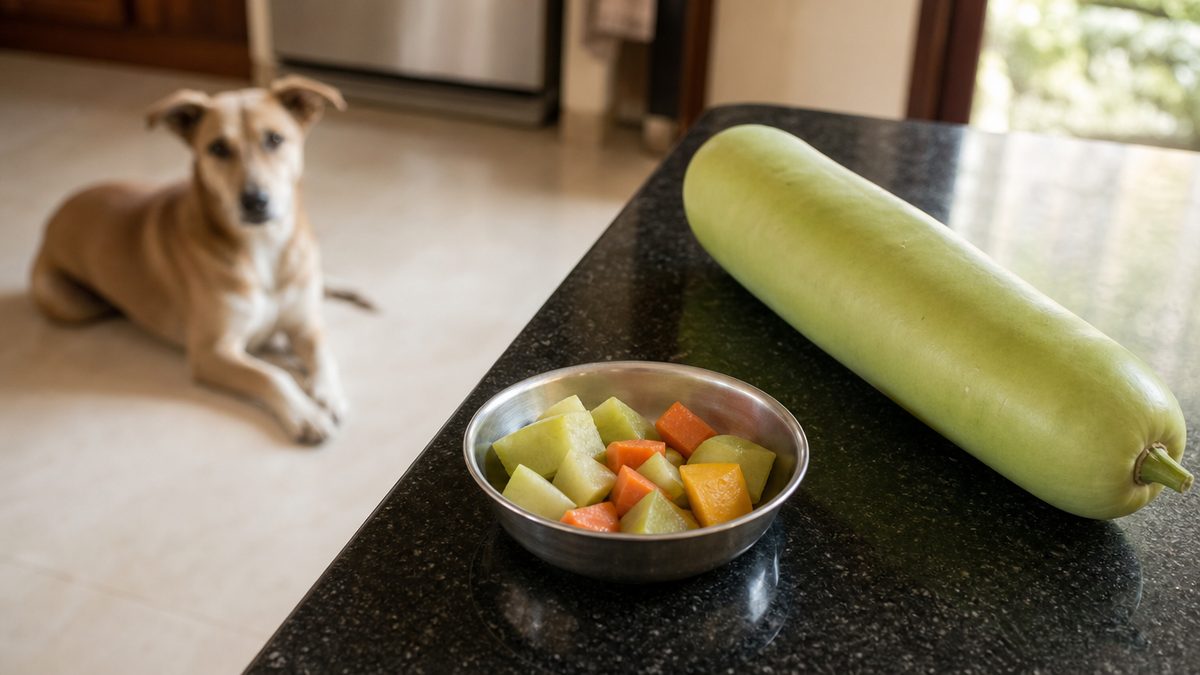
Which vegetables are good for dogs? Lauki, tinda, parwal, tori, kaddu, gajar, bhindi, gobhi, baingan, matar, palak and methi are all safe cooked plain and counted. Potato, arbi and suran are safe only cooked, never raw or green. Bitter lauki is the one to bin untasted. A healthy 10 kg dog's daily ceiling runs from 427 g of lauki to 43 g of shakarkandi. Vegetables are optional for a dog, so a refused bowl costs nothing.
This guide is general information for Indian pet owners and is not a diagnosis. Always consult a registered veterinarian near you before acting on anything you read here, and treat any sudden change in your pet's condition as urgent.
Which vegetables are good for dogs, and which Indian ones nobody rates
Which vegetables are good for dogs comes down to three groups. Almost every Indian sabzi is safe cooked plain and counted, three starchy tubers are safe only after cooking, and a short list is refused outright. The surprise is how little of that list is about poison.
Start with the verdict, then read why. The table below sorts every vegetable this page measures, names the thing that decides its tier, and says where the evidence actually stands. Note how many rows say that nobody has looked.
| Vegetable | Verdict | What decides it | Where the evidence stands |
|---|---|---|---|
| Lauki (bottle gourd), tinda, tori (ridge gourd), parwal, ash gourd, cucumber | Give, cooked plain and counted | Taste a raw sliver first. Bitter means bin it | The lowest-energy group at 46 to 82 kJ per 100 g. No entry on the ASPCA plant list in either direction, and no canine study of any of them |
| Kaddu (pumpkin), gobhi (cauliflower), gajar (carrot) | Give, cooked plain and counted | Portion size, nothing else | Carrot and the Cucurbita maxima squashes are on the ASPCA non-toxic list. Cauliflower appears nowhere on it |
| Bhindi (ladies finger) | Give, cooked plain and counted | Cook it. Raw pods are tough rather than toxic | 27.5 kcal and 4.08 g of total dietary fibre per 100 g. No poison-control entry, no canine data |
| Baingan (brinjal) | Give the ripe flesh, cooked, counted | Ripeness, and leaving the leaves and stem in the bin | Solanum melongena has no ASPCA entry either way, and EFSA could not characterise the aubergine glycoalkaloid risk even for people |
| Matar (fresh green peas) | Give, cooked plain and counted | It is a pulse as well as a vegetable | The densest vegetable here at 340 kJ per 100 g, so the portion is small. The pulse question belongs on our dal page |
| Palak (spinach), methi, chaulai (amaranth) | Give, boiled and drained, counted | The oxalate load, and the boiling water you throw away | Palak carries 592 mg of total oxalate per 100 g and chaulai 779 mg. No canine dietary oxalate threshold exists to compare them with |
| Karela (bitter gourd) | Give cooked, counted, and only if the dog wants it | Most dogs refuse it, which settles the question | The only vegetable here with a published canine poisoning case report, from 1976, whose contents we could not read |
| Potato, shakarkandi (sweet potato), suran (elephant yam), arbi (colocasia) | Cook first, always. Never raw | Starch that is useless raw, plus the green-potato rule | Colocasia esculenta sits in the ASPCA toxic section. Solanum tuberosum appears in neither section |
| Any green, sprouted or bitter potato | Never | Glycoalkaloids concentrate in the green parts | Merck names the leaves, shoots and unripe berries of Solanum species as the toxic parts |
| Any bitter-tasting lauki, tinda, tori or cucumber | Never, at any quantity | Bitterness is the cucurbitacin signal | An ICMR expert committee recorded 3 deaths and 26 hospital admissions after bitter bottle gourd juice. Human cases. No dog has ever been tested |
| Arbi leaves (patra, alu wadi), brinjal leaves and stem, tomato plant, potato haulm | Never | The leaf is not the vegetable | Arbi leaf carries 701 mg of total oxalate per 100 g against 49 mg in the tuber. The ASPCA lists the tomato plant as toxic to dogs |
| Onion, garlic, spring onion, leek | Never, at any weight | The Allium mechanism, which is not a portion question | Our Allium page carries the dose in grams. India's own food tables file the onion bulb under condiments rather than vegetables |
One row is handed off rather than argued here. Onion and garlic are the two genuinely toxic things in an Indian vegetable basket, they destroy red blood cells rather than upsetting a stomach, and the dose is lower than most owners expect. We will not repeat the case, because our onion and garlic page carries the published doses converted into grams for real body weights, the reason cats are hit harder, and what the leftover sabzi routine should be. Read that one first if there is onion in the pot.
The three questions that sort any vegetable
To sort a vegetable nobody has written about, ask three questions in order, because only the first changes what you do today.
- Does it taste bitter? Bitterness in the gourd family is the cucurbitacin signal, and an ICMR expert committee's answer to it is to discard the vegetable rather than cook it.
- Is it raw, green or sprouted? Raw starch is close to useless to a dog, and the glycoalkaloids in the Solanum group sit in the green parts rather than in the tuber.
- What does it displace? A vegetable with no toxin and no green part still carries energy and bulk, and both come out of a bowl that was already balanced.
Our guide to Indian food safe for dogs sets out the wider four-category test and applies it to the whole plate. This page applies it to the vegetable bag, where the first question has no equivalent anywhere else in an Indian kitchen.
Lift the dog's share out before anything goes into the kadhai, boil it plain, and taste a raw sliver of any gourd before you start. Three seconds of tasting is the only safety check on this page that cannot be replaced by a portion size.
Why an Indian vegetable bag needs its own page
The pages ranking for this query sort a different bag. On 22 October 2026 the top results on Google India led with broccoli, green beans, celery, kale, zucchini and bell peppers. India's own horticulture figures describe something else. In the all-India 2013-14 final estimates published by the National Horticulture Board, potato led at 41,555 thousand tonnes, followed by onion at 19,402, tomato at 18,736, brinjal at 13,558, cabbage at 9,039, cauliflower at 8,573 and okra at 6,346, with bottle gourd at 1,819 and bitter gourd at 807. Those figures are a decade old and we are using them for rank and scale rather than as a current crop number, but the ranking has not changed character. Broccoli does not appear in the table at all.
So the vegetable most likely to be in a bag in Pune, Kolkata or Chennai this week is one that no top-ranking page on this query rates, and the vegetable at the top of every one of those lists is one most Indian households buy rarely. That is the gap this page exists to close.
What Indian vegetables actually contain, from India's own food tables
Indian vegetable composition comes from the Indian Food Composition Tables 2017, compiled at the ICMR-National Institute of Nutrition in Hyderabad, which analyses Indian cultivars sampled across Indian regions instead of importing a foreign value. Every vegetable named in this page's brief has a row. Two things an Indian cook uses every week do not.
Read the table below as the basis for every gram figure further down. IFCT publishes energy in kilojoules, and the kilocalorie column is our conversion at 4.184 kJ per kcal. The regions column is printed beside every row in the original, so you can see which figures rest on six separate regional samples and which rest on one.
| Vegetable (IFCT food code) | Energy, kJ | Energy, kcal | Total dietary fibre, g | Moisture, percent | Regions sampled |
|---|---|---|---|---|---|
| Bottle gourd, lauki, elongate pale green (D007) | 46 | 11.0 | 2.12 | 95.17 | 6 |
| Ridge gourd, tori (D068) | 55 | 13.1 | 1.81 | 94.99 | 6 |
| Tinda, tender (D073) | 58 | 13.9 | 2.00 | 94.41 | 6 |
| Ash gourd, petha (D001) | 73 | 17.4 | 3.37 | 92.17 | 6 |
| Cucumber, green, elongate (D043) | 82 | 19.6 | 2.14 | 92.96 | 6 |
| Bitter gourd, karela, elongate (D004) | 87 | 20.8 | 3.78 | 90.87 | 6 |
| Cabbage, green, patta gobhi (C015) | 90 | 21.5 | 2.76 | 91.85 | 6 |
| Cauliflower, phool gobhi (D036) | 96 | 22.9 | 3.71 | 90.76 | 6 |
| Pumpkin, kaddu, orange round (D066) | 97 | 23.2 | 2.56 | 91.85 | 6 |
| Parwal, parwar (D060) | 101 | 24.1 | 2.61 | 91.57 | 6 |
| Spinach, palak (C033) | 102 | 24.4 | 2.38 | 90.31 | 6 |
| Brinjal, baingan, all varieties (D031) | 106 | 25.3 | 3.98 | 90.00 | 6 |
| Ladies finger, bhindi (D056) | 115 | 27.5 | 4.08 | 89.06 | 6 |
| Amaranth leaves, chaulai, green (C002) | 128 | 30.6 | 4.41 | 86.85 | 6 |
| Carrot, gajar, orange (F002) | 139 | 33.2 | 4.18 | 87.69 | 6 |
| Fenugreek leaves, methi (C020) | 144 | 34.4 | 4.90 | 86.73 | 5 |
| Potato, brown skin, big (F006) | 292 | 69.8 | 1.71 | 80.72 | 6 |
| Peas, fresh, matar (D061) | 340 | 81.3 | 6.32 | 73.37 | 6 |
| Yam, elephant, suran (F017) | 353 | 84.4 | 4.17 | 74.39 | 6 |
| Colocasia, arbi (F004) | 372 | 88.9 | 3.22 | 73.49 | 6 |
| Sweet potato, shakarkandi, brown skin (F013) | 456 | 109.0 | 3.99 | 69.21 | 4 |
Three things fall out of that table and none of them appears on a ranking page. The energy spread across one vegetable bag is close to ten-fold, from 46 kJ in a pale green lauki to 456 kJ in a shakarkandi, so a katori of one is not a katori of another. The split is not gradual either: everything from lauki to methi sits between 46 and 144 kJ, and then the four tubers jump to between 292 and 456. And fibre does not track energy at all, with lauki carrying 2.12 g per 100 g against potato's 1.71 g despite six times the water.
What India's own tables do not analyse, which is not what you would guess
The brief for this page assumed IFCT would be missing several of the Indian vegetables on it. It is not. IFCT 2017 analyses every one of the sixteen, and in places it is far more granular than any foreign table. Brinjal alone gets 22 rows, twenty-one named varieties from D010 to D030 plus an all-varieties row at D031. Bottle gourd gets three, separated by shape and skin colour. Bitter gourd gets three, separated by ridge pattern.
Two real absences exist and both are worth knowing.
- Turnip has no row at all. A search of the full IFCT 2017 text on 22 October 2026 returned zero occurrences of turnip or shalgam anywhere in its 585 pages. Any shalgam figure you read online comes from somewhere other than India's national food tables.
- No vegetable is analysed cooked. Every figure in the table above is for the raw edible portion. IFCT's groups run from cereals to shellfish with no cooked-vegetable group, so the moment you boil a sabzi for your dog, both the weight and the composition move away from the printed row. That caveat applies to every gram figure on this page and we would rather state it once, loudly, than bury it.
- The onion bulb is not filed as a vegetable. IFCT puts onion, big at G017 and onion, small at G018, in group G, Condiments and Spices, while onion stalk sits at D058 among the vegetables. India's own classification already separates the thing that poisons a dog from the things that do not.
The same vegetable, five names, one row
IFCT prints a vernacular name index beside its composition data, and it solves a problem no dog-feeding page addresses. A reader in Bengaluru and a reader in Kolkata are often asking about the same vegetable under names that look unrelated, and an answer written for one is useless to the other.
| IFCT entry | Hindi | Bengali | Marathi | Kannada | Tamil |
|---|---|---|---|---|---|
| Bottle gourd (D007) | Lowki | Lau | Pandhara | Sorekai | Suraikkai |
| Bitter gourd (D004) | Karela | Korola | Karle | Hagal kai | Paavakkai |
| Ridge gourd (D068) | Torai | Jhinge | Dodka | Heeraikai | Peerkankai |
| Parwal (D060) | Parwal | Potol | Parwar | Mara thonde | not listed |
| Brinjal (D010) | Baingan | Begun | Vange | Badane | Kathirikkai |
| Ladies finger (D056) | Bhindi | Dherosh | Bhendi | Bende | Vendaikkai |
| Pumpkin (D066) | Kaddu | Kumro | Lal bhopla | Kumbala kash | Parangikkai |
| Spinach (C033) | Palak | Palong shak | Palak | Spinak soppu | Pasalai keerai |
| Fenugreek leaves (C020) | Methi sag | Methi shak | Methi sag | Menthya soppu | Vendhaiya keerai |
| Colocasia (F004) | Arwi | Kochu | Alu kanda | Samagadde | Seppankizhangu |
| Elephant yam (F017) | Zimikandha | Ol | Suran | Suvarna gadda | Karunai kizhangu |
| Sweet potato (F013) | Shakarkand | Ranga alu | Ratalu | Genasu | Sakkarvalli kizhangu |
The bag itself differs by region, which is the other reason a single list fails. A Tamil Nadu kitchen buying pasalai keerai, peerkankai and paavakkai and a Karnataka kitchen buying sorekai, heeraikai and hagal kai are working from exactly the same IFCT rows as a Delhi kitchen buying palak, torai and karela, under names that share no letters at all. Every composition and portion figure on this page is keyed to the botanical name for that reason, so it survives the translation.
One entry in that index is worth a warning. IFCT glosses parwal's Malayalam name as kovakkai, which in ordinary Kerala usage is the ivy gourd that IFCT itself analyses separately at D054 as kovai. Where a vernacular name is ambiguous, go by the botanical name on the row rather than by the word, which is the same discipline this page applies to everything else.
How much vegetable, in grams, by your dog's weight
To size a vegetable portion, divide one tenth of your dog's daily energy by the vegetable's energy per 100 g. That is the method our mango page established for a single fruit and our Indian fruit page extended across a whole fruit cart. This page extends it once more, to vegetables, and the extension is interesting because it breaks.
Two published numbers do the work, and they are the same two the fruit pages used, so we are not re-deriving them. The WSAVA Global Nutrition Committee's guide to treats states that treats should always make up less than 10 percent of a dog's daily calorie intake, and that treats should never replace a meal. The WSAVA calorie table gives a healthy adult dog in ideal body condition 280 to 351 kcal a day at 5 kg, 470 to 590 at 10 kg and 940 to 1,174 at 25 kg, calculated from the 2006 National Research Council maintenance equations.
The table below applies the treat ceiling to the lower end of each WSAVA range, which is the conservative choice and the right one for a dog in a Mumbai or Bengaluru flat walked once a day. Energy per 100 g is IFCT's, converted from kilojoules.
| Vegetable | kcal per 100 g | 5 kg dog (28 kcal) | 10 kg dog (47 kcal) | 25 kg dog (94 kcal) |
|---|---|---|---|---|
| Bottle gourd, lauki | 11.0 | 255 g | 427 g | 855 g |
| Ridge gourd, tori | 13.1 | 213 g | 358 g | 715 g |
| Tinda | 13.9 | 202 g | 339 g | 678 g |
| Ash gourd | 17.4 | 160 g | 269 g | 539 g |
| Cucumber | 19.6 | 143 g | 240 g | 480 g |
| Bitter gourd, karela | 20.8 | 135 g | 226 g | 452 g |
| Cabbage | 21.5 | 130 g | 218 g | 437 g |
| Cauliflower, gobhi | 22.9 | 122 g | 205 g | 410 g |
| Pumpkin, kaddu | 23.2 | 121 g | 203 g | 405 g |
| Parwal | 24.1 | 116 g | 195 g | 389 g |
| Spinach, palak | 24.4 | 115 g | 193 g | 386 g |
| Brinjal, baingan | 25.3 | 111 g | 186 g | 371 g |
| Ladies finger, bhindi | 27.5 | 102 g | 171 g | 342 g |
| Amaranth, chaulai | 30.6 | 92 g | 154 g | 307 g |
| Carrot, gajar | 33.2 | 84 g | 141 g | 283 g |
| Fenugreek leaves, methi | 34.4 | 81 g | 137 g | 273 g |
| Potato | 69.8 | 40 g | 67 g | 135 g |
| Peas, matar | 81.3 | 34 g | 58 g | 116 g |
| Elephant yam, suran | 84.4 | 33 g | 56 g | 111 g |
| Colocasia, arbi | 88.9 | 31 g | 53 g | 106 g |
| Sweet potato, shakarkandi | 109.0 | 26 g | 43 g | 86 g |
Where the treat ceiling stops being the limit, which is most of this table
Read the top of that table rather than the bottom, because the top is where the method runs out. A 10 kg dog's energy ceiling for lauki is 427 g. That is a vegetable that is 95.17 percent water, so the ceiling is also about 407 g of water and 9.1 g of dietary fibre arriving in one day. Nobody is going to feed that, and nobody should.
This is the honest difference between a fruit page and a vegetable page. Across the Indian fruit cart the energy ceiling is a real constraint, because fruit sugar is dense enough to bite. Across the Indian vegetable bag it is a constraint on exactly four rows, the tubers and the peas, and on the other seventeen it produces a quantity so absurd that something else has to take over as the limit.
What should take over has not been published. We looked for a canine limit on vegetable volume, on daily fibre intake or on water from food, and found none. The Merck Veterinary Manual is explicit that there is no dietary requirement for fibre in dogs and cats, which means there is also no published ceiling. So the second constraint on this page is ours rather than anyone's, we are labelling it as ours, and it is deliberately crude.
- Cap any single vegetable at the energy figure in the table, or at a quarter of the bowl by volume, whichever comes first. The second half of that rule is Bonbeno's own and has no study behind it.
- Introduce one vegetable at a time and wait two days before the next. A dog eating lauki, gobhi and palak in the same week gives you no way to read which one loosened the stool.
- Read the stool rather than the chart. Fibre source measurably changes stool consistency in dogs, which is the one readout you get for free.
- Subtract the vegetable from dinner rather than adding it on top. Our dog diet chart for India carries the daily grams the subtraction comes out of.
Every figure above assumes the vegetable is the only extra crossing the treat line that day, which in an Indian kitchen it will not be. Halve it if the dog also got a piece of roti or a spoon of curd. Halve it again for a dog on a weight plan. The WSAVA table itself says these recommendations are for guidance only and that some dogs have higher or lower requirements.
The dogs for whom the table does not apply
Three groups sit outside the assumption above. A diabetic dog's question about potato or shakarkandi is about when the starch arrives relative to insulin and meals, not only how much, and it belongs with the veterinarian who set the treatment; see diabetes in dogs and cats. A dog on a reduction ration has a smaller day for the ceiling to come out of, so see obesity in dogs and cats. And a dog that has formed calcium oxalate stones needs the palak conversation held with its own vet rather than with a chart, which the oxalate section below returns to.
The cellulose problem: what a dog gets out of an intact plant cell
A dog gets very little out of an intact plant cell, because the cell wall is a barrier its own enzymes cannot open and its gut bacteria open at wildly different rates. That is the single most useful thing to understand before you decide how to prepare a vegetable.
Two statements from the veterinary reference set the floor. Fibre is resistant to digestion by digestive enzymes produced in the gastrointestinal tract of dogs and cats, and although beneficial bacteria in the large intestine are capable of fermenting fibre, there is no dietary requirement for fibre in dogs and cats at all. Cellulose is named there as an example of insoluble fibre, alongside beet pulp and rice bran. A dog has no cellulase of its own, so whatever sits inside a cellulose wall is reachable only if something opens the wall first.
That something is either your kitchen or the dog's colonic bacteria, and the bacteria are far less reliable than people assume.
The eight-fold spread nobody tells owners about
In the clearest canine measurement of this, 14 fibrous substrates were fermented in vitro using dog faeces as the inoculum. Organic matter disappearance was lowest at under 10 percent for Solka Floc and oat fibre, and greatest at over 80 percent for fructooligosaccharides and lactulose. The same two at the bottom produced under 1 mmol of total short-chain fatty acids per gram of substrate, against over 6.8 mmol for lactulose, citrus pectin and guar gum. The companion paper describes Solka Floc plainly as a non-fermentable fibre.
So the question is not whether a dog can use fibre. It is which fibre, and the answer varies by a factor of eight before you have even chosen a vegetable. The same study fed six diets to dogs and measured what came out: total dietary fibre digestibility was 60.8 percent on the most fermentable diet and 11.0 percent on the Solka Floc diet. An owner who watches recognisable pieces of carrot leave a dog is watching the low end of that range in person.
What the cell wall is actually doing
The food-science explanation is specific rather than vague. Cell wall encapsulation influences macronutrient digestibility through limited access to digestive enzymes and limited release of substrate and product, and encapsulation of starch can limit the extent of gelatinisation during hydrothermal processing of plant foods. That is a review of human and in vitro work rather than a canine one, and we are labelling it as such, because no equivalent measurement exists in dogs.
The practical reading survives the gap anyway. Chopping breaks walls mechanically, cooking softens and ruptures them, and mashing finishes the job. A dog handed a raw carrot baton swallows two pieces of intact tissue; the same carrot boiled soft and mashed is a different food to the animal's small intestine even though the IFCT row has not moved.
Almost every page on this query lists the vitamins in a vegetable. None of them asks whether the dog can reach them. A nutrient inside a sealed plant cell that passes through a dog in six hours is not a nutrient the dog received, and the only levers you have over that are the knife and the pan.
Raw or cooked, and what cooking actually changes
Cook the vegetable. Cooking changes four separate things at once, and three of them move in the dog's favour, which is why the raw-versus-cooked argument that fills this query is mostly settled before it starts.
Set out what each change actually is, because they are usually jumbled together.
- It opens the cell wall. Heat and water soften and rupture plant tissue, which is the only route by which what is inside a cell becomes reachable.
- It removes soluble oxalate, if you throw the water away. Boiling reduced soluble oxalate in nine vegetables by 30 to 87 percent and was more effective than steaming at 5 to 53 percent, while baking, tested only on potatoes, produced no oxalate loss at all. About 100 percent of the loss was recovered in the cooking water.
- It makes starch usable. Raw potato, arbi and suran are dense in starch that a dog's amylase reaches poorly while the granules remain packed inside intact cells.
- It does nothing at all to cucurbitacin. Bitterness in a gourd is not a cooking problem. The ICMR committee's advice is to taste a small piece before using the vegetable and to discard it if it is bitter, and one of the 26 hospitalised patients in that review had boiled the juice before drinking it.
That last point deserves its own line because it is the one people get wrong. Three of the four changes reward cooking. The fourth is a reason to taste first and cook second, and no amount of boiling substitutes for it.
Throw the boiling water away, which is the opposite of the usual Indian habit
Boiling only lowers oxalate if the water goes down the sink. Since roughly 100 percent of the oxalate lost from the vegetable turns up in the cooking water, a cook who boils palak and then pours the green water into the dal has moved the oxalate rather than removed it. Indian kitchens are thrifty with that water for good reasons on the human side. For the dog's portion, pour it out.
Five preparation rules that cover every vegetable here
- Wash it first. ICMR-NIN states that pesticide residues in vegetables and fruits can be minimised by washing the foodstuffs thoroughly in running water or by peeling, and that cooking and other processes can also reduce such residues.
- Taste a raw sliver of any gourd. Bitter means bin, not cook.
- Peel the tubers and anything with a tough or waxed skin, then boil until soft enough to crush between two fingers.
- Chop or mash before serving, because a swallowed chunk is a sealed container.
- Serve it plain. Nothing on this page survives a tadka, and our spices, salt and masala guide carries the measured doses for what gets added in those last two minutes.
Raw is not forbidden across the board. A raw cucumber slice or a raw carrot stick on a humid afternoon is a low-energy, low-risk thing to hand a dog, and it is the one case where the point is the chewing rather than the nutrition. Treat it as enrichment, count it against the same ceiling, and do not expect the dog to absorb much of it.
Oxalate in palak, and the Indian greens that beat it
Oxalate is the real reason to go carefully with Indian greens, and palak is not the worst of them. India's own food tables measure oxalate in every vegetable on this page, split into soluble and insoluble, and the ranking contradicts the assumption that a spinach page would start from.
The numbers are below. Soluble oxalate is the fraction that matters most, because soluble sources of oxalate appear to be better absorbed than insoluble sources.
| Vegetable (IFCT code) | Total oxalate, mg | Soluble, mg | Soluble share | Regions |
|---|---|---|---|---|
| Amaranth, spined, green leaves (C005) | 1,073 | 81.78 | 8 percent | 4 |
| Amaranth, chaulai, green leaves (C002) | 779 | 198 | 25 percent | 6 |
| Colocasia, arbi, green leaves (C018) | 701 | 208 | 30 percent | 6 |
| Spinach, palak (C033) | 592 | 241 | 41 percent | 6 |
| Ladies finger, bhindi (D056) | 83.87 | 5.99 | 7 percent | 6 |
| Colocasia, arbi, tuber (F004) | 48.73 | 26.60 | 55 percent | 6 |
| Bitter gourd, karela (D004) | 45.40 | 17.53 | 39 percent | 6 |
| Pumpkin, kaddu (D066) | 41.22 | 35.84 | 87 percent | 6 |
| Brinjal, baingan, all varieties (D031) | 34.31 | 28.17 | 82 percent | 6 |
| Fenugreek leaves, methi (C020) | 34.29 | 9.08 | 26 percent | 5 |
| Ridge gourd, tori (D068) | 29.55 | 1.22 | 4 percent | 6 |
| Peas, fresh, matar (D061) | 18.42 | 14.18 | 77 percent | 6 |
| Carrot, gajar (F002) | 17.45 | 12.63 | 72 percent | 6 |
| Elephant yam, suran (F017) | 15.58 | 12.39 | 80 percent | 6 |
| Sweet potato, shakarkandi (F013) | 14.39 | 6.56 | 46 percent | 4 |
| Potato (F006) | 12.24 | 9.71 | 79 percent | 6 |
| Cauliflower, gobhi (D036) | 9.82 | 1.88 | 19 percent | 6 |
| Tinda (D073) | 3.36 | 1.91 | 57 percent | 6 |
| Parwal (D060) | 3.24 | 1.56 | 48 percent | 6 |
| Cabbage, green (C015) | 2.88 | 0.53 | 18 percent | 6 |
| Bottle gourd, lauki, round pale green (D008) | 2.53 | 1.38 | 55 percent | 5 |
Two findings in that table have not been published anywhere we could find. Palak is fourth on total oxalate, not first: chaulai carries 779 mg per 100 g and spined chaulai 1,073 mg, against palak's 592 mg. But palak carries the highest soluble share of the four leaves at 41 percent, which is 241 mg of the absorbable fraction against chaulai's 198 mg and spined chaulai's 82 mg. Rank the leaves by total oxalate and palak looks safest of the four. Rank them by soluble oxalate and it looks worst. Both rankings come from the same six-region dataset and we are publishing both rather than choosing.
The second finding is about arbi. The colocasia leaf carries 701 mg of total oxalate per 100 g and the colocasia tuber carries 48.73 mg, which is a fourteen-fold difference between two parts of the same plant. Patra and alu wadi in Maharashtra and Gujarat, and the arbi-leaf preparations of eastern India, are made from the high end of that. Keep the leaf away from the dog and the tuber, boiled, is a different question.
What the energy ceiling delivers in oxalate, and the threshold that does not exist
Put the two tables together and the arithmetic is uncomfortable. A 10 kg dog's energy ceiling for palak is 193 g, which carries about 1,142 mg of total oxalate and about 465 mg of soluble oxalate. The same dog's ceiling for lauki is 427 g, which carries about 16 mg. Those are our multiplications of IFCT's figures, not IFCT's own.
The obvious next question has no published answer. No canine dietary oxalate threshold exists. The best canine data we found is a Dutch cohort of 141 privately owned dogs plus a crossover trial in 23 more, and it did not measure dietary oxalate content at all. It measured what came out: urinary oxalate ranged from 21.1 to 170.6 mmol per mol creatinine in the dogs, and higher excretion was associated with a dry diet as the primary energy source, with breed, with male sex and, counter-intuitively, with receiving no snacks.
That last association is worth sitting with before anyone turns this section into a ban. In the only canine dataset of its kind, the dogs getting no snacks had higher urinary oxalate, not lower. It is a cohort association rather than a causal finding, and it is the opposite of what a reader would predict from the composition table above.
Calcium oxalate is, with struvite, one of the two commonest bladder stone types in dogs, and the Merck Veterinary Manual's own account of prevention names reduced dietary protein, calcium and sodium and a high-moisture diet, and does not name dietary oxalate as a lever. If your dog has formed a stone, the decision is clinical and belongs with your vet, and our page on bladder stones in dogs carries the stone types, the Indian case series and the costs. Separately, oxalate binds dietary calcium, which is a home-cooking problem rather than a stone problem, and our page on balancing a home-cooked diet for calcium covers it.
The honest instruction is short. Boil the greens, pour the water away, keep palak and chaulai to an occasional part of the portion rather than a daily one, and raise it with your vet before anything else if your dog has a stone history. That advice is driven by the absence of a threshold, not by a measured danger.
Solanine in baingan and potato, and the green potato rule
Solanine and its relatives are real, they sit in the green parts of the Solanum plant rather than in the vegetable, and the dog-specific evidence is thinner than every page on this query implies. One published canine case exists, and it is not about a potato from a kitchen.
Start with where the compound lives. The Merck Veterinary Manual's table of poisonous range plants groups nightshades, Jerusalem cherry, potato, horse nettle and buffalo bur together as Solanum species, and names the toxic parts as the leaves, shoots and unripe berries, with inflammation of the stomach and intestine with bleeding, weakness and excess drooling, followed by difficulty breathing, trembling, progressive paralysis, laying down and death. The tuber you boil is not in that list. The haulm, the sprouts and the green skin are the plant.
The one canine case report, and what it was actually about
A 10-week-old intact male Labrador retriever weighing 6 kg was presented for acute onset of weakness and ataxia, and vomited plant material identified as creeping nightshade, Solanum dulcamara. The puppy was mentally obtunded and recumbent with generalised muscle tremors, pyrexic at 39.7 degrees Celsius, tachycardic at 160 beats per minute and tachypnoeic, and was discharged with complete resolution approximately 64 hours after presentation. The report describes solanine as poorly absorbed from the gastrointestinal tract, causing local irritation, and hydrolysed in the gut to solanidine, which is absorbed and produces the systemic effects.
Read that carefully, because it is the whole canine evidence base. A puppy ate a wild nightshade plant in a garden and needed three days of supportive care. Nobody has published a dog poisoned by a cooked potato or a cooked brinjal, and the absorption note in that same report is the reason: the parent glycoalkaloid is poorly absorbed in the first place.
What the regulator could and could not conclude
EFSA ran the most thorough assessment of these compounds that exists, and its two relevant conclusions sit awkwardly beside each other. For acute gastrointestinal effects in humans it identified a lowest-observed-adverse-effect level of 1 mg of total potato glycoalkaloids per kg of body weight per day as its reference point. For horses, farm and companion animals, no risk characterisation for potato glycoalkaloids could be performed due to insufficient data on occurrence in feed and on potential adverse effects in these species. And for tomato and aubergine glycoalkaloids, the risk to human health could not be characterised at all, due to the lack of occurrence data and the limited toxicity data.
So the position on baingan is this. The European regulator could not characterise the brinjal glycoalkaloid risk for people, let alone for dogs, and the ASPCA plant database carries no entry for Solanum melongena in either direction while listing the tomato plant, Lycopersicon species, as toxic to dogs. Ripe brinjal flesh, cooked plain, has no published canine problem. Its leaves and stem are a different object and belong in the bin.
Never give a dog a potato that is green under the skin, sprouting, or bitter. Peel deeply, cut out every eye and green patch, boil until soft, and discard anything that still tastes bitter. The same goes for the chips in the pressure cooker that nobody checked. If your dog has eaten a quantity of green or sprouted potato, telephone a veterinary surgeon the same day rather than waiting for a symptom, and read our guide to foods toxic to dogs for how the first hour works. Bonbeno names no drug and no dose.
Bitter lauki: an Indian poisoning nobody has ever checked in a dog
Bitter bottle gourd has killed people in India, the Indian Council of Medical Research investigated it and published what it found, and no dog has ever been studied. Both halves of that sentence matter, and transferring the first to dogs without saying so would be the exact error this site exists to avoid.
What happened is documented to an unusual standard for a food-safety question in India. After a death in Delhi in June 2010 was raised in Parliament, the Department of Health Research constituted an expert committee at ICMR in October 2010, which reported in August 2011.
The committee gathered three deaths, one in Nanakpura, Delhi on 23 June 2010 and two in Amroha, Uttar Pradesh on 28 March 2007. All three were over 59 years old and all three had been diabetic for about twenty years, and all three reported the juice as extremely bitter. It also gathered 26 people admitted to hospitals after drinking freshly prepared bottle gourd juice, from the National Capital Region, Madhya Pradesh, Gujarat and Uttarakhand, 17 men and 9 women aged 30 to 73.
| Finding | Figure |
|---|---|
| Amount of juice consumed on the day | 20 to 350 ml, reported as bitter in every case |
| Time to first symptom | five minutes to nine hours |
| Vomiting of blood | 19 of 26, 73.1 percent |
| Diarrhoea | 18 of 26, 69.2 percent |
| Hypotensive on arrival | 12 of 22 with a recorded blood pressure, 54.5 percent |
| Elevated liver enzymes | 9 of the 10 patients with results available |
| Needed intensive care | 18 patients, for 1 to 4 days |
| Hospital stay | 1 to 12 days |
| Outcome | all 26 recovered fully, with no sequelae |
The committee attributed the bitterness and the toxicity to cucurbitacins, the tetracyclic triterpenoid compounds of the Cucurbitaceae family, and recorded that the bottle gourd fruit contains cucurbitacins B, D, G and H and 22-deoxycucurbitacin. It also recorded that higher cucurbitacin levels are triggered by environmental stress including high temperatures, wide temperature swings, too little water, uneven watering, low soil fertility and low soil pH. That last sentence is why this is a seasonal problem in a hot, humid country rather than a constant one. A gourd grown through a dry April or through an erratic monsoon has met more of that list than one grown in a steady season, so the taste check matters most in exactly the months when lauki and tori are cheapest and most tempting. We found no Indian survey measuring cucurbitacin against the calendar, so treat that as a reading of the committee's own stress list rather than as a measured seasonal pattern.
What we searched for, and what came back empty
We looked for dog evidence rather than assuming it did not exist, and we are publishing the searches so you can repeat them. On 22 October 2026, a PubMed search combining cucurbitacin, bottle gourd and Lagenaria with dog, dogs and canine returned three records in total. They are a 2014 nanomedicine paper on spray granulation, a 2010 paper on cucurbitacin I and actin dynamics in cell motility, and a 2005 paper on the archaeological origins of a domesticated plant in the Americas. Not one concerns a poisoned animal.
The absence is sharper than it looks, because the ICMR committee itself asked for the work. Among the three research areas it identified in 2012 were chemical composition studies on bitter and normal bottle gourd, animal toxicity studies, and studies on interaction between bottle gourd juice and other drugs. Fourteen years later the animal toxicity studies have not reached a dog in anything PubMed indexes.
The committee did quote one animal figure from older work, and we are flagging how we read it. It records intraperitoneal median lethal doses for pure cucurbitacins isolated from Cucumis species as 1.2 mg of cucurbitacin A per kg and 1.0 mg of cucurbitacin B per kg in albino mice, and 2.0 mg of cucurbitacin A per kg in the rat, attributing them to David and Vallance in 1955. We read those figures inside the ICMR paper rather than in the 1955 original, they are injected rather than eaten doses, and they are mice and rats. None of that transfers to a dog eating a sabzi.
Extremely bitter bottle gourd juice has killed three people in India and hospitalised twenty-six more, and the ICMR committee's advice is to taste a small piece of the bottle gourd before using it and to discard it if it is bitter. No dog has been reported poisoned by bottle gourd anywhere, and nobody has tested one. Those two sentences are both true and the second does not cancel the first. Taste the gourd, bin it if it is bitter, and do not tell another pet parent that lauki is dangerous, because it is not. The bitter one is.
Karela, the one Indian vegetable here with a canine case on record
Bitter gourd is deliberately bitter, which breaks the taste rule above, and it is also the single vegetable on this page with a published canine poisoning report. A 1976 note in Veterinary Medicine, Small Animal Clinician is titled Acute poisoning in a puppy caused by the balsam pear, Momordica charantia. We read the title and the record metadata at PubMed on 22 October 2026; no abstract is indexed and we did not open the full text, so we cannot tell you what dose, what signs or what outcome it describes. A second canine paper exists from 1978 on the effects of a Momordica charantia fruit extract on testicular function in the dog, also with no indexed abstract.
That is a thin evidence base and it still beats everything else in the vegetable bag, where the count is zero. The practical position on karela is that cooked karela in a counted portion has no reported harm, that most dogs refuse it anyway, and that a vegetable a dog will not eat is not a vegetable you need to feed. Karela juice is a separate thing and does not belong in a dog, for the same reason the ICMR report is about juice rather than about sabzi.
Vegetables are optional for a dog, in a way they are not for you
Vegetables are optional for a dog and compulsory for a person, and the two numbers that prove it come from the same institute. That asymmetry is the most useful thing on this page and almost nobody states it.
ICMR-NIN tells Indians that every individual should consume at least 400 g of vegetables every day, split as 100 g of green leafy vegetables, 250 g of other vegetables and 50 g of roots and tubers, plus 100 g of fresh fruit. It also records the gap: people in India eat merely 100 g to 200 g of vegetables and fruits per day while the recommendation is 500 g per day.
Now the dog. There is no dietary requirement for fibre in dogs and cats, and dietary carbohydrates are not considered essential nutrients in the diet for adult, non-reproducing dogs and cats. A complete and balanced dog food already supplies everything the animal needs, which is why the WSAVA guidance frames a treat as something that must stay under 10 percent of the day and must never replace a meal.
So a person who skips vegetables for a week has a nutritional problem and a dog who skips them for a week has nothing. That is liberating rather than discouraging. It means you can offer lauki, refuse to argue when the dog turns away, and lose nothing. It means a fussy dog is not a deficient dog. And it means the reason to give vegetables at all is enrichment, bulk for a dog on a reduction ration, and variety, rather than a nutrient the bowl is missing.
The vegetables this page deliberately does not own
- Onion, garlic, spring onion, leek and chives. The most important toxic vegetables in an Indian kitchen, and not a portion question at all. Our onion and garlic page carries the doses in grams, the reason the powder beats the bulb, and what to do about leftover sabzi.
- Peas as a pulse. Fresh matar is a vegetable here and a pulse question elsewhere. The protein arithmetic, the antinutrients and the diet-associated dilated cardiomyopathy reports all belong to our dal and pulses page, which keeps them at their actual size.
- A dog that has already eaten something. The first hour, the dose arithmetic and what the evidence says about making a dog vomit live on our page on foods toxic to dogs. Nothing on this page is first aid.
- Fruit. Guava, papaya, chikoo, sitaphal and the seed-and-stone argument live on our Indian fruit page, which established the portion method this page extended.
- Cats. A cat is an obligate carnivore with no use for any of this, and our guide to Indian food safe for cats explains why the feline list is so much shorter. The oxalate figures above apply to a cat more sharply than to a dog, simply because a cat is smaller.
Everything on this page is about adding a vegetable to a complete diet. Building the whole diet is a different exercise with a different failure mode, and our homemade dog food guide and our guide to feeding a dog in a vegetarian household cover what a bowl of vegetables cannot supply on its own.
What this page can prove, and what it cannot
Seven things here are measured at a source we opened and six are gaps we are naming rather than filling. Both lists are short on purpose, and the second one is the more useful of the two.
What is measured.
- Energy, dietary fibre, moisture, region count and total and soluble oxalate for sixteen Indian vegetables across twenty-one IFCT rows, read directly in the Indian Food Composition Tables 2017 PDF on 22 October 2026.
- The daily energy range for a healthy adult dog at 5, 10 and 25 kg, and the published 10 percent treat ceiling, both read in the WSAVA documents themselves.
- The ICMR expert committee's denominators on bitter bottle gourd juice, its symptom percentages, its cucurbitacin attribution and its public advisory.
- That boiling removes 30 to 87 percent of soluble oxalate and that the loss turns up in the cooking water.
- That fermentability of fibre by dog faecal bacteria ranges from under 10 percent to over 80 percent organic matter disappearance across 14 substrates Sunvold GD, Fahey GC Jr.
- That a Labrador puppy was successfully treated after eating Solanum dulcamara, and that solanine is poorly absorbed and hydrolysed to solanidine in the gut.
- That ICMR-NIN recommends at least 400 g of vegetables a day for a person, while the veterinary reference states there is no dietary requirement for fibre in dogs.
What we could not establish, and what we did instead.
- There is no canine evidence for cucurbitacin or bottle gourd in either direction. PubMed returned three off-topic records on 22 October 2026, and we have labelled the ICMR evidence as human in every sentence that uses it.
- No canine dietary oxalate threshold exists. We have published the IFCT oxalate figures and the canine urinary oxalate study that did not measure dietary oxalate, and said plainly that the veterinary reference on canine urolithiasis does not name dietary oxalate as a lever.
- EFSA could characterise no risk from potato glycoalkaloids for companion animals, and no risk from aubergine glycoalkaloids even for people. We have not filled that gap with an estimate.
- The 1976 canine karela poisoning report and the 1978 canine Momordica study have no indexed abstract and we did not open either full text, so we are citing their existence and nothing more.
- No canine measurement exists of how much a dog extracts from a whole against a mashed vegetable. The cell wall encapsulation evidence we have cited is human and in vitro, and the quarter-of-the-bowl rule in the portion section is Bonbeno's own, with nothing published behind it.
- We could not read the ASPCA's stated toxic principle for Colocasia esculenta, because the individual plant entry page did not render its content on 22 October 2026. We have used the printable plants-toxic-to-dogs list, which places it in the toxic section, and have not inferred a mechanism from it.
One absence is worth recording on its own. Of the sixteen Indian vegetables in the composition table, the ASPCA toxic and non-toxic plant database carries an entry for three by species: carrot and sweet potato among the non-toxic plants, and Colocasia esculenta, the arbi, among the toxic ones. Indian pumpkin's species reaches the list only through five named squash cultivars, all non-toxic. Lauki, tinda, parwal, tori, karela, bhindi, baingan, methi, palak, gobhi, matar and the potato itself appear in neither section. Absence from that list is not evidence of safety and it is not evidence of danger. It is evidence that the most quoted pet plant list in the world was not written for an Indian vegetable bag, which is the reason this page exists.
Common questions about dogs and vegetables
What is the best vegetable for dogs?
Lauki is the best everyday vegetable for a dog by the numbers, because at 46 kJ per 100 g it is the lowest-energy row across all three vegetable groups of India's national food composition tables and carries only 3.75 mg of total oxalate per 100 g. A healthy 10 kg dog's energy ceiling for it is 427 g, which is more than anyone would sensibly feed. Peel it, deseed it, boil it plain, and taste a raw sliver first because bitter lauki must be discarded.
Which vegetables are dogs allowed to eat?
Dogs are allowed lauki, tinda, parwal, tori, ash gourd, cucumber, kaddu, gobhi, gajar, bhindi, ripe baingan flesh, matar, palak, methi and cooked potato, shakarkandi, suran and arbi, all served plain with no oil, salt or masala. Onion, garlic, spring onion and leek are refused at any weight. So is any gourd that tastes bitter, and any potato that is green, sprouted or bitter.
What vegetables should a dog not eat?
A dog should not eat onion, garlic, spring onion, leek or chives in any quantity, any bitter-tasting bottle gourd, tinda, ridge gourd or cucumber, any green or sprouted potato, and the leaves and stems of the arbi, brinjal, potato and tomato plants. The Merck Veterinary Manual names the leaves, shoots and unripe berries of Solanum species as the toxic parts, and the ASPCA lists the tomato plant and Colocasia esculenta as toxic to dogs.
Can my dog eat raw lauki?
Boil lauki rather than giving it raw, and taste a raw sliver yourself before you cook it. Raw lauki is not toxic, but a dog gets very little out of intact plant cells, and the one serious hazard in a bottle gourd is cucurbitacin, which cooking does not remove. An ICMR expert committee recorded three deaths and twenty-six hospital admissions in people after extremely bitter bottle gourd juice, and recommended tasting a small piece and discarding anything bitter.
Are gourds toxic to dogs?
Ordinary gourds are not toxic to dogs, and bitter ones are a different matter. Lauki, tinda, tori, parwal and ash gourd have no entry on the ASPCA plant database in either direction and no canine study of any kind. The risk sits entirely in cucurbitacin, which announces itself as bitterness. No dog has ever been reported poisoned by a gourd, and a PubMed search on 22 October 2026 combining cucurbitacin and bottle gourd with dog terms returned three records, none of them about poisoning.
Can dogs eat spinach raw or cooked?
Give palak boiled and drained rather than raw, because boiling removes 30 to 87 percent of soluble oxalate while steaming removes only 5 to 53 percent, and roughly all of the loss ends up in the cooking water. That means you have to pour the water away rather than add it to the dal. Raw palak carries 592 mg of total oxalate per 100 g, of which 241 mg is the soluble fraction that is better absorbed. No canine dietary oxalate threshold has been published.
Are cooked potatoes good for dogs?
Plain boiled potato with no green patches is fine for a dog in a counted amount, and raw potato is not. At 69.8 kcal per 100 g a potato is roughly six times as energy-dense as lauki, so a 10 kg dog's daily ceiling is about 67 g rather than 427 g. Peel deeply, cut out every eye and green patch, and discard anything bitter. EFSA set a human reference point of 1 mg of total potato glycoalkaloids per kg of body weight and could characterise no risk at all for companion animals.
Is eggplant toxic for dogs?
No canine toxicity has been established for eggplant, and no study has tested one either. Solanum melongena appears in neither the toxic nor the non-toxic section of the ASPCA plant database, and EFSA stated that the risk from aubergine glycoalkaloids could not be characterised even for human health, due to a lack of occurrence data and limited toxicity data. Give ripe baingan flesh, cooked plain, at about 186 g a day for a 10 kg dog, and bin the leaves and stem.
Is raw okra toxic to dogs?
Raw okra is not toxic to dogs and it is still worth cooking. Abelmoschus esculentus appears nowhere on the ASPCA plant database in either direction and has no canine study behind it. India's food tables measure bhindi at 27.5 kcal and 4.08 g of total dietary fibre per 100 g, which puts a 10 kg dog's daily ceiling at about 171 g. Boil it soft and chop it, because a dog swallowing whole raw pods extracts very little from intact plant cells.
How much pumpkin can I give my dog?
Give a healthy 10 kg dog up to about 203 g of plain cooked kaddu a day, a 5 kg dog up to 121 g and a 25 kg dog up to 405 g. Those are one tenth of the lower end of the WSAVA daily energy range for a dog in ideal body condition, calculated against the 23.2 kcal per 100 g that India's food tables measure for orange round pumpkin. Halve them if the dog gets anything else that day, and remove the skin and seeds.
What vegetables can a dog eat daily?
No vegetable has to be eaten daily by a dog, because dietary carbohydrates are not essential nutrients for an adult dog and there is no dietary requirement for fibre at all. If you want a daily one, the low-energy gourds are the sensible choice, since lauki, tori, tinda and parwal all sit under 25 kcal per 100 g and under 4 mg of total oxalate. Rotate rather than repeating, keep each to a quarter of the bowl, and subtract it from dinner rather than adding it.