
Breed profile
Bolonka: The Complete India Guide
A 3 to 4 kg Russian curly-coated toy that three registries name three different ways, fully recognised by the AKC on 1 January 2026 and still absent from the FCI.
Quick answer
The Bolonka is a 3 to 4 kg curly-coated Russian toy dog whose name is genuinely ambiguous. Russkaya Tsvetnaya Bolonka means Russian coloured lapdog and is the breed the American Kennel Club fully recognised on 1 January 2026; Bolonka Zwetna is the same dog under its German name; Bolonka Franzuska is the white one, which German records folded into the Bolognese in 1990. No Indian price in India exists, and heat tolerance rates 2 out of 5.
This page summarises published registry statistics, breed-club screening guidance and peer-reviewed veterinary research for general information. It is not a diagnosis and it is not treatment advice. Consult a registered veterinarian about your own dog before acting on anything here, and treat a rectal temperature at or above 40.5 degrees C as an emergency.
Bolonka at a glance
What a Bolonka actually is, and why the name is the hard part
A Bolonka is a 3 to 4 kg curly-coated Russian companion dog of the bichon type, bred in Soviet Leningrad and Moscow from the 1950s to be a small apartment dog for people who had no other option. The hard part is not the dog. It is the name, because three different names are in circulation and they do not all mean the same animal.
The word bolonka is Russian for lapdog, so on its own it settles nothing. Tsvetnaya means coloured, so Russkaya Tsvetnaya Bolonka is the Russian coloured lapdog. Franzuskaya means French, so Franzuskaya Bolonka is the French lapdog, and that one is white. Germany transliterated tsvetnaya as zwetna, which is why German paperwork and German-language veterinary literature say Bolonka Zwetna for the same dog the Americans call the Russian Tsvetnaya Bolonka.
On 1 January 2026 the coloured one became a fully recognised American Kennel Club breed in the Toy Group, alongside the Basset Fauve de Bretagne and the Teddy Roosevelt Terrier, taking the AKC's recognised total to 205 breeds. That is recent enough that most breed pages on the internet, including the German Wikipedia entry, still describe the breed as internationally unrecognised. The Fédération Cynologique Internationale still does not recognise it, provisionally or definitively.
The short version of the breed history
The breed history starts in Leningrad in 1951, when cynologists of the Leningrad Hunting and Fishery Society, LODIR, set out to create a national Russian toy dog and fixed the type by strict selection on phenotype. Their two defining requirements were a small size of 20 to 24 cm and a broad palette of solid colours. The first written standard for the Tsvetnaya Bolonka followed in 1964, and in 1966 the cynological council of the Soviet Ministry of Agriculture confirmed it. The AKC dates the current name to that same year, 1966.
The founding stock was a mixture. The VDH standard names Bolognese, Shih Tzu and Lhasa Apso among the founding breeds. The AKC's account, drawing on the Russian Tsvetnaya Bolonka Club of America, is more specific and more human: a group of dog people in St Petersburg bred Zhuzhu, a coffee-coloured dog bought from a touring circus, to Trifon, a white dog from Hungary, and Maltese, Bolognese and Shih Tzu blood went in later.
The dog in front of you
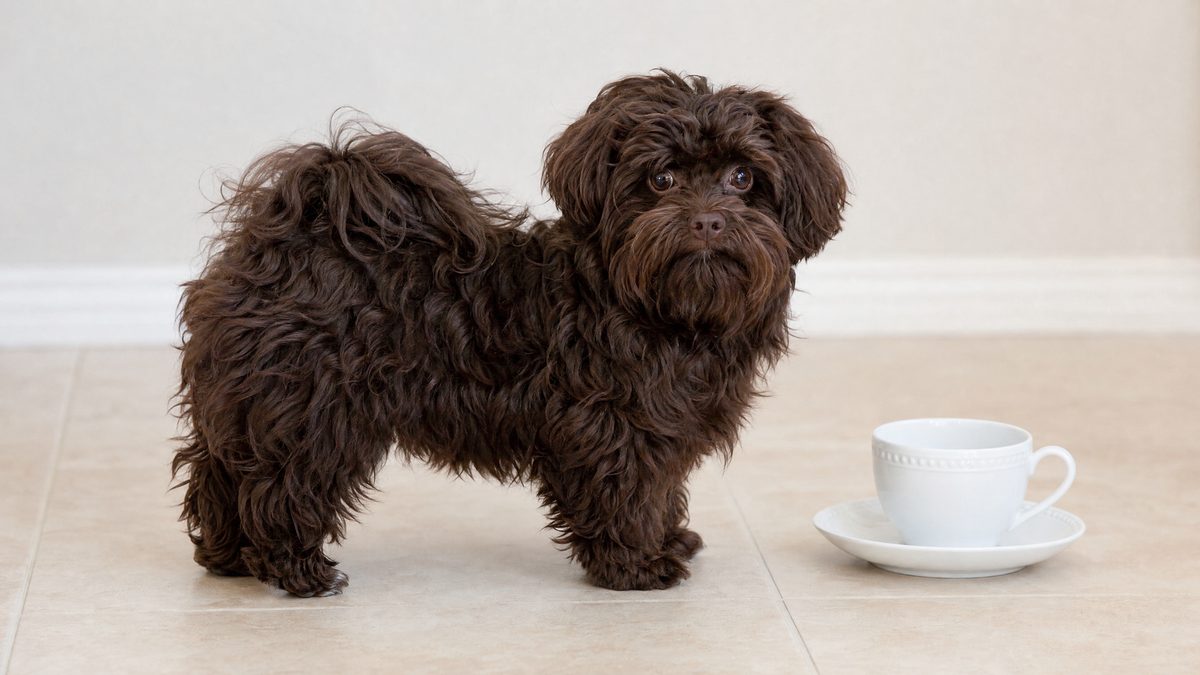
The AKC standard describes a small, sturdy, balanced dog, slightly longer than tall, that looks dishevelled because of its wavy or curly coat, moves with the tail carried over the back, and is friendly to all with no sign of aggression. The head carries a well-developed beard and moustache. Complete absence of that beard and moustache is a disqualification in the American standard and in the German one, which is unusual and tells you how central the furnishings are to breed type.
Height is where the two standards nearly agree and then diverge. Both want a dog up to about 26 cm at the withers. The AKC writes it as up to 10 and a quarter inches and disqualifies anything over 11 inches, which is 27.9 cm. The RKF text the VDH publishes wants up to 26 cm and disqualifies anything over 28 cm. The AKC's own breed page then rounds the whole thing to a flat 11 inches, which is the disqualifying height rather than the desired one.
The AKC prints a pronunciation guide because the name defeats people: Russian S-vet-naya Bo-lonk-a. The plural is Bolonki, not Bolonkas. Breeders shorten it to Bolonka in ordinary speech.
Nothing on this page is written for a Russian winter. Everything is checked against what the dog faces in Chennai in May and in Mumbai in August, because a double coat with a well-developed undercoat, designed by its own breeders for Russian cold, is the single most consequential thing about keeping this breed in India.
Which name means which dog, settled from the registry documents
Three names are in circulation and they resolve to two dogs plus one obsolete label. Read the table first, then the evidence for each row.
| Name | Literal meaning | The dog it denotes | Registry position |
|---|---|---|---|
| Russkaya Tsvetnaya Bolonka | Russian coloured lapdog | The coloured breed. Any colour except solid white. | Fully AKC-recognised in the Toy Group from 1 January 2026. Recognised by the RKF. Not FCI-recognised. |
| Bolonka Zwetna | Coloured lapdog, German transliteration | The same dog as above. Not a separate breed. | Nationally recognised by the VDH as standard number 999, expressly not FCI-recognised. |
| Bolonka, Bolonki | Lapdog, lapdogs | The everyday short name for the coloured one. | Used as the common name in all countries. Bolonki is the plural. |
| Franzuskaya Bolonka, Bolonka Franzuska | French lapdog | The white one, a bichon type close to the Bichon Frise. | Not recognised anywhere as a separate breed. German records folded it into the Bologneser in 1990. |
| Deutscher Bolonka | German Bolonka | An informal German label for the coloured dog, in use since the 1980s. | No registry standing. |
Take the colour test first, because it settles most arguments in one line. The coloured lapdog is by definition not white. The AKC standard permits all colours except solid white, spotted, parti-colour or merle, and makes any of those a disqualification, allowing only small white markings on the toes and forechest. The RKF text the VDH publishes says the same thing in German: every colour is allowed except white and piebald, with small white markings on chest and toes tolerated. So if the dog in the photograph is white, it is not a Tsvetnaya Bolonka, whatever the caption says.
The commonest error on the English-language internet
Dogbreedslist.info holds a page-one position for this term in India and gets the naming wrong twice on the same page. Its Other Names row lists Bolonka Zwetna, Franzuskaya Bolonka, Russian Lapdogs, Colored Lap Dog as synonyms of one breed, which merges the white dog into the coloured one. Its colour table then prints White as a Bolonka colour. And its own overview paragraph, two screens further down, says the opposite: that the Franzuskaya Bolonka is white while the Tsvetnaya and Zwetna are black, brown, gray, red or wolf-gray. A page cannot list white as a permitted colour and also say the coloured variety is never white.
The same page carries two further errors worth knowing about, because they propagate. It gives male height as 9 to 11 inches and converts that to 22 to 37 cm, when 11 inches is 27.9 cm, and it gives a separate, smaller range for females when neither live standard splits the sexes at all. Both standards state one height for dogs and bitches together Verband für das Deutsche Hundewesen. And its history section says a Maltese-like dog was given to Russia by the court of Louis IV, a French king who reigned in the tenth century, three hundred years before bichon-type dogs are first recorded.
Why the German name is the one in the scientific literature
The only paper indexed in PubMed that names this breed at all calls it the Bolonka Zwetna, because it came out of the University of Zurich. So a buyer searching the veterinary literature under the American name finds nothing, and a buyer searching under the German name finds the one study that exists. That is a practical consequence of the naming mess rather than a curiosity, and it is covered in the health sections below.
Ask a seller a single question: is this dog registered as Russkaya Tsvetnaya Bolonka, as Bolonka Zwetna, or as something else. Those first two are the same breed and either answer is coherent. Any answer involving the word Franzuska, or any white puppy offered as a Tsvetnaya Bolonka, means the seller does not know which dog they are selling.
What happened to the white one, and why no registry lists it
The Franzuskaya Bolonka is not a lost breed and it is not a colour variety of the coloured one. It is a population of white bichon-type dogs that the responsible authorities in Moscow told the FCI were Bolognese, after which the German studbook holding them was transferred wholesale into the Bologneser breed in 1990.
The Russian name is Французская болонка, French lapdog, and the story behind it is straightforward. Bologna-type lapdogs spread from the French aristocracy to the Russian court from the Renaissance onward, and Catherine the Great kept several at the Romanov court. After the October Revolution of 1917 trade links broke and the Soviet Union was isolated, so Soviet breeders carried on from the French stock already inside the country, without imports and with inbreeding, and the result got the name Bolonka Franzuska.
The East German chapter, with a number attached
Export from the Soviet Union was tightly controlled, but a few East German breeders obtained dogs through diplomatic channels, and from 1980 Bolonka Franzuska were exported to the GDR openly and bred under that name inside the VKSK, the East German smallholders' and small-livestock association. It became one of the most popular toy breeds in the GDR: 2,500 puppies were registered before reunification alone. That is not a marginal population, and it is why the question of what these dogs actually were mattered enough to be settled formally.
The first one to reach West Germany did so in 1982. A Russian bitch called Julia was entered in the studbook of the Verband Deutscher Kleinhundezüchter, the VDH member club that still keeps the German studbook for these breeds, and she was entered as a Bologneser. Her Russian original papers said Bolonka Franzuska.
Then in 1990 the whole VKSK studbook followed her. The club's account of the decision is that in Russia it had never been doubted that Bolonka Franzuska were Bolognese, and that this position was officially confirmed to the Secretary General of the FCI by the responsible authorities in Moscow. That is the closest thing to a formal ruling that exists on this name, and it is why no kennel club anywhere lists a Franzuskaya Bolonka today. The FCI's B list runs straight from Bolognese, standard 196, to Border Collie, with nothing between them.
One earlier voice disagreed and is worth recording because it shows the question was genuinely open at the time. The 1985 BI-Lexikon Hunderassen, a standard GDR reference, wrote that the Bolonka Franzuska certainly went back to the Bichon Frisé, and set out two possible futures for it: fold it back into the parent breed, or recognise it as independent. Moscow and the VK chose the first, and the parent they chose was the Bolognese rather than the Bichon Frisé.
The one place the white dog still has a page
English Wikipedia keeps a Franzuskaya Bolonka title, but it is a redirect. It lands on the Bichon article, where a short Bolonka Franzuska section sits directly under the Bolonka section, so a reader who follows the link from the Bolonka article arrives at a page about a dog type rather than a breed. German Wikipedia still keeps a standalone article, which records the height as 20 to 26 cm and the coat as always white, and states plainly that the Bolonka Zwetna was bred in the Soviet Union out of a colour variant of the Franzuska.
If somebody in India offers you a white Bolonka, the honest description of that dog is a Bolognese or a Bichon-type crossbred. The Bolognese is FCI standard 196 and has a real, checkable standard, so ask for that paperwork instead. A Franzuska pedigree does not exist to be produced.
Who recognises the Bolonka today, registry by registry
Four positions exist and they do not agree. The AKC recognises the breed fully, the RKF recognises it nationally, the VDH recognises it nationally as a foreign national breed, and the FCI does not recognise it at all.
| Registry | Status | Document | Evidence |
|---|---|---|---|
| American Kennel Club | Fully recognised, Toy Group, effective 1 January 2026 | Breed standard approved 17 June 2021, effective 1 January 2023 | One of three breeds recognised that day, taking the AKC total to 205 |
| AKC Foundation Stock Service | Left the programme on recognition | FSS list revised 10 June 2026 | The 88-breed FSS list has only two Toy breeds, Bolognese and Volpino Italiano, and no Bolonka |
| Russian Kynological Federation | Recognised nationally | Standard adopted by the RKF board on 24 November 2010, published in RKF Journal No. 5 2010 | Cited as the source text on the face of the German standard |
| Verband für das Deutsche Hundewesen | Recognised nationally since February 2011, expressly not FCI-recognised | Standard number 999, dated 29 August 2023 | The VDH page's own line reads: breed not FCI recognised, nationally recognised by the VDH |
| Fédération Cynologique Internationale | Not recognised, definitively or provisionally | None | Absent from the B nomenclature, absent from the R nomenclature, absent from the 20-breed provisional list |
| United Kennel Club | Listed for Bloodlines and Performance only, no conformation | None. The UKC page says no breed standard exists | The same registry publishes a full Bolognese standard, so the absence is a decision |
| The Royal Kennel Club | Not recognised | None | No Bolonka page on the site, while the Bolognese has a Toy-group breed standard |
| Kennel Club of India | No published standard traced | None found | India follows FCI nomenclature, and the FCI has no Bolonka standard for the KCI to adopt |
Take the FCI absence seriously, because it is checked three ways rather than asserted. The FCI's own B page lists every recognised breed alphabetically and jumps from BOLOGNESE straight to BORDER COLLIE. The R page, where a breed filed under its Russian name would sit, lists five: Russkaya Psovaya Borzaya, Russkiy Tchiorny Terrier, Russkiy Toy, Russko-Evropeiskaia Laika and, alphabetically nearby, the Ratonero Bodeguero Andaluz. No Russkaya Tsvetnaya Bolonka. And the provisional list, the real one, carries 20 breeds, the newest four dated 11 February 2026, and the Bolonka is not among them.
The German standard number is the tell
The VDH publishes the breed under Std. Nummer 999, which is not an FCI number. FCI numbers run in sequence and currently reach 378. A 999 is a placeholder the VDH uses for a breed it looks after nationally without FCI backing, and seeing it on a pedigree tells you immediately that the dog cannot be shown for an FCI CACIB. The VDH page states the position in one line: breed not FCI recognised, nationally recognised breed of the VDH.
Two English-language registries add a fifth and sixth position, and both were checked against a control on the same host. The United Kennel Club publishes a page for the breed, under the heading Bloodlines Listing Service Group, whose entire content is the sentence no breed standard exists for the Russian Tsvetnaya Bolonka and this breed is not eligible to compete in UKC Conformation events. That is a deliberate position rather than an oversight, because the same registry publishes a full Bolognese standard with a downloadable PDF. A UKC-listed Bolonka can be registered and can compete in performance events, and cannot be shown.
The Royal Kennel Club does not list the breed at all. A site search returns no Bolonka page of any kind, while the same search run for the Bolognese returns a Toy-group breed standard, an A to Z entry and a health-standard row. So in Britain the coloured Bolonka has no registry existence, and the white dog it descends from has one.
There is movement, though, and it comes from the German club rather than from the FCI. The colour-genetics monograph published by the Verband Deutscher Kleinhundezüchter says that an FCI standard has long been in preparation and that how it will finally settle the colour question is uncertain. Treat that as a live process with no date attached rather than an imminent change.
The AKC route, and why the breed vanished from one AKC list
The breed entered the AKC Foundation Stock Service in February 2015. The club that got it there was formed as the North American Russian Tsvetnaya Bolonka Club in 2000 and renamed itself the Russian Tsvetnaya Bolonka Club of America when the FSS listing came through. Full recognition then required 150 dogs with three-generation pedigrees, a written standard, one club representing the breed, a period in the Miscellaneous Class, Certificate of Merit titles, judging seminars and two Open shows.
Having completed that, the breed left the FSS. Anyone checking the AKC's FSS list today finds only two Toy breeds on it, the Bolognese and the Volpino Italiano, out of 88 breeds in the programme. That absence is a promotion, not a delisting, and it is easy to misread as the opposite.
The American and Russian standards, compared line by line
Two live breed standard documents describe this dog and they agree on most of it, which makes the eight places they diverge worth knowing before you judge a puppy against either one.
The American text is the Standard of the Russian Tsvetnaya Bolonka, approved 17 June 2021 and effective 1 January 2023, published by the Russian Tsvetnaya Bolonka Club of America, which also hosts an illustrated version showing the correct outline and head. The German text is Standard-Nr. 999, dated 29 August 2023, and it is not a German invention: its own front matter names its source as the standard version adopted by the RKF board on 24 November 2010 and published in RKF Journal No. 5 of 2010, translated into German by Karin Biala-Gauss. So this is an American document against a Russian one, with the Germans acting as translator rather than author.
| Point | AKC, effective 2023 | RKF text as published by the VDH | Practical effect |
|---|---|---|---|
| Desired height | Up to 10.25 in, 26.0 cm | Up to 26 cm, both sexes | Identical in practice |
| Disqualifying height | Over 11 in, 27.9 cm | Over 28 cm | A 27.95 cm dog is disqualified in the USA and allowed in Germany |
| Weight | Ideal 7 to 9 lb, 3.2 to 4.1 kg | Average 3 to 4 kg | The German floor is 200 g lower |
| Merle | Explicitly disqualified by name | Not mentioned at all | A merle Bolonka fails an AKC ring and is unaddressed in the Russian text |
| Dwarfism | Not addressed | Pronounced dwarfism characteristics are a disqualification | Teacup marketing is disqualifying under the Russian text and merely unmentioned under the American |
| Aggression | Should never show aggression, but not a listed disqualification | Aggressive or excessively fearful dogs are disqualified | The Russian text puts temperament in the DQ list |
| Eye set | Set on the frontal plane | Set straight | Agreed. The German club's own web page says slightly obliquely set, which agrees with neither |
| Shoulder angle | 100 to 110 degrees | 100 to 110 degrees | Identical, and clear evidence of a shared parent text |
| Body length | Not more than 15 percent longer than height | Not more than 15 percent longer than height | Identical |
| Undercoat | Well-developed undercoat required | Missing undercoat is a severe fault | Agreed, expressed differently |
What both texts insist on, and what that means for a photograph
Four features are non-negotiable in both documents, and between them they let you reject a mislabelled dog from a photograph. The coat must be long, dense and forming large curls, with large curls preferred over waves, never straight. The head must carry a developed beard and moustache, and complete absence of them disqualifies in both Verband für das Deutsche Hundewesen. The ears must hang: the German text calls them medium, triangular with slightly rounded tips, richly furnished and hanging from the cartilage, and makes half-erect or erect ears a severe fault, while the AKC calls them V-shaped, dropped, lying close to the skull and lifting at the base when alert Russian Tsvetnaya Bolonka Club of America. And the tail must be full and carried over the back with the tip touching the body, with taillessness or a short tail disqualifying in the German text and a missing or docked tail disqualifying in the American one, which adds the plain sentence the tail may not be docked Verband für das Deutsche Hundewesen.
Blue eyes disqualify in both. So does a spotted or flesh-coloured nose in the AKC text, where the German text simply requires black or coat-coloured pigment, preferably dark Verband für das Deutsche Hundewesen.
The clause nobody quotes
The German text contains one line with no counterpart anywhere in the American standard: the colours of the Bolonka should not be reminiscent of a Shih Tzu or a Poodle. It sits in the general appearance paragraph, and it is a breed-identity instruction rather than a colour rule, aimed at the two founding or neighbouring breeds whose patterns would blur the type. It is the clearest statement in either document that this breed is defined against its relatives rather than only in its own terms.
Neither, formally, because India has no Bolonka standard. In practice, ask which registry issued the pedigree and read that registry's text. An AKC-registered import is described by the American standard; a German-bred dog with a VDH pedigree is described by standard number 999. Both are freely downloadable and both are short.
Three contradictions inside the German documents, and one on Wikipedia
Four checkable errors and internal conflicts sit in the German-language sources for this breed, and none of them appears on any English page. They matter because German documents are the ones a European-bred import arrives with.
One: the bite is tolerated in one paragraph and disqualifying in another
The German standard's dentition paragraph reads that a scissor bite is desired, and that a level bite as well as a slight undershot bite are tolerated. Its severe-faults list then makes an overshot bite a severe fault. And its disqualifying-faults list, three items below, reads undershot bite, wry bite. So the same two-page document tolerates a slightly undershot mouth in one paragraph and disqualifies an undershot mouth in another, with no wording to reconcile them.
The AKC text handles the same anatomy without tripping: a scissors bite is preferred, a level bite or a slightly undershot bite is tolerated, and only an overshot bite or a wry mouth disqualifies. Read the two together and the German list is almost certainly meant to disqualify a pronounced undershot bite, but the document does not say so, and a judge or a buyer reading only the disqualification list would reach the opposite conclusion. The German club's own page adds a third wording, tolerating a Reibevorbiss, a grinding edge-to-edge contact.
Two: the club that keeps the studbook publishes a narrower height than the standard
The Verband Deutscher Kleinhundezüchter is the VDH member club that actually maintains the German studbook for this breed, and its breed page gives the size as desired 24 to 26 cm. The standard the VDH publishes gives desired height as up to 26 cm, with no lower bound and a disqualification only above 28 cm. A 22 cm dog is inside the standard and outside the club page's range. If you are buying from Germany, that four-centimetre band is the one the studbook keeper is working to.
Three: the same club describes the eyes and muzzle differently from the standard
The standard says the eyes are set straight and that the muzzle length is slightly more than one third of the skull length. The club page says the eyes are slightly obliquely set and that the muzzle is a little shorter than the skull length, which is a very different proportion from one third. The AKC agrees with the standard on both: eyes on the frontal plane, muzzle slightly more than one third of the length of the head. Two of three sources agree and the odd one out is the club whose studbook the dog is in.
Four: German Wikipedia links the wrong standard entirely
The German Wikipedia article on the Bolonka Zwetna has a Zuchtstandards row in its infobox with two links. The VDH link is correct. The link labelled Russische Kynologische Föderation points at a PDF on rkf.org.ru whose file name contains vostochnoevropejskaja, and opening it returns a complete, correctly formatted RKF standard approved by the RKF Presidium on 15 October 2014 with amendments of 18 March 2020, for the Vostochnoevropeiskaya Ovcharka, the East European Shepherd. That is a 65 kg service dog, not a 4 kg lapdog.
The document is genuine, the server returns it normally, and nothing about the request fails. Only the heading printed inside the file gives it away. A reader following that link to check the Russian standard for the Bolonka reads a shepherd-dog standard instead, and would find no Bolonka in it and draw exactly the wrong conclusion. The same article also still says that neither the Zwetna nor the Franzuska achieved international recognition, and still carries the category Miscellaneous Class (AKC), both of which the AKC's January 2026 recognition made out of date American Kennel Club.
Read the heading printed inside the document, not the link that took you there. The RKF PDF says East European Shepherd on its first page. The German club page says 24 to 26 cm where the standard says up to 26 cm. Thirty seconds inside each file is the whole check.
Coat colours: the one trait the whole breed is named after
Colour is not a preference in this breed, it is the definition, because tsvetnaya means coloured and the dog exists as a separate breed only because Soviet breeders wanted a lapdog that was not white. That makes the coat colours section the place where the two standards and the American registration system pull apart hardest.
The rule in both live standards is the same and it is short. Every colour is permitted except solid white, and the German text adds piebald, while the American text spells out spotted, parti-colour and merle. Small white markings on the toes and forechest are permitted in both Verband für das Deutsche Hundewesen. Large white chest markings and white paws are a severe fault in the German text, one grade short of disqualifying.
What the AKC will actually register
The AKC's registration system lists 17 colour codes and 7 marking codes for the breed: Red Sable 155, Golden 093, Sable 164, Black and Tan 018, Red with Black Overlay 422, Brown with Black Overlay 421, Grizzle 109, Black Brindle 279, Black 007, Brown 061, Red 140, Gray 100, Wolfgray 227, Fawn 082, Blue 037, Cream 076 and Silver 176, plus markings for Black Mask 004, Tan Points 029, Tan Markings 012, Silver Markings 034, Fawn Markings 008, Saddle Pattern 131 and Brindle 051.
Two of those codes sit awkwardly against the German position. The VK's colour-genetics monograph, written by the same person who translated the VDH standard, states that brindle is a recent appearance in the breed, that a brindle coat no longer counts as solid colour, and that brindle is not mentioned as permitted in the current standard. The AKC nonetheless carries Black Brindle as colour code 279 and Brindle as marking code 051. The German club page, meanwhile, lists brindle among its permitted colours, disagreeing with its own colour monograph.
Blue and silver, and the health argument against them
Blue is colour code 037 and Silver is 176 in the AKC system. Blue in dogs is the dilute, produced by a homozygous dd genotype at the D locus. The VK monograph makes an explicit health argument against breeding for it: homozygous dd can cause colour dilution alopecia, meaning progressive and final hair loss during the first year of life affecting only the diluted parts of the coat, often with thickened, dried, inflammation-prone skin that is distressing for both dog and owner. The author states that on her research dd does not occur in current pure lines, that she cannot exclude it, and that breeding for dilution would be questionable on health grounds.
One further line from the same document is directly useful to an Indian owner, and appears nowhere else. Lightened colours produced by bb or dd are associated with increased tear flow, and the author says this should be taken into account in breeding. In an Indian city, a small white-faced dog with a wet face collects dust and stains, and the pale-coloured dogs are the ones that will need the daily face wipe most.
Why your puppy's colour will change
Expect the colour you buy not to be the colour you keep. Three separate mechanisms are at work. Many solid-coloured Bolonka puppies are born with a black mask that fades away during the first years of life, which the monograph calls a phantom mask and attributes to temporary black pigment in the mask hairs at birth rather than to the true mask allele. Agouti puppies born red with black commonly mature to apricot. And the G locus produces progressive greying: puppies born black or chocolate lighten noticeably during the first year, black going to blue-grey or silver-grey and chocolate to a milky coffee or cream, sometimes on the body only while head and legs stay dark.
The coat texture changes on the same schedule. Puppies begin to change coat gradually from about six months, some develop their curl only during that change, and most Bolonki have a completely changed coat and full curls by 12 months.
One further genetic point matters for anyone buying a dog with white on it. Recessive s alleles, which produce white spotting, are still present in the gene pool from founding or later out-crossed breeds. A standard-conforming Bolonka must be SS at the S locus, and the small permitted markings on chin, throat, feet and chest come from modifier genes rather than from a spotting allele. Anything more than very small markings is a sign of the recessive allele rather than a modifier.
Bolonka price in India: there is no Indian market, and here is the evidence
No price in India exists for the Bolonka, because no Indian seller stocks the breed. Every rupee figure that surfaces against the name in an India-restricted search belongs to a T-shirt, a digital download, a bronze statue or an art print.
Start with the control, because an absence only counts as evidence if the search itself worked. An India-restricted search for the breed name together with puppy price and rupees returned no Indian dog listing at all. The same tool, in the same session, run on labrador retriever puppy price in india, returned a complete Mr n Mrs Pet page publishing INR 30,000 to INR 1,20,000, broken into basic quality at INR 30,000 to 60,000, KCI registered at INR 60,000 to 90,000 and champion bloodline at INR 90,000 to 1,20,000, with a city table covering Hyderabad, Bangalore, Delhi, Chennai, Lucknow, Mumbai, Jaipur and Pune. The control returns a priced page. The breed query does not. That is a real absence, not a broken search.
What the Indian rupee results actually are
The India-restricted results for this breed are merchandise, top to bottom. Etsy runs an Indian storefront page whose title is literally Buy Bolonka Online In India, and what it sells is prints and digital downloads priced in the low hundreds of rupees. Ubuy India carries a Bolonka Zwetna Puppy Dog Proud Woman for Dog Owners Raglan, a slogan shirt, confirmed on the product page itself. The remaining India-restricted results are a Desertcart India gift item, a Saatchi Art print, an eBay bronze statue and a Facebook answers page. Not one of them is a dog.
This is the useful finding and it is worth saying plainly. Everything you can buy in India with the word Bolonka on it is a printed image or a shirt. There is no second category, and there is certainly no dog.
The international prices, which disagree by a factor of thirty
Outside India the breed does sell, and the published spread is extraordinary for a single breed.
| Source and market | Published price | At 84.38 | At 74 | What it is |
|---|---|---|---|---|
| PetGlobals, Zhukovsky, Russia | EUR 107.80, about USD 133 | Rs 11,222 | Rs 9,842 | Classified listing, Russian nursery |
| PetGlobals, Losino-Petrovsky, Russia | EUR 323.39, about USD 484 | Rs 40,840 | Rs 35,816 | Classified listing, male |
| PetGlobals, Vsevolozhsk, Russia | EUR 431.19, about USD 445 | Rs 37,549 | Rs 32,930 | Nursery specialising in the breed since 2001 |
| PetGlobals, Munich, Germany | EUR 450.00, about USD 475 | Rs 40,081 | Rs 35,150 | Classified listing |
| PetGlobals, Vsevolozhsk, Russia | EUR 592.88, about USD 716 | Rs 60,416 | Rs 52,984 | Advertised as a miniature girl |
| PetGlobals, Rokiskis, Lithuania | EUR 1,200.00, about USD 1,248 | Rs 1,05,306 | Rs 92,352 | Advertised as a chocolate baby lapdog |
| Dogbreedslist.info | USD 1,500 to 2,500, up to 3,000 | Rs 1,26,570 to 2,10,950 | Rs 1,11,000 to 1,85,000 | Editorial estimate, no market named |
| Good Dog, United States | USD 3,000 to 4,000 | Rs 2,53,140 to 3,37,520 | Rs 2,22,000 to 2,96,000 | Live US marketplace band |
The dollar conversions in that table are the site's own, not ours. What the two rupee columns show is the range an honest Indian quote would have to fall inside: roughly Rs 10,000 at the Russian floor to roughly Rs 3.4 lakh at the American ceiling, a spread of about thirty to one for the same breed. A seller quoting a single confident Indian figure for a dog with that spread has not sourced it from anywhere.
One Indian listing site has repeatedly been caught printing Rs 98,999 across its pages, attached to whichever puppy is in stock rather than to any breed, alongside recurring animals such as two Maltipoos and a Doxiepoo, and it appears on pages for breeds the site does not stock at all. It divides to USD 1,173.25 at 84.38 and USD 1,337.82 at 74, neither of them a round dollar figure, so it is not even a bad conversion. It is a rupee-native charm price. Never accept it as a Bolonka price.
The only lawful way a Bolonka reaches India, read from the trade notice
One route exists and it is narrow: you bring your own dog with you. DGFT Trade Notice 22/2022-23 of 19 December 2022 classifies dogs under ITC(HS) 01061900 as Restricted, and permits import for exactly three purposes.
The three permitted purposes, quoted from Policy Condition (7) of the notice, are a pet dog with a valid pet book and relevant records in the name of the importer; dogs imported by R&D organisations for research with the recommendation of the CPCSEA; and dogs for internal security by the Defence and Police Force. Policy Condition (8) then closes the door explicitly: import of commercial dogs for breeding or any other commercial activities other than the purposes mentioned above is not permitted.
Paragraph 6 of the same notice repeats the point in operational language, stating that any applications for trading or breeding purposes, or applications made on behalf of another person or entity, shall be duly rejected. Read those two together and no lawful supply chain for this breed can form in India. A commercial importer cannot bring in breeding stock, and nobody can import a puppy on your behalf.
What the personal route actually requires
Up to two pets can come in as passenger baggage without a DGFT authorisation, but only for a person transferring residence to India after two years of continuous stay abroad, and only cats and dogs qualify under the baggage rules. A DGFT import authorisation is required if the stay abroad was under two years, if the pet is not travelling as passenger baggage, if the pet cannot come under baggage rules, or for any temporary import. More than two pets always needs an authorisation, and those applications go to the DAH&D for examination first.
The mechanics are specific enough to plan around. Apply on the DGFT website using form ANF-2M against your own Importer Exporter Code, or against the permanent IEC number IIHIE0153E reserved for persons importing for personal use. Start the process at least two months before travel. Then obtain an Advance No Objection Certificate from the Regional or Quarantine Officer of the Animal Quarantine and Certification Service, submitting the DGFT licence and a health certificate from a veterinarian in the exporting country, with all disease testing done in that country and the reports travelling with the animal. The NOC must be obtained seven days before travel, relaxable to three days.
The Kennel Club of India adds a paperwork layer on top of the government one. Its checklist for registering a dog as import status requires the export pedigree in original, the airway bill in original, the air ticket in original, the boarding pass with payment, the DGFT licence, the customs clearance document, the quarantine clearance document, the pet passport and a notarised affidavit. For a Bolonka the first of those is the hard one: the export pedigree would have to come from the AKC, the RKF or the VDH, and the KCI has no Bolonka standard of its own against which to place the dog in a group.
Entry is limited to seven places. Import of pet animals is allowed only through the airports and seaports of Delhi, Mumbai, Chennai, Hyderabad, Bengaluru and Kolkata and, since October 2024, Kochi airport, and animals may be quarantined at the government quarantine station of those ports. The full route is set out in how to import a dog to India.
Ask for the DGFT import authorisation number under which the parents entered India, and ask for the registry and registration number on the pedigree. There is no lawful commercial breeding import route, so a genuine Indian-bred litter would need documented parents who arrived as somebody's personal pets, and the pedigree would say Russkaya Tsvetnaya Bolonka or Bolonka Zwetna. Nobody in India has produced either document.
Indian breeding law, and the clause that collides with the breed standard
If a Bolonka litter is ever bred in India, the Prevention of Cruelty to Animals (Dog Breeding and Marketing) Rules 2017 govern it, and one of their clauses names a trait that both Bolonka standards expressly tolerate.
If a litter is ever bred in India, the Prevention of Cruelty to Animals (Dog Breeding and Marketing) Rules 2017, gazette notification G.S.R.496(E), govern it. Rule 8(1)(a) states that pups less than eight weeks in age are not sold, and Rule 8(1)(b) that dogs over six months are not sold without first being sterilised unless sold to another licensed breeder.
The Second Schedule, Part II, paragraph 6(8) prohibits tail docking, ear cropping, de-barking, de-clawing, branding, dyeing, injecting substances to enhance visual appeal, surgery to camouflage a defect, and any other mutilation or change of appearance by artificial means, calling all of it strictly forbidden. That aligns exactly with both breed standards, which disqualify a docked tail, so on this point Indian law and the breed standard want the same dog.
The clause that does not align is in Part III, paragraph 8(10). It requires that dogs shall have been tested for genetic defects, including hip dysplasia, progressive retinal atrophy, night blindness, hypothyroidism, entropion, ectropion, overshot, undershot jaw (when incisors do not touch or mesh), wry mouth, two or more missing teeth, unilateral cryptorchid or full cryptorchid males. Both Bolonka standards tolerate a slightly undershot bite. So an Indian breeder following the breed standard would be producing dogs carrying a trait that Indian law names in its genetic-defect testing list. The rule requires testing rather than exclusion, so this is not automatically an offence, but it is a genuine collision between what the standard permits and what the law flags, and nobody writing about this breed has noticed it.
Two more provisions are worth knowing before anyone breeds a toy bitch. Paragraph 5(6) states that no female dog shall be exploited to give birth to more than five litters in her lifespan, paragraph 5(7) that no male shall be used for breeding before his eighteenth month, and paragraph 6(4) that female dogs shall not be mated after the age of eight years.
Ask for the DGFT import authorisation number under which the parents entered India, and ask for the registry and registration number on the pedigree. There is no lawful commercial breeding import route, so a genuine Indian-bred litter would need documented parents who arrived as somebody's personal pets, and the pedigree would say Russkaya Tsvetnaya Bolonka or Bolonka Zwetna. Nobody in India has produced either document.
What a Bolonka costs to keep in India each month
Budget roughly Rs 6,000 to Rs 13,500 a month for a 3 to 4 kg Bolonka in an Indian metro, with grooming rather than food as the largest line, which is the reverse of most breeds.
Set the cost of ownership out honestly, with the uncertainty visible. Nobody in India keeps this breed at any scale, so the food and veterinary lines below are derived from body weight and from what small long-coated toy dogs cost here, not from Bolonka-specific Indian data, and they are labelled as such. Where a figure is genuinely unknown, this page says so rather than inventing one.
| Line item | Typical monthly range | Basis |
|---|---|---|
| Complete dry food, 3.5 kg dog | Rs 900 to 2,200 | Roughly 2.5 to 3.5 kg of premium small-breed kibble a month |
| Wet food or fresh toppers | Rs 0 to 1,200 | Optional, and easy to overdo on a dog this size |
| Professional grooming | Rs 2,000 to 5,000 | One or two full sessions a month for a curly coat, the largest single line |
| Home grooming consumables | Rs 300 to 700 | Shampoo, conditioner, comb and slicker replacement, ear cleaner |
| Tick and flea prevention | Rs 400 to 900 | Non-negotiable in India, see the health sections |
| Routine veterinary care, amortised | Rs 700 to 1,500 | Annual vaccination, deworming, dental checks, spread over 12 months |
| Eye and dental maintenance | Rs 200 to 600 | Daily eye wipes plus toothpaste, driven by the breed's specific risks |
| Air conditioning attributable to the dog | Rs 1,200 to 3,000 | Summer months in Delhi, Ahmedabad, Chennai or Kolkata, see the climate section |
| Estimated total | Rs 5,700 to 15,100 | Realistic planning band, Rs 6,000 to 13,500 in a normal month |
Why grooming dominates the budget
This is a long-coated dog with a well-developed undercoat and large curls, and the standard forbids trimming other than neatening the feet, so the coat you buy is the coat you maintain. The AKC's own care guidance is to brush or comb with a wide-tooth comb several times a week to prevent mats, and to wash the face, moustache and beard daily on a dog kept in full coat. Nothing in that routine scales down with body weight. A 3.5 kg Bolonka takes as much grooming labour as a 9 kg Havanese and more than a 25 kg Labrador.
The grooming line is the one figure here with real Indian market data behind it. A services marketplace publishing city-wise 2026 rates gives a full groom for a long-coated dog at Rs 1,400 to 2,500 in Pune, Rs 1,800 to 3,500 in Mumbai, Rs 1,500 to 3,000 in Bangalore and Rs 1,200 to 2,500 in Hyderabad, at a recommended frequency of every four to six weeks, with a basic bath and dry between sessions at Rs 350 to 800 and dematting billed separately at Rs 500 to 1,500. Two full grooms and a bath in a month is how the Rs 2,000 to 5,000 band above is reached, and the same source recommends increasing frequency by 25 to 30 percent from June to September.
The two costs Indian buyers forget
Air conditioning is a real line item, not a luxury, for a Russian double-coated breed in an Indian summer, and the climate section quantifies why. Budget for the room the dog lives in being cooled through the hottest four hours of the day from March to June in the northern and western metros.
Tick prevention is the second. Indian tick-borne pathogen prevalence is high enough to make monthly prophylaxis a fixed cost rather than a seasonal one: an eight-district Odisha survey of 320 dogs found 31.56 percent carrying at least one tick-borne pathogen. On a dog with this coat, you will not see the tick, which is the whole argument for spending the money.
One cost this breed does not carry is early orthopaedic surgery on a large frame, and one it may carry is patellar surgery on a small one. OFA records patellar luxation in 8.4 percent of 131 evaluated Bolonki, and grade 2 or grade 3 luxation, the grades most likely to reach surgery, in 3.1 percent of them. Price a one-off surgical contingency of Rs 25,000 to Rs 60,000 into your thinking rather than into your monthly budget.
Heat tolerance: the origin climate against the Indian one, with coordinates
Heat tolerance rates 2 out of 5 for the Bolonka, because this is a heat-sensitive double-coated breed and there is a 21 degree gap between where it was made and where you want to keep it. Moscow's annual mean air temperature is 4.28 degrees C. Delhi's is 25.60 NASA POWER climatology API.
These figures come from the NASA POWER climatology service, queried by explicit latitude and longitude rather than by place name, with the coordinates the API returned checked against the coordinates requested in every case. Moscow was queried at 55.7558 north, 37.6173 east and the API echoed 55.756 and 37.617. Saint Petersburg was queried at 59.9311 north, 30.3609 east and echoed 59.931 and 30.361 NASA POWER climatology API. That check matters because a climate page served for the wrong city would discredit the most original argument on this page.
| Location | Annual mean temp, C | Coldest month mean, C | Warmest month mean, C | Annual mean RH, percent |
|---|---|---|---|---|
| Moscow, breed origin | 4.28 | -10.7, January | 19.0, July | 87.5 |
| Saint Petersburg, breed origin | 4.41 | -9.1, January | 18.3, July | 88.9 |
| Bengaluru | 23.74 | 20.2, December | 28.4, April | 67.9 |
| Pune | 23.86 | 19.6, December | 28.9, April | 66.8 |
| Delhi | 25.60 | 13.6, January | 35.9, June | 45.6 |
| Kolkata | 25.81 | 17.3, January | 31.5, May | 73.9 |
| Hyderabad | 26.10 | 20.8, December | 33.3, May | 60.3 |
| Mumbai | 26.77 | 23.2, January | 31.2, May | 67.4 |
| Ahmedabad | 27.57 | 19.9, January | 35.1, May | 48.3 |
| Chennai | 27.95 | 24.1, January | 31.5, May | 72.4 |
The one comparison that settles it
Read the table for the sentence hiding in it. Bengaluru's coolest month is warmer than Moscow's hottest month. December in Bengaluru averages 20.2 degrees C; July in Moscow averages 19.0 NASA POWER climatology API. Bengaluru is the mildest large city in this list. So in the friendliest Indian metro for a cold-climate dog, the coolest four weeks of the year are still warmer than the warmest four weeks the breed's founders ever designed for.
Mumbai makes the same point harder. Its coldest month, January, averages 23.2 degrees C, which is 4.2 degrees warmer than Moscow's July. A Bolonka in Mumbai never experiences a month as cool as a Moscow summer.
Humidity is not the differentiator, temperature is
Here the data corrects an intuition. Moscow's annual mean relative humidity is 87.5 percent and Saint Petersburg's is 88.9, both higher than every Indian city in the table, Kolkata at 73.9 included NASA POWER climatology API NASA POWER climatology API. So this is not a dog from a dry climate. It is a dog from a cold wet one, which is a different problem: it is used to damp air but only at low temperature, and it has no experience at all of damp air at 30 degrees.
The monsoon months are where the two combine badly. Mumbai runs 90.4 percent mean relative humidity in August at a mean 26.1 degrees C, Pune 90.8 percent in August, and Kolkata 89.1 percent in August. A dense undercoat that stays damp in that air is the mechanism behind most of the skin problems this breed will have in India, and it is the reason the grooming section rejects one piece of the breed club's own advice.
City by city, what to expect
- Bengaluru and Pune are the two workable cities. Annual means of 23.7 and 23.9 degrees C, and April peaks of 28.4 and 28.9. A Bolonka can live here with shade, early walks and a fan, without permanent air conditioning.
- Hyderabad is manageable with restrictions. The annual mean is 26.1 but May averages 33.3 degrees C, so March to June needs a cooled room in the middle of the day.
- Mumbai and Chennai are hard. Neither has a cool season for this dog, and both add high humidity. Expect indoor living with cooling for most of the year and monsoon skin management on top.
- Kolkata is the worst combination in the list: a May mean of 31.5 degrees C followed by three months above 87 percent humidity.
- Delhi and Ahmedabad are the extreme cases. Delhi's June mean is 35.9 degrees C and its peak recorded 2 m temperature in June across 2001 to 2020 was 48.8; Ahmedabad's May mean is 35.1 with a peak of 48.6. A dog whose origin city peaks at 35.1 has no physiological answer to that.
One caveat on the peak figures. NASA POWER's T2M_MAX is the highest hourly 2 m temperature recorded in that month across the period, not a monthly average high, so 48.8 in Delhi is an extreme rather than a routine day. It is quoted here because a dog does not get to average its worst afternoon.
The Indian summer routine that actually prevents heatstroke
Manage the Bolonka's heat risk by changing when it moves rather than by cutting its coat, because the largest study of canine heat-related illness found that exertion, not confinement, is what kills dogs.
The VetCompass study of 905,543 UK dogs identified 1,259 heat-related illness events in 1,222 dogs and found exertional heat-related illness the predominant trigger at 74.2 percent of the 879 events where a cause was recorded, against 12.9 percent environmental and only 5.2 percent vehicular confinement. The odds of death after vehicular heat illness were statistically similar to the odds after exertional heat illness. The authors' own headline is that in the UK, exertion affects and kills more dogs than a hot car does.
Apply that to India, where ambient temperatures are far higher than the UK's, and the conclusion is uncomfortable for owners of small energetic dogs. The dangerous moment is not the parked car, which most Indian owners already know about. It is the 5 pm walk in May because the dog was bouncing off the walls, or the enthusiastic fetch session on a terrace at 3 pm.
The daily schedule from March to June
- Walk before 07:00 and after 19:30, and test the pavement with the back of your hand for five seconds before you step off the lift.
- Cap outdoor sessions at 15 minutes in April to June in Delhi, Ahmedabad, Chennai, Kolkata and Hyderabad, and split the day's exercise into three short outings rather than one long one.
- Move all training and problem-solving indoors during the hot months. This breed is trainable and takes well to indoor games, so mental work substitutes for distance genuinely well.
- Keep one room at 26 to 28 degrees C through the middle of the day and let the dog choose to be in it. A Bolonka will not tell you it is overheating until late.
- Carry water on every outing, offer it every five minutes, and do not wait to be asked.
- Wet the belly, groin and paw pads rather than the back, because water sitting on a dense curly coat traps heat instead of releasing it.
Do not shave, and here is the honest version of why
Shaving a double-coated dog removes the insulating layer that also slows heat gain, and the coat rarely regrows in its original texture. On this breed there is a second cost that is specific rather than general: the curl is a breed-defining trait that develops during the coat change between six and twelve months, and a coat that has been stripped or straightened cannot be assessed for it at all. A puppy shaved in its first Indian summer may never show you what its adult coat was going to be.
The workable alternative is a shorter maintained length rather than a shave. Keep the coat combed right through to the skin so air can move, keep the belly and groin clipped short where it touches the floor, and accept that the head furnishings stay. That gives you airflow without stripping the insulation.
Recognising the emergency
A Bolonka at 3.5 kg has very little thermal mass and will decompensate faster than a large dog. Purina India lists the signs as severe panting, difficulty breathing, severe salivating, vomiting, diarrhoea, a raised temperature of 40.5 degrees C or above, blood in the urine, nosebleeds and ultimately collapse and coma, and names excessive humidity, obesity, intense exercise, old age and lack of acclimatisation among the factors that raise the risk. It also notes that a dog can develop heat stroke after vigorous exercise in hot weather in as little as 30 minutes.
Owners of small dogs assume small means low risk, and then take the dog out at the same times they would take a Labrador, on the reasoning that it is only a short walk. The VetCompass data says exertion is the dominant trigger. A short walk at 4 pm in May in Ahmedabad is exertion at 35 degrees C for a dog built for 19.
The first-aid detail is worth learning before you need it, because two common instincts are wrong. Spray or sponge with cool but not cold water, making sure it reaches the skin rather than running off the coat, and wet the belly and the inside of the legs thoroughly; use a fan; do not plunge the dog into cold water or an ice bath, because that prevents the core temperature coming down; and stop cooling once the temperature reaches 39.4 degrees C so the dog does not swing into hypothermia. On a curly double coat the water-to-skin instruction is the one that matters most, since a sprayed Bolonka can look wet and be dry underneath.
Temperament and household fit, including who should not buy one
The Bolonka is even-tempered, affectionate and friendly to everyone, and the AKC standard makes that a requirement rather than a description: the breed should never be shy or show aggression of any kind.
The breed was designed for one job. Soviet apartment blocks had no room for a working dog, and the LODIR cynologists who fixed the type in Leningrad were building a small companion for city flats. The AKC repeats it in its own words: Bolonki were originally bred to be the ultimate house pet for apartment living. Almost nothing about this dog is a compromise between a working purpose and a domestic one, which is unusual and is the main reason it suits Indian flats.
The German standard describes an attached dog with a lively temperament and a balanced character, and puts aggression and weakness of character in its disqualification list, which is a stronger position than the American text takes. The VK's own club page adds the practical version: alert and watchful but not a yapper, usually announcing visitors, and unhappy being left alone.
Two traits that surprise new owners
First, the breed is more independent than most toys. The AKC says so twice on its breed page, noting that Bolonki are fairly independent for a toy breed and require early socialisation with people. Do not expect a dog that dissolves into your lap on day one. Expect one that decides about you.
Second, some are mimics. The AKC's description notes that some Bolonki are excellent mimics while others are content to sit by the door and monitor who is allowed in and out. That door-monitoring habit is the raw material of a barking problem in an Indian apartment corridor, where a stranger passes every few minutes.
Who this dog suits
- Households where somebody is home most of the day, because this breed does not like being alone.
- Flats of any size, including 1BHKs, since the exercise requirement is genuinely modest.
- Families with children old enough to handle a 3.5 kg dog without dropping it, which in practice means about seven and up.
- Owners willing to comb a curly coat several times a week for the next fifteen years.
- Homes in Bengaluru, Pune or the hill stations, or homes anywhere in India that will run air conditioning for the dog in summer.
Who should not buy one
- Anyone out of the house nine hours a day. A dog bred to be a house companion and left alone all day becomes a barker.
- Households with toddlers. A 3 kg dog and a two-year-old is a fracture risk for the dog, not a bite risk for the child.
- Anyone who wants a low-maintenance coat. There is no low-maintenance version of this dog.
- Anyone buying on the hypoallergenic claim, which the evidence does not support and which this page addresses separately.
- Anyone in Delhi, Ahmedabad, Chennai or Kolkata who is not prepared to change the household routine around the dog's heat limits for four months of the year.
One quiet warning about guarding. The breed was bred with a tendency to defend its territory and its people and can make a reasonable alarm dog, but it cannot follow through and should never be given a guarding job. A 3.5 kg dog that announces an intruder has done everything it is capable of doing.
The AKC records that Bolonki get along well with dogs and other animals, and rates the breed as good with children while noting supervision is always sensible. Unlike a terrier, this is not a breed with a hard constraint around small pets, which widens the households it can join.
Training a clever, mildly independent toy dog
Train a Bolonka with a firm but gentle hand, short sessions and early socialisation, and it does well in obedience, rally, tracking and agility. The two things that go wrong are barking and the small-dog exemption owners give themselves.
Start with what the breed brings. The AKC describes the Bolonka as very clever and smart, doing well in formal training when trained firmly but gently, and specifically names obedience, rally, tracking and agility as sports it succeeds in. The VK's club page says the same in German: highly capable of learning, curious, easily guided, and always ready for something new. This is not a stubborn breed. It is a bright one with a mild independent streak.
The barking problem, and the fix
The AKC flags it directly: Bolonki may like to alert you to everything happening around them, so training them to understand when vocalisation is appropriate may be necessary. In an Indian apartment building this is the difference between a dog your neighbours tolerate and one they complain about. The corridor outside your door produces a delivery rider, a domestic worker, a neighbour and a lift chime every twenty minutes.
Work on it from week nine, not from month nine. Teach an alternative behaviour to barking, so the trigger produces a walk to a mat rather than a run to the door. Reward silence after one bark instead of trying to prevent the first one, which is the alarm reflex and is not going away. Desensitise deliberately to the specific Indian sounds that will define the dog's life: the doorbell, the lift, the pressure cooker whistle, crackers during festival season, and the building's dogs.
Socialisation on an Indian schedule
Socialise the puppy on a deliberate schedule, because the window closes around 12 to 14 weeks and in India that collides with the vaccination calendar. The Dog Breeding and Marketing Rules note that puppy vaccination can start at seven to eight weeks and is usually completed at eighteen weeks, so waiting for full cover means waiting past the window. Work around it rather than through it: carry the puppy on outings, invite vaccinated adult dogs home, and let it meet people, surfaces and sounds indoors.
Prioritise three exposures specific to this breed. Handling of the face, because you will be washing a beard daily for fifteen years. Handling of the feet, because the standard permits neatening them and a groomer will. And restraint on a table, because a curly-coated dog will spend hours of its life on a grooming table and a dog that fights it makes the whole routine impossible.
The small-dog exemption
The single largest training failure in Indian toy-breed households is not doing the training at all, on the reasoning that a 3.5 kg dog cannot cause a problem. It can. An untrained Bolonka barks, resource-guards a sofa, refuses grooming, refuses nail clipping and will not come when called, and every one of those is a welfare problem for the dog rather than an inconvenience for you. A dog that cannot be groomed will be sedated for grooming, and a dog that will not come back is a dog that never goes off-lead.
Two more practical notes. Do not let a puppy jump off furniture: the AKC's health guidance is explicit that young dogs should not be encouraged to jump until they are adults, to avoid patella injuries. And house-training in an Indian monsoon needs an indoor option, because a small dog will not choose to squat in a flooded street; set up an indoor toilet area before the rains rather than during them.
Sit, down and a name response inside two weeks. Reliable indoor toileting by 16 to 20 weeks with a monsoon fallback. Quiet-on-cue as a work in progress for the first year, not a fortnight. Comfortable grooming-table behaviour by six months if you start in week nine. Off-lead recall in a safe enclosed space by nine to twelve months, and never on an Indian road.
Daily exercise requirement, and what happens without it
Give a Bolonka 30 to 60 minutes of activity a day, split into two or three short outings plus indoor problem-solving, and it is satisfied. This is one of the few imported breeds whose exercise need genuinely fits an Indian flat and an Indian summer.
Two independent sources land in the same place. Good Dog classifies the breed as moderate energy and notes that moderate-energy dogs typically need around 30 to 60 minutes a day of physical activity. The AKC is looser and lower: as classic lapdogs, Bolonki enjoy walks and playtime but do not require a great deal of exercise, although they can be very energetic and play-driven and should have a good romp at least twice per week.
Take the higher of the two as your planning figure and the lower as your bad-weather floor. A Bolonka that gets 30 minutes on a monsoon day is fine. A Bolonka that gets 30 minutes every day for a year is under-stimulated, because the AKC's own note is that this breed is play-driven and clever, and clever under-worked dogs invent projects.
What the day looks like in an Indian city
- Two lead walks of 15 to 20 minutes, before 07:00 and after 19:30 from March to June, and any time in the cool months.
- Ten to fifteen minutes of indoor work daily: hide and seek, a ball rolled along the floor, or new tricks, all three of which the AKC names for this breed.
- One longer outing at the weekend in the cool season, 40 to 60 minutes in a park or a safe enclosed space.
- Nothing that involves jumping down from height, and no stair repetitions, until the dog is fully grown.
The AKC's exercise guidance for the breed names exactly those indoor activities, hide-and-seek, chasing a ball rolled along the floor, and learning new tricks, which is a useful confirmation that indoor substitution is not a compromise for this dog. For a Russian double-coated breed in Chennai in May, that matters more than it does for almost any other breed on this site.
What under-exercise looks like
It does not look like destructive chewing in a dog this small. It looks like barking, following you room to room, refusing to settle in the evening, and demanding attention during work calls. Those read as temperament faults and are usually an unmet activity budget. The fix is ten minutes of nose work or trick training, not a longer walk in the heat.
The joint limit you must respect
The AKC's health guidance for this breed states plainly that to avoid patella injuries, young dogs should not be encouraged to jump until they are adults. That is not generic small-dog advice. OFA data records patellar luxation in 8.4 percent of 131 evaluated Bolonki, and the breed sits at rank 14 among all breeds in that table, which is high. Sofas, beds, car boots and the last two stairs are the everyday risks. Use a ramp or lift the dog.
One Indian detail. Polished granite and vitrified tile, which is what most Indian flats have, give a toy dog no grip and load the stifle every time it turns at speed. Rugs or runners along the corridors the dog sprints down are the cheapest orthopaedic intervention available to you.
Grooming a curly double coat in Indian humidity
Groom a Bolonka by combing right through to the skin several times a week, washing the beard daily, and drying the dog properly afterwards. That last instruction contradicts the breed club's own published advice, and this section explains why India is the reason.
The coat is long, dense, thick, soft and supple with a well-developed undercoat, forming large curls or heavy waves, and it is the same length all over the body. The standard permits no trimming other than neatening the feet, and the coat is never deliberately parted. Hair on top of the head may fall naturally or be held with a small bow.
The AKC's routine is brushing or combing with a wide-tooth comb several times a week to prevent mats, and washing the face, moustache and beard and moustache daily on a dog in full coat. It also flags that the eyes and ears need frequent checking, that hair in the eyes causes irritation and can lead to painful corneal scratches and ulcers, and that drop ears are prone to infection, particularly after bathing or swimming, so ears must be kept clean and dry.
Where the breed club's advice does not transfer to India
The Russian Tsvetnaya Bolonka Club of America's published guidance on the coat, written by the club secretary, is that to achieve and maintain the curl, breeders recommend that Bolonkas are allowed to dry naturally, allowing the natural oils to remain. In a North American house that is sound advice and it protects a breed-defining trait, since a judge who cannot tell whether a dog has the correct coat because it has been blow-dried or straightened must fault it.
In an Indian monsoon it is the wrong instruction, and the climate data says why. Mumbai runs 90.4 percent mean relative humidity in August, Pune 90.8 percent, Kolkata 89.1 percent and Bengaluru 78.7 percent, all at mean temperatures between 23 and 27 degrees C. Air at 90 percent humidity does not dry a dense undercoat. It leaves it damp for hours, and warm damp fur under a curly outer coat is how a small dog gets hot spots, Malassezia overgrowth and a smell you cannot wash out.
Indian grooming practice already says this in its own words. The standard monsoon guidance published for Indian pet owners is to dry the coat completely every session, on the explicit reasoning that in India's humidity a half-dry coat can develop fungal infection within hours during monsoon season, to keep long coats trimmed shorter from June because a shorter coat dries about three times faster, to clean and dry the ears after every wet walk, and to use a medicated shampoo containing chlorhexidine or ketoconazole through the monsoon months.
The resolution is not to reject the club's advice but to bound it. From November to February in most of India, air-drying works and preserves the curl. From June to September, and year-round in Mumbai, Chennai and Kolkata, towel firmly and then finish with a cool blower on the undercoat until the skin is dry to the touch, working section by section with the comb. You lose a little curl definition and you keep the dog's skin healthy, and the AKC's own warning about ears after bathing points the same way.
The weekly routine
- Comb to the skin three or four times a week with a wide-tooth comb, then a fine comb through the friction points: behind the ears, the armpits, the groin and the tail base.
- Wash and dry the beard and moustache daily, since a wet beard in Indian humidity ferments.
- Wipe the eye corners daily, more often on pale-coloured dogs, which carry more tear flow.
- Check and dry the ears twice a week and after every bath, because the ear leather lies flat against the skull and holds moisture.
- Bathe every three to four weeks in the dry season and every two to three weeks during the monsoon, always drying fully.
- Trim nails every three weeks. A dog this light does not wear its nails down on Indian tile.
Two mat warnings specific to the breed. A severely matted Bolonka can develop a haematoma, which is a real injury rather than a cosmetic problem. And a mat over the loin or behind the ear in the monsoon traps moisture against the skin and becomes a hot spot within days. If you cannot get a comb through a mat in two passes, cut it out or get it clipped out.
The AKC's health guidance says keeping topknots tied up helps prevent corneal abrasions. OFA's eye data supports the concern: exposure keratopathy syndrome was recorded in 3 of 121 examined Bolonki, 2.5 percent, which is a small number on a small sample but sits in the same place as the club's advice. In Indian dust that is a daily job, not a show-day one.
Health risks and screening, with the OFA numbers that do exist
The Bolonka has real, published screening data, which is unusual for a breed this rare, and the health issues it points to are the knee and the eye. OFA holds 131 patellar evaluations, 121 eye examinations, 74 progressive retinal atrophy tests and 66 cardiac examinations for the breed, retrieved on 23 August 2026.
The national breed club's recommended tests for CHIC certification are a patella evaluation, a cardiac exam, an ophthalmologist evaluation and a progressive retinal atrophy DNA test. The AKC adds that routine health checks should cover eye, patella and heart, that young dogs should not be encouraged to jump until adult to avoid patella injuries, and that although not found frequently in Bolonki, responsible breeders also screen for liver shunt, Legg-Calve-Perthes disease and PRA.
| Database | Breed rank | Evaluations | Result |
|---|---|---|---|
| Patella | 14 | 131 | 91.6 percent normal, 8.4 percent abnormal: grade 1 5.3, grade 2 2.3, grade 3 0.8 |
| Eyes, CAER | 128 | 121 | 95.9 percent normal, 0.0 percent breeder option, 4.1 percent abnormal |
| Progressive retinal atrophy, DNA | 24 | 74 | 91.9 percent normal, 8.1 percent carrier, 0.0 percent affected |
| Basic cardiac | 67 | 66 | 100.0 percent normal, 0.0 equivocal, 0.0 abnormal |
| Hips | not listed | 0 | Below OFA's 100-evaluation threshold for a hip listing |
| Elbow, thyroid, shoulder, dentition, congenital cardiac, advanced cardiac, BAER hearing, degenerative myelopathy | not listed | 0 | No rows for this breed in any of these tables |
Every absence above is checked against a control
An absent row proves nothing unless the query works, so the same dump was searched for LABRADOR RETRIEVER in the same session, and the Labrador returns 109 rows including hips, elbow, thyroid, shoulder, dentition, congenital cardiac, advanced cardiac, BAER hearing and degenerative myelopathy, in every one of which the Bolonka is absent. So those absences are real: the breed genuinely has no OFA hip or thyroid data.
Two absences are not informative and this page will not claim them. The Legg-Calve-Perthes, tracheal hypoplasia and primary lens luxation tables list neither the Bolonka nor the Labrador, so the Bolonka's absence there says nothing about the breed. That distinction matters because Legg-Calve-Perthes is exactly the condition the AKC names as one breeders should screen for, and it would be easy to report a meaningless zero as reassurance.
The knee, and how long a Bolonka actually lives
Patellar luxation is the breed's clearest orthopaedic signal, and life expectancy is the figure everyone quotes and nobody has measured. Both deserve their own numbers.
Patellar luxation is the breed's clearest orthopaedic signal. A rank of 14 means only thirteen breeds in the whole OFA patella database record a worse rate, and 8.4 percent of 131 evaluated Bolonki were abnormal. Put that beside the general dog population: the VetCompass study of 210,824 dogs attending primary-care practices in England found an overall patellar luxation prevalence of 1.30 percent, with Pomeranians at 6.5 times the odds of crossbreds, Chihuahuas at 5.9 and Yorkshire Terriers at 5.5.
Those two numbers are not directly comparable, because OFA counts dogs whose owners chose to have them screened while VetCompass counts diagnoses in the general population, and the OFA figure is small and self-selected. What they agree on is direction. This is a small breed with a knee problem, and the AKC's no-jumping instruction for growing puppies is the cheapest intervention available.
The same study found one detail that applies here directly: dogs below their mean bodyweight for breed and sex had 1.4 times the odds of a patellar luxation diagnosis. A Bolonka sold as a teacup or miniature, below the standard's 3 kg floor, is in the risk group the data identifies, and the RKF text separately disqualifies pronounced dwarfism characteristics.
Life expectancy, and what is not known
The AKC gives a life expectancy of 14 to 20 years, and Good Dog repeats 14 to 20. Dogbreedslist gives 12 to 16. None of those rests on a study. The largest dataset on breed longevity, covering 584,734 UK dogs across 155 breeds, does not include the Bolonka, because the breed is too rare in the UK to appear. So the honest statement is that a well-kept small dog of this type commonly reaches its mid-teens, and that no published survival estimate for this breed exists at all.
The absence is worth showing rather than asserting, because Dogs Trust publishes the underlying breed table. It carries 155 breeds plus a crossbred group, and its inclusion floor is low: the Pharaoh Hound appears on 36 individuals and the Swedish Vallhund on 61 with 22 deceased. The Bolonka is not in it, while every breed it is cross-shopped against is, which puts the UK Bolonka population below roughly twenty recorded deaths.
The comparison the table does allow is instructive. The Bolognese, the breed the white Franzuska was reclassified as, records a median life expectancy of 14.9 years on 182 individuals, one of the three longest-lived entries in the whole table, against 12.5 for the Bichon Frise, 14.0 for the Lhasa Apso, 12.8 for the Shih Tzu, 13.1 for the Maltese, 14.5 for the Havanese and 12.0 for the crossbred group of 111,053 dogs. That is not a Bolonka figure and this page will not present it as one, but it is the closest relative on record and it is a long-lived dog.
The one paper in the world literature, and what it found
Searching PubMed for the term Bolonka returns exactly one record, and that record is a 2014 Zurich study of lens luxation in which the Bolonka Zwetna is named by name.
The search was run through the PubMed E-utilities API with the query translation returned, so the term can be checked rather than trusted. The term Bolonka translated to "Bolonka"[All Fields] and returned a count of 1. The term Bolonka Zwetna translated to "Bolonka"[All Fields] AND "Zwetna"[All Fields] and returned the same single record. Tsvetnaya Bolonka, Russian Tsvetnaya Bolonka and Russkaya tsvetnaya bolonka each returned zero.
Controls were run in the same session, because a zero from a broken search is not a finding. The term patellar luxation dog returned 316 records and Bolognese dog breed returned 5, both with sensible query translations and relevant titles. The search works. The literature really is one paper deep.
What that paper says
Betschart, Hässig and Spiess reviewed every dog presented with lens luxation at the University of Zurich Veterinary Teaching Hospital between 2000 and 2011. A total of 134 dogs were included, representing 0.41 percent of all 32,523 dogs presented to the hospital in the period and 3.02 percent of all dogs presented to the ophthalmology service. The 134 dogs came from over 40 breeds, 63 male and 71 female.
The split was 86 primary lens luxations, 64 percent, and 48 secondary, 36 percent. The commonest causes of secondary luxation were glaucoma at 58 percent, cataract at 19 percent and trauma at 17 percent. Terriers, Chinese Crested dogs, Pinschers and Spitz showed the predisposition to primary lens luxation. And a second list, of breeds suffering significantly more often from secondary lens luxation, names Siberian Huskies, Basset Hounds, Bearded Collies, Cairn Terriers, mixed breeds, Bolonka Zwetna, Boston Terriers, Borzoi, Dobermann, Eurasier, Leonberger, Luzerner Niederlaufhund and Weimaraner.
Two further findings from the paper matter to an owner. Dogs with primary lens luxation were on average 7.39 plus or minus 3.02 years old, significantly younger than dogs with secondary luxation at 9.12 plus or minus 3.38 years. And primary luxations were bilateral in 85.5 percent of cases against only 14.5 percent of secondary ones.
Why this converges with the registry data
The finding is not isolated. OFA's eye-condition breakdown independently records lens subluxation or luxation, condition code LENS 100.375, in 1 of 121 examined Bolonki. One dog is not a prevalence estimate, and this page will not present it as one. What matters is that two unrelated datasets, a Swiss referral hospital series and an American voluntary eye register, both put this breed's lens on the list.
The practical consequence is specific. Secondary lens luxation follows glaucoma, cataract or trauma, so the way to protect a Bolonka's lens is to catch those three early. The breed club's recommendation of an annual ophthalmologist examination is therefore not a show-breeder formality on this breed. In India, where board-certified veterinary ophthalmologists exist in only a handful of cities, that means planning the appointment rather than hoping for it.
Sudden cloudiness, a visibly trembling iris, a reddened or painful eye, squinting, or a dog that stops using stairs it used yesterday. Any of those in a Bolonka is a same-day veterinary visit, not a wait-and-see. Lens luxation can raise intraocular pressure fast, and pressure damage to the optic nerve is not recoverable.
The Indian health pressures a curly coat makes worse
Three risks change materially for this breed in India: tick-borne disease you cannot see through the coat, eye surfaces exposed to dust and heat, and periodontal disease in a small mouth. All three are manageable and none of them is in the breed club's guidance, because the club is writing for another country.
Ticks, and the coat that hides them
Indian tick-borne pathogen prevalence in dogs is high and seasonal. A hexaplex PCR survey across eight districts of Odisha screened 320 dogs and found 31.56 percent carrying at least one of Ehrlichia canis, Babesia gibsoni, Babesia vogeli, Hepatozoon canis or Anaplasma platys, with Hepatozoon canis and Babesia gibsoni peaking in summer and Anaplasma platys in the rains, and co-infections making the clinical picture worse.
A larger Punjab study of 719 blood samples gives the detection detail that matters for an Indian owner. By multiplex PCR the prevalences were Babesia gibsoni 8.9 percent, Hepatozoon canis 5.1 percent, Ehrlichia canis 2.6 percent and Babesia vogeli 1.1 percent. By microscopy, which is what most Indian clinics run first, the same samples gave 5.0, 1.0, 1.4 and 0.1 percent. Microscopy found roughly half the Babesia gibsoni and a fifth of the Hepatozoon canis that PCR found. The study also reports that breed, sex and location were significantly associated with Babesia gibsoni infection.
Now add the coat. A dense curly coat with a well-developed undercoat, the same length over the whole body, is close to the worst possible surface for finding an attached tick by eye. Run a metal comb to the skin over the whole dog twice a week during the tick season, pay attention to the ear leathers, the beard, between the toes and the tail base, and keep year-round prophylaxis rather than seasonal. If your dog is dull, off food or febrile after a period outdoors, ask specifically whether PCR is available rather than accepting a negative blood smear.
Eyes, dust and the topknot
The AKC's grooming guidance for the breed says hair in the eyes causes irritation leading to painful corneal scratches and ulcers, and that keeping the topknot tied up helps prevent corneal abrasions. OFA's eye-condition breakdown records exposure keratopathy syndrome in 3 of 121 examined Bolonki, 2.5 percent, and keratoconjunctivitis sicca, dry eye, in 1 of 121. Those are small numbers on a small register, but they sit exactly where the club's advice points.
India adds particulate load, long dry months in the north and west, and air conditioning that dries the ocular surface further. A dog whose face furnishings sweep its own cornea, in Delhi in April, is running a daily abrasion risk that the same dog in Munich is not. Tie the topknot, wipe the eye corners daily, and get an ophthalmologist examination annually as the breed club asks.
Teeth, which small dogs lose
Periodontal disease is the most under-treated condition in Indian toy dogs. The UK primary-care study of 22,333 dogs found a one-year period prevalence of diagnosed periodontal disease of 12.52 percent, with Toy Poodles at 3.97 times the odds of crossbreds, and crucially found that increasing adult bodyweight was associated with progressively decreasing odds. A 3.5 kg dog is at the wrong end of that gradient.
Brush the teeth daily from the week the puppy arrives, not from the year the vet mentions it. The Dog Breeding and Marketing Rules list two or more missing teeth among the genetic defects a breeding dog must be tested for, and the German standard makes the absence of two or more incisors a severe fault, so dentition is already a documented weak point in this breed rather than a general small-dog worry Verband für das Deutsche Hundewesen.
Liver shunt, and what the numbers actually support
The AKC names liver shunt among the conditions responsible breeders screen for, while noting it is not found frequently in Bolonki. The reference dataset on congenital portosystemic shunts covers 2,400 dogs over 22 years and reports the condition in 0.18 percent of all dogs, with the highest proportions in Havanese at 3.2 percent, Yorkshire Terriers at 2.9, Maltese at 1.6, Dandie Dinmont Terriers at 1.6 and Pugs at 1.3, and 33 breeds at significantly increased risk compared with mixed-breed dogs. The Bolonka is not among them, and the honest reading is that the breed was too rare in North American teaching hospitals between 1980 and 2002 to appear at all, not that it is free of the condition.
Patella check at every visit. Annual ophthalmologist examination. Cardiac auscultation annually. Year-round tick prophylaxis with a twice-weekly comb-through. Daily toothbrushing. Bile acid testing only if the puppy is small for its litter, slow to thrive, or dull after meals, which are the signs that would justify chasing a shunt.
The hypoallergenic claim, and the evidence against it
No dog breed is hypoallergenic, and the Bolonka is not an exception. The claim attaches to this breed because it sheds very little, and shedding is not what causes the allergy.
The claim is everywhere on this breed. Dogbreedslist prints Hypoallergenic: Yes in its characteristics table and devotes a paragraph to arguing that breeds which do not shed are more likely to be hypoallergenic because dander and saliva stick to the hair. Good Dog rates the breed very low shedding. German Wikipedia records the low-shedding trait and then, to its credit, immediately adds that the inferred suitability for allergy sufferers has not been confirmed for any breed studied.
The measurement study settles it. Vredegoor and colleagues sampled hair and coat from dogs of so-called hypoallergenic breeds and from control dogs, plus settled floor dust and airborne dust from their homes, and measured Can f 1, the major dog allergen, by ELISA. The hypoallergenic group, 196 dogs, returned a geometric mean of 2.26 micrograms per gram in hair against 0.77 in the 160 control dogs, and 27.04 in coat samples against 12.98.
Read those numbers again. The supposedly hypoallergenic dogs carried roughly three times as much Can f 1 in hair and twice as much in coat as the controls. Differences between breeds were small relative to the variation within a breed. Settled floor dust was lower only for Labradoodles, and no differences in airborne allergen levels were found between breeds at all. The authors' conclusion is a single sentence: there is no evidence for the classification of certain dog breeds as being hypoallergenic.
What is true, and what is being sold
The true part is that a Bolonka sheds very little, and the AKC's own trait scale places it at the low-shedding end. For an Indian household that means less hair on the sofa and on your clothes, which is a real domestic benefit worth paying for. It is not an allergy benefit, and the airborne allergen finding is the reason: what a person with a dog allergy inhales does not depend on whether the hair falls out.
Neither live breed standard says anything about shedding, hypoallergenic properties or allergy suitability. Read the AKC standard end to end and the word does not appear; read the German standard and it does not appear either Verband für das Deutsche Hundewesen. That silence is itself evidence: the people who define the breed make no such claim.
If somebody in your household is allergic
Do not buy a rare and expensive imported dog on the strength of a claim that measurement has refuted. Arrange a genuine trial instead: spend several hours across multiple days in a house with an adult dog of the type, and see what happens to the allergic person. That single test is worth more than any breed label.
If you go ahead anyway, the mitigations that have evidence behind them are environmental rather than genetic: keep the dog out of the bedroom, use a HEPA filter in the room the allergic person sleeps in, wash bedding weekly at high temperature, and bathe and groom the dog outside the house. Those reduce exposure. Choosing a breed does not.
Indian sellers price hypoallergenic breeds at a premium, and a family with an asthmatic child is exactly the buyer that premium targets. If a seller offers a Bolonka on the basis that it is safe for allergies, they are either repeating something they have not checked or knowingly selling a claim the published measurement contradicts. Either way, that is the moment to walk.
Feeding a 3 to 4 kg dog in India without making it fat
Feed a Bolonka a complete small-breed diet in two or three measured meals a day, weigh the food rather than scooping it, and watch the waist. On a 3.5 kg dog, 300 grams of excess weight is nearly a tenth of body mass.
The AKC's nutrition guidance for the breed is deliberately plain: a high-quality dog food, commercially manufactured or home-prepared with veterinary supervision, appropriate to the dog's life stage, with calorie consumption and weight watched because some dogs are prone to getting overweight, and treats limited because too many cause obesity. There is no breed-specific diet and this page will not invent one.
Portions by life stage
| Age | Meals per day | Approach |
|---|---|---|
| 8 to 12 weeks | 4 | Small frequent meals. A toy puppy can become hypoglycaemic if a meal is missed. |
| 3 to 6 months | 3 | Puppy formula, weighed. This is the fastest growth phase and the phase to avoid over-supplementing. |
| 6 to 12 months | 2 to 3 | Transition to adult food towards the end. The coat is also changing in this window. |
| 1 to 8 years | 2 | Adult maintenance, weighed daily, treats counted inside the daily total. |
| 8 years and over | 2 | Senior formula if weight or kidney values shift, with more frequent veterinary checks. |
Use body condition rather than a number on a bag. You should feel the ribs easily under a thin fat cover, see a waist from above, and see an abdominal tuck from the side. On a coated dog you cannot see any of that, so you have to feel for it, which means a hands-on check every week rather than a glance.
What changes in India
Three things. First, ambient heat suppresses appetite, so an Indian Bolonka often eats less in May and more in December, and an owner who reads the May dip as illness may start hand-feeding treats and create a fussy eater. Second, humidity spoils kibble fast: buy the smallest bag that gives you a month's supply, keep it sealed in a rigid container, and do not decant into cloth bags. Third, Indian households feed table food, and on a 3.5 kg dog two pieces of chapati with ghee is a meaningful fraction of the daily energy budget.
Keep clean fresh water available at all times, which matters more here than in the origin climate. In summer, offer water on every outing and refill bowls twice a day rather than topping them up, because a bowl standing in Indian heat grows a biofilm within hours.
The beard problem nobody warns you about
A dog with a well-developed beard and moustache eats with its face. Wet food and gravy soak into the furnishings, and in Indian humidity that ferments within a day, producing the smell owners blame on the dog rather than on lunch. Two fixes work: feed from a narrow deep bowl that the beard clears, and wash the beard after every wet meal, which is the same daily wash the AKC already recommends for a dog in full coat.
One caution against a common Indian shortcut. Free-feeding a bowl left down all day suits a large dog in a cool house and suits nothing about this one: it makes portion control impossible on a dog whose entire daily ration is a small handful, and it leaves food standing in the heat. Measure, serve, remove.
Month by month through the first year
The Bolonka's first year has three fixed events: the socialisation window closing at about 14 weeks, the coat change from six months, and full curl by twelve months. Everything else is built around those.
| Age | What is happening | What you do |
|---|---|---|
| 8 weeks | The legal earliest sale age in India under Rule 8(1)(a) of the 2017 Rules. | Refuse any puppy offered younger. Start vaccination, which can begin at seven to eight weeks. |
| 8 to 10 weeks | Settling in, first fears, four meals a day. | Begin daily face handling and foot handling. Introduce the comb before there is anything to comb. |
| 10 to 14 weeks | The socialisation window is open and closing. | Carry the puppy out daily. Invite vaccinated adult dogs home. Desensitise to doorbell, lift, cooker and crackers. |
| 3 to 4 months | Teething. Three meals a day. | Start toothbrushing now, while the mouth is still novel. Introduce the grooming table. |
| 4 to 5 months | Confidence surge and the first testing of boundaries. | Reinforce quiet-on-cue. No jumping down from furniture: the patella rule starts here. |
| 5 to 6 months | Vaccination course complete by about 18 weeks. | Full outdoor walking. Two short outings, timed for the cool hours. |
| 6 to 8 months | The coat change begins. Curl may appear for the first time. | Increase combing to daily. This is the peak matting window of the dog's life. |
| 8 to 10 months | Adult coat coming through. Two meals a day. | First full professional groom. Book it before the coat mats, not after. |
| 10 to 12 months | Most Bolonki have a completely changed coat and full curls. | Settle the adult routine: comb three or four times a week, daily beard wash, weekly ear check. |
| 12 months | Physically mature for a toy breed. | Baseline patella check, first full ophthalmologist examination, cardiac auscultation. |
The coat change is the part owners are unprepared for
Between six and twelve months the puppy coat gives way to the adult one, and during that overlap the dog mats faster than it ever will again. The club's own account is that puppies begin to change coat gradually from about six months, that some have little curl before the change and develop it afterwards, and that by twelve months most have a completely changed coat and their full curls in various grades, from large and small ringlets to big waves.
Two consequences follow. Do not judge the adult coat at eight weeks, because the curl you are being shown may not be the curl you get. And do not skip a week of combing in months seven to nine, because a Bolonka that mats badly enough during the change often ends up clipped down, which costs the dog its insulation going into an Indian summer.
The legal minimum age, and why to insist on it
Rule 8(1)(a) of the Prevention of Cruelty to Animals (Dog Breeding and Marketing) Rules 2017 states that pups less than eight weeks in age are not sold. On a toy breed the temptation to sell early is strong, because a smaller puppy photographs better and because buyers ask for one. A Bolonka taken at six weeks misses two weeks of littermate bite inhibition and starts life hypoglycaemia-prone, and the sale is unlawful.
Registration is worth doing early too. Whatever registry the parents are with, register the litter or transfer the paperwork within the first weeks, because a pedigree chased eighteen months later on a rare breed with no Indian presence is a pedigree you will not get.
Bolonka against the small dogs an Indian buyer can actually get
Compare the Bolonka against the breeds it is confused with rather than against dogs nobody sells here, because in India the real choice is between a dog you cannot buy and four bichon-type dogs you can.
| Breed | Adult size | Registry position in India | Heat tolerance | The honest difference |
|---|---|---|---|---|
| Bolonka | 24 to 26 cm, 3 to 4 kg | No KCI standard. No FCI standard. AKC-recognised since 1 January 2026. | 2 of 5 | Curly coloured coat, never white, beard and moustache required. Not available in India. |
| Bolognese | FCI standard 196 | FCI-recognised, so a KCI route exists. | 2 of 5 | The white one. This is what a Bolonka Franzuska was reclassified as in 1990. |
| Bichon Frise | FCI standard 215 | FCI-recognised and sold in India. | 2 of 5 | White, powder-puff trimmed coat, and the closest thing to a Franzuska you can lawfully buy here. |
| Havanese | FCI standard 250 | FCI-recognised and sold in India. | 3 of 5 | Larger and silkier, higher shunt risk at 3.2 percent, but a real Indian supply chain. |
| Lhasa Apso | One of the Bolonka's founding breeds | FCI-recognised, widely sold in India. | 2 of 5 | Heavier coat, more aloof, and the cheapest way to get this look in India. |
| Shih Tzu | One of the Bolonka's founding breeds | FCI-recognised, very widely sold in India. | 1 of 5 | Brachycephalic, which is a serious heat penalty the Bolonka does not carry. |
| Indian pariah dog | Locally adapted | Free to adopt everywhere. | 5 of 5 | No coat problem, no import problem, no price problem, no heat problem. |
Against the Bolognese, which is the substantive comparison
This is the comparison that the naming history forces. Moscow told the FCI that Bolonka Franzuska were Bolognese, and the German studbook moved wholesale into the Bologneser breed in 1990. So if what attracted you was the white curly Russian lapdog, the breed you want is the Bolognese, it has FCI standard 196, and India has a route to it that the Bolonka does not.
If what attracted you was the coloured dog, the chocolate or black or red-sable curly coat, then no substitute exists. The Bolognese is white by definition and the Bichon Frise is white by definition. Colour is the entire point of the Tsvetnaya Bolonka, and it is the one thing the alternatives cannot give you.
Against the Shih Tzu, on heat
The Shih Tzu is one of the Bolonka's founding breeds, it is everywhere in India, and it is the breed most Indian buyers end up with when they wanted something else. On heat the Bolonka is actually the safer of the two despite its Russian origin, because the Shih Tzu is brachycephalic and the VetCompass heat study found brachycephalic dogs had greater odds of all three types of heat-related illness compared with mesocephalic dogs. A Bolonka has a normal muzzle and a bad coat. A Shih Tzu has a bad coat and a compromised airway.
Against the Havanese, on availability and on the liver
The Havanese is the closest available analogue with a real Indian supply chain, and it is a reasonable choice. Know one thing about it that does not apply to the Bolonka: the Havanese has the highest recorded proportion of congenital portosystemic shunt diagnoses of any breed in the 2,400-case reference series, at 3.2 percent, against 0.18 percent for all dogs. The Bolonka does not appear in that series at all, which reflects rarity rather than freedom from the condition.
The comparison that should be on this page
Set every imported toy against a healthy adopted Indian dog before you set them against each other. The pariah dog is heat-adapted, costs nothing, needs no comb, has no registry ambiguity, and is available in every Indian city today. That is the honest baseline, and a Bolonka has to beat it on something other than looks to justify the difference.
Ten mistakes Indian buyers make with this breed
Every mistake below has a source behind it on this page, and eight of the ten are made before the dog arrives.
- Buying a white puppy as a Bolonka. Both live standards disqualify a solid white coat, so a white dog is a Bolognese, a Bichon type or a crossbred, whatever the caption says.
- Believing a single Indian price. The published international range runs from about EUR 108 in Zhukovsky to USD 4,000 in the United States, a spread of roughly thirty to one, so a confident single rupee figure is invented rather than sourced.
- Accepting Rs 98,999. That number recurs across the pages of one Indian listing site, attached to whichever puppy was in stock, including breeds the site does not stock. It is a house charm price, not a breed price.
- Paying a premium for a miniature. The RKF text published by the VDH makes pronounced dwarfism characteristics a disqualification, and the VetCompass patella study found dogs below their breed mean weight had 1.4 times the odds of a patellar luxation diagnosis. A teacup Bolonka is both off-standard and at higher risk.
That fourth one has a live example. One Russian classified listing advertises a miniature Russian coloured lapdog girl at EUR 592.88, against EUR 431.19 for a standard puppy from the same city. A premium of about 38 percent is being charged for a trait the breed's own Russian standard disqualifies.
- Buying on the hypoallergenic claim. Vredegoor's measurement found so-called hypoallergenic breeds carried roughly three times the Can f 1 in hair as controls, with no difference in airborne allergen at all.
- Air-drying the coat in the monsoon. The breed club recommends natural drying to preserve the curl, which is correct in North America and wrong at 90 percent August humidity in Mumbai or Pune.
- Shaving the dog in April. Removing a double coat removes insulation that also slows heat gain, and on a puppy under twelve months it destroys the coat change that produces the breed's defining curl.
- Walking at the wrong hour. The VetCompass heat study found exertion the trigger in 74.2 percent of heat-related illness events, well ahead of vehicular confinement at 5.2 percent. A short 5 pm walk in May is exertion at 35 degrees C.
- Letting a puppy jump off the sofa. The AKC's own breed guidance says young dogs should not be encouraged to jump until adult, to avoid patella injuries, and OFA ranks the breed 14th worst of all breeds for patellar luxation.
- Trusting a negative blood smear for tick disease. In 719 Punjab samples, microscopy found Babesia gibsoni in 5.0 percent where PCR found 8.9 percent, and Hepatozoon canis in 1.0 percent where PCR found 5.1. On a dog whose coat hides the tick, ask for PCR.
One further mistake belongs to the reading rather than the buying, and it catches careful people. Checking a breed standard by following a link instead of reading the document. German Wikipedia's infobox link to the Russian standard for this breed opens a genuine RKF standard for the East European Shepherd. Nothing fails, nothing 404s, and the reader ends up citing a shepherd dog. Read the heading inside the file every time.
Is the dog coloured rather than white. Does the pedigree name Russkaya Tsvetnaya Bolonka or Bolonka Zwetna and give a registry and number. Is there a DGFT import authorisation for the parents. Is the puppy at least eight weeks old. Has a patella check and an eye examination been done on the parents. Five questions, and no honest seller minds any of them.
Adoption and responsible sourcing, and the honest answer for India
Adopt rather than import, because the lawful import route brings in one dog for one family and creates no supply, and because the dogs that need homes in India today are in every city you live in.
Set out the position without softening it. There is no Indian Bolonka rescue, no Indian breed club, no KCI standard, and no Indian breeder with verifiable stock. DGFT permits import only for a personal pet with a pet book in the importer's name, for CPCSEA-recommended research, or for Defence and Police use, and states that applications for trading or breeding purposes shall be duly rejected. Nothing in that permits an Indian rescue population to exist.
The three routes that are actually open
- Adopt an Indian dog. Free-ranging Indian dogs are heat-adapted, need no coat maintenance, carry no registry ambiguity and are available today in every Indian city. Against a 2 of 5 heat rating on a Russian double coat, this is not a consolation prize.
- Adopt a small coated dog already here. Shih Tzu, Lhasa Apso and Bichon-type dogs and their crosses come into Indian rescue regularly, usually surrendered by owners who did not expect the grooming. They need exactly the skills a Bolonka would have needed from you.
- Bring your own dog with you. If you already live abroad with a Bolonka and are moving to India, the pet-baggage route exists for up to two animals after two years of continuous stay abroad, and the authorisation route exists otherwise.
If you are importing your own dog to India
Plan the paperwork before the flight. Apply on the DGFT portal using ANF-2M at least two months ahead, against your own IEC or the personal-use IEC IIHIE0153E; obtain an Advance NOC from the AQCS quarantine officer seven days before travel, submitting the DGFT licence and the exporting country's veterinary health certificate with all test reports; and fly into one of the six ports the DGFT notice names, Delhi, Mumbai, Chennai, Hyderabad, Bangalore or Kolkata. A pet arriving under the baggage rules can also land at Kochi since October 2024.
Then plan the acclimatisation. A dog that has never met 35 degrees C needs to acclimatise over weeks rather than days: arrive in the cool season if you can choose, keep the dog indoors and cooled for the first fortnight, extend outdoor time by five minutes at a time, and get the coat into a maintainable condition before the first summer rather than during it.
If you are buying abroad, what to verify
Ask which registry issued the pedigree and read that registry's standard. An AKC pedigree means the dog is described by the standard effective 1 January 2023. A VDH pedigree carries standard number 999 and means the dog cannot be entered for an FCI CACIB anywhere. Both are legitimate; they are not interchangeable, and a seller who cannot tell you which one they hold does not have one.
Verify the health testing against the club's own list rather than against the seller's assurance. The Russian Tsvetnaya Bolonka Club of America's CHIC recommendations are a patella evaluation, a cardiac exam, an ophthalmologist evaluation and a PRA DNA test. Ask for those four on both parents, by certificate number. The PRA carrier rate in the OFA data is 8.1 percent of 74 tested dogs, so carriers exist in the population and a carrier-to-carrier mating is the thing testing is there to prevent.
What responsible sourcing looks like in practice
- The puppy is at least eight weeks old, which Indian law requires of any Indian litter and which good practice requires everywhere.
- Both parents have documented patella, eye, cardiac and PRA results, produced without being asked twice.
- The seller can name the registry and the registration number, and the breed name on the paperwork is Russkaya Tsvetnaya Bolonka or Bolonka Zwetna.
- The puppy is coloured, not white, and has visible beard and moustache furnishings developing.
- The tail is natural and undocked, which both standards require and Indian law separately mandates.
- The seller asks you as many questions as you ask them, and will take the dog back at any age.
Bonbeno does not broker sales, recommend breeders or link puppy listings, and nothing above is an introduction to anyone. The classified listings quoted in the price section are cited as published price evidence and are not endorsements. If you want this breed, the only path that costs no animal anything is to want it and then adopt something else.
Bolonka questions Indian buyers actually ask
What is the expected price for a Russian Tsvetnaya Bolonka?
It depends entirely on which country you ask, and the spread is about thirty to one. Russian classified listings run from about EUR 108 to EUR 593, German ones around EUR 450, a Lithuanian one EUR 1,200, and the live United States marketplace band is USD 3,000 to 4,000. No Indian price exists at all, because no Indian seller stocks the breed.
How much do Russian Tsvetnaya Bolonka puppies shed?
Very little. Both the AKC trait scale and the Good Dog listing rate the breed at the low-shedding end, and German sources record that the breed sheds little to nothing. That is a genuine domestic benefit and it is not an allergy benefit, because measured airborne allergen does not differ between so-called hypoallergenic breeds and control dogs.
How long do Russian Tsvetnaya Bolonka puppies live on average?
The AKC and Good Dog both give 14 to 20 years and Dogbreedslist gives 12 to 16, but none of those rests on a study. The largest breed-longevity dataset, covering 584,734 UK dogs across 155 breeds, does not include the Bolonka because it is too rare there to appear. No published survival estimate exists for this breed.
Do Russian Tsvetnaya Bolonka need a lot of exercise?
No. Good Dog classifies the breed as moderate energy needing roughly 30 to 60 minutes a day, and the AKC says Bolonki do not require a great deal of exercise but should have a good romp at least twice a week. Split it into two short outings plus ten minutes of indoor problem-solving, and time the outings for the cool hours in an Indian summer.
Can I adopt a Russian Tsvetnaya Bolonka from a rescue or shelter?
Not in India, because no Indian population exists to surrender dogs into rescue. Breed-specific rescue exists in the United States. If the coated toy dog is what you want, Shih Tzu, Lhasa Apso and Bichon-type dogs and their crosses come into Indian rescue regularly and need exactly the grooming commitment a Bolonka would have needed.
Are Bolonka dogs hypoallergenic?
No dog breed is, and this one is not an exception. Vredegoor and colleagues measured Can f 1 in 196 dogs of so-called hypoallergenic breeds against 160 control dogs and found higher levels in the hypoallergenic group, 2.26 against 0.77 micrograms per gram in hair, with no difference in airborne allergen. Neither Bolonka breed standard mentions allergy suitability at all.
What is a Bolonka dog?
A Bolonka is a 3 to 4 kg curly-coated Russian companion dog of the bichon type, developed in Leningrad from 1951 for apartment living, with a required beard and moustache and a coat that may be any colour except solid white. Bolonka is simply Russian for lapdog, so the full name matters: Russkaya Tsvetnaya Bolonka means Russian coloured lapdog.
Is a Bolonka the same as a Bichon?
It is a bichon type but not a Bichon Frise. The Bichon Frise is FCI standard 215 and is white; the coloured Bolonka is defined by not being white and has no FCI standard at all. The genuinely confusing overlap is the white Bolonka Franzuska, which Moscow told the FCI was a Bolognese and which German records folded into the Bologneser breed in 1990.
What is the difference between a Bolonka Zwetna and a Russian Tsvetnaya Bolonka?
There is none. Zwetna is the German transliteration of tsvetnaya, the Russian word for coloured, and Germany has used the name since the 1980s. The VDH standard and the AKC standard describe the same dog, and the VDH text is a German translation of the RKF board standard of 24 November 2010, so both trace to the same Russian parent document.
Is the Bolonka recognised by the FCI?
No, neither definitively nor provisionally. The FCI's B nomenclature runs from Bolognese straight to Border Collie, the R nomenclature lists five Russk breeds without this one, and the 20-breed provisional list does not carry it. A German colour-genetics monograph published by the studbook-keeping club says an FCI standard has long been in preparation, with no date attached.
Can a Bolonka handle the Indian climate?
Poorly, and the origin data says why. Moscow averages 4.28 degrees C a year against Delhi's 25.60, and Bengaluru's coolest month at 20.2 degrees C is warmer than Moscow's hottest month at 19.0. Bengaluru and Pune are workable with shade and early walks; Delhi, Ahmedabad, Chennai and Kolkata require air conditioning and a changed routine for four months of the year.
What health tests should a Bolonka breeder have done?
Four, from the national breed club's own CHIC list: a patella evaluation, a cardiac exam, an ophthalmologist evaluation and a progressive retinal atrophy DNA test. OFA data shows why the first and last matter, with patellar luxation in 8.4 percent of 131 evaluated dogs and a PRA carrier rate of 8.1 percent in 74 tested dogs.
Is a white Bolonka rare or valuable?
Neither. A solid white coat is a disqualifying fault in the AKC standard and is excluded by the RKF text the VDH publishes, so a solid white dog is outside both standards rather than rare within them. Small white markings on the toes and forechest are permitted, and large white chest markings and white paws are a severe fault in the German text.
Can I import a Bolonka to India to breed from?
No. DGFT Trade Notice 22/2022-23 classifies dogs as Restricted under ITC(HS) 01061900 and permits import only for a personal pet with a pet book in the importer's name, for CPCSEA-recommended research, or for Defence and Police use, and states that applications made for trading or breeding purposes shall be duly rejected.
Compare with similar breeds
Bolonka sits in 2 Bonbeno groups. Each one compares it directly against the breeds it is genuinely an alternative to, on the same figures.