
Dog health guide
Dog diarrhoea at home: what to feed, what to skip, and when it is a vet visit
In three controlled trials, dogs given a dummy tablet or a plain diet were back to formed stool in about four to five days. Four in ten still leave a clinic with an antibiotic. This page is about the gap between those two facts.
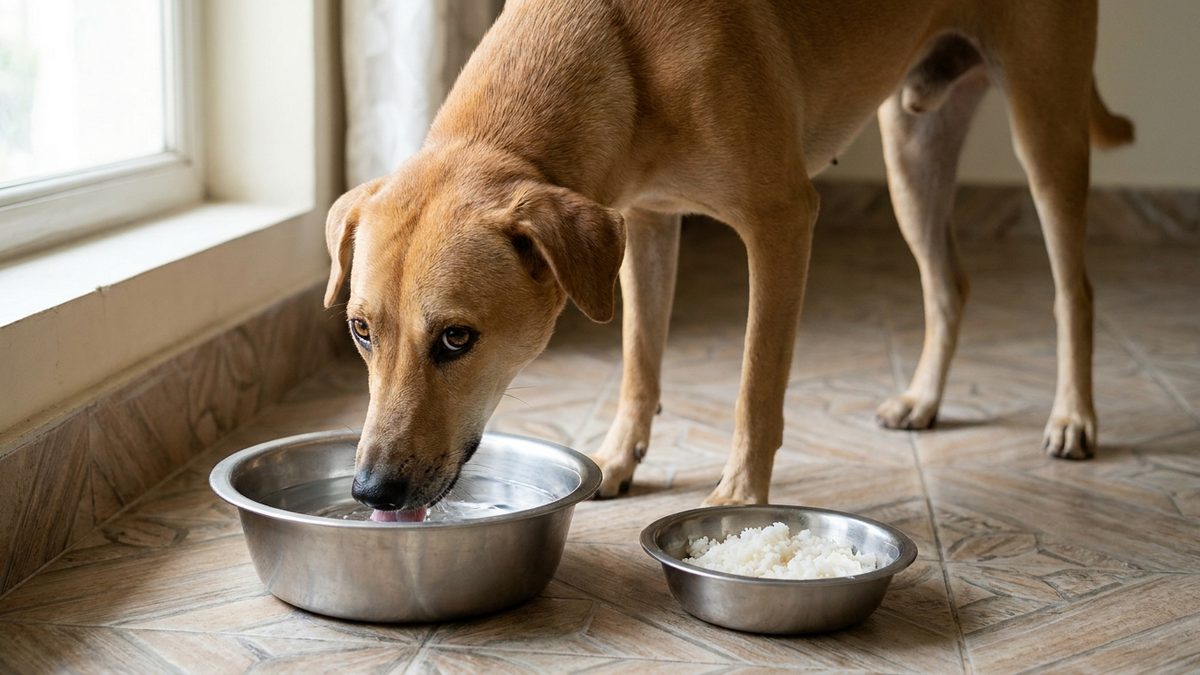
Quick answer
Dog diarrhea home remedy advice comes down to three things for a bright adult dog: keep water available, feed small meals of a plain, easily digestible food, and wait, because acute diarrhoea in the placebo arms of controlled trials cleared in about four to five days with no medicine. Skip human anti-diarrhoea tablets and leftover antibiotics. See a vet the same day for a puppy, black or bloody stool, repeated vomiting, lethargy or refusal to drink, and for anything lasting beyond two to three days.
This guide is general information for Indian pet owners and is not a diagnosis. Always consult a registered veterinarian near you before acting on anything you read here, and treat any sudden change in your pet's condition as urgent.
How long diarrhoea lasts in a dog, with and without treatment
Acute diarrhoea in an otherwise well dog lasts about four to five days from the first clinic visit when nothing active is given, and that figure comes from the dummy-tablet arms of controlled trials rather than from anyone's impression.
Start with how ordinary this is. The Royal Veterinary College analysed the records of 2,250,417 dogs under primary veterinary care in the UK in 2019 and estimated that 8.18 percent of them, about one dog in twelve, received veterinary care for acute diarrhoea at least once in the year. Those are only the dogs that reached a clinic. The ones that passed loose motions for a day and recovered on the kitchen floor are not in the count.
The same study measured how those cases ended. Of 1,835 confirmed cases, 1,473, or 80.27 percent, had only one physical visit for that episode. The college's own summary is that the majority of cases resolve within two days of veterinary treatment and that fewer than 20 percent need a second visit.
What nobody on the Indian first page tells you is how long diarrhoea lasts when the treatment is a placebo. Three trials answer it, and they are set out below. A placebo arm is the closest thing that exists to a measurement of the natural course, because the dog is examined, enrolled, watched and given nothing active.
| Trial | Dogs | Arm with no drug | Time to normal stool in that arm | Antibiotic arm |
|---|---|---|---|---|
| Langlois and colleagues, Michigan State University, 2020 | 31 (14 treated, 17 controls) | Placebo | Mean 3.6 days, standard deviation 2.1 | Mean 2.1 days, standard deviation 1.6 |
| Shmalberg and colleagues, University of Florida, 2019 | 60 (20 per group) | Placebo | Mean 4.8 days, standard deviation 2.9 | Mean 4.6 days, standard deviation 2.4 |
| Rudinsky and colleagues, 2022, acute colitis only | 59 | Easily digestible diet plus placebo tablet | Median 5 days, range 4 to 10 | Median 8.5 days, range 7 to 12 |
Two details in the Florida trial sharpen the picture. Its dogs had already had diarrhoea for a mean of 1.7 days before they were brought in, so the placebo dogs were loose for roughly six and a half days from the first bad stool to the first formed one. And two things in the history lengthened an episode whatever tablet the dog received: a history of previous diarrhoea added about 1.6 days and dietary indiscretion added about 1.4.
The authors of the Michigan trial wrote that most dogs achieve resolution of diarrhoea within several days regardless of treatment. A bright adult dog on day two of loose stool is in the middle of the usual course, not at the start of a crisis. A dog on day six with no improvement is outside it.
Age shifts the odds at both ends. The odds of an acute diarrhoea diagnosis were higher in dogs under 3 years and in dogs over 9 years than in dogs aged 4 to 5, and German Shepherd Dogs, Yorkshire Terriers and Maltese were among six breeds with raised odds against crossbreeds. All of that is British data. No Indian study we could find reports how long a diarrhoea episode lasts or how many dogs need a second visit, and we are not going to supply a number nobody has measured.
When to see a vet for dog diarrhoea the same day
See a vet the same day if the dog is a puppy, if the stool is black or bloody, if the dog is also vomiting repeatedly, or if it is dull, off its food or refusing water, because each of those moves the dog out of the group the reassuring trials studied.
The trials above enrolled dogs that were otherwise well. The guideline that governs treatment draws the same line: its mild category is a dog in good general condition with no signs of dehydration or systemic illness. Our guide to rice for dogs already sets out that guideline's mild, moderate and severe ladder in full, so it is not repeated here. What follows is the list an owner can apply at home.
- Go today for any puppy with diarrhoea that has not finished its vaccine course. In a Tirupati veterinary college series, 62 of 154 dogs brought in with vomiting, diarrhoea, anorexia, dehydration and fever tested positive for canine parvovirus, and 15 of those 62 had been vaccinated.
- Go today for black or tarry stool, or stool containing fresh blood, which Cornell lists among its reasons to see a veterinarian.
- Go today if vomiting is added to the diarrhoea, or if the dog stops eating or is lethargic.
- Go today for a dog that will not drink, or that you think is dehydrated. Dehydration and salt imbalance, which may lead to shock, follow when large quantities of fluid are lost.
- Go today for a toy breed, a senior dog or a dog with an existing illness. A small body dehydrates on less lost fluid.
- Go within a day or two if a plain diet has not worked after 2 to 3 days, or if the diarrhoea has not resolved in 48 to 72 hours.
Vomiting alongside diarrhoea is common rather than rare, which is why it is a sign to weigh and not a diagnosis. In the British records, 44.25 percent of acute diarrhoea cases also vomited, 27.68 percent had a reduced appetite and 24.20 percent were lethargic. One bout of vomiting in a dog that then drinks and wags is different from a dog that cannot keep water down. Our guide to a dog vomiting yellow or white foam covers the vomiting side, including the retching-with-nothing-coming-up emergency.
Nothing on this page about waiting applies to a puppy. An unvaccinated or part-vaccinated puppy with diarrhoea in India is a parvovirus question first, and the hours spent watching are the hours that matter. Telephone a vet, say the word parvovirus so the clinic can isolate the puppy on arrival, and read our page on canine parvovirus on the way.
Indian sources disagree on the threshold for an adult dog, and the disagreement is worth seeing. An Indian clinic chain's page says it is best to call your vet as soon as diarrhoea begins and again if it lasts more than 24 hours. Cornell's veterinary college says 48 to 72 hours for a dog that is otherwise eating and bright. Both cannot be the rule. The trial evidence sits with the longer window for a well adult dog and with the shorter one for every dog on the list above.
Do not use the skin pinch to reassure yourself. Our guide to how much water a dog should drink sets out why the skin tent and tacky gums fail as home tests for dehydration, and that argument is not rebuilt here. Judge the dog on whether it is drinking, eating and behaving like itself.
What the stool tells you: large bowel, small bowel and stool colour
The stool tells you which end of the gut is involved and whether there is bleeding, and it tells you much less about the cause than colour charts claim.
Large bowel diarrhoea is the usual sudden kind. Dr. Carly Fox of the Schwarzman Animal Medical Center told the American Kennel Club that most dogs presenting with acute diarrhoea have large bowel diarrhoea, which arises from the colon, and that small bowel diarrhoea is often more chronic and needs more of a diagnostic work-up.
The Merck Veterinary Manual describes the large bowel pattern precisely: increased urgency and frequency of defecation with decreased faecal volume per bowel movement, characterised by mucus, fresh blood, straining and occasionally pain when passing stool, while weight loss and vomiting are uncommon and occur more often when the small intestine is involved. That is the dog that asks to go out six times in an evening, squats and strains, and passes a spoonful of jelly-coated stool each time.
| What you see | What the references say it points to | What to do |
|---|---|---|
| Many small stools, urgency, mucus, straining, a streak of red blood | Large bowel diarrhoea, the colon | Home care is reasonable in a bright adult dog; vet if it passes 2 to 3 days |
| Large-volume watery stool | Usually associated with hypersecretion, the gut pushing fluid out | Watch drinking closely; same-day vet for a small dog, a puppy or a dull dog |
| Black, tarry stool | May be a sign of bleeding in the stomach or small intestine | Same-day vet |
| Loose stool with weight loss, or loose stool that keeps returning | Small intestine involved, or a chronic problem | Book a work-up; this is not a home-care case |
Black stool deserves its own line. Cornell explains that black stool, called melena, is caused by partially digested blood coming out in the faeces, and Merck's owner manual says black, tarry faeces may be a sign of bleeding in the stomach or small intestine. A bloody red streak on an otherwise formed or jelly-like stool is a different finding from a tarry black one, and the black one is the one that cannot wait.
What stool colour cannot tell you
Colour charts overreach. The Indian clinic page that ranks for this query states that yellow or orange stool suggests liver issues or a bacterial infection, that green could mean the dog ate grass, and that grey and greasy stool is often linked to pancreatic or biliary disease, and it cites no study for any of the three. We could not find a published study that tests stool colour against a diagnosis in dogs. Treat black and red as real signals, because the references above explain the mechanism, and treat the rest of the palette as a reason to take a photograph and a sample, not as a diagnosis.
The trials did not use colour at all. They used a faecal scoring chart for consistency, and the Florida trial's endpoint was the first stool scoring 3 or less on its chart, meaning faeces that has form. Form, frequency and the dog's manner are what a vet will ask about. Write down the number of stools a day and whether each one held a shape.
A dog that squats repeatedly and passes little is often assumed to be constipated. Merck's owner manual says straining during bowel movements is usually associated with inflammation of the rectum and anus, and the colitis pattern above includes straining with small, frequent stools. Giving a laxative or extra oil to that dog makes the problem worse.
What to feed a dog with diarrhoea, and the home remedies that hold up
Feed a dog with diarrhoea small meals of a plain, easily digestible food and keep water down at all times, because diet is the one home measure with a controlled trial behind it and most other home remedies have none.
The diet evidence is direct. In a randomised trial of 59 client-owned dogs with acute colitis, dogs fed an easily digestible diet with a placebo tablet reached remission in a median of 5 days, and the authors concluded that dietary management proved a superior strategy to the antibiotic it was compared with. The Royal Veterinary College's summary of its own records reaches the same place from the other direction, calling bland diets with or without probiotics a sensible initial approach.
In an Indian kitchen the bland diet is boiled rice with a little plain boiled chicken, and what that bowl does and does not deliver is worked out in full on our guide to rice for dogs, including why it is a bridge of a few days and not a diet. Cornell makes the same point in one line: these bland diets are not appropriate for long-term feeding because they are not nutritionally balanced. An owner feeding a complete packaged food has a second option that Purina's Indian page describes, which is to keep the regular food and feed it in small portions.
- Keep fresh water available throughout, and refill it often.
- Feed small amounts four to six times a day in place of the usual one or two meals.
- Use plain boiled rice with boiled, skinless chicken, or small portions of the dog's regular complete food, with no ghee, oil, salt, masala or milk.
- Stop all treats, biscuits, table scraps and chews until the stool has been formed for two days. Cornell's Dr. Meredith Miller advises avoiding excessive treats or rich food until the diarrhoea resolves.
- Return to the normal food gradually once the stool is formed. VCA describes a transition back over seven to ten days.
- Count the stools and note the first formed one, so you can tell a vet which day you are on.
Fasting: five pages, five numbers, no trial
Withholding food is the most repeated instruction on this subject and the published periods do not agree. An Indian supplement seller says to withhold food for 6 to 8 hours. The Indian clinic chain says 12 to 18 hours. Cornell says 12 to 24 hours. Virbac's Indian page says a short period, never longer than 24 hours. Purina's Indian page does not mention fasting at all and says to feed small portions. None of the five cites a study for its number.
A fourfold spread, from 6 hours to 24, is what custom looks like. The trial that produced the 5-day diet result fed its dogs from enrolment. Our page on a vomiting dog sets out the hospital evidence that early feeding did not lose to fasting, and that argument is not repeated here. For a bright adult dog with diarrhoea and no vomiting, a missed meal does no harm and a day of starvation has no evidence behind it. Never withhold food from a puppy or a toy breed without a vet's instruction, and never withhold water from any dog.
Curd, pumpkin, isabgol, jeera and rice water
The kitchen home remedies sort into three groups. Rice water and curd have been checked on this site already: maand is not an oral rehydration fluid, which the rice guide explains, and the claim that curd works as a probiotic for an upset gut is not supported by the one canine trial that looked, which our guide to curd, paneer and ghee for dogs sets out. Curd also carries lactose, which loosens stool in some dogs.
Pumpkin, or kaddu, is recommended by VCA on the ground that it is high in soluble fibre and can help bind stool. No trial of pumpkin in dogs with diarrhoea was found for this page. The nearest tested thing is psyllium, the husk sold in India as isabgol: in the colitis trial a psyllium-enhanced diet reached remission in a median of 5 days, exactly the same as the plain digestible diet without it. So fibre did no harm and added no speed in that trial. A spoon of plain steamed pumpkin is a reasonable food. It is not a treatment.
Jeera water, saunf, ginger and coriander appear on an Indian seller's page as remedies for digestive upset, each introduced with the words may help, and the page cites no study or veterinary body for any of them while linking repeatedly to its own probiotic product. We found nothing to support them and are not recommending them.
Probiotics are the remaining category, and the label problems and the guideline's neither-for-nor-against position are covered on our guide to supplements for dogs. One number belongs here. In the Florida trial the probiotic group reached formed stool in 3.5 days against 4.8 on placebo, a difference that was not statistically significant in 60 dogs, and the authors called their own study underpowered. British vets nonetheless gave probiotics to 59.62 percent of cases. That is a common practice resting on a possible effect, which is worth knowing before you pay for a sachet.
Fresh, clean water is on every list read for this page. Whether a sachet of human oral rehydration salts belongs in a dog's bowl is a separate question with its own evidence, set out on our guide to how much water a dog should drink. The short version is that a dog needing rehydration needs a vet, and a dog that is drinking normally needs only water.
Human medicines and leftover tablets: what not to give
Do not give a dog human medicines for diarrhoea, including the anti-diarrhoea tablets and pink bismuth liquids sold over an Indian chemist's counter, and do not finish an old strip of antibiotics from a previous illness.
Three veterinary sources say this in almost the same words. Cornell says never to try human medications such as bismuth subsalicylate or loperamide unless a veterinarian directs it, as they can be harmful to certain dogs and may not pair well with other medications. Dr. Fox told the American Kennel Club that most human medications are ineffective, but some can be harmful. VCA lists both drug types as dangerous home remedies and gives the reasons.
- Bismuth subsalicylate liquids and tablets: high doses can cause toxicity in dogs, and cats are especially sensitive and should never receive them.
- Loperamide, the gut-slowing tablet: if the dog has swallowed something harmful, has a blockage or has parasites that need to pass, slowing the gut may worsen the condition.
- Leftover antibiotics: an Indian clinic page warns against human medications like antibiotics without veterinary supervision because incorrect dosing can cause serious harm, and the next section explains why the right dose would usually not help either.
- Human painkillers for a dog that seems to have a sore belly: these are a separate poisoning risk, covered on our guide to giving medication to a pet at home.
The phrase certain dogs in Cornell's warning has a specific meaning. Some herding breeds and their crosses carry a gene variant that lets particular drugs, the gut-slowing one among them, reach the brain. Our page on MDR1 drug sensitivity in dogs names the breeds and the drugs. An owner cannot tell by looking whether an Indian mixed-breed dog with a collie somewhere in its ancestry carries it.
A dog that has scavenged spoiled food is clearing it. A tablet that stops the gut moving keeps the problem inside, which is the reason VCA gives for calling that tablet dangerous. If you think the dog ate something poisonous and not merely rotten, that is a different page: read foods toxic to dogs and telephone a vet now.
Bonbeno names no drug to give and no dose. Which medicine, if any, is a decision for the vet who has examined the dog, which is why this page publishes under the medical disclaimer.
Why an antibiotic is not the default for dog diarrhoea
An antibiotic is not the default because the current guideline recommends against one for mild and moderate acute diarrhoea, bloody or not, and the trials behind that recommendation show little or no gain and a measurable cost.
The European guideline on canine acute diarrhoea, distributed through the World Small Animal Veterinary Association, recommends against antimicrobial treatment in mild disease whether the diarrhoea is haemorrhagic or not, as strong recommendations on high-certainty evidence with 100 percent panel agreement, and suggests antimicrobials only in severe disease, where signs of systemic illness persist despite adequate fluid therapy. Our rice guide already reports that guideline. What it does not carry is the trial evidence underneath, which follows.
Where the two placebo trials disagree
Two randomised, double-blinded, placebo-controlled trials tested the same antibiotic, metronidazole, and they do not agree. At Michigan State University, 14 treated dogs resolved in a mean of 2.1 days against 3.6 days for 17 controls, a difference of a day and a half that reached significance at P = .04. At the University of Florida, 20 treated dogs reached formed stool in 4.6 days against 4.8 for 20 on placebo, with no significant difference between groups.
We are printing both and averaging neither. The Michigan authors, who found the benefit, did not recommend the drug on the strength of it. They wrote that additional studies are needed to assess the benefits and risks of routine use because most dogs achieve resolution within several days regardless of treatment. The Florida authors wrote that its use should be discouraged until evidence-based data demonstrate a difference in outcome. The best case for the antibiotic, taken at face value, is a day and a half.
The third trial points the other way. In 59 dogs with acute colitis, adding the antibiotic to an easily digestible diet lengthened the median time to remission from 5 days to 8.5, and it affected the faecal dysbiosis index negatively at days 7 to 10. A dysbiosis index is a laboratory score of how far the gut bacteria have shifted from the healthy pattern.
That shift lasts. In 24 healthy pet dogs given a 14-day course, the faecal dysbiosis index rose significantly, bacterial richness fell, and the changes had not fully resolved 4 weeks after the drug was stopped, which the authors summarised as a minimum 4-week effect on the faecal microbiome. So the trade on offer is, at best, a day and a half sooner against a month of disturbed gut bacteria, and in the colitis trial it was three and a half days later.
Bloody diarrhoea in a bright dog
Blood is the finding that tips owners and clinicians toward an antibiotic, and the records show it. Bloody diarrhoea was recorded in 29.32 percent of the British cases, and those cases were prescribed antibiotics far more often than the non-bloody ones, 59 percent against 30 percent. The guideline does not make that distinction. Its recommendation against antimicrobials in mild disease is identical for haemorrhagic and non-haemorrhagic diarrhoea. Blood is a reason to see a vet the same day. It is not, on its own, a reason for an antibiotic.
Practice has not caught up anywhere. In the British records 38.20 percent of cases still received an antibiotic, and the authors wrote that this raises concerns about unnecessary antibiotic therapy. We found no Indian prescribing audit for canine diarrhoea, so nobody can say what the Indian figure is.
If your bright, drinking adult dog is prescribed an antibiotic injection or tablets for a day or two of loose stool, ask one polite question: is my dog mild, moderate or severe, and what are we treating with this? A vet who has found a fever, a blood count that worries them or a dull dog has an answer. The guideline keeps antimicrobials for severe disease, and a good vet will be glad you asked.
Causes of loose motions in Indian dogs: scavenging, worms and parvovirus
The causes of loose motions an Indian owner meets first are the same ones measured elsewhere, scavenging and sudden diet change, with two that carry far more weight here: intestinal parasites and parvovirus.
The Royal Veterinary College lists scavenging, underlying gastroenteritis and other digestive diseases, reactions to specific medications and sudden dietary changes as the reasons recorded for acute diarrhoea, and its lead author's motto is that consistent diet leads to consistent poo. Cornell adds a stressful event such as boarding or a clinic visit, and internal parasites, to its list of transient causes. Vets call the scavenging cause dietary indiscretion, and in the Florida trial it lengthened an episode by about 1.4 days.
An Indian street supplies more to scavenge than a British one. A dog on a lead in Mumbai, Delhi, Bengaluru, Hyderabad, Pune or Kolkata passes open garbage, discarded food and other dogs' faeces on an ordinary walk, and a dog that eats from the ground will, sooner or later, pay for it overnight. In the monsoon the same walk adds standing water, and in a humid kitchen food left out spoils within hours.
The parasite load has an Indian denominator
A survey of 411 stray and refuge dogs in four Indian locations found hookworms to be the most commonly identified parasite in Sikkim, at 71.3 percent, in Mumbai, at 48.8 percent, and in Delhi, at 39.1 percent. Those were street and shelter dogs and not pets, so the figures are not the chance that your dog has hookworm. They are a measure of what is on the ground your dog walks and sniffs.
That is why a faecal sample matters more in India than the foreign pages suggest, and why the Florida trial repeated its analysis after removing dogs with parasite eggs in their stool. Our dog deworming schedule for India covers the signs of each worm and how often to deworm, and the Giardia figures from Chandigarh's parks are on our guide to dog toilet training. Neither is repeated here.
Parvovirus, leptospirosis and the diseases that are not a home-care case
Parvovirus is the cause that turns loose motions into an emergency. Of 154 dogs with suspected gastroenteritis sampled at the College of Veterinary Science in Tirupati, 62 tested positive by PCR, and 45.16 percent of the positives were puppies of 0 to 3 months. Those 154 were dogs a vet already suspected, so 40 percent is not the risk for every puppy with a loose stool. It does show how often an Indian teaching hospital finds the virus when it looks. The vaccination schedule is the prevention.
Two more conditions belong in the conversation with a vet and each has its own page. A dog with fever, vomiting and diarrhoea after wading through flood water in the rains is a candidate for leptospirosis, and our monsoon care guide covers that season. A dog with diarrhoea, a hunched back and vomiting after ghee, mutton fat or festival sweets is a candidate for pancreatitis.
- Change food over a week, mixing the new into the old, and do not switch brands on the day the old bag runs out.
- Keep the dog from scavenging on walks with a short lead past garbage points, and teach a leave-it cue.
- Deworm on the schedule your vet sets, and take a stool sample to the routine visit.
- Finish the puppy vaccine course before the puppy walks on shared ground.
- Refrigerate cooked food within two hours, and do not feed anything that sat out overnight.
- Keep the diet boring before boarding, travel and house moves, because stress and a new food together are two triggers at once.
What a vet does for diarrhoea, and what it costs in India
A vet examines the dog, checks hydration and temperature, and usually starts with a faecal sample, and a government veterinary hospital in Patna charges Rs 100 for that faecal examination.
Take a fresh stool with you. VCA says the vet will likely ask for a sample of fresh faecal material to be brought to the appointment, and that further tests may include bloodwork, stool and rectal swab samples for parasite examination, X-rays, ultrasound and endoscopy. The American Kennel Club's source adds that diagnostics are typically recommended when the diarrhoea is more chronic, severe, accompanied by weight loss or vomiting, or seen in a puppy.
Two Indian state veterinary universities publish what those steps cost, and the figures below were read from each institution's own page on 12 November 2026.
| Line item | Published fee | Institution |
|---|---|---|
| Registration, dog or cat, outpatient, valid 10 days | Rs 200 | Veterinary Clinical Complex, Bihar Animal Sciences University, Patna |
| Registration, dog or cat, emergency window, valid 5 days | Rs 300 | Veterinary Clinical Complex, BASU, Patna |
| Faecal examination, dog or cat | Rs 100 | Veterinary Clinical Complex, BASU, Patna |
| Complete blood count | Rs 300 | Veterinary Clinical Complex, BASU, Patna |
| Sodium, potassium and chloride | Rs 350 | Veterinary Clinical Complex, BASU, Patna |
| Parvovirus PCR | Rs 600 | Veterinary Clinical Complex, BASU, Patna |
| Small animal registration, valid 7 days | Rs 100 | Madras Veterinary College Teaching Hospital, TANUVAS, Chennai |
| Haematology, biochemistry, urine or culture | Rs 50 | Madras Veterinary College Teaching Hospital, TANUVAS, Chennai |
A registration, a faecal examination and a blood count at the Patna hospital come to Rs 600, or ₹600 in the form a receipt prints it. At the Chennai hospital, run by the Tamil Nadu Veterinary and Animal Sciences University, the pharmacy procures and dispenses drugs and fluids free of cost on an average annual budget of Rs 25,00,000. Neither page lists a charge for fluid therapy.
The catch is the clock, not the rupee figure. The Patna outpatient window runs 9 am to 1 pm with an emergency window from 2 pm to 8 pm, and the Chennai hospital works 8 am to 1 pm on weekdays and 8 am to 11.30 am at weekends and on government holidays. Diarrhoea that turns bloody at 11 at night needs a private clinic that is open. Our guide to what a vet visit costs in India sets out private prices, and the find a vet page is the place to look before you need one.
- A fresh stool sample in a sealed container, and a photograph of the worst one.
- The day and hour it started, and the number of stools each day since.
- Whether each stool was watery, jelly-coated, bloody or black.
- Everything eaten in the two days before, including treats, bones, scraps and anything scavenged.
- The vaccination card and the date of the last deworming.
- Every medicine or home remedy already given, with the strip or bottle.
When diarrhoea keeps coming back, and what this page cannot prove
Diarrhoea that returns every few weeks, or that never fully stops, is a different problem from an acute bout and belongs with a vet, because the reassuring figures on this page all come from single acute episodes.
The history predicts the course. In the Florida trial a history of previous diarrhoea lengthened the current episode by about 1.6 days whatever the dog was given. Small bowel diarrhoea is often more chronic and needs more of a diagnostic work-up, and weight loss occurs more often when the small intestine is involved. A dog that is losing weight with loose stool has stopped being a home-care case.
For the recurring large bowel pattern, the Merck Veterinary Manual records that supplementing the diet with fibre or feeding a commercial high-fibre diet improves diarrhoea in many animals with colitis, and that novel protein diets have controlled signs in dogs. Those are diet trials run with a vet over weeks, with one change at a time. They are not a reason to rotate through four foods in a month, which the diet-change evidence above says causes the thing you are trying to stop.
Five limits on this page are stated plainly below.
- Every duration figure comes from American trials of 31, 60 and 59 dogs and from British clinic records. No Indian study of how long acute diarrhoea lasts in dogs was found.
- The Indian hookworm figures describe 411 stray and refuge dogs, read from the paper's abstract, and say nothing direct about vaccinated, dewormed pets.
- The Tirupati parvovirus figure describes dogs already suspected of the disease, so it overstates the risk in an unselected puppy.
- No trial of pumpkin, jeera, saunf, ginger or curd in dogs with diarrhoea was found, which means untested and not disproved.
- The government fees are what two institutions publish on their own websites. Private clinic prices are higher and are not on this page.
One sentence carries the page. A bright adult dog with loose stool, drinking and interested in food, is following a course that three controlled trials measured at about four to five days without any medicine, and the job at home is plain food, water and a count of the days. Everything else on the list at the top of this page is a reason to stop counting and go.
Common questions
What stops dog diarrhea fast at home?
Nothing at home stops it fast, and the honest answer is time plus plain food. In controlled trials, dogs on a placebo returned to formed stool in a mean of 3.6 to 4.8 days. Keep water available, feed small meals of an easily digestible food, stop all treats, and count the days. Do not give human anti-diarrhoea tablets. See a vet the same day for a puppy, blood, black stool, vomiting or a dull dog.
What food can I give my dog to stop diarrhea?
Give small, frequent meals of a plain, easily digestible food, such as boiled white rice with boiled skinless chicken, or small portions of the dog's regular complete food. In a randomised trial of 59 dogs with acute colitis, an easily digestible diet alone brought remission in a median of 5 days. Add no ghee, oil, salt, masala or milk, and return to the normal diet gradually once the stool is formed.
Why is my dog pooping liquid poop?
Your dog is passing liquid stool because the gut is moving fluid out faster than it absorbs it, and the usual triggers are scavenged or spoiled food, a sudden change of diet, stress, or intestinal parasites. Dehydration follows when large quantities of fluid are lost, so watch that the dog keeps drinking. In a puppy in India, rule out parvovirus with a vet the same day.
How long does diarrhoea last in a dog?
Acute diarrhoea in an otherwise well dog lasts about four to five days from the first clinic visit when no drug is given. Placebo dogs in two trials took a mean of 3.6 and 4.8 days to resolve, and dogs on diet alone took a median of 5 days. Cornell's veterinary college advises seeking care if it has not resolved in 48 to 72 hours.
Should I starve my dog if it has diarrhoea?
Not as a rule. Published fasting periods run from 6 to 8 hours on one Indian page to 12 to 24 hours at Cornell, and none cites a trial. The one diet trial fed its dogs from the start and reached remission in a median of 5 days. A missed meal does a bright adult dog no harm, but never fast a puppy or a toy breed without veterinary advice, and never withhold water.
Does my dog need antibiotics for diarrhoea?
Usually not. The European guideline on canine acute diarrhoea recommends against antimicrobials in mild and moderate disease, including bloody diarrhoea in a dog that is otherwise well, and suggests them only in severe disease. One trial found the antibiotic shortened diarrhoea by a day and a half, a second found no difference, and a third found dogs given it took 8.5 days to recover against 5 on diet alone.
Can I give my dog a human loose motion tablet?
No. Cornell's veterinary college says never to give human medications such as bismuth subsalicylate or loperamide unless a veterinarian directs it, because they can be harmful to certain dogs. VCA adds that a gut-slowing tablet may worsen things if the dog has swallowed something harmful, has a blockage or has parasites that need to pass. Some herding breeds carry a gene variant that makes that tablet dangerous.
What does black stool mean in a dog?
Black, tarry stool means partially digested blood, which points to bleeding in the stomach or small intestine, and it is a same-day vet visit. Cornell calls it melena and lists it among the reasons to see a veterinarian. A streak of fresh red blood on a small, jelly-coated stool is a different finding that comes from the colon, and it still deserves a call the same day.