
Dog life guide
Trekking with a dog in India: where it is allowed, what altitude does, and the hazards on the trail
The Wild Life (Protection) Act 1972 bars livestock from a national park and never once names the dog. The ban is real anyway, it is discretionary, and nothing in the Indian trekking literature explains either that or what 3,500 metres does to a dog's heart.
Quick answer
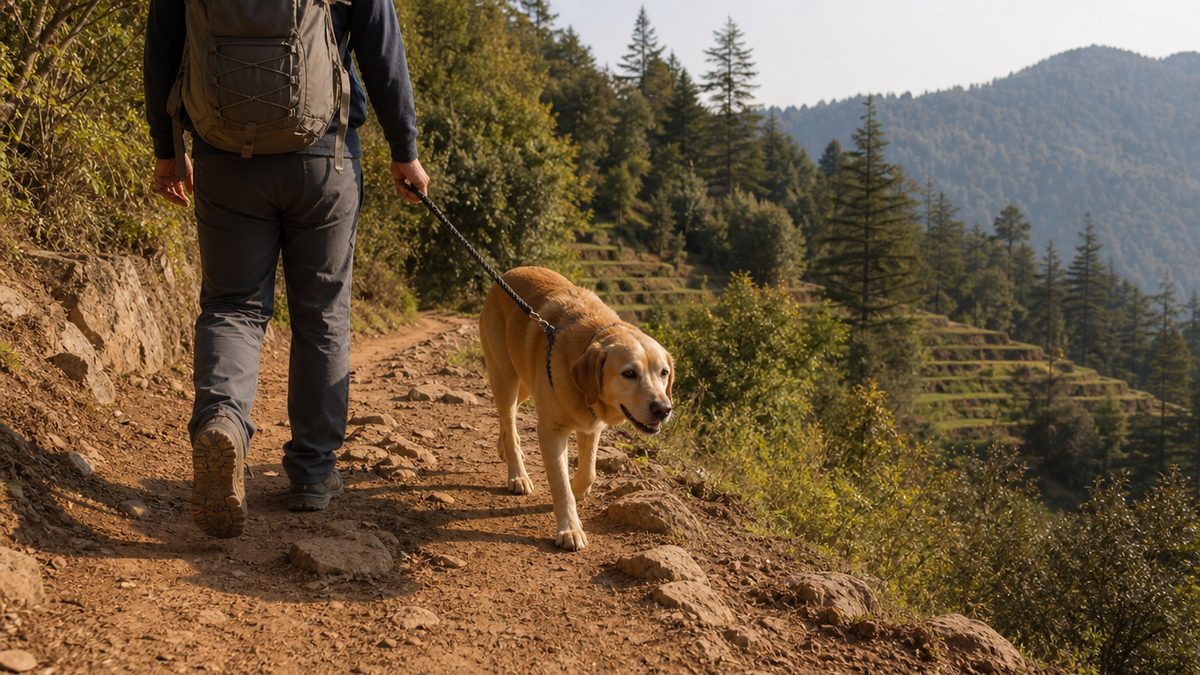
Trekking with dog India starts with where it is allowed. The Wild Life (Protection) Act 1972 bars livestock from a national park, and its definition of livestock never names the dog, so the refusal you meet at a park gate is a permit condition rather than a statutory ban. Walk instead on reserve forest, revenue land, village routes and operator trails outside protected areas. Above 3,000 metres ascend slowly, and refuse the trip outright for flat faced, very young, elderly or unfit dogs.
This guide is general information for Indian pet owners and is not a diagnosis. Always consult a registered veterinarian near you before acting on anything you read here, and treat any sudden change in your pet's condition as urgent.
Where trekking with a dog in India is actually allowed
Trekking with a dog in India is allowed on reserve forest, revenue land, village paths and the commercial Himalayan routes that lie outside protected areas, and it is refused inside national parks and wildlife sanctuaries. The refusal is real. What almost nobody writes down is that it does not come from the Act everyone cites.
Start with the statute, because the national park access rules are where every ranking page waves its hands. Section 35(7) of the Wild Life (Protection) Act, 1972 reads: "No grazing of any live-stock shall be permitted in a National Park and no live-stock shall be allowed to enter therein except where such live-stock is used as a vehicle by a person authorised to enter such National Park";. That is the flat bar people have in mind.
Now read the definition it depends on. Section 2(18A), as the Act stands in its 1 April 2023 text, says livestock "means farm animals and includes buffaloes, bulls, bullocks, camels, cows, donkeys, goats, sheep, horses, mules, yaks, pigs, ducks, geese, poultry and their young but does not include any animal specified in Schedules I, II and IV". A dog is not a farm animal and is not on that list. We read the whole Act looking for it, and the only dog in the text is the dhole, the wild dog, sitting in a schedule as a protected species.
The Wild Life (Protection) Act, 1972 nowhere prohibits taking a pet dog into a national park or a wildlife sanctuary. Sections 33A and 35(7) reach livestock, and the Act's own definition of livestock does not name the dog. Anyone who tells you the Act bans dogs has not read the definition clause.
So where does the refusal come from? From discretion, exercised in three places. Entry to a sanctuary is by permit under section 28, and a permit "shall be issued subject to such conditions and on payment of such fee as may be prescribed";. The Chief Wild Life Warden controls, manages and maintains every sanctuary and "shall take such steps as will ensure the security of wild animals" in it. And the field administration of a tiger reserve treats a dog inside the reserve as something to be removed, which the next section covers. None of that is written on a signboard, which is why owners keep being turned away without an explanation.
Sanjay Gandhi National Park publishes a page of rules and not one is about dogs
Sanjay Gandhi National Park in Borivali, Mumbai is the park an Indian city dweller is most likely to try first, and Google's People Also Ask box asks about it by name. Its official dos and donts page carries a list of visitor instructions and a schedule of on-the-spot fines. The instructions cover weapons, camera flash, music, plastic, alcohol, smoking and feeding animals. The fines run from ₹200 for spitting to ₹1,000 for feeding or teasing wild animals, with ₹500 for entering prohibited areas. Dogs and pets appear nowhere on it.
That silence is not permission. It means the decision sits with the gate, and visitors report being turned back with a dog in hand. Treat an unpublished rule as a refusal, and if you want a definite answer, get it from the range office in writing before you drive out.
| Land | What governs it | A dog's position |
|---|---|---|
| National park | Wild Life (Protection) Act 1972, s.35; entry on a permit under s.28 | No statutory bar on dogs, a near-universal refusal in practice as a permit condition. Assume no. |
| Wildlife sanctuary | Same Act, ss.27, 28, 33, 33A; Chief Wild Life Warden controls entry | Same position. s.33A requires livestock to be immunised, and a dog is not livestock, so nothing in the Act covers it either way. Assume no. |
| Reserve forest | Indian Forest Act 1927, s.26, which prohibits listed acts including cattle trespass | Not a protected area. Entry is a state forest department matter and many hill routes cross one. Ask the range office. |
| Revenue land and village paths | No forest or wildlife statute; local and panchayat practice | The clearest legitimate ground for trekking with a dog, and where most Indian hill trails below the treeline actually run. |
One practical note on reserve forest, and a limit on how far we will take it. Section 26 of the Indian Forest Act, 1927 prohibits a list of acts inside a reserved forest, among them that a person "trespasses or pastures cattle, or permits cattle to trespass". The prohibition is framed around cattle and we found no dog-specific provision in that chapter. What follows is narrower than it sounds. A reserve forest is not a protected area under the wildlife Act, the state forest department still controls entry, and whether a given trail needs a permit at all varies by state and by division. Ask the range office, and get the answer on paper or on WhatsApp from an official number.
Why protected areas refuse dogs, and it is not bureaucracy
Protected areas refuse dogs because a domestic dog carries canine distemper and rabies into wild carnivore populations with no immunity to either, and because dogs chase and kill wildlife at a scale India has now measured. Both halves have published Indian evidence behind them.
The predation half first. The only sub-continent scale assessment of what dogs do to Indian wildlife surveyed 249 key informants and national print media. Dogs were reported attacking 80 species, 31 of them IUCN Red List threatened and four Critically Endangered. Roughly 68 percent of the attacks were by dogs unaccompanied by humans, most were by packs, and 45 percent of those pack attacks killed the prey. The figure that matters for a trekker is the last one: nearly 48 percent of the incidents were in and around wildlife protected areas, which the authors read as evidence that dogs are a large-scale edge effect around India's reserves.
An owner reading that will object, reasonably, that their leashed dog is not a feral pack. True. The edge effect is not the only mechanism, and the disease half does not care whether your dog is on a leash.
What the Gir outbreak did and did not prove
In September 2018 the unusual death of 28 Asiatic lions of all age groups was reported from Gir Wildlife Sanctuary in Gujarat over two weeks. Investigators sampled 229 wild and 87 captive lions and detected canine distemper virus in 68 of them, 21.3 percent overall, comprising 56 of the wild lions (24.5 percent) and 12 of the captive ones (13.8 percent). Every one of the 22 lions showing clinical signs tested positive, and 6 of 52 leopard samples were positive too.
Here is the part that gets overstated, so we will state it accurately. The investigating team did not identify domestic dogs as the source of that outbreak. What they recorded is that canine distemper is prevalent among dogs in India and that the free-ranging dog population often poses a threat of transmission to wildlife, and they noted other wildlife species could have a role in transmission. The lineage clustered with a strain circulating in Indian dogs. That is a strong link, not a proof of one event.
India's own wildlife administration has not waited for the proof. The National Tiger Conservation Authority wrote from New Delhi to every tiger range state in October 2018 saying lion deaths in Gujarat had been attributed to canine distemper, "a viral disease where in dogs (feral on domestic) act as a transmitting host", and reiterated its standing advisory. That advisory asks states to create immunity buffers around tiger reserves, on the principle that vaccinating 70 to 80 percent of a population disrupts transmission, so that "vaccinated animals act as a firewall between tigers and stray animals".
The operational document is blunter. The NTCA's Standard Operating Procedure for stray and feral dogs in tiger reserves exists "to avoid disease spread and physical injury to tigers and other wildlife", carries camera trap images of dogs chasing sambar inside a reserve, and instructs that dogs captured from within a tiger reserve "should under no circumstance be released back" and that an alternate site be found for them.
A dog found loose inside a tiger reserve is, by the state's own written procedure, an animal to be caught and permanently relocated. That is the policy backdrop to the refusal at the gate. It is also a reason not to test the rule: a dog that slips a leash inside a protected area is not simply a dog you have to find again.
Rabies sits alongside distemper and runs in both directions. India vaccinates against it precisely because the free-ranging reservoir is large, and a trek takes your dog into contact with that reservoir rather than away from it. Keep the rabies vaccination current before you travel, and read our pages on rabies in dogs and cats in India and distemper in dogs in India for the clinical picture. The dog vaccination schedule for India sets out the timing.
What an Indian trekking operator will put in writing
An Indian trekking operator that takes dogs draws the protected-area line in its own terms, and the clearest published example states it in one sentence. Read that sentence before you read anybody's list of dog friendly trails.
Himalayan High, which runs guided Himalayan treks and publishes a pet policy, states: "Pets are allowed only on designated treks outside National Parks and Wildlife Sanctuaries. Pets are strictly prohibited in protected areas";. That is the rule of thumb this page has spent two sections deriving from the statute, written by an operator who has to apply it at a trailhead.
The rest of the same document is worth more than most trekking blogs. It requires the owner to declare breed, size, weight, age, temperament and health issues before booking, and to show vaccination and deworming. It requires the dog to be leashed "at all times during the trek, in villages, and at campsites". It states that most homestays will not take a pet indoors because of shedding, allergies, noise and "risk of conflict with resident dogs". It says plainly that the company "does not provide veterinary care" and that "evacuation or emergency transport for sick or injured pets is the responsibility and cost of the owner". And it reserves the right to end the trek without refund if a pet poses a risk.
Where that operator's own two pages disagree
Publish the disagreement rather than smoothing it. The same operator's terms warn that "High altitude and long trails may not be suitable for all breeds";, while its pet-friendly listing includes the Shang La to Matho La trek in Ladakh at 5,200 m, Stok Kangri Base Camp at 4,950 m and Nanda Devi East Base Camp at 4,196 m. Both statements can be sincere. They sit awkwardly together because there is no published canine acclimatisation schedule anyone could use to plan the second against the first, which is the subject of the next section.
The page that ranks first in India for this query takes a different approach and is weaker for it. The Indiahikes guide to dog friendly trails in India, published in January 2021, recommends five self-guided routes and never mentions a forest department, a permit, a protected area or a single law. It suggests Shivanasamudra in Karnataka partly because "It has many monkeys around. This will help you gauge how your dog responds to the wildlife", recommends Naneghat in Maharashtra specifically in the monsoon without mentioning leeches, and offers Prashar Lake at 8,900 feet as a way to see "how your dog responds to the weather and high altitude of the Himalayas" with no guidance on what that response looks like or when to turn around.
- Ask whether the route crosses a national park, a wildlife sanctuary or a tiger reserve at any point, and get the answer in writing.
- Ask who carries the dog if it cannot walk, and what that costs. Most Indian operators answer that you do.
- Ask where the nearest veterinary facility to each campsite is, by name and by driving hours.
- Ask what the homestay or campsite rule is for a dog indoors at night, before you are standing outside one at 4,000 m.
- Ask what happens to your booking if the operator judges your dog unfit on day one. The honest ones say you lose the money.
What altitude does to a dog, and how fast is too fast
Altitude raises a dog's pulmonary artery pressure in direct proportion to how high it goes, and at a simulated 6,000 m it produces frank pulmonary oedema. Those are the two experiments that exist. Everything else published for owners is extrapolation.
The field study is the more useful of the two because the dogs were living and working, not in a chamber. Swiss researchers followed dogs that already lived at 2,300 m, where chronic hypoxia induces mild pulmonary hypertension, and re-examined them at 3,500 m after half a year of regular exercise at that height. At 3,500 m the dogs were severely hypoxaemic, with arterial oxygen tension of 52 plus or minus 5 mmHg. All seven dogs with measurable tricuspid regurgitation had systolic pulmonary hypertension, between 33.6 and 54.8 mmHg. Diastolic blood pressure rose. Strikingly, none of the dogs developed erythrocytosis, and their packed cell volume at 3,500 m was no different from their packed cell volume at 2,300 m.
Read that last finding twice. Six months of intermittent severe hypoxaemia did not raise these dogs' red cell counts. A dog does not acclimatise the way a human trekker does, and the ascent plan you build for yourself is not a plan for the dog walking beside you.
The chamber study is the one that shows the damage. Twelve adult male beagles were randomised into a control group and a high altitude pulmonary oedema group of six each. The oedema group was taken to a simulated 6,000 m at an ascent rate of 600 m per minute and held there for 48 hours. They became lethargic and respiratory distressed, and "Beagle dogs in the HAPE group exhibited typical pulmonary edema", with raised lung wet-to-dry ratios, higher injury scores and elevated inflammatory cytokines.
| Height | An Indian example | What is documented for dogs |
|---|---|---|
| 2,300 m | Above Manali, most Kumaon and Garhwal road heads | Mild pulmonary hypertension in dogs living there chronically |
| 2,700 m | Prashar Lake, Himachal Pradesh, at about 8,900 feet | Nothing measured at this height specifically |
| 3,500 m | Leh, Har Ki Dun, Deoriatal ridge country | Severe hypoxaemia and systolic pulmonary hypertension in exercised dogs after six months of residence |
| 4,200-5,200 m | Nanda Devi East Base Camp, Stok Kangri Base Camp, Matho La | Nothing published. These heights are offered commercially to dogs on no canine evidence at all |
| 6,000 m | Above any trekking peak a pet would reach | Frank pulmonary oedema in 6 of 6 beagles after a fast 48-hour exposure |
The honest limit of what is known
No veterinary body publishes an ascent rate for dogs. The human rule is clear and well established: above 3,000 m, do not increase sleeping elevation by more than 500 m per day, and take a rest day with no gain in sleeping elevation every 3 to 4 days. There is no canine equivalent, there is no canine diagnostic criterion, and there is no evidence that borrowing the human number is correct for a dog.
We are going to recommend borrowing it anyway, and say why. The human rule is a conservative ceiling, the one dog study at trekking heights found pressures rising with altitude rather than plateauing, and the only canine oedema was produced by an ascent rate 1,000 times faster than a walker's. A conservative ceiling with no evidence behind it beats no ceiling at all. Treat it as the slowest reasonable plan rather than a safe one, and build the itinerary around sleeping elevation, not around the day's high point.
What to watch for, and what it is not
- Breathing that does not settle. A healthy dog's breathing comes down within minutes of stopping. Breathing that stays fast and effortful through a long rest is the signal to turn around.
- Cough, especially a wet or productive one appearing on the climb, in a dog that was not coughing at the road head.
- Gums and tongue going pale, grey or blue. Check them in daylight before you start, so you know what normal looks like on your own dog.
- Refusing food and water at camp after a day of work, which in a dog that normally eats is a change worth acting on.
- Stumbling, circling, or an unsteady back end. Stop there. Do not interpret it, descend.
- Not altitude: limping, a cut pad, a tick, or a dog that is simply tired. Rule out the ordinary explanations first, then act on the altitude one.
There is no published veterinary protocol for altitude illness in dogs and no drug this page will name, because dosing is a veterinary decision for your individual animal. What is not in doubt from the human literature and the canine physiology alike is that going down works. If your dog deteriorates at height, lose altitude immediately and keep losing it. Do not wait for morning, and do not finish the itinerary.
One more reason to descend early rather than late: at 4,000 m you are carrying the dog out yourself. Plan the trip so that you could.
Which dogs should not go, and how to condition the ones that can
Four groups of dog should not be taken on a multi-day Indian trek: flat faced breeds, puppies whose growth plates are open, elderly dogs, and any adult that has not been conditioned for it. The honest refusal is the most useful thing in this guide, and it costs nothing.
Flat faced dogs are first and the case is the strongest. Brachycephalic obstructive airway syndrome is assessed in Cambridge's veterinary grading scheme by a 3-minute trotting exercise tolerance test, because the signs are often absent at rest. Grade 0 and Grade I are clinically unaffected; Grade II and Grade III are clinically affected and need management or surgery. The same source explains the mechanism that matters on a climb: the canine nasal cavity does the heat exchange, and a BOAS-affected dog with an obstructed nose "cannot exchange heat as easily as healthy dogs when their body temperature rises during exercise", and may become cyanotic or collapse when it cannot meet its oxygen requirement during exercise.
The three-minute test that settles it for a flat-faced dog
A dog that cannot trot for three minutes at sea level without grading as clinically affected has no business climbing for six hours at 3,000 m, where the air it is struggling to move also carries less oxygen. That is not a judgement about Pugs, French Bulldogs or Shih Tzus as pets. It is arithmetic about a nose. Ask your vet to grade the dog rather than guessing, and if the grade comes back II or III, the answer is no and it stays no after surgery until a vet says otherwise. Heat is a separate and larger problem for the same dogs, and our guide to heat safety for dogs in India covers it properly.
Puppies are second. A growing dog's joints are still forming, and sustained descent on steep rocky ground loads them in a way a flat walk does not. Wait until growth is finished, which is later in large breeds than most owners assume, and ask your vet when it is finished in your dog rather than using a number off the internet.
Elderly dogs are third, and the refusal here is softer. A fit senior can do a gentle day walk on village paths. What a senior should not do is a multi-day itinerary with a committing descent, because the thing that goes wrong is the return leg. Our senior dog care guide covers the wider picture of what changes.
Unfit adults are fourth and are the largest group by far. A flat-dwelling dog that walks twice a day on tarmac is not conditioned for 900 m of ascent, and the mismatch shows up as a dog that cannot continue on day two, in a place with no road.
The conditioning build-up, over eight weeks
No veterinary body publishes a conditioning protocol for a trekking dog, so what follows is our construction from ordinary exercise-progression principles rather than a cited schedule. Treat the sequence as a shape to follow and the two rules under it as the part that matters.
- Weeks 1-2: establish a daily hour of continuous walking on varied surfaces, at a pace you would hold on a trail rather than a sniffing pace.
- Weeks 3-4: add one weekly outing of 2 to 3 hours with real gradient. The Nandi Hills road out of Bengaluru, a Sahyadri fort path out of Pune, or a 20-storey stairwell will do if there is nothing better.
- Weeks 5-6: add the dog backpack, empty, on the long outing. Then add weight in gradual steps across two sessions and stop well short of what the dog will carry.
- Weeks 7-8: do one back-to-back weekend, a long day followed by another long day, because trek fatigue is cumulative and a single hard day proves nothing.
- Throughout: walk in the heat your trek will actually have at the road head, and watch recovery. A dog whose breathing is still fast twenty minutes after stopping is not ready for the next step.
Two rules sit over all of that. Increase one thing at a time, distance or gradient or load, never two together. And condition on the surface you will meet, because a dog that is fit on grass can still be unfit on scree.
The widely repeated figure that a dog can carry 10 to 30 percent of its body weight appears in Indian trekking blogs with no source attached, and we could not find a controlled study behind it. Treat it as folklore. The defensible version is the process, not the number: start with an empty pack, add weight gradually, and accept that a dog carrying its own food is a convenience for you and a cost to the dog.
The Indian trail hazards nobody writes up
Five hazards sit on Indian trails that a Western hiking guide never mentions: land leeches in the monsoon, porcupine quills, snakes on warm rock, macaques and langurs, and the resident dogs at every hill settlement. Each has a different answer and the fifth has its own section below.
Leeches, including the one that goes up the nose
Land leeches of the genus Haemadipsa are a guaranteed feature of the Western Ghats in Karnataka, Kerala and Tamil Nadu during and after the monsoon, when the forest floor stays humid for weeks, and of the North East through the same season. They sit on wet leaf litter and low vegetation and attach to whatever passes. On a dog they attach anywhere the coat is thin: between the toes, in the groin, on the belly, around the lips and inside the ears. A leech bite bleeds for a long time after the leech has gone, because of the anticoagulant, and the bleeding frightens owners more than the blood loss warrants.
The version that is genuinely serious is the one that gets inside. A veterinary team at the state veterinary college in Palampur, Himachal Pradesh, reported a 6-year-old non-descript male dog weighing 30 kg with three months of recurrent nosebleeds, sneezing and reverse sneezing. Rhinoscopy found live leeches attached to the nasal mucosa deep in both nasal cavities, at the level of the ethmoid conchae, one of them 10 to 12 cm long and the other 4 to 5 cm. The mucosa was severely inflamed with multiple bleeding points, and the dog was anaemic. Both leeches were removed endoscopically under general anaesthesia.
The route in is the part a trekker needs. The same paper states that leech infestation in dogs happens "mostly during drinking of water and swimming in the rural water stream";. Your dog puts its face in a hill stream and a juvenile leech goes up a nostril. That is the mechanism, and it is also why the water section below is not a throwaway.
- Check the dog at every break during leech season, not at the end of the day. Feet, ears, lips, groin, armpits.
- Remove an attached leech by sliding a fingernail or a card under the narrow sucker first, then the rear one, rather than pulling it straight off.
- Do not burn it, do not use salt on a dog's skin and do not use a chemical. All three make the leech regurgitate into the wound.
- Expect the bite to ooze for an hour or more. Press it clean and leave it. Watch for swelling or heat over the next two days.
- Go to a vet for recurrent nosebleeds, sneezing or reverse sneezing in the weeks after a monsoon trek. That combination has a specific cause and a specific fix.
Porcupine quills, and why the clock matters more than the quill
The Indian crested porcupine is nocturnal, slow and entirely unbothered, which is exactly why a confident dog gets a face full of quills. A retrospective of 296 quill incidents involving 242 dogs found an average of 21.8 quills recovered, with a range from one to over a hundred. The commonest site was the external head and neck, then the oral cavity. Four dogs had quills migrate into a joint or an eye, and complications occurred in 32 of the 296 cases, 10.8 percent.
Now the number that should shape your trip plan. Complications ran at 7.2 percent when the dog was seen within 12 hours, 8.2 percent between 12 and 24 hours, and 37.5 percent beyond 24 hours. Cases presented after 24 hours were 5.2 times more likely to have complications. On a trek, the delay is the default. A dog quilled on the second evening of a five-day route is a dog that reaches a vet well past that threshold.
Quills are barbed and break. A broken quill migrates inwards, which is how they reach joints and eyes. Cut nothing, pull nothing you cannot remove cleanly and completely, keep the dog from pawing at its face, and turn the trek around. The published complication curve is the argument: the clock is the thing you control.
Snakes belong on any Indian trail list and we will not re-explain them here, because the clinical picture has its own page. Read snake bite in dogs in India before a trek, and read it again for the first-hour actions. The trail-specific points are simple: a dog nosing into rock crevices and under logs is the behaviour that gets dogs bitten, warm rock in the late afternoon is where snakes are, and a leash is what keeps a dog out of both.
Ticks are the same. India's tick season does not end, and the pathogen load they carry is real, but our tick prevention guide for dogs in India owns the whole subject including removal technique and product classes. Check the dog nightly on a trek and use that page.
Macaques and langurs, and a legal point worth knowing
Rhesus macaques around Himalayan hill settlements and bonnet macaques in the south are habituated, bold and territorial around food. A dog that chases one gets bitten, and a monkey bite is a deep puncture wound two days from a vet. A dog that is cornered by a troop panics. Neither encounter has a good version, and the only reliable management is a short leash and walking past without stopping.
There is also a legal edge. The Act defines hunting to include "capturing, coursing, snaring, trapping, driving or baiting any wild or captive animal and every attempt to do so", and section 9 says no person shall hunt any wild animal specified in Schedules I and II. Coursing is the old word for hunting with dogs by sight, and driving means pushing an animal. We could not find a reported Indian case holding a pet owner liable because their dog chased wildlife, and we are not going to pretend one exists. What is certain is that a forest officer watching a dog chase a wild animal has a provision to point at, and that is enough to end your trek.
The dogs already on the trail
Free-ranging dogs are the commonest animal your dog will meet in the Indian hills, they are present at densities most visitors do not expect, and they are a conflict risk and a rabies exposure in the same encounter.
The Trans-Himalaya has the numbers. A 2025 issue brief from the Centre of Excellence for Himalayan Studies records about 25,000 stray dogs across the Union Territory of Ladakh, with 9,000 to 10,000 in Leh district alone, which the brief puts at nearly 30 percent of the human population of the region. In Changthang Wildlife Sanctuary, free-ranging dog densities reach 310 individuals per 100 sq km at Hanle and 61 per 100 sq km at Tso Moriri, far exceeding the densities of native carnivores. Scat analysis puts 74.29 percent of their diet as livestock and 13.06 percent as wild species.
That same brief carries the public health side. Dog bite cases reported in Ladakh through the Integrated Disease Surveillance Programme rose from 2,165 in 2022 to 2,569 in 2023 and 4,078 in 2024. Those are human bites, and they are the measure of how much contact there is. A visiting pet dog walks into that.
Those dogs are kept alive by people, which is why they sit where trekkers do. In peri-urban Leh, stray dogs account for about 13 percent of reported livestock deaths, an average loss of Rs 3,984 per household. A household losing that much to dogs does not welcome a visiting pet into its yard, and that is worth knowing before you knock on a homestay door with one.
It is not only Ladakh. In Spiti, feral dogs caused 68 percent of livestock deaths, more than wild carnivores did. In the Pangi and Lahaul valleys of Himachal Pradesh, 12 percent and 6.7 percent of surveyed residents reported livestock losses to feral dogs. In North Sikkim, Dokpa pastoralists lose yaks to dogs sustained on waste near army camps and tourist hubs. Dog and wolf hybridisation has been observed in Ladakh and in Spiti. Food dumping sites near settlements, army posts and tourist infrastructure are the attractant in every one of those landscapes, which tells you exactly where on a trail the trouble is.
- Walk through hill villages and past army or labour camps on a short leash, not a long one, and not off-lead at all.
- Keep your dog out of rubbish dumps and kitchen waste pits, which is where resident packs concentrate and where fights start.
- Do not feed resident dogs near your campsite. You will draw them to the tent your dog is sleeping in.
- Walk past, do not walk through. Give a group of resident dogs the width of the trail and keep moving, and avoid letting the two dogs meet nose to nose.
- Carry your dog's rabies vaccination certificate, and know where the nearest human anti-rabies facility is, because the bite may be yours.
Clean the wound with running water and soap for as long as you can bear to, then get to a vet. A bite from an unvaccinated free-ranging dog is a rabies exposure question even in a vaccinated pet, and it is a veterinary decision, not yours. Our page on rabies in dogs and cats in India sets out the 10-day watch and what happens next.
Our guide to stray dogs in India covers the law, the Animal Birth Control Rules and the civic position in full. What this section adds is the specifically alpine version of the problem, which is denser than the urban one and sits exactly where trekkers camp.
Drinking water on the trail, and what rock does to feet
Carry your dog's drinking water rather than letting it drink from streams below a settlement, and treat the trail surface as the thing that will end your trek if anything does.
Nobody has published a daily water requirement for a dog working at altitude in Indian conditions, and we are not going to invent one. Work it the other way. Offer water at every break rather than at camp, carry a collapsible bowl because a dog drinking from a bottle wastes most of it, and measure what your own dog actually drinks on the conditioning walks described above. Then carry that, plus a margin, and plan the day around where you can refill. A dog that stops drinking is giving you information, and you will only notice if you know its normal.
A stream below a village is not clean water. It carries whatever the settlement and its livestock put in upstream, which makes it a leptospirosis and a giardia question, and in the Western Ghats and the North East it is also where nasal leeches are acquired. Our guide to swimming safety for dogs in India owns the water quality subject properly, with India's own bathing water standard and the Indian leptospirosis evidence, and leptospirosis in dogs in India is the clinical page. The trail rule is one line: drink from above a settlement or from your own bottle, never from standing water, and never from the channel below a village.
Feet next, and briefly, because paw care deserves its own guide and this is not it. What a trek does to a dog's feet is different from what a city street does. Dry scree abrades the pad surface. Wet rock softens it first and then abrades it. Long descents grind the front pads in particular, and a dog that is sound at camp can be lame an hour into the next morning. Check all four feet by hand every evening, between the toes as well as underneath, and stop at the first roughened patch rather than the first limp. Boots and paw balm are covered in our guide to cooling vests and summer gear for dogs in India, which also records honestly that paw balm has no published evidence behind it. Wet-weather paw care is in monsoon care for dogs in India.
The useful protection on rock and scree is conditioning the feet over weeks, checking them twice a day, and turning around early. A boot that has never been worn before the trek is a new problem at 3,500 m, not a solution. If you intend to use boots, the dog wears them on every conditioning walk first.
Leave no trace with a dog, including where nothing decomposes
Pack out your dog's faeces from any trail above the treeline and from any catchment above a village, because the nutrient load is larger than people assume and the cold does the rest.
The quantified case is Belgian rather than Indian, and it is the only one with real numbers. A Ghent University team measuring what dogs add to nature reserves put dog urine at an average of 18.7 g of nitrogen and 484.6 mg of phosphorus per litre, against 0.7 to 10.2 g of nitrogen per litre for cattle urine. Dog faeces carry 44.3 mg of nitrogen and 32.0 mg of phosphorus per gram of dry mass, against 10 to 30 mg of nitrogen and 1 to 4 mg of phosphorus per gram for savanna ruminants. A dog deposits a more concentrated load than a cow does.
One finding from that paper is worth acting on by itself. Faeces accounted for 97 percent of the phosphorus and 56 percent of the nitrogen deposited, so simply picking them up removes almost the whole phosphorus load. The bag in your pocket is not a gesture. It is the intervention.
Altitude adds a second problem that nobody has measured in India. Decomposition slows sharply as soil temperature falls, so what is buried in a high alpine meadow or on a moraine persists for seasons rather than weeks. We looked for an Indian measurement of how long dog faeces persist above the treeline and did not find one, so we are not going to put a number on it. The honest instruction stands without one: carry it out.
- Carry double the waste bags you think you need, plus one sealable dry bag to put them in.
- Pack out everything above the treeline and everything within a catchment that feeds a village water source. No exceptions for a long day.
- Bury only below the treeline, only where there is real soil, well away from any water source, trail or campsite, and only where no local rule says otherwise.
- Never leave a bagged deposit beside the trail to collect later. On an Indian trail it will not be collected.
- Keep the dog out of alpine meadows in the flowering season and off bird nesting ground, where the cost is trampling rather than nutrients.
The operator terms quoted earlier make this a condition rather than a courtesy: owners "must carry waste bags and dispose of pet waste responsibly; no waste is to be left at campsites, villages, or trails";. A trekker who treats this casually is the reason the next operator stops taking dogs.
The plan that has to exist before you leave the road head
Write down three things before you start walking: how you get the dog out, where the nearest vet is, and who you call. Every other item on a packing list is optional beside those three.
The evacuation plan is the one people skip. On a Himalayan trail there is no stretcher for a dog and no helicopter that will take one, and nobody is coming to evacuate your dog for you. If your dog cannot walk, you carry it, or a porter does at a price nobody has quoted you in advance. The rupee cost of getting a sick animal off a mountain falls entirely on the owner, and the operator terms we read say so in plain words. A 30 kg dog is a two-person carry over broken ground, so the real planning question is whether your group could do it for the distance back to the road.
- Name the nearest veterinary hospital to each night's camp, with a phone number and driving hours, before you leave home.
- Carry the dog's vaccination record, including the rabies date, as paper and as a photo on your phone.
- Confirm the microchip is readable and the registered contact number is current. Our guide to pet microchipping in India covers the registry side.
- Photograph the dog from the side and the front in good light the week before, which is what a lost-dog post needs. How to find a lost pet in India is the page to read before you need it.
- Decide and say out loud, to whoever you are walking with, what will make you turn around. Agreeing it on day three at altitude is not a decision, it is an argument.
Carry a dog-specific first aid kit rather than relying on the group's. The useful contents are unglamorous: a tick remover, a roll of self-adhesive bandage, sterile saline for flushing eyes and wounds, a muzzle for a dog in pain, antiseptic, tweezers, and a towel. Do not carry human painkillers for the dog Blue Cross, Emergencies and first aid…. Several are toxic to dogs at ordinary human doses, and pain relief on a trek is a veterinary decision made in advance, not an improvisation at camp.
Trek insurance does not cover your dog, and most Indian pet insurance excludes adventure activity. Budget for the possibility of an emergency veterinary bill at a small-town clinic in cash, because many will not take a card. Our guide to building an emergency vet fund sets out how much and how to hold it.
One last thing, and it is the thing that distinguishes a good owner from an enthusiastic one. Read your dog on the first morning rather than on the last. A dog that is reluctant at the road head, that keeps stopping to look back, or that will not settle in the tent on night one is telling you something before it costs anything. Our guide to dog body language covers the vocabulary. Turning around on day one is cheap. Turning around on day four is not always possible.
Common questions
Can I hike with a dog?
Yes, on land outside India's protected areas. Reserve forest, revenue land, village paths and operator routes that avoid national parks and wildlife sanctuaries are where trekking with a dog is legitimate in India. Inside a national park or a sanctuary the answer is no in practice, because entry is by permit and the permit condition is set by the forest department.
Why do most national parks not allow dogs?
Most national parks refuse dogs because a domestic dog can carry canine distemper and rabies into wild carnivores and because dogs chase and kill wildlife. India's pan-India survey recorded dogs attacking 80 species, 31 of them IUCN threatened, with nearly 48 percent of incidents in or around protected areas. The refusal is a permit condition, not a clause in the Act.
Can I take my dog to Sanjay Gandhi national park?
Assume no, and ask the park before you travel. Sanjay Gandhi National Park's own official dos and donts page lists 9 visitor instructions and 13 on-the-spot fines and does not mention dogs or pets anywhere, so there is no published rule to rely on. An unpublished rule leaves the decision with the gate, and visitors report being refused entry with a dog.
Which national park is the most dog friendly?
None of them, and the question has a false premise worth correcting. Indian national parks and wildlife sanctuaries are the one category of land where a dog is consistently refused, and the national wildlife administration treats a dog inside a tiger reserve as an animal to be caught and permanently relocated. Look for reserve forest, revenue land and village routes instead.
How do I know if my dog has altitude sickness?
Watch for breathing that does not settle during a long rest, a new cough appearing on the climb, pale, grey or blue gums, refusing food and water at camp, and any stumbling or unsteadiness. There is no canine diagnostic criterion published, so treat the combination of effortful breathing and a change in behaviour at height as sufficient reason to descend.
How long does altitude sickness last in dogs?
Nobody has published a duration, and any page that gives you one is guessing. What is documented is that dogs exercised at 3,500 m still showed severe hypoxaemia and pulmonary hypertension after six months of residence, and did not raise their red cell counts at all. Do not wait a condition out at height. Descend, and have a vet assess the dog.
Can I take my dog up a mountain?
Up to a point, and the point is lower than operators advertise. The only canine evidence at trekking heights shows pulmonary artery pressure rising with altitude, and the human rule of no more than 500 m of sleeping elevation gain per day above 3,000 m has no canine equivalent. Treks offered to dogs at 4,950 m and 5,200 m rest on no published canine evidence at all.
Is leech harmful to dogs?
A skin leech is mostly a nuisance that bleeds for an hour, but a leech that reaches the nasal cavity is a genuine clinical problem. A Himachal Pradesh veterinary team removed two live leeches, one of them 10 to 12 cm long, from deep inside both nasal cavities of a dog with three months of recurrent nosebleeds, inflamed mucosa and anaemia.
What to do if you find a leech on your dog?
Slide a fingernail or a card under the narrow front sucker first, then the rear one, and lift the leech off rather than pulling it. Do not burn it, salt it or apply a chemical. Expect oozing for an hour and watch for swelling over two days. Never try any of that on a leech inside the nose, where the published veterinary route is rhinoscopy under anaesthesia and saline irrigation has a variable success rate.
How long of a hike can a dog do?
No published evidence sets a distance, and the mileage figures on hiking blogs carry no source. Judge it by three things instead: whether the dog is conditioned for the gradient and the surface, whether the return leg is still within reach, and whether you could carry the dog out if it stopped. On an Indian trek, evacuation is the owner's responsibility and cost.