
Dog life guide
Cooling vests and summer gear for dogs in India: what works, in which city, and what is marketing
Every page selling summer gear to Indian dog owners describes how a cooling vest works. None of them tells you that the same vest has five times more to give in Jaipur than in Kochi on a May morning, that the only controlled trial on dogs ran at half an Indian coastal humidity, or that a gel mat chewed open is a poisoning case.
Quick answer
A cooling vest for dogs works by evaporating water, so your city's humidity decides what it delivers, not its price. At 08:30 IST in May, the India Meteorological Department's own normals give Jaipur a wet-bulb depression of 10.8 C and Kochi 2.0 C, so the same vest has five times the margin in one. Gear buys a mildly warm dog a fraction of a degree. It never treats heatstroke, never justifies a hot walk, and a chewed gel mat is a poisoning case.
This guide is general information for Indian pet owners and is not a diagnosis. Always consult a registered veterinarian near you before acting on anything you read here, and treat any sudden change in your pet's condition as urgent.
What summer gear can reach, and what it cannot
Summer gear reaches the skin, and below 32 C the skin is where more than 70 percent of a dog's heat loss already happens, by radiation and convection from the body surface. Above that, the route changes. As ambient temperature climbs towards body temperature, evaporation through panting becomes the most important mechanism for shedding heat in dogs, and no vest, mat or fan touches it.
That sentence is the whole argument, so it is worth reading it twice. A dog has two routes out. One is the body surface, and that route runs on the temperature difference between the dog and the air, so it shuts down as the air warms up and reverses once the air is hotter than the dog. The other is the respiratory tract, where panting moves large quantities of air across the moist membranes of the nasal turbinates and the mouth, and that route runs on evaporation.
Indian summer spends most of its waking hours on the far side of that 32 C line. Averaged over five years of hourly data, Delhi in June sits at or above 32 C for 16 hours of the day, from 07:30 to 22:30 IST. Ahmedabad in May manages 15 hours, 08:30 to 22:30. Even the mildest cities on the list cross it: Bengaluru for 7 hours in March, Kochi for 7.
| City | Worst month | Hours at or above 32 C | The block, in IST |
|---|---|---|---|
| Delhi | June | 16 | 07:30 to 22:30 |
| Ahmedabad | May | 15 | 08:30 to 22:30 |
| Jaipur | June | 14 | 08:30 to 21:30 |
| Hyderabad | May | 12 | 08:30 to 19:30 |
| Kolkata | April | 9 | 08:30 to 16:30 |
| Mumbai | March | 9 | 09:30 to 17:30 |
| Chennai | May | 9 | 09:30 to 17:30 |
| Pune | April | 9 | 09:30 to 17:30 |
| Bengaluru | March | 7 | 10:30 to 16:30 |
| Kochi | March | 7 | 10:30 to 16:30 |
For most of that block the dog is panting, and panting is the mechanism every piece of summer gear works around rather than through. A cooling vest can hold the skin a little cooler. It cannot widen an airway or move more air across a nose.
The RSPCA puts it without hedging: first aid or cooling products like gel mats, cooling jackets and boots on paws should never be used as a way to justify walking your dog in hot weather, and avoiding the heat in the first place is the best protection. Everything below is written inside that rule. The hour to walk, city by city, is in heat safety for dogs in India, and that page is the one to read first.
This page does not cover heatstroke, its signs or its first aid. Those belong to heat stroke in dogs and the heat-safety guide, which carry the cool-first, transport-second protocol and the walk windows. It also does not cover summer clipping, because whether to shave a double coat is settled with real evidence in dog grooming at home in India, and the answer there is to trim rather than shave and to manage the heat with the hour instead of the clippers.
The number that decides whether a cooling vest for dogs will work
The number is the wet-bulb depression, the gap between the air temperature and the wet-bulb temperature, because a soaked surface cools towards the wet bulb and no further. A big gap means a wet vest can get cold. A small gap means a wet vest just stays wet.
An evaporative cooling vest is three layers of fabric holding water. You soak it, wring it out, and put it on the dog. Water evaporating from the outer layer takes its latent heat from whatever is behind it, which is the dog. The rate at which that water leaves depends on how much more water vapour the surrounding air can still hold, and the wet-bulb depression is the standard way of measuring exactly that. Evaporative coolers in buildings are rated on it for the same reason.
So the question for an Indian buyer is not whether evaporative cooling is real physics. It is. The question is how much of it your street is offering on the morning you walk.
That relationship has been measured on a garment, not just asserted. A 2026 thermal-manikin study tested four evaporative cooling vests in a climatic chamber to ASTM F2371:2016, at 35 C and 40 C, at relative humidity of 20 and 40 percent, and at three air speeds. Raising relative humidity from 20 to 40 percent at 35 C and 0.4 metres per second cut cooling capacity by an average of 28 percent, which the authors attribute to suppressed evaporation rates. The best vest delivered 77.6 W at 20 percent humidity and 46.5 W average at 40 percent, and the worst dropped to 29.0 W. About 80 percent of the variation in cooling was governed by how much water actually evaporated.
Where the evidence stops, and why that matters here
Read the test conditions again. The wettest air that study used was 40 percent relative humidity. An Indian coastal morning is nothing like that. IMD's own 1991 to 2020 normals put the 08:30 IST relative humidity in May at 84 percent in Kochi, 74 percent in Kolkata, 70 percent in Mumbai and 67 percent in Chennai.
Nobody has measured an evaporative cooling vest at the humidity of a Chennai or Kochi morning. Bonbeno will not invent a figure for it, and no page that tells you a vest loses a specific percentage above a specific humidity threshold has one either. What the evidence supports is a direction, measured twice and in the same direction both times: as humidity rises, an evaporative garment delivers less. How much less, at 85 percent, in a coat, on a dog, is unpublished.
India's own definition of a heat day already prices in the humidity
A reader needs a line to hold their own city against, and India publishes one. IMD declares a heat wave when the maximum temperature reaches 40 C in the plains, 37 C at coastal stations or 30 C in hilly regions, with a departure from normal of 4.5 to 6.4 C, and a severe heat wave above a 6.4 C departure; an outright 45 C is a heat wave on its own and 47 C a severe one.
Read the coastal line, because it is the one that matters on this page. India's own meteorological agency sets the coastal threshold three degrees below the plains threshold. The reason is the same property of the air this whole page turns on: wet air carries heat away from a body less well, so a coastal 37 C costs an animal what an inland 40 C costs. The agency that declares heat in India already separates the dry regime from the humid one. The shelf selling cooling gear into both does not.
The same IMD document defines heat discomfort as determined by a combination of meteorological factors, naming temperature, relative humidity, wind and direct sunshine, together with social and cultural factors, naming clothing, occupation and accommodation, and physiological factors such as health, fitness, age and level of acclimatisation. Clothing is in that list. It is the only Indian official statement found anywhere in this research that treats what is on a body as part of the heat equation, and it is filed among the things that shape how bad the heat gets rather than among the remedies.
IMD declares a warm night only when the maximum temperature reached 40 C and the minimum ran 4.5 to 6.4 C above normal, and a very warm night above a 6.4 C departure. That pairing is the point. A warm night is by definition the night after a 40 C day, so it is the night a dog most needs to shed what it has stored and least able to. Nothing on this page runs while a dog sleeps: a vest dries out, a gel mat fills up, and the fan is the only item that is still doing anything at 3 am. Check the forecast minimum as well as the maximum, and treat a run of warm nights as cumulative rather than as three separate days. The full alert framework, the colour codes and what each means for a walk are in heat safety for dogs in India and are not repeated here.
The 28 percent figure comes from a human-shaped thermal manikin wearing a human vest. A dog garment covers a different fraction of the body, sits over fur rather than skin, and is worn by an animal whose main cooling route is its airway rather than its skin. The direction transfers. The number does not, and this page does not pretend it does.
The evaporative margin in ten Indian cities, from IMD's own normals
To find your own city's margin, read the wet-bulb depression below, because the India Meteorological Department publishes both the mean dry bulb and the mean wet bulb for every station and month in its 1991 to 2020 Climatological Tables, which means the gap is IMD's own arithmetic rather than a formula applied here.
IMD records at two synoptic hours, 03 UTC and 12 UTC, which are 08:30 and 17:30 IST. Those happen to be close to the two hours Indian owners actually walk dogs, so the table below is the real decision rather than a climate curiosity.
| Station | May, 08:30 IST | May, 17:30 IST | August, 08:30 IST | What that means for a wet vest |
|---|---|---|---|---|
| Jaipur | 10.8 | 16.4 | 2.5 | The best case in India. A soaked vest has real room to work in April and May |
| New Delhi (Safdarjung) | 8.5 | 14.4 | 2.7 | Works in May, close to useless by August |
| Hyderabad | 8.1 | 13.7 | 2.2 | A dry pre-monsoon window, then it closes |
| Pune | 5.9 | 11.7 | 1.7 | Evening margin far better than morning |
| Ahmedabad | 5.4 | 15.8 | 1.7 | India's hottest May afternoon, and a modest morning margin |
| Chennai (Nungambakkam) | 4.9 | 4.9 | 3.7 | Morning and evening identical, and both small |
| Mumbai (Santacruz) | 4.2 | 5.3 | 1.8 | Small all day, all season |
| Kolkata (Alipore) | 3.7 | 4.8 | 1.9 | Small all day, all season |
| Bengaluru | 2.8 | 8.1 | 1.4 | Mild city, so the vest is rarely the question |
| Kochi (CIAL) | 2.0 | 4.2 | 1.1 | The worst case. A wet vest here is mostly a wet layer |
Read the May morning column first. Jaipur offers 10.8 C of margin and Kochi offers 2.0 C. That is a factor of 5.4 between two Indian cities, on the same morning, for the same product, bought at the same price. No ranking page in the Indian result set for this keyword makes that distinction, and the one that holds position one tells you flatly that all dogs benefit from a summer cooling jacket.
Now read which cities sit at the bottom of it. Four of the lowest five, Chennai, Mumbai, Kolkata and Kochi, are coastal stations, and IMD declares a heat wave at those from 37 C rather than the 40 C it uses inland India Meteorological Department, Pune. Bengaluru is the fifth and the exception, a mild city rather than a wet-hot one. That overlap is not a coincidence. The property of the air that forces IMD to drop its coastal threshold by three degrees is the same property that empties an evaporative vest, so the places where India officially counts heat soonest are the places where this product has least to give.
Now read across a single row. New Delhi goes from 8.5 C of margin at 08:30 in May to 2.7 C at 08:30 in August. That is the same city, the same dog and the same vest losing 68 percent of its ceiling between the pre-monsoon and the monsoon. In Ahmedabad the morning margin falls from 6.6 C in March to 1.7 C in August. The monsoon months look kinder on a thermometer and are the months in which evaporation works least well, which is the point monsoon care for dogs in India makes about damp coats from the disease side.
The hour a vest works best is the hour you must not walk
The hourly picture contains an awkward joke. Hourly means for May put Delhi's wet-bulb depression at 7.70 C at 05:30 IST and 18.09 C at 14:30, and Chennai's at 2.04 C at 05:30 and 9.29 C at 14:30. An evaporative vest therefore performs at its best in the middle of the afternoon, which is exactly the block that the heat-safety guide tells you to keep a dog out of, and at its weakest in the pre-dawn hour, which is the only hour you should be using.
At the hour you will actually walk, the gap between a dry city and a humid one is at its widest. Delhi's 7.70 C against Chennai's 2.04 C at 05:30 in May is a factor of 3.8. A Delhi owner and a Chennai owner buying the same vest on the same website in the same week are buying two different products.
Where the two instruments disagree, printed rather than averaged
Two datasets were used here and they do not always agree. For Chennai in May at 08:30 IST they are almost identical, with NASA POWER giving 31.6 C and 62.4 percent humidity against IMD's 31.6 C and 67 percent India Meteorological Department, Pune. For New Delhi at the same hour they are 4.0 C and 19 humidity points apart, with NASA POWER at 34.63 C and 26.8 percent against IMD at 30.6 C and 46 percent India Meteorological Department, Pune.
Two explanations are plausible and neither is resolved here. NASA POWER returns an hourly mean over a grid cell covering 08:30 to 09:30 IST while IMD records one instantaneous reading at a single station at 08:30, and a reanalysis grid cell over a large dry-season city is not the same thing as the observatory inside it. This page therefore uses IMD for every city figure in the table and uses NASA POWER only for the shape of the day, which IMD cannot give because it publishes two hours rather than 24.
What the only controlled trial of a cooling vest on dogs found
The only controlled trial of a cooling vest on dogs found a difference of 0.427 C across all measurement moments and 0.62 C at the finish line, in 13 military working dogs, which is a real effect and a small one.
The design is worth knowing before the number. Thirteen healthy military working dogs in Valencia, Spain, 10 males and 3 females, aged 2 to 6 with a mean of 4, 69 percent German Shepherds and 31 percent Belgian Malinois, ran 20 minutes at 10 km/h with their handlers on three separate days, once with an evaporative cooling vest, once with a phase change material vest and once with nothing. The order was randomised and counterbalanced.
| Condition | Kennel, before | Finish line | Difference against no vest |
|---|---|---|---|
| No cooling vest | 38.57 C | 41.22 C (SD 1.09) | Reference |
| Phase change material vest | 38.57 C | 40.82 C (SD 0.60) | 0.39 C lower at the line; 0.492 C lower at 15 minutes (p = 0.015) |
| Evaporative cooling vest | 38.38 C | 40.59 C (SD 0.68) | 0.62 C lower at the line (p = 0.011); 0.769 C lower at 15 minutes (p = 0.008) |
The authors are careful about what that buys, and so is this page. Their words are that the objective of these cooling vests is not to cause a sharp drop in temperature but rather to maintain thermal neutrality, and that the difference is smaller than the one expected in humans. They state plainly that cooling vests are not indicated for treating heat stroke or for a rapid reduction in temperature, because water immersion is more effective.
Now hold that trial up against an Indian morning. It ran on three days at ambient temperatures of 31, 27.8 and 28.4 C with relative humidity of 53, 46 and 49 percent. Those are Jaipur or Hyderabad numbers in the pre-monsoon, and they are nothing like Mumbai at 86 percent in July or Kochi at 92 percent. The evidence for this product category, on dogs, exists only in air roughly half as humid as the Indian coast.
The trial where the gear alone did nothing
A 2025 study in 12 Labrador Retrievers tested six approaches after 30 minutes on a treadmill at 12.5 km/h on a 2.5 percent incline, in a room held at 21 to 22 C and 64 to 65.6 percent relative humidity. The groups were no cooling, drinking ice water, a cooling blanket, a fan, alcohol applied to glabrous skin, and water applied to glabrous skin. In that first test, drinking ice water was the only treatment that reduced core temperature. A cooling blanket on its own and a fan on its own were therefore among those that did not.
The second test is the part to remember. Adding a fan to the water, and adding a fan to the alcohol, worked from the first measurement after exercise, and the authors conclude that applying water or alcohol to glabrous areas in combination with increased airflow effectively reduced core temperature from a very early stage.
Across both of those trials the thing that works is wet skin with air moving over it. That is free. A tap, a cloth and a ceiling fan reproduce it, which is why an honest gear page has to begin by saying that the cheapest version of the mechanism is the one with the most evidence behind it. What a vest adds is convenience and duration on a walk where you cannot carry a bucket.
Field data agree with the modesty of the effect and cannot separate the vest from the water. Across 115 cooling profiles from 52 dogs at UK canicross events, 30.4 percent used active cooling, defined as cold-water immersion or application of a cooling coat, and the study pooled those two into one group. No dog became hypothermic and no adverse effects were seen from any cooling method. In 24.4 percent of profiles the dog's temperature went up during the first five minutes after exercise stopped, which is the strongest argument on this page for not ending a hot walk by putting the dog straight into a car.
The strap sits across the thing that is doing the work
A cooling vest is a garment that encircles the thorax, and a 2026 veterinary review of dog-worn equipment notes that such a garment could be expected to restrict thoracic excursion during inspiration, with the risk rising as the dog works harder.
This is the point that no Indian page selling these makes, and it follows directly from the physiology at the top of this page. A hot dog cools by panting. Panting is ventilation. Ventilation needs the chest to expand. The review's wording is careful and worth quoting at length, because it is the only veterinary statement of its kind found anywhere in this research.
Harnesses and vests cover the largest surface area of any commonly used equipment and have the greatest variability of design and fit, so they carry the greatest variability of potential impact on the dog. Except for some sled and skijoring designs, all of them have a continuous strap or panel encircling the thorax, and the greater the dog's exertion, the greater the chest excursion needed to sustain ventilation and the greater the potential for a fixed strap to impair breathing.
The author is explicit that canine studies are missing and that this is an extrapolation. In humans, decreased chest wall expansion caused by constraining thoracic straps, vests or other external devices has consistently been shown to impair respiratory function and endurance in healthy adults, and parallel investigations in dogs are lacking, so extrapolation seems reasonable in the absence of canine-specific data. The same review records that no investigations of the gait impacts of cooling vests have ever been reported.
Four fit rules that follow from that, not from a brand
- Prefer independent straps to a solid panel. The review suspects that a solid lateral chest panel connecting multiple thoracic straps restricts breathing more severely than single or multiple independent straps.
- Prefer a strap sitting further forward. A thoracic strap in the axillary region may be better for breathing, because the cranial thorax does not widen as much with respiration.
- Check the fit while the dog is panting, not while it is standing still. The restriction the review describes gets worse as exertion rises, so a vest that fits a calm dog in a shop may not fit the same dog at minute twelve of a walk.
- Take it off the moment the walk ends. A soaked garment that stops evaporating is an insulating layer, which is exactly the failure the RSPCA warns about.
A brachycephalic dog is already short of airway, so panting is already the bottleneck, and nothing you strap to a torso reaches an airway. Putting a thoracic strap on a Pug, a French Bulldog or a Shih Tzu in the hope of making a hot walk safe is working on the wrong end of the animal. The measured risk these breeds carry, the Indian context and the grading scheme are set out in brachycephalic obstructive airway syndrome. The answer for a flat-faced dog in an Indian May is a shorter, cooler walk, not better gear.
The review's closing judgement covers this whole category. There is a paucity of evidence regarding best designs and best practices for standard dog equipment, and while potential harm is suspected, little evidence exists to define the actual risks. Treat anyone who tells you otherwise about a cooling vest as selling one.
Ice-pack and phase-change vests are a different machine
A phase change material vest does not evaporate anything, so humidity does not touch it; it carries a fixed quantity of cold in a pack that absorbs heat while it melts, and it stops when the pack has melted.
That makes it the obvious candidate for a coastal Indian city where a soaked vest has 2 C of margin to work with. It also makes it a different and smaller promise, because the amount of heat a phase change pack can absorb is finite and set at the factory, while an evaporative vest keeps going as long as you keep re-wetting it and the air keeps taking the water.
In the one trial that compared them head to head, the phase change vest came second. The dogs wearing it finished at 40.82 C against 40.59 C for the evaporative vest and 41.22 C with nothing, and at 15 minutes post-exercise the phase change vest was 0.492 C below no vest while the evaporative vest was 0.769 C below. The authors say the reason for the lower efficacy is unknown, and offer one explanation worth acting on: because cooling depends on the gradient between the coolant and the skin and on the size of the cooled area, the vest may not envelop the entire trunk and its surface area may be insufficient.
Note what that trial's conditions were. It ran at 46 to 53 percent humidity, which is where the evaporative vest is still comfortably inside its working range. Nobody has repeated that comparison in air at 85 percent, where the evaporative vest's advantage should shrink and the phase change vest's should not. Expecting the ranking to flip in Kochi is a reasonable inference from the physics, and it is an inference, not a result, and this page labels it as one.
- Coverage is the variable to judge a phase change vest on. The authors' own explanation for its weaker showing is insufficient cooled area, so a pack sitting in one pocket over the spine is doing less than a garment wrapping the chest.
- Weight is real and is rarely listed. The evaporative vest used in that trial weighed 380 g dry and 780 g wet in size XL. An ice-pack vest carries its coolant as mass on the dog's back for the whole walk.
- Never put a frozen pack directly against skin. Products that need pre-cooling in the fridge or freezer are a distinct category from self-cooling gel, and the RSPCA's first myth is that the two are interchangeable.
- Watch for the moment it stops. A spent pack is a layer of insulated fabric, which is the same failure mode as a dried-out evaporative vest.
A reflective vest is a third thing again and should not be described as cooling at all. It carries no water and no coolant; it reduces the solar load reaching the coat and does nothing once the dog is in shade. For a dark-coated dog standing in direct Indian sun that is not nothing, but it is sun protection rather than cooling, and for a thin-coated or hairless dog the skin question underneath it belongs with sunburn and solar dermatitis in dogs.
Cooling mats, what the gel is, and the chewing risk
A cooling mat works, measurably, and it works less well than a bucket of water. In nine working dogs cooled after a treadmill run in a 30 C chamber, the mean time to bring gastrointestinal temperature down to 39 C was 16 minutes with partial immersion, 36 minutes on a 4 C cooling mat and 48 minutes with fans alone.
That is the most useful set of numbers on this page, because it ranks three things people actually do and gives each a time. The mat beat the fans. The water beat the mat by a factor of more than two. And the detail that should change how you read the whole category is that the water bath was at 30 C, the same temperature as the ambient air, and still won. What a bucket has is contact area and conduction into a large thermal mass, not a cold temperature.
Indian mats are not the 4 C laboratory mat in that study. The ones sold here are pressure-activated gel pads, described by the retailer as requiring no refrigeration or batteries and as using a gel that absorbs body heat and offers a surface cooler than the floor. Listed prices on one large Indian retailer on 21 October 2026 ran from Rs 599 to Rs 1,980 for mats, with a cooling bandana at Rs 451.
| Surface | Mechanism | Evidence | Indian cost |
|---|---|---|---|
| Bare tile or stone floor in the coolest room | Conduction into a large thermal mass that stays below air temperature | No trial, but it is the same mechanism as the mat with a far bigger mass behind it | Free |
| Wet towel laid UNDER the dog, re-wetted often | Conduction plus evaporation from the towel | The RSPCA endorses damp towels under a dog and warns against them over it | Free |
| Pressure-activated gel cooling mat | Gel absorbs heat until it has warmed to the dog | A 4 C mat took 36 minutes to bring nine dogs to 39 C, against 48 for fans alone and 16 for immersion | Rs 599 to Rs 1,980 |
| Shallow water, a paddling tray or partial immersion | Conduction into water plus a very large contact area | The fastest of the three methods tested, even at 30 C water | Free to low |
| Fans alone | Convection, plus evaporation only if the dog is wet | The slowest arm in the same study at 48 minutes | Already in the house |
A mat stops working, and then it works against you
The RSPCA's warning here is specific and is the thing owners get wrong. Monitor the mat regularly during use, because some can retain heat once they have warmed up or reached the end of their cooling effect, potentially making the dog hotter rather than cooler. A gel mat is a heat sink with a finite capacity, so a dog that has been lying on it for two hours in a Chennai afternoon is lying on something that has already absorbed what it can.
ASPCA Poison Control issued a warning on 5 October 2026 about cooling pet pads and gel wraps, noting that packaging may describe the gel as nontoxic or medical grade, and that reported signs after ingestion include vomiting, muscle tremors, unsteadiness on the feet, sensitivity to sound or touch, low blood pressure and a raised heart rate, with seizures and deaths also reported. Some products said to contain nontoxic polymers such as polyacrylamide have been found to contain high levels of acrylamide, a potent neurotoxin, and some contain superabsorbent beads that can expand after swallowing and obstruct the gut. Their instruction is to avoid leaving pets unsupervised around pet cooling mats. If your dog has chewed or punctured one, that is a same-day veterinary visit, and take the packaging with you.
There is a published case behind that warning. In 2015 a 3-year-old, 22.3 kg Australian Shepherd mix tore open the outer shell of a commercial dog pad and ate roughly 0.35 kg of the sodium polyacrylate hydrogel inside, an estimated 15.7 g/kg. Within 24 hours it showed ataxia, vomiting, anxiety, intention tremors and rapid breathing, and on examination it had profound ataxia in all four limbs, a wide-based posture and no menace response on either side. Neurological signs consistent with suspected acute forebrain and cerebellar neurotoxicity persisted for at least 96 hours; the dog was treated with intravenous fluids, improved within three days and had fully recovered at two weeks.
The disagreement in that case is the part to carry home. The manufacturer's own safety sheet gave the gel as 30 percent sodium polyacrylate and 70 percent water, with an oral rat LD50 above 40,000 mg/kg. That number is what the word "nontoxic" on the box is resting on. It did not predict four days of neurological signs in this dog, and the authors' conclusion is that polyacrylic acid hydrogel ingestion may induce clinically significant gastrointestinal irritation and neurotoxicity in dogs. One Indian retailer's own page calls the contents a non-toxic cooling agent. Both statements are published; the second is not a safety assessment of the dog that chews it open.
A cooling bandana sits in the same family and is the mildest member of it. It is a strip of evaporative fabric at the neck, so everything in the humidity section applies to it, with far less surface area to work with. It carries one advantage worth naming: it is not a thoracic strap, so it does not raise the breathing question that a vest does.
Fans and misting do less for a dog than they do for you
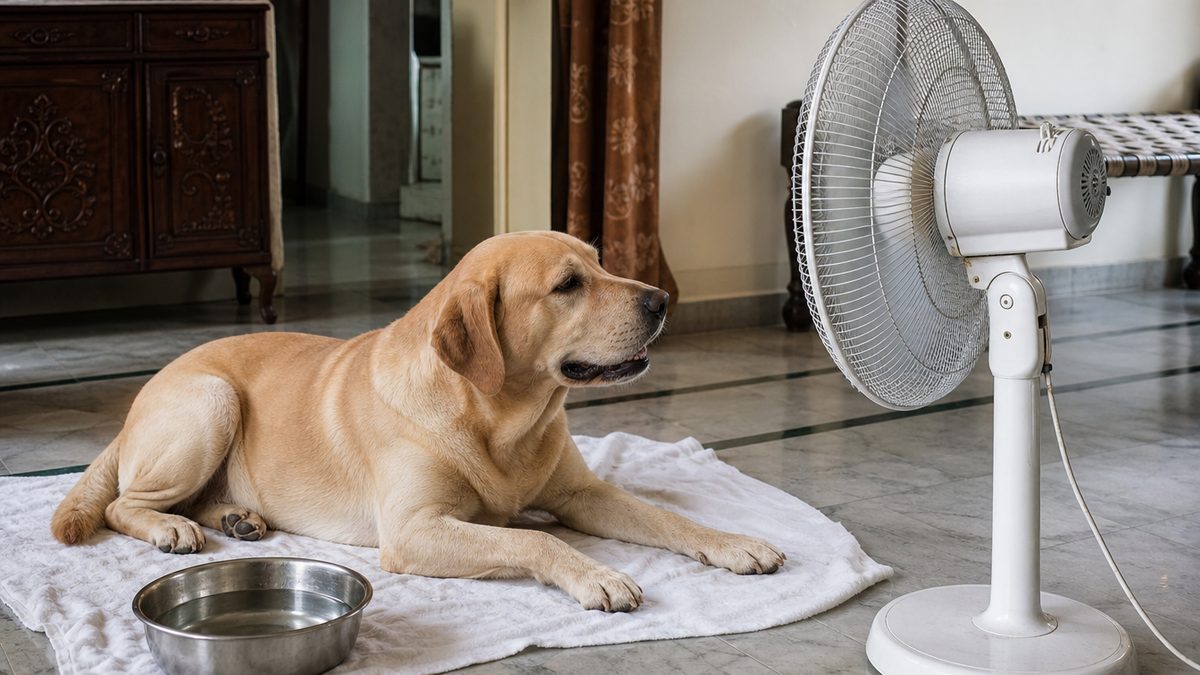
A fan does less for a dog because a fan accelerates evaporation, and you have a wet skin over your whole body while a dog does not. Moving air over dry fur mostly moves air over dry fur.
That is not a figure of speech, it is what the trials show. Fans alone were the slowest arm in the nine-dog comparison, taking 48 minutes to bring the dogs to 39 C against 36 on a cooling mat and 16 in water. In the 12-Labrador study, a fan on its own was among the treatments that did not reduce core temperature at all; water plus a fan, and alcohol plus a fan, both worked from the first measurement.
So the instruction is not "get a clip-on crate fan". It is "wet the dog, then point the fan at it". A fan is the multiplier on an evaporative intervention and close to nothing without one. In a humid Indian city the fan matters more rather than less, because it is the only lever you have on an evaporation rate that the air is otherwise refusing to allow.
Misting is the same mechanism delivered differently, and it has no published evidence in dogs at all. A Europe PMC search for misting, mister or mist fan together with dog, dogs or canine returned two records on 21 October 2026, neither about cooling an animal, against a control of 995 records for dogs and cooling. What can be said is mechanistic rather than measured: a mist that wets the coat and is then evaporated by moving air is water plus a fan, and a mist that hangs in already-saturated coastal air is raising the local humidity around the dog, which is the opposite of what you want.
- Wet the dog first, then run the fan. Water on the coat with air moving over it is the only combination both trials agree on.
- Aim at the underside. The glabrous skin of the belly, groin, armpits and paw pads is what the successful arm of the Labrador study targeted.
- Never lay a damp towel over the dog. The RSPCA is explicit that this traps heat and worsens the dog's condition, and that a wet towel belongs under the dog, re-wetted frequently.
- Plan the fan around the power cut, not the air conditioner. Which room, which circuit and what happens at 2 pm is covered in keeping a dog in an Indian flat.
Cats are a separate case with the same physics and a quieter animal, and the room rather than the gear is what decides it; that is in heat safety for cats in India.
Dog boots, paw balm and the one patch of skin built to exchange heat
Dog boots are a protective tool for a named hazard, and the thermal argument against wearing them all summer is that the paw pad is the one patch of a dog's skin with a dedicated vascular heat exchanger in it.
Whether a dog tolerates dog boots, what they do to gait and how to habituate a dog to them over a week is already answered with both published biomechanics studies in do dogs need clothes in India, and this page does not repeat it. The hot-pavement question, the measured asphalt temperatures and the hand test that detects them are in heat safety for dogs in India. What neither page raises is the thermal trade-off, so that is all this section adds.
Scanning electron microscopy of vascular corrosion casts from 16 limbs of four adult dogs found that the arteries supplying the footpad surface are wrapped in abundant venules forming a vein-artery-vein triad, that numerous arteriovenous anastomoses and well-developed venous plexuses run through the dermal vasculature, and that the triad forms a counter-current heat exchanger. The anastomoses shift blood flow, draining blood to the skin surface.
Two honest caveats belong with that. The paper describes this structure as a heat-conserving adaptation for cold climates, and it is quoted here only for the anatomy, which is that the pad is a vascular heat-exchange surface rather than an inert sole. And nobody has measured whether covering a pad changes heat loss in a hot climate. What is measured is that the one intervention that reliably cooled dogs in a 2025 trial was applied to glabrous skin, the hairless skin of which the pads are the largest accessible patch.
So the reading is narrow and practical. Use dog boots when there is a hazard they solve and take them off when there is not, rather than treating them as summer uniform. The same logic appears in the RSPCA's warning, which names boots on paws alongside gel mats and cooling jackets as things that must never be used to justify walking a dog in hot weather.
Paw balm has no published evidence of any kind
A Europe PMC search on 21 October 2026 for paw wax, paw balm or pad wax in the title or abstract, with or without dog, dogs or canine, returned zero records both times. The same index returned 995 records for dogs and cooling and 944 for dogs and heat-related illness in the same session, so this is a genuine absence rather than a query that failed.
That does not make paw balm harmful. It makes every claim you will read about it, in either direction, an opinion. A thin wax film on a pad is physically unlikely to be meaningful thermal insulation against a surface hot enough to injure skin, and the honest position is that nobody has tested it. If a pavement needs a product to be survivable, the pavement is the problem.
One paw-based intervention has been tested, and it is not a wax. In 12 working dogs in training, isopropyl alcohol applied to the paw pads cooled dogs more than no intervention, water immersion cooled them more efficiently than the alcohol, and the alcohol raised the dogs' heart rates more than either immersion or no intervention, which the authors read as the application itself being stressful to the dogs. Alcohol on pads is an emergency measure with a measured cost, not a daily routine.
What to buy first on a small budget, and what to buy never
Buy nothing first. Everything with the strongest evidence behind it is already in an Indian home: a tap, a cloth, a tiled floor, a fan and the decision to walk at a different hour.
That is not a rhetorical flourish, it is what the trials rank. Water plus moving air cooled dogs in both controlled studies Evaluation of methods to reduce…. The best-performing single method anywhere in this literature was partial immersion in water that was no colder than the air. A cooling vest bought for Rs 1,799 to Rs 2,499 delivers a documented 0.62 C at the finish line of a 20-minute run, in air half as humid as a Mumbai morning.
| Priority | What | Indian cost | Why it sits here |
|---|---|---|---|
| 1 | Moving the walk to the pre-dawn hour | Free | Exercise is the dominant trigger of heat illness and the hour is the only lever that removes the exposure rather than managing it |
| 2 | A bare patch of tile in the coolest room, plus a fan | Free, or already owned | Conduction into a cool floor plus convection, and the fan is the multiplier on anything wet |
| 3 | A cloth and a jug, used to wet the belly, groin and pads before the fan | Free | The only combination that reduced core temperature in the 12-Labrador trial |
| 4 | A shallow tray or tub of plain tap water | Low | Partial immersion was the fastest method tested, at 16 minutes against 36 and 48 |
| 5 | A cooling mat, if the dog cannot or will not use the floor | Rs 599 to Rs 1,980 | Measurably better than fans alone, and it stops once it has absorbed its fill RSPCA, Heatwave pet care myths |
| 6 | An evaporative cooling vest, in a dry city, for a walk you cannot carry water on | Rs 1,799 to Rs 2,499 | Worth considering where the wet-bulb depression is 8 C or more, which from the table means Jaipur, Delhi and Hyderabad in April and May |
| 7 | A cooling bandana | From Rs 451 | Same mechanism, much less surface area, but no strap around the chest |
| Never | Any of the above as permission to walk a hot dog in the heat | Zero and also infinite | The RSPCA's own rule |
The wider arithmetic of keeping a dog in India, and where a one-off Rs 2,000 purchase sits against the monthly lines, is in how much a dog costs in India per month. For most households the honest comparison is that a cooling vest costs roughly what a month of a medium dog's food costs, and buys a documented fraction of a degree on one kind of walk in one kind of weather.
Google India's People Also Ask boxes for this topic ask "Which dog cooling vest is the best?" and "Which dog cooling mats actually work?". Bonbeno does not rank or recommend a named product it has not tested first-hand, so neither question is answered here, and the page says so rather than dropping them quietly. What is answerable is everything above: read your city's wet-bulb depression, buy the mechanism before the product, check that a vest does not restrict the chest, and take it off when the walk ends.
How long does a cooling vest last, and what re-wetting really means
The honest answer is that it lasts until it dries, and how long that takes is the same variable that decides whether it was cooling in the first place. The Indian page holding position one for this keyword says its jacket is typically effective for 15 to 20 minute walks in most areas and that if it feels dry you spray some water on it, and adds that humidity, wind and sunlight affect how quickly you need to recharge it, with more wind or sun increasing evaporation.
Read that last clause carefully, because it is stated backwards for the buyer who needs it most. It frames humidity as something that changes how often you re-wet the vest. For a reader in Chennai, Mumbai, Kolkata or Kochi, high humidity means the vest stays wet for longer and cools less while it does, which is the failure mode rather than the convenience Effect of vest structure, airflow velocity. A vest that is still damp after an hour in Kochi is not a vest that is still working. It is a vest that has nowhere to send its water, and at that point it is a layer of wet fabric over a panting dog, which is the condition the RSPCA warns can insulate the dog and make it hotter.
Common questions
Do dog cooling vests actually work?
Yes, by a small and measured amount. In the only controlled trial on dogs, 13 military working dogs running 20 minutes at 10 km/h finished 0.62 C cooler wearing an evaporative vest than wearing nothing, and were 0.769 C cooler 15 minutes afterwards. The authors say the aim is to maintain thermal neutrality rather than to produce a sharp drop, and that these vests are not indicated for treating heat stroke. That trial ran at 46 to 53 percent humidity, roughly half an Indian coastal morning.
Do cooling vests actually work in humid weather?
Less, and nobody has measured how much less on a dog. An evaporative vest cools by drying out, so its ceiling is the wet-bulb depression of the surrounding air. On a thermal manikin, raising humidity from 20 to 40 percent cut cooling capacity by an average of 28 percent. No published test of any evaporative cooling garment goes above 40 percent humidity on a manikin or 53 percent on a dog, while IMD puts Kochi at 84 percent and Mumbai at 70 percent at 08:30 in May.
Are cooling vests good for dogs?
They are a modest help in dry air and a fit question in every climate. A 2026 veterinary review notes that harnesses and vests cover more of a dog than any other equipment, that nearly all of them have a continuous strap or panel encircling the thorax, and that such a strap could be expected to restrict chest expansion during inspiration, with the risk rising as the dog works harder. No study of the gait effects of cooling vests has ever been published. Prefer independent straps to a solid panel, and remove the vest when the walk ends.
Do those dog cooling mats really work?
Yes, and less well than plain water. In nine working dogs cooled after a treadmill run in a 30 C chamber, the mean time to bring internal temperature down to 39 C was 16 minutes with partial immersion, 36 minutes on a 4 C cooling mat and 48 minutes with fans alone. The water bath was at 30 C, the same as the air, and still beat the cold mat by more than two to one, because what a bucket offers is contact area rather than a cold temperature.
Do vets recommend cooling mats for dogs?
Veterinary and welfare guidance treats them as a comfort measure with conditions attached, not as a treatment. The RSPCA says not all cooling mats and jackets are the same, that some need pre-cooling while others are self-cooling gel, and that a mat should be monitored because some retain heat once they have warmed up and can then make a dog hotter rather than cooler. The same guidance says cooling products must never be used to justify walking a dog in hot weather.
Are cooling mats ok for dogs?
Only supervised. ASPCA Poison Control warned on 5 October 2026 about cooling pet pads and gel wraps, noting that packaging may call the gel nontoxic or medical grade, that reported signs after ingestion include vomiting, muscle tremors, unsteadiness, sound or touch sensitivity, low blood pressure and a raised heart rate, and that seizures and deaths have been reported. Some products contain high levels of acrylamide, a potent neurotoxin, and some contain beads that swell and obstruct the gut. Do not leave a dog unsupervised with one.
What is the fastest way to cool a dog down?
Water on the dog with air moving over it, starting where you are rather than on the way to the clinic. Partial immersion was the fastest of three methods tested in working dogs, at 16 minutes to reach 39 C, and it won even though the water was no colder than the air. In a separate 12-dog study, a fan alone and a cooling blanket alone did not reduce core temperature while water plus a fan did. Heatstroke itself is a veterinary emergency and is covered on our heat stroke page.
Does a dog cooling vest really work in Indian cities?
It depends on which Indian city and which month, by a factor of five. Using the India Meteorological Department's own 1991 to 2020 normals, the wet-bulb depression at 08:30 IST in May is 10.8 C in Jaipur, 8.5 C in Delhi, 4.9 C in Chennai, 4.2 C in Mumbai and 2.0 C in Kochi. Delhi's own figure falls from 8.5 C in May to 2.7 C in August. Read your city before you read a product description.
Does paw balm protect a dog from hot pavement?
Nobody knows, because nobody has studied it. A Europe PMC search on 21 October 2026 for paw wax, paw balm or pad wax, with and without dog, dogs or canine, returned zero records both times, while the same index returned 995 records for dogs and cooling. Every claim about paw balm and heat, in either direction, is therefore opinion. If a pavement needs a product to be survivable, move the walk instead.