
Dog health: dermatology
Sunburn and solar dermatitis in dogs in India, from the first patch of redness to squamous cell carcinoma
Chronic sun damage on a dog's belly, nose and ear tips is a premalignant skin disease, not a cosmetic one. India supplies the exposure in every month of the year, and the cheapest effective treatment is shade.
Quick answer
Sunburn in dogs is cumulative ultraviolet injury to thinly haired, unpigmented skin, and its chronic form has a clinical name, canine solar dermatitis. It starts as redness and scaling on the belly, groin, nose bridge and ear tips, thickens into wrinkled skin with blackheads, and is premalignant. In 991 outdoor-housed beagles, 363 developed solar dermatosis, and 26 percent of those dogs carried a skin tumour against 7 percent of the rest. India supplies the exposure in every month of the year, and shade costs nothing.
This guide is general information for Indian pet owners and is not a diagnosis. Always consult a registered veterinarian near you before acting on anything you read here, and treat any sudden change in your pet's condition as urgent.
Signs of Canine solar dermatitis
The 9 signs to watch for are listed below. Any one of them is a reason to consult your nearby vet; none of them is a diagnosis.
- Redness and fine scaling on the belly, groin and inner thighs
- Skin that thickens, wrinkles and loses hair in sun-exposed patches
- Comedones, which look like blackheads, on thinly haired skin
- A sharp line where pigmented skin stops and damaged pale skin begins
- Crusting or a raw pink patch on the nose bridge or ear margins
- Lesions worse on the side the dog habitually lies on
- Little or no itching, unlike an allergy
- Blood blisters, firm nodules or a sore that will not heal
- A rash that returns worse each warm season despite antibiotics
Breeds on this site that document this condition
Each breed page below carries the figure for this condition with its denominator and its source. The 8 breeds listed are the ones on this site that document it, not a ranking of risk.
India supplies more of the causal exposure than any country that has published on this condition. NASA POWER climatology queried by coordinates on 27 September 2026 puts Bengaluru, Kochi and Thiruvananthapuram above London's sunniest month in all twelve months of the year, Chennai in eleven and Hyderabad in ten, so there is no off-season to relax in. Ultraviolet peaks in March in Kerala, April in Bengaluru and Chennai and May across the north and west, which is weeks before the heat that owners use as their cue. Leh, at 4,533 metres, records the highest single month of the sixteen Indian locations checked. India also runs one time zone across roughly 30 degrees of longitude, so solar noon and therefore the peak window shift by more than an hour between Assam and Gujarat. Free-roaming and terrace-sleeping dogs take the dose lying on their backs on hot concrete. No Indian series on canine solar dermatitis has been published, and a 210-case Indian dermatoses series never names the category once. Diagnosis is cheap here, at Rs 150 for histopathology at ICAR-IVRI and Rs 500 per specimen at BASU Patna.
What sunburn in dogs actually is, and why the clinic calls it something else
Sunburn in dogs is ultraviolet injury to skin that has too little hair or too little pigment to stop it, and when the exposure repeats the condition acquires a different name and a different meaning. Veterinary dermatology calls the chronic form canine solar dermatitis, and describes it as a severe dermatologic disorder rather than a red patch that fades.
Two different problems share the everyday word. The acute one is what a person recognises, and the PDSA describes it in an owner's terms, with redness, crusting, flaking, itching, blisters and pain, where mild cases often heal within a few days at home and severe ones need a vet the same day. The chronic one has no single bad afternoon behind it. It is the sum of every exposure the skin has taken, it does not resolve, and it is the version that matters in a country with a year-round ultraviolet load.
The chronic form has a fixed address on the body. Canine solar dermatitis occurs on the medial aspect of the legs, the ventrolateral abdomen and thorax, the lateral flank and the bridge of the nose, in non-pigmented skin. Those are the places a dog's coat is thinnest and its skin is palest. The current veterinary review puts the same point in one line, that ultraviolet-associated cancers typically develop in sparsely haired or hairless regions such as the nose and ventrum.
Three defences, and what removes them
A dog is not defenceless against ultraviolet light. The haircoat, the stratum corneum and melanin pigmentation usually protect against the harmful effects of UV radiation, which is why breeds with a short hair coat or light pigmentation are more frequently affected. Take away any one of the three and the exposure reaches living cells. A white dog has lost the third. A short-coated dog has thinned the first. A dog lying on its back has removed both over the one region where it had least to spare.
The wavelengths do different jobs. UVA at 320 to 400 nm penetrates more deeply into the skin than UVB does and is associated with photosensitivity reactions, while prolonged exposure to the shorter UVB wavelengths at 290 to 320 nm causes the phototoxicity that a reader would call sunburn, damaging keratinocytes directly and making the superficial skin blood vessels dilate and leak. Long-term exposure to both produces three cellular events, which are oxidative damage and cell death, immune suppression, and inhibition of tumour suppression.
For scale, the solar spectrum reaching a dog is composed of about 40 percent visible light at 400 to 700 nm, 50 percent infrared at 700 to 20,000 nm and 9 percent ultraviolet at 100 to 400 nm. The smallest slice does the mutagenic damage. That 9 percent is the whole subject of this page.
The lesion has an order, and the order is the warning
Lesions usually start as erythema and scaling, which evolve into thick, firm and wrinkled skin with alopecia and comedones, meaning dilated hair follicles, and occasionally round raised red nodular masses. An owner who knows that sequence can place their dog on it. Redness that comes and goes is early. Skin that has gone leathery and grown blackheads is not early. A nodule is the stage at which the question stops being dermatology and starts being oncology.
Where a dog carries both pigmented and unpigmented skin, the boundary does the explaining for you. There is often a sharp demarcation between areas of normal skin with protective pigment and damaged non-pigmented skin. The Kansas State page illustrates exactly that with a 5-year-old Boxer whose black spots sit beside unpigmented skin showing marked epidermal hyperplasia and erythema, which the authors read as evidence of the protective effect of melanin.
Ultraviolet light contributes little in the way of thermal or heat burden, whereas visible radiation can penetrate skin and create thermal injury and necrosis, and sunlight-induced burns and necrosis affecting the black spots of Dalmatians have been reported as an uncommon injury with a different pathogenesis from canine solar dermatitis. Black skin absorbs about 45 percent more solar radiation than white skin does. So on a Dalmatian the white skin is at risk of actinic damage and the black spots are at risk of a thermal burn, and those are two mechanisms, not one. Your nearby vet is the person who decides which is in front of them.
Which dogs get it, and why almost every dog has one vulnerable patch
Solar dermatitis affects dogs with short white hair or unpigmented skin, and the two published risk lists name overlapping sets of breeds. Both lists are illustrative rather than closed, and the more useful way to read them is as descriptions of coat and pigment rather than of pedigree.
Kansas State names Beagles, Boxers, Bull Terriers, Dalmatians, Pit bulls and Whippets as more frequently affected, and closes the list with etc., which makes it illustrative. The dvm360 dermatology review names seven, which are pit bull terriers, Staffordshire bull terriers, bull terriers, boxers, Dalmatians, American bulldogs and whippets, then adds that any dog with white or lightly pigmented hair and skin is at risk. A breed absent from either list is unnamed, not excluded.
Veterinary Partner states the general rule that makes the breed lists secondary. Most of the time a good fur coat is all the protection a dog needs, and there are two problems with that, the tummy, which is sparsely furred in most dogs, and short white fur, which sunlight readily penetrates. The first problem belongs to nearly every dog alive. A Labrador has a sparse ventral abdomen too; it simply spends less of its life lying belly-up on a hot terrace than the dog that develops the disease.
The measured version of coat and pigment
One retrospective study puts numbers on the coat-and-pigment rule rather than on breed. Across 212 dogs carrying 306 cutaneous haemangiomas and haemangiosarcomas, dogs with short hair coats and lightly pigmented skin had 65 percent of the dermal tumours against 28 percent in dogs with variable coat length and pigmentation, and 65 percent of the tumours in ventral glabrous skin against 22 percent. Dermal haemangiosarcoma showed a marked predilection for glabrous skin at 63 percent against 10 percent for haired skin.
Behaviour decides the map as much as genetics does. The distribution of the lesion depends on the individual animal's behaviour and the length of exposure. In dogs that prefer to lie on one side of the body, lesions may be worse on the more chronically sun-exposed side. That single clinical observation is why an Indian page cannot be a translation of a British one. The dog that sleeps on its back on a terrace at two in the afternoon has chosen the exposure, and it has chosen it on the one surface that has no coat to lose.
| Site | Named by | How a dog exposes it |
|---|---|---|
| Ventrolateral abdomen and thorax | Kansas State, and the review naming the ventrum | Lying on the back, or standing over reflective ground |
| Inguinal and axillary skin, medial thighs | Kansas State and dvm360 | Sparsely haired at all times, fully exposed when the dog rolls |
| Lateral flank and lateral trunk | Kansas State and dvm360 | Lying on one preferred side, day after day |
| Bridge of the nose and nasal planum | Kansas State, dvm360 and the PDSA | Held up and forward whenever the dog is awake outdoors |
| Ear tips and margins | The PDSA and the dvm360 sunscreen guide | Thin skin, sparse hair, no shade from any angle |
| Eyelids and lips | The PDSA and the dvm360 sunscreen guide | Unpigmented margins on light-faced dogs |
The Indian population nobody has measured
India's exposed dog is often not a pedigree at all. The nearest Indian denominator anyone has published for the free-roaming population comes from a prevalence survey of 323 sexually intact stray dogs over three months of age caught from the streets of Jodhpur between September and November 2005, in which skin conditions were found in 69 percent, alongside low body condition score in 70 percent and tick infestation in 68 percent. That paper does not break the skin conditions down by diagnosis, so it cannot tell you how many were actinic. It does tell you that the Indian city with one of the highest ultraviolet loads in this page's own table has a free-roaming dog population in which most animals have something wrong with their skin, and that nobody has looked for sun damage among it.
The cat in the same household is on the same terrace. International Cat Care's owner guidance on feline sun exposure covers sunburn and skin cancer under their own headings, and the sites it deals with are the ones a cat presents with rather than a dog's ventral abdomen. White-eared cats are the classic case, and the current veterinary review treats dermal squamous cell carcinoma as a shared ultraviolet-driven problem of both species. If you are changing the terrace routine for the dog, change it for the cat at the same time.
Bonbeno's breed pages for the Dalmatian, the Bull Terrier, the Boxer, the Whippet and the American Pit Bull Terrier cover breeds that sit on one or both published risk lists. The Chinese Crested Dog and the American Hairless Terrier have no coat to lose anywhere, which is a different magnitude of the same problem.
Indian ultraviolet, measured city by city, and why there is no safe season
India's ultraviolet load does not switch off in winter, and in the south it never drops to a European summer peak at all. Bonbeno queried the NASA POWER climatology for sixteen Indian locations by explicit latitude and longitude on 27 September 2026, and the result changes what sun advice for an Indian dog should say.
Every figure below is the NASA POWER all-sky surface ultraviolet index from the MERRA-2 reanalysis, a monthly climatological mean, requested one location at a time with the coordinates and elevation echoed back in each response and checked before use. Querying by coordinates rather than by place name matters, because a climate portal can serve a perfectly formatted page for the wrong city and a coordinate pair cannot.
| Location | Annual mean | Peak month | Peak | Lowest month | Lowest | Months above London's sunniest month |
|---|---|---|---|---|---|---|
| Leh (4,533 m) | 1.68 | July | 2.84 | December | 0.52 | 7 |
| Thiruvananthapuram | 2.12 | March | 2.54 | November | 1.77 | 12 |
| Bengaluru | 2.08 | April | 2.54 | December | 1.64 | 12 |
| Kochi | 2.04 | March | 2.50 | November | 1.76 | 12 |
| Chennai | 1.95 | April | 2.40 | December | 1.43 | 11 |
| Ahmedabad | 1.89 | May | 2.75 | December | 1.09 | 9 |
| Hyderabad | 1.88 | May | 2.45 | December | 1.35 | 10 |
| Mumbai | 1.79 | May | 2.53 | December | 1.22 | 9 |
| Pune | 1.75 | May | 2.51 | December | 1.30 | 7 |
| Nagpur | 1.73 | May | 2.48 | December | 1.11 | 9 |
| Jodhpur | 1.69 | May | 2.41 | December | 0.81 | 8 |
| Jaipur | 1.65 | May | 2.39 | December | 0.79 | 8 |
| Kolkata | 1.54 | May | 1.99 | December | 0.84 | 8 |
| Shimla | 1.48 | May | 2.30 | January | 0.60 | 7 |
| Guwahati | 1.37 | August | 1.84 | January | 0.78 | 6 |
| Delhi | 1.36 | May | 2.06 | December | 0.54 | 7 |
| London (reference) | 0.63 | June | 1.44 | December | 0.04 | 0 |
| Melbourne (reference) | 1.29 | January | 2.65 | June | 0.25 | 5 |
Three findings an owner can act on
There is no off-season in south India. Thiruvananthapuram's quietest month is November at 1.77, which is 23 percent above London's sunniest month of June at 1.44. Kochi's November at 1.76 and Bengaluru's December at 1.64 clear the same bar. All three cities exceed a London midsummer in every one of the twelve months, and Chennai does it in eleven. Put the other way, London's ultraviolet index swings by a factor of 36.0 between June and December while Thiruvananthapuram's swings by 1.44. A sun routine that is switched on for summer and off for winter is a European habit, and in Kerala or Karnataka it is wrong for the whole year.
The peak month is not the hottest month, and it moves with latitude. Kochi and Thiruvananthapuram peak in March, Bengaluru and Chennai in April, and the entire north and west in May. Leh peaks in July and Guwahati in August, both of them well outside the season an owner would guess. An owner in Kochi who waits for the heat before covering the dog starts roughly two months late.
The highest single month in the set is not in the plains. Leh, which NASA POWER returns at an elevation of 4,532.61 m, reaches 2.84 in July, above Ahmedabad's 2.75 in May, which is the highest month of any non-Himalayan location checked. Altitude, thin air and snow reflection are why. The dvm360 review makes the same point clinically, that solar dermatitis also affects animals living at high altitudes. A white dog in Leh or Spiti is in the highest-exposure place in the country and almost nobody writes sun advice for it.
These are NASA POWER monthly climatological means across all hours, not the number a weather app shows. The WHO, which developed the ultraviolet index with the United Nations Environment Programme, the World Meteorological Organization and the International Commission on Non-Ionizing Radiation Protection, states that in reporting the UVI, the maximum daily UV level, which occurs during the four-hour period around solar noon, is provided on a given day. A solar-noon maximum is far higher than a 24-hour mean, which is why every figure in the table sits below the 0 to 11-plus range a person recognises. Every figure is on the same scale, so the comparisons between them hold exactly. The absolute values must not be read as app ultraviolet index numbers.
An independent Indian instrument says the same thing
The satellite record agrees, and it is Indian work. Eighteen years of daily ultraviolet index over Kerala, from 2004 to 2022, were derived from the ultraviolet-B irradiance measured by the Ozone Monitoring Instrument aboard the AURA satellite, with authors at the Kerala State Disaster Management Authority in Thiruvananthapuram. More than 79 percent of those measurements fell into the very high and extreme ultraviolet index categories, and the higher values were observed in March, April and September. Two instruments, a reanalysis and a satellite radiometer, independently place Kerala's peak in March and April rather than in the hot months.
One time zone, and a solar noon that moves by ninety minutes
India runs a single clock across roughly 30 degrees of longitude, and that has a consequence for sun advice that no ranking page mentions. Indian Standard Time is UTC plus five and a half hours, derived from the standard meridian at 82 degrees 30 minutes East, which passes through Mirzapur in Uttar Pradesh, and every 15 degrees of longitude corresponds to a one-hour time difference. Britannica states the consequence directly, that without a standard time India's westernmost and easternmost regions would have a natural two-hour difference in local time. Applied to the two cities furthest apart in this page's own table, solar noon arrives at about 12:00 IST on the meridian itself, roughly 38 minutes later in Mumbai at 72.88 degrees East and roughly 37 minutes earlier in Guwahati at 91.74 degrees East, a spread of about an hour and a quarter. Those two clock offsets are Bonbeno's arithmetic from the meridian, the 15-degree rule and the coordinates queried for the table above, not figures lifted from a source, and the underlying rule that the peak sits in the four hours around solar noon is the WHO's.
Indian dermatologists have already published on the consequence for human skin. A 2022 study in Photodermatology, Photoimmunology and Photomedicine is titled Photodermatosis and high UV index in Jorhat (north east India) due to single time zone, from the Department of Dermatology at Command Hospital Air Force, Bangalore. The full text is behind a paywall, so nothing from its body is quoted here, but the title alone establishes that the single-time-zone effect on ultraviolet exposure is a recognised Indian clinical concern rather than this page's invention. The practical translation for a dog owner in Assam or Arunachal is that the dangerous window opens earlier on the clock than the standard advice assumes, and in Gujarat or Rajasthan it closes later.
The progression to squamous cell carcinoma, with the denominators attached
Chronic solar dermatitis is a premalignant condition, and that is the reason this page is not about comfort. Intermittent chronic exposure causes keratinocyte proliferation, mutagenesis and premalignant actinic keratosis, which can evolve into sun-induced skin tumours including squamous cell carcinoma, haemangioma and cutaneous haemangiosarcoma.
Almost every page that says so stops there. The numbers below are what the pathway looks like when somebody counted, and they come from a small literature, so it is worth being precise about what each one measures and where each one is weak.
How often sun-damaged skin turns into a tumour
The largest count is a life-span study of 991 beagles up to 14 years of age, housed in gravel-based outdoor pens in a high-altitude, high-sunshine environment. Solar dermatosis was diagnosed in 363 of the 991 dogs, an incidence of 36.6 percent, and it was restricted to the sparsely haired, non-pigmented abdominal skin. Across the whole colony there were 175 haemangiomas, haemangiosarcomas or squamous cell carcinomas of the skin, of which 129 occurred in dogs with solar dermatosis and 46 in dogs without. Counted by dog rather than by tumour, 93 of the 363 dogs with solar dermatosis, or 26 percent, carried at least one of the three tumour types, against 44 of the remaining dogs, or 7 percent.
Those beagles were not an ordinary population. They were part of a life-span study of the effects of low-level ionizing radiation during development, and had received whole-body gamma-radiation exposures at one of three prenatal or three postnatal ages. The authors themselves report an apparent increased risk for haemangiosarcomas and squamous cell carcinomas in dogs that had both solar dermatosis and gamma-ray exposure at one year of age, and read it as an interaction between ionizing and ultraviolet radiation. So the 26 percent against 7 percent is a strong correlation, at P less than 0.001, measured inside a co-irradiated colony. It is the best canine denominator that exists for this pathway. It is not a clean estimate of what happens to a pet dog in Pune, and anyone quoting it without that sentence is overstating it.
A second beagle series measured the step that matters most, which is how many dogs with chronic sun damage actually develop carcinoma. Chronic dermatosis developed in sparsely haired, lightly pigmented ventral body skin in 397 of 1,680 beagles by the time the dogs were five and a half years old, and in 26 of 55 other beagles by 12 years of age. Squamous cell carcinomas developed in the sites of dermatosis in eight of the 397 younger dogs and in five of the 26 older ones. That is roughly 2 percent of the young cohort against roughly 19 percent of the old one, and the gap between those two figures is the whole argument for starting sun protection in a puppy rather than in a nine-year-old.
Both series are beagle colonies reported from Colorado State University, one explicitly so and the other sharing an author base and an era. Whether they draw on overlapping animals is not something this writer could establish from the published records. They are therefore presented here as one line of evidence examined twice, rather than as two independent populations agreeing with each other. The distinction matters because a reader who counts them as two will over-weight the finding.
What happens once the carcinoma exists
The prognosis literature is more reassuring than the pathway sounds, and it contains one genuinely surprising result. A retrospective series of 193 dogs histopathologically diagnosed with dermal squamous cell carcinoma at a single institution found documented histopathologic actinic change in 38 percent of them, and reported an overall median survival time of 1,004 days. The dogs whose tumours showed actinic change survived significantly longer, with a median of 1,359 days against 680 days for those without, a hazard ratio of 0.42 with a 95 percent confidence interval of 0.193 to 0.930 and P equal to 0.032. Sun-induced squamous cell carcinoma is, on that evidence, the less aggressive kind.
Read that carefully, because it is easy to misuse. A longer median survival is a statement about what happens after diagnosis, not a reason to let the damage accumulate. Those medians are measured in years of surveillance and repeated surgery, and the review that summarises the field describes these tumours as causing substantial local disease and often requiring repeated surgery because of recurrence or new lesions, creating a notable welfare and financial burden.
The nose is the site with its own series. Across 89 dogs treated locally for nasal planum squamous cell carcinoma, a visible mass on the nasal planum was the presenting complaint in 89 percent and metastasis was detected in 12 percent at the time of local therapy. Surgical excision alone was used in 63 of the 89 dogs, or 71 percent, and radiation alone in 20 of 89, or 22 percent. Local recurrence was reported in 19 of the 89 dogs, or 21 percent, including 16 of the 63 treated with surgery alone, or 25 percent, and the median survival time for the whole group was 452 days with a 95 percent confidence interval of 285 to 576.
| Figure | Denominator | Population it was measured in |
|---|---|---|
| Solar dermatosis in 36.6 percent | 363 of 991 dogs | Beagles in outdoor pens, high altitude and high sunshine, also gamma-irradiated |
| A skin tumour in 26 percent of affected dogs against 7 percent of unaffected | 93 of 363, against 44 of the rest | The same 991 beagles |
| Chronic dermatosis in 23.6 percent by 5.5 years | 397 of 1,680 dogs | A beagle colony, ventral sparsely haired skin |
| Carcinoma in about 2 percent of the young cohort, about 19 percent of the old | 8 of 397, and 5 of 26 | The same beagle work at two ages |
| Actinic change in 38 percent of dermal carcinomas | 193 dogs | One US referral institution, 1987 to 2017 |
| Median survival 1,004 days overall | 193 dogs | The same institution; 1,359 days with actinic change, 680 without |
| Local recurrence 21 percent | 19 of 89 dogs | Nasal planum carcinoma treated locally, multi-institutional |
| Dermal tumours in glabrous skin 63 percent | 212 dogs, 306 tumours | Retrospective haemangioma and haemangiosarcoma series |
Two rarer endpoints are on record and belong here for completeness. A seven-year-old American Staffordshire bull terrier was diagnosed with chronic solar dermatitis and basal cell carcinoma, which the authors report as the first case of canine basal cell carcinoma developing as a complication of chronic solar dermatitis. And the haemangioma and haemangiosarcoma route is not a footnote to the carcinoma route; in the 991-dog colony all three tumour types were counted together precisely because they arose in the same damaged skin.
The sentence to take away is the one the dvm360 review puts at the end of its treatment section. Even with future sun avoidance, prior skin damage can still progress to skin neoplasia months or years after exposure. Protection stops the meter running. It does not reverse what is already on it.
What to look for at home, and the point at which watching stops being reasonable
Look at the belly, the groin, the nose tip and the ear margins in good light once a week, and run your fingers from a pigmented patch onto a pale one. Early solar dermatitis is a change in texture before it is a change in colour, and the sites are predictable enough to make a routine short.
The acute and chronic pictures need separating at the door. Acute sunburn produces redness, crusting, flaking, itching, blisters and pain, and mild cases often heal within a few days with cold compresses, shade and cover, while severe sunburn should always be checked by a vet straight away. Chronic solar dermatitis produces a slower, drier, thicker change that does not heal and does not itch much.
The absence of itch is the most useful home clue. Although affected dogs may lick damaged areas, the pruritus associated with solar dermatitis is usually otherwise minimal, unlike that in dogs with allergic dermatitis. A dog with a red belly that is frantically scratching is more likely telling you about something else. A dog with a red belly that is ignoring it, in a household where the dog sunbathes, is the profile this page is about.
- Run the pigment test. Passing your fingers across the fur from a white patch to a coloured one gives a dramatic difference in skin texture, because the coloured fur is protective against the sun.
- Check the side the dog sleeps on. Lesions may be worse on the more chronically sun-exposed side in dogs that prefer one side.
- Count the comedones. Dilated hair follicles appearing as blackheads on thin-skinned areas are part of the established lesion sequence, not dirt.
- Look at the nose tip and ear margins separately. Ears, nose, eyelids and tummy are the most common places for a pet to get sunburnt.
- Note the season. Lesions that recur every warm season and worsen year on year, while improving briefly on steroids and antibiotics, are a documented presentation of solar dermatitis mistaken for seasonal allergy.
Any blood blisters on the skin, especially on the tummy, should be seen by a veterinarian. So should a firm nodule or a raised red mass on sun-exposed skin, because those are in the lesion sequence at the point where neoplasia begins. So should severe sunburn or an animal that appears to be in pain. And so should any skin lesion that has not resolved on empiric treatment, because lack of resolution of skin lesions with empiric therapy should raise suspicion of solar dermatitis and the need for further investigation. None of this is an emergency measured in minutes. It is an appointment measured in days, and the reason to make it is that the tumours which arise here are best removed early. Find a clinic through Bonbeno's vet directory and take photographs of the skin in daylight before you go.
One practical Indian point about timing the visit. The government teaching hospitals that price this work cheapest also keep morning outpatient hours, with the Bihar Animal Sciences University clinical complex running an OPD window of 9:00 AM to 1:00 PM and an emergency window of 2:00 PM to 8:00 PM. Those morning hours fall inside the period a sun-damaged dog is supposed to be indoors. Travel with the dog covered and in shade, and do not let the trip to the dermatology appointment become another exposure.
How a vet confirms it, and the four things it is mistaken for
A definitive diagnosis can only be reached by histopathological examination of a skin biopsy. Everything before the biopsy is a shortlist, and the shortlist is where this condition most often goes wrong, because early solar dermatitis looks like several commoner problems.
The skin lesion initially manifests as erythema and scaling, which often resembles pyoderma, dermatophyte infection, cutaneous lymphoma or an autoimmune disease. The dvm360 review adds allergies to the list and states the consequence plainly, that solar dermatitis can mimic other skin diseases such as allergies or pyoderma and so go unrecognised and untreated until irreversible damage or sun-induced skin cancers have developed. Bonbeno covers three of those look-alikes separately, in hot spots and pyoderma in dogs, ringworm in dogs and cats and atopic dermatitis in dogs, and a fourth in mange in dogs.
What the vet is looking for, in order
Diagnosis involves considering the patient's signalment and clinical signs and ruling out other causes of scaly, erythematous dermatitis or folliculitis, including bacterial, Demodex and dermatophyte infections. An adequate history matters unusually much here, and Kansas State lists what belongs in it, which is a history of sunbathing or sun exposure, the signalment, the duration, the distribution and location of the lesions, and non-responsiveness to standard of care therapy. In India that history has a specific question in it, which is where the dog sleeps between eleven and three.
Secondary infection has to be cleared before the biopsy or it will corrupt the result. Most actinic dermatitis cases carry a hefty secondary Staphylococcus infection, and depending on its degree, systemic antibiotics may be indicated for two to three weeks before biopsy so that infection does not alter the histologic interpretation and so that the right lesions get sampled. Kansas State gives the same instruction, that in the event of secondary pyoderma, biopsies should be collected after antibiotic therapy to prevent misdiagnosis. The exception is an obviously neoplastic mass, where the advice is to biopsy immediately to expedite treatment.
Why one biopsy is not enough
The recommendation is to collect multiple skin biopsies at different stages of the disease, and based on the gross lesions the samples should include areas of erythema, crusted plaques, nodules and the margins of ulcers, so that the full spectrum of the disease is visible to the pathologist. Solitary nodules should be completely excised rather than sampled, to prevent overt progression of neoplasia. A single punch from the reddest spot can miss the one area that has already changed.
What the pathologist finds is specific. The most consistent histologic finding in dogs with chronic solar dermatitis is a narrow, hypocellular, pale-staining band of collagen along the dermo-epidermal junction with deposition of numerous pale blue stained elastin fibres, alongside epidermal hyperplasia, follicular dilation with keratosis and dermal fibrosis. The dvm360 review names the same change as solar elastosis, linear bands of degenerated basophilic elastin accumulation arranged parallel to the skin surface, and notes that in chronic cases the report may show follicular cysts, pyogranulomatous inflammation and precancerous actinic keratosis or neoplastic cells. Because some of those changes also occur in bacterial folliculitis, the submission form should carry the full history and the request should ask for interpretation by a veterinary dermatopathologist.
The dvm360 review illustrates the failure mode with a case whose truncal hair loss was worsened by iatrogenically induced hyperadrenocorticism, after a year and a half of daily oral glucocorticoid given for an erroneously diagnosed allergic dermatitis. The dog was treated for the wrong disease for eighteen months and acquired a second one. Another of its illustrated cases had lesions that occurred seasonally in the warm months and seemed at first to improve with glucocorticoids and antibiotics, but returned more severely each summer, and the keys to the diagnosis were the lack of marked pruritus and the distribution of the lesions sparing pigmented areas. If your dog has been on repeated courses for a skin problem that keeps coming back worse each summer, that pattern is worth raising with your nearby vet by name.
There is no screening scheme for this condition and there cannot be one. No registry, DNA test or eye scheme screens for ultraviolet damage, because the exposure is environmental and the phenotype at risk, which is short white coat over pale skin, is visible from across a room. The screening test is the owner's weekly look and the vet's biopsy when something changes.
What the diagnosis and the surgery cost in India, from published government rate cards
The histopathology that settles this diagnosis costs Rs 150 at a central government veterinary institute and Rs 500 per specimen at a state one. The figures below are read from the institutions' own published pages, not from an average or a conversion, and each was divided by 84.38 and by 74 to confirm it is an Indian price rather than a dollar list.
Two things make this section unusual. The first is that almost nothing about solar dermatitis is expensive to diagnose in India, which removes a common reason owners delay. The second is that the same institution can print two different surgery prices on two different pages, so a single quoted figure would be misleading.
| Item | ICAR-IVRI Izatnagar, pet animal, from June 2024 | BASU Patna, canine | TANUVAS Madras Veterinary College |
|---|---|---|---|
| Registration | Rs 30, rising to Rs 200 after 12:30 PM and Rs 400 after 5:00 PM or on holidays | Charged at the reception counter, OPD 9:00 AM to 1:00 PM | Rs 100 for a small animal, valid 7 days only |
| Skin scraping | Rs 100 | Rs 50 for skin or nasal scrapping | Rs 200 per sample |
| Cytology or FNAC | Rs 150 for each | Rs 250 for biopsies (FNAC) | Rs 300 per sample for cytology |
| Histopathology | Rs 150 | Rs 500 per specimen for H and E examination | Not priced on the laboratory page read |
| Bacterial culture and sensitivity | Rs 150 for ABST | Not priced on the page read | Rs 600 per sample for ABST and culture |
| Minor surgery | Rs 100 | Not separately priced on the page read | Rs 500 on the Clinics page, Rs 1,000 on the Surgery page Tamil Nadu Veterinary and Animal Sciences… |
| Excision of a tumour | Rs 300 | Not separately priced on the page read | Falls under minor or major surgery, Rs 1,500 to Rs 3,000 for major Tamil Nadu Veterinary and Animal Sciences… |
The disagreement is inside one university, and both pages are live. The Madras Veterinary College Department of Clinics publishes a hospital fee structure under a column headed COST IN RUPEES giving minor surgery at Rs 500 and major surgery at Rs 1,500, while the Department of Veterinary Surgery and Radiology publishes a fee approved by the HMC Committee giving minor surgery at Rs 1,000, major surgery at Rs 3,000 and specialised or emergency surgery at Rs 5,000. Neither page carries a date. Take the higher pair to the appointment and be pleased if the bill is the lower one.
The exchange-rate test, run on every figure above
Rs 150 is about 1.78 dollars at 84.38 to the dollar and about 2.03 at 74. Rs 500 is about 5.93 and 6.76. Rs 3,000 is about 35.55 and 40.54. None of those lands on a round dollar figure at either rate, which is what a converted American price list looks like, so these are genuine Indian rate cards rather than translations. All are institutional teaching-hospital rates and none of them is what a private metro clinic will quote.
Set that against what the condition costs if it is missed. The review describes ultraviolet-associated tumours as often requiring repeated surgery because of recurrence or new lesions, creating a notable welfare and financial burden, and Veterinary Partner records that many dogs must come in monthly as new skin tumours appear. A Rs 150 histopathology at the point where the skin first thickens is the cheapest intervention on this page after shade, which is free.
Treatment in general terms, and the one line every source agrees on
The best treatment option is to minimize the exposure to sunlight. The dvm360 dermatology review says the same thing in different words, that the best treatment for canine solar dermatitis is prevention, and adds the sentence owners most need, that oral and topical medications cannot replace sun avoidance in treating and preventing the condition.
Everything below is a drug class and what it is for. This page names no medicine you can buy, prints no amount of anything, and is not a treatment plan. Your nearby vet is the only person who can examine your dog, and dosing is entirely their call.
First the infection, because it hides the disease
Most actinic dermatitis cases carry a hefty secondary Staphylococcus infection and need regular topical disinfection, as a mousse, spray or wipe, if not oral antibiotics. Clearing it is not a side quest. It changes what the skin looks like, it changes what a biopsy shows, and it is the step that lets the vet see which lesions are actually actinic. In the published imiquimod case the dog had eight weeks of an oral antibiotic first, after which the haemorrhagic bullae resolved while the underlying erythematous solar lesions with induration and comedones persisted. That is the shape of it, an infection that clears and a sun injury that does not.
Then inflammation, perfusion and the premalignant skin
Where the skin is inflamed and uncomfortable, a short course of topical steroids can relieve it, and the instruction that matters is to use a product made for animals, because human products are not made with the expectation that they will be licked. Protocols using daily vitamin A have been shown to reduce the development of skin cancer and lessen sun damage, and the veterinary reference is explicit that your veterinarian will tell you what to get. Pentoxifylline is used to improve circulation to the skin and so assist perfusion and healing.
For skin that is already precancerous, two further options appear in the literature. Non-steroidal anti-inflammatories help with pain and can also inhibit sun-induced cancers, with the standing warning never to use a human product in a pet without specific instructions from a veterinarian because many human NSAIDs are toxic to animals. The formal trial of that idea used a COX-2 selective inhibitor in five dogs with solar dermatitis or actinic keratosis over 180 days, scoring erythema, skin shine, induration and comedone counts on days 0, 50 and 180, and four of the five improved, with the histological gain lying in regularisation of the epidermal proliferation rather than recovery of the dermal changes. Five dogs is a very small series and the authors present it as a hypothesis about COX-2 in the pathogenesis rather than as a treatment recommendation.
Topical imiquimod is an immunomodulator with anti-tumour effects, and the practical caution attached to it is that the dog must not lick it, so special wraps may be needed. There is one published canine case, a 5-year-old neutered male American Bulldog whose topical imiquimod course resolved the erythema while some non-inflamed comedones remained, and the authors state that although imiquimod has long been suggested for solar dermatitis, this is the first known case report detailing its efficacy in dogs. One case is one case.
And surgery, when a tumour has already formed
Once neoplasia has occurred, aggressive surgical resection or laser therapy should be performed, and where large or invasive masses are present, screening for metastasis to draining lymph nodes and internal structures is necessary. Surgery is often curative for a solitary tumour, especially when it is performed early, and the difficulty is that multiple areas of tumour can arise and on an abdomen there is only so much skin that can be removed, which is why many dogs must come in monthly as new skin tumours appear. In the nasal planum series, surgical excision alone was the treatment in 63 of 89 dogs and 16 of those 63 recurred locally, which is 25 percent.
The dvm360 review follows one pit bull through treatment and photographs the result. After six weeks of antibiotic therapy and three months of sun avoidance, the prior lesions of erythema and bullae had resolved, although scarring was still present and a persistent scaly erosive lesion remained on the prepuce, which the author reads as likely precancerous or early cancer and says warrants a biopsy. That is an honest picture of a good outcome. The inflammation goes, the scar stays, and the surveillance does not stop.
Sun avoidance, which beats every product on this page and costs nothing
Move both walks out of the middle of the day, give the dog a dark place to lie, and cover the belly before it goes out. The current veterinary review ranks the strategies in that order, listing indoor confinement during peak ultraviolet periods, shade and sun-protective clothing as the primary strategies, with sunscreen an additional one.
Two published avoidance windows exist and they do not agree. Veterinary Partner advises keeping the pet indoors during the hours of 11 a.m. to 2 p.m.. The dvm360 review advises keeping the dog indoors during the day especially between 9 a.m. and 3 p.m., which it calls the most intense ultraviolet radiation time. That is a three-hour window against a six-hour one, from two reputable sources, neither citing a measurement behind the choice.
In India the wider window is the safer default, and it should be shifted by longitude. The WHO's own definition puts the maximum daily ultraviolet level in the four-hour period around solar noon, and solar noon in India does not fall at the same clock time everywhere, because one time zone is stretched across roughly 30 degrees of longitude from the 82.5 degrees East standard meridian. An owner in Guwahati should run the window earlier than one in Ahmedabad, by roughly an hour and a quarter, and an owner anywhere in India should treat the dvm360 six-hour window as the starting point rather than the three-hour one, because the underlying ultraviolet load here is higher in every month than the load the British and American advice was written for.
- Move both walks into darkness or deep shade. This is the single highest-value change available and it costs nothing. The primary strategy named in the current review is indoor confinement during peak ultraviolet periods.
- Start protecting before the heat arrives. Ultraviolet peaks in March in Kochi and Thiruvananthapuram, April in Bengaluru and Chennai, and May across the north and west. Temperature is a poor proxy for exposure.
- Take the terrace away at midday. Pets like to sunbathe and many lie happily on their backs to do it, which exposes the one region with no coat. The distribution of lesions depends on the animal's own behaviour and the length of exposure.
- Deal with the reflection, not only the direct sun. Large expanses of white concrete are highly reflective of sunlight and will expose a tummy even without sunbathing. Indian marble balconies, whitewashed terraces and society driveways are exactly that surface.
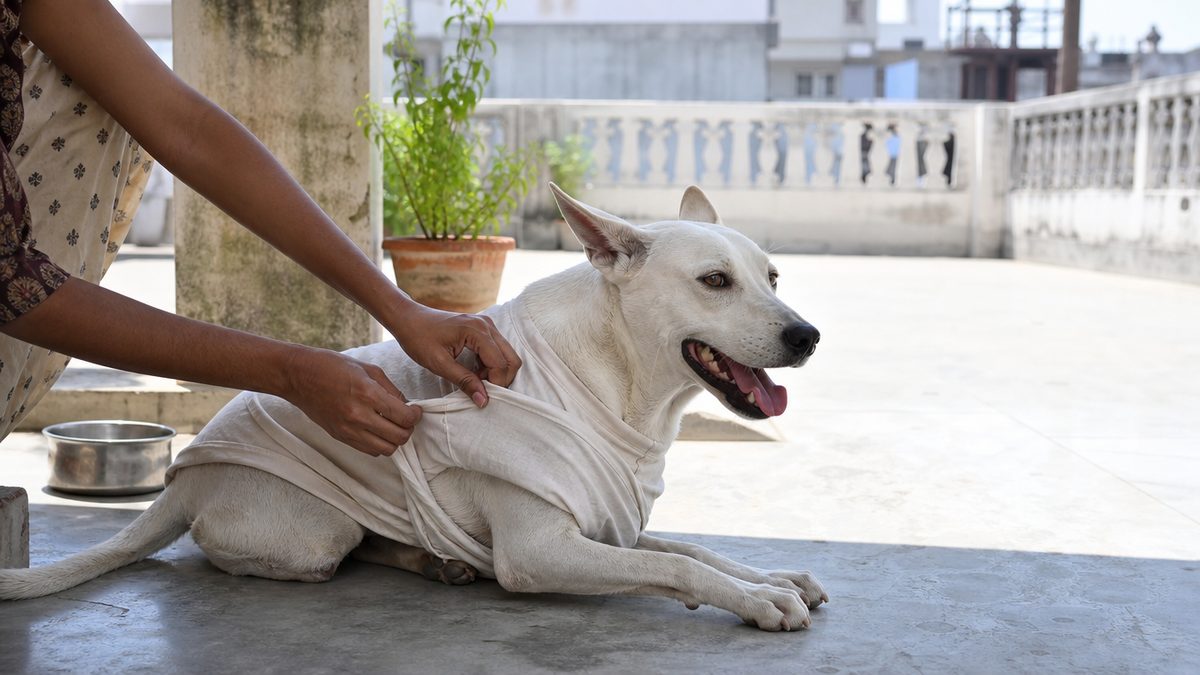
- Put a shirt on the dog. A sunsuit or even a T-shirt is better than nothing, with leg holes cut so the tummy and back are well covered, which unfortunately leaves the legs vulnerable. The dvm360 review agrees a T-shirt may help while noting it is often impossible to cover all at-risk areas.
- Start in puppyhood. The instruction is to educate owners of at-risk dogs about the need for sun avoidance starting at a young age, and the beagle data shows why, with carcinoma in roughly 2 percent of the cohort examined at five and a half years against roughly 19 percent of the cohort examined at twelve.
- Check the skin weekly and photograph it monthly. Prior skin damage can still progress to neoplasia months or years after exposure even with future sun avoidance, so the looking does not stop when the redness does.
In cross-bred Mexican hairless dogs exposed to solar radiation at 290 to 400 nm, histological change in the skin was already present after the first exposure at a point when no colour change, meaning no visible erythema, could be detected, and melanocytes were found throughout the epidermis of unprotected sites by the third day of exposure while sunscreen-protected sites showed no colour change and no melanocyte increase. Waiting for a dog to look burnt before acting is waiting past the point where the damage starts. Europe PMC serves that record with its French and Spanish summaries only, which is the text read here.
None of this is exotic. Shade, timing and a shirt are the whole intervention, they are free or nearly free, and they are more effective than anything sold in a bottle. Bonbeno's guide to heat safety for dogs in India covers the walk-window arithmetic for nine cities from the temperature side, which is a different hazard sharing the same two hours of the day.
Sunscreen, and the honest problem with every option an Indian owner can buy
Pet sunscreen is an additional strategy rather than a primary one, and once you read the labels against the toxicology guidance the reason becomes clear. Every named formulation is flagged by somebody, and in India the one product with regulatory standing costs several times its home price.
The two ingredient groups, and who objects to which
The ASPCA Animal Poison Control Center's position is unambiguous. The main ingredients to avoid when picking a sunscreen for pets are zinc oxide and a group of chemicals referred to as salicylates, because with repeated exposure to zinc oxide on the skin pets can develop zinc toxicity which can damage the red blood cells, while salicylates applied to the skin may produce mild skin redness and irritation. Veterinary Partner puts the zinc warning in one clause, that zinc oxide can be toxic if licked.
The 2026 review from the University of Queensland's School of Veterinary Science reaches a different conclusion on the same molecule. Sunscreens containing non-nanoparticle zinc oxide appear safe for dogs and cats when ingestion is prevented or minimised, whereas the safety of organic ultraviolet filters remains unclear because of limited safety data in both humans and animals, and non-nanoparticle titanium dioxide is a possible alternative although there is currently little information on its safety when ingested by dogs and cats.
Both positions are defensible and they are answering slightly different questions. The poison-control guidance is about what happens when a pet swallows the product, and the detail supports that reading: for zinc oxide the most common sign reported is vomiting, occurring soon after exposure because of the irritating nature of the compound, with allergic reactions on rare occasions, while for salicylates there may be respiratory alkalosis and compensatory metabolic acidosis, with rare hepatoxicity, hyperthermia and seizures, and possible gastric ulceration. The review is about what happens when ingestion is prevented. The practical instruction they converge on is that the dog must not lick it.
Only Epi-Pet K-9 Care Sunscreen is approved by the FDA Center for Veterinary Medicine for use in dogs and horses, and it is described as the only FDA-compliant pet sunscreen. Its manufacturer's own store lists five declared sunscreen agents, which are Ethylhexl Methoxycinnamate, Octyl Salicylate, Homosalate, Benzophenone-3 and Ethyllhexyl Salicylate, with no mineral filter among them. Two of those five are salicylates, and salicylates are one of the two ingredient groups the ASPCA tells owners to avoid in a pet sunscreen. Meanwhile the filter the 2026 review does endorse, non-nanoparticle zinc oxide, is the other group the ASPCA names. That is not a gap in anyone's reasoning. It is what an under-researched field looks like, and it is precisely why the review ranks shade, timing and clothing above sunscreen. Discuss any product with your nearby vet before it touches the dog, and note that the Epi-Pet label says it is not for use on cats.
What an Indian owner can actually buy, and what it costs
This is the question no ranking page asks, so Bonbeno opened the listings. The Epi-Pet spray is sold into India through Amazon.in, where the product page read on 27 September 2026 gave a one-time purchase price of Rs 6,103.00 against a list price of Rs 6,499.00, inclusive of all taxes, on a 4 fluid ounce bottle with country of origin USA. The manufacturer's own store sells its 3.5 fluid ounce bottle at 17.95 US dollars. Per fluid ounce that is roughly 18.08 dollars in India at 84.38 rupees to the dollar, or 20.62 at 74, against roughly 5.13 dollars at source, so the Indian shelf price is between about three and a half and four times the maker's own, depending which rate you use.
The Indian-sold alternatives are cheap and undocumented. A representative Flipkart listing, Fur Ball Story Cool Pet Sunscreen for Dogs, shows Rs 349 struck through, Rs 336 listed and a buy price of Rs 319, filed under Pet First Aid Kit, with a stated shelf life of 36 months and Prescription Required marked No. The listing prints no SPF figure, no active ingredient and no UVA or UVB claim anywhere on the page. Rs 349 divided by 84.38 is about 4.14 dollars and divided by 74 is about 4.72, so it is a genuine Indian price rather than a conversion.
That absence of a label is the whole problem, because the label is exactly what the guidance tells you to read. The advice is to select a product that is water-resistant, unscented and of at least SPF 30 even if it is not officially standardised, to perform a small patch test before a full application, and to apply to the areas most vulnerable to ultraviolet radiation, which are the bridge of the nose, the ear tips, the skin around the lips, the inner thigh and the groin. The PDSA gives the owner-facing version, a pet-safe or child-safe waterproof sunblock of SPF30 or higher, applied in two layers at least 15 minutes before the animal goes outside, with the dog discouraged from licking it off and the product reapplied as necessary. None of that can be checked against a listing that publishes no ingredients.
| Option | What a source says for it | What a source says against it |
|---|---|---|
| Non-nanoparticle zinc oxide | Appears safe for dogs and cats when ingestion is prevented or minimised | Named by the ASPCA as one of two ingredients to avoid; repeated skin exposure can cause zinc toxicity damaging red blood cells |
| Organic ultraviolet filters | Used in the only FDA-compliant pet sunscreen | Safety in pets remains unclear on limited data; two of the five in that product are salicylates, the ASPCA's other named group |
| Non-nanoparticle titanium dioxide | A possible alternative to zinc oxide and organic filters | Little information on its safety when ingested by dogs and cats |
| Human or baby sunscreen | Widely used by owners, and the PDSA accepts a child-safe product | Human products carry irritating scents and toxicity potential because they are not formulated on the assumption they will be licked |
| An unlabelled Indian pet product | Available, cheap and needs no prescription | Publishes no SPF and no active ingredient, so none of the published selection criteria can be applied to it |
| A shirt and a shaded terrace | A primary strategy in the current review, alongside shade and indoor confinement | Cannot cover every at-risk area, and leaves the legs vulnerable Coyner KS, DVM DACVD |
The ASPCA's own summary of where this leaves an owner is worth quoting as guidance rather than as a product review. Rather than reaching for sunscreen, be mindful and limit the pet's time in bright sunshine during peak hours, which also prevents overheating and dehydration. The products marketed for pets are usually not tested by the FDA, so their effectiveness is unknown, a point the dvm360 guide repeats about the CVM and SPF ratings. If your household can manage exactly one intervention, make it the walk timing, not the bottle.
Living with a sun-damaged dog in India, year after year
A dog diagnosed with solar dermatitis needs a permanent change of routine and a permanent habit of looking, because the skin does not go back to how it was. The realistic goal is to stop new damage and to catch anything that grows while it is still small enough to remove.
Start with the calendar, because in India it is unusual. Bengaluru, Kochi and Thiruvananthapuram exceed a London midsummer in all twelve months, Chennai in eleven and Hyderabad in ten. A household in any of those cities is running a year-round routine, not a seasonal one. A household in Delhi, where the ultraviolet index falls to 0.54 in December against 2.06 in May, genuinely does get a quieter season and can relax the shirt in winter while keeping the habit.
Then the surveillance. Prior skin damage can still progress to skin neoplasia months or years after exposure, even with future sun avoidance, and once tumours begin, many dogs must come in monthly as new skin tumours appear. Agree a review interval with your nearby vet rather than inventing one, and bring dated photographs of the same areas in the same light.
The prognosis conversation should be specific rather than frightening. Median survival across 193 dogs with dermal squamous cell carcinoma was 1,004 days, and in the subgroup whose tumours showed actinic change it was 1,359 days against 680 days without. In the nasal planum series, dogs undergoing local treatment had a median survival of 452 days, metastasis was detected in only 12 percent at the time of local therapy, and the authors conclude that dogs undergoing local treatment of nasal planum carcinoma had a favourable prognosis with long-term survival possible. These are conditions to manage over years.
The Indian evidence gap, stated as a controlled absence
No published Indian series on canine solar dermatitis exists, and that statement is the result of a search rather than an assumption. Europe PMC REST was queried on 27 September 2026 with the field syntax that instrument actually reads. The control query, TITLE_ABS hip dysplasia and TITLE_ABS Labrador, returned 110 on-topic canine papers, confirming the instrument was working; the same session's deliberate PubMed-syntax control returned three European haematology congress abstracts, confirming that the wrong syntax fails silently. Against that working instrument, squamous cell carcinoma combined with dog, dogs or canine and TITLE_ABS India returned 0, the same combination for skin tumour, skin neoplasm or cutaneous neoplasm returned 0, and solar dermatitis or solar dermatosis combined with AFF India, the author-affiliation instrument, returned 0.
The affiliation search does find Indian canine dermatology and Indian canine skin-tumour work, and none of it is actinic. Indian canine dermatoses and dermatitis papers returned eight records, all of them demodicosis, atopy or Malassezia. Indian canine skin-tumour work returned a 17-tumour immunohistochemistry series from a veterinary college in Kerala and a 40-tumour survivin series from Bengaluru, neither of which attributes a single tumour to ultraviolet exposure and neither of which uses the words solar, actinic or sunburn anywhere Kavya N, Rao S, Sathyanarayana ML. The clearest demonstration is a 210-case Indian dermatoses series from a veterinary hospital in Surat, in which 60 cases, or 28.57 percent, were non-parasitic dermatoses, of which bacterial skin infection was 80.00 percent, other non-parasitic disorders 11.67 percent and fungal skin infection 8.33 percent. Reading that paper's full text end to end, the words solar, actinic, sunburn and ultraviolet do not appear in it once. A recognised category was available and nobody used it.
It does not mean Indian dogs do not get solar dermatitis. The exposure is higher here than in any country that has published on it Valappil NKM, Mammen PC, the susceptible phenotype is common, and the 323-dog Jodhpur survey found skin conditions in 69 percent of free-roaming dogs without ever classifying them. It means nobody has counted. Until somebody does, an Indian owner and an Indian vet are working from Colorado beagle colonies Hargis AM, Thomassen RW, a Californian referral caseload and an Australian review, applied to a country with more ultraviolet than any of them. That is a reason to be more cautious than the overseas advice, not less.
The last thing worth saying is the cheerful one. This is among the most preventable conditions on Bonbeno's health list. The exposure is visible, the susceptible dogs are identifiable at a glance, the protective measures are shade and timing and a cotton shirt, and the diagnostic test that settles the question costs Rs 150 at a central government institute. For a related chronic skin condition with a very different mechanism, see atopic dermatitis in dogs; for the acute summer emergency that shares the same two hours of the day, see heat stroke in dogs.
Sunburn and solar dermatitis in dogs, answered
What can I do for my dog's sunburn?
Get the dog out of the sun, then judge the severity. Mild sunburn often heals within a few days with cold compresses, keeping the animal out of direct sunlight until the skin has healed, and sun protective clothing if it must go outside. Severe sunburn should always be checked by your vet straight away, and may need pain relief, anti-inflammatories and wound dressings.
How do you know if your dog is sunburned?
Look for redness, crusting, flaking, itching, blisters and pain on the ears, nose, eyelids and tummy, which are the commonest sites. For the chronic form, run your fingers from a white patch of coat onto a coloured one; a dramatic difference in skin texture at that boundary is the clue, because coloured fur is protective against the sun.
What does stage 1 sunburn look like?
Veterinary dermatology does not number the stages in dogs, but the published lesion sequence has a clear first step. Lesions usually start as erythema and scaling, which then evolve into thick, firm and wrinkled skin with hair loss and comedones, meaning dilated hair follicles, and occasionally round raised red nodular masses. Redness and scaling is the earliest visible stage.
What should I do if my dog has sunburn on their paws?
Have a vet look at it, because the limbs are a documented site rather than an odd one. Canine solar dermatitis occurs on the medial aspect of the legs, and the dvm360 review photographs severe solar dermatitis with scarring and furunculosis on the medial hock of a pit bull. Note that a shirt covers the belly and leaves the legs vulnerable.
How is solar dermatitis in dogs treated?
The best treatment option is to minimize the exposure to sunlight, and the dermatology review adds that oral and topical medications cannot replace sun avoidance. Beyond that a vet may address the secondary bacterial infection, use animal-specific topical anti-inflammatories, and for precancerous skin consider topical or oral options. Tumours are removed surgically. Your nearby vet decides all of it.
Can sunburn in dogs turn into skin cancer?
Yes, and that is the reason to act early. Intermittent chronic exposure causes keratinocyte proliferation, mutagenesis and premalignant actinic keratosis, which can evolve into sun-induced tumours including squamous cell carcinoma, haemangioma and cutaneous haemangiosarcoma. In a 991-dog beagle colony, 26 percent of dogs with solar dermatosis carried one of those three tumour types against 7 percent of dogs without it.
Do dogs in India need sunscreen all year?
In the south, treat the risk as year-round rather than seasonal. NASA POWER climatology puts Bengaluru, Kochi and Thiruvananthapuram above London's sunniest month in every one of the twelve months. Sunscreen is an additional strategy rather than the first one, because indoor confinement at peak ultraviolet, shade and sun-protective clothing are the primary strategies.
Is zinc oxide sunscreen safe for dogs?
The sources disagree and both are current. The ASPCA names zinc oxide as one of two ingredients to avoid, because repeated skin exposure can cause zinc toxicity that damages red blood cells. A 2026 veterinary review concludes that non-nanoparticle zinc oxide appears safe for dogs and cats when ingestion is prevented or minimised. Ask your nearby vet before using any product.
Which Indian dogs are most at risk of solar dermatitis?
Short-coated dogs with white or unpigmented skin, and any dog that sunbathes on a terrace. Kansas State names Beagles, Boxers, Bull Terriers, Dalmatians, Pit bulls and Whippets as more frequently affected, and closes the list with etc., so it is illustrative. Hairless breeds have no coat anywhere, which is the same problem without a boundary.