
Dog life guide
Are dogs allowed into cafes in India: what FSSAI actually requires, and how to be the customer a cafe wants back
Four documents decide whether your dog sits with you, and the pages ranking for this question have opened none of them. The clause itself, what it does not say about outdoor seating, where assistance dogs stand, and the table manners that get you invited back.
Quick answer
Are dogs allowed into cafes in India? Sometimes, and the cafe decides, not a statute. The Food Safety and Standards Act 2006 says nothing about animals. The rule sits in Schedule 4 of the 2011 Licensing Regulations, a condition of the cafe's licence, and it reads that animals, birds and pets shall be excluded from food premises. Nothing in it carves out outdoor seating, so a cafe seating your dog is exercising discretion and carrying the risk.
This guide is general information for Indian pet owners and is not a diagnosis. Always consult a registered veterinarian near you before acting on anything you read here, and treat any sudden change in your pet's condition as urgent.
Are dogs allowed into cafes in India, and who actually decides
Dogs are allowed into cafes in India only where the cafe chooses to allow them, because no Indian statute bans an animal from a restaurant and no Indian statute gives a pet dog the right to enter one. The decision belongs to the food business operator, and it is constrained by a condition attached to its licence rather than by a line in an Act.
That one sentence disposes of both halves of the argument you will find online. The owner who says dogs are banned in India is wrong about where the ban lives. The owner who says there is no rule at all is wrong that a cafe faces no exposure. The truth sits in four documents, and the pages currently ranking for this question have opened none of them.
We opened all four. What follows quotes them, names the clause numbers, and says plainly where the text runs out and nobody has answered the question yet.
| Instrument | What it says about a dog in a cafe | What it does not say |
|---|---|---|
| Food Safety and Standards Act, 2006 | Nothing. The word animal appears only in animal husbandry, in animal feed and live animals within the definition of food, and in diseased animal substance | No ban on a dog in a restaurant, and no right to bring one |
| Schedule 4, Part II, clause 9.2.1 of the FSS (Licensing and Registration of Food Businesses) Regulations, 2011 | "animals, birds and pets shall not be allowed to enter into the food establishment areas/ premises" | Nothing separating indoor from outdoor seating, and no exception for an assistance dog |
| Schedule 2, condition 7 of the same Regulations | Requires the licence holder to maintain the sanitary and hygienic standards specified in Schedule 4 according to the category of food business | Does not create a separate offence of admitting a dog |
| Rights of Persons with Disabilities Act, 2016 | Nothing about dogs. Section 3(3) bars discrimination on the ground of disability unless the act or omission is a proportionate means of achieving a legitimate aim | No definition of an assistance animal, no registration scheme, and no provision naming refusal of one as an offence |
Read the table from right to left and the practical position falls out. A cafe that turns your dog away is on firm ground and can point at its licence. A cafe that seats your dog is exercising a discretion that the regulator has not written down, and is absorbing whatever risk comes with it. Your job as the customer is to make that discretion cheap for them.
Bonbeno does not publish a verdict on a named business without testing it first hand, so this page names no cafe and recommends none. It describes categories, quotes published policy as a factual matter, and leaves the shortlist to you.
What FSSAI actually requires about animals on food premises
FSSAI requires that animals, birds and pets be kept out of food premises, and it does so in Schedule 4 of the Food Safety and Standards (Licensing and Registration of Food Businesses) Regulations, 2011. The requirement reaches a cafe as a condition of its licence, not as a section of the Act.
The notified wording sits inside the pest control section. Clause 9.2.1 of Part II reads that the food establishment, including equipment and building, shall be kept in good repair to prevent pest access and to eliminate potential breeding sites, that holes, drains and other places where pests are likely to gain access shall be kept sealed or fitted with mesh, grills or claddings, "and animals, birds and pets shall not be allowed to enter into the food establishment areas/ premises";.
Part II applies to every food business operator applying for a licence. A restaurant is pulled in twice, because Part V of the same Schedule governs catering and food service operations and opens with the words "In addition to Part-II";. Part V then defines its own reach, and the definition is wider than most owners expect. It covers "premises where public is admitted for repose or for consumption of any food or drink or any place where cooked food is sold or prepared for sale", and it lists eating houses, restaurants and hotels, snack bars, canteens, food service at religious places, neighbourhood tiffin services and dabba walas, rail and airline catering, and hospital catering.
So the clause is not a kitchen rule that someone has over-read. It arrives at a cafe through a Part written specifically for cafes, and the Part says in its own first line that it covers the room where the public sits.
Statute or licence condition, and why the difference matters to you
It is a licence condition. We read the Food Safety and Standards Act, 2006 looking for a prohibition on animals in a food business and there is none: the word animal occurs in the definition of contaminant in the context of animal husbandry, in the definition of food which excludes animal feed and live animals unless prepared for human consumption, in the definition of primary food, and in the phrase "diseased animal substance" inside the adulteration definition. The word dog does not appear in the Act at all.
What makes Schedule 4 bite is Schedule 2, the conditions of licence, whose condition 7 requires the operator to maintain the sanitary and hygienic standards specified in Schedule 4 according to the category of food business. Failure to comply with a regulation is addressed by the Designated Officer through an improvement notice under section 32, which must state the grounds, specify the failure, specify the measures required, and allow a reasonable period of not less than fourteen days. Section 58 then sets the residual penalty for contravening any provision of the Act, rules or regulations where no penalty is separately provided, at up to two lakh rupees.
Translate that into what happens in a real cafe. A food safety officer who objects to a dog in the dining area does not arrest anybody. The realistic consequence is an inspection finding, a notice with a compliance deadline, and a licence file that now carries a mark against it. That is a slow, bureaucratic, entirely unglamorous risk, which is exactly the kind of risk a small business will not take for one customer who argues at the door.
The clause also reaches the person standing in front of you, which is why a polite refusal is rarely negotiable. FSSAI runs a training and certification scheme called FoSTaC, set up to "train and certify the Food Safety Supervisor from each Food Establishment";. Its course manuals are built directly on Schedule 4, and the sentence appears in them word for word: item 7 of the pest control section reads "Animals, birds and pets shall not be allowed to enter into the food establishment areas/ premises";. The manual we opened is the manufacturing course rather than the catering one, and FoSTaC runs separate courses by sector, so read this as evidence of how the clause is taught rather than as the catering syllabus itself. The practical consequence holds either way. A certified supervisor has read that line and been examined on it, so the manager declining your dog is repeating something they were trained on rather than inventing a house preference.
The sentence FSSAI rewrote in 2022, and what it still is not
FSSAI issued a Direction on 28 November 2022 operationalising the Food Safety and Standards (Licensing and Registration of Food Business) Amendment Regulations, 2021, and that document substitutes a new Part V of Schedule 4 for catering and food service operations. In the new Part V, the animals rule is lifted out of the pest paragraph and given its own clause. Clause 3.3.3 reads, in full, "Animals, birds and pets shall be excluded from the food premises";. The identical sentence also appears in the revised Part II, under clause 15.2 on preventing access.
The revision is blunter than the 2011 text, and it is worth noticing what the drafters did. They removed the pest-control framing, which was the only thing in the old wording that let a sympathetic reader argue the clause was aimed at vermin rather than at a labrador on a lead. The new sentence stands alone and is not about pests at all.
The status of that revision is the part nobody reports accurately, so here it is in the Direction's own words. The notice states that the Authority "hereby makes the following regulations operational with immediate effect", that food business operators shall follow the revised regulations, and that "the enforcement of these regulations shall commence only after the final regulations are notified in the Gazette of India", with the exception of one unrelated sub-regulation. It adds that any non-compliance in respect of Schedule 4 "may be addressed by issuing Improvement Notice under Section 32 of the Food Safety and Standards Act";.
As of the most recent FSSAI communication we could open, the 2011 Schedule 4 remains the operative hygiene schedule. FSSAI's FAQ of 27 March 2026 on the Amendment Regulations, 2026, which brought in perpetual validity of licences, deemed registration of street vendors and a turnover ceiling of ₹1.5 crore for registration, still directs food businesses to comply with "the hygiene and sanitary requirements specified under Schedule 4 of the Food Safety and Standards (Licensing and Registration of Food Businesses) Regulations, 2011";. The 2026 amendment changed how long a licence lasts and who needs which category. It did not rewrite the animals clause.
A customer who announces that a cafe is violating FSSAI by seating dogs has the relationship backwards. The cafe is the one carrying the regulatory exposure, under a condition of its own licence, and it is carrying it so that you can sit down. Arguing the law at the door is the single fastest way to make a manager withdraw a policy that was always discretionary.
Does the rule separate indoor seating from outdoor seating?
No Indian food-safety text separates indoor seating from outdoor seating. The phrase the regulation uses is food premises, the Act's own definition of premises is wide, and the outdoor-only convention every Indian cafe follows is a risk-management practice rather than a legal line.
Start with the statutory definition, because the regulations borrow it. Section 3(1)(zi) of the Act provides that "premises" include "any shop, stall, hotel, restaurant, airline services and food canteens, place or vehicle or vessel where any article of food is sold or manufactured or stored for sale";. A terrace where a cafe serves coffee is a place where an article of food is sold. A pavement table is a place where an article of food is sold. Neither falls outside that wording on any reading we can construct.
Then read Part V again. Its scope sentence covers premises where the public is admitted "for repose or for consumption of any food or drink";. Repose means sitting down. The drafters went out of their way to include the room where nobody cooks anything, which is the opposite of a kitchen-only rule.
Set against that, the universal Indian practice is the indoor and outdoor split. It is a sensible practice. It keeps the animal away from the pass, the service station, the open display and the stores, which is where contamination actually happens, and it gives an inspector a visible control to look at. It is just not something the regulation says. Treat it as good risk management that the industry invented for itself, and do not quote it back to a manager as though it were a rule you can hold them to.
What a regulator looks like when it does write the distinction
Ireland's food regulator has answered precisely this question, in public, in plain language, which makes it a useful mirror. The Food Safety Authority of Ireland states that "the law does not specifically prohibit companion animals (dogs and cats) from being in a retail food business", but that the law obliges operators to manage contamination risk and therefore to ensure animals do not get access to places where food is prepared, handled or stored. It then says that access to customer dining areas "could be permitted by the food business at its discretion", and lists five conditions: the access is considered within the food safety management system, the dining areas are monitored, all reasonable effort is taken to ensure food cannot be contaminated, the animals are kept under the control of their owners, and proper procedures exist to deal with any contamination.
That is the document an Indian cafe owner wishes existed here, and it does not. FSSAI's own sector guidance for catering, a 67-page document issued on 19 January 2018, never mentions pets or customers' animals at all. The word animal occurs three times in it, once about traps and filters on drains to prevent the re-entry of pests, once about microwave cooking of raw animal food, and once about storing foods of animal origin below 4 degrees Celsius. The question every Indian dog owner asks is not addressed in the guidance the regulator wrote for restaurants.
| Question | India, FSSAI | Ireland, FSAI |
|---|---|---|
| Are pets excluded from a food business? | Yes. Schedule 4 requires that animals, birds and pets be excluded from food premises | No outright prohibition. The duty is framed as managing contamination risk |
| May a business admit dogs to the customer dining area? | No published position we could find, and the text draws no indoor or outdoor line | Yes, at the business's discretion, subject to five stated conditions |
| Is there an exception for assistance dogs? | None anywhere in the food regulations | Yes. Businesses that prohibit companion animals "should make an exception for guide dogs and assistance dogs" |
| Does the sector guidance address it? | No. The 67-page catering guidance does not mention pets | Yes. A dedicated consumer page answers it directly |
We looked for an FSSAI clarification, circular or guidance note permitting animals in an open-air or outdoor section and did not find one in the instruments we opened. That is not the same as proof that none exists. If somebody shows you one, read the document rather than the headline, and check whether it is a notified regulation, an operational direction or a trade association's interpretation.
Assistance dogs are a separate and much stronger case
An assistance dog is not a pet, and the case for admitting one rests on disability law rather than on food law, because Indian food law contains no exception for it. The disability law is real but it is broader and vaguer than most people assume.
We searched the full text of the Rights of Persons with Disabilities Act, 2016 and the word dog does not occur anywhere in it. There is no Indian statutory definition of an assistance animal, no national registration or accreditation scheme, and no provision that names the refusal of one as an offence. Anyone who tells you that Indian law guarantees an assistance dog entry to a restaurant has not read the Act.
What the Act does give is a general duty that a restaurant is squarely inside. Section 2(h) defines discrimination to include "all forms of discrimination and denial of reasonable accommodation";. Section 2(i) provides that "establishment" includes a Government establishment and a private establishment. Section 2(y) defines reasonable accommodation as "necessary and appropriate modification and adjustments, without imposing a disproportionate or undue burden in a particular case, to ensure to persons with disabilities the enjoyment or exercise of rights equally with others";. Section 3(3) states that "no person with disability shall be discriminated on the ground of disability, unless it is shown that the impugned act or omission is a proportionate means of achieving a legitimate aim";. Section 46 requires that "the service providers whether Government or private shall provide services in accordance with the rules on accessibility formulated by the Central Government under section 40";.
Put those together and the question a refusing restaurant would have to answer is narrow and uncomfortable. Food safety is a legitimate aim. Is a blanket refusal of a trained assistance dog a proportionate means of achieving it, when the hygiene clause the restaurant is relying on was drafted about pest access and when other food regulators treat trained assistance dogs as low risk? We are not aware of an Indian court or commission decision answering that, and we are not going to invent one.
Why the aviation comparison is the useful one
India already demonstrates what an explicit assistance-animal rule looks like, just not in food law. In aviation the regulator spells it out, and the carriers follow. Our guide to flying with a dog or cat in India sets out the DGCA position and the carrier-by-carrier picture, and our guide to whether pets are allowed in Uber or Ola covers the ground transport side, including where to take a complaint when an assistance dog is refused. We are not repeating either here. The point for this page is the contrast: a binding, specific rule exists for aircraft and does not exist for a cafe, and a food regulator elsewhere has written the carve-out that FSSAI has not.
Ireland's regulator also explains the reasoning, which is worth borrowing even where the law does not apply. Guide dogs and assistance dogs "may be regarded to pose low risk of contaminating food due to the high standards of training, grooming and veterinary care given to them", and the dogs are trained so that "when the owner is dining out the guide dog or assistance dog is trained to lie down beneath the table and to stay there until the owner is leaving";. Training, grooming, veterinary care, and a dog that lies down and stays down. Those are four testable things, and a restaurant can see three of them from the door.
India has no registration scheme, which means nobody can check, which means the only thing protecting genuine assistance dog users is that the claim is rarely abused. Every pet passed off as an assistance dog makes the next real one less believable. If your dog is a pet, ask as a pet owner and accept a no.
State and municipal variation, and what we looked for and did not find
No state or municipal rule we found varies the FSSAI animals clause, because food-safety standards in India are central. The Act and the regulations under it apply in Karnataka and Maharashtra and Tamil Nadu alike, and a Commissioner of Food Safety enforces the same Schedule 4 in each.
We searched for a state food-safety rule, a municipal health trade licence condition or an eating house licence condition that separately addresses animals in a dining area, and found none. Record that as a negative finding rather than as a guarantee. India has hundreds of urban local bodies, each with its own trade licence paperwork, and we cannot claim to have read all of them. What we can say is that the central instrument is the one every licensed cafe in the country is actually audited against, and that none of the FSSAI documents we opened delegates the animals question downward to a state.
Two things genuinely do vary by place, and neither is food law.
- The house rules of the individual venue. This is the real source of variation, and it changes by day of the week as well as by address. A venue's own policy is the only one that will be applied to you at the door.
- Local dog-control law on the street outside. Leash requirements, muzzle requirements for a dog described as ferocious, fouling penalties and registration all sit with the municipal body and differ between cities. Those rules govern the walk to the cafe rather than the table, and our guides to dog registration in India and to walking a dog at night safely in India cover them.
One change in 2026 widened the net rather than narrowing it. Under the Amendment Regulations notified on 10 March 2026, street food vendors already registered under the Street Vendors (Protection of Livelihood and Regulation of Street Vending) Act, 2014 are deemed to be registered under the Food Safety and Standards Act, 2006, and FSSAI's FAQ adds that "all such vendors shall comply with the hygiene and sanitary requirements specified under Schedule 4";. On the text, the chai stall where your dog has waited at your ankle for years is now a food premises carrying the same clause as a fine-dining room.
Nobody enforces it there, and that gap is the most informative thing in this whole section. The clause is applied where an inspector is likely to look and where a licence is worth protecting. A busy licensed cafe in Bengaluru, Hyderabad or Mumbai has more to lose than a cart in the same street, which is why the cafe is the one that will say no.
Because the variation is at venue level rather than at state level, no article, list or map can tell you today's answer for a particular address. The only reliable instrument is a phone call to the venue on the day you plan to go.
How to find a genuinely pet friendly cafe in India
To find a genuinely pet friendly cafe in India, treat pet friendly as a claim to verify rather than as a category, because in practice the phrase almost always means the outdoor seating only and almost never means what a first-time visitor assumes.
Google's own People Also Ask box makes the confusion visible. Pull the box for dog friendly cafes in Bangalore, in Mumbai, in Delhi and in Pune and the same question comes back in all four: "Are dogs allowed into cafes?" People searching a city list still do not know the underlying answer, which tells you how thin the published material is.
An Indian pet-travel directory states the practical position for one metro bluntly. Writing about Delhi, Pet Friendly Places says that "pet friendly almost always means: dogs allowed in the outdoor seating area only", that "indoor seating is typically off-limits", and that "most places require dogs on leash";. It also warns that weekend policies shift with crowd levels, so a venue that is relaxed on a Tuesday may ask you to keep to one end of the outdoor section on a Sunday. That matches the regulatory picture above: a discretion, exercised case by case, withdrawn when the room gets crowded.
Six questions to ask when you book
- Ask whether dogs are permitted, and in which part of the premises. Permitted on the property is not the same as permitted at a table, and a venue that seats dogs in a car park is telling you something.
- Ask whether that is the policy on the day you are coming. Name the day and the time. A Sunday brunch service is a different venue from a Wednesday afternoon.
- Ask whether the dog section is shaded or covered. This is the question that decides whether the visit is pleasant or dangerous, and it is the one nobody asks.
- Ask whether there is a size or breed limit. Many Indian venues have an unwritten one, and you would rather hear it on the phone than at the gate.
- Ask for a table at the edge, away from the service walkway. Staff carrying trays past a dog's tail is the mechanism behind most bad outcomes.
- Ask whether water is provided. Carry a collapsible bowl regardless, because the answer is often yes in principle and no in practice.
The season decides more than the policy does
Here is the consequence of outdoor-only that no list mentions. If the only seating open to your dog is outdoors, then the dog-friendly season in your city is the season in which outdoor seating is usable, and in most of India that is a minority of the year. Delhi and Ahmedabad make an outdoor table unusable through the summer months. Mumbai loses the monsoon entirely, and a wet dog on a wet terrace is nobody's good afternoon. Chennai and Kolkata stay humid enough for long enough that the limiting factor is the air rather than the rain. Bengaluru and Pune are the two large metros where an outdoor table works across most of the calendar, which is part of why their pet-friendly scenes are the ones people write about.
Plan the visit around the dog's thermal ceiling rather than around your free afternoon. Our guide on how to keep a dog cool in summer in India sets out the hours to avoid city by city, and our monsoon care for dogs in India guide covers the wet-coat, ear and paw routine that follows a rainy outing. The short version for a cafe trip is that an early morning or a late evening table in the cool months is the whole opportunity, and a midday table in May is a bad idea with good coffee attached.
For the wider question of what else to do with the dog once you are out, our guide to things to do with your dog in India sets the activity out by life stage with the heat hours and the rupee costs attached. This page is only about the table.
What good looks like at the table
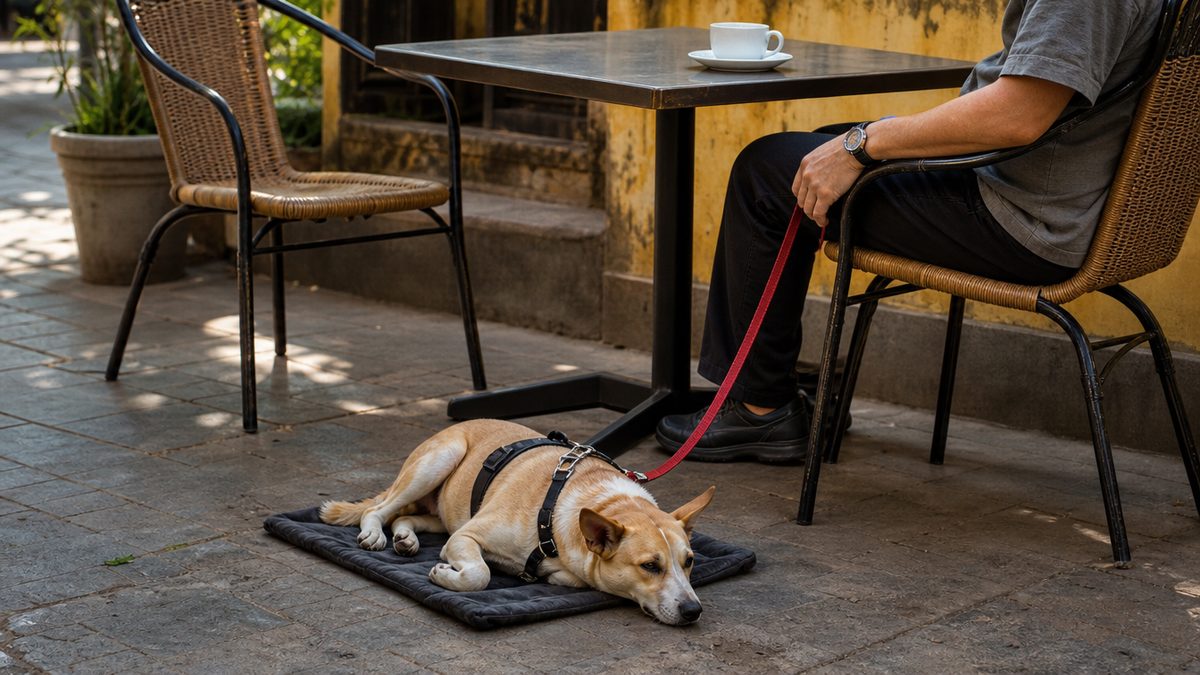
A dog that gets invited back is a dog that lay down under the table and did nothing for an hour. That is not a personality, it is a trained behaviour, and it is the same standard a food regulator applies when it decides that assistance dogs are low risk.
The Food Safety Authority of Ireland describes the behaviour precisely: when the owner is dining out, the dog "is trained to lie down beneath the table and to stay there until the owner is leaving";. Lie down, beneath the table, until you leave. Every rule below is in service of producing that.
- Exercise before, not after. A dog taken straight from the flat to a cafe has a tank of unspent energy and will spend it on the room. Walk first, then eat. This inverts the instinct most owners have, which is to make the cafe the outing.
- Empty the dog before you arrive. A toilet stop five minutes from the door removes the single worst thing that can happen at the table.
- Arrive off-peak. The first hour of service is calm, the staff have time, and the dog gets to settle before the room fills rather than after.
- Bring the mat. A familiar mat or towel that the dog already associates with settling at home turns an unfamiliar floor into a known place. This is the single most useful object in the bag.
- Place the dog between you and the wall. Not in the walkway, not under the neighbouring table, not where a server has to step over it.
- Keep the lead short and in your hand. Enough length to lie down, not enough to reach the next table or the serving station.
- Offer water early. A dog that is panting is a dog that will fidget. Fill the bowl before you order, not when the food arrives.
- Order, eat, leave. Keep the visit shorter than the dog's settling capacity. Twenty good minutes beat ninety that end badly.
Where we disagree with the usual Indian advice about the lead
A published Indian guide advises readers to "keep your dog tethered to the chair leg or your belt loop";. We agree with the belt loop and we disagree with the chair leg, and since this is a safety point rather than a style point it is worth setting out both positions rather than quietly picking one.
A cafe chair is not an anchor. It is a light object that moves. A dog that startles at a dropped tray, a passing dog or a firecracker does not know the chair is attached to it, and it will move anyway; the chair comes along, the noise and the chase amplify the fright, and now you have a panicking dog towing furniture through a room where people are carrying hot liquid. The failure mode is not rare enough to ignore. We found no published safety guidance in either direction, so treat this as reasoning from the failure mode rather than as a cited rule, and note that the regulator's own description of a dog that behaves in a restaurant puts the control in the training, not in an anchor.
One piece of equipment is simply wrong for this room. A retractable lead gives a dog several metres of thin line at ankle height among trays, chair legs and strangers, and the lock is the part that fails when you need it. Our guide on collar or harness for dogs covers why a retractable lead is a liability in detail. Use a fixed lead of about one and a half metres for a cafe.
Practise the settle at home before you spend money on it
Settling on a mat is a behaviour you can build in a week of two-minute sessions on your own floor, and then in a quiet corridor, and then outside a shop, long before you try it with a waiter and a dosa in the picture. Trying it for the first time in a crowded cafe is an exam the dog has not revised for. Our puppy training in India guide covers the reward-based method; the same approach works on an adult dog, more slowly.
The best moment to pay the bill is while the dog is still lying down. An owner who waits for whining, pacing or a bark has let the dog learn that the cafe is a place where it eventually becomes uncomfortable, which makes the next visit harder. Leaving early on a good note is a training decision, not a social failure.
What gets dogs and their owners banned
Six behaviours end a cafe's pet friendly policy, and five of them belong to the owner rather than to the dog.
- A dog on the furniture. On the chair, on the bench, with paws on the table. This is the one that staff photograph, management sees, and policy changes over. A dog that is not allowed on furniture at home does not try it in a cafe.
- A dog fed from the plates. Eating from cafe crockery puts the animal's saliva directly into the venue's washing-up stream, which is precisely the contamination the hygiene clause exists to prevent. If you bring food for the dog, bring the bowl for it too.
- A dog that cannot settle. Pacing, circling, popping up at every passing server. A dog that has not learned to settle is not ready for a cafe, and nothing you do at the table fixes it on the day.
- Barking. One bark is an incident, three is a policy review. Our guide to whether neighbours can complain about dog barking in India deals with the barking problem itself; the cafe answer is simply that a dog which barks at strangers is not ready for a room full of them.
- Toileting indoors, concealed. The accident is forgivable. Walking away from it is not, and a cafe that finds it later will remember who was sitting there.
- The owner who insists. Argues at the door, invokes the law, demands the manager, or sits down anyway. This is the behaviour that closes a venue to every dog owner who comes after you.
That last one deserves a sentence of its own, because it is the one dog owners do not count as a behaviour problem. A venue's policy on dogs is discretionary, unwritten and reversible, and managers revise it after unpleasant conversations rather than after bad statistics. The customer who makes admitting a dog feel expensive is the reason the next sign says no pets.
The other customers, including the ones who are frightened of dogs
Assume at least one person in the room is frightened of your dog, because the best measurement available puts the proportion of adults who are afraid on meeting an owned pet dog at about one in five, and because you belong to the group least able to see it.
The measurement comes from the wrong country and it is still the most useful number on this page, so we will give it with its limits attached. A cross-sectional study of 1,359 adults across the seven geographic regions of Turkiye, published in Frontiers in Veterinary Science in May 2025, measured dog phobia with the DSM-5 Severity Measure for Specific Phobia. It found that 69.5 percent of participants, 945 of 1,359, had dog phobia at some level from mild to very severe, and that 5.8 percent were in the severe or very severe bands. The authors state that to the best of their knowledge no previous study had evaluated the frequency of dog phobia.
The figure that matters in a cafe is a different one from the headline. Asked specifically about encountering owned pet dogs, rather than street dogs, 263 of the 1,359 participants, 19.4 percent, answered "I am afraid", and a further 12.9 percent answered that they were neither afraid nor not afraid. Fear of street dogs ran far higher, at 50.2 percent, and fear of being attacked by a street dog at 63.0 percent. The gap between those two columns is the whole point: people distinguish your dog from a street dog, and roughly one in five of them is still frightened of your dog.
Why a dog owner is the worst judge of this
The same study measured the thing that makes this blind spot structural. Dog phobia was present in 51.7 percent of participants who owned a dog against 70.8 percent of those who did not, and in 56.3 percent of pet owners of any kind against 76.9 percent of non-owners, both differences significant at p below 0.001. Phobia was also twice as likely in people who had never cared for a street animal, odds ratio 2.03, and twice as likely in people with a personal or family history of being attacked by a dog, odds ratio 2.10. You sit in the least frightened cell of that table, surrounded by people drawn from the most frightened ones.
Now the honesty about transfer. This is Turkiye, not India. The sample was collected online by snowball sampling, 89.6 percent of participants held a university degree or above, and the authors themselves write that more representative studies are needed to better reflect the general population. We could find no Indian equivalent that measured the frequency of dog phobia with a validated scale, which is itself worth saying out loud. Take the direction and the ranking from this study. Do not quote the Indian percentage, because nobody has measured it.
- Do not let your dog greet anyone. Not the next table, not the staff, not a child who has run over. A dog that stays under your table is not asking anybody to make a decision about it.
- Position for the frightened person, not for the friendly one. Choose the seat that puts the most distance and the most furniture between your dog and the rest of the room.
- Move when asked, without discussion. A quiet move costs you thirty seconds and buys the venue's policy another year.
- Read the room rather than the dog. The signals your dog is giving are covered in our dog body language guide, which is the page to read before this one. At a table, your attention belongs on the humans.
- Let other people's children be their parents' problem. When a child approaches, the right move is to tell the parent what to do, not to manage the child yourself. The procedure for how a child should approach a dog is set out in full there, and a cafe table is the worst place to teach it.
Fear runs in both directions. A dog wedged under a table in a loud, crowded cafe has no exit, and a trapped dog that cannot increase distance is the classic bite scenario. If the room fills and your dog goes still, stops taking food or starts watching the door, that is the dog asking to leave. Pay and go.
The hygiene you control, and the risk the cafe is carrying for you
You control three things the regulator cares about, and Ireland's food authority names all three when it explains why trained assistance dogs are treated as low risk: training, grooming and veterinary care.
That is a better checklist than anything written for Indian pet owners, because it is the list a food-safety official would actually use. A dog that behaves predictably, sheds and smells less, and is current on its veterinary care is a dog that a manager can seat without thinking about it twice. Each of the three is something you can change before you leave the house.
- Brush before you go, outside. Ten minutes with a brush on your own balcony is hair that does not end up under a cafe table. In a heavy shedding week, skip the outing.
- Wipe the paws at the door. Indian pavements carry what Indian pavements carry, and the paw is the part that has been on all of it.
- Carry a towel in the monsoon. A wet dog dries by transferring itself to the floor and the furniture, and the smell is the complaint a manager hears from the next table rather than from you.
- Keep the dog's own bowl in the bag. Never let the dog eat or drink from the venue's crockery, and never from a shared plate.
- Clean up anything immediately, and tell a member of staff. Carry bags and a small bottle of water. Reporting an accident costs you one embarrassing sentence; concealing one costs the next dog owner the table.
- Keep the vaccination and parasite control current. A cafe outing is a shared-surface outing. The schedules are on our dog vaccination schedule and tick prevention for dogs in India guides.
Now the part that should change how you behave. The regulatory exposure of this outing is not yours. You are a customer. The food business operator is the one holding a licence that carries Schedule 4 as a condition, the one who receives the improvement notice under section 32 if an officer objects, and the one facing a penalty of up to two lakh rupees under section 58 for a contravention with no separate penalty provided Ministry of Law and Justice. Nothing happens to you. Everything happens to them.
That asymmetry is the reason to hold yourself to a higher standard in a cafe than at home. You are asking a licensed business to take a small regulatory risk, unpaid, so that you can have a nicer hour. Behave like somebody who understands that, and the policy survives. Behave like somebody who thinks it is an entitlement, and it will not.
This is not sentimentality. A venue's pet policy is discretionary and informal, which means it is sustained by whether the people running it feel good about it. Dog owners who are visibly easy customers are the reason pet friendly sections keep opening in Indian cities, and the ones who are not are the reason they close.
What nobody has answered yet
Three questions about dogs in Indian cafes have no published answer, and knowing which ones they are keeps you from repeating somebody's guess as though it were settled.
- Whether FSSAI treats an open-air terrace as food premises for this clause. The Act's definition of premises is wide enough to cover it and the regulation draws no line, but we found no clarification applying the clause to outdoor seating one way or the other.
- Whether refusing a trained assistance dog is lawful under section 3(3). The provision requires a refusal to be a proportionate means of achieving a legitimate aim, and no Indian decision we could find has tested a restaurant's refusal against it.
- How common fear of dogs actually is in India. No study we could find has measured it with a validated scale, which is why this page cites a Turkish one and says so.
Three smaller things are settled and worth carrying away. The hygiene requirement is real and it is a licence condition rather than a criminal prohibition. It makes no distinction between the kitchen and the table, whatever the industry convention says. And the person deciding whether your dog sits down is a manager weighing an unwritten risk, which means your behaviour at the table is the policy.
For context on the wider relationship between Indian streets, dogs and the places people eat, our guide to stray dogs in India covers the law and the civic position on community dogs, which is a separate question from a pet at a table and is routinely confused with it.
Common questions
Are dogs allowed into cafes?
Dogs are allowed into cafes in India only where the individual cafe permits it. No statute bans an animal from a restaurant and no statute grants a pet a right of entry. FSSAI's Schedule 4 requires that animals, birds and pets be excluded from food premises, as a condition of the cafe's licence, so a venue that seats your dog is exercising discretion rather than following a rule.
Are dogs allowed in a cafe?
Ask the cafe, because the answer is set at venue level and changes by day. In practice an Indian cafe that calls itself pet friendly usually means dogs in the outdoor seating area only, on a leash, with indoor seating off limits. Weekend policies tighten when the room is crowded, so confirm for the specific day and time you plan to visit rather than relying on a published list.
Are dogs allowed in most cafes?
No. Most cafes in India do not admit dogs, because FSSAI's hygiene schedule requires animals, birds and pets to be excluded from food premises and that requirement is a condition of the licence the cafe holds. The venues that do admit dogs are a self-selected minority, they concentrate in a few neighbourhoods of the larger metros, and they almost always restrict dogs to outdoor seating.
Is it illegal for a cafe in India to allow dogs?
Not illegal in the sense of a criminal prohibition. The Food Safety and Standards Act 2006 contains no ban on animals in a food business; the exclusion sits in Schedule 4 of the 2011 Licensing Regulations and binds the operator through condition 7 of its licence. Non-compliance is addressed by an improvement notice under section 32, which must allow at least fourteen days, with a residual penalty of up to two lakh rupees under section 58.
Does the FSSAI rule apply to outdoor seating?
Nothing in the text exempts outdoor seating. The regulation speaks of food premises, and section 3(1)(zi) of the Act defines premises to include any shop, stall, hotel, restaurant or place where an article of food is sold. Part V of Schedule 4 expressly covers premises where the public is admitted for repose or for consumption of food or drink. The indoor and outdoor split is industry practice, not a legal line.
Can a restaurant in India refuse an assistance dog?
The position is unsettled and weaker than people assume. The Rights of Persons with Disabilities Act 2016 never mentions dogs, defines no assistance animal and creates no registration scheme. It does bar discrimination on the ground of disability unless the act is a proportionate means of achieving a legitimate aim, and it defines discrimination to include denial of reasonable accommodation. We found no Indian decision testing a restaurant refusal against that standard.
What should I do with my dog once we are seated?
Settle the dog on a familiar mat beneath the table, between you and the wall, on a short fixed lead held in your hand rather than tied to a chair. Offer water before you order. Ireland's food authority describes the standard that makes assistance dogs acceptable in restaurants as a dog trained to lie down beneath the table and stay there until the owner leaves. Aim for that, and leave while the dog is still settled.