
Dog and cat life guide
Dog birthdays and pet celebrations: what a party actually puts in front of the animal, and what a good day looks like instead
Nobody has ever measured whether a dog enjoys its own birthday party. Plenty has been measured about the things a party is made of, and most of it points the same way.
Quick answer
Dog birthday celebration ideas almost all describe a party, and a party is a gathering of unfamiliar people, noise, handling and a broken routine. No study has measured whether dogs enjoy their own parties. What is measured is that fear of strangers is common, and that dogs recall events over hours rather than dates, so your dog has no idea what the day is. Mark it with a long walk somewhere new, a food it is genuinely allowed, and a quiet house.
This guide is general information for Indian pet owners and is not a diagnosis. Always consult a registered veterinarian near you before acting on anything you read here, and treat any sudden change in your pet's condition as urgent.
Does your dog enjoy a birthday party?
Nobody knows, because nobody has measured it. No published study has observed pet dogs at their own birthday parties and asked whether they enjoyed the experience. That absence is the honest starting point, and every page that tells you your dog loves a party is telling you something it cannot know.
What has been measured is each of the things a party is made of. A birthday party is a gathering of unfamiliar people in the animal's own home, at an unusual hour, with raised voices, music, balloons, food it cannot have, hands reaching for it, and a routine that stops working for an afternoon. Taken apart, that list is not a celebration. It is a list of the things the behavioural literature records as stressors for a meaningful minority of pet dogs.
The most useful frame comes from the welfare framework that was rewritten specifically to handle this question. The 2020 revision of the Five Domains Model added a fourth domain, Behavioural Interactions, which covers an animal's interactions with humans, and it sets out when those interactions help and when they hurt. Human interaction has negative welfare impacts, the authors write, "when animals have had little or no prior human contact, when human presence adds to already threatening circumstances, when human actions are directly unpleasant, threatening and/or noxious, when humans' prior actions are remembered as being aversive or noxious and when the actions of bonded humans cause unintended harms";.
Read that last clause again. The actions of bonded humans causing unintended harms is the entire risk of a birthday party, written down by welfare scientists four years before anyone applied it to a pupcake.
The same paper lists the other side, and it is just as specific. Human interaction has positive welfare impacts "when the companionable presence of humans provides company and feelings of safety, when humans provide preferred foods, tactile contacts and/or training reinforcements, when humans participate in enjoyable routine activities or in engaging variable activities, when the presence of familiar humans is calming in threatening circumstances and when humans act to end periods of deprivation, inhibition or harm";.
Notice what is on that list. Familiar humans. Preferred foods. Enjoyable routine activities. Engaging variable activities. Notice what is not on it: strangers, costumes, an audience, or a hat. A celebration built from the first list is good for the animal. A celebration built from the second is good for the photograph.
What a party is, from the animal's side
The table below takes a standard dog birthday party apart and puts each element beside what is actually known about it. Two columns matter more than the ideas list you came here for, because every row that has real evidence behind it has that evidence somewhere other than the party literature.
| What the party puts in front of the animal | What is actually known | Where to read the evidence |
|---|---|---|
| Unfamiliar people in its own home | Fear of strangers or other dogs is reported in roughly 10 to 19 percent of pet dogs, and urban dogs score higher than rural ones | This page, and reading your dog's body language |
| Children who want to touch it | A five step greeting with a stop and check, and an adult supervising for anyone under five | Teaching children how to meet a dog |
| Balloons popping, music, raised voices | Noise sensitivity is the most common anxiety trait measured in pet dogs, at 32 percent of 13,715 | How to calm dogs during firecrackers |
| Being held still for a photograph | Viewers are measurably poor at telling a comfortable animal from an uncomfortable one in a picture | Pet photography tips |
| A party hat or an outfit | A garment must not block sight, hearing, breathing, mouth or movement, and must never be left on an unsupervised animal | Do dogs need clothes in India |
| Cake, and the human food around it | Chocolate, dried fruit and sugar-free sweeteners are the three that cause real harm, by dose | Foods toxic to dogs |
| An afternoon outdoors | Heat illness in dogs is overwhelmingly triggered by activity, and most of the Indian year is too hot for an outdoor gathering | Heat safety for dogs in India |
| Neighbours, the lift and the society lawn | An association can fix walking timings and designate a pet corner; it cannot ban your animal | Society rules for pets in India |
Before you plan anything, ask who the event is for. There is nothing wrong with the answer being you. Marking the day matters to the person, and that is a real reason to do it. The failure is only in believing the animal shares the occasion, and then building a day around that belief.
What is known about dogs and unfamiliar visitors
Fear of unfamiliar people is common enough in pet dogs to be the default planning assumption rather than the exception. A survey of 13,715 Finnish pet dogs across 264 breeds found fear to be the second most common anxiety-related trait, at a prevalence of 29 percent, behind noise sensitivity at 32 percent.
The stranger-specific figure is harder to pin down, and the honest thing is to publish the range rather than one number. The team that analysed social fearfulness in 6,000 dogs from the same cohort opens by summarising the field: the prevalence of fearfulness in pet dogs ranges from 26.2 percent to 44 percent across studies, and around 10 to 19 percent of dogs show fear of strangers or dogs. Those are figures their introduction reports from earlier work rather than their own measurement, and we have said so rather than passing them off as a single finding.
What that study did measure matters more for a party. It found that the level of socialisation during puppyhood, between seven weeks and four months of age, had the strongest association with both fear of dogs and fear of strangers. It found that small dogs were more likely to show fear of dogs and strangers than large dogs. And it reported a finding that was new at the time: dogs living in a more urban environment were more likely to be afraid of dogs and strangers than dogs living in more natural and agricultural areas.
Why an Indian metro flat makes this more likely, not less
The urban association is the part that transfers. The authors' own reading is that urban areas may be hectic and stressful environments full of different stimuli, such as sudden and loud noises, and that this may predispose dogs to fear-related problems. They also state plainly that in the absence of previous literature no further conclusions can be drawn from the association, and we are repeating that caveat rather than dropping it.
If you live in a flat in Mumbai, Delhi, Bengaluru, Chennai, Hyderabad, Pune or Kolkata, your dog is already in the category with the higher reported rate, already hears a corridor full of unfamiliar footsteps every day, and already meets more strangers per week than a village dog meets in a month. A dozen more of them arriving at once, into the one room it cannot leave, is not a small addition to that load.
Two practical consequences follow, and they are the only two that the evidence supports without stretching it.
- Count the guests honestly. Four familiar adults is a different event from twenty people your dog has never met, and the size is the single variable you fully control.
- Give the animal somewhere to withdraw to, with the door open, before anyone arrives. An animal that can leave is in a different situation from one that cannot, whatever the room looks like.
- Expect the small dog to find it harder than the large one. That is the direction the data runs, and it is the opposite of how most households treat a lap dog at a gathering.
- Treat a recently adopted animal as out of scope entirely. Poor early socialisation is the strongest single association with social fear, and a dog whose history you do not know should not meet twenty strangers in week three.
None of these studies observed a party. They measured owner-reported fear of unfamiliar people in ordinary life. Applying them to a gathering is a reasonable inference and not a finding, and anyone telling you the research proves dogs hate parties is overstating what the research did.
Being hugged, held and passed around: what the evidence does and does not show
The evidence on hugging dogs is better than it was ten years ago and still weaker than the internet claims. Two sources sit behind almost every statement you will read, and they are not the same kind of thing.
The famous one is not a study. In April 2016 a psychologist published a piece whose statistical analysis section reads in full: "The data set consisted of the first 250 photos that came out of Google images and Flickr using the search terms 'hug dog'", of which the number showing stress was 204, a proportion of 0.816. That is a single observer scoring internet photographs, published on a magazine blog, with no peer review and no second coder. It has been repeated for a decade as though it were an experiment.
The better one is real, and it is newer. A 2024 paper in Applied Animal Behaviour Science examined human-directed play, petting and hugging behaviour using video-sharing platforms, reviewing the 80 most popular hugging videos and the 80 most popular petting videos against 30 play videos. The behaviour recorded in most videos was blinking, present in 126 of 190 videos, and it was shown in significantly fewer play videos, 3 of 30, than in hugging videos, 64 of 80, or petting videos, 59 of 80, at p below .001. The authors' conclusion is a call for education: they advocate for increased education for both adults and children in canine communication, context, and co-operative ways of respecting agency in human-dog interactions.
Read the method before you read the headline. That paper's sample is the most popular hugging videos on the internet, which is a convenience sample of filmed moments, not a sample of pet dogs in their own homes. It is a genuine peer-reviewed result and it still cannot tell you what proportion of dogs dislike being hugged. Larger percentages circulate from the same paper through secondary summaries; we read the abstract and the blinking result at the publisher page and could not open the full results, so we are quoting only what we read.
What survives both sources is the direction, not the size. Hugging and close restraint co-occur with behaviours that the ethogram treats as low-level discomfort, more often than play does. That is enough to decide how to behave at a party, and it is not enough to publish a percentage.
The rule that does not depend on the percentage
The agency point from the Five Domains revision settles this without needing a number. Enhanced circumstances, the authors write, enable animals to engage in agency-related behaviours linked to affectively positive experiences of anticipation, goal achievement and memory of success, and the exercise of agency is anticipated to be accompanied by a general sense of being in control of their actions. An animal being held so that a guest can hug it has had exactly that removed.
So the rule is about the ability to leave, not about hugs. Do not hold a dog or a cat in place so somebody can touch, hug or photograph it. If the interaction only works while someone is holding the animal still, the animal has already answered. Our guide to reading your dog's body language is the dictionary for the signals that come before a dog gives up and tolerates it, and our guide to pet photography at home covers why the resulting picture tells your audience nothing, because viewers routinely read animal discomfort as humour.
This is the single highest-risk moment of any pet gathering and it is also the most photographed. A frightened animal that cannot move has one option left. Children are the usual people on the receiving end, and the bite is then blamed on the animal.
Does your dog know it is its birthday?
No. Your dog does not know what day it is, and nothing in the literature suggests any animal tracks a calendar date. The timescales at which dogs have actually been shown to perceive elapsed time are measured in minutes and hours.
The best evidence on canine recall comes from a 2016 Current Biology report on episodic-like memory, which tested whether dogs could reproduce a human action they had not been asked to remember. Seventeen dogs trained on the Do as I Do method were tested with a short retention interval of one minute and a long one of one hour. They recalled the demonstrated actions after both intervals, although performance declined more with time than in conditions where imitation was expected. One hour is the longest delay in that design. It is also, as far as the published record goes, the outer edge of what has been demonstrated for unexpected recall of a specific past event in a dog.
Time perception has been tested separately, and the answer is similar in scale. Twelve dogs were left alone at home for three durations, half an hour, two hours and four hours. Greeting behaviour at the owner's return was more intense after the longer separations, with higher frequencies of lip licking and body shaking, and the effect was already present after two hours. The authors' reading is that the dogs were affected by time and able to perceive its length once it was over.
Four hours is the longest interval anyone tested there. A year is not a scale at which any of this has been examined, and a dog that cannot reliably distinguish two hours from four is not keeping a diary.
What the dog does notice
It notices you. A dog reads the departure from routine, the unusual cooking smell, the furniture moving, the tone of your voice and the fact that everyone is behaving oddly. None of that amounts to understanding an occasion, and some of it is the part that unsettles an anxious animal. The excitement you see in the morning is a response to your own behaviour, which is a real thing and worth knowing, and it is not recognition of a date.
Two honest conclusions follow. The first is that you cannot disappoint your dog by not having a party, because it has no expectation to disappoint. The second is that anything genuinely good you do on the day is good for the same reason it would be good on any other day, so you may as well choose the thing that is good rather than the thing that photographs well.
The dog birthday cake, and what Indian law actually covers
A dog birthday cake sold by an Indian pet bakery sits almost entirely outside Indian food regulation, and the reason is a single clause. This is the part of the subject where real harm happens and where not one ranking page has checked the law.
Start with the statute. Section 3(1)(j) of the Food Safety and Standards Act, 2006 defines food as "any substance, whether processed, partially processed or unprocessed, which is intended for human consumption", and the same clause states that it "does not include any animal feed". A cake baked for a dog is animal feed. The Act, the FSSAI licensing regime built on it, and the labelling regulations that require an ingredient list in descending order of weight are all addressed to food for people, and none of them reaches the box in front of you.
The one Indian standard that does address pet food is narrower than it sounds. IS 11968:2019, Pet Food for Dogs and Cats, issued by the Bureau of Indian Standards, defines its own scope in a single sentence: the standard prescribes the requirements, methods of sampling and test for complete pet food for dogs and cats. A cake, a biscuit or a birthday treat is not complete pet food by that definition, so the standard's nutrient and hygiene requirements do not describe it even in principle. Separately, standards of this kind for pet food in India are voluntary, as a review of the sector by lawyers at Cyril Amarchand Mangaldas stated in July 2023: there are no mandatory standards for domestic production of pet food and nutrition, and BIS Specification IS 11968:2019 relating to dog and cat food is voluntary in nature.
That position is current as of this month, and we checked rather than assuming. On 7 October 2026 the Central Government notified the Animal Feeds and Feed Ingredients (Quality Control) Order, 2026 under section 16 of the Bureau of Indian Standards Act, 2016, which came into force on 12 October 2026 and makes BIS certification compulsory for specified feed products. The goods brought within its scope are three: mineral mixtures for supplementing cattle feeds, dicalcium phosphate of animal feed grade, and common salt and cattle licks for animal consumption. Pet food is not among them.
The last layer is the packet itself, and it is a commercial rule rather than a safety one. A pre-packaged commodity is defined as one "which without the purchaser being present is placed in a package of whatever nature, whether sealed or not, so that the product contained therein has a pre-determined quantity", and the Legal Metrology (Packaged Commodities) Rules, 2011 require ten declarations on every such package: the manufacturer, packer or importer and their address, country of origin for imports, the common or generic name, net quantity, month and year of manufacture, a best before date, the maximum retail price, consumer care details, dimensions where relevant, and unit sale price. Read that list twice. None of the ten is an ingredient list. And a cake boxed at the counter while you watch is not a pre-packaged commodity at all, so it carries none of them either.
| Instrument | What it is | Does it reach a dog birthday cake? |
|---|---|---|
| Food Safety and Standards Act, 2006 | India's food safety statute, administered by FSSAI | No. Section 3(1)(j) covers substances intended for human consumption and expressly excludes animal feed |
| IS 11968:2019, Bureau of Indian Standards | The only Indian standard written for dog and cat food | No. Its scope clause covers complete pet food, and the standard is voluntary |
| Animal Feeds and Feed Ingredients (Quality Control) Order, 2026 | Makes BIS certification compulsory for named feed products, in force 12 October 2026 | No. Its table names three cattle feed items and no pet food |
| Legal Metrology (Packaged Commodities) Rules, 2011 | Label declarations on pre-packaged goods, under the Department of Consumer Affairs | Partly. A sealed packet needs a manufacturer, net quantity, date and MRP. A cake boxed at the counter is not pre-packaged, and no version requires an ingredient list |
None of that changes if you bake the cake yourself, except that you then know what went into it, which is the entire advantage. None of it means an Indian pet bakery is doing anything wrong either. It means that "100 percent pet safe", which several of them print, is a sentence the seller wrote about itself. There is no certification behind it, no authority checking it, and no label obligation that would let you verify it. Bonbeno does not recommend any bakery, brand or product, and the point here is not that one seller is better than another. It is that the question has to be asked at the counter, because no document will answer it for you.
What to ask before anyone cuts a slice
- Ask for the full ingredient list, in writing, including the icing and any decoration. You are entitled to ask and they are not obliged to have it written down, which is itself the answer to how carefully it was made.
- Ask specifically about chocolate, cocoa, raisins, kishmish, sultanas and any sugar-free sweetener. Those are the four categories that cause the emergencies, and a decorative sprinkle is enough.
- Ask what the cake weighs and roughly what is in it by proportion, then work out what a slice costs your animal against its daily allowance before you decide the portion.
- Ask when it was baked and how it has been stored, because nothing on a counter-sold cake carries a date and an Indian kitchen in a humid month is a short clock.
- Decide the slice size before the cake arrives, not with everyone watching.
The arithmetic for step three is already published here and this page will not repeat it. Our guide to homemade dog treats in India sets out how to weigh a batch, divide by the pieces and keep the day's treats inside the ten percent ceiling, which is the only method that turns "a small piece won't hurt" into a number. The toxins each have their own page with the dose and the first hour: chocolate toxicity in dogs, grapes and raisins, xylitol and sugar-free products, and Diwali sweets and your dog for Indian confectionery generally. If something has already been eaten, foods toxic to dogs is the triage page.
The toxins get the attention and a large fatty helping sends more Indian dogs to a clinic. A birthday is the day a dog is handed biryani, mutton curry, ghee-heavy sweets and cake in one afternoon by several different people who each think they are the only one. Brief the room, and read pancreatitis in dogs if your animal is already overweight or has had an episode.
Costumes, party hats and props
Put a party hat on for the photograph and take it off immediately afterwards, if you are going to use one at all. The clothing question is settled elsewhere on this site and the only thing a birthday adds to it is duration.
Our guide to do dogs need clothes in India carries the whole answer, built on the one professional-body statement that exists on dressing an animal. A garment must fit properly and be comfortable, must not have pieces that can easily be chewed off or cause choking, must not block the animal's sight, hearing, breathing, mouth or movement, and must never be left on an unsupervised pet. That page also covers the thermal trade-off, why a layer in a warm Indian room is an overheating risk rather than a comfort, and the seven things that routinely fail the test. Read it there. This page will not restate it.
What a birthday adds is the clock, and it cuts both ways. A hat worn for ninety seconds while someone takes a picture, with an adult holding it and nobody else in the room, is the easiest version of the rule to keep: supervised, brief, removable. The same hat still on three hours later, with an elastic strap under the chin, while fifteen people are in the house and nobody is watching the animal, is the hard version, and it is the one that actually happens at parties.
The props are the same test with a different object. Bells, buttons, beads and sequins on a birthday outfit are exactly the swallowing risk the rule describes, and a cake topper or a plastic number pushed into the icing is a small hard object sitting on food the animal has been invited to eat. If an item has to stay balanced on the animal for the shot to work, the animal is being restrained by an object rather than by a hand, which is the same problem in a different shape.
- Put the costume on, take the photograph, take the costume off. Treat anything longer as a decision that needs its own reason.
- Count the small parts before and after. A bell that came off is a bell that went somewhere.
- Keep the outfit clear of the face entirely, because a hood that slips over the eyes removes sight and hearing at the moment the room is full of strangers.
- Skip it altogether on a flat-faced dog, a cat, a senior animal, or anything already finding the day difficult.
Tinsel, ribbon, fairy lights and candles are a mechanical and electrical problem rather than a behavioural one, and they already have a page. See diyas, candles and burn risk to pets before you string anything up, particularly if there is a cat in the house.
Where to hold it: the terrace, the society lawn, or indoors
Hold it indoors, in a room the animal already uses, unless you have checked the month and the venue rules. The outdoor option that every ideas list assumes is unavailable for much of the Indian year, and for two different reasons depending on where you live.
The heat is the first reason and it is covered in full in heat safety for dogs in India, which gives pre-dawn walk windows for nine cities and the India Meteorological Department alert thresholds that should cancel an outdoor plan outright. An afternoon gathering on a terrace between March and June sits squarely inside the hours that page tells you to avoid, and a dog in a costume on a hot terrace is two problems stacked.
The rain is the second, and this is where the country splits in half.
The month that works in Mumbai is not the month that works in Chennai
India has two rainy seasons and they belong to different states. The India Meteorological Department's Chennai centre puts it plainly: the southwest monsoon season of June to September is the chief rainy season for India, and about 75 percent of the country's annual rainfall falls then. After it withdraws, the northeast monsoon arrives, described as a small-scale monsoon confined to parts of southern peninsular India comprising the meteorological sub-divisions of Tamil Nadu, Puducherry and Karaikal, Kerala and Mahe, Coastal Andhra Pradesh and Yanam, Rayalaseema, and South Interior Karnataka. Its normal date of onset over coastal Tamil Nadu is 20 October.
So a late October terrace plan is ordinary in Pune, Ahmedabad or Kolkata and a poor bet in Chennai or Bengaluru, and a June plan is the reverse. Nobody writing dog birthday celebration ideas for an Indian audience has ever mentioned this, and it decides whether the venue exists.
The third reason is the building. A society lawn, terrace or clubhouse is common property, and using it for a private gathering with an animal brings in rules that already have their own pages here. An association can require a leash, fix timings and designate a pet corner; it cannot ban your animal or fine you outside the narrow cases, and society rules for pets in India sets out which document says what. If a complaint follows, handling a complaint about your pet is the procedure, and dog barking and your neighbours covers the noise question, which is the one a gathering actually generates.
Whatever you decorate, the decorations are worth a sentence of their own, because they are where the money goes. One Indian decoration company's pet-birthday page quotes packages starting at Rs 1,499 for a simple balloon setup and running to ₹7,999 for a premium themed arrangement, delivered across India. That is a real market price and not a recommendation. It is also, for most animals, several thousand rupees spent on the one element of the day the animal cannot perceive as anything except more objects in its room and, when a balloon goes, a bang.
A short message to the two flats either side, a day ahead, settles more than an apology afterwards. It costs nothing, it is the thing easiest to skip, and it is the difference between a gathering people tolerate and a complaint on the society group.
A gathering of children around one animal
Supervise it as an adult job, and do not rely on the children having been told the rules. This is the highest-risk configuration at a pet birthday and it is also the configuration most of these parties are designed around.
The greeting procedure itself is published in full at teaching children how to meet a dog, and that page carries the five steps, the stop and check that almost every other page leaves out, the Indian bite data, and the age boundaries. Its conclusion is the one that matters here: children under five cannot reliably run the procedure, so an adult supervises instead of teaching. This page writes no greeting procedure, because that one is better.
What a party adds is volume and distraction. Five children around one animal is not five sequential greetings, it is a circle, and a circle removes the escape route that the whole procedure depends on. The adults are meanwhile serving food, taking pictures and talking, which is precisely when nobody is watching.
- Name one adult whose only job for the afternoon is the animal. Not a shared job, not the host, one person who is not doing anything else.
- Set the rule as a number before anyone arrives: one child at a time, and only when the animal comes to them.
- Keep the animal's retreat room closed to children and open to the animal, and say so out loud to the room rather than assuming it is obvious.
- Move the animal out before the cake, not during it. Food plus children plus a crowd is the combination that produces the grab.
- End the animal's participation early, while it is still going well, instead of waiting for the signal that it has had enough.
That is not a character flaw and it is not unpredictable. It is the last option available to an animal that has already tried turning away, freezing and moving off. Every step above exists to keep the earlier options open.
Cats, and why the answer is simpler
Do not hold a party for a cat. The question that is genuinely open for dogs is close to settled for cats, and the honest version of a cat celebration is a quiet day with a good meal and nobody new in the house.
International Cat Care names the relevant conditions directly. Being confined indoors, being bored, having restricted access to hiding places where the cat feels safe, or not enough clean litter trays can all be very stressful for some cats. A gathering in a flat removes the hiding places, fills the rooms, blocks the route to the tray and puts strangers between the cat and everywhere it would normally go.
The signs it produces are specific and they are easy to miss at a party, because most of them are quiet. The published list includes freezing, a tense crouched posture, a tail tucked close to the body, ears lowered or flattened back, eyes fully open and staring or looking away with rapid blinking, hiding, a heightened startle response described as jumping at the slightest noise, playing less, and attempts to run away or escape. A cat that has gone under the bed and stayed there for four hours has not missed the party. It has removed itself from it.
The same source gives the rule that replaces all the ideas lists. Allowing your cat to initiate contact with you, so they feel they have choice and control over the interaction, is probably the easiest way to establish the quality and quantity of affection that they want. A celebration a cat can initiate is a meal it likes, a new box, a window hour and an undisturbed afternoon. Our guides to indoor cat boredom and enrichment and making your house cat friendly cover what to actually put in front of it, and indoor cat safety in India explains why the hiding place has to stay inviolable even when a guest finds it charming.
If guests are coming regardless, shut the cat in a room with its tray, water, bed and a closed door before the first person arrives, and tell everyone that room is not part of the house today.
Adoption day and gotcha day
Mark the adoption day if you want a date and do not have one, and know that the term you use for it is contested. For an adopted animal with no known birthday, the day it came home is the only anniversary available, and it is a good one.
Gotcha Day is a term for the anniversary of the day on which a person or a pet joins a family by adoption, also called Homecoming Day, Family Day or Adoption Day, although the date may differ from the date the legal adoption became final. The term comes from human adoption, not from pets. A 2001 paediatrics text recommended a celebration in addition to the traditional birthday, and an author declared 15 September 2005 International Gotcha Day in reference to her own international adoptions.
It is worth knowing that the word is disputed, because the criticism is unexpectedly relevant. Arguments against it include that it puts the focus on the adult's experience of events and demeans that of the adoptee, and that adoption follows loss, so marking the day of transition can heighten those feelings. One critic's objection to the word itself is that "we use it when we grab someone who is running from us, or when we save someone from something, or when we're playing a game";.
Transfer that argument to an animal and it lands on the honest point of this whole page. The day is about the person. Your dog was not rescued in its own account of events; it changed location. It does not remember the date, it cannot distinguish this anniversary from last Tuesday, and the shelter paperwork that fixes the date is a human document. Adoption day is a thing you do because it means something to you, and that is a perfectly good reason that does not need the animal to be in on it.
Which is why the version that works is the quiet one. Many Indian households use the adoption day instead of inventing a birthday for an animal of unknown age, which is more honest than the estimate a vet gave you at intake. Our guides to adopting a dog in India and adopting a cat in India cover what that intake date actually records.
Repeat the walk you took on the first day, in the same place, once a year. It costs nothing, it needs no guest list, the animal enjoys the walk on its own terms, and you get the comparison that actually means something, which is how much easier the same walk is now than it was the first time.
What a good celebration looks like if you take all of that seriously
Build the day from the things the welfare literature lists as positive, which are familiar people, preferred foods, enjoyable routine activities and engaging variable activities. Every one of those is cheaper than a party and none of them needs a theme.
The strongest single option is a long walk somewhere the animal has never been. It satisfies two items on that list at once, the engaging variable activity and the companionable presence of a familiar human, and it does not require the animal to tolerate anything. Novelty is the active ingredient, so a different park, a different lane, a different patch of scrub is worth more than a longer version of the usual route.
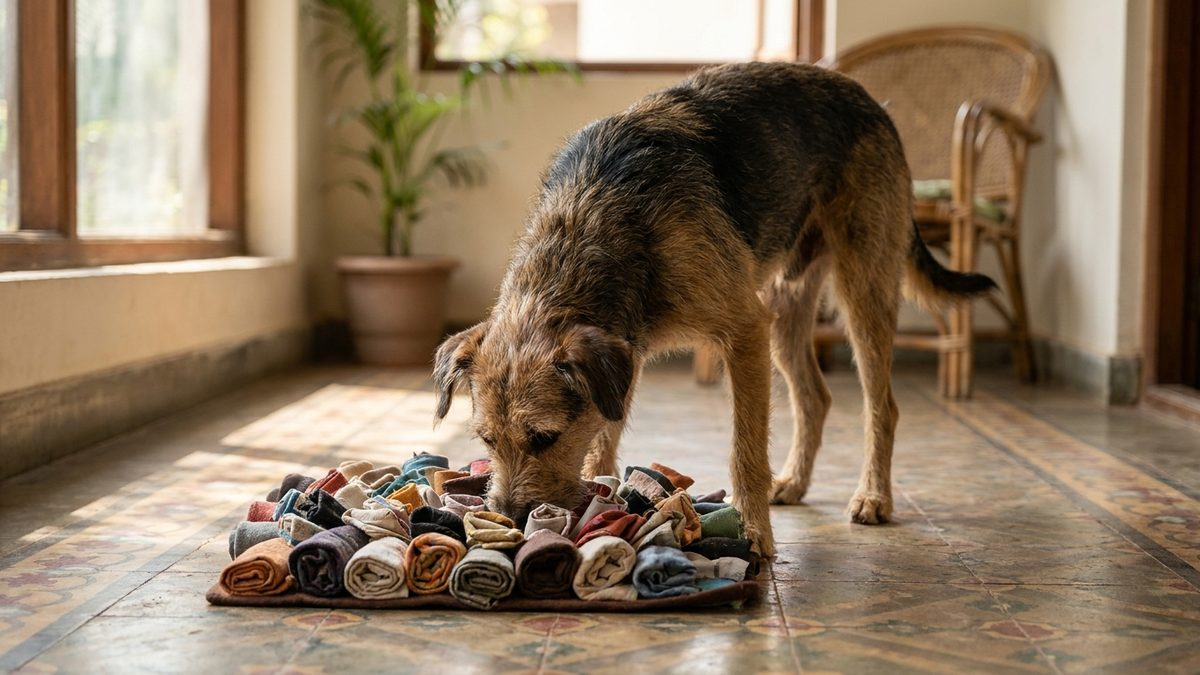
The second is food it is genuinely allowed, in a form that takes work to get at. We will not rebuild the enrichment case here because it is already built: dog boredom busters sets out what the foraging, chewing and scent work studies actually found, including which of the popular claims the evidence does not support, and indoor cat boredom and enrichment does the same for cats. Take the day's food, use it for a novel puzzle instead of the bowl, and you have done more for the animal than the cake will.
The third is subtraction. An afternoon with nothing scheduled, no visitors, no handling and no camera is not a non-event for an animal that spends most days managing a building full of noise.
- A new route, walked slowly, with the lead long enough that the animal sets the pace and the stops.
- The day's ration delivered through a puzzle, a scatter or a long chew rather than a bowl.
- One food it is allowed and does not usually get, weighed and counted against the day's allowance rather than added to it.
- An hour of your undivided attention doing the thing it already likes, which is different for every animal and which you already know.
- A house that stays the shape it usually is, with the same bed in the same corner.
That list is not a consolation prize for people who cannot throw a party. Measured against the published account of what makes a human-animal interaction positive, it outperforms the party on every item, and it is the version a nervous animal can also have.
A quiet celebration for an anxious, elderly or reactive animal
Cancel the gathering entirely for these animals and keep the day ordinary. For an animal that is already managing fear, pain or age, the kindest version of the occasion is one it does not notice happening.
Three groups should not be at a party in their own home, and the reasoning differs for each.
- The noise-sensitive animal, because balloons, party poppers and a room of raised voices are the stimulus class it already struggles with. Noise sensitivity is the most prevalent anxiety trait measured in pet dogs, and the management that works is in how to calm dogs during firecrackers in India.
- The elderly animal, because stiff joints, reduced hearing and failing sight change what a crowded room is, and because an old dog that is startled can injure itself getting away. See senior dog care in India.
- The animal that struggles when you are out of the room, because a house full of people is not company to it and the day will cost more than it gives. See separation anxiety in dogs.
- The recently adopted or reactive animal, for the socialisation reason set out above, which is the strongest association in the social fearfulness data.
For all four, the quiet celebration is the same shape. Keep the routine exactly as it is. Add one good thing the animal can take or leave, early in the day when it is freshest. Photograph it asleep, from across the room, if you want a picture. Do not invite anybody. Tell the family members who wanted a party that the animal is having one and they are not invited to it, which is true.
Have the gathering somewhere else, or on a different day, and leave the animal out of it. A cake for the humans in the evening after the dog has had its walk and gone to sleep is not a compromise. It is two events, each of which works.
How to tell afterwards whether the day was good
Judge it by what the animal did when it had a choice, not by how it looked in the photographs. This is the one test that works, and it is the test the whole page has been building towards.
Agency is the measure. The welfare literature's own criterion is whether the animal could consciously seek its own goals and whether the attempt succeeded, and that translates into four questions you can answer the next morning.
- Where did the animal spend the afternoon, and did it choose that place? An animal that chose the far bedroom chose it for a reason.
- Did it eat normally that evening, and did it settle at the usual time? A refused meal and a late, restless night are the two cheapest signals available and almost nobody records them.
- Did it come back towards the people, repeatedly, without being called? Returning voluntarily is the only evidence of enjoyment that is not an interpretation of a face.
- What was it doing in the two seconds before each photograph, and the two seconds after? If the honest answer to either is that it was trying to leave, the picture is a record of that.
Write the answers down somewhere you will find them next year. That note is worth more than the album, and if you repeat the occasion annually it is the only way you will notice an animal becoming less tolerant of it with age rather than more.
Our guide to reading your dog's body language covers the signals in detail, including the uncomfortable finding that owning a dog does not make a person good at reading one. That is the reason this test is built on where the animal went and what it ate rather than on what its face was doing.
What this page can prove, and what it cannot
This page cannot prove that dogs dislike birthday parties, and it has not tried to. It can prove that the claim they enjoy them has nothing behind it, and that several of the things a party is made of have been measured as stressors.
Four limits are worth stating plainly, because the alternative is a page that sounds more certain than its sources.
- No study has observed pet animals at a celebration. Every behavioural figure on this page comes from ordinary life or from filmed interactions, and applying it to a party is inference.
- The hugging evidence is drawn from internet media on both sides. The 2016 photograph analysis was not peer reviewed, and the 2024 paper that was peer reviewed sampled the most popular hugging videos online, which is not a sample of pet dogs at home.
- The prevalence figures are Finnish. A survey of 13,715 dogs in Finland is the largest of its kind and there is no Indian equivalent, so the numbers describe a different population of dogs in a different climate and housing stock.
- Nobody has measured how long a dog can track. One hour is the longest delay tested for unexpected recall and four hours the longest for time left alone. That no study has looked at a year is a gap in the literature, not proof of a limit, although nothing suggests a calendar sense exists.
What India is missing is more specific. There is no Indian prevalence survey of canine fear, no Indian measurement of what a pet bakery's product actually contains, and no regulator with a remit over either. Until one of those exists, an Indian owner deciding how to celebrate is working from Finnish behavioural data, a voluntary standard that does not cover the product, and their own reading of their own animal. The last of those three is the one to trust most, and it is free.
Common questions
How do I make my dog's birthday special?
Make it special with a long walk somewhere the dog has never been, the day's food delivered through a puzzle or a scatter instead of a bowl, one food it is genuinely allowed, and an afternoon with no visitors. Those are the things the welfare literature lists as producing positive experiences for an animal: familiar humans, preferred foods, enjoyable routine activities and engaging variable activities. A party of unfamiliar people is on the other list.
How to celebrate a dog's birthday at home?
To celebrate at home, keep the house the shape it usually is and change what the dog does rather than who is in the room. Take the first walk earlier and somewhere new, use the day's ration for a novel foraging puzzle, give one allowed food weighed against the daily allowance rather than added to it, and spend an uninterrupted hour on whatever that individual animal already enjoys. Invite nobody your dog does not already know well.
Do dogs realize it's their birthday?
No. Dogs do not track calendar dates, and nothing in the published record suggests they can. The longest delay at which unexpected recall of a specific past event has been demonstrated in dogs is one hour, in a study of 17 dogs tested at one minute and one hour. Separately, 12 dogs left alone for half an hour, two hours and four hours showed the difference only in how they greeted their owner afterwards. Your dog reads your behaviour on the day, not the date.
What food to serve at a dog birthday party?
Serve food you can account for, which in practice means the dog's own diet plus one allowed extra you have weighed. Keep every human dish away from the animal and brief the room, because the usual failure at an Indian gathering is several guests each giving one piece. The four categories that cause emergencies are chocolate and cocoa, grapes, raisins and kishmish, any sugar-free sweetener, and a large fatty helping. Each has its own page here with the dose and what to do.
What are the essentials for a dog birthday party?
The essentials are fewer than the ideas lists claim. One room the dog can withdraw to with the door open, one named adult whose only job is the animal, a guest count small enough that every face is familiar, no human food within reach, and an early finish for the dog whether or not the party continues. Decorations, costumes, goodie bags and a themed cake are for the people, which is fine as long as nobody pretends otherwise.
How to celebrate dog Gotcha Day?
To celebrate a gotcha day, repeat the walk you took on the first day, in the same place, once a year. Gotcha Day is the anniversary of the day a person or pet joined a family by adoption, also called Homecoming Day, Family Day or Adoption Day, and it is the usual choice when an adopted animal has no known birthday. The term is contested in human adoption because critics say it centres the adult's experience, which is worth knowing, because the pet version is also for you.
Is a dog birthday cake from an Indian pet bakery regulated?
Barely. India's Food Safety and Standards Act, 2006 defines food as intended for human consumption and expressly excludes animal feed, so a dog cake sits outside it. The only Indian pet food standard, IS 11968:2019, covers complete pet food by its own scope clause and is voluntary. The 2026 feed quality control order names three cattle products and no pet food. Legal Metrology rules require ten declarations on a sealed packet, none of them an ingredient list, and a cake boxed at the counter is not pre-packaged at all.
What should I do instead if my dog is anxious, elderly or reactive?
Cancel the gathering and keep the day ordinary. Noise sensitivity is the most prevalent anxiety trait measured in pet dogs, at 32 percent of 13,715 surveyed, and balloons, poppers and raised voices sit squarely in that category. An elderly dog that is startled in a crowded room can injure itself getting away. Add one good thing early in the day, photograph the animal asleep from across the room, and hold the human celebration somewhere else or on another day.