
Dog health: orthopaedic
Luxating patella in dogs: grades 1 to 4, the small breeds India keeps, and what surgery costs here
Ten breeds with the number of dogs each rate was measured in, the four OFA grades in the registry's own words, the first Indian clinical series on this condition and what it found, three government rate cards that price the operation, and the re-luxation rate that decides whether surgery is worth it.
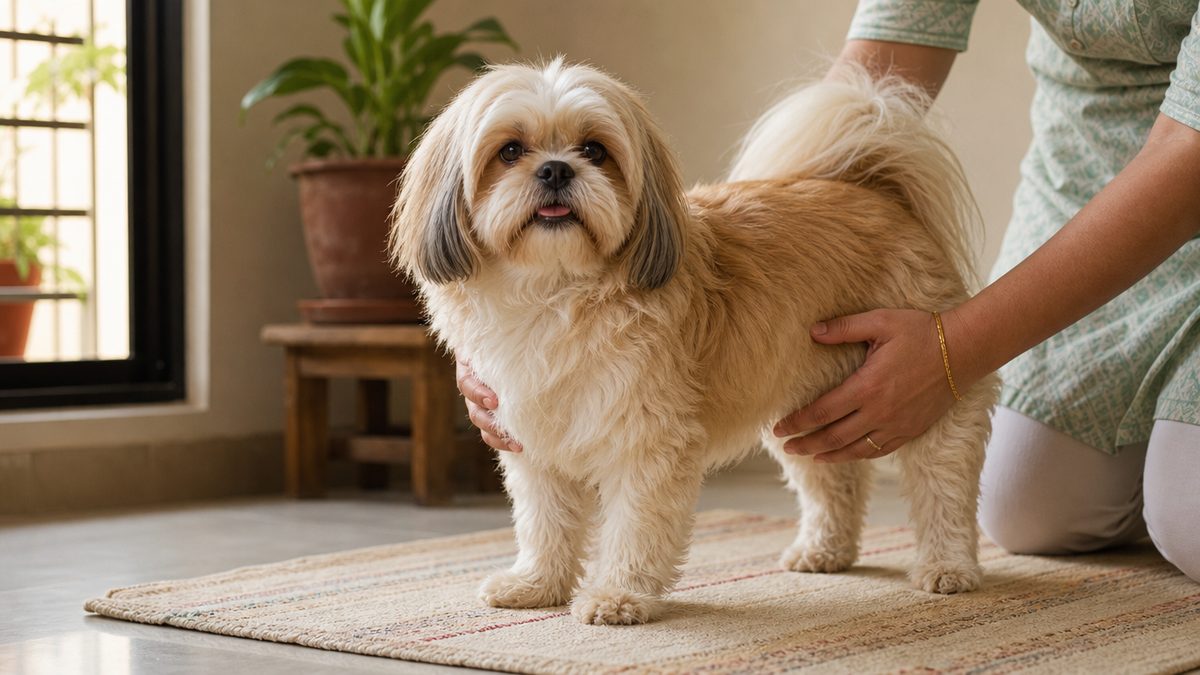
Quick answer
A luxating patella in dogs is a kneecap that slips out of its groove, graded 1 to 4, and it was diagnosed in 1.30 percent of 210,824 dogs in English primary-care practice. Toy breeds carry most of it, led by the Pomeranian at 6.5 percent of 1,040 dogs. Grade 1 is usually managed without surgery and grades 3 and 4 usually need it. ICAR-IVRI at Izatnagar prices the operation at Rs 500 plus tax. Your nearby vet decides.
This guide is general information for Indian pet owners and is not a diagnosis. Always consult a registered veterinarian near you before acting on anything you read here, and treat any sudden change in your pet's condition as urgent.
Signs of Luxating patella in dogs
The 10 signs to watch for are listed below. Any one of them is a reason to consult your nearby vet; none of them is a diagnosis.
- A skip or hop for two or three strides, then a normal gait again
- Holding one back leg up mid-run, then putting it straight back down
- Reluctance to jump onto the sofa, climb stairs or run at full speed
- A click or grinding from the knee as the dog turns
- Sitting with one back leg stuck out to the side
- A crouching, bow-legged stance through both back legs
- Stiffness after rest that eases once the dog warms up
- Thinner muscle on one thigh than on the other
- A limp that goes away for weeks and comes back worse
- A back leg carried permanently, which is what grade 3 and 4 look like
Breeds on this site that document this condition
Each breed page below carries the figure for this condition with its denominator and its source. The 10 breeds listed are the ones on this site that document it, not a ranking of risk.
India publishes no prevalence figure for patellar luxation, and until April 2026 it published no clinical series either. Fourteen stifle joints operated at Guru Angad Dev Veterinary and Animal Sciences University in Ludhiana between March 2024 and February 2025 are now the only Indian count, and they run the other way from the world literature, with eight lateral luxations against six medial where an Italian referral series found 85 percent medial. Half those Indian dogs were Pomeranians, but Labrador Retrievers, Golden Retrievers and a Cane Corso were in the same caseload and the bodyweight range ran to 40 kg. Rule 8(10) of the Dog Breeding and Marketing Rules 2017 requires a breeding dog to have been tested for genetic defects 'including' eleven it names, and this is not among them; because the clause says including, the list is illustrative rather than closed. One Indian government rate card names the operation: ICAR-IVRI at Izatnagar charges Rs 500 plus tax, against Rs 2,500 for a canine major operation at BASU Patna and Rs 1,500 at Madras Veterinary College in Chennai, while no private Indian clinic publishes a figure at all.
What a luxating patella in dogs is, and which way the kneecap slips
A luxating patella in dogs is a kneecap that slides out of the groove it should sit in at the bottom of the thigh bone, and the cause is almost never the kneecap itself. The whole extensor mechanism is misaligned, so the quadriceps muscle, the patella, the patellar ligament and the tibial tuberosity no longer pull in one straight line, and the joint wears from that.
This is a developmental fault rather than an injury. The dog is born normal and the deformity appears as the limbs grow, which is why the Royal Kennel Club describes back legs that do not develop quite as they should and a cascade of problems that follows. Trauma can luxate a patella too, and the OFA treats a traumatic luxation as a separate category of no importance to certification.
The mechanism explains the shape of the treatment. Without the patella pressing into the trochlear groove during growth, the groove never deepens, so a shallow groove is a consequence of the instability as well as a cause of it. That is the loop surgery is trying to break.
Medial and lateral luxation, and why the direction names the breed
The direction the kneecap slips sorts the patients into three groups before anyone has taken a radiograph. The OFA sets them out in its own words, and the fourth category exists only to be excluded from the register.
| Category | Dogs it happens in | What the OFA says about it |
|---|---|---|
| Medial luxation | Toy, miniature and large breeds | Known to be heritable or strongly suspected, and should be considered an inherited disease |
| Lateral luxation | Toy and miniature breeds | Usually seen late in life, from 5 to 8 years of age, and the heritability is unknown |
| Lateral luxation | Large and giant breeds | A genetic pattern has been noted, with Great Danes, St. Bernards and Irish Wolfhounds most commonly affected |
| Traumatic luxation | Various breeds | Of no importance to the certification process |
Medial is the common one by a wide margin, and one referral series counted it. Among 801 affected stifles in four Italian clinics, 85 percent of the luxations were medial. The first Indian series points the other way, with eight lateral luxations against six medial in 14 stifle joints at Ludhiana, which is a caseload of 14 and not a prevalence, but it is the only Indian count that exists.
The MSD Veterinary Manual puts the same split in one line, that lateral patellar luxation is much less common than medial and is more prevalent in large-breed dogs, and it lists the deformities that travel with each direction, distal femoral varus and internal tibial rotation on the medial side against coxa valga and external tibial rotation on the lateral.
The large-breed story is real and it is different. Lateral luxation in Great Danes, St. Bernards and Irish Wolfhounds travels with the same femoral deformities that drive hip disease, so a big dog with a slipping kneecap is usually a different problem from a Pomeranian with one. Our page on hip dysplasia in dogs covers that side of it.
How common it is, and in which population
Patellar luxation was diagnosed in 1.30 percent of dogs in the largest primary-care study of it, 210,824 dogs attending 119 clinics in England between September 2009 and August 2014. The Royal Kennel Club prints the same figure as approximately 1.3 percent of the dog population, which is the only number any ranking page carries.
Where a rate was measured changes it more than anything about the dogs. American referral populations have reported prevalence anywhere from 1.5 to 8.0 percent, and the same paper that reports the 1.3 percent figure says plainly that referral caseloads are an unreliable source for a general-population estimate. An Italian referral series found patellar luxation in 559 of 8,694 orthopaedic cases, fractures excluded, which is a share of a clinic's orthopaedic work rather than a share of all dogs. Read every number on this page with its population attached.
None of those populations is India. There is no Indian prevalence figure for this condition, pedigree or free-ranging, and the honest reading of a UK insured-and-registered caseload is that it tells you which breeds are at risk and not how many dogs in Chennai or Delhi have it.
One question about this condition has four published answers and only one of them carries a denominator. The OFA says bilateral involvement is most common. VCA says approximately 50 percent of affected dogs have both knees involved, on a page that gives no number behind it. VOSD says bilateral luxation is reported in up to 50 percent of small-breed dogs. The VetCompass study counted: of 722 incident cases with limb information recorded, 273 were bilateral and 449 were unilateral, 245 left and 204 right. Note that the paper prints those as 27.8 and 62.2 percent while 273 divided by 722 is 37.8 percent, which is what adds to the paper's own 62.2, so read the counts rather than the percentages. Either way, have both knees examined, because one limp is not evidence of one bad knee.
The four grades of patellar luxation, and what each one means for you
Grades of patellar luxation run 1 to 4 and describe how far the joint has deformed, not how much the dog hurts. Grade 1 means the kneecap can be pushed out and springs back on its own; grade 4 means it is permanently out and cannot be put back.
| Grade | What the vet feels | What it usually means for you |
|---|---|---|
| Grade 1 | The patella luxates easily at full extension but returns to the trochlea when released. No crepitation. Minimal deviation of the tibial crest and very slight tibial rotation | Often nothing to do beyond weight control, floor grip and a recheck. Surgery is not automatic |
| Grade 2 | Frequent luxation, sometimes becoming more or less permanent. The limb is sometimes carried. Up to 30 degrees of medial tibial torsion. Constant luxation erodes the patella and the medial trochlear ridge, so crepitation appears | Many dogs live with it reasonably well for years, but the erosion is cumulative and lameness usually decides the timing |
| Grade 3 | The patella is permanently luxated, with 30 to 50 degrees of deviation of the tibial crest. Many animals still use the limb with the stifle held semi-flexed. The trochlea is very shallow or flattened | Surgery is the usual recommendation, and the deformity is now bone rather than soft tissue |
| Grade 4 | The tibia is medially twisted with the crest 50 to 90 degrees off the cranial-caudal plane. The patella is permanently luxated and the trochlea is absent or convex. The limb is carried or the dog moves in a crouch | Surgery, and the most complex version of it. This is the grade where re-luxation after repair is commonest |
Two scales are in use and they are the same scale counted differently. The Royal Kennel Club describes vets using the Putnam scheme, which grades dogs from 0 to 4 where 0 is normal, while the OFA issues a number to dogs found normal and grades the abnormal ones 1 to 4 Orthopedic Foundation for Animals. The Indian series at Ludhiana used Putnam's system as amended by Singleton, which is the same ladder again.
Age of onset tracks the grade, and the OFA splits patients into three recognisable classes. Puppies that carry a leg oddly from the moment they start walking are generally grade 3 and 4. Young to mature dogs with grade 2 to 3 have usually had an intermittently abnormal gait all their lives and arrive when it worsens. Older dogs with grade 1 and 2 can go suddenly lame because soft tissue finally gives way after minor trauma, or because arthritis has caught up.
The grade is a measure of deformity and a poor measure of pain. The OFA notes that pain is present in some cases, especially where the cartilage of the patella and femoral condyle has softened, but that most animals seem to show little irritation on palpation. A dog that does not flinch has not been cleared.
Never try to push a luxated kneecap back yourself. The Royal Kennel Club is explicit that if the patella becomes permanently dislocated the dog needs an urgent veterinary appointment, and that trying to reduce it at home could be very painful or damage the surrounding tissues. This is the one thing on this page an owner must not get wrong.
The signs of a luxating patella, and when to book the vet
The first sign of a luxating patella in most dogs is a skip. The dog runs, holds one back leg up for two or three strides, then puts it down and carries on as if nothing happened, and the pattern repeats over weeks.
That pattern matters more than any single episode. Lameness that appears suddenly, resolves on its own and then reappears repeatedly is one of the clearest indicators of this condition. The Royal Kennel Club describes the same gait as skipping or bunny-hopping, and notes that because the patellae sit only in the back legs, a front-leg limp is never this.
Age is not the guide most owners expect. The median age at diagnosis across all breeds in the English primary-care study was 4.0 years, with an interquartile range of 1.7 to 7.5 years and a full range of 0.2 to 19.0 years. In the Indian series the median ages by grade were 24, 11 and 18 months and the whole range was 5 to 42 months, because those were dogs presented for surgery rather than dogs presented for a limp. A middle-aged dog is the typical patient and a puppy is a common one.
One authority disagrees with that timeline and the disagreement is worth keeping. The MSD Veterinary Manual states that animals of any age can be affected but that clinical signs generally start showing before the age of 1 year. Both can be true at once, because one is the age the gait first changes and the other is the age it finally reaches a clinical record, and the four-year gap between them is the interval in which an Indian owner decides this is just how their dog runs.
Four findings move the appointment from next month to this week.
- A permanently carried leg, or a crouching, bow-legged stance in both back legs, which is what grade 3 and 4 look like from across a room.
- A skip that has become a limp, meaning the dog no longer recovers between episodes.
- A click or grinding you can hear, because crepitation appears once the patella has eroded the medial trochlear ridge.
- Any of the above in a small-breed puppy from a breed on the cards below, because the joint-preserving operations work best before the bones finish deforming.
Your nearby vet decides what your dog needs, and nothing here replaces that examination. Before the appointment, note when the gait changed, whether it is worse on tile than on mud, and whether the dog still jumps onto the sofa, because an Indian floor is part of the history. Use our veterinary directory if you do not already have a clinic.
How patellar luxation is diagnosed, and what the examination costs in India
Patellar luxation is diagnosed by hand. A vet palpates the stifle joint, starting at the tibial tubercle and working up the patellar ligament to the patella, and grades what the knee does under that pressure.
The dog stays awake for it. The OFA examines dogs conscious and states that chemical restraint is not recommended, because sedation changes the muscle tone the grade is measured against. A grade given under anaesthetic is not the same measurement, and the OFA's grade 2 description notes that reduction is often possible under anaesthesia in knees that will not reduce awake.
Imaging comes after the hands, not before them. The Royal Kennel Club describes a physical assessment first, then referral to an orthopaedic specialist depending on severity, and then an x-ray, CT or MRI under sedation or general anaesthetic where the deformity needs measuring. The review makes the same point from the surgeon's side, that diagnosis rests on clinical instability while imaging exists to quantify the skeletal deformity and choose the operation.
Three Indian government hospitals publish what that imaging costs, and they disagree by a factor of four for the same radiograph. Madras Veterinary College charges Rs 100 for an x-ray and Rs 2,000 for a plain CT scan. ICAR-IVRI at Izatnagar charges Rs 150 for plain radiography, plus tax. Bihar Animal Sciences University at Patna charges Rs 400 for a canine or feline x-ray. Every one of those figures was divided by 84.38 and by 74 before it was published here and none resolves to a round dollar number, so these are Indian rate cards rather than converted American ones.
What the grade does not tell you, and what an Indian study found under the microscope
The grade measures alignment and says nothing directly about the cartilage. The Ludhiana study took articular cartilage and joint capsule samples from 14 stifle joints during corrective surgery and found erosive lesions across multiple parts of the joint, with significantly greater chondrocyte loss in the grade 4 group than in the lower grades and significantly reduced proteoglycan staining against controls.
The gross findings put a number on what a surgeon sees when the joint is opened. Articular cartilage erosions were present in 57 percent of affected stifles in that Indian series, most often on the distal patella and the lateral trochlea, and the authors note this sits inside the 39 to 64 percent range reported by earlier work on medial luxation. The damage is already there by the time the skip has become a limp.
Treatment options in general terms, from the feeding bowl to the operating table
Treatment options for a luxating patella split at the grade. Conservative management is reasonable for grade 1 where the lameness is mild and infrequent and the osteoarthritis is mild, while grade 3 and grade 4 luxations need surgical correction to restore a normal quadriceps mechanism.
Grade 2 is where judgement lives. The review puts it that grade 1 and 2 dogs without clinical signs can be managed conservatively, but that surgery should be considered once the dog is lame, and that joint pathology increases with age and with grade, so correction should happen at the earliest sensible opportunity rather than after a year of watching.
Non-surgical management is a package rather than a pill. It combines anti-inflammatory and analgesic drug classes to control pain, physical rehabilitation to build the quadriceps, weight control to take load off the stifle joint, and hydrotherapy or massage for comfort. The Royal Kennel Club adds changing the amount and type of exercise the dog gets. This page prints no drug and no dose, because the choice and the amount belong to the veterinarian who has examined your dog.
Weight is the one lever an owner controls completely, and it cuts both ways in this condition. Dogs below the mean bodyweight for their breed and sex carried 1.4 times the odds of a patellar luxation diagnosis, so keeping a toy dog thin is not protective. Aim for the middle of the breed's own range, and let your vet set the target.
The three things a surgeon actually does, and why most dogs get more than one
A luxating patella can be corrected surgically, and the operation is assembled from parts rather than picked off a shelf. Techniques divide into those that reshape bone and those that only rebuild soft tissue, and most dogs that undergo surgery need some combination of the two.
- Tibial tuberosity transposition cuts the bony lump the patellar ligament attaches to and moves it sideways until the patella sits centrally in the groove, fixed with pins and a tension band wire. The review calls it possibly the most important component of the repair, because quadriceps malalignment drives every grade.
- Trochleoplasty, or sulcoplasty, deepens the trochlear groove so that roughly half the patella sits below the level of the ridges. Wedge and block recession preserve the cartilage; abrasion trochleoplasty removes it and is the crudest of the set.
- Soft-tissue balancing releases what is too tight and tightens what is too loose, using medial desmotomy, lateral imbrication, antirotational sutures and release of the medial musculature. On its own it rarely corrects a luxation and is used to supplement the bone work.
- Femoral varus osteotomy reshapes and straightens the thigh bone itself with a plate and screws, for dogs whose femur is the bent part.
The order of operations follows the deformity, not the grade alone. A shallow groove with a straight limb is a sulcoplasty problem; a straight groove with a twisted tibia is a transposition problem; a grade 4 knee in a Pomeranian is usually both plus a bent femur The Royal Kennel Club. Ask which of the four your dog's surgeon intends to do and why, because the answer tells you how much bone work is involved and therefore how long the recovery runs.
What surgery achieves, and the re-luxation rate no ranking page prints
Surgery for patellar luxation works for most dogs and fails for a measurable minority, and the prognosis is written in three published series with real denominators. Overall complication rates run 18 to 21 percent, major complications 13 to 16 percent, and patellar re-luxation 5 to 8 percent Bosio F, Bufalari A, Peirone B Rutherford L, Langley-Hobbs SJ.
| Series | Population | Any complication | Major (needing revision) | Re-luxation |
|---|---|---|---|---|
| Arthurs and Langley-Hobbs 2006, UK referral | 109 dogs, 131 luxations | 18 percent | 13 percent | 8 percent |
| Bosio and others 2017, four Italian referral clinics | 400 dogs, 574 stifles, drawn from 559 diagnosed dogs among 8,694 orthopaedic cases | 21 percent (5 percent minor plus 16 percent major) | 16 percent | 7 percent |
| Rutherford and others 2015, four UK referral centres, cats | 85 surgeries in 71 cats | 26 percent | 20 percent | 5 percent |
| Outcome grading, Italian series | 574 stifles | Good in 88 percent | Fair in 2 percent | Poor in 10 percent |
Those headline rates hide the thing that actually predicts failure, which is the grade. A study of surgical management in Pomeranians found grade 2 luxations had a 100 percent success rate after surgery, grade 3 dogs experienced recurrent patellar luxation in about 11 percent of cases, and grade 4 dogs re-luxated in 36 percent, because of the degree of skeletal deformity involved. A grade 4 knee is a different operation with a different answer.
Size is the second predictor and it surprises people. Overall, major and re-luxation complications were all more frequent in dogs weighing 20 kg or more than in dogs under 20 kg. The Italian series reached the same conclusion from a larger caseload, finding bodyweight and grade of luxation the only two variables statistically correlated with surgical complications. A big dog having this operation is a higher-risk patient than a Pomeranian having it.
Two findings about technique point in opposite directions and both deserve printing. In dogs, tibial tuberosity transposition was associated with a lower frequency of major complications and of re-luxation, and trochlear sulcoplasty with a lower frequency of re-luxation, while retinacular or capsular release was associated with more major complications. In cats, the same transposition was the technique significantly associated with more major complications, at 5.57 times the odds. The species are not interchangeable and neither is the evidence.
The honest summary is that the operation is reliable rather than certain. The review's own conclusion is that the prognosis is favourable in most cases and that the risk of complication and of recurrence tracks the grade of luxation and the severity of the deformity. Ask your surgeon for their own numbers for your dog's grade and weight.
Luxating patella surgery cost in India, from the only rate cards that print one
A luxating patella surgery cost in India is published by exactly one institution that names the operation. ICAR-IVRI at Izatnagar lists Pateller Luxation Surgery and Desmotomy at Rs 500 for pets, plus tax as applicable, on a rate card in force since July 2022.
| Item | ICAR-IVRI, Izatnagar | BASU Veterinary Clinical Complex, Patna | Madras Veterinary College, Chennai |
|---|---|---|---|
| The operation | Pateller Luxation Surgery / Desmotomy, Rs 500 for pets | Major operation, canine or feline, Rs 2,500 | Major surgery Rs 1,500, specialized surgery Rs 3,000 |
| Radiograph | Plain radiography Rs 150 | X-ray, canine or feline, Rs 400 | X-ray Rs 100, plain CT scan Rs 2,000 |
| Registration | Dog or cat Rs 50 in normal hours, Rs 150 after 12:30 pm, Rs 300 after 5:00 pm or on a holiday | Rs 200 for the 9:00 am to 1:00 pm outpatient slot, valid 10 days; Rs 300 for the 2:00 pm to 8:00 pm emergency slot, valid 5 days | Small animal registration Rs 100, valid 7 days |
| Related orthopaedic lines | Femoral head osteotomy Rs 500, tendon and ligament repair Rs 400, chemical restraint Rs 100 | Fracture management by open method Rs 2,500, fracture plaster Rs 500 | Emergency surgery Rs 2,500, orthopaedics runs as a named referral unit |
| Stated caveat | Plus tax as applicable | Dressing free, indoor stay Rs 200 per day | The pharmacy dispenses drugs and fluids free of cost, on an average annual budget of Rs 25,00,000 |
Every rupee figure in that table was divided by 84.38 and by 74 before publication and not one resolves to a round dollar amount, so this is an Indian price list and not a converted American one Tamil Nadu Veterinary and Animal Sciences…. The spread is the finding. The same class of canine operation is priced at Rs 500, Rs 1,500 and Rs 2,500 by three government institutions, a five-fold range, and the radiograph that precedes it ranges from Rs 100 to Rs 400.
Read those numbers for what they are. A subsidised teaching-hospital tariff is the fee charged at the counter, not the economic cost of the surgery, and it assumes a queue, hospital timings that close at 1:00 pm in Chennai and an 8:00 pm cut-off in Patna, and a teaching caseload. It is a floor for what this can cost in India, and a useful one, because it is published.
Geography is the catch. Those three rate cards belong to institutions in Izatnagar in Uttar Pradesh, Patna in Bihar and Chennai in Tamil Nadu Bihar Animal Sciences University Tamil Nadu Veterinary and Animal Sciences…. An owner in Mumbai, Delhi, Bengaluru, Hyderabad, Pune or Kolkata is not going to drive a Pomeranian across the country for a grade 2 knee, so the realistic comparison for most readers is a private orthopaedic referral in their own city, and no Indian clinic publishes that number. Ask three clinics near you for a written quote and ask each one whether it covers one knee or two, the implants, the radiographs and the recheck, because the government tariffs above show how far apart two honest Indian prices for the same operation can sit.
No private Indian clinic publishes a surgery cost for this operation on any page that ranked for the query. Vetic, the one Indian page in the Indian result set, asks its own readers' question about typical costs and answers only that costs may vary based on severity, clinic facilities and location. VOSD, which runs India's largest referral hospital for dogs out of Bengaluru in Karnataka, publishes a detailed page and no figure either. The only price in the ranking set is American, at USD 1,000 to USD 3,000 per affected knee, higher for large breeds and severe luxations. Bonbeno does not convert that into rupees, because a converted dollar range is not an Indian price.
Budget for the whole episode rather than the line item. Two knees are possible, revision surgery happens in 13 to 16 percent of cases in the published series, and the arthritis that follows is a decade-long cost in food, weight management and pain control. Our guide to pet insurance in India reads the Indian policies clause by clause, and the point that matters here is that cover has to exist before the diagnosis.
Screening and prevention: who runs a patella register, and who does not
One body runs a patella screening scheme an Indian buyer can name, and it is the OFA. Its Patellar Luxation Database accepts dogs 12 months and over, examined awake by the attending veterinarian, and issues an OFA number to every dog found normal at that age.
The register has two rules worth knowing before you go looking for a breed in it. Examinations on dogs under 12 months are treated as consultations and no OFA number is assigned, although evaluation at 6 to 8 weeks is encouraged as breeding data before a puppy leaves. And a breed does not appear in the OFA statistics tables at all until a minimum number of individuals have been evaluated, which is 100 for hips and 50 for every other database including patellas. An absent breed is usually an unscreened breed rather than a healthy one.
The OFA also does not require a dog to be purebred or registered to be evaluated or entered, which matters in India where a great many owned dogs are indies.
Britain, which people often assume is stricter, has no patella scheme at all. The Canine Health Schemes run jointly by the British Veterinary Association and the Royal Kennel Club cover hips, elbows, eyes and Chiari malformation with syringomyelia, and in 2025 they processed over 6,400 hip scores, over 5,300 elbow grades and over 14,000 eye examinations. For patellas the Royal Kennel Club says it does not record results from dogs that have been graded and that there is no formal scheme for it to accept results at this time, leaving individual breed clubs to run their own grading days.
India has a breeding rule and it does not name this condition. Rule 8(10) of the Prevention of Cruelty to Animals (Dog Breeding and Marketing) Rules, 2017 requires that dogs shall have been tested for genetic defects, and then lists them: hip dysplasia, progressive retinal atrophy, night blindness, hypothyroidism, entropion, ectropion, overshot and undershot jaw, wry mouth, two or more missing teeth, and unilateral or full cryptorchid males. Eleven defects, and patellar luxation is not among them. The words patella and luxation do not appear anywhere in the 14-page gazette notification.
That gap has a shape. The commonest orthopaedic disorder of exactly the toy breeds India buys most is the one defect a registered Indian breeder is not required to test for, while progressive retinal atrophy, which our page on progressive retinal atrophy in dogs covers, is named in the rule.
Prevention, honestly stated, is thin. The Royal Kennel Club says the condition is influenced by enough different factors that no single thing prevents it, and recommends asking the breeder whether either parent has shown signs or been diagnosed and whether the condition runs in the pedigree. Four things are worth doing anyway.
- Ask for a patella grade on both parents in writing, from a vet who palpated the dogs awake at 12 months or older, which is the OFA standard even if the dogs are not OFA-registered. Our breeder checks guide covers what else to ask for.
- Watch the puppy move away from you before you agree to anything, because a skip is visible and a grade 1 knee is not.
- Weigh the dog every month and keep it mid-range, since dogs below their breed and sex mean carried 1.4 times the odds of diagnosis and the underfed toy dog is not the safe one. Our dog diet chart for India has the portions.
- Discuss neuter timing rather than defaulting to a date, because neutered dogs showed 2.4 times the odds of a patellar luxation diagnosis and an Austrian study of small and miniature breeds found about 3 times the odds, which is an association in observational data and not a reason to skip sterilisation.
Do not breed from an affected dog. The Royal Kennel Club is direct that it does not recommend breeding from a dog affected by patella luxation because the associated genes can pass to the puppies, and the VetCompass authors conclude that control strategies including this disorder are worthwhile breeding goals in predisposed breeds O'Neill DG, Meeson RL, Sheridan.
The breeds India keeps, and what the first Indian study found
Ten breeds carry a measured rate on the cards below, each with the number of dogs it was measured in, and the five that Indian households buy most sit at the top of that list. The Pomeranian leads at 6.5 percent of 1,040 dogs and the Shih Tzu, which everyone assumes is affected, is not statistically distinguishable from a crossbred.
Read the cards as a UK primary-care measurement, because that is what they are. The breed prevalences come from Table 1 of the VetCompass study and the odds ratios from its final multivariable model, which adjusted for breed-relative bodyweight, age, sex, neuter status and insurance, with the clinic attended as a random effect.
The Shih Tzu result is the one worth pausing on. At 1.4 percent of 4,151 dogs the breed sits barely above the crossbred baseline of 1.2 percent of 47,300 dogs, and its adjusted odds ratio of 1.2 carried a P value of 0.392, which is not significant. Ranking pages list the Shih Tzu among affected breeds and the evidence does not support treating it as predisposed.
What the Ludhiana series found, and what it cannot tell you
India's first clinical dataset on this condition was published in April 2026. A prospective study at the Teaching Veterinary Clinical Complex of Guru Angad Dev Veterinary and Animal Sciences University in Ludhiana, Punjab, enrolled 14 stifle joints from 12 client-owned dogs presented over one year, March 2024 to February 2025, all with grade 2, 3 or 4 luxation and all going to surgery.
| What was counted | The number |
|---|---|
| Dogs and joints | 12 dogs, six male and six female, 14 stifle joints |
| Direction | Eight stifles lateral, six medial |
| Grade 2 | Five stifles, 36 percent, median age 24 months, median weight 4.9 kg |
| Grade 3 | Five stifles, 36 percent, median age 11 months, median weight 13.3 kg |
| Grade 4 | Four stifles, 28 percent, median age 18 months, median weight 8.3 kg |
| Whole group | Age 5 to 42 months, bodyweight 3 to 40 kg |
| Breeds | Half the affected dogs were Pomeranians, then Labrador Retrievers, Golden Retrievers, Cane Corso, Pugs and Shih Tzus |
| Cartilage erosion seen at surgery | 57 percent of affected stifles, most often distal patella and lateral trochlea |
Two things in that table are genuinely new for an Indian reader. The first is that the caseload is not all toy dogs. Labrador Retrievers, Golden Retrievers and a Cane Corso appear alongside the Pomeranians, Pugs and Shih Tzus, and the bodyweight range runs to 40 kg. The second is the direction. Eight lateral against six medial inverts the 85 percent medial split of the Italian referral series Sharma P, Anand A, Pathak D.
Hold both findings loosely. Fourteen stifles at one referral teaching hospital in Punjab is a caseload, not a prevalence, and a surgical series over-counts the severe end by design because grade 1 dogs are not operated on. It is still the only Indian count in existence, and until a second one appears it is what an Indian owner has.
The nearest thing to an Indian population figure comes from Thailand. A study of 59 Pomeranians drawn from 15 families found patellar luxation in 75 percent of them, with a male to female ratio of 1 to 1.95, and traced an association to a region on chromosome 7. Dogs recruited by family for a genetics study are selected for the trait, so 75 percent is not a population prevalence, and the useful part is the confirmation that the Pomeranian problem is genetic and travels with the breed into Asia.
Two absences are worth stating plainly rather than papering over. There is no published Indian prevalence study for this condition; a PubMed search restricted to India returned exactly one record, and reading it shows a Canadian cadaver study that matched only because its contrast solution contained India ink. And the Indian Spitz, the small breed most Indian households actually keep, carries no within-breed denominator in any registry or study we could open, because it is in neither the OFA tables nor any primary-care cohort. Its risk is inferred from being a small spitz-type dog, and inference is not a measurement.
Cats get a luxating patella too, and usually show nothing at all
Feline patellar luxation is common and almost silent. In 107 pedigree cats radiographed at the Small Animal Clinic in Brno between April 2019 and July 2020, medial patellar luxation was found in 32.7 percent, and only one cat in the whole study showed anything the breeder had noticed.
The grades sat at the mild end. Luxation was grade 1 in 26.2 percent of right patellae and 25.2 percent of left, grade 2 in 5.6 and 4.7 percent, grade 3 in a single right patella at 0.9 percent, and no cat in the study was grade 4. Where cats were affected, 32 of the 35 had it in both knees, which is 91.4 percent bilateral and the opposite pattern to dogs.
That one owner-noticed sign is the finding to carry home. The only thing anybody reported was increased vocalisation when the cat was touched, in one cat out of 107, with no changes in activity, defecation or movement seen in any of the rest. A cat with a luxating patella looks like a cat.
Read the denominator before you apply it. That population was 85 Maine Coons, 13 Norwegian Forest Cats, five Burmillas, three Siberians and one Oriental Shorthair, all pedigree and all at least 10 months old, so it is a pedigree-cat estimate and not a figure for the Indian street cat or the household moggy. Nineteen of the 107 had both hip dysplasia and patellar luxation, which is 17.8 percent carrying two orthopaedic problems at once.
Surgery in cats has its own numbers and they are not the dog numbers. Across 85 corrective surgeries in 71 cats at four referral centres, postoperative complications occurred in 26 percent of cases, 20 percent were major and needed revision, 5 percent were patellar re-luxation and 6 percent were minor. A previous fracture of the same femur was the strongest predictor of trouble, at 19.25 times the odds of re-luxation, and grade 4 luxation raised minor complications at 8.5 times the odds.
The OFA accepts cats into its patellar luxation database, with requirements, protocols, procedures and fees identical to dogs. If you keep a pedigree cat of an affected breed in India, that is the register the paperwork would go to, and no Indian scheme exists to replace it.
Living with a luxating patella in an Indian flat
A dog with a low-grade luxating patella lives an ordinary life in an Indian flat, and the three things that change the odds are the floor, the furniture and the weight. Many dogs with a grade 2 knee live with the condition reasonably well for many years, while the constant luxation quietly erodes the patella and the medial trochlear ridge.
Start with the floor, because most Indian homes are tiled or laid with polished stone and a toy dog on a smooth floor is scrabbling for grip on every turn. It gets worse in the monsoon, when wet paws, a humid house and a polished doorway meet several times a day. Rugs, a runner down the corridor the dog sprints along, and mats at the doorway and beside the bed cost less than one consultation, and they change the daily load on a shallow, unstable knee more than anything else an owner can buy.
Then take the jumping out. Repeated landings off a bed or a sofa onto tile are the everyday mechanism, and blocking that one behaviour with steps or a ramp is the single highest-value habit change for a small-breed dog. Stairs in a walk-up building matter the same way, and carrying a 4 kg dog down two floors is not indulgence.
Walking is good and running on a hard surface is the question. The condition is a reason to change the kind of exercise rather than to stop it, and the Royal Kennel Club lists changing the amount and type of exercise alongside weight loss and physiotherapy as standard advice for a mildly affected dog. Lead walks on mud or grass, in the cooler hours of an Indian day, beat fetch on a tiled terrace.
- Lay grip on the routes the dog runs, not the whole house, because the corridor and the doorway are where the turns happen.
- Block the sofa and the bed with steps, a ramp or a closed door, and teach the dog to be lifted down rather than to leap.
- Weigh monthly and record it, aiming for the middle of the breed range rather than the thin end.
- Swap hard-surface sprinting for lead walks on soft ground, keeping the total distance the same.
- Book a patella palpation at every annual visit, because it takes a minute, needs no sedation and is the cheapest thing on this page.
Watch for the second injury, which is the one that changes the plan. A stifle joint that has been unstable for years is a stifle joint under chronic abnormal load, and the review notes that patellar luxation can also arise as a complication of cranial cruciate ligament disease or of femoral and tibial fractures, so the two problems keep company. A sudden, severe, non-weight-bearing lameness in a dog that had been coping is a same-day appointment.
The prognosis for a well-managed dog is genuinely good. In the Italian series the outcome was good in 88 percent of 574 operated stifles, fair in 2 percent and poor in 10 percent, and the review's conclusion is that most dogs return to normal limb function. This is a condition to manage early, not one to panic about. Our senior dog care guide for India covers the arthritis years that follow.
Patella luxation does not go away on its own, it is a lifelong condition that may progress as the dog ages, and no operation and no supplement cures the arthritis that has already formed. Surgery realigns the joint and stops the grinding. What it buys is a stable knee and a slower decline, and for most dogs that is enough.
Ask your own vet before you change anything here. The dog in front of them is the one that counts, and a grade is a judgement made by hands on a particular knee.
Questions Google India asks about a luxating patella in dogs
Can a dog live with luxating patella?
Yes, and the grade decides how well. The Royal Kennel Club says many dogs with patella luxation live with a good quality of life, depending on severity and on whether arthritis or other secondary conditions have developed. Grade 1 and 2 dogs often need only weight control, floor grip and prescribed pain relief, while grade 3 and 4 dogs usually need surgery.
Is walking good for dogs with luxating patella?
Yes, walking is good, and the surface matters more than the distance. Standard advice for a mildly affected dog is to change the amount and type of exercise rather than to stop it, alongside weight loss, physiotherapy and hydrotherapy. Lead walks on mud or grass are kinder to an unstable knee than sprinting and fetch on tile or polished stone.
Can a luxating patella heal itself?
No. Patella luxation does not go away on its own, in the Royal Kennel Club's own words, and it is a lifelong condition that may progress as the dog ages. No cure reverses the bone deformity or the arthritis already formed. A mild case can be managed so that it worsens more slowly, which is a different thing from healing.
Do luxating patellas get worse with age?
Usually yes, and the mechanism is mechanical rather than mysterious. The OFA describes a grade 2 patella riding over the medial trochlear ridge until it erodes both surfaces, so grinding appears where there was none. Older dogs with grade 1 and 2 luxations can go suddenly lame when soft tissue finally breaks down, or as degenerative joint disease catches up.
How much does surgery cost for a dog with luxating patella?
In India the only published price that names the operation is a government one. ICAR-IVRI at Izatnagar lists Pateller Luxation Surgery and Desmotomy at Rs 500 for pets, plus tax, on a rate card in force since July 2022, with plain radiography at Rs 150 and registration from Rs 50 to Rs 300. No private Indian clinic publishes a figure.
Can a dog live with a luxating patella without surgery?
Often yes, at grade 1. Conservative management suits a grade 1 dog whose lameness is mild and infrequent and whose osteoarthritis is mild, combining anti-inflammatory and analgesic drug classes, physical rehabilitation, weight control and hydrotherapy. Grade 3 and grade 4 luxations need surgical correction to restore the quadriceps mechanism, so going without surgery is not really the choice there.
Which dog breeds in India get a luxating patella most often?
The Pomeranian leads on measured rate, at 6.5 percent of 1,040 dogs in English primary-care records, followed by the Yorkshire Terrier at 5.4 percent of 6,980 and the Chihuahua at 4.9 percent of 4,619. The Pug sits at 3.5 percent of 1,998. The Shih Tzu, at 1.4 percent of 4,151, is not statistically distinguishable from a crossbred dog.
Does any Indian rule require patella screening in breeding dogs?
No. Rule 8(10) of the Prevention of Cruelty to Animals (Dog Breeding and Marketing) Rules, 2017 lists eleven genetic defects that breeding dogs must be tested for, including hip dysplasia and progressive retinal atrophy. Patellar luxation is not on that list, and the words patella and luxation appear nowhere in the 14-page gazette notification.
Can cats get a luxating patella?
Yes, and they rarely show it. Medial patellar luxation was found in 32.7 percent of 107 pedigree cats screened in the Czech Republic, bilateral in 32 of the 35 affected cats, and almost all of it graded 1 or 2 with no cat at grade 4. Only one cat in 107 showed a sign the owner had noticed, increased vocalisation on being touched.